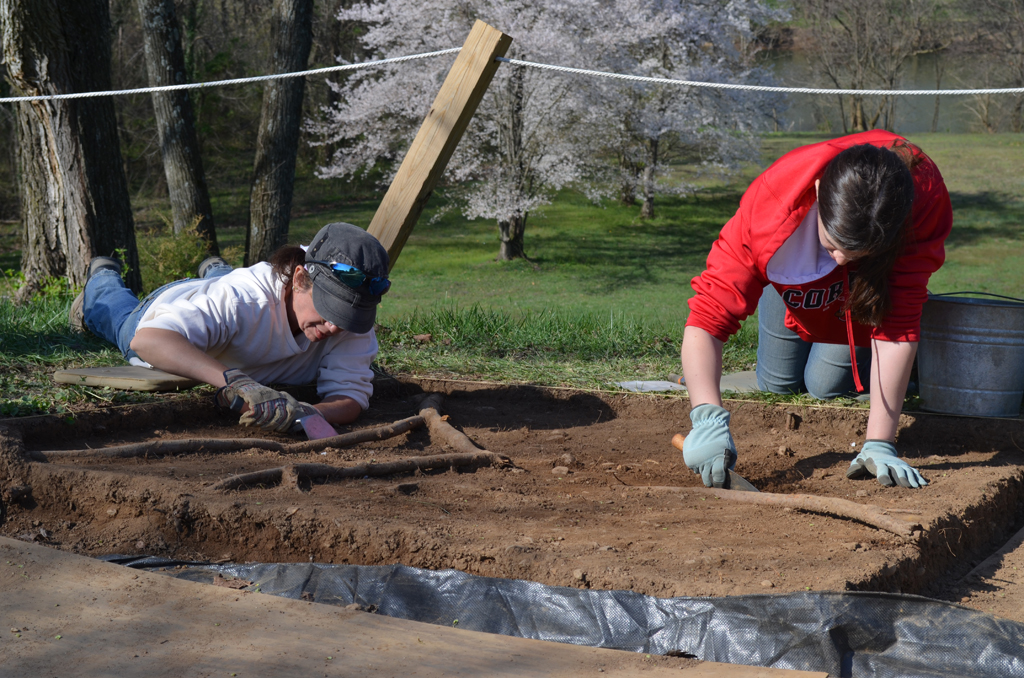
Last week, another archaeological excavation season began at George Washington’s Ferry Farm. Here are some scenes from the first week of digging.
Orientation for the dig staff.
Laura Galke, dig site director, explains how to properly complete a context register form, which helps track where an artifact was found.
Moving equipment to the dig site.
Dry screens ready for use.
Munsell books, pens, sharpies, scissors, chaining pins, plumb bobs, line levels, trowels, string and duct tape AKA archaeology supplies!
All the wheelbarrows!
Gathering shovels. Shovels are important.
Did we mention shovels are important?
The dig site is waiting.
Dig, dig, dig.
Rooting out the artifacts
Scraping dirt into a dust pan to be screened.
Brooms and buckets.
Documenting the work is crucial to excavating properly.
On weekdays, see Ferry Farm’s archaeologists working at the excavation site from now through late-June or, if you can’t visit before June, spend a day on the dig site by watching the video below.
Archaeologists spend much more of their time working to determine the significance of an object than actually finding the object through excavation. This analytical work is done in an archaeology lab, where t is vital to keep the artifacts organized. This video shows how artifacts are labeled to help make sure nothing gets lost.
Sometimes, it can be a challenge to precisely identify an artifact. When faced with this challenge, archaeologists working in the lab put their five senses to work and call upon some interesting ‘tricks of the trade’ to make those difficult identifications.
Learn more about archaeology and being an archaeologist during Archaeology Day at Ferry Farm on Monday, February 15 from 10:00 a.m. – 4:00 p.m. Visit http://www.ferryfarm.org for event details.
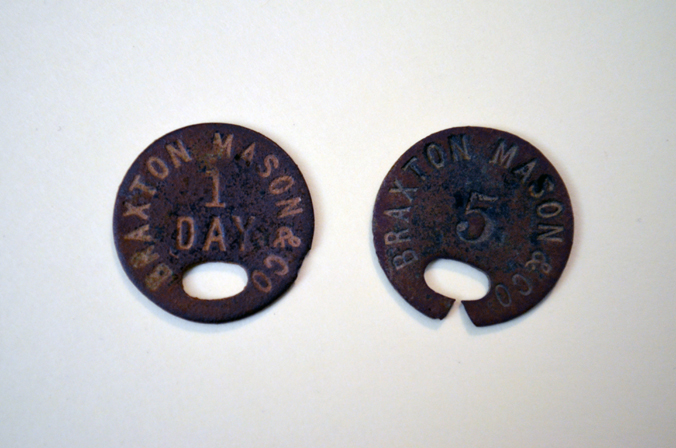
Two of 21 payment tokens discovered by archaeologists at Historic Kenmore.
During excavations around and under Kenmore’s 19th century portico in the early 2000s, archaeologists discovered several small metal disks. Some disks were significantly corroded but a few still showed markings clearly. They were stamped with the words “Braxton Mason & Co” as well as “1 day” and on another disk “5”. The disks had oval-shaped holes punched through the middle. Over the years, excavations have found a total of 21 disks scattered around Kenmore.
Archival box containing artifact bags of payment tokens recovered during excavations at Kenmore.
What were these disks? The machine-made nature of both the disks and the stamped words on them suggested they dated much later the 18th century and were more likely from the late 19th or even early 20th centuries. The first clue to their purpose was the holes punched in the middle of each disk, which suggested they were intended to be strung together on a chain or key ring. Though of different shapes and materials, similar artifacts intended to be strung together in the same manner had been excavated at other sites around Fredericksburg, especially on the nearby Northern Neck. In those instances, the artifacts were identified as payment tokens used by workers in the “truck farming” industry. Day laborers were hired to pick produce, which was collected by the bushel-full in trucks and then sold roadside from the same trucks. For every bushel of produce picked, the laborer received a payment token, usually marked with either the amount “1 bushel” or so many pounds. At the end of the day or of the week, laborers lined up to trade in their tokens for payment. As the 20th century progressed, the Northern Neck became a center for the food canning industry, and eventually the small truck farms raised produce almost solely to supply 120 canneries. These canneries started issuing their own payment tokens often stamped with the company name. [1]
For a long time, it was believed the metal tokens found at Kenmore were payment tokens related to truck farming. The thought was that the Howard family, who owned Kenmore from 1881 until 1914, perhaps used the remaining land surrounding the house for a small truck farming operation. The tokens probably had been inadvertently dropped by laborers around the property. On its surface, this seemed a plausible explanation and was added to the canon of Kenmore’s history.
Upon closer inspection, however, there were issues with the truck farming theory. First, Braxton Mason & Co was neither a Northern Neck cannery nor a business anywhere in the Fredericksburg area in the 20th century. Also, the Kenmore tokens were stamped with time increments instead of quantities. Lastly, there was no other evidence of the Howards being involved in truck farming.
Working in the museum field has its definite perks, and one of them is that we have access to a vast network of people who possess an impressive amount of knowledge about a wide variety of topics. Almost all of them love a good mystery! Armed with the name Braxton Mason & Co and a rough date range of 1820 to 1880, I put out a call to museum colleagues in Virginia. Had anyone ever heard of Braxton Mason & Co? Did anyone have any idea what kind of business it was? Within days, I began receiving bits of information and a truly interesting picture began to emerge.
First, a colleague from Petersburg found a tiny reference to Braxton Mason & Co in the Railroad Gazette of 1871. The single sentence stated that the company won the contract to build a portion of the Lynchburg and Danville railroad.[2] Braxton Mason & Co was a railroading firm! But who were the individuals Braxton and Mason? The Acts of the General Assembly of the State of Virginia for 1870 recorded that a Mr. Braxton and two gentlemen named Mason were among a group of 24 investors who formed the Fredericksburg & Northern Neck Railway Company in April. Could this Braxton and one of the two Masons be our guys?
A second colleague found reference to a Carter M. Braxton in the Fredericksburg City Council minutes of 1866. With the Civil War over, the city renewed pre-war efforts to build a railway line to Gordonsville.[3] The project’s engineer was Carter Braxton. The Fredericksburg-Gordonsville Railroad was completed in 1870, just before Braxton Mason & Co was contracted to build the Lynchburg-Danville line. Could Carter Braxton and one of his fellow investors (named Mason) in the Fredericksburg Northern Neck Railroad Company have split off and formed a smaller railway business? At the moment, that seems the likely explanation.
So, that explains what Braxton Mason & Co was but what did it have to do with Kenmore? A third colleague inadvertently came up with a potential answer. In order for Carter Braxton to complete the rail line to Gordonsville, the 1866 city council minutes said, swampy land that was part of the Kenmore property needed to be drained. It was decided the “owners of Kenmore” would be asked to contribute since they would benefit financially from the railway’s construction. The third colleague involved in this research had done extensive work establishing Kenmore’s ownership history. The upheaval of the Civil War kept this history a bit cloudy. Deeds and records of sale simply did not survive. Because of my colleague’s work, however, we know that, in 1866, Kenmore’s owner was Levi Beardsley, a New Yorker who came to Virginia after the war in hopes of finding promising business ventures.[4] As New Yorkers were not popular in the South, he told people that he was actually from Iowa. His secret came to light during a failed political campaign in 1868 and his various business ventures began to crumble. In order to keep Kenmore safe from his creditors, he put it into trust for his wife.[5] The trustee was a man named William Barton.
In 1870, the same year that Braxton Mason & Co began taking contracts on their own, Beardsley and his wife finally gave up and left Virginia. Kenmore was supposedly auctioned off, but it appears that William Barton retained control of the property. Shortly thereafter, Barton rented the house out to tenants. We have never known the identity or number of these tenants.
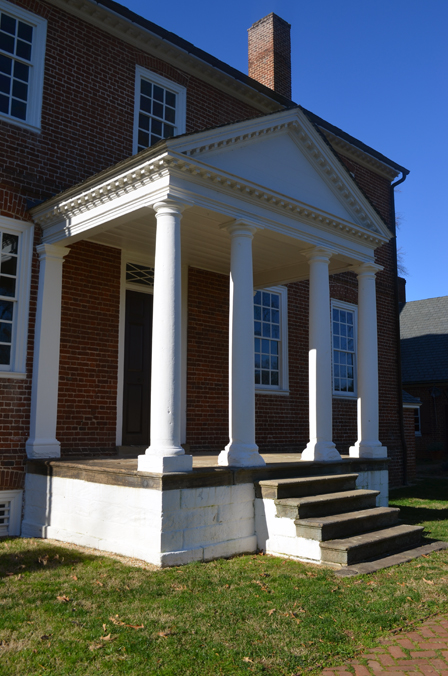
The 19th century portico on the east front of Kenmore.
Is it possible that, while working on the Fredericksburg-Gordonsville Railroad that crossed Kenmore property, Braxton Mason & Co housed their workers at Kenmore itself? Did laborers gather on the house’s portico each week to collect payment for their tokens, some of which were accidentally dropped nearby? It would certainly explain the presence of these perplexing metal disks and fill in the gap of who was living at Kenmore after 1870. Whether this theory can be proven with certainty remains to be seen but, in the end, it’s the investigation that makes it fun…with a little help from our friends.
Meghan Budinger
Aldrich Director of Curatorial Operations
[1] Dodd, Anita L. Day Laborer Tokens: Meaning and Function at Two 18th Century Plantations. 2006.
[2]Railroad Gazette, vol. 3, 1871. Pg. 68. Reference provided by Emmanuel Dabney, Curator, Petersburg National Battlefield.
[3] Minutes of the City Council of Fredericksburg, 1866. Reference provided by Judy Hynson, Archivist, Stratford Hall.
[4] Walker, Travis. Levi A. Beardsley and Family. 2013.
[5] Norman, Gary J. and Edgar R. Hon. Kenmore’s Yankees: The Beardsleys in Fredericksburg. 1996.
Archaeologists at Ferry Farm regularly find evidence of ‘expedient’ tool making by Native Americans. These quickly-made tools were created for a single, immediate job and, once used, just discarded. In this video, we break off a flake of obsidian and use it to fillet a fish.
Close-up of a mid-1700s sleeve link recovered at Ferry Farm. It features the image of King William III.
This cuff link or ‘sleeve button’ – made in the mid 1700s – was recovered by archaeologists from George Washington’s boyhood home at Ferry Farm. It is one of the earliest examples of the Washington family’s resistance to King George III. What makes this sleeve button so interesting is the man depicted: King William III, who ruled England with Queen Mary. This sleeve link was made two generations after the death of this monarch. Nonetheless one of the Washington brothers wore this politically provocative accessory. What made William III, a monarch who died in 1702, an attractive choice for colonial apparel during the mid-1700s? The answer resides in this sleeve link’s political dimensions and reflects the Washington family’s early resistance to Crown policy.
November is an appropriate time to remember the polemical reign of William and Mary: they were married on November 4, 1677 and William landed at Torbay, England, November 5, 1688 to begin battles against the supporters of King James II, then ruler of England. When the unpopular James fled to France with his wife and young son (heir to the throne) parliament met and, after some deliberation, offered the monarchy to William and Mary. Individual rights, representative government, and justified rebellion became associated with the rule of William and Mary and were part of annual celebrations held for this sovereign pair for generations. Popular items such as coins, playing cards, plates, mugs, and pamphlets reinforced these connotations throughout their reign and beyond.
Cuff links, such as the William III link from Ferry Farm, were popular fashion accessories throughout the 1700s. Made from a molded glass ‘gem’ (see photo) originally situated within a copper-alloy setting (not shown), this sleeve button featured King William III’s silhouette. It was modeled after coins that depicted the English monarch beginning in the mid-1690s (see image). At that time, the king’s profile, along with his name “Gulielmus” (in Latin) followed by the initials “D. G.” – an abbreviation of the Latin dei gratia (by the grace of god [King]) – were prominently featured on currency.
A 1697 sixpence featuring King William III. This silhouette (and text) inspired the design of the mid 1700s sleeve link from Ferry Farm.
Beginning in the mid-1700s, when the Washingtons wore their William III sleeve link, tensions were growing between Britain and her North American colonies, incited by the colonists’ concern over the policies of King George III. The Sugar Act and the Stamp Act taxed American colonists, even though they had no representation in parliament.
Colonists asserted that this was a violation of their rights under the English Bill of Rights (enacted in 1689 under the reign of William and Mary). Thanks to a popular campaign that originally began in the 1690s, William and Mary came to represent the right of subjects to resist a king who was abusing power, and this narrative proved to be enduring. In fact, colonists supported this narrative with other figures in English history. As the Washingtons were looking to William and Mary to legitimize their resistance to King George III, Thomas Jefferson took as his role model Oliver Cromwell, whose rebellion resulted in regicide and who was considered particularly militant by the colonists. While the Washingtons owned cufflinks to celebrate William and Mary, Jefferson owned a miniature depicting the far more revolutionary Cromwell.
Regardless, William III thus became a symbol for American colonists in general, and the Washington family in particular, as momentum grew to resist crown powers during the mid-1700s. By wearing this sleeve link, the Washingtons proclaimed their enduring support for representative government. And, we all know where that led—the American Revolution and birth of the United States, whose first president grew up at Ferry Farm.
Laura Galke, Archaeologist
Site Director/Small Finds Analyst
Additional Reading
Cofield, Sara Rivers
2012 Linked Buttons of the Middle Atlantic, 1670-1800. Journal of Middle Atlantic Archaeology 28:99-116.
Greene, Jack P.
1992 The Glorious Revolution and the British Empire 1688-1783. In The Revolution of 1688-1689: Changing Perspectives, edited by Lois G. Schwoerer. Cambridge University Press, New York, pp. 260-271.
McConnel, James Richard Redmond
2012 The 1688 Landing of William of Orange at Torbay: Numerical Dates and Temporal Understanding in Early Modern England. The Journal of Modern History 84(3):539-571.
McConville, Brendan
2006 The King’s Three Faces: The Rise and Fall of Royal America, 1688-1776. University of North Carolina Press, Chapel Hill.
Schwoerer, Lois G.
1990 Celebrating the Glorious Revolution, 1689-1989. Albion: A Quarterly Journal Concerned with British Studies. 22(1):1-20.
1989 Images of Queen Mary II, 1689-95. Renaissance Quarterly, 42(4):717-748.
1977 Propaganda in the Revolution of 1688-89. The American Historical Review 82(4):843-874.
Weil, Rachel J.
1992 The Politics of Legitimacy: Women and the Warming-pan Scandal. In The Revolution of 1688-1689: Changing Perspectives. Cambridge University Press, New York, pp. 65-82.
Wieldraaijer, Matthijs
2010 Good Government and Providential Delivery: Legitimations of the 1672 and 1688/89 Orangist Revolutions
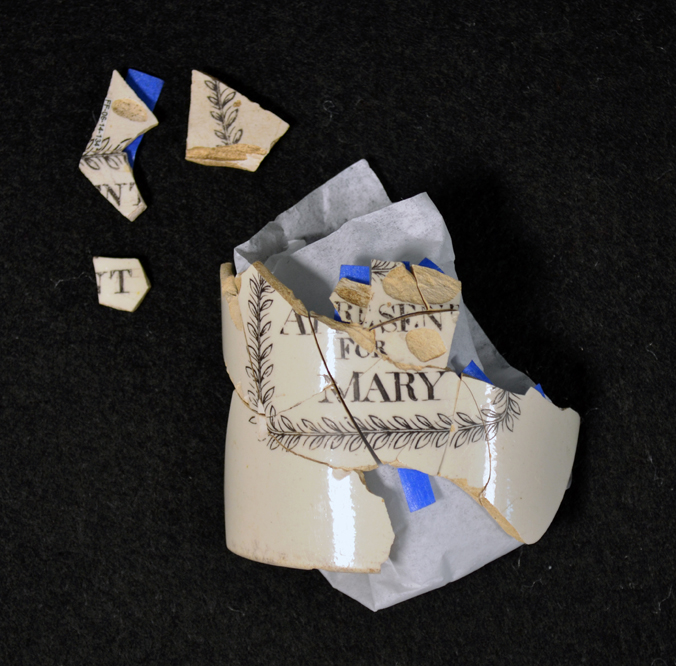
Child’s mug that reads “A Present for Mary” unearthed at George Washington’s Ferry Farm.
Archaeologists are always trying to link artifacts with the actual people who lived at the sites we study. As such, we get very excited when we find artifacts with people’s names on them. It makes our job easy, right? So, imagine our elation when a small creamware cup bearing the words “A Present For Mary” in black transfer print was unearthed at George Washington’s Ferry Farm. People immediately assumed it must have belonged to George’s mother Mary Washington, the most famous Mary to live here. However, upon closer inspection this theory totally unraveled. The small cup was in fact a child’s mug manufactured long after Mary had grown up and, for that matter, probably after her death. It could never have been owned by Mary Washington. What seemed an open and shut case got a little more interesting.
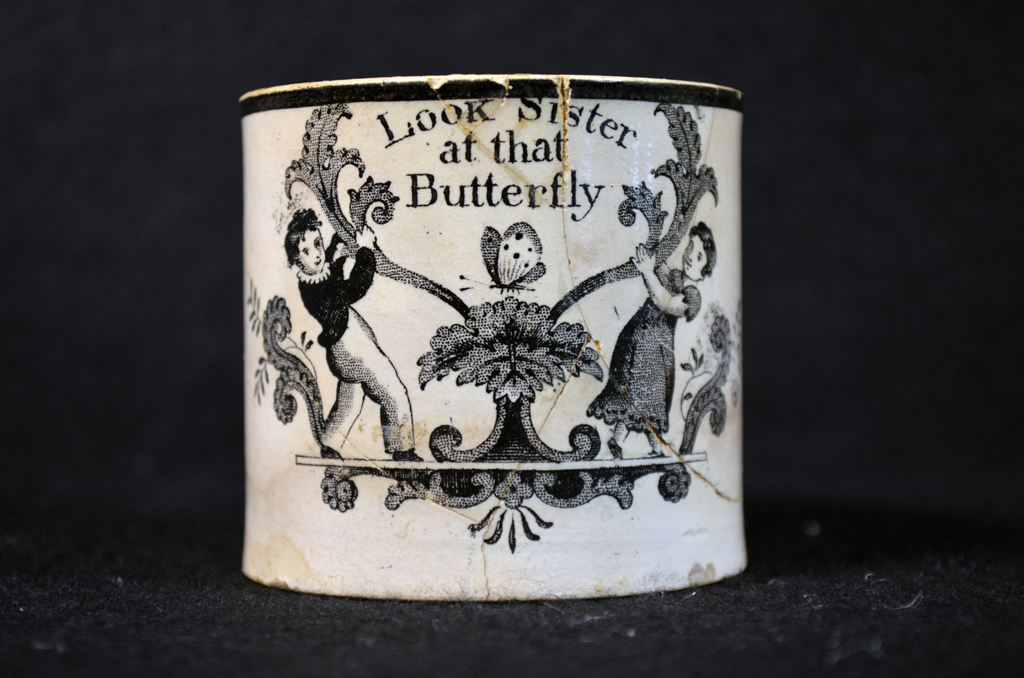
First off, what was a child’s mug? Well, it was a common and inexpensive small mug given to children as a reward for learning, doing well in Sunday school, or general good behavior. The mugs were fairly small and decorated with the child’s name, bible verses, images of play, or references to learning. Inspiration for these decorations came from the popular children’s books of the time. A few common sayings found on these mugs were:
A gift for___.
A present for ___.
A trifle for ____.
A present for a good girl/boy.
A present for writing well.
A reward for industry.
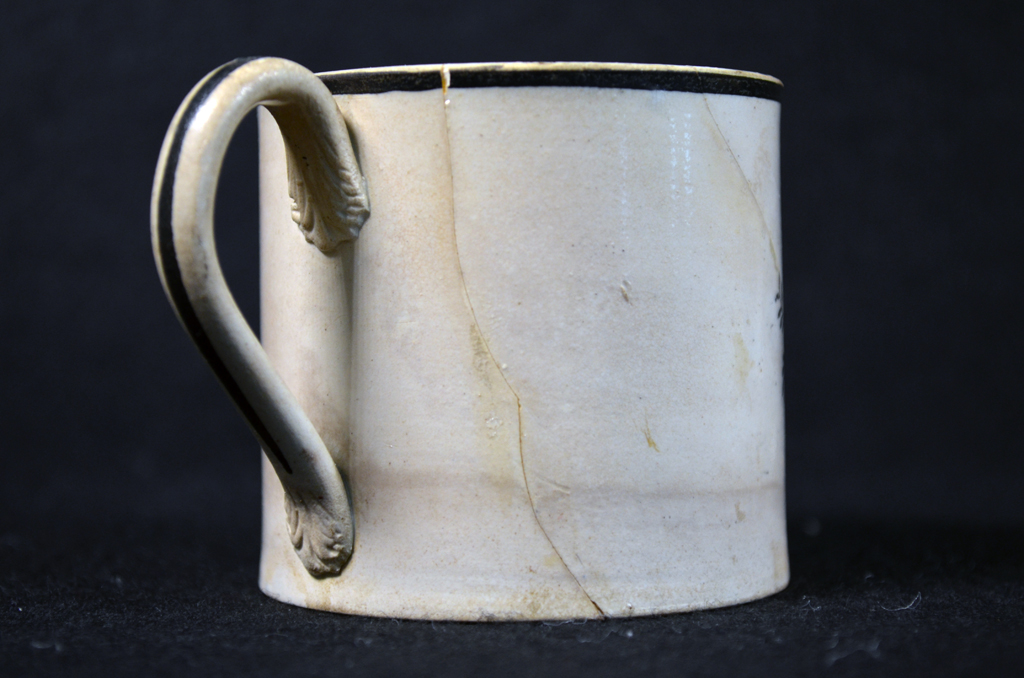
Example of a complete mended pearlware child’s mug with a whimsical phrase illustrated in black transferprint.
These mugs were similar to christening mugs, which are still common gifts today. While they have the same shape and are given to children, the two types of cup differ in material and purpose. A child’s mug was mass-produced in factories and made of relatively cheap ceramic. It would have been sold for a few pennies. In contrast, a christening mug was a fancier gift, often made of far more expensive silver or porcelain. Similar to our fine china today, these christening mugs weren’t meant for everyday use like the more ordinary child’s mugs. Indeed, excavated child’s mugs often exhibit extensive use wear from being handled by children.
Ceramic child’s cups were manufactured starting in the late 1700s and remained abundant by the mid-1800s. Their rise in popularity coincided with the emergence of a more modern concept of childhood. Prior to the 19th century, children were treated like tiny adults or pre-adults. They dressed like adults and the few toys that did exist reinforced social roles and instructed children how to perform adult tasks. It wasn’t until the 1800s that childhood became distinct from adulthood. With this change, children became a new marketing demographic with books, toys, and ceramics targeted just at them.
In our efforts to find more fragments of the mystery Mary mug, we scoured the Ferry Farm artifact database and not only discovered more of her mug but also sherds from three other child’s mugs! While two of these do not contain complete names, one pearlware mug clearly reads “A Present For Billy”.
Pearlware and Creamware sherds representing, clockwise, at least four child’s mugs. All include the phrase “A Present For…” Two names are visible. ‘Mary’ can be seen on far right mug in grouping 2 and the partial name ‘Billy’ is exhibited on the lower middle sherd marked 3.
Unfortunately, the dates during which these mugs were manufactured fall within a fifty year gap in our knowledge of who exactly was living at Ferry Farm. From the late 18th century to the first quarter of the 19th century, an absentee owner rented the land to tenants. Information on just who those tenants were has been lost to time. In a sense, this makes the discovery of the mugs even more special. Although we’ll probably never precisely know the Mary and Billy the mugs belonged to, we now know that two children with those names lived and played here. Anonymous no more, these simple sherds are likely all the evidence there is to proclaim their time at Ferry Farm. While the children may have been sad upon breaking their mugs, we’re very happy to have what remains and hope to one day expand upon their stories.
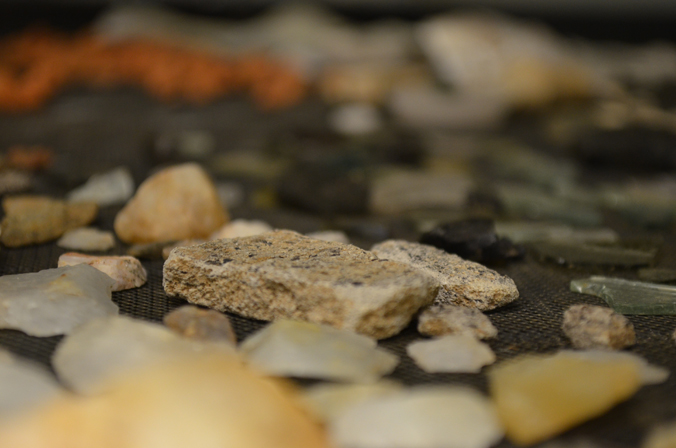
Artifacts excavated at George Washington’s Ferry Farm.
Here at Ferry Farm for the last 13 years, professional archaeologists have been exploring the local landscape, digging hundreds of excavation units in their quest to reveal the history of all those who lived here, including, of course, the Washington family. Their investigative efforts have resulted in a multitude of artifacts dating from the earliest prehistoric Native American occupation of this riverine site, through the Colonial and Civil War periods, all the way to a 1990s occupation of the farm.
So, what happens to all the artifacts that are uncovered and dug up with trowels and shovels? All of those items are important pieces to the puzzle of reconstructing the history of this site, but only if they are cleaned up and recognizable. That is the purpose of the archaeology lab here at George Washington’s Ferry Farm. With the help of both professional staff and dedicated volunteers, every single artifact that has come out of the ground is washed, dried, identified, labelled, and, finally, catalogued into a searchable computer database.
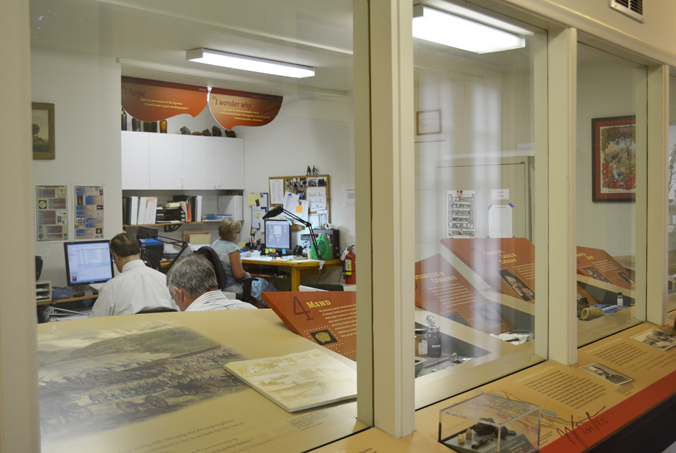
The archaeology lab is located within the Ferry Farm Visitor Center which houses museum exhibits, storage rooms for the artifacts, and other administrative offices. Visitors making their way through the exhibits can check out our lab spaces through large windows, allowing them a peek into our work spaces and giving them the ability to see the different processes the artifacts go through.
The visitor’s view of the Archaeology Lab.
While archaeological excavations at Ferry Farm take place every year, actual digging occurs only three months out of the year. Artifact processing and analysis in the lab goes on for 12 months out of the year. Archaeologists often say that “1 day in the field equals 3 days in the lab” and, in general, that adage is true. Once the artifact bags come into the lab, it can be six months to one year or more before an entire artifact collection is completely processed.
So where does it all start? Well, in the wet lab…
Wet Lab
Where artifacts are washed inside the Wet Lab.
The wet lab is a small room where the artifacts are washed and dried. It is fitted out with two sinks – the artifacts are washed only with water – and a countertop to provide space for the washing process. Toothbrushes, dental picks, pipe cleaners, washtubs, and other cleaning tools are handily arranged for easy access by the staff.
The washing process is pretty straightforward. The artifacts, covered with dirt from the field excavation, are poured out of the bag onto a tray. The washer separates the different items on the tray and proceeds to carefully wash them with a tooth brush and water. After a quick rinse, the washed items are placed on a tray covered with mesh and the tray is placed in a drying rack. The washing process can be seen in this video. The artifacts stay on the drying racks for at least a week to make sure they are completely dried before being bagged. Large windows allow visitors to watch this process and to see the “treasures from the earth” as they are uncovered and completely revealed, often for the first time in 200 years or more!
Dry Lab
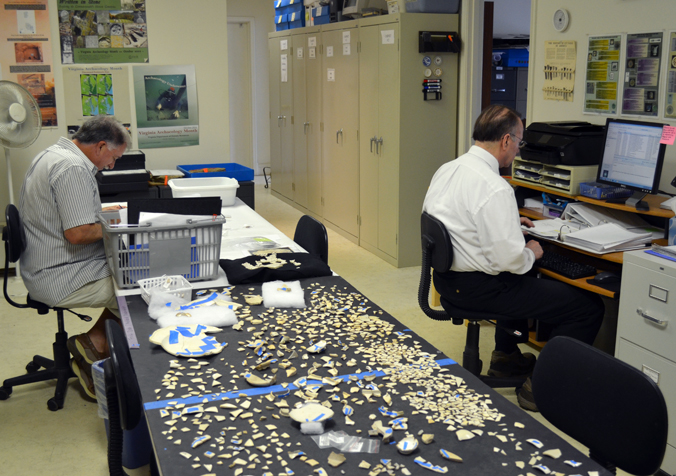
Volunteers work in the Dry Lab.
The dry lab is a larger space containing desk space for the staff, the small finds cabinets, and long tables used for labeling and other projects. It is here that the dried artifacts are placed into acid-free plastic bags, catalogued, and then labelled by the staff and volunteers. Our staff spends quite a bit of time cataloguing the artifacts, which involves identifying, counting, measuring, and weighing all the artifacts. The cataloging process can be seen in this video. Each artifact is labeled with identifying information and the address of the exact location where it was found on the site. Research is always an ongoing activity as identifying and dating specific artifacts helps in understanding Ferry Farm’s past and the people who once occupied this ground.
Time is also spent on the mending, conservation, and analysis of artifact collections. The small finds cabinets contain hundreds of unique artifacts that are studied because of their personal relationships to the individuals that lived here. Long term projects, such as our current white-salt glazed ceramic mending, take place in the dry lab space, where a table covered with hundreds of ceramic sherds awaits matching. And as with the wet lab, museum visitors can look through the windows and observe all the projects being currently worked on.
Having an archaeology lab on site is very convenient for the archaeologists that work at Ferry Farm as it allows them easy access to the artifacts at all stages of their processing. Future plans for Ferry Farm rely on knowing what has been found here and weaving together that data with the historical record. It also gives the public an exciting chance to see all the work that goes into getting the artifacts ready for further research.
Archaeologists spend much more of their time working to determine the significance of an object than actually finding the object through excavation. This analytical work is done in an archaeology lab. First, artifacts must be washed, which you can see here. Then, the artifacts are cataloged as the video below shows.