Archaeologists spend much more of their time working to determine the significance of an object than actually finding the object through excavation. This analytical work is done in an archaeology lab. Before analysis can begin, the newly uncovered artifacts have to be thoroughly washed. This video shows how.
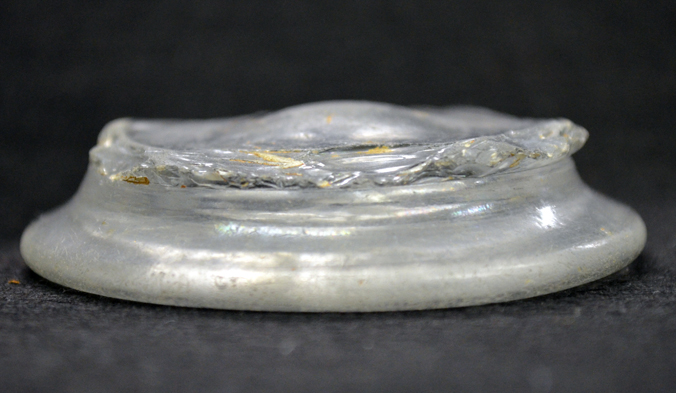
Archaeologists are occasionally confronted with ‘mystery artifacts’ that either cannot be identified or have been altered to serve a purpose other than what was originally intended. Recently, in our small finds collection, we identified an artifact transformed in just such a way. Someone intentionally chipped away the edges of this 18th century leaded glass base for a cup or mug to form a disc. In addition, they also smoothed out the broken edges so they are no longer sharp.
For the moment, the object’s purpose is and, may always remain, a mystery. Use-wear on the base’s interior may hint at how it was used after alteration. Numerous scratches in the glass are present on the ‘kick up’- a small bump on the inside of the glass formed when it was hand blown.
This is not wear that typically accumulates during the life of a drinking vessel so we know the wear occurred after modification. Oddly enough, while pondering possible uses, a staff member here at Ferry Farm turned it upside down and spun the disc on the table. It whirled around perfectly like a top right where the glass exhibited the extreme wear! Take a look at this video for more detail in how the glass has been broken and smoothed and see how the modified base spins like a top.
While this is only speculation, it is possible that we are looking at an improvised toy. Perhaps a child living at Ferry Farm converted this broken glass into a toy top and played with it for many happy hours before it was lost or discarded and found its way into the archaeological record. We can only assume the child would laugh if they knew that archaeologists would be brooding over their whimsical plaything hundreds of years later.
Mara Kaktins, Archaeologist
Ceramics & Glass Specialist
Each summer. students from the University of South Florida attend a field school at George Washington’s Ferry Farm to learn practical aspects of archaeological excavations. This is what they said about their experience.
On weekdays, see Ferry Farm’s archaeologists at work on the excavation site from now through mid-June.
Each summer, archaeologists from across the United States come to George Washington’s Ferry Farm for about two months of excavations on and around the site of Washington’s boyhood home. These are their stories.
On weekdays, see Ferry Farm’s archaeologists at work on the excavation site from now through mid-June.
What do archaeologists do with the broken ceramic and glass artifacts after these objects have been excavated, cleaned, and catalogued? They are cool to look at but what do these little pieces actually tell us about the past? How can we use them to understand the lives of those who purchased, used, and eventually discarded them?
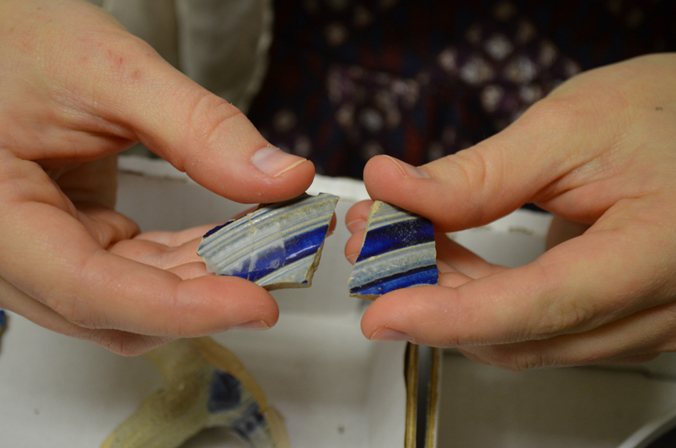
One method is by mending the sherds (‘sherd’ is the term we use to describe broken pieces of ceramic and glass) to re-create the vessels. We mend by spreading out all of the fragments on a table and carefully seeing which ones fit together. Then, we use non-damaging tape to join the pieces temporarily. If deemed appropriate, we might decide to carefully glue the sherds together – with removable archival glue, of course!
Sherds to be mending in the Archaeology Lab at George Washington’s Ferry Farm
As archaeologists mend and a vessel takes shape, we can determine a number of details about the object we couldn’t when it was just a pile of broken stuff! First, we can figure out what type of vessel it was and what its uses were. Determining the vessel type helps us figure out what activities took place in a given excavation area. Cooking vessels mean the area was used for food preparation. Plates, bowls, and cups show the area was used for dining while crocks indicate a storage area.
Second, we can determine how much a mended vessel was used by the “use-wear” present on it. For instance, a chamber pot kept under a bed and drawn out from its storage place a couple of times a day will start to exhibit wear marks on the base where it is dragged across the floor. These grooves usually run parallel with the handle. The longer the pot is used the more wear it acquires. The same goes for knife-marks on dinner plates or stir-marks in drinking vessels. However, it is difficult to truly examine the use of a chamber pot using just one sherd. It is preferable to have as much of a whole vessel as possible, so we must mend!
Yay! They match!
Within the archaeological community, the general opinion is that mending is a fun activity. It definitely is! What is more fun than taking ancient fragments long-ago discarded by their owners and creating tankards, porringers, teapots, jugs, and all manner of other vessels that say something about who used them? It is one thing to show someone a sherd of porcelain and say “George Washington’s mother may have owned this” and quite another to show them a mended teapot and declare “George Washington was served tea from this very pot!” That being said, mending is also frustrating at times. Imagine taking 100 puzzles, mixing them all together, throwing away 90 percent of the pieces, and then trying to work the puzzles! This is basically mending in a nutshell. Some of us stare at the sherds for so long that we see them when we close our eyes or go to sleep! Now, that’s dedication!
It is rare that an entire vessel can be completely reconstructed. When an object is broken, perhaps all of the fragments do not get swept up and deposited in the same place. Areas where people lived sometimes become agricultural fields and are plowed for decades or longer, resulting in fragments of vessels being further broken and scattered about the landscape. Insects and animals move artifacts when burrowing in the soil, a process termed ‘bioturbation’. We do the best we can with the artifacts we’ve recovered.
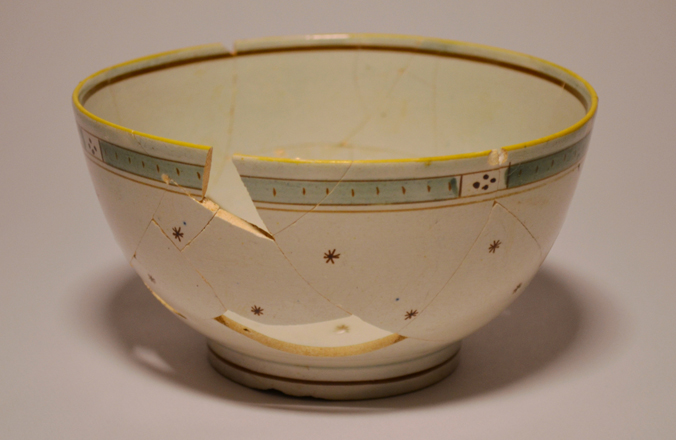
Pearlware waste or ‘slop’ bowl. Hand painted. Made in England between 1795 and 1830. Excavated at Historic Kenmore. This bowl would have been used during the tea ceremony as a receptacle for spent tea leaves or unwanted cold tea before refilling a cup with hot tea.
Still, archaeologists really love when we mend a vessel to near perfection and put it on display for the public along with all the information we’ve learned from it. We’ve actually just finished mending German Westerwald stonewares and we’ll share some of that project’s results in the not-too-distant future. Soon, we’ll be moving onto English white stonewares. On your next visit to Ferry Farm, you’ll likely see a mending project on display in our laboratory and maybe some of our talented staff working hard to unlock the secrets contained within those humble sherds!
Mara Kaktins
Archaeologist/Ceramics and Glass Specialist