Lives and Legacies

Tag: Archives

  • From the Vaults: Rarely Seen Documents

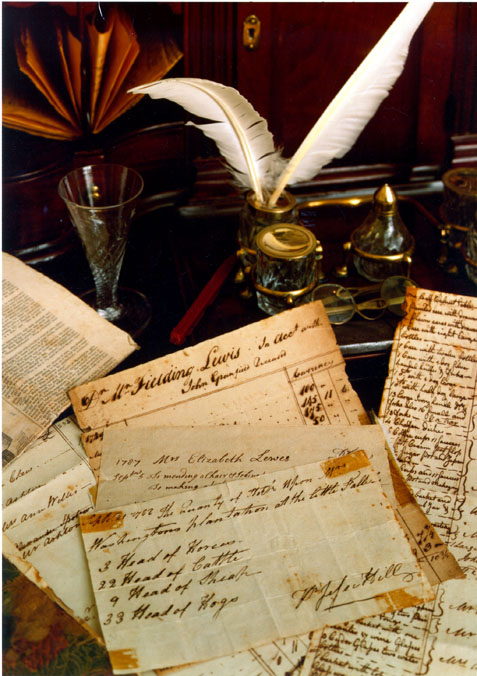
    Some of the most delicate objects in our collection are our archives. Paper and other document materials like vellum and parchment are very sensitive materials that can be irreversibly damaged simply by light.  This makes it very difficult to display or put on exhibit for extended periods despite our comprehensive policies for conserving and preserving documents; exhibition has always been unfeasible.  To remedy this, we have been working on getting archival-safe, high-quality images of our important documents online for everyone to access.  So, while you might not see the documents in person, you can still explore, read, and learn about these important papers while we preserve them for future generations.     

    Until we launch our online archives, I wanted to give everyone a sneak peek at a few of our incredible pieces.

    One of our oldest documents in the collection is a Land Grant signed by William Gooch on September 28, 1730, written on vellum.  William Gooch was a colonial administrator who served as governor of Virginia from 1727 to 1749.  The grant is not in the best condition, but it reads that it grants 400 acres in Spotsylvania County to Paul Plunkepee.  This grant is officially recorded as Land Office Patents, No. 14, 1728-1732, page 40, and is available at the Library of Virginia.

    One of our most unique documents is a letter from George Washington to Lieutenant Governor Robert Dinwiddie, written on June 10, 1752, when he was twenty.  Robert Dinwiddie served as Lieutenant Governor of Virginia from 1751 to 1758.  In the letter, George requests his first military appointment to the open adjutancy of the Northern Neck or other district.  George’s half-brother Lawrence had been appointed Adjutant General of the colony in 1743.  Due to his illness and eventual death, the adjutant was to be divided into smaller districts (i.e., Northern Neck).

    Dinwiddie declined the appointment but assigned George to an envoy position that winter to confront the French, who had recently built a fort on what Dinwiddie considered British land.  Additionally, George met with the Iroquois Confederacy to make peace and obtain intelligence about the French.  

    This amazing letter pinpoints the beginning of George Washington’s illustrious military career, which would eventually culminate in him becoming the first President of the new United States of America.  The letter is in great condition after meticulous conservation work, which included repairs with Japanese tissue called tengucho and wheat starch paste called jin shofu.  It was then cleaned and flattened, and the iron gall ink stabilized.
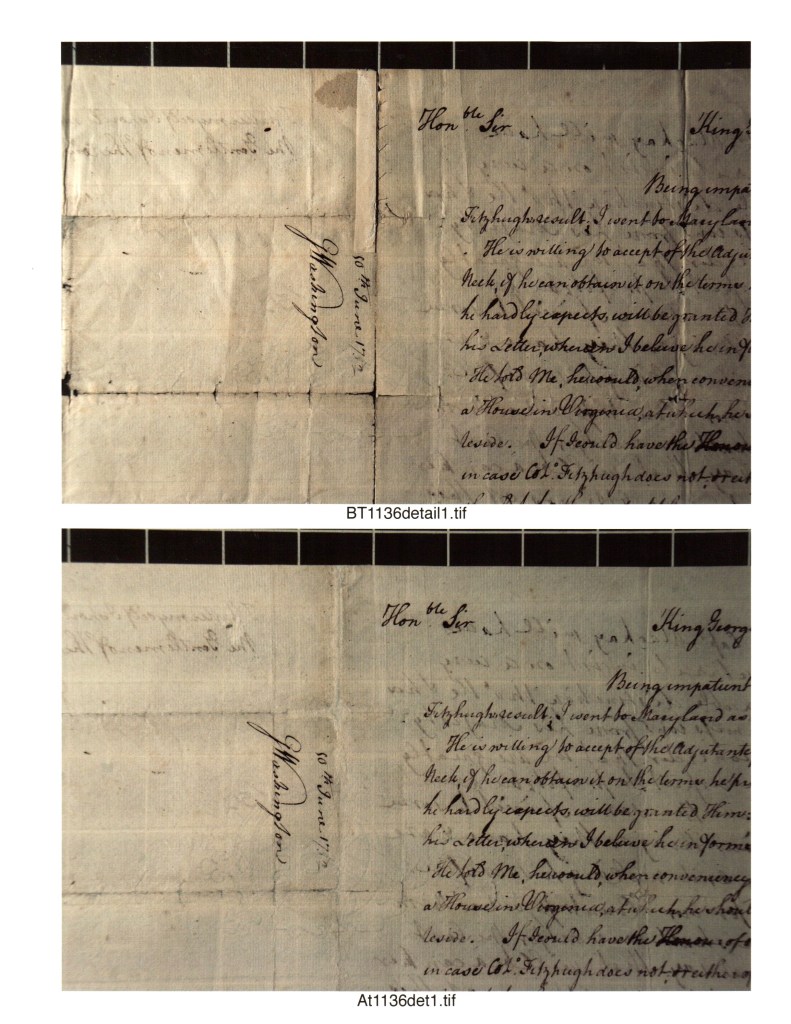
    A transcript of the letter can be found on the National Archives website at Founders Online.

    Next are two letters between George Washington and Irish-born publisher Matthew Carey.  Matthew Carey moved to America in 1784 and settled in Philadelphia, where he established a publishing business and bookshop with $400 given to him by the Marquis de Lafayette.  Carey’s first publication was The Pennsylvania Herald in 1785, followed by two of the first successful American magazines, The Columbian Magazine and The American Magazine in 1786 and 1787.

    In George’s first letter to Carey in 1785, he requests a subscription to Carey’s newspaper but asks him to send the newspaper disguised as an ordinary letter because George has been having problems with the post office delivering his newspapers .  George thinks his papers may not have been delivered because “persons who wishing to read News Papers without being of the expence [sic] of paying for them, make free with those which are addressed to others.”

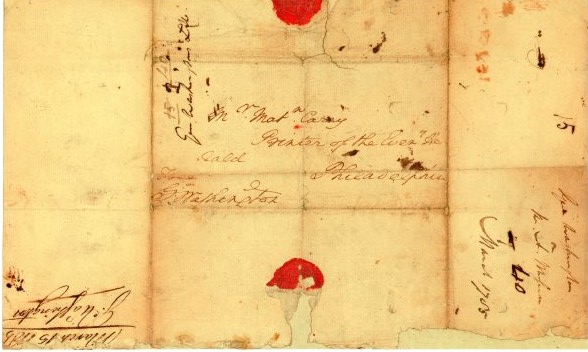
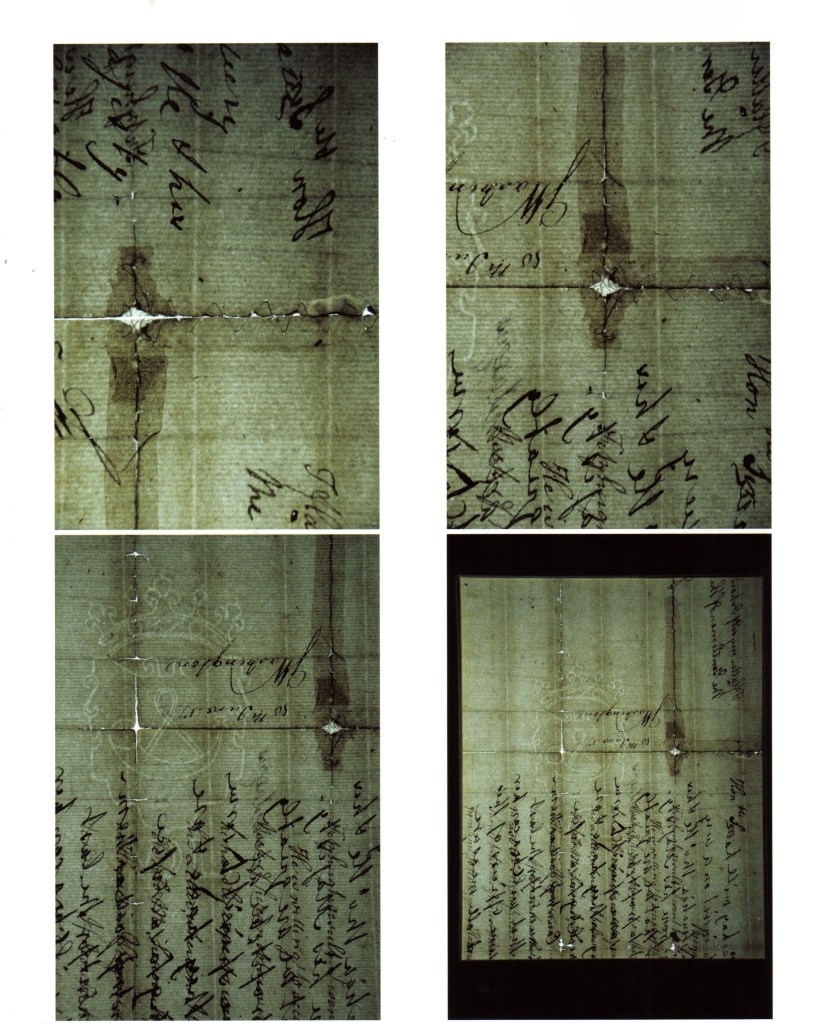
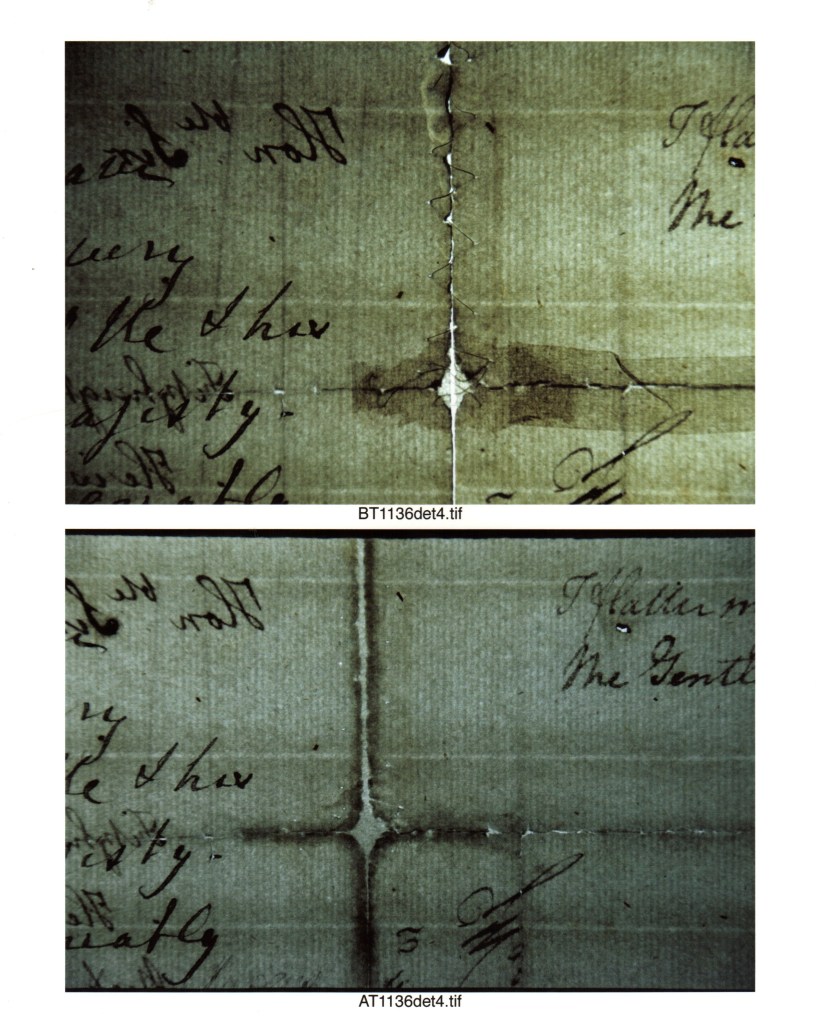
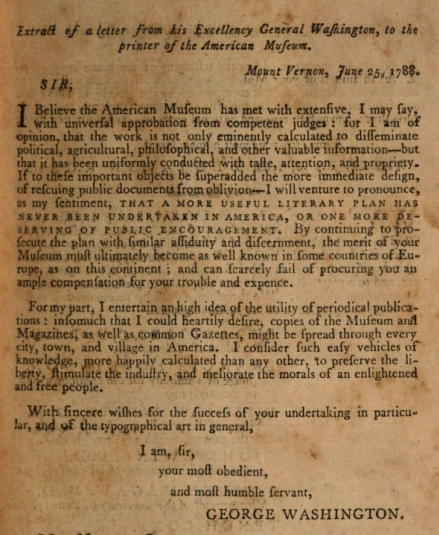
    The second letter between George and Matthew is dated June 25, 1788.  The year before, Carey launched “The American Museum” magazine.  It was a literary museum that reprinted significant historical documents on American history and original essays on politics, commerce, and culture.  The magazine got a positive response, but Carey was finding it expensive to distribute the magazine across the country, so he asked George, one of his first subscribers, to write an endorsement for the magazine that would help attract new subscribers.[2] 

    Washington responded immediately, seizing the opportunity offered by Carey to express his belief that the free dissemination of information and ideas was vital to preserving American liberty.  ‘I could heartily desire,’ Washington wrote, that ‘copies of the Museum and Magazines, as well as common Gazettes, might be spread through every city, town & village in America – I consider such easy vehicles of knowledge, more happily calculated that any other, to preserve the liberty, stimulate the industry and meliorate the morals of an enlightened and free People.”

    Carey published Washington’s endorsement in the next issue of his magazine—his marks for the typesetter can be seen in the original Washington letter.  The result was a flood of new subscriptions that allowed Carey to continue publishing The American Museum for another four years.

    Transcripts of the letters can be found on the National Archives website at Founders Online.

    These are just a few of the amazing documents in our collection, which we hope to bring you soon so that you can explore them yourself.  Check back often, and we will keep you updated on our progress with our digitization project.

    Heather Baldus

    Collections Manager


    Bibliography

    Edd Applegate (August 17, 2012). The rise of Advertising in the United States: A History of Innovation to 1960. Scarecrow Press. p.25.

     

  • Kenmore’s Holy Grail

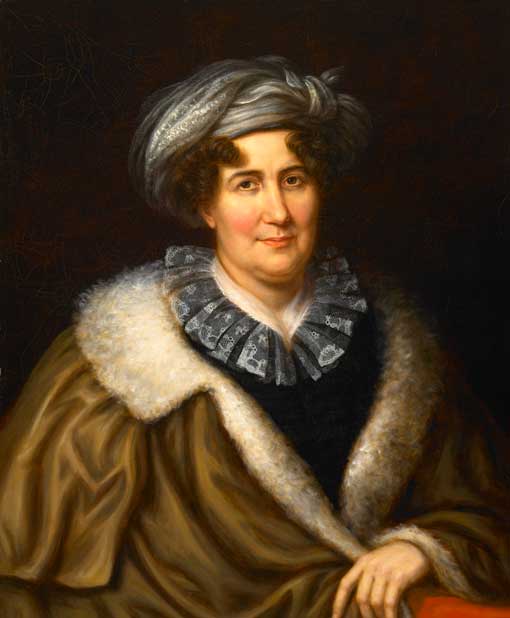
    “The drawing-room walls are covered with pictures, some very fine, from the ancient masters, but most of them portraits of our most distinguished men, six or eight by Stewart. The mantelpiece, tables in each corner and in fact wherever one could be fixed, were filled with busts, and groups of figures in plaster, so that this apartment had more the appearance of a museum of the arts than of a drawing room.” Those are the words of Margaret Bayard Smith upon entering the drawing room at James Madison’s Montpelier in 1828.  Smith was a noted journalist and socialite in 19th century Washington, DC, and a good friend of Thomas Jefferson, in addition to James and Dolley Madison.  She is best remembered for her detailed diary entries, recounting her lengthy visits to the homes of well-known figures in American society at the time.  Her record is a treasure trove of information for the curators trying to piece together the original appearance of some of those great houses.  And she was not alone! Many a traveler in the 18th and 19th century wrote down their observations of daily life at Montpelier, Monticello, Mount Vernon and similar places in letters, diaries, journals, and even occasionally in newspaper columns.  Altogether, these contemporary descriptions of times long past are some of the best resources we have for creating a picture of what a house looked like once upon a time.

    M-108, Courtesy of the Montpelier Foundation
    The Drawing Room at James Madison’s Montpelier. Courtesy of Montpelier, a National Trust Historic Site.

    Margaret Bayard Smith
    Portrait of Margaret Bayard Smith by Charles Bird King (c. 1829). Credit: Smithsonian Institution

    Alas, Mrs. Smith never made it to Kenmore.  Nor, apparently, did any of the other wonderfully prolific travel writers of her day.  Amazingly, not a single contemporary description of Kenmore, either its interior or exterior, has ever surfaced.  It would seem that not one visitor to the Lewis home was moved to write down any impressions of the awe-inspiring plasterwork ceilings that quite literally defied imagination.  The English carpets on the floors inspired no comment.  No one ever reported the gossip of an evening’s entertainment at Kenmore to a friend.  None of the Lewis family members themselves ever described a family dinner.  This lack of description is baffling, and it has been a frustrating problem for those of us working on Kenmore’s restoration and refurnishing over the last 15 years.  But more than bafflement and frustration, it’s become an intriguing mystery.  In short, a description of Kenmore from the 18th century has become our Holy Grail.

    Let’s begin with the premise that it is highly unlikely that NO ONE ever wrote anything about Kenmore during the Lewis era.  Someone, somewhere, surely put pen to paper and wrote about their surroundings in the Lewis house.  It is simply that we haven’t found these accounts yet.  They exist, but they’re hidden away somewhere.  So the real question is why haven’t any of them come to light yet? There are several possible reasons.

    First, history has not remembered Fielding Lewis the way it has George Washington and Thomas Jefferson.  Although his role in early American history was a rather important one, it didn’t make headlines at the time, and it doesn’t show up in many history books today.  Documents related to Fielding and his family were not given the same status and protection by later generations as those related to the Founders and early presidents.  Ironically, most of the existing letters written by Fielding Lewis survive only because he was writing to George Washington, and therefore they are held in the same repositories that hold the Washington Papers (Mount Vernon, the Library of Congress, etc.).  In our own lives, we often discard quite a bit of correspondence and other paperwork because it seems trivial, or because it doesn’t have anything to do with an important person or event.  Many original documents related to Kenmore may simply did not survived.

    Lewis Papers
    While there are some Lewis family documents in our collection, there is no description of Kenmore during the Lewises time among the family’s papers.

    Another possible explanation for the lack of descriptive accounts is difficulty that many historic sites have to deal with: The Civil War.  In almost any effort to trace the historical roots of, well, anything, in the United States, there tends to be this deep, black abyss when you reach the years of the Civil War.  Repositories for legal documents, like courthouses and libraries, were ransacked and destroyed all over the South (and in parts of the North, as well).  Newspaper printing offices were wrecked.  Family records, stored in attics and Father’s desk, were destroyed in fires and bombardments.  Correspondence was disrupted, and what made it through rarely described beautiful houses, but rather focused on the horrors of war.  Fredericksburg, which saw one of the earliest examples of urban warfare rage through its streets in 1862, was particularly hard hit.  If documents describing Kenmore existed prior to the War, it is entirely possible that they did not survive it.

    The third possibility has something to do with Kenmore’s name.  As those who have been on tour know, the house was not called “Kenmore” when the Lewis family lived in it.  In fact, the Lewis family did not give the house a name at all.  It wasn’t until 1819, when the Gordons owned the property, that the name “Kenmore” appears in court records (the Gordons named the house in honor of the ancestral home in Scotland, Kenmuir).

    So, any documents describing Kenmore from the Lewis era would not have used the word “Kenmore.” It is entirely possible that researchers have in fact come across descriptions of Kenmore, but they didn’t know what they were looking at because the house described was not identified as Kenmore.  It’s also possible that descriptions of Kenmore do survive in repositories that have no connection to the Lewises, the Washingtons or even Virginia, in which case they would have no idea what they were looking at, without the word “Kenmore” to Google.  It seems like a trivial issue, but it’s actually a real problem!

    There you have it.  Could it be that one of the most beautiful houses in colonial America was seemingly ignored by correspondents of the day? It seems unlikely, and so our search for own Holy Grail continues.  If any of our readers happen to be combing through obscure 18th century documents in the future, we would appreciate you keeping an eye out for us!

    Meghan Budinger
    Aldrich Director of Curatorial Operations