Archaeology is trash. There, I said it. Before you call Mr. Jones and have me thrown in a pit of snakes, let me explain. Generally speaking, archaeology focuses on understanding the past through the items that people left behind, i.e., their trash. Most of the things we find are left around because they were broken or no longer needed. Disposal of these items looked much different before modern garbage collection as we know it today. Rather than trashcans and landfills, trash was often thrown outside of the home or workspace near windows and doors or any other designated disposal areas. These areas, also known as middens, usually have a high number of artifacts and are top-tier when it comes to understanding a site. So, in other words, archaeology is trash, and we love it.
Most people can get behind the archaeologists saving the trash that’s hundreds or thousands of years old, but things are a little different when it comes to saving more modern materials like plastic. When visitors or volunteers see things like plastic bottle caps or food wrappers in our bags to bring back to the lab, they usually have a few questions. Like, “Did you mean to keep this?” Or “Why are you keeping this trash?” Here at Ferry Farm, we don’t pick favorites, every bit of trash can tell us something about the site and how it has been used.
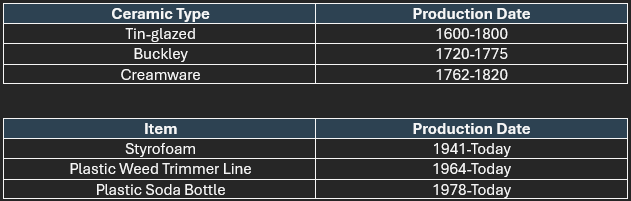
One-way modern materials can help us understand a site is by helping us determine the Terminus Post Quem (TPQ), or “time after which,” of a layer. The TPQ is determined by identifying the earliest production date of the most recently produced item. For layers deposited before the widespread use of plastics, ceramics are usually used for determining the TPQ because they are datable (temporally, not romantically) since most have very specific production dates, and they also hold up pretty well under ground. For example, when looking at the ceramics in a layer with tin-glazed wares, Buckley, and creamware, the TPQ would be 1762 since that is the earliest production date of the most recently produced ceramic (creamware). All the items in the layer had to have been deposited after that date.
The same idea works with modern synthetic materials like plastics, which are usually found at sites that have been used within the last 100 years. If there were to be some plastic soda bottles, weed eater line, and styrofoam in a layer, the TPQ would be 1978. While these materials may also be items you have in your home, not thought to be worth collecting and preserving, their presence in a layer helps provide a date. They can also tell us if an earlier layer was disturbed.
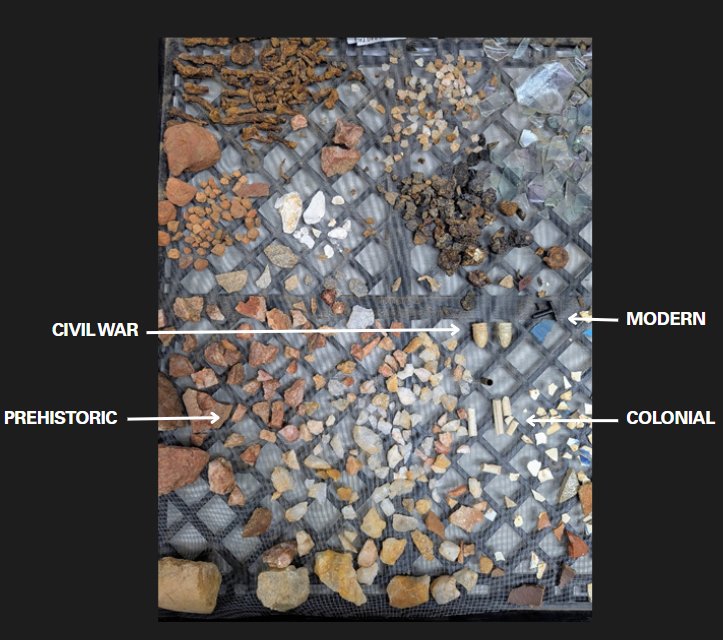
When archaeologists talk about disturbed layers, we aren’t judging their emotional state or love of 2000s heavy metal. Instead, when a layer is described as disturbed, that means there was some sort of activity happening after the initial deposition that affected that layer. During last season’s dig, there were layers with a mix of colonial, prehistoric, and modern materials that indicated that the area was disturbed by some subsequent activity. The information gathered by the presence of modern materials is important for the interpretation of the site and its use over time.
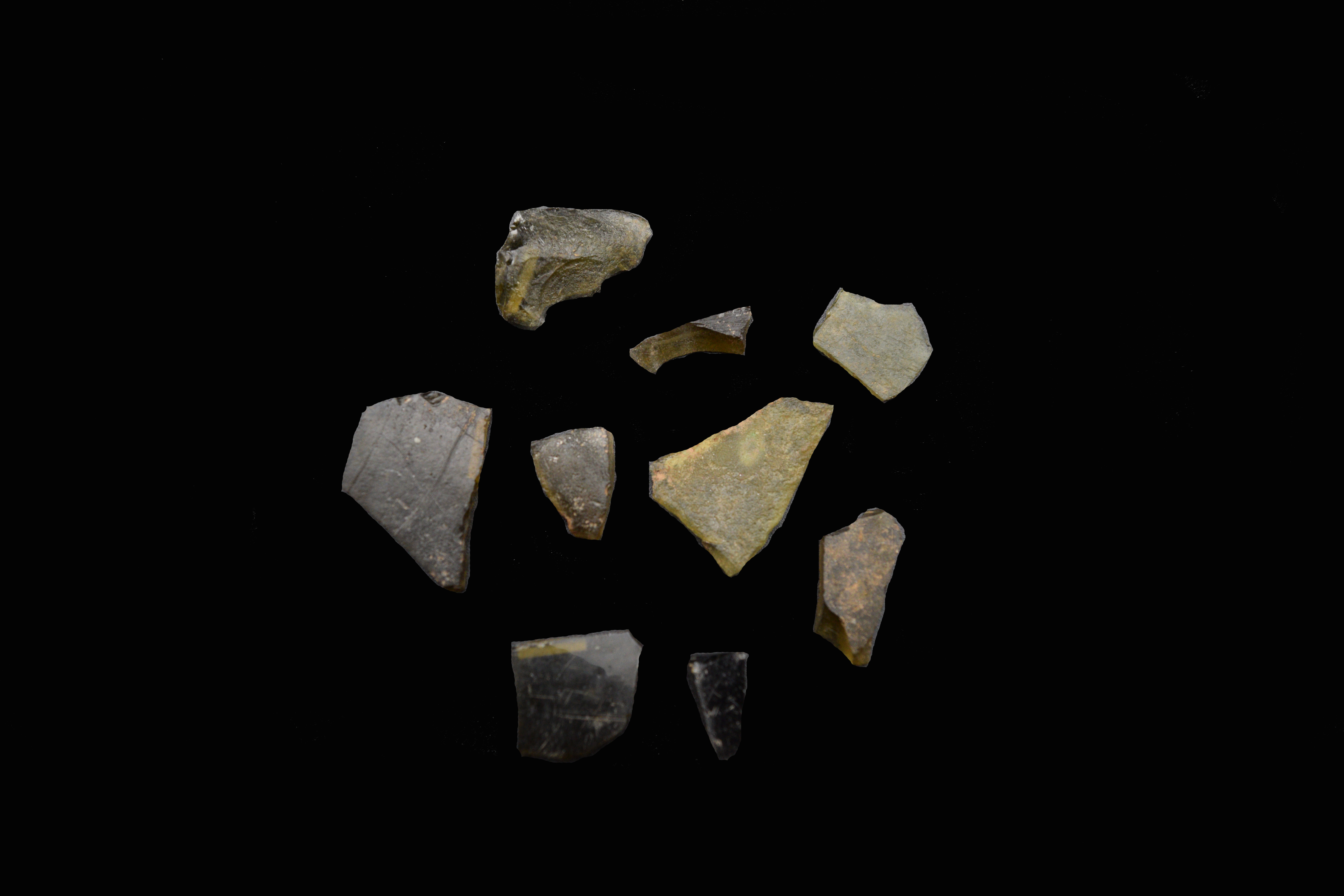
Example of a disturbed layer– Artifacts include prehistoric flakes and fire-cracked rock, colonial items like tobacco pipe stems, Civil War Minie balls, and modern-day plastics
Now that we know why we keep this so-called modern trash. Here are a few examples of how the presence of these items helped our archaeologists understand a part of our site.
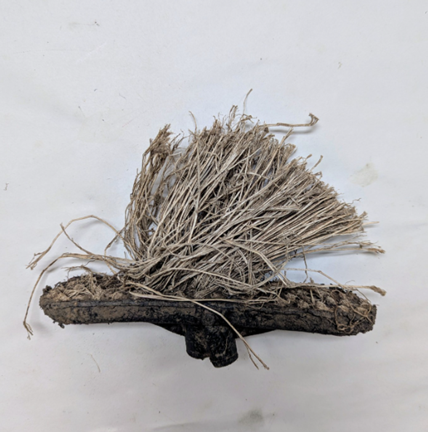
My favorite example happened during last year’s dig. One of our crew, Abbie, was preparing a feature for photographs and had to keep clipping pesky hairlike roots that were in the way. After a bit of excavating, it turns out the “roots” were bristles from a plastic broom. The broom dated the feature fill to the late 20th century and got to the root of the hairy soil issue.
Pesky broom in feature
Our staff has numerous examples of these modern materials being used to help identify previous archaeology as well, from candy wrappers at the bottom of shovel test pits and trenches to an entire trowel! While things like plastic trash bags and food containers aren’t the most exciting to find, they play a part in interpreting the history of activities on the site.
Once something is left behind, it becomes part of the archaeological record, whether it was 10,000 years ago or yesterday’s lunch. What does your trash say about you?
While the house at Historic Kenmore has been faithfully restored to its circa 1775 appearance, the road to that final result was a pretty dirty one. As in plaster dust, paint fumes, and all manner of dirt and debris. Back in the late 1980s and early 1990s, the first forays into the research for and the subsequent writing of a Historic Structure Report (HSR) took place. This project entailed a number of architectural historians selectively pulling up floorboards and peeking behind plaster walls to more fully understand how the house was originally built, its current condition, and its history of change over time. This important document provided us with a clear understanding of Kenmore’s architectural history, was the guiding document for a decade-long restoration of the structure, and also gave us a collection of architectural fragments and individual artifact finds that continue to help us understand the material world of those who lived and labored at Kenmore through the centuries.
In a past blog post, we learned a bit about rats as collectors and examined a rat’s nest that was discovered during that HSR investigative period. If you haven’t looked at the video of the unpacking of that nest, here it is. (In that nest, there were assorted papers, fibers, and other fluffy goodies dating to around the turn of the 20th century.) But the nest wasn’t the only thing uncovered during that HSR peeking and prodding process.
Enter the “Above Ground Archaeology” or “Interior Archaeology” collection. These eclectic artifacts were carefully collected, numbered according to their context or find location, bagged, documented on a list, and lovingly packed away in our ubiquitous Hollinger boxes. Over the years, some of the artifacts were pulled by curators for exhibition in the Kenmore galleries, but most were stowed away in their boxes for long-term preservation and research purposes.
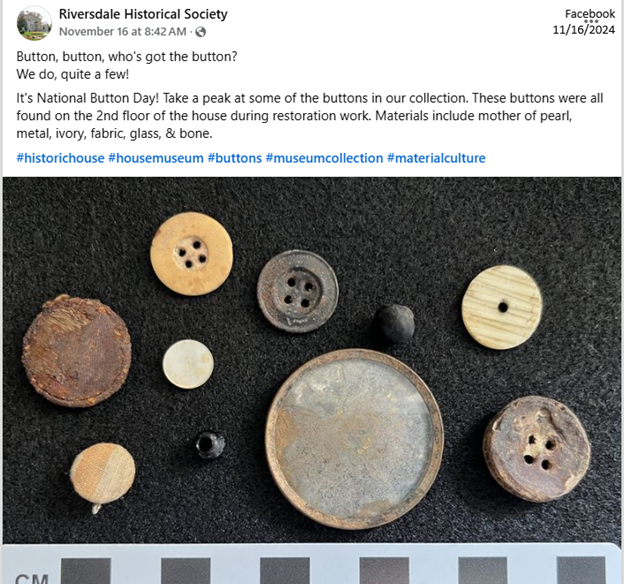
The use of found objects in historic structures to help illuminate the material world of the building’s residents and workers is not a revolutionary concept. Colonial Williamsburg, for instance, in their recent restoration of the historic Bray School, removed modern plaster walls, revealing not only structural information but also artifacts: “We are collecting building fragments and objects found in the walls…These items shed light on the building’s original finishes and various inhabitants since 1760.” Riversdale Historical Society has been showcasing some of their “found” artifacts on Facebook — most recently posting a set of buttons for National Button Day.
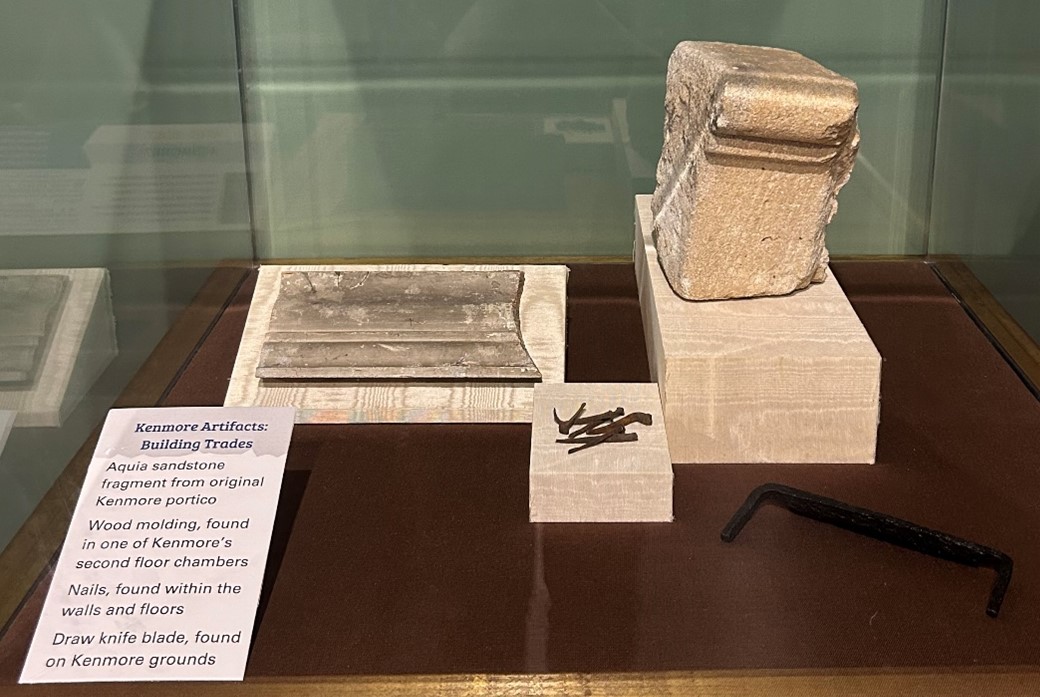
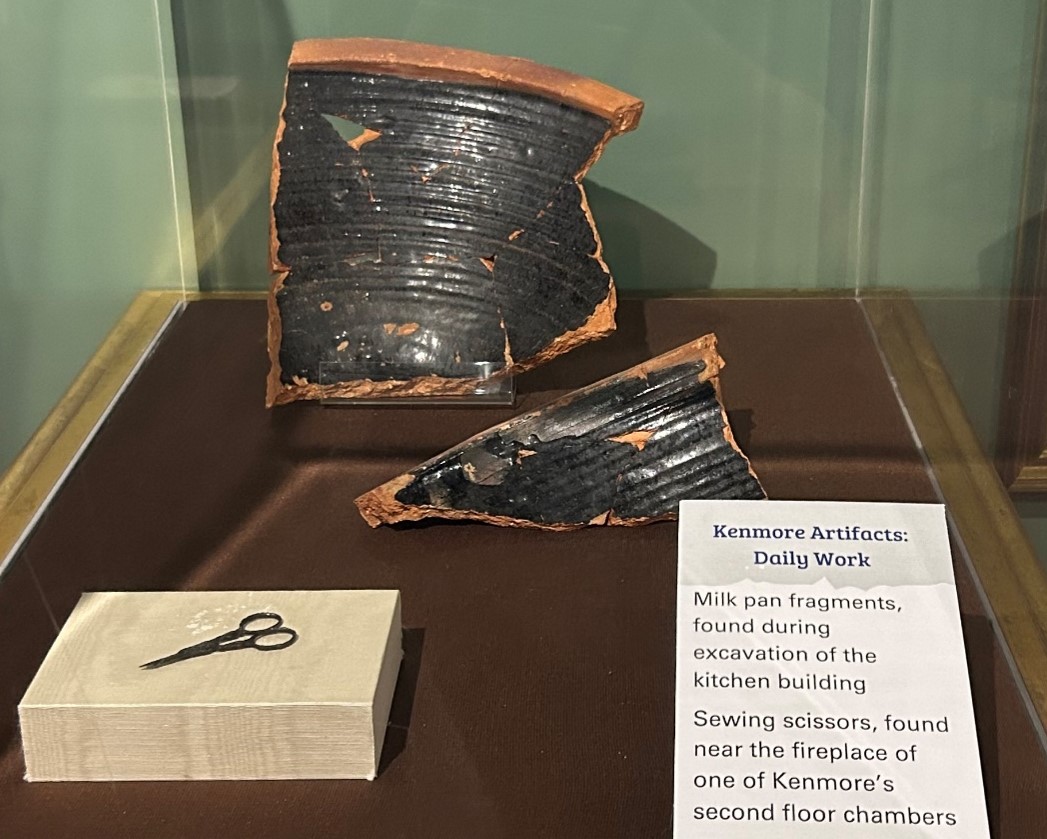
Recently, we pulled a few of Kenmore’s artifacts into exhibit cases in our refreshed orientation exhibit in the Bissell Gallery of the Crowninshield Education Center at Historic Kenmore. Together with in-ground archaeology, these exhibit cases help us illustrate the built environment and the wares known and used at the site.
Case in the orientation exhibit at Historic Kenmore – including molding fragments and nails found during the HSR investigationsCase in the orientation exhibit at Historic Kenmore – including the tiny (sewing) scissors found near one of the second-floor fireplaces.
In 2010, then Intern Ashley Dean (University of Mary Washington) was tasked with inventorying the three boxes of artifacts, and for that, we are extremely grateful. What resulted from that inventory project was a 12-page list of artifacts that formed the center of this rejuvenated research initiative. The artifacts in these boxes range from architectural elements (plaster fragments, nails, wallpaper bits) to broken household goods (bottle glass, ceramic pieces) to whole objects (beads and a pair of sewing scissors). When first bagged and numbered, these artifacts were recorded by location context—based on the mapping system then being used in the architectural investigations of the house, with room numbers ranging from B001 in the cellar (or basement level) to 301 being the attic (or 3rd floor) of the house.
Attic (Room 301) mapping
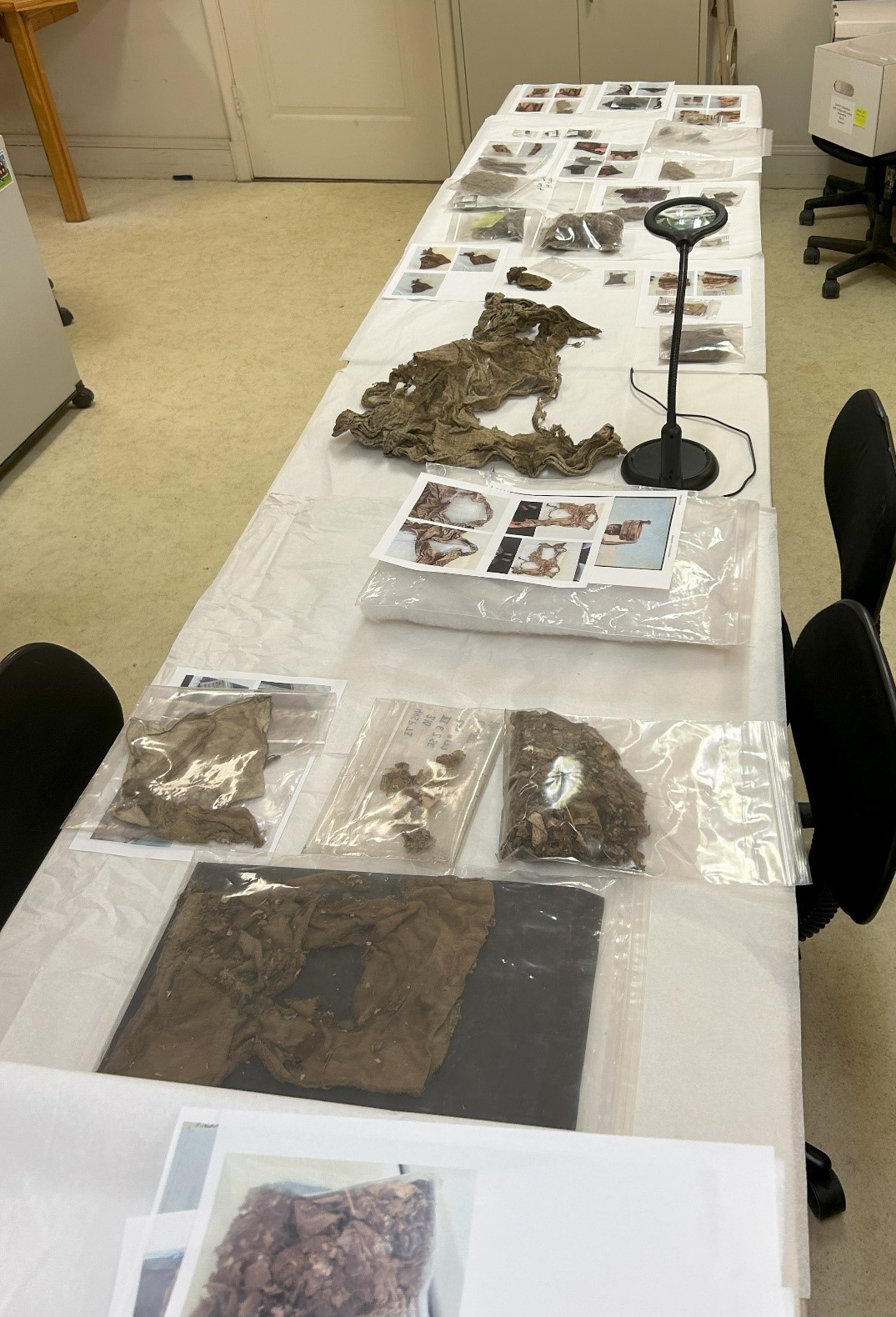
Fast forward to 2024, the artifacts were again reviewed, and the idea blossomed to plan a textile assessment of all the small scraps of fabrics that had been collected. According to our in-house review, we could tell that they dated to a variety of periods and ranged in their likely original use, from costumes to household linens.
Selection of textile fragments in the Kenmore Above Ground Archaeology collection (July 2024)
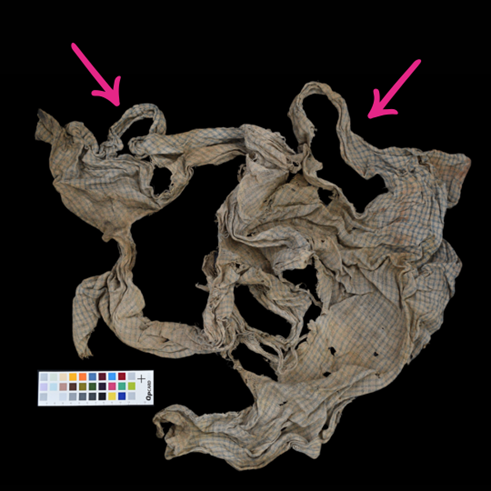
One particularly large artifact proved the most intriguing — a pile of blue and white check fabric. The indeterminate ball of checked fabric piqued the interest of staff and now serves as the starting point for a multi-year conservation assessment and interpretation project. A few months after our in-house assessment, we hosted a textile conservator who conducted a baseline review of the textile fragments and more fully examined the artifact for potential treatment. She had a rapt audience that morning!
Textile fragments in the archaeology lab, awaiting the arrival of the textile conservatorTextile conservator Colleen Callahan examining what we had determined to be a child’s full apron or pinafore
And just a few weeks ago, the textile artifact, which looks to be a full child’s apron or pinafore, was transported to the conservation lab for treatment and further research.
Check fabric before conservation. Armholes visible along upper portion.
The found artifacts from Historic Kenmore have not yet been able to fully share their stories. We look forward to beginning to delve more into their manufacture, use, and re-use by the generations of people who wore them, worked with them, saved them, hid them, and otherwise interacted with the artifacts and the spaces in which they were found.
If you have visited Ferry Farm recently or follow us on social media, you may have noticed the construction of two buildings near the Washington House. These new structures represent those that stood in these spots during George Washington’s time and were constructed using 18th-century methods. Identified through archaeology, their reconstructions allow us to tell better the stories of the people who lived and worked at Ferry Farm. We have previously blogged about the Quarter, a building for housing enslaved individuals owned by the Washingtons. For this blog, we will look at an integral structure located behind the Washington dwelling: the Cellar House.
The Cellar House
What is a cellar house, you may ask? While explaining it to my 7-year-old son, I told him it is neither a cellar nor a house (by modern standards). At this point, he threw up his arms and gave me up for an imbecilic parent. However, this structure was extremely important for large farms in the 18th century. Picture a simple timber and daub (fancy word for hardened clay) building with four walls, one door, high rafters, no windows, and a three-foot-deep pit beneath its floorboards. It is not fancy or decorative by any standards, yet this building holds preserved food that feeds dozens of people at Ferry Farm during seasons when fresh food is unavailable.
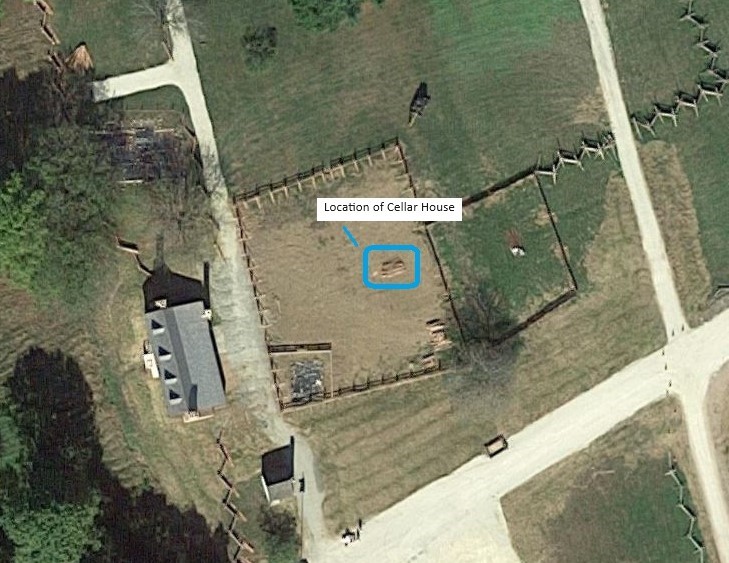
Location of the Cellar House on the Ferry Farm property
Let’s do a brief overview of food preservation during the Washington time period since it has already been touched on in previous blogs. Keeping food from going bad varies from region to region, depending on your climate (combinations of cold, wet, dry, or hot). The hot and humid months in Virginia posed quite a problem for colonists. These conditions do not lend themselves to easy food preservation. Plainly speaking, the East Coast Southern States drew the short straw when it came to keeping food consumable in the long term. As they say, “Where there’s a will, there’s a way,” and Virginians had a wide variety of cards in their deck for keeping food from rotting. Salt, sugar, wood ash, alcohol, vinegar (which was formerly alcohol), and other substances were utilized along with methods including smoking, fermenting, and dehydrating. However, even the best food preservation methods are useless if the resulting food is not stored correctly.
The cellar house could store many different types of foods and beverages, depending on where one kept them in the building. The rafters were ideal for cured meats such as hams, keeping them high and dry. Hooks on the walls held bunches of drying herbs, garlic, and onions. The shelves were perfect for baskets and small crocks of food, while the floor was sturdy for storing large casks or jugs of ale and cider, sacks of grain, and bushels of hardy vegetables and fruits. The pit beneath the floorboards, a glorified ‘cellar,’ was a few degrees cooler in the hot months and a few degrees warmer during the cold season. However, the difference between spoilage and edibility could hinge on maybe 10 degrees, making the subfloor pit essential for colonists who needed to keep some food cooler in summer but warmer (not freezing solid) in winter. Basically, the role the cellar house played varied by the seasons as a revolving door of foods came and went.
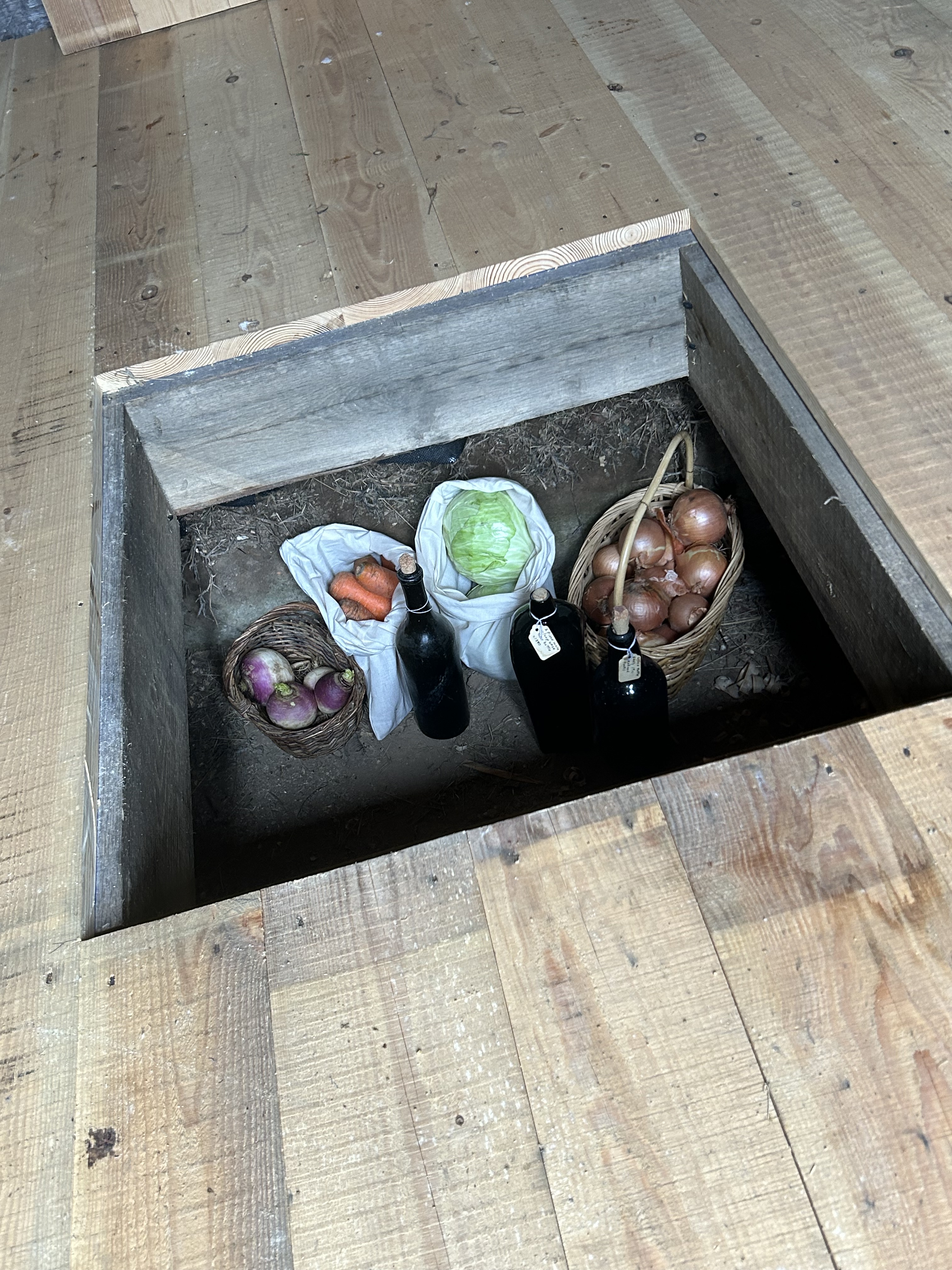
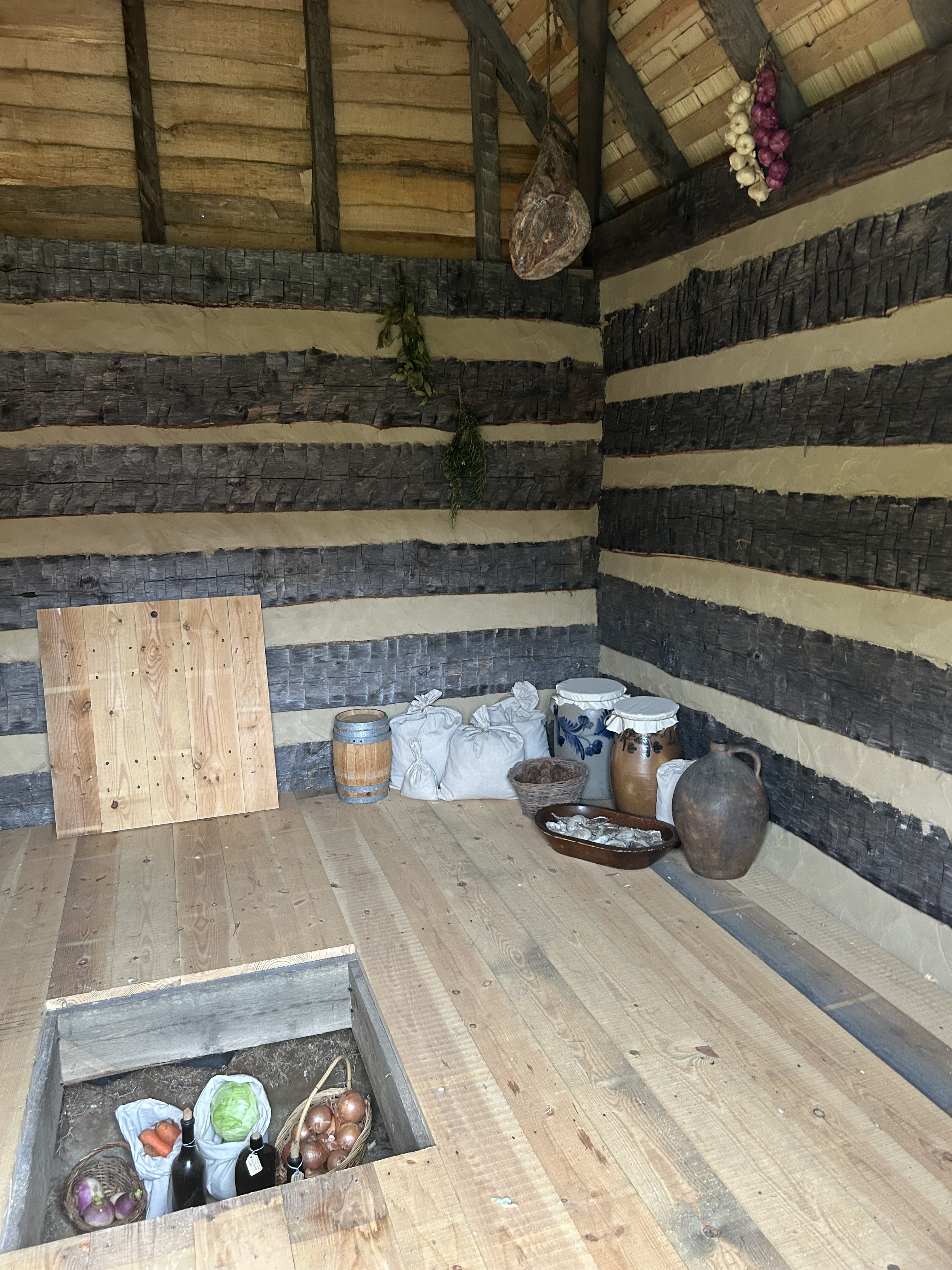
Inside of Cellar HouseInside of Cellar House
When archaeologists at Ferry Farm excavated the area underneath and around where the cellar house would have been, we found artifacts indicative of such a structure. Namely, very few items would have been found inside and around a dwelling, such as tea and tablewares, byproducts of meals, and valuable personal items. Large storage vessels, metal hooks for hanging food, and wrought nails and daub used to build the structure dominate the cellar house artifacts. The only notable personal items recovered were fragments of smoking pipes. That’s right, the smoke break was a thing even among enslaved workers stacking food inside the cellar house.
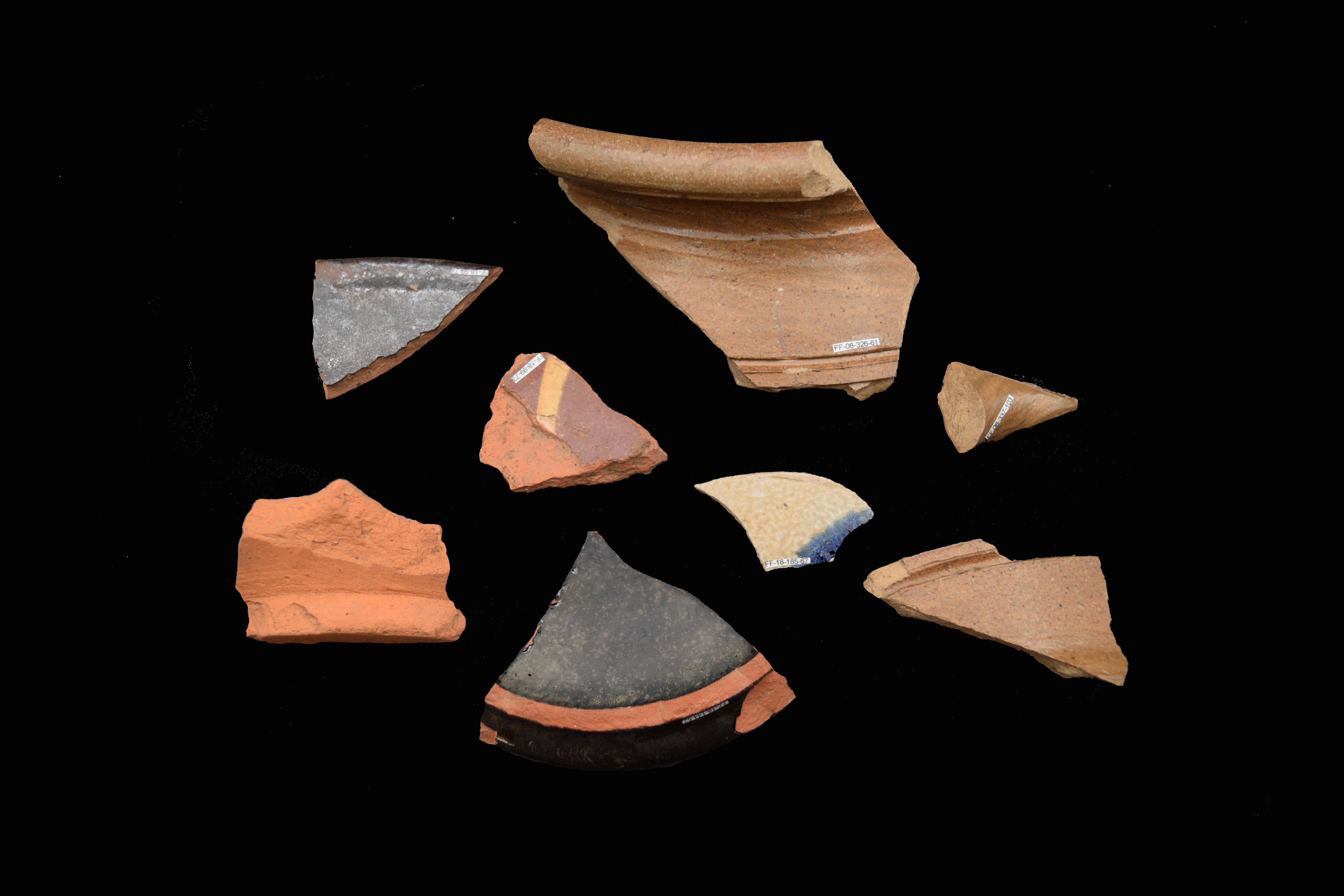
Ceramics from the Cellar HouseFaunal finds from the Cellar HouseGlass finds from the Cellar House
The cellar house is currently fully constructed, but we have yet to populate it with all of the storage vessels, food, smoking pipes, and other accouterments of a storage building. Eventually, visitors will be able to look into this building and take a trip back to the mid-eighteenth century with crocks, jugs, bottles, sacks, barrels, and baskets full of food and drink. All of which will be informed by the historic records and the artifacts recovered by our archaeologists, as with all the reconstructed buildings at Ferry Farm. Then, perhaps when I show the building to my son, he’ll see its importance: part pantry, part colonial refrigerator, and all cellar house.
Archaeologists tend to have strong feelings about ceramics. Ceramics can play a major role in interpreting a site, as their materials often reflect their function. This can be helpful when determining how a site was used. For instance, finding an abundance of redwares and stonewares could indicate a primarily utilitarian site like what would have been used in our Cellar House whereas porcelain and refined earthenwares may reflect a more domestic space. So, it really isn’t surprising that we feel some type of way about these artifacts.
Redware and stoneware storage vessels Porcelain and refined earthenware tablewares
But don’t let that fool you. Archaeologists have feelings about ceramics based solely on their appearance as well. It has come to my attention that Whieldon Ware just might hold the title as the most polarizing ceramic type as of late. These feelings were made very apparent during our recent acquisition of some Whieldon Ware pieces. Most either love or hate it; rarely is there an in-between. Before we get into the ceramic and its distinct look that conjures images of either vomit or a work of art (depending on whom you ask), let’s go over a little background on its creator, Thomas Whieldon.
Thomas Whieldon was an influential English potter producing examples of early creamware beginning in the mid-18th century. He gained popularity for his innovative shapes and decoration, which can be seen on various figurines, dishes, and other vessels. Whieldon is also well known for his partnership with the MVP of the ceramics world, Josiah Wedgwood, Mr. Creamware himself. Together, they developed advances in the realm of refined earthenware, like the perfecting of the green glaze as seen on the pineappleware we have found at Ferry Farm (Wedgwood & Ormsbee, 1947).
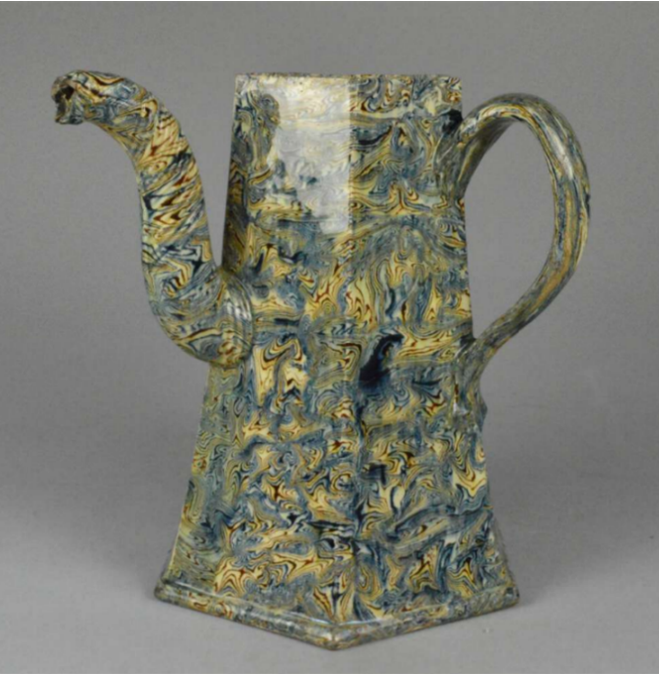
Whieldon agate ware coffee pot. Source: British MuseumWhieldon figurine. Source: The British Museum.
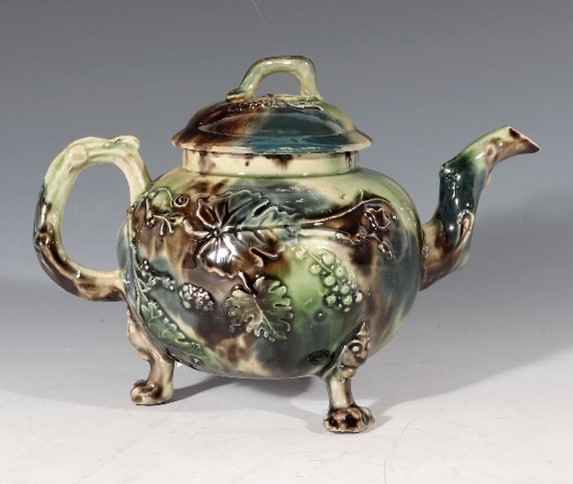
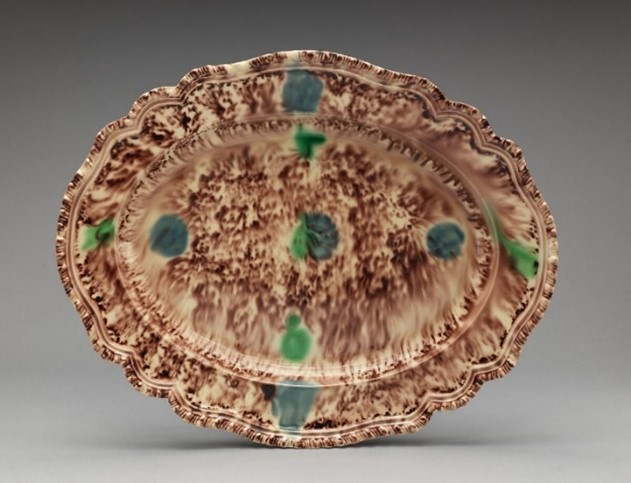
With that said, what we commonly think of when referring to Whieldon Ware is Whieldon’s tortoiseshell or clouded wares. These were created by sponging metal oxides on cream-colored earthenware and then adding a clear lead glaze. The mixing of the metal oxides with the liquid glaze caused the colors to blend and streak, creating splotches of green, yellow, purple, blue, and brown, depending on the types of metal oxides used (Gallagher, 2015). This resulted in a clouded or tortoiseshell decoration. Due to the nature of the technique, no two pieces look exactly the same. For Whieldon lovers like myself, the uniqueness of each piece gives it its charm.
Examples of Whieldon’s tortoiseshell/clouded ware with similar decoration to sherds found at Ferry Farm – Teapot. Source: Earle D. Vandekar of Knightsbridge, IncExamples of Whieldon’s tortoiseshell/clouded ware with similar decoration to sherds found at Ferry Farm – Platter. Source: Met Museum
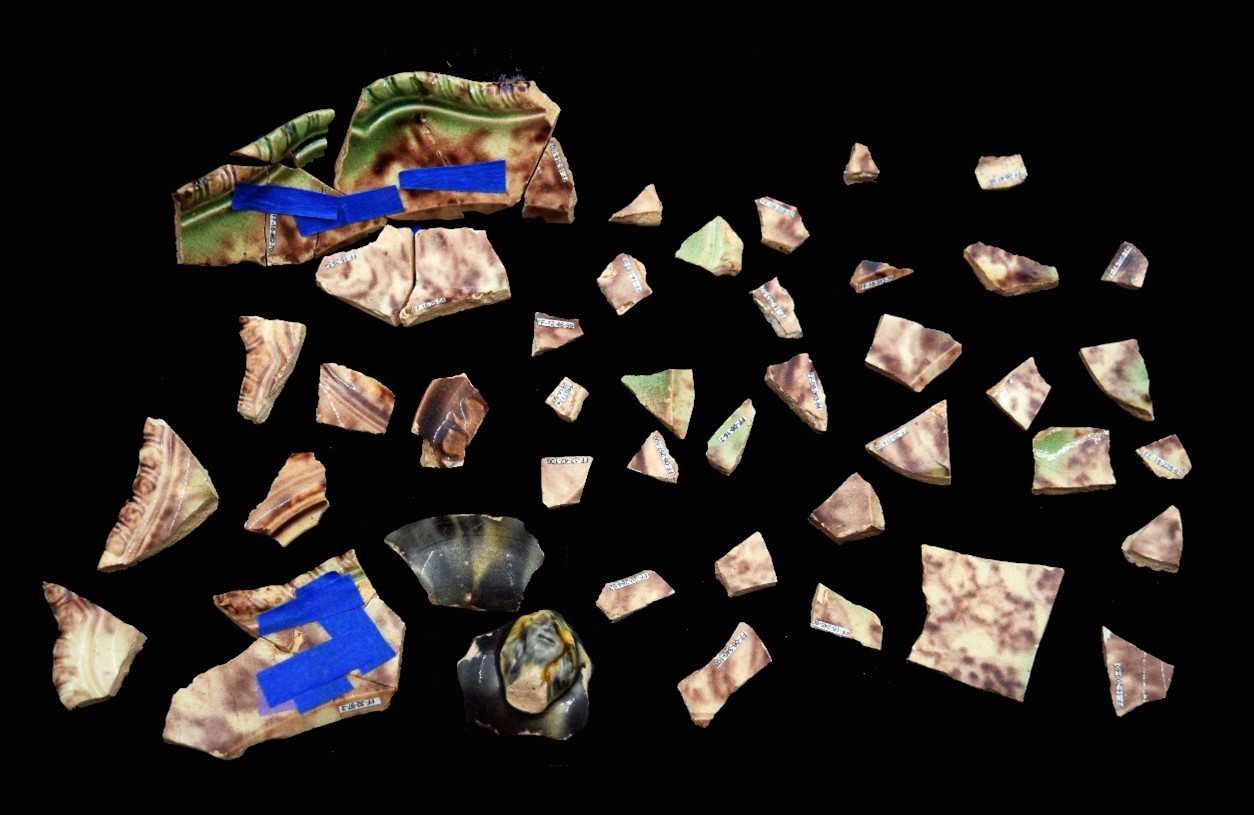
Now that we know more about Whieldon Ware and how some of us feel about it today, let’s talk about how Mary Washington may have felt about it. I firmly believe that she was not team Vomit Ware and instead found the decoration quite desirable. Our excavations have found evidence of at least four Whieldon Ware plates, a teapot, teacup, and other medium-sized holloware vessels at Ferry Farm. Considering the short-lived popularity of the type, lasting only from 1740-1775, we can be quite certain that it was Mary who was buying these items.
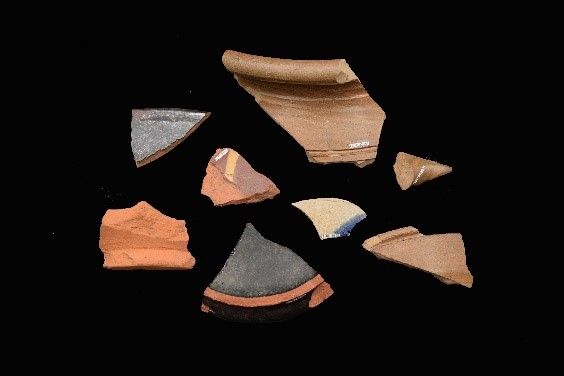
Some Whieldon Ware vessel mends and sherds excavated at Ferry Farm
Toward the end of the 1770’s, Whieldon Ware quickly went out of style and was replaced by Wedgwood’s new, improved creamware and its more subtle decoration. While it may have gone out of style, potters continued to replicate the technique for many years, which makes it difficult to attribute all examples of the type to Whieldon himself. After 1780, he retired from the business, demolished his factory, built an ornamental garden in its place, and spent the rest of his years as a sheriff (Hildyard, 2005; The London Gazette, 1785).
So, there you have it, the very brief story of Whieldon and his wares.
While Mary Washington and a couple of us in the lab are Team Whieldon all day, every day (or at least the days concerning Whieldon), the majority are a hard pass. Where do you stand? Are you Team Whieldon or team Whieldout?
Danielle Arens
GWF Archaeologist
References
Gallagher, B. (2015). British Ceramics 1675-1825: The Mint Museum. Charlotte: The Mint Museum.
Hildyard, R. (2005). English Pottery 1620-1840. London: V&A Publications.
The London Gazette. (1785, November 12). The London Gazette(12699), p. 522.
Wedgwood, J., & Ormsbee, T. H. (1947). Staffordshire Pottery. New York: Robert M. McBride & Company.
The archaeology and curatorial departments for The George Washington Foundation have long worked together to furnish the reproduced Washington house with historically accurate items that resemble as closely as possible the ones that George and his family would have lived with daily. These pieces are not originals, which means visitors touring the house can handle them.
In our latest collaboration we’ve been examining sherds of ceramic vessels owned by the Washington’s to obtain actual eighteenth-century dishes. We want to display these dishes in our gallery to give visitors an idea of what the whole vessels looked like. Four such ceramics have recently been acquired at auctions by the Foundation and you can see them first here along with the excavated remnants they resemble.
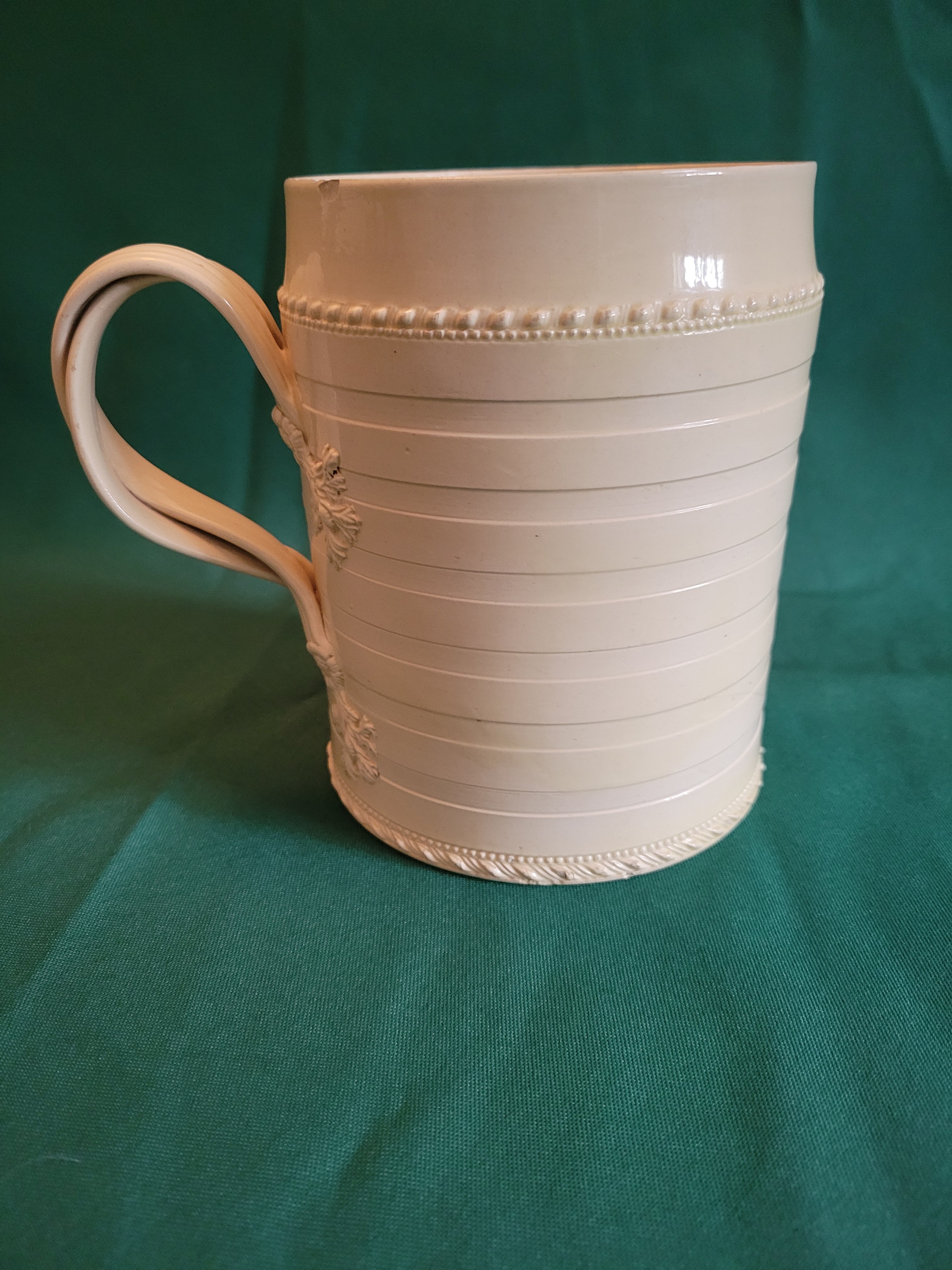
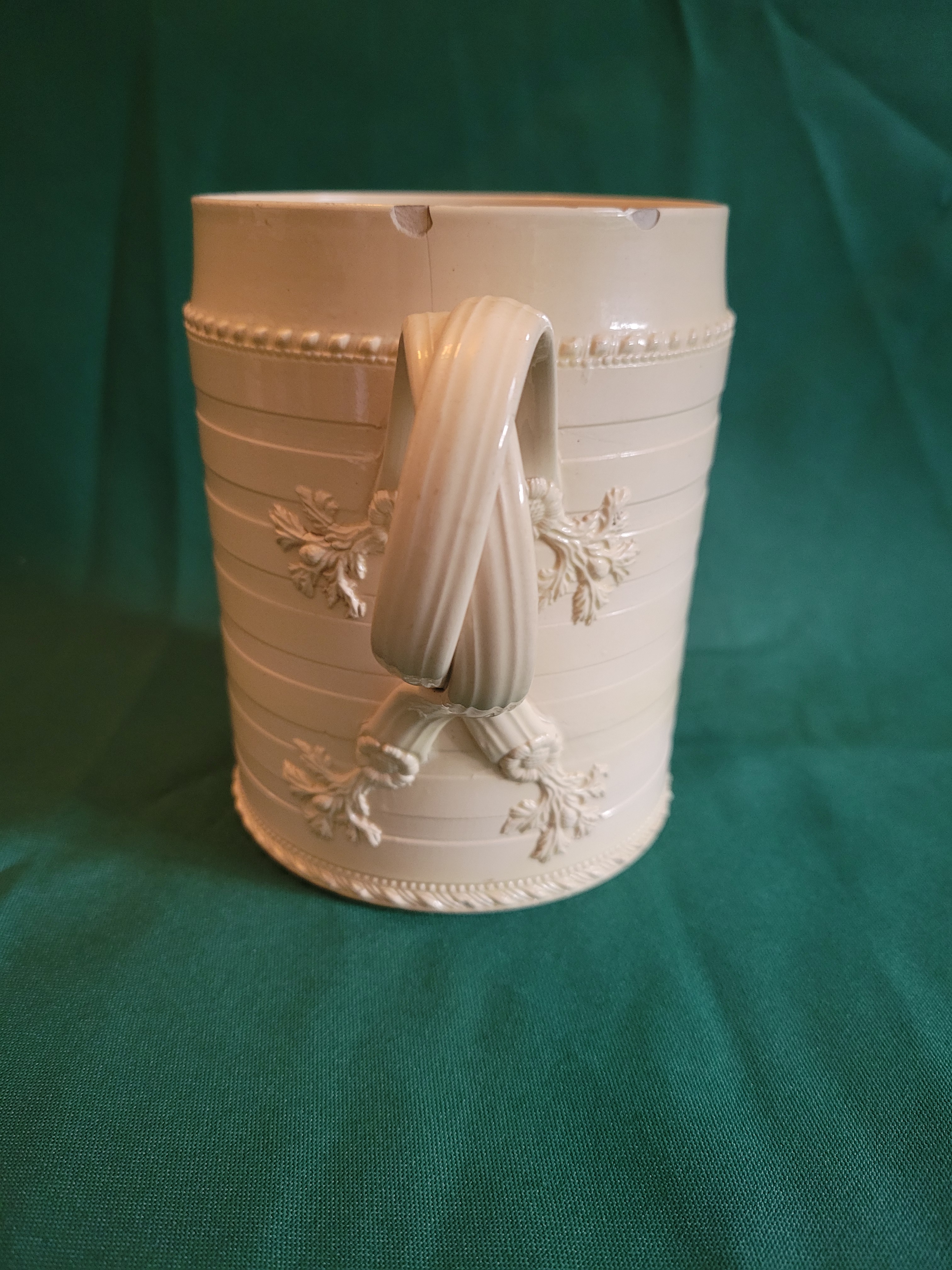
Creamware tankard with strawberry terminals and twisted reeded handles, ca. 1750-1800Creamware tankard with strawberry terminals and twisted reeded handles, ca. 1750-1800Creamware jug with strawberry terminals and twisted reed handles; face below the spout of the jug. ca. 1750-1800 Creamware sauceboat with curved handle which terminate with strawberry flowers. Moulded detail finials
Three of our acquisitions are a type of English ceramic called ‘creamware,’ which was invented in the early 1760’s and was very popular with George’s mother, Mary. Both this lovely pitcher and mug exhibit decorative elements represented by our excavated ceramics. Most prominent are the elegantly curved handles that terminate in delicate strawberry flowers. At least two vessels with these types of handles have been recovered at Ferry Farm. The first is a highly decorative creamware sauce boat and the second a petite teacup, both of which were considered quite fashionable for the time. The jug and teacup also share a common form of decoration called a ‘beaded rim.’
Creamware jug with strawberry terminals and twisted reed handles; face below the spout of the jug, ca. 1750-1800Creamware jug with strawberry terminals and twisted reed handles; face below the spout of the jug. ca. 1750-1800Creamware sherd with “beaded rim”Creamware teacup sherd with “beaded rim”
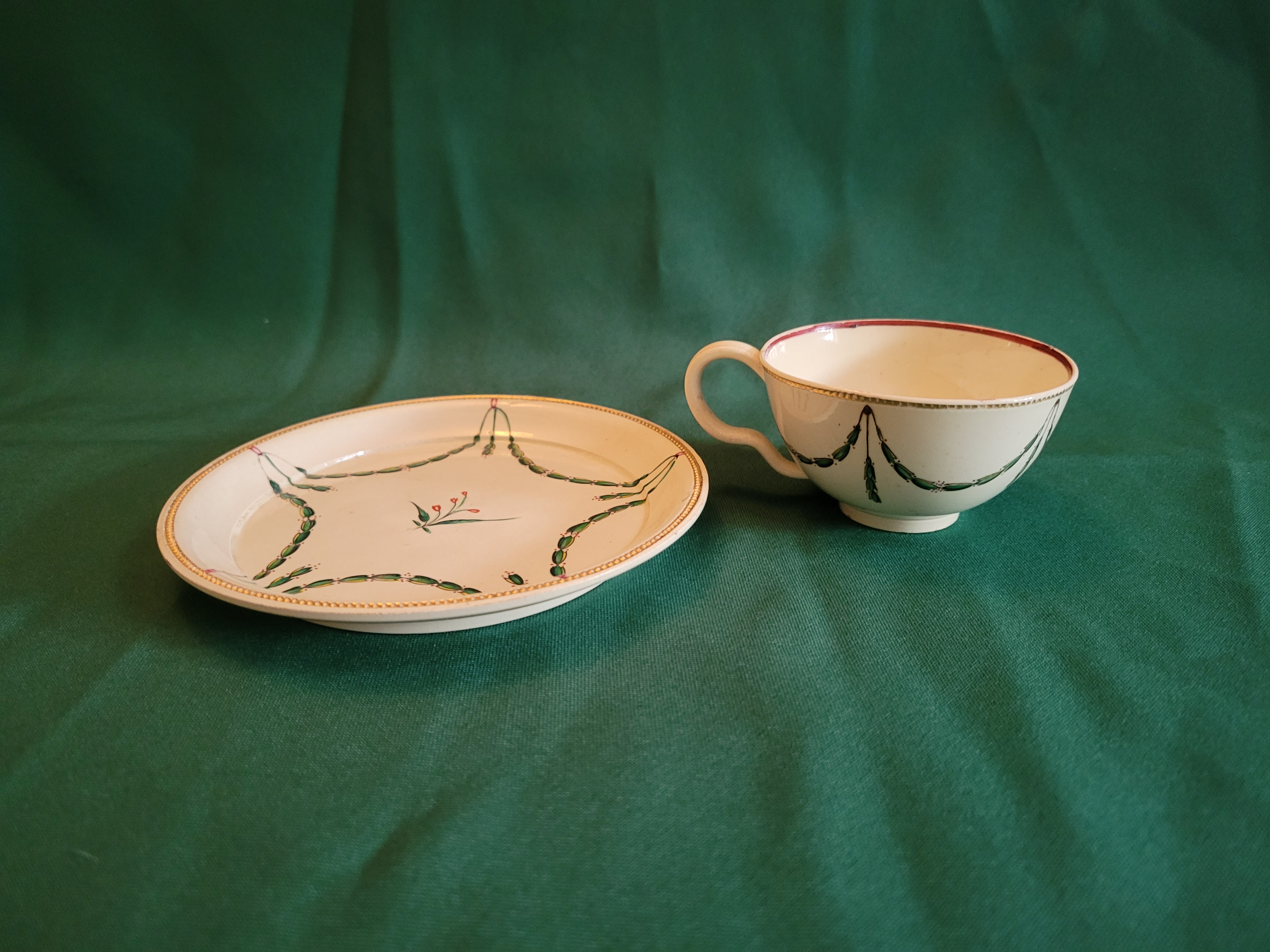
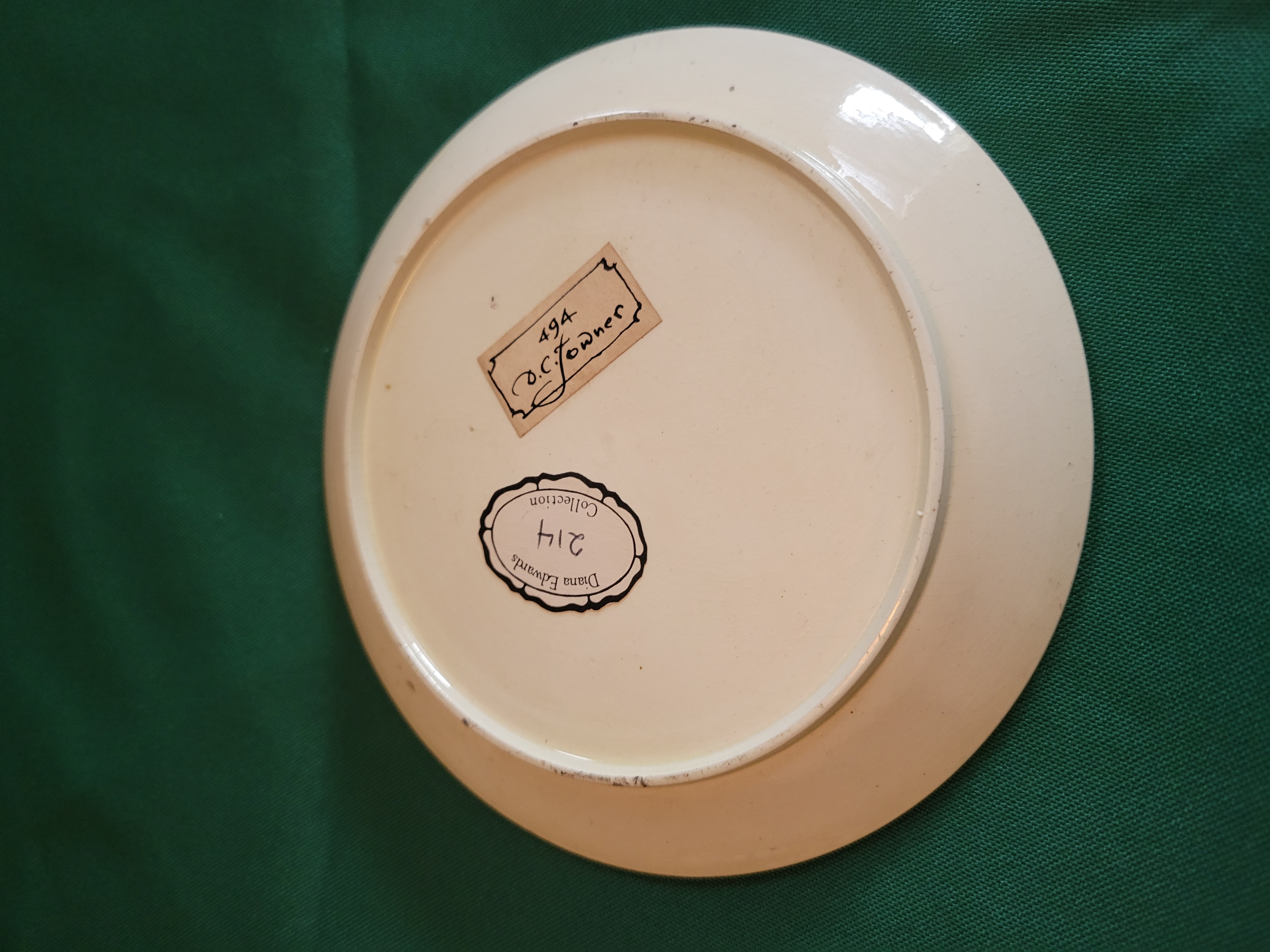
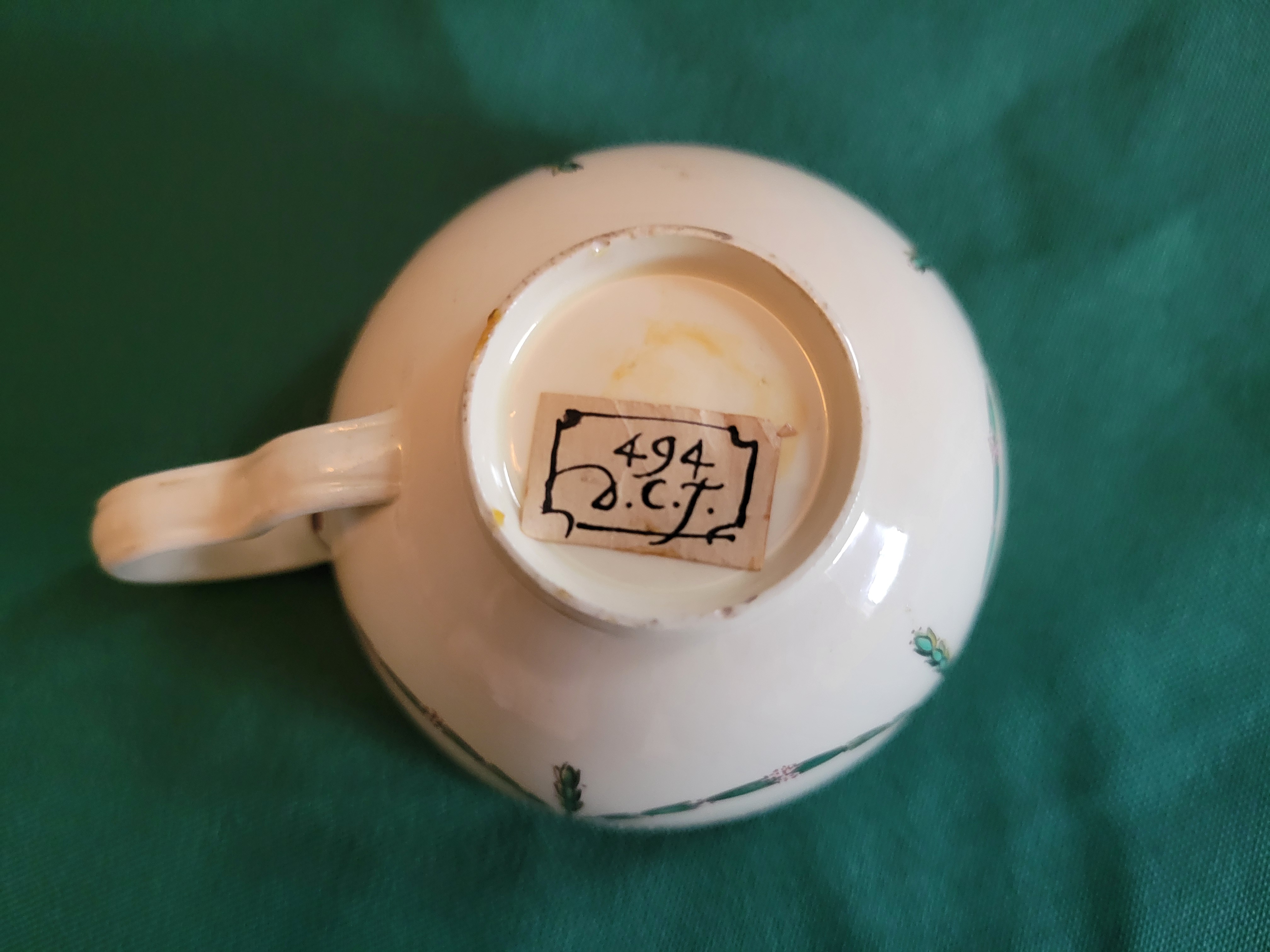
Another teacup owned by Mary was this beautiful piece hand-painted with a detailed swag motif. But from the sherds it’s difficult to really appreciate how graceful this decoration is. Luckily, our curators hunted down a similar cup and saucer with the same decoration, which is unusual. The saucer also features a beaded rim that has been filled in with gold gilding, although we believe the gold to be a later addition to the piece. The cup and saucer also have handwritten tags affixed to the bases which indicate they had the distinction of having been in the collection of a well-known (at least to ceramics geeks like yours truly) collector of creamware. This man by the name of Donald Towner had written extensively on the topic of English ceramics and over his career had amassed a large study collection, of which this was one. His book on the Leeds Pottery in England features a catalogue from the pottery that includes many of the decorative elements and shapes discussed above (Towner, 1965).
English Creamware Cup and Saucer, ca. 1775-1780English Creamware Saucer, ca. 1775-1780. Formerly in Donald Tower Collection, 1968, A Belton, 1988 and Diana Edwards MurnaghanTeacup from Donald Towner Collection, 1968.Teacup sherd with swag motif
But my favorite is this delightfully potbellied creamer with three legs featuring lion’s heads and paws for feet. The ceramic type in question is called Whieldon and started to come on the market in England around 1749. Of note is the raised molded leaf decoration which resembles one sherd from our collection. While we may never know the exact type of vessel our leaf came from, the complete creamer gives one a better idea of how the decoration was placed and looked. Mary’s choice of ceramics played a large part in emphasizing her and her children’s place among the Virginia Gentry and we’re very pleased to have some whole examples now to help illustrate to visitors just how lovely some of these dishes were!
Whieldon ware sherd, ca. 1740-1770Staffordshire Mottled Creamware Milk Jug, c. 1755-1765Staffordshire Mottled Creamware Milk Jug, c. 1755-1765
Mara Kaktins, Archaeologist & Lab Manager
Bibliography
Towner, Donald. The Leeds Pottery, 1965. Taplinger Publishing Co., Inc., New York.
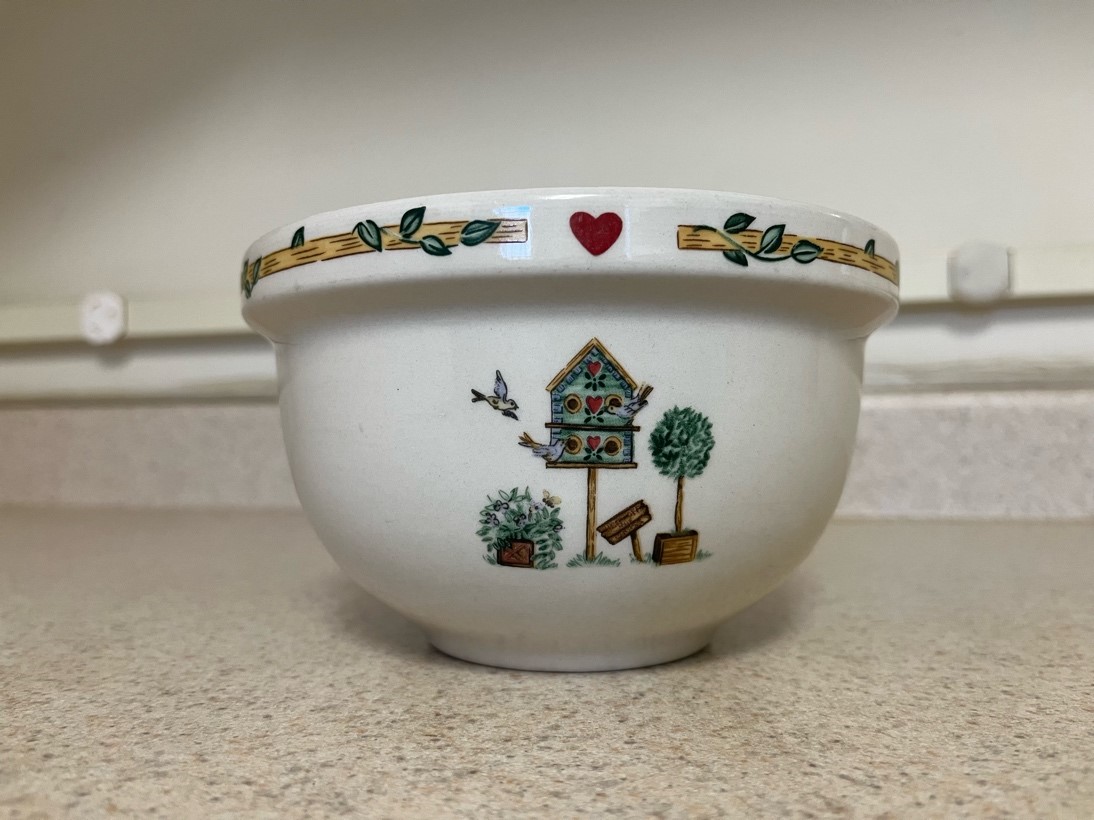
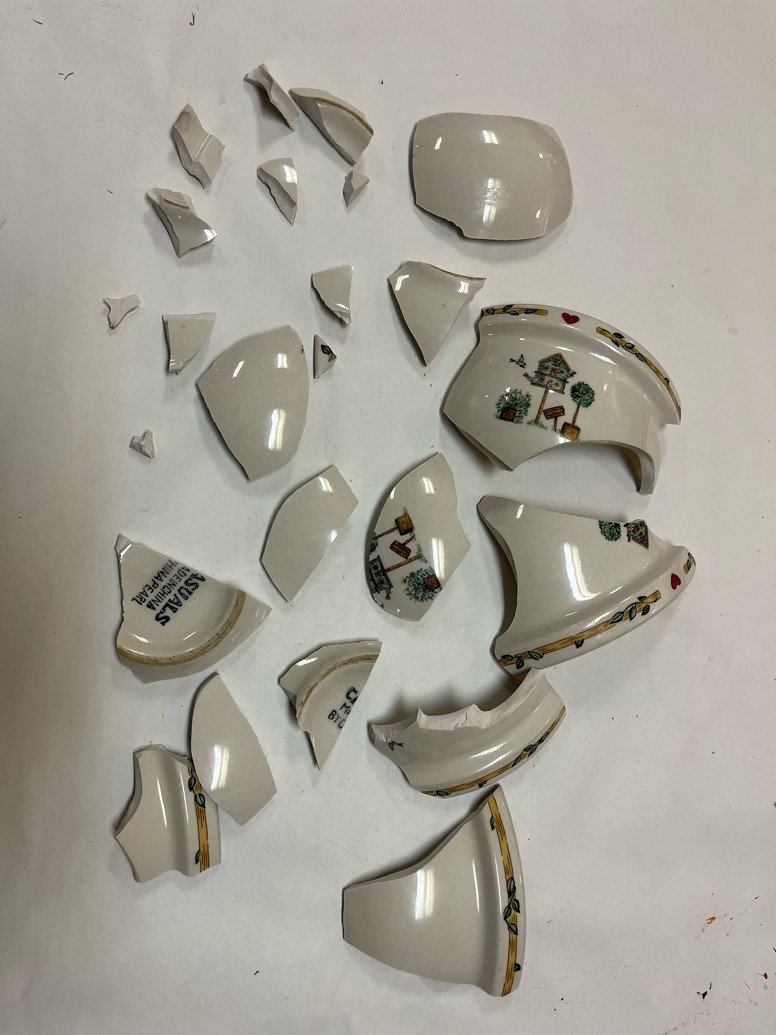
If you visited Ferry Farm on October 21, 2022, you may have heard a loud crash coming from the archaeology lab – don’t worry, it was on purpose! During my fall semester internship at the Ferry Farm Archaeology Department, I had the pleasure of learning how to mend ceramic vessels, and like any skill, practice makes perfect. I purchased a cheap ceramic bowl from Goodwill and purposefully shattered it so I could practice putting it back together again. Follow along as I take you through the process!
Bowl in one piece before being broken
Here is what the bowl looked like when I first bought it – in one piece! I chose this bowl because it was a good size: not too big where it would be too long of a project, but not too small where it would only take a few days to complete.
Breaking the bowl
Next came the fun part: breaking it! I placed the bowl inside a plastic bag so that all the pieces would stay together. Then, against my natural instinct, I threw the bag onto the ground and broke it into pieces! Notice how some are larger than others- this means that I had to be very careful as to not accidentally exclude a small piece from the entire bowl.
Taping sherds
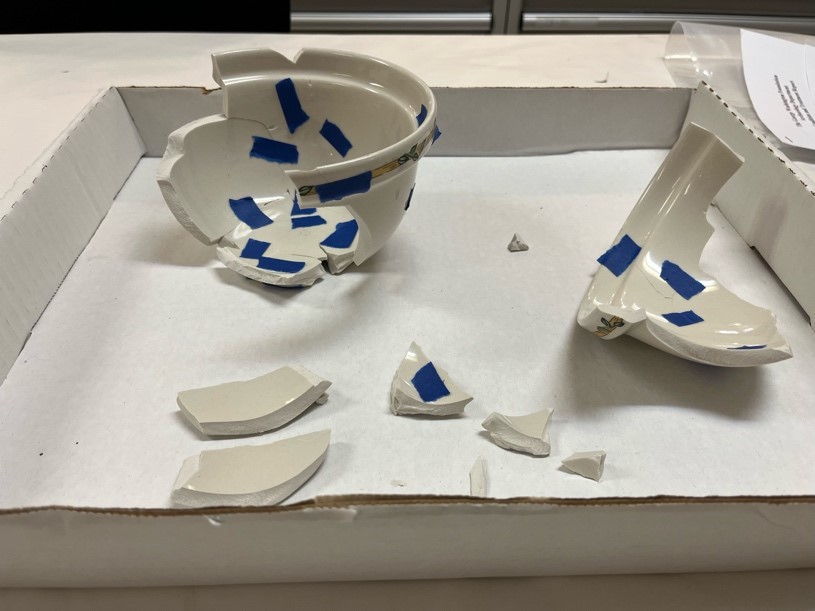
After collecting all the sherds, my next step was to figure out where everything goes by taping the sherds together. This process allowed me to plan out the order in which the sherds would be glued together. I used blue painter’s tape to do this because it doesn’t leave residual adhesive on the surface of the sherds. This same tape is used when mending the ceramics found archaeologically at Ferry Farm.
More taping
More taping… it’s coming together!
Here is the completed bowl after taping! Once all the sherds were back in their rightful places, it was time to carefully plan out how I wanted to glue them. When mending, you don’t want to just start gluing together the first pieces you know fit together. It is important to take into account the shape of the vessel so that you leave as few gaps between the sherds as possible. I developed a plan to start from the base and work my way up to the rim of the bowl. With this done, it was time to start gluing!
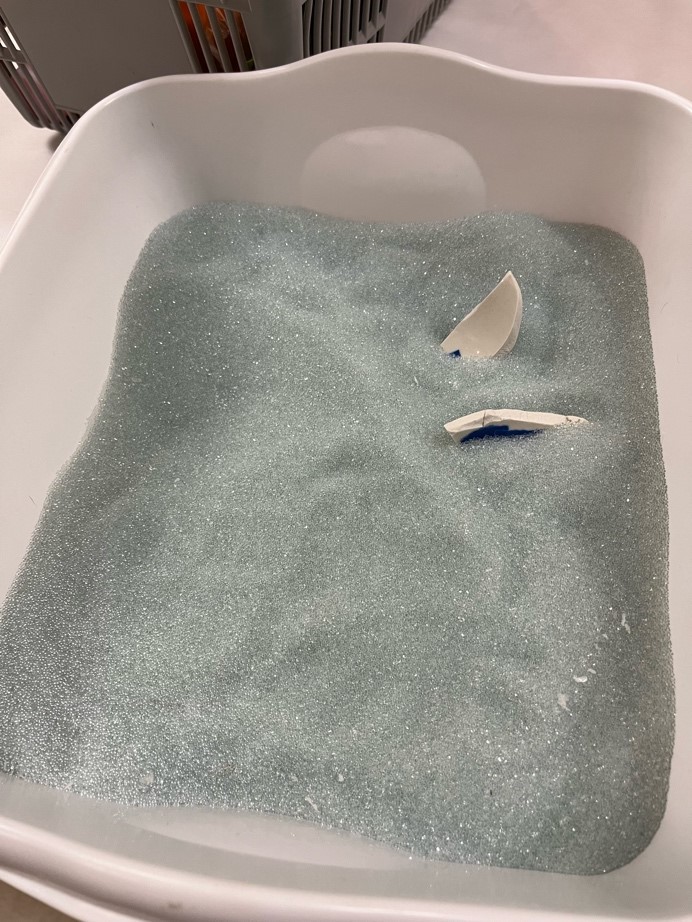
It is protocol in the Archaeology Department to mend ceramics using a reversible method. The glue I used was a solution of 35% B72 in acetone, which is removable with acetone. I started by coating the broken edges of the sherds with a less concentrated solution of the glue, 5% B72 in acetone. This prepped the sherds to have glue applied to it. After this, I applied 35% B72 to only one sherd to be mended and then held it together with its neighbor. After 10 seconds of holding the sherds together, they were sticking quite nicely. I then placed a few pieces of painter’s tape to ensure the glue would hold, and placed the freshly glued sections into a bucket filled with glass beads.
Glass beads…yes, everyone who goes to the lab runs their fingers through them.
The glass beads hold the glued sherds together and prevent them from shifting as the glue dries. I repeated this process for all the sherds over the course of a few days until…
Finished glued bowl
…the gluing was complete!
Here is the final product! Now, no mend is ever going to be perfect. Once a vessel is broken, there will always be misaligned sherds in the vessel due to the tension of the entire piece being broken.
So, why do we mend ceramics in the first place? It can help archaeologists understand what types of objects a site’s occupants would have used and what activities were taking place. It is also an important process in public interpretation: mended ceramics can help the public see what certain vessels would have looked like during a site’s target period of significance.
Finally, keep in mind that what I did with this bowl was only practice: actual mending with sherds excavated from an archaeological site does not go as smoothly as this. Only a small percentage of a vessel is typically found and thus able to be mended. The reason why so few sherds of one vessel are found is because decades and centuries of being in the ground allows for sherds to get mixed up and moved due to bioturbation (movement of soil by animals such as rodents and insects), erosion, and in some cases, agricultural plowing.
It can be daunting to look at a blank space and realize you are in charge of filling it. And not just filling it, you need to create something that will leave a lasting impression on the public. The process of creating an exhibit is much more complicated than it seems. From the initial idea to the final product, there are many steps that require careful attention.
With countless artifacts in the Archaeology Lab, finding inspiration for a topic was easy. Once I settled on 18th Century tea practices, everything seemed to fall into place. There were many subjects I could have focused on from this topic. In order to connect the idea to Ferry Farm and the Washington legacy, I chose to focus on Betty Washington and what she would have learned from her mother growing up at Ferry Farm.
This inspiration came from an archaeologically excavated pewter teaspoon handle with the initials ‘BW’ stamped into it. It is clear that Miss Betty Washington was the owner of this spoon. The spoon was likely part of a children’s tea set that Betty was given in order to teach her the intricacies of the American Tea Ceremony. This education was Mary’s legacy for Betty; it taught her how to be a proper gentry lady and interact with the upper-class circles in Virginia.
Teaspoon handle with “BW” initials.
Once I picked my topic, it was time to begin researching. Research is the backbone of any exhibit, though it might not be the most exciting part. I was able to obtain an understanding of the Tea Ceremony from my research that I applied to my specific topic. The biggest question on my mind throughout my research was: Why was this important for Betty?
While working on research, I was simultaneously creating a reproduction 18th Century creamware teapot. With the help of the Archaeology Lab Forgeries Department, I quickly transformed a Goodwill find into delicate creamware with a rose motif. The pot is the centerpiece of the exhibit on 18th Century tea practices. Many scholars wrote that the teapot is the literal and figurative center of the ceremony, bringing people together and initiating the ceremony. This concept inspired my placement of the teapot for the exhibit.
Hand painting of reproduction teapot.
After concluding my research, writing the signs for the exhibit, and finishing the replica pot, I had to choose the artifacts to include in the exhibit. Throughout this process, I kept my thoughts on Betty. The BW teaspoon handle was set aside for the exhibit as well as the replica teapot. Including teaware from Ferry Farm and Kenmore displayed the continuity of Betty’s gentry practices throughout her life. A slop bowl excavated from Kenmore, as well as a teacup and a saucer excavated from Ferry Farm were both chosen for the exhibit in order to support that point.
Once this was all completed, the excitement truly began. I saw my work come to fruition when I set up the display in the conservation window of the Archaeology Lab. Being able to share what I had learned with the public was an excited prospect. The exhibit is currently on display and can be seen in the Ferry Farm Visitor Center.
Intern Gillian Both standing behind her exhibit.
This process has taught me a lot about exhibit design and the research process. I couldn’t have completed the exhibit without the Archaeology Lab staff helping me along every step of the way. I encourage you to go and visit the lab to see the exhibit and learn more about archaeology at Ferry Farm.
The story of Mary Ball Washington is one of overcoming a lifetime of adversity. Often overshadowed by her larger than life son George, Mary’s place in history fluctuated from saint to shrew with many historians ignoring the obstacles she faced and overcame. The archaeological record sheds light on some of the strategies Mary used to navigate her way through mid-18th century life as a widow while trying to maintain her own social status and that of her children. Fragments of highly-specialized ceramics excavated at Ferry Farm, the plantation Mary called home for much of her life, speaks to her efforts.
Specialized dishes are those designed for a very specific job unlike, say, a bowl which is multi-purpose. We have uncovered evidence of many dishes Mary owned that fulfilled single tasks. These type of ceramics are a sign of gentility. Most households could not afford these items and likely did not possess the resources to make the food and drink that they were designed to hold.
As the 18th century progressed, so did dining habits. Increasingly, people of means gravitated toward dinners with multiple courses of entrees, appetizers, beverages, and deserts. Previously, most meals consisted of large one-pot creations with multiple ingredients. In order to pull course cooking off, one required the specialized dishes designed for serving multiple courses.
One prime example of such specialized dishes from Ferry Farm is Mary’s elaborately decorated creamware sauce boats. The sauce boats are a luxury in and of themselves. They’re highly decorated and were very fashionable at the time. Not only were they expensive, but they showed that Mary had the refinement to serve her guests the fancy sauces being introduced into colonial cooking. They also indicated that she had a trained kitchen staff of enslaved workers capable of executing these new and intricate recipes. You never thought a sauce boat could hold so much meaning, did you?
Portion of a highly-decorated creamware sauce boat that belonged to Mary Washington.
Fragments of an extremely fancy white salt glazed fruit dish are further examples of Mary’s calculated purchasing of dishes. Previously written about here and here, this dish was meant to display fruit, another luxury in the 18th century. Being able to afford non-local or out-of-season fruit was a status symbol and necessitated the proper dish to proudly display the fruit. To put the rarity of fruit in perspective, in colonial America, pineapples were so expensive you could rent one for display at parties in the holiday season because most people couldn’t afford to buy one outright. While renting a fruit may seem ridiculous to modern readers, the action highlights just how important being seen to own certain items was during the colonial era. Of course, we still engage in this same behavior today, but just not with pineapples.
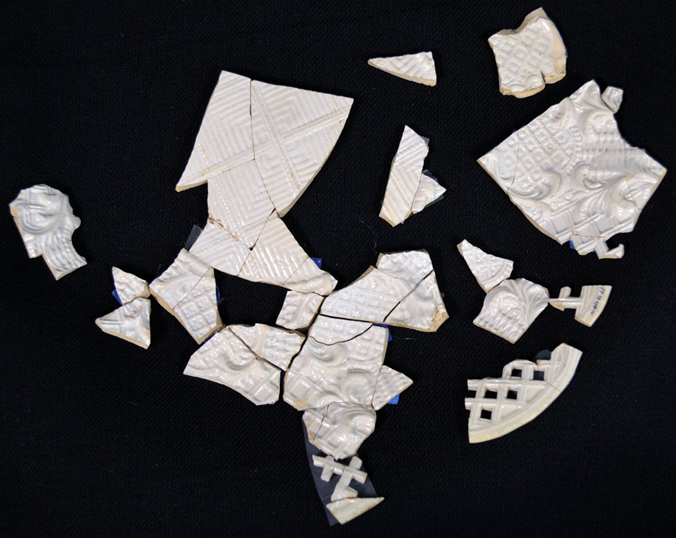
Fragments of a white salt-glazed fruit dish excavated at Ferry Farm and a complete example from the collection at Kenmore (above).
Ferry Farm archaeologists also excavated fragments of two creamware condiment dishes. Once again, the ability to serve various condiments to dinner guests conveyed status. Condiments could include relishes, dips, mustards, ketchups (mushroom ketchup being the preferred type), and pickled vegetables such as capers. Castor sets were also a way to serve other condiments such as olive oil, vinegar, pepper, etc. Generally, these castor sets were only owned by well-to-do households in the colonial period. The base of a creamware castor was recovered at Ferry Farm.
Creamware castor base excavated at Ferry Farm.
The fact that so many of Mary’s specialized ceramics are made of creamware should also be noted. Creamware was invented in 1762 and wasn’t the most expensive type of ceramic (that was porcelain) but it was highly fashionable. Mary, as a widow with five children and a diminished income following her husband’s death, likely couldn’t afford much porcelain. She opted for the less expensive but still highly-desirable creamware, instead.
The Washington family went to great lengths to demonstrate their status and refinement to visiting friends, neighbors, and relatives. At Ferry Farm, this burden fell solely on Mary after the death of her husband. Her specialized ceramics served to illustrate her place within the gentry class despite her diminished income and refusal to remarry after being widowed. Her goal was to remain independent while raising five children to be successful adults and members of the Virginia gentry class. In doing so, she likely realized that the socioeconomic security of her children would ensure her own into the future as well. Consequently, it was important that Mary cultivate a refined household with appropriate table and teawares. Ceramic artifacts from Ferry Farm reveal a woman who carefully selected choice ceramics to perform very specific tasks, while at the same time not overextending her budget. These ceramics contributed to her goal of remaining a part of the gentry class and teaching her children genteel habits so they could do the same. It was a task in which she overwhelmingly succeeded.
Mara Kaktins, Archaeologist Ceramics & Glass Specialist
The 18th century was dominated by the ideas of the Enlightenment which gave rise to a range of principles like liberty, equality, constitutional government, and free enterprise. It was a revolution in thought led not by politicians and soldiers, but by a handful of thinkers, scientists, artisans, and merchants. Josiah Wedgwood was a thinker, scientist, artisan, merchant all rolled into one. He became one of the founding fathers of the industrial revolution, creating a new artistic industrialism that used the division of labors, scientific experimentation, and commerce to make affordable yet quality products that democratized artistry.[1]
Josiah Wedgwood (1780) by George Stubbs. Enamel on a Wedgwood ceramic tablet at the Wedgwood Museum in Barlaston, Stoke-on-Trent, England. Credit: Wedgwood Museum / Daderot / Wikipedia
In his heart, Wedgwood believed that man could create a better world through self-improvement, education, and commerce. Although he lived in England, he saw the American colonists’ struggle against taxation imposed on them and America’s potential as a capital of finance and freedom smothered under a foreign ruler. He was naturally sympathetic to their plight. Wedgwood spent the Revolutionary War trying to walk the fine line between being a patriotic British merchant and a radical dissenter.
Josiah Wedgwood was born in July of 1730 in Burslem, England to a family of potters that stretched back more than four generations. When he was a child, he survived a bout of small pox that left his left leg too weak to work a potter’s wheel. This led him to focus his energies on design rather than the physical production of ceramics.[2]
In 1759, he set up his own pottery called Ivory Works. The pottery had swift success and became one of the largest manufacturers of Staffordshire pottery, known particularly for fine earthen and stonewares. Demand for quality minimalistic earthenware design was high among the English at the time. Wedgewood devoted himself to glaze development, kiln technology, and marketing to fulfill demand. He perfected a cream-colored earthenware which took over 5000 glaze tests to get the color just right. He developed a new colored unglazed body known as “jasper” that allowed for the production of two-color ornamental wares to match the public’s desire for minimalistic, neo-classical styling.[3]
Wedgwood became a producer of fine ceramics and transformed pottery-making into an industry that rivaled European porcelain in elegance of shape, durability, and lightness of weight. In 1765, shortly after opening his first London showroom, he got a huge break when he was invited to take part in a contest to design a tea set for Queen Charlotte. It took months of experiments but his gilded tea set with green flowers won the competition. With royal recognition, Wedgwood became a Georgian super brand, distinguished by quality while delivering artistic perfection on an industrial scale.[4]
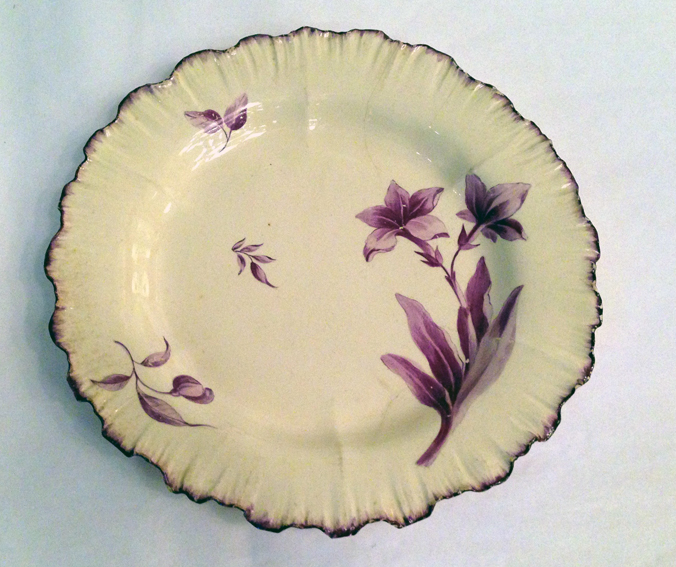
Dating from about 1765, this circular Wedgwood plate has a molded shell edge and is finely painted in deep purple with flowers and leaves. The edge is feathered in purple.
Why was America so important?
In the middle of the 18th century, a new consumer group appeared: the middling class. This middling class was particularly prevalent in the American Colonies. They wanted British goods like sugar, coffee, chocolate, and tea and their accompanying accessories and ceramics to show off their new social status and refinement.[5]
Pre-Revolutionary War, America did not have a single pottery manufacturer to create tea accoutrements like teapots and saucers capable of matching the quality and aesthetic of Wedgwood. Thus, America became a good client in the booming British export trade and one of Wedgwood’s most important overseas markets. The colonies, in fact, became such a huge market that “around half of all English exports of copperware, ironware, glassware, earthenware, silk goods, printed cotton and linen goods, and flannels were shipped to colonial consumers.” Josiah took advantage of this boom and packed as many crates as possible on Liverpool ships bound for the New World.[6]
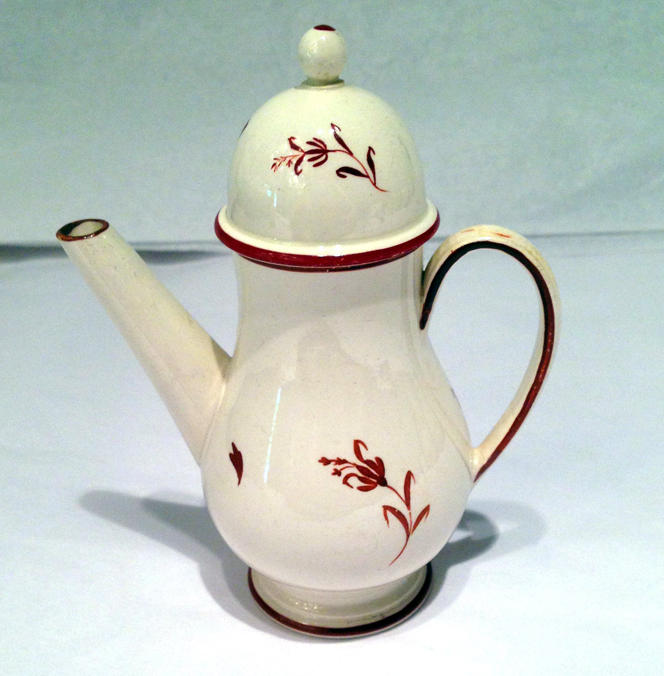
This miniature covered creamware Wedgwood coffeepot dates from between 1785-1800. It has a plain loop handle, straight spout, and knob finial and is painted with underglaze iron red scattered flower sprays and border stripes. The lid is dome-shaped.
“All the world are with the Ministers & against the poor Americans…”
There were two reasons why Josiah Wedgwood disagreed with the war against America, one was philosophical and one was financial. Wedgwood enjoyed the American boom in ceramic exports and worried about what taxation and colonial unrest might have upon his trade. Many businessmen with interests in America saw a threat to the market for British goods with undue taxes like the Stamp Act of 1765. They agreed with future Prime Minister Lord Pitt’s criticism “that this kingdom has not right to lay a tax on the colonies…Trade is your object with them and taxing was ill advised. If you do not make suitable laws for them, they will make laws for you.” Because of the strong opposition from merchants and American resistance, the Stamp act was repealed. However, that did not ease the anxieties of Wedgwood and other merchants.[7]
Wedgwood knew he had much to lose if American markets became inaccessible because of war stating, “the bulk of our particular manufacture you know is exported to foreign markets for our home consumption is very trifleing [sic] in comparison to what is send aboard, …this trade to our Colonies.” He continued, “we are apprehensive of losing in a few years.”[8]
Legislation continued to cut into Wedgwood’s trade and profits. Besides imposing an indirect tax on the colonists, the Townshend Acts of 1767 got rid of a refund on the duty that manufacturers paid, which meant it would cost more to export goods to the colonies. In 1775, Parliament issued the New England Restraining Acts, restricting the Colonies’ trade and commerce to Great Britain, Ireland, and the British West Indies. This was Parliament’s response to the declaration of the Continental Congress in the fall of 1774 instigating a “non-consumption agreement” and promising “we will not import, into British America, from Great Britain or Ireland, any goods, wares, or merchandise whatsoever.” By the next year, diplomatic and commercial relations had broken down and, three months before the Declaration of Independence was signed, American ports were officially closed to British trading ships.[9]
This all had a major effect on commerce for merchants and manufacturers like Wedgwood. In 1770, customs and excise officers recorded over 1.2 million pieces of glass and earthenware shipped to America. In 1775, less than 139,000 pieces had been shipped.[10]
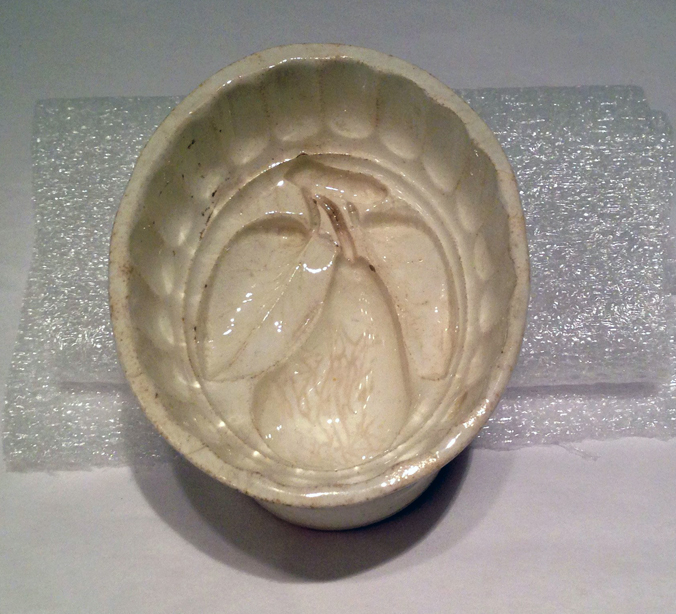
An oval form with a tall, off-center oval foot rim. The inside is molded with fluted sides, a deep pear, and two flanking leaves on bottom. This Wedgwood form dates from between 1810 and 1820.
Enlightenment Philosophy at Work
While war took a large chunk out of Wedgwood’s bottom line, that was not the only reason he opposed war. He was a man of the Enlightenment and held fast to many of the philosophical principles that formed the basis for this new America.
Josiah was born and raised a Unitarian. The seven principles of Unitarianism include the belief in the inherent worth and dignity of every person, the free and responsible search for truth, the use of democratic process, and peace, liberty, and justice for all. Wedgwood grew up in a society that created its own culture distinct from the Anglican status quo, a culture with a strong sense of morality and responsibility. So his interests in the ideas of the Enlightenment were not too surprising.[11]
Josiah delved into the Enlightenment, reading many of the writings from the great thinkers of the time including John Locke’s Treatise on Education, Adam Smith’s Wealth of Nations, and Thomas Paine’s Common Sense. They all talked about concepts of self-improvement, education, liberty, and inalienable rights. Wedgwood truly believed in these principles and put them into practice in his own life and business by trying to use his company and wealth for the social good. He reinvested profits back into the company to create a better standard of living for the employees in under his care. Schools were started for the workers’ children, additional training was made available for workers, and work place safety was improved with the elimination of harmful lead glazes and the constant search for better environmental practices. He believed that the people mattered more than the profit.[12]
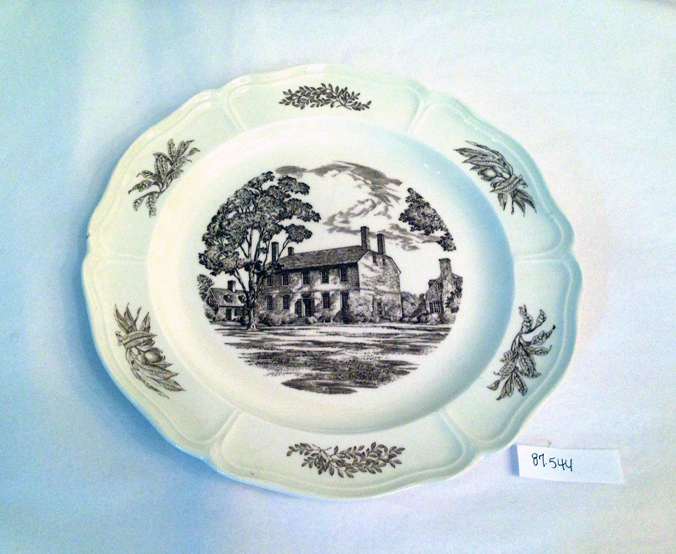
A “Queen’s” shape Wedgwood plate from 1956 with a view of Kenmore as the center transfer-print. The six lobed rim is transfer-printed in brown with various leaves.
With the American Revolution and then the French Revolution, he saw a chance to create societies built upon Enlightenment philosophies that could flourish without an authoritarian regime and without imposition of unnecessary taxation. A society ruled by reason, truth and free enterprise. Wedgwood’s idealism was high. Life does not always follow abstract principles, however, and he would struggle to balance his ideals with political, financial, and social realities.[13]
He supported America’s right to self-rule and knew the colonists were a force to be reckoned with commercially. Yet, he was also a British businessman with a prominent reputation. At home, he had to balance his principles with his need to seem patriotic. He tried to stress to government ministers the economic devastation a war would have on Britain but he was clear in his opinion of “the absurdity, folly & wickedness of our whole proceedings with America.”[14]
Wedgwood lived to see America’s victory in the struggle for independence, passing away in January 1795. He and his business had survived the war with their Enlightenment ideals and financial success intact.[15]
Heather Baldus
Collections Manager
[1] Wilson, A.N., The Genius of Josiah Wedgwood, BBC Two, April 19, 2013.
[3] Perry, Mike. “WEDGWOOD (JOSIAH WEDGWOOD & SONS LTD),” Pottery Histories potteryhistories.com/page99.html; Wilson, The Genius of Josiah Wedgwood; “Josiah Wedgewood (1730-95) ,” The Royal Collection Trust.
[4] “Josiah Wedgewood (1730-95) ,” The Royal Collection Trust; Wilson, The Genius of Josiah Wedgwood.
[5] Berg, Maxine. “Men and Women of the Middling Classes: Acquisitiveness and Self-Respect.” Luxury and Pleasure in Eighteenth-Century Britain, Oxford University Press, 2007, 199-246; Dolan, Brian. Wedgwood: The First Tycoon. New York City, Viking, 2004, 74-75; Wilson, The Genius of Josiah Wedgwood.
[6] Wilson, The Genius of Josiah Wedgwood; Dolan, 250, 75.