On walls of the Historic Kenmore’s drawing room hang two large portraits of a man and a woman. The man is an older gentleman in a serene outdoor setting, looking quite dignified and sober in a brownish knee-length jacket, knee breeches and long waistcoat. His eyes rest on the portrait viewer, one hand on moss-covered rocks, the other on his hip, and his head turned slightly to his left. Across the room, the woman sits at a slight profile with her head turned to her left to face the portrait viewer. She wears a billowing blue and white dress and holds two pink roses in her right hand while her left arm casually sits on a marble top table. She is indoors with what appear to be some drapes billowing behind her. The man and woman are Fielding Lewis and Betty Washington Lewis, the owners of Kenmore.
Fielding and Betty’s portraits were commissioned by the couple and painted by prolific colonial artist John Wollaston in the 1750s. On the surface, these paintings are just two genial portraits that provide us with visual records of the heads of the family. Through the subtle symbolism, however, they also tell a larger story of how Fielding and Betty wished to be portrayed publically to their contemporaries as well as to posterity.
Portraits first became a popular mode of expression for the aristocracy and the wealthy during the Renaissance. These paintings were usually large scale affairs meant to be displayed and seen by the public. The paintings depicted people with expensive goods, fine cloth, rare flowers, and exotic pets. Whether the portraits’ subjects actually owned these items was less important than the suggestion including the items made. In fact, these paintings were filled with symbolism–images, objects, or colors representing ideas and that allow the artist to go beyond the obvious to create links between otherwise different concepts. A color can depict character, a flower personality and a fabric economic status.[1]
Through symbolism, portraits were used to reflect social status, wealth, success, power and cultural refinement. A portrait’s details were integral to the story of the painting and many factors had to be taken into account. Aspects such as artist, style, background, color, fabric, and accessories all needed to be discussed to create the portrayal desired by the patron.[2]
Centuries after the Renaissance, the importance of portraiture as a record of status and position in society had not changed and the custom had become more popular outside of the aristocracy as well as outside of Europe. Even in faraway British North America, the wealth of the gentry, or upper class, desired portraits to show their status and position. Fielding Lewis and Betty Washington Lewis, members of the gentry with a wealthy business in Atlantic World trade, were no exception. Mr. and Mrs. Lewis wanted to portray themselves as socially refined not only to cement their place in the community but to allow for a continued rise in their status. Accordingly, they sat for portraits by John Wollaston.
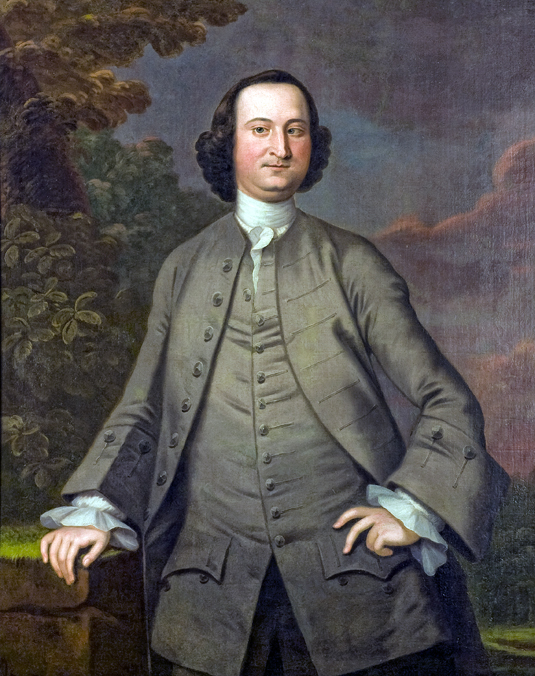
The most noticeable thing about Fielding’s portrait is the muted colors used in the background and in his clothing. One of the most visually striking symbols in portraits was the colors used to represent the subject. While color may not have inherent meaning, it can be made meaningful through context. The colors in the background, clothing, and accessories all relate to the overall message or story being told by the artist. The browns, greens, and beiges in Fielding’s portrait create a natural and relaxed atmosphere. The nature background is a stylized classical bucolic setting that helps strike a balance between Fielding’s muted clothing palette and the landscape setting. The woodland glen signifies a natural sincerity that, when mixed with the brown and beige of his ensemble, creates the feeling of calmness, reliability, dependability and an earthy richness. All of these traits are important for a successful merchant. Fielding was telling visitors to his house that he was a person they could do business with and trust.[3]
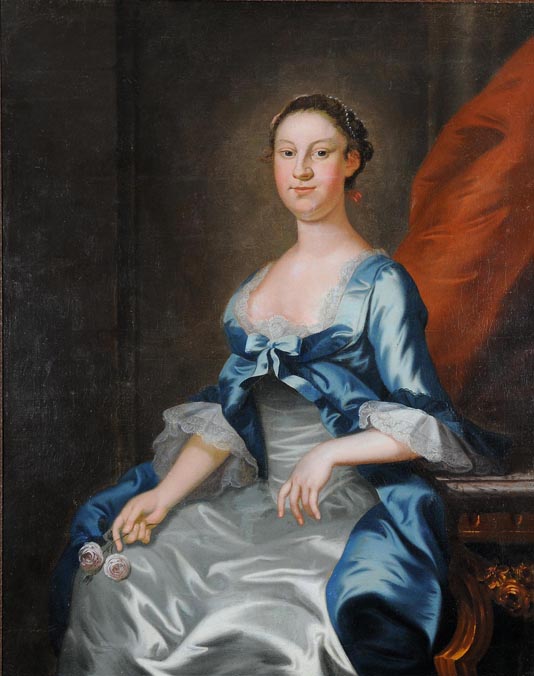
Betty’s portrait uses color, context, fabric and an accessory to illustrate her own geniality and her family’s affluence, for not only as a Lewis but as a Washington as well. The background around Betty, who is at the center of the portrait, offers hints of this grandeur with brown walls and a heavy brown billowing curtain creating a frame of luxurious richness. To add to the opulence, Betty is poised with her arm resting on an ornate Rococo-style marble top table with heavily carved gold legs. The portrait conveys that she can afford such ornamental comforts. Next to the table, Betty in her flowy blue and white satin dress with a pair of roses resting on her right knee is the focus. Blue was a popular color for ladies and was common in many portraits painted by Wollaston. The color gives the sitter not only an air of peace and calmness but also of restraint and intelligence. The satin denotes a luxury and fashion available to only those with means. Meanwhile, the pink rose tells of Betty’s grace, beauty and gentility. Overall, the portrait depicts a sophisticated and refined 18th century woman, a wife and mother who adds balance and depth to her husband’s trustworthiness and professionalism.[4]
Fielding and Betty did not stop with portraits of themselves. About twenty years after sitting for John Wollaston, they commissioned famed painter Charles Willson Peale to produce several portraits of their offspring. There are two in Kenmore’s collection.

One of these Peale portraits depicts John Lewis, the eldest son of Fielding and his first wife, Catharine who sits with one hand on his hip and one hand on a book. The posture gives John a sense of self-assurance and capability. Unlike his father’s subdued color palette, John’s jacket and waistcoat are an amazing red with gold detailing. The red paired with the gold creates warmth but also projects a sense of power, strength and confidence. The book in his the left hand gives an air of knowledge and awareness.
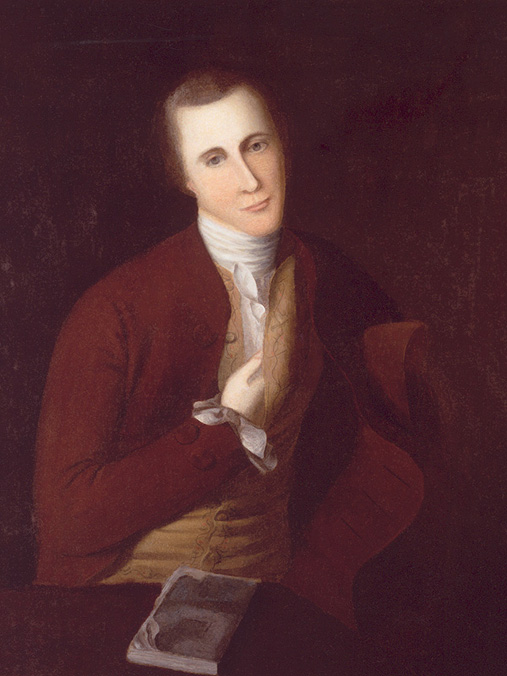
The second Peale portrait in the collection depcits Fielding Lewis Jr., the eldest son of Fielding and Betty, striking a very traditional pose with a hand tucked in his jacket and a slight tilt of the head. The pose is welcoming, kind and is the embodiment of a thoughtful young gentleman. Much like his father he chose a subdued color palette with an earthy reddish-brown jacket and goldish yellow waistcoat, which convey a sense of reliability, stability and affability. The brown background adds a natural simplicity with soothing warmth. Additionally, like his brother, there is a well-read book by his side indicating a sense of learning and mindfulness. This portrait’s symbolism reflects the more aspirational messages in these paintings as Fielding, Jr. struggled with money problems for most of his life and even ended up in debtors’ prison.
Later portraits in Kenmore’s collection contain other fascinating symbolism that tells the stories of the paintings’ subjects. These portraits visually record family history or emphasize familial connections.
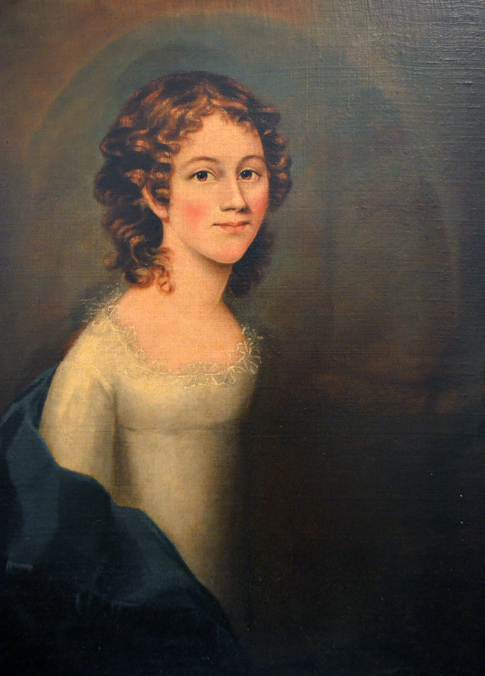
This 19th century portrait of Eleanor Rosalie Tucker, the great granddaughter of Fielding and Betty, is painted in characteristic neoclassical style with direct lighting, soft features, rosy cheeks and a roundness of the face. The white muslin gown gives the young girl a purity and serenity beyond her years. The halo surrounding the sitter represents her delicacy and gives her an otherworldliness. This is appropriate as, sadly, she was painted for this portrait on her deathbed in 1818.

Finally, this portrait of the Wallace family painted in the mid-Victorian period is quite a unique painting in our collection with a fascinating twist to its symbolism. The portrait has a traditional composition but at the center is a large leashed bird in mid-flight. This bird is a rebus, a puzzle device used to visually depict words and/or phrases. They are used extensively in heraldry to hint at the name of the bearer. This painting’s bird rebus is attached to a young girl named Mary Byrd Wallace, the great, great granddaughter of Fielding and Betty Lewis.
Portraits are sometimes the only visual representation we may have of a historic figure. These portraits do more than capture a person’s appearance, however. The wealthy and socially important also used portraits and their symbolism to emphasize their wealth and high status. Portraits also visually recorded family history or emphasized familial connections. For the Lewis family, like everything in their house and like their house itself, their portraits revealed how they saw themselves and, perhaps more importantly, how they wanted others to see them whether in the 18th or the 21st centuries.
Heather Baldus
Collections Manager
[1] “Faces of a New Nation: American Portraits of the 18th and early 19th centuries”, The Metropolitan Museum of Art Bulletin, Summer 2003: 11
[2] Crown, Carol. The New Encyclopedia of Southern Culture, Vol. 23, University of North Carolina Press, 2013: 150-151.
[3] Centeno, Carlos. “Lose the Color Symbolism Chart: The Unpredictable Meanings of Color,” July 6 2016. https://medium.com/@carlitocenteno/lose-the-color-symbolism-chart-the-unpredictable-meanings-of-color-edc81db6541e; “Faces of a New Nation,” 13
[4] “British and American Grand Master Portraits of the 1700s”, National Gallery of Art. https://www.nga.gov/features/slideshows/british-and-american-grand-manner-portraits-of-the-1700s.html; Centeno; De la Tour, Charlotte. Le langage des fleurs, 1819: 58; Hooper, Lucy. The Lady’s Book of Flowers and Poetry, 1846: 248.