
This time of year, I find it difficult not to reach into my freezer after dinner to get a cold, sweet dairy treat. Ice cream in cartons and scooped from behind a counter has become a part of the American experience. Ice cream was not always so easy to come by, however, as the ingredients and tools to make it were reserved for the most elite part of the population.
Ice cream has a complicated past that is often exaggerated, misinterpreted, and associated with individuals that probably have nothing to do with the creation of the icy treat. In the 20th century, companies fabricated a great deal of these origin stories to help sell this delicacy. Stories range from Ancient Rome to Martha Washington and Dolley Madison, some of which contain bits of truth, but are now inflated into full blown myths.
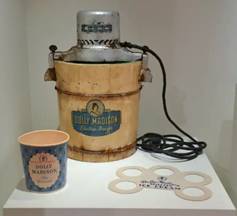
A “Dolly Madison” branded electric ice cream freezer, along with packaging for commercially made Dolly Madison Ice Cream. Source: The Montpelier Foundation.
Here is what foodways historians believe to be true based on the evidence we do have. The earliest known description of a frozen dairy product comes from China in the 7th Century. It most likely was not the recipe for this specific dessert that traveled the Silk Road to Europe, but the concept of freezing liquids using a combination of ice and salt. This combination creates an endothermic effect which draws heat from outside air that lowers the temperature of the ice to the point that it is able to freeze liquids, not just keep them cold. To put this discovery into perspective, humans discovered how to utilize fire about 790,000 years ago, but it was only about 1,400 years ago that humans discovered how to use cold in a similar fashion.[i]
Moving forward to Colonial North America, ice cream recipes were not hard to come by as even Hannah Glasse had a recipe “To Make Ice-Cream” in her popular book The Art of Cookery Made Plain and Easy.[ii] Thomas Jefferson, extensive traveler that he was, even recorded a recipe for vanilla ice cream, helping to establish its popularity in the English American colonies and new republic.[iii] Ice cream flavors usually depended on seasonal fruits that were easy to mash, but more interesting and savory flavors like parmesan and oyster also made their way into recipe books of the period.
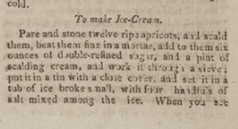
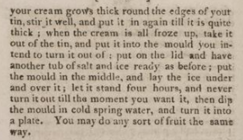
“To Make Ice-Cream” from The Art of Cookery Made Plain and Easy by Hannah Glasse Source: Library of Congress.
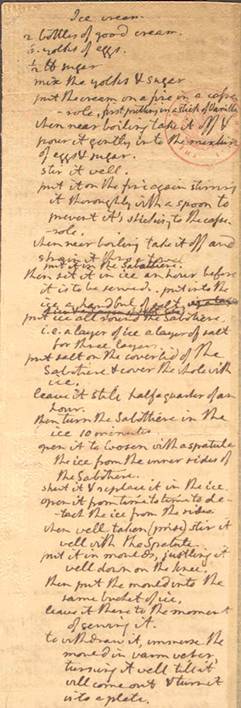
Thomas Jefferson’s recipe for ice cream. Written in his hand. Source: Library of Congress.
So, if it wasn’t availability of recipes and the concept of freezing the cream to make the dessert that stopped Americans from making this treat to cool off in the summer, then what was it? It was the capability of keeping ice, the labor it took to churn the cream by hand, the expensive imported ingredients, and the specialty serving pieces needed to put the frozen delight on the table for guests.
At this time, if you wanted ice, you had to harvest it from frozen lakes, ponds, or rivers in the winter. Anyone could do that, but preserving it was the challenge. Underground ice houses specifically built to preserve the ice until the warmer months were reserved for the elite.
Also remember that colonists had to typically import both the sugar to sweeten the cream and the salt for the ice. Both white sugar and salt were used sparingly. So, a recipe meant to show off using a liberal amount of both was something many could not afford to waste resources on.
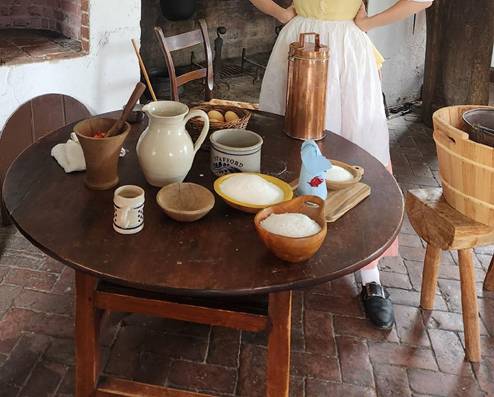
Ingredients used to make strawberry ice cream. Source: The George Washington Foundation.
Ice cream could be made using either a pewter vessel or a specialty sorbetiere. A sorbetiere was a French invention made specifically for ice cream production that was essentially just a copper container with a lid. Either the sorbetiere or pewter bowl with the ice cream mixture was placed into a container of ice and salt. The container was then churned, occasionally stopping to scrape the mixture off the sides when it began to freeze. This process is not unlike what happens in both hand crank and electric ice cream makers from modern times, but all done by hand. On a Southern plantation wealthy enough to afford the ice, sugar, salt, and tools to make the ice cream, they’d also have to spare the time of an enslaved laborer for an hour or more to churn the dessert by hand.
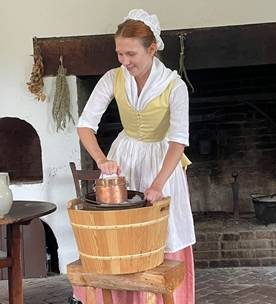
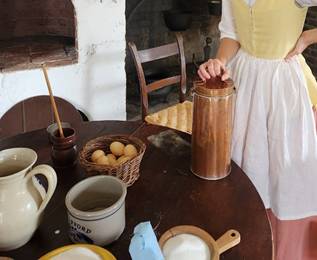
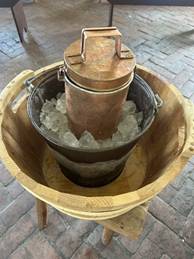
(Left) Churning the ice cream. Source: Emma Schlauder. (Center & Right) Copper sorbetiere. Source: The George Washington Foundation.
George and Martha Washington were possibly introduced to ice cream by the Royal Governor of Virginia, Lord Botetourt in 1770 at the Governor’s Palace in Williamsburg, where there is evidence of an ice house and ice molds used in the production of ice cream.[iv] Following George’s introduction to ice cream, he ordered an ice house to be built at Mount Vernon and he acquired a “cream machine for ice” and other items to help make and serve ice cream to guests.[v] Martha Washington was known for hosting gatherings during George’s presidency where she served prestigious treats like Lemonade and ice cream, as noted by Abigail Adams in 1789.[vi]
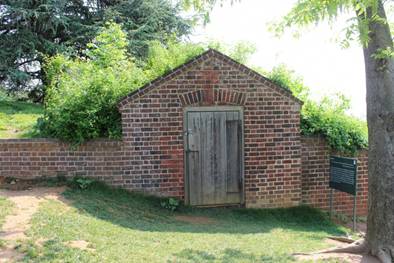
Ice house at Mount Vernon. Source: Mount Vernon Ladies’ Association.
When I prepare for Taste Through Time Programs, I always look for evidence of what I am making at both Kenmore and Ferry Farm. Unfortunately, there is really no evidence of ice cream being served at either property during the occupation of the Washington and Lewis families. Despite the presence of The Art of Cookery Made Plain and Easy in Fielding Lewis’ probate inventory and loaves of white sugar in Betty Lewis’, there is currently no evidence of ice houses or ice cream making and serving equipage at either Kenmore or Ferry Farm from this period.
Allison Burgess
DAR Director of Education
[i] Theobald, M. M. (Winter 2010). Some Cold, Hard Historical Facts about Good Old Ice Cream. Colonial Williamsburg Journal. https://research.colonialwilliamsburg.org/Foundation/journal/Spring10/icecream.cfm
[ii] Glasse, H., Katherine Golden Bitting Collection On Gastronomy & Elizabeth Robins Pennell Collection. (1805) The Art of Cookery Made Plain and Easy; Excelling Any Thing of the Kind Ever Yet Published … Also, the Order of a Bill of Fare for Each Month in the Manner the Dishes Are to Be Placed Upon the Table, in the Present Taste. Alexandria: Printed by Cottom and Stewart, and sold at their Book-Stores, in Alexandria and Fredericksburg. [Pdf] Retrieved from the Library of Congress, https://www.loc.gov/item/05005034/.
[iii] Berkes, A. (2013, June 28). Ice Cream. Monticello.org. https://www.monticello.org/research-education/thomas-jefferson-encyclopedia/ice-cream/
[iv] Theobald, M. M., Some Stone Cold Historical Facts.
[v] Ledger B (photostat, Mount Vernon Ladies’ Association), 198a.
[vi] “Abigail Adams to Mary Smith Cranch, 9 August 1789,” Founders Online, National Archives, https://founders.archives.gov/documents/Adams/04-08-02-0214. [Original source: The Adams Papers, Adams Family Correspondence, vol. 8, March 1787 – December 1789, ed. C. James Taylor, Margaret A. Hogan, Jessie May Rodrique, Gregg L. Lint, Hobson Woodward, and Mary T. Claffey. Cambridge, MA: Harvard University Press, 2007, pp. 397–401.]

