Lives and Legacies

Tag: George Washington

  • Ice Cream: A Scoop of History

    This time of year, I find it difficult not to reach into my freezer after dinner to get a cold, sweet dairy treat.  Ice cream in cartons and scooped from behind a counter has become a part of the American experience. Ice cream was not always so easy to come by, however, as the ingredients and tools to make it were reserved for the most elite part of the population. 

    Ice cream has a complicated past that is often exaggerated, misinterpreted, and associated with individuals that probably have nothing to do with the creation of the icy treat.  In the 20th century, companies fabricated a great deal of these origin stories to help sell this delicacy.  Stories range from Ancient Rome to Martha Washington and Dolley Madison, some of which contain bits of truth, but are now inflated into full blown myths.
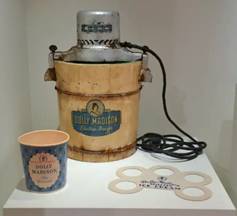
    Dolly Madison electric ice cream freezer on display

    Moving forward to Colonial North America, ice cream recipes were not hard to come by as even Hannah Glasse had a recipe “To Make Ice-Cream” in her popular book The Art of Cookery Made Plain and Easy.[ii]  Thomas Jefferson, extensive traveler that he was, even  recorded a recipe for vanilla ice cream, helping to establish its popularity in the English American colonies and new republic.[iii]  Ice cream flavors usually depended on seasonal fruits that were easy to mash, but more interesting and savory flavors like parmesan and oyster also made their way into recipe books of the period.
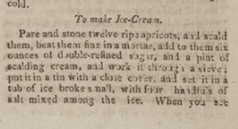
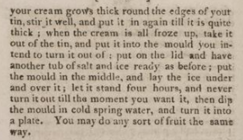
    text of how to make ice cream
    printed text of how to make ice cream

    “To Make Ice-Cream” from The Art of Cookery Made Plain and Easy by Hannah Glasse  Source: Library of Congress.
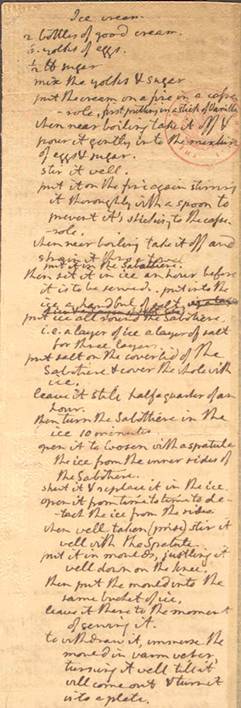
    Thomas Jefferson's written ice cream recipe

    Thomas Jefferson’s recipe for ice cream. Written in his hand.  Source: Library of Congress.

    So, if it wasn’t availability of recipes and the concept of freezing the cream to make the dessert that stopped Americans from making this treat to cool off in the summer, then what was it?  It was the capability of keeping ice, the labor it took to churn the cream by hand, the expensive imported ingredients, and the specialty serving pieces needed to put the frozen delight on the table for guests. 

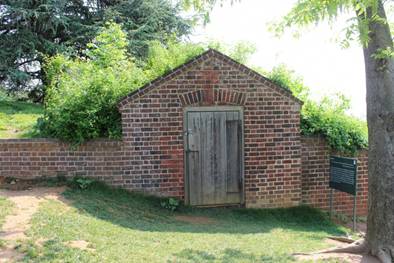
    At this time, if you wanted ice, you had to harvest it from frozen lakes, ponds, or rivers in the winter. Anyone could do that, but preserving it was the challenge. Underground ice houses specifically built to preserve the ice until the warmer months were reserved for the elite.

    Also remember that colonists had to typically import both the sugar to sweeten the cream and the salt for the ice.  Both white sugar and salt were used sparingly.  So, a recipe meant to show off using a liberal amount of both was something many could not afford to waste resources on. 
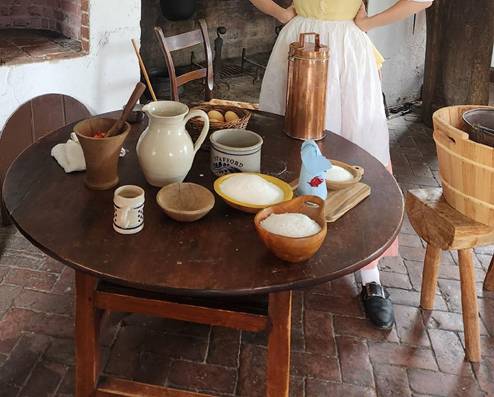
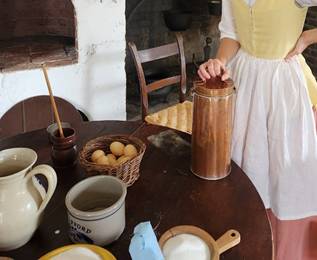
    ingredients laid on on a table for making ice cream

    Ingredients used to make strawberry ice cream.  Source: The George Washington Foundation.

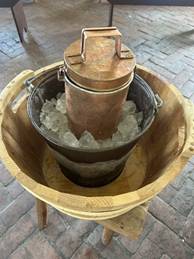
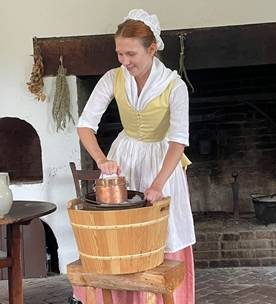
    Ice cream could be made using either a pewter vessel or a specialty sorbetiere.  A sorbetiere was a French invention made specifically for ice cream production that was essentially just a copper container with a lid.  Either the sorbetiere or pewter bowl with the ice cream mixture was placed into a container of ice and salt.  The container was then churned, occasionally stopping to scrape the mixture off the sides when it began to freeze.  This process is not unlike what happens in both hand crank and electric ice cream makers from modern times, but all done by hand.  On a Southern plantation wealthy enough to afford the ice, sugar, salt, and tools to make the ice cream, they’d also have to spare the time of an enslaved laborer for an hour or more to churn the dessert by hand. 
    woman hand churning ice cream in 18th century clothing
    a copper sorbetiere on table with ingredients
    copper sorbetiere sitting in bucket of ice

    (Left) Churning the ice cream. Source: Emma Schlauder. (Center & Right) Copper sorbetiere. Source: The George Washington Foundation.

    George and Martha Washington were possibly introduced to ice cream by the Royal Governor of Virginia, Lord Botetourt in 1770 at the Governor’s Palace in Williamsburg, where there is evidence of an ice house and ice molds used in the production of ice cream.[iv]  Following George’s introduction to ice cream, he ordered an ice house to be built at Mount Vernon  and he acquired a “cream machine for ice” and other items to help make and serve ice cream to guests.[v]  Martha Washington was known for hosting gatherings during George’s presidency where she served prestigious treats like Lemonade and ice cream, as noted by Abigail Adams  in 1789.[vi]
    Mount Vernon Ice House

    Ice house at Mount Vernon. Source: Mount Vernon Ladies’ Association.

    When I prepare for Taste Through Time Programs, I always look for evidence of what I am making at both Kenmore and Ferry Farm. Unfortunately, there is really no evidence of ice cream being served at either property during the occupation of the Washington and Lewis families. Despite the presence of The Art of Cookery Made Plain and Easy in Fielding Lewis’ probate inventory and loaves of white sugar in Betty Lewis’, there is currently no evidence of ice houses or ice cream making and serving equipage at either Kenmore or Ferry Farm from this period.

    Allison Burgess

    DAR Director of Education


    [i] Theobald, M. M. (Winter 2010). Some Cold, Hard Historical Facts about Good Old Ice Cream. Colonial Williamsburg Journal. https://research.colonialwilliamsburg.org/Foundation/journal/Spring10/icecream.cfm

    [ii] Glasse, H., Katherine Golden Bitting Collection On Gastronomy & Elizabeth Robins Pennell Collection. (1805) The Art of Cookery Made Plain and Easy; Excelling Any Thing of the Kind Ever Yet Published … Also, the Order of a Bill of Fare for Each Month in the Manner the Dishes Are to Be Placed Upon the Table, in the Present Taste. Alexandria: Printed by Cottom and Stewart, and sold at their Book-Stores, in Alexandria and Fredericksburg. [Pdf] Retrieved from the Library of Congress, https://www.loc.gov/item/05005034/.

    [iii] Berkes, A. (2013, June 28). Ice Cream. Monticello.org. https://www.monticello.org/research-education/thomas-jefferson-encyclopedia/ice-cream/

    [iv] Theobald, M. M., Some Stone Cold Historical Facts.

    [v] Ledger B (photostat, Mount Vernon Ladies’ Association), 198a.

    [vi] “Abigail Adams to Mary Smith Cranch, 9 August 1789,” Founders Online, National Archives, https://founders.archives.gov/documents/Adams/04-08-02-0214. [Original source: The Adams Papers, Adams Family Correspondence, vol. 8, March 1787 – December 1789, ed. C. James Taylor, Margaret A. Hogan, Jessie May Rodrique, Gregg L. Lint, Hobson Woodward, and Mary T. Claffey. Cambridge, MA: Harvard University Press, 2007, pp. 397–401.]
  • 2026 Dig season begins at Ferry Farm, Boyhood Home of George Washington 

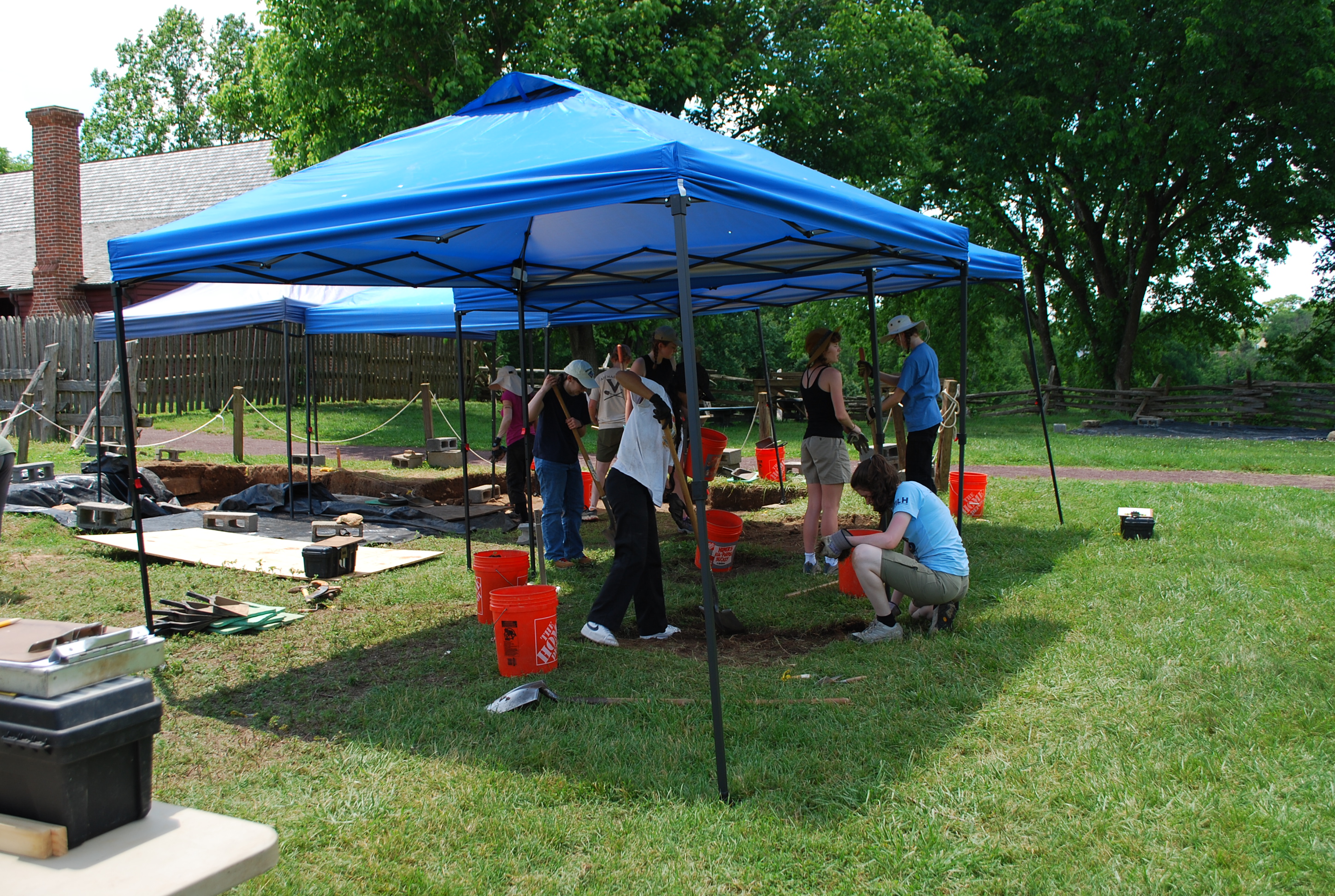
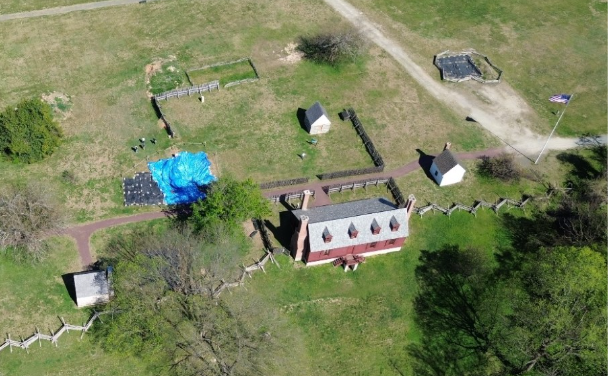
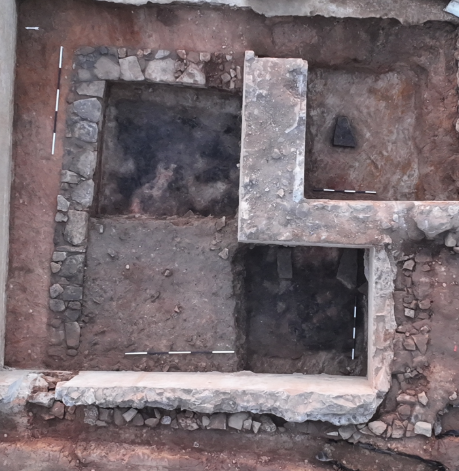
    Beginning on Monday, April 27th and continuing for the next 11 weeks, archaeologists will once again be outside working onsite at Ferry Farm, George Washington’s Boyhood Home. Our current excavations are centered on an eighteenth-century kitchen located on the north side of the work yard approximately 50 feet from the main house.  This wood-framed building, 16’ by 16’ in plan with an Aquia stone foundation and full cellar, would have been a hub of activity on the farm landscape and understanding its place within this landscape is important to our interpretation of life on the Washington farm.  

    Figure 1. Our kitchen site is located beneath the blue tarp just northeast of the main house.

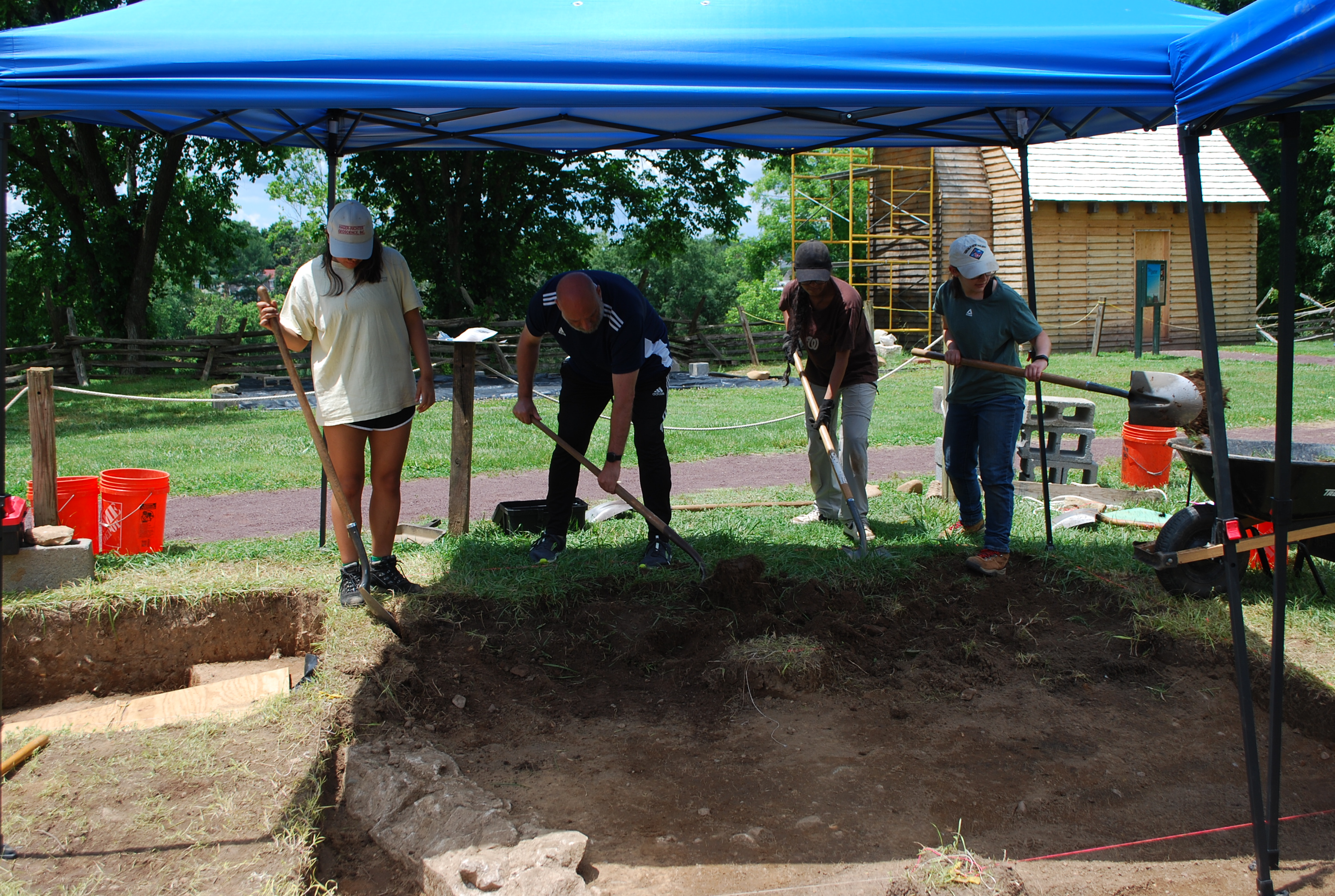
    We began last year’s excavation season by uncovering and exposing the entirety of the site, which had been sealed 28 years ago with a protective layer of sand. Exposed was a 16’ square stone foundation to a cellar filled with burnt household and architectural debris. For our excavation plan, we divided the cellar fill into four quadrants and were able to excavate two of them down to the level of the cellar floor over the course of our season. One of the quadrants had previously been excavated in the 1990s, leaving one more quadrant to dig this summer.  

    Figure 2. The eighteenth-century kitchen stone wall foundation, intruded upon by twentieth- century concrete foundations.

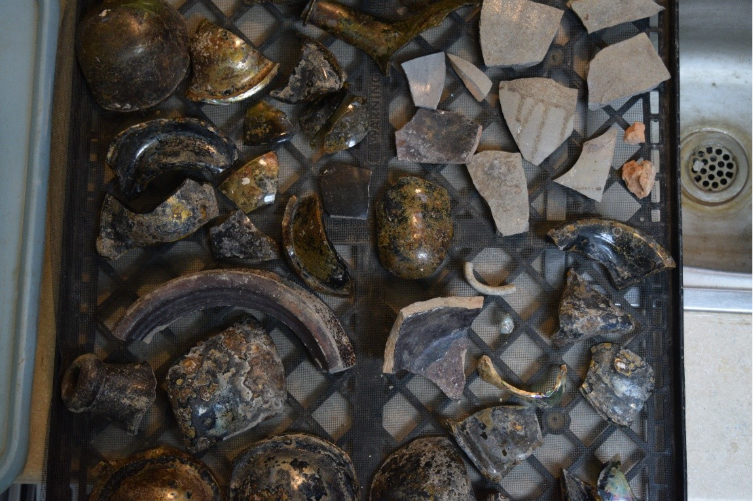
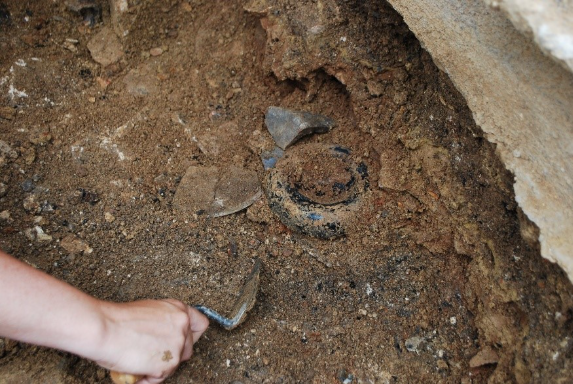
    From the burned fill came an unexpected bounty of artifacts. Hundreds of fragments of glass wine bottles and ceramic storage containers were sifted through our screens, along with buckets of burned architectural debris such as plaster, mortar, and wrought nails of all sizes.  A smaller number of more delicate artifacts also surprisingly survived, such as straight pins, animal bones, leaded tableware glass, buttons, box hinges, small copper drawer pulls, and even a concentrated deposit of eggshells! 

    Figure 3. A large wine bottle base being excavated out of the kitchen cellar fill. 

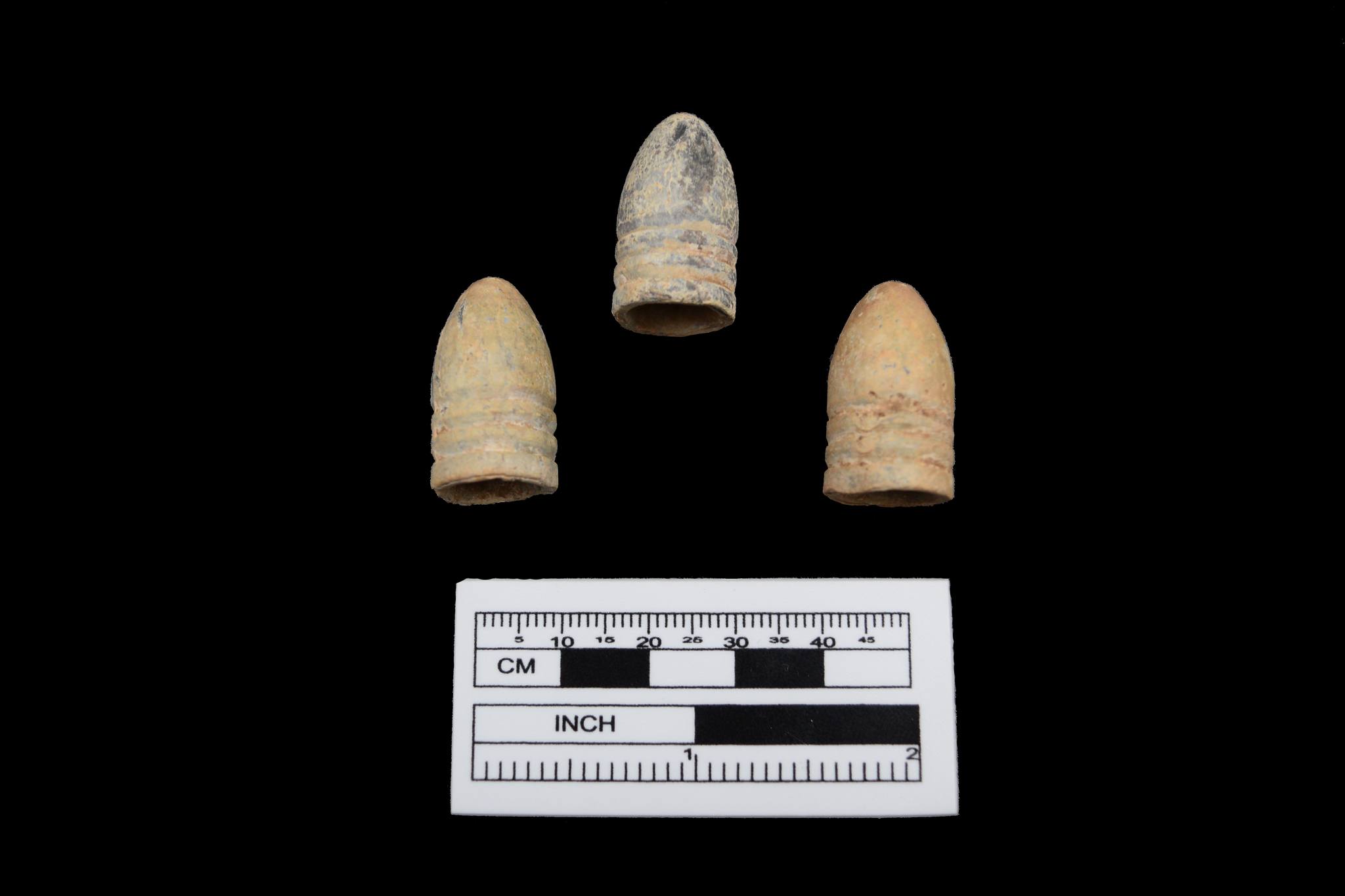
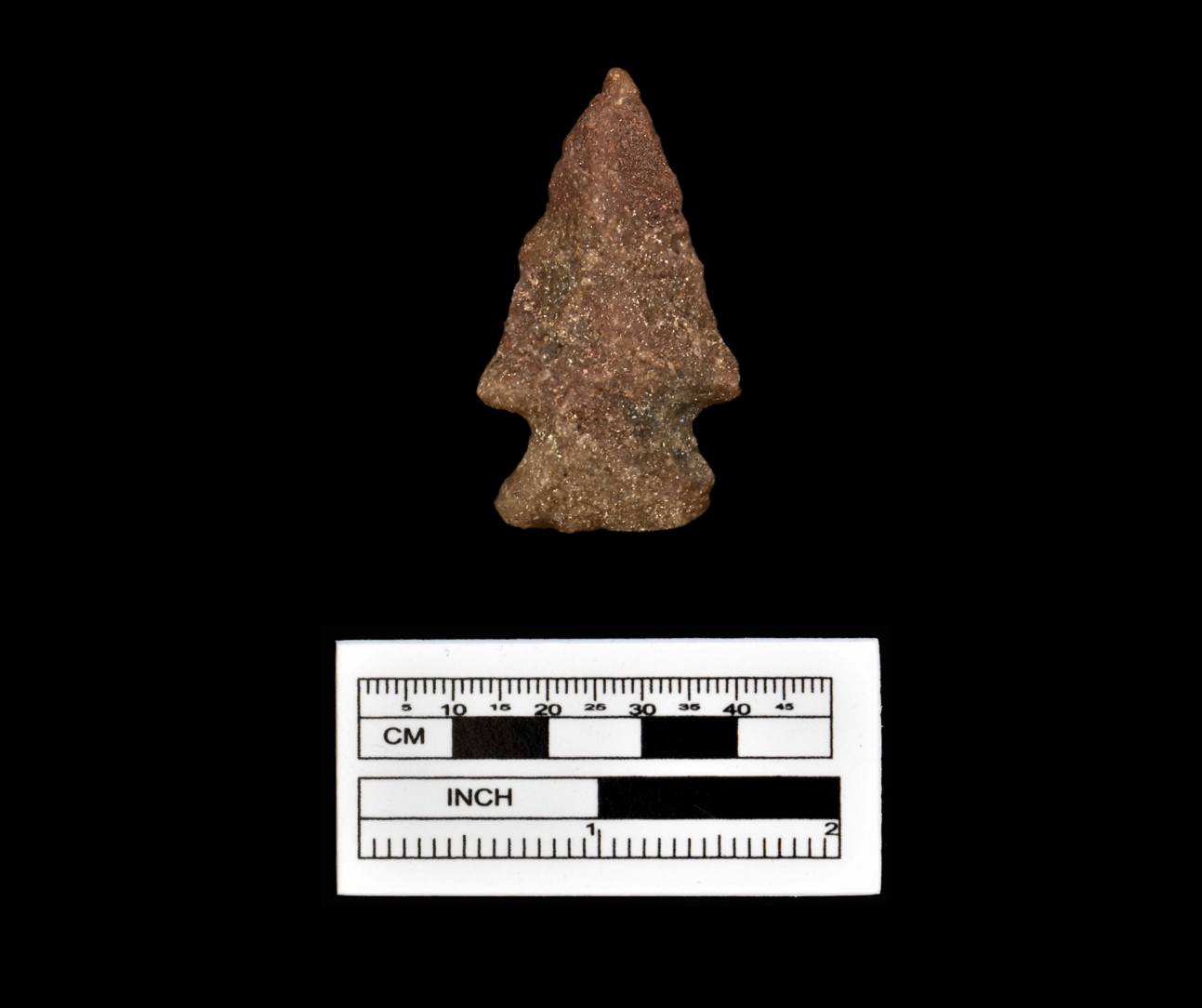
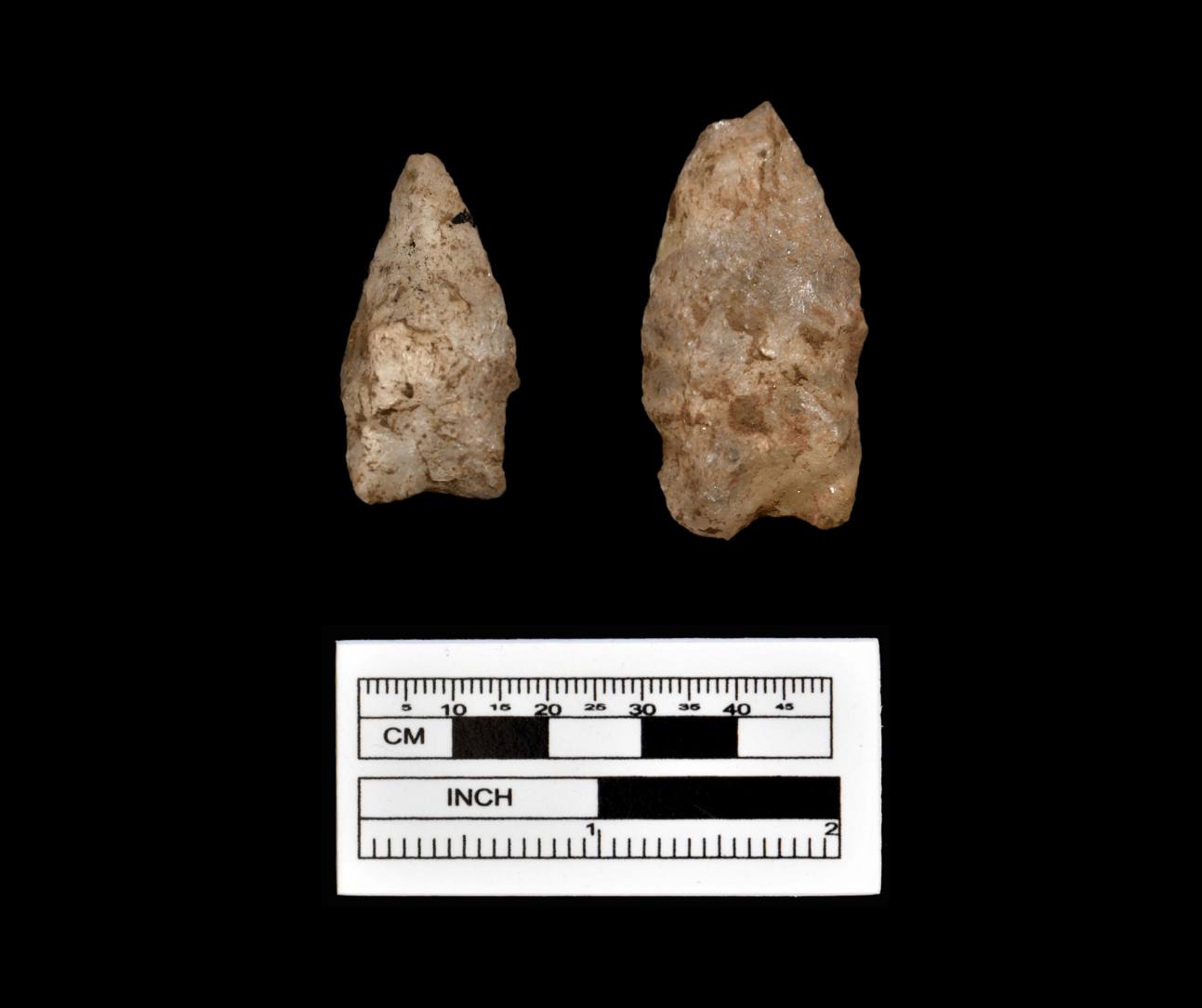
    Excavation also continued outside of and around the kitchen foundation as we searched for additional clues to the architectural footprint of the building. From these units we found artifacts ranging in age from 6500 BC to modern day. Native American projectile points and flint-knapping debitage, colonial-era ceramics, Civil War bullets, and twentieth-century household remains were all dug up in the various soil layers covering this part of the site.      

    Our archaeology lab has been very busy for the last nine months cleaning and sorting all the artifacts that were found last summer.  Understanding the types of artifacts found will aid in our interpretation of how the building was used, its construction details, its role in the farm landscape, and, hopefully, the date it burned down! 

    Figure 4. Glass wine bottles and stoneware crocks are washed and dried in the lab before being sorted and catalogued. 

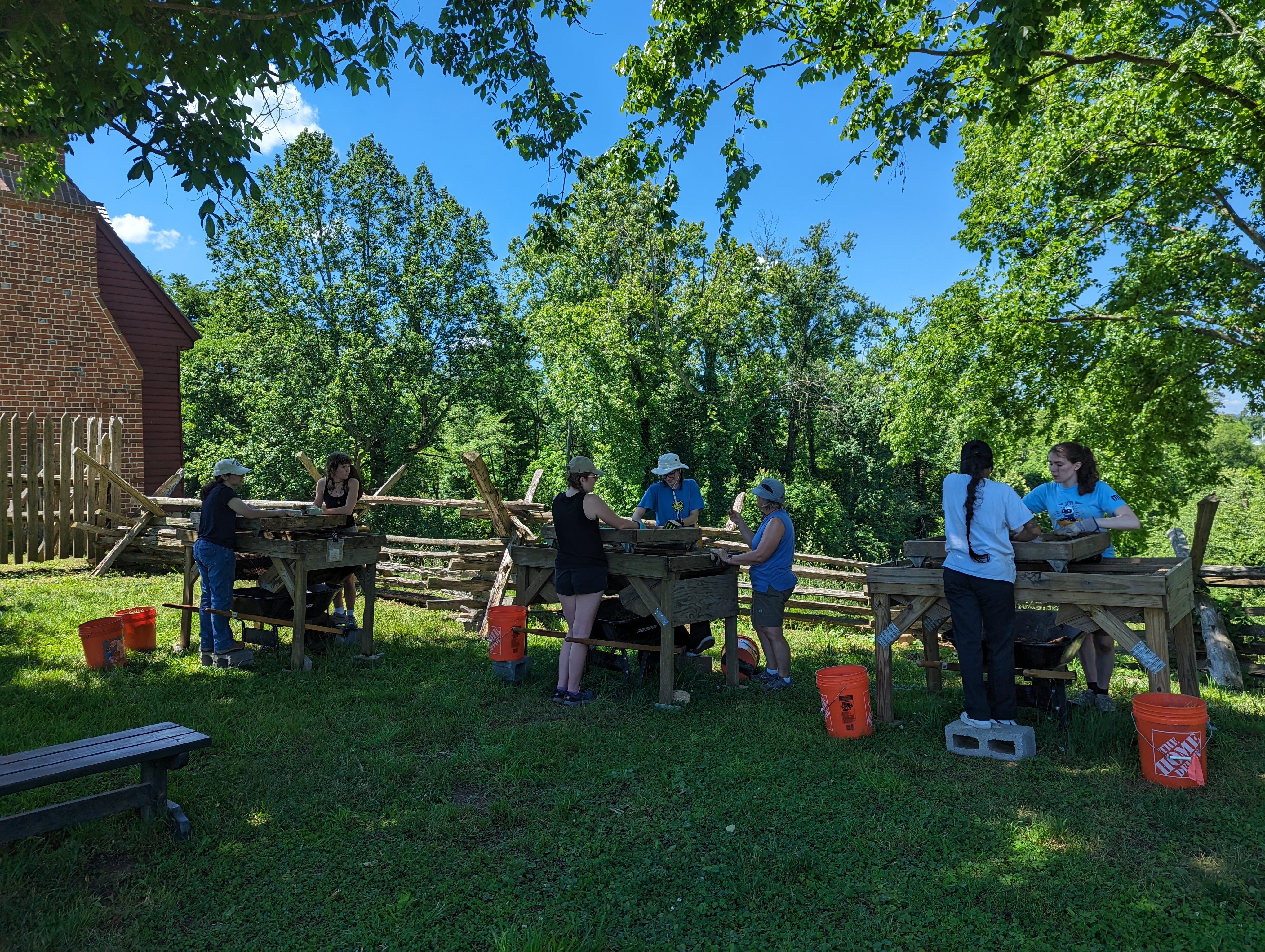
    Our field crew will be on site weekdays from April 27th to July 10th.  Once again students from the University of South Florida will be here to learn the basics of archaeology field work during the months of May and June. We welcome all visitors to ask questions and enjoy the opportunity to help us sift for artifacts!  

    Judy Jobrack and Danielle Arens

    GWF Archaeologists

  • Meet the Crew 2025

    We are heading into the final stretch of this year’s exploration of the 18th-century kitchen at George Washington’s Ferry Farm, and it definitely hasn’t disappointed! The finds are getting bigger and better as we continue excavating deeper into the cellar and expand our look into the surrounding area. We have made a ton of progress that wouldn’t have been possible without the help of our crew of the George Washington Foundation staff, interns, and University of South Florida field school students. While there are still a few weeks before the official end of the dig on July 11. Just in case you missed them, here are some quick introductions and fun finds from the 2025 field school and crew.

    Left to right: Judy, Danielle, Abby, Sarah, Alaina, Alaina S., Sofia, Addie

    Field School

    “Hi, my name is Alaina Scapicchio, and I am a Ph.D. candidate in the Department of History at the University of South Florida. This is my third summer digging at Ferry Farm. My favorite moment of the summer was excavating a partially intact pig jaw!” 

    -Alaina

    “Hi! My name is Addie, I am a history and anthropology student at the University of South Florida. My favorite artifact to find are the animal bones.”

    -Addie

    “Hi, my name is Alaina. I am studying history at USF. My favorite part of the field school was digging in the kitchen because of how many cool artifacts we found. My favorite artifact was the piece of the Bartmann jug!”

    -Alaina

    “Sofia Almeida is a first-year History PhD student at the University of South Florida. Her research focuses on historic cemeteries, public history, and memory. One of her favorite parts of field school was digging in the kitchen cellar. One of her favorite artifacts this season was a decorated fragment of Staffordshire ceramic.”

    -Sofia

    GWF Interns

    “Hey! My name is Abby! I am a recent graduate from UVA and am planning to pursue a career in archaeology. I enjoy reading and playing Ultimate Frisbee in my free time. My favorite artifact that I helped find this season was a projectile point with jagged edges.”

    -Abby

    “Hey all, my name’s Max Puckett. I’m a senior at the University of Mary Washington, currently pursuing a BA in Historic Preservation. In my spare time, I like to cook, research, and read. I’ve really loved this field season so far- we are pulling out a ton of interesting and exciting artifacts.”

    -Max

    Sarah came to Ferry Farm as a VCU student in the summer of 2014 and has been in over half a dozen summer digs since then. This year’s dig is very special to her because it is focused on the cellar of the Washington kitchen. Her favorite artifacts from this dig are the ones that can actually be paired and mended with each other because much of what collapsed in the kitchen fire was left in place and not scattered or missing.

    -Sara

    GWF Staff  

    I have been involved with the Ferry Farm Archaeology Department since 2012, when my youngest twins graduated from high school. I started out as a volunteer but then took on a part-time position cataloguing artifacts from the summer digs, which then turned into a full-time job as a lab assistant.  I have been co-field director since 2019.  I have a BA in Anthropology and an MA in Historical Archaeology, with past jobs in cultural resource management and historic sites, such as Mount Vernon.  Though I really enjoy pulling out the handfuls of wine bottle necks and bases, I do find it more awe-inspiring when we pick out the tiniest and fragile eggshell fragments among the rubble and debris inside the kitchen cellar.

    -Judy Jobrack

    “Hello! I’m Danielle, and I have been at Ferry Farm since 2022, first as an intern and then lab assistant and co-field director. As a UMW Historic Preservation alum, I love all things old, both above ground and below, so this year’s dig has been particularly exciting with all the architectural bits we have been finding. With that said, I think my favorite artifact so far has been a brass/copper button –metal with verdigris is just so cool!”

    -Danielle Arens

    Though some of our crew is leaving, the rest of us will be digging every weekday until July 11, so be sure to come say hi and see what new things we have uncovered!


    Danielle Arens

    GWF Archaeologist


  • It’s That Time of Year Again: 2025 Dig Preview

    It’s the most wonderful time of the year! There’ll be dirt out for screening, ceramics for cleaning, and lots of good cheer…. Okay, sorry, that might be a little too far. But it is a super exciting part of the year here at Ferry Farm, George Washington’s Boyhood Home. We have officially started this summer’s dig season!

    Building off of the previous two years’ exploration of the kitchen site, we are revisiting the 18th-century kitchen cellar again this year. While last year’s dig focused on locating and exposing the kitchen’s stone wall foundations, our focus this year will be excavating the fill within the cellar walls that had been deposited as a result of a fire sometime in the 1740s. The fire caused the building to collapse in on itself, filling the cellar space with ash and debris.

    Excavating sites like this are very exciting because they represent preserved moments in time, leaving the possibility to find artifacts left in situ or in place, when the fire occurred. It is likely that most of the artifacts excavated will have evidence of the extreme heat caused by the fire. Toasty artifacts from the 2023 preliminary kitchen exploration have been washed and catalogued, showing damage to artifacts, such as glass bottles and ceramic storage vessels, ranging from being slightly charred and burnt to being completely melted. Toasty or not, these artifacts will help us nail down the date of the fire and what was being stored in the kitchen cellar when it went up in flames.

    Our 18th-century kitchen, unfortunately, lies beneath the foundations of two farmhouses with full cellars dating from the 19th and 20th centuries. The construction of these homes severely impacted the kitchen structure and its burnt cellar fill, making it difficult for our archaeologists to accurately interpret the kitchen’s architectural features. A small portion of the kitchen cellar fill was also the subject of previous archaeological excavations in the 1990s, so we are not the first team to sample the fill. But in the interest of site preservation, the kitchen remnants were covered over twenty-five years ago with protective geofabric, and the farmhouse cellars backfilled completely with sand.

    Luckily, we had the help of an excavator at the beginning of this season to remove the five feet of protective sand covering the kitchen cellar fill so we could get to the fun stuff sooner! But our fun isn’t restricted to the cellar, as we still have multiple 5” x 5” units around the outside of the kitchen foundations to investigate. Our team is still trying to locate the midden (trash deposits) and fireplace associated with the kitchen, as well as additional architectural evidence that would give an idea of the overall form and dimensions of the complete kitchen structure.

    Every excavation year brings new and exciting finds as we sift through thousands of years of site habitation. Come visit us while we dig weekdays from opening until 3:30 pm through July 11th. Hope to see you there!


    Danielle Arens and Judy Jobrack

    GWF Archaeologists

  • Kenmore Goes to Sea: Ship Naming in the US Navy

    On July 22, 1942, Annie Fleming Smith wrote a letter. Smith was a prolific letter writer—her innumerable missives had helped raise the funds that saved Kenmore two decades earlier—so it is not surprising that she put pen to paper on that summer day. What is surprising is that the intended recipient of that letter was not a prospective donor, a fellow regent of the Kenmore Association, or a friend. Instead, she addressed her epistle to Frank Knox, the Secretary of the Navy. Smith wanted “confirmation of the fact of the naming of the U.S.S. KENMORE” after the home and “any other information you can release” about the ship.[1]

    Letter that Annie Fleming Smith sent to Secretary of the Navy Frank Knox asking for confirmation that the first USS Kenmore had been named after the historic home. Smith, Annie Fleming to Frank Knox, July 22, 1942. The George Washington Foundation.

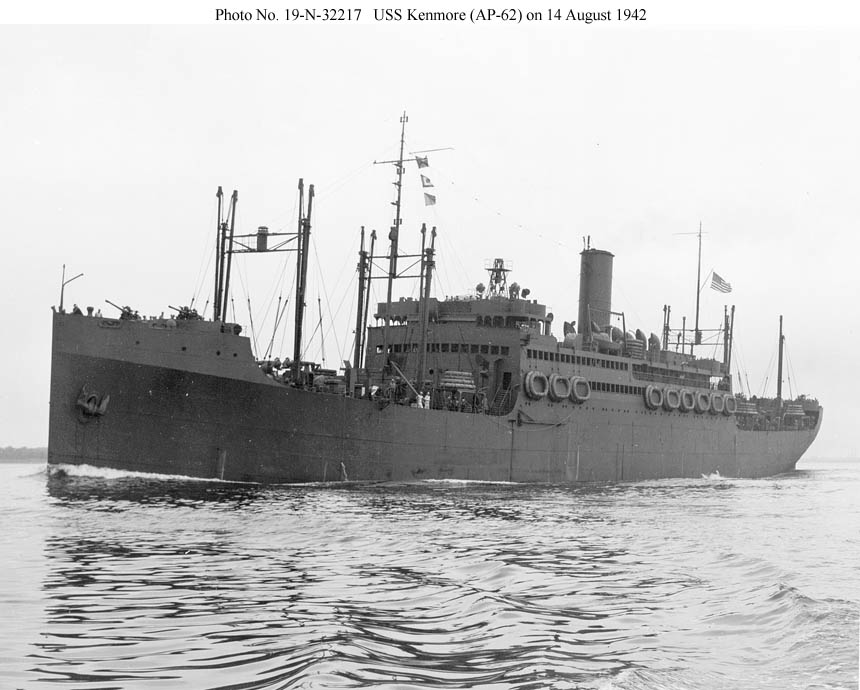
    Although there is no record that Knox responded to Smith (there was, after all, a war on), the USS Kenmore was, in fact, named for the historic estate. The Naval History and Heritage Command ship-naming file on Kenmore I (AP-62) includes an April 13, 1942, memo to the Secretary of the Navy from the chief of the Bureau of Navigation and prepared by Louis Emil Denfeld, then assistant chief of the Bureau of Navigation, recommending that the President Madison be renamed Kenmore, in honor of the “[h]ome of Betty Washington at Fredericksburg, Virginia, sister of George Washington who married Col Fielding Lewis.”[2] The recommendation was approved on April 16 of that year, and the newly renamed vessel was “commissioned at Baltimore, Md., on 5 August 1942, Cmdr. Myron T. Richardson in command.”[3]

    USS Kenmore (AP-62) on trials in the Chesapeake Bay on August 14, 1942. Shipscribe

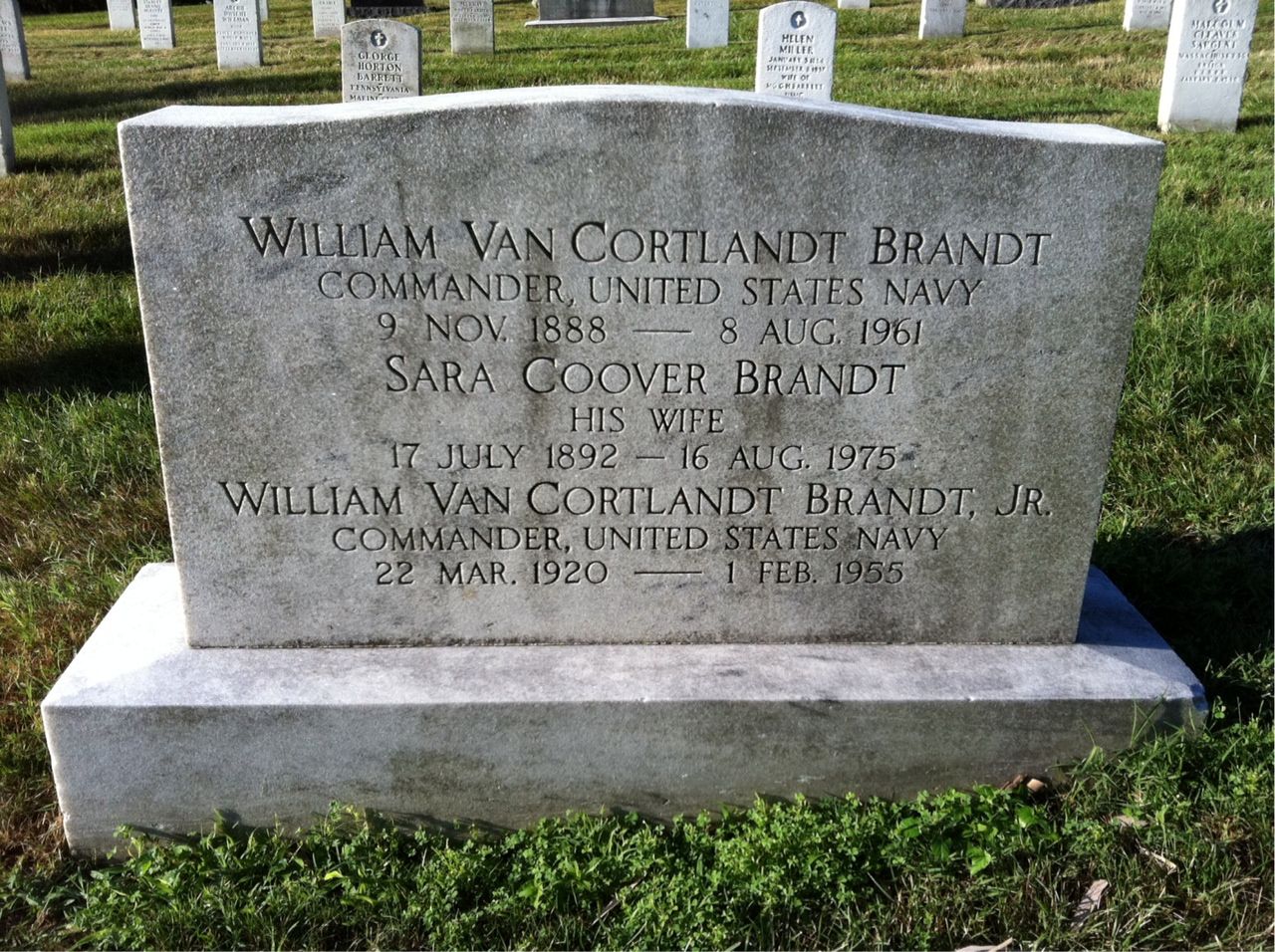
    Smith had learned of the ship during a mid-1942 visit to the estate from Lt. Commander William VanC. Brandt (USNR) of the Kenmore, who later wrote to “Miss Annie” to thank her for her hospitality.[4] “All the Officers of the Kenmore,” Brandt told Smith, “were most interested in learning the history and record of the beautiful estate for which our ship is named.”[5] Brandt planned to have framed and displayed in the ship’s wardroom photographs of the property given to him by Smith; later, the vessel’s captain requested a picture of the house for his room.[6] For her part, Smith was “thrilled” to meet Brandt and “to know about your ship,” although she was skeptical enough of the origin of the transport’s new name to write Knox.[7]

    The Arlington National Cemetery headstone of William VanC. Brandt, from whom Annie Fleming Smith learned that a Navy ship had been named after the historic home she had helped save from development in the 1920s.

    The Kenmore operated primarily in the Pacific until September 1943; she was then converted into a hospital ship and renamed Refuge.[8] The Navy must have liked the name Kenmore, as it was bestowed in October 1943 on another transport, originally called the James H. McClintock.[9] The Kenmore II also served in the Pacific Theater and, after “hostilities ended on 15 August 1945, [began] returning veterans to the U.S.”[10] She was decommissioned on February 1, 1946.[11]

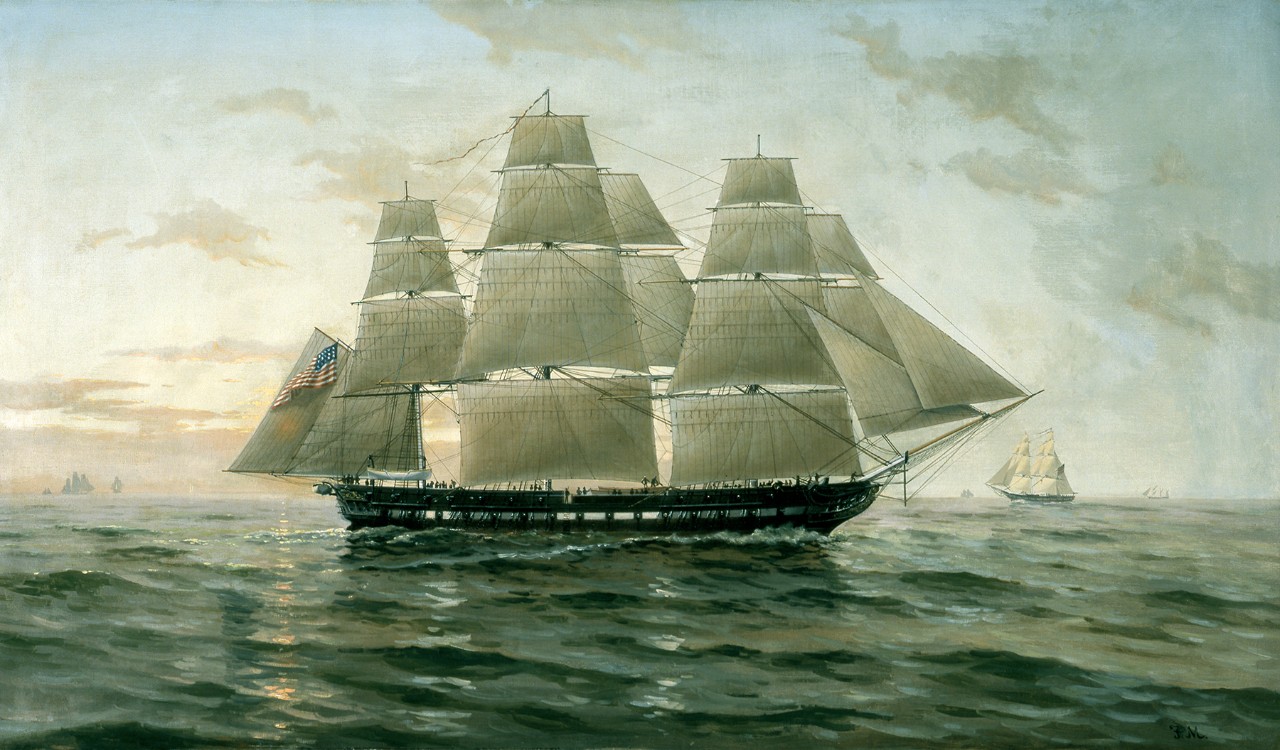
    The Kenmores were not the only vessels named for properties associated with George Washington and his family. The Wakefield (AP-21) borrowed its name from the Westmoreland County birthplace of the first president, today owned by the National Park Service.[12] There have been five Mount Vernons; the first was built in 1859 and chartered by the Navy two years later, before they bought it later that year.[13] The most recent vessel named after Washington’s residence and plantation was a dock landing ship commissioned in 1972 and decommissioned in 2003.[14] The possible birthplace of Mary Ball, George Washington’s mother, lent its name to the Epping Forest, a dock landing ship launched in 1943.[15]

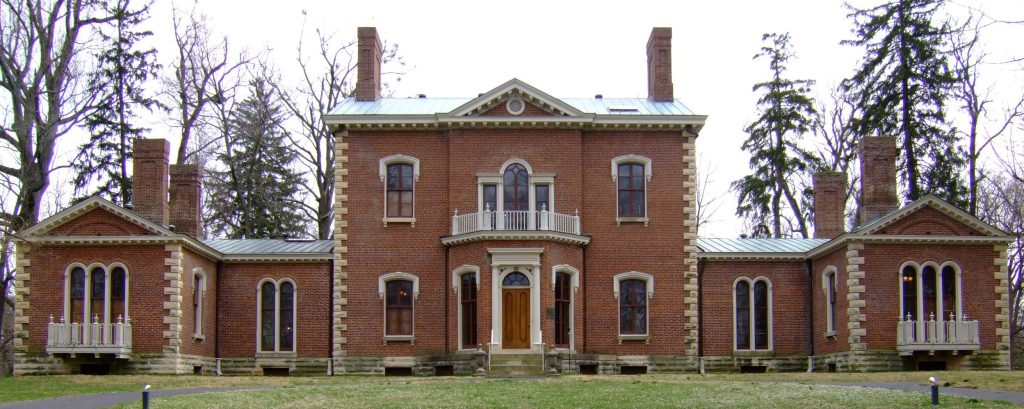
    The monikers of other ships are connected more tenuously to places tied to George Washington and his family. For example, a 1943 submarine chaser was rechristened the Abingdon in 1956.[16] The vessel’s new name came from the town of Abingdon, in Washington County, Virginia (named, yes, for George Washington).[17] According to the county’s official history, “myths claim that [the town] was named for Martha Washington’s ancestral home” in England.[18] While this may be a false etymology, were those who named the ship drawing on the tale when they chose to call the vessel Abingdon? Additionally, the many Arlingtons that have served the Navy over the years have each been named after Arlington County, which draws its appellation from Arlington House, built for George Washington Parke Custis, the step-grandson of his celebrated namesake.[19]

    Arlington Mansion was built by George Washington Parke Custis. Union soldiers posing on the lawn, June 28, 1864.

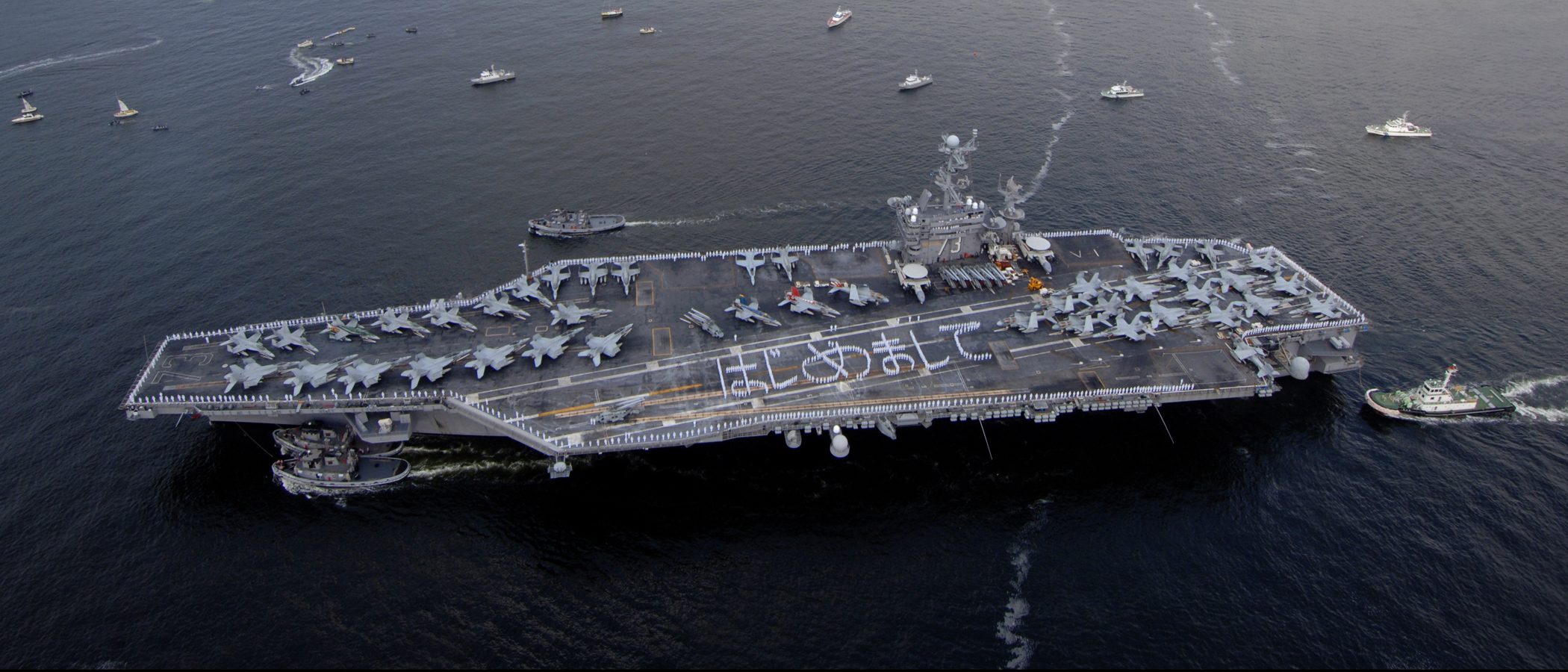
    The Navy’s infatuation with the commander in chief of the Continental Army has, of course, also been expressed by naming ships directly after Washington and his family, not just their properties. While a complete inventory of such vessels is beyond the scope of this post, it is worth noting that four ships have been named the George Washington, including CVN-73, an active nuclear-powered aircraft carrier, while several others have sailed under just his surname.[20] Martha, George’s wife and the nation’s first first lady, has inspired the names of at least two Navy ships: the Lady Washington and the Martha Washington.[21] Civilian shipbuilders have also found inspiration in the Washington family: the SS Mary Ball was a liberty ship active during World War II.[22]

    Who was responsible for naming these ships? As hinted at above, while final authority for ship names was (and still is) the responsibility of the Secretary of the Navy, during World War II, it was the Bureau of Navigation (renamed the Bureau of Personnel on May 21, 1942) that researched and recommend ship names based on the traditional naming conventions associated with each class of vessels.[23]

    Typically, it was dock landing ships, or LSDs, that were named for “cities and places of historical interest of same name, or places of historical interest only.” [24] Epping Forest, Gunston Hall I (named for George Mason’s home), Ashland (for the boyhood home of Henry Clay), Carter Hall (after the Virginia estate), Oak Hill (for the home of President James Monroe), and Shadwell (for the birthplace of Thomas Jefferson) are all examples of LSDs whose names aligned with this convention.[25]

    But the Kenmores, the Mount Vernon IV, and the Wakefield were not LSDs; they were transports, classified AP, and anyone seeking consistency in the Navy’s naming of troop transports during World War II is bound to be disappointed. Some vessels in the AP class were named after celestial bodies, others after Revolutionary War heroes, and others, as we have seen, after historic estates.

    This lack of consistency is not surprising. After all, when Benjamin Stoddert named the Navy’s sixth ship, a frigate, he chose to call it the Chesapeake, despite President George Washington’s agreement with the recommendation that frigates be named after “principles or symbols found in the US Constitution.” Therefore, “the very first naming decision by the very first Secretary of the Navy resulted in the ‘corruption’ of the established naming convention.”[26] This tradition of flexibility regarding ship names has endured, and ship names continue to excite interest (and occasionally strong feelings) from many parties, including those who propose denominations for new vessels. If you are such a person, here’s an idea: how about another Kenmore, or maybe a Ferry Farm?  


    Adam Nubbe

    Manager of School & Youth Programs


    [1] Smith, Annie Fleming to Frank Knox, July 22, 1942. The George Washington Foundation.

    [2] Naval History and Heritage Command, Kenmore I, ship-naming file, April 13, 1942.

    [3] Ibid; Cressman, R. J. (2020, March 31). Kenmore I (AP-62). https://www.history.navy.mil/research/histories/ship-histories/danfs/k/kenmore.html

    [4] Brandt, William VanC. to Annie Fleming Smith, June 30, 1942. The George Washington Foundation.

    [5] Ibid.

    [6] Ibid; Smith, Annie Fleming to William VanC. Brandt, July 10, 1942. The George Washington Foundation.

    [7] Smith, Annie Fleming to William VanC. Brandt, July 10, 1942. The George Washington Foundation.

    [8] Naval History and Heritage Command, Kenmore I, ship-naming file, April 13, 1942.

    [9] Cressman, R. J. (2020, March 31). Kenmore II (AP-162). https://www.history.navy.mil/research/histories/ship-histories/danfs/k/kenmore-ii–ap-162-.html

    [10] Ibid.

    [11] Ibid.

    [12] Cressman, R. J. (2022, April 1). Wakefield (AP-21). https://www.history.navy.mil/research/histories/ship-histories/danfs/w/wakefield.html

    [13] Naval History and Heritage Command. (2015, August 11). Mount Vernon I (Gbt). https://www.history.navy.mil/research/histories/ship-histories/danfs/m/mount-vernon-i.html

    [14] Pike, J. (n.d.). LSD 39 Mount Vernon. https://www.globalsecurity.org/military/agency/navy/lsd-39.htm

    [15] Naval History and Heritage Command. (2015, July 8). Epping Forest. https://www.history.navy.mil/research/histories/ship-histories/danfs/e/epping-forest.html

    [16] Mann, R. A., & Cressman, R. J. (2023, November 27). Abingdon (PC-1237). https://www.history.navy.mil/research/histories/ship-histories/danfs/a/abingdon.html

    [17] Ibid; Hagy, J. W. (2019, June 10). A Brief History of Washington County, Virginia. Washington County, Virginia. https://www.washcova.com/history/

    [18] Ibid.

    [19] Parsons, L., & Cressman, R. J. (2023, December 13). Arlington I (AP-174). https://www.history.navy.mil/research/histories/ship-histories/danfs/a/arlington-i.html; Arlington, Virginia. (n.d.). History of Arlington. https://www.arlingtonva.us/Government/Topics/Welcome-Kit/History-of-Arlington; National Park Service. (2023, January 12). George Washington Parke Custis. https://www.nps.gov/arho/learn/historyculture/george-custis.htm

    [20] Naval History and Heritage Command. (2020, May 5). Washington VIII (BB-56). https://www.history.navy.mil/research/histories/ship-histories/danfs/w/washington-viii.html; US Navy. (n.d.). USS George Washington (CVN 73). https://www.airpac.navy.mil/Organization/USS-George-Washington-CVN-73/

    [21]  Naval History and Heritage Command. (2016, February 9). Martha Washington. https://www.history.navy.mil/research/histories/ship-histories/danfs/m/martha-washington.html; Naval History and Heritage Command. (2015, July 28). Lady Washington. https://www.history.navy.mil/research/histories/ship-histories/danfs/l/lady-washington.html

    [22] Jobrack, J. (2020, September 10). True or False? Test Your Knowledge of Mary Washington. https://livesandlegaciesblog.org/2020/09/10/true-or-false-test-your-knowledge-of-mary-washington/.

    [23] Calkins, W. F. (1958, July). Down to the sea in ships’–names. U.S. Naval Institute. https://www.usni.org/magazines/proceedings/1958/july/down-sea-ships-names; Naval History and Heritage Command. (2020, June 29). Denfeld, Louis Emil. Louis Emil Denfeld. https://www.history.navy.mil/research/library/research-guides/modern-biographical-files-ndl/modern-bios-d/denfeld-louis-emil.html

    [24] Department of the Navy, A Report on Policies and Practices of the U.S. Navy for Naming the Vessels of the Navy (2012, November), 63. https://apps.dtic.mil/sti/tr/pdf/ADA569699.pdf

    [25] DANFS – Naval History and Heritage Command. Dictionary of American Naval Fighting Ships — Index. (n.d.). https://www.history.navy.mil/research/histories/ship-histories/danfs.html

    [26] Department of the Navy, A Report on Policies and Practices of the U.S. Navy for Naming the Vessels of the Navy (2012, November), 7. https://apps.dtic.mil/sti/tr/pdf/ADA569699.pdf


  • From the Vaults: Rarely Seen Documents

    Some of the most delicate objects in our collection are our archives. Paper and other document materials like vellum and parchment are very sensitive materials that can be irreversibly damaged simply by light.  This makes it very difficult to display or put on exhibit for extended periods despite our comprehensive policies for conserving and preserving documents; exhibition has always been unfeasible.  To remedy this, we have been working on getting archival-safe, high-quality images of our important documents online for everyone to access.  So, while you might not see the documents in person, you can still explore, read, and learn about these important papers while we preserve them for future generations.     

    Until we launch our online archives, I wanted to give everyone a sneak peek at a few of our incredible pieces.

    One of our oldest documents in the collection is a Land Grant signed by William Gooch on September 28, 1730, written on vellum.  William Gooch was a colonial administrator who served as governor of Virginia from 1727 to 1749.  The grant is not in the best condition, but it reads that it grants 400 acres in Spotsylvania County to Paul Plunkepee.  This grant is officially recorded as Land Office Patents, No. 14, 1728-1732, page 40, and is available at the Library of Virginia.

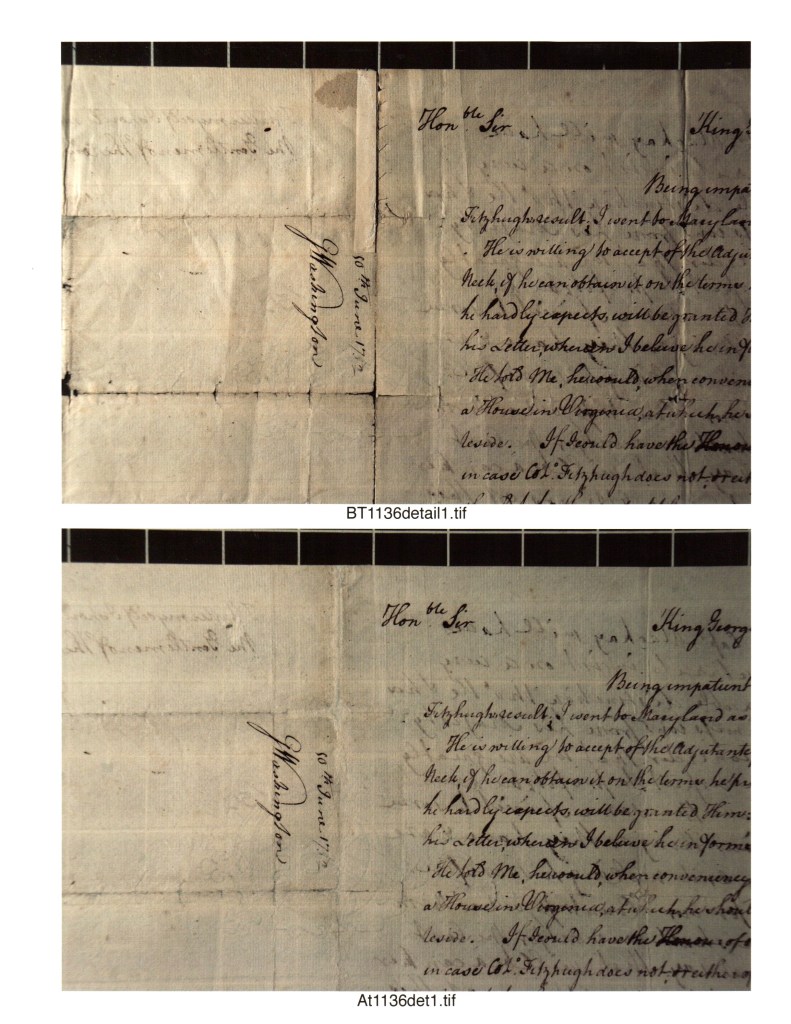
    One of our most unique documents is a letter from George Washington to Lieutenant Governor Robert Dinwiddie, written on June 10, 1752, when he was twenty.  Robert Dinwiddie served as Lieutenant Governor of Virginia from 1751 to 1758.  In the letter, George requests his first military appointment to the open adjutancy of the Northern Neck or other district.  George’s half-brother Lawrence had been appointed Adjutant General of the colony in 1743.  Due to his illness and eventual death, the adjutant was to be divided into smaller districts (i.e., Northern Neck).

    Dinwiddie declined the appointment but assigned George to an envoy position that winter to confront the French, who had recently built a fort on what Dinwiddie considered British land.  Additionally, George met with the Iroquois Confederacy to make peace and obtain intelligence about the French.  

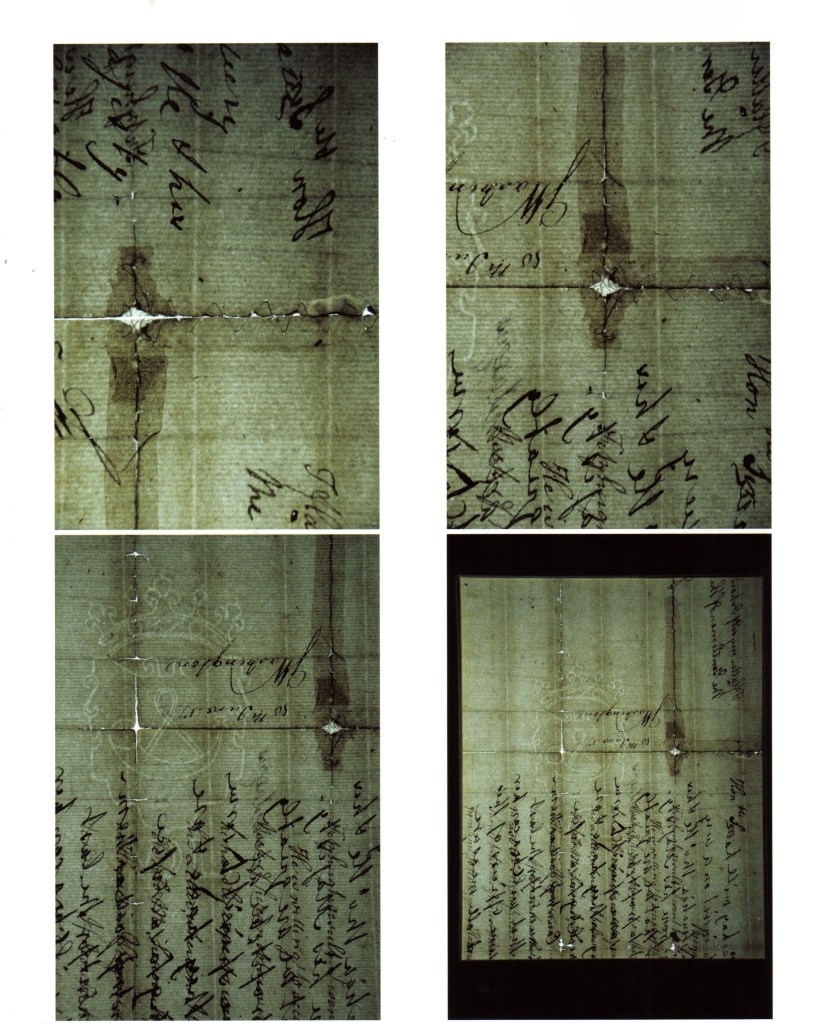
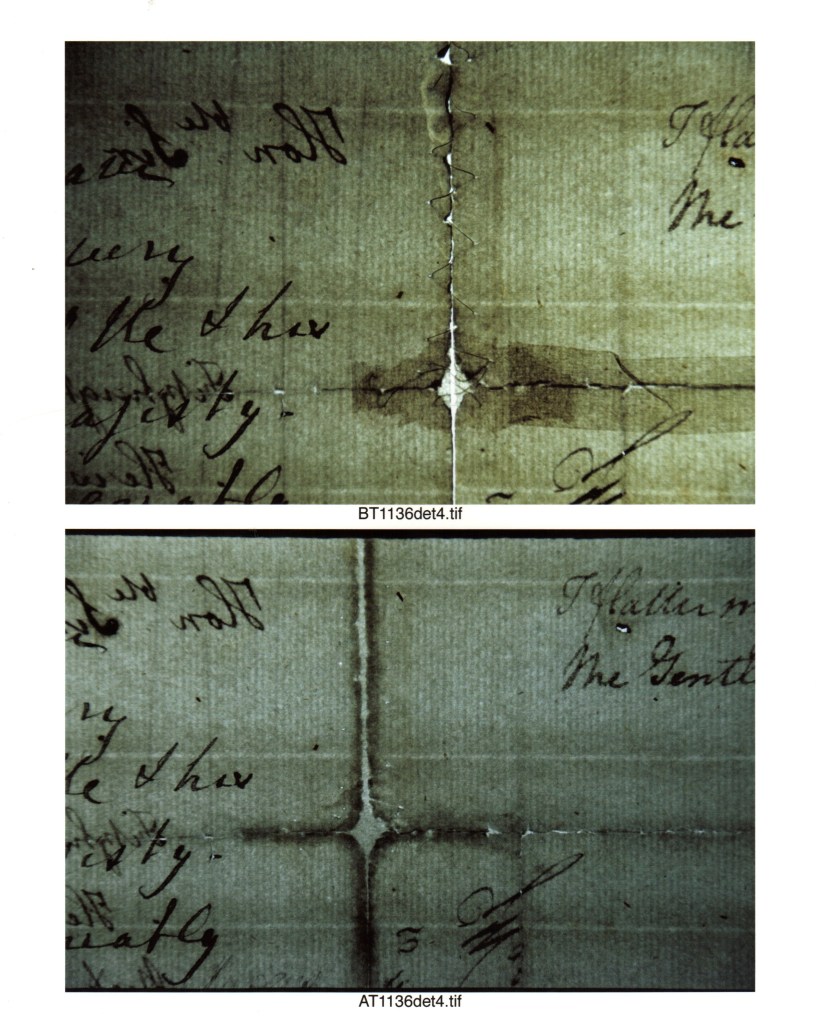
    This amazing letter pinpoints the beginning of George Washington’s illustrious military career, which would eventually culminate in him becoming the first President of the new United States of America.  The letter is in great condition after meticulous conservation work, which included repairs with Japanese tissue called tengucho and wheat starch paste called jin shofu.  It was then cleaned and flattened, and the iron gall ink stabilized.

    A transcript of the letter can be found on the National Archives website at Founders Online.

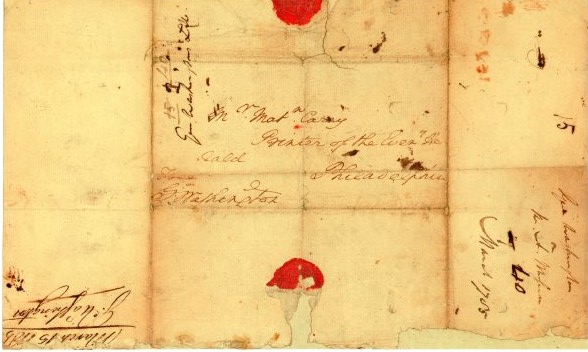
    Next are two letters between George Washington and Irish-born publisher Matthew Carey.  Matthew Carey moved to America in 1784 and settled in Philadelphia, where he established a publishing business and bookshop with $400 given to him by the Marquis de Lafayette.  Carey’s first publication was The Pennsylvania Herald in 1785, followed by two of the first successful American magazines, The Columbian Magazine and The American Magazine in 1786 and 1787.

    In George’s first letter to Carey in 1785, he requests a subscription to Carey’s newspaper but asks him to send the newspaper disguised as an ordinary letter because George has been having problems with the post office delivering his newspapers .  George thinks his papers may not have been delivered because “persons who wishing to read News Papers without being of the expence [sic] of paying for them, make free with those which are addressed to others.”

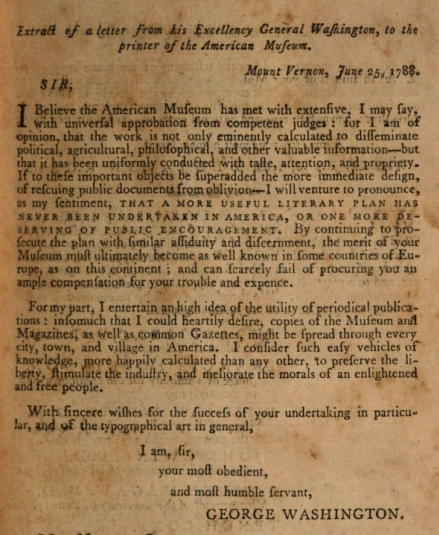
    The second letter between George and Matthew is dated June 25, 1788.  The year before, Carey launched “The American Museum” magazine.  It was a literary museum that reprinted significant historical documents on American history and original essays on politics, commerce, and culture.  The magazine got a positive response, but Carey was finding it expensive to distribute the magazine across the country, so he asked George, one of his first subscribers, to write an endorsement for the magazine that would help attract new subscribers.[2] 

    Washington responded immediately, seizing the opportunity offered by Carey to express his belief that the free dissemination of information and ideas was vital to preserving American liberty.  ‘I could heartily desire,’ Washington wrote, that ‘copies of the Museum and Magazines, as well as common Gazettes, might be spread through every city, town & village in America – I consider such easy vehicles of knowledge, more happily calculated that any other, to preserve the liberty, stimulate the industry and meliorate the morals of an enlightened and free People.”

    Carey published Washington’s endorsement in the next issue of his magazine—his marks for the typesetter can be seen in the original Washington letter.  The result was a flood of new subscriptions that allowed Carey to continue publishing The American Museum for another four years.

    Transcripts of the letters can be found on the National Archives website at Founders Online.

    These are just a few of the amazing documents in our collection, which we hope to bring you soon so that you can explore them yourself.  Check back often, and we will keep you updated on our progress with our digitization project.

    Heather Baldus

    Collections Manager


    Bibliography

    Edd Applegate (August 17, 2012). The rise of Advertising in the United States: A History of Innovation to 1960. Scarecrow Press. p.25.


  • Pull Over!! The Virginia Highway Historical Markers of The George Washington Foundation

    As you drive down the road, sometimes, there are enough signs to make your head spin.  It can be tempting to just drive by these stark white cast iron road markers with black text when you see them.  Even so, sometimes you can’t help but let a word or a phrase catch your eye, sparking curiosity as you continue on with your travels.

    “Highway markers near Seven Pines, VA” courtesy of the Library of Virginia. (Virginia State Chamber of Commerce)

    The Virginia Highway Marker program is the oldest one of its kind in the United States (Virginia Department of Transportation, n.d.).  In 1927, State Route 1 was freshly paved and ready for new motor vehicles to coast down from Washington, DC to Richmond. (Virginia Department of Transportation, 2006).

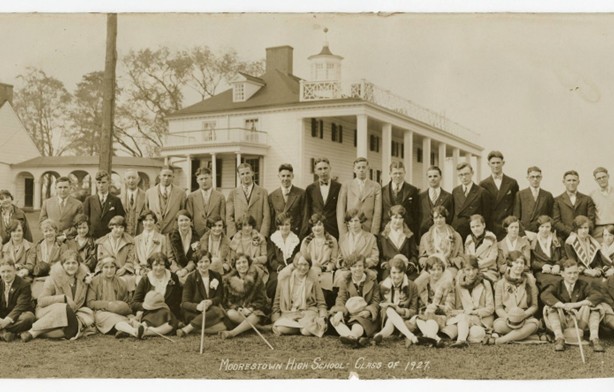
    Drivers were given a red carpet to travel straight to what many viewed as the birthplace of our nation, George Washington’s Mount Vernon. Thousands began their pilgrimage. Hotels, motels, gas stations, and attractions began to pop up along the path.

    “Moorestown High School Class of 1927” posing in front of Mount Vernon

    With all these new travelers who appreciated their state’s history, William E. Carson of the Conservation and Economic Development Commission erected several markers along the road, designating historic areas of interest and turning the roads into an attraction. (Virginia Department of Transportation, n.d.).

    Fabricating the markers was a beast to tackle since the traditional method of construction would have been granite.  Unfortunately, the stone was a bit too pricy and was also found to be difficult to read at the lightning-fast 25 mph speed limit.  Aluminum was an option for its lightweight and non-corrosive nature, and in fact, many early signs were manufactured from the metal, although they were quickly found to crack easily.  They were replaced with cast iron, and cast metal has been the preferred method of construction ever since (Rachal, 1949).

    Two of our three markers were first seen in the early years of the program. The oldest of our three was also the one that had the least amount of time in the light.  The Accokeek Iron Furnace marker (E-49) is located off Courthouse Rd in Stafford near an archaeological dig site owned by the George Washington Foundation. The modern iteration was erected in 1998.

    Accokeek Iron Furnace: The Principio Company constructed the Accokeek Iron Furnace nearby about 1726 on land leased from Augustine Washington (father of George Washington), who became a partner. After Washington’s death in 1743, his son Lawrence inherited his interest in the company and the furnace. When he in turn died ten years later, his share descended first to his brother Augustine Washington Jr. and later to William Augustine Washington. The archaeological site is a rare example of an 18th-century Virginia industrial enterprise. It includes the furnace location, the wheel pit and races, a retaining wall made of slag, an extensive slag dump, and mine pits.

    This text is not what was written prior to 1930. Those signs were brief, containing only a sentence or two for motorists to read as they drove by.  Between 1927 and 1930, though, cars sped up.  Where they were once going 25 mph, they were soon going 40 mph or even rocketing 50 mph down the highways!

    Trying to read the markers while driving quickly became impossible. The Commission’s solution? Publish a booklet with each highway marker printed and arranged neatly for passengers to read as they traveled.  All you had to remember was the marker’s number or title.  The first of these booklets were distributed in early 1930, free of charge (Rachal, 1949).

    This edition contains the earliest record of the Accokeek marker, then titled “Ancient Iron Furnace,” and reading only: “Here on Accokeek Run were iron mines and a furnace in which Augustine Washington, father of George Washington, began to smelt iron in 1727.”

    Unfortunately for our little marker, this was the last time it could be featured in the booklet. Disaster struck in late 1930. Engineer P. W. Snead wrote to the Commission on December 19th to report that the sign was found that morning, knocked from its post, and shattered.  The commission wrote back a few days later, asking for the aluminum pieces to be gathered and sent back since the factory would refund them for the parts.  (Library of Virginia Archives, 1930). The Accokeek marker was not restored until 1998, 68 years later, as part of a federal grant, according to the manager of the highway marker program, Jennifer Loux.

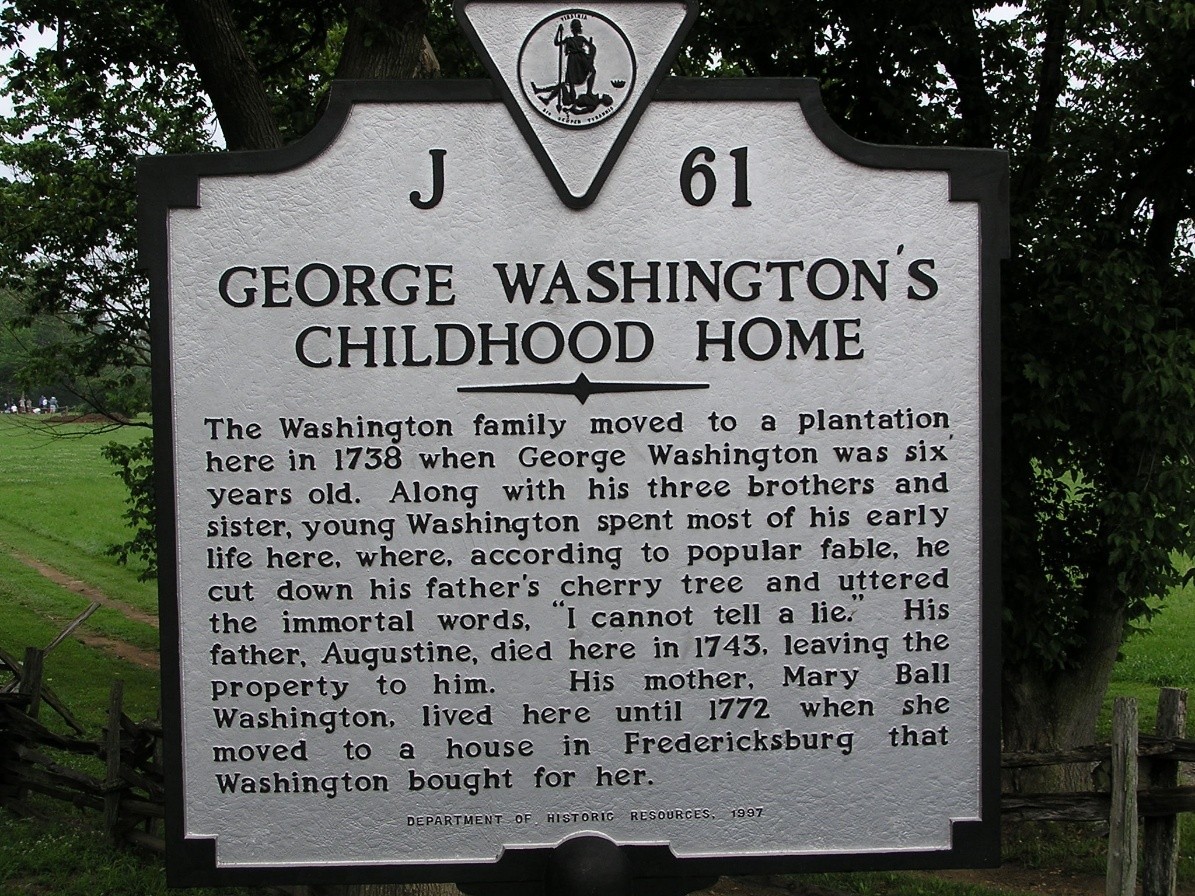
    The “Washington’s Boyhood Home” marker is also found in the booklet’s first edition, and its modern counterpart is now at the entrance to Ferry Farm.  Although there are no records of the sign being damaged prior to its replacement in 1997, after exposure to the elements for almost 70 years, it was probably time for a refresh.

    Alternatively, the motivation for the marker’s replacement (likely from the same federal grant) may have come from historical inaccuracies. The original text of the marker reads:

    “Washington’s Boyhood Home: At this place, the Ferry Farm, George Washington lived most of the time from 1739 to 1747. Here, according to tradition, he cut down the cherry tree. Washington’s father died here in 1743. The farm was his share of the paternal estate.”

    We now believe that the Cherry Tree story was likely an exaggeration or a myth, and so the verbiage was changed on the modern marker. Many old highway markers contained inaccurate information, as is often the case with many historical resources. As technology and research evolve over time, so does what we know. Another example of this never made it to the press, but early drafts of the marker’s text include his attendance at the “Old Field School.” We have since learned that there is no documentation of Washington ever attending a formal school in his life.

    The current marker was installed in 1997, the same year the George Washington Foundation obtained the property, and the sign continues to greet visitors to this day.

    George Washington’s Childhood Home: The Washington family moved to a plantation here in 1738 when George Washington was six years old. Along with his three brothers and sister, young Washington spent most of his early life here, where, according to popular fable, he cut down his father’s cherry tree and uttered the immortal words, “I cannot tell a lie.” His father, Augustine, died here in 1743, leaving the property to him. His mother, Mary Ball Washington, lived here until 1772 when she moved to a house in Fredericksburg that Washington bought for her.

    Our third marker is different, having not been placed until 1995.  At this point in time, the highway marker program had been passed around, with different organizations all bearing the burden of putting up new signs and maintaining the old ones.  It first passed hands in 1949 to the Virginia Department of Highways, who, after a year, handed the responsibility off to the Virginia State Library.  In 1966, it was traded again and is now operated by the Virginia Department of Historic Resources in collaboration with the Department of Transportation (Virginia Department of Historic Resources, n.d.).

    Former director of the Kenmore Association (now the George Washington Foundation) Vernon Edenfield wrote to the DHR proposing the marker. The Association paid for the manufacturing out of pocket. You can now visit it along Caroline St, four blocks from Kenmore, in front of Fielding Lewis’ storefront.

    Kenmore: Four blocks west stands Kenmore, built in 1775 by Col. Fielding Lewis for his wife, Betty, sister of George Washington. Near here, between Kenmore and the Rappahannock River, stood Lewis’s warehouses and docks. Kenmore’s intricate plasterwork is the finest in the country. Among 19th-century owners and occupants were Samuel Gordon, who named it Kenmore, and William Key Howard Jr., who restored and embellished the mansion’s plasterwork. Washington and other Revolutionary leaders often visited, and during the Civil War, Union troops used it as a hospital. The Garden Club of Virginia, starting in 1929, rehabilitated Kenmore’s gardens as its first restoration project.

    Although you might think after nearly 100 years of recording and presenting history that the Virginia Highway Marker program has run out of ideas, you can’t be further from the truth.  New markers are being planned constantly, and more gaps in history are being filled each year. In Fredericksburg alone, there are plenty more markers commemorating the city’s rich history.  If you feel there is an opportunity for a new marker somewhere, you can submit a proposal through the DHR’s website.

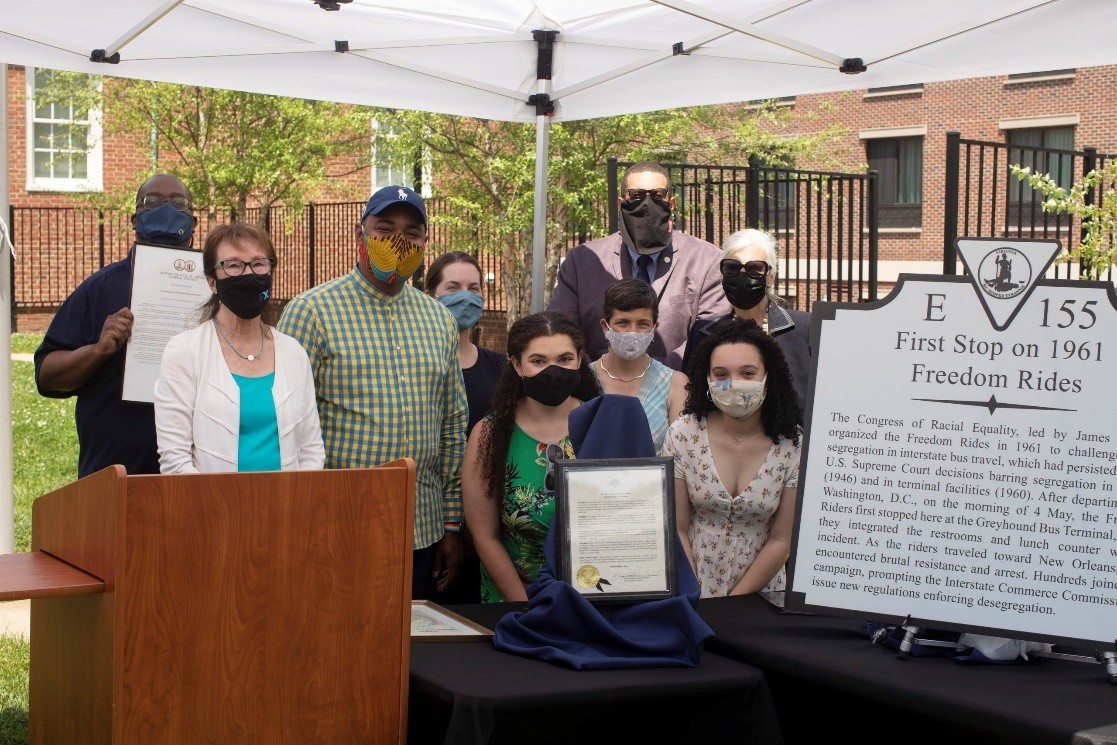
    The unveiling of the new Freedom Rides marker in 2021 at the site of the old Greyhound bus depot on Princess Anne St, which was proposed by staff and students from the University of Mary Washington

    History can be found anywhere if you know where to look, and the Virginia highway markers are a testament to that.  Be sure to keep an eye out for them on your next drive!

    Sarah Alden

    Manager of Visitor Services and Interpretation


    Bibliography

    Laiacona, J. (2021, May 4). Marker Furthers UMW Mission on Freedom Rides’ 60th Anniversary. Retrieved from University of Mary Washington: https://www.umw.edu/news/2021/05/04/marker-furthers-umw-mission-on-freedom-rides-60th-anniversary/

    Library of Virginia Archives. (1930). Virginia

    Mount Vernon. (n.d.). Historic Preservation at Mount Vernon. Retrieved from George Washington’s Mount Vernon: https://www.mountvernon.org/preservation/historic-preservation-at-mount-vernon#main-content

    Prats, J. J. (2010, October 23). State Historical Markers Numbering Plans. Retrieved from The Historical marker Database: https://www.hmdb.org/m.asp?m=2

    Rachal, W. M. (1949). Historical Markers on Virginia Highways. State and Local History News, 151-153.

    Virginia Department of Historic Resources. (n.d.). Historic Markers. Retrieved from Virginia Department of Historic Resources: https://www.dhr.virginia.gov/programs/highway-markers/

    Virginia Department of Transportation. (2006). A History of Roads in Virginia: “The Most Convenient Wayes”. Richmond: Virginia Department of Transportation Office of Public Affairs.

    Virginia Department of Transportation. (n.d.). Historical Markers. Retrieved from Directional Signing Program: https://vaidsp.com/historicalmarkers/

    Virginia State Chamber of Commerce, a. L. (n.d.). Highway markers near Seven Pines, Va. Picture Collection.

  • “To Bigotry, No Sanction…:” Jewish Identity in Early America and Relations to Washington

    Figure 1: Washington’s words to the Newport congregation (George Washington Institute for Religious Freedom)

    The quote, “To Bigotry, No Sanction, To Persecution No Assistance” appears in a 1790 letter written by George Washington to the Hebrew Congregation in Newport, RI (Fig 1). Of all the words Washington committed to paper, these rank amongst the most important, yet he merely adapted them from a letter sent by the Congregation itself.

                By 1790, Jewish communities in the newly formed United States desired to confirm their place in society and the freedoms promised under the founding documents. Washington’s visit to Newport, RI, that year allowed direct access to a government representative for a community seeking reassurance. Their letter moved Washington, yet he was no stranger to the lives and likely concerns of the wider Jewish American community.

    The Jewish Diaspora and Settlement in the Americas

                For those unfamiliar with the Jewish diaspora (Def: the dispersion of a people from their original homeland, in this case, Israel, through forced or voluntary migration), the current Jewish population of the United States largely consists of Ashkenazi Jews whose ancestors settled in central and eastern Europe before immigrating to the States. While some Ashkenazim moved to the Americas during the colonial period, the majority emigrated during the late 1800s and early 1900s. Nonetheless, Jews have lived in the Americas since the 1500s, they simply belonged to another sect of the diaspora.

                Sephardic Jews descend from those who settled on the Iberian Peninsula. Infamously pushed out of the region or forced to convert during the Inquisition, many initially sought refuge in Portugal (briefly), North Africa, the Ottoman Empire, and the Netherlands. As restrictions in some of these areas increased, numerous families forged proof of Christian ancestry to emigrate to Brazil and the Spanish colonies before seeking more religious freedom in British territories.

                Here, those who had seemingly converted, but continued to practice as Crypto-Jews, shed their Catholic personas and openly embraced their ethnoreligious identity. Aaron Lopez (1731-1782), called the “Merchant Prince of Newport,” serves as one example (Fig 2). Born Duarte Lopez in Portugal, he moved his wife Anna and daughter Catherine to Newport, RI, in 1752, where they reclaimed their Jewish identities under the names Aaron, Abigail, and Sarah.

    Figure 2: Aaron Lopez (American Jewish Historical Society)

                Several organized Jewish communities ultimately emerged in New York City, Newport, Philadelphia, Charleston, and Savannah. These areas proved ideal due to their nature as trade centers and rules, allowing more religious, political, and business freedom for non-Christians. Still, Jews lived and worked throughout the thirteen colonies as active members of the wider community, and many crossed paths with George Washington and those he knew.

    Colonial Virginia

    Jewish history in Virginian territory began when Joachim Gaunse, a Bohemian metallurgist, joined the Roanoke Colony in 1585. However, he escaped the fate of the Lost Colony by returning to England in 1586. A later instance of Jewish settlement occurred when Elias Legarde/o arrived in the Jamestown area in 1621. After that, small, scattered groups emerged throughout the colony, and the first Jews in the greater Fredericksburg area arrived by 1652. Nonetheless, they could not hold citizenship or public office as these statuses required oaths invoking the Christian faith.

    Jewish presence in Fredericksburg and other cities meant that Washington and his associates lived and worked alongside Jewish community members all their lives. In staying active in the community, many Jewish men, including the majority mentioned in this blog, joined the Masons. Specifically, (H)ezekiel Levy appears in Fredericksburg Lodge No. 4’s records as the sole Jewish member in 1776. As Washington maintained a life membership with his mother lodge from 1752 onwards, the two men potentially knew each other (Fig. 3).

    Figure 3: Masonic Lodge #4 – founded 1753, built 1816

    Other Jewish residents of Fredericksburg and businessmen likely crossed paths with Fielding Lewis. The Gratz brothers of Philadelphia, Barnard, and Michael, built a business network that spread across the colonies (Fig 4). They supplied Virginian troops during the French & Indian War and set up trade in Fredericksburg by 1776, where their associate Joseph Myers handled business affairs. Henry Mitchell, a one-time friend of the Lewises, counted amongst those who did business with the Gratzes and Myers. Like their gentile counterparts, however, Jewish merchants engaged in all aspects of the economy. This included the Atlantic and domestic slave trade, from which they profited, advanced, and purchased individuals.

    As Washington’s career took off, he came into closer contact with Jewish Virginians. Jacob Myer and Michael Franks served alongside Washington in the build-up to the French & Indian War, and the latter fought at the Battle of Fort Necessity (July 3, 1754). In 1769, Washington sought the services of Williamsburg’s Dr. John de Sequeyra for his stepdaughter Patsy Custis’ epilepsy (Fig. 5). Sequeyra, a well-respected physician, arrived in Virginia in 1745, wrote about diseases found in the region and served as the first visiting physician at, and later director of, Williamsburg’s Public Hospital. While Thomas Jefferson often receives credit for popularizing tomatoes as edible, Jefferson himself credited Sequeyra.

    Figure 5: Dr. John de Sequeyra (Winterthur Museum)

    American Revolution

                Like the colonists typically pictured during the war, the American Revolution brought turmoil to Jewish communities. The majority supported the cause of independence, with leading merchants voicing dissent from the 1765 imposition of the Stamp Act. Others remained loyal to the crown as they knew where they stood in society. Regardless of which side they chose, Jews aided their cause as soldiers, merchants, and suppliers. Still, the war brought division, death, and poverty to many families.         

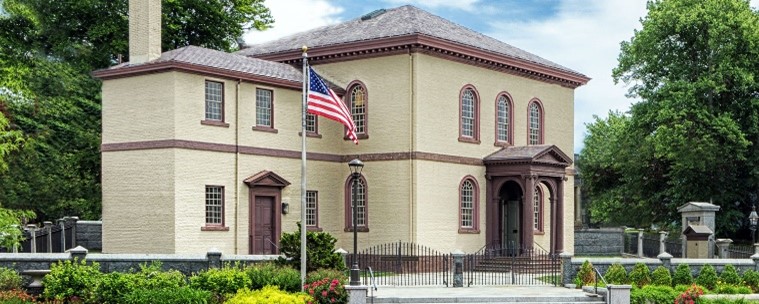
    The Touro-Hays family illustrates one such division. Issac Touro, head of the Newport Congregation, remained loyal to the British while his brother-in-law, merchant-banker Moses Michael Hays, sided with the Patriots (Fig 6). Despite holding opposing views, the two men used their positions to take a stand for the larger Jewish community. In 1775, Hays refused to sign a declaration of loyalty to the patriot cause until the authors removed the phrase “upon the true faith of a Christian.” When the British occupied Newport the following year, Hays, along with most of the congregation, fled while Issac remained behind. Using his connections, Touro ensured that the British left Newport’s synagogue largely untouched. Today, it stands as the oldest surviving synagogue in North America and answers to the name “Touro Synagogue” (Fig. 7). When it became clear that the British would lose, however, Touro moved his family to the Caribbean. The two sides of the family would only reunite after 1783, when Issac died, and his widow Reyna returned from Jamaica with their children to live with her brother Michael.

    Figure 7: Touro Synagogue (Touro Synagogue)

                In all, approximately a third of the Jewish population served during the American Revolution from Bunker Hill to Yorktown. This included the lowest positions up to the rank of Lieutenant-Colonel, which Solomon Bush of Philadelphia held. This period additionally saw public office open to Jews, with numerous individuals serving on committees. The first known Jewish fatality of the war occurred on August 1, 1776, in South Carolina when Francis Salvador fell to the British-allied Cherokee during a skirmish. Two years prior, the colony elected him a delegate to the Provincial Congress; the highest political position held by a Jew at the time.  

                Many who served as merchants and financiers devoted their assets, like Fielding Lewis, to the cause. As ship owners, many outfitted privateers and helped run blockades. Haym Salomon, a Polish-born Jew from Philadelphia, served as the Continental Congress’ main financier, an agent to the French consul, paymaster for the French forces, and worked closely with Superintendent of Finance, Robert Morris (Fig. 8). Salomon committed his entire fortune to the war effort, and his most significant contribution came when he raised the funds for the Yorktown campaign at the personal request of Washington. Like many individuals, he never received reimbursement from the government and ultimately died penniless.

    Figure 8: Haym Salomon (U.S. National Archives and Records Administration)

    Early America

                In the wake of independence, the United States faced uncharted territory. For minority groups, these uncertainties proved even more concerning. The arguments for revolution and documents written to establish the new nation spoke to religious freedom and social equality, but how far that stretched remained debatable.

                In 1786, Thomas Jefferson took steps to ensure these freedoms by writing the Virginia Statute for Establishing Religious Freedom. Passed into law, the bill affirmed the right to choose one’s faith along with the separation of church and state in Virginia. Several years later, in 1789, Kahal Kadosh Beth Shalome became Virginia’s first established Jewish congregation. Jefferson’s stance on religious freedom would ultimately inspire Commodore Uriah Levy to purchase and preserve Monticello.

                At this time, we return to where we started. In 1790, Washington made a trip to Rhode Island to acknowledge their ratification of the Constitution. On August 18, while Washington met officials and residents of Newport, Moses Seixas of the Jewish congregation read aloud a letter expressing gratitude to the President and government while expressing hope for tolerance and equality (Fig. 9). Its key passage reads:

    “…erected by the Majesty of the People – a Government, which to bigotry gives no sanction, to persecution no assistance – but generously affording to all Liberty of conscience, and immunities of Citizenship: deeming every one, of whatever Nation, tongue, or language equal parts of the great governmental Machine…”

    Figure 9: Letter from the Hebrew Congregation of Newport (Library of Congress)

    In writing the letter, the congregation wished to express their hopes for the future and receive assurance from their head of state that this future existed. On August 21, Washington replied to the letter thanking them for the “cordial welcome [he] experienced…from all…citizens” while reflecting on the difficulties of the past and how the future promised security. Then, using the congregation’s own words, he wrote that:

    “It is now no more that toleration is spoken of as if it were the indulgence of one class of people…for, happily, the Government of the United States…gives to bigotry no sanction, to persecution no assistance…”

     Washington closed his letter by wishing that “every one shall sit in safety under his own vine and fig tree and there shall be none to make him afraid.” The following year saw the ratification of the Bill of Rights, which further solidified religious freedom and equality.

    Despite efforts made during the founding era and successive periods, antisemitism has never gone away. Now, more than ever, we must work to uphold that the wishes, freedom, and security of those who served the United States since its founding.


    Emma Schlauder

    Research Archaeologist


    Bibliography


    Encyclopedia Virginia 2024 Virginia Statute for Establishing Religious Freedom (1786). https://encyclopediavirginia.org/entries/virginia-statute-for-establishing-religious-freedom-1786/#:~:text=As%20part%20of%20the%20revisal,physics%20or%20geometry.%E2%80%9D%20Jefferson%20was. Accessed 10 December 2024.
    Fort Necessity: National Battlefield Park 2015 Roster of Virginia Regiment. https://www.nps.gov/fone/learn/historyculture/roster.htm. Accessed 12 December 2024.
    Goldring/Woldenberg Institute of Southern Jewish Life N.D. Encyclopedia of Southern Jewish Communities – Virginia. https://www.isjl.org/virginia-encyclopedia.html. Accessed 9 December 2024.
    N.D. Encyclopedia of Southern Jewish Communities – Fredericksburg, Virginia. https://www.isjl.org/virginia-fredericksburg-encyclopedia.html#:~:text=Although%20there%20were%20Jews%20living,1850s%20and%20opened%20mercantile%20stores. Accessed 9 December 2024.
    Immigrant Entrepreneurship: German-American Business Biographies, 1720 to the Present 2018 Michael Gratz (1739-1811). https://www.immigrantentrepreneurship.org/entries/michael-gratz/. Accessed 11 December 2024.
    Jewish Virtual Library N.D. Virtual Jewish World: Virginia, United States. https://www.jewishvirtuallibrary.org/virginia-jewish-history. Accessed 9 December 2024.
    John L. Loeb, Jr.: Database of Early American Jewish Portraits N.D. Barnard Gratz. https://loebjewishportraits.com/biography/barnard-gratz/. Accessed 11 December 2024.
    N.D. Michael Gratz. https://loebjewishportraits.com/biography/michael-gratz/. Accessed 11 December 2024.
    N.D. Aaron Lopez. https://loebjewishportraits.com/biography/aaron-lopez/. Accessed 11 December 2024.
    My Jewish Learning N.D. The Revolutionary War and the Jews. https://www.myjewishlearning.com/article/the-revolutionary-war-and-the-jews/. Accessed 12 December 2024.
    National Jewish Outreach Program 2016 Revolutionary Doctors. https://njop.org/revolutionary-doctors/. Accessed 12 December 2024.
    The American Council for Judaism 1999 An Exploration of Four Hundred Years of Jewish History in Virginia. http://www.acjna.org/acjna/articles_detail.aspx?id=367>. Accessed 9 December 2024.
    Touro Synagogue: National Historic Site N.D. Jews in Early America. https://tourosynagogue.org/history/jews-in-early-america/#early-jews-american-history. Accessed 9 December 2024.
    N.D. George Washington Letter, 1790. https://tourosynagogue.org/history/george-washington-letter/. Accessed 10 December 2024.

  • The Last of Washington’s Horse Chestnut Trees?

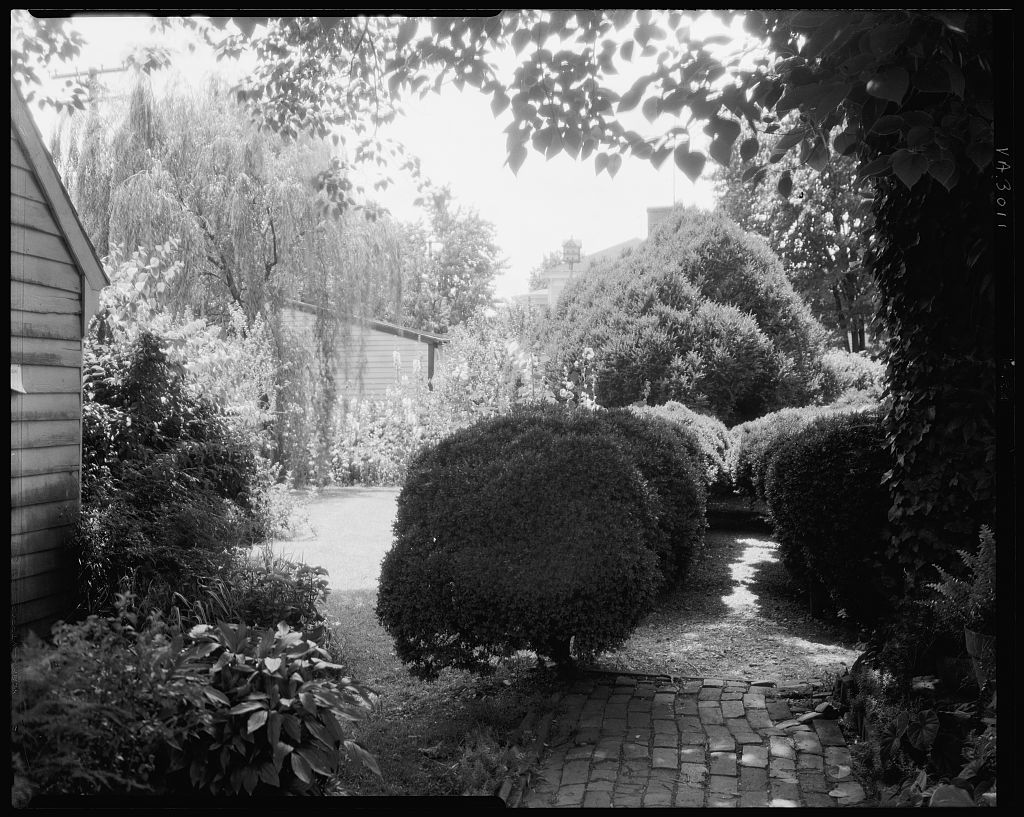
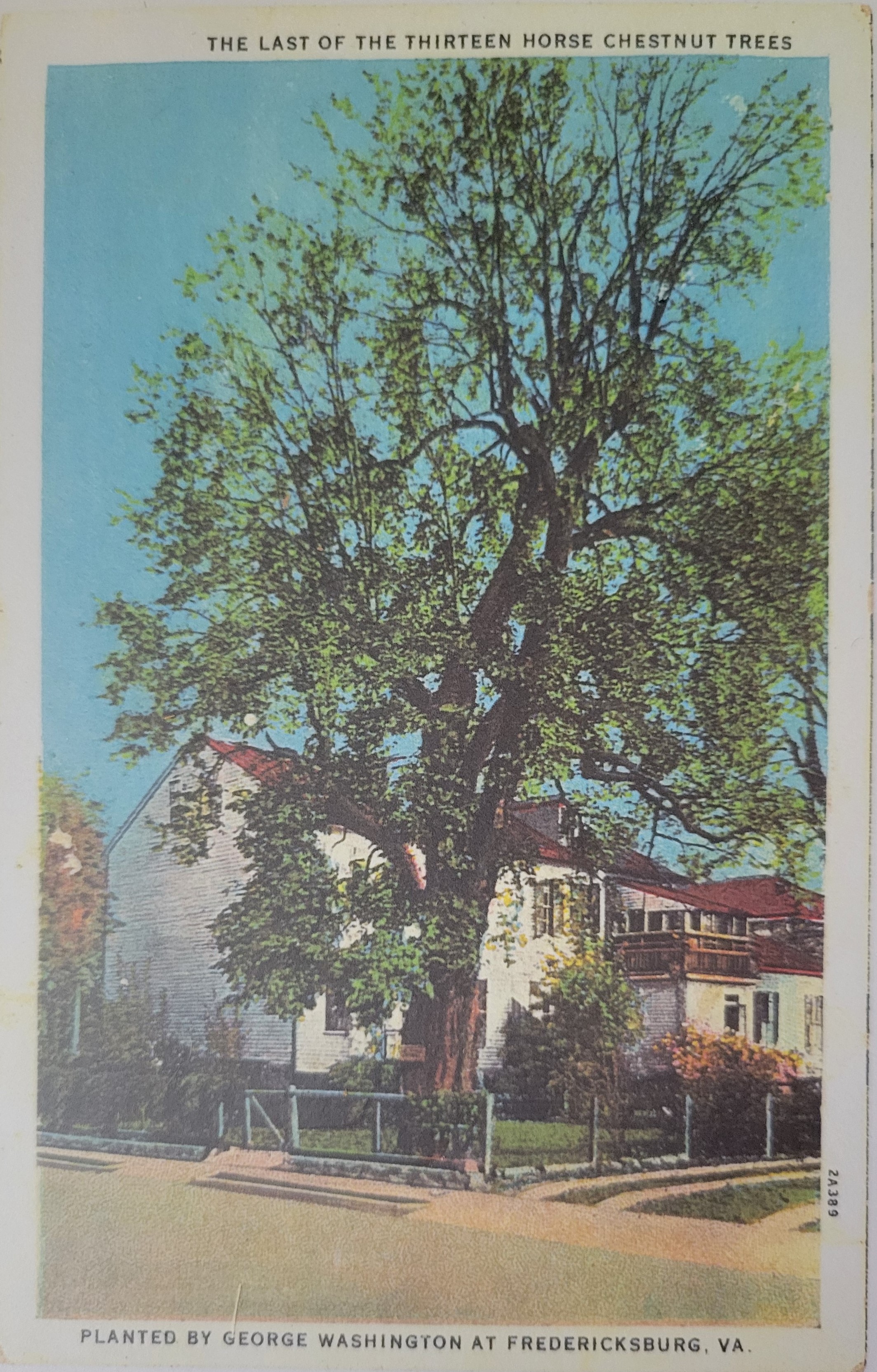
    There once stood a large horse chestnut tree on the corner of Fauquier and Charles Street in Fredericksburg. It was noted as one of the thirteen legendary Washington horse chestnut trees planted by George himself. By the 1930s, it was becoming clear that the tree needed some help, so the Daughters of the American Revolution (DAR) took up the cause to protect this historic tree.

    The tree legend states that George, while visiting his mother in June 1788 in Fredericksburg, decided to plant thirteen horse chestnut trees from her house to his sister’s house, Kenmore, just a few blocks away. This provided a scenic path for his mother when she visited her daughter Betty. These trees commemorated the thirteen original states.

    It is a great story. It is patriotic and nostalgic, showing George as a man of the earth with his love of trees, gardening, and horticulture. He planted these trees for a future America to remember the struggles to create this country and the precious nature of our land that we must protect.
    But is it true? Did George plant that tree? What is the evidence?


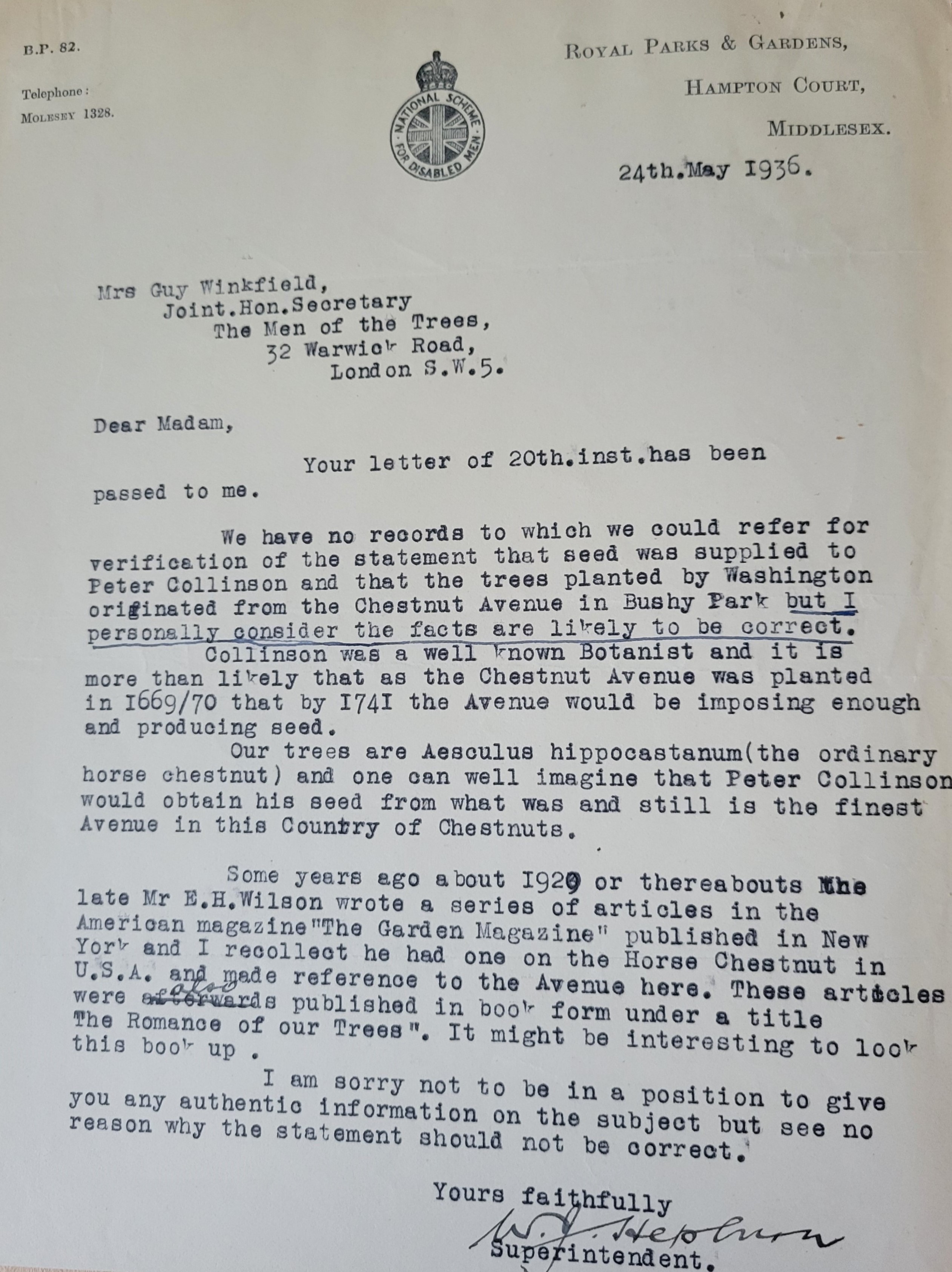
    The horse chestnut tree is a native of the Balkans region (Albania, Bulgaria, Greece, and Northern Macedonia). It made its way to Europe and England during the seventeenth century, noted as growing in South Lambeth, London, and being planted by Sir Christopher Wren at Hampton Court.

    Horse chestnut trees Bush Park, Hampton Court, England planted by Christopher Wren in 1669-1670.

    There is documented evidence of some horse chestnut trees crossing the Atlantic to Mr. John Bartram, one of America’s first botanists in the 1740s. In a letter from Peter Collinson, an English botanist, dated September 16, 1741, he wrote to Bartram, “I have sent some Horse-Chestnuts which are ripe earlier than usual; hope they will come fit for planting.”. Bartram acknowledged receiving them and stated that most were blue-molded, and only one germinated and grew. Over twenty years later, Bartram updated Callison on the success of the lone seedling, writing, “But what delights me is that our horse chestnut has flowered. I think it must excel in America.”

    Letter from Royal Parks and Gardens, Hampton Court, May 24 1936


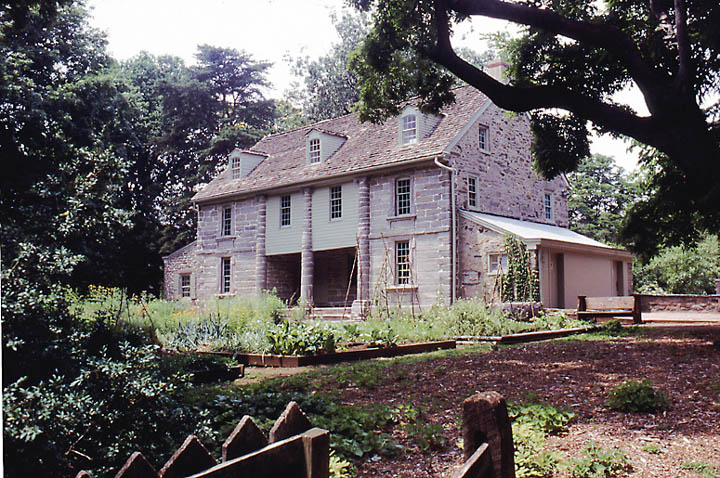
    Bartram’s Gardens in Philadelphia was quite popular and visited by many founding fathers while working there. George visited the gardens twice in the summer of 1787 while in the town during the Constitutional Convention, noting, “Sunday, June 10, 1787, breakfasted at Mr. Powell’s and in company with him rid to see the Botanical Gardens of Mr. Bartram, which, though stored with many curious plants, shrubs, and trees, many of which are exotics, was not laid off with much taste, nor was it large.”

    John Bartram’s house and upper garden at Bartram’s Garden

    Why mention this? In some versions of the story, Washington got his horse chestnut trees from this garden, but there is no evidence that the legendary trees were obtained from this famous historic garden.
    George only made two diary entries about horse chestnut trees on April 13, 1785, writing, “Received from Col. Henry Lee of Westmoreland 12 horse chestnut trees (small) and an equal number of tree boxes. They appeared to have been some time out of the ground. Planted 4 of the Chestnuts on my serpentine walk – two on the east end and the rest in the vineyard.” And again, on April 2, 1788, wrote, “Transplanted from a box in the garden, thirteen plants of the horse chestnut into shrubberies by the garden walls.”

    The entry shows evidence of planting the famous Washington trees, right? No, because George was at Mount Vernon in April and didn’t leave for Fredericksburg to visit his mother until June 10, 1788.

    But could he have had them sent down and have them planted before he came to see his mother? Yes, but the story says that George planted these trees with his own hand. Additionally, it would be odd for George to mention planting the trees while in residence at Mount Vernon and not say that they were in his mother’s garden in Fredericksburg. Washington was a diligent diarist but never mentioned planting thirteen horse chestnut trees in his mother’s garden.

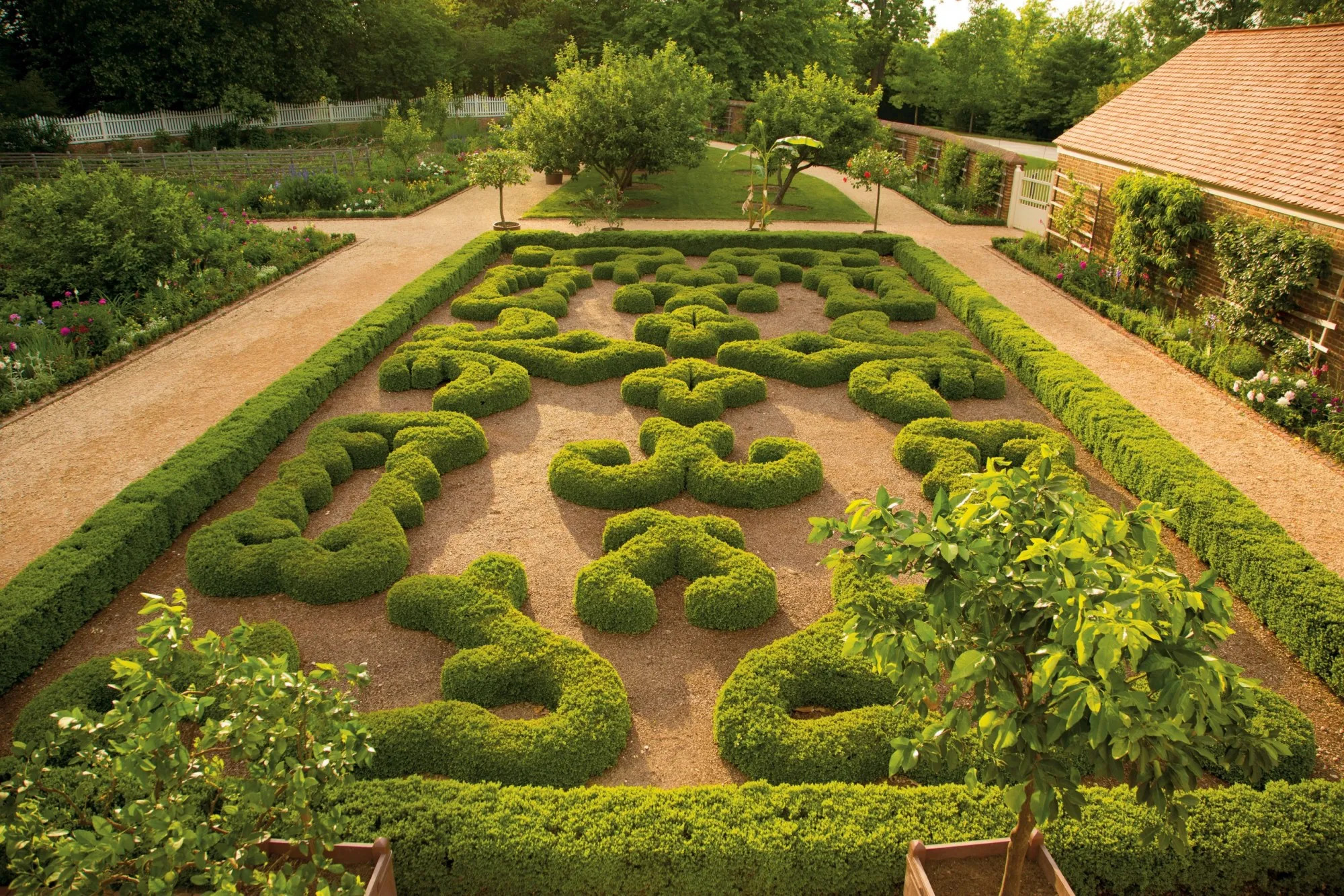
    Mary Washington’s house gardens, Fredericksburg.

    Further, no known letters from George, Mary, or Betty mention any horse chestnut trees between Mary’s gardens and Betty’s Kenmore.

    Spring time in the gardens at Kenmore Plantation (can you spot the cat?)

    This was all the primary source evidence I could find relating to George and any horse chestnut trees. So, I looked further into the story to see what other evidence was being used to verify that this tree was indeed one of the thirteen Washington trees.

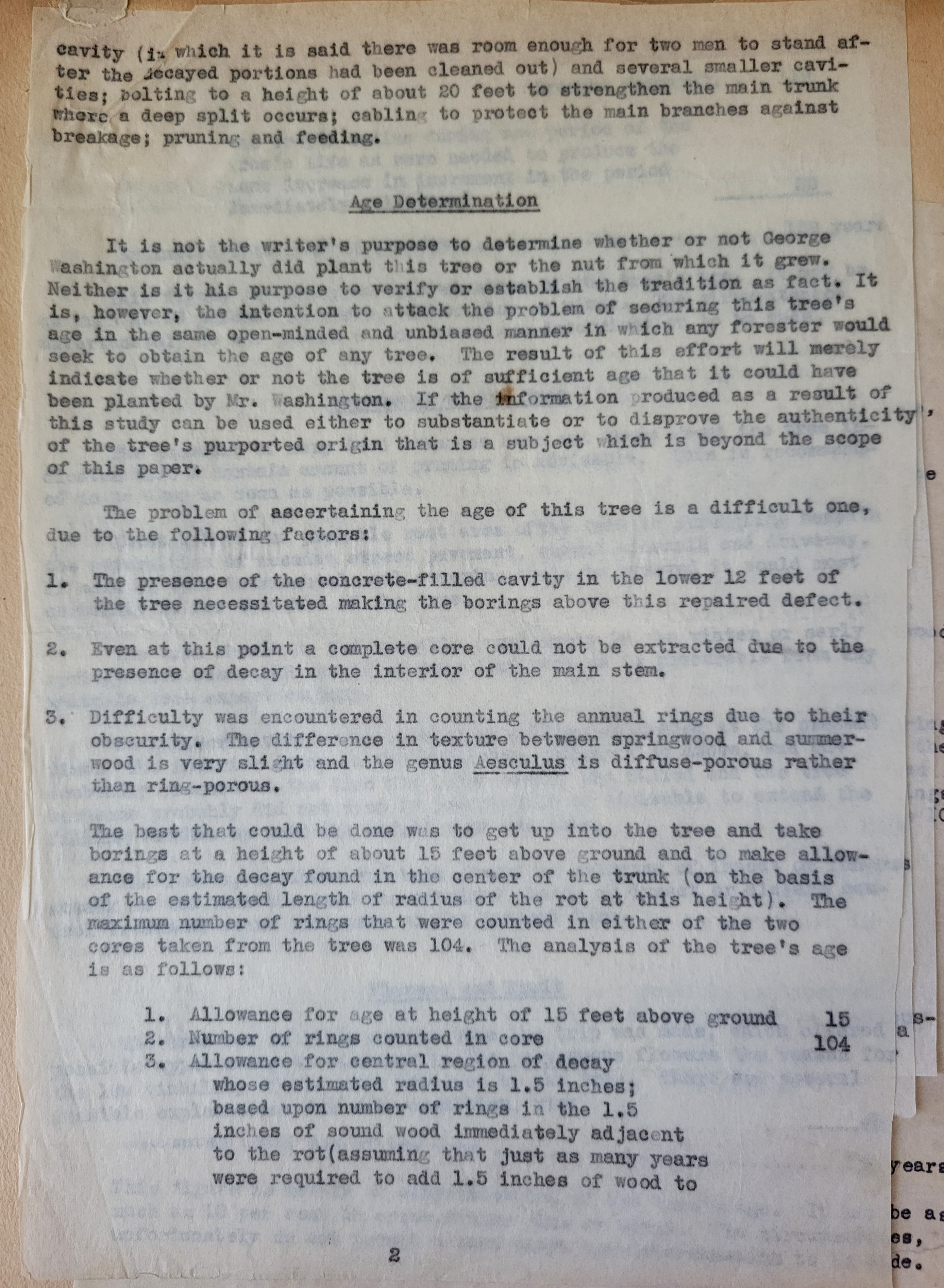
    As I said in the beginning, by the 1930s, many, including the DAR, were trying hard to save this lone surviving chestnut tree. With their extensive reach, they got Fred H. Arnold, the Assistant Forester for the National Park Service, to do an age-determination test on the tree in May of 1934. Mr. Arnold noted some issues with the test, stating that the lower twelve feet of the tree was filled with concrete, so the coring sample had to be taken above this “repaired defect”. Even then, a complete coring sample could not be extracted due to decay in the interior of the main stem. Additionally, Mr. Arnold said that it was very difficult to count the annual rings due to their obscurity because the texture difference between the springwood and summerwood for the horse chestnut tree (genus Aesculus) is very slight. Taking into account all this, Mr. Arnold estimated the tree to be around 139 years old with as much as 10% in error, either plus or minus, which would put the date it was planted somewhere between 1781 and 1809, which means that the tree is indeed old and could have been planted during Washington’s time in Fredericksburg.

    Age Determination, May 6 1934

    Lastly, local historian James Henry Heron collected local citizens’ recollections of the tree and the story. Mrs. Lilias Hamilton Scott, the wife of Mr. John Scott, who owned the lot on which the tree stands, wrote that her grandmother (Mrs. Janet Scott Hamilton) stated her great-grandmother (Mrs. Francis Scott) resided in Fredericksburg in 1788 and was Mary Washington’s neighbor and intimate friend. She said the trees were planted by Washington.

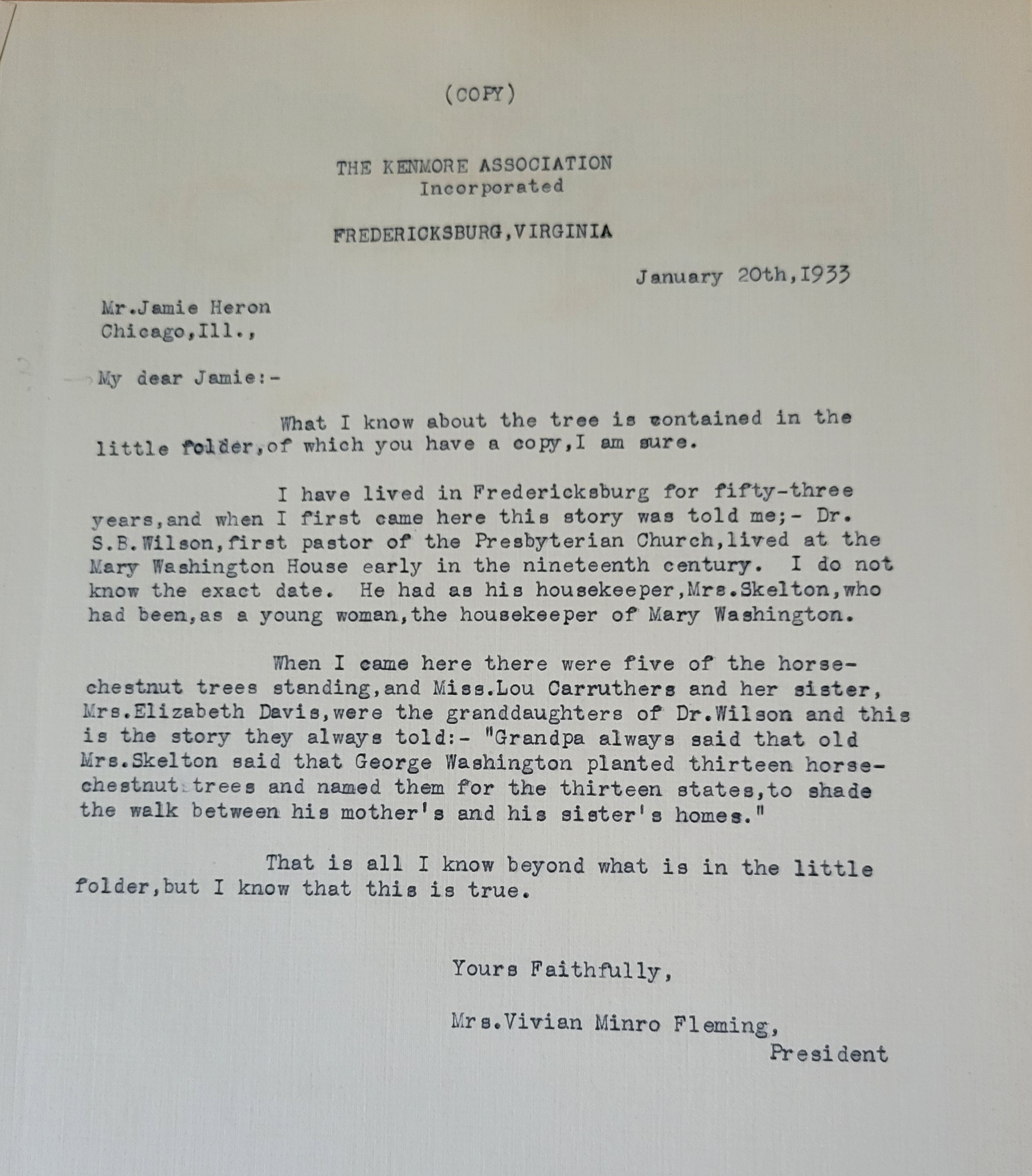
    Mrs. Vivian Minor Fleming traces the story back to Miss Lou Carruthers, her sister Mrs. Davis, and their grandfather Rev. S.B. Wilson’s housekeeper, Mrs. Polly Skelton, who had previously been a housekeeper for Mary.
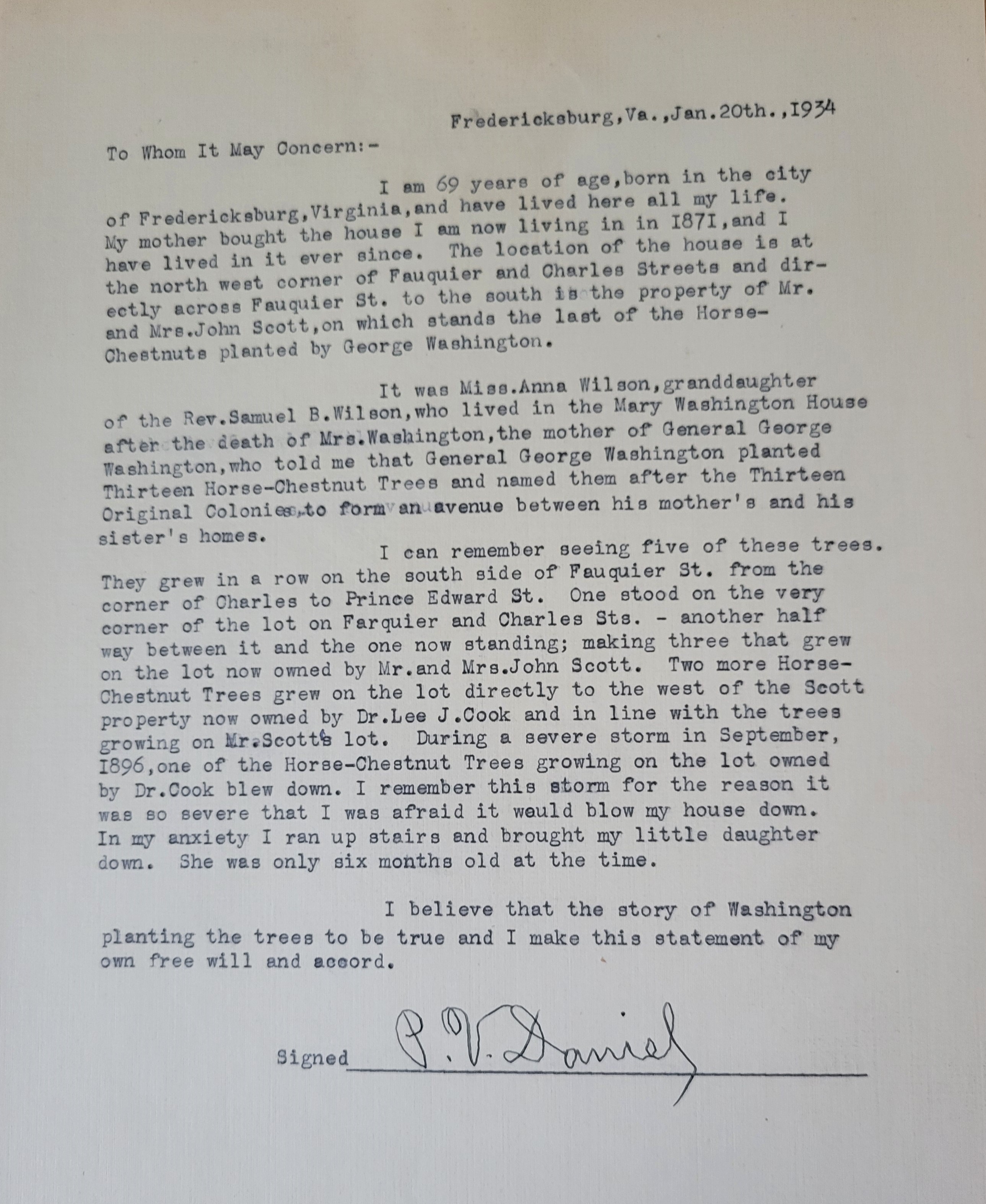
    Mr. P.V. Daniel, who remembers five of the original thirteen trees, lived across the street from the remaining one for over sixty years and said Miss Anna Wilson, granddaughter of Rev. S.B. Wilson, told him the story.
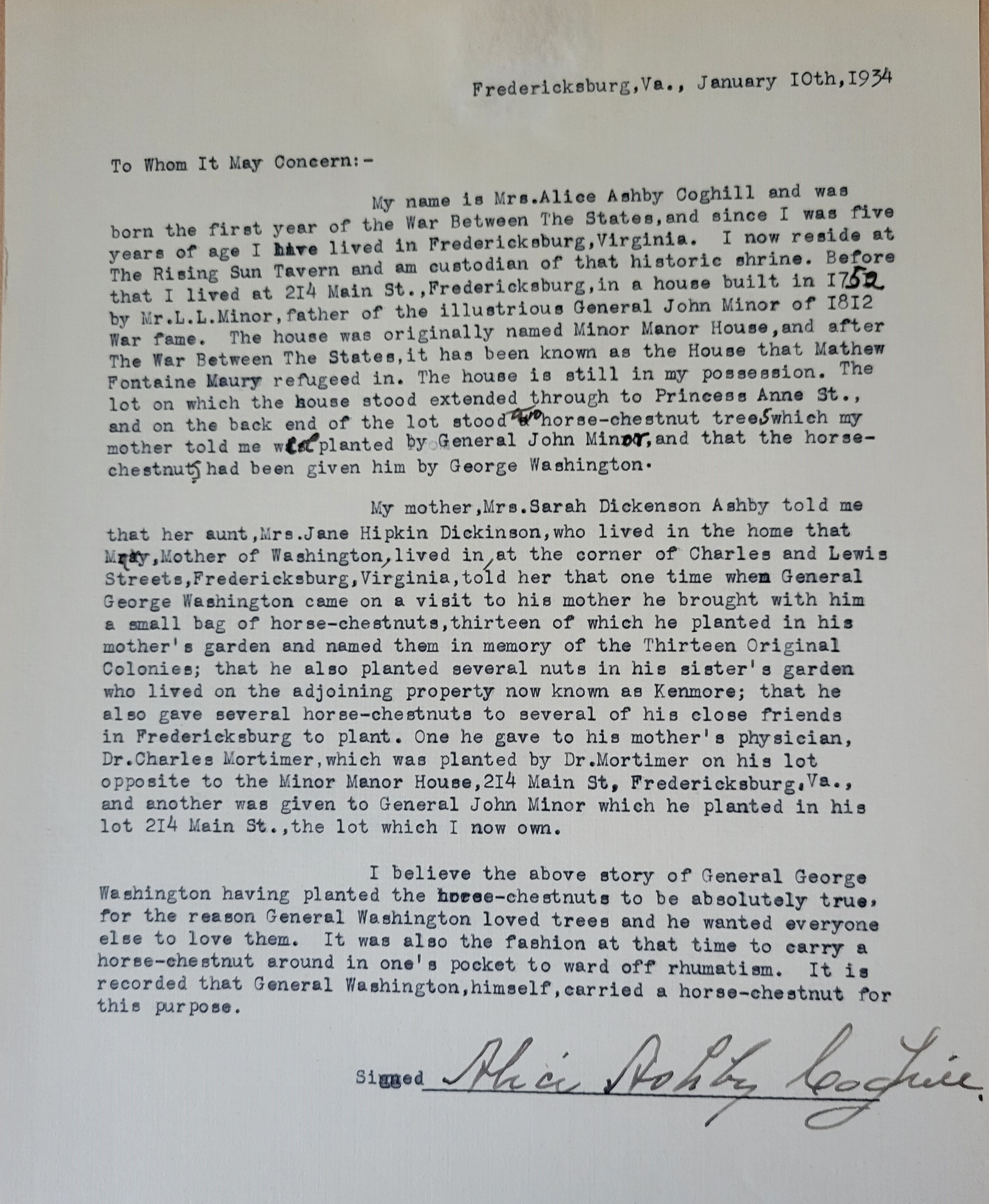
    Mrs. Alice Ashby Coghill says her aunt, Mrs. James Hipkin Dickinson, who lived at Mary Washington House after Rev. S.B. Wilson said Washington planted the trees and passed out horse chestnuts to friends.
    While I have no doubt these people are truthful in their recollections, they do not offer any definite evidence. They merely document that the legend was a well-known story but not that it was true.

    Regardless, the much-loved old tree was rightfully given proper emergency care with a donation and service from Senator Martin L. Davey from Ohio and The Davey Tree Expert Company. The famous tree lived happily for over another half century before being taken down in 2004.

    Whether this tree was planted by George along with twelve others will probably never be conclusively proven. Were the people wrong to save the tree all those years ago without better evidence? Absolutely not. They saved a beautiful 200-year-old horse chestnut tree with a legendary attachment to George Washington, but they also saved a bit of their own past, nostalgia, and pride in their own town’s history.


    Heather Baldus

    Collections Manager

  • That’s A Wrap! Ferry Farm’s Dig Season Recap

    October just happens to be Virginia Archaeology Month, and what better way to celebrate than to recap this summer’s excavation at George Washington’s Boyhood Home at Ferry Farm.

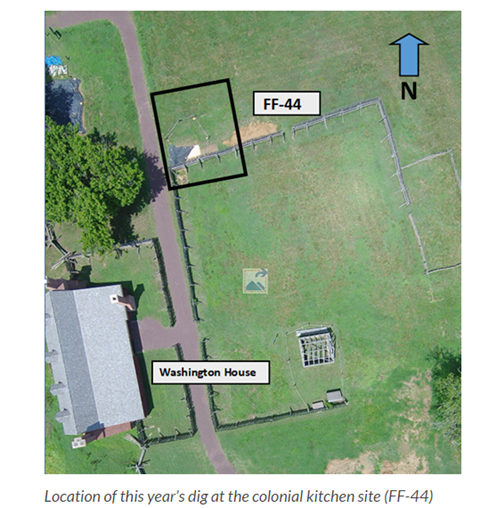
    You might remember from our dig preview, that this year’s dig (FF-44) focused on the continued exploration of the 18th-century kitchen site located just northeast of the main house. In 2023, our limited investigations uncovered just a small section of the kitchen’s stone foundation and cellar, giving us a sneak preview of the conditions and parameters of future site work. Armed with this knowledge, our aims this year were to uncover more of the original foundation walls of the kitchen cellar, to uncover additional architectural evidence of the kitchen outbuilding, and explore the surrounding landscape for features. So, did we do it?

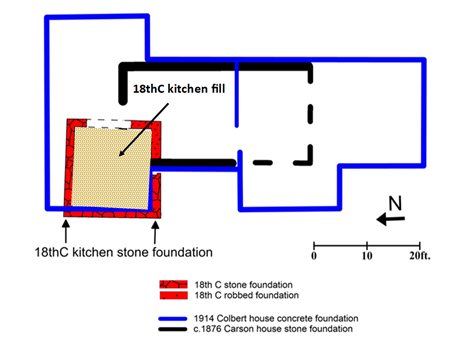
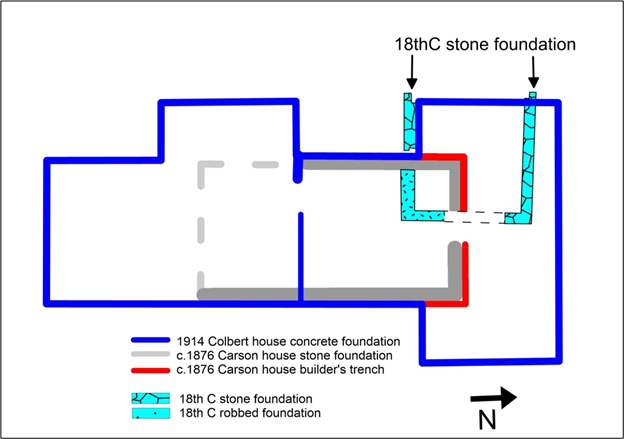
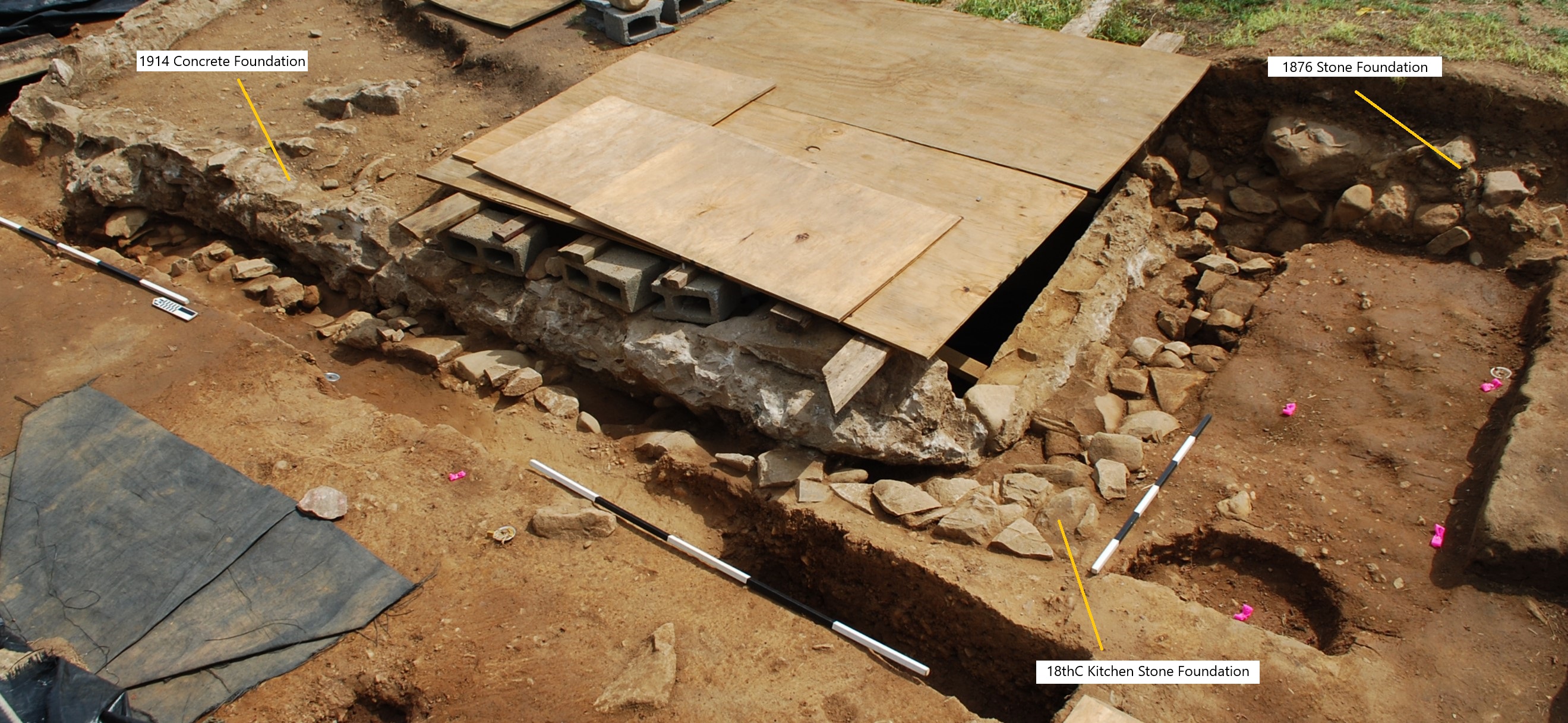
    Location of the 18th century kitchen foundation in relation to two later farmhouses dating to 1876 and 1914. 

    We did! But before we get to the fun discoveries, let’s go over how we got there. As far as sites go here at Ferry Farm, this one has been through a lot. Not only did the original 16’ by 16’ kitchen building burn and collapse in on itself in the middle of the 18th century, but it also had two subsequent farmhouses built on top of it that were either moved, damaged in a fire, or demolished all within the last 150 years. A previous archaeology project on the site introduced another element of complexity in understanding the depositional sequence of fills on the earlier 18th-century site, which had obviously been heavily disturbed by all these later events.

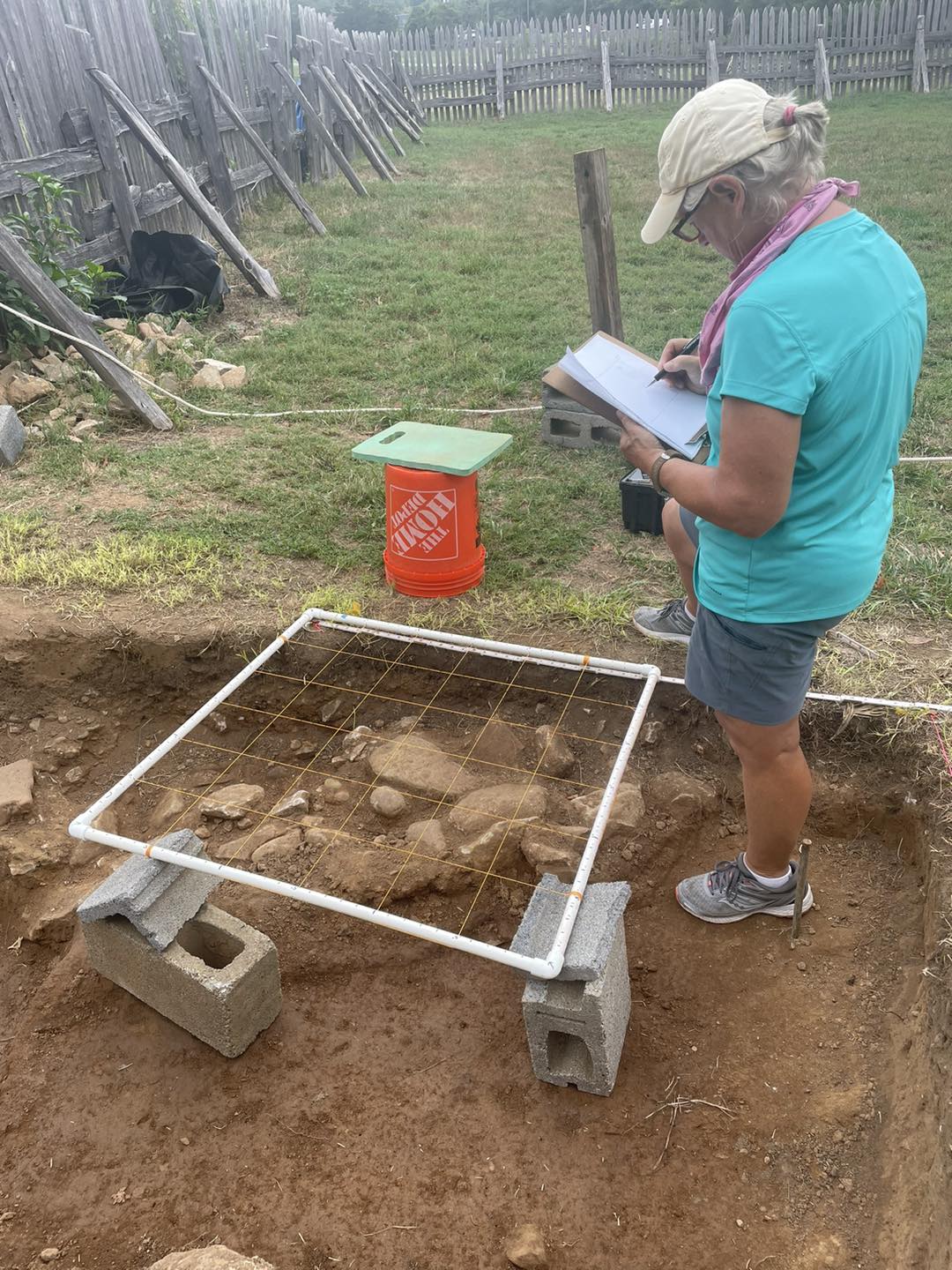
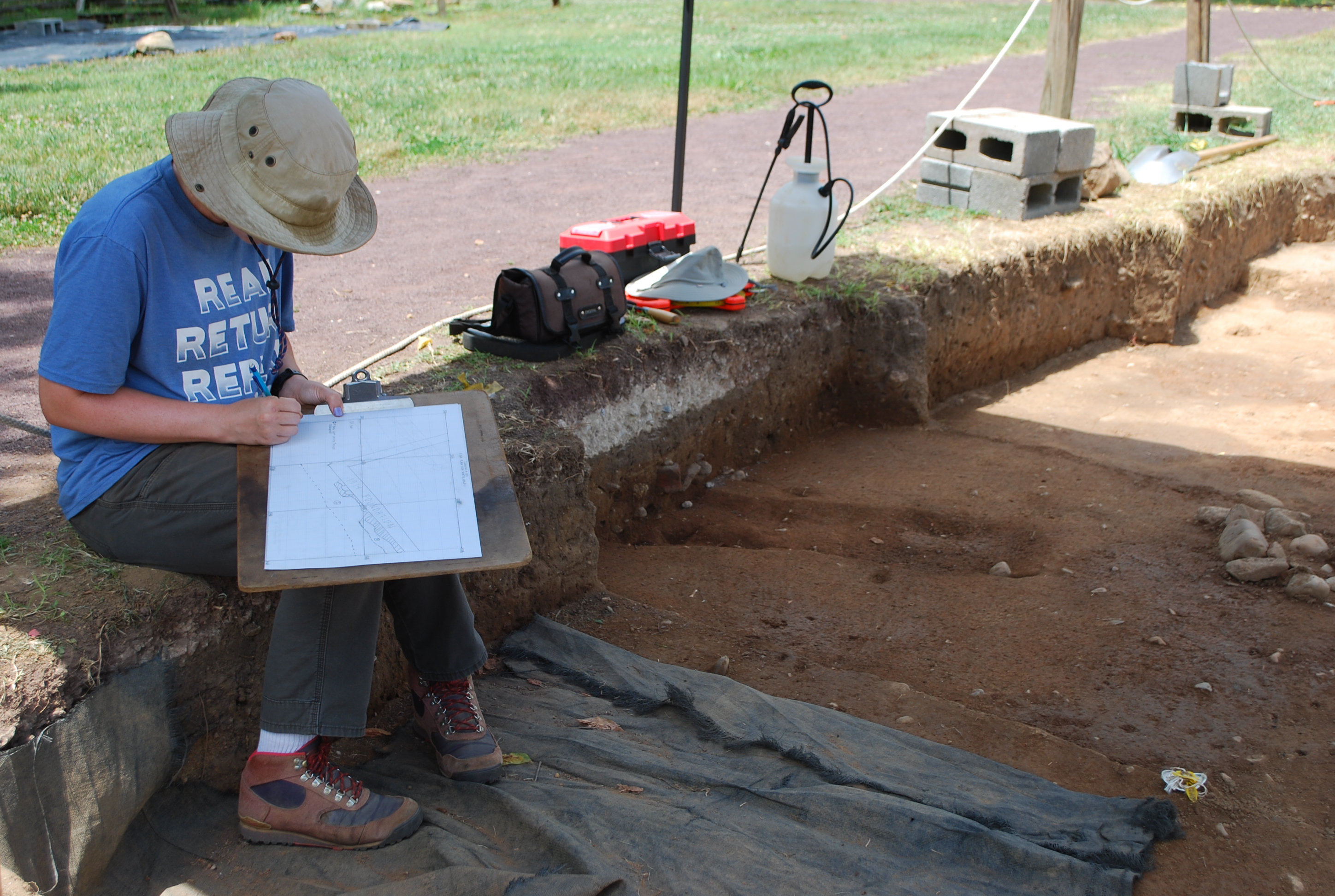
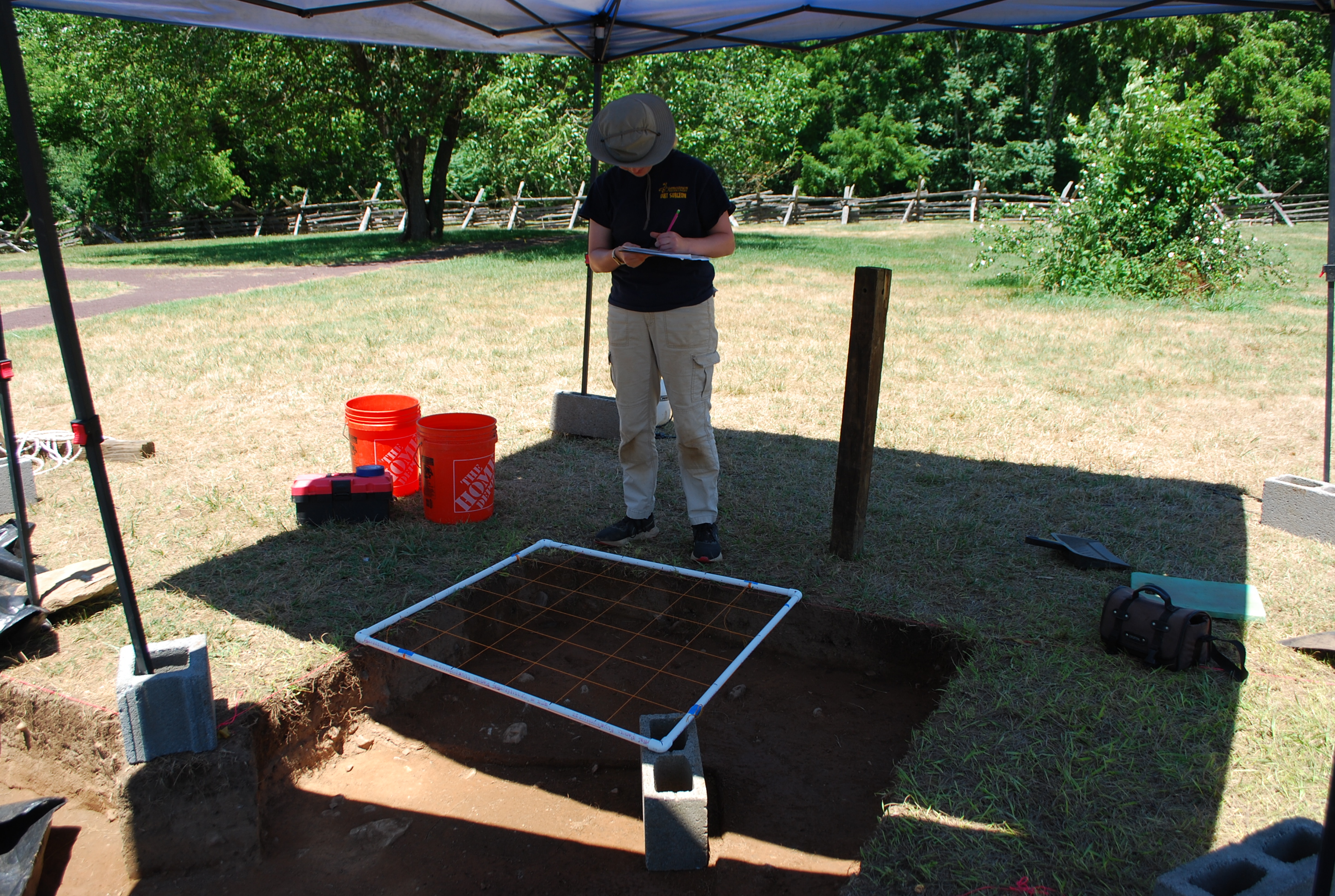
    All this led to an interesting excavation. Since a significant portion of the site had previously been excavated in the 1990s, a sizable amount of our site time was spent re-excavating backfilled archaeology units with the purpose of exposing unexcavated layers around the site. Not only would these unexcavated layers allow us to gather new data, but it would also give us the opportunity to better understand the findings as recorded in the earlier reports.

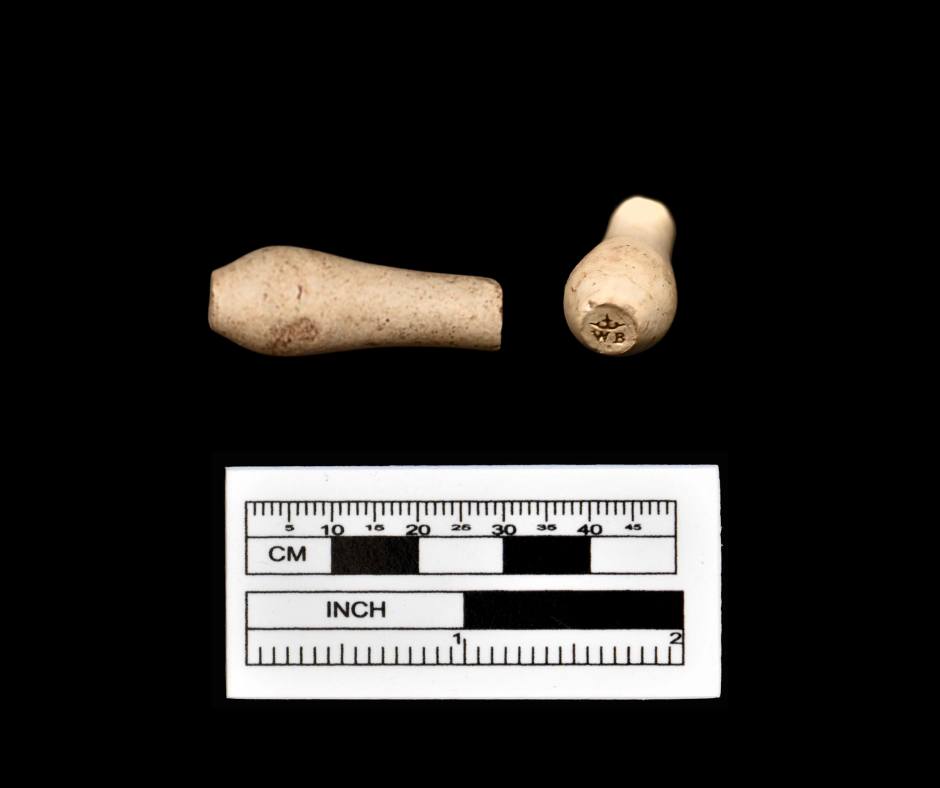
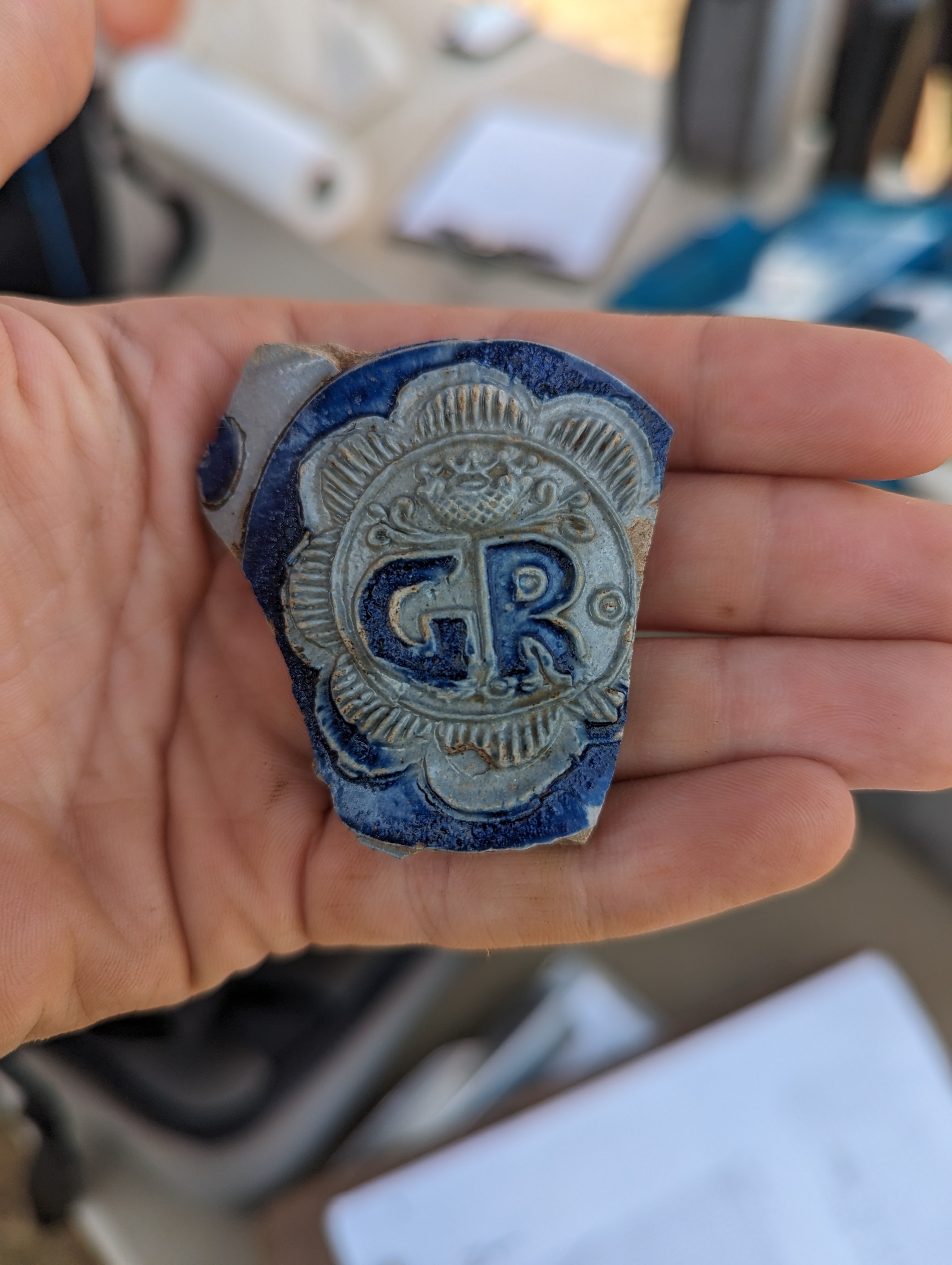
    With the help of our wonderful field school students and interns, we opened a total of twenty-seven 5’x5’ units across the kitchen site. Sifting through the dirt, hundreds of artifacts were found dating to all occupations of Ferry Farm. Super cool finds that date to the 18th-century period of use for the kitchen included tobacco pipe fragments, wine bottle sherds, and a variety of ceramics, including English stoneware, Chinese porcelain, and a German Westerwald ‘GR’ sherd. The prehistoric Native American occupations of the site were represented by an unusually high number of projectile points found (8 and counting!), dating to both the Early Archaic (8000 BC – 6500 BC) and Early Woodland (1100 BC – 500 BC) periods.  Civil War bullets came up in our screens, of course, as did 20th-century plastic, tools, toys, and bottle caps.

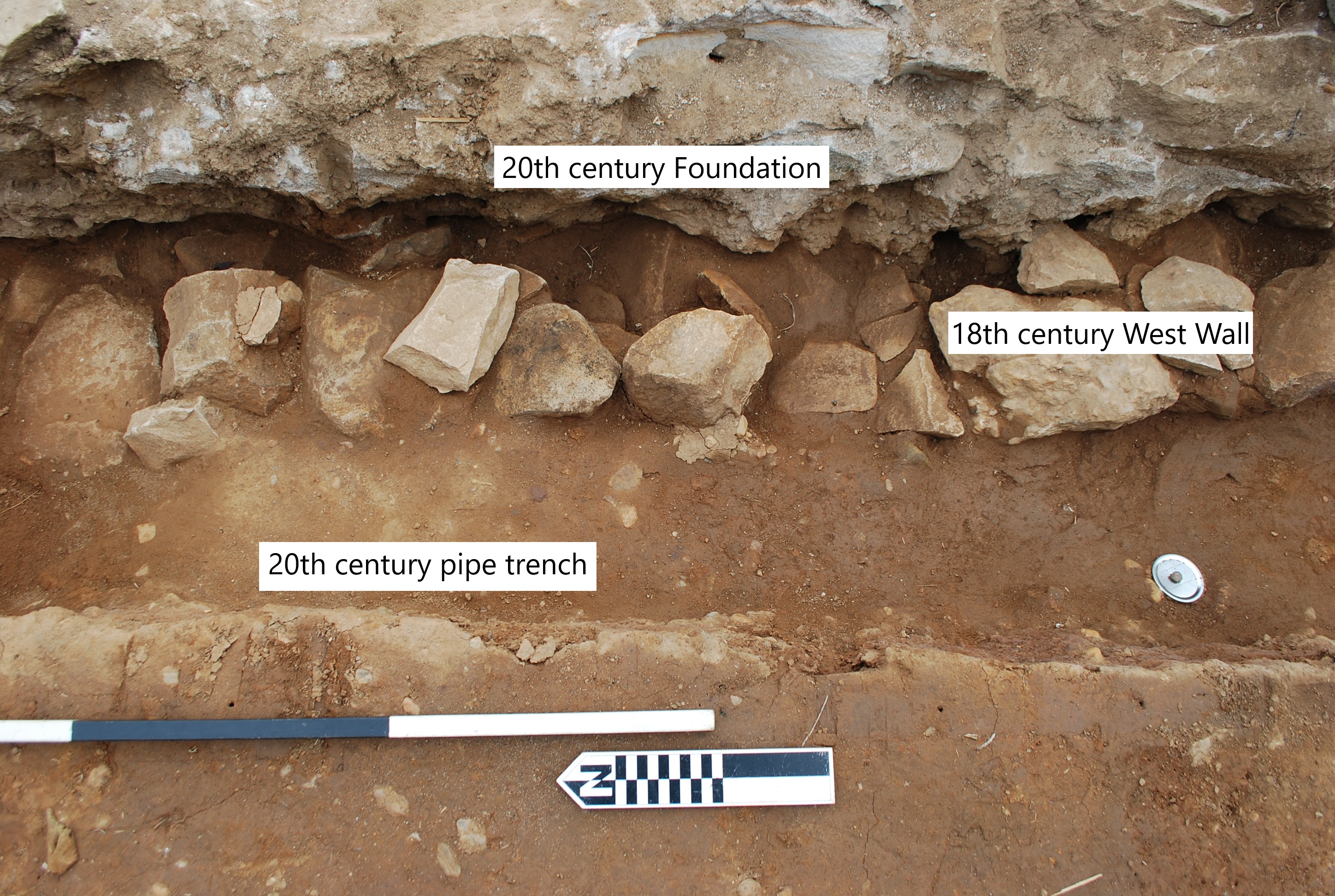
    But when it comes to finds, our most exciting discovery did not turn up in our sifting screens.  In fact, it was discovering that the western foundation wall of the kitchen cellar, thought to have been demolished, still survived!  During the 1990s excavations, the archaeologists did not see this portion of the stone foundation and assumed the construction of the 1914 Colbert house had destroyed it. Fortunately for us, it was hiding under a 20th century utility pipe and trench and lay directly adjacent to the Colbert concrete foundation. Now we have all four foundation walls that we hope to fully uncover next year.

    Exposed south and west stone walls of the colonial kitchen lie adjacent to and just outside of the 1914 concrete foundation wall.  
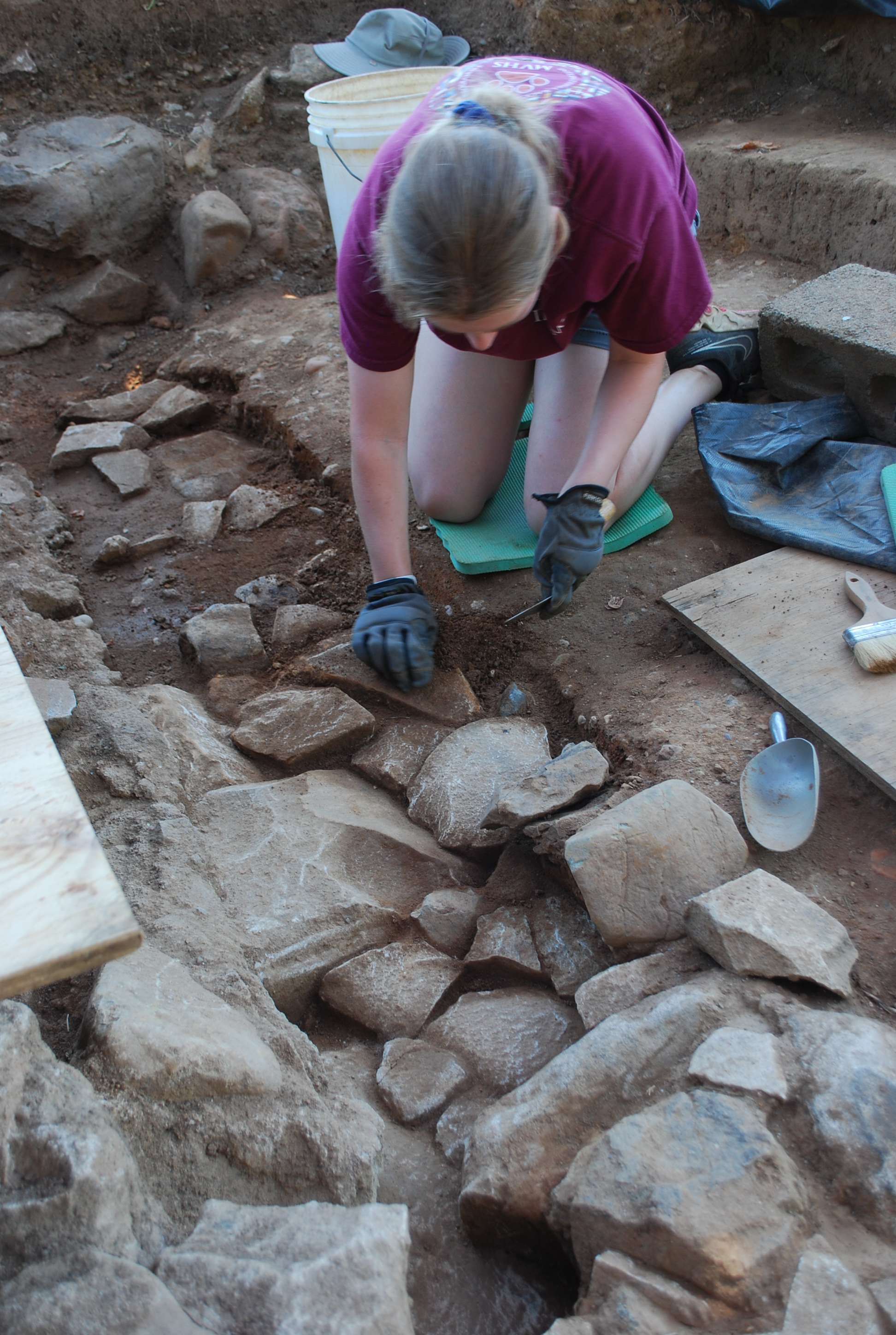
    West wall of colonial kitchen that was hiding under the pipe trench

    Our excavation units surrounding the kitchen foundation have not, as of yet, exposed additional building features associated with the kitchen outbuilding, such as foundations or fireplaces. That search will continue next year as we continue taking those units down and expanding our site area. Features exposed in the 1990s dig, but not excavated by them or us, such as possible post holes and trash middens, also await our return in 2025, when we plan on finishing their excavation.

    Each year’s excavation is built on the work accomplished in the previous years.  With the incredible amount of work done this past summer of exposing the original kitchen foundation, as well as the later farmhouse foundations, removing old fill, and opening up the adjacent landscape, we are looking forward to expanding our investigations of the kitchen site next year.  Stay tuned as we unravel the mysteries that are here at Ferry Farm, George Washington’s Boyhood Home.


    Danielle Arens and Judy Jobrack

    GWF Archaeology Field Directors