In 1824, the United States was approaching its national jubilee—50 years of independence. President James Monroe, looking to create a wave of patriotism and celebration, invited the last surviving General of the American Revolutionary War, an American hero and icon, to take a grand tour of the country revitalizing the “spirit of 1776.” That American hero was…a French aristocrat with a painfully long name of Marie-Joseph Paul Yves Roch Gilbert du Motier de La Fayette, the Marquis de Lafayette.
1824 portrait of Lafayette by Ary Scheffer is currently in the U.S. House of Representatives
I won’t go into General Lafayette’s exploits, heroism, and leadership during his time in the Continental Army, but the young man was impressive and quickly became an adopted countryman.
Lafayette being heroic at the Battle of Brandywine, artist Charles Henry Jeens
However, we will talk about his American tour, particularly his stop in Fredericksburg.
Lafayette arrived in New York on August 15, 1824, after setting sail on a merchant packet Cadmus from Le Havre with much disapproval from Louis XVIII, the King of France. But royal condemnation from Louis XVI (Louis XVIII’s elder brother) hadn’t stopped him from setting sail for America in 1777, and it didn’t stop him in 1824.
Lafayette arrived in Fredericksburg on the evening of November 20th. He was first received at the parade grounds by two companies of Riflemen, the Washington Guards, and the whole Marine Band from Washington. Then they all commenced in a long column toward town, gaining excited townspeople on horses as they continued down Hanover Street toward Caroline. (Merchant, 1824) (Levasseur, 1829)
Cover page of the book by Rufus B. Merchant documenting Lafayette visit, 1825
The procession made it to the Town Hall, which was festooned with evergreens and flowers. There, it was met by a battalion of little boys called Lafayette Cadets, dressed in sharp white uniforms with red trim. After a quick welcome speech from the mayor, the general was led into the Hall, where he was greeted by a group of garlanded young girls singing his praises.
Fredericksburg’s Town Hall, 1814-1816
The general was then whisked off to his accommodations provided by Mr. James Ross to enjoy refreshments and a “handsome” dinner. At nine o’clock, Lafayette, the Mayor, and Colonel Mercer were taken to the Farmer’s Hotel (west corner of Caroline and Hanover Streets) to partake in a grand welcome ball for a few hours until he retired, presumably exhausted from the day’s activities. (Merchant, 1824) (Crookshanks, 2018)
On Sunday, the general, his son, and Mr. La Vasseur visited the Freemasons at the Fredericksburg Lodge, No. 4. In addition to observing the solemn and profound ceremonies, Lafayette was elected an honorary member in the Old Lodge Room. (Masonic Lodge No. 4, 2024)
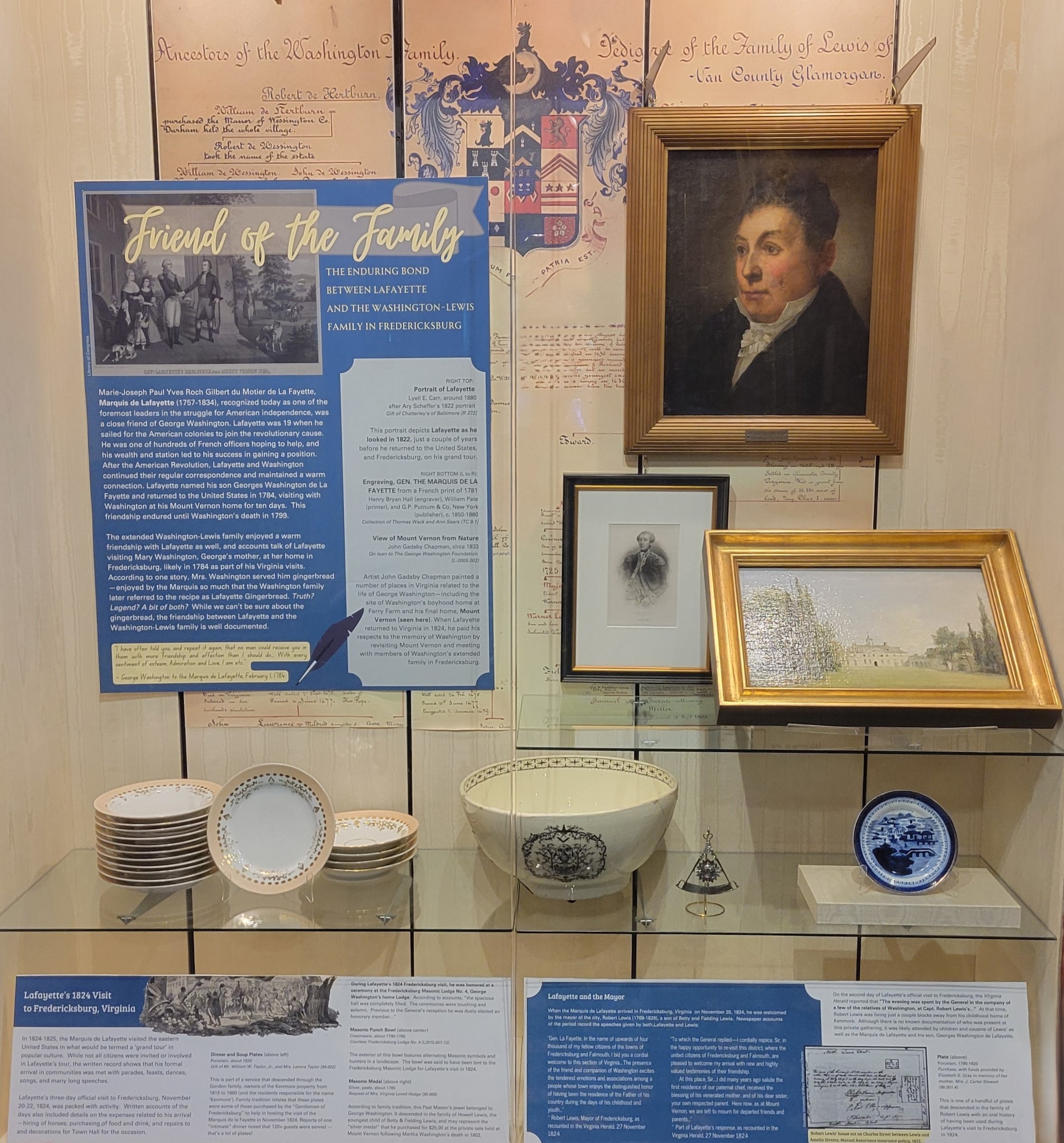
Masonic punch bowl used during the reception for the GeneralMasonic Lodge No. 4, about a hundred years after Lafayette’s visit.
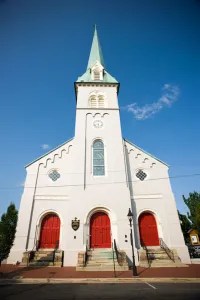
The assemblage of Masonic Brethren, civil authorities, military officers, Lafayette, and company was escorted to St. George’s Episcopal Church to enjoy an excellent discourse delivered by the Reverend Edward C. McGuire, also a Mason.
Interior of St. George’s Episcopal ChurchSt. George’s Episcopal Church, Established 1720
The general then spent the evening in the company of Washington relatives at Captain Robert Lewis’s, then retired to his lodging early at 9 o’clock. As Monday morning arrived, Lafayette was paraded to the town hall in a chariotee drawn by four white horses, where he was greeted by a crowd of ladies who occupied his time until he was led away for a sumptuous dinner at Mr. Gray’s Tavern. After a few hours of delicious food, songs, and speeches, the general was loaded into a carriage for the final time as he continued his journey to Washington. (Dovetail Cultural Resource Group, 2006)
Foundation of Mr. Gray’s tavern (Indian Queen Tavern) located on the current Marriott Hotel site.
Lafayette’s time in Fredericksburg might have been short this trip, but it gave the city a last chance to thank and honor a valued friend who had been a champion for America and helped fight for this country’s freedom.
The city will again celebrate General Lafayette’s visit with a Commemoration Weekend on November 23rd and 24th. The weekend will open with a recreation of Lafayette’s arrival at the Old Town Hall, including period music and costumed participants. A reception line with the General will follow it. There will also be a Lafayette Ball on Saturday night, where participants can dress in their finest Regency garb and dance the night away (until 9 p.m.) with the General and President Monroe.
Additional Saturday events include tours of the historic Masonic Lodge No. 4. Learn about the history of George Washington’s Mother Lodge and the fraternity’s importance to the general and see rare artifacts like the original punch bowl used during Lafayette’s visit. For more information and tour hours, visit the Masonic Lodge No. 4 website.
Sunday will start with recreating Lafayette’s Masonic welcome, with historical speeches and a unique ceremony. There will be additional Lodge tours from 1 to 4 p.m. At noon, a historic church service at St. George’s Episcopal Church will be reminiscent of that performed by Rev Edward McGuire. Lastly, back at the Masonic Lodge from 2 to 3 p.m., historian Chris Ruli will give a lecture discussing his forthcoming book, “Brother Lafayette,” which examines the Marquis’ connection to the ancient fraternity.
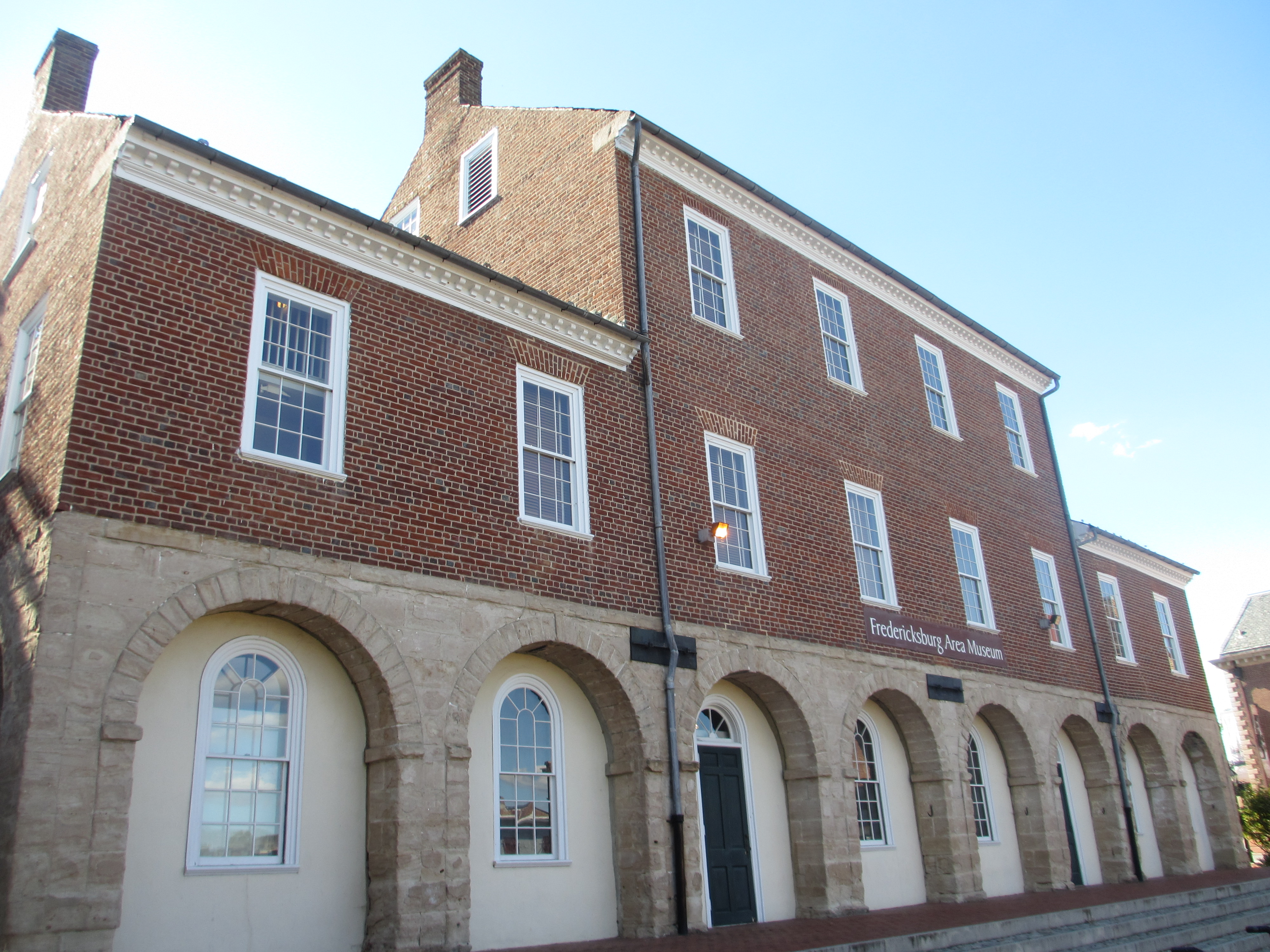
Finally, if you have some extra time on the weekend, stop by the Fredericksburg Area Museum and see their exhibit “Lafayette’s World: Revolutionary Ideals and the Limits of Freedom,” which explores Lafayette’s ideas on freedom, democracy, and abolitionism.
If you can’t attend the weekend events but still want to see exclusive artifacts related to Lafayette’s visit, including the extraordinary punch bowl of Masonic Lodge No. 4, stop by the Kenmore Visitor’s Center, check out our new exhibit, take a tour of the house and learn all about Fielding and Betty Lewis.
Friend of the Family – Lafayette’s Visit to America, Kenmore Visitor’s Center
If you have visited Ferry Farm recently or follow us on social media, you may have noticed the construction of two buildings near the Washington House. These new structures represent those that stood in these spots during George Washington’s time and were constructed using 18th-century methods. Identified through archaeology, their reconstructions allow us to tell better the stories of the people who lived and worked at Ferry Farm. We have previously blogged about the Quarter, a building for housing enslaved individuals owned by the Washingtons. For this blog, we will look at an integral structure located behind the Washington dwelling: the Cellar House.
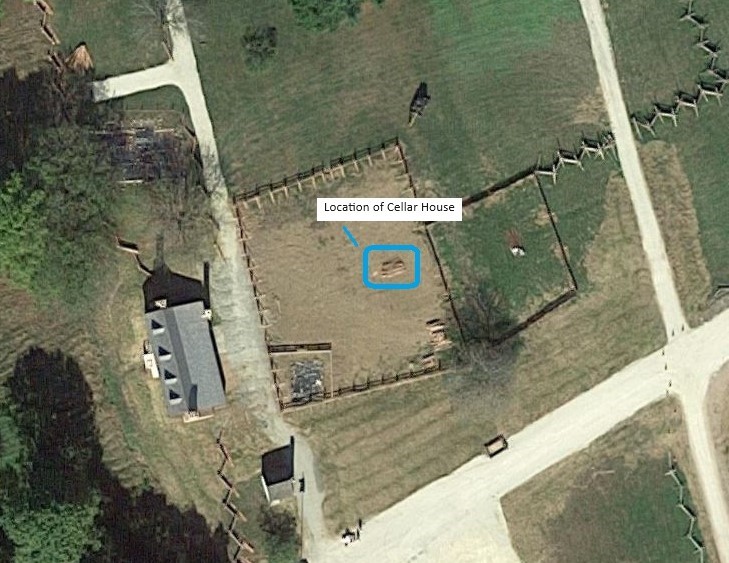
The Cellar House
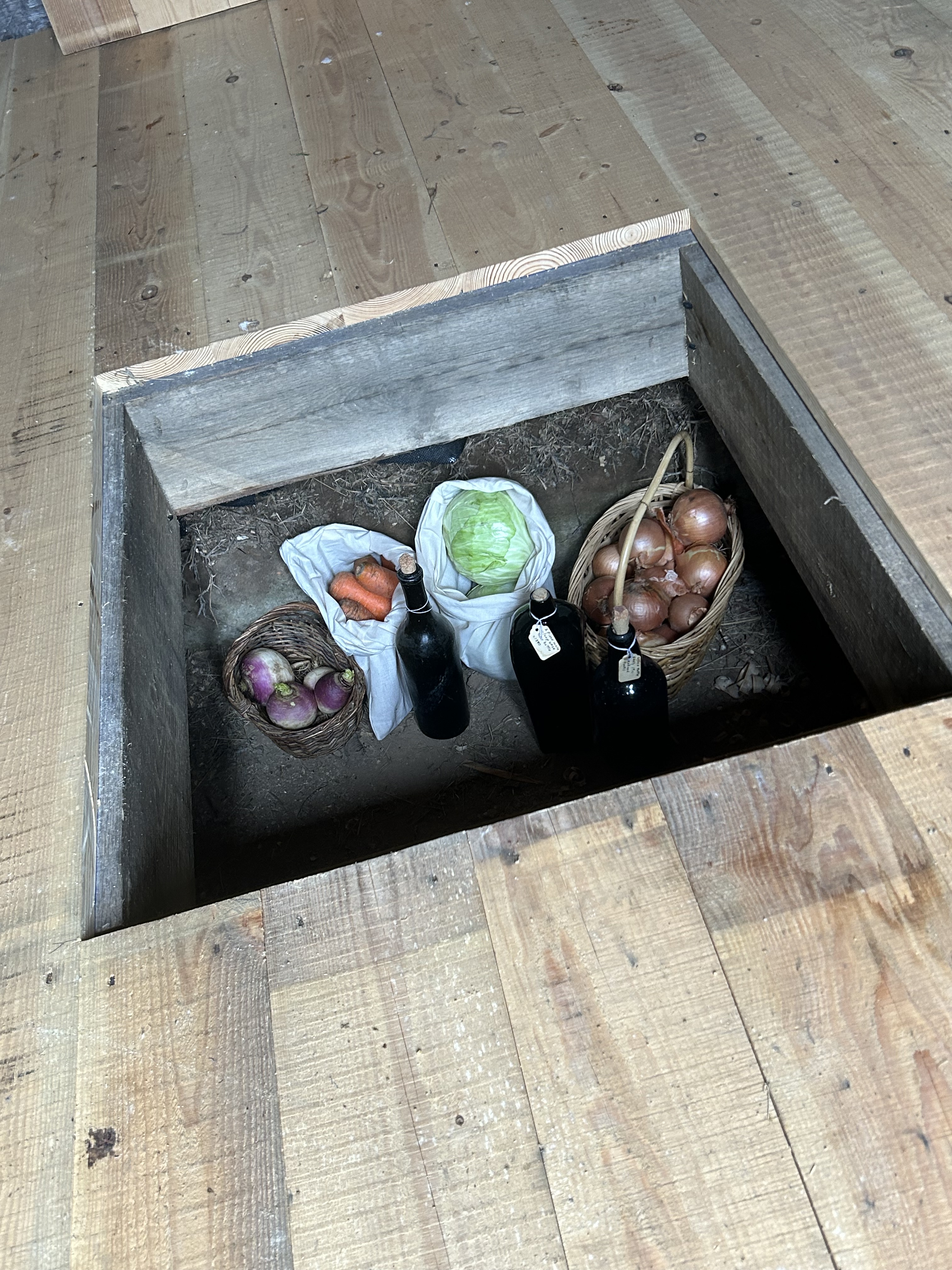
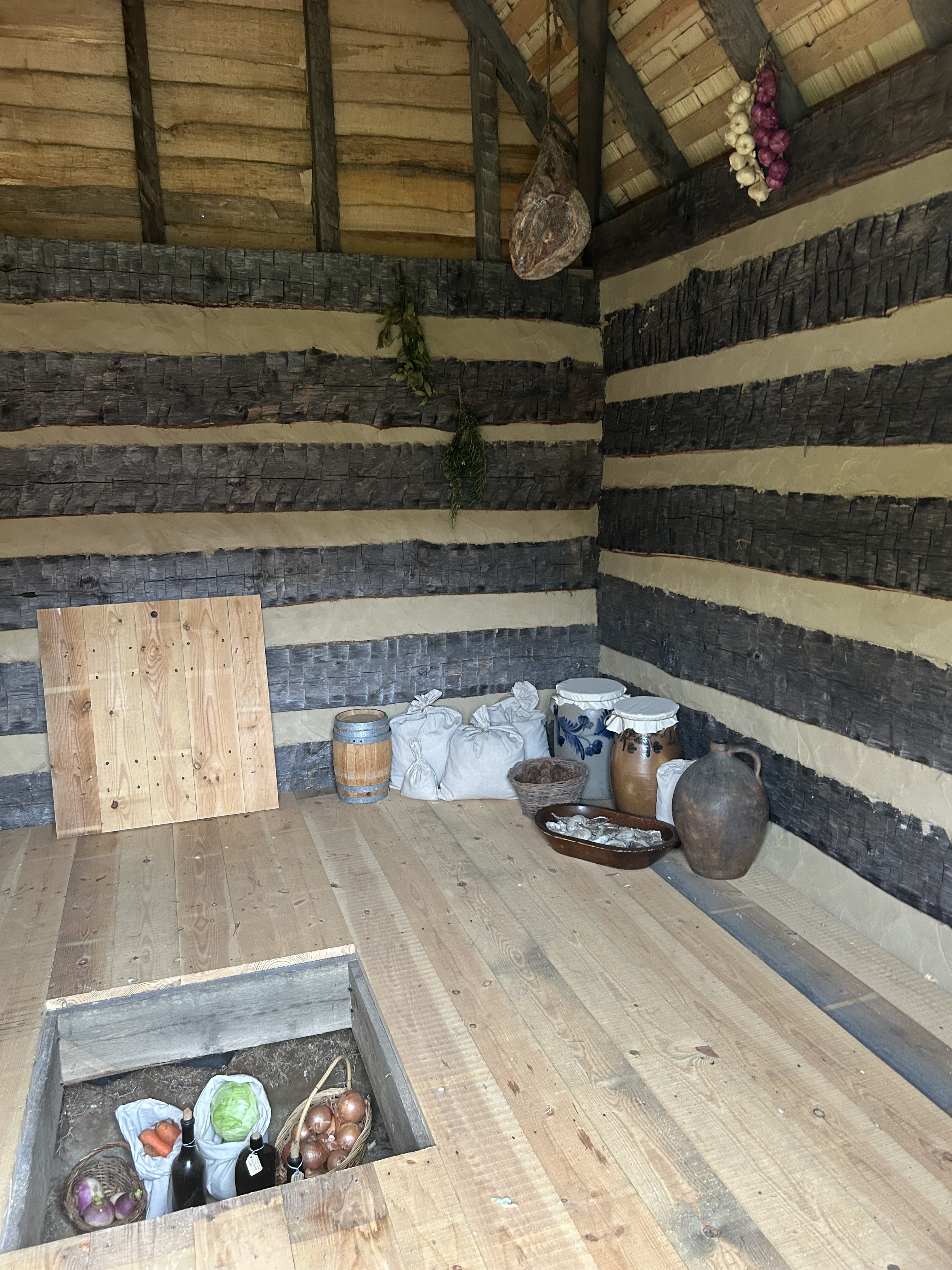
What is a cellar house, you may ask? While explaining it to my 7-year-old son, I told him it is neither a cellar nor a house (by modern standards). At this point, he threw up his arms and gave me up for an imbecilic parent. However, this structure was extremely important for large farms in the 18th century. Picture a simple timber and daub (fancy word for hardened clay) building with four walls, one door, high rafters, no windows, and a three-foot-deep pit beneath its floorboards. It is not fancy or decorative by any standards, yet this building holds preserved food that feeds dozens of people at Ferry Farm during seasons when fresh food is unavailable.
Location of the Cellar House on the Ferry Farm property
Let’s do a brief overview of food preservation during the Washington time period since it has already been touched on in previous blogs. Keeping food from going bad varies from region to region, depending on your climate (combinations of cold, wet, dry, or hot). The hot and humid months in Virginia posed quite a problem for colonists. These conditions do not lend themselves to easy food preservation. Plainly speaking, the East Coast Southern States drew the short straw when it came to keeping food consumable in the long term. As they say, “Where there’s a will, there’s a way,” and Virginians had a wide variety of cards in their deck for keeping food from rotting. Salt, sugar, wood ash, alcohol, vinegar (which was formerly alcohol), and other substances were utilized along with methods including smoking, fermenting, and dehydrating. However, even the best food preservation methods are useless if the resulting food is not stored correctly.
The cellar house could store many different types of foods and beverages, depending on where one kept them in the building. The rafters were ideal for cured meats such as hams, keeping them high and dry. Hooks on the walls held bunches of drying herbs, garlic, and onions. The shelves were perfect for baskets and small crocks of food, while the floor was sturdy for storing large casks or jugs of ale and cider, sacks of grain, and bushels of hardy vegetables and fruits. The pit beneath the floorboards, a glorified ‘cellar,’ was a few degrees cooler in the hot months and a few degrees warmer during the cold season. However, the difference between spoilage and edibility could hinge on maybe 10 degrees, making the subfloor pit essential for colonists who needed to keep some food cooler in summer but warmer (not freezing solid) in winter. Basically, the role the cellar house played varied by the seasons as a revolving door of foods came and went.
Inside of Cellar HouseInside of Cellar House
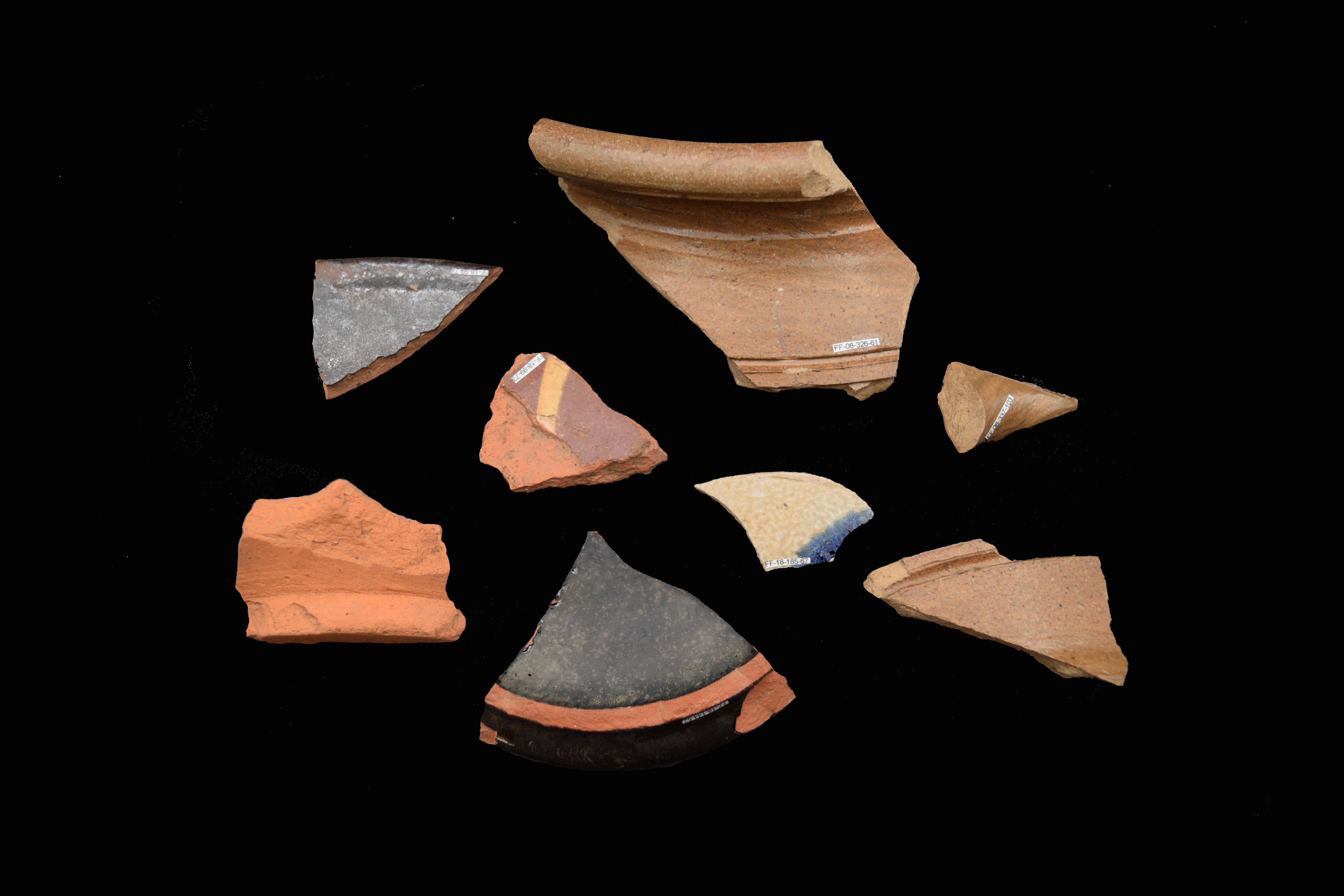
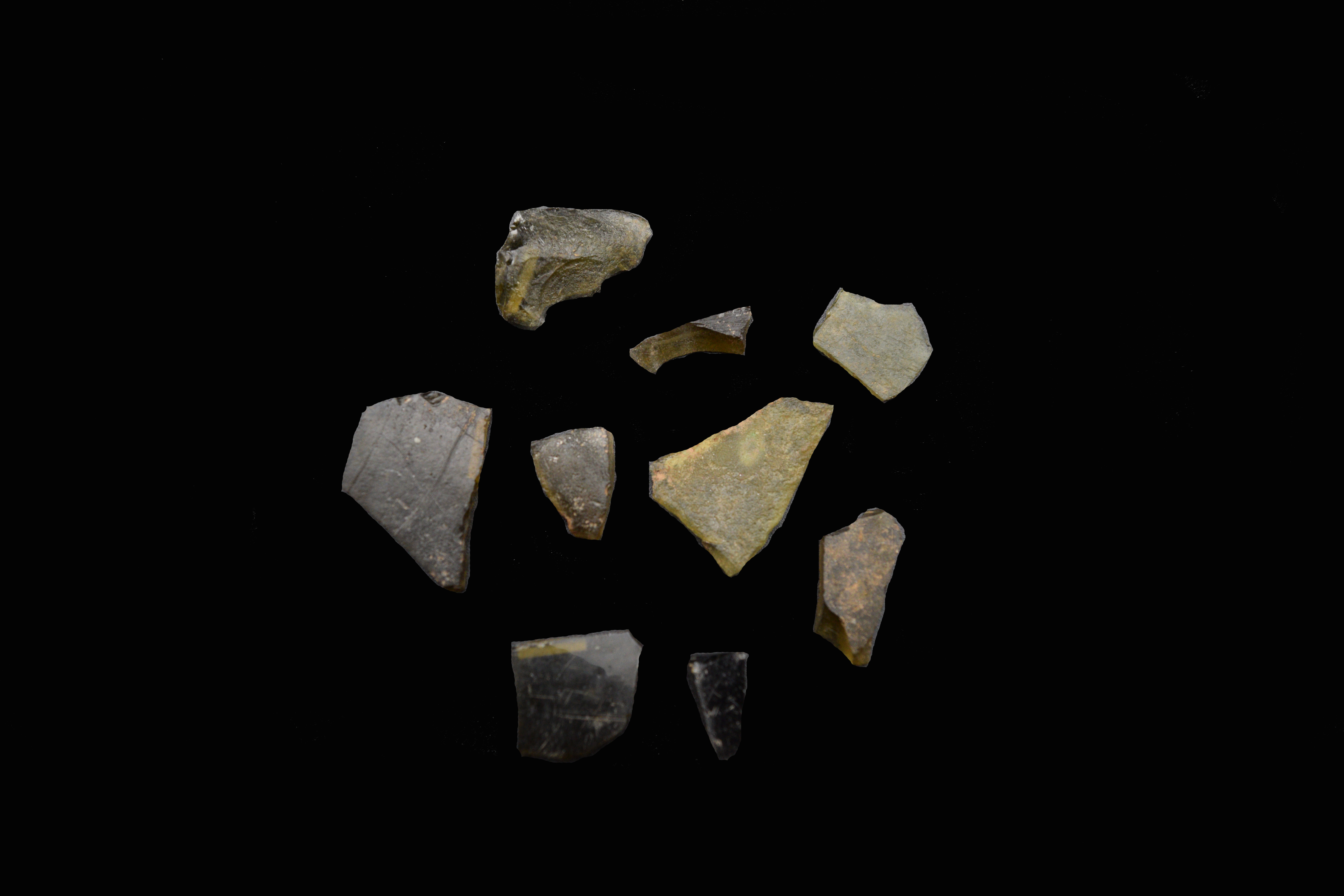
When archaeologists at Ferry Farm excavated the area underneath and around where the cellar house would have been, we found artifacts indicative of such a structure. Namely, very few items would have been found inside and around a dwelling, such as tea and tablewares, byproducts of meals, and valuable personal items. Large storage vessels, metal hooks for hanging food, and wrought nails and daub used to build the structure dominate the cellar house artifacts. The only notable personal items recovered were fragments of smoking pipes. That’s right, the smoke break was a thing even among enslaved workers stacking food inside the cellar house.
Ceramics from the Cellar HouseFaunal finds from the Cellar HouseGlass finds from the Cellar House
The cellar house is currently fully constructed, but we have yet to populate it with all of the storage vessels, food, smoking pipes, and other accouterments of a storage building. Eventually, visitors will be able to look into this building and take a trip back to the mid-eighteenth century with crocks, jugs, bottles, sacks, barrels, and baskets full of food and drink. All of which will be informed by the historic records and the artifacts recovered by our archaeologists, as with all the reconstructed buildings at Ferry Farm. Then, perhaps when I show the building to my son, he’ll see its importance: part pantry, part colonial refrigerator, and all cellar house.
Think about a portrait or painting of George Washington. What is a common element in the paintings? His uniform, yes, he is indeed painted quite a bit in his impressive military uniform. But how about a horse? George is often painted riding beautiful horses with a quiet dignity and noble appearance we expect from the father of our country.
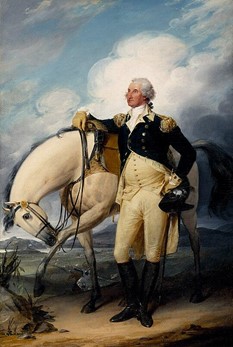
Washington at Verplanck’s Point by John Trumbull, Source: Winterthur
However, the horses in these paintings are not mere symbols of wealth or power. They are depicted with George because, from a tender age, his life has been intertwined with these creatures. As a surveyor, soldier, landowner, farmer, gentry, commander-in-chief, and president, he was inextricably linked with horses, not just as a mode of transportation but as a vital part of his daily life.
And it all started at Ferry Farm…
George moved to Ferry Farm around 1738 at the age of six. His father, Augustine Washington, was a member of the “planter class,” or Colonial American gentry. This meant he was a prominent member of society, involved in politics, and owned lots of land. Augustine purchased 150 acres across the river from Fredericksburg and later added an additional 450-acre parcel. In total, he owned Little Hunting Creek, Pope’s Creek, and the Ferry Farm properties.
The point? Augustine needed help because there were places to be, people to see, and fields to farm. So, horses were a fundamental necessity for the Washington family, and George would have grown up around them, taking care of them and learning to ride.
We have two great sources that give us some understanding of the horse situation at Ferry Farm. First, in 1743, the Washington patriarch died, leaving behind a widow, an 11-year-old George, and a probate inventory. On page two of the inventory, three horses and one mare are listed.
Augustine Washington Probate Inventory, 1743
Secondly, some pretty cool horse tack dating from the Washington occupation has been found during various archeological digs.
The Finds
One of the most universally known horse tack, essential for all horse maintenance – is the horseshoe. The horseshoe was used to protect the hooves because “…being rendered subservient to the use of man…applied to severe and continued labour, and compelled to tread frequently…on the irregular and stony surface of the roads, it became necessary to secure his feet from ruin by strengthening them with the iron band which we call a shoe” (Vial de Saint Bel, 1793). These shoes were handmade with no standardization across makers in shape, narrowness, or thickness. (Hume, 2001). This makes it difficult to pinpoint and assign a time on shape alone.
Our horseshoe was found in the second cellar of the Washington Home. It is quite wide between the branches (the curving sides), and the toe seems to straighten a bit at the center. The crease (the groove that runs down the sides) gives enough depth to allow the shoe to be firmly attached to the hoof with six nails (which we found a few originals). (University of Zurich, 2024) This find illustrates that there was active shoeing and horse maintenance going on at the farm. Additionally, these horses were ridden or used for farm work because shoes were used to protect the hooves from the wear and tear of hard roads, distribute the horse’s weight evenly on uneven ground, and provide traction on various surfaces.
Horseshoe with original nails
Another artifact found in the cellar of the Washington Home, the stirrup, further demonstrates horse riding as a family necessity. (Cofield, 2014)
Stirrup
The stirrups are used as foot support for the rider, and they hang from a saddle on straps known as stirrup leathers. Basic stirrups are made of three parts the eyes for the stirrup leathers to attach the stirrup to the saddle, a platform or base where the rider places their foot, and arms which connect the eye to the base. (Cofield, 2014)
Examples of Stirrup Forms Source: Diagnostic Artifacts in Maryland
Horseback riding master and author VS Littauer described the Forward Seat as a stirrup-centric approach versus traditional riding’s seat-centric. He argued riding without stirrups taught people to grip with the knee, which he considered a dangerous habit and likely to stiffen the rider. With stirrups, you can ride with a looser knee, letting your weight flow PAST your knee and into the stirrup. That is a more secure approach than riding with the thigh and knee. (Littauer, 1962)
Captain Vladimir Littauer – Forward Seat Riding,1947
Stirrups allow the rider’s legs to absorb up/down motion by allowing them to stand in matching balance with the horse, which makes riding longer distances more comfortable. Augustine certainly had to travel a great distance to check on his properties and perform his civic duties, like serving as a justice of the peace and sheriff for the county of Westmoreland.
One final utilitarian bit of horse tack found again in the cellar is a mullen mouth bit or snaffle bit. This bit consists of two rings on each side of a half-moon-shaped bar with no joint. The bit applies even pressure on the horse’s tongue and bars (gums) and allows the horse’s lips to feel the pressure from the bit and side rings. The bit, bridle, and reins function to create communication between the rider and the horse.
Mouth Bit
The Washington children would have used bits to learn to control. They would have learned how to work with the horse in a cooperative way that would create an effortless and seamless ride. George used this skill of communication and intuition to become a great rider. As Thomas Jefferson reminisced in a letter in 1814, “his person, you know, was fine, his stature exactly what one would wish, his deportment easy, erect, and noble; the best horseman of his age, and the most graceful figure that could be seen on horseback.” (National Archives, n.d.)
Lastly, just south of “The Quarter,” we uncovered around twenty leather ornaments. They were used to decorate the leather straps, nosebands, harnesses, and reins of horses. We wrote a post about them earlier explaining their purpose, which was purely aesthetic. Horse tack could be made without these pieces, but where is the fun in that? These flashy accessories were a great way to grab the attention of the public and hint at how fashionable and elegant you were as you trotted through town.
Ferry Farm leather ornaments dating from the 1700sThis copper-alloy mount dates from the mid-to-late 1700s
These artifacts illustrate that not only were horses actively used by the family, but it also fostered an environment where young George would have taken his first steps into learning about horsemanship. This knowledge and skill would help him in his future careers of surveying the Shenandoah Valley, as a lieutenant colonel during the French and Indian War, as a farmer and landowner at Mount Vernon, as a representative in the House of Burgesses, as commander-and-chief of the Continental Army and finally President of the United States.
Come see our new pop-up exhibit at Ferry Farm, where all these wonderful artifacts are displayed and put together with the help of our Fleming-Smith scholar, Sarah Moore.
Because of this, the motifs and marks on tobacco pipes can tell us a lot about the people who used them.
Tobacco pipes can also be valuable tools for dating a site by using pipe bore diameters, typologies, and maker’s marks. This last one helps set the stage for our question of the hour.
Some makers would mark their pipes to indicate a product as theirs. These marks can be found on different parts of a pipe, such as the bowl, heel, or stem. Finding a pipe with a maker’s mark can be very exciting as it allows a pipe to be attributed to a specific pipe maker and, thus, a time period. But that is not always the case. One of the more common maker’s marks in many archaeological sites is the mark “TD.” Remember the two we found during last summer’s dig?
Figure 2: Diagram of a tobacco pipe National Pipe Archive Figure 3: TD pipe bowls in Ferry Farm collection Figure 4: TD pipe bowl from 2023 dig
So, you’re probably thinking, what’s the question again? Just go look up a pipe maker with the initials TD, and you will have your maker. Well, unfortunately, it’s not always that easy.
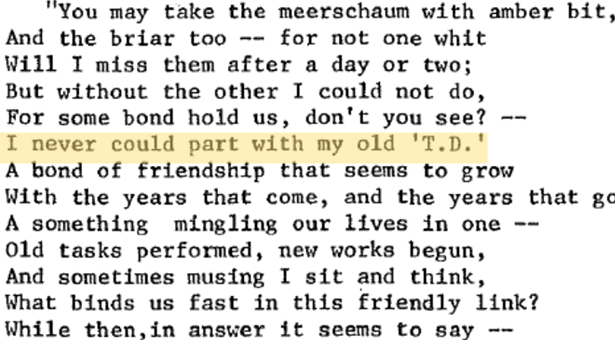
There are multiple pipe makers with those initials, and the pipes with variations of the TD mark have been found at sites with occupation dates suggesting the mark was being produced from the mid-18th century all the way into the 20th century. At some point, the mark stopped representing a single maker and instead became a symbol used on pipes throughout the years, reflecting clay tobacco pipes themselves. Think of it as the Kleenex or Q-tip of its time. TD became synonymous with clay tobacco pipes. This can be seen in written records like a catalog from 1892 that touts their rendition of “the Celebrated “T.D.” pipe” (Zorn). An early 20th-century song referencing “the Old TD” also supports the lasting influence of the mark (Cooper, 1907, as cited by Walker, 1966).
Figure 5: George Zorn & Co.’s “T.D.” pipe advertisement 1892 Figure 6: Early 20th-century smoking song, no known date or author, Cooper 1907 as cited by Walker 1966
Since there is no solid end date to help frame who the possible maker could be, archaeologists and historians have focused on looking at beginning dates to help find the original maker of the TD pipes, settling on a date in the middle of the 18th century. Archaeologists Adrian Oswald and Iain Walker are often cited as laying the foundations of the current TD lore. The combination of their findings identifies 18th-century London-based pipemaker Thomas Dormer as the most likely originator of the TD mark (Walker, 1966). With that said, Walker (1966) states that more information will have to be found to definitively give Dormer credit for originating the mark.
So, that brings us to the start of my research and a revisiting of the foundation of this theory, which was laid out as early as the 1930s. Who is Thomas Dormer, and is he the original TD? Why were TD pipes so popular that they were copied and made for centuries? And can we find new information to crack the case of the elusive TD mark?
The first step of the investigation is reviewing the literature and identifying current thoughts on TD pipes and their maker. One of the earliest deep dives into TD pipe origins can be found in the article “A Theory Regarding TD pipes” in the November 1937 printing of Antiques magazine. In this article, Alfred Hopkins expresses the mystery surrounding the mark and suggests its possible meaning. At the time, Hopkins (1937) and his contemporaries were unable to find potential pipe makers with the initials TD that would indicate the mark was referring to a maker. Instead, he states that it was a trademark of sorts to identify a quality product (Hopkins, 1937). He also mentions that TD may represent the beginning of the Christian hymn Te Deum Laudamus (Hopkins, 1937). Now remember, folks, this was written in the 1930s, and at the time, they didn’t have easy access to information. While more information has since been shared, we now know that there were indeed pipe makers with these initials and look more toward a maker rather than a hymn; Hopkins’ article plays an integral part in our quest by illustrating that there was an interest in the TD mark as early as the 1930s.
Figure 7: 1937 Alfred Hopkins article
Moving away from the 1930s and into the 1960s, Adrian Oswald compiled an index of pipe makers, which Iain Walker (1966) refined to find three possible English pipe makers that could be the originator of the mark: Thomas Dennis, Thomas Darkes, and Thomas Dormer. Walker (1966) continued this search and identified London-based pipemaker Thomas Dormer as the most likely of the three. Nailing down their sources became the next part of the puzzle in an attempt to confirm this information through primary source research and examination of any sources referred to in support of the theory.
This is where the quest to find new information about Thomas Dormer begins. Through this investigation, I was able to identify the “OG TD,” some juicy 18th-century family drama, and the possible first plagiarizers of the TD mark. There are twists, turns, and, unfortunately, too much to tell you in just one blog, so be sure to check out part two, where we get to the bottom of this mystery that began nearly 100 years ago.
Danielle Arens
GWF Archaeologist
References
(2022). Retrieved from George-M-Woodward-mavcor.yale.edu.jpg
The archaeology and curatorial departments for The George Washington Foundation have long worked together to furnish the reproduced Washington house with historically accurate items that resemble as closely as possible the ones that George and his family would have lived with daily. These pieces are not originals, which means visitors touring the house can handle them.
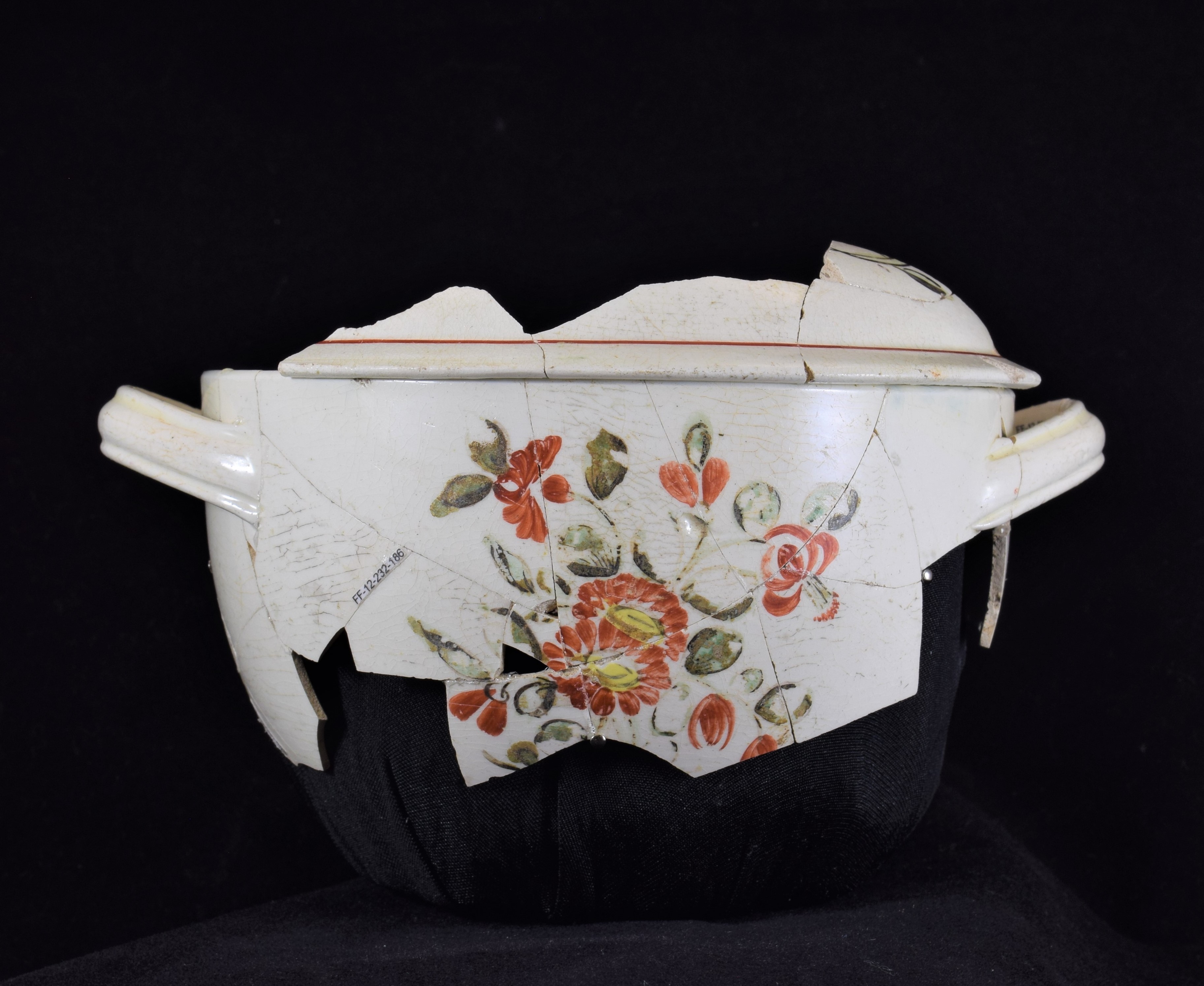
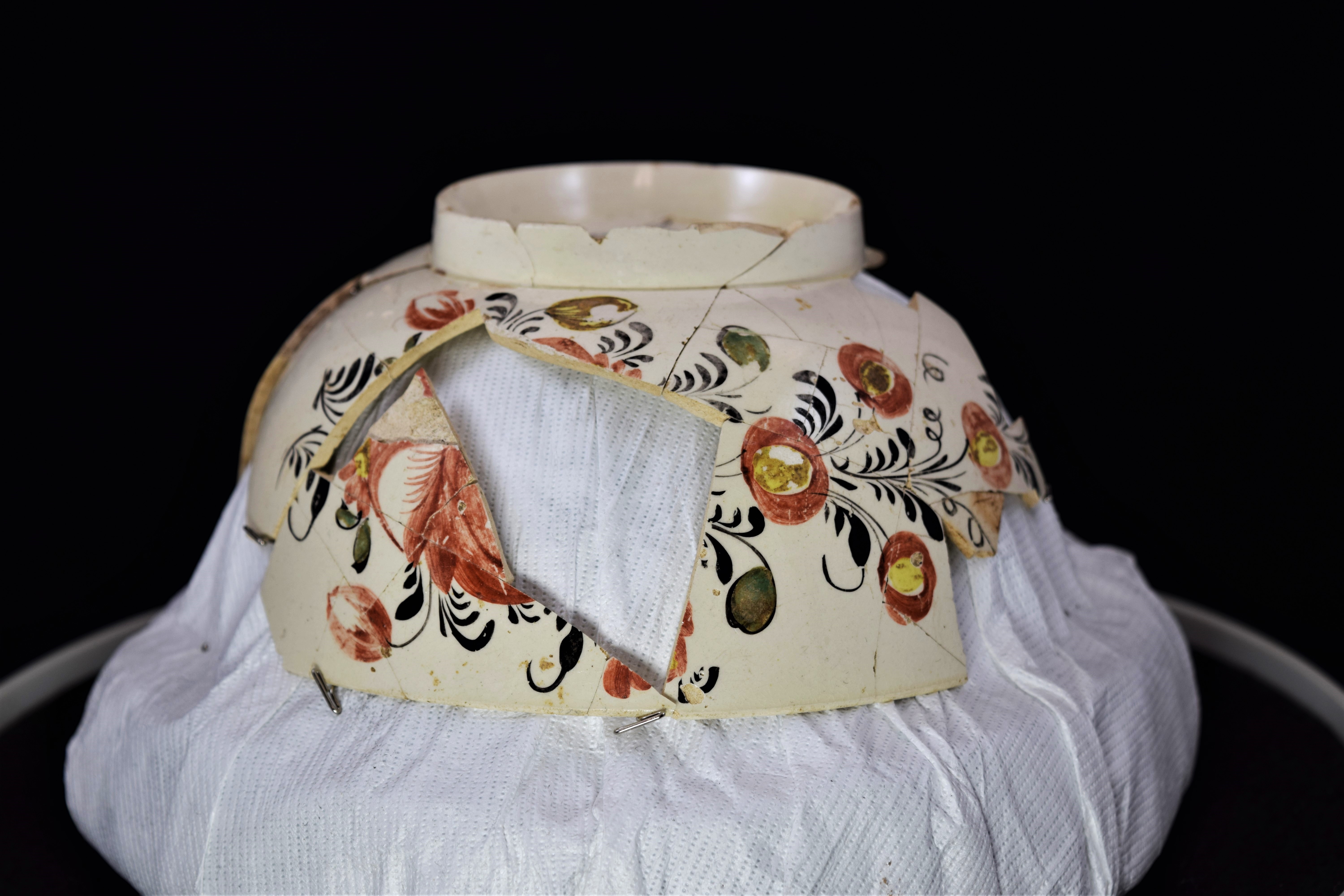
In our latest collaboration we’ve been examining sherds of ceramic vessels owned by the Washington’s to obtain actual eighteenth-century dishes. We want to display these dishes in our gallery to give visitors an idea of what the whole vessels looked like. Four such ceramics have recently been acquired at auctions by the Foundation and you can see them first here along with the excavated remnants they resemble.
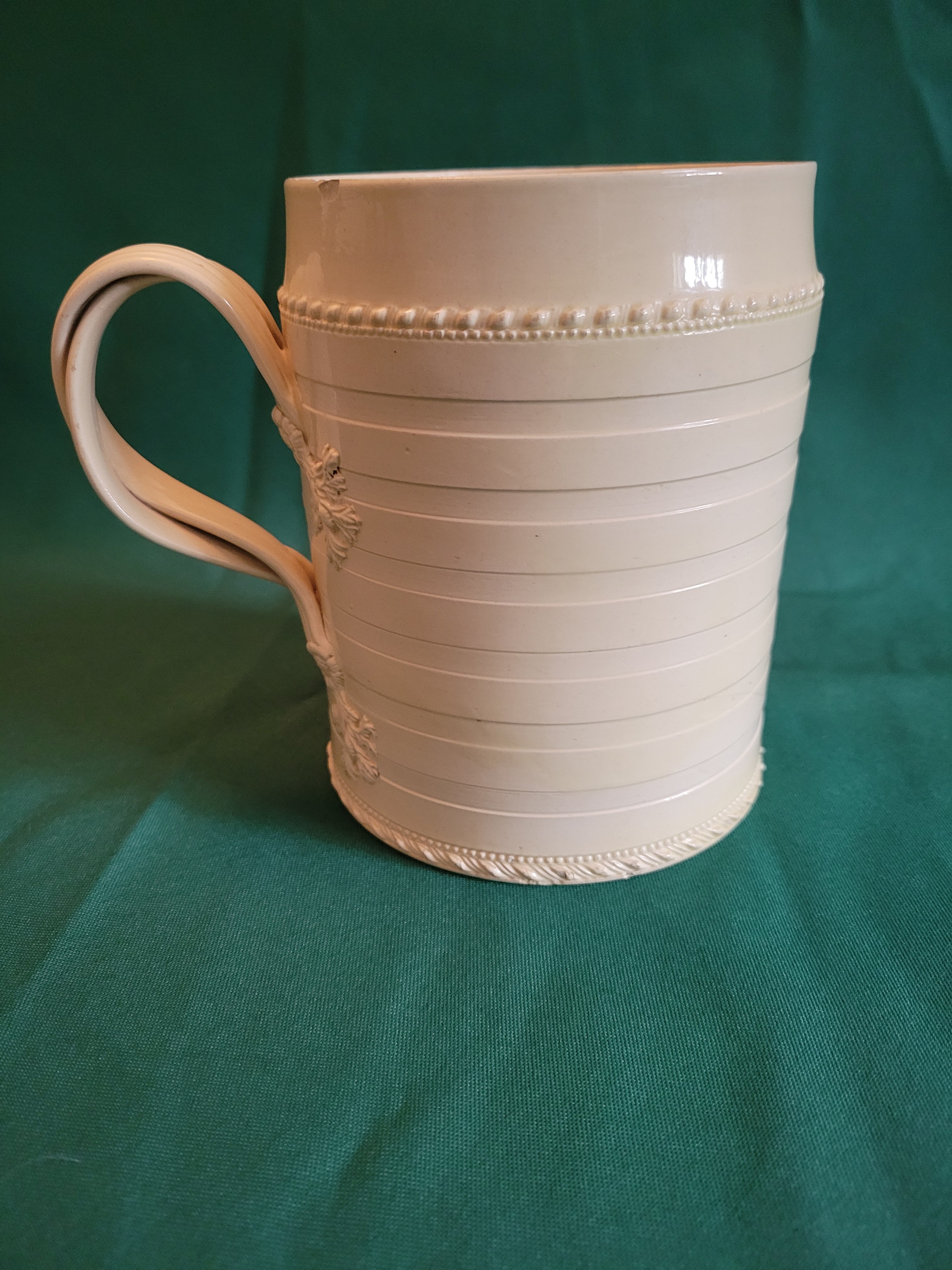
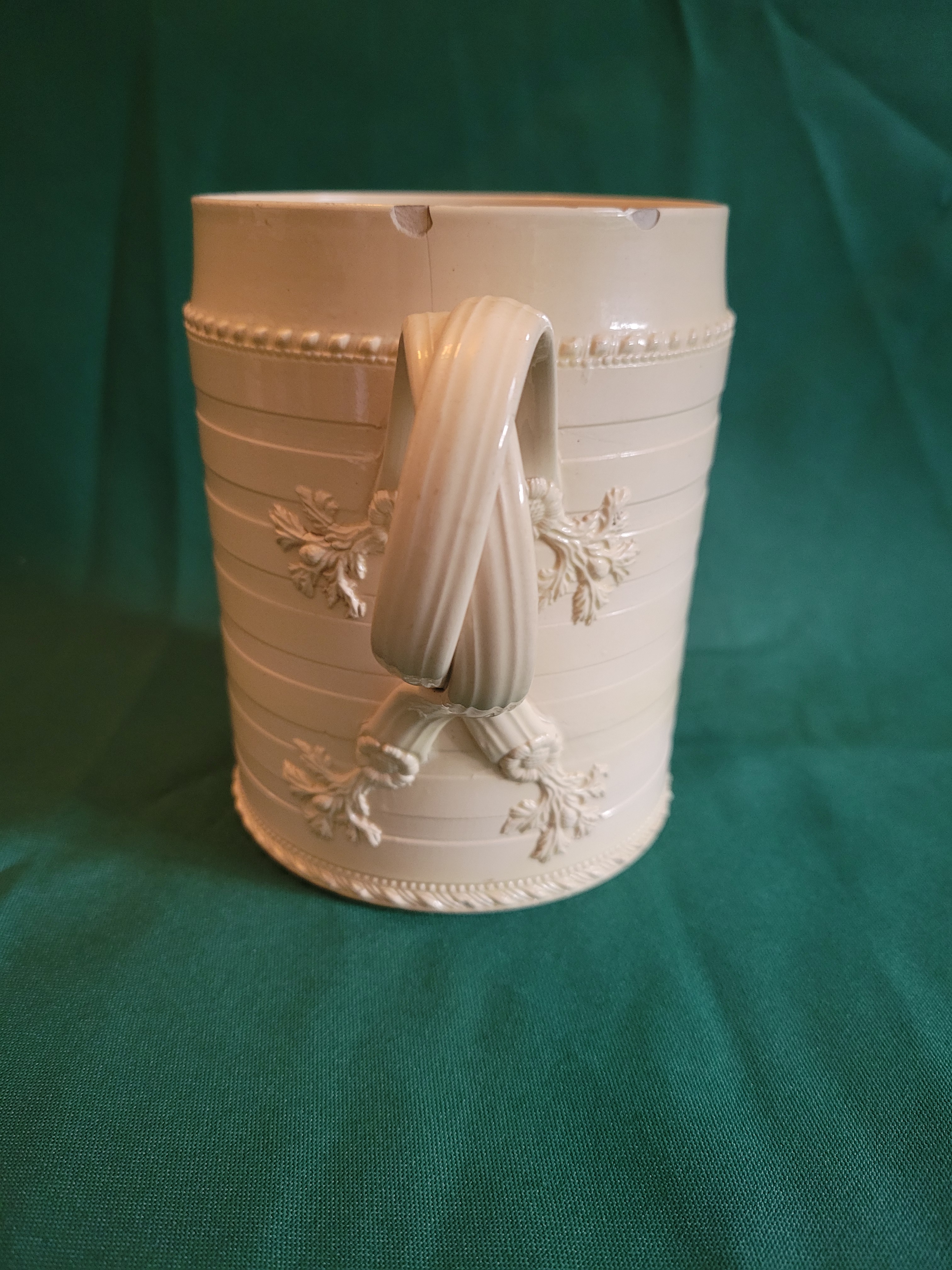
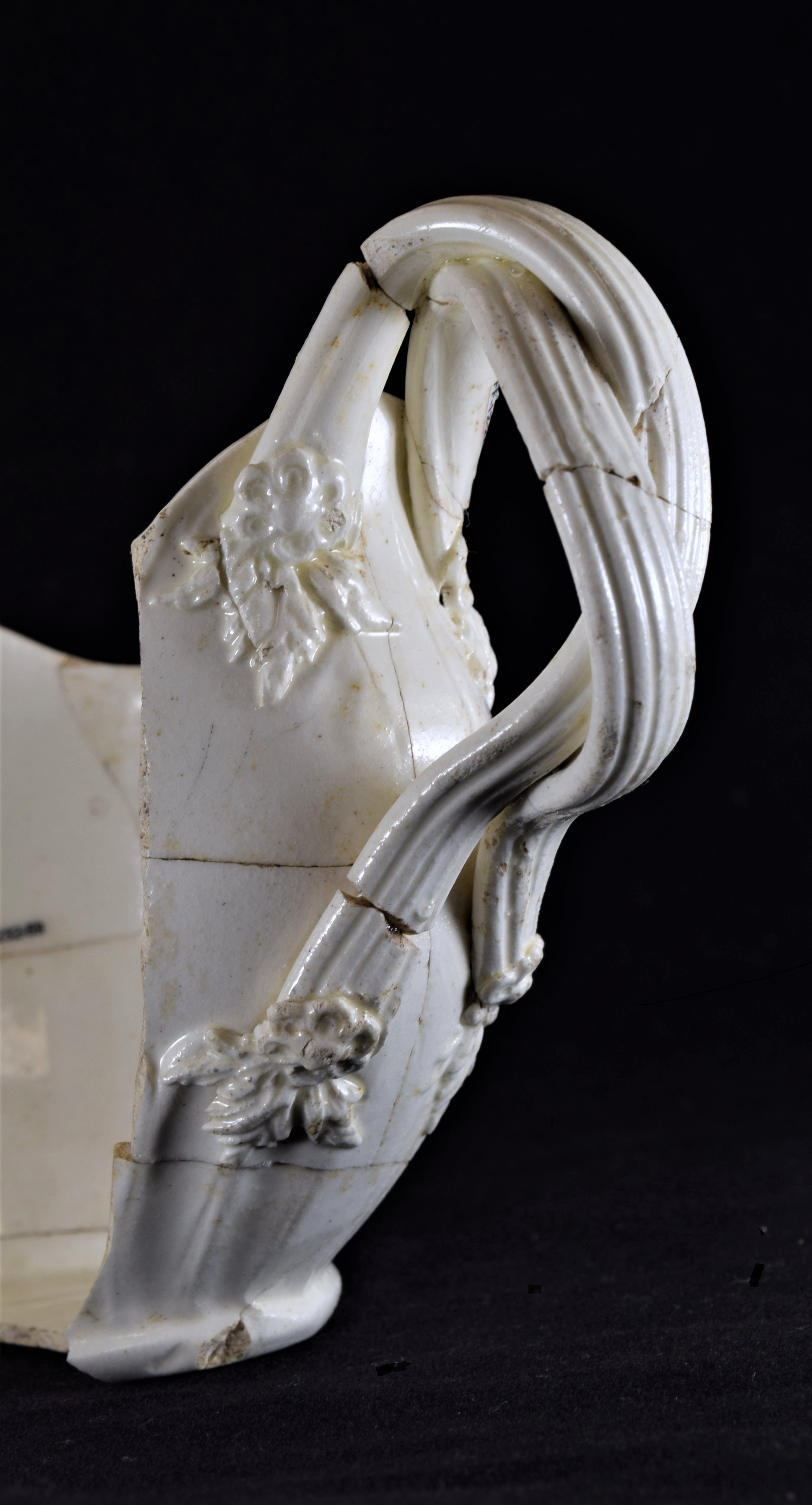
Creamware tankard with strawberry terminals and twisted reeded handles, ca. 1750-1800Creamware tankard with strawberry terminals and twisted reeded handles, ca. 1750-1800Creamware jug with strawberry terminals and twisted reed handles; face below the spout of the jug. ca. 1750-1800 Creamware sauceboat with curved handle which terminate with strawberry flowers. Moulded detail finials
Three of our acquisitions are a type of English ceramic called ‘creamware,’ which was invented in the early 1760’s and was very popular with George’s mother, Mary. Both this lovely pitcher and mug exhibit decorative elements represented by our excavated ceramics. Most prominent are the elegantly curved handles that terminate in delicate strawberry flowers. At least two vessels with these types of handles have been recovered at Ferry Farm. The first is a highly decorative creamware sauce boat and the second a petite teacup, both of which were considered quite fashionable for the time. The jug and teacup also share a common form of decoration called a ‘beaded rim.’
Creamware jug with strawberry terminals and twisted reed handles; face below the spout of the jug, ca. 1750-1800Creamware jug with strawberry terminals and twisted reed handles; face below the spout of the jug. ca. 1750-1800Creamware sherd with “beaded rim”Creamware teacup sherd with “beaded rim”
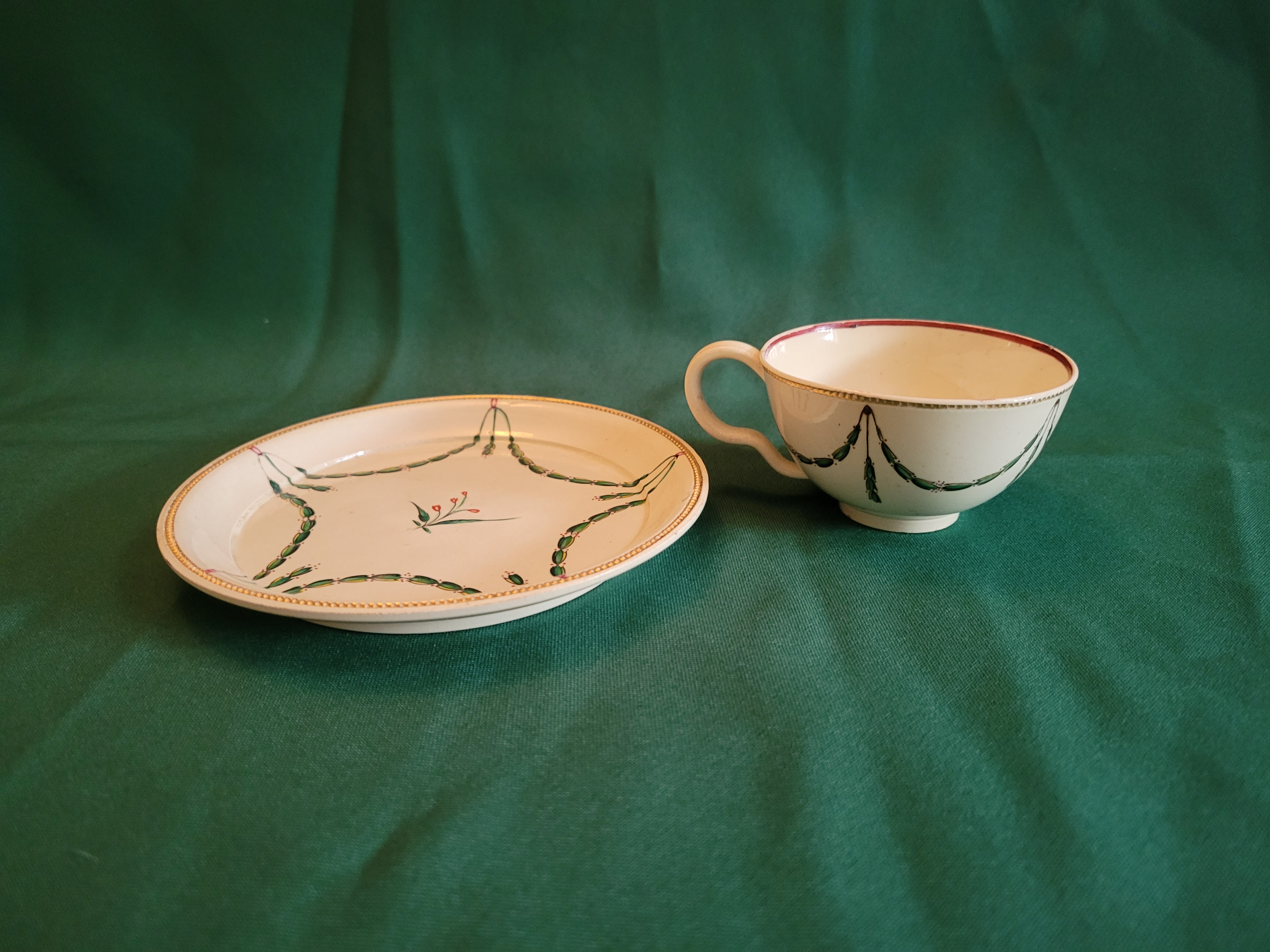
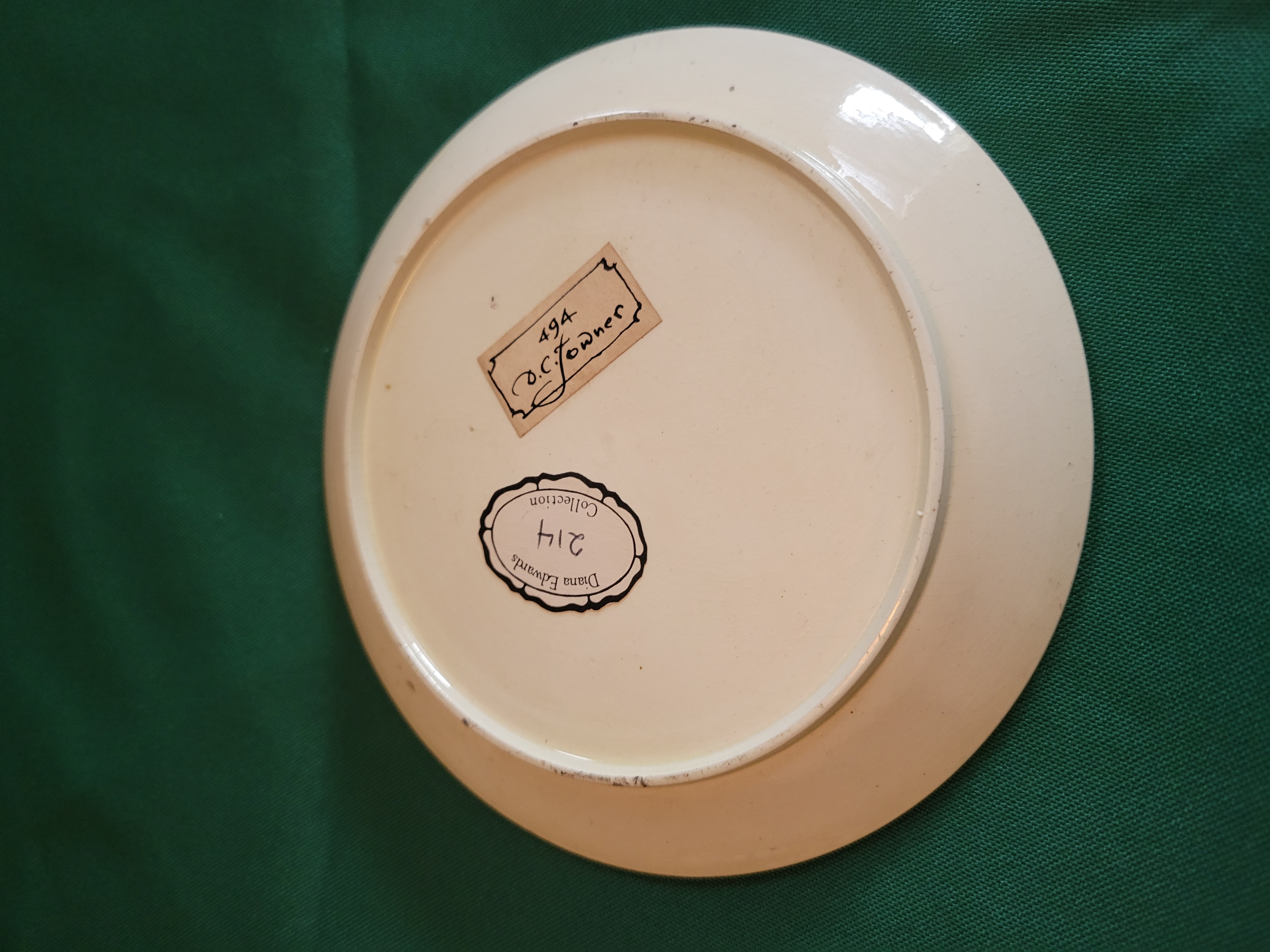
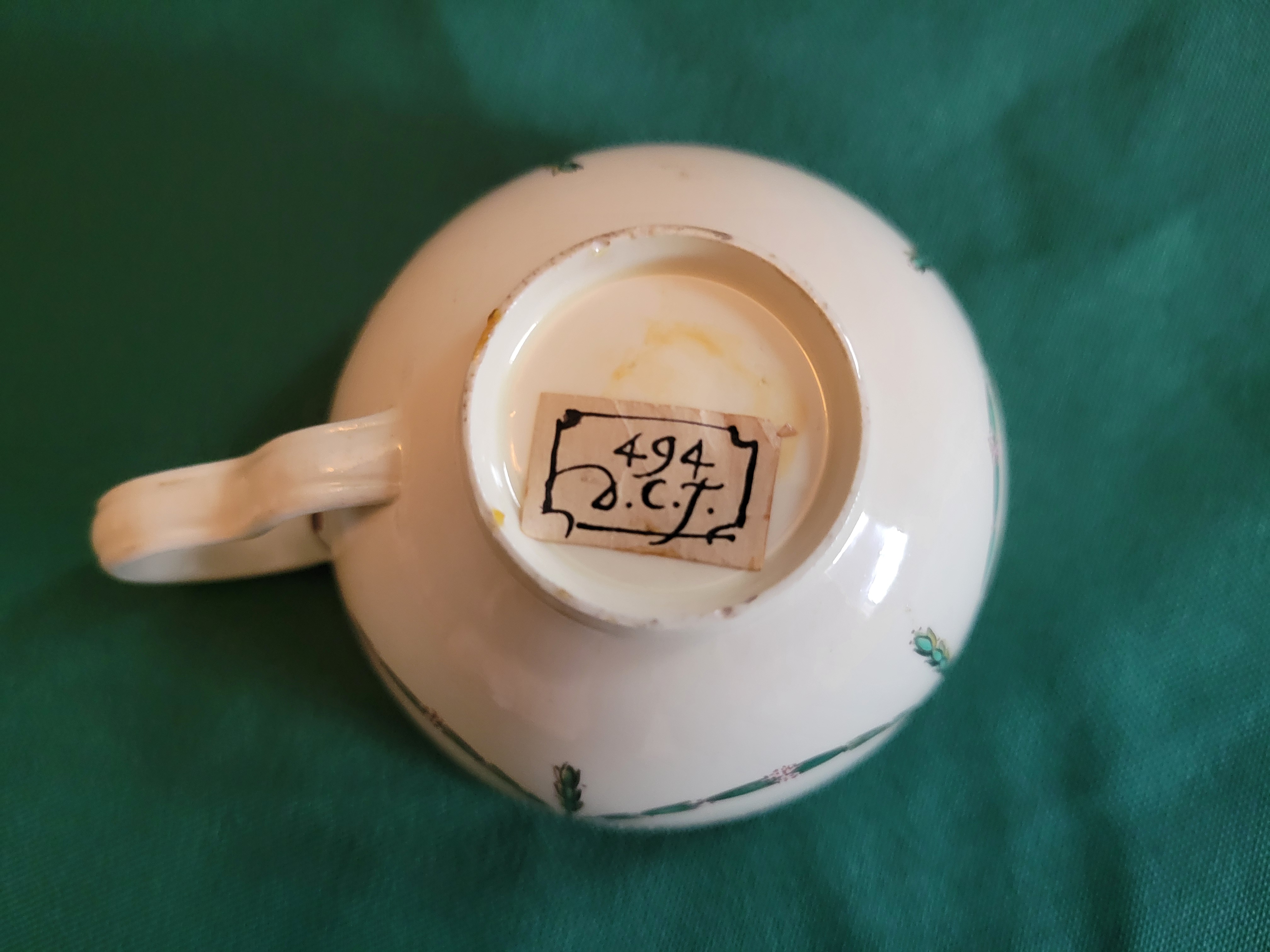
Another teacup owned by Mary was this beautiful piece hand-painted with a detailed swag motif. But from the sherds it’s difficult to really appreciate how graceful this decoration is. Luckily, our curators hunted down a similar cup and saucer with the same decoration, which is unusual. The saucer also features a beaded rim that has been filled in with gold gilding, although we believe the gold to be a later addition to the piece. The cup and saucer also have handwritten tags affixed to the bases which indicate they had the distinction of having been in the collection of a well-known (at least to ceramics geeks like yours truly) collector of creamware. This man by the name of Donald Towner had written extensively on the topic of English ceramics and over his career had amassed a large study collection, of which this was one. His book on the Leeds Pottery in England features a catalogue from the pottery that includes many of the decorative elements and shapes discussed above (Towner, 1965).
English Creamware Cup and Saucer, ca. 1775-1780English Creamware Saucer, ca. 1775-1780. Formerly in Donald Tower Collection, 1968, A Belton, 1988 and Diana Edwards MurnaghanTeacup from Donald Towner Collection, 1968.Teacup sherd with swag motif
But my favorite is this delightfully potbellied creamer with three legs featuring lion’s heads and paws for feet. The ceramic type in question is called Whieldon and started to come on the market in England around 1749. Of note is the raised molded leaf decoration which resembles one sherd from our collection. While we may never know the exact type of vessel our leaf came from, the complete creamer gives one a better idea of how the decoration was placed and looked. Mary’s choice of ceramics played a large part in emphasizing her and her children’s place among the Virginia Gentry and we’re very pleased to have some whole examples now to help illustrate to visitors just how lovely some of these dishes were!
Whieldon ware sherd, ca. 1740-1770Staffordshire Mottled Creamware Milk Jug, c. 1755-1765Staffordshire Mottled Creamware Milk Jug, c. 1755-1765
Mara Kaktins, Archaeologist & Lab Manager
Bibliography
Towner, Donald. The Leeds Pottery, 1965. Taplinger Publishing Co., Inc., New York.
Not every president gets their birthday celebrated every year with a federal holiday, but George Washington, a favorite of his countrymen and the first president, has had that privilege since 1879. But one year was a little different from the others: 1932. It marked Washington’s 200th birthday, and the United States was going to make a big deal about it.
In honor of the upcoming birthday, we decided to look at some of the memorabilia in our collection created to celebrate and educate the American public.
George Washington Bicentennial Commission
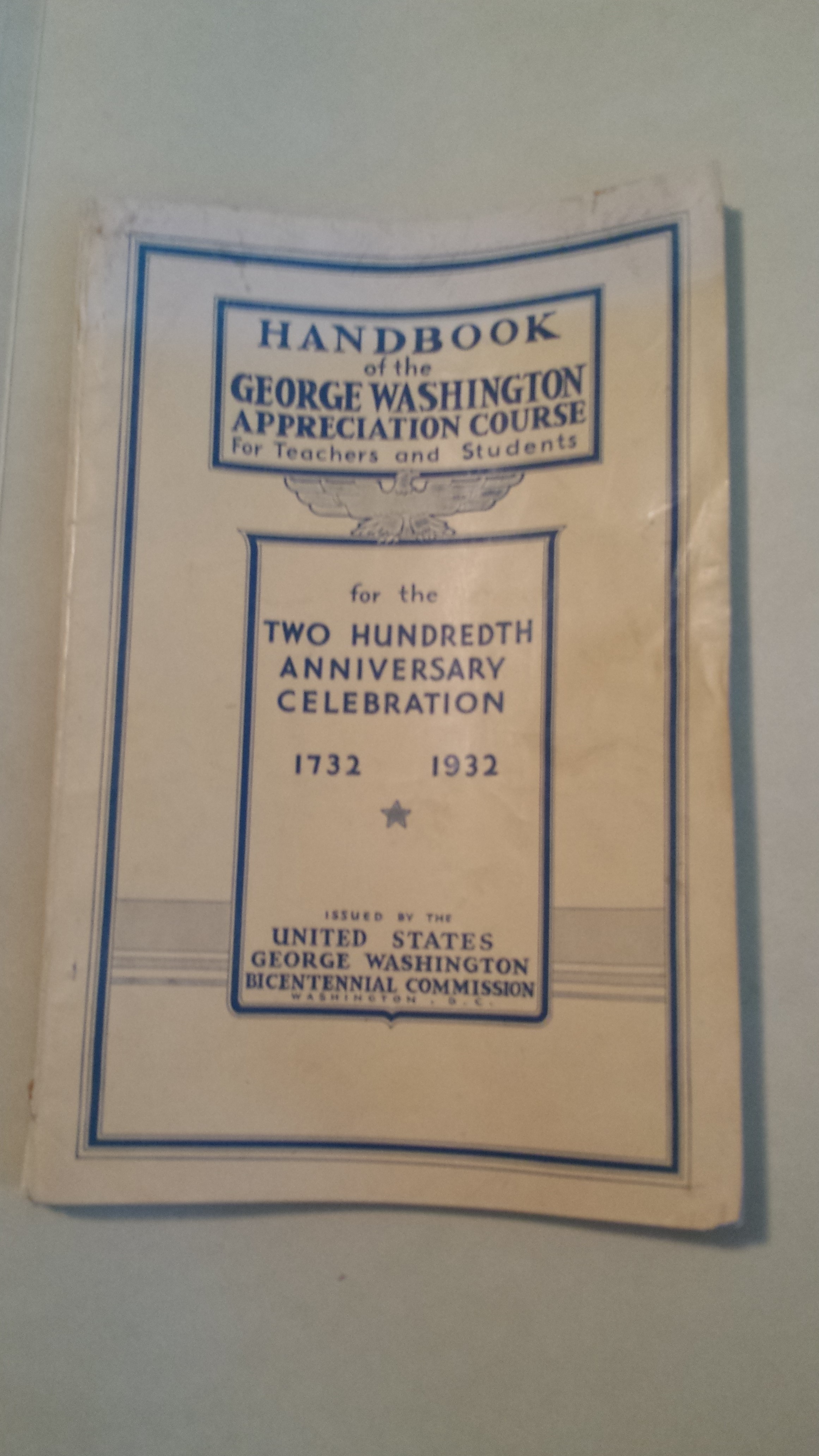
The planning for this celebration started early when Calvin Coolidge signed a joint resolution that established a commission to oversee the bicentennial ceremonies on Dec 2, 1924. The resolution was to mark the occasion of the birthday across the country and increase the understanding of Washington. (George Washington Bicentennial Commission, 1932) Under the direction of Representative Sol Bloom, an experienced entertainment promoter who got his start at the 1893 World’s Colombian Exposition, the committee initiated thousands of events, released educational resources for students, and had plays written in honor of Washington. (Larson, 2004)
Handbook of the George Washington Appreciation Course for Teachers and Students“Washington Takes the Risk”, including George Washington, Fielding Lewis, and Betty Washington Lewis
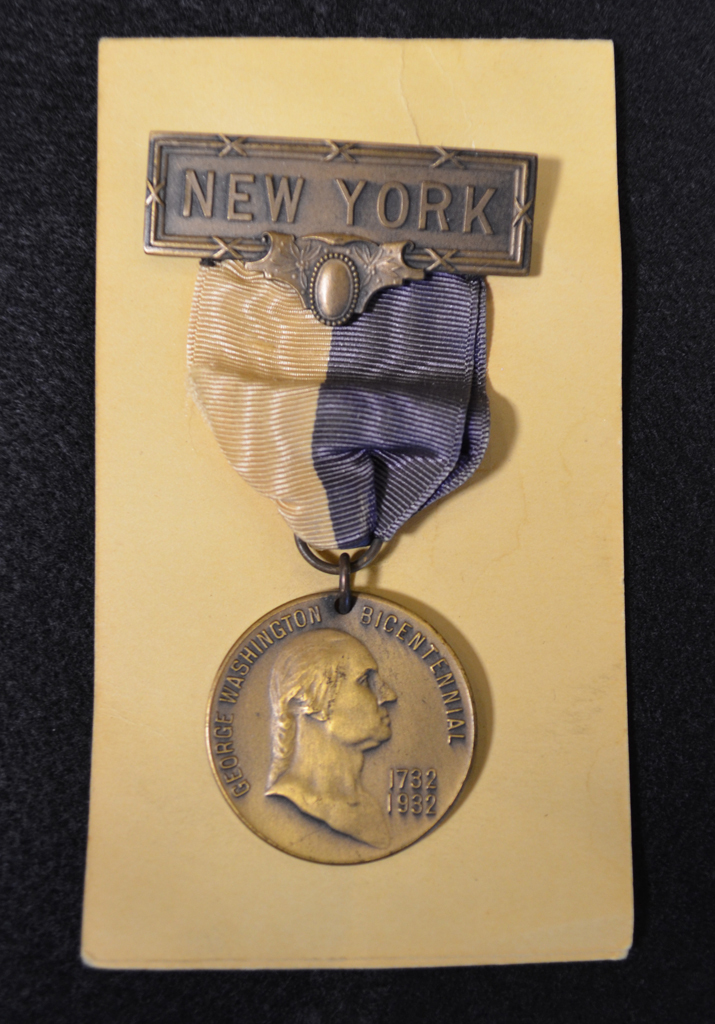
The commission additionally worked with over 250,000 local commissions to organize special events at not only a federal level but a state and city too. (The Washington Post, 1932) Special volunteers and prominent local people were often given commemorative metals as thanks for their service. We have one from the state of New York. It is a circular bronze medal attached to a blue and white ribbon. The back of the medal states, “1779 / Planned Sullivan / Clinton Campaign 1782 / Newburgh Temple Hill / Refused a crown / 1789 April 30th / New York City / Inaugurated first / President of the / United States.”
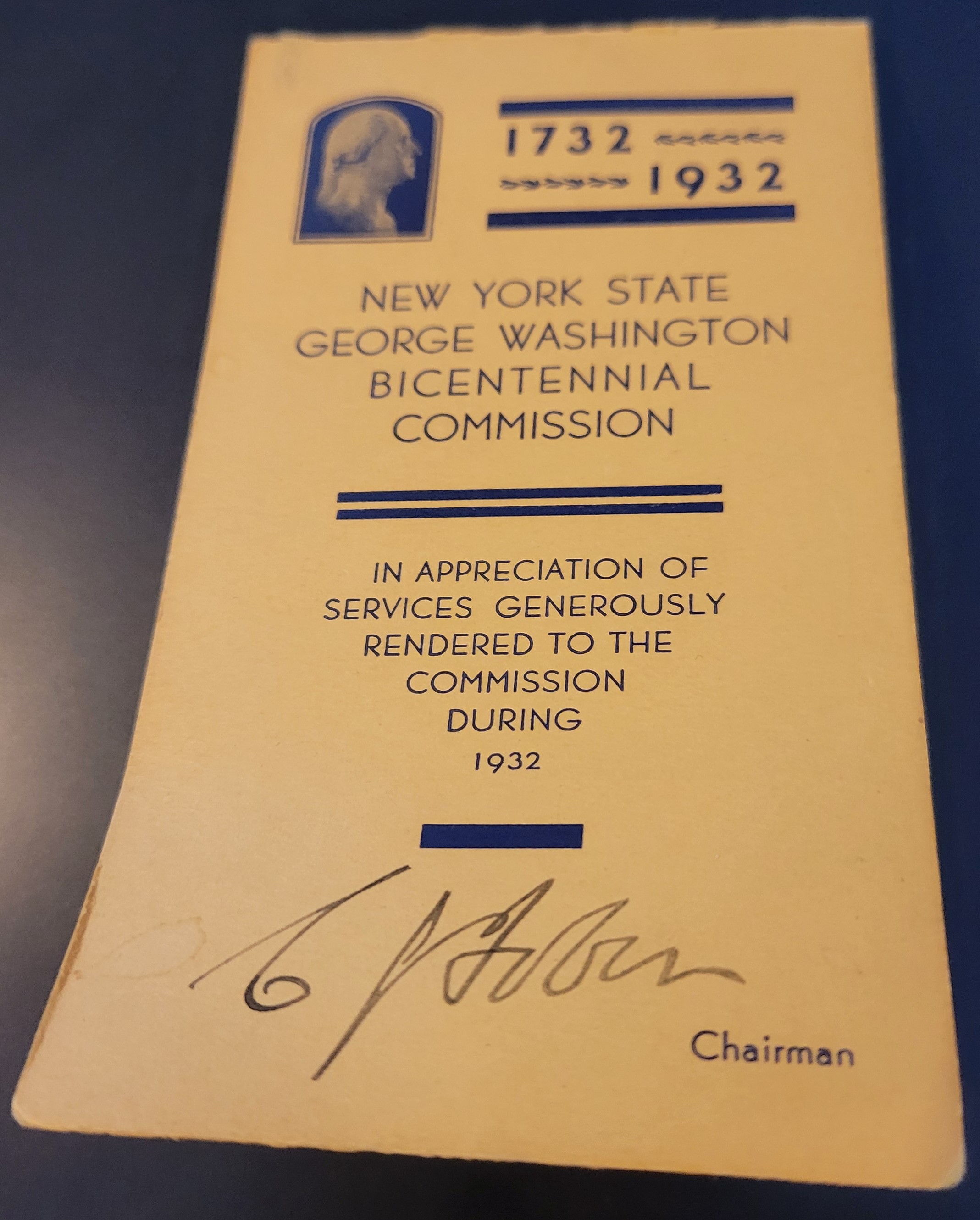
The medal is encased in a paper envelope with “New York State / George Washington Bicentennial Commission / In appreciation of / Services generously / Rendered to the / Commission / During / 1932” written on the front along with the signature Charles Tobin, chairman representing New York state on the Bicentennial Commission.
New York State George Washington Bicentennial Commission, 1932New York State George Washington Bicentennial Commission Medal, 1932New York State George Washington Bicentennial Commission Medal, 1932
Historical Context Help: The Sullivan-Clinton campaign was ordered by George Washington in response to the 1778 attacks by the Iroquois and British in central New York. Newburgh Temple Hill was a Continental Army encampment near Washington’s headquarters, where he gave a speech to quell the mass of soldiers who were getting ready to mutiny and attack Congress to get their promised back pay and pensions. Finally, in 1789, George was sworn in as President at Federal Hall in New York City.
The U.S. Post Office became involved in the commemoration of George with the release of a dozen stamps celebrating his life. The stamps were incredibly popular, and when they were first released for sale in D.C., there was a crowd of 50,000 people waiting to get their set of stamps. (The Washington Post, 1932)
Commemoration celebrating George Washington’s visit to Kenmore on April 8, 1791, as part of the birthday celebrations. Note the stamps. Commemoration of George Washington’s birth at Wakefield. Note the stamps.
Marketing George
Private companies even got in on Washington-mania by releasing all types of souvenirs like postcards, pins, coins, bottles, calendars, cigar box covers, books and pamphlets, hat stands, billheads, stationary, cartes-de-visite, playing cards, and puzzles. (Subseries 5.8. Washington’s Birthday, Bicentennial Souvenirs, 1931-1932 , 2024)
We have two bottles created for the Bicentennial celebration. The green water bottle has a likeness of George with “Washington/Bicentennial” underneath the image and 1732 and 1932 written on the sides. The water bottle was produced by the Hemingway Glass Company in Muncie, Indiana.
The clear pear-shaped bottle is embossed on one side with a cherry tree and the dates “1732 and 1932”. On the other, with a profile of Washington. It was created by the Owens-Illinois Glass Co. of Huntington, West Virginia.
Bicentennial bottle with George Washington profile. Owens-Illinois Glass Co., 1932. Bicentennial bottle with cherry tree. Owens-Illinois Glass Co., 1932
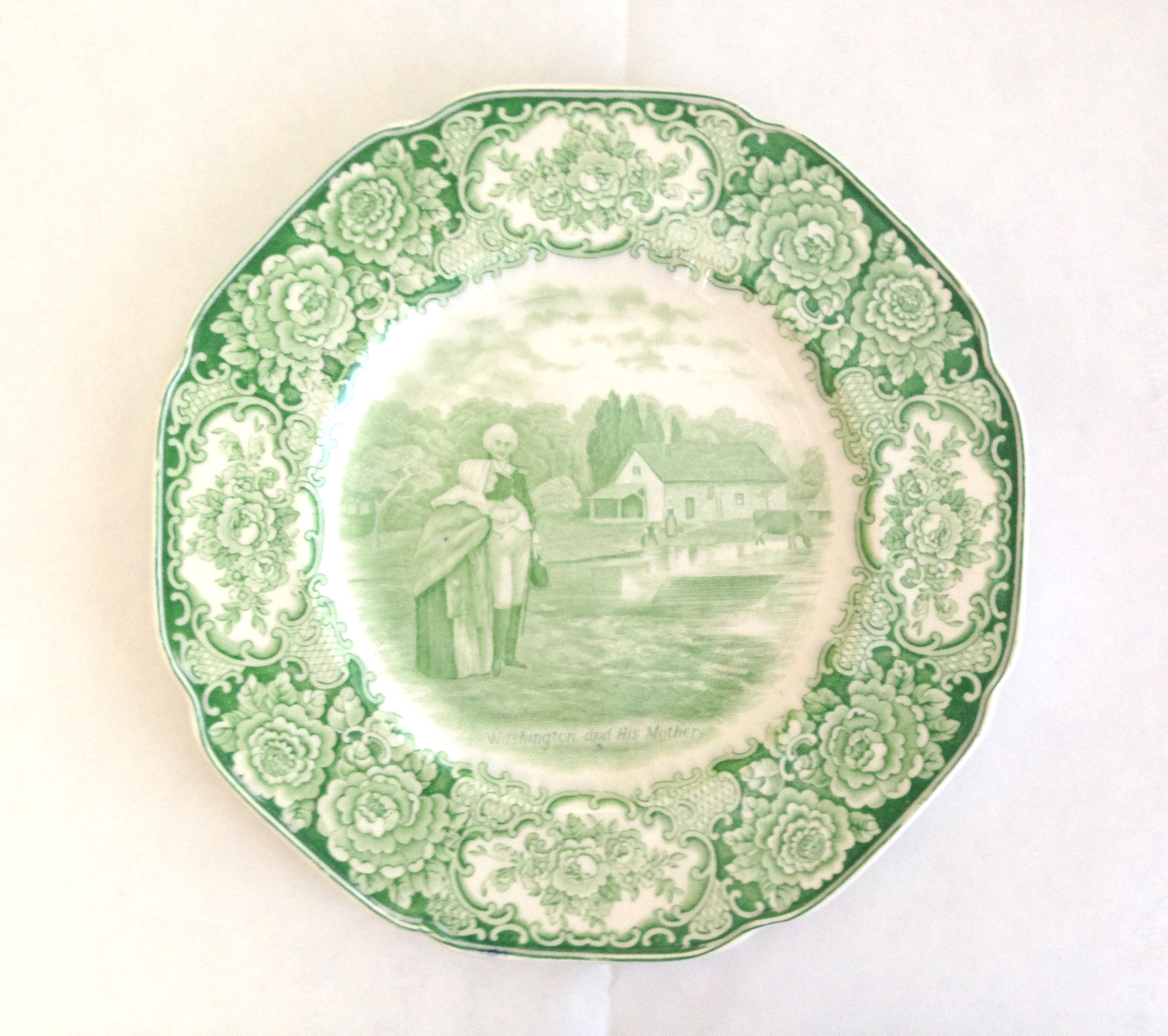
Plates were another big commemorative item. We have three plates issued by Crown Ducal, with the same scene of “Washington and his Mother” based on the print of the same name. On the back with the Crown Ducal crest, it says, “George Washington Bicentenary Memorial Plates / 1732-1932 / First in War / First in Peace / First in the hearts of his countrymen”. Crown Ducal released a series of twelve plates documenting Washington’s life. Of course, we are a little biased and like the one with his mother, Mary Ball Washington, the best.
Some companies even brought in Mrs. Martha Washington, like this set of plates from the Capital Souvenir Company. These are two round commemorative plates depicting George and Martha Washington, both with an elaborate floral gilded border.
George and Martha plate set, Capital Souvenir Company, 1932. George and Martha plate set, Capital Souvenir Company, 1932.
Fun Bicentennial Fact: On the eve of the birthday, Sears Roebuck was awarded a commission by the U.S. government to create a full-scale replica of Mount Vernon at the Exposition Coloniale Internationale in Paris. The agreed-upon price was around $75,000, and every detail of the home was reproduced from brass hardware, mantelpieces, and even cabinets. After the exposition, the house was bought by an American doctor working in Paris, and it was relocated to Vaucresson (a western suburb of Paris). It still stands today as a private residence and was even on the market in 2012 for 27 million dollars.
George Washington’s Mount Vernon in Paris, France,1932George’s Mount Vernon in Vaucresson, France today
Sears Roebuck also built the exact replica in Prospect Park, Brooklyn, NYC for the Bicentennial Commission. However, the house was not taken care of and boarded up and abandoned until it was eventually torn down. (The Brooklyn Daily Eagle, 1933)
Sears’ role in the reconstruction of Mount Vernon led to interest in their kit homes. In 1932, they offered a house in their catalog, loosely based on Mount Vernon. This model was oddly called “The Jefferson”.
Sears Roebuck house kit “The Jefferson” which strangely resembles Mount Vernon.
While we may not have as many George souvenirs, we are still putting on a big birthday party to celebrate George Washington and his time at Ferry Farm.
The party is on Monday, February 19th from 10am – 3 pm. While enjoying the grounds of Ferry Farm, you can take a selfie with “George Washington,” participate in our annual stone-throwing contest, play colonial games, and eat birthday cupcakes (while supplies last).
Additionally, guests can enjoy several educational stations, take an abbreviated Washington House tour, and talk with archaeologists, historians, and other experts to learn about Ferry Farm and the Washington Family.
Heather Baldus
Collections Manager
References
George Washington Bicentennial Commission. (1932). History of the George Washington Bicentennial Celebration. Washington D.C.
Larson, E. (2004). The Devil in the White City: Murder, Magic, and Madness at the Fair That Changed America. New York City: Knopf Doubleday Publishing Group.
The George Washington Foundation believes the Washington and Lewis families’ story is worth protecting for future generations. We are in contact with many descendants of the Washingtons and Lewises who have assisted the foundation in presenting the families’ legacies by adding to our collections and archives. We decided to explore the ancestors and descendants interesting tales and life accounts, using the artifacts and documents in our collections as a starting point.
The first person in our spotlight is Catherine Dangerfield Willis, who was born in Virginia, lived on the Florida frontier, became a historic preservationist, and became a Princess of the Second Empire because of her Washington relation.
Virginia Native and Washington Descendant
Catherine Daingerfield Willis was born in Fredericksburg in 1803. She was the daughter of Colonel Byrd Charles Willis and his wife Mary (née Lewis) Willis. From her maternal family side, Catherine was the great-granddaughter of Fielding and Betty Lewis and the great-grandniece of George Washington. (Glenn, 2014)
Catherine married Atcheson Gray at an early age, around 13 to 17 years old; accounts vary. The newlywed couple resided at their father-in-law’s house, Wakefield (yes, George’s birthplace). (Unknown, 2004) Sadly, their marriage was cut short when Atcheson died of malaria less than a year after their union, along with their first child. (Bellet, 1976)
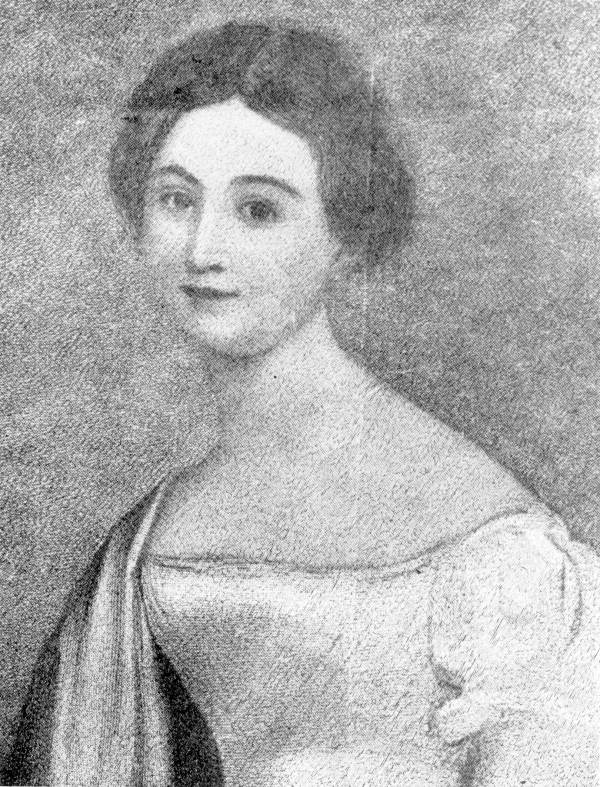
Catherine Daingerfield Willis Gray Murat, watercolor generously donated to GWF by Mrs. Lucy Robb Winston Works and family.
The Florida Frontier
After being widowed, Catherine and her family moved south to Tallahassee, the recently christened capital of the Florida Territory (Florida didn’t become a state until 1845) (Gannon, 2003). It had previously been an important Apalachee settlement which had been abandoned after it was burned to the ground by Andrew Jackson in 1818 during the first part of the Seminole Wars. (Smith, 2023) When Catherine and her family took up residence in Tallahassee in the 1820s, it was a rough place and had a reputation as an outlaw frontier town. Men carried guns and knives to protect themselves from the many duels, brawls, and knife fights that were common in the city. The eminent Ralph Waldo Emerson (a noted friend of Prince Murat) traveled to Tallahassee in 1827 and called it “a grotesque place…rapidly settled by public officers, land speculators, and desperadoes.” (Downes, 1956)
The less-than-stellar reviews of the city didn’t stop the Legislative Council from building three crude log huts for their official meetings. (Gannon, 2003) There was even the establishment of a city police force in 1826 to combat lawlessness. The police force consisted of only one guy, a City Marshal, but it still counts. (Tallahassee Police Department, 2023)
In this primitive but developing city, a love story blossomed between Catherine and an exiled French prince.
Portrait of Prince MuratCatherine Daingerfield Willis Gray Murat
A quick look at the tumultuous life of Charles Louis Napoleon Achille Murat
Achille Murat was born in the Hôtel de Brienne in Paris to Caroline Bonaparte, Grand Duchess of Berg, Queen of Naples, and sister to Napoleon Bonaparte, Emperor of the French By 1815, after his uncle’s second exile and the execution of his father Joachim Murat, the family fled to Austria. (Burnett, 1996)
Hôtel de Brienne, Paris, France where Prince Achille Murat was born.Achille (in uniform), with his brother, sisters and mother Caroline Bonaparte
When Achille turned twenty-one, he emigrated to the United States, landing in New York and immediately applying for naturalization. (Niles, 1823) Additionally, he renounced all European titles and citizenship. (Brandon, 1944) Before long, he made his way down to Florida to get in on some of the land deals in the newly acquired territory. His first stop was St. Augustine, where he purchased land and established a plantation called “Parthenope,” which utilized slave labor to grow oranges, sugar cane, cotton, and tobacco. (Roberts, 2004) (Bellet, 1976)
Prince Murat immediately on arrival in America applied for naturalization and renouncing his European titles.
While in St. Augustine, he developed a reputation for being a little eccentric. He liked to sit naked in the local Moses Creek during the sweltering Florida summers. (Hanna, 1948) He was obsessed with eating all different kinds of animals, like turkey buzzards, owls, alligators, and rattlesnakes. (Roberts, 2004) Finally, he disliked bathing and changing his clothes while living in a humid subtropical climate, and he “washed his feet only after he wore out his shoes.” (Hanna, 1948)
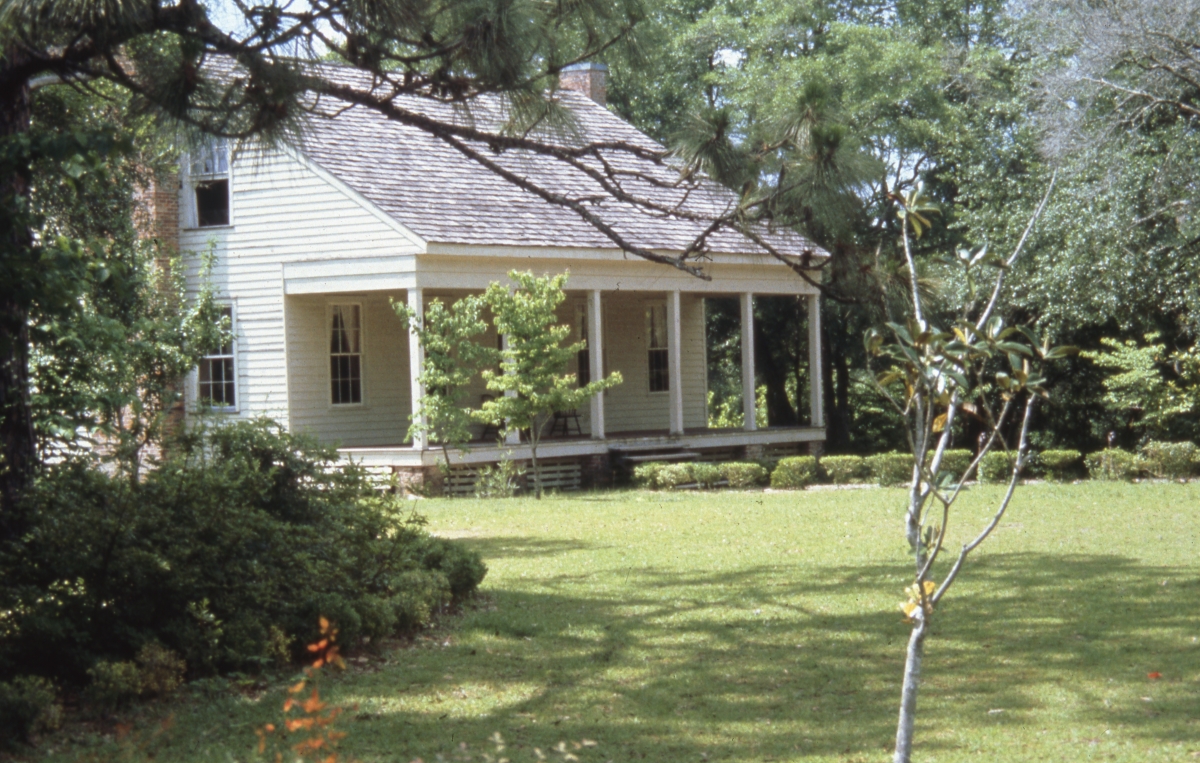
Home of Prince Murat, which was built around 1790 – Saint Augustine, Florida
Shortly before he met and married Catherine, he purchased another plantation named “Lipona,” which would be his primary residence in the US until his death.
A Marriage Between the Bonaparte’s and Washington’s and Entertaining Europe
In 1826, Catherine Daingerfield Willis Gray married the ex-prince of Naples and nephew of Napoleon Bonaparte, Achille Murat. Catherine’s father was initially against the match because of the Bonaparte and Murat families’ opposition to the union. Luckily, the Bonaparte’s and Murat’s were made aware that Caroline was the great-grandniece of George Washington, and the family warmly welcomed her. (Bellet, 1976)
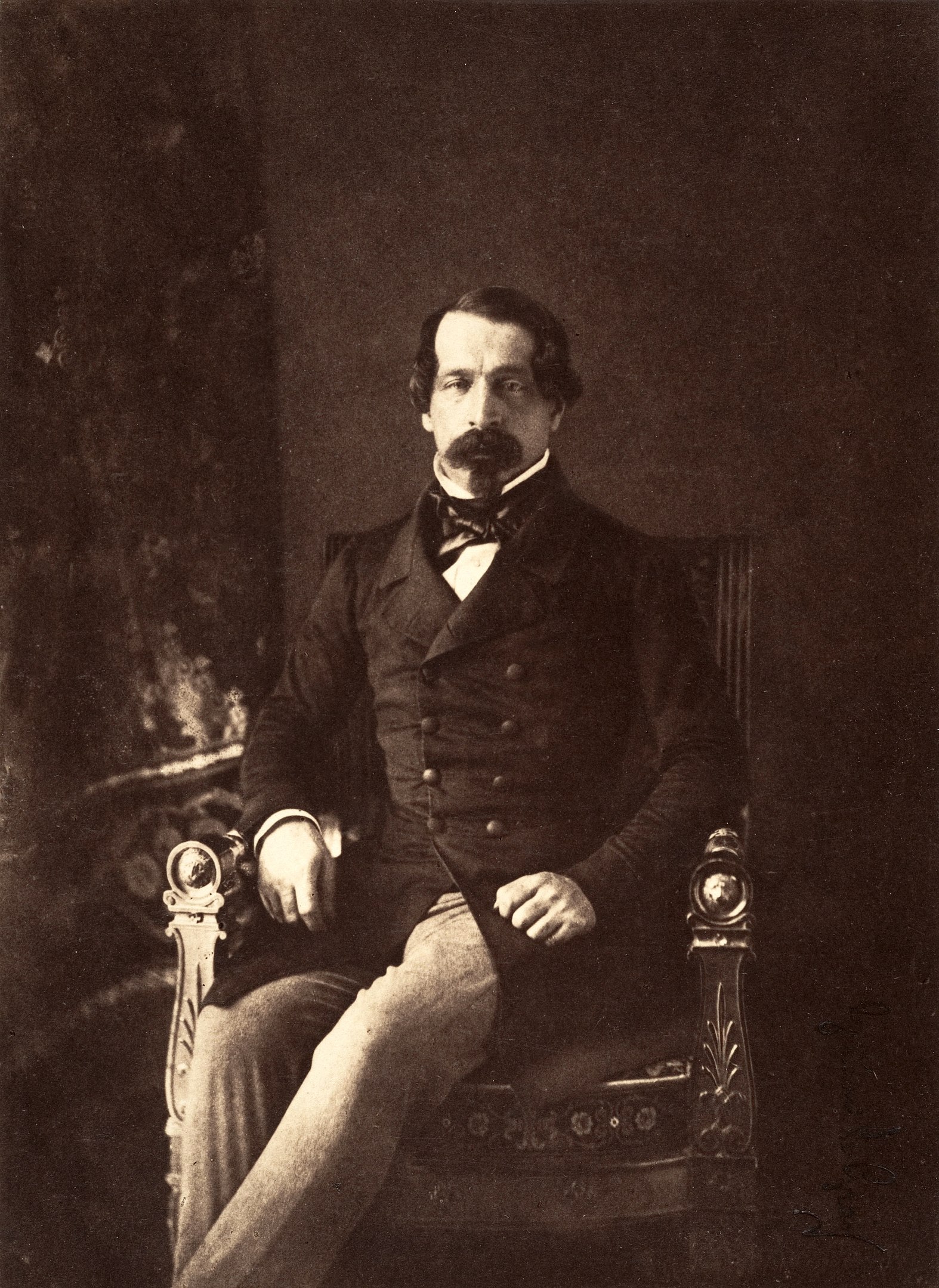
Louis Napoleon Bonaparte (Napoleon III), 1852Portrait of Prince Murat
The couple lived at Lipona outside of Tallahassee until the July Revolution of 1830 in Paris when Charles X abdicated, and Louis Philippe was selected as King. The Murats traveled to Europe as Achille tried to press claims to restore the families’ money and lands, but he failed. (Bellet, 1976) The couple moved to London, where they spent a few years in high society. Catherine became a favorite of Louis Napoleon (who would become the first President and then Emperor of France, Napoleon III). While in London, Catherine even attended and was given a seat in Westminster Abbey for the coronation of William IV of the United Kingdom. (Bellet, 1976)
Coronation of William IV, 8 September 1831
Return to America
Around 1835, the pair returned to America and set up residence just outside New Orleans, where Achille attempted to run a sugarcane plantation and practice law, both of which failed. (Hare, 2002) . They returned to Florida to their plantation Lipona, which he had mortgaged to the bank and subsequently lost due to nonpayment, requiring the couple to move to a smaller property. (Hanna, 1948)
Achille died in 1847, leaving his widow in a precarious financial situation, having acquired massive debt during his life. After the death of her husband, Catherine purchased a cotton plantation named Bellevue (now part of the Tallahassee Museum). She successfully managed the property and, after ten years, had paid all of Achille’s debts. (Sandler, 1999)
Bellevue Plantation
When Napoleon III became Emperor in 1852, Catherine was pronounced French royalty and Princess of the Second Empire, which granted her an annuity from the French government and allowed her to use the livery of France. (Bellet, 1976)
Catherine Daingerfield Willis Gray Murat, Princess of the Second Empire
Preservation and the Mount Vernon Ladies Association
In 1853, Ann Pamela Cunningham founded the Mount Vernon Ladies Association (MVLA) to preserve and restore George Washington’s Mount Vernon. There had been other failed attempts by owner John Augustine Washington to sell the property to the US government and the state of Virginia, and even vile rumors of it being looked at by “speculators” to turn it into a resort hotel. Seeing the state of the property belonging to one of the most beloved founding fathers, Cunningham was able to make a deal with Washington after much discussion to sell the property (house, outbuildings, and 202 acres) to the Association for $200,000 (around 7 to 8 million dollars today). (West, 1999)
Mount Vernon in 1858 before restoration by the MVLARecord of payment from MVLA, 1858
To raise money, Cunningham created a nationwide network of women by appointing one lady from each state as a vice regent to assist in fundraising. (Grabitske, 2004) In Florida, the daughter of the territorial governor, Ellen Call Long, was asked to become the state regent. She declined but suggested Catherine because of her family ties and influence. Catherine enthusiastically took on the role of vice-regent. She raised $3791.25, which was no small feat, with the entire population of Florida in 1860 being 144,424 people. (United States Census Bureau, 2021) The MVLA raised the funds and paid off the purchase price within two years despite The Panic of 1857 and the economic recession just before the beginning of the Civil War. (Casper, 2008) (Huston, 1987) Mount Vernon was saved and continues to be owned and maintained by the Association, as it is overseen by a board of regents of ladies from 27 states. (George Washington’s Mount Vernon, 2024)
Princess Catherine Murat died in August 1867 at her plantation, Bellevue. She is buried beside her husband, Prince Achille Murat, in the Tallahassee Episcopal Cemetery. They had no children.
Close up view of a plaque on the Prince and Princess Murat tombs – Tallahassee, Florida, ca 1900Graves of Prince and Princess Murat, 1949
Heather Baldus
Collections Manager
References
Bellet, L. P. (1976). Some Prominent Virginia Families, Volumes 1-2. Clearfield.
Brandon, E. E. (1944). A Pilgrimage of Liberty. Lawhead Press.
Burnett, G. (1996). Florida’s Past: People and Events That Shaped the State. Pineapple Press.
Casper, S. E. (2008). Sarah Johnson’s Mount Vernon : the forgotten history of an American shrine. New York: Hill and Wang.
Downes, A. J. (1956). The Legendary Visit of Emerson to Tallahassee. The Florida Historical Quarterly, 334-338.
Gannon, M. (2003). Florida A Short History. University Press of Florida.
George Washington’s Mount Vernon. (2024). About Mount Vernon. Retrieved from George Washington’s Mount Vernon: https://www.mountvernon.org/about/
Glenn, J. (2014). The Washingtons. Volume 1: Seven Generations of the Presidential Branch. Savas Publishing.
Grabitske, D. M. (2004). First Lady of Preservation: Sarah Sibley and the Mount Vernon Ladies Association. Minnesota History, 407-416.
Hanna, A. J. (1948). A Prince in Their Midst: The Adventurous Life of Achille Murat on the American Frontier. University of Oklahoma Press.
Hare, J. (2002). Tallahassee: A Capital City History. Arcadia Publishing.
Huston, J. L. (1987). The panic of 1857 and the coming of the Civil War. Baton Rouge: Louisiana State University Press.
Niles, H. (1823). Niles’ Weekly Register, p. 272.
Roberts, D. (2004). Dream state : eight generations of swamp lawyers, conquistadors, Confederate daughters, banana Republicans, and other Florida wildlife. New York City: New York: Free Press.
Sandler, R. (1999, October 23). The Princess Who Saved Mount Vernon. The Free-Lance Star, pp. 3-4.
Author’s Note: This blog contains hyperlinks to primary documents related to the event.
Figure 1: 250th Logo (Boston Tea Party Ships and Museum)
Intro
This year marks the 250th anniversary of the Boston Tea Party (Figure 1). Hailed as a defining moment in the quest for American independence and an act of patriotism, the event has inspired commemorations in many forms, and it remains a vital part of the American History curriculum. I, for one, thought it the epitome of achievement that I had the date memorized in kindergarten. Like much of our founding history, however, the story retains an element of myth. So, what exactly is the truth behind this event?
The Story
A general account of the Boston Tea Party tells how patriotic Bostonians, angered by unfair taxes, boarded three ships in Boston Harbor on December 16, 1773. Disguised as members of the Mohawk or Narragansett tribes, Samuel Adams led the Sons of Liberty in protest by throwing crates of the King’s tea overboard. This act helped unite the colonies against Britain and started the chain of events that ended in the “Shot Heard Round the World” on Lexington Green on the morning of April 19, 1775, following Paul Revere’s ride.
Sound familiar? In truth, this account covers the basics. It provides the “who,” “what,” “when,” “where,” and “why.” Nonetheless, it only scratches the surface of the complex event we know as the Boston Tea Party. To unpack this, let us look at what led to the event, how it happened, and the initial response.
Truth of the Tax
Taxes and tea sit at the heart of this story. The taxes that the colonies took issue with went into effect starting in the 1760s, with the ultimate goal of lessening the debt incurred by Britain during the Seven Years’ War. However, this set a new precedence as Britain had never taxed the colonists directly, and the passing of these tax laws occurred without consulting the colonies. The formal chant of “no taxation without representation” first appeared in 1768, and while the lack of representation presented a key reason for displeasure, the impact of taxes on merchants served as another.
While the Tea Act of 1773 served as the catalyst for the Boston Tea Party, the Tea Tax had existed since 1767. Introduced under the Townshend Acts, the tax remained the only one in effect upon the Act’s repeal in 1770. General dislike for the tax persisted, but the Tea Act took the issue to another level. In an aim to bail out the East India Company (EIC), the Act granted a monopoly over the tea trade by opening the colonial market to the company as the sole supplier, waived their tax payment in favor of those paid by colonists, and mandated that only EIC company agents (consignees) could sell the tea (Figure 2). Many perceived this as a restriction on business, as merchants could no longer source tea from Britain and smugglers, freedom of choice and rights. In truth, the protests against the tax and Tea Act occurred as a matter of principle since the cost of tea actually dropped, with consumers now able to buy directly from a supplier who faced no additional costs.
Figure 2: EIC Seal (East India Company)
Build Up
With the Boston Tea Party story often told in a bubble, it appears as an impulsive act, but far more happened behind the scenes. By the end of 1773, displeasure with the Tea Act made attempts of preventing the unloading of tea and boycotts of its purchase common. When Dartmouth, Beaver, and Eleanor anchored at Griffin’s Wharf (November 28-December 15), locals had expected their arrival since October and had spent November demanding the resignations of the consignees. Many foresaw the risk of tensions coming to a head, including Abigail Adams, who, on December 5, wrote that “the Tea that bainfull weed is arrived…The flame is kindled…Great will be the devastation if not timely quenched or allayed by some more Lenient Measures.”
After successfully chasing the consignees out of town, Bostonians urged Francis Rotch, whose family owned two of the ships, to depart without unloading the cargo. The Sons of Liberty stationed a guard at the docks to ensure that the tea remained onboard while Rotch decided. In response, Royal Governor Thomas Hutchinson ordered Rotch to unload the cargo within the standard twenty days of arrival or forfeit it and the ships. Rotch thus found himself in an impossible situation as Hutchinson and customs refused to let him leave while the Sons would accept nothing less.
December 16th
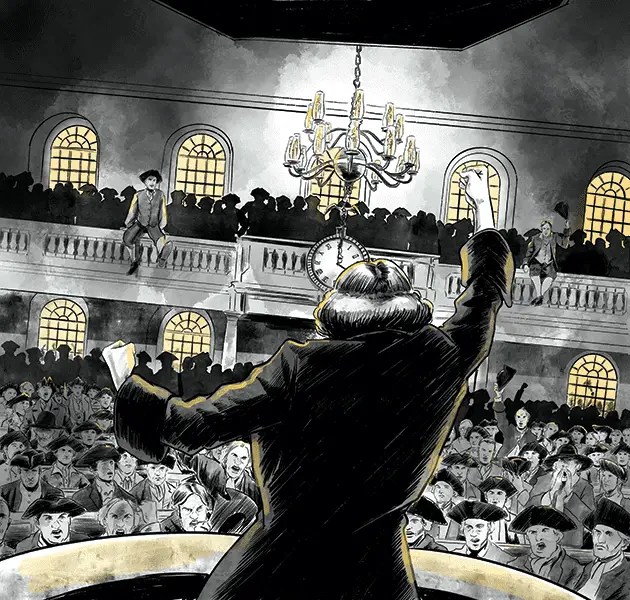
Many awoke on December 16, knowing the crisis would come to a head. The date marked the deadline for unloading Dartmouth’s cargo, and Rotch would make one final attempt to plead his case to both sides. Hutchinson and customs refused to budge, which further incensed Bostonians when Rotch reported that the tea would not be leaving. This announcement came as Samuel Adams headed a meeting at the Old South Meeting House (Figure 3).
Figure 3: Adams’ Speech at Old South (Revolutionary Spaces)
Serving as a leading figure within the Sons of Liberty, Adams had led many of the meetings and attacks that occurred almost daily in the buildup to the 16th. This particular meeting drew 5,000-7,000 people who clamored to hear the latest developments in the tea crisis. When Rotch’s news broke, Adams stated, “This meeting can do nothing further to save the country.” While often billed as a signal to start the Tea Party, doubt remains over the statement’s significance. According to eyewitness accounts, many stayed another 15 minutes, and Adams tried to prevent people from leaving before the meeting concluded.
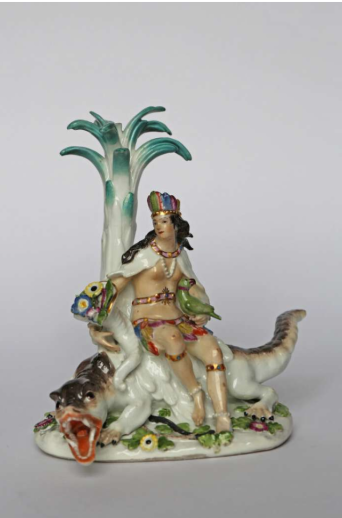
Regardless of intent, hundreds of people made their way to Griffin’s Wharf. Along the way, some donned disguises that mimicked Native Americans. These disguises served both practical and symbolic purposes. First, donning a disguise shielded the identity of individuals carrying out the illegal acts, even if no one mistook them for actual tribal members. Secondly, the choice of a Native American-inspired look embraced an allegory of America and linked Indigenous resistance to colonization with the colonists’ struggle against Britain (Figure 4).
Figure 4:“Allegory of the Continent of America,” c. 1750 (The Clark Museum)
Interestingly, Adams never claimed or denied involvement with the Tea Party, yet, in contrast to popular depictions, he did not appear at the harbor that night. Instead, he remained at Old South. Of the participants, only the identities of 116 are known, and only one faced arrest.
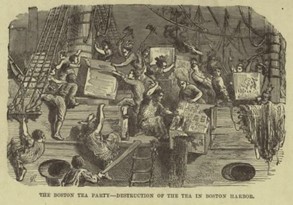
Figure 5: The Boston Tea Party, 1789, (LoC)Figure 6: The Boston Tea Party, c. 1872, (NYPL)
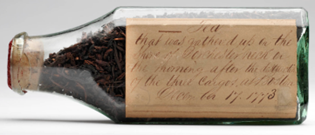
Despite a post-independent America enshrining the Boston Tea Party in glory, most initial reactions proved far less enthusiastic than that of John Adams. The name “Boston Tea Party” did not emerge until the 1820s, and even then, “Party” referred to a group of people rather than something celebratory. Instead, mentions of the event usually identified it by what happened, such as “the destruction of the tea” (Figure 7).
Figure 7: “Tea that was gathered up on the shore of Dorchester Neck on the morning after the destruction of the three cargos at Boston; December 17, 1773” (MHS)
While Parliament’s taxes made many colonists unhappy, they also valued their right to private property. In the case of the Boston Tea Party, the ships that the Sons of Liberty trespassed on belonged to Americans, while the EIC owned the destroyed tea. The King and Parliament had no direct connection to the ships or their cargo. As such, many viewed the attack as one on private property rather than a true strike against Parliament. Those who spoke out against it included Founding Fathers. Benjamin Franklin felt “truly concern’d…that there should seem to any a Necessity for carrying Matters to such Extremity, as, in a Dispute about Publick Rights, to destroy private Property.” Meanwhile, George Washington supported taking a stand against taxation and felt the cause of Boston equated to the cause of America, but ultimately could not “approve their cond[uc]t in destroyg the Tea.”
Impact
In the short run, the Boston Tea Party did little to fan the flames of independence. It inspired a few more boycotts (i.e., the Annapolis, Edenton, and Yorktown Tea Parties) and furthered a decline in consumption, but the British response to the event served as the primary catalyst. By punishing all of Boston, and by extension, Massachusetts Bay Colony, rather than just those responsible, the British infringed upon the rights of the colonists. Under the Coercive (nicknamed “Intolerable”) Acts, the British closed the harbor, demanded Bostonians pay damages to the EIC, imposed martial law, and required citizens to house, or quarter, members of the military on their property at their own expense (Figure 8).
Figure 8: “The Bostonians in Distress;” 1774 Satire of the Boston Port Act (LoC)
Those living in the twelve other colonies did not take well to this, as they feared the implementation of these acts in their homes. In response, the First Continental Congress met in Philadelphia from September to October 1774. While some delegates saw the issue as a Massachusetts one, others pressed the need to take a stand against the overreaches of Parliament and sympathized with Massachusetts. They concluded Congress by issuing their Declaration and Resolves, which listed objections to Parliament and confirmed their commitment to a trade boycott. However, when news of Lexington & Concord broke in April 1775, and Massachusetts found itself at war, the other colonies quickly had to decide which side they would take.
Legacy
Two hundred fifty years on, the Boston Tea Party remains an iconic event in American history and a pivotal moment in the founding of the country (Figure 9). While not wholly embraced as such upon its occurrence, the retelling of the event over time came to enshrine it in lore and leave out details that complicated the narrative. This shows that one cannot study a singular event without contextualizing it within the bigger picture. Nevertheless, John Adams’ belief that the “Destruction of the Tea” would become an epoch in history proved correct.
Figure 9: Robinson Tea Chest – 1 of 2 surviving chests (Boston Tea Party Ships and Museum)
Franklin, Benjamin. From Benjamin Franklin to the Massachusetts House Committee of Correspondence, 2 February 1774. Letter. From National Archives, Franklin Papers. https://founders.archives.gov/documents/Franklin/01-21-02-0023 (accessed Nov. 13, 2023).
Thanksgiving is next week, and families and friends across the United States will gather again to celebrate the past year’s blessings.
Days for giving thanks have been proclaimed throughout history for many reasons – most often to celebrate a bountiful summer or fall harvest, the end of a war, or even the beginning of a new nation. George Washington proclaimed a one-time day of Thanksgiving on Thursday, November 26, 1789, “to be devoted by the People of these States to the service of that great and glorious Being, … for the civil and religious liberty with which we are blessed, and the means we have of acquiring and diffusing useful knowledge; and in general for all the great and various favors which he hath been pleased to confer upon us.”.
The 1769 Thanksgiving Day Proclamation by George Washington
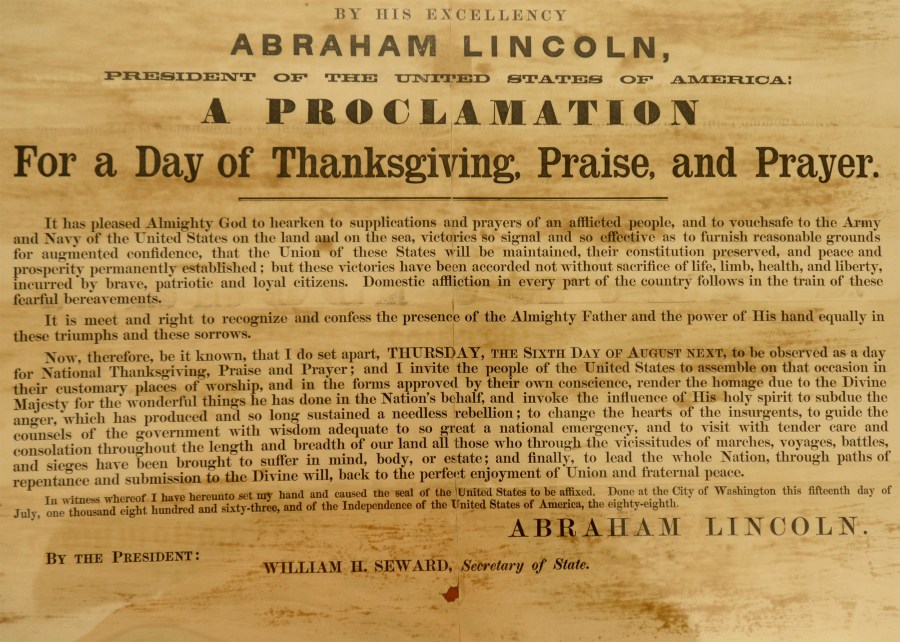
Individual states have proclaimed specific Thanksgiving days throughout the nation’s early years. Still, it wasn’t until 1863 when President Abraham Lincoln issued a proclamation designating the last Thursday of November “as a day of Thanksgiving” to be observed by all “fellow citizens in every part of the United States.” The nation was still suffering through the Civil War. Lincoln included a remembrance of “all those who have become widows, orphans, mourners or sufferers in the lamentable civil strife in which we are unavoidably engaged, and fervently implore the interposition of the Almighty Hand to heal the wounds of the nation and to restore it as soon as may be consistent with the Divine purposes to the full enjoyment of peace, harmony, tranquillity, and Union.”
1863 Thanksgiving Day Proclamation by President Abraham Lincoln
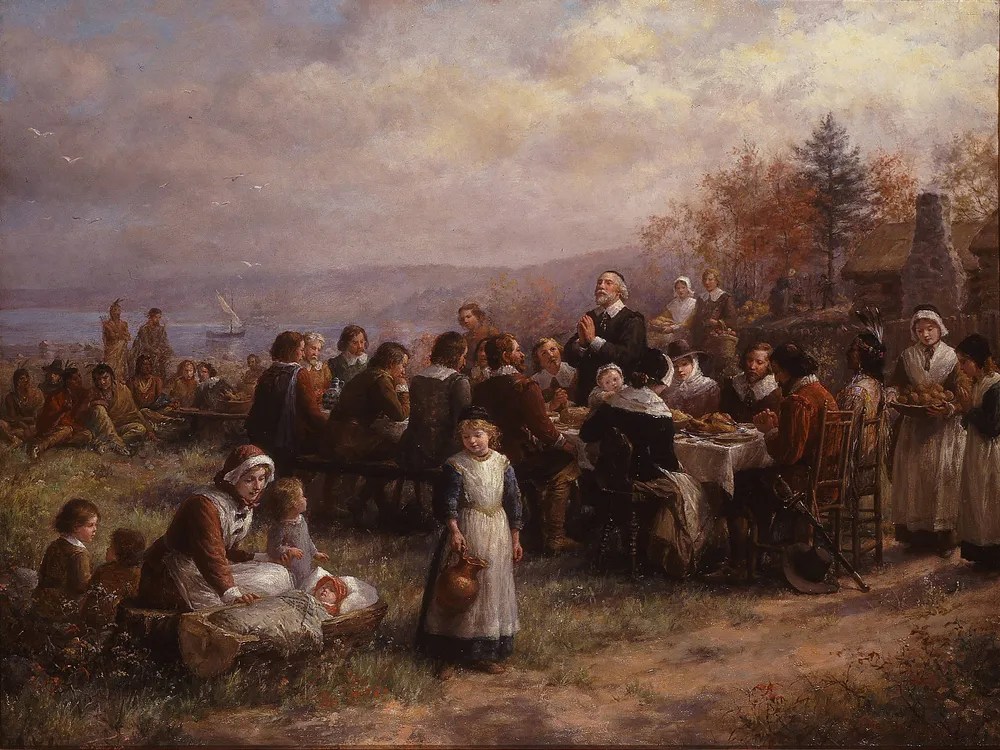
As the traditional vision of Thanksgiving is based upon the 1621 New England harvest feast shared by the Pilgrims of Plymouth, Massachusetts, and their new friends, the Wampanoag tribe, the November holiday is associated with an abundance and display of fall harvest foods. A table laden with a wide spread of traditional foodstuffs is the norm, but what’s underneath all that food is what I’m interested in!
Jennie Brownscombe’s 1925 very idealized version of the first Thanksgiving
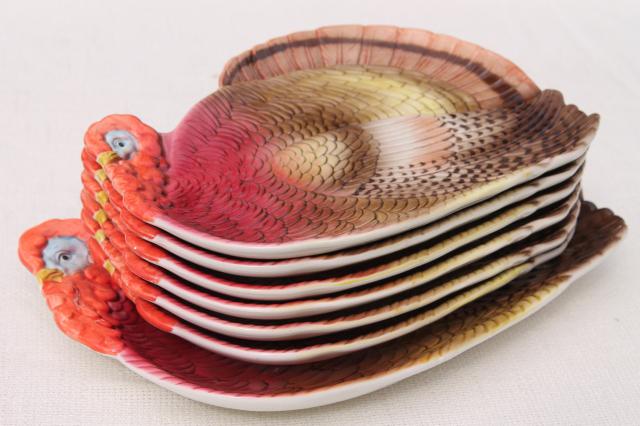
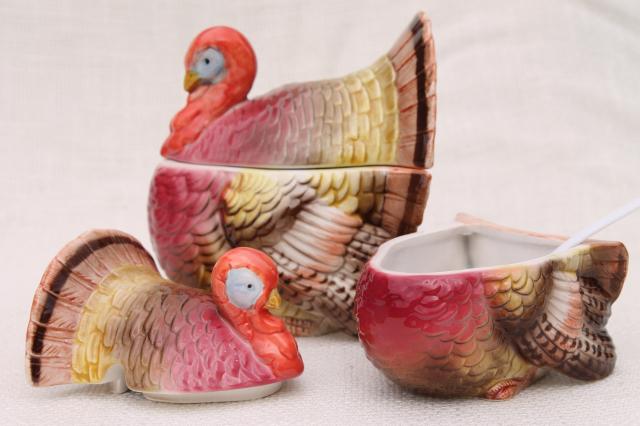
Our best china! Sometimes, it’s Grandma’s china, brought out of the basement, dusted, and cleaned off for the occasion. Other times, it’s our wedding china, if you are of that generation that still wants or received wedding china. Other times, it’s unique dishes made and decorated for the occasion (think turkey-shaped plates!). Dinner plates, salad and butter plates, serving platters and bowls, condiment vessels, punch bowls, sauceboats for the gravy, dessert plates, tea, and coffee services, crustal wine glasses – the variety can be tremendous, and the different table wares are utilized to display and serve specific foods and finished dishes.
Turkey Plate if that’s your thing.Turkey shaped gravy boat and cranberry sauce dish…an absolute necessity on a Thanksgiving table
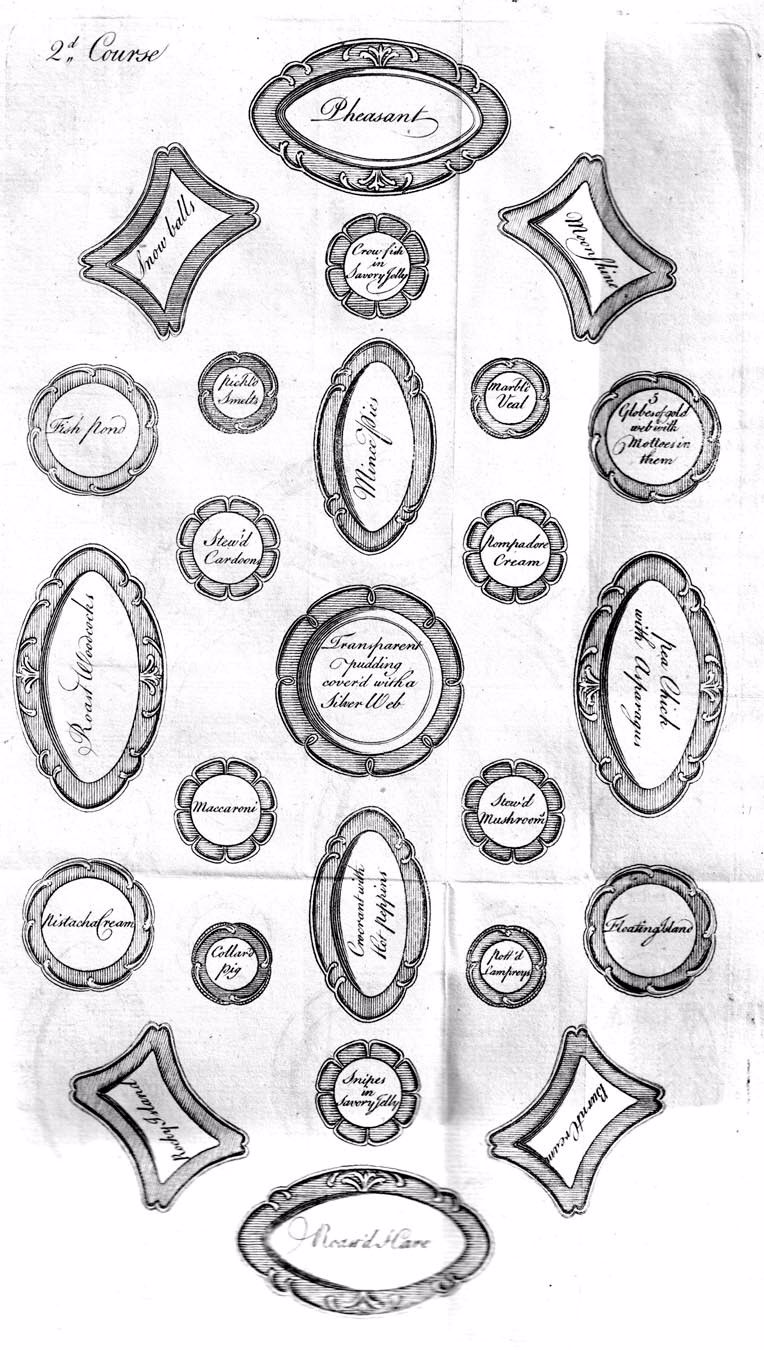
Mary Washington, as a member of the gentry class in Colonial Virginia, would have been well-versed in setting a stylish dinner table for family and guests. Formal dining habits during the 18th century slowly evolved to dinners consisting of multiple courses of food prepared and served in a more elaborate and complicated fashion. Cookbooks of the age detailed the possible menus for different seasons and even produced drawings of how each course’s dishes were laid out on the table. Elizabeth Rafferty’s 1769 The Experienced English Housekeeperincludes a copperplate drawing illustrating one such arrangement for the second course of a dinner. Hours could be spent looking up how some of her dishes were prepared, such as “Pistacha Cream,” “Potted Lampreys,” or “Transparent Pudding Covered With a Silver Web.”
Second course dinner layout from The Experienced English Housekeeper, 1769
Fragments of highly specialized ceramics excavated at Ferry Farm, the plantation Mary called home for much of her life, speak to her efforts to set a stylish table for guests. Numerous highly decorated (molded or painted) creamware vessels, including sauceboats, plates, platters, oval and round serving bowls, condiment bowls, casters, serving spoons, and tea wares, are in our collection and speak to the refinement of her table. Porcelain was the most desirous of tablewares, but its sheer expense was prohibitive for Mary except for limited items, such as teawares. Creamware, however, was within her budget and was extremely fashionable during the third quarter of the eighteenth century in English society.
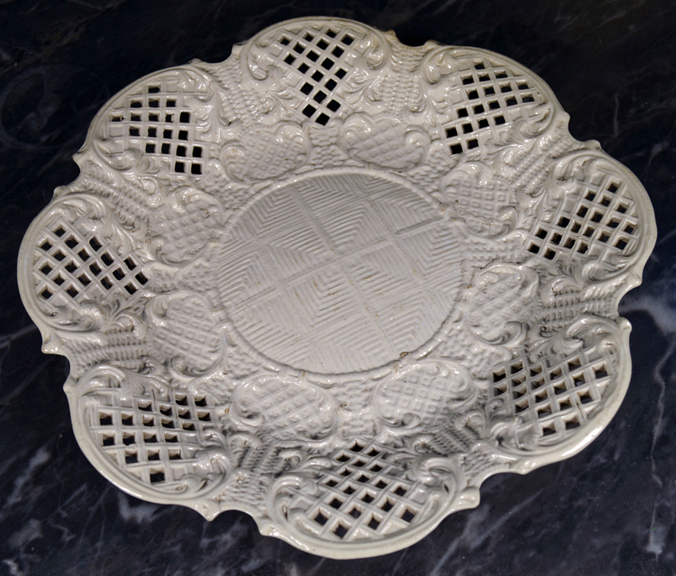
Mary also had a fancy white salt-glazed stoneware fruit dish in her collection. This dish, and possibly an accompanying pierced bowl, would serve local and non-local produce such as grapes, figs, oranges, pineapples, apples, peaches, and pears. Fresh fruit, especially during off-season times, was expensive as it had to be shipped in from warmer climates. However, its presence on the table indicated a measure of wealth and, consequently, status within the gentry lifestyle. Mary needed to maintain her gentry status for herself, but more importantly, for her children and their future success in the stratified society in which they lived.
Dish, 1760-1775 in Kenmore Collection
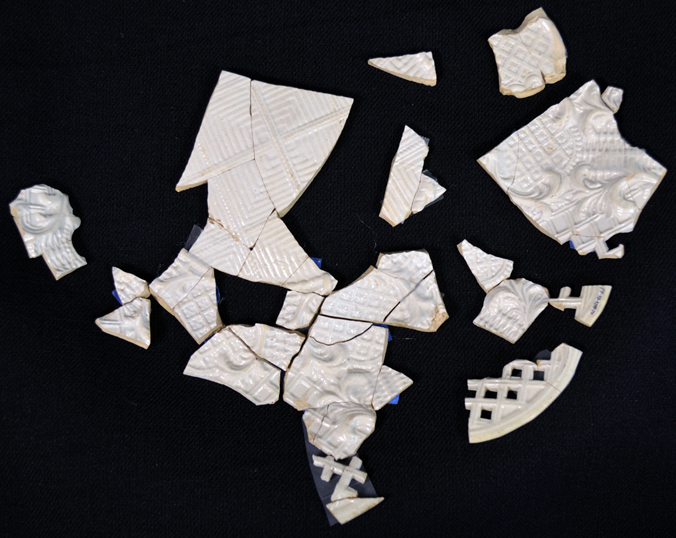
Fragments of a white salt-glazed fruit dish excavated at Ferry Farm
Collections managers deal with a wide array of objects. Sometimes those objects can be quite odd and even a bit gross to the modern person. One object that has always fascinated me is mourning jewelry and the hair of the deceased that jewelry contains. Not many people nowadays think of collecting loved ones hair to keep in a locket or to weave into bracelets, but this was a widespread practice and even quite fashionable a relatively short time ago. While perhaps odd to us today, mourning jewelry gives us a glimpse into rituals surrounding the dead and grieving at a time when death was a more prominent and ubiquitous part of life.
The evolution of mourning jewelry began around the Middle Ages as part of the growth of Christian ideas on mortality and redemption called Memento Mori. These ideas found their way into literature, art, and even fashion. Memento Mori jewelry reminded the wearer of their own mortality. These pieces, usually rings, incorporated macabre imagery like skulls, skeletons and coffins to create strong visual reminders of the transient nature of earthly life.
It was not until the 17th century that the Memento Mori jewelry developed into what we know as mourning or memorial jewelry. The imagery remained similar but the symbolism became more personal and served as a sentimental remembrance of a specific individual, instead of one’s own mortality. Engraved names, dates of death and age of the deceased appeared on pieces. Bereaved family presented these ornaments to friends and family as memorial to the individual. They became a status symbol and many wealthy people actually included instructions of how the jewelry would be designed, and made in their will. For example, George Washington declared in his will: “To my Sisters in law Hannah Washington & Mildred Washington; to my friends Eleanor Stuart, Hannah Washington of Fairfield, and Elizabeth Washington of Hayfield, I give, each, a mourning Ring of the value of one hundred dollars. These bequests are not made for the intrinsic value of them, but as mementos of my esteem & regard.”
The oval-shaped brooch above bears the 1798 Saint Memin likeness of George Washington in profile and dates from around 1799. The image is surrounded by gold and blue enamel and is under convex glass. The brooch is trimmed by forty-four seed pearls.
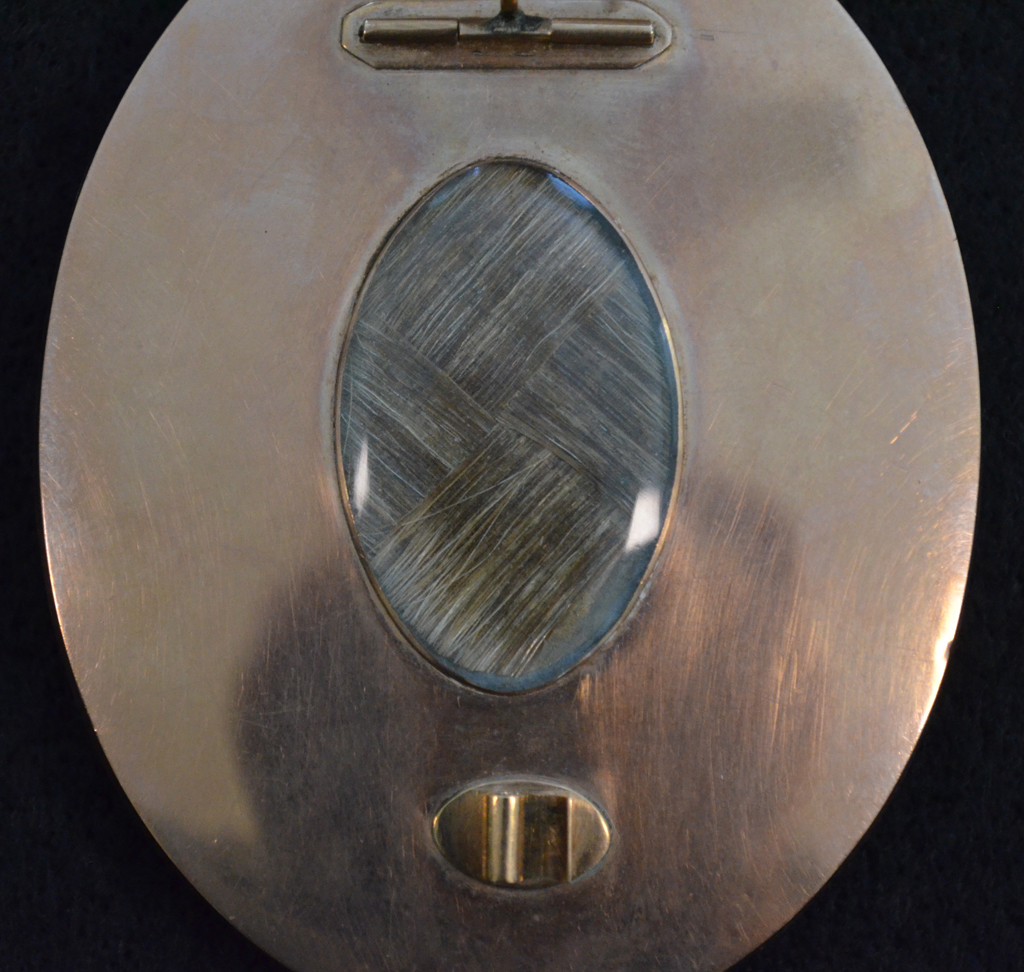
The back of the brooch contains a plait of brownish-red hair under glass along with a pin fastening. Tradition says the hair is General Washington’s cut after his death and sent from Mount Vernon by Martha to Mrs. R.B. Lee of the Sully Plantation, Fairfax Co., Virginia in December 1799.
By the time Washington died, mourning jewelry had evolved with changing attitudes toward death and with a greater focus on sentiment. The style changed to represent the lighter rococo styles and later Neo-classical designs became popular. The skulls and coffins were replaced by sepia-toned women dressed in billowing robes lamenting at a tomb, inscribed urns, and weeping willow trees in bucolic landscapes. Many rings and brooches were lined with pearls to represent tears and included a simple twist of the deceased’s hair.
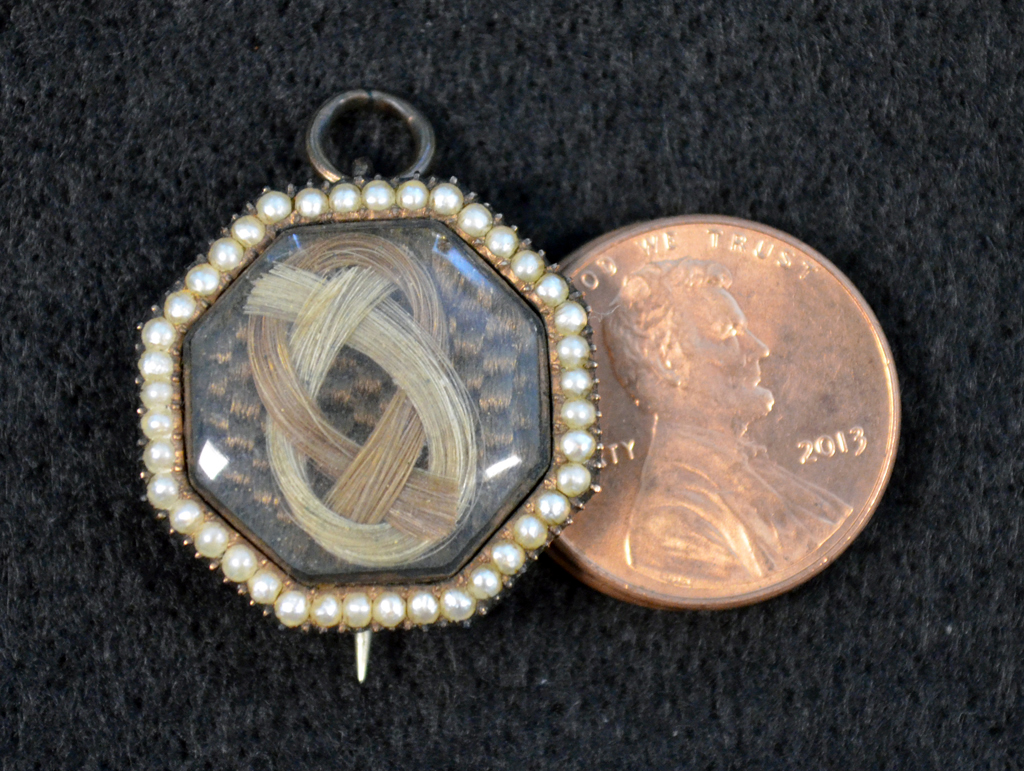
The octagonal locket dates from between 1800 to 1825 and has been turned into a brooch. The lock of hair, believed to be that of George Washington, is tied in a figure eight type knot and rests on a mat of woven hair. The lock of hair was supposedly given to Captain Robert Smith who knew and served with George during the war. After Captain Smith lost his wife, he went to visit the Washingtons at Mount Vernon and became friends with Nelly Custis, who gave him this lock of her great-grandfather’s hair. When Captain Smith died, he willed the pendant to his cousin and it passed through the Smith family until donated by a relative to The George Washington Foundation in 1925.
This traditional mourning brooch dates from 1790 to 1810. It contains many neoclassical imagery typical of the time including the weeping woman in classical dress sitting by a tomb, a willow tree, and a ceremonial urn carving. It is inscribed “Much Lov’d, Much Mourn’d”and is painted on ivory encased in a copper mount. The back contains a braid of brownish-blond hair under a glass cover.
In the 19th century the use of more elaborate hair work became increasingly popular. The Victorians developed a strict etiquette for mourning rituals and dress. The stages specified different colors, fabrics and even jewelry at different times during the mourning period, the length of which varied depending on the mourner’s relationship to the deceased. Mourning jewelry made of hair was allowed during the second stage (usually about a year into the mourning ritual) creating a rise in not only unique hair jewelry but do-it-yourself guides to making pieces with loved one’s hair.
This round, two piece hinged gold locket with ornate gold script initials (REL) set in cobalt glass opens to a glass faced compartment that contains a clipping of grey hair with an engraved inscription on the inside of the lid, “Died Oct 12, 1870”. The locket was made by Ms. Virginia Tayloe Lewis after asking her cousin Robert Edward Lee for a clipping of his hair. Mr. Lee sent a letter back with his regards and a snip of his white locks.
Memorial jewelry and hair work began to wane at the turn of the 20th century and now these pieces have become curios, often found in antique shops and museum storage collecting dust on shelfs. Sadly, most of the pieces have no information relating to who they were made for or the names of the mourned. Instead, we are left with an unidentified plait of hair or gold band symbolizing the only piece left from the life of a loved individual.