Lives and Legacies

Tag: collections care

  • Behind the Glass at Ferry Farm’s Archaeology Lab

    The observer stands behind glass and watches. The one being watched picks up the object with her bare hands turns it carefully to see every angle, then sets it down to record data into her computer. Then she washes her hands, unwraps another object – and eats it!

    Visitors to George Washington’s Ferry Farm can explore more than the museum gallery, or the Washington House replica, or newly constructed Quarter and Cellar outbuildings. They can tap into their people-watching curiosities and observe real archaeologists in a laboratory researching, washing objects, making labels, cataloguing, repairing ceramics – and even eating lunch!

    One extraordinary thing about Ferry Farm is that its archaeology lab is viewable and accessible to the public. The mysteries of history lie out in the open, sitting out on tables or in trays ready to be washed and categorized. Like zoo-goers, visitors are mesmerized by the goings-on behind the glass, and likewise, our archaeologists love interacting with the public, glad to answer questions or even pose for a picture.
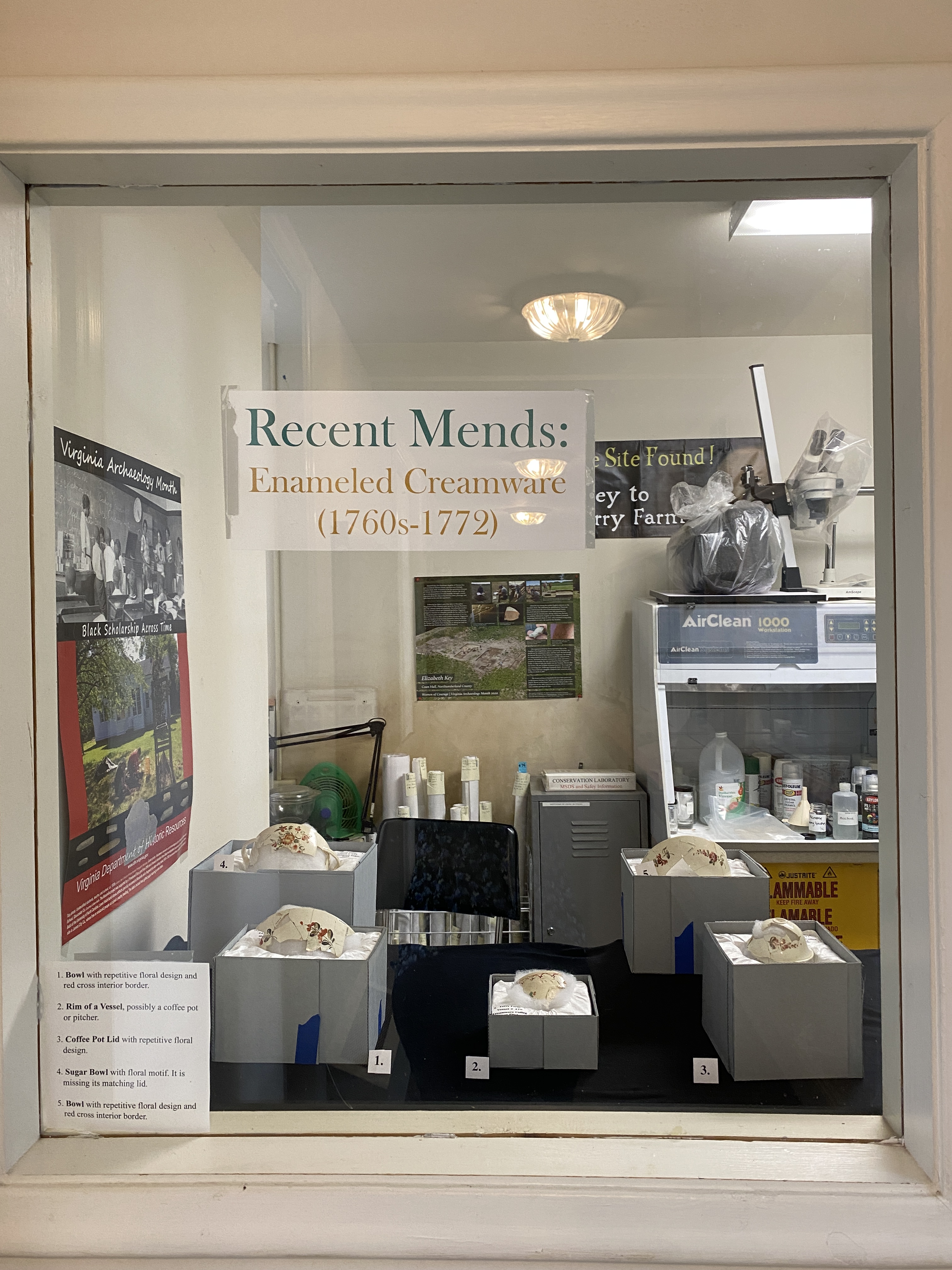
    Recent mends of enameled creamware behind one of several Archaeology Lab observation windows.

    It may be an interesting coincidence, but as Mary Washington drives the story of Ferry Farm and Historic Kenmore was saved by a group of intrepid women, Ferry Farm’s archaeology laboratory is also dominated by women who are passionate about what they do and more than willing to share their findings with guests and professional peers. Who are these interesting women, and what exactly happens in the lab? Its main inhabitants are Lab Supervisor Mara Kaktins and Field Directors Judy Jobrack and Danielle Arens. Also, part of the team (but not in the fishbowl) are Research Archaeologist Emma Schlauder and Director of Archaeology Dave Muraca. Dave, the only man in the department, led the team that discovered the foundation of the Washington House.

    There would be no lab work if there was no field work, and every summer for about 11 weeks, a carefully planned dig occurs on the grounds of George Washington’s Boyhood Home. Rich in artifacts, the land has yielded over 800,000 since the 1990’s. Finds date from indigenous, colonial, Civil War, and a sequence of farms throughout the 20th century. As Dave Muraca has said, “I would never recommend having a Civil War battle on your archaeological site. There are five successive farms out there, one on top of each other. In that way, it’s very complicated and hard to take apart.” That said, the fieldwork is not easy, but incredibly, each season, they find thousands of artifacts that will need to be mapped, processed, washed, bagged, catalogued in the database, labeled, stored, and researched.
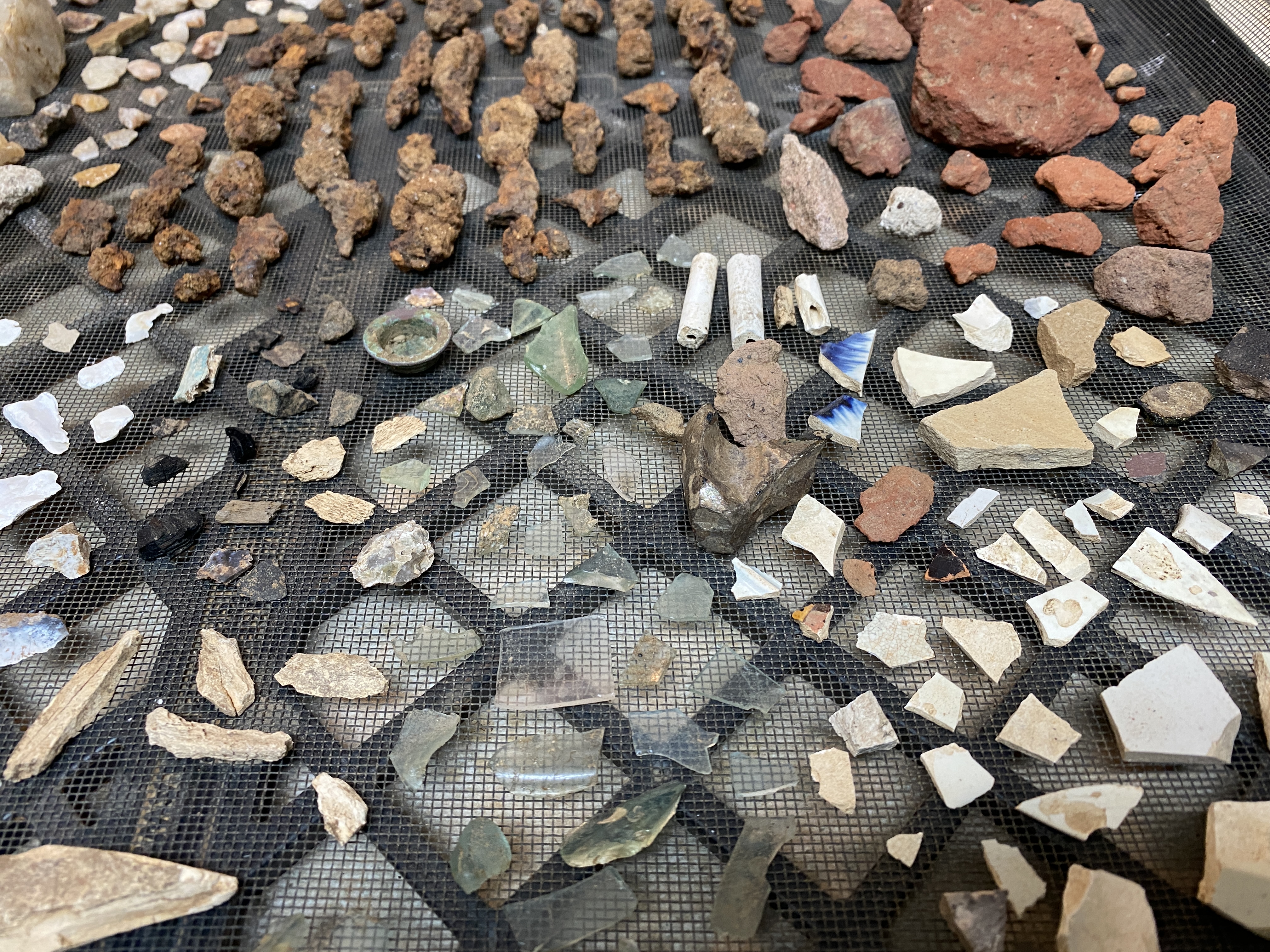
    Washed artifacts waiting to be bagged and catalogued.

    Typical finds include ceramic sherds, window glass shards, architectural pieces, household items, mortar, sandstone, personal items, pipes, wig curlers, buttons, personal adornment, and indigenous and faunal (animal remains). Objects popular with the public include a Masonic pipe bowl, cufflinks engraved with foxes and “Tally O,” a chamber pot, and even 20th-century items that indicate children used to live on-site, such as Matchbox cars, a toy motorcycle, or a doll’s head. Observers are also surprised to learn that 21st-century trash is catalogued because it was unearthed, and someday that too will be a part of Ferry Farm’s history.

    It’s important to note that Ferry Farm doesn’t dig exhaustively. While archaeologists are certainly concerned with the past, they also make concessions for the future, leaving areas untouched for future generations to dig using as-yet not invented technology. Ground penetrating radar has not been used much because of all that has happened on the land since Washingtons’ time. The main emphasis is feature-chasing – looking for structures such as the Washington House, cellar, kitchen, the Quarter, and more. No land feature will be recreated without knowing exactly where it stood.

    A unique quality of Ferry Farm’s Archaeology Department is that lab and field duties are not segregated; the same amazing team works both in the lab and field. This creates an intimacy with the artifacts that may not be present elsewhere. One day in the field equals three working days in the lab, processing, interpreting, and analyzing all the data from the artifacts. The first step is turning the field data into a format that’s digestible for record-keeping, end-of-year reports, and future Ferry Farm archaeologists. In the field, a site grid in five-foot increments is established and laid out to track where the finds are. Within that grid, context numbers are assigned to specific soil layers and features. A context is essentially a 5’ x 5’ address that notes the horizontal and vertical location of artifacts, noting spatial distribution where items are concentrated. In the lab, context maps are made from each grid unit, and the maps are put together to create the stratigraphy of a dig site.

    Leaded glass takes on a blue hue under UV light.

    Artifacts that come in are brought to the Wet Lab and washed with water in a tub or colander using tools such as toothbrushes, pipe cleaners, or dental picks. One might wonder if there are special precautions for handling artifacts, and interestingly, controversy swirls over whether artifacts should be handled with gloves or not. Rubber gloves are worn during lengthy washings to keep hands from getting too waterlogged. It turns out wearing gloves for analysis proves more damaging since touch sensitivity is reduced and gloves are prone to ripping. Items being examined have been surrounded by the elements for years, so oils from hands are not likely to harm artifacts any further.

    Next to the Wet Lab is the Conservation Lab, where acetone might be used to remove glue from previously mended artifacts. It’s equipped with a vent hood for fumes and the archaeologists wear masks for safety. They often create tableware replicas for the Washington House display, which might require the use of spray paint.

    Very well-designed and equipped, the lab was created by archaeologists for archaeologists. Their equipment includes a light table, a Dremel, a fine water screen for the field, and a UV light to identify leaded glass. For further testing, the department may contract out to other labs, such as the University of Eastern Michigan, with DART mass spectrometry capable of identifying organic materials.

    After artifacts are entered into the database and bagged with tiny labels indicating their project number and context, they are either put in the study collection or housed in cabinets or a storage room. With almost a million artifacts in the collection, the boxes stacked in the storage room resemble a miniature version of the ending scene in Raiders of the Lost Ark.
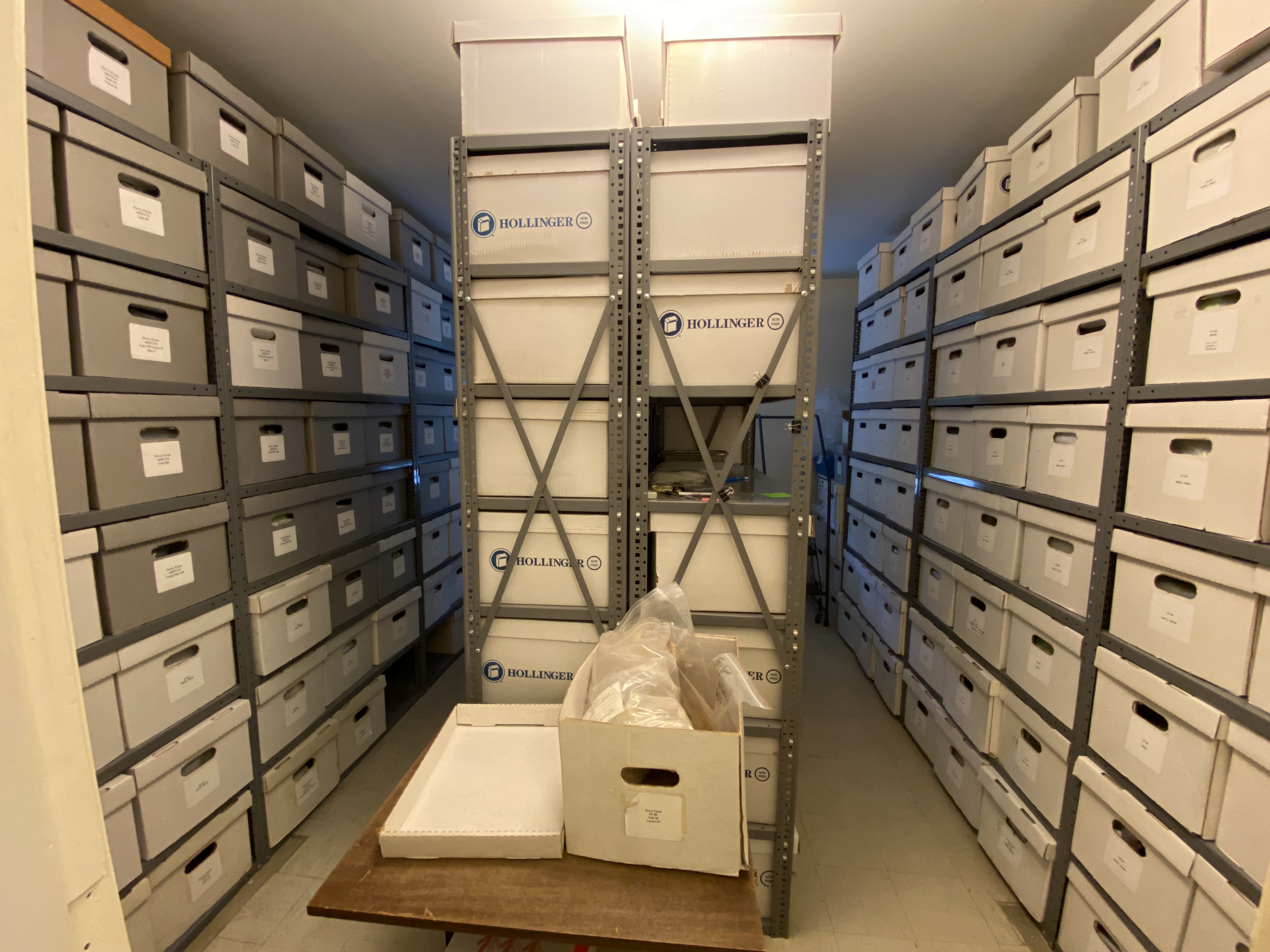
    Boxes of artifacts stacked in the storage room resemble a miniature version of the ending scene in Raiders of the Lost Ark.

    While one cannot put a value on tiny sherds of 18th-century ceramics, a rusted hinge, or an old button, Kaktins says, “Everything is priceless because of the information gleaned from it.” Archaeology at Ferry Farm is the driving force behind the stories shared with visitors. It informs where the buildings go, reveals the long-forgotten secrets of inhabitants, and intrigues visitors as they glimpse into the past.

    Lori Pikkaart

    Marketing & Communications Manager

  • Lecture – Cabinet of Curiosities: Kenmore and the Evolution of Museum Collections [Video]

    On Tuesday, May 15, 2018, Meghan Budinger, Aldrich Director of Curatorial Operations for The George Wsahington Foundation presented a lecture titled “Cabinets of Curiosities: Kenmore and the Evolution of Museum Collections.” Using Kenmore’s collection as a case study, Meghan reviewed 100-years worth of museum curation and talked about some of the most exciting and unusual objects in Kenmore’s collection.

    This final lecture in the latest trilogy of Foundation lectures took place at the Central Rappahannock Regional Library in Fredericksburg, Virginia.

  • Video – Lecture: “The Rooms at Ferry Farm”

    Furnishings posts logo finalOn Tuesday, September 19, 2017, Meghan Budinger, Aldrich Director of Curatorial Operations at The George Washington Foundation, presented a lecture titled “The Rooms at Ferry Farm.” Meghan surveyed how we plan to furnish the reconstructed Washington house using traditional decorative arts scholarship but also adopted skills from genealogists, architectural historians, material cultural experts, scientists, and even investigative reporters. Meghan discussed how the Washington house and the effort to accurately furnish its rooms is a prime example of the synthesis of all of these vocations. The lecture was given at the Central Rappahannock Regional Library headquarters in Fredericksburg, Virginia.
    Join us at the Washington House Celebration on Saturday, October 7, 2017 from 12:00 p.m. – 4:30 p.m to celebrate the construction of the Washington house! A special ribbon-cutting ceremony will begin at 1:30 p.m. featuring notable speakers. After the ceremony, guests will be invited to view the reconstructed Washington house! Parking for the event is off site at the VRE Fredericksburg Park and Ride Lot G at the corner of Prince Edward Street and Frederick Street.  Limited handicap parking is available at Ferry Farm. Buses will transport guests to and from Ferry Farm. The Washington House Celebration is a free event and RSVPs are not required.

    Learn more about the Washington House here and view other videos, photos, and blog posts about the project here.

  • Video – Lecture: “Building George’s House, Introducing the New Ferry Farm”

    On Tuesday, September 5, 2017, Dave Muraca, director of archaeology and vice president of museum content at The George Washington Foundation, presented “Building George’s House: Introducing the New Ferry Farm,” his account of the last eighteen months as George Washington’s Ferry Farm witnessed the careful reconstruction of the Washington house using many traditional techniques. Dave reviewed the archaeology that made the reconstruction possible and recounted the work of the skilled craftsmen building George’s house. The lecture was given at the Central Rappahannock Regional Library headquarters in Fredericksburg, Virginia.
    Join us at the Washington House Celebration on Saturday, October 7, 2017 from 12:00 p.m. – 4:30 p.m to celebrate the construction of the Washington house! A special ribbon-cutting ceremony will begin at 1:30 p.m. featuring notable speakers. After the ceremony, guests will be invited to view the reconstructed Washington house! Parking for the event is off site at the VRE Fredericksburg Park and Ride Lot G at the corner of Prince Edward Street and Frederick Street. Limited handicap parking is available at Ferry Farm. Buses will transport guests to and from Ferry Farm. The Washington House Celebration is a free event and RSVPs are not required.

    Learn more about the Washington House here and view other videos, photos, and blog posts about the project here.

  • Lecture Series will Introduce the New Ferry Farm

    Aerial House Photo
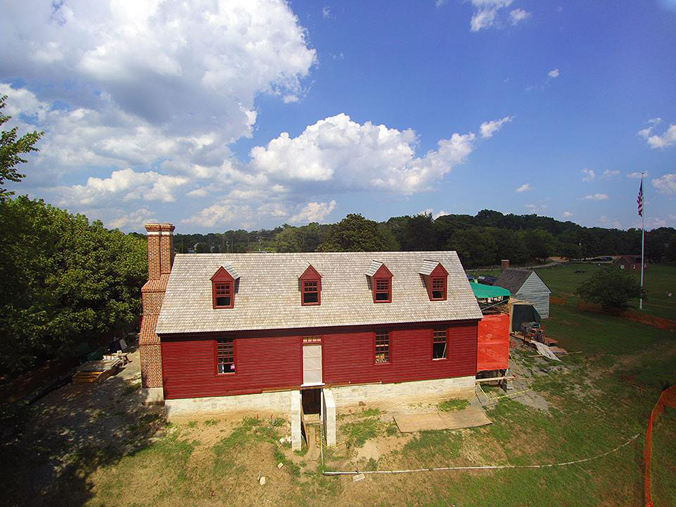
    A recent aerial view of the Washington house in the midst of construction at George Washington’s Ferry Farm. Photo credit: Jimmy Cline

    As construction of the Washington house at George Washington’s Ferry Farm nears completion, we want to share the many years of archaeology, historical research, scientific investigation, skilled craftsmanship, and hard work that made building this reconstruction possible.  Next month, The George Washington Foundation will present a lecture series titled George Washington: Boy Before Legend – Introducing the New Ferry Farm over three consecutive Tuesdays.

    First, on Tuesday, September 5, Dave Muraca, archaeologist and the Foundation’s vice president of museum content, will present “Building George’s House,” his account of the last eighteen months as Ferry Farm witnessed the careful reconstruction of the Washington House using many traditional techniques.  Dave’s talk will review the archaeology that made our replica possible and recount the work of the skilled craftsmen building George’s house.

    Second, on Tuesday, September 12, archaeologist and artifacts analysts Laura Galke will present “The Mother of the Father of Our Country.”  Laura’s lecture will examine how historical documents and newly-unearthed artifacts indicate that Mary Washington, George’s mother, faced challenges, governed her home, and managed the family’s plantations with a skill and determination that recent biographers have not appreciated. Laura will also discuss how the Washingtons’ investments in attire, furnishings, and landscape modification reflected their strategy for overcoming setbacks and for exhibiting British colonial refinement.

    Finally, on Tuesday, September 19, Meghan Budinger, director of curatorial operations, will survey how we plan to furnish the reconstructed Washington house in “The Rooms at Ferry Farm.”  In recent years, accuracy in historic house museums has become a primary focus of the curator’s presentation to the public.  How we know what we know about the past has become almost as interesting as the objects we curate.  As such, curators are not only decorative arts scholars, but have adopted skills from genealogists, architectural historians, material cultural experts, scientists, and even investigative reporters. Meghan will discuss how the Washington house and the effort to accurately furnish its rooms is a prime example of the synthesis of all of these vocations.

    Each lecture will begin at 7:00 p.m. and admission is free. The lectures will take place at Central Rappahannock Regional Library Headquarters, 1201 Caroline Street, Fredericksburg, Virginia 22401.  For more information, call 540-370-0732 ext. 24 or email hayes@gwffoundation.org.

    Then, in October, celebrate the construction of the Washington house at a special ribbon-cutting event at George Washington’s Ferry Farm.  More details soon!

    Jessica Burger
    Manager of Marketing, Communications, and Technology

    Zac Cunningham
    Manager of Educational Programs

  • Kenmore’s Holy Grail

    “The drawing-room walls are covered with pictures, some very fine, from the ancient masters, but most of them portraits of our most distinguished men, six or eight by Stewart. The mantelpiece, tables in each corner and in fact wherever one could be fixed, were filled with busts, and groups of figures in plaster, so that this apartment had more the appearance of a museum of the arts than of a drawing room.” Those are the words of Margaret Bayard Smith upon entering the drawing room at James Madison’s Montpelier in 1828.  Smith was a noted journalist and socialite in 19th century Washington, DC, and a good friend of Thomas Jefferson, in addition to James and Dolley Madison.  She is best remembered for her detailed diary entries, recounting her lengthy visits to the homes of well-known figures in American society at the time.  Her record is a treasure trove of information for the curators trying to piece together the original appearance of some of those great houses.  And she was not alone! Many a traveler in the 18th and 19th century wrote down their observations of daily life at Montpelier, Monticello, Mount Vernon and similar places in letters, diaries, journals, and even occasionally in newspaper columns.  Altogether, these contemporary descriptions of times long past are some of the best resources we have for creating a picture of what a house looked like once upon a time.

    M-108, Courtesy of the Montpelier Foundation
    The Drawing Room at James Madison’s Montpelier. Courtesy of Montpelier, a National Trust Historic Site.

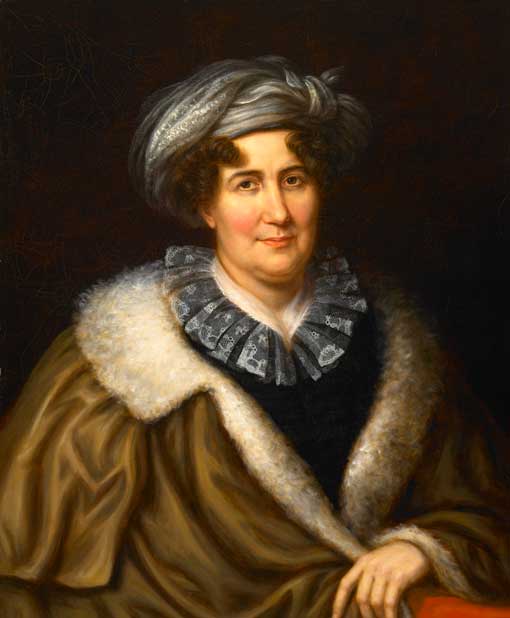
    Margaret Bayard Smith
    Portrait of Margaret Bayard Smith by Charles Bird King (c. 1829). Credit: Smithsonian Institution

    Alas, Mrs. Smith never made it to Kenmore.  Nor, apparently, did any of the other wonderfully prolific travel writers of her day.  Amazingly, not a single contemporary description of Kenmore, either its interior or exterior, has ever surfaced.  It would seem that not one visitor to the Lewis home was moved to write down any impressions of the awe-inspiring plasterwork ceilings that quite literally defied imagination.  The English carpets on the floors inspired no comment.  No one ever reported the gossip of an evening’s entertainment at Kenmore to a friend.  None of the Lewis family members themselves ever described a family dinner.  This lack of description is baffling, and it has been a frustrating problem for those of us working on Kenmore’s restoration and refurnishing over the last 15 years.  But more than bafflement and frustration, it’s become an intriguing mystery.  In short, a description of Kenmore from the 18th century has become our Holy Grail.

    Let’s begin with the premise that it is highly unlikely that NO ONE ever wrote anything about Kenmore during the Lewis era.  Someone, somewhere, surely put pen to paper and wrote about their surroundings in the Lewis house.  It is simply that we haven’t found these accounts yet.  They exist, but they’re hidden away somewhere.  So the real question is why haven’t any of them come to light yet? There are several possible reasons.

    First, history has not remembered Fielding Lewis the way it has George Washington and Thomas Jefferson.  Although his role in early American history was a rather important one, it didn’t make headlines at the time, and it doesn’t show up in many history books today.  Documents related to Fielding and his family were not given the same status and protection by later generations as those related to the Founders and early presidents.  Ironically, most of the existing letters written by Fielding Lewis survive only because he was writing to George Washington, and therefore they are held in the same repositories that hold the Washington Papers (Mount Vernon, the Library of Congress, etc.).  In our own lives, we often discard quite a bit of correspondence and other paperwork because it seems trivial, or because it doesn’t have anything to do with an important person or event.  Many original documents related to Kenmore may simply did not survived.

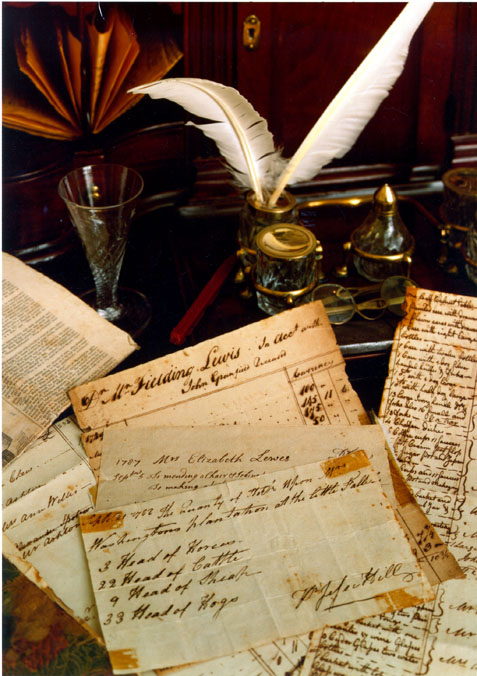
    Lewis Papers
    While there are some Lewis family documents in our collection, there is no description of Kenmore during the Lewises time among the family’s papers.

    Another possible explanation for the lack of descriptive accounts is difficulty that many historic sites have to deal with: The Civil War.  In almost any effort to trace the historical roots of, well, anything, in the United States, there tends to be this deep, black abyss when you reach the years of the Civil War.  Repositories for legal documents, like courthouses and libraries, were ransacked and destroyed all over the South (and in parts of the North, as well).  Newspaper printing offices were wrecked.  Family records, stored in attics and Father’s desk, were destroyed in fires and bombardments.  Correspondence was disrupted, and what made it through rarely described beautiful houses, but rather focused on the horrors of war.  Fredericksburg, which saw one of the earliest examples of urban warfare rage through its streets in 1862, was particularly hard hit.  If documents describing Kenmore existed prior to the War, it is entirely possible that they did not survive it.

    The third possibility has something to do with Kenmore’s name.  As those who have been on tour know, the house was not called “Kenmore” when the Lewis family lived in it.  In fact, the Lewis family did not give the house a name at all.  It wasn’t until 1819, when the Gordons owned the property, that the name “Kenmore” appears in court records (the Gordons named the house in honor of the ancestral home in Scotland, Kenmuir).

    So, any documents describing Kenmore from the Lewis era would not have used the word “Kenmore.” It is entirely possible that researchers have in fact come across descriptions of Kenmore, but they didn’t know what they were looking at because the house described was not identified as Kenmore.  It’s also possible that descriptions of Kenmore do survive in repositories that have no connection to the Lewises, the Washingtons or even Virginia, in which case they would have no idea what they were looking at, without the word “Kenmore” to Google.  It seems like a trivial issue, but it’s actually a real problem!

    There you have it.  Could it be that one of the most beautiful houses in colonial America was seemingly ignored by correspondents of the day? It seems unlikely, and so our search for own Holy Grail continues.  If any of our readers happen to be combing through obscure 18th century documents in the future, we would appreciate you keeping an eye out for us!

    Meghan Budinger
    Aldrich Director of Curatorial Operations


  • Photos: Historic Kenmore Behind-the-Scenes Tours

    On rare occasions, Historic Kenmore offers special behind-the-scenes tours that take visitors into portions of the home not usually open to the public during regular tours. Additionally, Meghan Budinger, Aldrich Director of Curatorial Operations,  leads the tour and shares her expert insights and knowledge into the mansion’s history, furnishing, and ongoing preservation. This past weekend, visitors once again got to go behind-the-scenes!

  • Ten Rarely-Displayed Objects from Kenmore’s Collection

    It is impossible for museums to exhibit the thousands of objects in their collections.  Historic Kenmore is no exception. While each of our objects is certainly unique and interesting, not every piece fits within our current interpretation of the life and times of the Lewis family.

    One reason museums might not display items is they are not from the time period being interpreted.  Our curator selects each object shown to the public after exhaustive study of primary resources like wills, probate inventories, letters and diaries and making sure it illustrates 18th century life in a wealthy Virginian home.  If we displayed pieces we have from the 1600s or 1960s, it would detract from the story of the Lewis family in the 1700s.

    A second reason museums might not display items is preservation and conservation.  Items that are two-hundred years old or more are very delicate and require special environments with proper temperatures, relative humidity, restricted lighting, and limited handling.  Material like textiles and papers don’t do well on display for long periods of time.  These items are better utilized in temporary exhibits in our visitors center or as digital content.

    In this list, I present ten of my favorite objects from Kenmore’s collection not often exhibited because they don’t quite match the history we’re trying to share or because they are too delicate for display. Besure to click on any of the photos for more detailed views of the objects.

    Ivory Silk Overdress and Petticoat

    overdress-and-petticoat
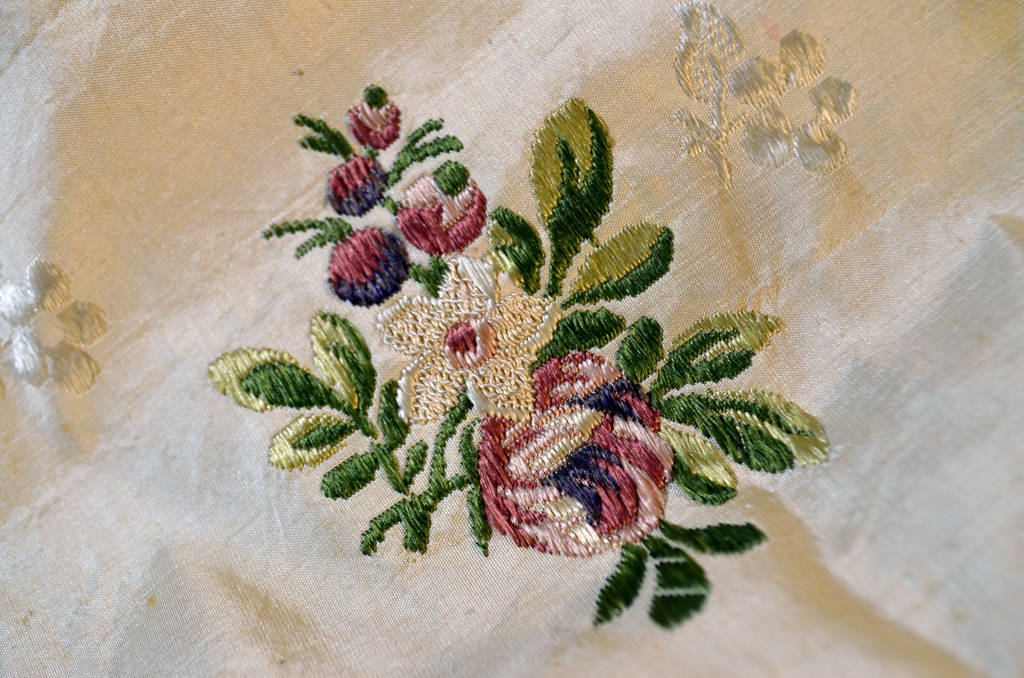
    One portion of the floral embroidery on the dress in Kenmore’s collection. The gown’s material is so delicate in some areas that we felt it best not to try and photograph the complete gown.

    robe-a-la-francaise-block-printed-cotton-c-1770
    Robe à la Française, c. 1770, similar in style to the dress in Kenmore’s collection. Credit: Los Angeles County Museum of Art / Wikipedia

    In Kenmore’s collection is an extremely delicate  overdress and petticoat with a brocaded multicolor floral pattern in the open robe style that dates from about 1775-1785. The particular cut of the open robe style was also known as “a la francaise” or “sack-back gown”.  This robe à la francaise is an illustration of the Rococo aesthetic that was popular during the eighteenth century.  I find clothing to be some of the most personal historic artifacts in any collection.  These pieces are not simply costumes but functional everyday garments that were used, stained, and mended by their owners.  Being able to see and handle this tangible historic link is as close to time-travel as we will get but, at the same times, textiles are extremely fragile and must be handled only rarely.

    empire-dress
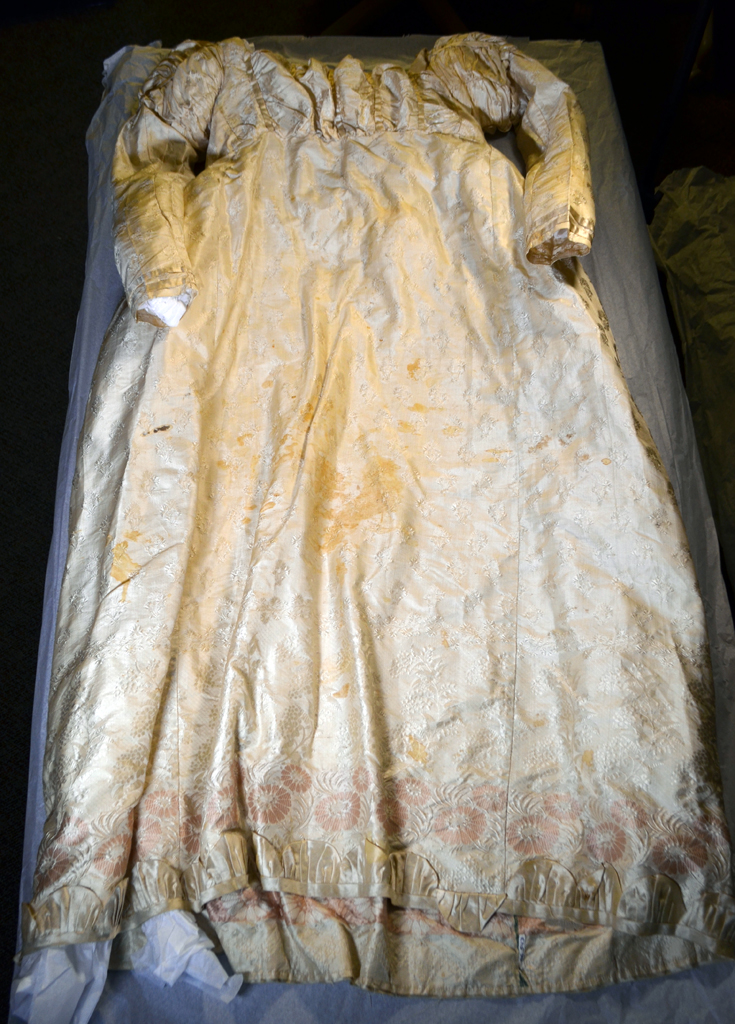
    Empire-style dress in Kenmore’s collection photograph while still laying in its storage box.

    Empire Waist Dress
    This cream-colored silk dress dates from between 1790 and 1820 and features a pattern of flower sprays and vines with row of pink brocaded flowers along bottom.  Cut in neo-classical style popular in the early nineteenth century with an “empire-style” waist, square neck and loose skirt.  Regency fashion is one of my favorite fashion epochs.  I find the empire-waisted silhouette to be flattering and probably the most comfortable of all historic women’s styles.  This piece doesn’t come out of storage much because it is a little too late for the Lewis era.

    “A New and Exact Map of the Dominions”
    new-and-exact-map-of-the-dominions
    Drawn by London cartographer Herman Moll in 1715, this map shows a fascinatingly detailed view of the Atlantic coastline from present-day South Carolina to Newfoundland, Canada indicating counties, mountains, towns, Indian settlements, rivers and bodies of water.  Insets along the bottom are maps of the Gulf of Mexico, the Carolinas, Charles-Town, and a small map of the “Principal Port of North America.” At right center is an inset showing a fully-colored view of Niagara Falls, with cute little beavers in the foreground building a dam.

    “View of London”

    view-of-london
    Close-up of a portion of Frederick de Wit’s “View of London.”

    This colored engraving done by Dutch cartographer Frederick de Wit shows a topographic view of the London with “The River Thames” across the center of map.  In the upper right corner there is a key with 148 streets, churches, wharves, theatres, and monuments listed and identified on the plan with a corresponding number. As an Anglophile who went to graduate school in London and spent over a year exploring that city’s streets,  I like seeing many familiar streets and sites on this map.  It shows that London city’s center has changed very little across the centuries.

    Bourdaloue
    bourdaloe
    This creamware bourdaloue is a smaller and more feminine version of a chamber pot circa 1780-1790.  In an era without public toilets, the bourdaloue provided a lady with a portable and relatively clean means of relieving herself away from home.  The vessel was oblong, rectangular, or oval in shape and a slightly raised lip at one end and a handle at the other and allowed usage from a squatting or standing position.  The bowl would then be given to the lady’s maid who disposed of the waste discretely.  Little everyday artifacts can get overlooked but they these fascinating little pieces give us a whole picture of colonial life. Plus, everyone loves chamber pots!

    The Gentleman’s Magazine
    gentlemans-magazine
    This March 1752 edition of The Gentleman’s Magazine includes articles on poetry, music, weather, gardening tips, criminal proceedings, history, and social services.  It’s amusing to read the various articles today and reflect on how similar they can be to our current news. There is a riveting report on the trial of Miss Blandy for poisoning her father, an account of the history of the Incas, and birth, marriage, and death announcements for the upper-crust of London society.  The Gentleman’s Magazine is digitized and can be read here. The Gentleman’s Magazine was founded in London in 1731 and remained in continuous print for 191 years.

    Homer’s The Iliad translated by Alexander Pope
    iliad
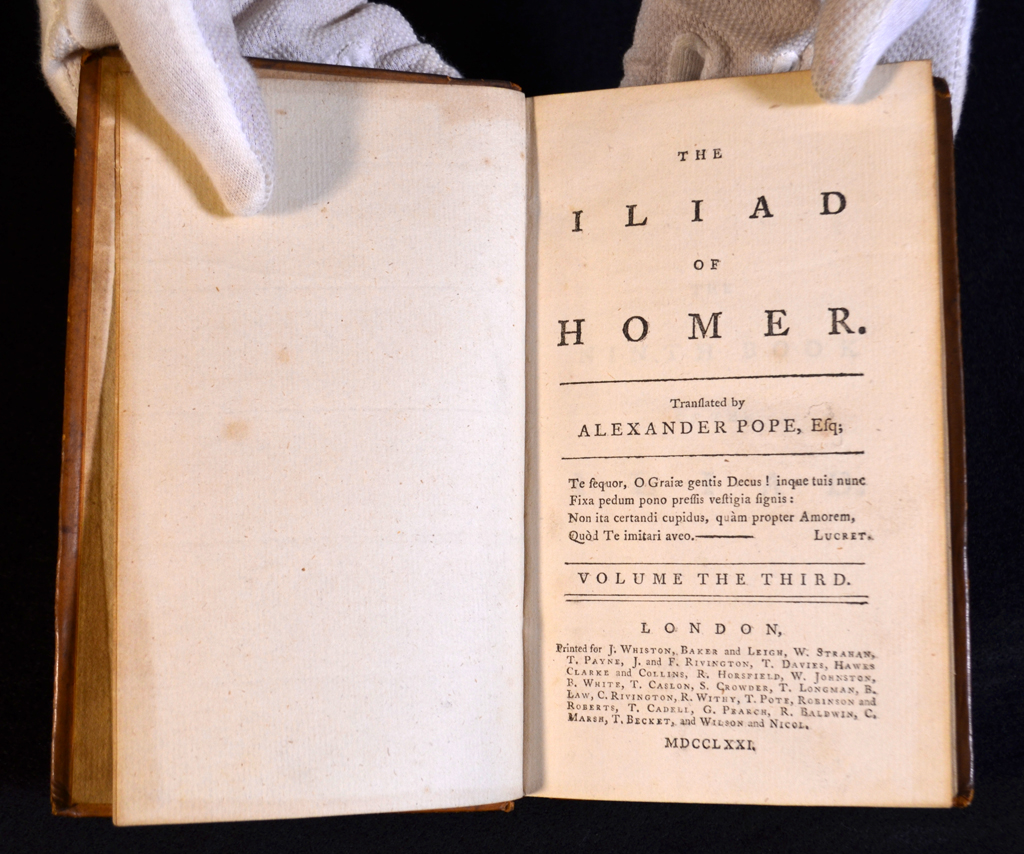
    These five volumes of Homer’s The Iliad were translated into English by the poet Alexander Pope between 1715 and 1720.  Written around the 8th century BC, Homer’s timeless story has influenced great artists for 2,000 years.  Pope was one of those artists.  He suffered from many health problems but was one of the few English poets able to earn a living from his literary works and I just think it’s cool that we have these special books in our collection.  Pope translated the epic verse for the publisher Bernard Lintot and earned the significant sum of £210.

    Marrow Spoon
    marrow-spoon
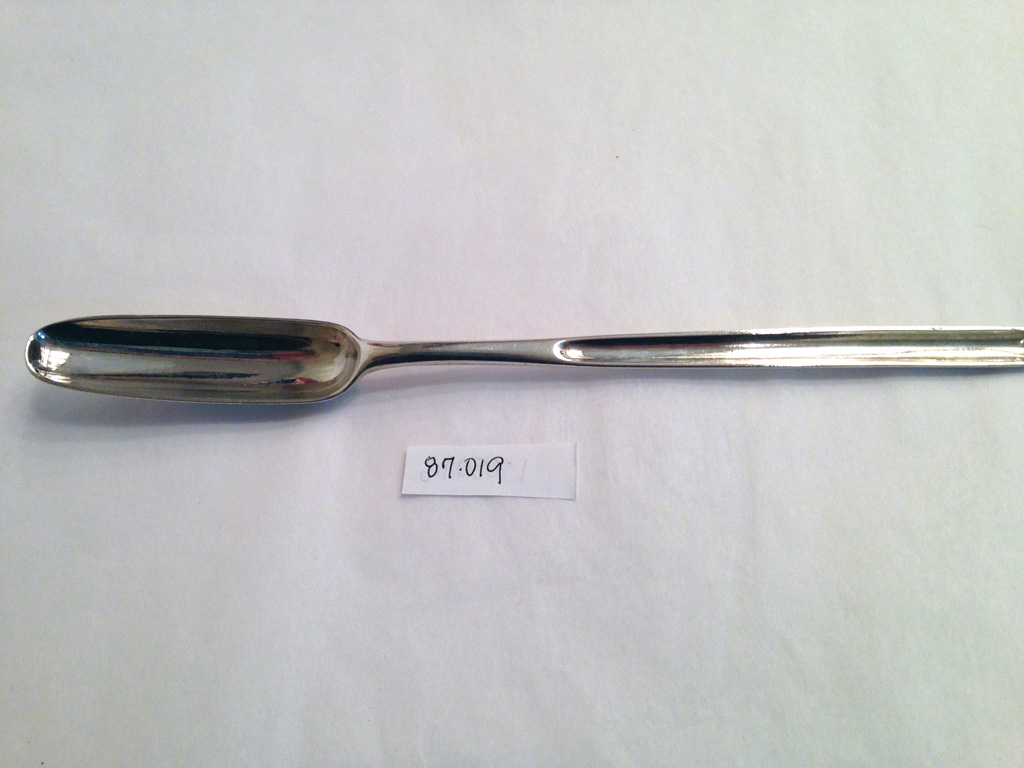
    This silver marrow spoon, circa 1722, features a long narrow scoop at one end and a broader spoon at the other.  Enjoying bone-marrow was so common that utensils were created to assist the diner in retrieving every morsel. These spoons were used at the table to get the tasty marrow out of the center of the bones without having to rudely gnaw, suck, slurp, bang, crack, or bite.  The fashionableness of certain food can be traced through the evolution of dining implements.  Today, our familiarity with the double scooped spoon and its purpose has waned just like roasted long-bone sprinkled with salt is no longer a prevalent dish on our tables.

    Mary Washington Monument Stone

    mary-washington-monument-stone
    Painted on this view of the stone are the ‘new’ [current] monument and the Mary Washington House.
    This is an Aquia sandstone fragment from the original Mary Washington Monument that was started in 1833 when President Andrew Jackson laid the cornerstone. The monument was never finished and was heavily damaged during the Civil war. In 1892, in order to raise money for a new memorial, the Mary Washington Monument Association began to sell off the original pieces painted by local women as “relics”.  While some felt this was desecrating Mary’s grave, the Association raised enough money for a new monument. In 1894, President Grover Cleveland dedicated the new monument, which still stands today. Although the way the group went about raising funds for the new memorial is not how it would be done today, these stones represent the beginning of the American preservation movement at the turn of the century.

    sampler
    The sampler’s poem has large faded from view. It read: “Learn to contemn all Praise betimes / For Flattery Is the Nurse of Crimes / With early Virtue plant thy Breast / The Specious Arts of Vice detest / Youth like softened Wax with Ease will take / Those Images that first Impressions make / If those be fair their Actions will be bright / If foul they’ll clouded be with Shades of / Night.”

    Sampler by Betty Washington Lewis
    This sampler was embroidered, signed, and dated by Betty Washington Lewis on February 25, 1805.  Betty was the daughter of Howell Lewis and the granddaughter of Fielding and Betty Lewis.  Girls demonstrated or tested their needlework skills by making samplers and often included the alphabet, figures, decorative motifs and, usually, a name and date.  This is one of the few textiles in our collection directly related to and created by a member of the Lewis family.  When an item is clearly marked with the date and who made it, it really doesn’t get much better for a historian!

    Heather Baldus
    Collections Manager

  • Video: Drawing Room Carpet

    A carpet was recently installed in the Drawing Room at Historic Kenmore. In this video, Meghan Budinger, Aldrich Director of Curatorial Operations, tells us all about it.

    Follow The Rooms at Kenmore blog for more about the drawing room carpet and the final stages of Kenmore’s refurnishing.

  • Video: UV Light in Museums

    Ultraviolet light is an important and useful tool within the museum world. In this video, we show you how archaeologists and curators use UV light in their work with artifacts and historic objects.