Lives and Legacies

Tag: Constitutional Convention

  • The Last of Washington’s Horse Chestnut Trees?

    There once stood a large horse chestnut tree on the corner of Fauquier and Charles Street in Fredericksburg. It was noted as one of the thirteen legendary Washington horse chestnut trees planted by George himself. By the 1930s, it was becoming clear that the tree needed some help, so the Daughters of the American Revolution (DAR) took up the cause to protect this historic tree.

    The tree legend states that George, while visiting his mother in June 1788 in Fredericksburg, decided to plant thirteen horse chestnut trees from her house to his sister’s house, Kenmore, just a few blocks away. This provided a scenic path for his mother when she visited her daughter Betty. These trees commemorated the thirteen original states.

    It is a great story. It is patriotic and nostalgic, showing George as a man of the earth with his love of trees, gardening, and horticulture. He planted these trees for a future America to remember the struggles to create this country and the precious nature of our land that we must protect.
    But is it true? Did George plant that tree? What is the evidence?


    The horse chestnut tree is a native of the Balkans region (Albania, Bulgaria, Greece, and Northern Macedonia). It made its way to Europe and England during the seventeenth century, noted as growing in South Lambeth, London, and being planted by Sir Christopher Wren at Hampton Court.

    Horse chestnut trees Bush Park, Hampton Court, England planted by Christopher Wren in 1669-1670.

    There is documented evidence of some horse chestnut trees crossing the Atlantic to Mr. John Bartram, one of America’s first botanists in the 1740s. In a letter from Peter Collinson, an English botanist, dated September 16, 1741, he wrote to Bartram, “I have sent some Horse-Chestnuts which are ripe earlier than usual; hope they will come fit for planting.”. Bartram acknowledged receiving them and stated that most were blue-molded, and only one germinated and grew. Over twenty years later, Bartram updated Callison on the success of the lone seedling, writing, “But what delights me is that our horse chestnut has flowered. I think it must excel in America.”
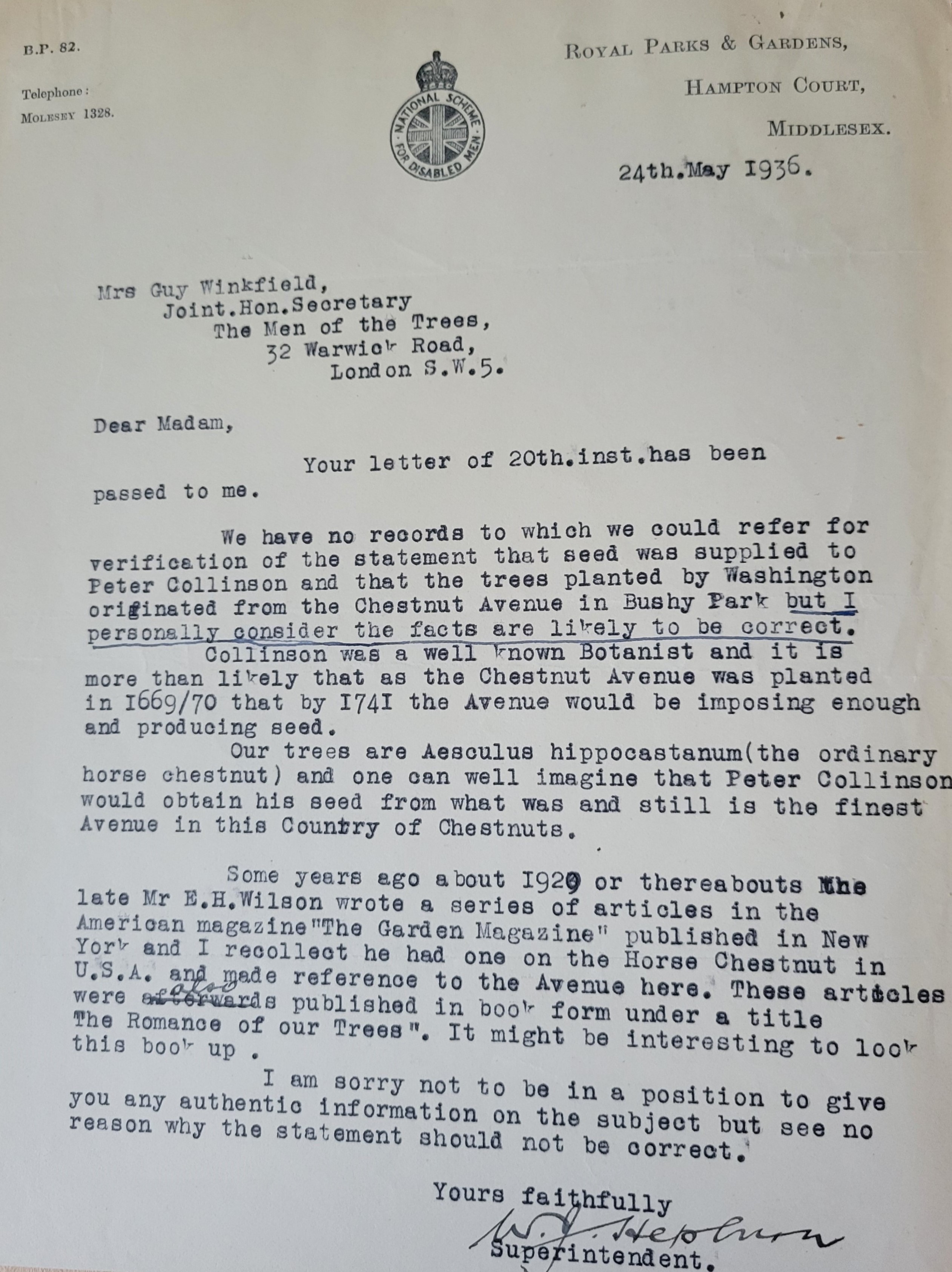
    Letter from Royal Parks and Gardens, Hampton Court, May 24 1936


    Bartram’s Gardens in Philadelphia was quite popular and visited by many founding fathers while working there. George visited the gardens twice in the summer of 1787 while in the town during the Constitutional Convention, noting, “Sunday, June 10, 1787, breakfasted at Mr. Powell’s and in company with him rid to see the Botanical Gardens of Mr. Bartram, which, though stored with many curious plants, shrubs, and trees, many of which are exotics, was not laid off with much taste, nor was it large.”
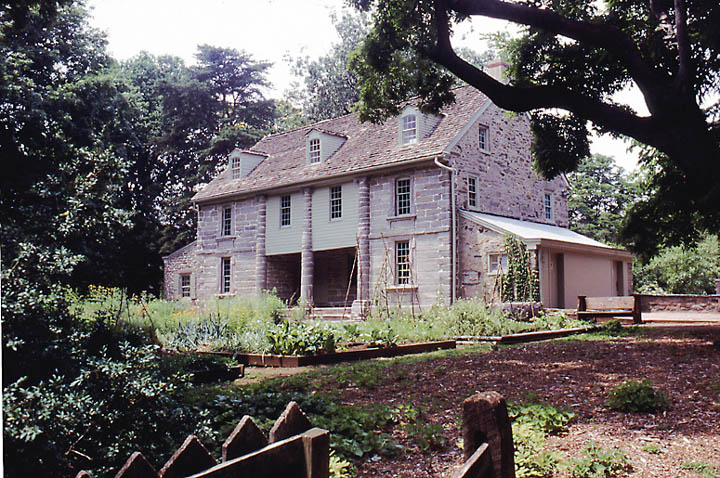
    John Bartram’s house and upper garden at Bartram’s Garden

    Why mention this? In some versions of the story, Washington got his horse chestnut trees from this garden, but there is no evidence that the legendary trees were obtained from this famous historic garden.
    George only made two diary entries about horse chestnut trees on April 13, 1785, writing, “Received from Col. Henry Lee of Westmoreland 12 horse chestnut trees (small) and an equal number of tree boxes. They appeared to have been some time out of the ground. Planted 4 of the Chestnuts on my serpentine walk – two on the east end and the rest in the vineyard.” And again, on April 2, 1788, wrote, “Transplanted from a box in the garden, thirteen plants of the horse chestnut into shrubberies by the garden walls.”

    The entry shows evidence of planting the famous Washington trees, right? No, because George was at Mount Vernon in April and didn’t leave for Fredericksburg to visit his mother until June 10, 1788.

    But could he have had them sent down and have them planted before he came to see his mother? Yes, but the story says that George planted these trees with his own hand. Additionally, it would be odd for George to mention planting the trees while in residence at Mount Vernon and not say that they were in his mother’s garden in Fredericksburg. Washington was a diligent diarist but never mentioned planting thirteen horse chestnut trees in his mother’s garden.
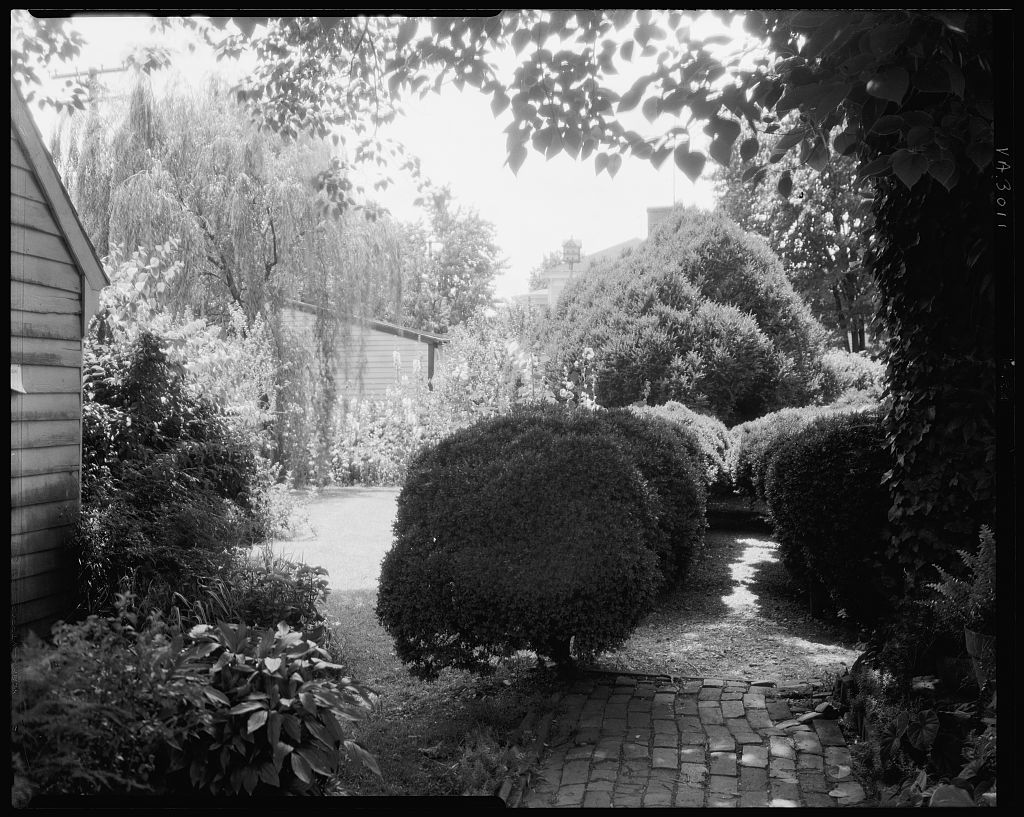
    Mary Washington’s house gardens, Fredericksburg.

    Further, no known letters from George, Mary, or Betty mention any horse chestnut trees between Mary’s gardens and Betty’s Kenmore.

    Spring time in the gardens at Kenmore Plantation (can you spot the cat?)

    This was all the primary source evidence I could find relating to George and any horse chestnut trees. So, I looked further into the story to see what other evidence was being used to verify that this tree was indeed one of the thirteen Washington trees.

    As I said in the beginning, by the 1930s, many, including the DAR, were trying hard to save this lone surviving chestnut tree. With their extensive reach, they got Fred H. Arnold, the Assistant Forester for the National Park Service, to do an age-determination test on the tree in May of 1934. Mr. Arnold noted some issues with the test, stating that the lower twelve feet of the tree was filled with concrete, so the coring sample had to be taken above this “repaired defect”. Even then, a complete coring sample could not be extracted due to decay in the interior of the main stem. Additionally, Mr. Arnold said that it was very difficult to count the annual rings due to their obscurity because the texture difference between the springwood and summerwood for the horse chestnut tree (genus Aesculus) is very slight. Taking into account all this, Mr. Arnold estimated the tree to be around 139 years old with as much as 10% in error, either plus or minus, which would put the date it was planted somewhere between 1781 and 1809, which means that the tree is indeed old and could have been planted during Washington’s time in Fredericksburg.
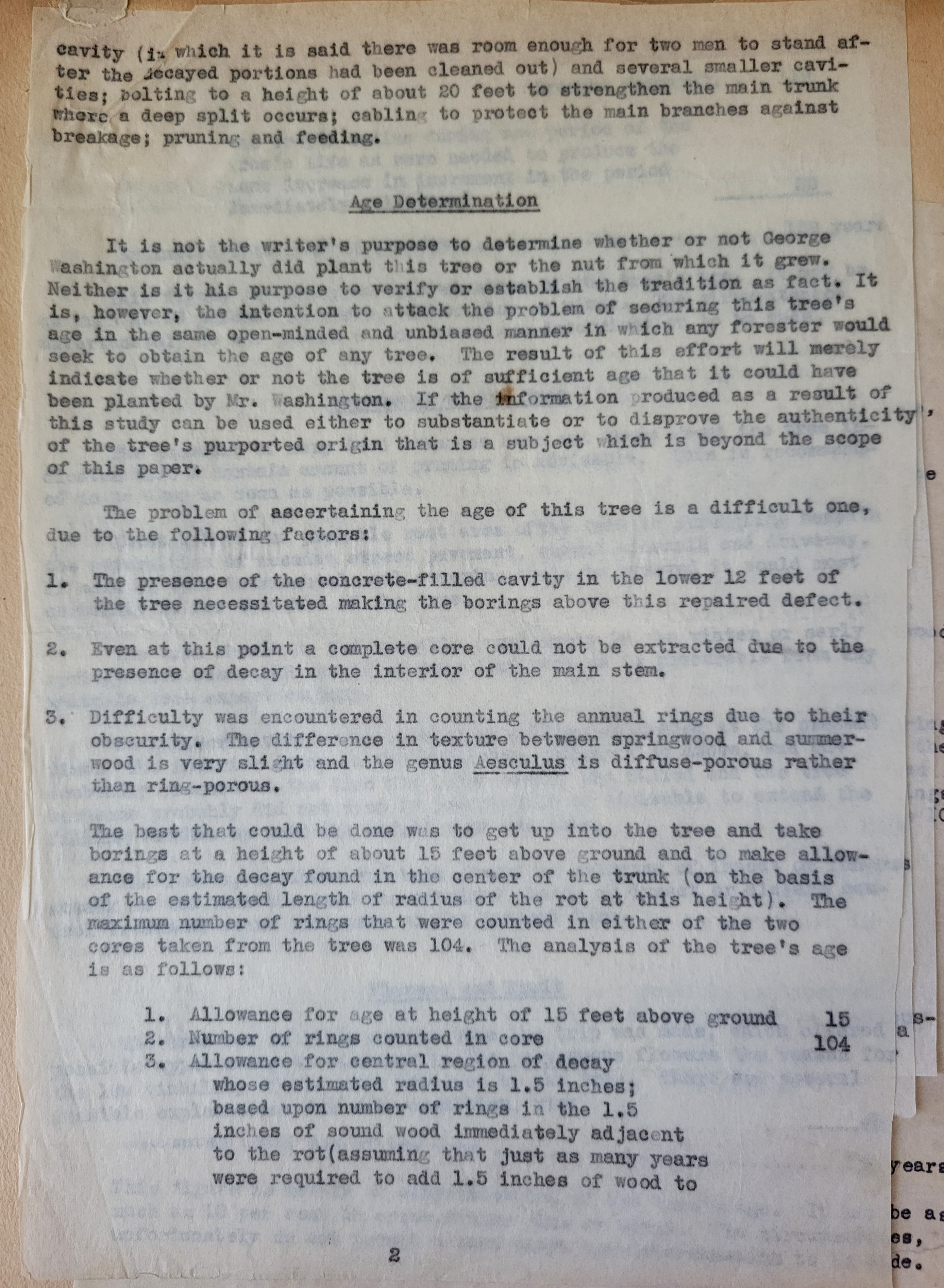
    Age Determination, May 6 1934

    Lastly, local historian James Henry Heron collected local citizens’ recollections of the tree and the story. Mrs. Lilias Hamilton Scott, the wife of Mr. John Scott, who owned the lot on which the tree stands, wrote that her grandmother (Mrs. Janet Scott Hamilton) stated her great-grandmother (Mrs. Francis Scott) resided in Fredericksburg in 1788 and was Mary Washington’s neighbor and intimate friend. She said the trees were planted by Washington.

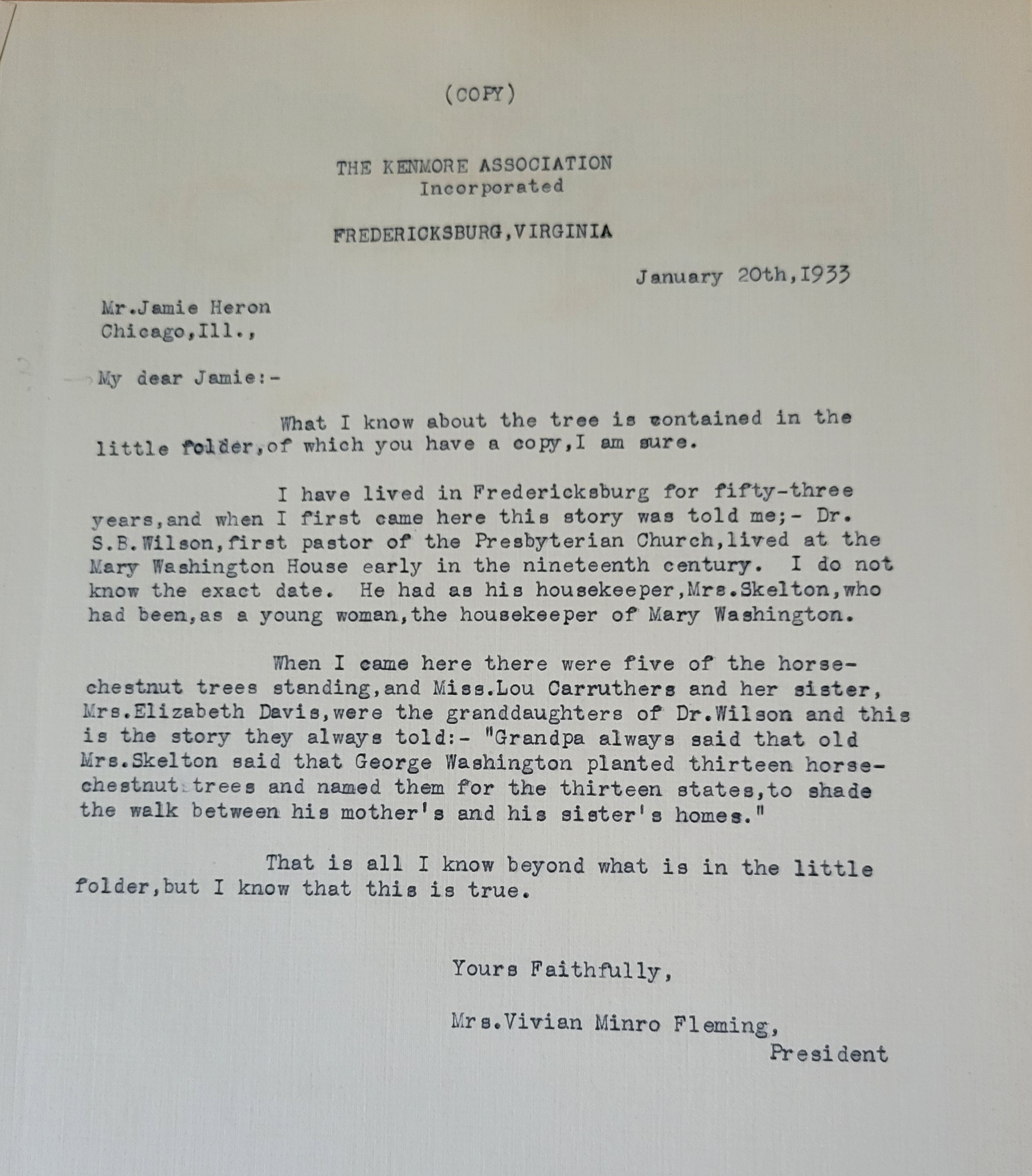
    Mrs. Vivian Minor Fleming traces the story back to Miss Lou Carruthers, her sister Mrs. Davis, and their grandfather Rev. S.B. Wilson’s housekeeper, Mrs. Polly Skelton, who had previously been a housekeeper for Mary.
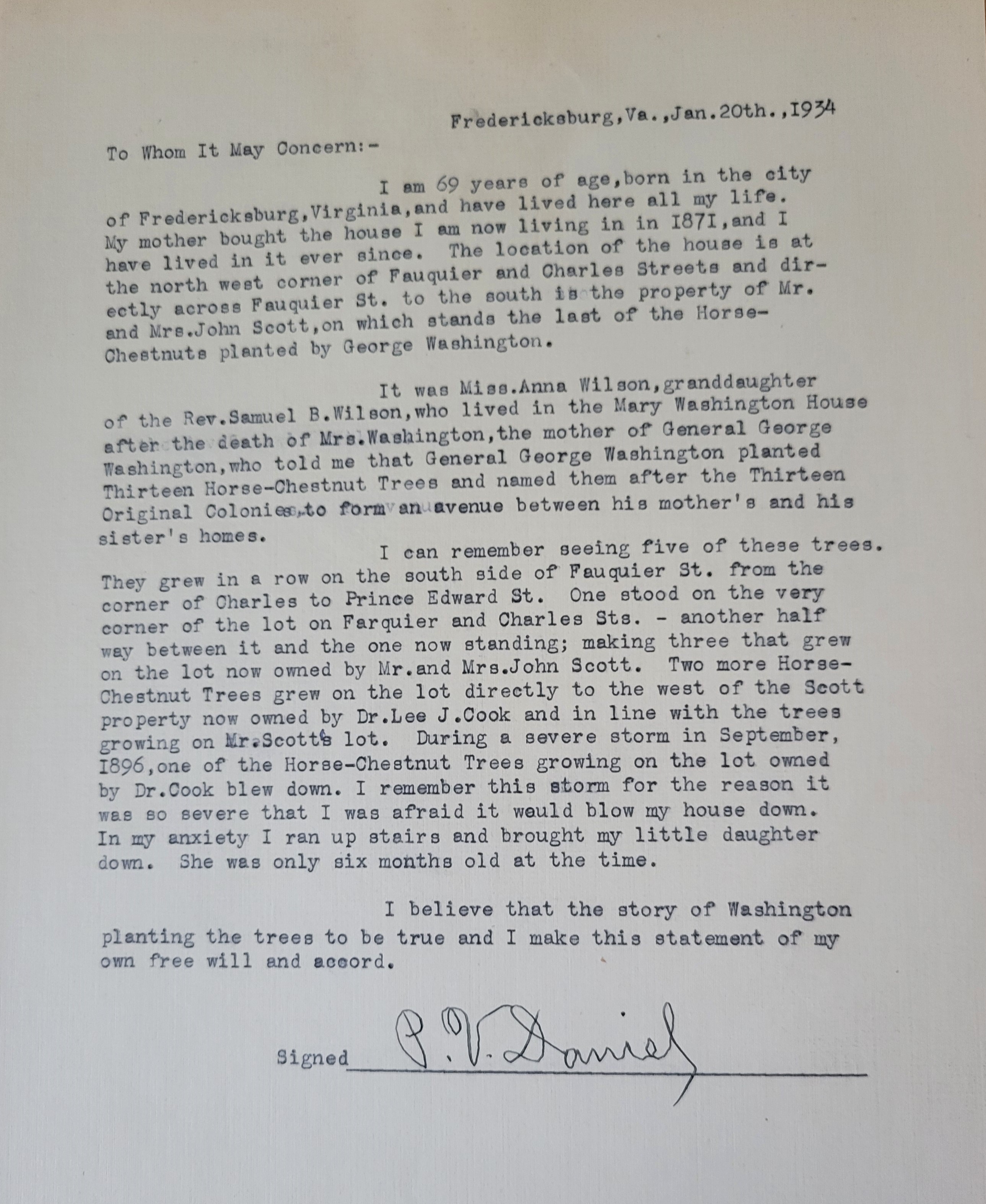
    Mr. P.V. Daniel, who remembers five of the original thirteen trees, lived across the street from the remaining one for over sixty years and said Miss Anna Wilson, granddaughter of Rev. S.B. Wilson, told him the story.
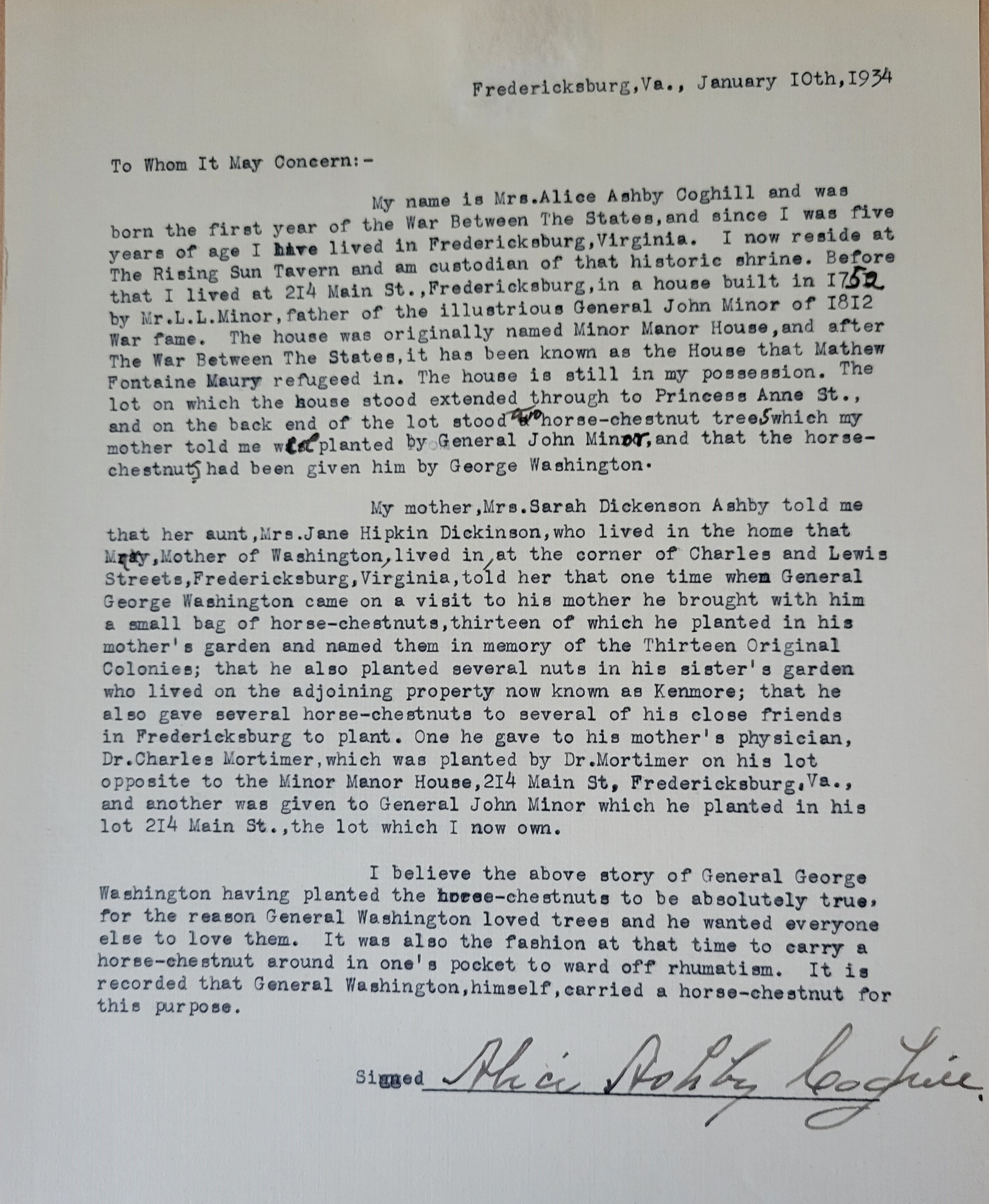
    Mrs. Alice Ashby Coghill says her aunt, Mrs. James Hipkin Dickinson, who lived at Mary Washington House after Rev. S.B. Wilson said Washington planted the trees and passed out horse chestnuts to friends.
    While I have no doubt these people are truthful in their recollections, they do not offer any definite evidence. They merely document that the legend was a well-known story but not that it was true.

    Regardless, the much-loved old tree was rightfully given proper emergency care with a donation and service from Senator Martin L. Davey from Ohio and The Davey Tree Expert Company. The famous tree lived happily for over another half century before being taken down in 2004.
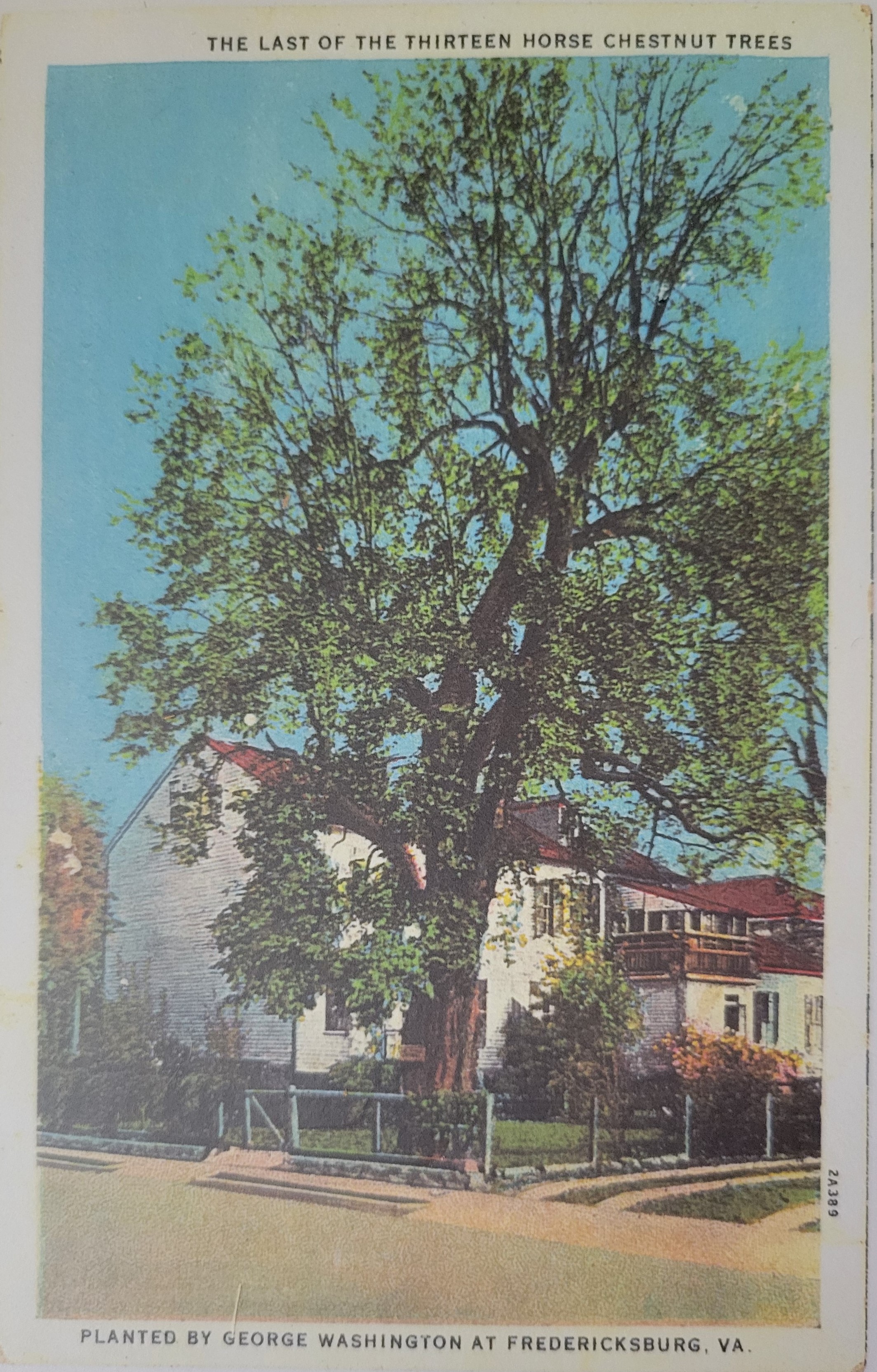
    Whether this tree was planted by George along with twelve others will probably never be conclusively proven. Were the people wrong to save the tree all those years ago without better evidence? Absolutely not. They saved a beautiful 200-year-old horse chestnut tree with a legendary attachment to George Washington, but they also saved a bit of their own past, nostalgia, and pride in their own town’s history.


    Heather Baldus

    Collections Manager
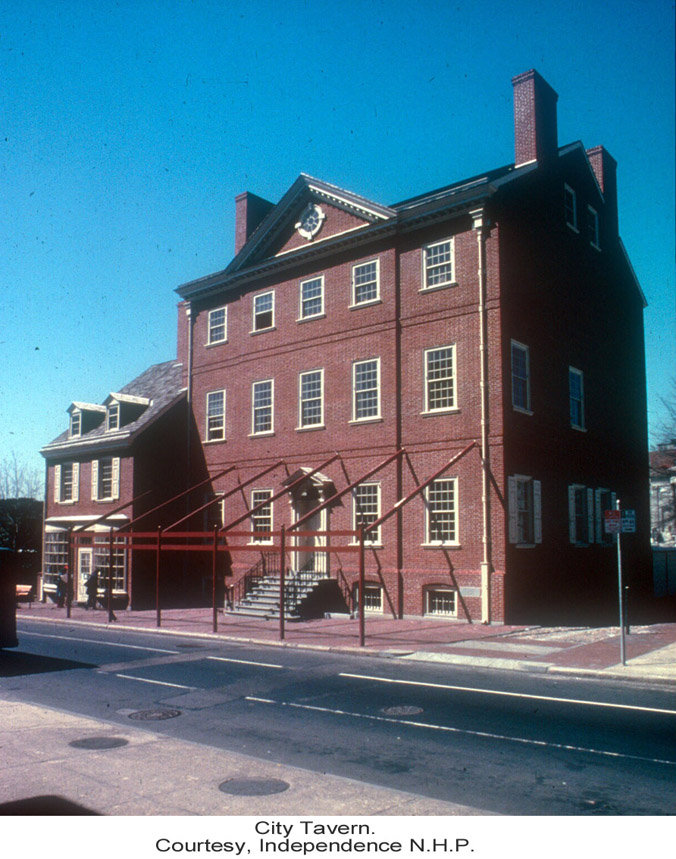
  • “Dined at the City Tavern”

    Christmas in the 18th century was celebrated quite differently than it is today. Unlike today, one of  the most important (and wildest) celebrations of the season took place on January 6th, or Epiphany. Also known as Twelfth Night, this holiday is more comparable to our present-day New Year’s celebrations in style and entertainment. Our stereotypical views of a supposedly refined time period perhaps conjure up images of classy champagne toasts and highly intellectual conversations. However, much like the Christmas season itself, 18th century parties and dinners any time of the year were actually quite different from that stereotype.

    On September 14, 1787 George Washington wrote in his journal:

    “Friday 14th.  Attended Convention. Dined at the City Tavern, at an entertainmt. given on my acct. by the City light Horse. Spent the evening at Mr. Meridiths.”

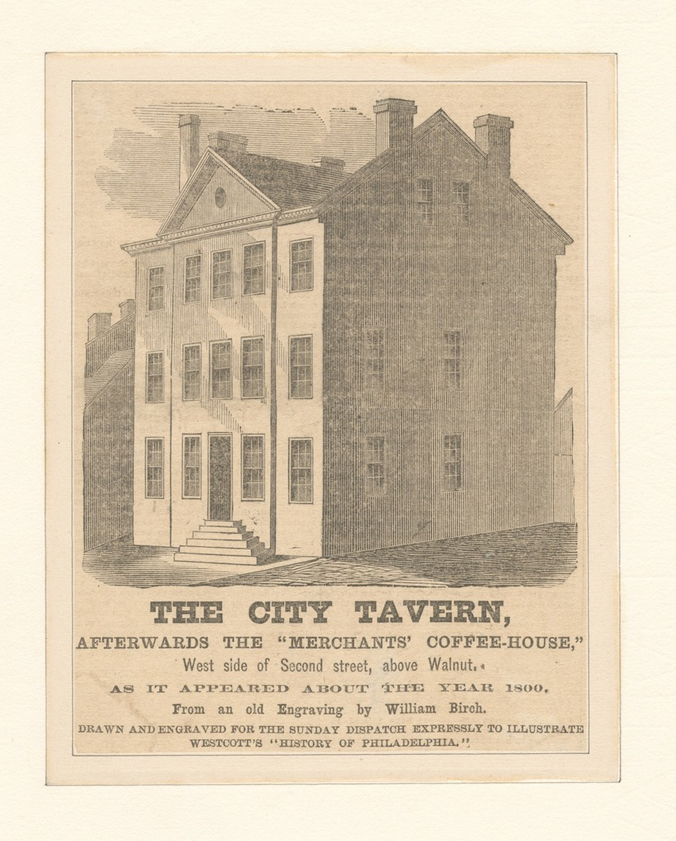
    It appears he enjoyed a simple enough dinner at City Tavern in Philadelphia after a day of Constitutional planning, right? Washington was famous; certainly everywhere he went, people provided “an entertainment” in his honor. As you look more into this event, you find that Washington’s simple diary entries may not always reveal the whole story of what happened.

    City Tavern as it appeared about 1800 from an engraving by William Birch. This print dates from 1850. Credit: New York Public Library.

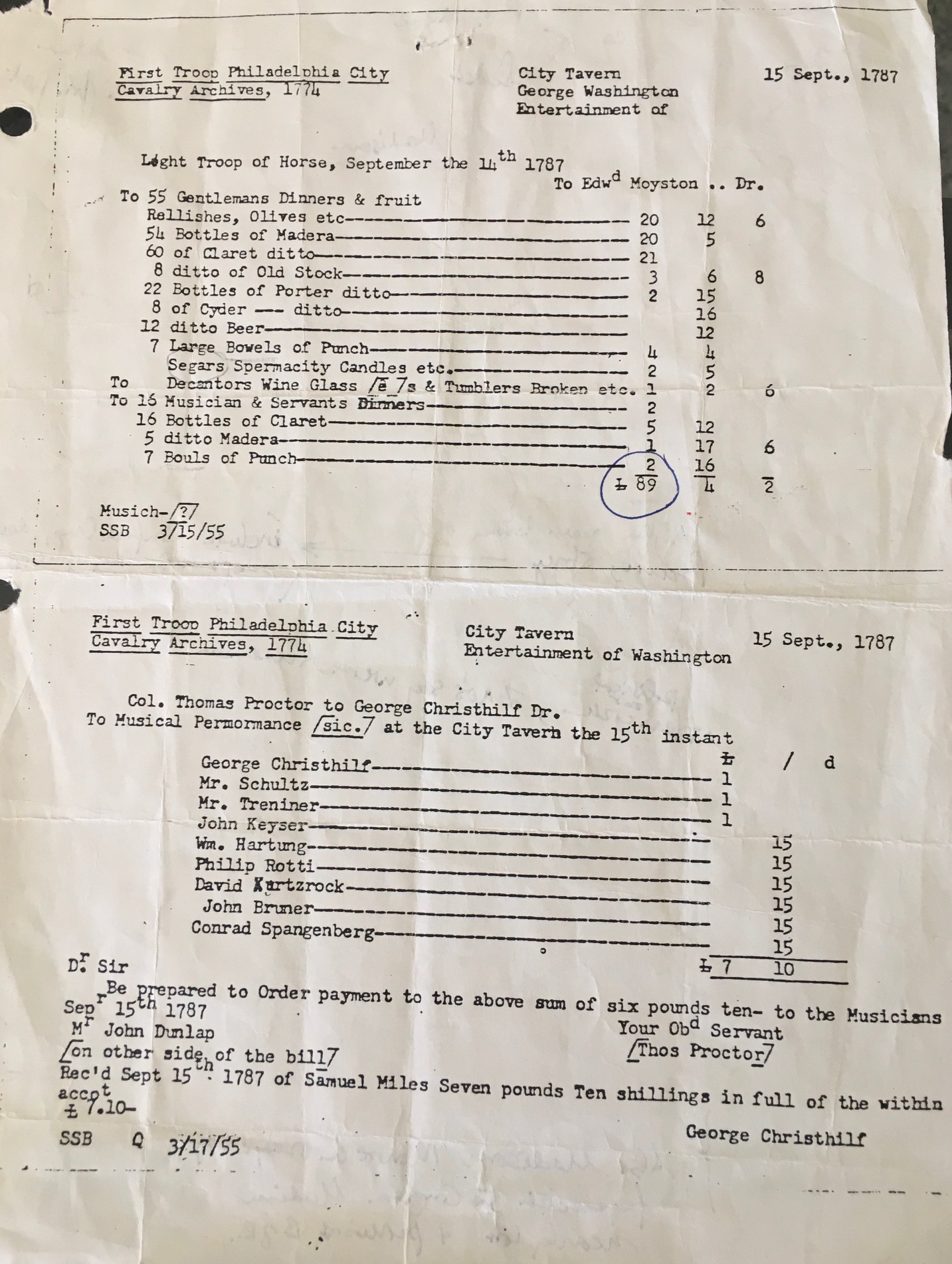
    In this entry, he notes the City Light Horse honoring him at the tavern. The Light Horse of the City of Philadelphia was founded in 1774. They fought with General Washington throughout the war, including at the battles of Trenton, Princeton, and Brandywine.  They were part of the icy-cold crossing of the Delaware and the snow-covered winter at Valley Forge. In fact, although operating under a new name, the First Troop Philadelphia City Cavalry remains intact today as a private military organization whose members all must serve in the Pennsylvania National Guard. Due to its close relationship with George Washington, the troop jumped at the chance to show him its appreciation at the tavern as the Constitutional Convention drew to a close. According to Dr. Gordon Lloyd, the Robert and Katheryn Dockson Professor of Public Policy at Pepperdine University, the bar tab sent to the City Light Horse remains in the First Troop, Philadelphia City Cavalry Archives. Here is the transcription of the bill:

    Courtesy of Dr. Gordon Lloyd, the Robert and Katheryn Dockson Professor of Public Policy at Pepperdine University.

    As you can see, the total comes to 89 pounds, 4 shillings, and 2 pence. According to the Bank of England, given inflation and changes over time, today this would be approximately £14,083 or around $18,471.

    While that sticker price is shocking enough, as we inspect the bill a little more, we notice what all was purchased for the gathering. There are four separate categories on the bill. The bottom section is the fee for the musicians to play. The next section up lists 16 bottles of claret, 5 bottles of madeira, and 7 bowls of punch drunk by the 16 servants and musicians.  Next, comes a line for items broken at the gathering.

    Finally, the top section of the bill deals with 55 guests, all men, who were the main party at City Tavern. The men ordered dinner and several different beverages. First, fifty-four bottles of madeira, probably Washington’s drink of choice. Throughout his life, Washington was said to favor this type of fortified wine from the Madeira islands, an archipelago off the coast of Portugal and a frequent stop for merchant ships travelling between Europe and America in the 18th century. Many prominent families in America took a liking to the wine, as it was relatively easy to obtain. According to records at Mount Vernon, Washington ordered Madeira by the pipe, a large, elongated barrel that held about 126 gallons of wine. Often, he ordered multiple pipes at a time. Today, you can still purchase Madeira wine, but be cautious as it runs 18-20 percent alcohol by volume. Similar to its brother, Port, Madeira is often used in cooking and is a staple of French cuisine today.

    Next, the sixty bottles of Claret were a French-style wine also popular in America in the 18th century. While Madeira came in both sweet and dry varieties, Claret was typically a dry, dark red. Claret is not a fortified wine like Madeira, meaning it is lighter and only around 13-15 percent alcohol by volume.

    The list notes that the gentlemen also consumed eight bottles of “Old Stock”, a term used for whiskey at the time. Perhaps throughout his time as General and President, nights like September 14, 1787 convinced Washington to create his own whiskey distillery later in life. By 1799, the distillery at Mount Vernon was one of the most profitable in the country. During the colonial era, it was not customary to age whiskey. The spirits produced at Mount Vernon, as well as, that served at City Tavern were practically straight from the still.

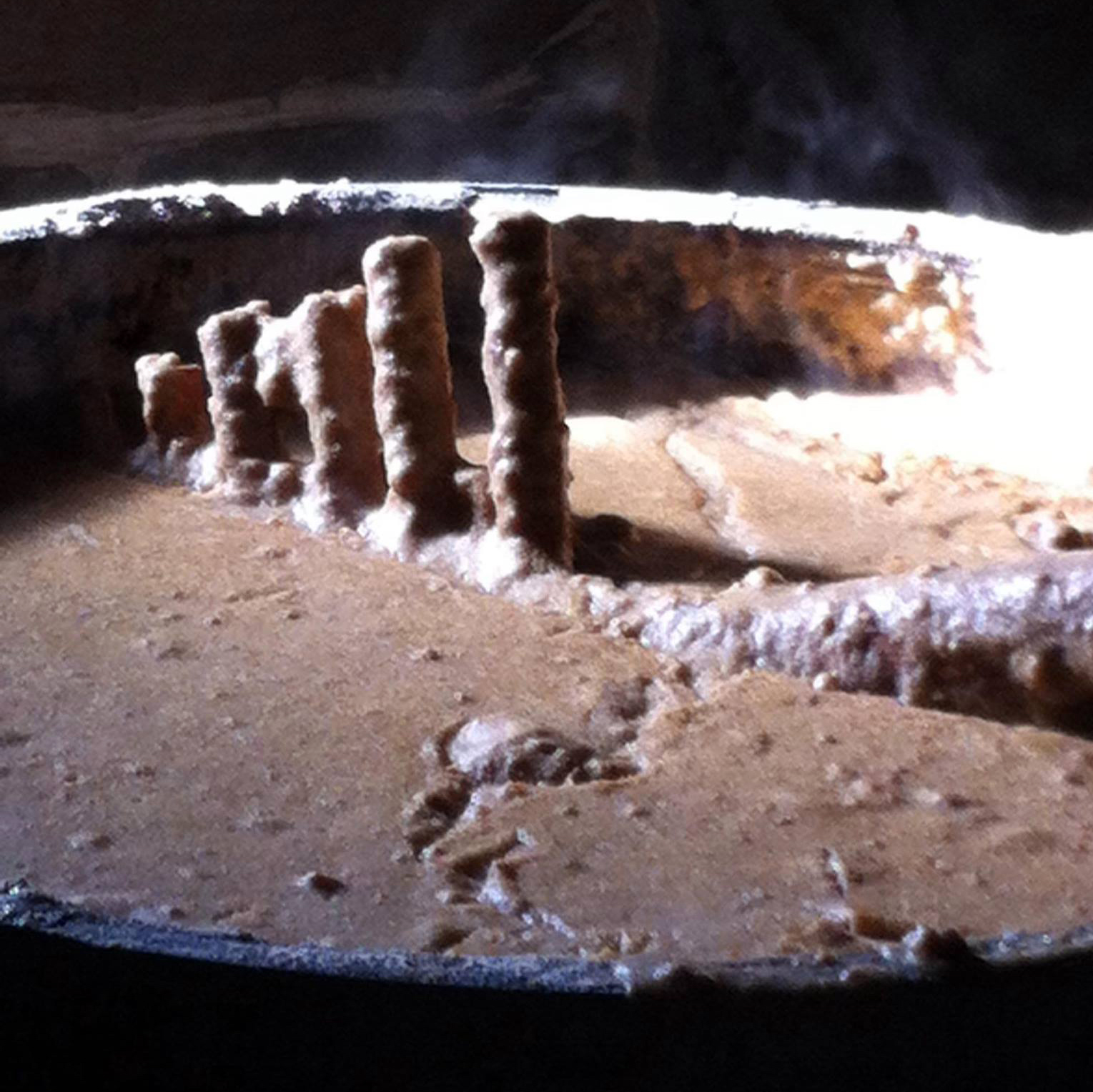
    Whiskey mash in the reconstructed distillery at Mount Vernon. Credit: Elizabeth Hosier.

    The porter, cider, and beer listed on the bill are all similar to the alcohols we call porter, cider, and beer today. Porter was a very popular style of beer in both England and America. In fact, the style was so popular, Washington had his own recipe for it to be produced at Mount Vernon.

    Lastly, the list claims the gentlemen also went through seven large bowls of punch. Punch recipes varied from tavern to tavern and from house to house in colonial days, but they were typically rum or whiskey-based and often contained more than one type of alcohol. You can read much more about punch and how it was served here and about Mary Washington’s punch bowl here.

    With all this drink flowing, we might conclude this was quite a raucous party, but these were rather typical evenings for the people of the 18th century. Keep in mind that water was not always drinkable due to bacteria, they didn’t always have access to fruit to make fresh juice, and certainly soda wasn’t around yet! They were left with few options: tea, coffee, or booze.

    Washington returned to the Convention and by the end of the day after the party, the delegates had finished. Copies of the document were ordered, and just two days later, they signed the Constitution of the United States on Monday, September 17, 1787. Washington stated in his journal:

    “The business being thus closed, the Members adjourned to the City Tavern, dined together and took a cordial leave of each other.”

    What happened that night at City Tavern? Unfortunately, no bill from this night survives to give us any clarification, but Washington provides a hint of just how much steam the delegates needed to blow off. The entry in his journal continued that he returned to his lodgings and:

    “retired to meditate on the momentous wk. which had been executed, after not less than five, for a large part of the time Six, and sometimes 7 hours sitting every day, sundays & the ten days adjournment to give a Comee. opportunity & time to arrange the business for more than four Months.”

    Momentous work, indeed.

    Elizabeth Hosier
    Manager of Interpretation and Visitor Services