In this video, we talk about how people, including George Washington, picnicked in the 18th century and take a closer look at one particular piece of furniture used while on a picnic 200 years ago.
You can read more about picnicking customs of the 1700s here.
In the summer of 1770, George Washington came to Fredericksburg for an extended stay. His time here would seem familiar to anyone who has gone back to their childhood hometown. While in town he visited his mother, went to the tavern to play cards with old friends, and stayed with his sister and brother-in-law. But the most interesting moment of his stay was on August 4, 1770 when he records…
While it is difficult to understand what exactly he meant by ‘Barbicue’. It is safe to assume that it was a communal meal similar to a modern day cook-out. Going to a cookout, a barbecue or a picnic, in today’s parlance, all mean pretty much the same thing – eating well-known foods while outdoors, probably seated on the ground, in a casual atmosphere. Above all, it is a highly social gathering. We use these kinds of meals to celebrate national holidays, family occasions or just a beautiful day – it’s what Americans do. But where did this past-time come from?
In England, the idea of consuming light fare outdoors in the form of a picnic had been around since as early as 1748, when the word “picnic” first shows up in writing. The word was probably a corruption of the French “pique nique” which basically means “to pick at small foods,” but for the English a picnic meant a fully mobile meal and all the accoutrements necessary to eat it. Baskets of food were packed, equipment for entertainment (games of cricket or maybe some hunting or fishing) was gathered, and wagons were loaded (usually one for guests, and one or more for the provisions). Then, the party set off to a pre-determined picturesque location, where it was all unpacked and set up by servants. Although we might be amazed at the sheer volume of stuff these picnics required (everything from chairs and tables to cutlery and glassware), an 18th century English picnic was still considered a very informal affair by that time’s standards. Guests might even be asked to contribute dishes to the meal (a forerunner of our potlucks), making recipes for picnic food were all the rage by the late 18th century.
This painting shows chairs being provided for the ladies to use during lunch on a fishing trip. The Anglers’ Repast (1789) by George Morland, 1763–1804, British, Oil on canvas. Public domain. Credit: Yale Center for British Art, Paul Mellon Collection.
While picnic’s etymology is relatively easy to trace, ‘Barbecue’ is far more difficult to pin down in the 17th and 18th centuries. Even the term itself is nearly impossible to decipher. The earliest known recording comes from a Spanish explorer in 1526, who used it as a verb meaning to roast meat. In 1672, the first reference in English came from the writings of John Lederer, a German explorer of the Blue Ridge Mountains. Originally written in Latin, Lederer’s expedition reports were translated into English by Maryland’s Governor Sir William Talbot and published.
Many scholars believe the word “barbecue” most likely derives from the West Indian word “barbacoa” in the 16th century. Believed to be a Taino word (although this is still up to scholarly debate), it is a term for slow-roasting meat over hot coals, usually using plenty of green saplings that would have created a lot of smoke. The meat originally roasted in this style was probably not the ubiquitous pork barbecue. While Christopher Columbus did bring some pigs on his voyage, it is Hernando de Soto who is credited with introducing the pig into Central America and Florida in 1539.
The word, and the meat, was probably encountered by ships’ crews during the colonial period and eventually made its way to the American colonies. Slow-roasting meat and spicing it with various rubs and marinades was a familiar concept in a many parts of the world, and especially on the African continent, so enslaved Africans living in the colonies also helped to proliferate the cooking method. As happened with many traditions from around the globe that found their way to the New World, a true “barbecue” as George would know it quickly became a uniquely American concept, combining the English love of a good outdoor meal and the exotic foods and cooking methods of the West Indies and Africa.
While the first American barbecues were practical affairs, held among enslaved communities or farming populations during the slaughtering season so as to quickly cook and preserve as much meat as possible, they very quickly took on a much more social aspect. An entire town might gather for a barbecue, which might last for several days, perhaps to coincide with court days or a market.
Between 1769 and 1774, George Washington recorded his attendance at six such affairs in his diary, including one barbecue that he hosted himself, another that was probably held at Fielding Lewis’s house in Fredericksburg, and a third in Alexandria at which he stayed all night.
Meghan Budinger
Aldrich Director of Curatorial Operations
Joe Ziarko
Manager of Interpretation & Visitor Services
In this video, we taste three different chocolate drinks from across the centuries and discover what ingredients went in them to make each taste so differently.
Read about “Sweet-Toothed Colonials and Their Chocolate” here.
Ahhh Chocolate! Now is the time of year when we consume even more than usual, often from heart-shaped boxes gifted by an admirer. Probably one of the most universally loved foods, the average American consumes roughly 11 pounds of the stuff a year! It is hard to imagine a world without chocolate and this love of the heavenly substance stretches all the way back to our country’s colonial roots. However, banish the visual of George Washington chomping a chocolate bar while chopping down the cherry tree, chocolate bars are a fairly recent invention of the mid-19th century. Before the mid-1800s, if you had a craving for the world’s favorite sweet, you drank it!
Chocolate has its origins in South America where archaeological evidence indicates it was being cultivated and consumed over 3,000 years ago. The Spanish were the first Europeans to try the spicy chili and chocolate beverage of the Aztecs. They introduced it to Europe in the 1600s where, with the addition of sugar, it became the height of fashion.
Drinking chocolate of the 18th century was different from our ubiquitous modern day cup of cocoa. It was made with either cacao nibs or blocks of compressed chocolate that were then grated or ground to a paste and dissolved in a warm liquid inside a dedicated ‘chocolate pot’. The chocolate was added to any combination of water, milk, cream, wine, or even brandy for an extra kick. This mixture was combined with sugar, though less than we use because it was an expensive import in colonial America. Other common ingredients included chili pepper, vanilla, nutmeg, or allspice. This resulted in a rich, sweet, spicy, and bitter drink that the colonists couldn’t get enough of.
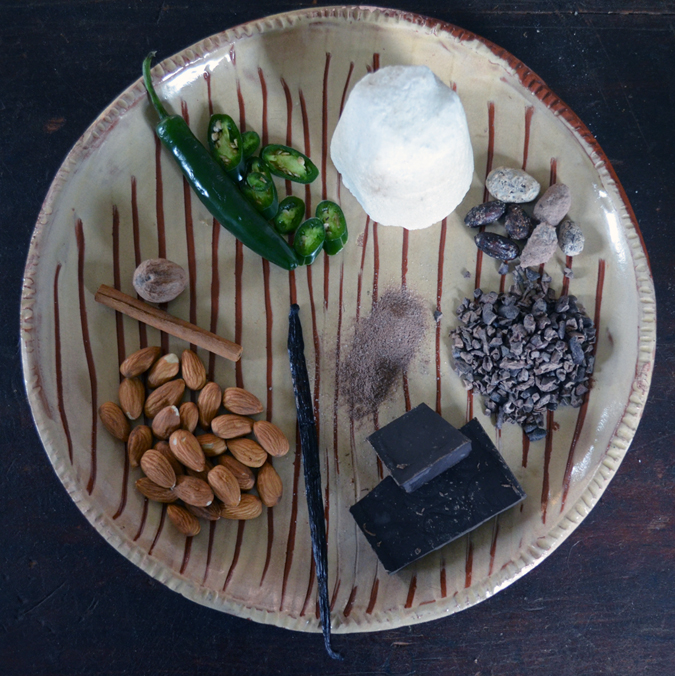
Popular ingredients in colonial-era chocolate drinks included (clockwise from top) sugar; cocoa beans, chocolate nibs, or chocolate block crushed and melted to form the foundation of the chocolate drink; vanilla; almonds; cinnamon; nutmeg; and chilis.
We know that many early Americans were fans of chocolate, but it wasn’t available to everyone. In the 1700s, chocolate was still a fairly expensive drink, similar to tea or coffee, making it a beverage of the upper and middle classes. It was seen as a nutritious and filling health food, commonly had with breakfast. Chocolate was a well-known staple at the Washington breakfast table, often served alongside tea and hoecakes in honey and butter.[1]
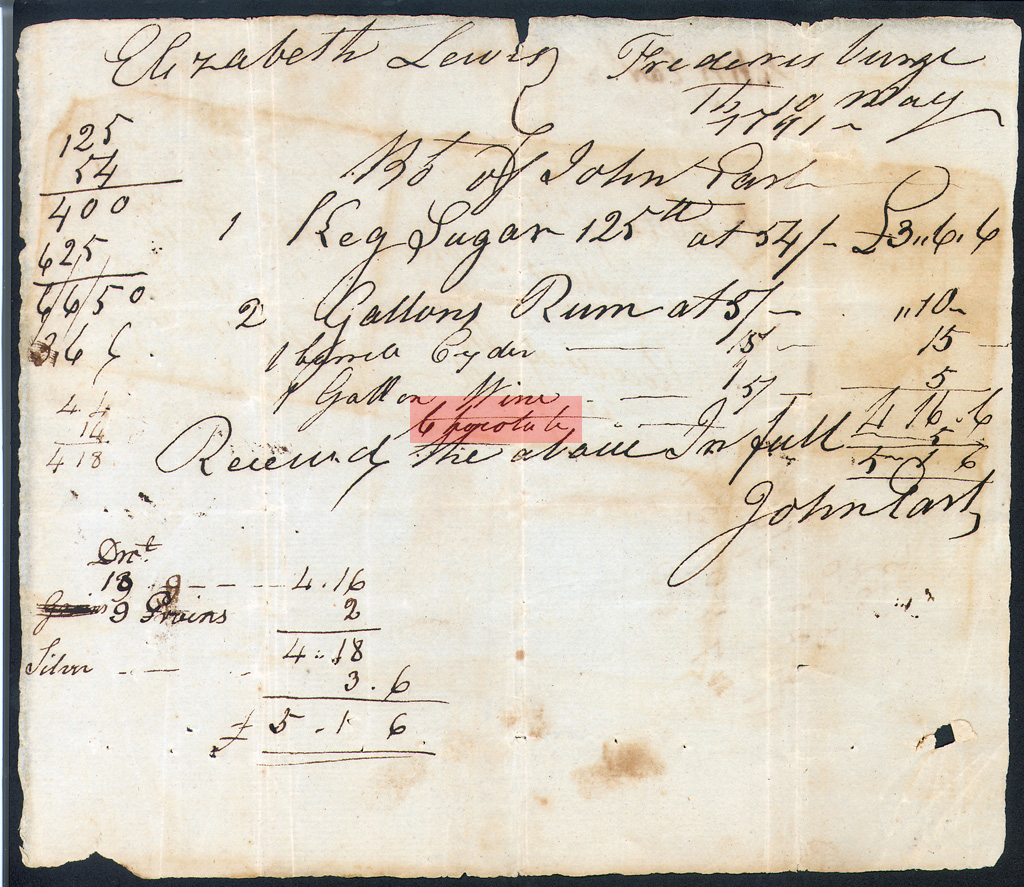
In fact, the Washingtons were such fans of chocolate that in 1757 George Washington ordered 20 pounds of chocolate from British merchant Thomas Knox. While living at Kenmore Plantation, George’s sister Betty Washington Lewis ordered a gallon of chocolate.
Although the handwriting is difficult to decipher, this receipt shows highlighted in red that Betty Washington Lewis ordered a gallon of chocolate in May 1791.
This love of chocolate is also evident in archaeological artifacts found through excavations at Ferry Farm. Archaeologists recovered fragments of a porcelain chocolate cup.
It may seem strange to us that there were special cups just for drinking chocolate. However, since it was a luxury good enjoyed by the upper classes it had a specific set of objects associated with its preparation and consumption. A teapot or teacup could have easily functioned for drinking chocolate but the purpose of this specialized material culture was to show off wealth and sophistication. For this reason a well-to-do colonial household would have separate sets of vessels for the making and consumption of tea, coffee, and chocolate. Using the right one in the right way let your peers know you were a well-educated gentry woman or man.
Chocolate cups and pots were often made of fancy material like silver or porcelain to show off the wealth of the owner and reflect the nature of the luxury ingredient. The chocolate cup recovered at Ferry Farm was painted red and blue in what is known as an ‘Imari palette’ and gilded to enhance the cup’s extravagance. Chocolate cups can be identified by their straight sides, unlike the gently sloping sides of a teacup.
Fragments of a porcelain chocolate cup made in the mid-1700s, decorated in the Imari palette design, and recovered during an archaeological excavation at Ferry Farm.
Similarly, 18th century chocolate pots generally are taller and have straighter sides compared to contemporary teapots.They also have a shorter spout with no strainer and often have a straight handle that juts out from the body.
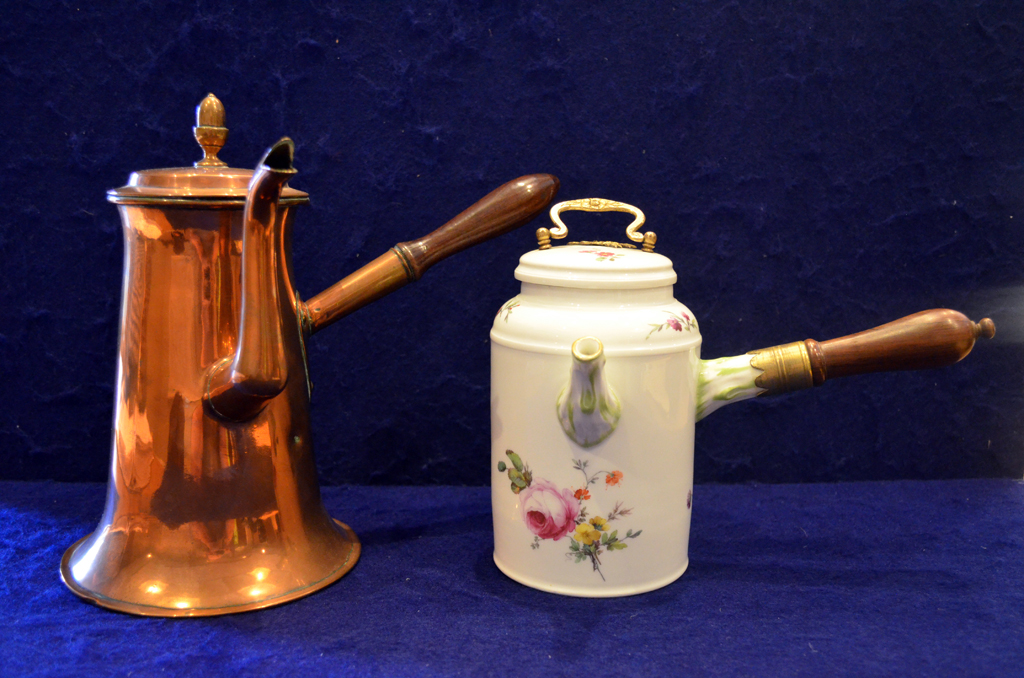
Two 18th century chocolate pots in the collection at Historic Kenmore.
This cooper chocolate pot features a wooden handle, “Goose neck” spout with split tip, a hinged lid with inverted acorn-shaped knob, and a tinned interior.
This cooper chocolate pot was made sometime between 1750-1770 in England or America.
This ceramic chocolate pot features a porcelain pot and lid decorated with an overglaze floral design in rose, orange, yellow and green.
The pot was made around 1770 at the Royal Porcelain Factory in Berlin, Germany.
The lid has circular hole in center for the chocolate mill, a hinged brass cover cast in a floral design, and a brass pull-type handle on top of the lid.
The maker’s mark on the ceramic pot is sword-shaped in underglaze blue on the underside of pot.
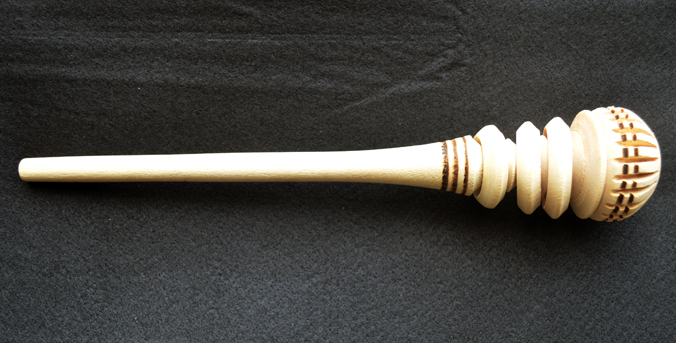
The most recognizable feature of a chocolate pot however is a hole in the lid where the chocolate mill, or molinillo, would be inserted and rubbed between the hands to briskly stir the chocolate, creating a delicious froth on the top.
Reproduction chocolate mill.
Kind of makes you want to try eighteenth century chocolate drink, doesn’t it? The next time you’re enjoying a bite of a candy bar or sipping your instant cocoa, think of the lofty origins of that treat and be grateful to the sweet-toothed colonials who so prized delicious chocolate!
It’s a long-standing holiday tradition! Adults and children alike will enjoy the sights and smells of the festive creations displayed at George Washington’s Ferry Farm!
This year’s theme is “George Washington Slept Here” and a list of contest winners can be seen here (PDF). Visitors may vote for their favorite and this ‘people’s choice’ winner will be announce after the holidays. The gingerbread houses remain on display until December 30.
Ferry Farm is open Monday – Saturday from 10:00 a.m. – 4:00 p.m and on Sunday from 12:00 p.m. – 4:00 p.m. The site will be closed Christmas Eve and Christmas Day.
Admission cost for viewing the gingerbread exhibit only is $4 adults, $2 students, under 6 free. There is an additional fee for a self-guided iPad tour of Ferry Farm. Visit www.ferryfarm.org for more details.
Mr. Gingerbread happily accepts votes for favorite gingerbread house.
All the gingerbread creations make the museum gallery smell delicious!
Visitors view the gingerbread houses during Sunday’s opening reception.
Young visitor looks one of the gingerbread houses.
“Valley Forge, 1777” by Matthew Yagla
“George Washington’s Birthplace” by Rachel Bosco
“Washington’s Headquarters at Valley Forge” by C.J. Crocker
“Young George at Ferry Farm” by Lachlan Eaton shows George chopping down a cherry tree.
“Ferry Farm” by Ryan Jackson
George slept here.
“Kenmore” by Diane Jackson
“Washington’s Headquarters at Fort Cumberland” by Gavin Carpenter
Interior view of the Ft. Cumberland headquarters.
“Mary Washington House” by Maggie Jackson
“Valley Forge, Washington Headquarters” by Valerie Jackson
“Hoovervilles” by Post Oak Middle School German Club
“Schlaf gut, Geroge! (Sleep well, George!)” by Chancellor Middle School German Class
“George’s Mount Vernon” by Chancellor High School German Club
“Martha & George in Love” by Courtland High School German Club depicts the Longfellow House.
“Chatham” by Girl Scout Troop 5057
“George Washington Surveying Natural Bridge” by Mr. & Mrs. John Simmers
George with his surveying equipment
“Washington’s Revolutionary War Headquarters” by Carrie Gonzalez and Shelley Brosius depicts the Ford Mansion in Morristown, NJ
“Gingerbread Friends at Ferry Farm”
“RACSB, RAAI Gingerbread House”
“Washington Headquarters, Longfellow House” by Nancy Rowland
Archaeologists at Ferry Farm regularly find evidence of ‘expedient’ tool making by Native Americans. These quickly-made tools were created for a single, immediate job and, once used, just discarded. In this video, we break off a flake of obsidian and use it to fillet a fish.
As thanksgiving approaches we turn our thoughts to tradition, family, and feast. Thanksgiving traditions call to mind family around a table full of food, a roast turkey with cranberry sauce, or maybe even a romanticized recreation of New England meal from the 17th century. But what is the history behind that tradition? What would people of the 18th century Virginia thought of our feast? Would Betty and George Washington have sat down for a meal of turkey and mashed potatoes in late November?
Thanksgiving as a national holiday wasn’t born until the 19th century and many modern American concepts of Thanksgiving come from legend and advertising.
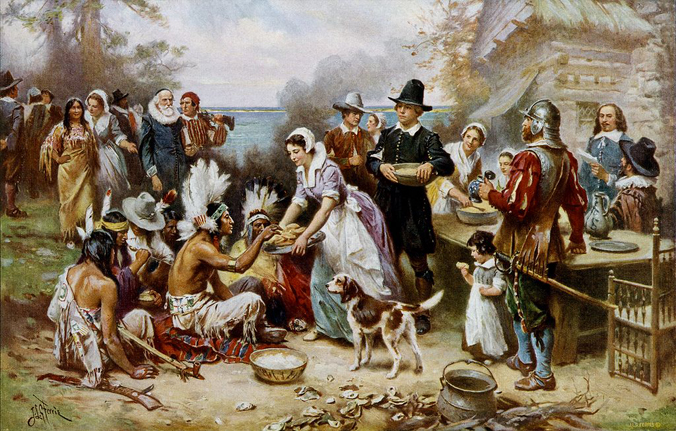
The First Thanksgiving 1621 by Jean Leon Gerome Ferris (1899). “The painting shows common misconceptions about the event that persist to modern times: Pilgrims did not wear such outfits, and the Wampanoag are dressed in the style of Native Americans from the Great Plains” says wikipedia.org. Public domain.
But when you peel back the layers of myth and romance in the above painting, in the advertising, and in the legends, you find a history deeply rooted in the 18th century and just as at home in Virginia as in Massachusetts.
While many people tend to look to colonial New England as the origin point for this late fall celebration, these bountiful autumn feasts have existed in places all over the world and for much longer. Many agrarian cultures have celebrated harvest festivals to mark the end of the harvest season. Families and communities came together, celebrated the bounty of the harvest, and gave thanks for all they had.
In the 1700s, Virginian households were familiar with a large fall feast. Produce that hadn’t been preserved had to be eaten. Cooler weather meant it was time to butcher and preserve meat. Soon, winter weather would make travel impractical. Any farm that enjoyed a bountiful year could celebrate with a large feast in the late fall.
But what would have been served at those feasts?
The dishes typically associated with Thanksgiving are inherently American. Turkey, potatoes, pumpkins, and cranberries are indigenous to the Americas and were unknown to Europeans prior to the 1500s. By the 18th century, Atlantic trade changed this. Some American produce like cranberries and pumpkins did not enjoy popularity in England. However, other American food had been fully accepted into kitchens and cookbooks on both sides of the Atlantic.
The Lewis family owned Hannah Glasse’s The Art of Cookery Made Plain and Simple, a cookbook from which Betty undoubtedly pulled many of her recipes. It contains multiple dishes modern Americans would consider typical Thanksgiving fare. It provides instructions for roasting a turkey complete with stuffing, making gravies for every kind of meat/preparation, and baking a plethora of desserts. It even contains a mashed potato recipe on page 193 that would be perfectly at home on any modern table.
BOIL your potatoes, peel them, and put them into a sauce-pan, mash them well; to two pounds of potatoes put a pint of milk, a little salt, stir them together, take care that they don’t stick to the bottom, then take a quarter of a pound of butter, stir it in, serve it up.
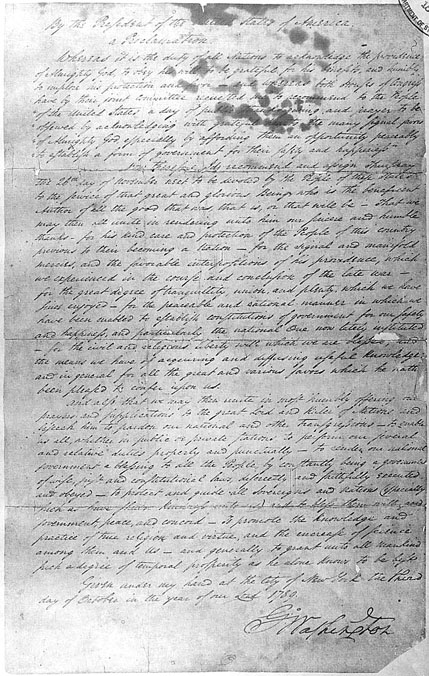
But if we are going to study Thanksgiving’s historic details, what about the term itself? Thankfully, we have George Washington himself to look to. Seventeen months after the ratification of the Constitution the newly elected President put forth a proclamation at the request of the Congress and Senate that…
Thanksgiving proclamation of 1789 by President George Washington. Library of Congress photo.
The day assigned was November 26, 1789, the last Thursday of the month.
We may not know whether or not Mary Washington ever sat her family around a large turkey dinner at Ferry Farm in late November, but we do know that a large harvest meal would not have been uncommon. Since Hannah Glasse’s cookbook rested on her shelf, we can have confidence that Betty Washington Lewis would have approved of our present-day mashed potatoes and roast turkey. Finally, we can read the words of Thanksgiving proclaimed to Americans by George Washington, as the new nation’s first president. When you sit down with family next week, remember that you are part of long tradition and celebrating something truly American.
Joe Ziarko
Manager of Interpretation & Visitor Services
In this video, we make a rare colonial-era treat known as “An Orange Fool” recently featured in a written blog post about where colonial Americans got their fresh fruit from. You can find the blog post and the “Orange Fool” recipe here.
Archaeologists sometimes recreate technology from the past to understand how people lived. This is called experimental archaeology. In this video, we recreate an earth oven and cook catfish in it.