In this video, we pick apart a rodent’s nest discovered by archaeologists investigating Historic Kenmore’s walls and floors for architectural artifacts. Like most museums, we take extensive pest prevention measures today but, back when it was an actual home, Kenmore was not always rodent-free. This nest revealed some fascinating history and told us a bit about Kenmore itself.
(NOTE: The video was filmed long before COVID-19 physical distancing requirements.)
In this video, Fredericksburg, Virginia-based furniture maker Steve Dietrich discusses two of the techniques he used to create a blanket chest for the reconstructed Washington house at Ferry Farm.
Watch other videos and read more about rebuilding the Washington house here.
In this video, we visit with Tom Snyder and Astrid Smith of Williamsburg Art Conservation to see how they upholstered the leather bottom chairs in the hall of the Washington house replica.
Watch other videos and read more about rebuilding the Washington house here.
The replica Washington house is open at George Washington’s Ferry Farm but furnishing is still ongoing. We traveled to Richmond to visit furniture maker Harrison Higgins and he told us about the furniture that he and his crew have made for the Washington house.
Watch other videos and read more about rebuilding the Washington house here.
On Tuesday, May 15, 2018, Meghan Budinger, Aldrich Director of Curatorial Operations for The George Wsahington Foundation presented a lecture titled “Cabinets of Curiosities: Kenmore and the Evolution of Museum Collections.” Using Kenmore’s collection as a case study, Meghan reviewed 100-years worth of museum curation and talked about some of the most exciting and unusual objects in Kenmore’s collection.
This final lecture in the latest trilogy of Foundation lectures took place at the Central Rappahannock Regional Library in Fredericksburg, Virginia.
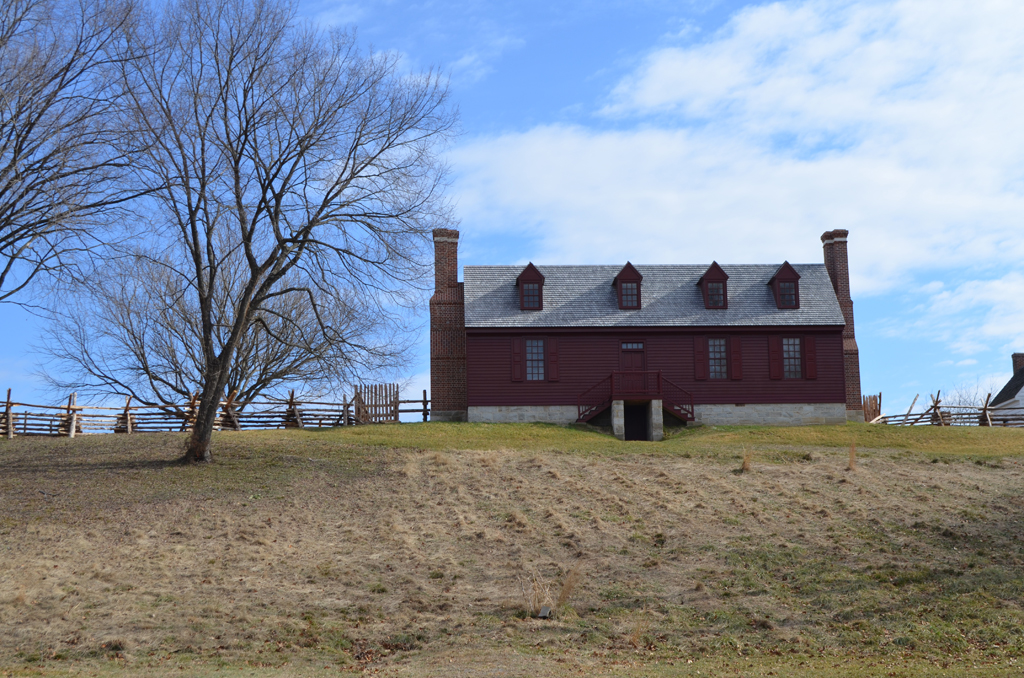
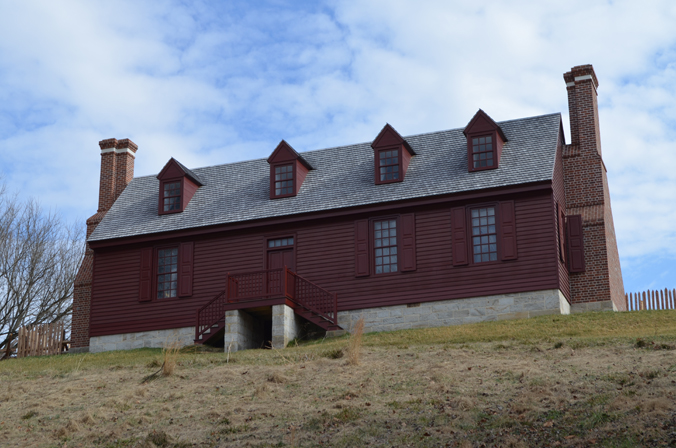
The Washington house at Ferry Farm is now open for tours! Using information from the probate inventory and archaeological evidence, the interpretive replica of George Washington’s boyhood home is currently being furnished with replica furniture and ceramics. You can read an in-depth post about the house here and below you will find photos that provide a glimpse of the house’s exterior and interior as well as the surrounding landscape.
View of the front of the house that faces Fredericksburg and the Rappahannock River.
View from the front door.
The passage.
The staircase.
One of the upstairs bedrooms.
Surveying equipment rests on a window sill.
View of Fredericksburg and the river from a window.
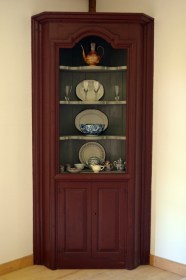
The corner cupboard in the parlor.
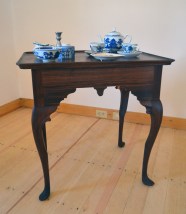
The tea table in the hall back room.
A bed in the hall back room.
The hall.
Table setting in the hall.
The escritoire, a massive cabinet-sized desk, in the hall.
Inside the escritoire.
The north side of the house.
Another view across the river into Fredericksburg.
The 1870s-era “Surveyor’s Shed” next the the Washington house replica.
The work yards behind the Washington house.
Learn more about this comprehensive project here and here.
Please visit www.ferryfarm.org and www.kenmore.org for more information on two National Historic Landmark sites, George Washington’s Ferry Farm and Historic Kenmore.
The completed reconstruction of the Washington house at George Washington’s Ferry Farm.
The Washington house at Ferry Farm is now open for tours. The interpretive replica of George Washington’s boyhood home is an interactive and hands-on experience for all ages, where visitors can experience what life was like in the eighteenth century. Using information from the probate inventory and archaeological evidence, the Washington house is currently being furnished with replica furniture and ceramics of what was originally in the home. This allows guests the opportunity to sit on the furniture and handle the objects.
Corner Cupboard
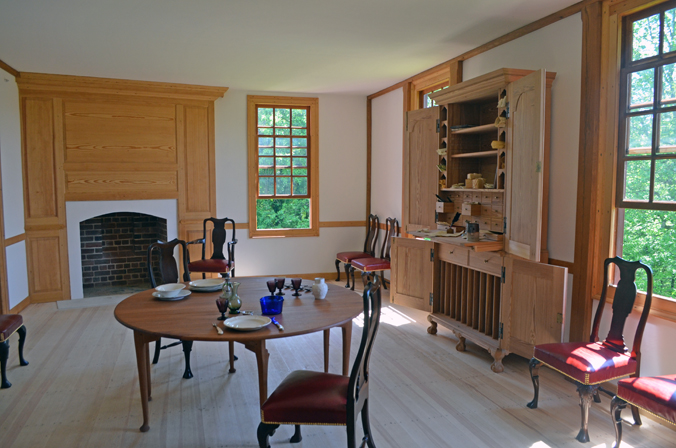
Following a plan conceived by The George Washington Foundation’s Collections Committee and curators, noted cabinetmakers are crafting reproduction furniture using pieces from the time period of the Washington house as examples. Craftsmen from Colonial Williamsburg produced a corner cabinet in the joiners’ shop and a tea table in the cabinetmakers’ shop using examples from the Colonial Williamsburg Foundation’s collection. Additionally, two dining tables, a set of twelve leather upholstered chairs, a “scrutore” – or desk with bookcase, a low-post bed, and a gaming table are currently on view in the Washington house.
Tea Table
The construction of the Washington house on its archaeological footprint is part of the first phase of The George Washington Foundation’s multi-year venture to physically develop George Washington’s Ferry Farm into an outdoor living museum. The first phase of the project will also include reconstructing the kitchen and outbuildings, and recreating the period landscape. Moreover, the Foundation is establishing a new entrance to the museum property, has erected a maintenance facility, and is completing necessary infrastructure.
Dining table, chairs, and “scrutore” in the Hall of the Washington house.
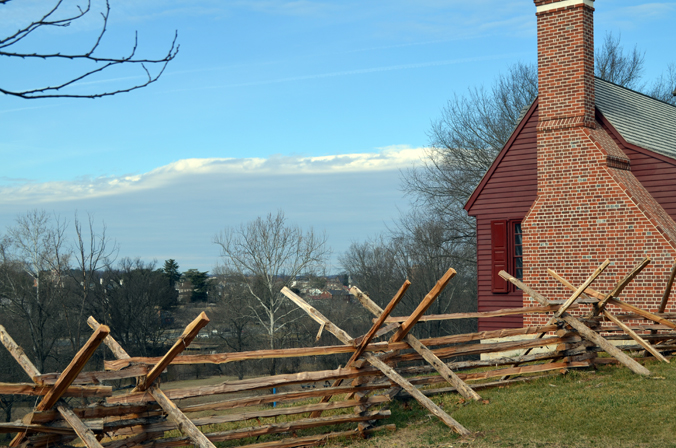
Employing building methods of the period, artisan masons laid the foundation for the Washington house using hand-cut Aquia sandstone in an oyster-shell mortar. Next, timber framers joined massive wood beams to create the frame of the home. Carpenters covered the roof with traditional, hand-prepared wood shingles and installed skillfully-crafted exterior doors and window sashes, as well as beaded weatherboard siding painted a traditional, deep red “Spanish brown” color.
Masons completed the brickwork for the three chimneys, each set in an English bond interspersed with glazed headers, while the carpenters fitted paneled doors with hand-wrought iron hardware and fabricating interior features such as an elaborate staircase in the center passage. Accomplished plasterers installed a traditional lime plaster, strengthened with animal hair, on wood lath across the walls of the Washington house.
The work yards behind the Washington house.
Constructing the Washington house and the first phase of improvements at Ferry Farm is a funding priority for the Foundation as part of The Future of Our Past Campaign—a $40 million dollar comprehensive fundraising initiative in support of efforts across its two National Historic Landmark sites: Historic Kenmore and George Washington’s Ferry Farm.
George Washington moved to Ferry Farm in 1738 with his parents, Mary and Augustine, his sister Betty, and their siblings, purchasing the site from William Strother III, a prominent colonial Virginian. Young George lived at the farm from age 6 to 22. Referred to as the Washington home house in George’s day, the property was later known as Ferry Farm—a historic ferry adjacent to the Washingtons’ house once linked it to the city of Fredericksburg via the Rappahannock River. The site was the setting of some of the best-known stories related to his youth, including tales of the cherry tree and throwing a stone across the Rappahannock River.
George was eleven when his father died in 1743. Augustine left Ferry Farm to George, for him to inherit when he reached majority. Mary Washington continued to live at Ferry Farm until 1772, when she moved to Fredericksburg to live closer to Kenmore and Fielding and Betty Washington Lewis.
View from the Washington house of Fredericksburg across the Rappahannock River.
In 1996, Ferry Farm was saved from commercial development through the hard work and determination of the Regents and Trustees of The George Washington Foundation (known then as the Kenmore Association), a long list of individuals, and several organizations.
The Foundation announced on July 2, 2008 that its archaeologists had located and excavated the remains of the long-sought house where Washington was raised. To date, over 750,000 artifacts have been unearthed at Ferry Farm. Ongoing research suggests that George’s experiences at Ferry Farm were influential in shaping the man that he would become.
On Saturday, April 25, 2015, the Foundation broke ground on the Washington house and the first phase of construction at Ferry Farm, forever preserving this remarkable landscape and providing a powerful stage to tell the story of young George and his family. Doris Kearns Goodwin, renowned presidential historian and Pulitzer Prize-winning author, was the keynote speaker for the Groundbreaking Ceremony.
Learn more about this comprehensive project here and here.
Please visit www.ferryfarm.org and www.kenmore.org for more information on two National Historic Landmark sites, George Washington’s Ferry Farm and Historic Kenmore.
David Muraca
Vice President of Museum Operations
Director of Archaeology
In this video, Fredericksburg, Virginia-based furniture maker Steve Dietrich discusses some of the techniques he used to create four low post beds for the reconstructed Washington house at George Washington’s Ferry Farm.
Watch other videos and read more about rebuilding the Washington house here.
In this video, Curator Meghan Budinger shows us early arrivals among the reproduction furniture to go into the reconstructed Washington house at George Washington’s Ferry Farm.

 In this video, Fredericksburg, Virginia-based furniture maker Steve Dietrich discusses two of the techniques he used to create a blanket chest for the reconstructed Washington house at Ferry Farm.