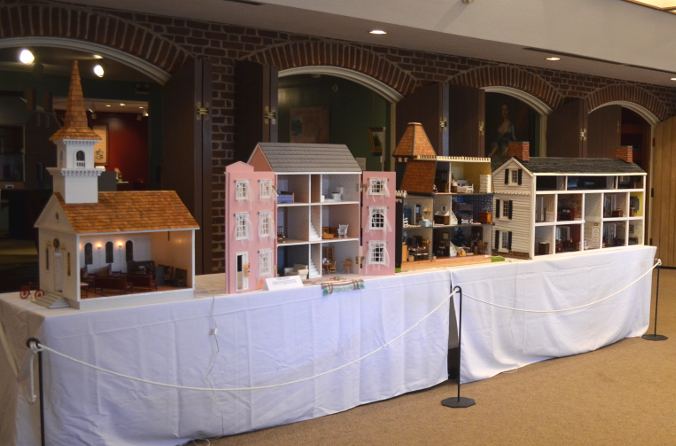
This year is our first-ever “A Wee Christmas — Dollhouses and Miniatures Show” at Historic Kenmore! “A Wee Christmas” has brought together many different dollhouses, miniature scenes, and figurines loaned by friends, neighbors, and staff for visitors to Kenmore Plantation to enjoy. The highly detailed, replica dollhouse of Kenmore on display in our Crowninshield Museum inspired this new holiday event. You can read a blog post about the history of the Kenmore dollhouse here.
The photos in the gallery below show several of the whimsical dollhouses and miniatures on display. To enjoy all of them up close, visit Historic Kenmore before the exhibit ends on December 30. Check out the events page on http://www.kenmore.org for more information!
“Country Church.” Submitted by James Opher.
A glimpse through the church’s front door.
Inside the country church.
“Antique Dollhouse.” Submitted by Susan Larson.
Susan bought her dollhouse during a visit to Fredericksburg, not knowning that she would soon move to the city.
“The Apple Blossom.” Submitted by David Budinger.
David built the house for his daughter, Meg (now Kenmore’s curator) around 1990.
Christmas tree inside “The Apple Blossom.”
“Plantation House.” Submitted by James Opher.
It was built in 1975…
…and renovated in 2014.
Inside the “Plantation House.”
“Bonaise” Submitted by Lucy Harmon.
“Bonaise” is a replica of the Harmons’ old farmhouse on White Oak Road in Stafford County.
Scene from “The Nutcracker.” Submitted by Anne Higgins.
“Victorian Dollhouse.” Submitted by Beth Waters Hunsinger & son Jackson Waters Hunley.
Santa gave Beth this house when she was about 9 years old.
Now, her son Jackson enjoys rearranging the furniture inside.
Interior of “Rammings’ House.” Submitted by Anna Jennings.
Made by Michael & Gloria Ramming in 1985, the house is a miniature of their home and furnishings in San Francisco, California.
“The Quilt Shop.” Submitted by Carol House.
The shop was featured in the Miniature Quilts magazine.
Tradition says that Mary Ball Washington, mother of George Washington, was well-known for her excellent gingerbread. The story goes that she even served her gingerbread to the Marquis de Lafayette when he visited Fredericksburg as part of his postwar tour of America in 1784. Inspired by this tale and as Mary’s home for three decades from 1738 to 1772, George Washington’s Ferry Farm hosts a Gingerbread Contest and Exhibit each December. This year’s event is the 28th annual and features the theme “Home Sweet Home.”
The photos in the gallery below show just a few of this year’s contest entries representing a variety of ages and skill-levels. We’re also sharing some photos of Ferry Farm decked out for the holiday season and want to thank the Ann Page Garden Club for beautifully decorating this year.
To see all the gingerbread creations and to vote for your favorite, visit Ferry Farm before the exhibit ends on December 30. Check out the events page on http://www.kenmore.org for more information!
“There’s No Place Like Home” by Valerie Jackson
“Welcome Home Sailors” by Daniel Jackson
“A Man’s Home is His Castle” by Matthew Yagla
“Home is Where the Doctor Is” by Massaponax High School German Club
“Tea Time” by Courtland High School German Program won Best in Show.
“Igloo Home” by Imogene Pastorek
“International Space Station” by The Szlyk Family
“Life’s a Beach” by The Abraham Family
“St. George’s Gingerbread Church” by Nicholas Perron
Dollhouses on display as part of our first-ever “A Wee Christmas” Dollhouses & Miniatures Show.
This holiday season, we’re excited to share with our visitors the many dollhouses and miniatures loaned by friends, neighbors, and staff to form our first-ever dollhouses and miniatures show that we’re calling “A Wee Christmas at Historic Kenmore”. A highly detailed, replica dollhouse of Kenmore on display in our Crowninshield Museum served as the inspiration behind this new exhibit. Like its real life counterpart, this unique Kenmore replica has a fascinating history all its own.
While on a visit to Fredericksburg in the spring of 1984, Florence White, an enthusiast of Georgian architecture, fell in love with Kenmore. She had been searching for years to find just the right place to make into a grand historical dollhouse. Kenmore with its simple, symmetric windows and imposing brick walls was perfect.
The dollhouse version of Historic Kenmore.
However, Florence needed someone who would construct this dollhouse with the degree of detail and intricacy that would mimic the elegant original. After a long unsuccessful search there came a chance meeting with Jim Freytag, a retired railroad man turned miniature enthusiast, and she knew she had her builder.
Jim’s first task was to visit the home that Florence wanted to replicate and gather as many details as he could. He wanted to make it as structurally authentic as possible from the number of bricks between the windows to the outside steps worn down with years of use. He toured the house taking notes on the particulars of each room, the furniture, the décor, and the layout. Photographs were not permitted inside the house so Jim purchased postcards in order to get better detail for the intricate plaster ceilings and mantels.
Some 2700 hours of work, 18,929 bricks and over $4000 later Florence had her Kenmore dollhouse. Jim had completed four bedrooms, a dining room, living room, drawing room, and study. They are each equipped with miniature pieces of furniture from a large cherry-stained Queen Anne table in the dining room flanked by two portraits of Colonel Lewis and Mrs. Lewis to canopy beds, brass candlesticks and leather boots in the bedrooms.
A view of the Chamber inside the Kenmore dollhouse.
Over twenty-six years later, the dollhouse now sits in the museum gallery at Kenmore’s visitor center for all to view. Each room still has the exact furnishings so painfully and meticulously created by Jim and positioned to Florence’s specifications. The house is a time capsule which shows Kenmore before renovations completed nearly a decade ago. Visitors can see pieces of furniture that are no longer on display and can understand the dimensions of the upper floor rooms which are not currently open to the public.
Florence’s devotion to detail and Jim’s immense skill leave us with a whimsical model of Kenmore which exudes all the elegance and beauty of the original that would have made the Colonel and Betty proud.
You can see Florence and Jim’s replica of Kenmore as well as all the other wonderful dollhouses and miniatures that make up “A Wee Christmas at Historic Kenmore” until December 30.
Historic Kenmore is decorated for the holidays, portraying what it may have looked like during the Christmas season of 1775. At that time, the Lewis family would have just moved into Kenmore a couple of months earlier, and it would have been their first Christmas in the new house. It was a time of some sadness, as well – their 15 year old son Charles had died that fall, of an unidentified illness. Although unknown at the time, it also would be the last “normal” holiday before the Revolution began in earnest.
The photos in the gallery below provide a glimpse of some traditional holiday decorations (a few have modern twists) and customs common to the 1700s.
Want to see Historic Kenmore in all of its holiday splendor? Seasonal tours are offered daily through December (Closed Christmas Eve, Christmas Day, and New Year’s Eve). Or reserve a spot for our dramatic theater presentation that re-creates a Twelfth Night celebration inside the house on Saturday, January 3 and Sunday, January 4. See the events page on www.kenmore.org for more information!
A wreath adorns Kenmore’s front gate.
Kenmore peaks through the center of a wreath.
A wreath on the door of an administrative building.
Kenmore’s garden volunteers created the amazing wreaths and swags hanging on our buildings this year.
A wreath on the door of an administrative building.
A close-up view of a wreath.
The garden gate.
The west front of Kenmore.
Festive doors.
Magnolia in an evergreen swag.
Inside of Kenmore, we bring out greenery to decorate the banister in the Passage.
Curatorial staff attach the greenery to the banister.
In the 1700s, evergreens and local plant material, like boxwood, magnolia and holly would be brought into the house, but in small quantities.
Colonial-era decorations were quite subdued.
Branches of pine or holly would be placed in clay jars and set on tables or mantels.
In the Passage, we re-create a dessert table Betty Lewis might have created to impress her holiday guests.
We carefully unwrap jelly glasses to be displayed on the table.
The table features plum pudding, miniature marzipan fruits, candied citrus, and syllabubs.
The desserts served as the centerpiece of a Twelfth Night ball.
The Christmas season lasted much longer than ours does, extending into January to Twelfth Night (a festive night marking the end of the Twelve Days of Christmas and celebrated much like New Year’s Eve is today).
During the ball, usually around midnight, guests were treated to the unveiling of the elaborate dessert table…
…filled to overflowing with sweets and confections arranged in imaginative ways and displayed on the best silver and glassware.
There is also a hedgehog cake, a favorite of Martha Washington’s at Mount Vernon.
The lady of the house would be severely judged on the creativity of her dessert table.
Among this year’s decorations are five tiny foxes, part of scavenger hunt for our younger visitors.
Fox hunts were a popular holiday custom with colonial Virginians and were much-loved by George Washington.
The completed decorations in the Passage.
Looking down into the Passage from above.
Holiday swags with modern lights on Kenmore’s doors.