Lives and Legacies

Tag: John Adams

  • Spilling the Tea: The Boston Tea Party at 250

    Author’s Note: This blog contains hyperlinks to primary documents related to the event.
    Figure 1: 250th Logo (Boston Tea Party Ships and Museum)

    Intro

    This year marks the 250th anniversary of the Boston Tea Party (Figure 1). Hailed as a defining moment in the quest for American independence and an act of patriotism, the event has inspired commemorations in many forms, and it remains a vital part of the American History curriculum. I, for one, thought it the epitome of achievement that I had the date memorized in kindergarten. Like much of our founding history, however, the story retains an element of myth. So, what exactly is the truth behind this event?  

    The Story

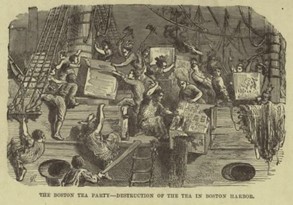
    A general account of the Boston Tea Party tells how patriotic Bostonians, angered by unfair taxes, boarded three ships in Boston Harbor on December 16, 1773. Disguised as members of the Mohawk or Narragansett tribes, Samuel Adams led the Sons of Liberty in protest by throwing crates of the King’s tea overboard. This act helped unite the colonies against Britain and started the chain of events that ended in the “Shot Heard Round the World” on Lexington Green on the morning of April 19, 1775, following Paul Revere’s ride.

    Sound familiar? In truth, this account covers the basics. It provides the “who,” “what,” “when,” “where,” and “why.” Nonetheless, it only scratches the surface of the complex event we know as the Boston Tea Party. To unpack this, let us look at what led to the event, how it happened, and the initial response.

    Truth of the Tax

    Taxes and tea sit at the heart of this story. The taxes that the colonies took issue with went into effect starting in the 1760s, with the ultimate goal of lessening the debt incurred by Britain during the Seven Years’ War. However, this set a new precedence as Britain had never taxed the colonists directly, and the passing of these tax laws occurred without consulting the colonies. The formal chant of “no taxation without representation” first appeared in 1768, and while the lack of representation presented a key reason for displeasure, the impact of taxes on merchants served as another.

    While the Tea Act of 1773 served as the catalyst for the Boston Tea Party, the Tea Tax had existed since 1767. Introduced under the Townshend Acts, the tax remained the only one in effect upon the Act’s repeal in 1770. General dislike for the tax persisted, but the Tea Act took the issue to another level. In an aim to bail out the East India Company (EIC), the Act granted a monopoly over the tea trade by opening the colonial market to the company as the sole supplier, waived their tax payment in favor of those paid by colonists, and mandated that only EIC company agents (consignees) could sell the tea (Figure 2). Many perceived this as a restriction on business, as merchants could no longer source tea from Britain and smugglers, freedom of choice and rights.  In truth, the protests against the tax and Tea Act occurred as a matter of principle since the cost of tea actually dropped, with consumers now able to buy directly from a supplier who faced no additional costs.

    Figure 2: EIC Seal (East India Company)

    Build Up

    With the Boston Tea Party story often told in a bubble, it appears as an impulsive act, but far more happened behind the scenes. By the end of 1773, displeasure with the Tea Act made attempts of preventing the unloading of tea and boycotts of its purchase common. When DartmouthBeaver, and Eleanor anchored at Griffin’s Wharf (November 28-December 15), locals had expected their arrival since October and had spent November demanding the resignations of the consignees. Many foresaw the risk of tensions coming to a head, including Abigail Adams, who, on December 5, wrote that “the Tea that bainfull weed is arrived…The flame is kindled…Great will be the devastation if not timely quenched or allayed by some more Lenient Measures.”

    After successfully chasing the consignees out of town, Bostonians urged Francis Rotch, whose family owned two of the ships, to depart without unloading the cargo. The Sons of Liberty stationed a guard at the docks to ensure that the tea remained onboard while Rotch decided. In response, Royal Governor Thomas Hutchinson ordered Rotch to unload the cargo within the standard twenty days of arrival or forfeit it and the ships. Rotch thus found himself in an impossible situation as Hutchinson and customs refused to let him leave while the Sons would accept nothing less.

    December 16th

    Many awoke on December 16, knowing the crisis would come to a head. The date marked the deadline for unloading Dartmouth’s cargo, and Rotch would make one final attempt to plead his case to both sides. Hutchinson and customs refused to budge, which further incensed Bostonians when Rotch reported that the tea would not be leaving. This announcement came as Samuel Adams headed a meeting at the Old South Meeting House (Figure 3).
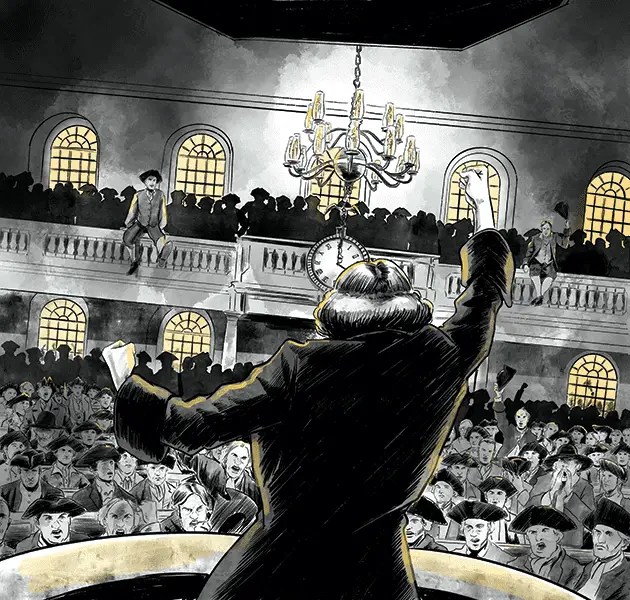
    Figure 3: Adams’ Speech at Old South (Revolutionary Spaces)

    Serving as a leading figure within the Sons of Liberty, Adams had led many of the meetings and attacks that occurred almost daily in the buildup to the 16th. This particular meeting drew 5,000-7,000 people who clamored to hear the latest developments in the tea crisis. When Rotch’s news broke, Adams stated, “This meeting can do nothing further to save the country.” While often billed as a signal to start the Tea Party, doubt remains over the statement’s significance. According to eyewitness accounts, many stayed another 15 minutes, and Adams tried to prevent people from leaving before the meeting concluded.

    Regardless of intent, hundreds of people made their way to Griffin’s Wharf. Along the way, some donned disguises that mimicked Native Americans. These disguises served both practical and symbolic purposes. First, donning a disguise shielded the identity of individuals carrying out the illegal acts, even if no one mistook them for actual tribal members. Secondly, the choice of a Native American-inspired look embraced an allegory of America and linked Indigenous resistance to colonization with the colonists’ struggle against Britain (Figure 4).
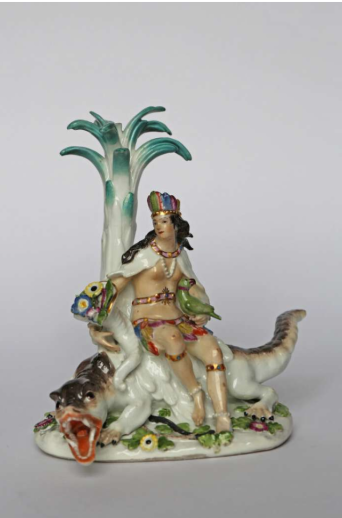
    Figure 4: “Allegory of the Continent of America,” c. 1750 (The Clark Museum)

    Interestingly, Adams never claimed or denied involvement with the Tea Party, yet, in contrast to popular depictions, he did not appear at the harbor that night. Instead, he remained at Old South. Of the participants, only the identities of 116 are known, and only one faced arrest.

    The day after, Samuel’s cousin, John Adams, described the event as “the most magnificent Movement of all. There is a Dignity, a Majesty, a Sublimity in this last Effort of the Patriots that I greatly admire. The People should never rise without doing something to be remembered—something notable And striking. This Destruction of the Tea is so bold, so daring, so firm, intrepid and inflexible, and it must have so important Consequences, and so lasting, that I cant but consider it as an Epocha in History.

    Reactions

    Despite a post-independent America enshrining the Boston Tea Party in glory, most initial reactions proved far less enthusiastic than that of John Adams. The name “Boston Tea Party” did not emerge until the 1820s, and even then, “Party” referred to a group of people rather than something celebratory. Instead, mentions of the event usually identified it by what happened, such as “the destruction of the tea” (Figure 7).
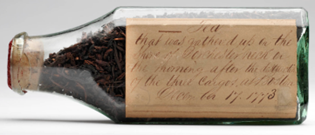
    Figure 7: “Tea that was gathered up on the shore of Dorchester Neck on the morning after the destruction of the three cargos at Boston; December 17, 1773” (MHS)

    While Parliament’s taxes made many colonists unhappy, they also valued their right to private property. In the case of the Boston Tea Party, the ships that the Sons of Liberty trespassed on belonged to Americans, while the EIC owned the destroyed tea. The King and Parliament had no direct connection to the ships or their cargo. As such, many viewed the attack as one on private property rather than a true strike against Parliament. Those who spoke out against it included Founding Fathers. Benjamin Franklin felt “truly concern’d…that there should seem to any a Necessity for carrying Matters to such Extremity, as, in a Dispute about Publick Rights, to destroy private Property.” Meanwhile, George Washington supported taking a stand against taxation and felt the cause of Boston equated to the cause of America, but ultimately could not “approve their cond[uc]t in destroyg the Tea.”

    Impact

    In the short run, the Boston Tea Party did little to fan the flames of independence. It inspired a few more boycotts (i.e., the Annapolis, Edenton, and Yorktown Tea Parties) and furthered a decline in consumption, but the British response to the event served as the primary catalyst. By punishing all of Boston, and by extension, Massachusetts Bay Colony, rather than just those responsible, the British infringed upon the rights of the colonists. Under the Coercive (nicknamed “Intolerable”) Acts, the British closed the harbor, demanded Bostonians pay damages to the EIC, imposed martial law, and required citizens to house, or quarter, members of the military on their property at their own expense (Figure 8).

    Figure 8: “The Bostonians in Distress;” 1774 Satire of the Boston Port Act (LoC)

    Those living in the twelve other colonies did not take well to this, as they feared the implementation of these acts in their homes. In response, the First Continental Congress met in Philadelphia from September to October 1774. While some delegates saw the issue as a Massachusetts one, others pressed the need to take a stand against the overreaches of Parliament and sympathized with Massachusetts. They concluded Congress by issuing their Declaration and Resolves, which listed objections to Parliament and confirmed their commitment to a trade boycott. However, when news of Lexington & Concord broke in April 1775, and Massachusetts found itself at war, the other colonies quickly had to decide which side they would take.

    Legacy

    Two hundred fifty years on, the Boston Tea Party remains an iconic event in American history and a pivotal moment in the founding of the country (Figure 9). While not wholly embraced as such upon its occurrence, the retelling of the event over time came to enshrine it in lore and leave out details that complicated the narrative. This shows that one cannot study a singular event without contextualizing it within the bigger picture. Nevertheless, John Adams’ belief that the “Destruction of the Tea” would become an epoch in history proved correct.

    Figure 9: Robinson Tea Chest – 1 of 2 surviving chests (Boston Tea Party Ships and Museum)

    Emma Schlauder

    Research Archaeologist


    Bibliography

    Adams, Abigail. Abigail Adams to Mercy Otis Warren, 5 December 1773. Letter. From National Archives, Adams Papershttps://founders.archives.gov/documents/Adams/04-01-02-0065 (accessed Nov 13, 2023).

    Adams, John. [December 1773]. Diary. From National Archives, Adams Papers. https://founders.archives.gov/documents/Adams/01-02-02-0003-0008 (accessed Nov. 13, 2023).

    “Boston Tea Party History.” Boston Tea Party Ships & Museum (website). https://www.bostonteapartyship.com/boston-tea-party-history (accessed Nov. 14, 2023).

    Cooper, Samuel. To Benjamin Franklin from Samuel Cooper, 17 December 1773. Letter. From National Archives, Franklin Papershttps://founders.archives.gov/documents/Franklin/01-20-02-0266 (accessed Nov. 13, 2023).

    “Declaration and Resolves of the First Continental Congress.” American Battlefields Trust (website). https://www.battlefields.org/learn/primary-sources/declaration-and-resolves-first-continental-congress (accessed Nov. 14, 2023).

    Franklin, Benjamin. From Benjamin Franklin to the Massachusetts House Committee of Correspondence, 2 February 1774. Letter. From National Archives, Franklin Papers. https://founders.archives.gov/documents/Franklin/01-21-02-0023 (accessed Nov. 13, 2023).

    ““Made one of the celebrated Tea Party in Boston harbor:” Remembering the Boston Tea Party in 1826.” American Battlefields Trust (website). https://www.battlefields.org/learn/primary-sources/made-one-celebrated-tea-party-boston-harbor (accessed Nov. 14, 2023).

    ““No Taxation Without Representation:” The Evolution of the Historic Phrase.” American Battlefields Trust (website). https://www.battlefields.org/learn/articles/no-taxation-without-representation (accessed Nov. 14, 2023).

    “Participants in the Boston Tea Party.” Boston Tea Party Ships & Museum (website). https://http://www.bostonteapartyship.com/participants-in-the-boston-tea-party#participant-list (accessed Nov. 14, 2023).

    Schiff, Stacy. The Revolutionary Samuel Adams. New York: Little, Brown and Company, 2022. “Tea Act.” American Battlefields Trust (website). https://www.battlefields.org/learn/primary-sources/tea-act (accessed Nov. 14, 2023).

     “The Boston Tea Party.” Massachusetts Historical Society (website). https://www.masshist.org/revolution/teaparty.php (accessed Nov 14, 2023).

    “The Final Straw.” Boston Tea Party Ships & Museum (website). https://www.bostonteapartyship.com/the-final-straw (accessed Nov 14, 2023).

    “The Intolerable Acts.” Boston Tea Party Ships & Museum (website). https://www.bostonteapartyship.com/the-intolerable-acts (accessed Nov 14, 2023).

    The Massachusetts Gazette; and the Boston Post-Boy and Advertiser. “Philadelphia, September 29. Extract of a letter from London, August 4.” From Massachusetts Historical Society. https://www.masshist.org/database/viewer.php?pid=2&old=1&mode=nav&ft+Coming% &nbsp 20of%20the%20American%20Revolution&item_id=434 (accessed Nov. 13, 2023).

    “The Secret Plan.” Boston Tea Party Ships & Museum (website). https://www.bostonteapartyship.com/the-secret-plan (accessed Nov 14, 2023).

    “Townshend Act.” American Battlefields Trust (website). https://www.battlefields.org/learn/primary-sources/townshend-act (accessed Nov. 14, 2023).

    Washington, George. From George Washington to George William Fairfax, 10–15 June 1774. Letter. From National Archives, Washington Papershttps://founders.archives.gov/documents/Washington/02-10-02-0067 (accessed November 13, 2023).

  • No Buttons for the Ladies

    Whilst I costume actors, living historians, and myself from time to time in 18th century clothing, I find myself puzzled about the stark difference between the closures and attachments of ladies’ and men’s garb.  I have to lace myself into my stays, tie on layers of padding and petticoats around my waist, and finally pin my gown closed.  Men have the enjoyment of a few buttons on their breeches and waistcoat, but that is it.  It frequently makes me grumpy how long it takes me to dress in comparison to my male counterpart.  I did not understand this phenomenon, until recently. 

    To put 18th century clothing closures into perspective, you had hooks and eyes, buttons, and ties/laces.  Thomas Hancock created elastic for gloves, suspenders, and stockings in the 1820s, but it struggled to withstand heat and last through time.  The elastic we know and love in our garments today did not come around until the early 1900s.[1]  The modern zipper was patented in 1917 and was used mainly on boots and tobacco pouches.  It took another 20 years before the technology even made it to mass produced clothing.[2]  By comparison, the button first becomes functional over decorative around 1,000 BCE in Asia.  Buttons would eventually travel the Mediterranean during the crusades into European territories around the late 11th century CE.[3]  So George Washington did not have a zipper on his pants or elastic on his socks, but he definitely had buttons on his coat.   

    A eye from a hook and eye set. Source: Ferry Farm Archaeological Collections

    Hooks and eyes were sometimes used for gown closures for women in the 18th century.  They were not used as much as pins were because of the rigidity in size it created for the garment. 

    We have buttons from men’s garments in the archaeological collections here at Ferry Farm.  We also see buttons all around male portraiture in our curatorial collection.  The ladies, however, are stuck with laces, ribbons, and pins.  And boy, do we have the pins to prove it in the archaeology collections. 

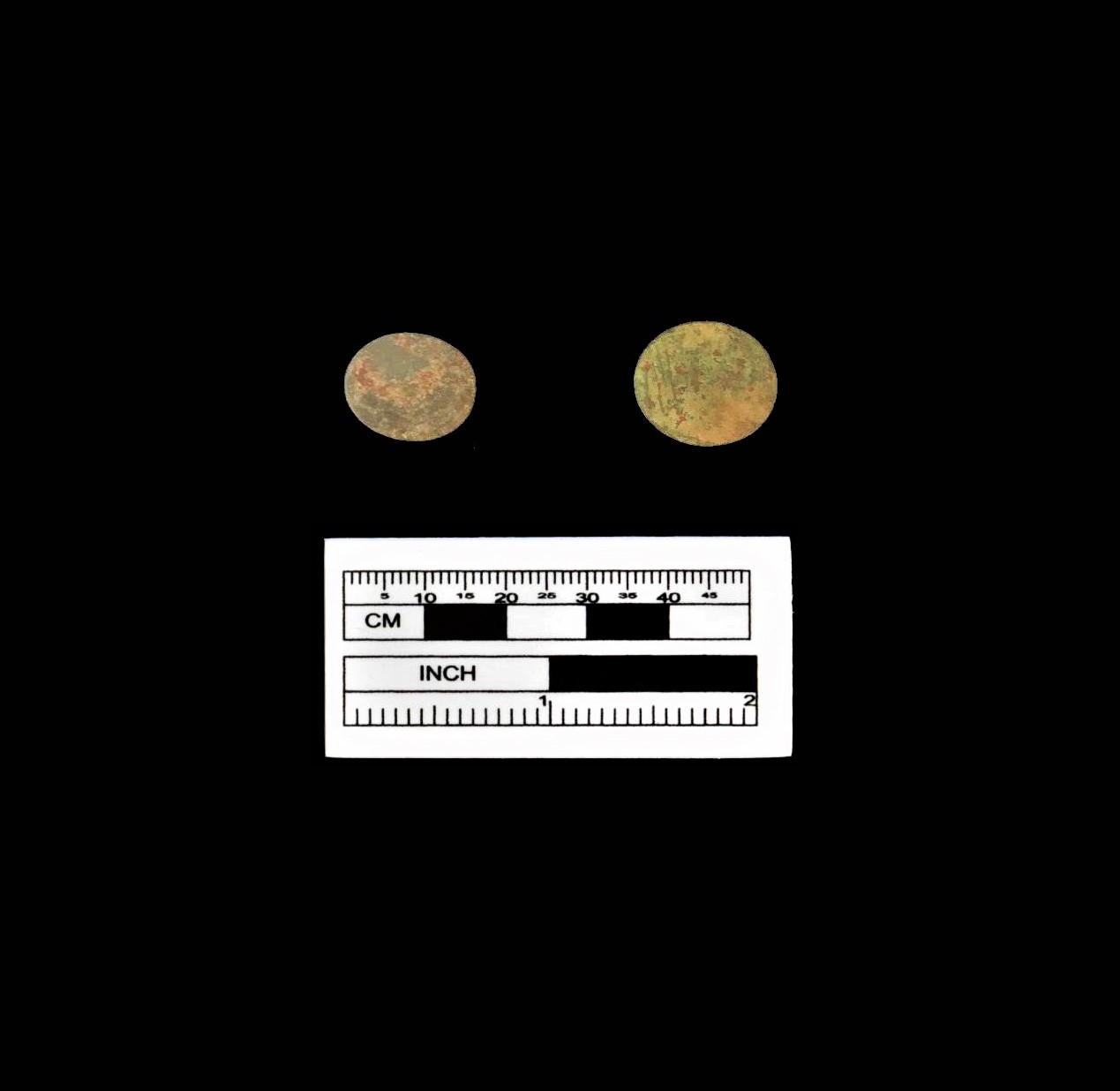
    Two metal buttons most likely from men’s garments.  Source: Ferry Farm Archaeological Collections
    Bone buttons Source: Ferry Farm Archaeological Collections
    Pins were used for pinning jackets closed and keeping caps pinned to your hair.  They were a necessary part of dressing. Source: Ferry Farm Archaeological Collections

    A small sample of the large collection of brass dress pins found at Ferry Farm.  Pins were not used for sewing, as basting before sewing was the regular practice.  Pins were used for pinning jackets closed and keeping caps pinned to your hair.  They were a necessary part of dressing.

    The answer to why this phenomenon is how it is hit me one day after rewatching a lecture given by a former staff member entitled “Betty Washington Lewis and Women’s Health.”  Dr. Kelly Brennen Arehart spoke about maternity wardrobes and how women wore their everyday clothing throughout pregnancy.  For my contemporary mind, this was shocking, but the more I thought about it the more it made sense. 

    Women go through a lot of fluctuations in body shape, weight, and proportions in their lifetime.  Between hitting puberty and development of curves, to many pregnancies, to the changes of menopause, women’s bodies go through so much.  Of course in between all of the big changes, there are also changes to the female body based on time in her menstrual cycle, metabolism fluctuations, or periods of eating more or less or different types of food that all change the body’s shape and size.  Unlike today, women of the past could not just go to the shop and buy a pair of pants in the size up.  Clothing was incredibly expensive and time consuming to make before sewing machines and mass production come into play.  In the 18th century, even the highest classes of women did not have the money or the time to go buy or have new clothing made when they gained a few pounds or got pregnant.  It was a matter of adjusting the clothing they already had.  And that is exactly what ties, pins, and laces allowed women to do. 

    The lacing, pinning, and tying made clothing far more adjustable compared to the rigidity of buttons.  Women tied their petticoats looser and simply covered the wider gap in the side with their jacket or gown.  Stays were either loosened significantly by the laces or they were left unlaced at the bottom entirely, especially in cases of late term pregnancies.  On top of the stays, jackets could be pinned further out to allow for more room in the bust and waist, or a stomacher could be added in the center opening of the jacket to expand the top even further.

    Whether these closures were intentionally created to be adjustable or if it was just a byproduct of lacking clothing technology, I am not entirely sure.  But the idea that buttons were only used on men’s not so fluctuating bodies (for the most part) says something.  A button is sewn down and cannot be easily moved or adjusted on a regular basis.  Once a button is sewn into place, there is no room for variation in body shape, unless one wanted to move the buttons every time he ate a large meal the previous day. 

    Even though Betty Washington Lewis had Charlotte, who we believe to be an enslaved woman acting as the seamstress of the Lewis household, Betty was pregnant on and off for twenty years.  If Charlotte or another enslaved seamstress had to make a maternity wardrobe for Betty every time she was with child, the seamstress would have no time to do any other tasks whatsoever.  It was not economical with precious time or expensive cloth for women to need new clothes every few weeks. 

    So to tie all this together, I am still not happy that it is so inconvenient for me to dress myself in 18th century clothing, but I understand why getting dressed was this way.  The adjustability of women’s clothing was so intentionally created to conform to their bodies in any season it was in.  It also opens my eyes to why pins were so important.  Without them, a woman could not dress. 

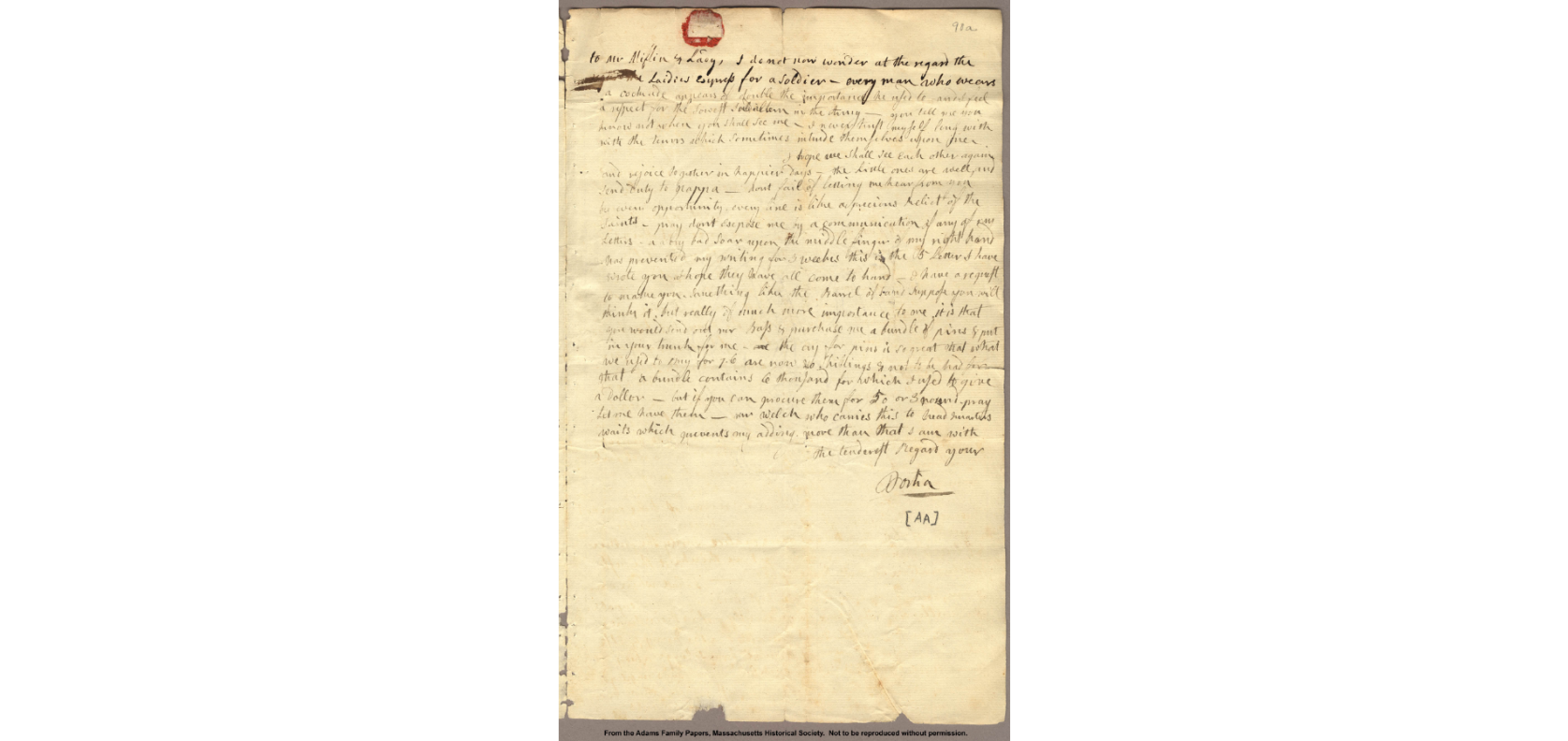
    Letter from Abigail to John Adams, June 14, 1775.  Source: Massachusetts Historical Society

    …I have a request to make you. Something like the Barrel of Sand suppose you will think it, but really of much more importance to me. It is that you would send out Mr. Bass and purchase me a bundle of pins and put in your trunk for me. The cry for pins is so great that what we used to Buy for 7.6 are now 20 Shillings and not to be had for that. A bundle contains 6 thousand for which I used to give a Dollor, but if you can procure them for 50 [shillings] or 3 pound, pray let me have them. Mr. Welch who carries this to head Quarters waits which prevents my adding more than that I am with the tenderest Regard

    your

    Portia


    Allison Ellis

    Manager of Public Programs


    [1] “Questions About Elastic,” Maggie May Clothing, Accessed July 10, 2023, https://maggiemayfashions.com/questions-about-elastic-2/.

    [2] Ninette Dean, “The Up and Down History of the Zipper,” The Smithsonian Libraries and Archives, Accessed July 10, 2023, https://blog.library.si.edu/blog/2010/05/03/the-up-an-down-history-of-the-zipper/.

    [3] Caroline Stone, “The Westward Journeys of Buttons,” AramcoWorld, Accessed July 10, 2023, https://www.aramcoworld.com/Articles/November-2020/The-Westward-Journeys-of-Buttons.

  • George Washington’s Troublesome Teeth

    It’s probably the myth that is more enduring and widespread than any other about George Washington.  At some point from someone, you have heard that George Washington’s false teeth were made of wood.  It is not true.  In reality, his dentures and dental tribulations were more complex than the familiar myth says.  The true story, even when it is uncertain, reveals much more about his life and about life in general in the 18th century.

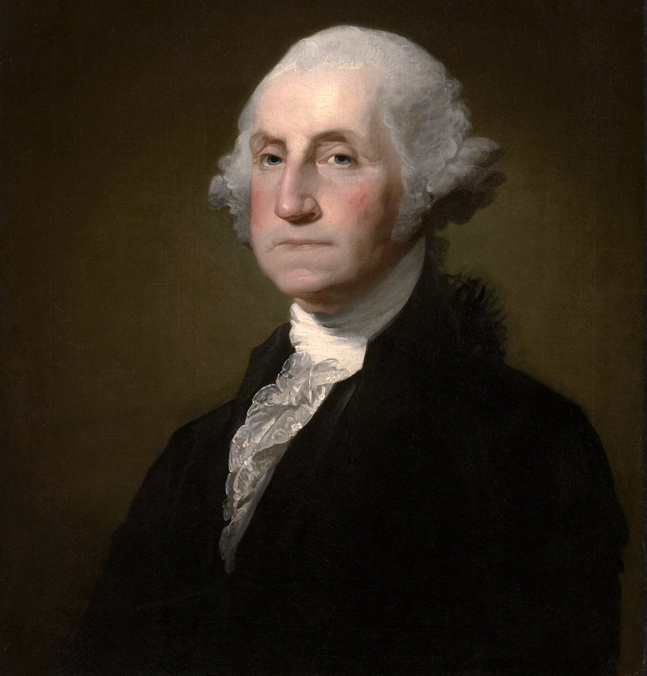
    George Washington by Gilbert Stuart (1798)
    George Washington by Gilbert Stuart (1798). Washington’s dental troubles are even apparent on his face. As the result of his dentures, he kept his mouth closed tightly and the false teeth caused the area around his lips, his lower jaw, and his chin to protrude slightly. Credit: Clark Art Institute

    George Washington had a tooth pulled for the first time in 1756 at the age of 24.  Four years later, George Mercer described Washington’s appearance in a letter, saying “His mouth is large and generally firmly closed, but which from time to time discloses some defective teeth.”   By the time of his first inauguration as president in 1789, George had only one tooth left.

    John Adams by Gilbert Stuart (1821)
    John Adams by Gilbert Stuart (1821) Credit: National Gallery of Art

    The causes of George’s dental problems will never be known with certainty.  According to John Adams, Washington himself “attributed his misfortune to cracking of Walnuts in his Youth.”  Furthermore, Adams hints at one additional potential factor: the common use of mercury in medicine during the 18th century.  Adams described how his doctors gave him sizable quantities of mercury when he was inoculated for smallpox.  The result was, he said, “that every tooth in my head became so loose that I believe I could have pulled them all with my Thumb and finger.”  Adams complained that his doctors “rendered me incapable  …of speaking or eating in my old Age, in short they brought me into the same Situation with my Friend Washington.”

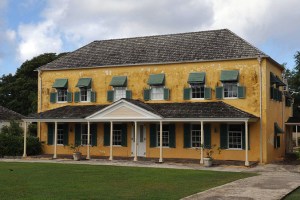
    Washington House, Barbados
    Home of Captain Croftan where Washington lived during the several months he visited Barbados in 1751. Credit: Wikipedia / Jerry E. and Roy Klotz

    For what it’s worth, nineteen-year-old Washington contracted smallpox in November 1751 during a stay in Barbados.  Constantly attended by Dr. John Lanahan, he was sick for 25 days before finally fighting off the deadly disease.  We have no records to tell us precisely how Lanahan treated Washington.  If we consult pages 28-29 of A Rational and Mechanical Essay on the Small Pox published in 1735 by Dr. William Hillary, we find a three-phase course of treatment for pox sufferers. “The first, by bleeding in the first Stations of the Disease; when the Fever is violent: The second by introducing the Practice of Purging, (and Bleeding) in the most dangerous Circumstances attending the second Fever.”  The third phase was employing all known methods to reduce inflammation.  All phases were typical medical practice at the time.

    The purging phase of smallpox treatment is when mercury may have become involved.  The most popular concoction to induce purging in the 18th century was called calomel.  It “was a white tasteless powder which consisted of mercury chloride. When taken in small doses calomel led to the evacuation of the bowels.  If taken over time or in heavier doses, calomel induced heavy salivation, bleeding gums, mouth sores, tooth loss.”  Again, in describing his own brush with smallpox, John Adams noted that his doctors “salivated me to such a degree” with “Milk and Mercury” that all his teeth became terribly loose.

    Young Washington survived his smallpox attack but literally carried the scars of the illness for life.  Back at Ferry Farm in January 1752, Mary Washington twice purchased some ointment from Dr. Sunderland (Sutherland?) to deal with George’s pox-caused facial scars.  The same bill also included a “mercurial purging” for someone. [1]  We should not definitively conclude that medicinal mercury caused George’s life-long dental troubles.  Like most things in history, his difficulties probably had a mix of causes common to the 1700s, including diseases and  “ poorly balanced diet . . . as well as genetics.”

    Regardless of the reasons for George’s defective teeth, Washington ultimately proved “very wise about the message an image can send, and knew that . . . he had to look the part of a leader… which meant at least having teeth.”

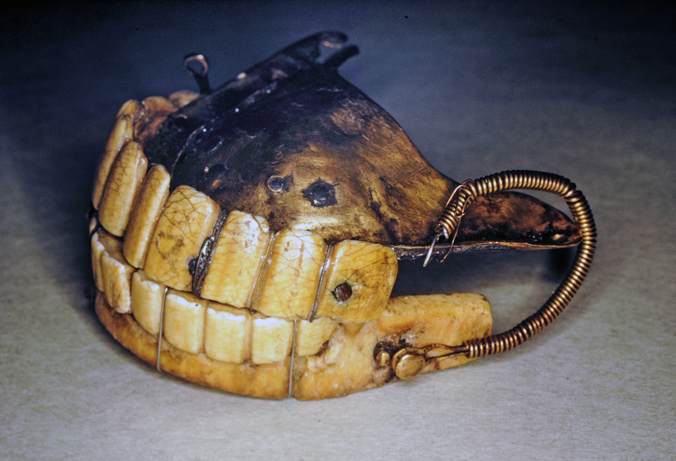
    George Washington - Full Dentures, Now Incomplete Set
    A set of Washington’s dentures as once owned by the Baltimore College of Dental Surgery, Dental School, University of Maryland. This older image shows both the lower and upper portions. Only the lower portion of these dentures is now present and on display at Baltimore’s Dr. Samuel D. Harris National Museum of Dentistry. Credit: National Museum of Dentistry

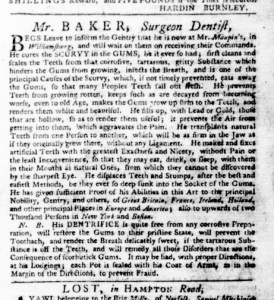
    Baker's Ad in the VA Gazette
    John Baker advertised his services as a Surgeon Dentist in the January 2, 1772 edition of the Virginia Gazette.

    Accordingly, as he lost more teeth, George replaced them with partial dentures and then eventually full dentures.  Surgeon Dentist John Baker, who we first wrote about here, became George’s regular dentist in 1772.  Baker stayed at Mount Vernon in October 1773 and received two substantial payments of £8 total from Washington that same month.  Baker was the first to make false teeth for George, creating a partial denture of ivory for wiring to his natural teeth.

    The tooth loss continued, however.  In 1783,Washington asked Baker “for some of the Plaister of Paris, or that white powder with which you take (in wax) the Model of the Mouth for your false teeth—and directions how to mix, & make use of it—When you have done this, I can then give you such a Model as will enable you to furnish me with what I want.”  It seems it was time for another new set of dentures.

    A month later, though, Washington took on a new dentist: Jean-Pierre Le Mayuer, who probably made him another partial denture.  Additionally, Le Mayuer practiced the relatively common 18th century dental technique of transplanting, in his words, “good living teeth in the Room of those which were broken or otherwise decayed.”  At first, Washington seemed skeptical about the practice.  He needed to replace his teeth but “(not by transplantation, for of this I have no idea, even with young people, and sure I am it cannot succeed with old).”  Eventually, his mind seemed to be changed somewhat by Richard Varick’s testimony of Le Mayuer’s skills.  That said, there’s little recorded describing the care Le Mayuer provided Washington.

    Despite George’s skepticism, Le Mayeur’s use of human teeth in his practice was not unusual for the time. A patient’s own pulled teeth might be used in their dentures.  Teeth from other people, especially the poor and enslaved, were bought and even harvested from the dead for use in dentures or transplanting.  In fact, “Wherever Dr. Le Mayuer practiced, he sought out through newspaper ads ‘Persons who are willing to dispose of their Front Teeth.’  While in New York, he advertised that he would pay two guineas each for good front teeth; in Richmond, he stipulated ‘slaves excepted.’”  Did this mean Le Mayeur would not pay for teeth from slaves or is it a Frenchman’s corruption of the word “accepted”?  It seems, in fact, he was willing to pay for the teeth of enslaved people for, in May 1784, Lund Washington, who was managing Mount Vernon while George commanded the Continental Army, recorded just over £6 “cash pd Negroes for 9 Teeth on Acct of Dr. Lemoire.”

    Washington definitely used human teeth in his dentures but we do not know if they were teeth from slaves.  He probably did use his own in some dentures.  Back in 1782, when John Baker was still his dentist, George wrote to Lund Washington instructing him that “In a drawer, in the Locker of the Desk which stands in my Study, you will find two small (fore) teeth; which I beg of you to wrap up carefully, & send inclosed in your next Letter to me. I am positive I left them there, or in the secret drawer in the locker of the same desk.”  It is believed “Washington hoped that these original teeth could be used within new dentures that were being fitted for his use.”

    George Washington - Full Dentures, Complete Set
    Washington dentures made by John Greenwood. Courtesy of Mount Vernon Ladies’ Association.

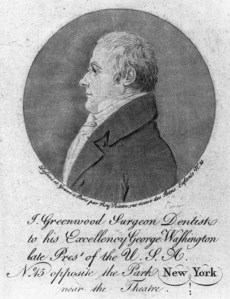
    John Greenwood
    Engraving of John Greenwood by Roy Peintre. Credit: Library of Congress

    “The only complete set of Washington’s dentures that still survives . . . is made of animal and human teeth, lead, and ivory.”  John Greenwood, who served as Washington’s dentist throughout the 1790s, made them out of hippopotamus ivory, horse or donkey teeth, human teeth, gold wire springs, brass screws, and lead.  Greenwood left a gap in this set for the one remaining tooth Washington had left.  Inevitably, that tooth finally had to be pulled and Washington presented Greenwood with this tooth as a gift, which hung on his watch chain inside a glass locket.


    George Washington suffered a lifetime of dental troubles.  The causes of those troubles and the attempted solutions were typical of the 18th century and teach us much about both Washington’s life and the lives of his fellow early Americans. The real story of Washington’s false teeth, even when uncertain, reveals more about his life and his times than any stale wooden myth.

    Zac Cunningham
    Manager of Educational Programs

    [1] Paula Felder, Fielding Lewis and the Washington Family: A Chronicle of 18th Century Fredericksburg, The American History Company, 1998: 103.

  • “Shews, Games, Sports, Guns, Bells, Bonfires and Illuminations”: Celebrating Independence

    Johannes Adam Simon Oertel. Pulling Down the Statue of King George III, N.Y C. ca. 1859. Oil on canvas. Artist Johannes A. S. Oertel, working in the mid-nineteenth century, provides an imagined depiction of the destruction of George III's statue in Bowling Green, the first victim of New Yorkers' reaction to hearing news of the Declaration of Independence. Oertel places women, children and Native Americans among what eyewitnesses recorded as a rowdy crowd of soldiers and civilians. No true image of the statue itself survives. However, contemporary descriptions inform us that the King was sculpted in Roman garb, not the eighteenth-century royal dress shown in the painting. More accurate is the view of the statue reconstructed by Charles M. Lefferts at right.
    Pulling Down the Statue of King George III, NYC (ca. 1859) by Johannes A. S. Oertel. Painting in the mid-1800s, Oertel created a thrilling but historically inaccurate depiction of  New Yorkers destorying a statue of George III after hearing news of the Declaration of Independence.  The event did happen but much of Oretel’s painting is fanciful. Public domain. Courtesy: Wikipedia.org

    Writing to wife Abigail following Congress’s adoption of the Declaration of Independence, John Adams famously outlined his vision for how future generations would celebrate the historic moment. “I am apt to believe that it will be celebrated, by succeeding Generations, as the great anniversary Festival,” Adams wrote in an oft quoted passage. “It ought to be commemorated, as the Day of Deliverance by solemn Acts of Devotion to God Almighty. It ought to be solemnized with Pomp and Parade, with Shews, Games, Sports, Guns, Bells, Bonfires and Illuminations from one End of this Continent to the other from this Time forward forever more.”

    Adams’ prediction was borne out immediately.  News of independence spread from Philadelphia across the new American states like a circle of ripples on a great lake.  By July 10, 1776, the first word arrived in Fredericksburg, Virginia, hometown of General George Washington and where his mother Mary still lived.  Indentured servant John Harrower, who served as tutor for Colonel William Daingerfield’s family at Belvidera plantation about seven miles downstream from Fredericksburg on a bluff overlooking the Rappahannock, recorded the moment in his journal. [1]

    “Wednesday 10th. At 6 pm went to Mrs. Battaile’s & teach’d until sunset and then returned home & soon after hea[r]d a great many Guns fired towards Toun. About 12 pm the Colo. Despatc[h]ed Anthy. Frazer there to see what was the cause of [it?] who returned, and informed him that there was great rejoicings in Town on Accott. of the Congress having declared the 13 United Colonys of North America Independent of the Crown of great Britain.” [2]

    July-4-2015 (16)
    Young members of the Continental Army recreate a charge during Fourth of July at Ferry Farm!

    Some days later, on July 26, when the Declaration was officially read out in Williamsburg, Virginia’s capital, the proclamation was made “amidst the acclimations of the people, accompanied by firing of cannon and musketry, the several regiments of continental troops having been paraded.”

    One year later, Adams prediction continued to bear fruit, as the infant nation celebrated its First Birthday.  In Charleston, South Carolina, on July 4, 1777 “ringing of bells ushered in the Day” and “At sun-rise American colours were displayed from all the forts and batteries, and vessels in the harbour.”  There was a parade of military troops and then “at one o’clock the several forts, beginning at Fort Moultrie on Sullivan’s Island, discharging seventy six pieces of cannon . . . and the militia and artillery fired three general vollies.”  The new state’s leaders gave a banquet with thirteen toasts and “double the number [of guests] that ever observed the birthday of the present misguided and unfortunate King of Great Britain.”  To end the day-long celebration, “the evening was concluded with illuminations, &c. far exceeding any that had ever been exhibited before.”.

    Back north, in Philadelphia, Pennsylvania, ships were also “dressed . . . with the colours of the United States and streamers displayed.” The crews climbed into the rigging and stretched out across the yardarms to salute the day and each ship fired thirteen cannons. On land, a banquet was held for Congress during which “The Hessian band of music taken at Trenton the 26th of December last, attended and heightened the festivity with some fine performances suited to the joyous occasion, while a corps of British deserters, taken into the service of the continent by the State of Georgia, being drawn before the door, filled up the intervals with feux de joie.” A feu de joie, French for “fire of joy”, is the firing of guns into the air in quick succession. It is sometimes described as a “running fire of guns.”. The dinner also included many toasts.  The late afternoon featured a parade of military troops and the ringing of bells. “At night there was a grand exhibition of firework, which began and concluded with thirteen rockets.”

    July-4-2015 (13)
    After flying for a year over Washington’s boyhood home, one U.S. flag is retired replaced with a new flag during the Patriotic Flag Retirement Ceremony at Ferry Farm’s Fourth of July celebration.

    Whether in Virginia in 1776 or South Carolina and Pennsylvania in 1777, all of these acts of celebration were quite traditional and had been used for decades to celebrate the monarch’s birthday each year.  In 1727, Willliamsburg marked the king’s birthday.

    “The colors were displayed at the Capitol and salvos fired from the cannon at the Palace, at the forts, and on board the king’s ships in Virginia waters at the time.  In the evening the Capitol, the Palace, the College, and ‘most of the Gentlemen’s and other House of Note’ were illuminated and bonfires were sometimes set in public squares in the city.  At the governor’s dinner the drinking of all the loyal healths consumed a great deal of time, a variety of choice wines and liquors, and a large store of gunpowder. The populace was sometimes treated to ‘plenty of liquor’ and drank the same healths outside the Palace or at one of the taverns. The day’s festivities closed with the governor’s ball for all the ladies and gentlemen in town.” [3]

    More than two centuries later, we still celebrate the Fourth of July with decorations of red, white, and blue, ubiquitous American flags, military parades, cannon fire, large amounts of food, the enjoyment of spirited beverages, music, and fireworks.  John Adams vision was far-reaching indeed!

    Zac Cunningham
    Manager of Educational Programs

    Celebrate Independence Day where George Washington spent his boyhood years!

    July-4-2015 (5)
    See more photos from last year’s Fourth of July at Ferry Farm here.

    This year’s theme, “We The People” focuses on The Declaration of Independence with a variety of activities and entertainment for young and old alike. Learn about archaeology at Ferry Farm, enjoy a patriotic flag retirement ceremony,interact with colonial and Civil War re-enactors as well as members of the Patawomeck tribe, listen to patriotic music, and participate in educational programs, crafts and games, and hands-on activities for the whole family.  Visit kenmore.org/events.html to learn more.

    Cost: $1 per person
    Parking: Eagles Lodge – 21 Cool Spring Road Fredericksburg, VA 22405
    Shuttles will run between the Eagles Lodge and Ferry Farm.

    [1] John Harrower, The Journal of John Harrower: An Indentured Servant in the Colony of Virginia, 1773-1776, edited by Edward Miles Riley, Williamsburg, VA: Colonial Williamsburg, 1963: xvi.

    [2] Harrower, 158.

    [3] Jane Carson, Colonial Virginians at Play, Williamsburg, VA: Colonial Williamsburg Foundation, 1989: 93.