Archaeologists tend to have strong feelings about ceramics. Ceramics can play a major role in interpreting a site, as their materials often reflect their function. This can be helpful when determining how a site was used. For instance, finding an abundance of redwares and stonewares could indicate a primarily utilitarian site like what would have been used in our Cellar House whereas porcelain and refined earthenwares may reflect a more domestic space. So, it really isn’t surprising that we feel some type of way about these artifacts.
Redware and stoneware storage vessels Porcelain and refined earthenware tablewares
But don’t let that fool you. Archaeologists have feelings about ceramics based solely on their appearance as well. It has come to my attention that Whieldon Ware just might hold the title as the most polarizing ceramic type as of late. These feelings were made very apparent during our recent acquisition of some Whieldon Ware pieces. Most either love or hate it; rarely is there an in-between. Before we get into the ceramic and its distinct look that conjures images of either vomit or a work of art (depending on whom you ask), let’s go over a little background on its creator, Thomas Whieldon.
Thomas Whieldon was an influential English potter producing examples of early creamware beginning in the mid-18th century. He gained popularity for his innovative shapes and decoration, which can be seen on various figurines, dishes, and other vessels. Whieldon is also well known for his partnership with the MVP of the ceramics world, Josiah Wedgwood, Mr. Creamware himself. Together, they developed advances in the realm of refined earthenware, like the perfecting of the green glaze as seen on the pineappleware we have found at Ferry Farm (Wedgwood & Ormsbee, 1947).
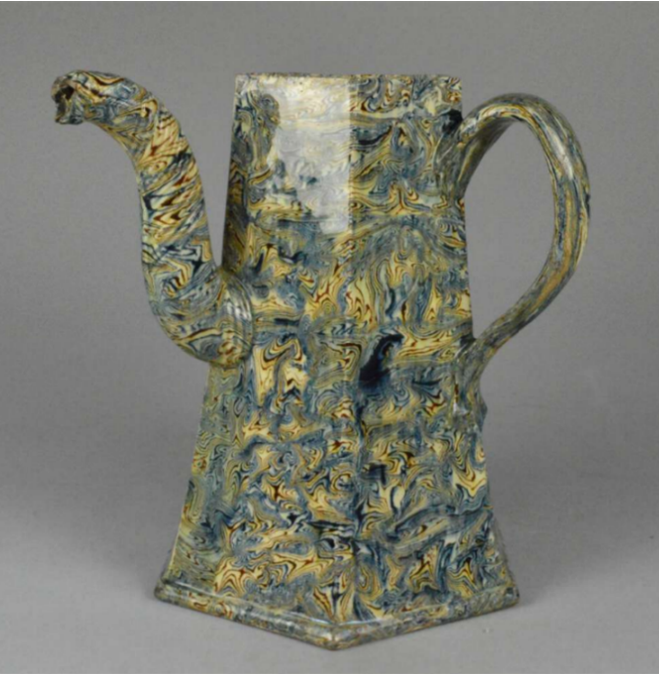
Whieldon agate ware coffee pot. Source: British MuseumWhieldon figurine. Source: The British Museum.
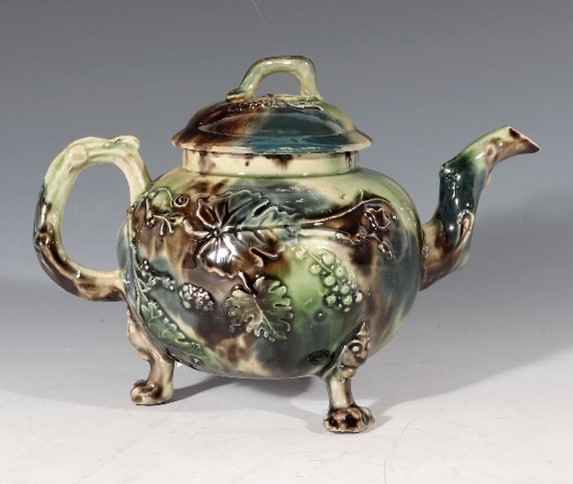
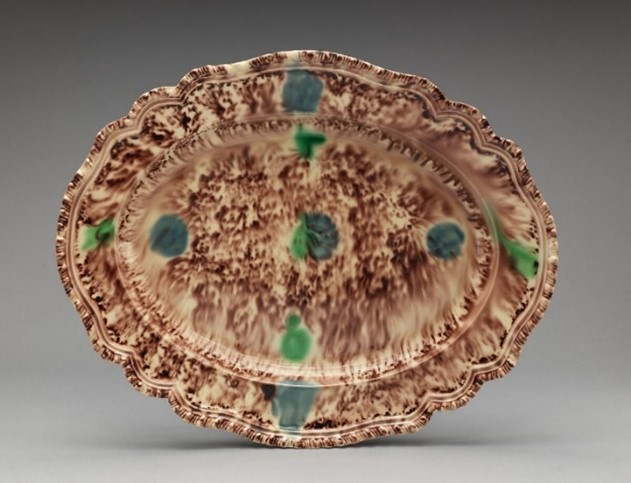
With that said, what we commonly think of when referring to Whieldon Ware is Whieldon’s tortoiseshell or clouded wares. These were created by sponging metal oxides on cream-colored earthenware and then adding a clear lead glaze. The mixing of the metal oxides with the liquid glaze caused the colors to blend and streak, creating splotches of green, yellow, purple, blue, and brown, depending on the types of metal oxides used (Gallagher, 2015). This resulted in a clouded or tortoiseshell decoration. Due to the nature of the technique, no two pieces look exactly the same. For Whieldon lovers like myself, the uniqueness of each piece gives it its charm.
Examples of Whieldon’s tortoiseshell/clouded ware with similar decoration to sherds found at Ferry Farm – Teapot. Source: Earle D. Vandekar of Knightsbridge, IncExamples of Whieldon’s tortoiseshell/clouded ware with similar decoration to sherds found at Ferry Farm – Platter. Source: Met Museum
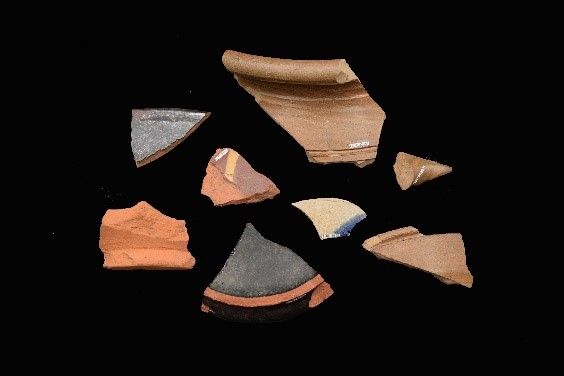
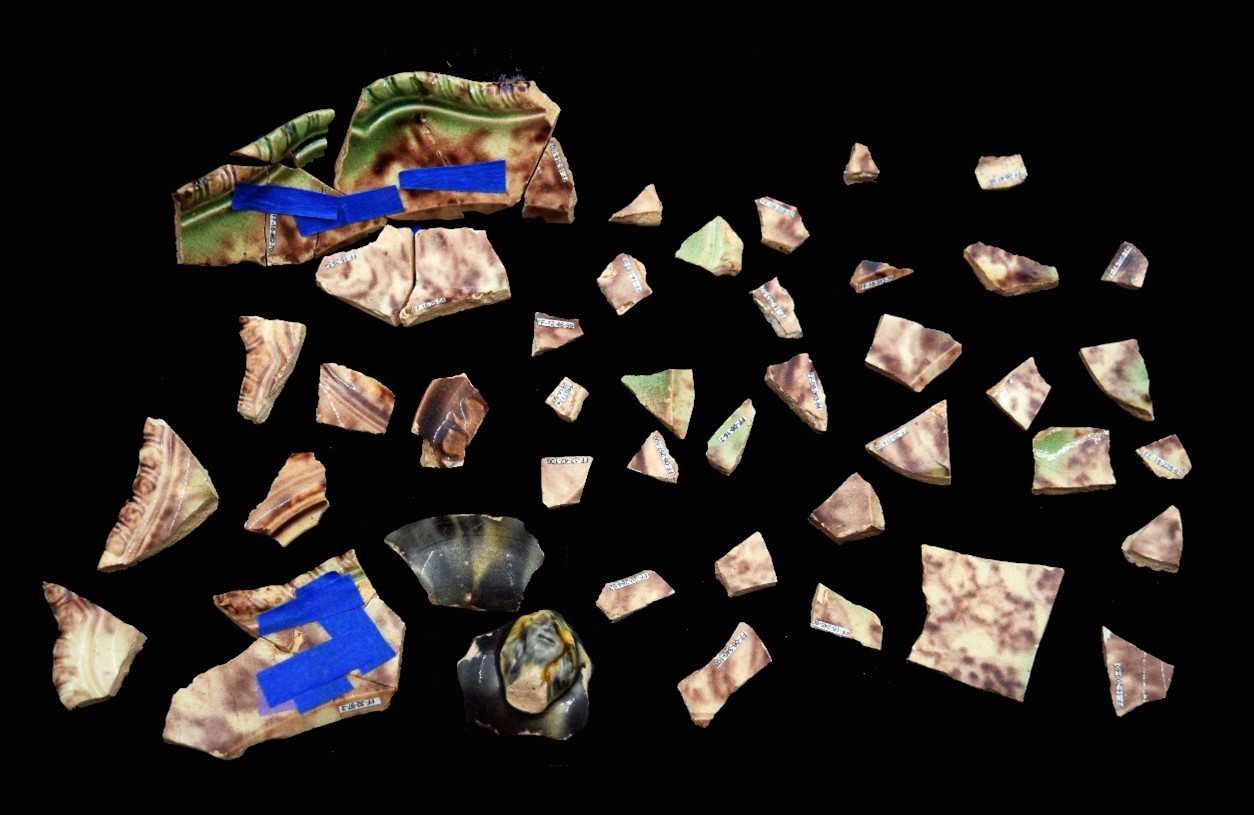
Now that we know more about Whieldon Ware and how some of us feel about it today, let’s talk about how Mary Washington may have felt about it. I firmly believe that she was not team Vomit Ware and instead found the decoration quite desirable. Our excavations have found evidence of at least four Whieldon Ware plates, a teapot, teacup, and other medium-sized holloware vessels at Ferry Farm. Considering the short-lived popularity of the type, lasting only from 1740-1775, we can be quite certain that it was Mary who was buying these items.
Some Whieldon Ware vessel mends and sherds excavated at Ferry Farm
Toward the end of the 1770’s, Whieldon Ware quickly went out of style and was replaced by Wedgwood’s new, improved creamware and its more subtle decoration. While it may have gone out of style, potters continued to replicate the technique for many years, which makes it difficult to attribute all examples of the type to Whieldon himself. After 1780, he retired from the business, demolished his factory, built an ornamental garden in its place, and spent the rest of his years as a sheriff (Hildyard, 2005; The London Gazette, 1785).
So, there you have it, the very brief story of Whieldon and his wares.
While Mary Washington and a couple of us in the lab are Team Whieldon all day, every day (or at least the days concerning Whieldon), the majority are a hard pass. Where do you stand? Are you Team Whieldon or team Whieldout?
Danielle Arens
GWF Archaeologist
References
Gallagher, B. (2015). British Ceramics 1675-1825: The Mint Museum. Charlotte: The Mint Museum.
Hildyard, R. (2005). English Pottery 1620-1840. London: V&A Publications.
The London Gazette. (1785, November 12). The London Gazette(12699), p. 522.
Wedgwood, J., & Ormsbee, T. H. (1947). Staffordshire Pottery. New York: Robert M. McBride & Company.
The 18th century was dominated by the ideas of the Enlightenment which gave rise to a range of principles like liberty, equality, constitutional government, and free enterprise. It was a revolution in thought led not by politicians and soldiers, but by a handful of thinkers, scientists, artisans, and merchants. Josiah Wedgwood was a thinker, scientist, artisan, merchant all rolled into one. He became one of the founding fathers of the industrial revolution, creating a new artistic industrialism that used the division of labors, scientific experimentation, and commerce to make affordable yet quality products that democratized artistry.[1]
Josiah Wedgwood (1780) by George Stubbs. Enamel on a Wedgwood ceramic tablet at the Wedgwood Museum in Barlaston, Stoke-on-Trent, England. Credit: Wedgwood Museum / Daderot / Wikipedia
In his heart, Wedgwood believed that man could create a better world through self-improvement, education, and commerce. Although he lived in England, he saw the American colonists’ struggle against taxation imposed on them and America’s potential as a capital of finance and freedom smothered under a foreign ruler. He was naturally sympathetic to their plight. Wedgwood spent the Revolutionary War trying to walk the fine line between being a patriotic British merchant and a radical dissenter.
Josiah Wedgwood was born in July of 1730 in Burslem, England to a family of potters that stretched back more than four generations. When he was a child, he survived a bout of small pox that left his left leg too weak to work a potter’s wheel. This led him to focus his energies on design rather than the physical production of ceramics.[2]
In 1759, he set up his own pottery called Ivory Works. The pottery had swift success and became one of the largest manufacturers of Staffordshire pottery, known particularly for fine earthen and stonewares. Demand for quality minimalistic earthenware design was high among the English at the time. Wedgewood devoted himself to glaze development, kiln technology, and marketing to fulfill demand. He perfected a cream-colored earthenware which took over 5000 glaze tests to get the color just right. He developed a new colored unglazed body known as “jasper” that allowed for the production of two-color ornamental wares to match the public’s desire for minimalistic, neo-classical styling.[3]
Wedgwood became a producer of fine ceramics and transformed pottery-making into an industry that rivaled European porcelain in elegance of shape, durability, and lightness of weight. In 1765, shortly after opening his first London showroom, he got a huge break when he was invited to take part in a contest to design a tea set for Queen Charlotte. It took months of experiments but his gilded tea set with green flowers won the competition. With royal recognition, Wedgwood became a Georgian super brand, distinguished by quality while delivering artistic perfection on an industrial scale.[4]
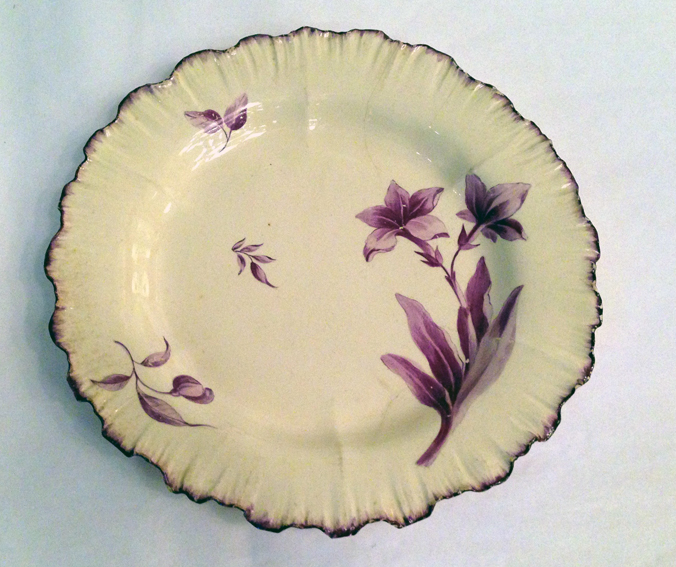
Dating from about 1765, this circular Wedgwood plate has a molded shell edge and is finely painted in deep purple with flowers and leaves. The edge is feathered in purple.
Why was America so important?
In the middle of the 18th century, a new consumer group appeared: the middling class. This middling class was particularly prevalent in the American Colonies. They wanted British goods like sugar, coffee, chocolate, and tea and their accompanying accessories and ceramics to show off their new social status and refinement.[5]
Pre-Revolutionary War, America did not have a single pottery manufacturer to create tea accoutrements like teapots and saucers capable of matching the quality and aesthetic of Wedgwood. Thus, America became a good client in the booming British export trade and one of Wedgwood’s most important overseas markets. The colonies, in fact, became such a huge market that “around half of all English exports of copperware, ironware, glassware, earthenware, silk goods, printed cotton and linen goods, and flannels were shipped to colonial consumers.” Josiah took advantage of this boom and packed as many crates as possible on Liverpool ships bound for the New World.[6]
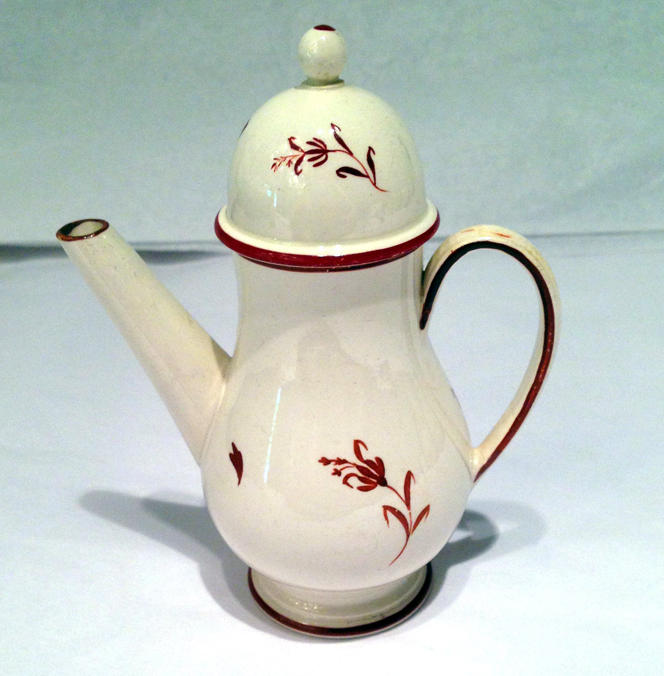
This miniature covered creamware Wedgwood coffeepot dates from between 1785-1800. It has a plain loop handle, straight spout, and knob finial and is painted with underglaze iron red scattered flower sprays and border stripes. The lid is dome-shaped.
“All the world are with the Ministers & against the poor Americans…”
There were two reasons why Josiah Wedgwood disagreed with the war against America, one was philosophical and one was financial. Wedgwood enjoyed the American boom in ceramic exports and worried about what taxation and colonial unrest might have upon his trade. Many businessmen with interests in America saw a threat to the market for British goods with undue taxes like the Stamp Act of 1765. They agreed with future Prime Minister Lord Pitt’s criticism “that this kingdom has not right to lay a tax on the colonies…Trade is your object with them and taxing was ill advised. If you do not make suitable laws for them, they will make laws for you.” Because of the strong opposition from merchants and American resistance, the Stamp act was repealed. However, that did not ease the anxieties of Wedgwood and other merchants.[7]
Wedgwood knew he had much to lose if American markets became inaccessible because of war stating, “the bulk of our particular manufacture you know is exported to foreign markets for our home consumption is very trifleing [sic] in comparison to what is send aboard, …this trade to our Colonies.” He continued, “we are apprehensive of losing in a few years.”[8]
Legislation continued to cut into Wedgwood’s trade and profits. Besides imposing an indirect tax on the colonists, the Townshend Acts of 1767 got rid of a refund on the duty that manufacturers paid, which meant it would cost more to export goods to the colonies. In 1775, Parliament issued the New England Restraining Acts, restricting the Colonies’ trade and commerce to Great Britain, Ireland, and the British West Indies. This was Parliament’s response to the declaration of the Continental Congress in the fall of 1774 instigating a “non-consumption agreement” and promising “we will not import, into British America, from Great Britain or Ireland, any goods, wares, or merchandise whatsoever.” By the next year, diplomatic and commercial relations had broken down and, three months before the Declaration of Independence was signed, American ports were officially closed to British trading ships.[9]
This all had a major effect on commerce for merchants and manufacturers like Wedgwood. In 1770, customs and excise officers recorded over 1.2 million pieces of glass and earthenware shipped to America. In 1775, less than 139,000 pieces had been shipped.[10]
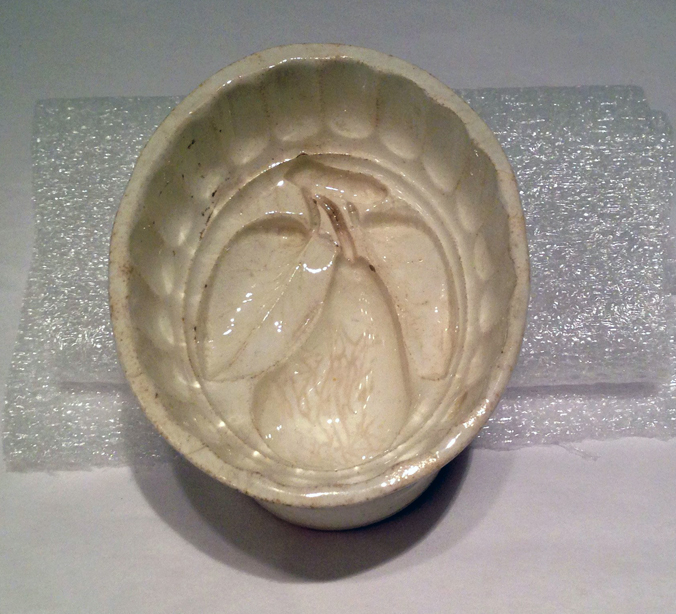
An oval form with a tall, off-center oval foot rim. The inside is molded with fluted sides, a deep pear, and two flanking leaves on bottom. This Wedgwood form dates from between 1810 and 1820.
Enlightenment Philosophy at Work
While war took a large chunk out of Wedgwood’s bottom line, that was not the only reason he opposed war. He was a man of the Enlightenment and held fast to many of the philosophical principles that formed the basis for this new America.
Josiah was born and raised a Unitarian. The seven principles of Unitarianism include the belief in the inherent worth and dignity of every person, the free and responsible search for truth, the use of democratic process, and peace, liberty, and justice for all. Wedgwood grew up in a society that created its own culture distinct from the Anglican status quo, a culture with a strong sense of morality and responsibility. So his interests in the ideas of the Enlightenment were not too surprising.[11]
Josiah delved into the Enlightenment, reading many of the writings from the great thinkers of the time including John Locke’s Treatise on Education, Adam Smith’s Wealth of Nations, and Thomas Paine’s Common Sense. They all talked about concepts of self-improvement, education, liberty, and inalienable rights. Wedgwood truly believed in these principles and put them into practice in his own life and business by trying to use his company and wealth for the social good. He reinvested profits back into the company to create a better standard of living for the employees in under his care. Schools were started for the workers’ children, additional training was made available for workers, and work place safety was improved with the elimination of harmful lead glazes and the constant search for better environmental practices. He believed that the people mattered more than the profit.[12]
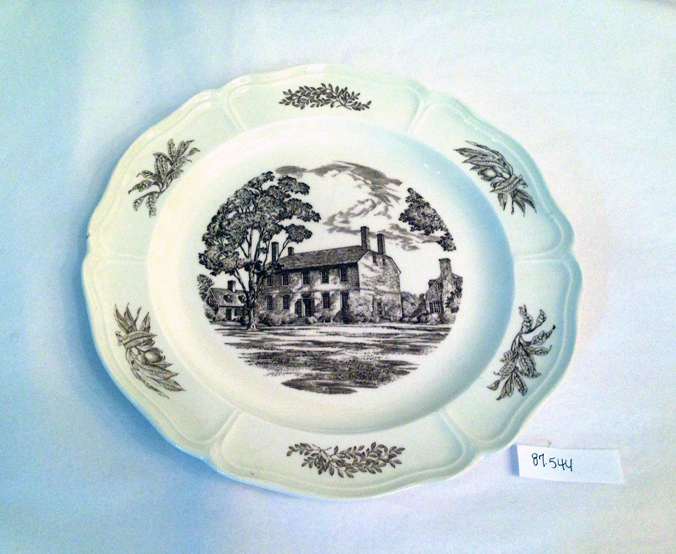
A “Queen’s” shape Wedgwood plate from 1956 with a view of Kenmore as the center transfer-print. The six lobed rim is transfer-printed in brown with various leaves.
With the American Revolution and then the French Revolution, he saw a chance to create societies built upon Enlightenment philosophies that could flourish without an authoritarian regime and without imposition of unnecessary taxation. A society ruled by reason, truth and free enterprise. Wedgwood’s idealism was high. Life does not always follow abstract principles, however, and he would struggle to balance his ideals with political, financial, and social realities.[13]
He supported America’s right to self-rule and knew the colonists were a force to be reckoned with commercially. Yet, he was also a British businessman with a prominent reputation. At home, he had to balance his principles with his need to seem patriotic. He tried to stress to government ministers the economic devastation a war would have on Britain but he was clear in his opinion of “the absurdity, folly & wickedness of our whole proceedings with America.”[14]
Wedgwood lived to see America’s victory in the struggle for independence, passing away in January 1795. He and his business had survived the war with their Enlightenment ideals and financial success intact.[15]
Heather Baldus
Collections Manager
[1] Wilson, A.N., The Genius of Josiah Wedgwood, BBC Two, April 19, 2013.
[3] Perry, Mike. “WEDGWOOD (JOSIAH WEDGWOOD & SONS LTD),” Pottery Histories potteryhistories.com/page99.html; Wilson, The Genius of Josiah Wedgwood; “Josiah Wedgewood (1730-95) ,” The Royal Collection Trust.
[4] “Josiah Wedgewood (1730-95) ,” The Royal Collection Trust; Wilson, The Genius of Josiah Wedgwood.
[5] Berg, Maxine. “Men and Women of the Middling Classes: Acquisitiveness and Self-Respect.” Luxury and Pleasure in Eighteenth-Century Britain, Oxford University Press, 2007, 199-246; Dolan, Brian. Wedgwood: The First Tycoon. New York City, Viking, 2004, 74-75; Wilson, The Genius of Josiah Wedgwood.
[6] Wilson, The Genius of Josiah Wedgwood; Dolan, 250, 75.
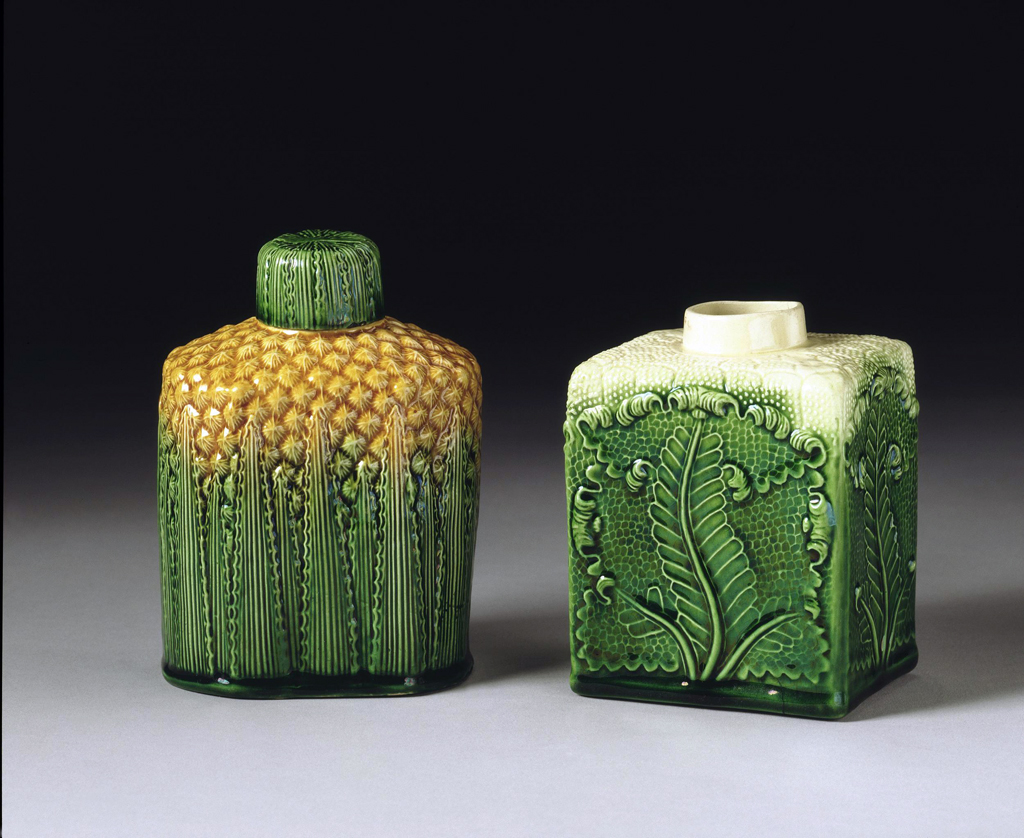
Fads come and go. Such is life. Eighteenth century colonists were not immune to flash-in-the-pan trends. However, given that information traveled a bit slower before the digital age, in the 18th century a ‘quick trend’ may have lasted 10 or 20 years, instead of 10 or 20 months. Such is the case with ‘vegetable ware’, a refined earthenware molded to look like produce. Imagine being the envy of all your colonial neighbors if you served them tea out of an elaborate ceramic cauliflower, pineapple, melon, or cabbage. As evidenced by the archaeological record, Mary Washington, George’ mother, was similarly taken with the prospect of displaying her very own veggie-themed teaware.
The advent of vegetable ware seems to coincide with the development of bright green and yellow pottery glazes by a young and upcoming potter named Josiah Wedgwood in 1760. He used these new flashy glazes for a number of applications, including coloring teaware molded to resemble produce. While some combinations of ceramics and decorations had previously enjoyed decades or even centuries of popularity in the past, the demand for the initially popular vegetable ware seemed to drop off after only ten years, around 1770. At that time, Wedgewood indicated he was glad to send a shipment of overstocked vegetable ware to the colonies – a popular dumping ground for out of fashion or slightly damaged English goods.
Mary seemed to prefer the pineapple form and owned at least one item, if not more, of this fruit-shaped tea equipage. Her preference for the tropical fruit design was not unique. In the 18th century, the pineapple was an incredibly sought after luxury item loaded with symbolism. Today, many of us, especially along the East Coast, associate the pineapple with welcoming guests into our home and as a decoration for the holidays. Colonial Americans considered it a Christian symbol as well as a display of status. They readily incorporated it into the architecture of their houses, decorated room interiors with the motif, and served food and beverages out of pineapple-shaped objects. These were all cheaper options than displaying an actual pineapple, which was well outside the price range of the average colonial American. In fact, there are accounts of people actually renting a real pineapple for a party rather than purchasing one outright. Rented fruit! Let that sink in for a second.
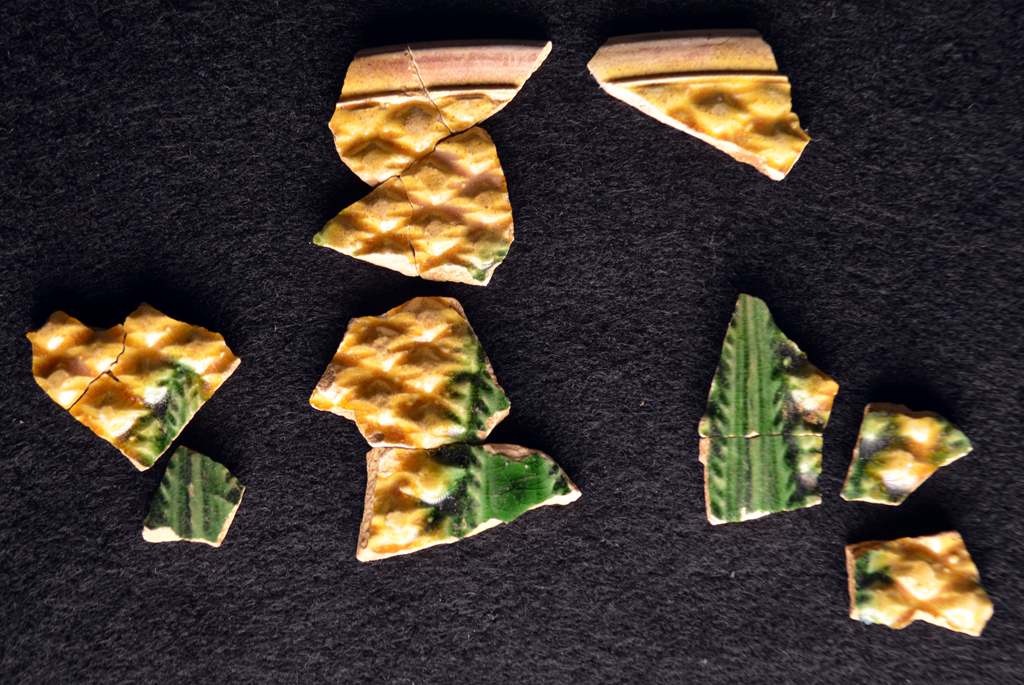
Returning to Mary’s ceramic pineapple, which is represented archaeologically by a dozen or so sherds. It is almost certainly some type of tea equipage, although we are not exactly
Vegetable ware sherds excavated at George Washington’s Ferry Farm.
sure which tea vessel it may be. The pineapple color and texture are unmistakable but we’ve yet to identify the specific object. A number of forms have been ruled out. It is not a tea or coffee pot because it appears to be relatively squat with a straight or very gently sloping body and a wide rim. What’s especially odd about this particular vegetable ware vessel is that the rim is unglazed. This would seem to suggest that it sported a lid of some kind or perhaps endured a defect during firing. Hopefully more of the vessel will come to light, we’ll be able to answer the question, and proudly display pineapple teaware in the newly recreated Washington house!
Mara Kaktins, Archaeologist
Ceramics & Glass Specialist