Several weeks ago, staff from George Washington’s Ferry Farm went hunting for objects to go into the reconstructed Washington house, which will be fully furnished with reproduction pieces to allow our visitors to sit on the chairs, open drawers, and pick up the plates on the table. Finding accurate, well-made reproductions of pieces from the Washington-era is no small feat but staff members have traveled to a variety of flea markets and consignment shops on the hunt for 20th century Colonial Revival objects that will pass as 18th century. Here are a few photos from one of these trips…
On a warm day in September, our intrepid band of archaeology and curatorial staff members set out into Virginia’s Northern Neck to hunt down modern stand-ins for the 18th century ceramics and glassware that were once used by the Washingtons at Ferry Farm. This is just one of the many flea markets and consignment shops that we visited that day.
A porcelain chamberstick, probably made in the 1970s or 1980s to mimic a colonial style. The decoration on this one is what really caught our eye – the blue and orange-red enamel with gilt highlights is known as the “Imari” palette and was often found on Chinese Export Porcelain teawares in the Washingtons’ time.
Ceramics and Glass Specialist Mara Kaktins examines some glass candlesticks for historical accuracy.
A baluster-stem wine goblet, perhaps from the 1930s, that is a pretty good approximation of a similar 18th century wine glass found archaeologically at Ferry Farm.
“Guys, whaddya think??”
A serving dish decorated in a great 20th century approximation of the rare “famille vert” palette found on very early 18th century Chinese Export Porcelain teawares. These dishes were made for Lord & Taylor in the 1980s.
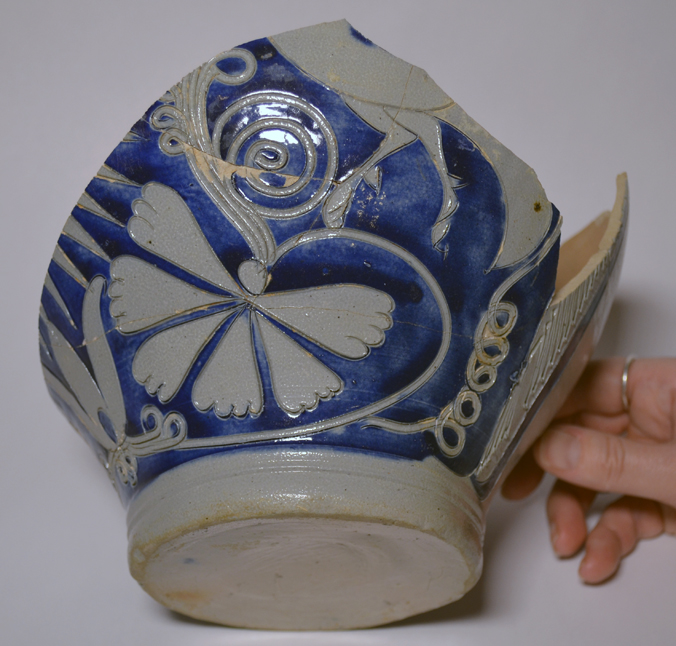
A 20th century earthenware jug decorated in great Westerwald style. We found this one in a shop that specializes in Asian antiques. Go figure!
Did they have umbrellas in the 18th century?
A perfect example of a reproduction redware pitcher!
Archaeology Lab Technician Elyse Adams, Curator Meghan Budinger and Archaeology Lab Supervisor Melanie Marquis tally our haul at the Animal Welfare League thrift shop. Great repros for a great cause!
Another dish made for Lord & Taylor, this time in the “Imari” palette. Interestingly, we found 3 of these Lord & Taylor dishes at 3 different stores – clearly, we were meant to have them.
Bonus to shopping at thrift stores: there’s usually a friendly pooch or two around! Mara says hi to this store dog while holding two very nice 20th century tea bowls that will easily pass for the 18th century version once we remove some of the exterior decoration.
To learn more about the reconstructed Washington house furnishing effort, you might wish to read these blog posts…
At George Washington’s Ferry Farm we’ve just wrapped up a ceramic mending project. We explain how and why we undertake these mending projects in this post. Our most recent effort focused on Westerwald stonewares owned by the Washington family. Stoneware is a high-fired, non-porous ceramic that is excellent for producing storage containers and drinking vessels. But what is a Westerwald, you may ask? Well, Westerwald stonewares were a ceramic produced in the Westerwald region of what is now Germany beginning in the 1500s. Destined for the British Isles and British colonial markets, this particular ceramic is common to archaeological sites in the Chesapeake region.
Westerwalds were salt-glazed, meaning that during the firing process large quantities of salt were introduced into the kiln. The salt vitrified (converted into a glass-like substance) upon contact with the vessels, producing a shiny glaze and a characteristic ‘orange peel’ texture on the surface of the pots. Decorated predominantly with molded and incised designs that are filled with bright cobalt blue and deep purple, Westerwalds are strikingly beautiful.
Jug with a bird motif.
We’ve learned a great deal from analyzing the Westerwalds used by the Washingtons. Many of the vessels identified in the Ferry Farm assemblage were tankards, jugs, and other drinking vessels from which beverages such as ale and cider, a large part of the colonial diet, were consumed. Some tankard handles we’ve excavated have small holes at the top, where a pewter lid — a distinguishing characteristic of German-made steins — was attached. These lids often do not survive in the archaeological record because the metal had value. Rather than being discarded, the pewter was often recycled.
In addition to being aesthetically pleasing, Westerwald drinking vessels often served a political purpose. An excellent example of this is to be found within our assemblage of Westerwalds in the form of multiple mugs emblazoned with the initials ‘G.R.’, meaning Georgius Rex, the Latin for King George. During the time Westerwalds were produced in Germany, three British kings were named George. Interestingly, however, all three came from the House of Hanover, a German royal family placed on the British throne in 1714. For Americans, of course, the most famous of these Hanover kings was George III.
Sprig decorated G.R. medallion on a jug fragment.
Thus, a gentleman sporting a ‘G.R.’ on his tankard or jug advertised his loyalty to the Crown with every draught of ale. A night of drinking involved numerous toasts “To the King’s Health!” It was not unheard of for dozens of toasts to be recited for the king, his family, and anyone else of political interest the imbibers saw fit to honor. Toasts and drinking vessels were also utilized to express disagreement with political powers. Politics and drinking definitely went hand-in-hand in the colonies. Once George Washington became a public figure, there were toasts such as “To General Washington, and victory to the American arms!” to honor him.
The presence of these initialed Westerwalds at Ferry Farm show that until the Revolution the Washington family, like most Americans, viewed themselves as loyal subjects of the British Crown. Indeed, many families in Fredericksburg would have owned such mugs and toasted their monarch prior to the war. In fact, several ‘G.R.’ vessels have also been excavated at Historic Kenmore, the home of George Washington’s sister, Betty. The people of Ferry Farm, Kenmore, and Fredericksburg found their daily lives governed by Britain’s global economy and imperial culture. Colonial men – whether gentry, tradesman, or servants – pursued homes, professions, pleasures, and possessions that conveyed their status, wealth, and English identities. One such possession that emphasized this identity was Westerwald drinking vessels.
Hollowware fragments with an unknown motif.
One has to wonder what became of these mugs once the Revolution began. Did Loyalists quietly stash away some of their ‘G.R.’ mugs once the tide of war went against them? Perhaps some tankards and jugs were smashed publically by Patriots in a ritual different from their intended purpose of toasting but no less a political act than those toasts had been. Nevertheless, it is intriguing to picture a young George Washington drinking heartily from a ‘G.R.’ mug and toasting a king against whom he would lead a revolution.
Mara Kaktins
Archaeologist/Ceramics & Glass Specialist

 Several weeks ago, staff from George Washington’s Ferry Farm went hunting for objects to go into the reconstructed Washington house, which will be fully furnished with reproduction pieces to allow our visitors to sit on the chairs, open drawers, and pick up the plates on the table. Finding accurate, well-made reproductions of pieces from the Washington-era is no small feat but staff members have traveled to a variety of flea markets and consignment shops on the hunt for 20th century Colonial Revival objects that will pass as 18th century. Here are a few photos from one of these trips…