18th-century household linen management and its 21st-century historic house equivalent
For the modern historic house museum collections staff, the care and cleaning of our spaces and objects are some of the most important tasks we do. Proper dusting and routine cleaning helps preserve historic objects, vacuuming floors and wiping down woodwork help to maintain our historic interiors, and rotation of sensitive works help to prolong their life through limited light exposure and other environmental impacts.
In January and February each year, when the Historic Kenmore and Ferry Farm sites are typically closed to the public, the curatorial staff is able to access the spaces to conduct inventories and condition assessments of objects…and to clean. Spring cleaning at the Washington House this year involved quite a bit of teamwork between our curatorial and buildings & grounds staff—fresh coats of whitewash went up on high-traffic areas of this historic recreation, and the wooden floors were vacuumed, spot-cleaned, and mopped to remove built-up dirt from tours and other activities.
Low-post bedstead in the Hall Back Room piled high with reproduction bedding.
Maintaining the bedsteads of the Washington House is an ongoing task for our interpretive staff, as they tidy and straighten the sheets and pillows that are moved about by visitors (something we encourage and celebrate!) during their immersive tour experiences. This year, as we (the curatorial staff) conducted our spring-cleaning routine, we tightened the bedstead ropes and refreshed the bedding to prep the house for another busy year. But as we went about conducting our room-by-room inventories and pulling bedding out for washing or airing, we uncovered an issue: many of our modern museum object labels for the sheets and pillowcases had become unreadable.
White linen reproduction bedsheet with its twill tape label (sans number).
Marking textiles in a museum collection typically entails a small length of twill (woven cloth) tape, a handwritten or applied object number, and small stitches to attach the tape to the textile object. But for our reproduction bed linens on the bedsteads of the Washington House, these labels no longer were readable due to laundering—the “permanent” number used just didn’t last. So what are our options?
As we like to do, we turned to the past for an understanding of what might be a better, but still historically accurate method for marking our linens. One such resource we turned to was cookery and household books of the period. The Workwoman’s Guide, for example, includes a number of receipts (or instructions) for making marking ink as well as detailed instructions for marking household linens with thread. In marking of linens, according to the author (A Lady), the textile would be marked with either the husband’s initials or the wife’s first name along with husbands initials, followed by an abbreviation of the type of article, and finally by the number and a date marker (last two digits of the year, for instance).
Receipt for “Permanent Ink for Marking Linen.” from The workwoman’s guide : containing instructions to the inexperienced in cutting out and completing those articles of wearing apparel, &c. which are usually made at home : also, explanations on upholstery, straw- platting, bonnet-making, knitting, &c. By A Lady (1838) via Smithsonian Libraries and Archives on Archive.org
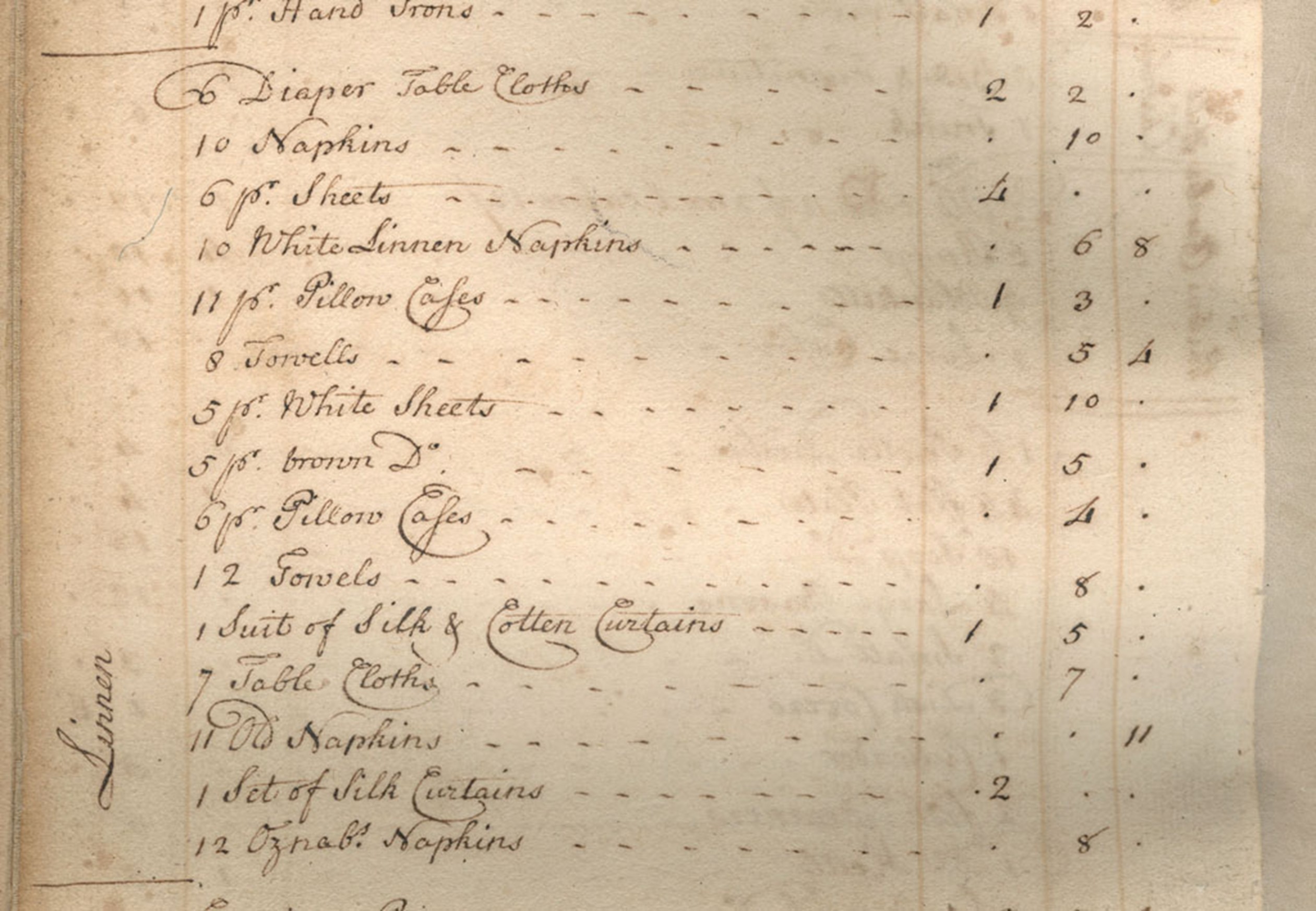
Existing household linens in museum collections and references in the written record indicate that some were in fact marked with numbers or initials/names (or both) to enable the items to be tracked and inventoried, although the exact combination of numbers and letters seem to vary, likely based on a complexities of the household and its linen inventory. The probate inventory taken after Augustine Washington’s death in 1743 records a variety of household textiles at Ferry Farm, including tablecloths, napkins, pillowcases, sheets, and towels. The appraisers, however, make no note of whether these textiles were marked in any way (just noting materials or other descriptors and quantity).
Excerpt of 1743 probate inventory of Augustine Washington listing “Linnen,” including 6 Diaper Table Cloths, 10 Napkins, 6 pr Sheets, 10 White Linnen Napkins, 11 pr Pillow Cases, 8 Towells, 5 pr White Sheets, 5 pr brown Do. [Sheets], 6 pr Pillow Cases, 12 Towels, 7 Table Cloths, 11 Old Napkins, and 12 Oznabs Napkins. Inventory submitted 1 July 1743 to King George County court.
The archaeological record of Ferry Farm includes a number of implements related to sewing, as touched upon in past blog posts such as this one or this one about thimbles. Our own museum collections house a few 18th or early 19th century sheets or other household linens, some of which have been marked in ink or stitching with (unidentified) owners’ initials/names and dates, much in keeping with the instructions outlined in period references such as The Workwoman’s Guide and other household manuals.
Sample layout and makeup of marks to include owner’s initials, item identification, number, and date. Excerpt from The workwoman’s guide (1838) via Smithsonian Libraries and Archives on Archive.org
So, for our modern museum inventory management purposes, I think we’ll be skipping the caustic nitrate of silver or crunchy cochineal beetles for coloring and stick to the needle and thread method of marking our reproduction bedding and other textiles. As suggested by A Lady, the Washington House marks will include both Mary and Augustine Washington’s initials along with notations of item type (such as WS for the five pairs of White Sheets listed in the 1743 inventory) and date of creation (for many of these reproduction linens, that would be 2018 or 2019). I’ll be getting my needle and thread ready so that next year’s inventory and spring cleaning will hopefully be easy-breezy.
Editor’s Note: Looking back in time, people’s personal hygiene, fashion choices, medical treatments, and more sometimes look, at the very least, bizarre, if not outright disgusting. When confronted with these weird or gross practices, our first reaction can be to dismiss our ancestors as primitive, ignorant, or just silly. Before such judgments, however, we should try to understand the reasons behind these practices and recognize that our own descendants will judge some of what we do as strange or gross. Here at George Washington’s Ferry Farm and Historic Kenmore, we’ve come to describe our efforts to understand the historically bizarre or disgusting as “Colonial Grossology.” The following is the latest installment in Lives & Legacies’ “Colonial Grossology” series.
Virginia is a hot place during summer and even for much of autumn. While we once wrote about how people in pre-air conditioned colonial times dealt with the heat in a previous blog post aptly titled, “The heat is beyond your conception”, I want to talk today about another bane of colonial Americans’ comfort in summer, namely smells and particularly body odor.
Today, history comes scent-free. We must study the past without using smell, one of our main senses, and, as we will soon see, that is probably for the better.
An 18th century summer smelled of human and animal waste, garbage, stagnant water, and body odor. These odors permeated every breath taken by colonists, whether very rich or very poor. Noted philosopher Jean-Jacques Rousseau once complained about the aroma of “stagnant urine” the hung about the Palais Royal in summer.[1]
How did colonists attempt to deal with the ubiquitous human stink before deodorant and regular bathing? What were the deodorizing options available to the likes of George or Betty Washington? What could they have possibly used to keep the dreaded stink of summer away or, at the very least, subdued?
Bathing
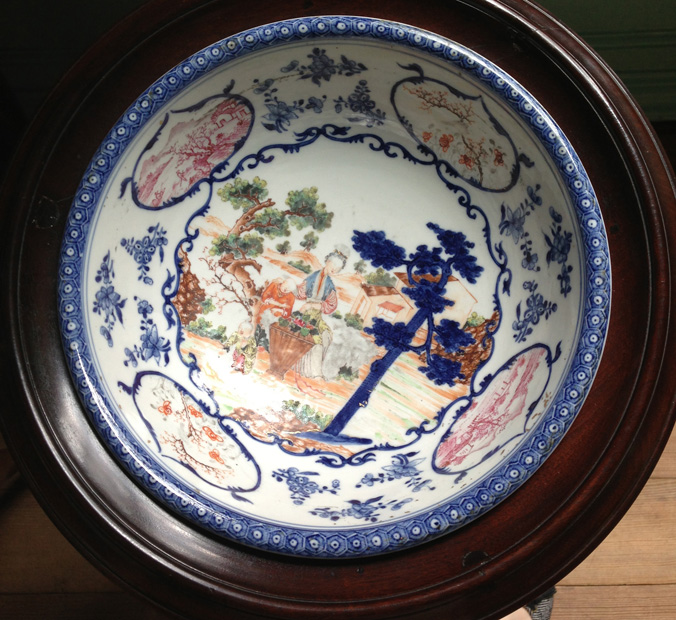
We’ve previously written about bathing in the 18th century in detail but toward the end of the 1700s, baths, or the immersion of the body in a tub of water, were becoming more popular with more affluent Americans. As the intrepid Elizabeth Drinker wrote of her first experience in a shower, “I bore it better than I expected, not having been wett [sic] all over at once for 28 years past”. [2] The wealthy tended to bathe more because they also had the luxury of milder soaps. Generally, the main soap available at the time was not normally used in washing the body because it was made of harsh cleaning agents.[3] Additionally, few experts advised taking more than one bath a month for health reasons.[4] There was actually a widespread fear that bathing could make you sick. Most importantly, very few people could devote time or energy to the immense task of fetching water and warming it for a bath. People’s daily washing consisted of a splash of cold water from a basin usually in the kitchen or bedchamber.[5] They washed the bits that showed namely the face, the feet, and the hands. This daily washing helped George or Betty start off their day smelling fresh but it didn’t last long in the brutal Virginia summer.
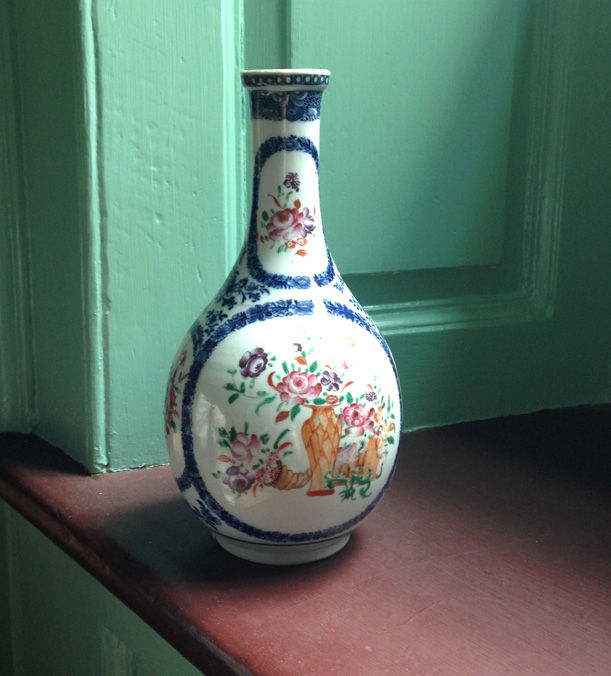
Wash basin in Historic Kenmore’s bedchamber.Close up of the wash basin in Kenmore’s bedchamber.Pitcher that goes with bedchamber wash basin.
Toward the end of the 1700s, a weekly changing of underwear was recommended and more frequent cleanings lead to more incentives for perfuming washtubs, chests and drawers.[6] Besides laundering, people also infused garments with a lovely fragrance or sewed up sweet smelling sachets to put in their pockets.
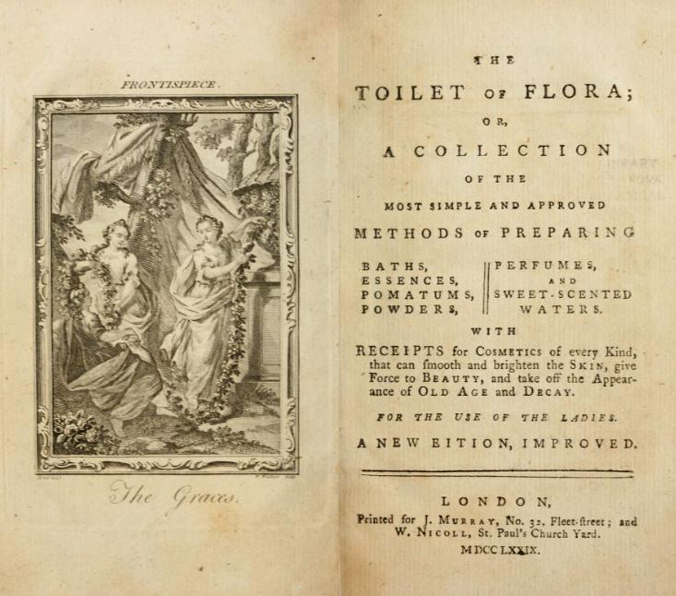
The English Husewife contains an interesting recipe to perfume gloves that involved soaking them in a mixture of angelica water, rose water, cloves, ambergris, musk, lignum aloes, benzoin, and calamus.[7] Meanwhile, The Toilet of Flora provided instruction on using violet and cypress powder to make sachets that could be secreted in a ladies pocket.[8]
Even ornamentation and jewelry didn’t escape the quest to hide the stench of summer. Recipes for perfumed chaplets and medals created a smelly paste substance that could be concealed in jeweled smelling boxes or worn as wax decorative medal.[9] Similarly, little sponges soaked in essential oils could be hidden in jewelry to give the wearer a sweet aroma.
Perfuming
As shown by all this perfuming of jewelry, clothes, and clothing storage, perfumes and waters were the most common way people in the 18th century tried to cover the stench of summer. Perfumes are strong concentrations of scents that last for a long time while waters are the more diluted eaux de toilette or eaux de cologne. All were available for purchase in colonial stores for those of means.[10] Additionally, there were dozens of handy books that supplied many easy to follow recipes for various lovely smelling perfumes and waters. The Toilet of Flora had about 6 perfume and 60+ recipes for waters.[11]
Frontispiece and title page of a 1779 edition of “The Toilet of Flora”.
PERFUME is made of essential oils or an aroma compound as well as fixatives and solvents. ESSENTIAL OILS are oils from a plant usually extracted through distillation. Compared to fatty oils, they are lighter and tend to evaporate without a trace. A perfume usually contains 15 to 20% pure essence. A perfume’s FIXATIVE helps the scent last. Today, we use synthetic fixatives but, in the 18th century, popular fixatives were benzoin (aka gum of Benjamin) labdanum, storax, ambergris (basically whale vomit), castoreum (the castor sacs of a mature North American beaver), and musk (the glandular secretions of the musk deer). Lastly, a perfume’s SOLVENT dilutes the perfume oil. The most common solvent being some type of alcohol/water mix but coconut oil or liquid waxes like jojoba oil can be substituted. Perfume is very strong and lasts for about five to eight hours.
EAU DE TOILETTE is light-scented cologne with a high alcohol content, 5 to 15% perfume essence and is usually scented with something floral or fruity like lavender, lilac, orange or lemon. An eau de toilette has a light scent that lasts around 3 to 4 hours. EAU DE COLOGNE is composed of two to four percent perfume oils in alcohol and water. The first eau de cologne was made in Cologne, Germany in 1709 and contained many different citrus oils. An eau de cologne has a light scent that only lasts a couple of hours.
One particularly perfume recommended in The Toilet of Flora contains musk, cloves, lavender, civet and ambergris.[12] While it likely smelled nice, it was probably expensive to make so would not have been an item produced for everyone. Nor did some think that perfume was appropriate for a woman of good repute to wear at the time. They instead recommended eau de rose or eau de lavender as a more appropriate alternative. As one guide stated, “In no circumstances should real perfume be applied to the skin. Only aromatic toilet waters – distilled rose, plantain, bean, or strawberry water – and eau de cologne were permissible”.[13]
Portion of an 18th century perfume bottle excavated by archaeologists at George Washington’s Ferry Farm.
No matter if they used a scent, laundered clothing, or bathe, the fact remains that an 18th century summer just stunk. People tried to mask it with whatever concoctions they could invent but it took another 100 years before deodorant and antiperspirant were invented to save humanity from the smell of itself during the hot humid summer months.
Heather Baldus Collections Manager
[1] Alain Corbin, The Foul and the Fragrant: Odor and the French Social Imagination, Cambridge, MA, Harvard University Press, 1986: 27.
[2] Richard L. Bushman and Claudia L. Bushman, “The Early History of Cleanliness in America,” Journal of American History, Vol. 74, No. 4 (Mar. 1988): 1214.
[3] “Wash-Balls” in The Toilet of Flora, London, 1779: 199-207.
[5] David S. and Jeanne T. Heidler, Daily Life in the Early American Republic, 1790-1820: Creating a New Nation, Westport, CT, Greenwood Press, 2004: 46.
George Washington’s Ferry Farm is busy reconstructing the Washington House and, behind the scenes, we are equally busy creating educational and interpretive activities to take place inside and outside the house. One common colonial chore you may eventually see being done outside the house is laundry. While doing laundry is still part of our routines, the way we do it today looks a lot different from methods used a few hundred years ago.
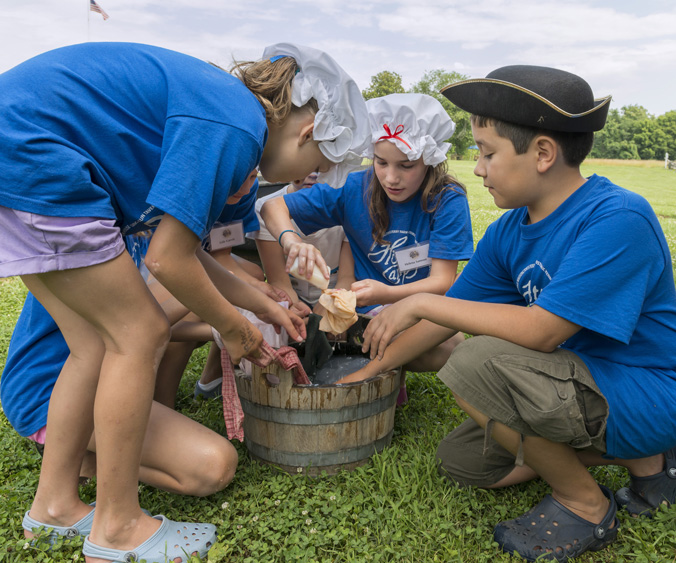
Children learning how to do laundry using 18th century methods during History Camp at George Washington’s Ferry Farm.
To begin with, in the past, most households had to make their own soap. I’m not talking about lavender-infused goat’s milk soap with rosehip essential oils and colloidal oatmeal exfoliant. I’m referring to a very basic soap composed of animal or vegetal fats combined with lye water. The end result was considered a success if it removed dirt without burning your skin off. Consequently, we figured it would be a good idea if we made some soap, just to get an idea of how it is done.
For our soap making experiment, we needed two basic ingredients: lye and animal fat. Fortunately, I raise pigs and had plenty of lard to contribute to the effort so we already had our first ingredient. Soap making was often a fall or early winter activity as this corresponded with the butchering of pigs and cows. Alternatively, a household could save up their old cooking grease to turn into soap (yum). The lye, our second ingredient, was easy to obtain….online! I did briefly look into making our own lye and quickly realized this was a task far too time consuming.
Colonists, however, not having the benefit of Amazon, wouldn’t have had a choice. To make lye, they began with a hopper filled with many fires worth of hardwood ashes. After enough ashes were secured, water would be filtered through it and collected below. The resulting liquid was boiled down to create the correct concentration, which involved a lot of guess work. If the lye was too weak it would not react enough with the fats to create soap. If it was too strong, the soap would impart nasty chemical burns. Colonial soap making involved quite a lot of effort.
Along with purchasing the lye online, we took yet another shortcut and used crockpots instead of a fire. This way we could regulate the temperature and keep it steady. Imagine standing in front of a hot fire and stirring a pot of caustic lye and smelly animal fat for hours and hours? No, thank you, I’ll use the crockpot!
Our first step was to melt the lard in the pot and then slowly add in the lye water. The resulting chemical reaction was quite interesting. Initially, the clear lard turned a creamy caramel color before it thinned into the consistency of melted butter. Then it began to turn darker and separate into what can only be described as an ‘applesauce’ texture. After what seemed like an eternity of stirring, the mixture progressed into a ‘mashed potato’ phase (hungry yet?). This fluffy concoction was transferred to a mold and left to set up for a few days.
These four pictures show the consistency of the soap in four stages: caramel (top left), melted butter (top right), applesauce (bottom left), mashed potatoes (bottom right). Credit: Elisa Gale
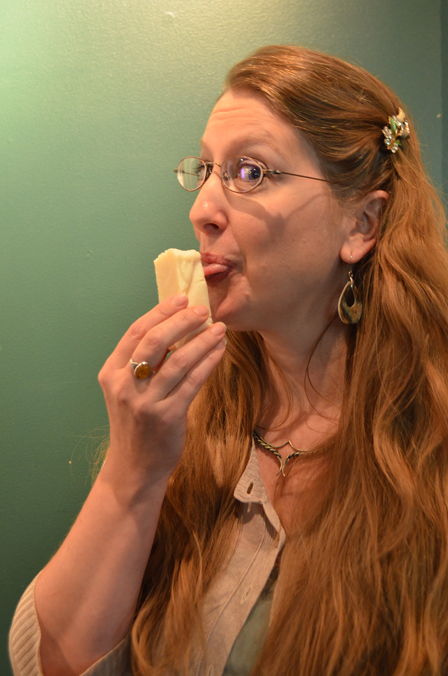
Our helpful instructor taught us the ‘zap’ test to roughly determine the pH of the soap, which was also a technique used by colonials. This involves touching the tip of your tongue to the soap. If you get a strong taste or ‘zap’, it means the pH is off, the soap is too alkaline, and could irritate your skin. If you taste nothing or only get a slight zap, it’s safe and good soap. After much soap licking, it was determined that we had indeed produced legitimate soap. This conclusion was further supported by our crockpots filling up with happy suds when we rinsed them with water.
The photo on the left shows the newly made soap cooling in a parchment paper-covered wooden mold while the photo on the right shows suds in a slow cooker. Credit: Elisa Gale
Zap test!
If you were a colonist, making soap is where doing your laundry started. It took months of preparation just to make soap, a product so cheap, easily obtainable, and ubiquitous in today’s society that we rarely give it a second thought. If you’re interested in learning more about how soap was made come to Ferry Farm this Fourth of July where there will be a traditional soap making demonstration!
Mara Kaktins, Archaeologist
Ceramics & Glass Specialist