Lives and Legacies

Tag: trees

  • The Last of Washington’s Horse Chestnut Trees?

    There once stood a large horse chestnut tree on the corner of Fauquier and Charles Street in Fredericksburg. It was noted as one of the thirteen legendary Washington horse chestnut trees planted by George himself. By the 1930s, it was becoming clear that the tree needed some help, so the Daughters of the American Revolution (DAR) took up the cause to protect this historic tree.

    The tree legend states that George, while visiting his mother in June 1788 in Fredericksburg, decided to plant thirteen horse chestnut trees from her house to his sister’s house, Kenmore, just a few blocks away. This provided a scenic path for his mother when she visited her daughter Betty. These trees commemorated the thirteen original states.

    It is a great story. It is patriotic and nostalgic, showing George as a man of the earth with his love of trees, gardening, and horticulture. He planted these trees for a future America to remember the struggles to create this country and the precious nature of our land that we must protect.
    But is it true? Did George plant that tree? What is the evidence?


    The horse chestnut tree is a native of the Balkans region (Albania, Bulgaria, Greece, and Northern Macedonia). It made its way to Europe and England during the seventeenth century, noted as growing in South Lambeth, London, and being planted by Sir Christopher Wren at Hampton Court.

    Horse chestnut trees Bush Park, Hampton Court, England planted by Christopher Wren in 1669-1670.

    There is documented evidence of some horse chestnut trees crossing the Atlantic to Mr. John Bartram, one of America’s first botanists in the 1740s. In a letter from Peter Collinson, an English botanist, dated September 16, 1741, he wrote to Bartram, “I have sent some Horse-Chestnuts which are ripe earlier than usual; hope they will come fit for planting.”. Bartram acknowledged receiving them and stated that most were blue-molded, and only one germinated and grew. Over twenty years later, Bartram updated Callison on the success of the lone seedling, writing, “But what delights me is that our horse chestnut has flowered. I think it must excel in America.”
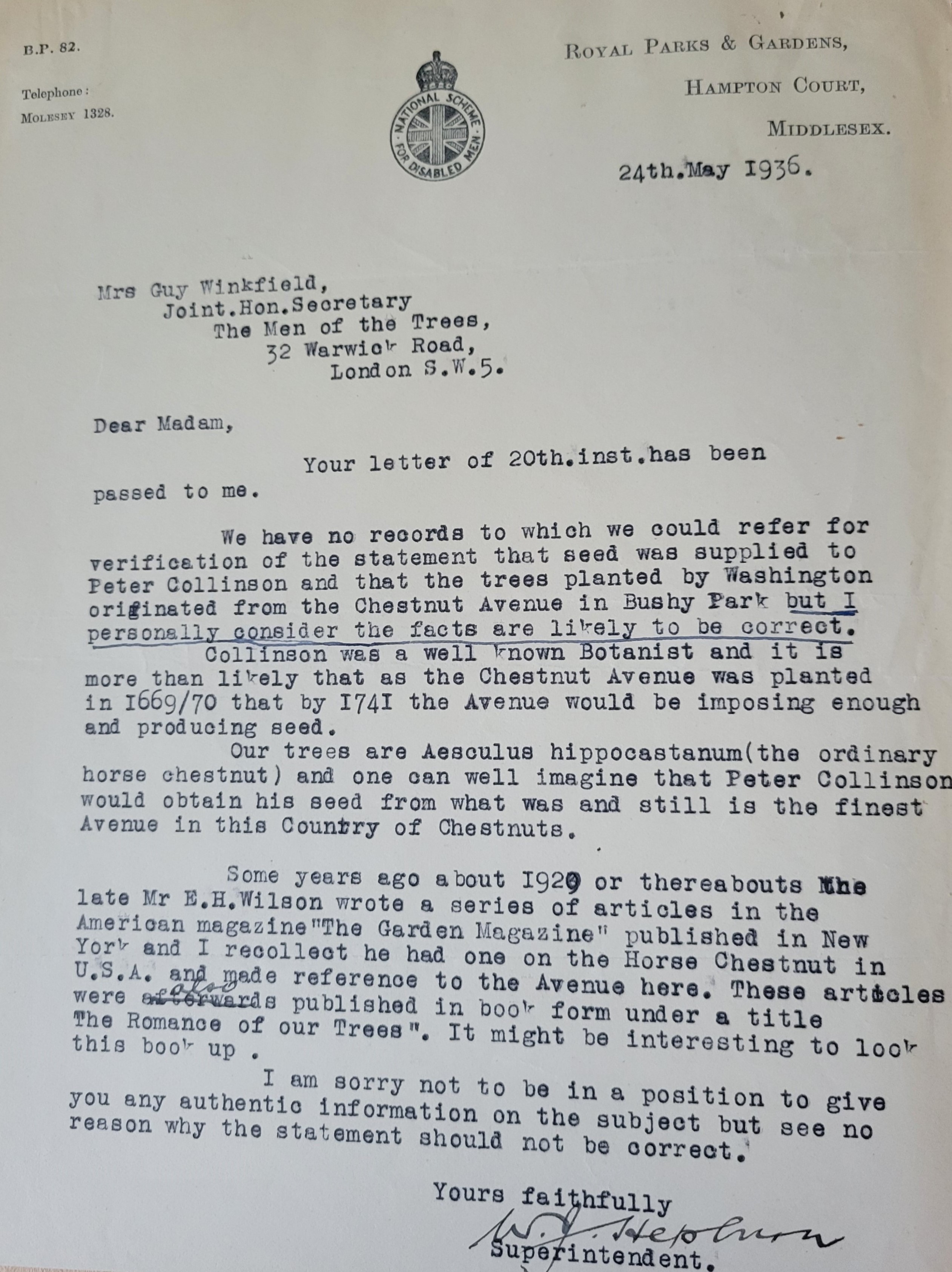
    Letter from Royal Parks and Gardens, Hampton Court, May 24 1936


    Bartram’s Gardens in Philadelphia was quite popular and visited by many founding fathers while working there. George visited the gardens twice in the summer of 1787 while in the town during the Constitutional Convention, noting, “Sunday, June 10, 1787, breakfasted at Mr. Powell’s and in company with him rid to see the Botanical Gardens of Mr. Bartram, which, though stored with many curious plants, shrubs, and trees, many of which are exotics, was not laid off with much taste, nor was it large.”
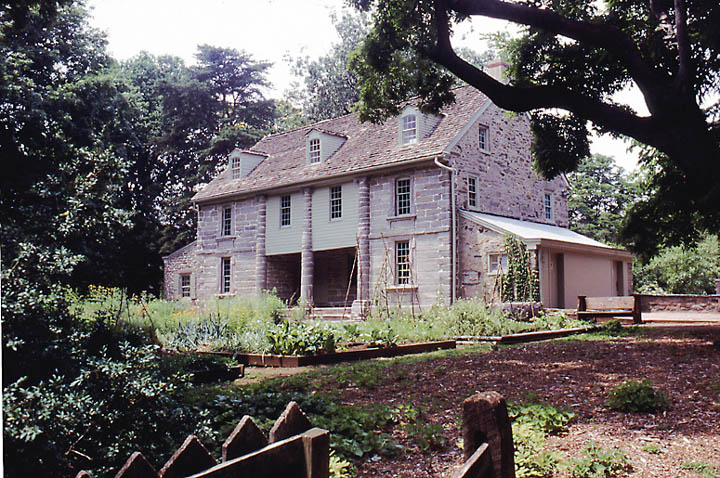
    John Bartram’s house and upper garden at Bartram’s Garden

    Why mention this? In some versions of the story, Washington got his horse chestnut trees from this garden, but there is no evidence that the legendary trees were obtained from this famous historic garden.
    George only made two diary entries about horse chestnut trees on April 13, 1785, writing, “Received from Col. Henry Lee of Westmoreland 12 horse chestnut trees (small) and an equal number of tree boxes. They appeared to have been some time out of the ground. Planted 4 of the Chestnuts on my serpentine walk – two on the east end and the rest in the vineyard.” And again, on April 2, 1788, wrote, “Transplanted from a box in the garden, thirteen plants of the horse chestnut into shrubberies by the garden walls.”

    The entry shows evidence of planting the famous Washington trees, right? No, because George was at Mount Vernon in April and didn’t leave for Fredericksburg to visit his mother until June 10, 1788.

    But could he have had them sent down and have them planted before he came to see his mother? Yes, but the story says that George planted these trees with his own hand. Additionally, it would be odd for George to mention planting the trees while in residence at Mount Vernon and not say that they were in his mother’s garden in Fredericksburg. Washington was a diligent diarist but never mentioned planting thirteen horse chestnut trees in his mother’s garden.
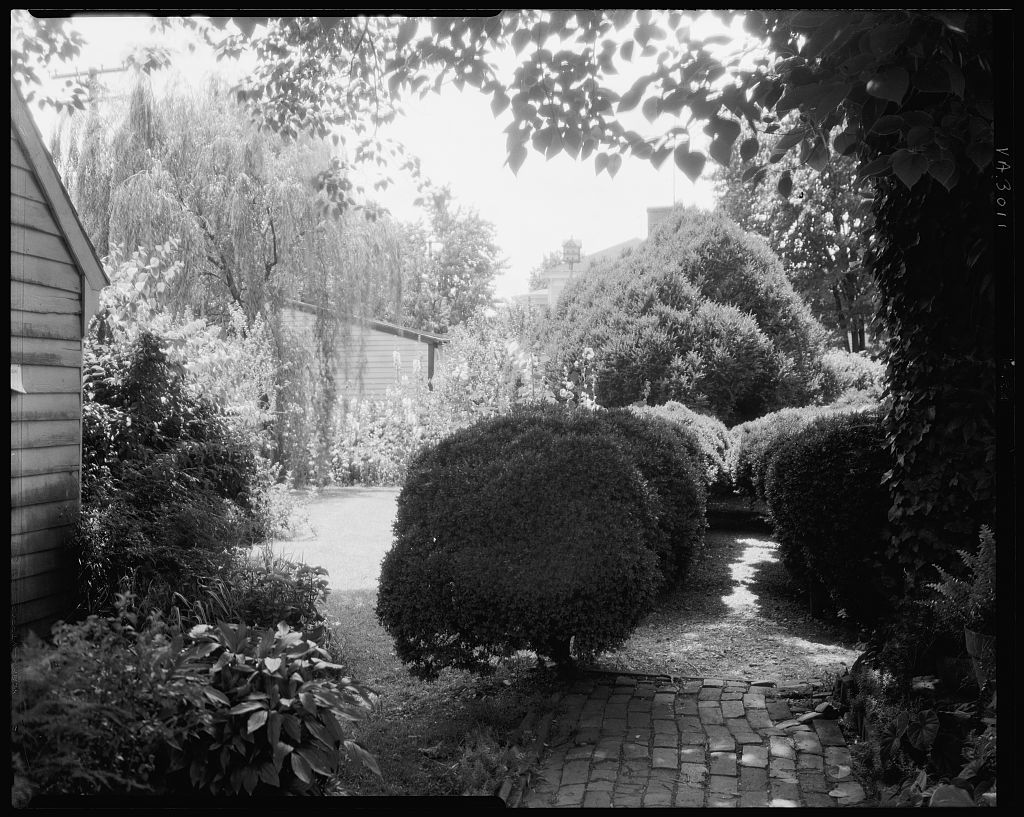
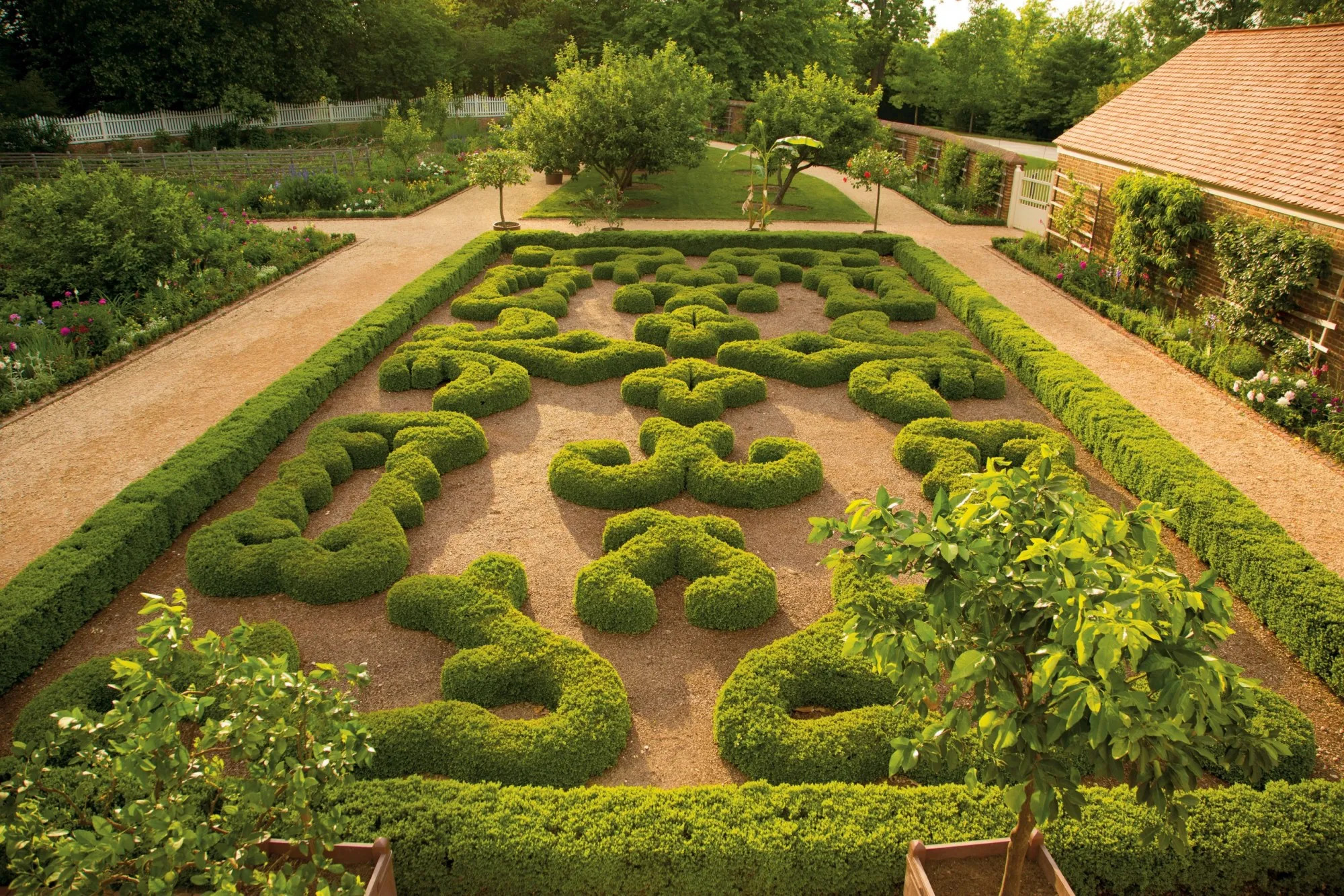
    Mary Washington’s house gardens, Fredericksburg.

    Further, no known letters from George, Mary, or Betty mention any horse chestnut trees between Mary’s gardens and Betty’s Kenmore.

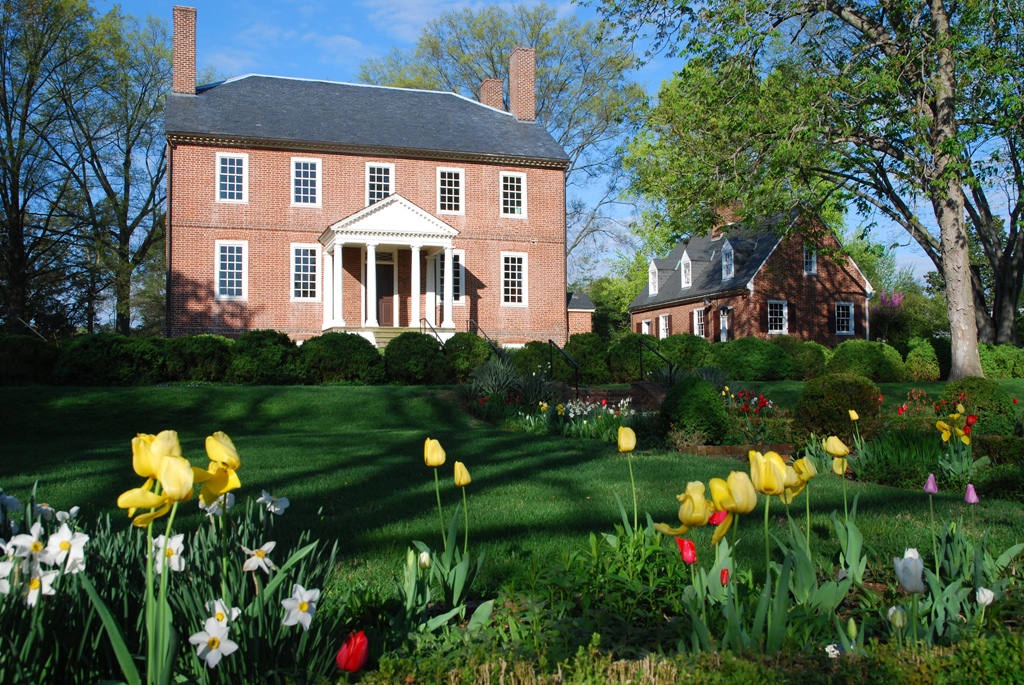
    Spring time in the gardens at Kenmore Plantation (can you spot the cat?)

    This was all the primary source evidence I could find relating to George and any horse chestnut trees. So, I looked further into the story to see what other evidence was being used to verify that this tree was indeed one of the thirteen Washington trees.

    As I said in the beginning, by the 1930s, many, including the DAR, were trying hard to save this lone surviving chestnut tree. With their extensive reach, they got Fred H. Arnold, the Assistant Forester for the National Park Service, to do an age-determination test on the tree in May of 1934. Mr. Arnold noted some issues with the test, stating that the lower twelve feet of the tree was filled with concrete, so the coring sample had to be taken above this “repaired defect”. Even then, a complete coring sample could not be extracted due to decay in the interior of the main stem. Additionally, Mr. Arnold said that it was very difficult to count the annual rings due to their obscurity because the texture difference between the springwood and summerwood for the horse chestnut tree (genus Aesculus) is very slight. Taking into account all this, Mr. Arnold estimated the tree to be around 139 years old with as much as 10% in error, either plus or minus, which would put the date it was planted somewhere between 1781 and 1809, which means that the tree is indeed old and could have been planted during Washington’s time in Fredericksburg.
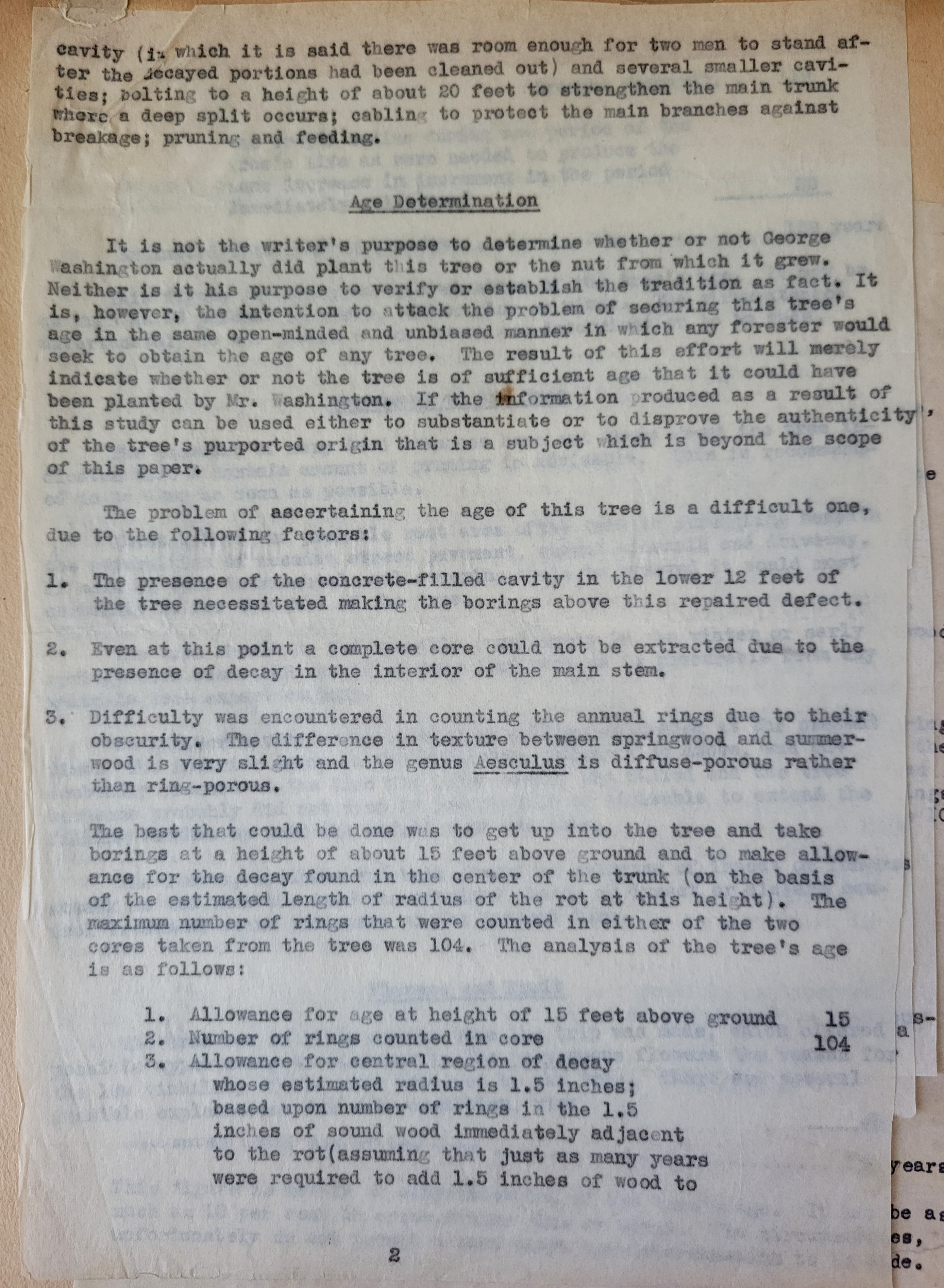
    Age Determination, May 6 1934

    Lastly, local historian James Henry Heron collected local citizens’ recollections of the tree and the story. Mrs. Lilias Hamilton Scott, the wife of Mr. John Scott, who owned the lot on which the tree stands, wrote that her grandmother (Mrs. Janet Scott Hamilton) stated her great-grandmother (Mrs. Francis Scott) resided in Fredericksburg in 1788 and was Mary Washington’s neighbor and intimate friend. She said the trees were planted by Washington.

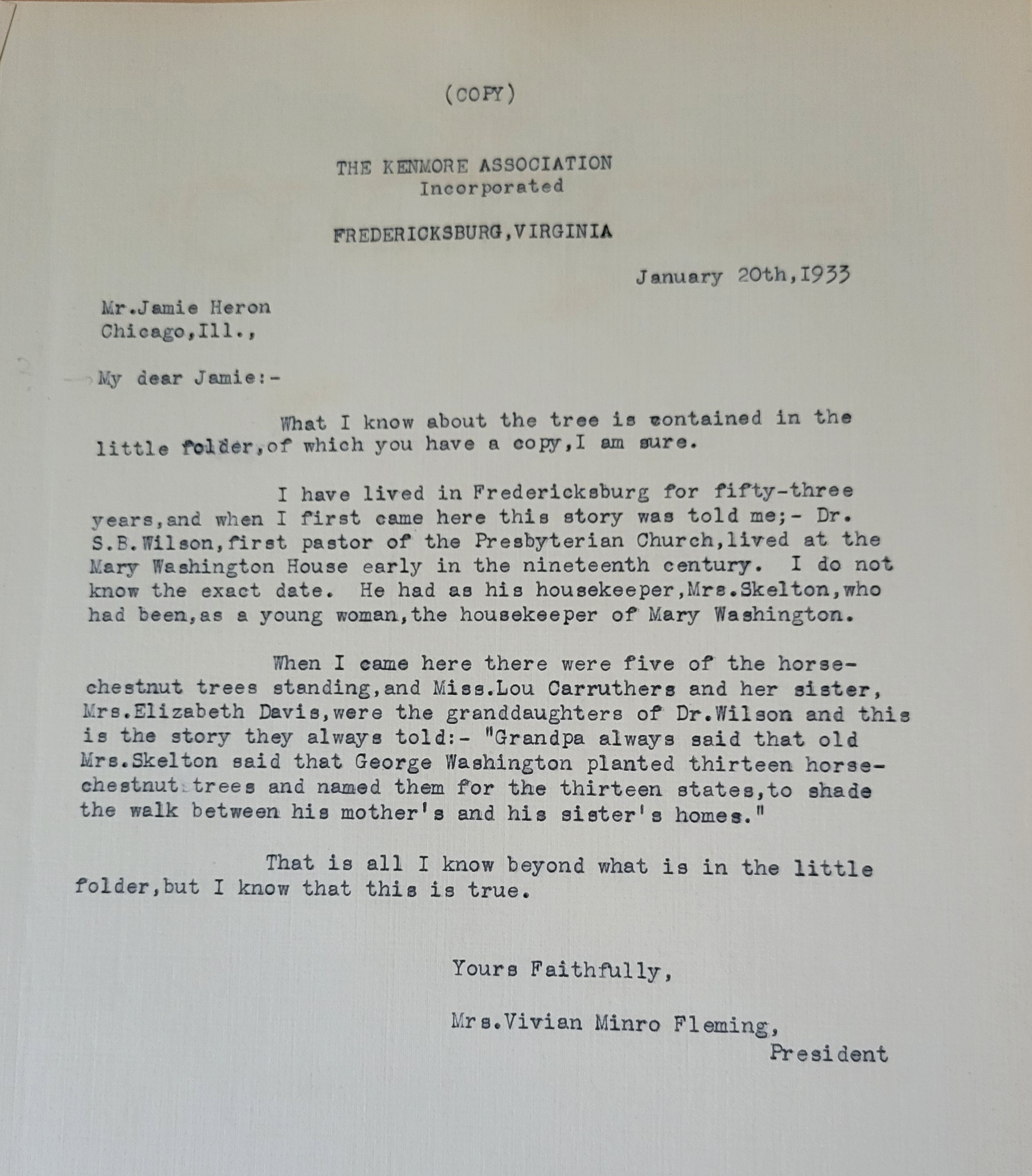
    Mrs. Vivian Minor Fleming traces the story back to Miss Lou Carruthers, her sister Mrs. Davis, and their grandfather Rev. S.B. Wilson’s housekeeper, Mrs. Polly Skelton, who had previously been a housekeeper for Mary.
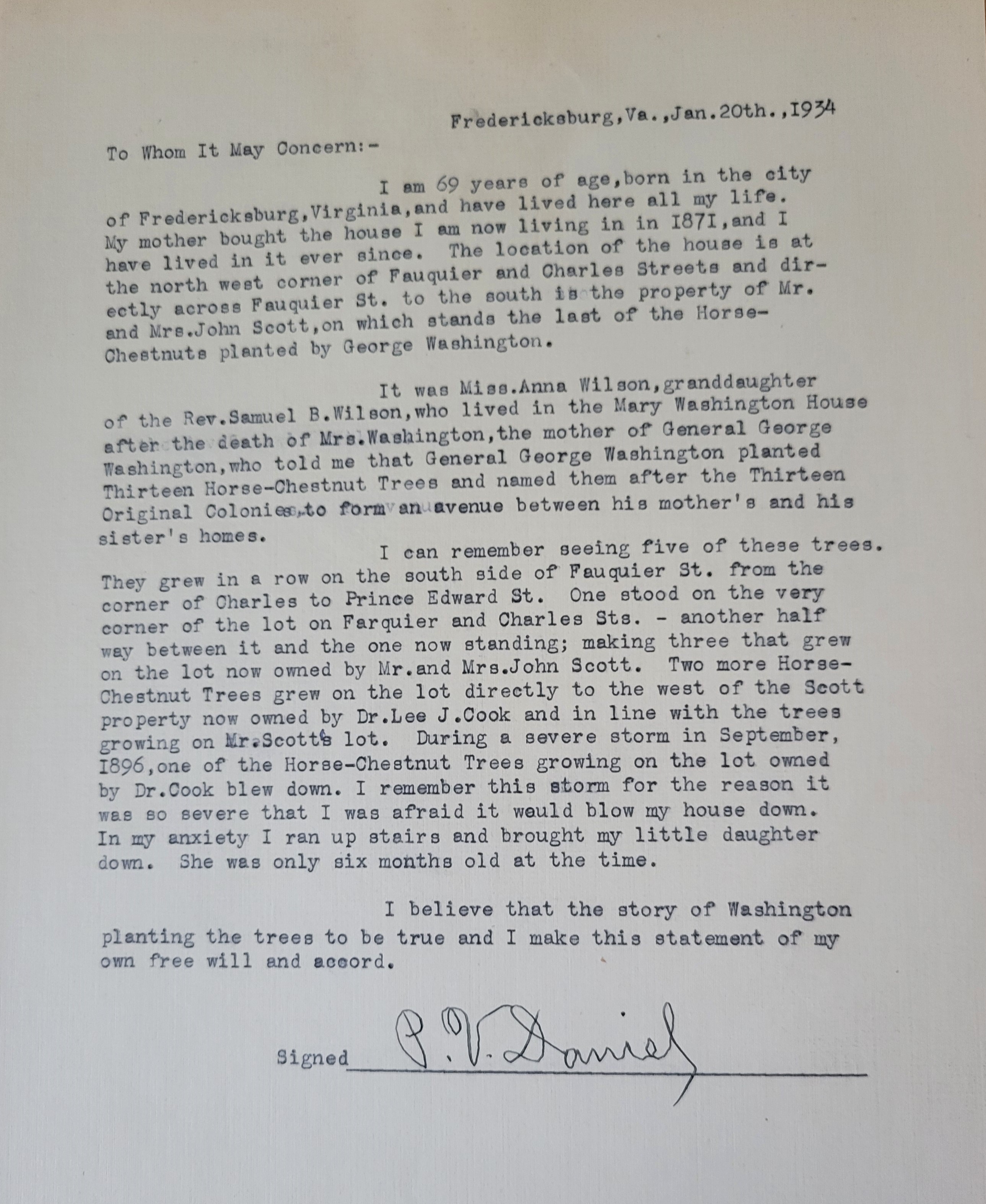
    Mr. P.V. Daniel, who remembers five of the original thirteen trees, lived across the street from the remaining one for over sixty years and said Miss Anna Wilson, granddaughter of Rev. S.B. Wilson, told him the story.
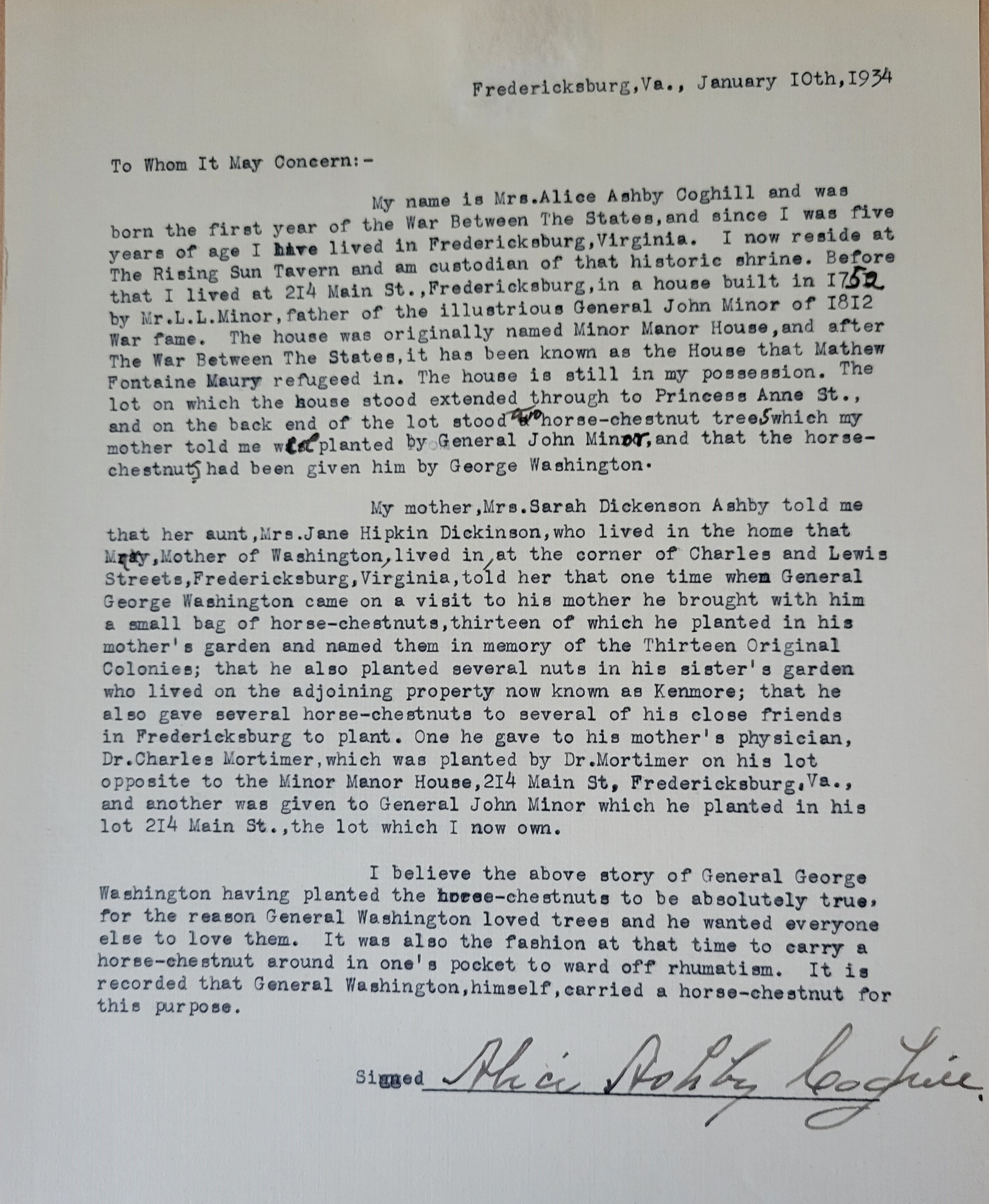
    Mrs. Alice Ashby Coghill says her aunt, Mrs. James Hipkin Dickinson, who lived at Mary Washington House after Rev. S.B. Wilson said Washington planted the trees and passed out horse chestnuts to friends.
    While I have no doubt these people are truthful in their recollections, they do not offer any definite evidence. They merely document that the legend was a well-known story but not that it was true.

    Regardless, the much-loved old tree was rightfully given proper emergency care with a donation and service from Senator Martin L. Davey from Ohio and The Davey Tree Expert Company. The famous tree lived happily for over another half century before being taken down in 2004.
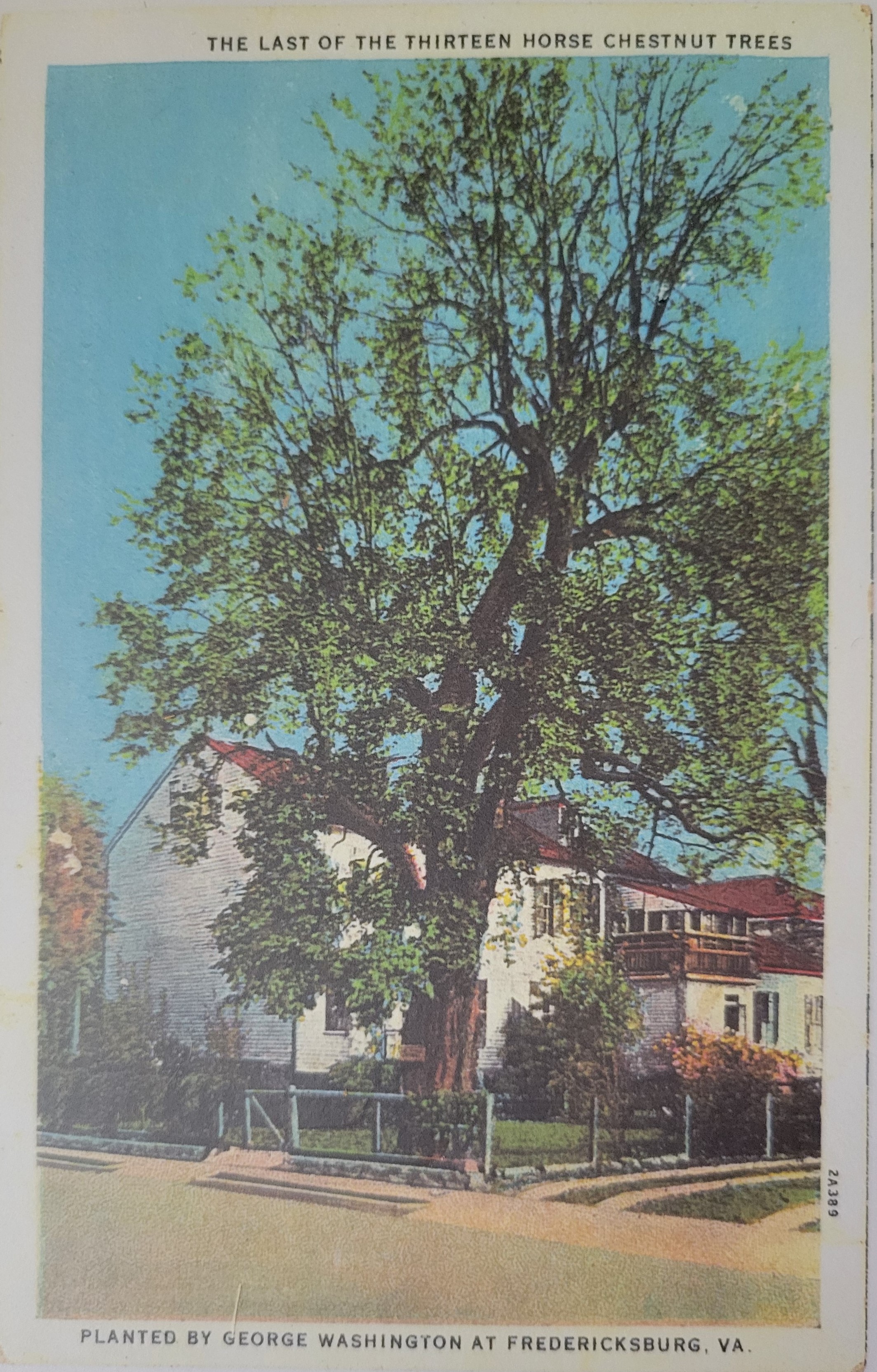
    Whether this tree was planted by George along with twelve others will probably never be conclusively proven. Were the people wrong to save the tree all those years ago without better evidence? Absolutely not. They saved a beautiful 200-year-old horse chestnut tree with a legendary attachment to George Washington, but they also saved a bit of their own past, nostalgia, and pride in their own town’s history.


    Heather Baldus

    Collections Manager

  • A History of Trees at Ferry Farm

    Cherry TreeThe moment anyone mentions trees and George Washington, you probably think of the famous Cherry Tree Story. However, this tale of young George taking a hatchet to his father’s cherry tree and, when confronted about the act, asserting “I cannot tell a lie” is probably just that — a story meant to demonstrate the integrity of the Father of Our Country. In reality, the trees of Ferry Farm have a much more fascinating history. Their story reflects, on a small local scale, vast environmental changes in eastern North America and shifting American attitudes toward the environment throughout the 18th, 19th, and 20th centuries.
    Today, we see wilderness as a good thing that needs protected and preserved. But in the 1700s, Europeans settlers saw wilderness as a bad thing. Preeminent environmental historian William Cronon notes, Europeans described wilderness as “’deserted,’ ‘savage,’ ‘desolate,’ ‘barren’—in short, a ‘waste,’.” People did not look at forests, deserts, or mountains as places to protect and visit. Instead, they were places to be feared and tamed.

    The opposite of wilderness was the managed landscape of Europe. In cities, towns, and farms, Europeans tried to control nature and make it follow humanity’s rules.  These efforts to tame the wilderness were transplanted to colonial plantations in the Americas.

    The first step in building a plantation and taming the wilderness was clearing the land for farming. Huge numbers of trees were cut down to do this.  On top of that, trees were cut down to make almost everything people of the 1700s and 1800s used and owned.  Furthermore, they were also cut down to do many everyday tasks.

    Throughout the 18th and 19th centuries, the wood from trees was…

    • used as the main architectural building material in houses, most other structures, farm buildings, fences, and more
    • used to build ships, boats, ferries, bridges, carriages and wagons that moved people and things from place to place
    • used to make everyone’s furniture (beds, chairs, tables, desks, cabinets, and trunks) as well as many household items and farming tools
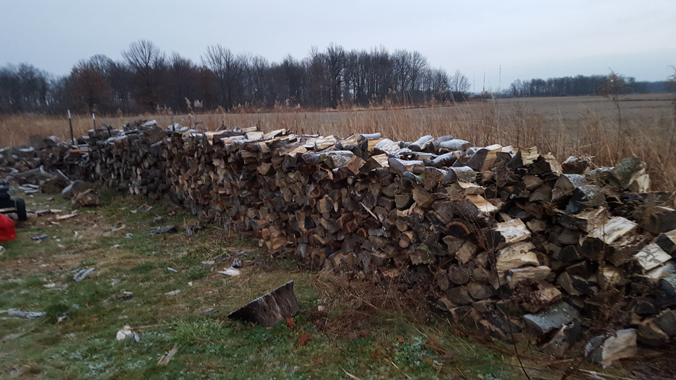
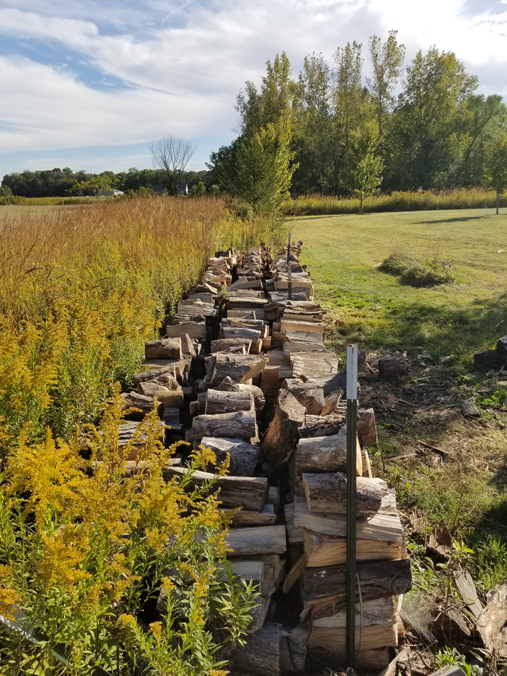
    • used as fuel for the fires needed to cook, heat, and even to make candles and soap. A colonial home needed at least 40 cords of wood for heating and cooking over the course of a year.

    5 cords of Firewood 1
    Five cords of firewood. A colonial home used 8 or 9 times this amount in a year for just heating and cooking. Credit: Chris Stevenson

    5 cords of Firewood 2
    Credit: Chris Stevenson

    According to the U.S. Forest Service, the area that would become the United States had just over 1 billion acres of forest before European settlement.  By 1910, the U.S. had a total of just over 700 million acres.  The 300 million acres of trees cut down was mostly in the eastern portion of the country.

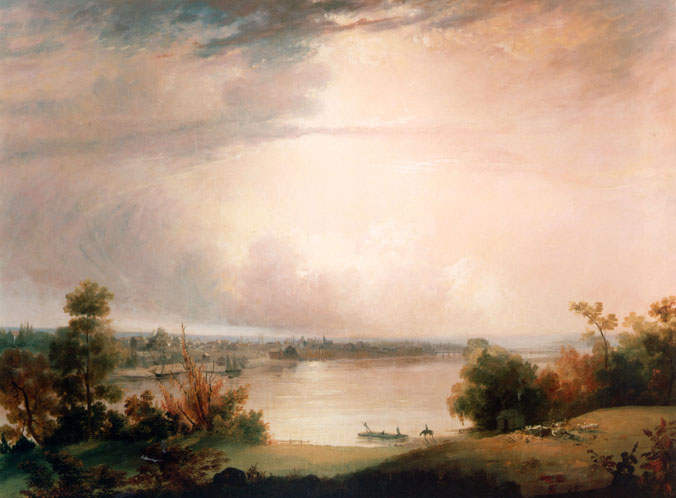
    These large scale trends can be seen on a small scale at Ferry Farm.  The European settlers who lived here, including the Washingtons, cut down a significant number of trees but not so many that there weren’t still quite a few standing when John Gadsby Chapman painted Ferry Farm’s landscape in 1833.

    1830s
    “The Old Mansion of the Washington Family” (1833) by John Gadsby Chapman shows the foundation stones of the house where George grew up at Ferry Farm and trees along the riverbank.

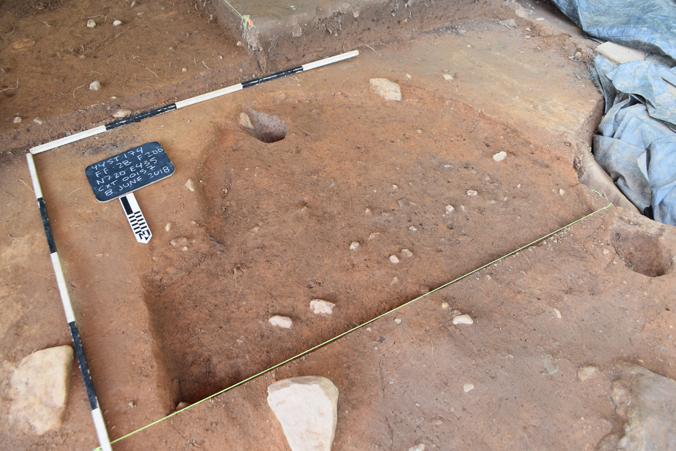
    We also have archaeological evidence showing the locations of trees during the Washington era.  This past summer in the yard north of the Washington house replica archaeologists uncovered “soil stains” left after trees fell in the past.  Soil stains are where the soil is a slightly different color than surrounding areas and indicate where people filled in holes created by uprooted trees. In other words, such soil stains indicate that a tree once stood there.

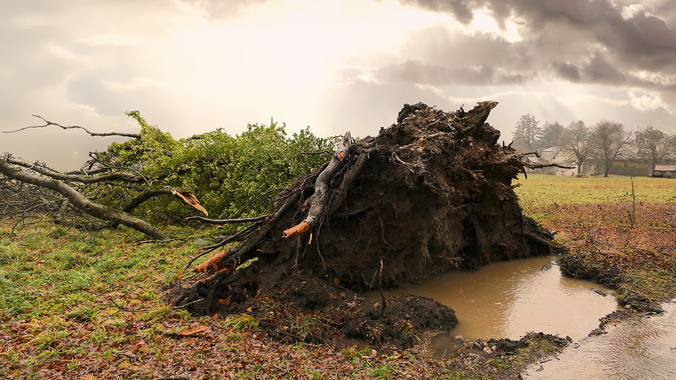
    Uprooted Tree
    A tree uprooted by a storm. Credit: ykaiavu / Pixabay

    In some cases, our archaeologists found that the holes were filled in multiple episodes, indicating that the soil settled and new dirt was later added or the person filling the hole borrowed different dirt of different colors from multiple locations. By excavating the soil from these soil stains and analyzing the artifacts, we can tell around when the holes were filled.

    Soil Stain
    Soil stain marking the site of an 18th and 19th century tree on the landscape at George Washington’s Ferry Farm.

    One very large tree left the sizable soil stain – almost 5ft x 5ft – pictured above.  Based on artifacts found in its soil, the hole was filled during the mid-19th century.  We can tell by the size of the stain that the tree was quite mature. Together, these facts are evidence of a tree that grew just 40 feet north of the original Washington house during the time George and his family lived at Ferry Farm. This discovery gives us another detail about the landscape so it can eventually be accurately recreated just as we did the main house.

    Finally, Ferry Farm archaeologists learned from these tree features and from the lack of other features in this yard that the area was well-kept. In the 18th century, this portion of the landscape was probably well-maintained because it was visible from Fredericksburg across the river.

    This tree fell sometime in the 19th century and it was not the only one at Ferry Farm or across the country. Indeed, deforestation at Ferry Farm and nationwide grew more rapid and widespread in the 1800s as “clearing of forest land in the East between 1850 and 1900 averaged 13 square miles every day for 50 years; the most prolific period of forest clearing in U.S. history.”

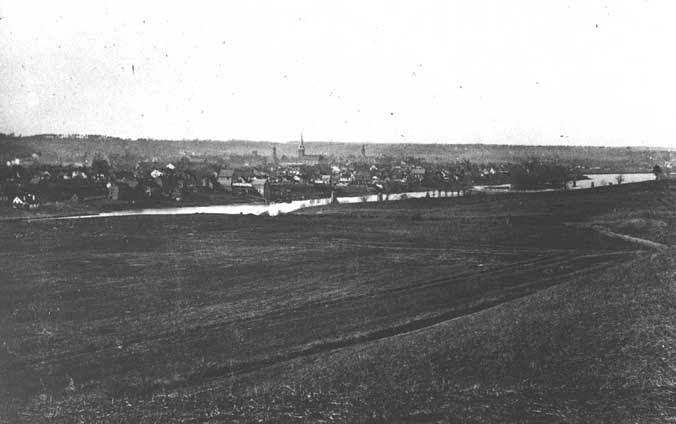
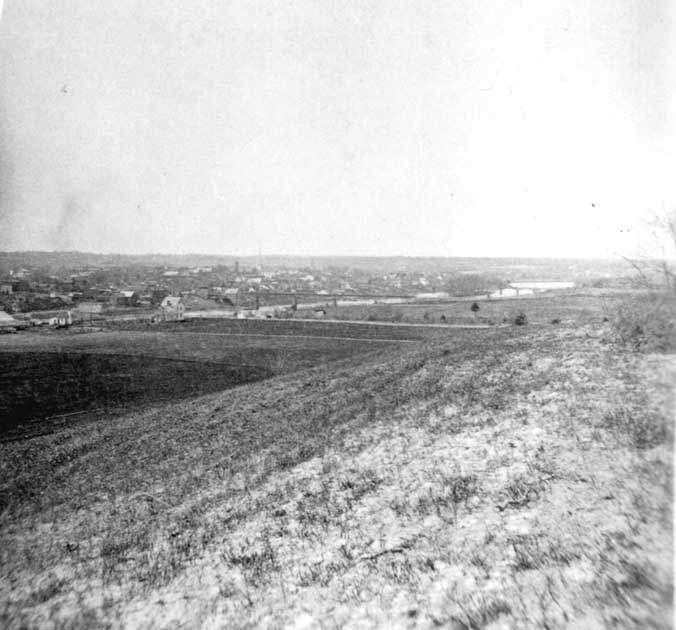
    In the 1860s, the Civil War exacerbated deforestation at Ferry Farm and throughout Stafford County.  Hundreds of thousands of Union Army soldiers radically altered the local environment to get the wood they needed for cooking and heating, to help build their fortifications and pontoon bridges, and even to build shelters.  During winter lulls in fighting, 18th and 19th century armies did not camp in tents. The soldiers built small log cabins.  By war’s end, Ferry Farm and Stafford County were nearly treeless as seen in the two photos of Ferry Farm below taken in the decades after the war ended.

    1870s
    View of Ferry Farm property in the 1870s.

    1880s
    View of the Ferry Farm property in the 1880s

    While deforestation sped up in the 1800s, that century also began a changing of people’s attitudes toward the environment.  As Cronon explains, “The wastelands that had once seemed worthless had for some people come to seem almost beyond price. That Thoreau in 1862 could declare wildness to be the preservation of the world suggests the sea change that was going on. Wilderness had once been the antithesis of all that was orderly and good—it had been the darkness, one might say, on the far side of the garden wall—and yet now it was frequently likened to Eden itself.” Wilderness was to be treasured, not feared.

    As the 19th century turned into the 20th, wilderness, nature, and the environment were increasingly seen as special and deserving of protection and preservation, sparking the creation of national and state parks, government agencies like the Forest Service, private conservation groups such as the Sierra Club, and, in 1872, the very first Arbor Day.

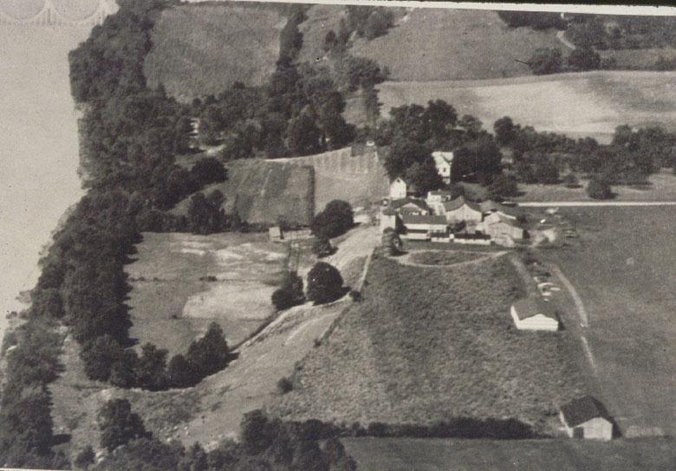
    We can see the impact of new attitudes toward the environment at Ferry Farm in photos below. The top one from the 1930s, a period of intense conservation efforts nationwide, shows trees starting to appear once again while the other from 2017 shows trees on a portion of Ferry Farm stretching out as far as the eye can see to the north.

    1930
    Aerial view of Ferry Farm taken in 1930.

    2017
    Aerial view of a portion of Ferry Farm and points north taken in 2017. Credit: Joe Brooks / Eagle One Photography

    The early 20th century saw the nadir of American deforestation in 1910. But since that year, forest acres in the U.S. have largely held steady [PDF].  The new conservation ethic symbolized in the practice of planting trees to replace those cut down, the reduced use of wood as a building material and fuel source, the need for less farm land, and the movement of people from rural to urban areas (all of which present their own challenges to the environment) have provided a reprieve for America’s forests.

    While George’s mythical chopping of the Cherry Tree is the most well-known tale about trees at Ferry Farm, the more important and fascinating story is how the 300 hundred year history of trees at Ferry Farm reflects broader post-settlement environmental changes in North America and how the Americans who made those changes grew to see the world differently.

    Zac Cunningham
    Manager of Educational Programs

    Elyse Adams, Archaeologist
    Archaeology Lab Technician

  • Apple Cedar Rust: What on Earth is It and Why Does It Matter?

    Apple Cedar Rust (2).JPG

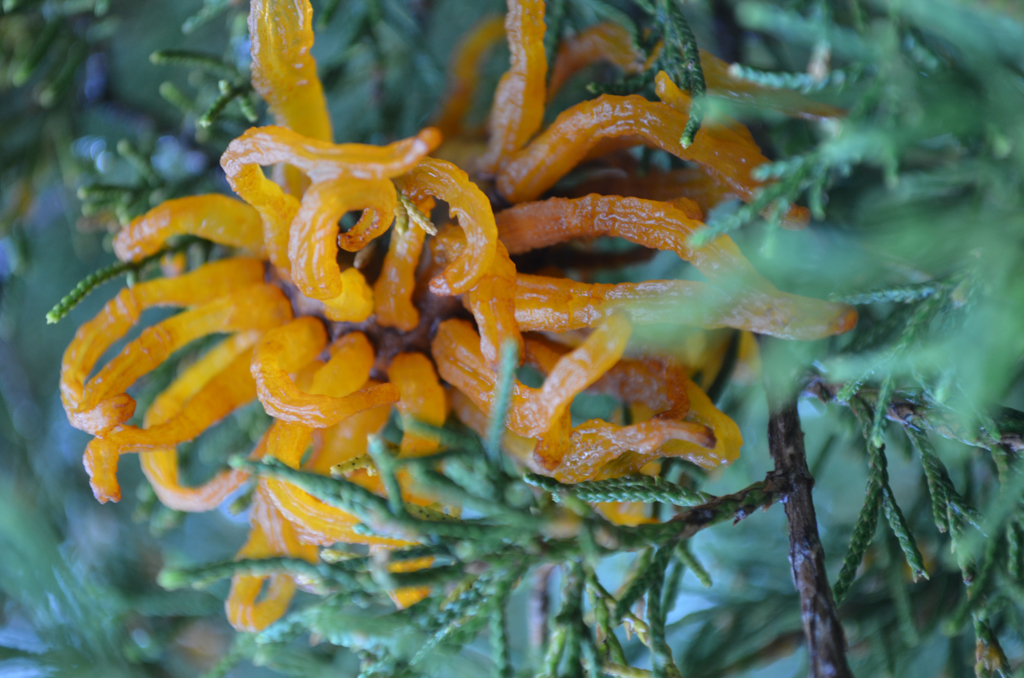
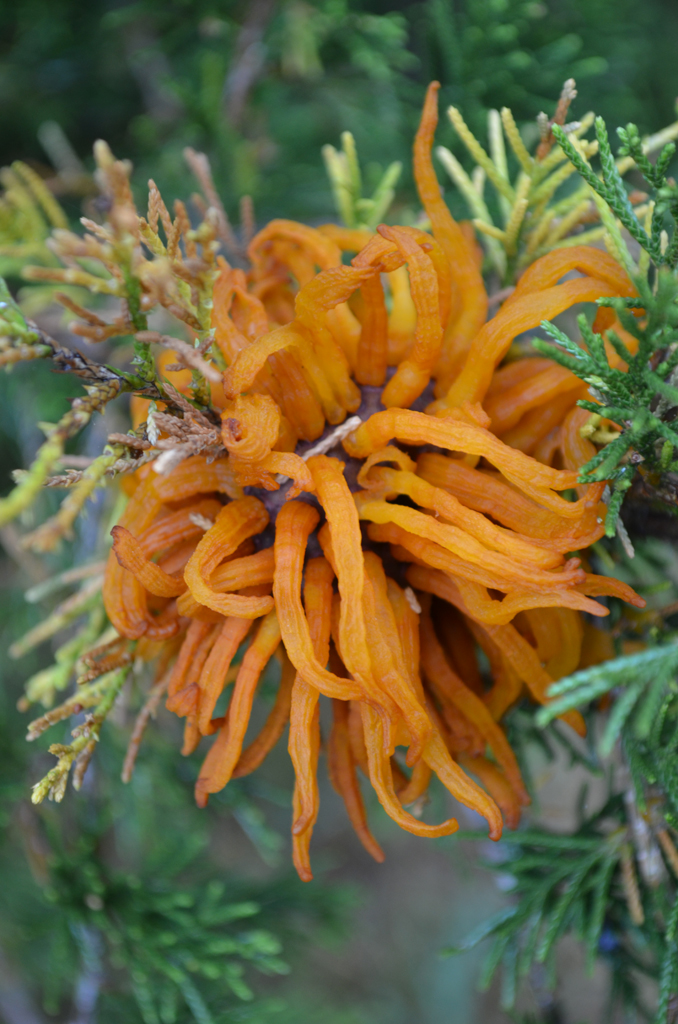
    Sometimes nature can be stranger than fiction.  At George Washington’s Ferry Farm, we are currently experiencing such a phenomenon:  Apple Cedar Rust.  Hideous in appearance, yet strangely fascinating, this fungus erupts on our cedar trees every few years when temperature and moisture are just right. It’s a monstrous growth with bright orange tentacles.  Like some bizarre alien fruit, they hang from the cedars after which they shrivel up and disappear until the conditions are just right for the fungus to become active again.

    But what are these odd gooey orbs, called ‘galls’, on the cedars and what do they mean in a greater context?  Well, what we are seeing at Ferry Farm and all around the Fredericksburg, Virginia area is actually only one stage in the life of the Apple Cedar Rust.  This fungus requires two trees to complete its two year life-cycle, as is evidenced by its name.  The gall on the cedar erupts with orange protrusions, called ‘horns’, during the spring and release millions of spores that will float on the wind for several miles trying to find an unsuspecting apple or crabapple tree in bloom.  At this point, the spores infect the leaves and blossoms of the poor tree, causing unappealing blemishes on the fruit and, occasionally, a total loss of the apple crop.  At the end of the summer, the fungus that developed on the underside of the apple leaves also releases spores that travel back to the cedars, where they lay dormant for over a year before eventually sprouting the orange jelly-like grows and starting the cycle again.

    Apple Cedar Rust (1)This disease had the potential to devastate colonial-era apple crops.  Although wild crabapple varieties were native to the Americas, European immigrants quickly introduced domesticated apples to the New World and widely cultivated the fruit.  Baked into pies and puddings, dried, turned into preserves, and even added to savory dishes, apples were very popular.  Not just prized as a food, the delicious fruit was also commonly converted into hard cider, which could be stored much longer than fresh apples and rivaled beer in popularity with colonials.  In years of abundant crops, excess apples could even be used to finish livestock prior to butchering.  As such, most colonial households grew at least a few apple trees. The loss of some or all of this fruit would have been tragic.  Native Americans also suffered the loss of indigenous crabapples, which provided food for them and for animals they hunted and relied on.
    It is unclear if the complex phenomenon of Apple Cedar Rust was understood by European settlers and Native Americans. Did they know that the strange orange masses on cedar trees signaled a drop in apple yields?  It is a question to ponder. Lacking the fungicides of today, early Americans’ only recourse would have been to destroy all the cedars within a few miles of their trees – not a very practical solution.  Most of us today do not grow our own food so Apple Cedar Rust is merely a gross curiosity, but to colonial farmers and past inhabitants of the early North American landscape, the ugly fungus may have caused real problems.

    Mara Kaktins, Archaeologist

  • Restoring Kenmore’s Gardens

    Kenmore's Gardens 1

    While the various restorations of Kenmore itself over the years are usually the star attraction for visitors to the site, there was another restoration, equally as important, that occurred on the property in its early years as a museum.  Kenmore’s gardens are well-known for their beauty now, but when the Kenmore Association acquired the property in the 1920s, the grounds were in a sad state.  It would take generations of work and ingenuity from a variety of people and groups to return the gardens to their former glory.

    Perhaps the most important moment in the history of Kenmore’s gardens was when the Garden Club of Virginia decided to tackle them as their first-ever restoration project in 1929.  The Garden Club established Virginia Garden Week specifically to raise funds for the project.  Their success in both completing the first restoration of Kenmore’s gardens, and in creating a significant annual event across the Commonwealth of Virginia lead to more than 50 historic garden restorations since, and the celebration of its 83rd Historic Garden Week next week.

    In 1940, the next phase of Kenmore’s garden restoration began when the Garden Club agreed to fund the implementation of designs by the renowned Southern landscape architect Charles Gillette.  His plans included the “secret garden” area in the northeast corner of the grounds, the brick wall that currently surrounds the property, and Kenmore’s iconic brick gate on Winchester Street. Gillette would continue his work at Kenmore into the 1950s.

    Garden Letter 1
    Page 1 of a letter from Hetty Harrison to Annie Fleming Smith dated June 26, 1940 informing the Kenmore Association that the Garden Club of Virginia had selected Kenmore as its restoration project and that renowned Southern landscape architect Charles Gillette would provide the design.

    Garden Letter 2
    Page 2 of the Harrison-Smith letter

    Tree Planting
    Ceremonial tree-planting on the Kenmore grounds, 1938.

    Most recently, the Garden Club of Virginia undertook another restoration of the gardens in 1992.  The Club remains a vital supporter of Kenmore’s landscape efforts to this day.

    During Historic Garden Week, enjoy Kenmore’s gardens and experience the house in a new way! On Tuesday, April 26, try a specialty tour highlighting one of three topics—the restoration of Kenmore at 11:00 a.m. and 2:00 p.m., American Revolution at Noon and 3:00 p.m., and ceramics at 1:00 p.m. and 4:00 p.m.  For more information and to view the specialty tours monthly schedule, click here.

    Meghan Budinger
    Aldrich Director of Curatorial Operations

  • Video: Arbor Day Celebration

    Each year, Historic Kenmore is the site of the Arbor Day Celebration for the City of Fredericksburg. This video shares sights and sounds from this year’s celebration held on Thursday, April 14, 2016.