Lives and Legacies

Tag: white salt-glazed stoneware

  • Expanding Ferry Farm: The Quarter

    If you have visited Ferry Farm recently or follow us on social media, you may have noticed the construction of two buildings near the Washington House. These new structures represent ones that stood in these spots during George Washington’s time. Identified through archaeology, their reconstructions allow us to better tell the stories of the people who lived and worked at Ferry Farm. For this blog, we will look at the structure adjacent to the Washington House along the embankment overlooking the Rappahannock: The Quarter.

    What’s in a Name?

                First, we need to define what we mean when we call the structure “the Quarter.” Regarding enslaved life, the term “quarter” can refer to several different situations. Generally, it refers to a structure that housed enslaved individuals with “quarter,” equating to a living space or personal quarters. The term has nothing to do with the number and makeup of the occupants or the appearance of the building. The other use for the term refers to a group of enslaved people. Augustine Washington’s probate inventory lists seven enslaved people at Ferry Farm’s “satellite quarter” (Fig. 1). In this use, it does not refer to a single physical structure but rather a group of people and their housing unit that moved around. “The Quarter” uses the term for a single structure, identified through archaeology, that housed an enslaved family in the heart of the Ferry Farm plantation.  

    Figure 1: Section of Augustine’s probate inventory listing individuals at the satellite “quarter”

    Enslaved Housing

                Living conditions varied widely across the Mid-Atlantic and even within a single plantation. Customarily, enslaved people lived where they worked. Work yard structures included living quarters above the workspace while the fields had structures akin to dormitories that housed people divided by biological sex. In certain cases, independent structures may have served as housing for single family units (Fig. 2). Those that lived within these spaces generally held high ranking positions within the hierarchy established by enslavers. Housing generally stood outside public view and in areas convenient to the work undertaken by the inhabitants. Quarters within sight of the public served as status symbols for the gentry.

    Figure 2: 1860 engraving depicting single quarters in South Carolina (Slavery Images)

                Identifying quarters today largely comes from historic records, oral history, archaeology, and architectural features. All of this can help establish a range of appearances for such structures. When a building no longer remains standing, these observations can be compared to artifacts uncovered at the site to determine its identity. Sub-floor storage pits, often located near hearths, serve as key architectural identifiers, while artifacts that reflect African diaspora culture, outdated items, and evidence of labor help pinpoint the identities of the inhabitants. Quarters served as the only personal spaces allotted to enslaved people, so any artifacts recovered can speak to their personal identities rather than those defined by Virginia colonials.

    Archaeological Evidence

                The excavation of the Quarter occurred in 2003, and research in successive years helped to identify its role and understand the lives of its inhabitants.

    • Architecture: When excavated, little remained of the Quarter, but the architectural elements present and absent provided enough information to understand its appearance. Archaeologists recovered small quantities of Aquia sandstone around the quarter indicating it may have had a light stone foundation and hearth. The main impact it had on the ground surface occurred through the creation of a sub-floor pit. These pits frequently appeared in quarters and served as storage areas for the occupants’ personal effects. Unfortunately, a tree later intruded a portion of the pit and the surrounding area thus making it difficult to study (Fig. 3). Other architectural elements included an abundance of nails and an absence of window glass (Fig. 4). This indicates the building had clapboard siding and likely shuttered windows in place of glass ones.
    Figure 3: Quarter Excavation Site
    Figure 4: Nail distribution around Quarter
    • Tableware (Fig. 5): Within the eighteenth-century contexts, we recovered many ceramics and utensils of European origin. White-salt glazed stoneware dishes and dog-nosed spoons represent styles in decline by the 1740s. This indicates that the enslaved occupants either received hand-me-downs from the Washingtons, a common practice, or purchased used items in the local market. A colonoware bowl served as an exception. A local ceramic type attributed to free and enslaved black communities, colonoware production mixed African ceramic techniques with European vessel forms.
    Figure 5: Tableware (L-R white salt glazed stoneware, dog-nosed spoon handle, colonoware bowl, table knives)
    • Small Finds (Fig. 6): Analysis of the artifacts revealed the personal effects of the occupants, their possible identities, and the labor they carried out. Wig curlers appear frequently throughout Ferry Farm, but the recovery of several at the Quarter indicates that the individual(s) tasked with maintaining the Washington wigs may have lived within. Sewing implements, such as thimbles, reflect labor carried out by enslaved women and girls either for the Washingtons or for themselves. A common practice in colonial Virginia saw each enslaved person receive a ration of cloth from which they fashioned their own clothing. Straight pins further indicate the presence of female occupants as these pins held their garments, such as bed gowns, together. Both genders used the numerous tobacco pipes recovered. The fishhook speaks to an entirely personal activity,  as enslaved communities often supplemented their food rations by fishing. The pierced coin serves as the artifact most indicative of enslaved culture. Piercing a coin allowed the owner to keep it on their person as a form of adornment. Such coins often served as talismans, though they could re-enter the economic world as needed.
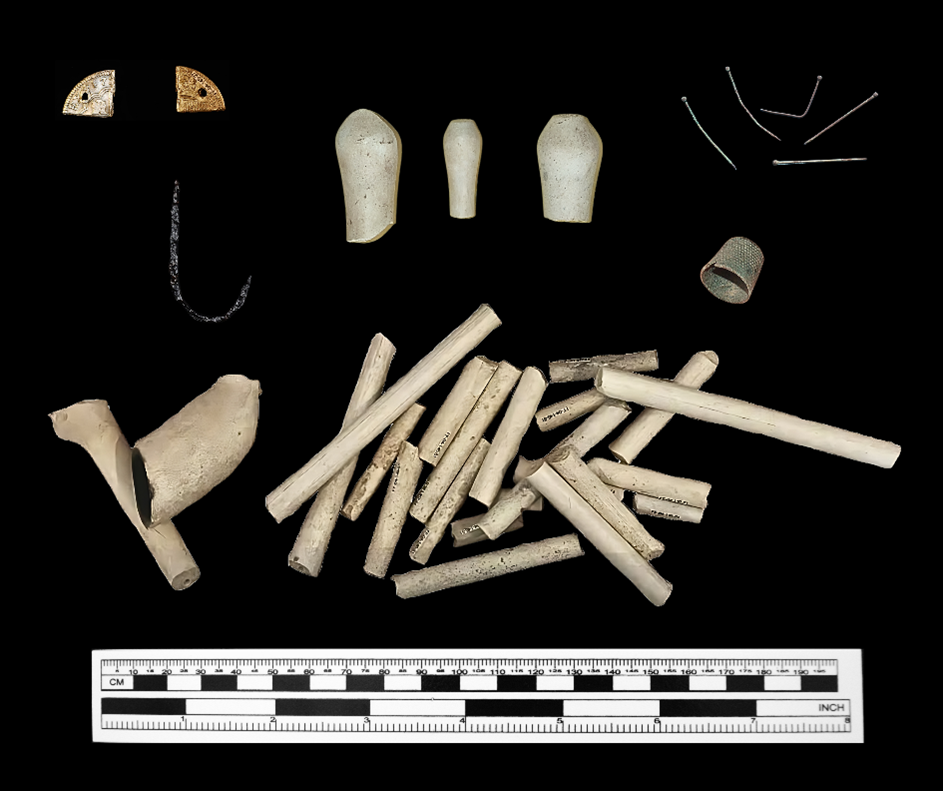
    Figure 6: Small Finds (L-R mirrored pierced coin, fishhook, wig curlers, thimble, straight pins, tobacco pipe fragments)
    • Diet (Fig. 7): Faunal remains found at the Quarter supplement the information provided by the fishhook. As expected, we identified several fish species including types of perch, catfish, and sunfish which lived in the Rappahannock at that time. Other animals included cattle, chickens, pigs, opossum, and shellfish, such as oysters. This mix of domestic and wild species indicates that the Quarter’s occupants supplemented the rations supplied by the Washingtons. The enslaved commonly achieved this by maintaining small gardens and raising chickens, hunting, fishing, and foraging. While we did not recover any plant remains, those consumed by the inhabitants likely reflected a similar mix of wild and domestic species.
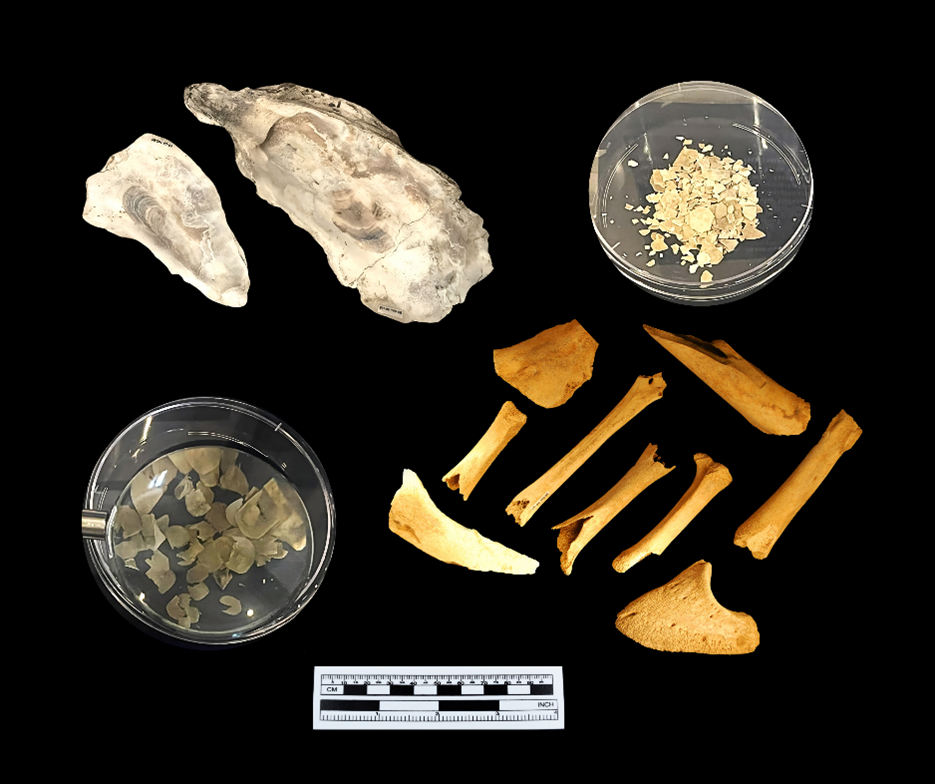
    Figure 7: Faunal (L-R Oyster shells, eggshells under microscope, fish scales/bones under microscope, various mammal bones)

    Reconstruction and Interpretation

                The reconstruction of the Quarter combined our archaeological evidence with the historic knowledge of enslaved housing (Fig. 8). The finished Quarter measures 16’x14’ which aligns with standard measurements for single-family quarters. From our archaeology, it has clapboard siding, sliding shutters in place of glass windows, a subfloor pit, and sandstone hearth. Information on contemporary quarters led to the inclusion of a loft and a daub lined wood chimney. Architects used eighteenth-century techniques to reconstruct the building.
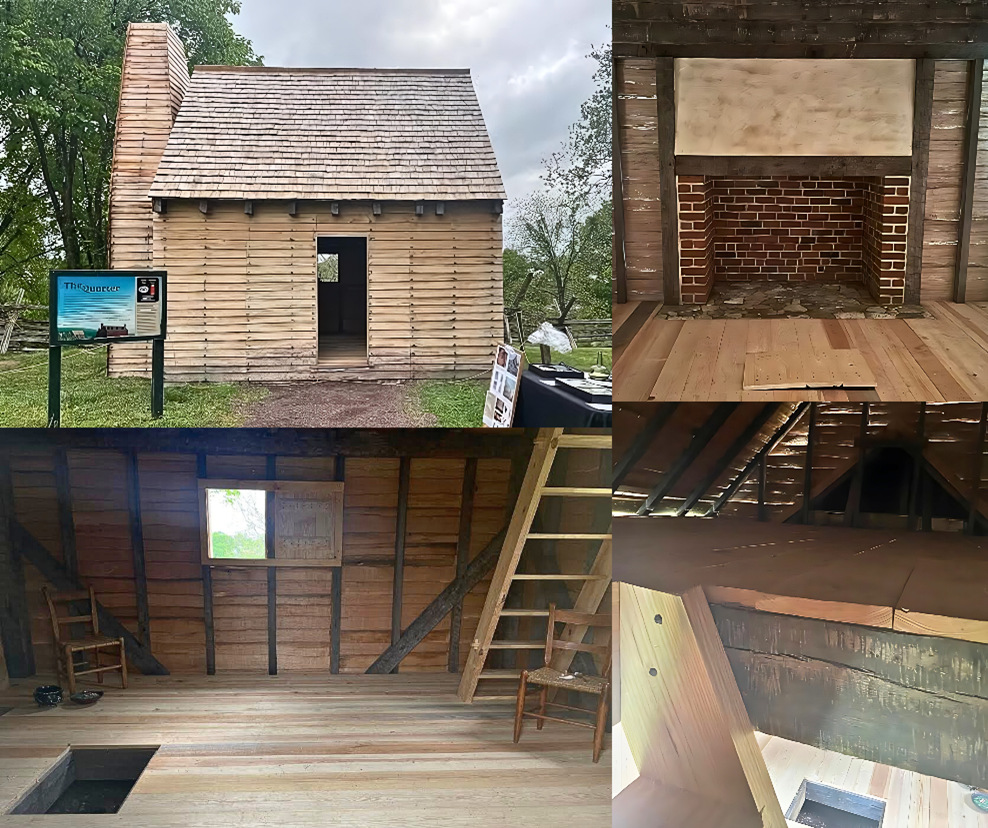
    Figure 8: The Quarter, various views

                From our findings, we concluded that the quarter housed a single family. At least one of these individuals held a high-ranking position within the labor hierarchy allotted these living arrangements (Fig. 9). The structure’s proximity to the Washington House and work yard indicates the occupants worked within these spaces. The position on the bluff overlooking the Rappahannock meant that this quarter, unlike others, lay in view of the public.  “The prominent placement of this structure on the landscape may mean that it was used to reinforce Washington’s prominent social standing in colonial Virginia.”     

    Figure 9: Portion of Augustine’s probate inventory listing individuals at Ferry Farm; some may have called the Quarter home

    The Quarter will open to visitors this fall, and visitors will be able to read about and visualize the lives of those who lived within. Like the Washington House, everything that furnishes the Quarter will be interactive and reflect archaeological finds. Planning remains ongoing for this, but when complete, visitors may find outdated tableware, evidence of meals, tools for labor, and personal effects.

    Emma Schlauder

    Research Archaeologist


    Bibliography
    
    Augustine Washington Probate Inventory, 1743
    
    Carson, Cary & Carl Lounsbury (editors)                                                                                                  2013     The Chesapeake House: Architectural Investigation by Colonial Williamsburg. The University of North Carolina Press, Chapel Hill, NC.
    
    Katz-Hyman, Martha B. & Kym S. Rice (editors)                                                                                       2011     World of a Slave: Encyclopedia of the Material Life of Slaves in the United States. Greenwood, Santa Barbara, CA.
    
    Lanier, Gabrielle M. & Bernard L. Vlach                                                                                                     1997     Everyday Architecture of the Mid-Atlantic: Looking at Buildings and Landscapes. The John Hopkins University Press, Baltimore, MD.
    
    Lounsbury, Carl R. (editor)                                                                                                                  1994     An Illustrated Glossary of Early Southern Architecture and Landscape. University Press of Virginia, Charlottesville, VA.
    
    Samford, Patricia                                                                                                                                       1996     The Archaeology of African-American Slavery and Material Culture. William & Mary Quarterly 53(1): 87-114.
    
    2000     Power Runs in Many Channels: Subfloor Pits and West African-Based Spiritual Traditions in Colonial Virginia. Doctoral Dissertation, Department of Anthropology, University of North Carolina, Chapel Hill. University Microfilms International, Ann Arbor, MI.                                                                                                                                           
    
    Stilgoe, John R.                                                                                                                                          1982     Common Landscapes of America, 1580-1845. Yale University Press, New Haven, CT.
    
    Wells, Camille                                                                                                                                        1993     The Planter’s Prospect: Houses, Outbuildings, and Rural Landscapes in Eighteenth Century Virginia. Winterthur Portfolio 28(1): 1-31.
    
    Vlach, John M.                                                                                                                                           1993     Back of the Big House: the Architecture of Plantation Slavery. The University of North Carolina Press, Chapel Hill, NC.
    
  • What’s on your Thanksgiving table?

    Thanksgiving is next week, and families and friends across the United States will gather again to celebrate the past year’s blessings. 

    Days for giving thanks have been proclaimed throughout history for many reasons – most often to celebrate a bountiful summer or fall harvest, the end of a war, or even the beginning of a new nation. George Washington proclaimed a one-time day of Thanksgiving on Thursday, November 26, 1789, “to be devoted by the People of these States to the service of that great and glorious Being, … for the civil and religious liberty with which we are blessed, and the means we have of acquiring and diffusing useful knowledge; and in general for all the great and various favors which he hath been pleased to confer upon us.”.

    The 1769 Thanksgiving Day Proclamation by George Washington

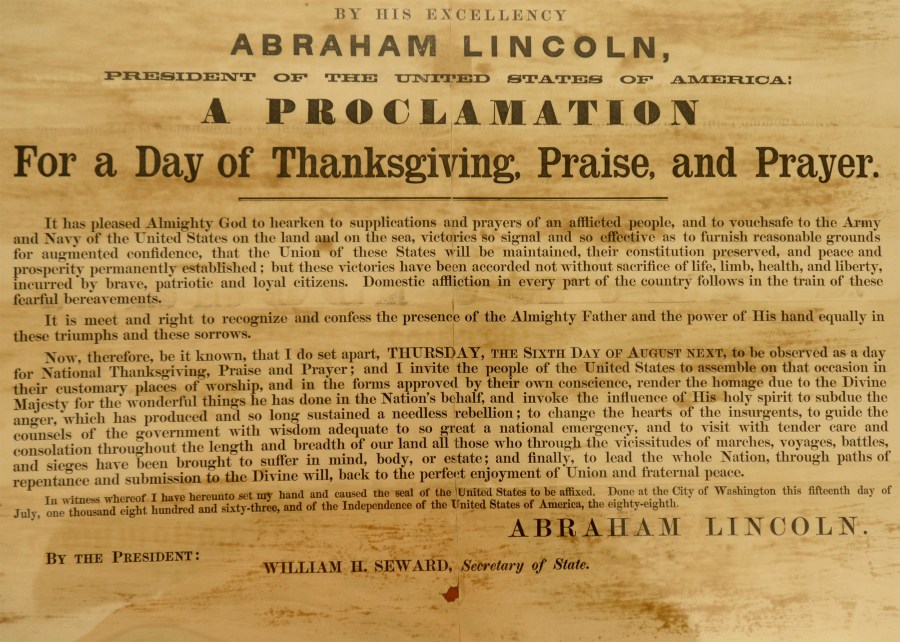
    Individual states have proclaimed specific Thanksgiving days throughout the nation’s early years. Still, it wasn’t until 1863 when President Abraham Lincoln issued a proclamation designating the last Thursday of November “as a day of Thanksgiving” to be observed by all “fellow citizens in every part of the United States.” The nation was still suffering through the Civil War. Lincoln included a remembrance of “all those who have become widows, orphans, mourners or sufferers in the lamentable civil strife in which we are unavoidably engaged, and fervently implore the interposition of the Almighty Hand to heal the wounds of the nation and to restore it as soon as may be consistent with the Divine purposes to the full enjoyment of peace, harmony, tranquillity, and Union.”

    1863 Thanksgiving Day Proclamation by President Abraham Lincoln

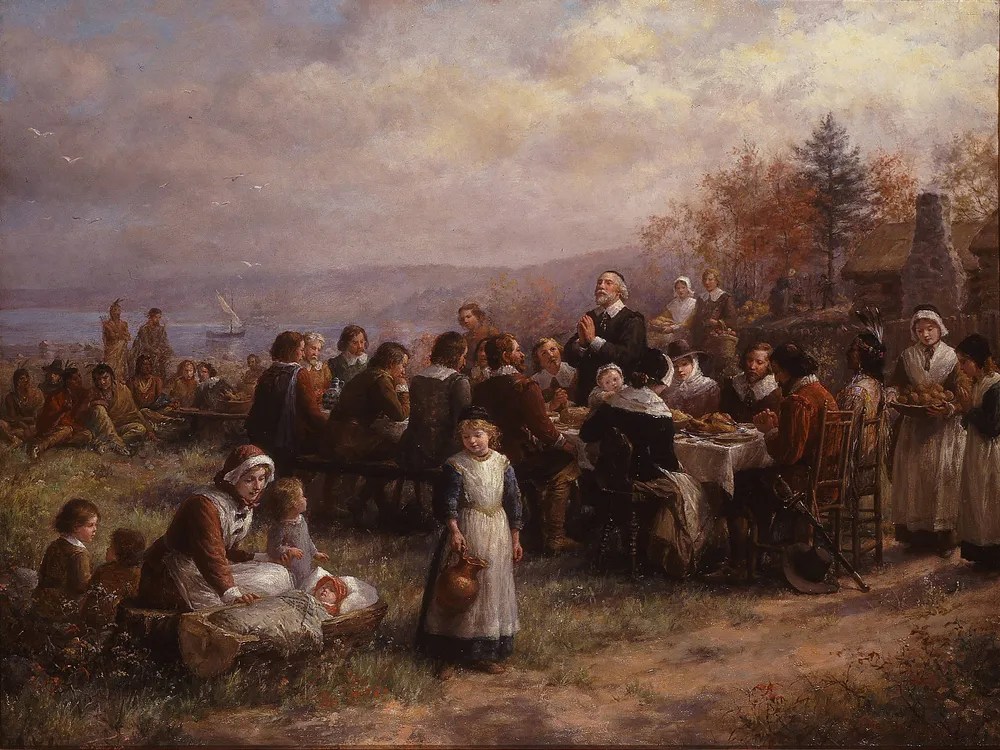
    As the traditional vision of Thanksgiving is based upon the 1621 New England harvest feast shared by the Pilgrims of Plymouth, Massachusetts, and their new friends, the Wampanoag tribe, the November holiday is associated with an abundance and display of fall harvest foods. A table laden with a wide spread of traditional foodstuffs is the norm, but what’s underneath all that food is what I’m interested in!

    Jennie Brownscombe’s 1925 very idealized version of the first Thanksgiving

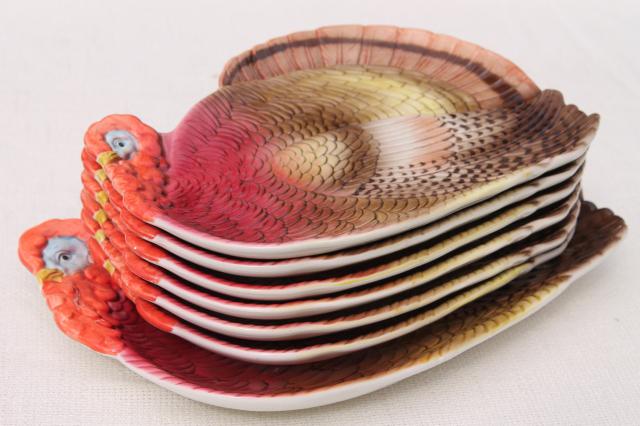
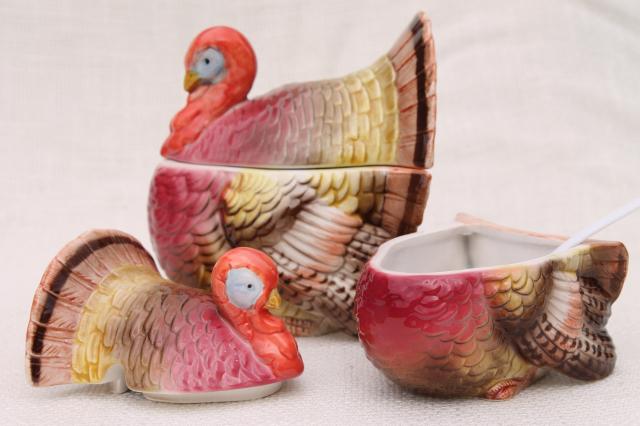
    Our best china! Sometimes, it’s Grandma’s china, brought out of the basement, dusted, and cleaned off for the occasion. Other times, it’s our wedding china, if you are of that generation that still wants or received wedding china. Other times, it’s unique dishes made and decorated for the occasion (think turkey-shaped plates!). Dinner plates, salad and butter plates, serving platters and bowls, condiment vessels, punch bowls, sauceboats for the gravy, dessert plates, tea, and coffee services, crustal wine glasses – the variety can be tremendous, and the different table wares are utilized to display and serve specific foods and finished dishes.

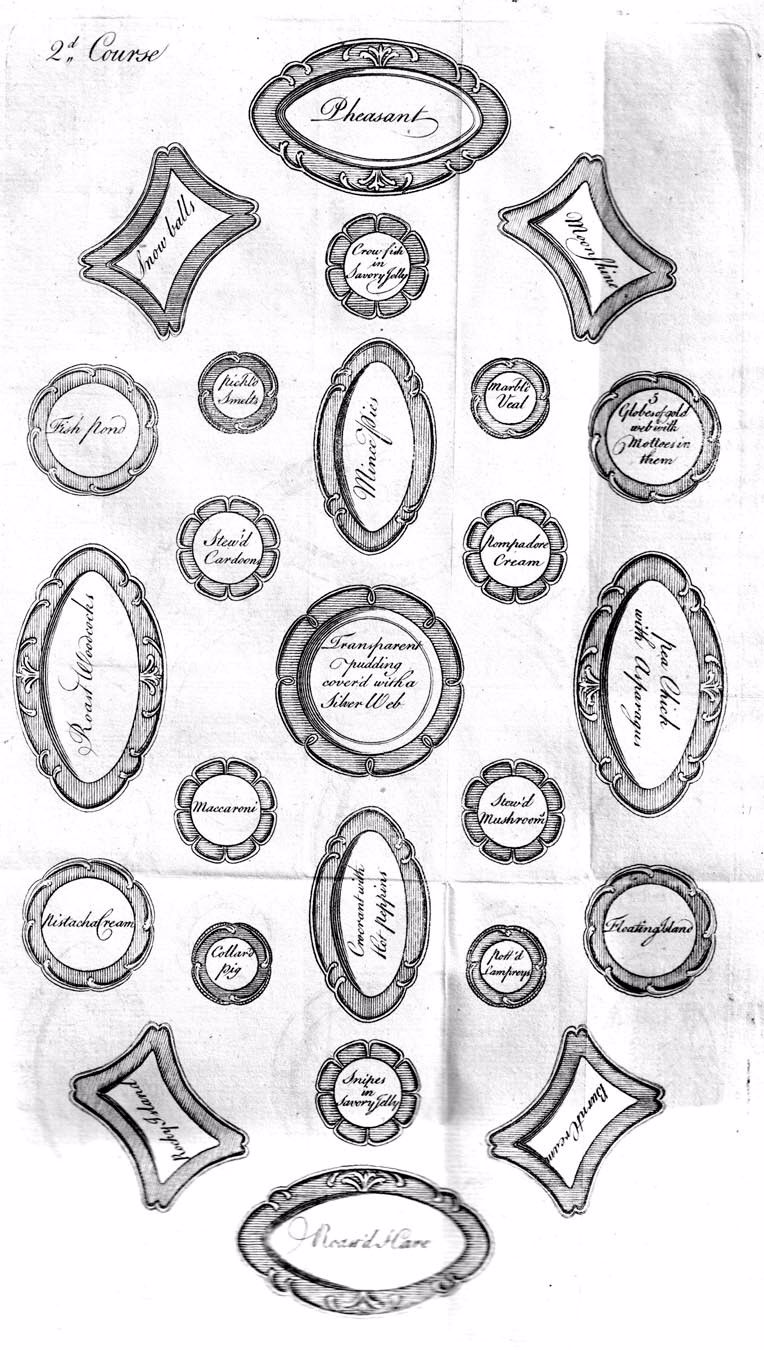
    Mary Washington, as a member of the gentry class in Colonial Virginia, would have been well-versed in setting a stylish dinner table for family and guests. Formal dining habits during the 18th century slowly evolved to dinners consisting of multiple courses of food prepared and served in a more elaborate and complicated fashion. Cookbooks of the age detailed the possible menus for different seasons and even produced drawings of how each course’s dishes were laid out on the table. Elizabeth Rafferty’s 1769 The Experienced English Housekeeper includes a copperplate drawing illustrating one such arrangement for the second course of a dinner. Hours could be spent looking up how some of her dishes were prepared, such as “Pistacha Cream,” “Potted Lampreys,” or “Transparent Pudding Covered With a Silver Web.”

    Second course dinner layout from The Experienced English Housekeeper, 1769

    Fragments of highly specialized ceramics excavated at Ferry Farm, the plantation Mary called home for much of her life, speak to her efforts to set a stylish table for guests. Numerous highly decorated (molded or painted) creamware vessels, including sauceboats, plates, platters, oval and round serving bowls, condiment bowls, casters, serving spoons, and tea wares, are in our collection and speak to the refinement of her table. Porcelain was the most desirous of tablewares, but its sheer expense was prohibitive for Mary except for limited items, such as teawares. Creamware, however, was within her budget and was extremely fashionable during the third quarter of the eighteenth century in English society.

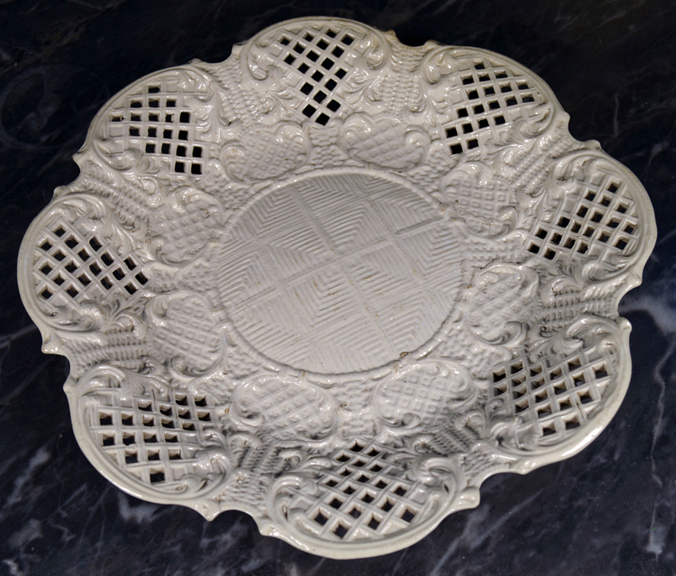
    Mary also had a fancy white salt-glazed stoneware fruit dish in her collection. This dish, and possibly an accompanying pierced bowl, would serve local and non-local produce such as grapes, figs, oranges, pineapples, apples, peaches, and pears. Fresh fruit, especially during off-season times, was expensive as it had to be shipped in from warmer climates. However, its presence on the table indicated a measure of wealth and, consequently, status within the gentry lifestyle. Mary needed to maintain her gentry status for herself, but more importantly, for her children and their future success in the stratified society in which they lived.

    So, what’s on your table this Thanksgiving?


    Judy Jobrack

    Archaeology Field Director

  • Appearance is Everything: Mary Washington and Her Specialized Ceramics of Gentility – Some Seriously Fancy Dishes!

    The story of Mary Ball Washington is one of overcoming a lifetime of adversity.  Often overshadowed by her larger than life son George, Mary’s place in history fluctuated from saint to shrew with many historians ignoring the obstacles she faced and overcame.  The archaeological record sheds light on some of the strategies Mary used to navigate her way through mid-18th century life as a widow while trying to maintain her own social status and that of her children.  Fragments of highly-specialized ceramics excavated at Ferry Farm, the plantation Mary called home for much of her life, speaks to her efforts.

    Specialized dishes are those designed for a very specific job unlike, say, a bowl which is multi-purpose.  We have uncovered evidence of many dishes Mary owned that fulfilled single tasks.  These type of ceramics are a sign of gentility. Most households could not afford these items and likely did not possess the resources to make the food and drink that they were designed to hold. 

    As the 18th century progressed, so did dining habits. Increasingly, people of means gravitated toward dinners with multiple courses of entrees, appetizers, beverages, and deserts. Previously, most meals consisted of large one-pot creations with multiple ingredients.  In order to pull course cooking off, one required the specialized dishes designed for serving multiple courses. 

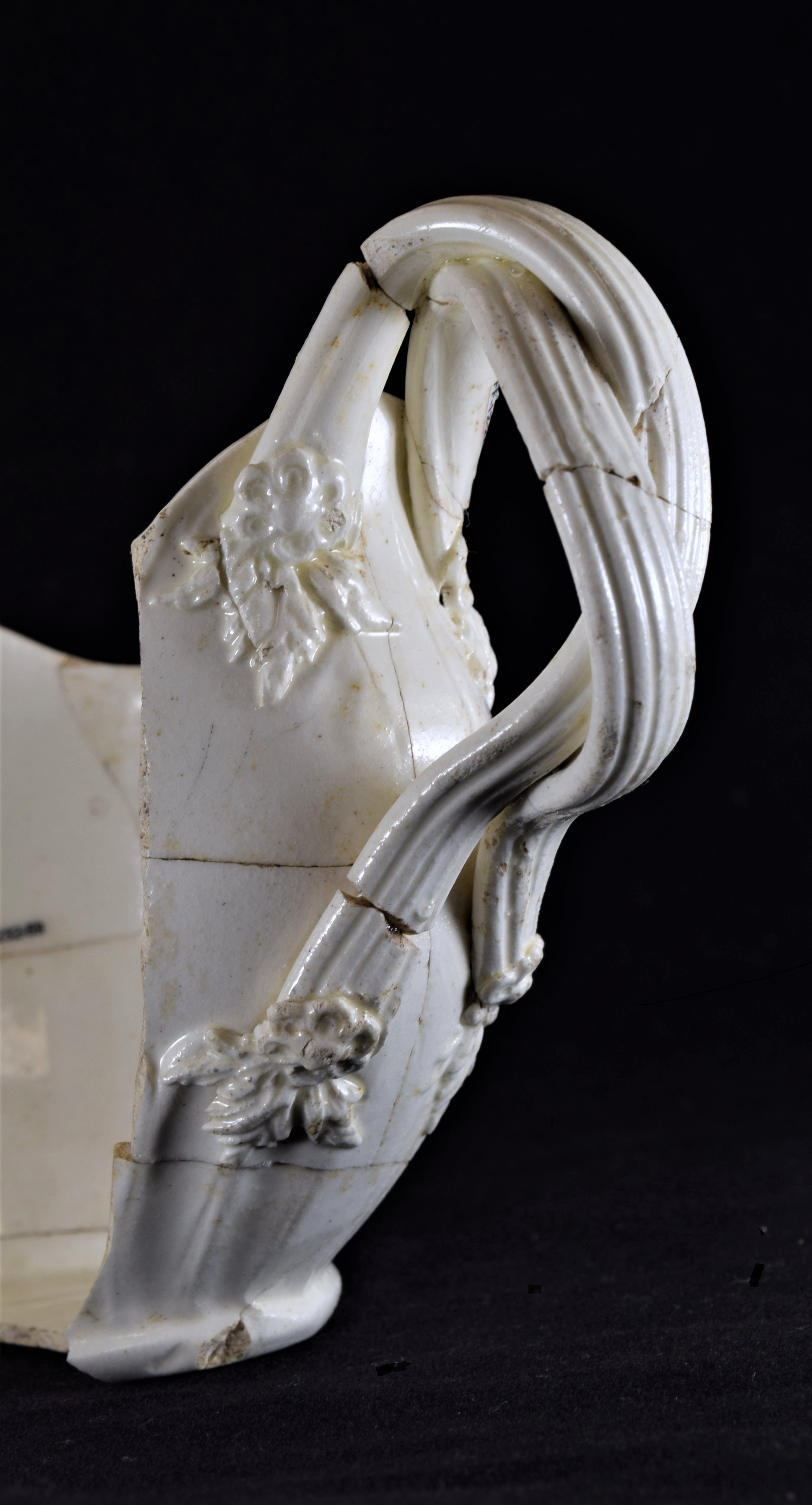
    One prime example of such specialized dishes from Ferry Farm is Mary’s elaborately decorated creamware sauce boats.  The sauce boats are a luxury in and of themselves. They’re highly decorated and were very fashionable at the time.  Not only were they expensive, but they showed that Mary had the refinement to serve her guests the fancy sauces being introduced into colonial cooking.  They also indicated that she had a trained kitchen staff of enslaved workers capable of executing these new and intricate recipes. You never thought a sauce boat could hold so much meaning, did you?

    Portion of a highly-decorated creamware sauce boat that belonged to Mary Washington.

    Fragments of an extremely fancy white salt glazed fruit dish are further examples of Mary’s calculated purchasing of dishes.  Previously written about here and here, this dish was meant to display fruit, another luxury in the 18th century. Being able to afford non-local or out-of-season fruit was a status symbol and necessitated the proper dish to proudly display the fruit.  To put the rarity of fruit in perspective, in colonial America, pineapples were so expensive you could rent one for display at parties in the holiday season because most people couldn’t afford to buy one outright.  While renting a fruit may seem ridiculous to modern readers, the action highlights just how important being seen to own certain items was during the colonial era. Of course, we still engage in this same behavior today, but just not with pineapples.

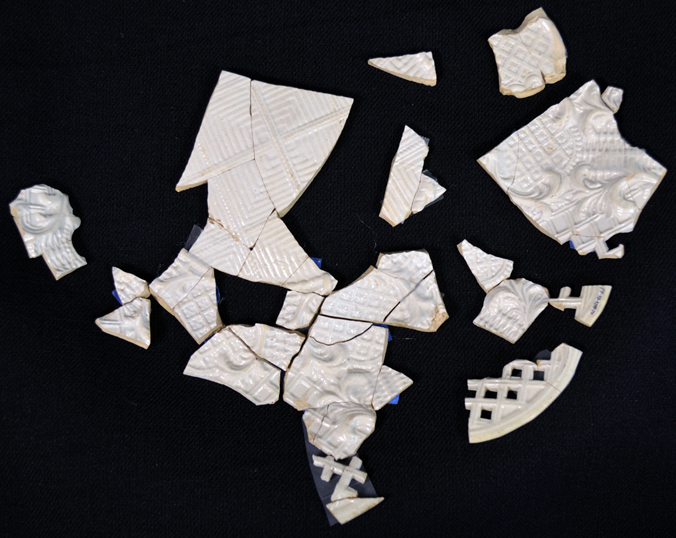
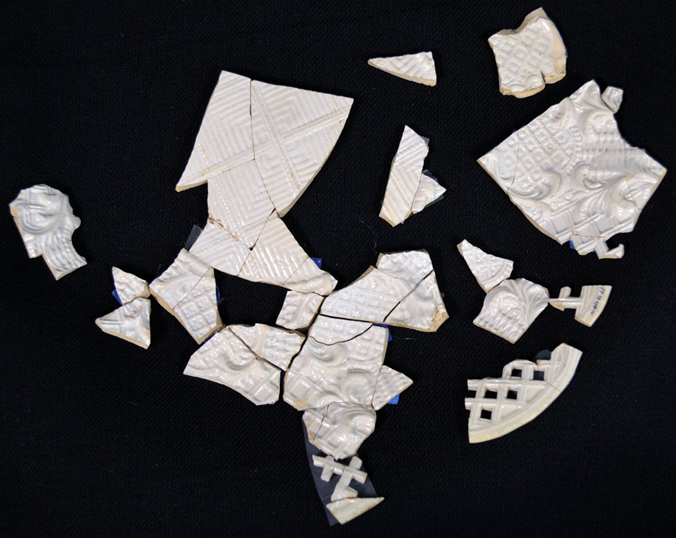
    Fragments of a white salt-glazed fruit dish excavated at Ferry Farm and a complete example from the collection at Kenmore (above).

    Ferry Farm archaeologists also excavated fragments of two creamware condiment dishes.  Once again, the ability to serve various condiments to dinner guests conveyed status.  Condiments could include relishes, dips, mustards, ketchups (mushroom ketchup being the preferred type), and pickled vegetables such as capers.  Castor sets were also a way to serve other condiments such as olive oil, vinegar, pepper, etc. Generally, these castor sets were only owned by well-to-do households in the colonial period. The base of a creamware castor was recovered at Ferry Farm.

    Creamware castor base excavated at Ferry Farm.

    The fact that so many of Mary’s specialized ceramics are made of creamware should also be noted.  Creamware was invented in 1762 and wasn’t the most expensive type of ceramic (that was porcelain) but it was highly fashionable.  Mary, as a widow with five children and a diminished income following her husband’s death, likely couldn’t afford much porcelain. She opted for the less expensive but still highly-desirable creamware, instead.

    The Washington family went to great lengths to demonstrate their status and refinement to visiting friends, neighbors, and relatives.  At Ferry Farm, this burden fell solely on Mary after the death of her husband.  Her specialized ceramics served to illustrate her place within the gentry class despite her diminished income and refusal to remarry after being widowed.  Her goal was to remain independent while raising five children to be successful adults and members of the Virginia gentry class.  In doing so, she likely realized that the socioeconomic security of her children would ensure her own into the future as well. Consequently, it was important that Mary cultivate a refined household with appropriate table and teawares. Ceramic artifacts from Ferry Farm reveal a woman who carefully selected choice ceramics to perform very specific tasks, while at the same time not overextending her budget.  These ceramics contributed to her goal of remaining a part of the gentry class and teaching her children genteel habits so they could do the same. It was a task in which she overwhelmingly succeeded.

    Mara Kaktins, Archaeologist
    Ceramics & Glass Specialist

  • Artifact, Object, Repro: Part 2 – White Salt-Glaze and Westerwald Stonewares

    Furnishings posts logo finalToday, we continue our look at the different ceramics displayed or soon to be displayed in the Washington house at George Washington’s Ferry Farm.  We’re examining the artifacts recovered at Ferry Farm, the complete 18th century objects those artifacts represent, and the reproduction pieces inspired by these artifact sherds as well as by the complete originals.  Last week, we learned about the blue and white Chinese Export Porcelain reproductions gracing the house.  This week, in the second post of this series, will investigate the white salt-glaze stoneware and the Westerwald stoneware.

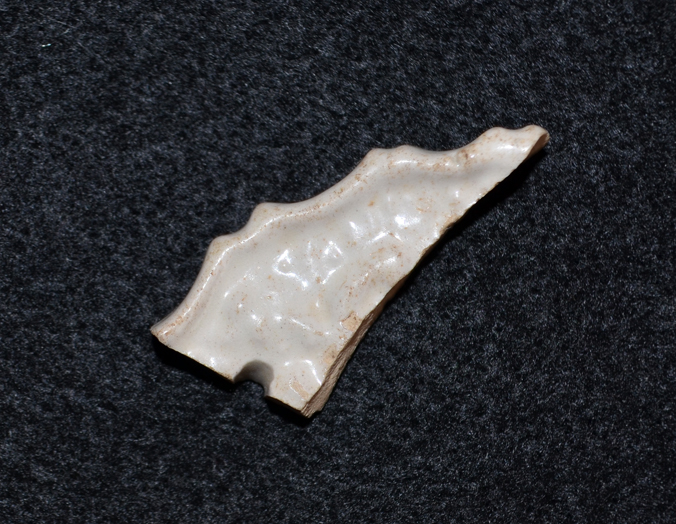
    These fragments are from white salt-glazed (WSG) stoneware dinner plate rims, and show two different styles of molded decoration.  The pattern in the above photo on the left was known as “dot/diaper/basket” and the pattern in the above photo on the right was known as “royal rim.”


    Molded WSG came into existence in the 1740s, so the Washington family was right on trend.  A few decades later, creamware would replace it as popular dinnerware, but the rim patterns found on WSG were often very similar to those used on later creamware.

    During the height of the Colonial Revival decorating style in mid-20th century America, the patterns used on WSG and creamware back in the 18th century had a major resurgence.  Several American potteries started producing white stoneware table wares, similar to WSG, with glossy surfaces similar to creamware, using molded rim decorations that were almost exactly like their 18th century predecessors.  The Canonsburg Pottery outside of Pittsburgh, Pennsylvania, produced dot/diaper/basket plates under the pattern name of American Traditional from the early 20th century through the company’s closure in 1978.  The Red Cliff Company pottery in Chicago produced plates with a rim pattern taken from the “royal” rim style on 18th century creamware (which was similar to an earlier WSG rim) under the pattern name Heirloom from the 1950s until their closure in 1977.  Similarly, Sears sold an almost identical plate under the pattern name American Federalist until the mid-1980s.  Luckily for us, all of these 20th century patterns are collectible and we found many of them in stores and on-line.

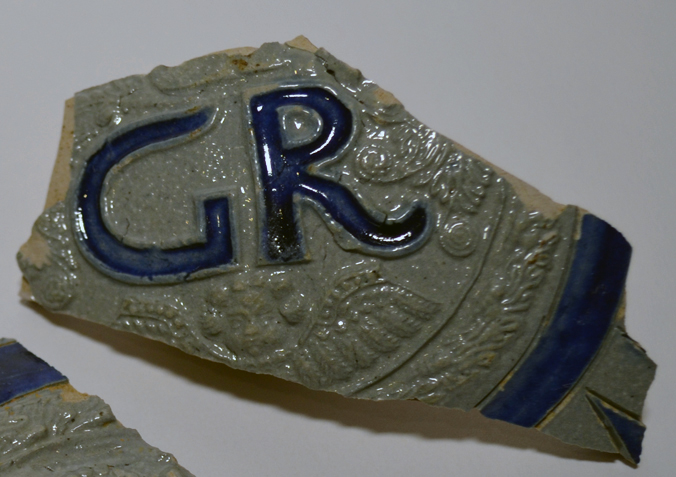
    C1 - Westerwald Artifact

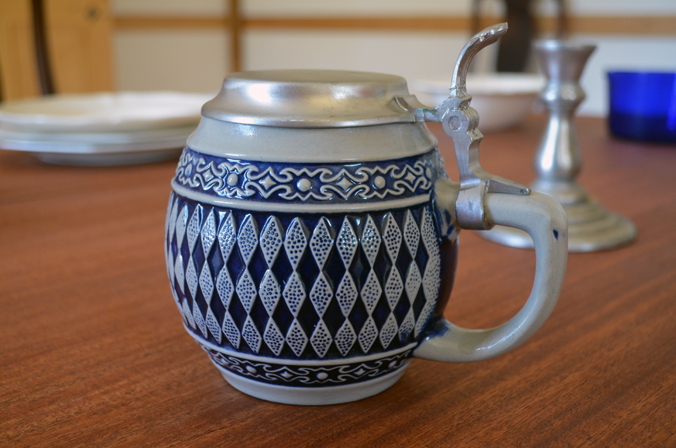
    The above fragment came from either a mug or a jug made from grey stoneware decorated with cobalt blue glaze, known as Westerwald.  The Washington family owned quite a bit of Westerwald ceramic, as did the Lewis family at Kenmore.

    C2 - Westerwald Mug

    Westerwald pottery originated in 17th century Germany, and it is still produced there today.  It was a popular style for traditional German steins, often with pewter lids attached.  In the 18th century, it was often made for export to England and was therefore decorated with the “GR” emblem, referencing Georgius Rex (King George).

    C2 - Westerwald Repro

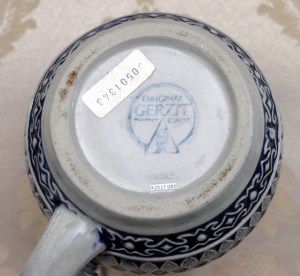
    During one of our treks through a thrift store, we came across this lidded Westerwald mug, and we were amazed at how similar to our 18th century fragments it was.  So amazed, in fact, that we questioned whether or not it might actually be an antique piece (that somehow remained in pristine condition)! A look at the bottom revealed a very 20th century maker’s mark, however, but it also spurred a desire to find out more about the company that was producing such excellent Westerwald. The mark indicated that the Markpiece was “Original Gerzit,” and some internet research revealed that the Gerzit Company in Höhr-Grenzhausen, Germany, was originally the pottery founded by Simon Peter Gerz in 1857.  The family owned and continued to operate the pottery through World War II, at which time they changed the name to Gerzit.  By German law established in 1887, Westerwald produced for export has to be marked Made in Germany.  Westerwald produced for sale in Germany doesn’t have to carry a mark at all.  Any Westerwald produced after World War II for export has to specify whether it was made in East or West Germany.  Putting all of that together, and comparing it to the mark on our newly acquired mug, shows us that it was produced sometime between 1949 (when the company name changed) and 1997 (when the company closed) and was originally intended for sale within Germany.  How it ended up in a thrift store in Virginia is anyone’s guess, but it was a very lucky find for us!

    In part 3, we’ll revisit Chinese Export Porcelains to see imari and famille rose artifacts, originals, and reproductions that will go in the Washington house.

    Meghan Budinger
    Aldrich Director of Curatorial Operations

  • The Fly …uh, Snail… in the Ointment …Pot

    It’s flu season again.  And for most of us who get sick that means a trip to the doctor, perhaps some prescribed medicines, and lots of rest.  But what did George Washington do when he got sick?  Although most of us likely think of our first president as perpetually healthy and strong, he was actually stricken by quite a few serious illnesses in his lifetime, many of which occurred while he was growing up at Ferry Farm.

    Mary, George’s mother, had a few options when caring for her sick children but a hospital was not one. They did not exist yet.  The most expensive solution was to call a doctor (Back then, they came to you. You do not go to them).  Most people could not afford a doctor’s visit, however, and many distrusted doctors as being worse than the diseases they cured.  This fear of doctors was somewhat justified given that George ultimately died of an illness he could well have survived had he not been bled to death by his doctors.

    An ill man who is being bled by his doctor. Coloured etching by J. Sneyd, 1804, after J. Gillray
    “An ill man who is being bled by his doctor. Coloured etching by J. Sneyd, 1804, after J. Gillray.” by James Gillray. Credit: Wellcome Collection. CC BY

    Option number two was to visit a pharmacy.  Now, we’re not talking Walgreens.  Think smaller and jars full of leeches.  Anyone could visit an 18th century pharmacy without any kind of prescription or referral. If you had the money, you could purchase whatever ‘cure’ you wanted.  The pharmacist was not necessarily a medical professional and may or may not have been good at diagnosing whatever illness you had. That didn’t mean you couldn’t walk out of a pharmacy with any and all manner of odd concoctions that cured you or did not cure you.  For instance, folks were awfully fond of self-treating with mercury tinctures until well into the 19th century, which we now know to be a colossally terrible idea.

    Michel Schuppach in his pharmacy examining a young woman's urine who is seated opposite him awaiting the result. Line engraving by B. Hübner, 1775, after G. Locher, 1774
    ‘Michel Schuppach in his pharmacy examining a young woman’s urine who is seated opposite him awaiting the result. Line engraving by B. Hübner, 1775, after G. Locher, 1774.’ by Gottfried Locher. Credit: Wellcome Collection. CC BY

    Another popular option was to make your own medicines at home.  Recipes for cures were passed down through word of mouth and many households had herb gardens containing medicinal plants, many brought with colonists from Europe.  There were also a number of books available that divulged the secrets of pharmacopoeia.  Many of the medicines described in these books sound like things a storybook witch might brew up.  One such tome available to Mary Washington was Thomas Fuller’s Pharmacopeia Extemporanea, published in 1710. It contains remedies such as ‘Pectoral Snail Water’, said to be good for “Erratic scorbutic Fevers, Flushings, flying Pains of the Joynts, hectic wasting of Flesh, and Night-sweats”.  The delicious-sounding ingredients were as follows:

    “Snails beaten to mash with their Shells 3 pound
    Crumb of white Bread new bak’d 12 ounces
    Nutmeg 6 drams
    Ground-Ivy 6 handfuls
    Whey 3 quarts; distil it in a cold Still, without burning
    One half pint brandy”

    One can only assume that the last ingredient was to help the mashed snails go down.

    We do have evidence showing the use of home medicines at Ferry Farm in the form of numerous ointment pots.  At least half a dozen have been identified thus far.  Ointment pots were used for holding various medical or cosmetic unguents likely made at home.  Generally, such pots were fairly plain with a rolled or flared lip used to secure a textile, hide, or paper lid with a string.

    Judging by their lack of use wear, the pots recovered at Ferry Farm were used for storage, not for actually manufacturing medicines.  The act of stirring or grinding substances in the pots would have resulted in microscopic striations or scratches in the glaze and these are absent in the Washington family ointment pots.  However, they do indicate the storage of medicines at Ferry Farm.  Given the nature of home remedies in the 1700s, one’s imagination can run wild thinking of all the interesting concoctions that they may have held!

    Mara Kaktins, Archaeologist
    Archaeology Lab Supervisor

    Further Reading

    Fuller, Thomas. Pharmacopoeia extemporanea : or, a body of prescripts. In which forms of select remedies, accommodated to most intentions of cure, are propos’d. London. 1710.

    Hume, Ivor Noel.  A Guide to the Artifacts of Colonial America.  University of Pennsylvania Press, Philadelphia.  2001.

    Hume, Ivor Noel.  Early English Delftware from London and Virginia.  Colonial Williamsburg Foundation, Virginia.  1977.

    Mellor, Maureen.  Pots and People that Have Shaped the Heritage of Medieval and Later England.  Ashmolean Museum, Oxford.  2000.

    Skerry, Janine E. and Suzanne Findlen Hood.  Stalt-Glazed Stoneware in Early America.  University Press of New England, Hanover and London.  2009


  • Tales of a Patch Stand and a Porringer

    For the past year or so my focus here at George Washington’s Ferry Farm has been determining what types of ceramics were owned by the Washington family. Once we have this information we want to acquire accurate examples to place in the reconstructed house for all to see.  From door hardware to teacups, most of the details of the house will be informed by archaeology or historic documents.  If a visitor asks “Why do you have these plates on the table?”, we can say “That’s an excellent question!  Because we’ve dug up pieces of it right over here!”  Our most recent focus has been on the white salt glazed stonewares, which have been featured in previous blog posts.  In this post, we talk about fragments that have been identified as a patch stand and a porringer.

    First of all, identifying whole vessels from tiny sherds involves a lot of research.  This is made all the more difficult when you’re working with a ware-type such as white salt glazed that is defined by its plain white color.  So, it’s always a thrilling moment when you’re paging through a huge book with a tiny but distinctive fragment of pottery in your hand and you manage to spot the fragment’s whole object.

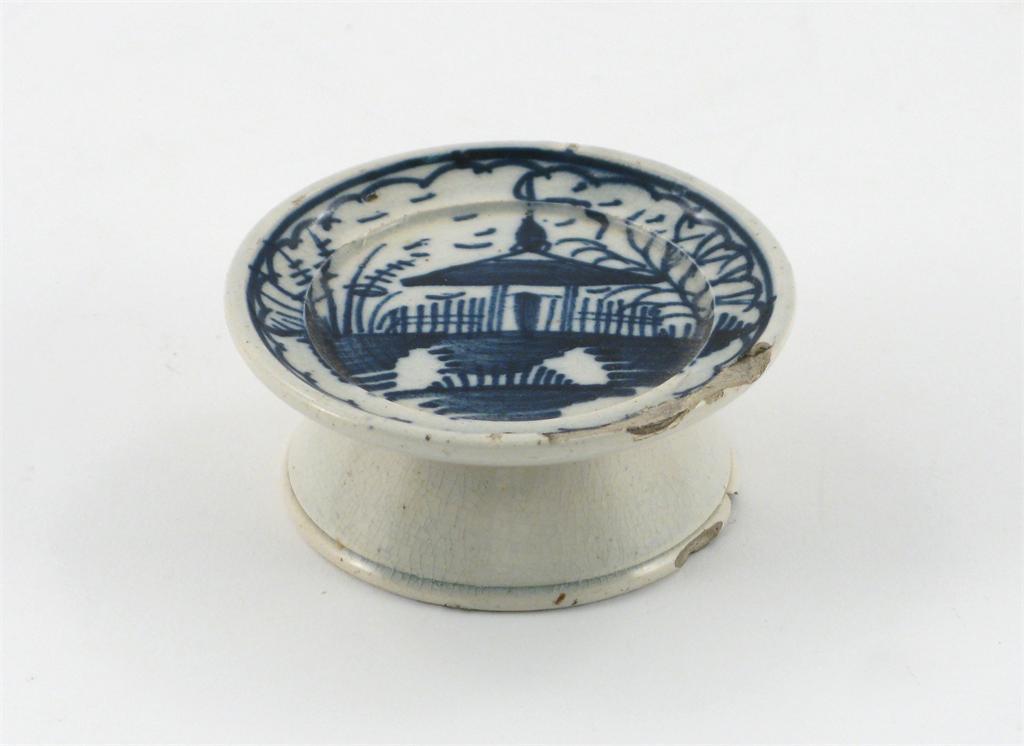
    My most recent ‘Eureka!’ moment involved both a patch stand and a porringer.  You’ve likely never heard these terms but you may own modern day equivalents.  A patch stand is a teapot stand, designed to elevate a teapot, arguably the most important object in a tea set, above the other tea wares.  It also serves the practical purpose of keeping the hot pot off of the table surface.

    18th-century-patch-stand
    18th century pearlware blue and white patch stand. Credit: Woolley & Wallis.

    At Ferry Farm, archaeologists found four small fragments from just such a patch stand.  The fragments all have evidence of ‘piercing’ or the cutting out of wet clay before it was fired to form a pattern.  The pattern created through piercing also promoted air circulation under the stand. Patch stands are not common in the archaeological record so we’re very happy to have identified the sherds. Now we’ll be able to furnish the new Washington house replica with a patch stand.

    The other vessel is a porringer. Although kind of a weird name, porringers were really handy and ubiquitous in every colonial household.  A porringer was simply a bowl with a handle for eating soups, porridges, stews, and the like.  You may have some equivalent in your house, like those oversized coffee mugs you can also use to eat soup or cereal.

    4x5 original
    A silver porringer dating from 1742 and made in Boston by Samuel Gray II. Credit: Los Angeles County Museum of Art.

    porringer-handle-fragment
    Fragment of a ceramic porringer handle excavated at Ferry Farm.

    Stay tuned and keep your eyes out for a sweet patch stand and a nifty porringer once the Washington house is finished!

    Mara Kaktins, Archaeologist
    Ceramics & Glass Specialist

  • Inside the Archaeology Lab: Putting Artifacts on Exhibit

    Here on Lives & Legacies we’ve shown you a variety of important tasks that take place inside the Archaeology Lab at George Washington’s Ferry Farm. You’ve seen how we wash, catalog, label, and then mend vessels with archival glue. One goal of all this work is to piece together whole artifacts from the many broken bits found and share that whole artifact with our visitors as part of the exhibits in our museum gallery.  Right now, a new exhibit of white salt-glazed stoneware vessels is on display at Ferry Farm. It took numerous staff and volunteers working hundreds of hours to get the vessels on display ready to be exhibited. Here’s how we did it!

    Seven reconstructed white salt-glazed (WSG) stoneware vessels make up a new exhibit at Ferry Farm.  These pieces, which include two dinner plates, a fruit dish, three ointment pots (used for mixing medicines and cosmetics), and a tea ware or condiment pot lid, were all excavated from the Ferry Farm site. These ceramics were popular during the mid-18th century and most likely graced the tables of the Washington family.

    white-salt-glaze-fruit-dish
    White salt glaze stoneware fruit dish, 1740-1765. The dish is decorated with a molded “dot, diaper, basket” pattern and would have been displayed prominently in the Washington house at Ferry Farm. An almost identical dish has been excavated at Mount Vernon and additional sherds with a similar pattern were recovered across the river at Kenmore. This may signify a Washington family preference for the motif or indicate that someone within the family acquired multiple fruit dishes and gave them as gifts, something George Washington was known to do.

    In preparation for the exhibit, I spent the better part of three weeks in August and September finishing the documentation for the individual vessels and then meticulously gluing them together. This relatively small amount of time spent at the end of the project was only the tip of the iceberg – the total amount of time spent getting these pieces ready for exhibition encompassed a year and a half! Preparing these pieces to be displayed involved the hard work of numerous archaeology lab staff and volunteers.

    November 2014 – January 2015: Executive decisions are made…
    First, discussions were held within the archaeology department about studying Ferry Farm’s archaeological collection of white salt-glazed stoneware. Such a study would answer questions about the material setting of the Washington household and help with interpreting the forthcoming Washington house replica to the public. The project was given the go-ahead.

    January 2015: Getting the lists together…
    Using our searchable artifact database, we generated a list of every piece of white salt-glazed stoneware in our collection.  A total number of 1,623 artifact bags were on this list, representing over 2,800 actual sherds.

    database
    Screencap of the artifact database.

    February 2015: Puzzle-solving begins!
    We started pulling the 1,623 artifact bags from storage, and by my records, we were still pulling artifact bags in June.  Lab staff, volunteers, and, on rainy days, the excavation field crews helped with pulling the artifacts.

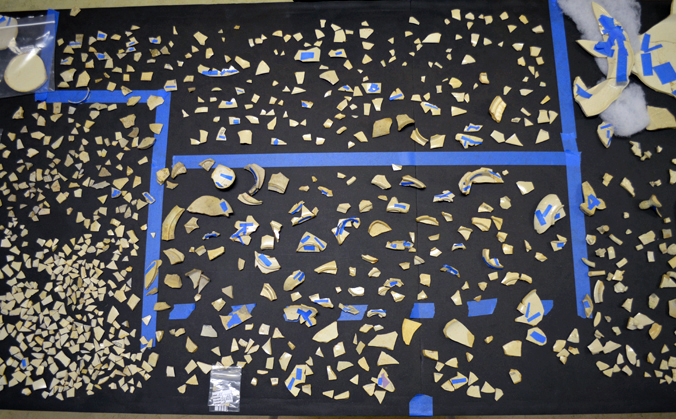
    After making sure the sherds were labeled correctly, we laid them all out on one of the lab tables, which had been covered in a black foam board to make it easier to see the all-white ceramics. The sherds were first separated by decorative variations, such as plain white salt-glazed, slip-dipped, scratch blue, or dipped with iron oxide, and next by vessel part, such as rims, bases, and bodies. Then the cross-mending began.

    white-salt-glaze-artifacts-on-table
    Sherds of white salt glaze stoneware waiting to be mended together.

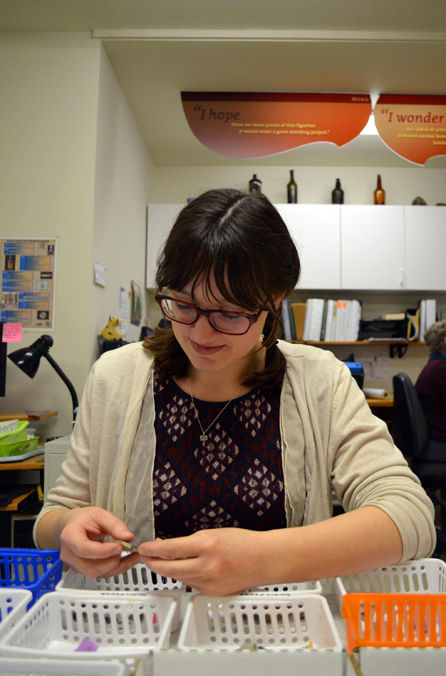
    Over the next eleven months, countless hours were spent at the table looking for mends between the sherds.  Having identifiable vessel parts, such as rims and molded and decorative elements, helped in the matching process, but there were hundreds of plain white, non-descript sherds to try and fit together.  Pieces that mended were taped together with painter’s tape, which doesn’t leave an adhesive residue on the artifacts.

    A friendly competition began and whoever had the most mends at the end of each month won a free lunch!  In all, everyone spent countless, addictive hours each week scrutinizing the sherds and patiently putting together “puzzles” for which, unfortunately, the majority of the pieces were missing.

    lauren-mending
    “Do these match?”

    vessel-209-pot-lid-recto-before-treatment
    Puzzle solved!

    January 2016: Minimum Vessel Count…
    After eleven months, we cried “uncle” to the cross-mending and started the minimum vessel count by figuring out how many and what types of individual WSG vessels were represented in our collection.  Under the supervision of Mara Kaktins, The George Washington Foundation’s ceramic and glass specialist, the sherds were separated into what we believed were individual vessels using the bases and rim styles.  By late April, our choices were firm and over sixty white salt-glazed vessels were identified.

    July 2016: Putting the paperwork in order….
    Treatment reports were started on the most complete vessels, which would be included in the new exhibit.  Each report listed all the sherds that made up each vessel and their condition. Photographs were taken to help with the mending and gluing.  The remaining white salt-glazed sherds on the table were separated into bags according to decorative and body type, their contexts recorded in a spreadsheet for our records, and then returned in storage.

    August 2016: Finally, the fun part – gluing!
    I started gluing the vessels using a product called B-72, an archival glue that can be removed, if necessary, and that we mix ourselves in the lab.  The design of the upcoming exhibit, including the layout, mounts and signage, was created by Meghan Budinger and Heather Baldus, the Foundation’s curatorial team.

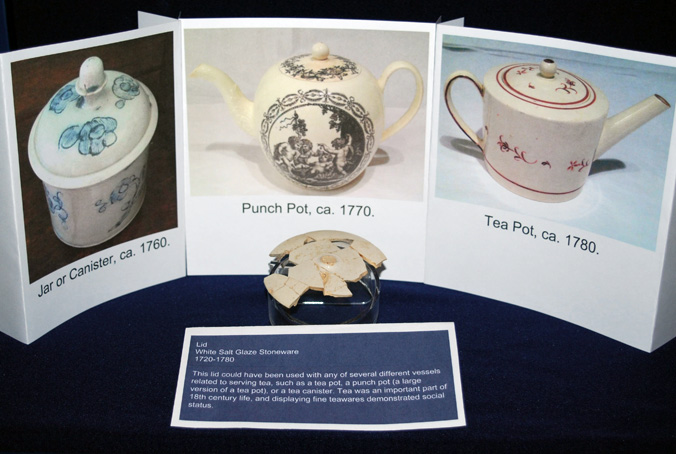
    lid
    White salt glaze stoneware lid, 1720-1780. This lid could have been used with any of several different vessels related to serving tea, such as a tea pot, a punch put (a large version of a tea pot), or a tea canister. Tea was an important part of 18th century life, and displaying fine teawares demonstrated social status.

    September 2016: Finishing touches…
    The white salt-glazed stoneware exhibit is now installed and ready for the enjoyment of our visitors to Ferry Farm. A total of 614 days from report prep to exhibition!

    Judy Jobrack, Archaeologist
    Assistant Lab Supervisor

  • Fine and Fashionable Fruit Dishes

    Fruit!  It’s good for you, delicious, and often beautiful – but have you ever thought of fruit as a status symbol?  In today’s world of relatively quick, inexpensive long-distance transportation, we enjoy fresh fruit from all over the world year-round.  We generally take this ability for granted.  In the eighteenth century, however, if you or your neighbors didn’t grow a particular fruit at home, then it had to be shipped to you at great cost.  In this age before refrigerated shipping, fruit’s extremely short shelf life was magnified.  As a result, a simple pineapple or lime represented a household’s wealth and the display of expensive fruits was a way to impress dinner guests. If you’ve got it, flaunt it, right?

    Fruit proved such a rare luxury in the 1700s that people purchased special dishes in which to serve the fruit.  These dishes also emphasized the social status of the owner because they signaled to people that this person could afford fresh fruit even if none might be available at the moment.  Like the fruit, the dishes themselves came to the owner’s table from all the way across an ocean, further emphasizing their wealth.   Archaeologically, we’ve recovered one such special fruit dish from George Washington’s Ferry Farm.  Made of white salt-glazed stoneware around 1755, this favorite ceramic of Mary Washington, George’s mother, is heavily decorated.  The entire surface of the object has some visually interesting thing to catch the eye.  With a geometric design in the center surrounded by a variation of the basket-dot-diaper motif common to the time period and an intricately pierced rim flanked by scroll-work, this dish would certainly have been highly valued in the Washington household.

    Fruit Dish 1
    The fruit dish sherds excavated at Ferry Farm.

    In the eighteenth century, one of the most important ways a person could display their standing and refinement was by hosting elaborate dinners.  This meant having extravagant and highly decorated centerpieces, preferably of silver.  However, if you couldn’t afford silver, then a ceramic equivalent was the next best thing.  Ceramic fruit dishes, like our white salt-glazed one, even borrowed some forms and stylistic elements common on silver dishes of the time.

    What makes our particular fruit dish found at Ferry Farm even more special is that sherds from an almost identical one were excavated at Mount Vernon.[1]  In 1757, not long after George Washington moved to Mount Vernon, he sent to England for a large amount of ceramics, including 100 “white stone” dishes.[2]  There were numerous other vessels ordered in white salt-glaze as well, including patty pans, mustard pots, butter dishes, mugs, teapots, slop basins, and more.  Having special tablewares just for specific types of foods and condiments impressed your dinner guests with both your financial wealth and your knowledge of the “proper” way to serve things.  Having the appropriate tableware was so important that when Washington didn’t receive certain items ordered from England, he complained to his supplier, Thomas Knox, writing that “The Crate of Stone ware don’t [sic] contain a third of the Pieces I am charg’d with, and only two things broke, and everything very high Charg’d.”  Though showing disappointment about the broken pieces, Washington’s concern that he did not receive all he ordered hints at how fashionable the stoneware was considered.  Also, given the large number of items ordered, it is impressive only two pieces broke.  White salt-glazed stoneware was sturdy enough for the Washington family to use every day.

    If finding similar ceramic dishes at Ferry Farm and Mount Vernon were not enough, we have also excavated very similar sherds at Historic Kenmore, the home of George’s sister Betty.  Apparently, the taste for lovely and heavily molded white salt-glazed dishes must have run in the family!  The icing on the cake is that we also have a complete example of a fruit dish in Kenmore’s collection of ceramics that matches the sherds recovered in digs at both Kenmore and Ferry Farm.  What are the odds?

    Fruit Dish 2
    The complete fruit dish in Kenmore’s ceramics collection.

    The archaeologists at Ferry Farm are working diligently to mend together as much of Mary Washington’s fruit dish fragments as possible.  We’re a third of the way there.  We hope to display these excavated pieces next to the complete dish so visitors can enjoy these lovely examples of eighteenth century artwork as much as we do.

    The Washingtons – Mary, George, and Betty – all went to great lengths to demonstrate their status and refinement to friends and neighbors.  They did so, in part, by serving exotic fresh fruit shipped to the colonies from around the Atlantic World.  To serve that fruit, they used fine and fashionable ceramic fruit dishes that were also shipped great distances.  Think about that the next time you enjoy a fruit cup!

    Lauren Jones, Archaeology Lab Technician
    Mara Kaktins, Ceramics & Glass Specialist
    Melanie Marquis, Archaeology Lab Supervisor

    [1] Email between Eleanor Breen, Director of Archaeology at George Washington’s Mount Vernon and Melanie Marquis, Archaeology Lab Supervisor at The George Washington Foundation, November 12, 2010.

    [2] Janine E. Skerry and Suzanne Findlen Hood, Salt-Glazed Stoneware in Early America, University Press of New England, 2009.