Lives and Legacies

Tag: Wig Curlers

  • Behind the Glass at Ferry Farm’s Archaeology Lab

    The observer stands behind glass and watches. The one being watched picks up the object with her bare hands turns it carefully to see every angle, then sets it down to record data into her computer. Then she washes her hands, unwraps another object – and eats it!

    Visitors to George Washington’s Ferry Farm can explore more than the museum gallery, or the Washington House replica, or newly constructed Quarter and Cellar outbuildings. They can tap into their people-watching curiosities and observe real archaeologists in a laboratory researching, washing objects, making labels, cataloguing, repairing ceramics – and even eating lunch!

    One extraordinary thing about Ferry Farm is that its archaeology lab is viewable and accessible to the public. The mysteries of history lie out in the open, sitting out on tables or in trays ready to be washed and categorized. Like zoo-goers, visitors are mesmerized by the goings-on behind the glass, and likewise, our archaeologists love interacting with the public, glad to answer questions or even pose for a picture.
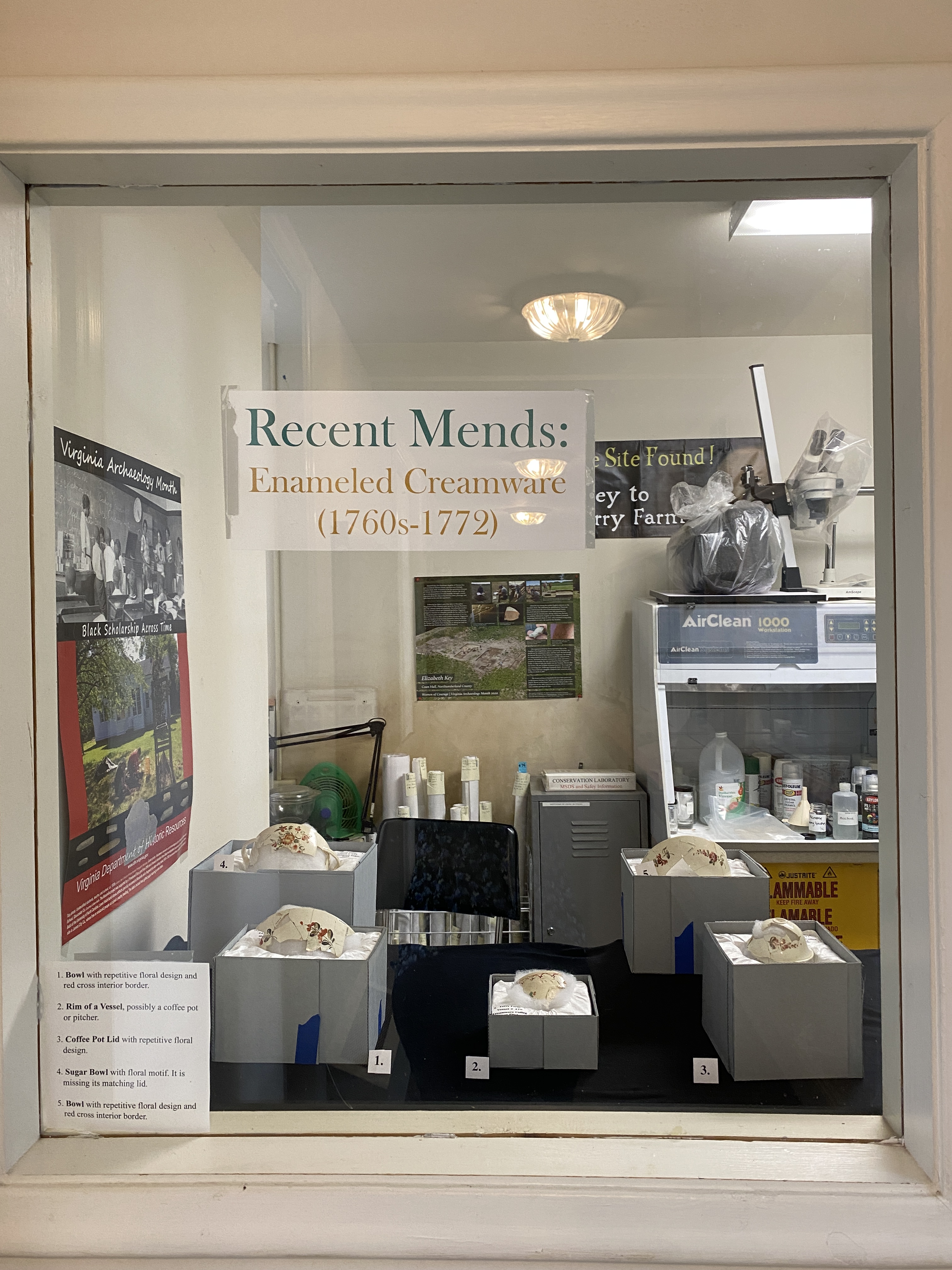
    Recent mends of enameled creamware behind one of several Archaeology Lab observation windows.

    It may be an interesting coincidence, but as Mary Washington drives the story of Ferry Farm and Historic Kenmore was saved by a group of intrepid women, Ferry Farm’s archaeology laboratory is also dominated by women who are passionate about what they do and more than willing to share their findings with guests and professional peers. Who are these interesting women, and what exactly happens in the lab? Its main inhabitants are Lab Supervisor Mara Kaktins and Field Directors Judy Jobrack and Danielle Arens. Also, part of the team (but not in the fishbowl) are Research Archaeologist Emma Schlauder and Director of Archaeology Dave Muraca. Dave, the only man in the department, led the team that discovered the foundation of the Washington House.

    There would be no lab work if there was no field work, and every summer for about 11 weeks, a carefully planned dig occurs on the grounds of George Washington’s Boyhood Home. Rich in artifacts, the land has yielded over 800,000 since the 1990’s. Finds date from indigenous, colonial, Civil War, and a sequence of farms throughout the 20th century. As Dave Muraca has said, “I would never recommend having a Civil War battle on your archaeological site. There are five successive farms out there, one on top of each other. In that way, it’s very complicated and hard to take apart.” That said, the fieldwork is not easy, but incredibly, each season, they find thousands of artifacts that will need to be mapped, processed, washed, bagged, catalogued in the database, labeled, stored, and researched.
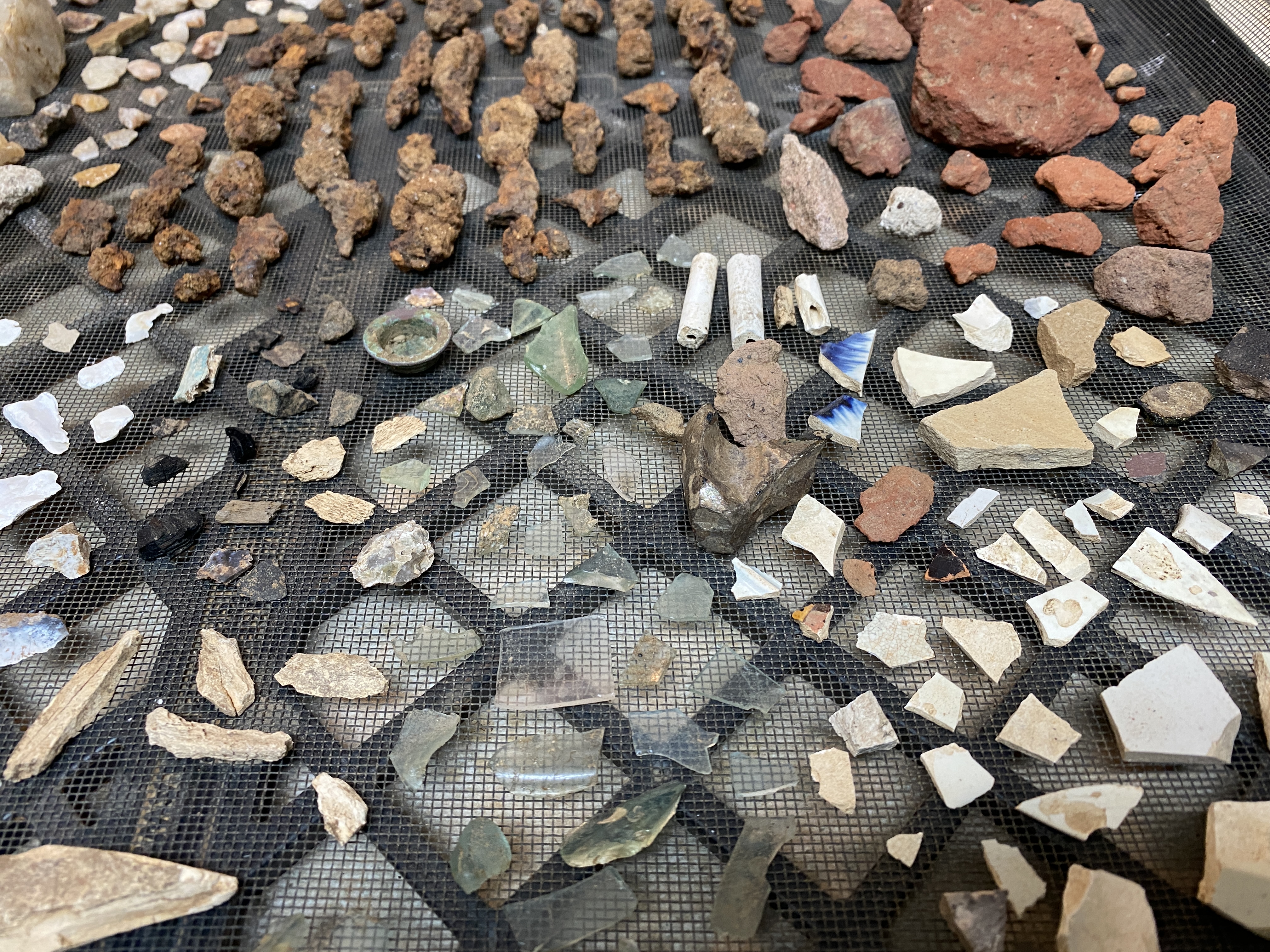
    Washed artifacts waiting to be bagged and catalogued.

    Typical finds include ceramic sherds, window glass shards, architectural pieces, household items, mortar, sandstone, personal items, pipes, wig curlers, buttons, personal adornment, and indigenous and faunal (animal remains). Objects popular with the public include a Masonic pipe bowl, cufflinks engraved with foxes and “Tally O,” a chamber pot, and even 20th-century items that indicate children used to live on-site, such as Matchbox cars, a toy motorcycle, or a doll’s head. Observers are also surprised to learn that 21st-century trash is catalogued because it was unearthed, and someday that too will be a part of Ferry Farm’s history.

    It’s important to note that Ferry Farm doesn’t dig exhaustively. While archaeologists are certainly concerned with the past, they also make concessions for the future, leaving areas untouched for future generations to dig using as-yet not invented technology. Ground penetrating radar has not been used much because of all that has happened on the land since Washingtons’ time. The main emphasis is feature-chasing – looking for structures such as the Washington House, cellar, kitchen, the Quarter, and more. No land feature will be recreated without knowing exactly where it stood.

    A unique quality of Ferry Farm’s Archaeology Department is that lab and field duties are not segregated; the same amazing team works both in the lab and field. This creates an intimacy with the artifacts that may not be present elsewhere. One day in the field equals three working days in the lab, processing, interpreting, and analyzing all the data from the artifacts. The first step is turning the field data into a format that’s digestible for record-keeping, end-of-year reports, and future Ferry Farm archaeologists. In the field, a site grid in five-foot increments is established and laid out to track where the finds are. Within that grid, context numbers are assigned to specific soil layers and features. A context is essentially a 5’ x 5’ address that notes the horizontal and vertical location of artifacts, noting spatial distribution where items are concentrated. In the lab, context maps are made from each grid unit, and the maps are put together to create the stratigraphy of a dig site.

    Leaded glass takes on a blue hue under UV light.

    Artifacts that come in are brought to the Wet Lab and washed with water in a tub or colander using tools such as toothbrushes, pipe cleaners, or dental picks. One might wonder if there are special precautions for handling artifacts, and interestingly, controversy swirls over whether artifacts should be handled with gloves or not. Rubber gloves are worn during lengthy washings to keep hands from getting too waterlogged. It turns out wearing gloves for analysis proves more damaging since touch sensitivity is reduced and gloves are prone to ripping. Items being examined have been surrounded by the elements for years, so oils from hands are not likely to harm artifacts any further.

    Next to the Wet Lab is the Conservation Lab, where acetone might be used to remove glue from previously mended artifacts. It’s equipped with a vent hood for fumes and the archaeologists wear masks for safety. They often create tableware replicas for the Washington House display, which might require the use of spray paint.

    Very well-designed and equipped, the lab was created by archaeologists for archaeologists. Their equipment includes a light table, a Dremel, a fine water screen for the field, and a UV light to identify leaded glass. For further testing, the department may contract out to other labs, such as the University of Eastern Michigan, with DART mass spectrometry capable of identifying organic materials.

    After artifacts are entered into the database and bagged with tiny labels indicating their project number and context, they are either put in the study collection or housed in cabinets or a storage room. With almost a million artifacts in the collection, the boxes stacked in the storage room resemble a miniature version of the ending scene in Raiders of the Lost Ark.
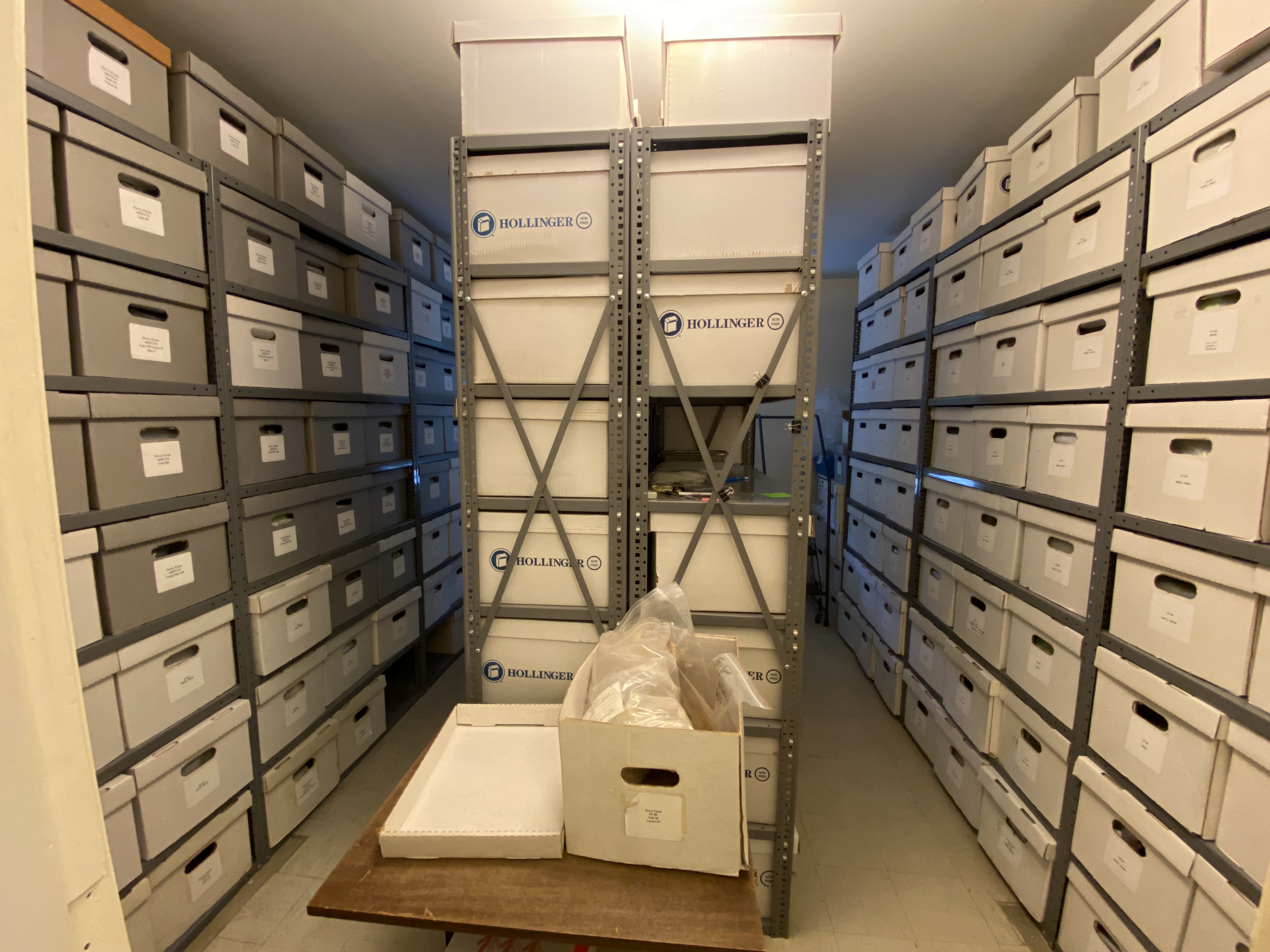
    Boxes of artifacts stacked in the storage room resemble a miniature version of the ending scene in Raiders of the Lost Ark.

    While one cannot put a value on tiny sherds of 18th-century ceramics, a rusted hinge, or an old button, Kaktins says, “Everything is priceless because of the information gleaned from it.” Archaeology at Ferry Farm is the driving force behind the stories shared with visitors. It informs where the buildings go, reveals the long-forgotten secrets of inhabitants, and intrigues visitors as they glimpse into the past.

    Lori Pikkaart

    Marketing & Communications Manager

  • Expanding Ferry Farm: The Quarter

    If you have visited Ferry Farm recently or follow us on social media, you may have noticed the construction of two buildings near the Washington House. These new structures represent ones that stood in these spots during George Washington’s time. Identified through archaeology, their reconstructions allow us to better tell the stories of the people who lived and worked at Ferry Farm. For this blog, we will look at the structure adjacent to the Washington House along the embankment overlooking the Rappahannock: The Quarter.

    What’s in a Name?

                First, we need to define what we mean when we call the structure “the Quarter.” Regarding enslaved life, the term “quarter” can refer to several different situations. Generally, it refers to a structure that housed enslaved individuals with “quarter,” equating to a living space or personal quarters. The term has nothing to do with the number and makeup of the occupants or the appearance of the building. The other use for the term refers to a group of enslaved people. Augustine Washington’s probate inventory lists seven enslaved people at Ferry Farm’s “satellite quarter” (Fig. 1). In this use, it does not refer to a single physical structure but rather a group of people and their housing unit that moved around. “The Quarter” uses the term for a single structure, identified through archaeology, that housed an enslaved family in the heart of the Ferry Farm plantation.  

    Figure 1: Section of Augustine’s probate inventory listing individuals at the satellite “quarter”

    Enslaved Housing

                Living conditions varied widely across the Mid-Atlantic and even within a single plantation. Customarily, enslaved people lived where they worked. Work yard structures included living quarters above the workspace while the fields had structures akin to dormitories that housed people divided by biological sex. In certain cases, independent structures may have served as housing for single family units (Fig. 2). Those that lived within these spaces generally held high ranking positions within the hierarchy established by enslavers. Housing generally stood outside public view and in areas convenient to the work undertaken by the inhabitants. Quarters within sight of the public served as status symbols for the gentry.

    Figure 2: 1860 engraving depicting single quarters in South Carolina (Slavery Images)

                Identifying quarters today largely comes from historic records, oral history, archaeology, and architectural features. All of this can help establish a range of appearances for such structures. When a building no longer remains standing, these observations can be compared to artifacts uncovered at the site to determine its identity. Sub-floor storage pits, often located near hearths, serve as key architectural identifiers, while artifacts that reflect African diaspora culture, outdated items, and evidence of labor help pinpoint the identities of the inhabitants. Quarters served as the only personal spaces allotted to enslaved people, so any artifacts recovered can speak to their personal identities rather than those defined by Virginia colonials.

    Archaeological Evidence

                The excavation of the Quarter occurred in 2003, and research in successive years helped to identify its role and understand the lives of its inhabitants.

    • Architecture: When excavated, little remained of the Quarter, but the architectural elements present and absent provided enough information to understand its appearance. Archaeologists recovered small quantities of Aquia sandstone around the quarter indicating it may have had a light stone foundation and hearth. The main impact it had on the ground surface occurred through the creation of a sub-floor pit. These pits frequently appeared in quarters and served as storage areas for the occupants’ personal effects. Unfortunately, a tree later intruded a portion of the pit and the surrounding area thus making it difficult to study (Fig. 3). Other architectural elements included an abundance of nails and an absence of window glass (Fig. 4). This indicates the building had clapboard siding and likely shuttered windows in place of glass ones.
    Figure 3: Quarter Excavation Site
    Figure 4: Nail distribution around Quarter
    • Tableware (Fig. 5): Within the eighteenth-century contexts, we recovered many ceramics and utensils of European origin. White-salt glazed stoneware dishes and dog-nosed spoons represent styles in decline by the 1740s. This indicates that the enslaved occupants either received hand-me-downs from the Washingtons, a common practice, or purchased used items in the local market. A colonoware bowl served as an exception. A local ceramic type attributed to free and enslaved black communities, colonoware production mixed African ceramic techniques with European vessel forms.
    Figure 5: Tableware (L-R white salt glazed stoneware, dog-nosed spoon handle, colonoware bowl, table knives)
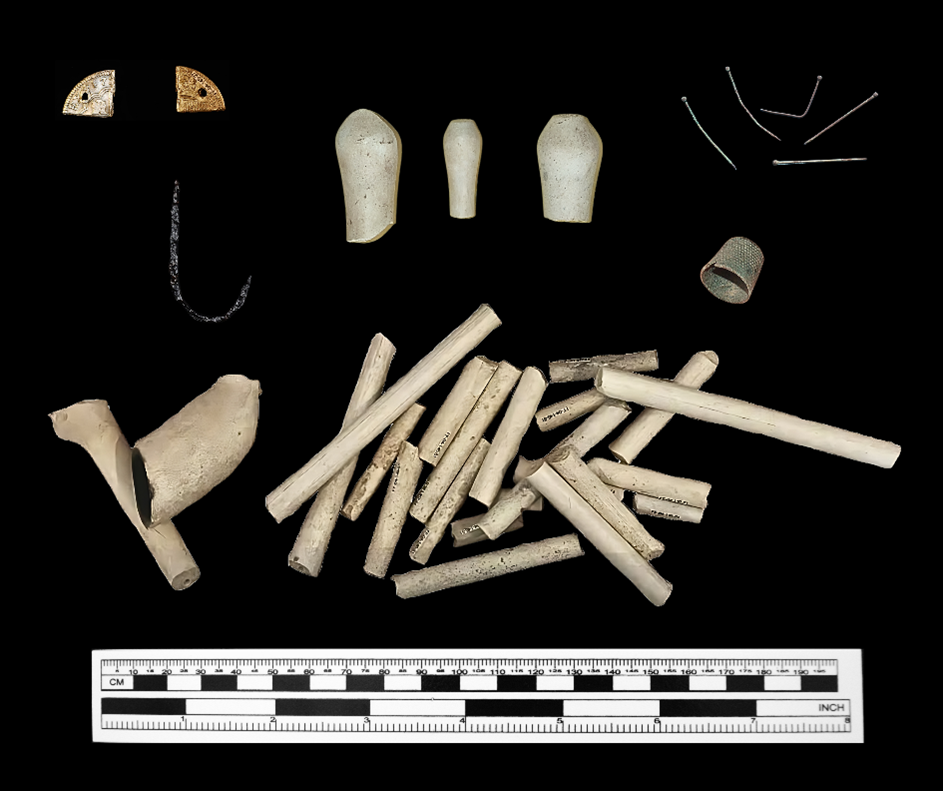
    • Small Finds (Fig. 6): Analysis of the artifacts revealed the personal effects of the occupants, their possible identities, and the labor they carried out. Wig curlers appear frequently throughout Ferry Farm, but the recovery of several at the Quarter indicates that the individual(s) tasked with maintaining the Washington wigs may have lived within. Sewing implements, such as thimbles, reflect labor carried out by enslaved women and girls either for the Washingtons or for themselves. A common practice in colonial Virginia saw each enslaved person receive a ration of cloth from which they fashioned their own clothing. Straight pins further indicate the presence of female occupants as these pins held their garments, such as bed gowns, together. Both genders used the numerous tobacco pipes recovered. The fishhook speaks to an entirely personal activity,  as enslaved communities often supplemented their food rations by fishing. The pierced coin serves as the artifact most indicative of enslaved culture. Piercing a coin allowed the owner to keep it on their person as a form of adornment. Such coins often served as talismans, though they could re-enter the economic world as needed.
    Figure 6: Small Finds (L-R mirrored pierced coin, fishhook, wig curlers, thimble, straight pins, tobacco pipe fragments)
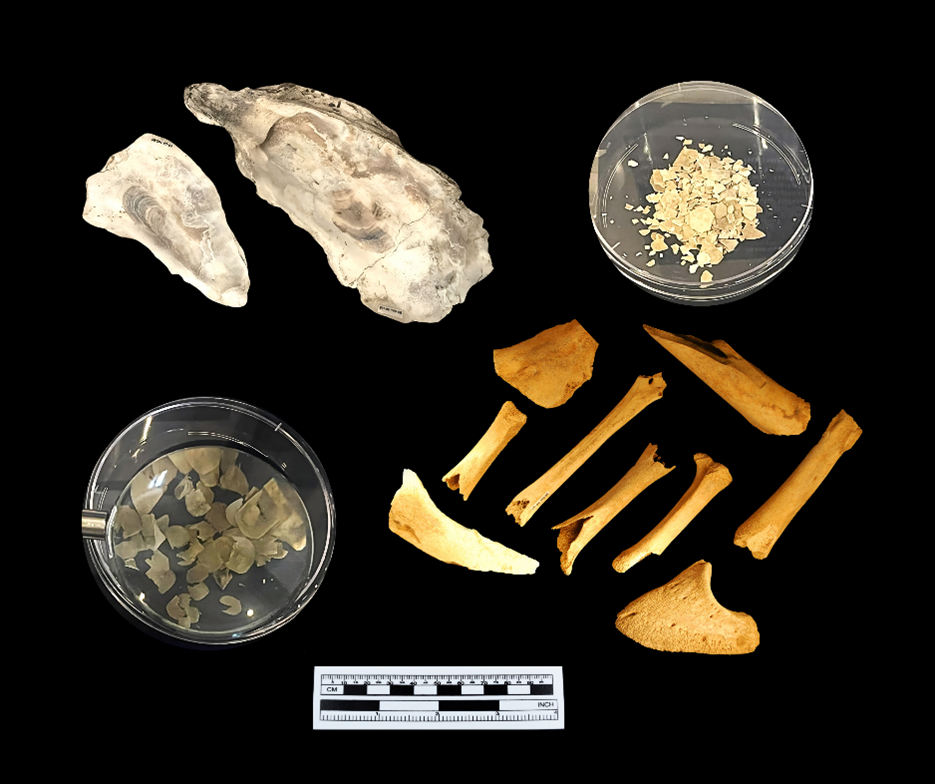
    • Diet (Fig. 7): Faunal remains found at the Quarter supplement the information provided by the fishhook. As expected, we identified several fish species including types of perch, catfish, and sunfish which lived in the Rappahannock at that time. Other animals included cattle, chickens, pigs, opossum, and shellfish, such as oysters. This mix of domestic and wild species indicates that the Quarter’s occupants supplemented the rations supplied by the Washingtons. The enslaved commonly achieved this by maintaining small gardens and raising chickens, hunting, fishing, and foraging. While we did not recover any plant remains, those consumed by the inhabitants likely reflected a similar mix of wild and domestic species.
    Figure 7: Faunal (L-R Oyster shells, eggshells under microscope, fish scales/bones under microscope, various mammal bones)

    Reconstruction and Interpretation

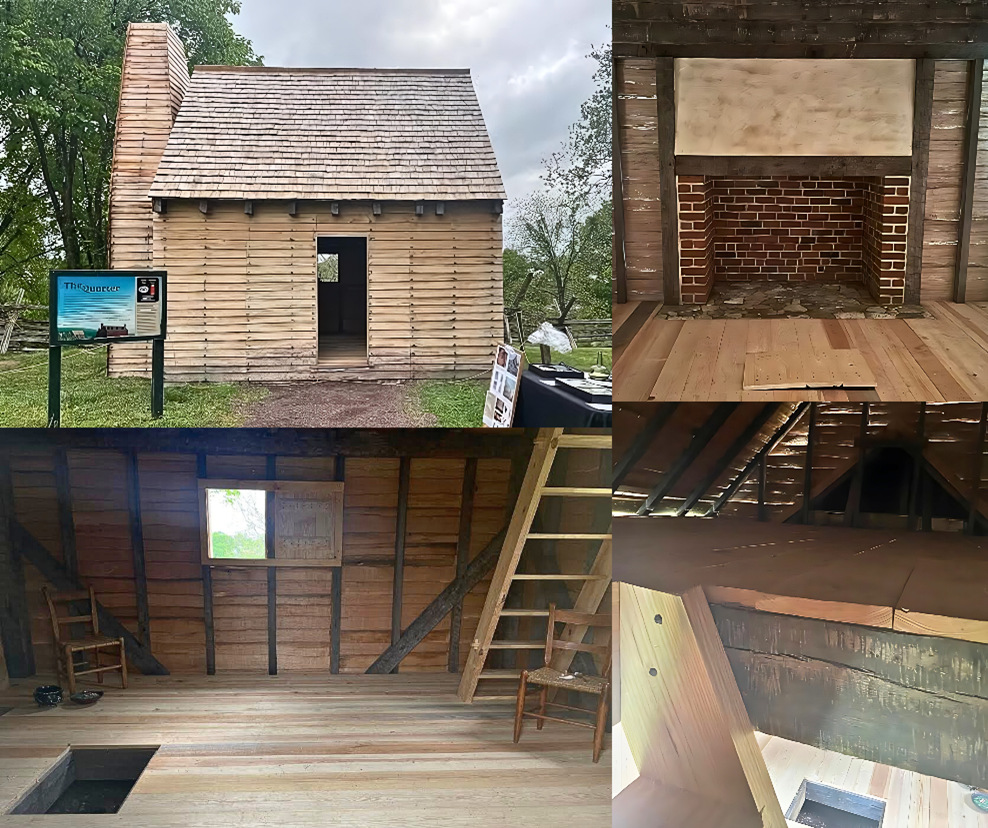
                The reconstruction of the Quarter combined our archaeological evidence with the historic knowledge of enslaved housing (Fig. 8). The finished Quarter measures 16’x14’ which aligns with standard measurements for single-family quarters. From our archaeology, it has clapboard siding, sliding shutters in place of glass windows, a subfloor pit, and sandstone hearth. Information on contemporary quarters led to the inclusion of a loft and a daub lined wood chimney. Architects used eighteenth-century techniques to reconstruct the building.

    Figure 8: The Quarter, various views

                From our findings, we concluded that the quarter housed a single family. At least one of these individuals held a high-ranking position within the labor hierarchy allotted these living arrangements (Fig. 9). The structure’s proximity to the Washington House and work yard indicates the occupants worked within these spaces. The position on the bluff overlooking the Rappahannock meant that this quarter, unlike others, lay in view of the public.  “The prominent placement of this structure on the landscape may mean that it was used to reinforce Washington’s prominent social standing in colonial Virginia.”     

    Figure 9: Portion of Augustine’s probate inventory listing individuals at Ferry Farm; some may have called the Quarter home

    The Quarter will open to visitors this fall, and visitors will be able to read about and visualize the lives of those who lived within. Like the Washington House, everything that furnishes the Quarter will be interactive and reflect archaeological finds. Planning remains ongoing for this, but when complete, visitors may find outdated tableware, evidence of meals, tools for labor, and personal effects.

    Emma Schlauder

    Research Archaeologist


    Bibliography
    
    Augustine Washington Probate Inventory, 1743
    
    Carson, Cary & Carl Lounsbury (editors)                                                                                                  2013     The Chesapeake House: Architectural Investigation by Colonial Williamsburg. The University of North Carolina Press, Chapel Hill, NC.
    
    Katz-Hyman, Martha B. & Kym S. Rice (editors)                                                                                       2011     World of a Slave: Encyclopedia of the Material Life of Slaves in the United States. Greenwood, Santa Barbara, CA.
    
    Lanier, Gabrielle M. & Bernard L. Vlach                                                                                                     1997     Everyday Architecture of the Mid-Atlantic: Looking at Buildings and Landscapes. The John Hopkins University Press, Baltimore, MD.
    
    Lounsbury, Carl R. (editor)                                                                                                                  1994     An Illustrated Glossary of Early Southern Architecture and Landscape. University Press of Virginia, Charlottesville, VA.
    
    Samford, Patricia                                                                                                                                       1996     The Archaeology of African-American Slavery and Material Culture. William & Mary Quarterly 53(1): 87-114.
    
    2000     Power Runs in Many Channels: Subfloor Pits and West African-Based Spiritual Traditions in Colonial Virginia. Doctoral Dissertation, Department of Anthropology, University of North Carolina, Chapel Hill. University Microfilms International, Ann Arbor, MI.                                                                                                                                           
    
    Stilgoe, John R.                                                                                                                                          1982     Common Landscapes of America, 1580-1845. Yale University Press, New Haven, CT.
    
    Wells, Camille                                                                                                                                        1993     The Planter’s Prospect: Houses, Outbuildings, and Rural Landscapes in Eighteenth Century Virginia. Winterthur Portfolio 28(1): 1-31.
    
    Vlach, John M.                                                                                                                                           1993     Back of the Big House: the Architecture of Plantation Slavery. The University of North Carolina Press, Chapel Hill, NC.
    
  • 2023 Ferry Farm Dig Preview

    Spring is here, which means another season of exciting archaeological work at Ferry Farm is about to begin! Ferry Farm, the boyhood home of George Washington, has been conducting archaeological investigations for over 30 years with the aim of recreating and analyzing the 18th-century farm landscape that shaped George Washington during his formative years as a young man. Every season brings new discoveries, and this year will be no different.

    This season we will be investigating two separate areas within the historic site. The first (FF-38) is a feature discovered in 2018 when we monitored the excavation of a utilities trench for the reproduction Washington house. This large feature, approximately 5’ x 7’ and over 2.5’ deep, is filled with dark brown organic soil and contains 18th-century artifacts, including a wig curler, a signature find for our site. Our excavations will expose the entire plan view of the feature and how it relates to other possible features in the surrounding area.

    Figure 1. The location of our two summer projects in the historic area.

    The second area of investigation (FF-40) is the site of a colonial-era kitchen that burned early in the Washington family tenure of the farm. Though the building’s remains were the subject of previous archaeological studies in the 1990s, we are going to open the site up again to have a second look. Since we have been unable, so far, to locate the kitchen that would have replaced this one after it was destroyed in a very hot fire, we want to continue examining the one we do know about!

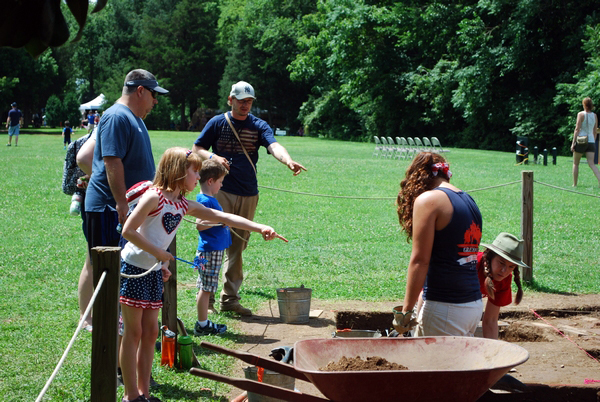
    The dig begins the week of May 8th and ends July 21st. The crew will be on-site Monday through Friday, 8 am to 4 pm. We are more than happy to answer questions about our work and show our visitors the artifacts that we find. Assistance is always welcome at our sifting screens, so come by and get your hands just a little bit dirty as we search for answers in the ground!

    Judy Jobrack

    Archaeology Field Director

  • Colonial Grossology [Video]

    Looking back in time, people’s personal hygiene, fashion choices, medical treatments, and more can seem disgusting.  When confronted with gross practices, our first reaction can be to dismiss our ancestors as primitive, ignorant, or just silly.  Before such judgments, however, we should try to understand the reasons behind these practices and recognize that our own descendants will judge some of what we do as gross.  Here at George Washington’s Ferry Farm and Historic Kenmore, we’ve come to describe our efforts to understand the historically disgusting as “Colonial Grossology.”  In this video, we examine three ways that daily life in the 18th century was sort of gross.

  • How Many Curlers did a Harried Hairdresser Need? Let’s Do the Math!

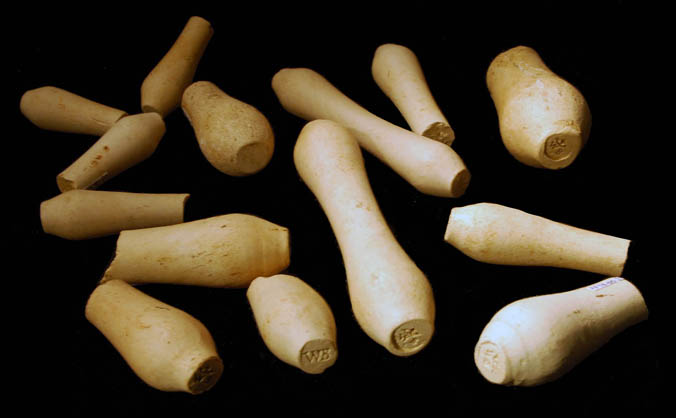
    After unearthing over 200 wig hair curlers from Washington’s Boyhood Home, we were in a position to do something that – to our knowledge – has never been done before: crossmend all those curler fragments. As a result, we can now predict the minimum number of curlers the Washington family’s harried hairdressers needed.

    2013_07_04_wigcurler
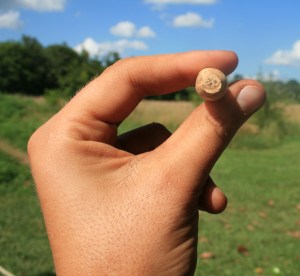
    Plate 1: A wig hair curler fresh from the excavation of the Washingtons’ task yard. Note the “WB” mark on its end, which we believe to be the Initials of its British manufacturer. Image courtesy of Virginia Commonwealth University/Bernard Means.

    If you remember our blog post from way back in January 2015, these unglazed ceramic curlers were often used by wigmakers to create the curled styles of a wig’s coiffure during the making of a new peruke (Plate 1). We’ve also learned that hair stylists employed curlers to freshen the lagging curls upon an existing wig, after a gentleman had worn it out. How often a wig needed to be re-set depended upon the standards of the gentleman, and the activities and weather that he and his stylish coiffure encountered. Because curlers had to be heated to be effective, they were only used when wigs were safely removed from the gentleman’s head.

    Before our crossmending could commence, the curlers had to be washed, cataloged, and labeled. Then, all of the labeled curler fragments could be compared and evaluated for crossmending. Previous analysis revealed that the assemblage included nine different sizes (Plate 2). Most of our curlers are smaller diameter, especially sizes one and two (for shorter hair/narrow width curls). Within each size, width and even length varied: they were not manufactured in a standardized way. This was the eighteenth century, after all.

    Ferry Farm All Nine-b-Smaller
    Plate 2: Representatives of the nine different curler sizes from Ferry Farm. These nine sizes were analytically imposed. They may not necessarily represent historically defined categories.

    FFCurlerMarksShopt.small
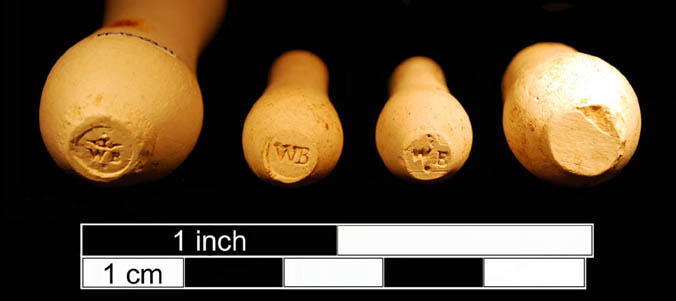
    Plate 3: There were three varieties of maker’s marks. A few curlers had no marks.

    Most curlers had one of three varieties of maker’s marks (Plate 3). However, a handful exhibited no mark at all. It was within these subcategories that the cross mending began. And the results were surprising.

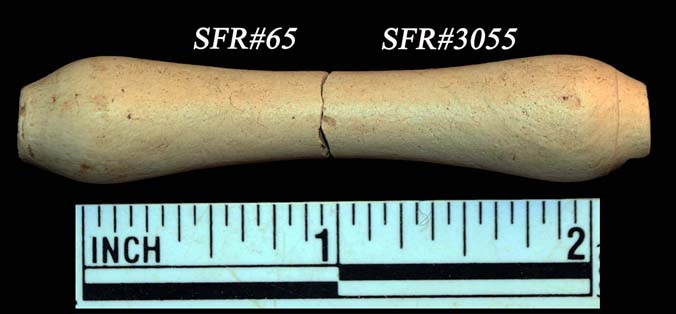
    You’ve probably broken a glass or plate. They usually break into many pieces. In contrast, curlers tend to break into two fragments at their weakest point: near the center of the curler (Plate 4). With a single mend you can often get a complete or near complete specimen (Plate 5).

    FF18 Curlers h.shopt.small
    Plate 4: Curlers tend to break into two fragments.

    One of the primary goals of crossmending was to determine whether we had found all of the curlers used here during the mid-1700s, or just a portion of them. If we had found the entire assemblage, for example, our 194 curler fragments should result in 97 crossmended curlers. That is to say, they should all mend to another fragment. An example of a crossmend is shown in Plate 5.

    Archaeologists refer to this process of mending fragmented remains of a larger item together as “crossmending.” Whether glass bottles. tablewares, ceramic vessels, or even the bones of animals, this process allows us to determine the minimum number of any given item in the recovered collection. For example, if after crossmending, you have three right hind cow legs and two left hind cow legs you know that were a minimum of three cows on site. This is a dramatic oversimplification, but you get the idea. This educated guess of the least number of specimens present is called the minimum number of individuals, or MNI.

    SFR65-3055
    Plate 5: A typical curler crossmend from Ferry Farm. Two fragments mend to form a complete specimen. Often, these curlers break in the middle, as shown.

    After weeks of dedicated crossmendingby steadfast interns, enthusiastic volunteers, and dedicated Foundation staff, a total of fifteen whole curlers were crossmended from thirty previously disparate fragments. When added to our impressive collection of complete curlers (n=20), a total of 35 complete curlers (20 complete, excavated curlers and an additional 15 formed from 30 mended fragments) make up the Ferry Farm assemblage.

    Another exciting result of this exercise was that we now had two complete (mended) size one curlers and a mended size eight curler: previously these two respective sizes were only represented by disjointed fragments. Unfortunately, no mended size nine curlers were discovered. Size nine continues to be represented by fragments, and it is the only size from Ferry Farm for which we have no complete examples.

    So what’s the minimum number of curlers that the Washingtons’ hairdresser used to curl their many wigs? Let’s do the math!

    There are        164 molded curler fragments with no matches
    +  1 hand made curler fragment
    +20 whole (unbroken) molded curlers
    +15 mended molded curlers (from 30 fragments)
                              (a minimum of) 200 curlers

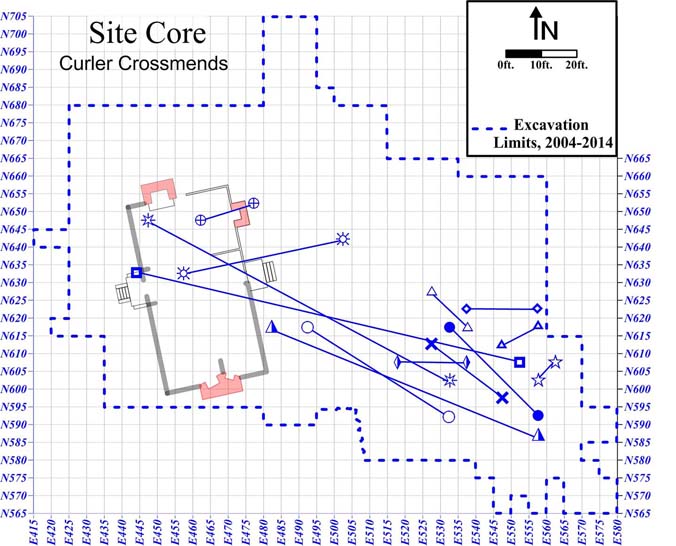
    Another informative aspect of crossmending is seeing from what areas of the site the mended curlers were found (Figure 1). As Figure 1 shows, a clear relationship between the work yard, where the majority of curlers were discovered and the Washington House can be seen. This adds additional evidence to our hypothesis that the majority of curling tasks took place in the eastern work yard and that finishing tasks associated with wigs (powdering, drying the washed, wet wig, and final elegant touches) took place in the parlor. The parlor has emerged as an area of wig hair maintenance, since eight curlers/curler fragments were recovered from the parlor room root cellar.

    14SeptCurlerXMendzSmall
    Figure 1: This bird’s-eye view of the Washington house and surrounding yard shows where ten of the crossmended fragments mend to their respective mates. A ‘path’ between the work yard – where the majority of curlers were used – and the Parlor inside the house is evident.

    While wearing wigs was highly fashionable among refined British colonial gentleman, little is known about how they were maintained, how often they were cleaned and set, and how these crucial activities were performed at the household level. The data recovered from Ferry Farm is providing new information and innovative analysis of this poorly understood, but essential hairdressing routine

    All in all, a terrific exercise!

    Laura Galke, Archaeologist
    Site Director/Small Finds Analyst

  • Le Pouf: Sensational Hairstyle of the 18th Century

    wig-hair-curlers
    Wig curlers excavated at George Washington’s Ferry Farm.

    We’re pretty interested in 18th century hairstyles, wigs, and wig-styling here at George Washington’s Ferry Farm and Historic Kenmore.  As evidence, check out our most viewed blog post. It’s about wig styling.  Our interest stems from the hundreds of wig curlers archaeologists have excavated during digs at Ferry Farm.  While those wig curlers were used to style men’s wigs here in British North America, our research explorations into hairstyling of the 1700s sometimes range more widely.  The information we find may have no direct relevance to George Washington and his family here in Fredericksburg but it still helps us to understand the world in which they lived.  Sometimes the information is simply too fascinating not to share here on Lives & Legacies and it’s all thanks to those little wig curlers that keep popping out of the ground where George Washington’s boyhood home once stood.

    One of the most sensational wig and hair styles of the 18th century – the pouf – was found among the women courtiers of Louis XVI and Marie Antoinette in France across the Atlantic from Ferry Farm.  The pouf was a hairstyle that became popular in the French court during the late part of the eighteenth century.  The pouf utilized everything from wire, cloth, gauze, wigs, animal hair, and the wearer’s own hair to create a voluminous coiffure that could be used as a canvas to express feelings (pouf à la sentiment) or commemorate events (pouf à la circonstance).[1]

    Portrait of Maria Amalie Auguste of Saxony in Polish costume (1780) by Heinrich Carl Brandt. Public domain. Credit: Royal Castle in Warsaw/Wikipedia.
    Portrait of Maria Amalie Auguste of Saxony in Polish costume (1780) by Heinrich Carl Brandt. Public domain. Credit: Royal Castle in Warsaw/Wikipedia.

    The pouf’s creation has been attributed to two people: Madame Rose Bertin and hairdresser Monsieur Léonard. [2]  Bertin had a shop in Paris, close to the Palace, where she and Léonard began offering these unique headdresses to the wealthy noble women of the court including Marie Antoinette.

    One of the first women of court to commission such a headdress was the Duchess of Chartres in April 1774.  The Duchess wanted to commemorate the birth of her son so she had Léonard create a unique coiffure.  It featured “fourteen yards of gauze and numerous plumes waving at the top of a tower…two waxen figures as ornaments, representing her son in his nurse’s arms.  Beside was placed a parrot pecking at a plate of cherries, and reclining at the nurse’s feet, a waxen figure of a little African boy of whom the duchess was very fond.  On different parts of the hairpieces were the initials of Duke of Chartres, of Penthievre, and of Orleans, formed with the hair of those princes – the husband, father, and father-in-law of the duchess.”[3]  The poufs popularity took off after the Duchess premiered this flamboyant bouffant and it became a must have fashion accessory for all aristocratic and wealthy ladies of France.

    The Duchess of Lauzun hired Bertin to decorate her locks as bemused contemporary journalists reported with– “a stormy sea, a hunter shooting at ducks, a mill where a female mill worker was being seduced by a priest, and at the bottom, the mill-worker’s husband walking along with his donkey.” [4]

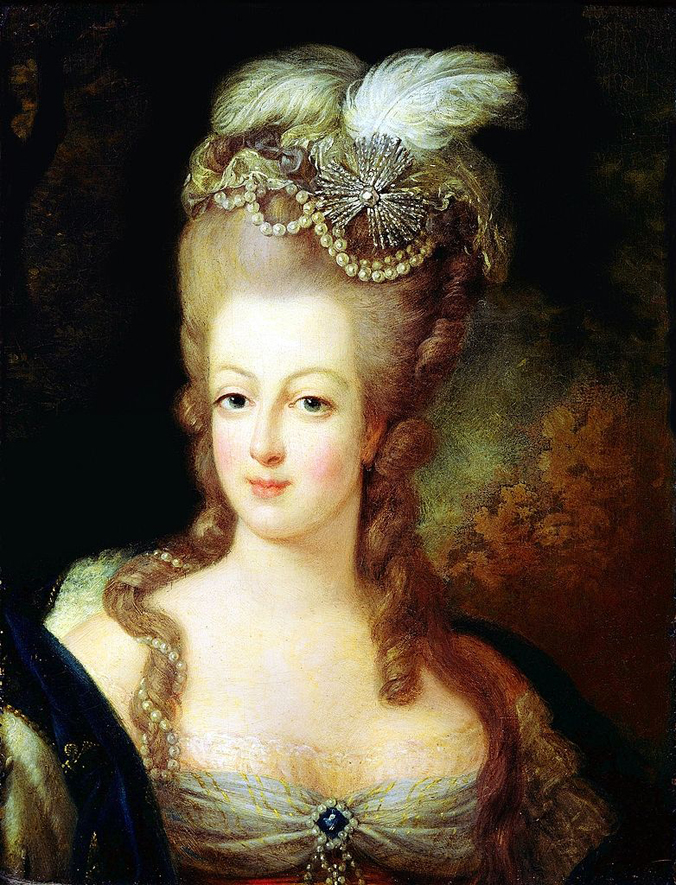
    Young Marie Antoinette, France’s new queen, became the leader of all things fashionable in pouf décor.  One of her most written about headpieces was the “coiffure à l’Iphigénie” which was wound with black mourning ribbons, trimmed with a black veil, adorned with a wreath of black flowers and topped with a crescent moon.  She wore this on a night at the opera to support a friend Christoph Gluck and his Parisian debut of “Iphigénie en Aulide.”[5]

    Portrait of Marie Antoinette (c. 1775) probably by Jean-Baptiste Gautier Dagoty. Public domain. Credit: Musée Antoine-Lécuyer/Wikipedia
    Portrait of Marie Antoinette (c. 1775) probably by Jean-Baptiste Gautier Dagoty. Public domain. Credit: Musée Antoine-Lécuyer/Wikipedia

    Ever at the cutting edge not only in fashion but in medicine, she unveiled “pouf à la inoculation” to celebrate her husband’s recent small pox vaccinationThis pouf included a serpent belonging to the Greek’s god of medicine, Aesculapius, twined around an olive tree that symbolized wisdom with a great golden sun rising behind it as a nod to her husband’s grandfather Louis XIV, the much-loved Sun King.

    Two other noted examples that caused a stir in the court were the Zephyr and the Coiffure a la Belle-Poule.  The Zephyr, created by Monsieur Léonard, was a moving garden of brightly colored flowers which was celebrated as a peak achievement for the hairdresser.  The Coiffure a la Belle-Poule was a nautical pouf that consisted of a ship sailing on a sea of thick wavy hair.  It was invented after the naval battle in which the frigate La Belle Poule was victorious.

    A realistic view of the "Coiffure à la Belle Poule." Public domain. Credit: Bibliothèque nationale de France/Wikipedia.
    A fairly realistic view of the “Coiffure à la Belle Poule.” Public domain. Credit: Bibliothèque nationale de France/Wikipedia.

    Soon these new hairdos began to make their way out of the circles of aristocracy to the streets of Paris.  However, as cutting-edge fashion makes its way out into the streets, the distinctiveness is somewhat diluted creating more audacious and ostentatious copycats.  This was quickly picked up on by social critics and became a fertile subject for mockery and satire.

    One critic lampooned the imitators saying, “they did not hesitate to embrace styles more ridiculous than sublime.  Thus spotting in the Queen’s pouf a la jardinière such implausible ingredients as an artichoke, a carrot, some radishes, and a head of cabbage.” [6] Another complained, “Frivolous women covered their heads with butterflies” and “Melancholic women went so far as to put crematory urns in their headdress.”  Even the hair dresser who invented the pouf began to decry the “prodigious folly of composite and fabricated coiffures, as pictures of towns, little models of Paris, a globe or the heavens.”

    A satirical view of the "Coiffure à la Belle Poule." Public domain. Credit: Henri Moreau/Wikipedia.
    A satirical view of the “Coiffure à la Belle Poule.” Public domain. Credit: Henri Moreau/Wikipedia.

    Some complaints seemed more valid than others.  Spectators at the Paris Opera petitioned the director, to refuse any lady whose coiffure blocked the view of the rest of the audience.    While enjoying the theatre might inconvenience others, getting to the theatre brought its own set of physical dilemmas for the pouf wearer.  Try squeezing a three foot bouffant into a small covered carriage or navigating a standard doorway with the additional height.

    Luckily, for those who found the pouf a public nuisance, a silly fashion fad, or just a physical pain to wear did not have to wait long for it to fall out of favor spectacularly.  The huge grandiose styles began to represent a symbol of aristocratic excess in a society on the verge of political revolution.  It embodied the nobility’s unbridled lavishness in the face of public discontent.  This willful ignorance didn’t end well for the coiffured-court ladies who soon found they no longer had anywhere to put their elaborate headdresses.

    Heather Baldus
    Collections Manager

    [1] Caroline Weber, Queen of Fashion: What Marie Antoinette Wore to the Revolution, New York: Picador, 2006: 104.

    [2] Weber, 104.

    [3] Weber, 105; Olivier Bernier, The Eighteenth Century Woman, New York: Doubleday, 1982: 235; Will Bashor, Marie Antoinette’s Head: The Royal Hairdresser, the Queen, and the Revolution, Guilford, CT: Lyons Press, 2013: 65

    [4] Weber, 105.

    [5] Weber, 106; Bashor, 66.

    [6] Weber, 111.

  • Perukes, Pomade, and Powder: Hair Care in the 1700s

    Editor’s Note: Looking back in time, people’s personal hygiene, fashion choices, medical treatments, and more sometimes look, at the very least, bizarre, if not outright disgusting.  When confronted with these weird or gross practices, our first reaction can be to dismiss our ancestors as primitive, ignorant, or just silly.  Before such judgments, however, we should try to understand the reasons behind these practices and recognize that our own descendants will judge some of what we do as strange or gross.  Here at George Washington’s Ferry Farm and Historic Kenmore, we’ve come to describe our efforts to understand the historically bizarre or disgusting as “Colonial Grossology.”  The following is the first in a series of “Colonial Grossology” posts that we’re offering on Lives & Legacies.

    Archaeologists at George Washington’s Ferry Farm have recovered a variety of hair care artifacts, including over 200 wig hair curlers.  These baked clay curlers were used exclusively to curl wig hair, and formed part of the Washington family’s regimen of wig maintenance.  The regimen included several practices that might seem strange or gross to us today.

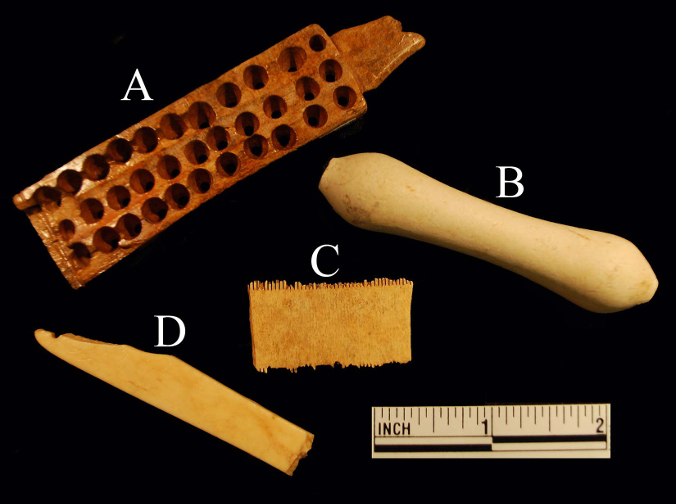
    Artifacts from Ferry Farm related to eighteenth-century hair care.  A) A woman’s bone hair brush, used on natural (not wig) hair.  B) An earthenware wig hair curler, made c. 1740-1780.  C)  A bone grooming or “lice” comb.  D)  A bone razor guard, used by men to shave their facial hair and to shave the head to accommodate a tight-fitting peruke.
    Artifacts from Ferry Farm related to eighteenth-century hair care. A) A woman’s bone hair brush, used on natural (not wig) hair. B) An earthenware wig hair curler, made c. 1740-1780. C) A bone grooming or “lice” comb. D) A bone razor guard, used by men to shave their facial hair and to shave the head to accommodate a tight-fitting wig.

    Powdered wigs, or ‘perukes’, were highly fashionable among gentlemen of the 1700s, and a few affluent households even insisted that their butlers and coachmen wear them.  Some gentlemen, including George Washington, opted not to wear a peruke.  To remain fashionable these men often styled their own hair to resemble a wig.

    George Washington, 1796, by Gilbert Stuart [Public Domain].  His hair was pomaded and powdered by his personal valet.
    George Washington, 1796, by Gilbert Stuart [Public Domain]. His own hair, not a wig, was pomaded and powdered by his personal valet to look as if he were wearing a wig.
    Human hair was often used to make these wigs, but horsehair, cow, goat, yak, and sheep hair provided economical options for consumers on a budget.  Owners of perukes made from human hair were often anxious about their quality:  it was a widespread concern that the hair of criminals, cadavers, prostitutes, or even plague victims was used to construct wigs.

    Throughout the 1700s, whether it was a person’s own hair or a peruke, pomade or pomatum was applied before wigs were powdered.  The word ‘pomade’ derives from the Latin word for apple, “pomum,” – since early recipes incorporated apples.   One recipe combined a pound of sheep suet (fat) with one pound of pig suet.  Sixteen rosewater-boiled apples were added.  Fragrance then enhanced this mixture, and might include some combination of rosewood oil, bay leaves, bergamot orange, or Macassar oil.  Such fragrances helped to lengthen the interval between hairdressing sessions and counteracted any rancid odors.

    Powder was typically made from wheat flour or dried white clay.  Beanmeal or cornflour was also used.  Powder was often enhanced by fragrances, such as those of orange flowers, rose petals, nutmeg, ambergris, jasmine, orris root, or lavender.

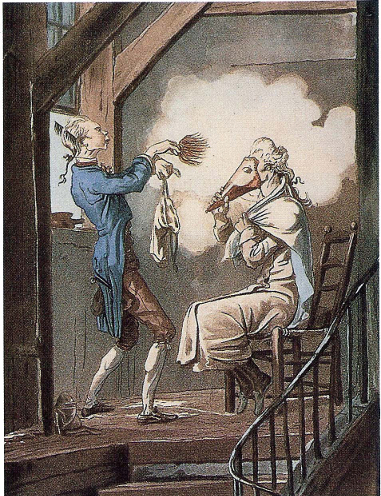
    A hairdresser or personal valet added the powder, which was freshly applied every morning, or each time a wig was donned.  The combination of lard and powder produced rigid curls and stiff hair styles.  Powder made hairstyles heavier: as much as two pounds heavier for the large periwigs popular until the 1730s[1]. A few households featured ‘powder rooms:’ a small room set aside for the application of powder.  A power bellows, a ‘carrot’[2], a swan-down puff, or comb was used to dust hair with powder.  White or grey powders were especially popular, but adventurous consumers might use black, blue, lavender, pink, red, or yellow.

    A gentleman being powdered by his valet.  A cone protects the gentleman’s face during the process.  Powder was made from starch, often wheat flour, or powdered white clay.  The Toilette of the State Prosecutor’s Clerk, c. 1768 by Carle Vernet.
    A gentleman being powdered by his valet. A cone protects the gentleman’s face during the process. Powder was made from starch, often wheat flour, or powdered white clay. The Toilette of the State Prosecutor’s Clerk, c. 1768 by Carle Vernet.

    Hairdressers could remove wigs to apply pomade and powder in a separate space, a convenience for wig wearers that men who only wore their own hair likely envied.  Men who did wear their own hair used a hairnet to preserve their pomaded locks overnight.  Each morning[3], a valet combed out the previous day’s pomade and dirty powder, before applying fresh pomade and powder.  This process could take an hour or more.  Many hairstyles remained undisturbed for weeks.  Headscratchers were kept close at hand: they allowed people to itch their scalps without disturbing their hairstyle too dramatically.

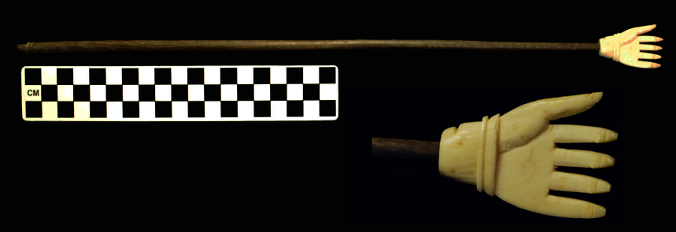
    An ivory-handled head scratcher and closeup [inset]. Personal collection. Used with permission
    The beginnings of this fashion trend were inspired by disease and lice.  Most people did not wash their hair very often.  Syphilis was rampant in Europe throughout the colonial period.  Symptoms such as hair loss, scabs, and rashes could be partially hidden beneath a voluminous wig.  The prevalence of highly contagious head lice, and the difficulty in exterminating them, also encouraged the adoption of false hairpieces.  In order to insure a good fit, gentleman shaved their heads, eliminating the hairs upon which lice thrived.  While cleaning lice from one’s own hair could be time-consuming, wigs could be conveniently removed – and boiled to eliminate pests and dirt.  However, if wigs were not properly maintained, they could become a haven for a variety of pests.

    To us today, the wearing of wigs covered in animal fat along with wheat flour or dried white clay may seem bizarre or disgusting or both.  Still, to the people of the time the reasons behind the practices made perfect sense.  Which of today’s perfectly sensible fashion choices might our descendants living 200 years in the future find strange or gross or both?

    Laura Galke
    Archaeologist, Site Director/Small Finds Analyst


    [1] Periwigs took as many as ten heads of hair to produce.
    [2] This was a carrot-shaped, wooden tube from which powder was blown onto the hair.
    [3] Ideally fresh pomade and powder were freshened each morning.  Frugal gentlemen might wait a week or more.