Lives and Legacies

Category: Archaeology

  • Bartmann Bottle: The Coolest Thing We’ve Ever Found

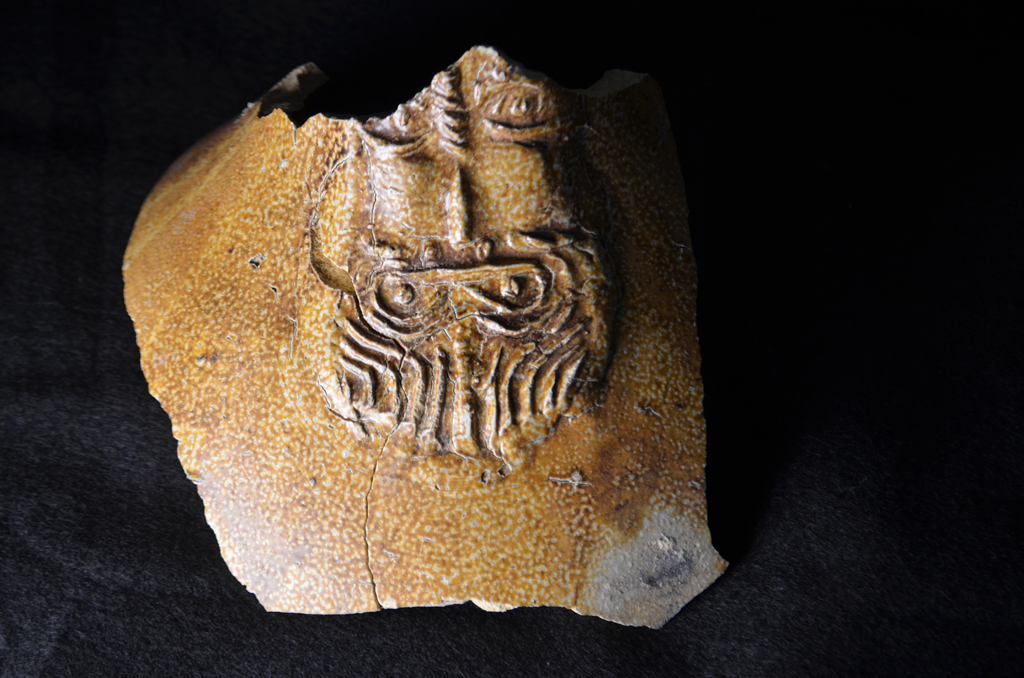
    We excavate hundreds of artifacts every day during the field season at George Washington’s Ferry Farm and occasionally one or two really stand out.  For me, the most interesting artifacts uncovered during the past few years are fragments of a Bartmann Jug.  The combination of an animated human face and fascinating symbolism makes this particular ceramic vessel unique among the hundreds of other vessels excavated from our archaeological site.  Just imagine the excavator’s surprise when the intense bearded face emerges as the dirt gets brushed off. That intense face and the story behind it make this object, in my view, the coolest thing we’ve ever found.
    Bartmann Bottle (1)

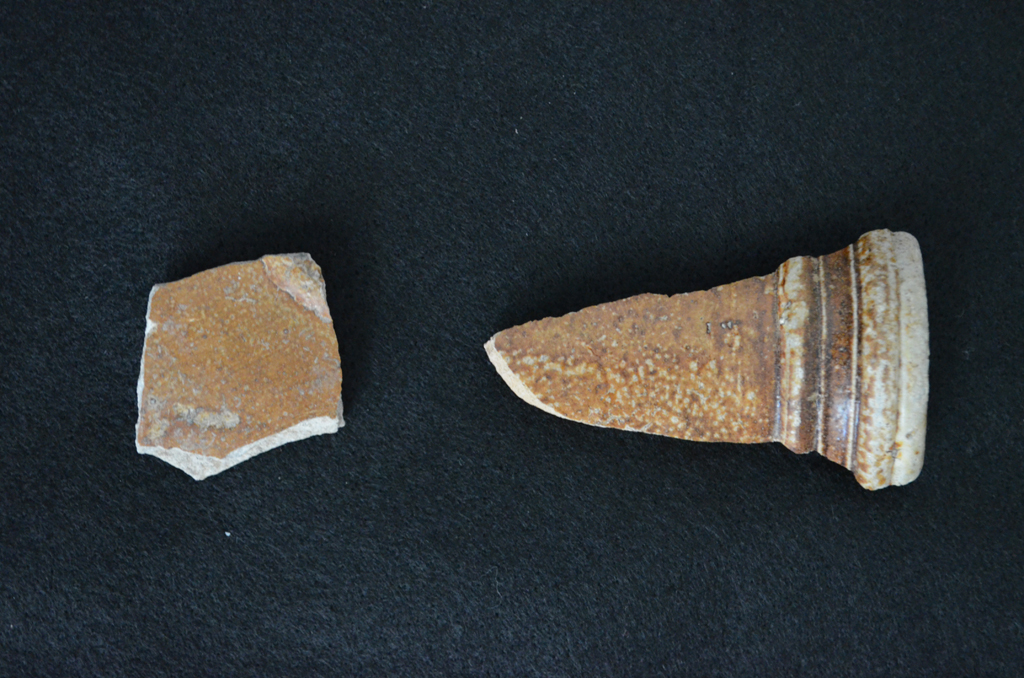
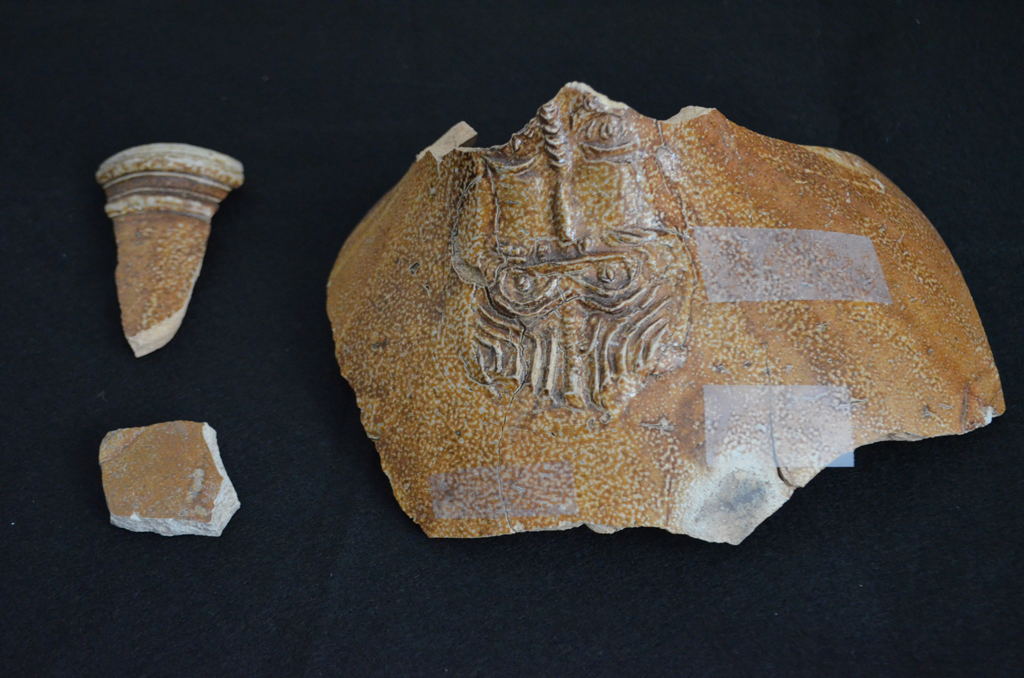
    The bottle itself would have had a solid sturdy base and a round, bulbous body with a cylindrical mouth.  It may have had a pewter lid, but these rarely survive archaeologically.  Pewter was fairly valuable and would have been melted down and reused after the vessel was broken, rather than discarded with the rest of it.  The bottle was medium sized, holding approximately a liter of low-alcohol beverage such as beer or cider.  The face of the bottle itself features a raised applied decoration known as a sprig mold, which is made by pressing wet clay into a mold, letting it dry to a point where it could be peeled out of the mold, and then attaching it to the unfired bottle.

    Establishing when the bottle was actually manufactured can be challenging for these vessels.  They were produced in Germany between 1550 and 1770.  The British Navigation Acts made foreign imports increasingly rare in the colonies after the early 18th century.  Knowing that the make-up of the ceramic body and glaze is German lets up narrow down the dates for this bottle to the early years of the 18th century.  It is decidedly part of the pre-Washington era material culture here are Ferry Farm.
    Bartmann Bottle (3)

    When looking at these bottles with their somewhat grotesque faces, one can’t help but wonder why people decorated their drinking vessels this way for some two hundred years?  What did it mean to their culture?

    These Bartmann Bottles were not just made in Germany. They were also shaped by German culture.  Their molded faces were sometimes elaborate and detailed and sometimes crudely executed. They were always male and always sported a large bushy beard.  This references German folklore’s “wild man of the woods.”  He was thought to live just beyond the bounds of civilization and run feral in the wilderness, living almost like an animal.  Perhaps rather appropriate to adorn a container of alcohol with?  However, these bottles were also widely exported. When they were brought to England, they became divorced from this folklore context.  Subsequently, the English created their own story about what the face on these Bartmann Bottles meant.
    Bartmann Bottle (2)

    In England around 1634, the bottles began to be called Bellarmines after Cardinal Robert Bellarmine.  Superficially, the wild face was said to resemble him. On a deeper level, the name was used as a way to mock the Catholic Church and its wider anti-protestant movement that Cardinal Bellarmine headlined.  This is following the monumental split of England from papal control and its moves farther towards Protestantism.   The colonists who brought this bottle to the new world thought of themselves as English so, if they gave any thought to the grimacing man who adorned their bottle of beer, they would have likely seen the figure as Bellarmine.

    This fascinating and drastic change in meaning as the object moves from culture to culture combined with the striking human features is what makes it, in my view, the coolest thing we’ve ever found.

    Lauren Jones, Archaeologist
    Archaeology Lab Technician
  • Video: Inside the Archaeology Lab – Mending with Archival Glue

    In this video, we discuss the importance of using archival glue to mend artifacts and demonstrate the process used to make this special glue.

    For information about the safe use of these chemicals, visit http://www.collectioncare.org/MSDS/b72MSDS.pdf

  • Video: Inside the Archaeology Lab – ‘Vesselization’

    In this video, we show you how archaeologists piece together artifacts in order to learn about the object and, most importantly, the people who used the object.

  • Photos: Glue Through a Microscope

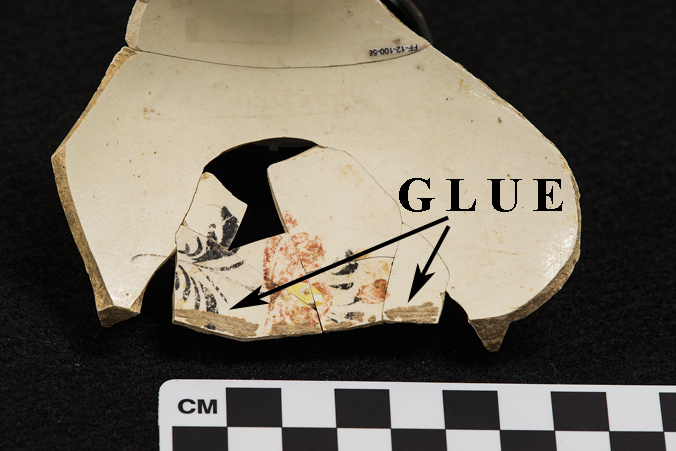
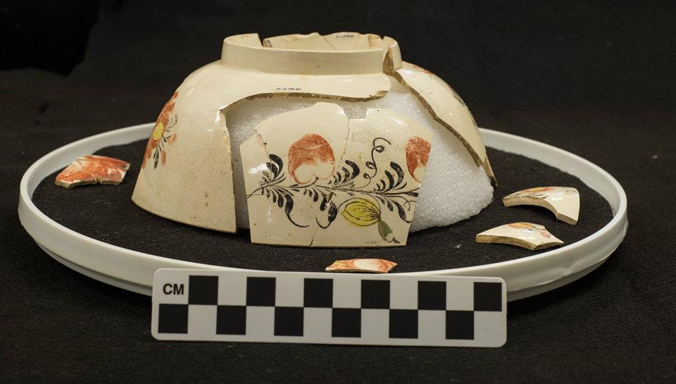
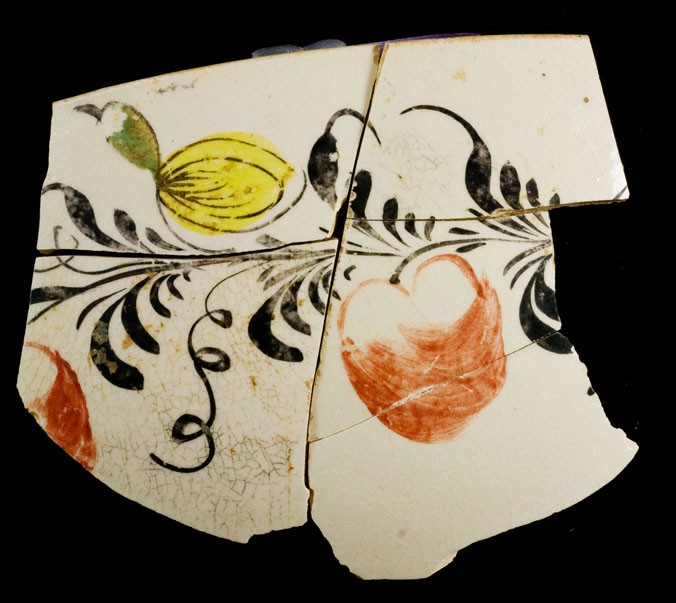
    While living at Ferry Farm, Mary Washington, mother of George, owned a creamware punch bowl with beautiful hand-painted enamel depicting a floral motif and cherry accents.  Archaeologists excavated pieces of this bowl from the cellar of the Washington home and subsequently discovered glue residue on the sherds.

    PunchBowl

    cherry-sherds

    interior-glue copy

    We’ve written about the importance of the bowl’s discovery here and even showed how we recreated a glue similar to the one used to repair the bowl here.

    As part of our continuing efforts to learn as much as we can about the punch bowl and these glue residues, we took the sherds to the archaeology lab at Dovetail Cultural Resource Group here in Fredericksburg, where they took photos using a microscope.

    Mara Kaktins, Archaeologist
    Ceramics & Glass Specialist

    Zac Cunningham
    Manager of Educational Programs


  • These Are A Few Of My Favorite (Broken) Things: Cobalt Blue Decanter Stopper

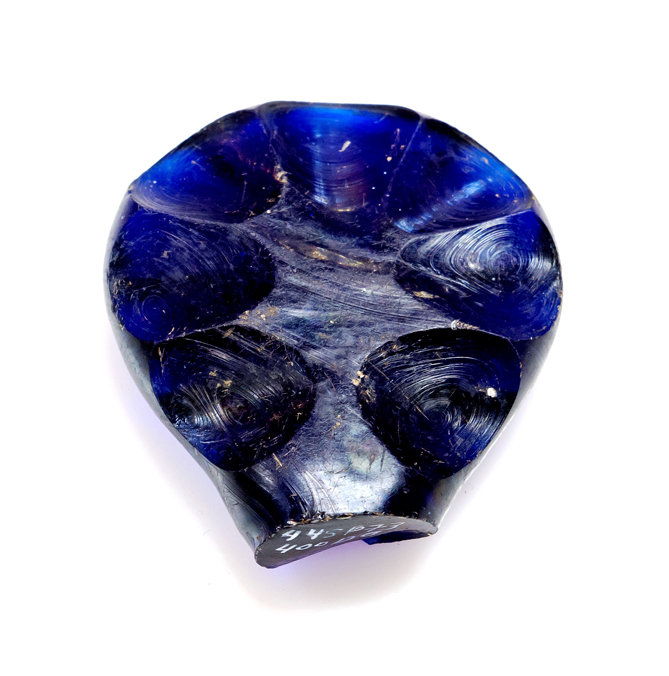
    Archaeologists are somewhat unique in their appreciation for all things broken, mostly due to the coveted information discarded items can tell us about those who died long ago.  However, occasionally a fragment is unearthed which is both informative and beautiful.  Such is the case with a lovely cobalt blue decanter stopper excavated on the grounds of Historic Kenmore.  Made from leaded glass to increase clarity, it seems quite heavy when placed in the hand.  Six carefully hand-cut flutes adorn each side and when held up to a light it exhibits violet-colored highlights that accent the piece perfectly.  Just the stopper alone is beautiful. Imagine how striking the entire decanter would have looked! Conveniently enough, that’s my job!

    Cobalt Stopper

    During the late 18th century, the decanter and its stopper graced one of the rooms at Kenmore and held either fortified wine like Madeira, Port, and Sherry or a stiffer spirit such as rum or gin.  It may have been part of a set and adorned with gold gilding that spelled out which heady beverage was contained within. I picture the decanter being picked up by one of the Lewis family’s enslaved servants on a dark night and a glint of purple from deep within the cobalt bottle shining as it reflects off of a candle while dark burgundy Madeira is poured forth into a waiting cup.

    All musings aside, however, the reality is that this stopper (which I am clearly obsessed with) also teaches us about how Fielding Lewis and his family lived.  The decanter was a showy piece meant for display.  It could be argued that, while it was a functional vessel, its primary purpose was to emphasize the wealth of the family and to impress guests.

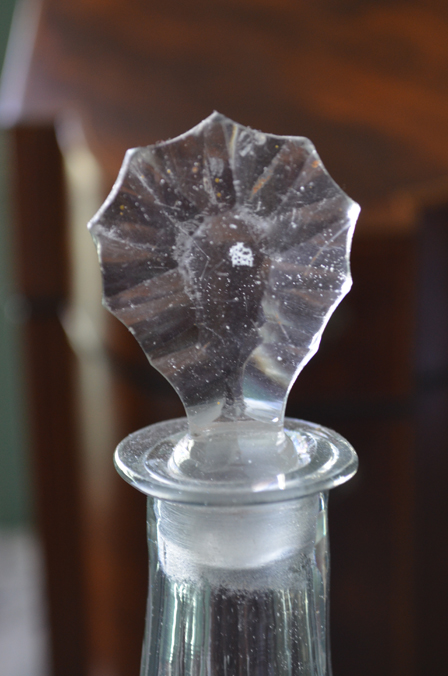
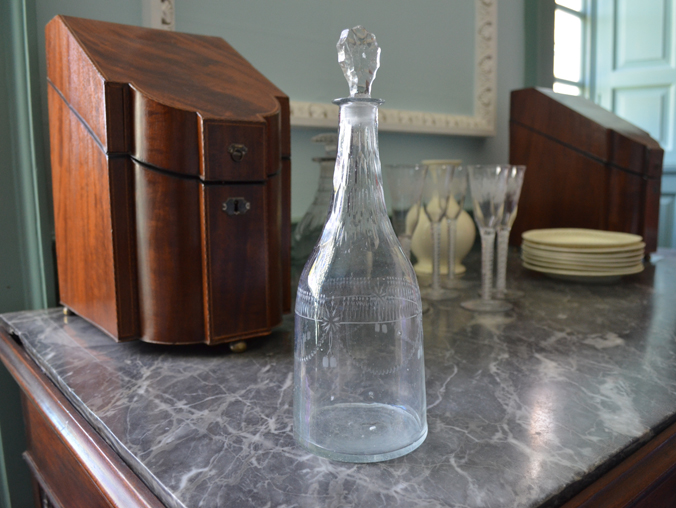
    For us today, the stopper has a practical use. Meghan Budinger, Kenmore’s curator, was able to locate a similar vessel using the excavated stopper as a guide. While the decanter on display in Kenmore’s dining room is clear instead of cobalt blue, its shape and design closely match the cobalt decanter and stopper owned by the Lewises.  Meghan continues her search for a blue decanter.

    Kenmore Decanter (2)

    Still, visitors and obsessed archaeologists alike may marvel at its beauty.  In fact, most of the ceramics and glass in that room have archaeological equivalents that have informed Meghan’s choices.  Thus, when asked by visitors why we have selected the beautiful tablewares before them, we can confidently answer that it is not just because they are pretty (so very, very pretty!) but also because, thanks to the archaeological record, we know the Lewis family owned pieces like them!

    Kenmore Decanter (1)

    You can see the clear glass decanter that is based on the cobalt blue stopper while also learning more about their ceramic cousins and about how archaeology has informed the choices of objects displayed inside Kenmore on a new specialty tour of the house called “Posh Pots and Decadent Dishes: The Lewis Family Life through their Ceramics.” Learn more about this new tour here. If antique glass is more your style, you can read more about Kenmore’s “Beautiful Glass” on The Rooms at Kenmore blog here.

    Mara Kaktins, Archaeologist
    Ceramics & Glass Specialist

  • Video: UV Light in Museums

    Ultraviolet light is an important and useful tool within the museum world. In this video, we show you how archaeologists and curators use UV light in their work with artifacts and historic objects.


  • Photos: It’s Spring. Let’s Dig!

    Dig Site Opens (15)

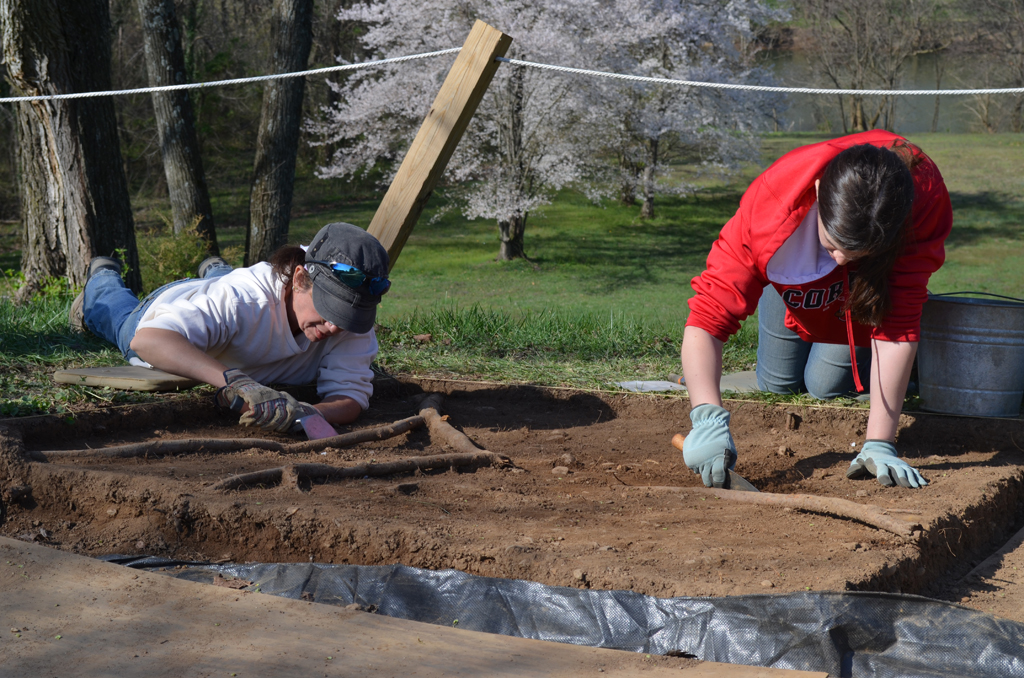
    Last week, another archaeological excavation season began at George Washington’s Ferry Farm. Here are some scenes from the first week of digging.

    On weekdays, see Ferry Farm’s archaeologists working at the excavation site from now through late-June or, if you can’t visit before June, spend a day on the dig site by watching the video below.

    Learn more about Ferry Farm archaeology here.

  • Between the Lines: Teasing out Tame’s Story

    In this day and age, it is easy to discover the particulars of someone’s life simply with the click of a button.  Phone number, age, home address, professional resume and more can easily be obtained by searching through public records on the Internet or at the library. A treasure trove of current primary and secondary resources awaits the present-day researcher trying to uncover the facts of someone’s life in the 21st century.

    But what do you do when the person lived over 250 years ago? What public and private historical records are available that will tell us who a person was, how they lived, when they died, and who their family was? Time, circumstances, and the natural decay of paper all take a toll on the sources we use to study the history of the people who came before us.  But the amount and quality of available information about a person also depends on the status and role they played in their own time.

    In 1750, an enslaved person living at George Washington’s boyhood home, now called “Ferry Farm,” was murdered.  His name was Tame and he was killed by Harry, another enslaved man owned by the Washington family.  These bare facts were recorded at a King George County Court of Oyer and Terminer, with no further explanations given of the crime or of the motives involved.[1]

    What led to Tame’s death? For that matter, who was Tame? How old was he? Where did he come from? How long was he with the Washington family and how does his fateful story figure into the daily operations of the farm and household? Answers to these kinds of questions are hard to come by because the stories of the enslaved population in the historical record are limited, in many cases, to just a few documents spanning their lifetime.

    Excavated by archaeologist at Ferry Farm, this broad hoe, also known as a “weed hoe,” was used sometime in the mid-1700s by enslaved people to remove weeds and loosen soil around crops. Older slave children joined adults in the fields to do this difficult task.

    Discovering Tame’s story begins with finding him in the written records.  Augustine Washington, George’s father, died on April 12, 1743, seven years before Tame’s murder.  His will, written a day before his death, lists by name some of the slaves that belonged to him and to whom he gave them. Tame is not among those mentioned.[2]  The subsequent July 1, 1743 probate inventory of Augustine’s estate details the property and personal items he owned and their value, including a list of the enslaved population, but Tame, again, is not listed.[3]

    Since he was not mentioned in either of these two historical documents relating to Augustine’s property, it’s possible that Tame was acquired after Augustine died,  either by his estate, his heirs, or by his wife Mary and sometime between 1743 and 1750.

    There is another scenario to consider, however.  Perhaps Tame does not show up in the court documents surrounding Augustine’s death because Tame was actually the property of Mary, Augustine’s wife, instead.

    To burn efficiently and ensure a clean flame, the cotton wicks of candles needed to be trimmed frequently. This tool, known as a wick trimmer (above and below), was used for this purpose. Due to the mundane and constant nature of the task, household slaves were often charged with maintaining candle wicks.
    To burn efficiently and ensure a clean flame, the cotton wicks of candles needed to be trimmed frequently. These tools, known as wick trimmers (above and below), were used for this purpose and discovered during excavations at Ferry Farm. Due to the mundane and constant nature of the task, household slaves were often charged with maintaining candle wicks.

    FF20-325-1-2590-Wick Trimmer

    Mary Ball, who married Augustine Washington in 1731, was born to Mary Johnson and Joseph Ball in 1708 in Lancaster County, Virginia.  When her father Joseph died in 1711, he willed to her a young slave:   ”Item: I give to my daughter Mary my negro boy Tame…” (Lancaster County Will Book 10:88). Since Tame is described as a “boy” in the document, he could be roughly any age between 5 and 16 years.

    Is this boy, willed to Mary when she was but three years old, the same person who was murdered 39 years later in 1750 at Ferry Farm? As Mary’s property, the boy Tame would have been part of her household wherever she lived: with her mother in Northumberland County following her father’s death, with her as Augustine’s wife at Pope’s Creek, Westmoreland County, and then, finally, at Ferry Farm, where she lived mostly as a widow.  As Mary’s property, Tame would not have appeared in the will or probate lists of her husband.  What is also interesting is that both Tame and the man accused of murdering him were described in the 1750 court proceedings as “belonging to Mary Washington of this county widow.”

    Exactly what role Tame played on the Washington farm and within their enslaved community is unknown. If Tame is the same boy Mary received when she was 3, he would be in his 40s or 50s when at Ferry Farm, and thus someone Mary had known well her whole life. Did he work in or around the main household for the family or as a field laborer?  Did his age and long term relationship with Mary relate in any way to his unfortunate murder in 1750? What was his status within the slave community? Even Tame’s name adds an interesting aspect to his story that separates him from the other Washington slaves on the farm. “Tame” is a name of West African origin and is unlike the usual Anglicized names of contemporary Washington slaves, such as Jack, Ned, Tim, Steven and Adam, as recorded in Augustine’s will and probate inventory.

    Recent research shows cowry shells were used as currency as part of the slave trade. The modifications to our cowries facilitate stringing them into groups of 40. These shells, originally from the east Indian Ocean, traveled to Virginia with their enslaved owners. Evoking memories of their African homeland and heritage, such familiar emblems helped comfort those who remembered a life of freedom and helped them to maintain elements of their culture.
    Recent research shows cowry shells like this one were used as currency as part of the slave trade. The modifications to cowries discovered at Ferry Farm facilitated stringing them into groups of 40. These shells, originally from the east Indian Ocean, traveled to Virginia with their enslaved owners. Evoking memories of their African homeland and heritage, such familiar emblems helped comfort those who remembered a life of freedom and helped them to maintain elements of their culture.

    Tame’s existence in the historical documents is brief and mysterious. It may always remain a mystery but further research may yet illuminate this man’s story and his long association with Mary Washington. History is indeed an unending journey.

    Judy Jobrack, Archaeologist
    Assistant Lab Supervisor

    [1] King George County Order Book 2, p. 670

    [2] King George County Order Book 2, Part 1, p. 333

    [3] King George County Inventory Book, 1721-1744, p. 285


  • Video: Inside the Archaeology Lab – Labeling Artifacts

    Archaeologists spend much more of their time working to determine the significance of an object than actually finding the object through excavation. This analytical work is done in an archaeology lab, where t is vital to keep the artifacts organized. This video shows how artifacts are labeled to help make sure nothing gets lost.

    Learn more about archaeology at Ferry Farm at http://bit.ly/1Ob37in.

  • Sweet-Toothed Colonials & Their Chocolate

    Ahhh Chocolate!  Now is the time of year when we consume even more than usual, often from heart-shaped boxes gifted by an admirer.  Probably one of the most universally loved foods, the average American consumes roughly 11 pounds of the stuff a year!  It is hard to imagine a world without chocolate and this love of the heavenly substance stretches all the way back to our country’s colonial roots.  However, banish the visual of George Washington chomping a chocolate bar while chopping down the cherry tree, chocolate bars are a fairly recent invention of the mid-19th century.  Before the mid-1800s, if you had a craving for the world’s favorite sweet, you drank it!

    Chocolate has its origins in South America where archaeological evidence indicates it was being cultivated and consumed over 3,000 years ago.  The Spanish were the first Europeans to try the spicy chili and chocolate beverage of the Aztecs.  They introduced it to Europe in the 1600s where, with the addition of sugar, it became the height of fashion.

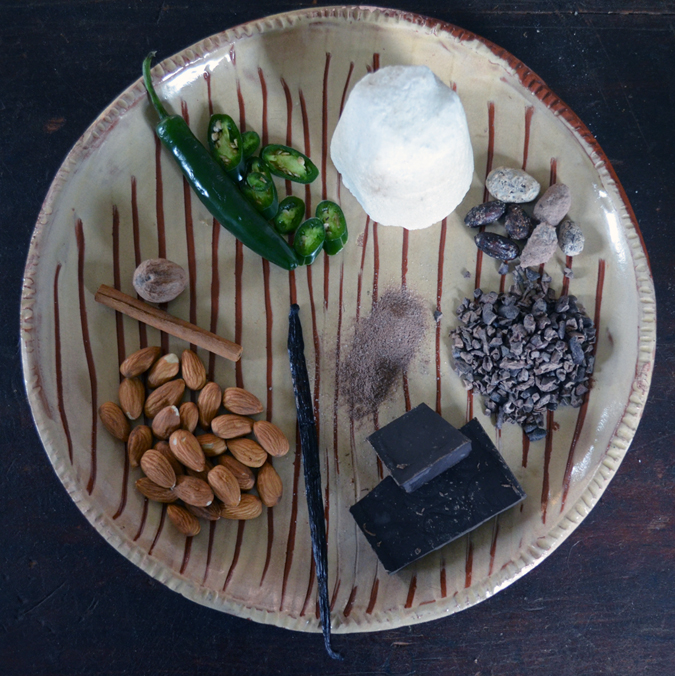
    Drinking chocolate of the 18th century was different from our ubiquitous modern day cup of cocoa.  It was made with either cacao nibs or blocks of compressed chocolate that were then grated or ground to a paste and dissolved in a warm liquid inside a dedicated ‘chocolate pot’.  The chocolate was added to any combination of water, milk, cream, wine, or even brandy for an extra kick.  This mixture was combined with sugar, though less than we use because it was an expensive import in colonial America.  Other common ingredients included chili pepper, vanilla, nutmeg, or allspice.  This resulted in a rich, sweet, spicy, and bitter drink that the colonists couldn’t get enough of.

    Chocolate Ingredients
    Popular ingredients in colonial-era chocolate drinks included (clockwise from top) sugar; cocoa beans, chocolate nibs, or chocolate block crushed and melted to form the foundation of the chocolate drink; vanilla; almonds; cinnamon; nutmeg; and chilis.

    We know that many early Americans were fans of chocolate, but it wasn’t available to everyone.  In the 1700s, chocolate was still a fairly expensive drink, similar to tea or coffee, making it a beverage of the upper and middle classes.  It was seen as a nutritious and filling health food, commonly had with breakfast.  Chocolate was a well-known staple at the Washington breakfast table, often served alongside tea and hoecakes in honey and butter.[1]

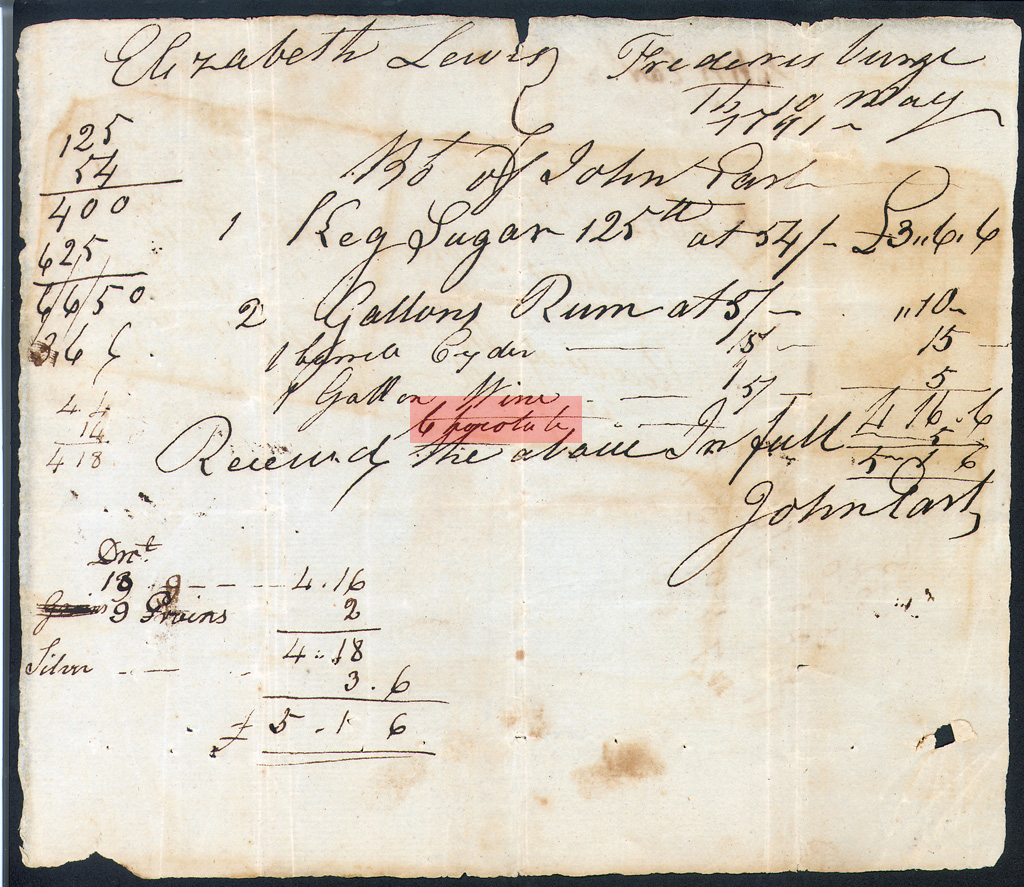
    In fact, the Washingtons were such fans of chocolate that in 1757 George Washington ordered 20 pounds of chocolate from British merchant Thomas Knox.  While living at Kenmore Plantation, George’s sister Betty Washington Lewis ordered a gallon of chocolate.

    Betty Orders Chocolate
    Although the handwriting is difficult to decipher, this receipt shows highlighted in red that Betty Washington Lewis ordered a gallon of chocolate in May 1791.

    This love of chocolate is also evident in archaeological artifacts found through excavations at Ferry Farm. Archaeologists recovered fragments of a porcelain chocolate cup.

    It may seem strange to us that there were special cups just for drinking chocolate.  However, since it was a luxury good enjoyed by the upper classes it had a specific set of objects associated with its preparation and consumption.  A teapot or teacup could have easily functioned for drinking chocolate but the purpose of this specialized material culture was to show off wealth and sophistication.  For this reason a  well-to-do colonial household would have separate sets of vessels for the making and consumption of tea, coffee, and chocolate.  Using the right one in the right way let your peers know you were a well-educated gentry woman or man.

    Chocolate cups and pots were often made of fancy material like silver or porcelain to show off the wealth of the owner and reflect the nature of the luxury ingredient.  The chocolate cup recovered at Ferry Farm was painted red and blue in what is known as an ‘Imari palette’ and gilded to enhance the cup’s extravagance.  Chocolate cups can be identified by their straight sides, unlike the gently sloping sides of a teacup.

    Fragments of a porcelain chocolate cup made in the mid-1700s, decorated in the Imari palette design, and recovered during an archaeological excavation at Ferry Farm.

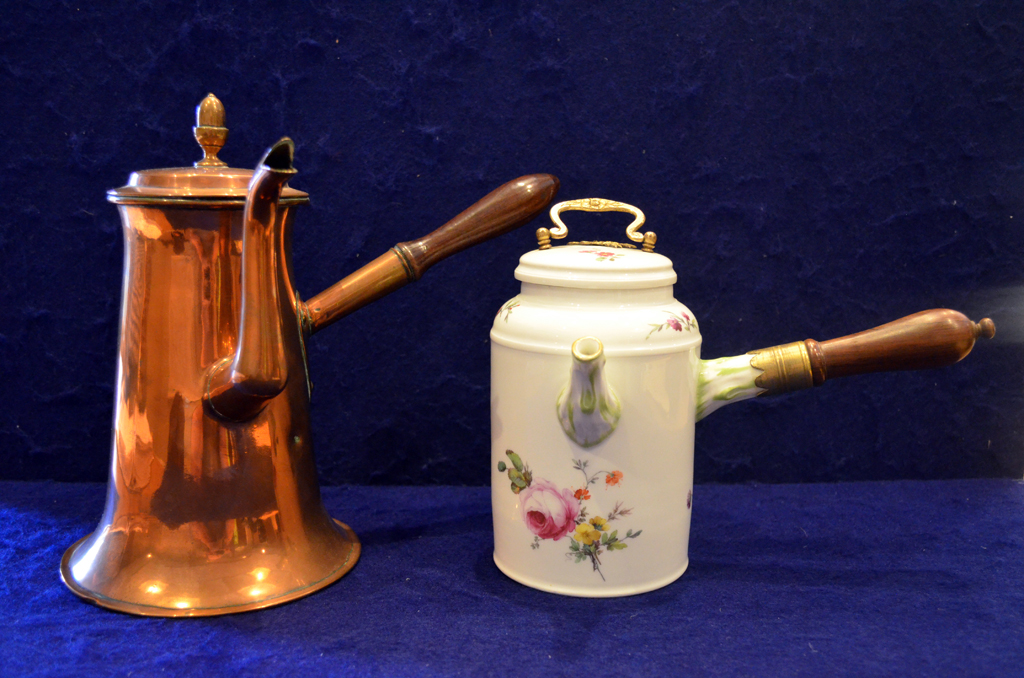
    Similarly, 18th century chocolate pots generally are taller and have straighter sides compared to contemporary teapots.They also have a shorter spout with no strainer and often have a straight handle that juts out from the body.

    Chocolate Pots 1
    Two 18th century chocolate pots in the collection at Historic Kenmore.

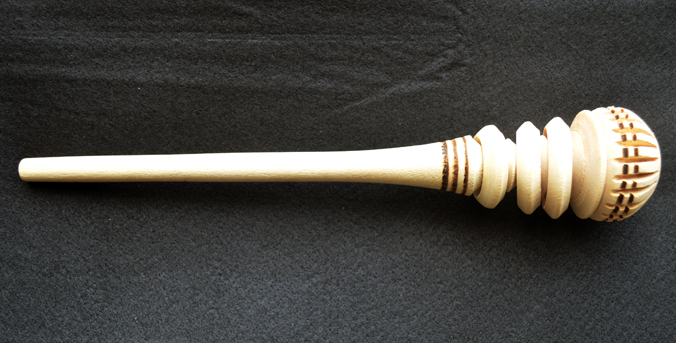
    The most recognizable feature of a chocolate pot however is a hole in the lid where the chocolate mill, or molinillo, would be inserted and rubbed between the hands to briskly stir the chocolate, creating a delicious froth on the top.

    Chocolate Mill
    Reproduction chocolate mill.

    Kind of makes you want to try eighteenth century chocolate drink, doesn’t it?  The next time you’re enjoying a bite of a candy bar or sipping your instant cocoa, think of the lofty origins of that treat and be grateful to the sweet-toothed colonials who so prized delicious chocolate!

    Lauren Jones, Archaeologist
    Archaeology Lab Technician
    Editor’s Note: Watch for a video exploring the topic of chocolate in colonial America coming soon!

    [1] McLeod, Stephen A. Dining with the Washingtons: Historic Recipes, Entertainment, and Hospitality from Mount Vernon. 2011: 37, 51.