For the past year or so my focus here at George Washington’s Ferry Farm has been determining what types of ceramics were owned by the Washington family. Once we have this information we want to acquire accurate examples to place in the reconstructed house for all to see. From door hardware to teacups, most of the details of the house will be informed by archaeology or historic documents. If a visitor asks “Why do you have these plates on the table?”, we can say “That’s an excellent question! Because we’ve dug up pieces of it right over here!” Our most recent focus has been on the white salt glazed stonewares, which have been featured in previous blog posts. In this post, we talk about fragments that have been identified as a patch stand and a porringer.
First of all, identifying whole vessels from tiny sherds involves a lot of research. This is made all the more difficult when you’re working with a ware-type such as white salt glazed that is defined by its plain white color. So, it’s always a thrilling moment when you’re paging through a huge book with a tiny but distinctive fragment of pottery in your hand and you manage to spot the fragment’s whole object.
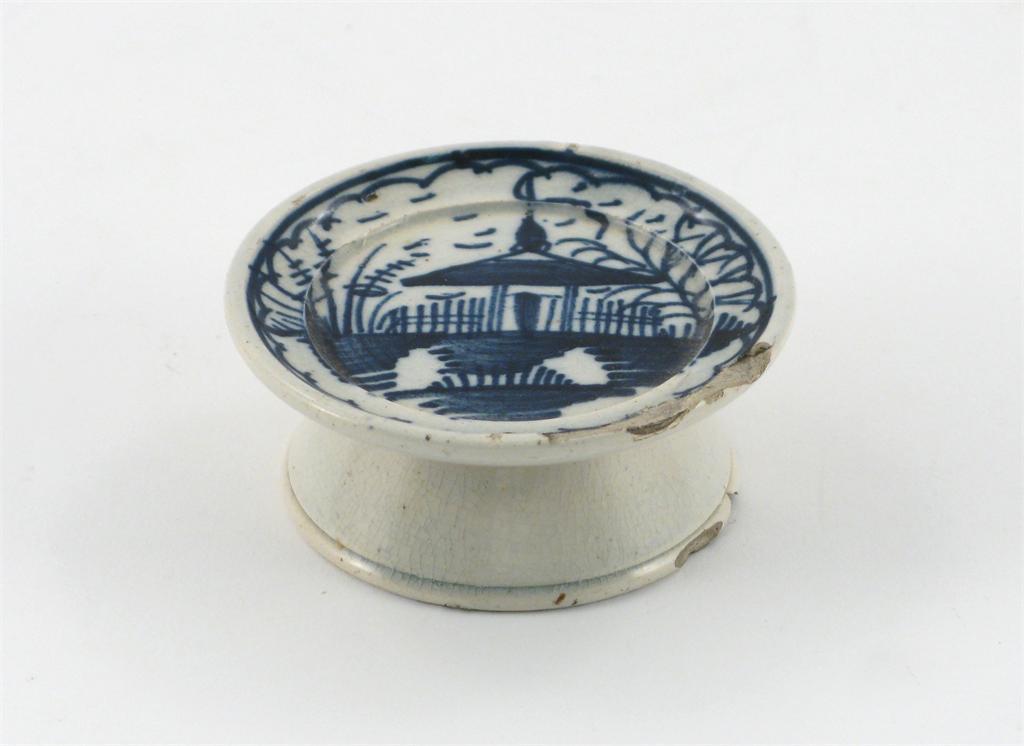
My most recent ‘Eureka!’ moment involved both a patch stand and a porringer. You’ve likely never heard these terms but you may own modern day equivalents. A patch stand is a teapot stand, designed to elevate a teapot, arguably the most important object in a tea set, above the other tea wares. It also serves the practical purpose of keeping the hot pot off of the table surface.
18th century pearlware blue and white patch stand. Credit: Woolley & Wallis.
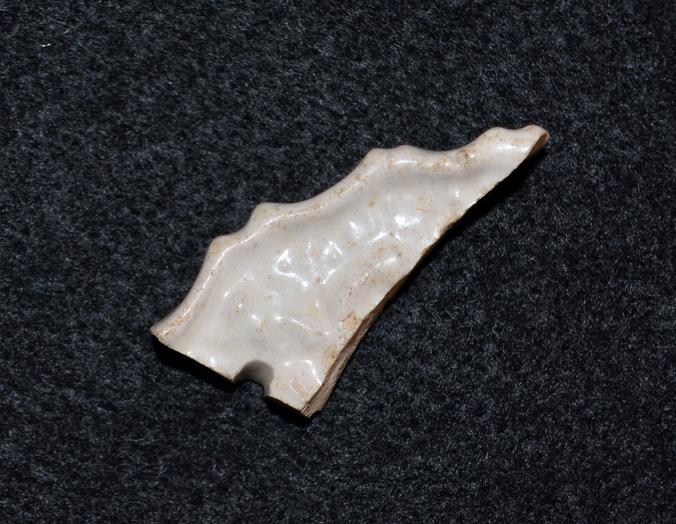
At Ferry Farm, archaeologists found four small fragments from just such a patch stand. The fragments all have evidence of ‘piercing’ or the cutting out of wet clay before it was fired to form a pattern. The pattern created through piercing also promoted air circulation under the stand. Patch stands are not common in the archaeological record so we’re very happy to have identified the sherds. Now we’ll be able to furnish the new Washington house replica with a patch stand.
Fragments of the patch stand excavated at Ferry Farm.
A profile view of one of the patch stand fragments.
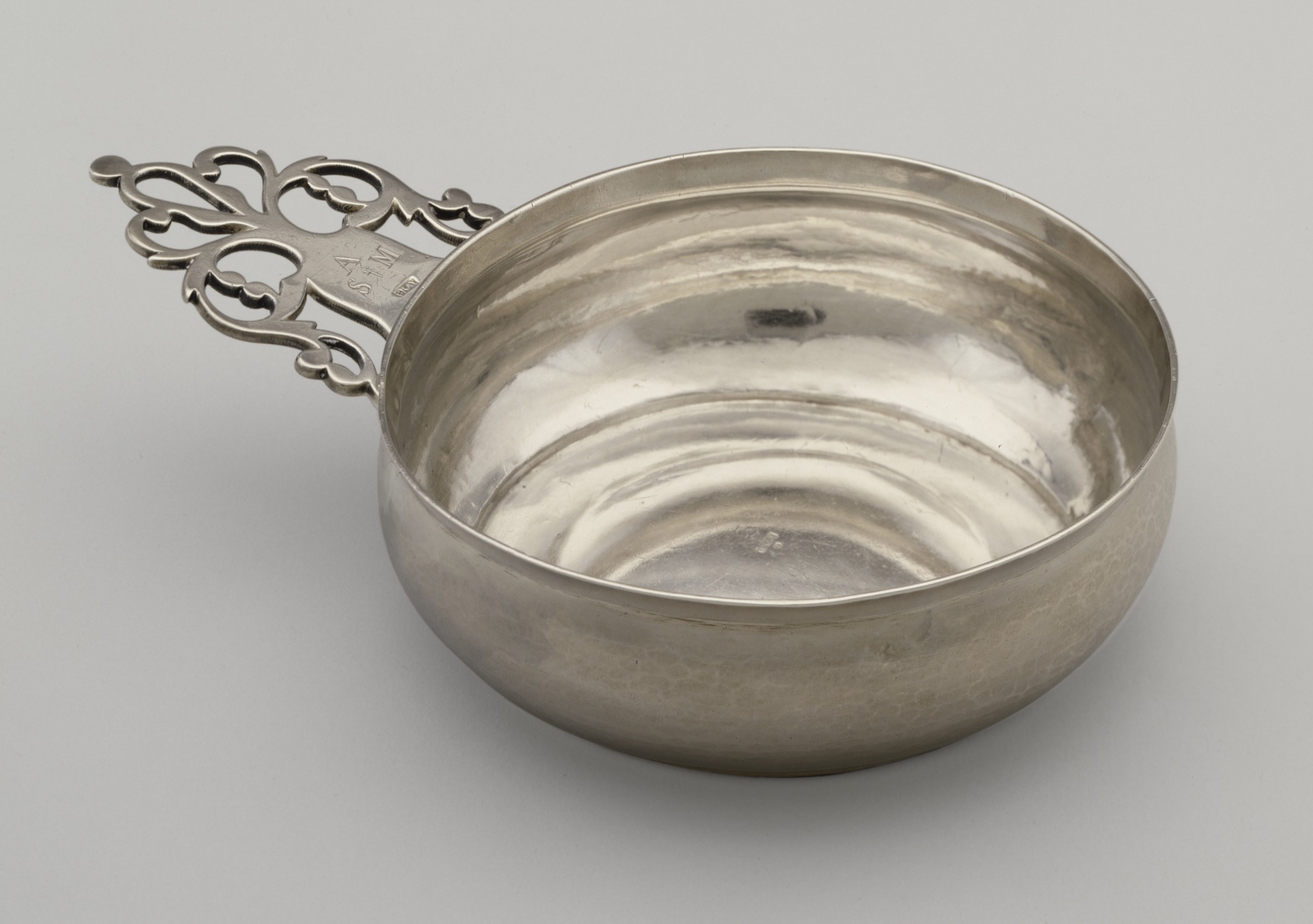
The other vessel is a porringer. Although kind of a weird name, porringers were really handy and ubiquitous in every colonial household. A porringer was simply a bowl with a handle for eating soups, porridges, stews, and the like. You may have some equivalent in your house, like those oversized coffee mugs you can also use to eat soup or cereal.
A silver porringer dating from 1742 and made in Boston by Samuel Gray II. Credit: Los Angeles County Museum of Art.Fragment of a ceramic porringer handle excavated at Ferry Farm.
Stay tuned and keep your eyes out for a sweet patch stand and a nifty porringer once the Washington house is finished!
Mara Kaktins, Archaeologist
Ceramics & Glass Specialist
Here on Lives & Legacies we’ve shown you a variety of important tasks that take place inside the Archaeology Lab at George Washington’s Ferry Farm. You’ve seen how we wash, catalog, label, and then mend vessels with archival glue. One goal of all this work is to piece together whole artifacts from the many broken bits found and share that whole artifact with our visitors as part of the exhibits in our museum gallery. Right now, a new exhibit of white salt-glazed stoneware vessels is on display at Ferry Farm. It took numerous staff and volunteers working hundreds of hours to get the vessels on display ready to be exhibited. Here’s how we did it!
Seven reconstructed white salt-glazed (WSG) stoneware vessels make up a new exhibit at Ferry Farm. These pieces, which include two dinner plates, a fruit dish, three ointment pots (used for mixing medicines and cosmetics), and a tea ware or condiment pot lid, were all excavated from the Ferry Farm site. These ceramics were popular during the mid-18th century and most likely graced the tables of the Washington family.
White salt glaze stoneware fruit dish, 1740-1765. The dish is decorated with a molded “dot, diaper, basket” pattern and would have been displayed prominently in the Washington house at Ferry Farm. An almost identical dish has been excavated at Mount Vernon and additional sherds with a similar pattern were recovered across the river at Kenmore. This may signify a Washington family preference for the motif or indicate that someone within the family acquired multiple fruit dishes and gave them as gifts, something George Washington was known to do.
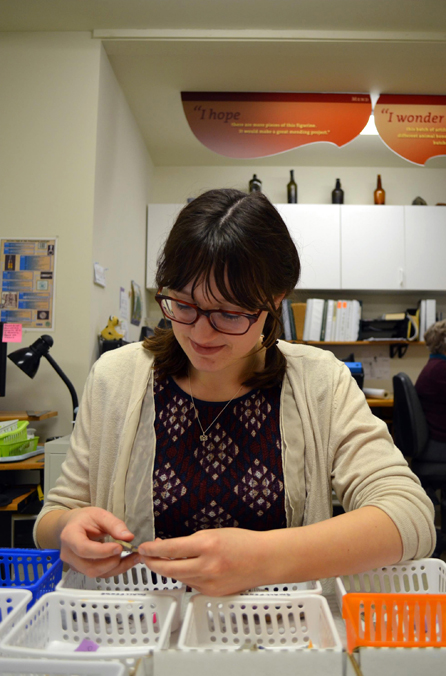
In preparation for the exhibit, I spent the better part of three weeks in August and September finishing the documentation for the individual vessels and then meticulously gluing them together. This relatively small amount of time spent at the end of the project was only the tip of the iceberg – the total amount of time spent getting these pieces ready for exhibition encompassed a year and a half! Preparing these pieces to be displayed involved the hard work of numerous archaeology lab staff and volunteers.
November 2014 – January 2015: Executive decisions are made… First, discussions were held within the archaeology department about studying Ferry Farm’s archaeological collection of white salt-glazed stoneware. Such a study would answer questions about the material setting of the Washington household and help with interpreting the forthcoming Washington house replica to the public. The project was given the go-ahead.
January 2015: Getting the lists together… Using our searchable artifact database, we generated a list of every piece of white salt-glazed stoneware in our collection. A total number of 1,623 artifact bags were on this list, representing over 2,800 actual sherds.
Screencap of the artifact database.
February 2015: Puzzle-solving begins! We started pulling the 1,623 artifact bags from storage, and by my records, we were still pulling artifact bags in June. Lab staff, volunteers, and, on rainy days, the excavation field crews helped with pulling the artifacts.
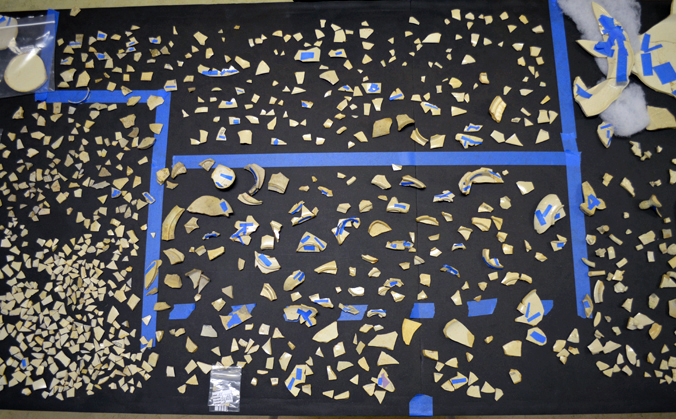
After making sure the sherds were labeled correctly, we laid them all out on one of the lab tables, which had been covered in a black foam board to make it easier to see the all-white ceramics. The sherds were first separated by decorative variations, such as plain white salt-glazed, slip-dipped, scratch blue, or dipped with iron oxide, and next by vessel part, such as rims, bases, and bodies. Then the cross-mending began.
Sherds of white salt glaze stoneware waiting to be mended together.
Over the next eleven months, countless hours were spent at the table looking for mends between the sherds. Having identifiable vessel parts, such as rims and molded and decorative elements, helped in the matching process, but there were hundreds of plain white, non-descript sherds to try and fit together. Pieces that mended were taped together with painter’s tape, which doesn’t leave an adhesive residue on the artifacts.
A friendly competition began and whoever had the most mends at the end of each month won a free lunch! In all, everyone spent countless, addictive hours each week scrutinizing the sherds and patiently putting together “puzzles” for which, unfortunately, the majority of the pieces were missing.
“Do these match?”Puzzle solved!
January 2016: Minimum Vessel Count… After eleven months, we cried “uncle” to the cross-mending and started the minimum vessel count by figuring out how many and what types of individual WSG vessels were represented in our collection. Under the supervision of Mara Kaktins, The George Washington Foundation’s ceramic and glass specialist, the sherds were separated into what we believed were individual vessels using the bases and rim styles. By late April, our choices were firm and over sixty white salt-glazed vessels were identified.
July 2016: Putting the paperwork in order…. Treatment reports were started on the most complete vessels, which would be included in the new exhibit. Each report listed all the sherds that made up each vessel and their condition. Photographs were taken to help with the mending and gluing. The remaining white salt-glazed sherds on the table were separated into bags according to decorative and body type, their contexts recorded in a spreadsheet for our records, and then returned in storage.
August 2016: Finally, the fun part – gluing! I started gluing the vessels using a product called B-72, an archival glue that can be removed, if necessary, and that we mix ourselves in the lab. The design of the upcoming exhibit, including the layout, mounts and signage, was created by Meghan Budinger and Heather Baldus, the Foundation’s curatorial team.
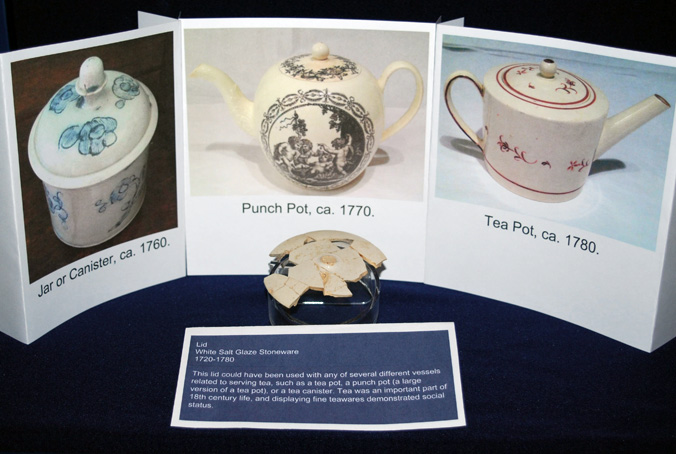
White salt glaze stoneware lid, 1720-1780. This lid could have been used with any of several different vessels related to serving tea, such as a tea pot, a punch put (a large version of a tea pot), or a tea canister. Tea was an important part of 18th century life, and displaying fine teawares demonstrated social status.
September 2016: Finishing touches… The white salt-glazed stoneware exhibit is now installed and ready for the enjoyment of our visitors to Ferry Farm. A total of 614 days from report prep to exhibition!
Tantalizing evidence of historic furniture use exists within the soils of George Washington’s Ferry Farm and that evidence gives us a more complete view of how the Washington family lived in the 1700s. The hundreds of items archaeologists and students have uncovered represent the remains of furniture broken or embellishments lost. The ruthless outdoor elements leave scant vestiges of furniture’s former glory. Wood disintegrates into soil, so these relics typically include only iron and brass hardware, such as drawer pulls, casters, bolts, keyhole escutcheons, or hinges. Over half of the hardware found consists of brass tacks. Such brass studs were often used in furniture upholstery, but were also popular for saddles, trunks, even antique wig stands: anytime a leather covering was added to a wooden frame or base.
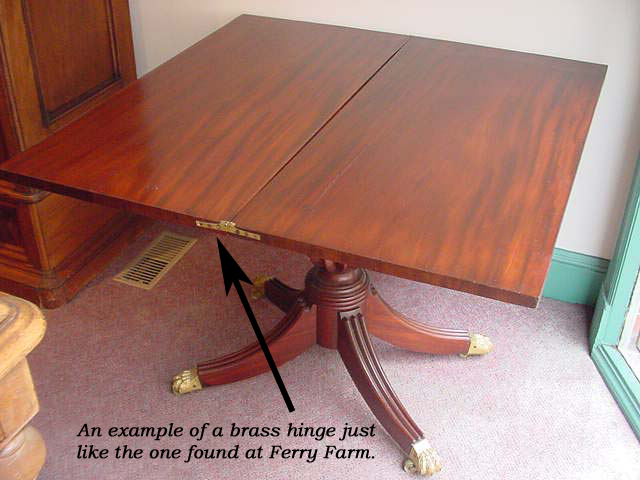
One particularly interesting brass hinge was unearthed in 2007 and boasts an exciting past. This hinge, part of a folding card table, was a crucial element in the popular Virginia domestic pastime of playing games such as backgammon, chess, and cards. Card tables provided a luxurious accessory for popular social entertaining and were part of a well-appointed home. Providing guests with such pleasant amusements reflected well upon the Washington family.
18th century card table hinge excavated at George Washington’s Ferry Farm.
Archaeological investigations sponsored by The George Washington Foundation have uncovered evidence that demonstrates that the Washingtons’ mid-1700s home was filled with fashionable accessories to enhance social bonding. These tools included tea wares, stemmed drinking glasses, glass decanters, fashionable dining utensils, and smoking pipes. The recovery of a card table hinge provides another element of their well-equipped home.
Gentleman often played card games together, but occasionally women joined the amusement as well (Porter and Porter 1782:466-467). Playing cards allowed ladies and gentlemen a refined form of amusement in a convivial atmosphere, without raising critical eyebrows from discerning social commentators in Virginia. These games were occasions in which mixed company – men and women – could enjoy companionship and pass the time in a genial way. It was one of the few entertainments in which men and women could directly compete (Sturtz 1996:169-171). Lucy Byrd’s acumen prompted her husband William to cheat on at least one occasion (Sturtz 1996:172-173, 175-176).
Such benign competition also allowed players to showcase their skills. William Byrd II thought that such games provided an effective antidote to “disagreeable” company, as it allowed the time spent with tiresome guests to pass quickly (Sturtz 1996:175). Tea or stronger beverages might lubricate such gatherings, which enhanced social bonds.
Card playing (group at card table in painting’s center) and tea drinking (group at table at painting’s right) provided elegant entertainment as depicted in The Assembly at Wanstead House (1728-31) by William Hogarth. Public domain. Credit: Philadelphia Museum of Art / Wikipedia
If card games included a little wager, they were all the more thrilling. Self-assured gambling and an indifference to losing money demonstrated a gentleman’s independence from monetary anxiety (Isaac 1974:352; Koda and Bolton 2006:100; Sturtz 1996:166). Such competitive confidence went a long way towards refuting any rumors of financial stress from which a gentleman might be suffering in the community.
In the years leading to the American Revolution, these occasions were increasingly viewed as a source of social disorder (Isaac 1974:358-359), but such amusements remained popular social events in Virginia.
Cards were a popular Virginia pastime and specific furniture such as folding card tables existed as luxurious accessories to support this pasttime (Isaac 1974:352). Hospitality was an important part of these occasions (Isaac 1974:352) and the folding card table made the game and the hospitality possible. Applying knowledge of the past to particular objects like a card table hinge excavated at Ferry Farm gives us a more complete picture of the lives led by the Washington family here in the 18th century.
Laura Galke, Archaeologist
Site Director/Small Finds Analyst
References Cited
Porter, James and William Porter
1782 Letters Addressed to Two Young Married Ladies, on the Most Interesting Subjects. The Critical Review, or, Annals of Literature. British Periodicals. Printed for J. Dodsley, London.
Goodison, Nicholas
1975 The Victoria and Albert Museum’s Collection of Metal-Work Pattern Books. Furniture History 11:1-30.
Issac, Rhys
1974 Evangelical Revolt: The Nature of the Baptists’ Challenge to the Traditional Order in Virginia, 1765-1775. The William and Mary Quarterly 31(3):345-368.
Koda, Harold and Andrew Bolton
2006 Dangerous Liaisons: Fashion and Furniture in the Eighteenth Century. The Metropolitan Museum of Art, New York.
The use of folk magic may seem foreign and exotic to many of us in the 21st century. If we look closer, though, it is apparent that some modern Americans still practice it today – even if they don’t realize it. Have you ever hunted for a four-leaf clover? Have you ever hung a horseshoe over your door? If so, you’re participating in a kind of folk magic.
Folk magic is (and was) thought to be a way to influence forces, seen and unseen, for good or for ill. It is sometimes referred to as “low” magic, not because it was seen as evil, but because it was passed down generation to generation rather than learned from books or formal tutors. “High” magic has its own fascinating history, but this blog post focuses on the everyday magic that 18th century Virginians, both black and white, practiced. Hoping to ward off evil and bring peace, prosperity, and abundance into their homes, some of these early Americans used magical means to their ends.
Europeans and Africans in British North America brought with them the spiritual, religious, and magical traditions of their homelands. The blending of these traditions became the bedrock for future iterations of American folk magic. One modern archaeologist says that this blending process makes it hard to tell exactly who was using what folk tradition while creating some of the material culture of folk magic; it is not always clear from the archaeological record exactly who made an object and what that object’s intended purpose was.[1]
One of the things that may have contributed to the cross-cultural blending is the similarities between English and African folk magic traditions. Both groups recognized that there were some people who were “set apart” from the rest of the group. These individuals were believed to possess special powers that made them respected, feared, or both. African and English traditions also shared a belief in magical objects, even everyday objects, that could be imbued with power. And lastly, both groups believed in the power of burying magical objects for protection – or for malice.
People thought talented in the magical arts were known as “cunning folk” in the English/English-American tradition and as “conjurors” in the African/African-American tradition. Cunning folk were not witches, who were thought to inhabit the fringes of society, but rather “practitioners of magic who healed the sick and the bewitched, who told fortunes, identified thieves, [and] induced love.”[2] This description of cunning folk is very similar to W.E.B. Du Bois’s definition of the conjuror, “the healer of the sick, the interpreter of the Unknown, the comforter of the sorrowing, the supernatural avenger of wrong . . .”[3]
The rest of Du Bois’s quote, however, highlights an essential difference between white cunning folk and the enslaved conjuror. The conjuror was also “. . . the one who rudely but picturesquely expressed the longing, disappointment, and resentment of a stolen and oppressed people.”[4] Despite their many similarities, enslaved conjurors and cunning folk operated in very different realities. In Du Bois’s estimation, the conjuror did more than just take care of the physical and spiritual needs of the enslaved; he or she took on the weight of slavery itself.
Both conjurors and cunning folk created magical charms and charged objects with magical meaning. At George Washington’s Ferry Farm, we found an excellent example of an object charged with meaning. A carnelian bead excavated on the property may indicate that a powerful conjuror might have lived here during the Washington’s time. This bead is similar to two found in Barbados and Archaeologist Jerome Handler asserts that these carnelian beads were the product of Cambay, India and were indications of the status of the person with whom they were buried.[5] Dave Muraca, director of archaeology at Ferry Farm, describes “all three beads” as “generally reddish-orange color” with “tapered ends and cylindrical shapes. Each one has 8 longitudinal facets and 4 beveled facets at each end. The main difference between the Washington site bead and the Barbadian beads is size, with the Barbadian beads being almost twice as long as the one recovered at the Washington farm.”[6]
Multiple views of the Carnelian bead excavated at George Washington’s Ferry Farm.
Cunning folk also made objects with magical meaning. Written charms, or amulets, were popular since they were easy to make and could be worn on the body. These charms often served as protection for people and livestock against witches’ attacks. An example of these charms can be found in Colonial Williamsburg’s Special Collections. This small piece of paper, dating to about 1700, promised to protect the wearer from “any mannor [sic] of Witchcraft or Evle [sic] spirit.” The amulet invokes the power of faith and the intervention of Jesus Christ on behalf of the afflicted woman. It closes with “amen, amen, amen,” and “fiat, fiat, fiat;” “fiat” being the Latin translation of ‘amen.” “Fiat” and “amen” had been used together since the 2nd century, particularly when the prayer it ended was one of condemnation.[7]
Witchcraft amulet, circa 18th century. Credit: Special Collections, John D. Rockefeller, Jr. Library, The Colonial Williamsburg Foundation
It was not uncommon for black and white practitioners of magic, to bury magical objects for protection. The nature of these objects may have been different, but the intent was the same – warding off evil and restoring peace to the household. At Ferry Farm, archaeologists have discovered whole oysters deliberately buried in the stone-lined cellar of the Washington house. The act of burying the oysters, which were seen as magical objects in the African/African American community, was likely an effort to protect the home. They were often used in burial rituals and were associated with death and the afterlife; an association that makes the oyster shells found at Ferry Farm all the more intriguing.
Whole oyster shell excavated from the Washington house cellar at Ferry Farm.
English/English-Americans also buried objects for protection, but some of the objects they buried were man-made rather than a product of the natural world. Witches bottles, often glass bottles filled with pins, nails, and even human urine, were designed to cure the afflicted of his or her bewitchment. A witch bottle found near in Virginia Beach, Virginia, known as the Great Neck witch bottle, dates to 1690-1750. Archaeologist M. Chris Manning describes it as being, “[a] small, narrow, light green glass medicine vial was found buried in an inverted [upside-down] position” containing 25 brass pins and 3 iron nails. It may have also contained the urine of the bewitched at some point.[8] These bottles were designed to hurt witches; their pins and needles were thought to injure those who placed malevolent spells on the innocent. In both the African/African-American and the English/English-American tradition, these buried objects were tasked with banishing evil forces in an effort to bring in positivity and peace to the household.
These are just a few examples of the similarities between the African and the English folk magic traditions. There are significant differences, in part because “magic” was part of African cosmology, meaning religion and magic were tied together, sometimes to the point where it’s hard to tell where one ended and the other began. This is different from the English tradition, where religion and folk magic were seen as separate, at least officially. Religious and secular authority figures in colonial America condemned the use of folk magic, but this did little to stem the tide of magic’s popularity.
The next time you pick up a lucky penny or even cross your fingers, remember that you are participating in a tradition older than America itself. While we may not make witches bottles or bury oyster shells anymore, there are plenty of instances where we seek luck, protection, love, and other good vibes through essentially “magical” means.
Kelly Arehart
Manager of Interpretation & Visitor Services
[1] Christopher C. Fennell, “Conjuring Boundaries: Inferring Past Identities from Religious Artifacts,” International Journal of Historical Archaeology, Vol. 4, No. 4, pp.284.
[2] Owen Davies. Popular Magic: Cunning Folk in English History, (London: Continuum), 2007, p. VII.
[3] W.E.B. Du Bois, Souls of Black Folk, Essays and Sketches, (Chicago: A.C. McClurg & Co.), 1903, 211.
[5] Jerome S. Handler, “An African-Type Healer/Diviner and His Grave Goods: A Burial from a Plantation Slave Cemetery in Barbados, West Indies,” International Journal of Historical Archaeology, Vol. 1, No.1, (June 1997), 91-130.
[6] David Muraca, “Murder and Magic at the Washington Farm,” George Washington Foundation, Fredericksburg, VA, unpublished report, 9.
[8] M. Chris Manning, “Homemade Magic: Concealed Deposits in Architectural Contexts in the Eastern United States,” Master’s Thesis, Ball State, 2012, 114.
When you enter a museum you’re surrounded by cool stuff. Be it paintings, fossils, or ancient artifacts, they’re all special items that you’d be hard pressed to find elsewhere. But what if I told you that the cool objects you see on display in a museum are a mere fraction of what most museums actually have in their collections? There is just never enough room, even for the biggest museums, to display everything. Additionally, some items are just too delicate to make available to the public. This is one of the reasons I love my job. My fellow archaeologists and I get a daily backstage pass to all the incredibly cool things excavated at George Washington’s Ferry Farm. Here’s our list of “Ten Cool But Rarely-Exhibited Artifacts Found at Ferry Farm.” Be sure to click on any of the photos for more detailed views of the artifacts.
Wine Bottle Seal Starting in the 17th century if you were a wealthy gentleman or tavern owner chances are you ordered at least a few custom wine bottles complete with your personal seal. The seals were stamped in various ways, such as with names, initials, symbols, crests, and dates. Archaeologists love them because they’re ‘talky,’ meaning the artifact yields lots of information. A fragmentary bottle seal was found here in 2004 and bears the incomplete name of its owner. The letters visible are either a capital “I” or “J” (the English used the letter I for J), and below that are the letters “-bin”. These few letters might refer to someone in the Corbin family, an extensive Virginia family with local ties. With a little investigation, perhaps we can flush out who was the mystery guest that brought his own bottle of wine for a visit to Ferry Farm!
Lead Whistle Instruments and toys tend to grab our imagination because they make us think about who used them and how the object got lost to time and archaeology. In our collection we have a simple lead whistle, measuring 1 7/8” long and 3/8” in diameter, with “U.S.A.” stamped on the side. It’s cheaply made out of lead, which was a very inexpensive material that has, for obvious reasons, been phased out of the toy industry. In the “Good Ol’ Days”, no one thought twice about making an instrument you put in your mouth out of lead. Maybe it’s a good thing that the person who owned the whistle lost it.
Chunkey Stone Fun to say. Fun to play. Basically a prehistoric rock doughnut, this hand-ground stone was used in a Mississippian Indian game called “Chunkey.” Warriors rolled disc-shaped stones across the ground and threw spears as close to the stone as possible. Similar to the Italian game of bocce, but unlike the Italians who threw wooden balls, Chunkey players threw spears, which is pretty awesome. It’s a bit of a mystery as to how it got to Ferry Farm because there is no evidence that Chunkey was played in eastern Virginia, however some of these gaming stones have been excavated in Maryland and Northern Virginia. It is also possible that one of Ferry Farm’s colonial inhabitants collected this exotic looking artifact for their cabinet of curiosities.
“Joseph” bottle fragment Normally broken bottle glass would have trouble finding its way onto any top ten list, but this fragment is one of a kind. Its owner inscribed his name “Joseph” and the date “174?” into the body of the bottle. That’s not an easy or common thing to do. The inscription is carved in an elegant and beautiful form indicating a gentry status for its owner. While no occupant of Ferry Farm was named Joseph, Mary Ball Washington’s older brother bore that name.
Joseph Ball, though living in England, was heavily involved with Ferry Farm. He absentee owned and operated a neighboring plantation. Joseph was lavish in both his gifts and advice to the Washingtons. He gave Betty, George’s sister, a beautiful silver tea set just before she married. He offered Mary advice on how to keep George out of the Royal Navy when a plan was hatched to put the then 13-year-old onboard a ship. And maybe, just maybe, he sent over a special bottle of wine with his name engraved on it for the Washington family.
Lead Toy Hatchet More lead toys? Yep. This little beauty has special significance to Ferry Farm because of the cherry tree myth. The 3-inch lead hatchet appears to be a souvenir made during the 20th century, possibly dropped during 1932’s anniversary celebration of George Washington’s birth. Keepsakes associated with George and the cherry tree abound in Fredericksburg. Previous private owners of Ferry Farm were known to capitalize on the history of the property, often selling fragments of the ‘original cherry tree’ and cherry seeds to visitors. This hatchet is an obvious symbol recalling the cherry tree story that is so closely associated with Washington’s childhood.
Milk Glass Darning Egg Recovered completely intact from an old burrow belonging to a groundhog, this artifact had multiple uses on a 19th and 20th century homestead. The glass egg was a darning aid used to fill out a sock while it was repaired or could be placed in a henhouse to encourage the ladies to lay eggs in a particular spot. There is also a persistent myth that these eggs were used to kill snakes. The snake would eat the glass egg, it was believed, which would then shatter inside them. This line of reasoning ignores the fact that snakes hunt by detecting chemical signatures of their prey and that snakes can’t really see the egg-like shape of our artifact because of their poor vision. But it’s a story that highlights the mythology that surrounds some objects once they fade into obscurity.
Tambour Hook The tambour hook falls into the category of artifacts that are a little too fragile to display. Made of carved bone and metal, this exceptional object was used by a gentlewoman, probably George’s sister Betty, to adorn fabric with elaborate embroidery. Recovered from the bottom-most soil level of the Washingtons’ root cellar where it was deposited sometime between 1741 and 1760, the carved designs that cover the bone handle feature a parrot, leaves, flowing vines, and numerous flowers and represent some of the most popular embroidery themes of the time. This hook helps demonstrates the fashionability of the Washington women, which contradicts the portrait painted by many modern biographers.
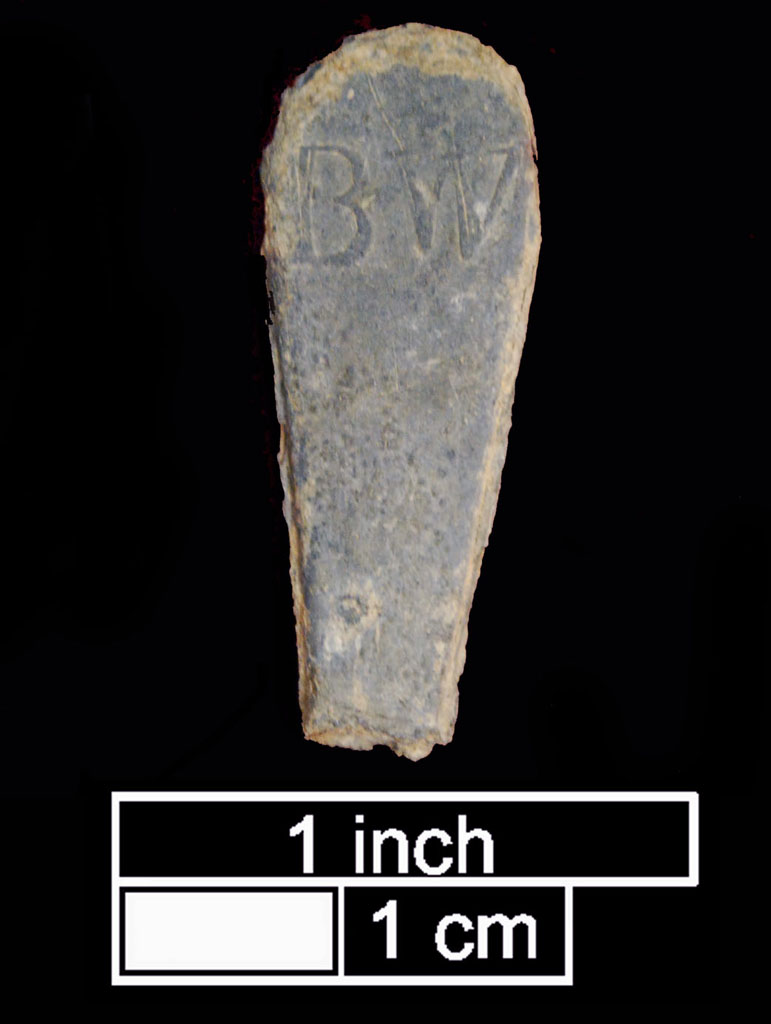
Pewter Teaspoon with Betty Washington’s Initials Betty had some of the coolest artifacts and this one literally has her name on it. It was customary for tea to be dispensed by the wife or by the oldest daughter in the house and Betty, as the only daughter, was clearly groomed in this ceremony as is evidenced by her own teaspoons. Pewter, an alloy containing a number of different metals including lead (yes, more lead), wasn’t as fancy as silver but the fact that it’s customized makes it special. This tea set appears to be part of a “practice” set that Betty used before her uncle gave her a silver tea set around her 16th birthday.
Bartmann or Bellarmine Jug/Bottle Who doesn’t want to drink out of a jug exhibiting the large face of a crazy bearded man? I do, and if you were a colonist in the 1700s and early 1800s, you did as well. Originating in Germany, these face jugs depicted a ‘wild man’ of the woods character popular in Eastern European folklore. By the time these vessels made it to the English market that aspect seems to have been forgotten. Subsequently, the English created their own story behind the bearded man revolving around their dislike for a similarly-bearded and unpopular anti-protestant cardinal by the name of Robert Bellarmine. For more about this artifact, read this blog post.
Repaired Creamware Cherry and Flower Punchbowl This artifact is cool for so many reasons. A beautiful bowl adorned with graceful hand painted flowers and cherries (remember, we love those here), it also exhibits a complicated and tortured use-life while highlighting the importance of punch drinking in the eighteenth century. Written about here, this bowl was owned by Mary Washington, George’s mother. Punch bowls vary in size and this one would have been called a ‘sneaker’, which denotes a bowl small enough for guests to take turns sipping out of it before passing it to the next person. Mary clearly loved the bowl so much that, when it broke sometime between 1765 and 1772, she had it repaired with glue. Although the hide or cheese-based glue used would not have resulted in a vessel capable of holding punch again, she could display it on her mantle or in her china cabinet…Oh, and the glaze? It has lead in it.
Laura Galke, Site Director/Small Finds Analyst
Judy Jobrack, Assistant Lab Supervisor
Mara Kaktins, Ceramics & Glass Specialist
Melanie Marquis, Lab Supervisor
Dave Muraca, Director of Archaeology
Sputniks and mutniks, flying through the air,
Sputniks and mutniks, flying everywhere,
It’s so ironic. Are they atomic?
Those funny missiles have got me scared. -Lyrics from “Sputniks and Mutniks” by Ray Anderson and the Home Folks (1958)
A replica of Sputnik at the National Air and Space Museum in Washington, DC. Credit: NASA/Wikipedia.
“Beep, Beep, Beep…” went the sinister telemetry signals from the Earth’s first artificial satellite. Launched by the Soviet Union on October 4, 1957 — 59 years ago today — those irritating beeps, which can be heard below, provided undeniable evidence of the successful launch. It occurred during the Cold War between the Communist East and the Capitalist West, and represented the dawn of the space age. Embedded within Sputnik were two radio transmitters that, using a single watt of power, broadcast a series of beeps received by radios and televisions all over the world. These beeping sounds frightened some, who mistrusted the technological breakthrough and its potential military applications.
Uncle Sam is “Awake at Last” from his bed of complacency while Sputnik can be seen through the window hurtling across the sky transmitting it’s urgent ‘beep.’ Cartoon by Edwin Marcus. Credit: Library of Congress
Sputnik roused considerable political anxiety on the part the United States, a country determined to perfect satellite technology and to engage in cosmic exploration. They underestimated the progress of the Soviet program. Today, in popular parlance, a “sputnik moment” refers to being spectacularly caught off guard by the unanticipated advancements of a rival. President Obama incorporated “Sputnik moment” in his 2011 State of the Union Address designed to encourage investment in research and technology.
At the height of the crisis in 1957, the Eisenhower administration referred to Sputnik as “…a silly bauble….” The satellite represented a rather modest accomplishment whose engineers prioritized being first in orbit over producing a sophisticated data-gathering tool. Recently, some scholars have suggested that the satellite was a bit of a ‘bluff’ to make the United States believe that the Soviet program was more sophisticated than it was. Like many martial ‘bluffs,’ the impact was far-reaching and it exacerbated and escalated an already frigid Cold War.
About the size of a beach ball, Sputnik orbited less than 600 miles above earth. Each orbit lasted 96 minutes. The National Aeronautics and Space Administration (NASA) was created in 1958 as a response to this (perceived) technological “wake up” call. Nationally, efforts to strengthen primary school science education ensued and encouraged more students to seek technologically-oriented careers in service of a more robust space program.
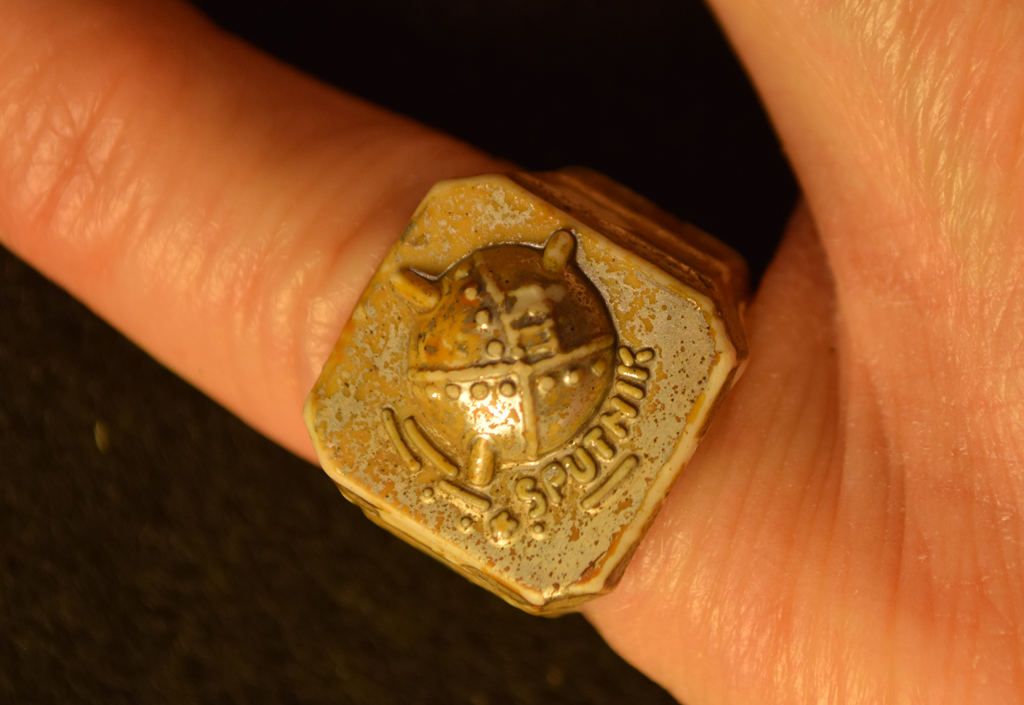
In 2014, Ferry Farm archaeologists unearthed a tangible prize from this moment: a plastic toy “Sputnik” finger ring. Remember that Ferry Farm remained home to a variety of individuals and families in the centuries since the Washingtons lived there. The flashy gold-colored ring, originally dispensed from a gumball machine, featured an idealized image of the satellite and the word “SPUTNIK.” It was no doubt cherished by its original owner, and envied by the prospective young space explorer’s friends.
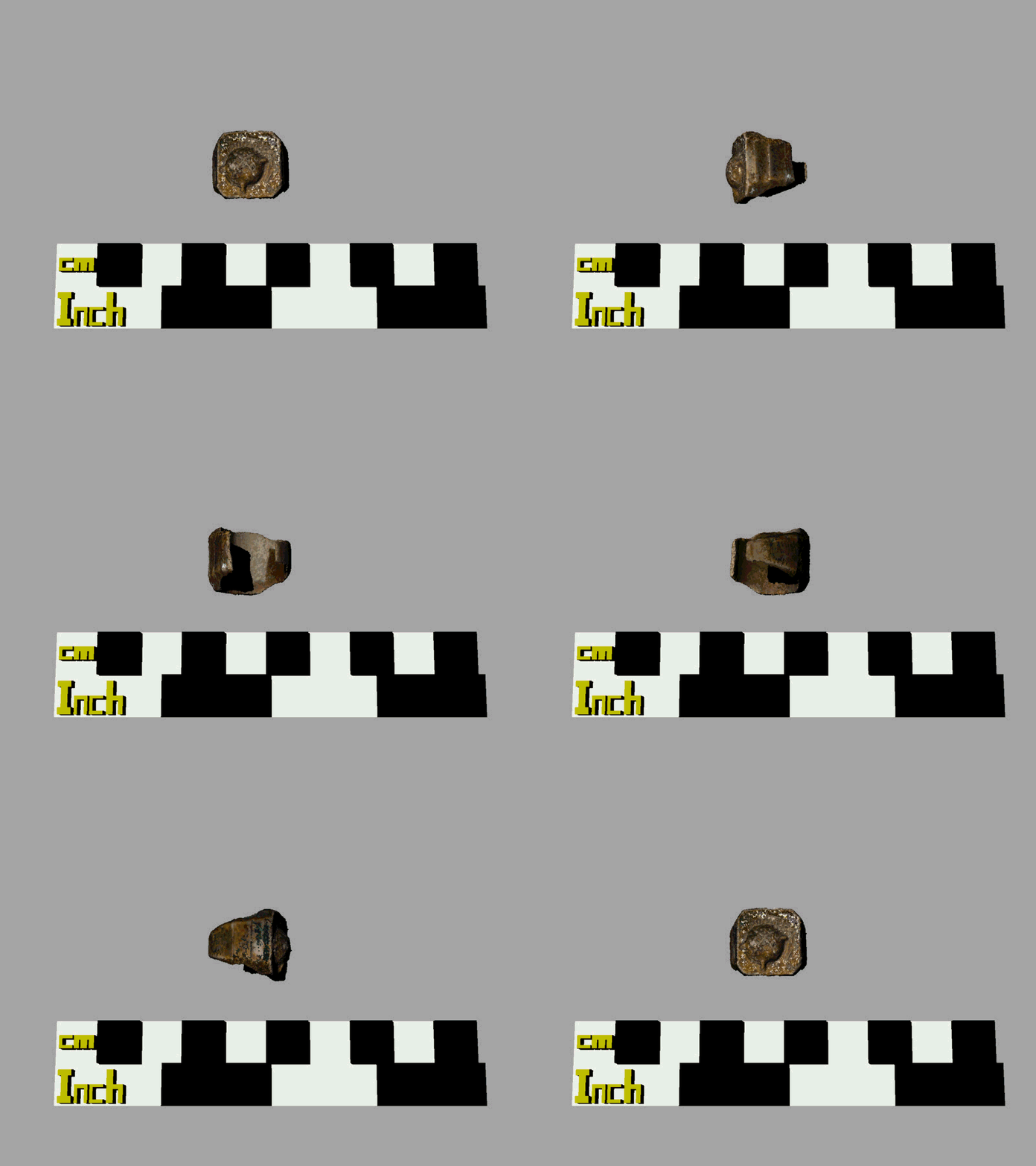
The Sputnik ring recovered archaeologically at George Washington’s Ferry Farm.A 3D image of the Sputnik ring.
As an archaeologist, the find confused me: why would toys commemorating Soviet satellites exist in the United States? Who would buy this celebratory object for their child? For goodness sake this land had once been Washington’s home, first president of the definitely-not communist United States. I foremost saw the object through a politico-military lens, rather than as a space-age wonder for all people.
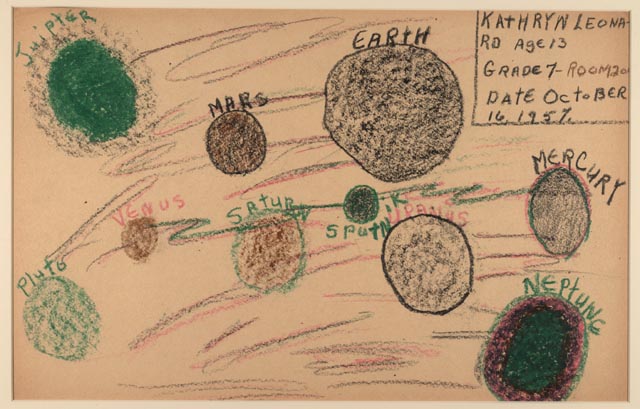
In popular American culture of the late 1950s, the surprise of Sputnik frequently was one of delight rather than apprehension. For some, those cosmic beeps were inspirational, promising future space travel and technological progress. From this new age of cosmic exploration emerged songs, dance, theatre, literature, and graphic art.
A generation of young Americans, enthralled by science fiction adventures of Buck Rogers and Flash Gordon, could not contain their excitement. They were captivated by the real-life manifestation of their outer space fantasies. The launch excited children who dreamed of the day they might defend the earth against hostile invaders from space. Kids who spent their school days engaged in “duck and cover” drills ironically raced out to their back yard for a glimpse of the Soviet technology racing across the night sky.
The satellite orbited the earth for three months, though its radio signals tactfully subsided after three weeks. Sputnik’s orbit eroded 4 January 1958. Its effects were as far reaching as they were long lasting.
The Sputnik launch garnered a diverse array of reactions nationally and internationally: pride, disquiet, excitement, imagination, and infinite inspiration. The rich variety of these responses led to the creation of a wide range of material culture – objects as small and inexpensive as a child’s toy ring and as massive an investment as the Kennedy Space Center. People created – and experienced – music, technology, literature, dance, and theatre that allowed them to understand this event in ways relevant to their own lives. These responses reflect humankind’s desire to comprehend pivotal events that are beyond their control through personal agency. Material culture – artifacts – gives us the capacity to participate in, to understand, and to ‘own,’ grand events that are larger than we are.
This was true in the past as well, as the assorted artifacts analyzed daily at Ferry Farm attest. Prehistoric ground stone tools were an astonishing advancement in their time: this technology allowed our ancestors to maximize the nutritional benefits of nuts, seeds, and grains, to fell trees that made dwellings more comfortable, and to toss spears farther and with greater force. Such scientific wonders no doubt inspired non-ground stone-producing peoples to invest in technological developments of their own.
Have a Sputnik moment! Let’s redefine the phrase to commemorate the boundless scientific and artistic creativity that the launch stimulated, rather than the political anxiety that emerged. Create a technologically- or arts-inspired marvel of your own! Don’t avoid sputnik moments… pursue them. Show your support for World Space Week, which is held annually October 4-10. To learn more about this year’s events: http://www.worldspaceweek.org/
Laura Galke, Archaeologist
Site Director/Small Finds Analyst
Blough, Glenn O.
1957 “Children, Put Away Your Sputniks.” The Science Teacher 24(8):373-374.
Bonner, Thomas N.
1958 “Sputniks and the Educational Crisis in America.” The Journal of Higher Education 29(4):177-184, 232.
Brandau, Daniel
2015 “Demarcations in the Void: Early Satellites and the Making of Outer Space.” Historical Social Rsearch/Historische Sozialforschung 40(1[151]):239-264.
Cowen, Ron
2007 “Sputnik + 50: Remembering the Dawn of the Space Age.” Science News 172(14):216-217, 221.
Kabakchi, V. V. and Charles Clay Doyle
1990 “Of Sputniks, Beatniks, and Nogoodniks.” American Speech 65(3):275-278.
Launius, Roger D.
2009 “Abandoned in Place: Interpreting the U.S. Material Culture of the Moon Race.” The Public Historian 31(3):9-38.
The majority of what crosses my desk everyday as I catalog artifacts are items that would be difficult, if not impossible, to ascribe to any one person who lived on the land we call Ferry Farm. Architectural debris (brick, mortar, plaster, nails), food remains (oyster shell, animal and fish bones, eggshells (!)), broken household objects (glass bottles, wineglasses, dinner plates, storage crocks), and modern garbage (plastic – so much of it!), when found on site, are all interesting artifacts in and of themselves and can answer specific research questions. At the same time, they all attest to the mundane, collective aspects of everyday life on a farm that has been occupied off and on for over 250 years. Every once in a while, however, an artifact is caught in the field sifting screen or the lab wash bucket that puts a smile on your face and causes you to excitedly announce to the rest of the crew, “Look what I found – a gem!” Then, you think “I wonder who it belonged to?”
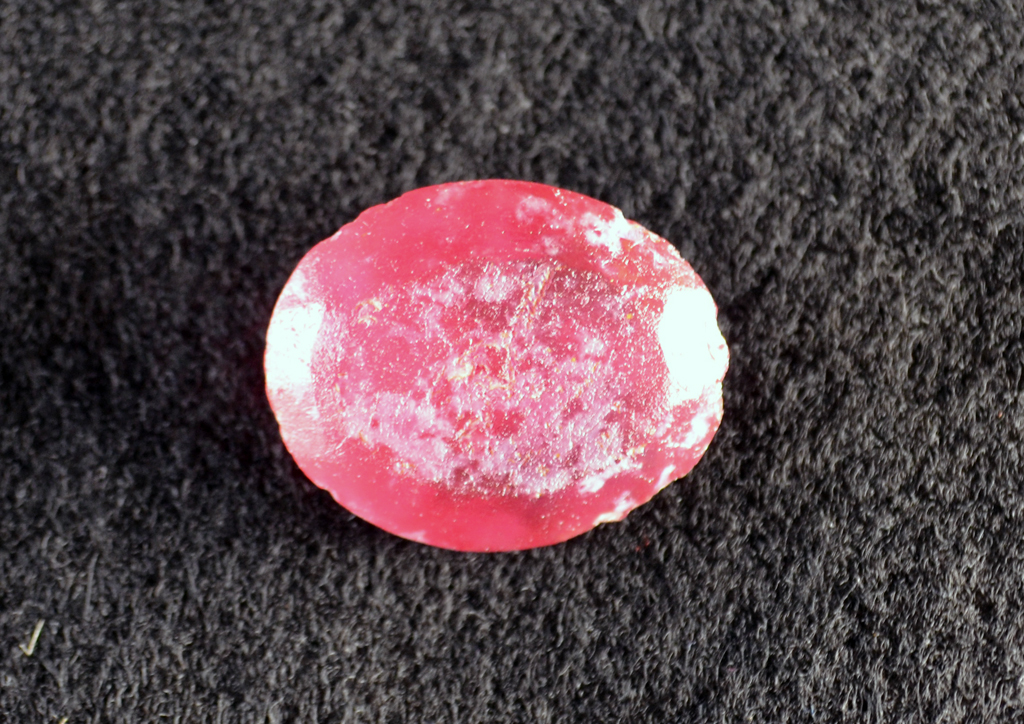
An oval, faceted red paste gem that probably came from a piece of jewelry. (SF 1947)
Gemstones and jewelry are definitely exciting finds on any archaeological site, but at Ferry Farm we are more likely to find bits of jewelry and clothing fasteners decorated with imitation or “paste” gems. Paste gems are molten leaded glass pressed into gem-like molds and then polished to look like the real thing. With the better quality pastes, the facets could even be cut and polished. They were available in any color imaginable by adding metallic oxides during their manufacture. Their color could also be enhanced or changed by attaching colored foils to the undersides of the gem. Paste gems were usually set in closed, versus open-backed, settings to protect the foil backing from tarnishing.
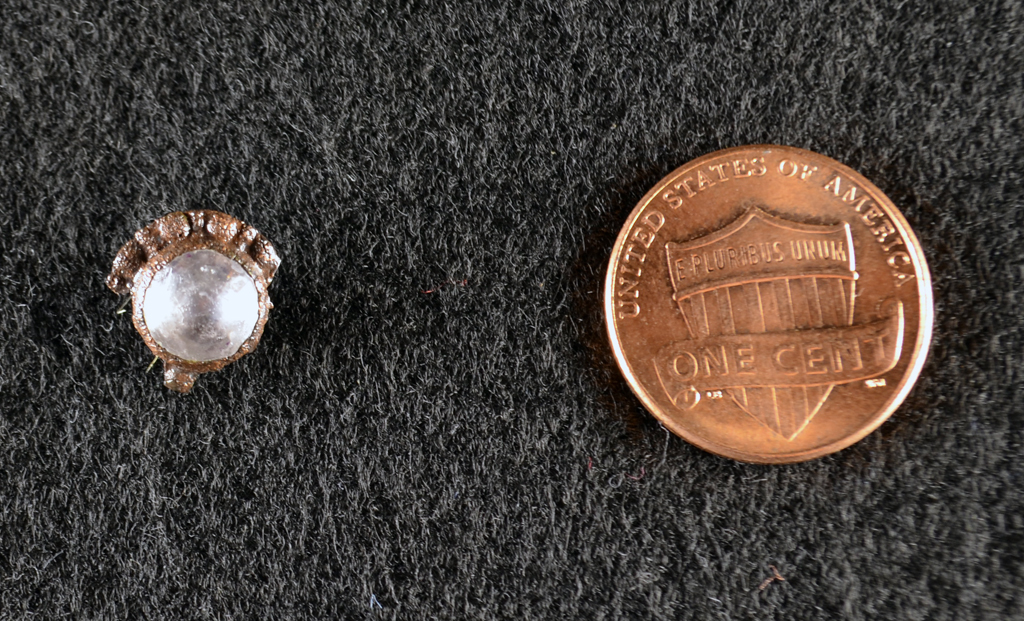
This colorless paste gem is cut in a style similar to the “brilliant cut,” a popular diamond cut during the 18th century, and would have been set in a closed setting for either a piece of jewelry, a button, or a buckle. (SF 1948)
The use of paste gems was popular from the 17th through the early 19th centuries because they were so versatile and economical. Pastes were available in a wide selection of colors that imitated any precious or semi-precious gemstone. Because they were created in molds, they also came in a multitude of sizes and shapes, such as circles, triangles, squares, octagons and hexagons. The jeweler could then cut the gems to fit together in closely-set arrangements not always possible with real stones. Improvements in the quality of the glass during the 18th century heralded gems with added brilliance and allowed greater flexibility in cutting and using the paste stones in detailed settings. Despite being imitations, pastes were highly desired in and of themselves by both the middle class and the wealthy.
Three similar rectangular faceted gems in blue and green. (SFs 212, 215, 230)
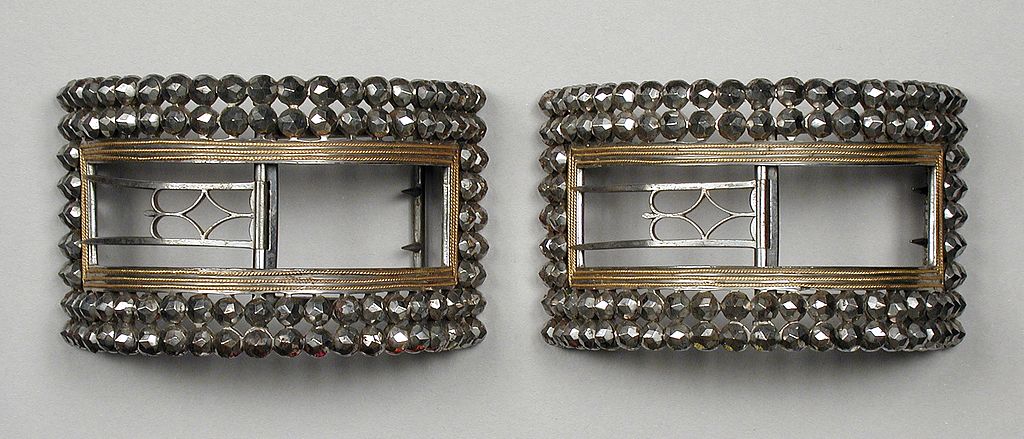
Just like real stones, paste gems were set in all kinds of jewelry and items of personal adornment worn by both men and women. Necklaces, brooches, rings, bracelets, and earrings were all decorated with paste gems. Clothing fasteners, such as buckles, buttons, sleeve buttons, were also set with pastes. Buckles used to fasten a wide variety of clothing articles, such as hats, shoes, girdles, stocks, and gloves, were very fashionable items to be set with paste gems. One advantage of using pastes over real stones is that it was certainly easier to replace a lost buckle set with pastes than one set with real diamonds!
Pair of man’s steel and gilt wire shoe buckles, England, circa 1777-1785. Public domain. Credit: Los Angeles County Museum of Art / Costume Council Fund / Wikipedia
Paste gems found at Ferry Farm have come in a range of colors – green, red, pink, aqua, blue, black, and colorless – as well as shapes. Figure (SF#1947) is an oval, faceted red paste gem that probably came from a piece of jewelry. Figure (SF# 212, 215, 230) shows three similar rectangular faceted gems in blue and green. The colorless paste gem in Figure (SF#1948), cut in a style similar to the “brilliant cut,” a popular diamond cut during the 18th century, would have been set in a closed setting for either a piece of jewelry, a button, or a buckle.
Sleeve button with its colorless glass inset. (SF 234)
Sometimes the paste gem is still found within its setting, such as the sleeve button with its colorless glass inset seen above (SF#234) but, more often than not, finding a paste gem in its original, complete setting is a rare occurrence. Figure (SF#1971) is a fragment of a copper alloy shoe buckle with two empty settings for paste gems.
Fragment of a copper alloy shoe buckle with two empty settings for paste gems. (SF 1971)
Who did these gems and their settings belong to? Distinctive style changes in gem shapes and jewelry settings help establish when certain pieces were in fashion. Knowing changes in clothing fashions through time and recognizing when certain types of clothing fasteners, such as shoe buckles and sleeve buttons, were popular also help us focus our research. We can assume that whoever was sporting these gems was trying to be stylish and fashionable in their time by adding a little “bling” and glitter to their wardrobe. For as long as people have been traditionally adorning themselves with real gemstones in jewelry, there has always been that goal to create comparable imitations to swap out the real thing. These special artifacts found at Ferry Farm are a reflection of these stylistic changes.
Colonial American. Think about that term. What does it mean to you? It refers to citizens of the American colonies prior to the Revolution. In the minds of many of us in the present-day United States, however, it might denote a unique American identity, probably because our own identities as Americans are firmly set and celebrated. But what if I told you that most of these colonial Americans considered themselves to be loyal British subjects for much of the colonial period and proudly displayed objects that confirmed their loyalty?
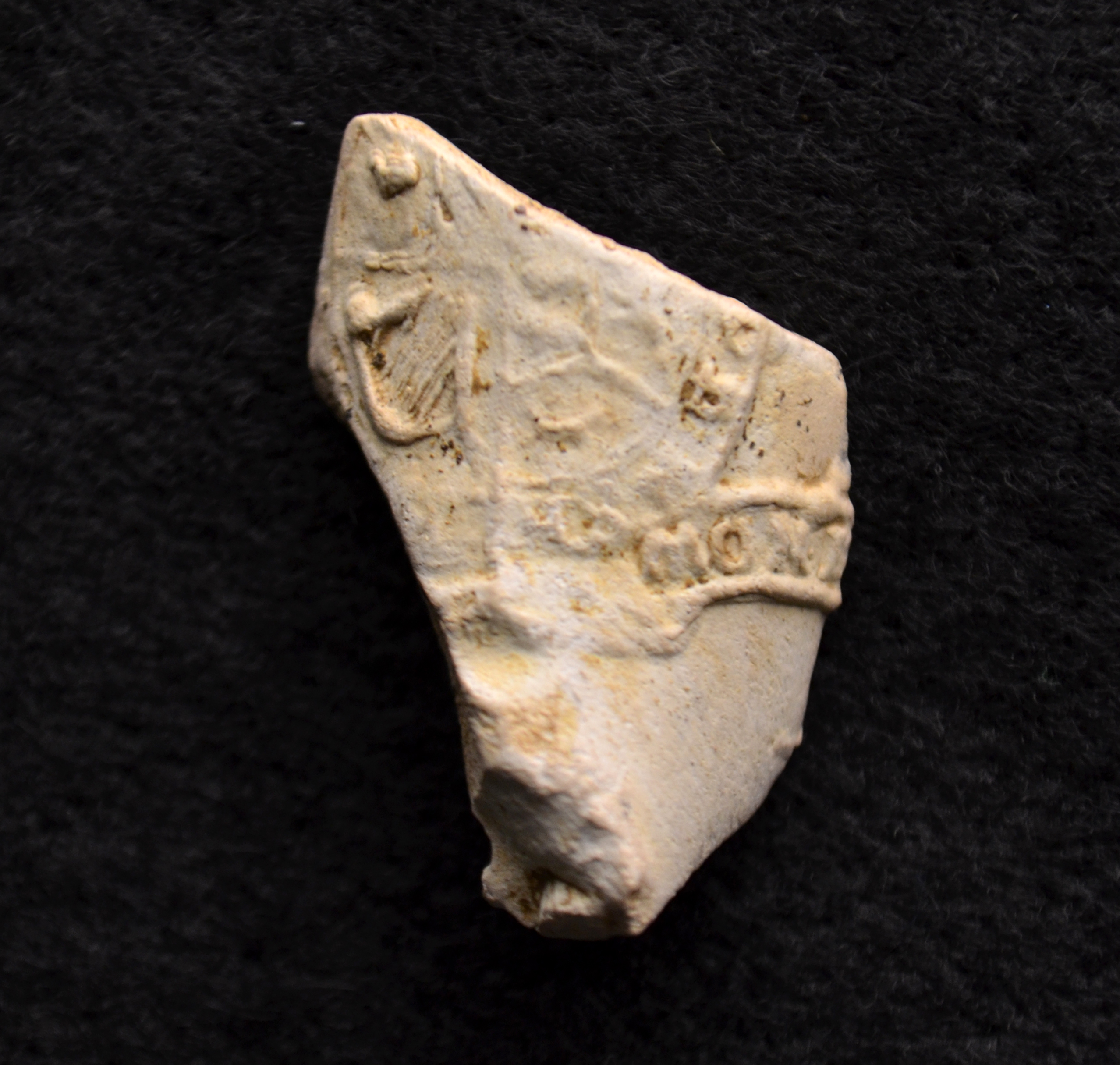
One such object discovered at George Washington’s Ferry Farm is a small fragment from a white clay smoking pipe bowl. The design on this tiny fragment includes a small harp and the letters “Mon D…”.
Pipe bowl fragment excavated by archaeologists at George Washington’s Ferry Farm.
Sometimes in archaeology we have genuine ‘Ah Ha!’ moments and, for me, this was one such instance. I grew up with a suncatcher – a gift from an English family friend — in my bedroom that featured a rearing unicorn above the words ‘Mon Droit.
I loved that suncatcher and, when I saw the pipe fragment, I recognized what the design was right away. It was the British royal coat of arms!
On pipe bowls like the one unearthed at Ferry Farm, the coat of arms wrapped around three quarters of the circular bowl. A lion, shield, and unicorn each filled their own quarter of the bowl above the full French phrase “Dieu Et Mon Droit” or “God and my right,” a claim that the right of the British monarch to govern was divine in nature. This phrase has a long history in England. It was first used as a battle cry by Richard I in the 12th century and picked up as a royal motto by King Henry V, who lived from 1386-1422. The use of the French language for an English motto may seem odd but French was very fashionable and the official language of the English court.
The British royal coat of arms from 1714-1800 during the Hanover dynasty. Credit: Sodacan/Wikipedia
It is doubtful that anyone living at Ferry Farm after the America Revolution wanted to advertise their loyalty to the British crown so we can safely say this pipe was probably used between 1714, when the Hanover dynasty began under George I, and, at the latest, the 1770s. During most of this time period, the Washington family lived at Ferry Farm.The royal coat of arms is full of important symbols. Grasping the center shield is a lion signifying England and a unicorn representing Scotland. On the shield’s lower left is a harp symbolizing Ireland. The harp is clearly identifiable on the pipe fragment excavated at Ferry Farm. The lower right section of the shield includes a columned monument and another lion. These symbols were added during the House of Hanover’s reign. Monarchs regularly changed the coat of arms as each new king or queen sought to make their mark on the official emblem. The monument and small lion were included on the shield to denote the Hanovers’ rule over their territory in what is now Germany. The fragment found at Ferry Farm also contains these elements indicating that it was manufactured between 1714 and 1800.
Pipes featured more than political symbols. This is a 3D image of another smoking pipe bowl excavated at Ferry Farm decorated with a Masonic symbol. The pipe was probably made in the northeast of England between 1770-1810. You can read more about this pipe here.
Why is this pipe fragment a big deal? During the 18th century, smoking a pipe with a political symbol like the one we’ve found was the equivalent of slapping a candidate’s bumper sticker on your car, placing a political party’s sign in your yard, or sharing a favorite political meme on social media. The act was public, deliberate, and did not go without notice. The practice continued well into the 1800s when groups such as the Irish employed smoking pipes to advertise their support for causes such as a free Ireland. It was a way to signal identity to others.
During most of the colonial period in America, aligning yourself with the crown was not at all radical but rather what was expected of most subjects. In fact, this pipe bowl fragment is not the only artifact excavated at Ferry Farm to hint at past occupants’ loyalty to Britain. As noted in a previous blog, we have found several drinking vessels exhibiting the initials ‘G.R.’ for ‘George Rex’ or King George. In another blog, we also discussed an artifact uncovered at Ferry Farm that points toward a growing resistance to the British crown. This mid-18th century sleeve button depicts William III, who, although he died decades before the button was manufactured, came to represent the right of subjects to resist a king who was abusing power.
G.R. medallion on a Westerwald jug fragment
Close-up of a mid-1700s sleeve link recovered at Ferry Farm. It features the image of King William III.
What we may be seeing in these three types of artifacts present at Ferry Farm is a fundamental shift of views within the Washington family as the political climate changed throughout the 1700s. The objects hint at a swing from loyal British subjects to revolutionaries and the beginning of our identity as independent Americans.
Mara Kaktins, Archaeologist
Ceramics & Glass Specialist
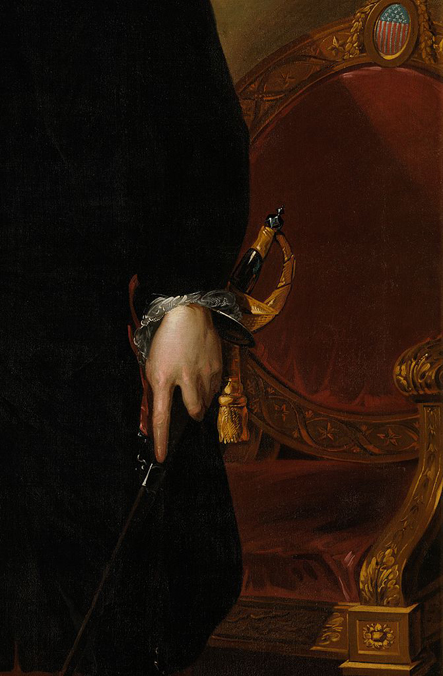
George Washington by Gilbert Stuart (1796). In the portrait, Washington wears his ceremonial sword. Public domain.
Editor’s Note: This is the second of two posts inspired by this year’s Summer Olympics. This week, Archaeologist Mara Kaktins reflects on the connection fencing has created between her family and George Washington. Read our first Olympics-inspired post here.
At our monthly blog meetings, post topics are floated and people grab them up, usually when it aligns with individual research interests. George Washington as an avid fencer seemed an appropriate subject with the Summer Olympics in full swing this month. I am no fencer, nor am I an athlete, so why write about fencing? The spirit to volunteer for this assignment came to me because of the recent passing of my father. He, my uncle, and my grandfather were all fencers. It led me to ponder our first president, my grandfather, and the modern Olympic sport of fencing.
Let’s begin by examining the early history of fencing in the American colonies. Long considered a ‘gentleman’s sport’, fencing was massively popular in Europe. Respect for the knowledge of sword play extended to the colonies, where masters from abroad set up schools to teach young men this ancient art. These instructors did not just show their students how to fence. Sword play was part of a larger artistic curriculum that could also include dancing, horseback riding, popular languages such as French, boxing, gentlemen’s games like cards, and knowledge of various musical instruments. Fencing, or ‘short sword’ as it was sometimes called, was not seen as merely a sport. It was referred to as an ‘art’. With mastery, came not just dexterity, physical fitness, and strength but also good temperament, courtly manners, and a sense of restraint. Teachers often emphasized that a gentleman well-versed in the sword was less likely to ever use one, having gained honor and discipline in addition to knowledge of a deadly weapon. Sort of like the colonial equivalent of “With great power comes great responsibility”.
A closer view of Washington’s ceremonial sword.
As a young man living at Ferry Farm, George Washington attempted to better himself learning all of the gentlemanly arts. It is no surprise he studied fencing. Some evidence suggests that Lawrence Washington, his older half-brother who was a Captain in the Virginia Militia may have helped him in this regard. Schooled in England, Lawrence learned all he needed to know of being a gentleman in the mother country, as was customary for gentry children. George Washington never attended a real school, much less an English one. He was determined, however, and sought his gentlemanly education where he could in Fredericksburg, Virginia.
Fragment of a cooper-alloy hand guard from a sword dating to the late 1600s or early 1700s and unearthed by archaeologists at Ferry Farm.
The closest dedicated fencing instructor was in far-away Williamsburg so George had to make do. The early George Washington biographer, Washington Irving, suggested that Lawrence and his military friends along with an adjutant known only by his last name of Muse probably instructed George in sword play. There was also a rather mysterious Dutch mercenary and translator, Jacob Van Braam (all good stories should have a shadowy Dutchman). Temporarily located in Fredericksburg, Van Braam was in between wars and supplemented his income by teaching young George how to handle a blade. They later campaigned together and fought at Fort Necessity in 1754 where a mistranslation by Van Braam may actually have contributed to the conflict that is credited with helping start the Seven Year War. Presumably the Dutchman was more skilled with weapons than in French and George Washington went on to become a famous general, often depicted carrying a sword, a symbol of his status and military skill. Van Braam later fought in the Revolutionary War but for the British before retiring to France.
Fencing foil belonging to the late Uldis Kaktins, my father.
Fast forward two centuries to a young man in Latvia named Zigurds, my grandfather. Fencing remained a popular sport in Europe and a skill that educated men certainly looked to acquire. Zigurds was tall, young, and handsome, had a law degree, and his father was a world famous opera singer. Zigurds seemed to have a lot going for him and likely learned to fence for many of the reasons George did: physical prowess and a respected mental fortitude. With the onset of the Second World War, Zigurds learned that the Soviets were going to deport him, his wife, and two young children to Siberia so he took his family and fled to the United States. In America, his and his wife’s law degrees were worthless. They moved into a rough but affordable neighborhood in Boston and worked blue collar jobs. My grandfather’s life was completely different from what he had known in Latvia except for fencing. He instructed fencing at the YMCA and headed a Latvian fencing club. Normally a fairly stern figure, Zigurds once dressed as a ‘swashbuckler’ to be filmed fencing for a short film or commercial.
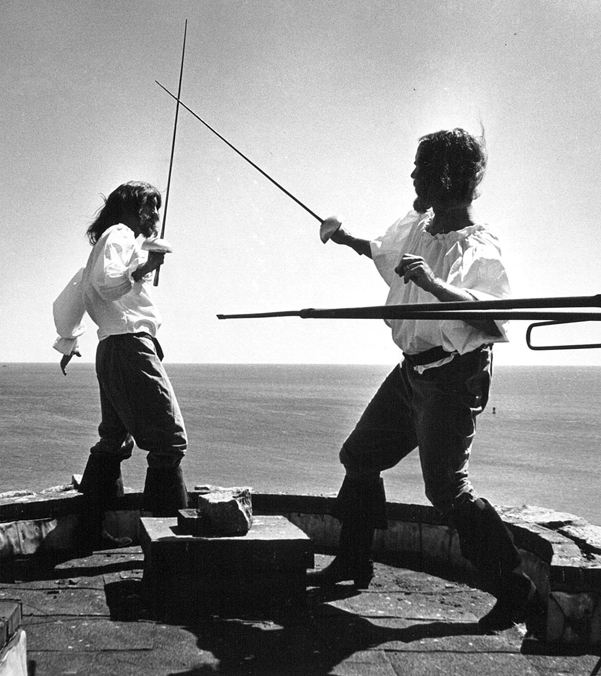
Zigurds Kaktins, my grandfather, (right) fencing in swashbuckler’s costume in the 1960s.
Zigurds passed on fencing to my father and uncle. My recently deceased father always had a grace about him. He carried himself easily and with confidence but was quick and nimble when needed. Perhaps not coincidentally, he was also an excellent dancer. I think that his early instruction in fencing contributed to this grace. A man of grace and confidence, an excellent dancer, and a fencer. These words prove an apt description of my father, my grandfather, and the Father of my Country.
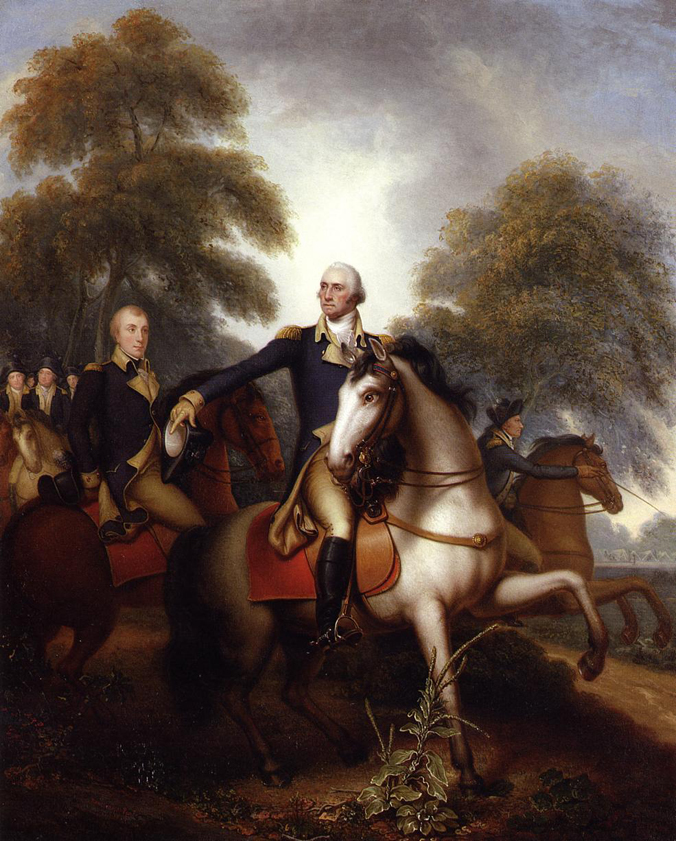
“Washington Before Yorktown” by Rembrandt Peale (1823) Public domain. Courtesy: The Athenaeum/Wikipedia
Editor’s Note: This is the first of two posts inspired by this year’s Summer Olympics. This week, it’s an equestrian-inspired post from Archaeologist Laura Galke, who briefly looks at some of the ornaments found on 18th century horse tack.
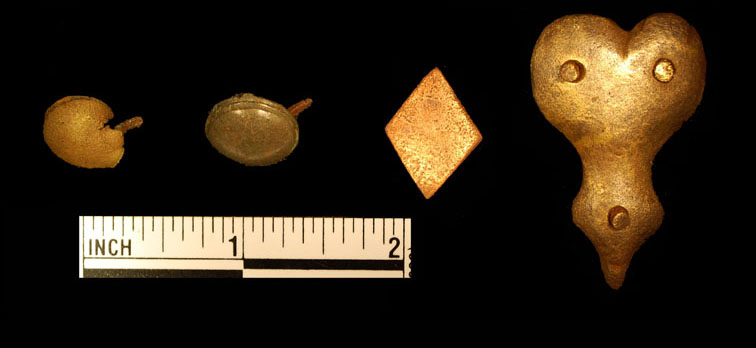
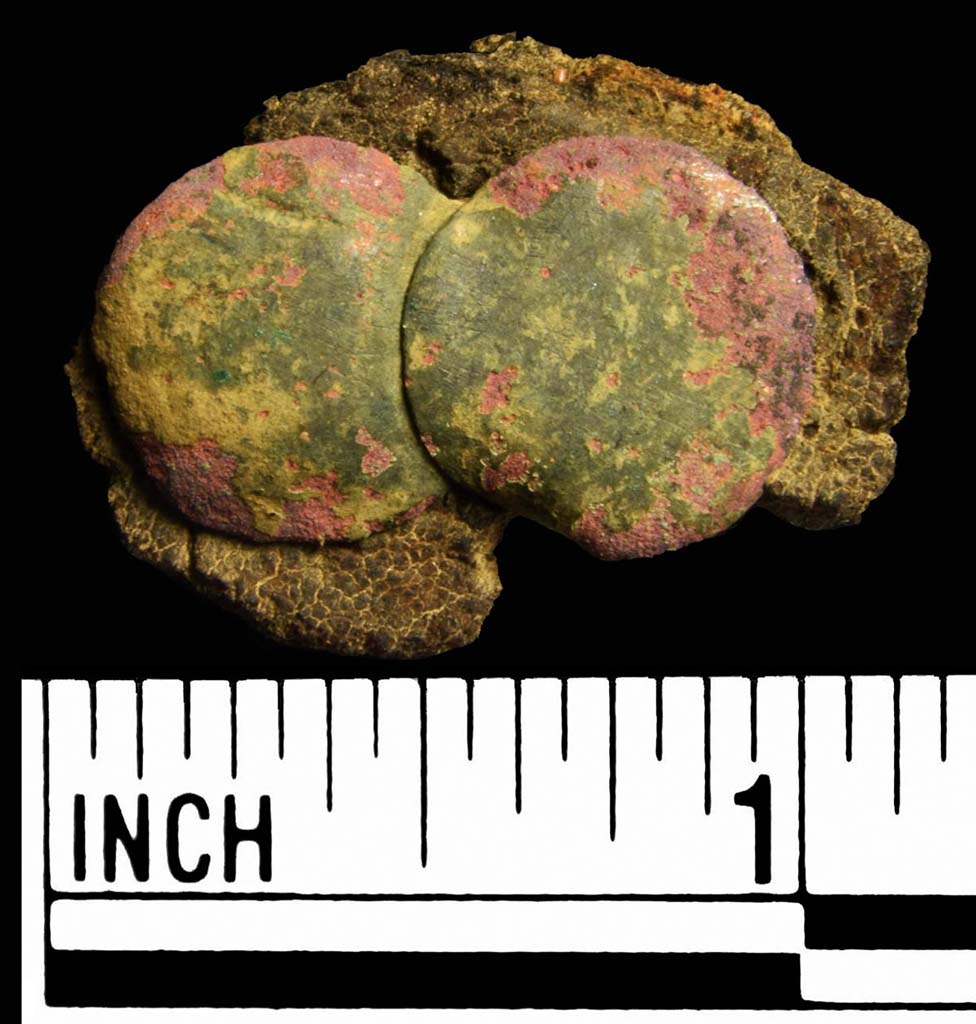
What an impressive sight the Washingtons made as they rode their horses with bridles and straps embellished with these shiny brass decorations. Today, people who study these decorations refer to them as “mounts” or “leather ornaments.” They were used to ornament the leather straps, nosebands, harnesses, and reins of horses. Individual riders enjoyed these, but they also could adorn steeds that pulled carriages. About twenty of these ornaments have been found during recent excavations at Ferry Farm.
Ferry Farm leather ornaments dating from the 1700s. The Harwoods, Strothers or the Washingtons may have purchased these.
Colonial Virginians, including George Washington, took pride in owning horses. Adorning their stallions with such flashy decorations attracted attention to their owners as they journeyed through the streets, on the ferries, and along the trails of Colonial Virginia and beyond. It was also a great way to draw attention to a favorite steed or an elegant carriage in a public setting. Unlike household adornments – which were esteemed by an intimate circle of family, friends, and enslaved attendants – investments in these leather ornaments were appreciated by a wider audience as rider and horse proudly paraded about the colony and region.
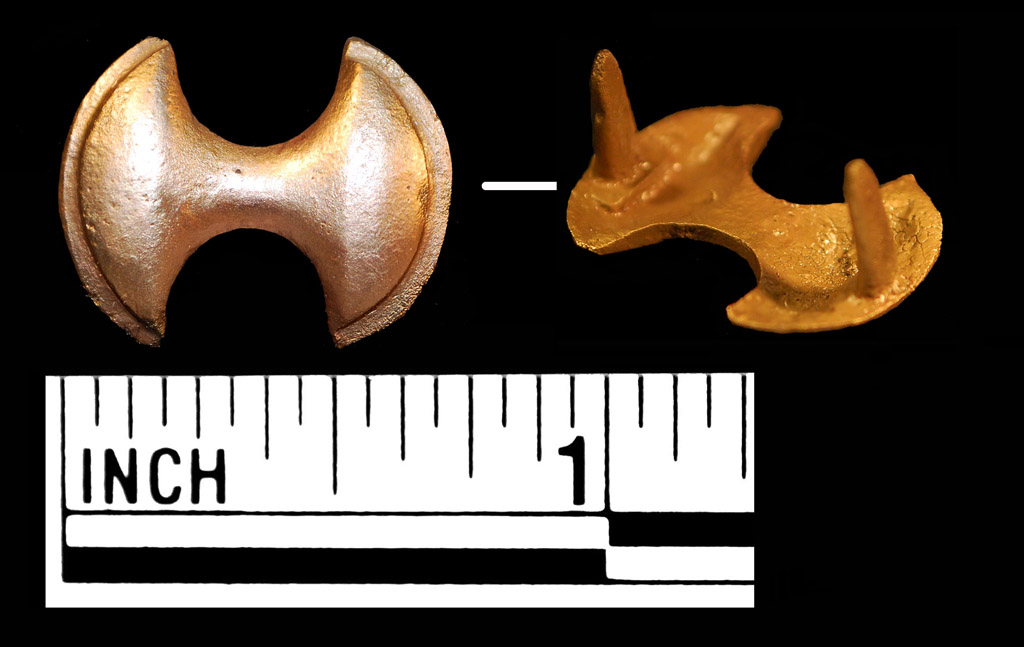
This copper-alloy mount dates from the mid-to-late 1700s.
In Colonial households, men typically purchased these showy trimmings. Indeed, they bought most things associated with the stable: horses or transportation. Horse milliners were the source for such tack. However, purchases related to the health of livestock, such as medicine, was the responsibility of women.
Copper naturally repels the bacteria that break down organic materials such as leather. These mid-to-late 1700s Washington family ornaments have actually preserved a small portion of the original leather straps they adorned.
Laura Galke, Archaeologist
Site Director/Small Finds Analyst
Further Reading
Cofield, Sara Rivers
2008 A Preliminary Study of 17th– and 18th-Century Leather Ornaments from Maryland. Maryland Archaeology 44(2):12-27. Available online http://www.jefpat.org/research.html
Griffiths, Nick
2004 Harness Pendants and Associated Fittings. In The Medieval Horse and its Equipment, c. 1150 – c. 1450, edited by John Clark, pp. 61-71. The Boydell Press, Woodbridge.
McBane, Susan
1992 TheIllustrated Guide to Horse Tack. David and Charles. Milanostampa, Brunel House Newton Abbot Devon.
Noel Hume, Ivor
1991 A Guide to Artifacts of Colonial America. Vintage Books, New York.
Vickery, Amanda
2009 Behind Closed Doors: At Home in Georgian England. Yale University Press, New Haven.