Archaeologists spend much more of their time working to determine the significance of an object than actually finding the object through excavation. This analytical work is done in an archaeology lab. First, artifacts must be washed, which you can see here. Then, the artifacts are cataloged as the video below shows.
Fruit! It’s good for you, delicious, and often beautiful – but have you ever thought of fruit as a status symbol? In today’s world of relatively quick, inexpensive long-distance transportation, we enjoy fresh fruit from all over the world year-round. We generally take this ability for granted. In the eighteenth century, however, if you or your neighbors didn’t grow a particular fruit at home, then it had to be shipped to you at great cost. In this age before refrigerated shipping, fruit’s extremely short shelf life was magnified. As a result, a simple pineapple or lime represented a household’s wealth and the display of expensive fruits was a way to impress dinner guests. If you’ve got it, flaunt it, right?
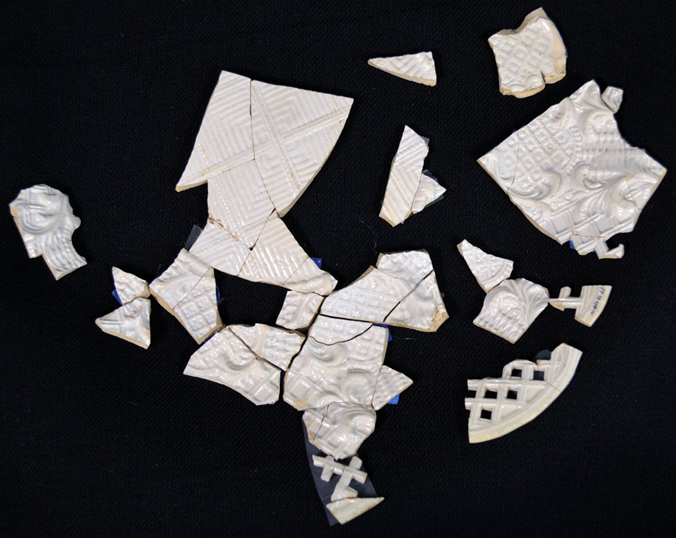
Fruit proved such a rare luxury in the 1700s that people purchased special dishes in which to serve the fruit. These dishes also emphasized the social status of the owner because they signaled to people that this person could afford fresh fruit even if none might be available at the moment. Like the fruit, the dishes themselves came to the owner’s table from all the way across an ocean, further emphasizing their wealth. Archaeologically, we’ve recovered one such special fruit dish from George Washington’s Ferry Farm. Made of white salt-glazed stoneware around 1755, this favorite ceramic of Mary Washington, George’s mother, is heavily decorated. The entire surface of the object has some visually interesting thing to catch the eye. With a geometric design in the center surrounded by a variation of the basket-dot-diaper motif common to the time period and an intricately pierced rim flanked by scroll-work, this dish would certainly have been highly valued in the Washington household.
The fruit dish sherds excavated at Ferry Farm.
In the eighteenth century, one of the most important ways a person could display their standing and refinement was by hosting elaborate dinners. This meant having extravagant and highly decorated centerpieces, preferably of silver. However, if you couldn’t afford silver, then a ceramic equivalent was the next best thing. Ceramic fruit dishes, like our white salt-glazed one, even borrowed some forms and stylistic elements common on silver dishes of the time.
What makes our particular fruit dish found at Ferry Farm even more special is that sherds from an almost identical one were excavated at Mount Vernon.[1] In 1757, not long after George Washington moved to Mount Vernon, he sent to England for a large amount of ceramics, including 100 “white stone” dishes.[2] There were numerous other vessels ordered in white salt-glaze as well, including patty pans, mustard pots, butter dishes, mugs, teapots, slop basins, and more. Having special tablewares just for specific types of foods and condiments impressed your dinner guests with both your financial wealth and your knowledge of the “proper” way to serve things. Having the appropriate tableware was so important that when Washington didn’t receive certain items ordered from England, he complained to his supplier, Thomas Knox, writing that “The Crate of Stone ware don’t [sic] contain a third of the Pieces I am charg’d with, and only two things broke, and everything very high Charg’d.”Though showing disappointment about the broken pieces, Washington’s concern that he did not receive all he ordered hints at how fashionable the stoneware was considered. Also, given the large number of items ordered, it is impressive only two pieces broke. White salt-glazed stoneware was sturdy enough for the Washington family to use every day.
If finding similar ceramic dishes at Ferry Farm and Mount Vernon were not enough, we have also excavated very similar sherds at Historic Kenmore, the home of George’s sister Betty. Apparently, the taste for lovely and heavily molded white salt-glazed dishes must have run in the family! The icing on the cake is that we also have a complete example of a fruit dish in Kenmore’s collection of ceramics that matches the sherds recovered in digs at both Kenmore and Ferry Farm. What are the odds?
The complete fruit dish in Kenmore’s ceramics collection.
The archaeologists at Ferry Farm are working diligently to mend together as much of Mary Washington’s fruit dish fragments as possible. We’re a third of the way there. We hope to display these excavated pieces next to the complete dish so visitors can enjoy these lovely examples of eighteenth century artwork as much as we do.
The Washingtons – Mary, George, and Betty – all went to great lengths to demonstrate their status and refinement to friends and neighbors. They did so, in part, by serving exotic fresh fruit shipped to the colonies from around the Atlantic World. To serve that fruit, they used fine and fashionable ceramic fruit dishes that were also shipped great distances. Think about that the next time you enjoy a fruit cup!
[1] Email between Eleanor Breen, Director of Archaeology at George Washington’s Mount Vernon and Melanie Marquis, Archaeology Lab Supervisor at The George Washington Foundation, November 12, 2010.
[2] Janine E. Skerry and Suzanne Findlen Hood, Salt-Glazed Stoneware in Early America, University Press of New England, 2009.
Archaeologists spend much more of their time working to determine the significance of an object than actually finding the object through excavation. This analytical work is done in an archaeology lab. Before analysis can begin, the newly uncovered artifacts have to be thoroughly washed. This video shows how.
Archaeologists sometimes recreate technology from the past to understand how people lived. This is called experimental archaeology. Native American occupation of Ferry Farm left behind many artifacts including fire-cracked rocks. This video shows how those rock artifacts were made through a cooking technique known as stoneboiling.
See the first video in our Science of History series here.
Chances are you haven’t spent much time thinking about chicken digestive tracts. This is normal. Here at George Washington’s Ferry Farm, however, the topic actually comes up from time to time. More than once we archaeologists have found ceramic artifacts that have been rounded in an odd fashion, as if tumbled in a river for many years. What accounts for this phenomenon? The answer lies – or roosts, rather – in the coop.
Have you ever given thought to how birds eat? How they chew food and digest whole seeds without any teeth? A bird chews its food, but not with its mouth. Most birds use gizzards that essentially act as second stomachs. Almost pure muscle with a strong lining, the gizzard mashes up food to make its nutrients absorbable by the intestines. A bird ingests rocks and grit to help the gizzard grind tough foods like seeds and plant material. These rocks are not passed through the bird but remain inside its gizzard until they are completely ground up or the bird dies. Subsequently, these rocks sometimes take on a rounded, polished look because the gizzard is essentially a tiny rock tumbler.
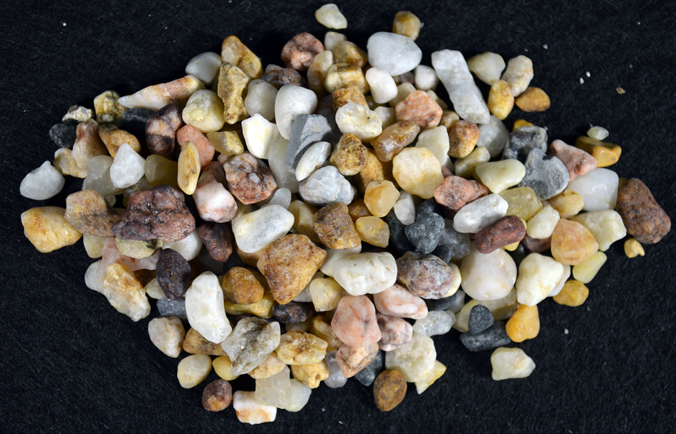
Stones recovered from the gizzard of a modern turkey.
How does all this relate to archaeology? Simply put, a bird cannot differentiate between a rock and an artifact. The free-range chickens, turkeys, and geese that live with humans gobble up anything that is about the right size for their gizzard, whether rocks, glass, ceramics, or even plastic and metal (The plastic and metal is probably not all that good for them). When a bird is butchered, the gizzard stones – known as ‘gastroliths’ to archaeologists – are released, buried, and excavated to confuse some poor archaeologist hundreds of years later. This is exactly what happened at Ferry Farm. At least one Ferry Farm bird had expensive taste and swallowed porcelain. Some ceramic gastroliths excavated by our archaeologists were in a gizzard so long that the glaze wore off entirely and was ingested. Eighteenth century ceramic glazes contained lead, and this ultimately would have been passed on to the humans who ate the unlucky fowl.
Ceramic pieces worn smooth inside a turkey or goose gullet and recovered archaeologically at Ferry Farm.
In addition to being an archaeologist, I also keep birds on a small farm. After butchering a few chickens and a turkey, I notice that the size of the gizzard stones reflected the size of the bird. A turkey is capable of ingesting much larger objects as gastroliths than chickens. This was such an exciting revelation that I saved some stones recovered from the turkey gizzard and analyzed them. Archaeologists are an odd bunch! The stones were partially rounded and, in addition to rock, the turkey had eaten chucks of concrete and even a bone.
Two pieces of concrete and one piece of bone from inside a modern turkey gizzard.
Given the size of the ceramic gizzard stones excavated at Ferry Farm, we can deduce that the birds which ate them were probably large domestics such as turkeys or geese. So we not only learned why the chicken ate the artifact but that it probably wasn’t even a chicken at all. This helps to us to understand what kinds of livestock the Washington family kept at Ferry Farm. Who knew you could learn so much from a beat up piece of pottery in a gizzard?
Mara Kaktins, Archaeologist
Ceramics & Glass Specialist
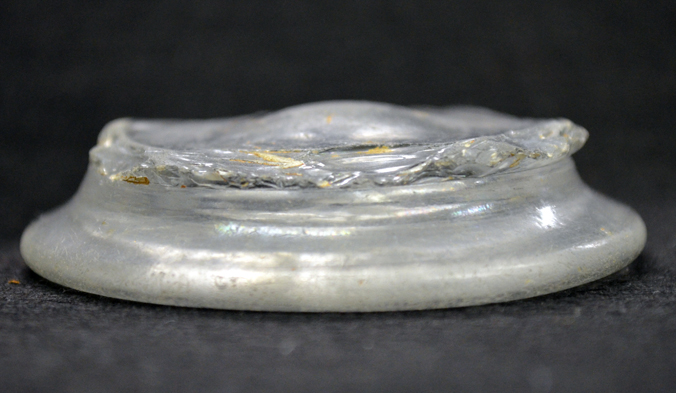
Archaeologists are occasionally confronted with ‘mystery artifacts’ that either cannot be identified or have been altered to serve a purpose other than what was originally intended. Recently, in our small finds collection, we identified an artifact transformed in just such a way. Someone intentionally chipped away the edges of this 18th century leaded glass base for a cup or mug to form a disc. In addition, they also smoothed out the broken edges so they are no longer sharp.
For the moment, the object’s purpose is and, may always remain, a mystery. Use-wear on the base’s interior may hint at how it was used after alteration. Numerous scratches in the glass are present on the ‘kick up’- a small bump on the inside of the glass formed when it was hand blown.
This is not wear that typically accumulates during the life of a drinking vessel so we know the wear occurred after modification. Oddly enough, while pondering possible uses, a staff member here at Ferry Farm turned it upside down and spun the disc on the table. It whirled around perfectly like a top right where the glass exhibited the extreme wear! Take a look at this video for more detail in how the glass has been broken and smoothed and see how the modified base spins like a top.
While this is only speculation, it is possible that we are looking at an improvised toy. Perhaps a child living at Ferry Farm converted this broken glass into a toy top and played with it for many happy hours before it was lost or discarded and found its way into the archaeological record. We can only assume the child would laugh if they knew that archaeologists would be brooding over their whimsical plaything hundreds of years later.
Mara Kaktins, Archaeologist
Ceramics & Glass Specialist
Each summer. students from the University of South Florida attend a field school at George Washington’s Ferry Farm to learn practical aspects of archaeological excavations. This is what they said about their experience.
On weekdays, see Ferry Farm’s archaeologists at work on the excavation site from now through mid-June.
Each summer, archaeologists from across the United States come to George Washington’s Ferry Farm for about two months of excavations on and around the site of Washington’s boyhood home. These are their stories.
On weekdays, see Ferry Farm’s archaeologists at work on the excavation site from now through mid-June.
Archaeologists sometimes recreate technology from the past to understand how people lived. This is called experimental archaeology. When archaeologists at George Washington’s Ferry Farm found glue residue on sherds of Mary Washington’s china, they developed ways to recreate this glue. This video explains the glue making process and what recreating the glues revealed about Mary.