Lives and Legacies

Category: Daily Life in the 1700s

  • Fredericksburg’s June Fair

    Ask someone to list traditional summertime activities and they will probably mention picnics, family reunions, beach vacations, mountain getaways, and baseball games. Their list is likely to include going to the fair as well.  The fair as a summer pastime is a long tradition and like many American traditions can be traced back to the age of Washington.

    In 1738, Augustine Washington moved his wife Mary and their five children, including six-year-old George, to Ferry Farm on the Rappahannock River opposite Fredericksburg, Virginia.  Coincidentally, in the same year, the colony’s General Assembly authorized two fairs to be held each year in Fredericksburg (pg. 35). This act built on an earlier ordinance passed in 1705 allowing for ‘markets and fairs’ as a necessary and civilizing element of early Virginian society.

    Although other cities held fairs, Fredericksburg was one of the few that held a fair in June.  Sometimes called June Fair, it was one of the oldest and largest in the colony.  June Fair and other fairs were “first and foremost a market ‘for the sale and vending of all manner of cattle, victuals, provisions, goods, wares, and merchandizes.’ Prizes, ‘or bounties,’ were sometimes offered for the best stock and poultry” (pg. 18).

    Pieter Angillis, 1685–1734, Flemish, active in Britain (from ca. 1715), Covent Garden, ca. 1726, Oil on copper. Pubic domain. Credit: Yale Center for British Art, Paul Mellon Collection
    Although this painting depicts a busy London agricultural market in the early 1700s, a similar hustle and bustle likely filled Fredericksburg during June Fair.  Covent Garden (1726) by Pieter Angillis, 1685–1734, Flemish, active in Britain (from ca. 1715), Oil on copper. Pubic domain. Credit: Yale Center for British Art, Paul Mellon Collection.

    Fairs were about more than agriculture, however. The importance of a summer fair was its ability to gather people from all over the surrounding counties to a single central location to conduct business and government and to offer social interactions and entertainments.  In an agricultural colony such as Virginia, homes and plantations were very distant from one another and, for much of the year, people hardly saw anyone besides their immediate neighbors and family members.  Most colonial Virginians traveled no more than fifty miles from home in their lifetimes. This made for an isolated existence focused on the constant attendance of crops. During natural seasonal breaks, however, farmers traveled to a town to sell those crops at the fair.

    Fairs were not just for farmers to sell. Court sessions, also known as ‘Public Times’, often coincided with fairs. Soon merchants and entertainers saw opportunity in the large numbers of people gathered together at the fair. Many people got paid or, more likely, an increase in credit and ready money made the fair a natural time to celebrate, entertain, gamble, and socialize.

    Among the amusements common to colonial-era fairs,

    “contests for prizes . . . in cudgeling, wrestling, manual-exercises, foot-racing, dancing, singing, violin-playing, greased-pig-chasing, etc. Prizes were offered to the most beautiful maid.  In towns large enough to warrant their attention, companies of actors sometimes arranged to give plays during fairs. Such plays, however, were held at the local play-house or theatre, and not on the market-square, where the fair usually took place” (pg. 19).

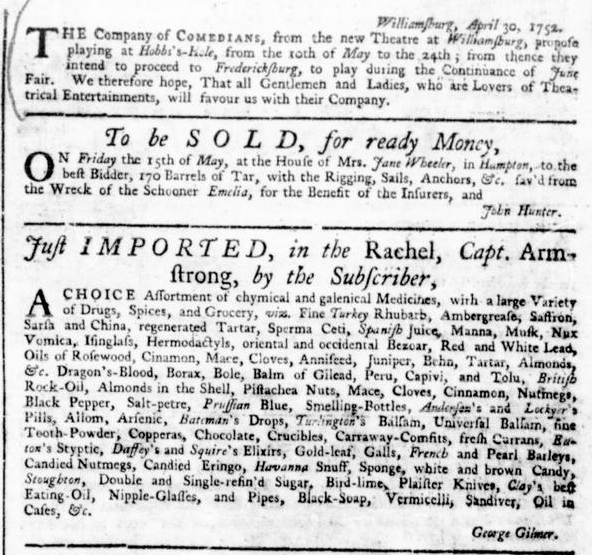
    For example, in 1752, an acting troupe known as “THE Company of COMEDIANS, from the new Theatre at Williamsburg, propose[d] … to proceed to Fredericksburg, to play during the Continuance of June Fair.” The troupe hoped “That all Gentlemen and Ladies, who are Lovers of Theatrical Entertainments, will favour us with their Company.”
    Company of Comedians - Va Gazette
    Advertisement in The Virginia Gazette announcing the appearance of the Company of Comedians at June Fair in 1752.

    The fair brought people together to conduct more than agricultural business.  Indeed, “the fair was also a place where men met to make and pay debts. Land, houses, storehouses, and personal property were offered for sale at fairs — privately and by public auction” (pg. 18).

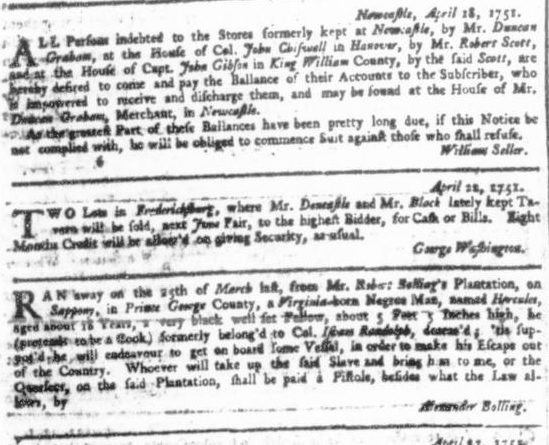
    During June Fair in 1751, 19-year-old George Washington auctioned off two of his lots in Fredericksburg.  His announcement of the sale in The Virginia Gazette offered the lots, “where Mr. Doncastle and Mr. Black lately kept Tavern, next June Fair, to the highest Bidder, for Cash or Bills. Eight Months Credit will be allow’d on giving Security, as usual” and was signed “George Washington.”
    Washington Virginia Gazette Ad
    Announcement placed in The Virginia Gazette by George Washington announcing his intention to auction off two lots of his land in Fredericksburg at June Fair in 1751.

    A decade later at June Fair in 1760, George’s account ledger shows him paying Fielding Lewis £40.  Furthermore, just few days before paying his debt to brother-in-law Fielding, George also bought tickets to a ball and lost money on a horse race, both popular fair activities.

    Indeed, “the most popular attractions of the fairs in Virginia and Maryland were the horse-races . . . held at race-tracks near the town. Purses were subscribed, and many gentlemen, who had no interest in the other activities, would attend the races” (pg. 19).

    Gambling at the fair, mainly in the form of lotteries, even supported more noble pursuits.  At June Fair in 1769, a lottery was undertaken to raise £450 for building a new church and for purchasing an organ for that church.  The drawing was to take place on “the 7th day of JUNE next (being the first day of the Fredericksburg fair) at the town-house” and was supervised and supported by a host of the town’s luminaries including Charles Dick, Hugh Mercer, Charles Washington (George’s brother), George Weedon, and Fielding Lewis.

    June Fair was a community event attended by Virginians from across the colony and brought George Washington back to his boyhood home on more than one occasion.  At the fair, Virginians sold farm goods and land, settled debts and tried court cases, enjoyed a play and gambled on the horses.  June Fair, much like today’s summer pastimes, was a moment in the year to enjoy the summer weather and the company of neighbors, friends, and family before returning to isolated plantations and farms and the unending work of plowing, planting, and harvest.

    Zac Cunningham
    Manager of Educational Programs

    Joe Ziarko
    Manager of Interpretation & Visitor Services
  • Some Tax Myths… Busted!

    Benjamin Franklin once wrote that “Nothing is certain except death and taxes.” And with the deadline to pay the federal income tax only days away it would be difficult to disagree with the founding father. However in the 200 years since the American Revolution, a few popular misconceptions attach themselves to that universal truth. This blog post will debunk two such highly-repeated but highly-inaccurate tax myths.

    The Closet Tax

    The misconception that early Americans were taxed for the number of closets in their homes has been repeated so many times that almost everyone has heard it somewhere at some time. The pervasiveness of a story, however, does not make it true.  No records show any of the 13 colonies or early states had a closet tax.

    How did this myth originate?  There are two likely culprits.  First, most historic homes seem to lack closets but that is simply a modern impression.  In the 18th century, closets were not used to store clothes. That practice became popular after the Civil War. Instead, clothes were kept in a trunk or a clothes press and this leaves bedrooms woefully lacking in closet space to modern eyes. Despite our notions, 18th century homes, like wizards who arrive exactly when they mean to, had just as many closets as early American homeowners wanted.

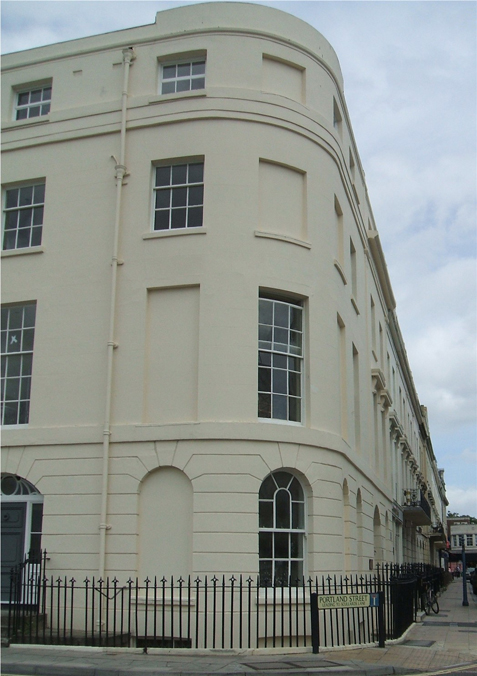
    The other culprit in creating the closet tax myth may be England’s window tax. From 1696 until 1851, England taxed the number of windows in homes as a way to tax individuals proportionately to their wealth because it was thought that more windows meant a larger home and more wealth.  A similar logic – more closets meant more wealth – is said to explain the mythical closet tax. The window tax ultimately affected architecture in England and resulted in homes with fewer windows.  The same thing is claimed to have resulted from the faux closet tax.  Both Virginia (in 1781) and Pennsylvania (1798) tried a window tax, unsuccessfully, but there was never a closet tax.

    Bricked Up Windows
    As a result of the window tax, many homeowners in England bricked up their windows to reduce their tax burden. This house was constructed in 1830 on Portland Street in Southampton. Credit: Gary Blunt / Wikimedia Commons
    This cartoon from an 1850 edition of the British satircal magazine Punch advocated for the repeal of the window tax. Indeed, repeal finally took place in July 1851. Credit: Wellcome Library, London.
    This cartoon from an 1850 edition of the British satircal magazine Punch advocated for the repeal of the window tax. Indeed, repeal finally took place in July 1851. Credit: Wellcome Library, London.

    The Boston Tea Party

    It is sometimes claimed the Boston Tea Party was a protest against tea’s rising cost.  Actually, the Tea Act made tea cheaper for colonists.  In 1770, Lord North, the new Prime Minister, repealed all of the Townshend Duties, except for the one on tea. He also passed the Tea Act of 1773 which allowed the East India Company to sell tea directly to the colonies, dropping the price of tea well below that of smuggled Dutch tea even with the small tax included. To Parliament, repealing all the duties except the small one on tea seemed perfect. The action did away with measures the colonists disliked, enacted an alternative that was much cheaper, encouraged English/colonial shipping, and used something colonists already bought.

    In spite of all of this, it was not a welcome measure with some colonists like the Sons of Liberty, a radical group of Boston merchants. Colonists were not forced to spend their money on tea and its tax. They could even refuse ships that held the tea from entering their ports. Most other colonies protested the Tea Act through boycott. Massachusetts’s Royal Governor Thomas Hutchinson, however, ordered a tea-filled ship be allowed into the harbor despite the insistence of Bostonians. This act by the governor speaks more directly to the motives of the Sons of Liberty on that evening in December 1773.

    "Americans throwing Cargoes of the Tea Ships into the River, at Boston," engraving by W.D. Cooper in The History of North America. London: E. Newbury, 1789. Credit: Library of Congress / Wikimedia Commons
    “Americans throwing Cargoes of the Tea Ships into the River, at Boston,” engraving by W.D. Cooper in The History of North America published in London in  1789. Credit: Library of Congress / Wikimedia Commons

    The governor’s disregard for the people’s wishes and the reaction of the Son of Liberty were indicative of a long-standing animosity between the two. While motives were varied, numerous, and complex; the Sons of Liberty were not protesting the oppressive cost of tea when they tossed it into Boston Harbor.

    Joe Ziarko
    Manager of Interpretation & Visitor Services

  • Video: How to Play Whist

    Colonial Americans often played cards for leisure and enjoyment and one of the most popular card games of the period was Whist. In this video we show you how to play this game.

    You can read a bit about the history of playing cards themselves here.

  • How Washington Relaxed: A Short History of Playing Cards

    As modern people, we tend to assume the past is a foreign land where residents’ lives are alien to our own. Would the founding fathers balk at how we dither away our time? Or would they recognize that life without its moments of levity is foolish?

    Eighteenth century America was a time of growing leisure activities. Colonists enjoyed playing games, watching horseraces, or going to an evening of theatre. But for anyone who has ever passed the time with solitaire or gone all-in with a pair of Kings, you have passed the time in a way George Washington would recognize immediately.

    The entire history of playing cards is massive and sometimes convoluted. Opposing origins, numerous legends, and the lack of definitive documentation make a ‘brief history’ all but impossible. But a few things are known.

    Playing cards used strictly for games have been around for thousands of years but the oldest recognizable relatives to our modern playing cards appeared in Europe in the latter half of the 1300s. At this time, France saw a rise in the popularity of expensive and elaborate fortune-telling  Tarot cards, not the everyman game familiar to modern audiences.

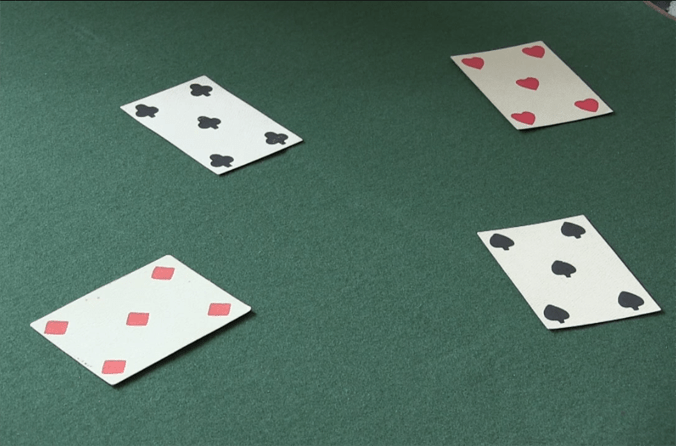
    Around the same time, we find references to card games in Italy that speak most directly to our modern notion of cards. Here their earliest decks contain familiar features: cards numbered one to ten, four royal court cards, and four suits including cups/chalices (coppe), coins(denari), swords (spade), and club/baton (bastoni).

    Suits
    Suits in a reproduction set of 18th century playing cards seen in a screen capture from an upcoming Lives & Legacies video about how to play Whist, a game popular with colonial Americans.

    By the beginning of the new century, the 1400s, references to people playing ‘cards’ are seen all across Europe.  Card numbers, royalty, and suit continued to change across Europe for the next 200 years and featured plenty of regional differences.

    For the most part there were four suits, but what those suits were was debatable. Other suits in Europe (some even today) included roses, bells, acorns, shields, leaves, pikes, tiles, clovers, hearts, and of course diamonds.

    The royal cards varied from deck to deck, much like the royalty and ruling elite varied in the nations of Europe. Some decks had no queen, others included clergy, sometimes it was three royal cardsand other times there were four. There was one constant, however, there was always a King and he was the highest in the deck.

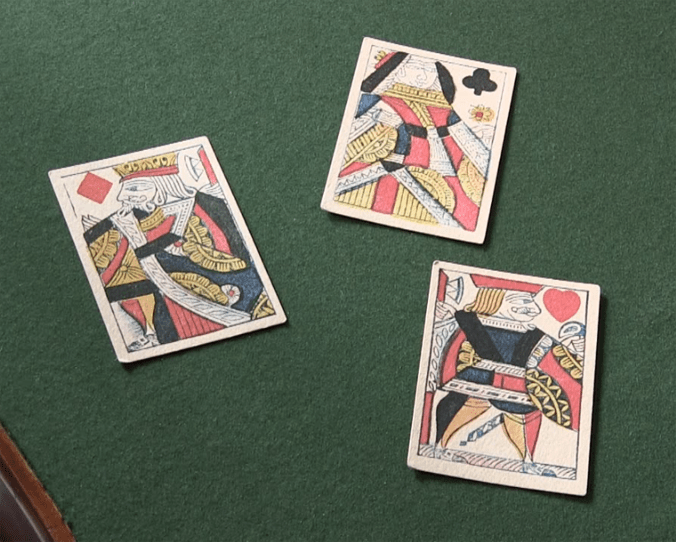
    RoyalCards
    The King, Queen, and Knave in a reproduction set of 18th century playing cards. When printed numbers and letters (K, Q, J) were added to cards, the Knave came to be called the Jack so it would not be mistaken for the King.

    By the early 17th century, England had a standardized deck (based on the ‘French’ deck) made up of the four suits we know, numeric cards one to ten, Knave, Queen, and King. This is the deck we still use today.

    By this time, cards even started to play a role in politics. In 1615, as an effort to cease the importation of foreign cards and raise revenue, King James I placed a duty on imported cards and appointed an office to inspect playing cards. Although initially unpopular with commoners who preferred the cheap foreign cards, ultimately the duty persisted. The King and Parliament tried to levy a similar duty with the Stamp Act 150 years later, which many credit with beginning American opposition to British taxation that ultimately led to Revolution.

    Those 150 years were incredibly important to the growth the Colonies and of Virginia. They grew from rugged outposts in a strange land to thriving cities and societies that weather the French and Indian War. The colonists earned their right to leisure and wanted to enjoy it!

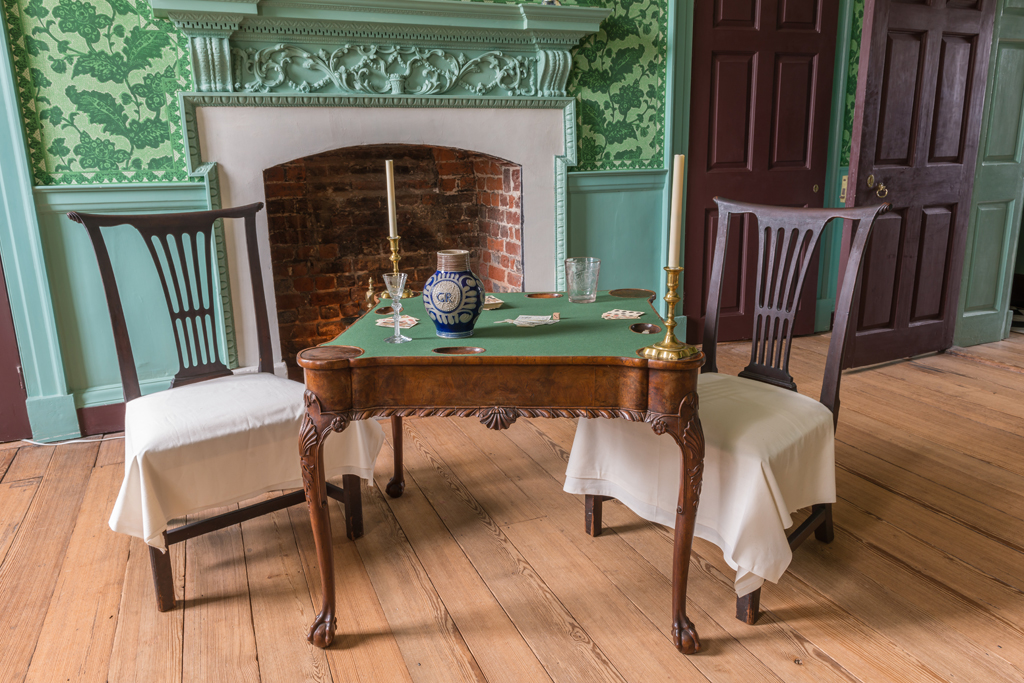
    Gaming Table (1)
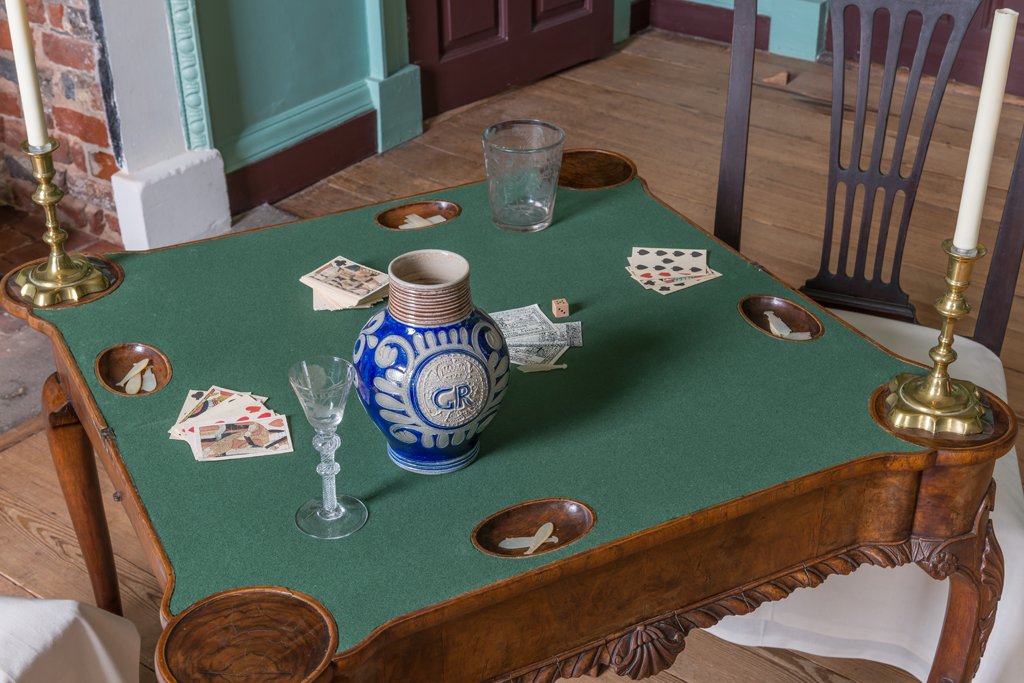
    The walnut gaming table in Historic Kenmore’s drawing room was made in England around the year 1760. The table top is covered in green baize (felted wool, similar to what you find on modern billiards tables) with wells to hold gaming chips and “turrets” at the corners to hold candlesticks.
    Gaming Table (2)
    The table has a possible connection to the Washington family, in that it might have descended through George Washington’s younger brother Charles’s family. That connection is still the subject of research, and it may be a while before we are able to conclusively prove or disprove that provenance.

    Prior to the Revolution, Virginians prided themselves in being British! They enjoyed British rights, food, drink, and pastimes like horseracing, dancing, and of course, playing cards. It would not be uncommon to see cards being played at the taverns or at gaming tables in drawing rooms, by all members of Virginia society. We only need to look at the probate inventory of Fielding Lewis to discover what games they played for among the books included in his library it lists ‘Hoyl 1 Vol’.

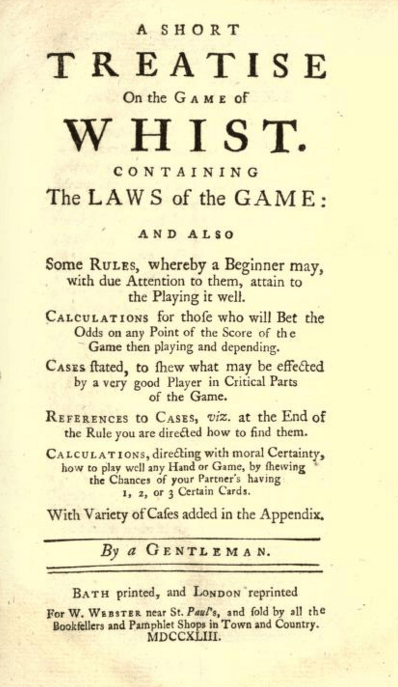
    In 1742, Edmond Hoyle published a Short Treatise on the Game of Whist. This pamphlet taught the rules to Whist as well as the best hands/plays  and was an immediate success! Hoyle continued to expand his Treatise to include other games such as back gammon and chess. Ultimately, the book’s 15 editions made it the standard instructional for card games in the English-speaking world. You can read a bit more about Hoyle and, more importantly, about gaming pieces used in the 1700s on The Rooms at Kenmore blog here.

    Hoyle
    Front page of Hoyle’s Short Treatise on the Game of Whist, published in 1743.

    And, finally, if there is any doubt to whether or not colonial men enjoyed the pastime of playing cards, we need only look at George Washington and Colonel Fielding Lewis. On December 23, 1769, George Washington stopped in Fredericksburg while returning home to Mt. Vernon. He would spend Christmas Day with his sister and brother-in-law and won ‘£2 5s at cards’. Whether George and Fielding both enjoyed that specific game may be lost to history, but how they spent that holiday is undeniable; they played cards.

    Whether for the game of Whist set out on Kenmore’s gaming table or the game of Hearts you play with your family at home, playing cards have a history that can be traced over the centuries and across the globe. It is a history that we share as directly with one another as well as with our founding fathers.

    Joe Ziarko
    Manager of Interpretation & Visitor Services

    Editor’s Note: Watch for an upcoming video about how to play the game of Whist coming soon!