On Tuesday, May 21, 2019, Dave Muraca, Director of Archaeology at The George Washington Foundation, presented “The Social Role of Garbage in Colonial Virginia,” the final talk in this year’s annual lecture series. Dave presented three case studies in 18th century garbage disposal at George Washington’s Ferry Farm, Colonial Williamsburg, and Historic Kenmore.
Thanks to the Fredericksburg branch of the Central Rappahannock Regional Library at 1201 Caroline Street in Fredericksburg, Virginia for hosting the series once again this year. To learn about other events and happenings, visit kenmore.org.
On Tuesday, May 14, 2019, Park Ranger Deborah Lawton of George Washington Birthplace National Monument presented a lecture titled “Foodways in the 18th Century” that explored the new dishes and changing tastes of the time.
Join us on Tuesday, May 21, 2019 for “The Social Role of Garbage in Colonial Virginia” with Dave Muraca, Director of Archaeology at The George Washington Foundation. Dave will explore some of the aspects of colonial waste disposal and put these practices into a larger context that in turn may make modern persons question their own sense of normalcy. Talk begins at 7:00 p.m. The lecture is FREE and hosted at the Fredericksburg branch of the Central Rappahannock Regional Library at 1201 Caroline Street, Fredericksburg, Virginia. To learn more, visit kenmore.org.
On Tuesday, May 7, 2019, Archaeologist Mara Kaktins, Ceramics & Glass Specialist at The George Washington Foundation, presented a lecture titled “Drinking with the Washingtons: Archaeological Evidence of Colonial Imbibing at Ferry Farm.” Mara explored a wide variety of beverage-related artifacts from teawares to punch bowls and discussed how cups and glasses reflected efforts by Mary Washington to demonstrate the family’s economic status and refinement.
Join us on Tuesday, May 14, 2019 for “Food in the Eighteenth Century” when Deborah Lawton, Park Ranger at George Washington Birthplace National Monument, will explore the new dishes and changing tastes that marked the foodways of the eighteenth century. Talk begins at 7:00 p.m. The lecture is FREE and hosted at the Fredericksburg branch of the Central Rappahannock Regional Library at 1201 Caroline Street, Fredericksburg, Virginia. To learn more, visit http://www.kenmore.org.
With hindsight, the events of history often seem inevitable. America was destined for independence from Britain. All colonists were patriots who saw themselves as a nation and a people separate from the mother country. This was absolutely not the case. Colonists’ views on the appropriateness of independence evolved with events. Over time, British identity gave way to American identity.
The American Stars and Stripes and British Union Jack, the present-day flags of the United States and the United Kingdom. Credit: Hellerick / Wikipedia
We have written several blog posts about how colonists, including members of the Washington family, clung to their Englishness. They expressed this identity through Westerwald mugs emblazoned with ‘G.R.’ for Georgius Rex in homage to three British kings named George, including George III who would be the foe of the American independence movement. They expressed their English identity through pipe bowls emblazoned with the British royal coat of arms. Even as protests against their lack of representation in Parliament increased, colonists still hung onto their English roots through, in the Washingtons’ case, wearing cuff links emblazoned with an image of King William III, who “came to represent the right of subjects to resist a king who was abusing power.”
The shift from a British identity to an American identity took time as colonists gave up aspects of British culture while they resisted, first, governmental overreach and, then, ultimately embraced full national independence.
Tea was one aspect of English culture given up as a political act to protest British rule and to show support for the American cause. Abstention from tea drinking began with the Tea Act of 1773. Parliament passed the Tea Act to bailout the financially troubled East India Company (EIC).[1] The government told the Company that it could ship tea directly to the colonies, duty-free. The EIC could get rid of loads of tea piling up in their London storerooms. Colonists could get tea that was cheaper than the illegal stuff smuggled in. Everyone should have been happy. But everyone wasn’t. The tea the Company sold to the colonists was to be taxed under the Townshend Acts. If colonists purchased it, they indirectly accepted Parliament’s right to tax them without representation.[2]
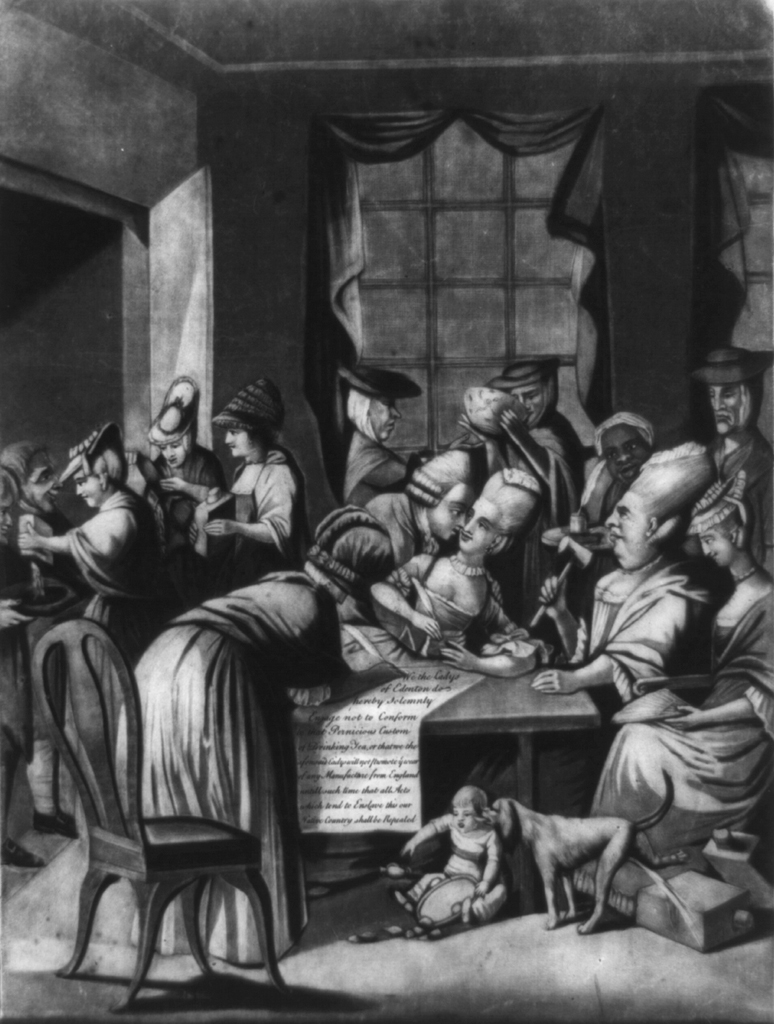
“A society of patriotic ladies, at Edenton in North Carolina” printed for R. Sayer & J. Bennett on March 25, 1775 in London. This satirical print shows American women pledging to boycott English tea in response to Continental Congress resolution in 1774 to boycott English goods. Credit: Library of Congress.
By at least May of 1774, Virginians near Fredericksburg had given up their tea. Philip Vickers Fithian, tutor to the Carter family at Nomini Hall, visited some neighbors on May 19 and noted in his diary that he “Drank Coffee at four, they are now too patriotic to use tea.”[5] Indeed, as Fithan indicates and as we’ve previously explored in this post, coffee became Americans’ go-to substitute for tea.
For those who disliked coffee or simply still wanted tea, there was a black market to provide one with British tea but there were also American-grown substitutes that adhered to the boycott and came to be known as “Liberty Teas.” Dr. Leonard Perry, extension professor at the University of Vermont, provides an excellent summary of tea substitutes used by early Americans during their tea boycotts…
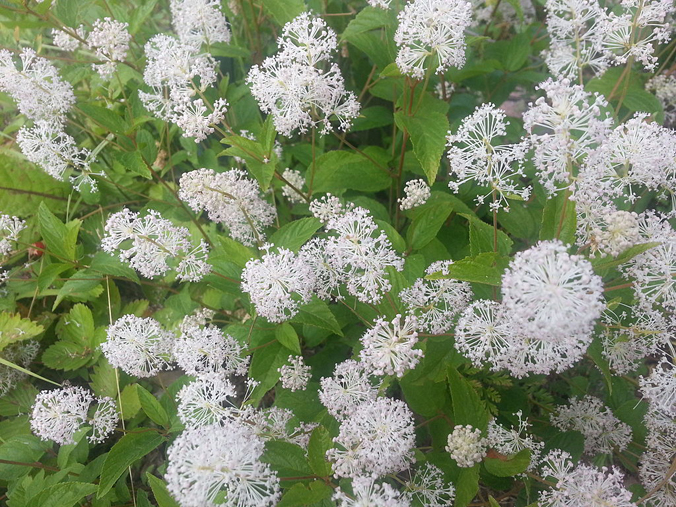
“One of the most common substitutes was the native American shrub New Jersey tea (Ceanothus americanus), also known then as Indian tea or Walpole tea. Leaves of raspberry also were commonly used for these colonial teas, as were sweet fern and spicebush. Bark from some trees such as sassafras and willow were used.
Common flowers used for the Liberty teas were sweet goldenrod (Solidago odora), red clover, chamomile, and violets. Leaves of herbaceous plants such as bergamot (bee balm or Oswego tea), lemon balm, and mints were brewed as many are today. Many herbs were brewed in the 18th century including parsley, thyme, marjoram, rosemary, and sage. Native Americans introduced the colonists to many of these plants which they often brewed to use medicinally. Even some fruits were used in colonial teas, including those of dried strawberries, blueberries and apples. Rosehips, rich in vitamin C and used today in teas, were used then as well. “Indian lemonade tea” was made from boiling the berries of the red sumac.
Often ingredients were combined, such as a common tea recipe of that time including equal parts sweet goldenrod, betony, clover, and New Jersey tea.”
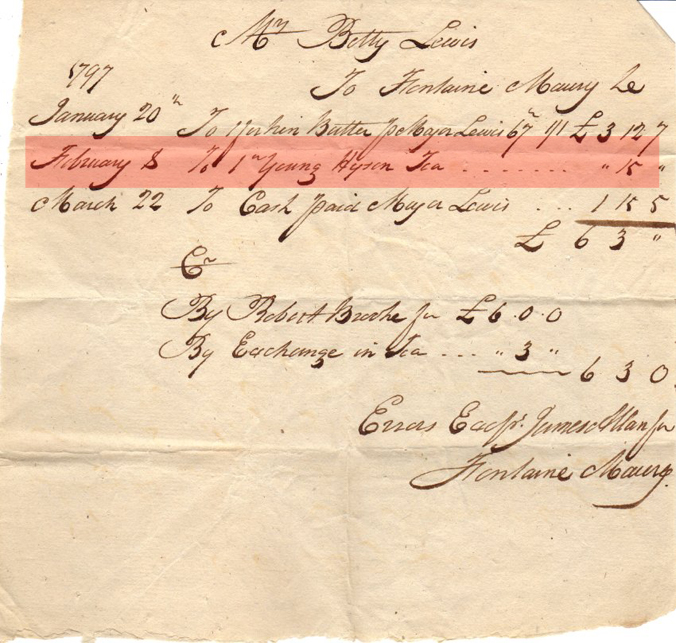
Tea would return to American tables following the successful War for Independence. There are several receipts from the 1790s that show Betty Washington Lewis purchasing tea, including a type of imported Chinese green tea, at Kenmore. But, for the most part, these imported teas as well as the herbal liberty teas were ultimately eclipsed by coffee, which became, like tea for the British, the drink synonymous with American culture.
Receipt showing Betty Washington Lewis’ purchase of some “young hyson tea,” a type of Chinese green tea, on February 8, 1797.
Visit Historic Kenmore on Saturday, May 4 for “Tea and Tour: The Ladies of Kenmore” focusing on the many generations of ladies who have called Kenmore home! Enjoy Kenmore tea and gingerbread while experiencing eighteenth-century tea service first hand. See the first floor of the mansion, learning the history of the grand 1775 home through vignettes, and meet a few of the extraordinary ladies of Kenmore along the way as part of this dramatic tour.
Event admission is $20 Adults and $10 under 17. Reservations required and there are only a very few spaces left. For more information and reservations, please call (540) 370-0732 ext. 24 or email [email protected].
Zac Cunningham
Manager of Educational Programs
Heather Baldus
Collections Manager
[1] Breen, T. H., The Marketplace of Revolution, Oxford: University Press, 2004: 298-301.
[3] Clark, F, “Chocolate and other Colonial Beverages” in Chocolate: History, Culture, and Heritage, 2009 (eds L. E. Grivetti and H.-Y. Shapiro), John Wiley & Sons, Inc., Hoboken, NJ: 276.
[4] Root, Waverly et al., Eating in America, New York: Ecco, 1981: 127
[5] Diary entry, May 19 1774 by Philip Vickers Fithian, Journal & Letters of Philip Vickers Fithian, 1773-1774: A Plantation Tutor of the Old Dominion, Williamsburg, VA: Colonial Williamsburg, 1943, 147.
[6] Diary entry, September 26, 1774 by Fithian, 257.
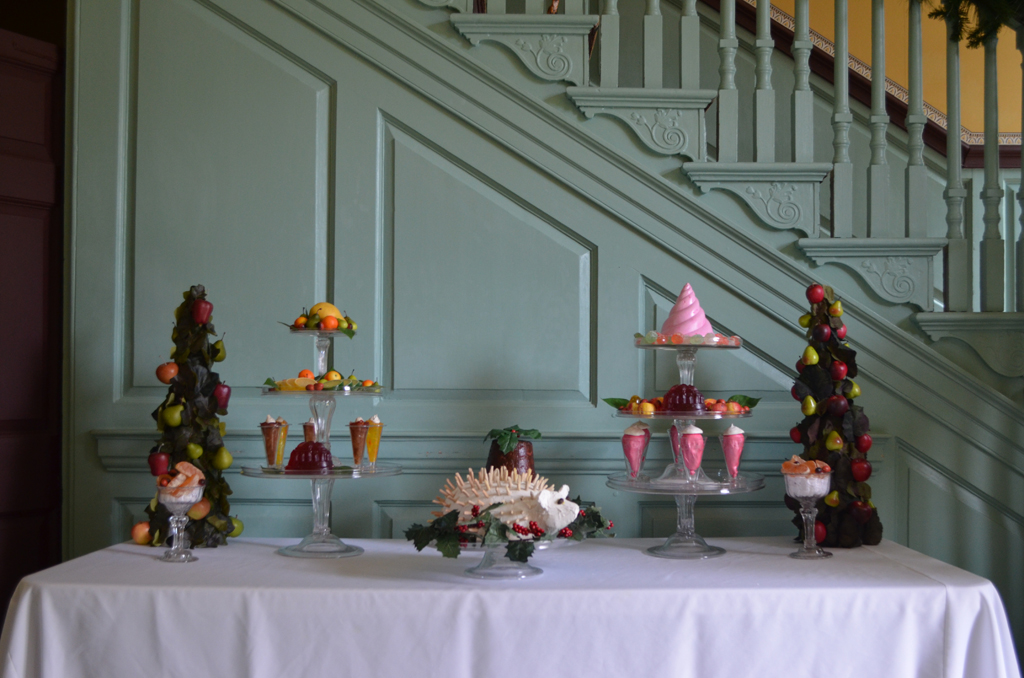
The holiday season has arrived at Historic Kenmore, bringing with it our annual display in the house of colonial wintry traditions from greenery to lovely desserts. Two years ago, I explored the mysterious origin of Betty Lewis’s hedgehog cake and even made a pretty passable replica. This year, there is another dessert on our table at Kenmore that I have been eager to talk about and even taste, syllabub.
Display of desserts popular in the 18th century inside the Passage at Historic Kenmore.
Syllabub is no longer the favorite staple dessert it once was two hundred years ago. I decided to investigate this fluffy confection to learn its history and to attempt to recreate it. You may find that it’s worth reviving this old classic for your upcoming holiday celebrations!
One of the earliest references to this frothy treat is from a 16th century Tudor drama called Thersytes, when a character states, “You and I…muste walke to him and eate a solybubbe!”[1] It continued to be mentioned through the 17th and 18th century in plays, poetry, art, diaries and cookbooks. From poet laureate Ben Jonson to famous diarist Samuel Pepys to pioneers in household management like Hannah Woolley, Eliza Smith, and Hannah Glasse, they all knew and appreciated this sweet treat.[2]
Through the centuries, syllabub evolved to suit changing taste and convenience.
One of the oldest and most legendary syllabub recipes was informally known as “under the cow”.[3] To make it, a poor dairymaid was supposed to milk a cow directly over a bowl of sugar, sack (a white fortified wine), brandy, and cider to create a “fine frothy top.” Then she was to let it sit for a few hours in a cool place. It sounds simple, rustic, and even pretty tasty. However, this recipe was more fantasy than reality and incredibly impractical. Despite being unsanitary, it doesn’t seem to work and splits the milk in a most unappetizing way.[4]
If you don’t have a live cow, another syllabub recipe, also rather dubious, was the so-called “Poured or Teapot” approach[5]. This method called for the maker to fill a container with milk and then, from a substantial height, pour it into a bowl of sugar, wine, cider or bandy, and a bit of lemon to create a light and frothy mixture. This could actually work, if the maker used a heavily enriched cream (similar to modern heavy whipping cream). Otherwise, it also tended to create an unpleasant curdle. [6]
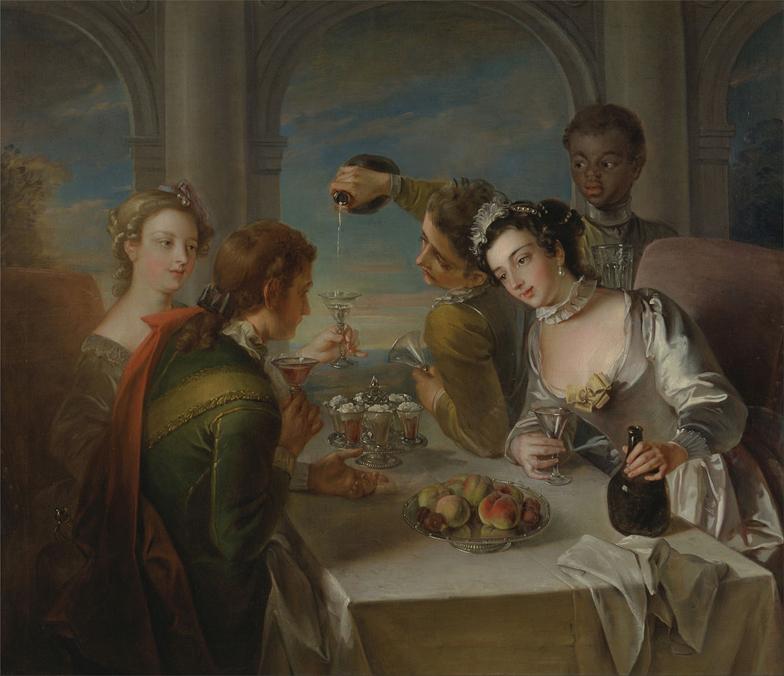
The two former methods, if they worked, were supposed to create a syllabub that was more of a drink and that was pretty heavy on the spirits. By the 18th century, however, the “Whipt syllabub” became the most popular style of syllabub. It contained less alcohol and was used as a topping instead of as a drink. The recipe called for the whipping of cream, wine, lemon juice, sugar, and sometimes egg whites. As the froth started to develop, the maker spooned it off into a sieve and let it dry. After drying, the maker placed the little clouds of froth on top of a glass of sweet wine or jelly.[7]
“The Sense of Taste” (mid-to-late 1740s) by Philippe Mercier includes some “Whipt syllabubs” on the table. Credit: Yale Center for British Art
I decided to try this fourth style and used a recipe for my experiment called an “Everlasting syllabub” found on page 276 of Mrs. Eliza Smith’s cookbook The compleat housewife, or Accomplished gentlewoman’s companion, published in 1773.[8] Betty Washington Lewis owned this book, which is listed on the 1781 probate inventory of Kenmore. Additionally, I picked this recipe because I don’t have access to a cow, didn’t want to create too much of a mess, and wanted to create a dessert rather than a liquor-infused drink.
RECIPE
18th century recipe To make Lemon Syllabubs Take a quart of cream, half a pound of sugar, a pint of white wine, the juice of two or three lemons, the peel of one grated; mix all these, and put them in an earthen pot, and milk it up as fast as you can till it is thick, then pour it in your glasses, and let them stand five or six hours; you may make them overnight.
Recipe using modern measurements and a mixer and that makes less syllabub: 2 cups heavy whipping cream, chilled 1 cup white sugar ½ cup white wine or apple juice for non-alcoholic ¼ cup of lemon juice 2 tsp of grated lemon zest Nutmeg to sprinkle on top
Whip the cream and sugar (slowly tbsp. at a time) in a bowl until the cream begins to thicken. Add white wine, lemon juice and zest and continue to whip until light and fluffy and just holds a peak. Make sure that all the sugar has dissolved and does not give the syllabub a grainy texture. Serve chilled with a dash of nutmeg or lemon zest. Makes 12 servings.
Syllabub can sit in the fridge for a few hours but you may get some separation of the wine and cream.
Everlasting syllabub creates a fluffier mousse that is great on its own or as a topping on jellies and trifles. The recipe is quite simple and requires heavy cream, white wine, lemon juice, lemon zest, sugar. This is all beaten together until it is almost the texture of modern whipped cream. The ingredients are relatively inexpensive and it took less than 15 minutes to create and serve.
After taste-testing my refreshing treat with several colleagues, we arrived at a consensus that this indeed is a dessert that needs revived for our holiday celebrations. It is light, fluffy, and citrusy and would be a great palate cleanser after a heavy dinner or a nice change from dense baked goods. For families with children, a non-alcoholic version can be made by replacing the wine with apple juice.
The syllabub we made topped with lemon zest and nutmeg.
Our experiment was a success and many of you may now have a new dessert gracing your holiday table, if you can keep from eating it all yourself.
[2] Day, Ivan. “Further Musings on Syllabub, or Why Not ‘Jumble it a pritie while’?” Historic Food, https://www.historicfood.com/Syllabubs%20Essay.pdf; Pepys, Samuel. “Sunday 3 August 1662.” The Diary of SamuelPepys, https://www.pepysdiary.com/diary/1662/08/03/; Woolley, Hannah. The Queen-like Closet or Rich Cabinet Stored With All Manner Of Rare Receipts For Preserving, Candying And Cookery. Very Pleasant And Beneficial To All Ingenious Persons Of The Female Sex. Duck Lane near West Smithfield, Richard Lowndes, 1672. J. Buckland, et al. 1773, pg 114; Glasse, Hannah. The Art of Cookery, Made Plain and Easy. London, Company of Bookfellers, 1747, pg 218.
[3] MacDonell, Anne. The Closet of Sir Kenelm Digby Knight Opened. London, Philip Lee Warner, 1910, pg 120.
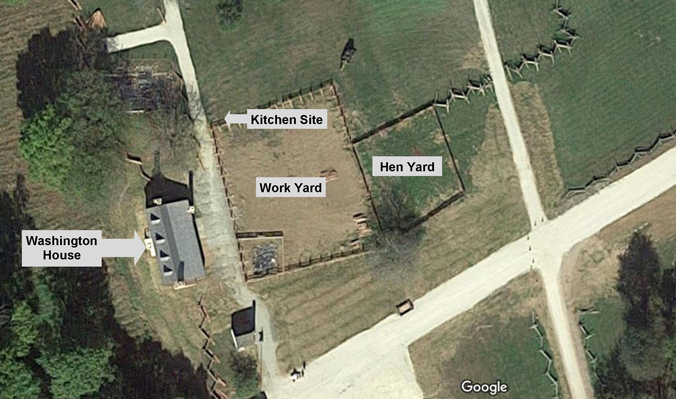
Twenty years ago, archaeologists digging at George Washington’s Ferry Farm unearthed the remains of a mid-eighteenth century kitchen. It was immediately obvious from the state of the artifacts that this kitchen had not simply fallen into to ruin and been abandoned – it had burned down. While this is fairly interesting in and of itself, a reexamination of the kitchen fire artifacts this year revealed surprising information about the intensity of the fire.
Overhead image of George Washington’s Ferry Farm showing location of the kitchen that burnt down in the 18th century. Credit: Google
What first struck us was the sheer density of artifacts in this kitchen. We recovered A LOT of artifacts. Furthermore, these broken sherds could be mended to form almost whole bottles, crocks, jugs, pans, and such. The number of artifacts and the fact they could be put together to form entire objects tell us that the Washington family and their slaves did not have much, if any, time to salvage what was inside the burning kitchen. Food, wine bottles, food storage and preparation vessels and utensils, furniture, and more all destroyed exactly where they stood. Think of this kitchen as a mini Pompeii or Titanic. Just about everything that the Washington’s had in their kitchen went down with the ship and was still there, just squished and burned.
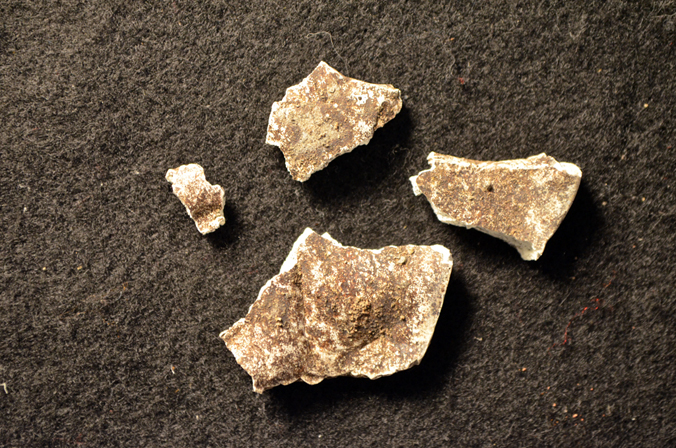
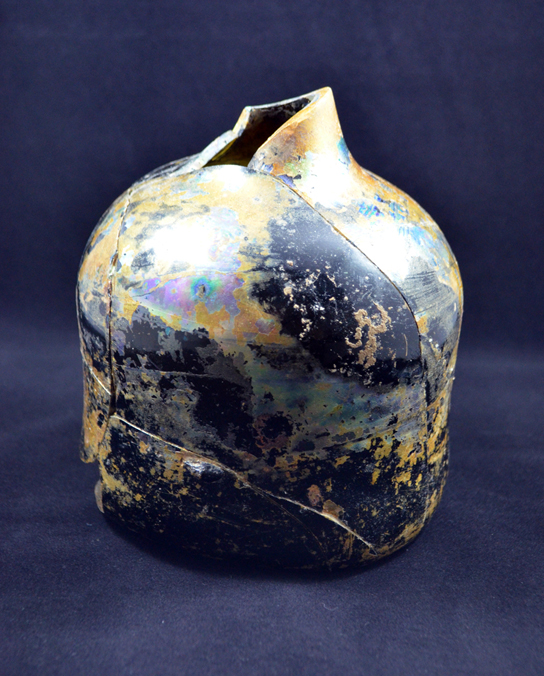
A preserved moment in time like this fire is a great opportunity for archaeologists to study the Washingtons but it comes with one big problem—most of the artifacts were totally cooked and absolutely toasted beyond recognition in some cases. Soft metal artifacts made from lead and copper, for example, were reduced to melted blobs by the fire. Ceramic vessels appear to have exploded from the heat and were reduced to blackened sherds. Some of the glass bottles survived with a minimal amount of warping from heat but the majority were melted or even burned in a process called ‘devitrification’. And oddly enough there was very little animal bone, which is usually ubiquitous in kitchens found archaeologically.
To put the intensity of this kitchen fire in context here are some quick statistics (in Fahrenheit):
Lead melts at 621.4 degrees.
According to the National Institute of Fire and Safety Training, the average modern house fire tops out at around 1,100 degrees.
1,400-1,800 degrees is the temperature at which bone will be destroyed
Copper melts at 1,984 degrees
Glass melts between 2,600 and 2,800 degrees.
Since the Washington kitchen fire was hot enough to actually burn glass, not just melt it, we’re looking at a fire that likely exceeded 2,800 degrees. That’s incredible! It also explains why there was so little animal bone recovered. Most bone was probably completely destroyed by the flames.
Extremely burned tin glaze ceramic recovered from the kitchen site at Ferry Farm.Devitrified glass from the burnt Washington kitchenMelted copper alloy excavated from the Ferry Farm kitchenBlobs of lead alloy recovered from the kitchen siteSlightly burned wine bottle from the kitchenA second slightly burned wine bottle
So, how on earth did the fire get that hot? We’ll probably never know, unfortunately. Some possible explanations may be the environmental conditions at the time of the blaze – a hot dry day with high winds could produce a perfect storm for a wooden kitchen to turn into an inferno. The fire also may have started at night when few people were awake to notice and try to put it out, although presumably the kitchen housed enslaved people, as was common for that time period. Another culprit may have been what was kept in the kitchen. There were dozens of wine bottles in there. While we call them ‘wine’ bottles today, they were actually all-purpose vessels that held any kind of spirituous liquid including harder alcohol like gin, whiskey, and rum, which are highly combustible. Animal products such as lard, tallow, beeswax, and even whale oil for lamps were likely stored in the kitchen and all burn quite well for long periods of time.
Regardless of the fire’s cause, it is clear from archaeological evidence that it happened quickly because not much within the structure could be saved, if anything. We also know that it burned extremely hot and for a sustained period of time in order to have caused so much damage to the items within.
Finally, perhaps, the last and the biggest mystery is where the replacement kitchen was located. Kitchens were almost all outbuildings because, as you may have deduced, they tended to catch on fire easily. A colonial household absolutely required a kitchen, however, and another would have been built almost immediately. Somewhere on the landscape at Ferry Farm, there is another kitchen waiting to be discovered archaeologically.
In the meantime, The George Washington Foundation plans to reconstruct the original Washington era kitchen so visitors can experience the sights, sounds, and smells of an eighteenth century kitchen, minus the blazing inferno, of course.
Mara Kaktins, Archaeologist
Archaeology Lab Supervisor
Ceramics & Glass Specialist
In this video, we do some experimental archaeology and try four different techniques used to preserve fresh uncooked eggs before the advent of refrigeration.
You can also read about meat preservation techniques prior to the invention of refrigeration here.
It’s easy to take our refrigerators for granted. There they sit in our kitchens quietly keeping our food safe to eat and making our lives quite easy. It may be difficult to imagine but a large percentage of time on an 18th century homestead such as George Washington’s Ferry Farm was spent preserving food for long term storage.
Before grocery stores and refrigeration, most foods were only available at particular times of the year – this is called seasonality. Eggs, for instance, were not plentiful in the fall and winter when hens traditionally stop laying. Certain fish, such as shad and herring, can only be caught during the few weeks a year when they spawn. And, of course, most crops were harvested in the fall. So when food was available it needed to be preserved and stored properly if there was any hope of enjoying it in the future.
Food preservation was especially important in the fall and early winter, which was butchering season for large animals. Chickens and small game were enjoyed year round because they could be eaten in one or two meals. A larger pig or cow, however, would spoil in mere days when exposed to the humid and hot Virginia summers. Therefore butchering was left to the cold months. Even the frosty temperatures were not enough to stave off decay and therefore long term preservation techniques were employed to guarantee a supply of meat throughout the year.
To begin, preservation involved many people. In my own household today, we butcher two hogs once a year and it’s a family event with our neighbors and friends helping out. In the Washingtons’ case, a number of their slaves were put to this task and likely butchered dozens of hogs at once to ensure the family and the enslaved population had enough meat for the upcoming year.
Pigs were the preferred livestock for meat in Virginia, as anyone who lives here knows well. We love our pork. This is not a coincidence as pork’s high fat content aids with preservation and helps the meat survive the nasty summers previously mentioned.
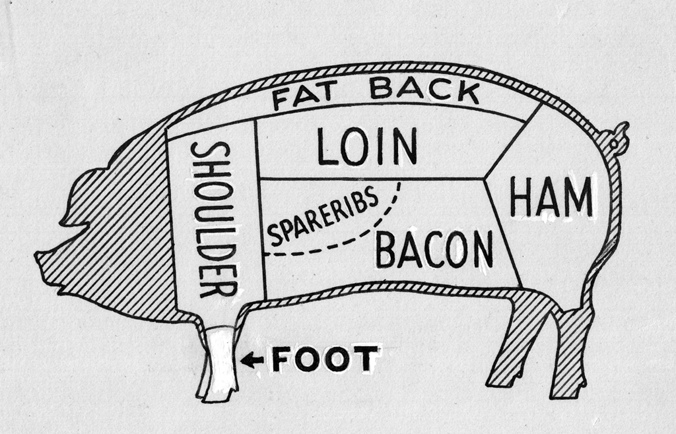
A butcher’s diagram showing the main cuts of pork and from where the come on a pig. Credit: Wikipedia/Pearson Scott Foresman.
After butchering, the next step in preservation was to treat the meat in a manner that would facilitate storage. This usually involved drying, salting, or a combination of the two. The idea was to reduce the meat’s water content, which promotes spoilage, and kill or inhibit bacterial growth. Salting pork drew out moisture so small meat cuts could be rubbed down with salt and then stored in even more salt, which was relatively cheap in the 1700s and keeps the nasty bacteria at bay. Furthermore, adding the chemical compound saltpetre (potassium nitrate) to the rub kept meat edible even longer and had the added benefit of ‘fixing’ the nice red color of the meat. Saltpetre is still in use today for food preservation (and also makes great gunpowder and fertilizer, strangely enough).
A technique that worked even better for long term storage was brining. This process involved soaking the meat in a salt water mixture and was good for larger cuts, like hams. Meat could be stored in the brine and packed tightly in covered jars or casks in a cool environment for months. The Washingtons had cellars in their house ideal for this purpose and the archaeological record at Ferry Farm is full of fragments of stoneware and earthenware jars – the Tupperware of their day.
Of course all this salted meat would need to be soaked in water before it was edible. Even the salt-loving Virginians couldn’t palate it otherwise.
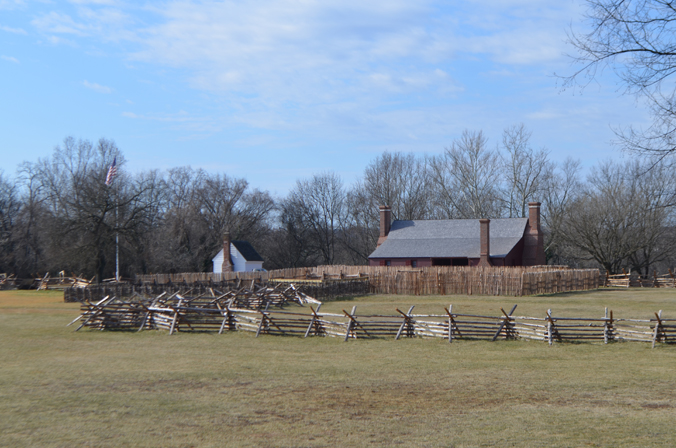
Adding the extra step of smoking to the salting process preserved the meat even longer. The smokehouse was ubiquitous on 18th century farms and, while we know the Washingtons had a smokehouse, we have yet to locate it archaeologically. We have found evidence for a smokehouse that predates the Washingtons moving to Ferry Farm, however.
Archaeologists have not located where the smokehouse stood when the Washingtons lived at Ferry Farm. Perhaps it stood among the fenced-in work yards behind the family home. More archaeological exploration will be necessary to place the structure on the landscape.
Your basic smokehouse was a small, square, one room structure with a pyramid-shaped roof and rafters in the roof to hang meat on. In the middle of the room was a fire pit or box where a fire was kept going for days at a low temperature. It dried the meat without cooking it and exposed the meat to a lot of smoke, which inhibits decay and is a deterrent for bugs and vermin. Have you ever wondered why mosquitos don’t seem to bite much when you’re around a camp fire? It’s the smoke.
One final common preservation and storing technique was to pot meat. This involved packing cooked meat tightly into a jar and capping it with a generous amount of butter, lard, or tallow (rendered beef fat). An unappetizing as this may sound it kept meat safe to eat for weeks or months in the right environment. Potted meat is still popular in certain areas, although you’ll find it in cans, nowadays.
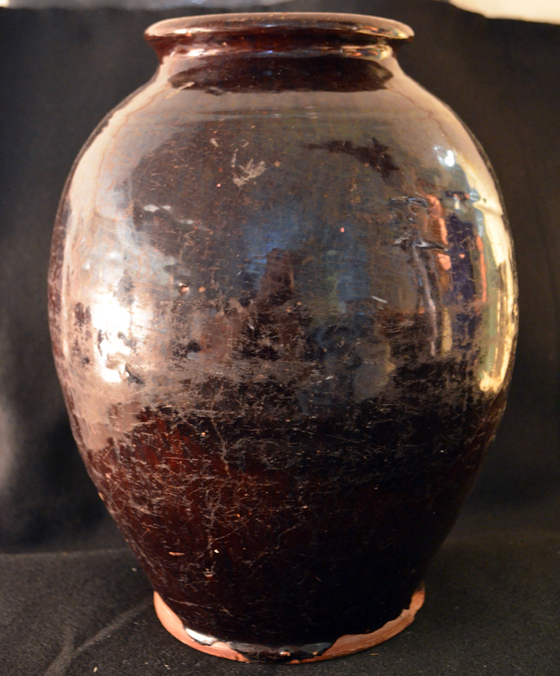
A complete redware storage jar.
A variety of ceramic pots like the above redware jar were available for storage of preserved meat and other foodstuffs in the 1700s. Below are photos showing four different types of storage vessel sherds excavated at Ferry Farm:
American salt glazed stoneware jar rim.
Buckley Jar/Crock rim with part of the Handle still attached.
Redware storage vessel rim.
English stoneware crock sherd.
All of the above mentioned preservation and storage techniques lend their own unique taste to meat, many of these flavors are now considered very desirable and the main reason these techniques are still employed for various foods, even though we don’t require them any longer thanks to refrigerators and freezers. Think salted bacon, Spam, smoked barbeque, and delicious salty ham. What originated as necessary methods for making food last have evolved into our own unique modern cuisine.
Mara Kaktins, Archaeologist
Archaeology Lab Supervisor
Further Reading
Oliver, Sandra L. Food in Colonial and Federal America. Greenwood Press, Westport, Connecticut and London. 2005
Olmert, Michael. Kitchens, Smokehouses, and Privies – Outbuildings and the Architecture of Daily Life in the Eighteenth-Century Mid-Atlantic. Cornell University Press, Ithaca and London. 2009.
Root, Waverly and Richard De Rochemont. Eating In America. The Ecco Press, Hopewell, New Jersey. 1995.
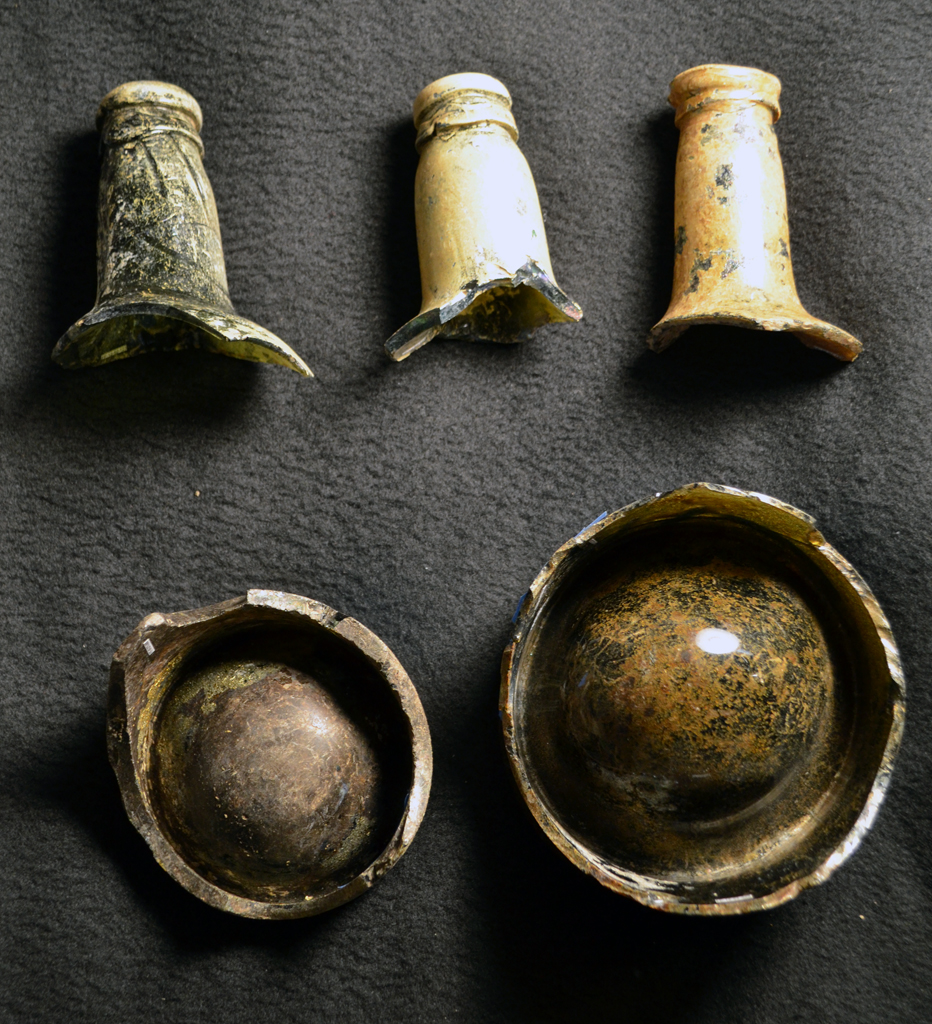
Ah, the humble wine bottle. There are few historical archaeological sites without them and Ferry Farm is no exception. Our current mending project has produced about a dozen wine bottles from one Washington house cellar feature alone. Readily identifiable because their form has changed little in the past 250 years, these beauties are sometimes overlooked in favor of fancier or more exotic artifacts. However, there is much we can learn from the sherds of wine bottles and much history wrapped up in their existence on colonial sites.
Mid-18th century bottle neck and base fragments excavated from the Washington house cellar at Ferry Farm.
Let’s start with what wine bottles cannot tell us. They can’t actually tell us whether or not folks were drinking wine. Huh? Well, ‘wine’ bottles of the colonial period held anything from vinegar to gin and all liquids in between. Yes, many contained wine but the modern use of ‘wine’ to describe these bottles, with their tall, cylindrical shape and dark green-colored glass, is really just a reflection of what we exclusively drink from them currently.
Most 18th and 19th century wine bottles held a variety of substances over their lifetimes. Bottles were not cheap before industrialization made them relatively disposable and were often listed in probate inventories. Recycling is nothing new. Your average 18th century household carefully cleaned out each empty bottle for reuse when needed. The inside was scoured with sand, small pebbles, or lead shot (which is a terrible idea). It is not uncommon to find wine bottles archaeologically that exhibit heavy use wear on the inside and outside from years of being drained, cleaned, refilled and used for storage, serving, and transport. Truly, the wine bottle was a workhorse.
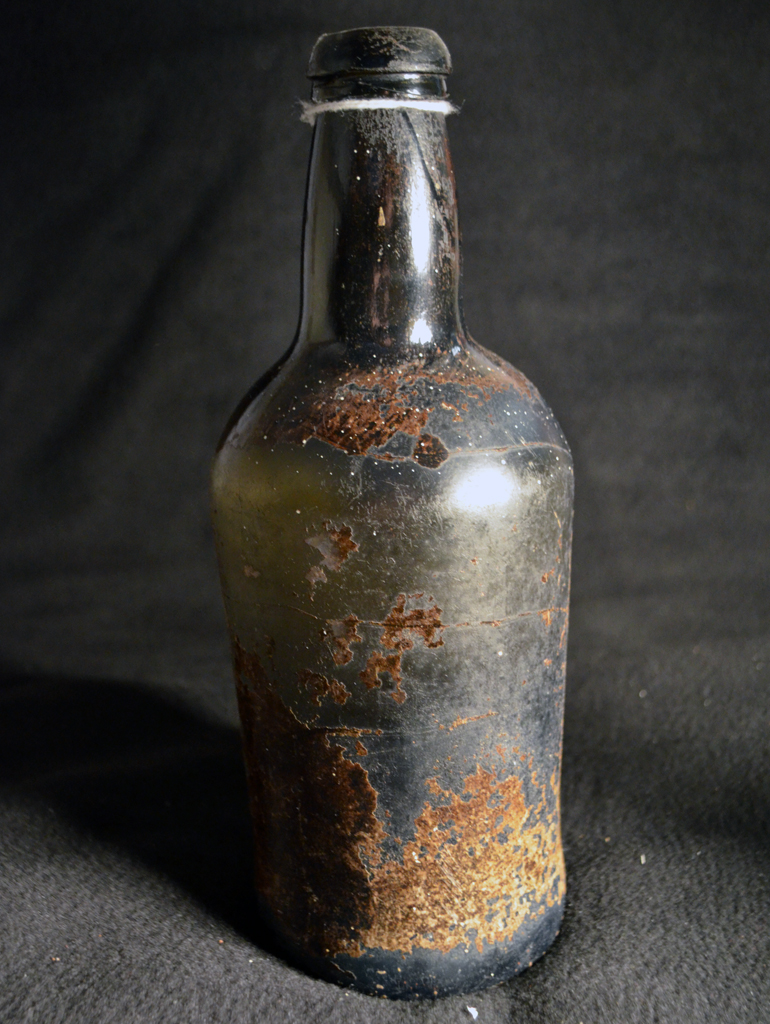
An example of what the bottles excavated at Ferry Farm looked when they were whole.
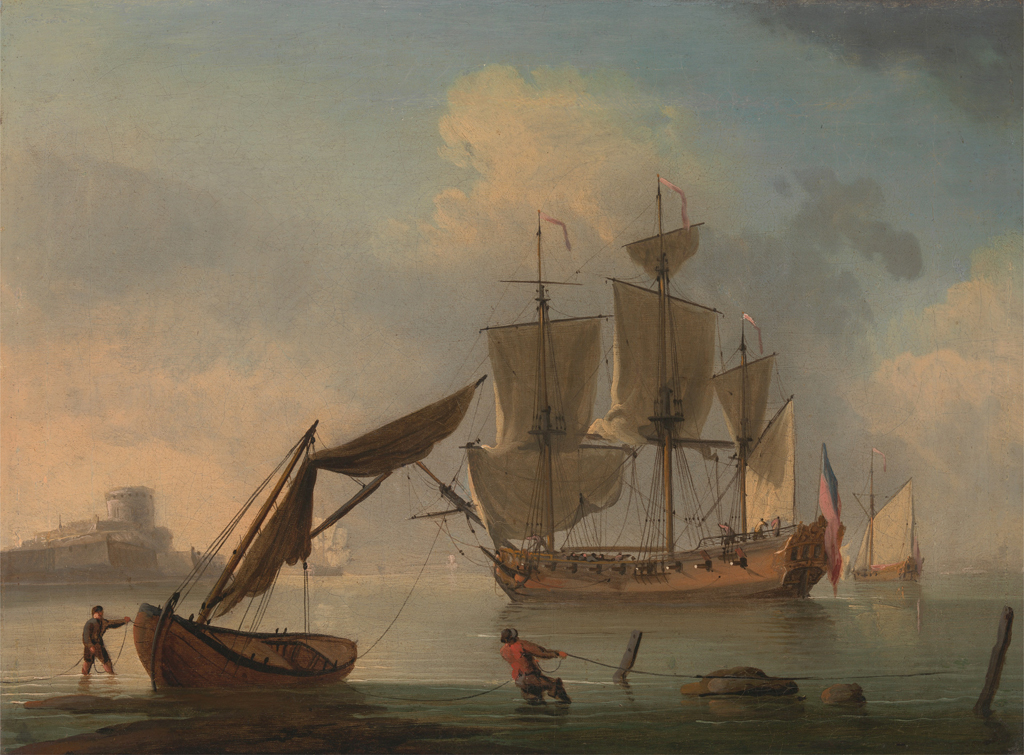
Where did these ever-present bottles come from? For the most part, from England. This isn’t surprising given that colonials weren’t really allowed to trade with any other countries. While there were some early glass houses in the Americas, their production was nowhere near that of England’s well-established glass industry. The English produced squat and sturdy wine bottles of very dark glass often dubbed ‘black glass’ able to survive shipping across the Atlantic. They were filled before the trip and used as ballast in the ship, the contents often being worth more than the bottle itself.
For the most part, these ‘black glass’ wine bottles were filled with wine but not the wine that you’re likely familiar with. Your typical red or white wine would not survive the months-long tumultuous ocean journey (with its extremes of temperature and humidity) from Europe to America. It would be vinegar by the time it arrived, if you were lucky.
However, wine fortified with a hard liquor such as brandy would halt fermentation and oxidation processes and make the wine both transportable AND much higher octane once it arrived for thirsty colonials. Subsequently, a lot of the wine enjoyed in 18th century America was fortified. Not only did these fortified wines such as Madeira, port, sherry, Masala, or Malaga survive the nasty voyage across the ocean, they actually tasted better once they reached their destination. Fortified wines are total masochists and basically thrive under neglect and abuse. The more rocking of the boat the better. Fortified wines also love extremes of temperature and humidity. In fact, bottlers often documented the voyage a particular wine took. Madeira and Port that traveled south of the equator and then back north again fetched top dollar because they had been exposed to the extreme conditions of the tropics.
“An English Sloop Becalmed near the Shore” (mid-18th cent.) by Francis Swaine. Credit: Yale Center for British Art, Paul Mellon Collection
But why import all this wine? Surely it would have been cheaper and easier to make it locally like most other colonial food and beverages. Well, the colonists tried….and tried…and tried. Even Thomas Jefferson, one of the great innovators of his day and a celebrated lover of wine, failed in this task, although not for lack of effort. It turns out that European grapes do not do well in the Americas and tend to wither from disease and pests. Additionally, North America’s few native grapes are ill-suited to making fine wine. It was not until recently in our history as a country that we’ve succeeded in growing hybrid grape varieties that will produce a palatable wine. We had a much better track record of making wine out of pretty much everything else (dandelions, apples, barley, peaches, quince, and any berry they could get their hands on). Seeing as it was unimaginable that our founding fathers go without one of their favorite beverages, both wine and wine bottles ended up making their way across the Atlantic in large quantities.
All of this brings us back to the Washington family wine bottles. Their presence is not a surprise but finding them has us pondering the importance of wine in the colonies, the intricacies of colonial transatlantic trade, and the value of seemingly everyday objects in colonial society. Of course it’s also fun to contemplate all of the libations they may have held over the years until a careless hand shattered them and banished the bottles to the trash midden where they would await discovery by archaeologists two and a half centuries later.
Mara Kaktins, Archaeologist
Ceramics & Glass Specialist
Grasse, Steven. Colonial Spirits: A Toast to Our Drunken History. Abrams Image, New York. 2016
Hancock, David. Oceans of Wine: Madeira and the Emergence of American Trade and Taste. Yale University Press, New Haven and London. 2009.
Jones, Olive R. Cylindrical English Wine & Beer Bottles 1735-1850. Minister of Supply and Services, Canada. 1986.
“It is indeed bad to eat apples. It is better to make them all cider” — Benjamin Franklin
Name a beverage consumed by all age groups, men and women alike, the poor and the very rich, from sun up to sun down, that is touted as healthy and refreshing yet also contains alcohol. If you were a colonial American, the answer was hard cider. In America’s early days, cider reigned supreme and, even though the beverage is currently enjoying a resurgence in popularity, consumption of cider is nowhere near as high as it was during George Washington’s lifetime. To better understand early Americans’ obsession with cider, one must go back to the first European colonization of America (What a great idea! Let’s do that).
It’s the early 17th century and colonists are trying to make their new home a bit more like their old home. One sure way to do this is to bring over plants to grow the food you already like. Sometimes, this doesn’t work very well (grapes, for example) but, sometimes, the introduced species thrive in their new environment. Such was the case with apples. Technically, there are already two varieties of crabapple native to the Americas but these are not especially good eating compared to domesticated apple varieties in Europe. Ultimately, the apple became such a popular cultivar, some land grants stipulated that to claim legal ownership you had to plant apple trees to prove you intended to stay and improve the land.
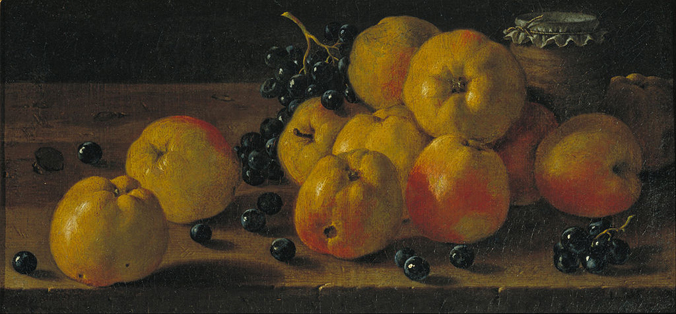
“Still Life with Apples, Grapes and a Pot of Jam” (1700s) by Luis Meléndez. Credit: Museu Nacional d’Art de Catalunya / Wikipedia
That North American climate and soil was well suited to apples was especially fortuitous since colonists were also looking for things to ferment into alcohol. Alcohol was a large part of their diet, and it just so happens that apples lend themselves very well to this end. Think about it, in addition to providing fresh fruit, apples could be dried for storage, fed to livestock in the fall to fatten them before butchering, made into apple cider vinegar which is both useful for medicinal purposes but also a key ingredient for pickling, one of the most common preservative methods at the time, and finally turned into lots of yummy fermented beverages like, apple brandy, and applejack (we’ll talk about this interesting drink a bit later), and cider..
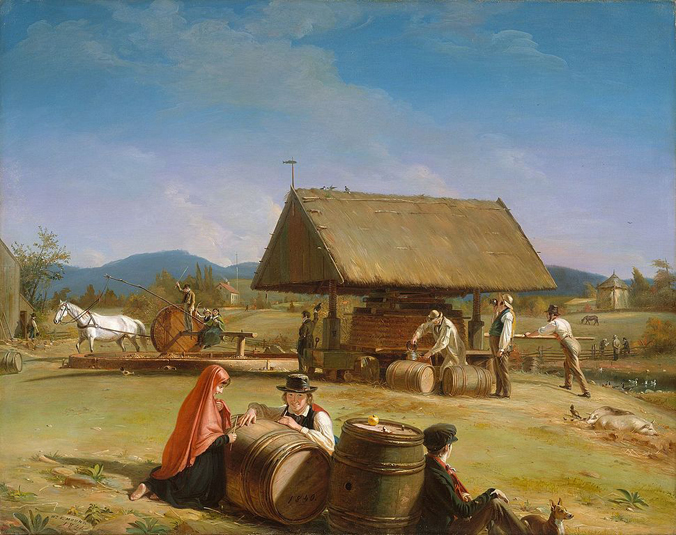
Making apple cider is very simple, and it’s even simpler to make hard cider. In fact, left to their own devices, apples practically ferment themselves since they are covered with wild yeast that loves to eat sugar and throw off alcohol as a pleasant byproduct. So, colonists didn’t have to work very hard to turn perishable cider into hard cider, which could be stored longer. Furthermore, if you expose hard cider to oxygen for too long, it will naturally turn into vinegar. What’s not to love?
“Cider Making” (c.1840) by William Sydney Mount. Credit: Metropolitan Museum of Art / Wikipedia.
Did I mention how much cider was consumed during the colonial period? It should be noted that even though it did contain alcohol it wasn’t necessarily considered an alcoholic drink. John Adams drank a large glass of cider every morning (yep) and fancied himself an abstainer of strong drink. Cider was described as healthy and a thirst quencher, likely owing to the slight carbonation which is also a byproduct of fermentation. Children regularly consumed hard cider, which isn’t nearly as horrific as it sounds when you take into account that it had a low ABV of around 3% and this probably made it safer to drink that most water available.
However, children were not encouraged to partake of cider’s much bigger and somewhat brutish brother, applejack. Applejack resulted when you allowed hard cider to freeze and removed the frozen water crystals, leaving the concentrated alcohol behind. The more times this simple distillation process was repeated the stronger the applejack becomes. This method also does little to remove impurities contained within the cider so the result can be a very high octane skull splitter, which was still much beloved of colonials.
Although cider was a very common drink, it could also be elevated to gourmet status. Just as wine drinking has advanced to a fine art, with enthusiasts who obsess over the distinctive notes each grape produces under distinctive growing conditions, so did gentry colonists enjoy comparing fine ciders from different regions and varieties of apples. Much was made of the ‘terroir’ of ciders, or the climate, soil, and landscape where the apples were produced. Modern varieties of apples are much different than those available three hundred years ago so it’s interesting to ponder over the distinct flavors colonial ciders would have had, especially given that they had access to a wider variety of apples than we do today. There were thousands of varieties available across the colonies and early Republic producing thousands of distinct ciders. So perhaps the saying should not be ‘As American as apple pie’ but rather ‘As American as apple cider’.
Mara Kaktins, Archaeologist
Ceramics & Glass Specialist
Further Reading
Brown, John Hull. Early American Beverages. Bonanza Books, New York. 1966
Grasse, Steven. Colonial Spirits. Abrams Image, New York. 2016
Oliver, Sandra L. Food in Colonial And Federal America. Greenwood Press, London. 2005
Root, Waverly and Richard De Rochemont. Eating In America. The Ecco Press. 1995








 “It is indeed bad to eat apples. It is better to make them all cider” — Benjamin Franklin