On Friday, January 11, Saturday, January 12, and Sunday, January 13, Historic Kenmore will again present Twelfth Night at Kenmore, a dramatic theater presentation set in 1776.
This production depicts the first Christmas that Fielding and Betty Washington Lewis celebrate in their newly built home. It is not the usual joyous atmosphere, however. The Revolutionary War brings fear, doubt, and frustration to the Lewis family, their friends, and Kenmore’s enslaved community. Here are some photos from last year’s performance.
John Lewis (Michael S. Taylor) encourages Betty Washington Lewis (Barbara Escamilla Cochran) to reveal who the Twelfth Night king and queen shall be.
Betty Washington Lewis (Barbara Escamilla Cochran) welcomes guests to her home and offers a holiday toast.
Patriots George Weedon (L-Wilson Johnson) and Fielding Lewis (R-Rae Ehlen) worry about the latest war news.
Hetty, an enslaved washerwoman and house servant (Ashleé James), overhears Weedon and Lewis discussing Dunmore’s Proclamation, which promised freedom to slaves who fought for the British.
Mary Washington (Anne Lloyd) admonishes Nancy Alexander Lewis (Corinn Keene) to be mindful of her duty as a Patriot woman.
Rachel, an enslaved cook (Gladys Perkins), clears the dining room table after the ball’s grand meal is complete.
Having heard about Dunmore’s Proclamation, Hetty wonders how she might escape slavery and join the British cause in the hope of gaining freedom.
Fielding Lewis, Jr. (Sam Fulton) and George Weedon debate the wisdom of suspending horse racing in Fredericksburg as part of the effort to stay focused on the war effort.
The Lewis family sings “The First Noel.”
Henry Mitchell (Preston Simms) talks with Pompy, an enslaved blacksmith (Marcus Salley) and wonders whether he might as well become a Loyalist since his neighbors already seem to think that he is one.
Lucy Thorton Lewis (Cynthia Palmer), wife of John Lewis, acted as a guide for the evening and narrated our story.
Lucy Thorton Lewis (Rachel Sargeant), wife of John Lewis, acted as a guide for the evening and narrated our story.
The “Twelfth Night at Kenmore” cast.
Performance dates: Friday, January 11, Saturday, January 12, Sunday, January 13
Performance times: 3:30 p.m., 4:00 p.m., 4:30 p.m., 5:30 p.m., 6:00 p.m. and 6:30 p.m.
Reservations required. Call 540-370-0732 x24 or email [email protected]
Cost: $12.00 adults, $6.00 ages 3-17; under age 3 free.
This past weekend at Historic Kenmore, the Fredericksburg Theatrical Society presented three performances of the 18th century play The Lying Valet at Historic Kenmore. Here are some photos of the play.
(l-r) Roody Labaze as Sir Gayless, Christian Humphrey as The Lying Valet Timothy Sharp, and Brianne Cook as Miss Kitty Prye
Brianne Cook as Miss Kitty Prye
Roody Labaze as Sir Gayless
Gabrielle Fox as Mistress Melissa
Christian Humphrey as Timothy Sharp, The Lying Valet
Brianne Cook as Miss Kitty Prye
(l-r) Christian Humphrey as The Lying Valet Timothy Sharp and Roody Labaze as Sir Gayless
Gabrielle Fox as Mistress Melissa disguising herself as a Frenchman
The cast of the Lying Valet: (l-r) Brianne Cook, Gabrielle Fox, Wilson Pezzuto (director), Christian Humphrey, and Roody Labaze
Brianne Cook as Miss Kitty Prye
(l-r) Christian Humphrey as The Lying Valet Timothy Sharp and Roody Labaze as Sir Gayless
Christian Humphrey as Timothy Sharp, The Lying Valet
Gabrielle Fox as Mistress Melissa disguising herself as a Frenchman
The cast of the Lying Valet: (l-r) Brianne Cook, Gabrielle Fox, Wilson Pezzuto (director), Christian Humphrey, and Roody Labaze
Gabrielle Fox as Mistress Melissa
(l-r) Roody Labaze as Sir Gayless, Christian Humphrey as The Lying Valet Timothy Sharp, and Brianne Cook as Miss Kitty Prye
Roody Labaze as Sir Gayless
Brianne Cook as Miss Kitty Prye
Check kenmore.org/events for event listings of future theater productions and other special tours, exhibits, and programs or follow us on Facebook.
This weekend at Historic Kenmore, The George Washington Foundation will present three performances of The Lying Valet performed by the Fredericksburg Theatrical Society.
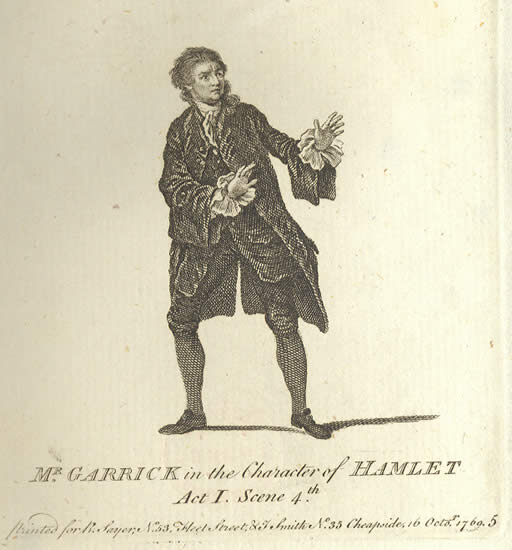
First performed in London in 1741, The Lying Valet was written by David Garrick. “If there was one name to know on the London stage in the 18th century,” as we’ve noted in a previous blog, “it was David Garrick. As a writer and actor, he was synonymous with celebrity” and was one of the leading thespians of the time.
Etching of David Garrick in Hamlet from Dramatic Characters, or Different Portraits of the English Stage, 1773. Public Domain. Credit: Wikipedia
The Lying Valet was performed many times in the British Colonies and perhaps could have even been the very first play that life-long theatre fan George Washington ever saw! As noted in an account ledger he kept, twenty-year-old George saw a play for the first time ever on June 2, 1752 during June Fair in Fredericksburg. June Fair was a annual community gathering where Fredericksburgers and other Virginians sold farm goods and land, settled debts and tried court cases, gambled on horse races, and enjoyed a play. Whatever the play was that Washington saw on that day in 1752, it was performed by the Murray-Kean Company of actors. Intriguingly, The Lying Valet was indeed one of the plays in their repertoire but there is no way to know if the play was performed on that day at June Fair.
The Lying Valet tells the story of William Gayless, who lost all of his money after a series of bad choices. Left only with one chair, Gayless attempts to rectify his situation by marrying the rich young lady Melissa, whom he has come to care for, despite the advice of his servant. Timothy Sharp, Gayless’ lying valet, finds himself weaving a few lies to save face for his master, all the while Kitty Pry, a servant to Melissa, attempts to uncover the truth. One thing leads to another as Sharp finds himself caught on the brink of disaster, and it looks as though Gayless will never have a wedding. Will everything end happily, or will lies, consumption, Frenchmen, drunk cooks, half truths, and a significant lack of funds ruin the whole plot?
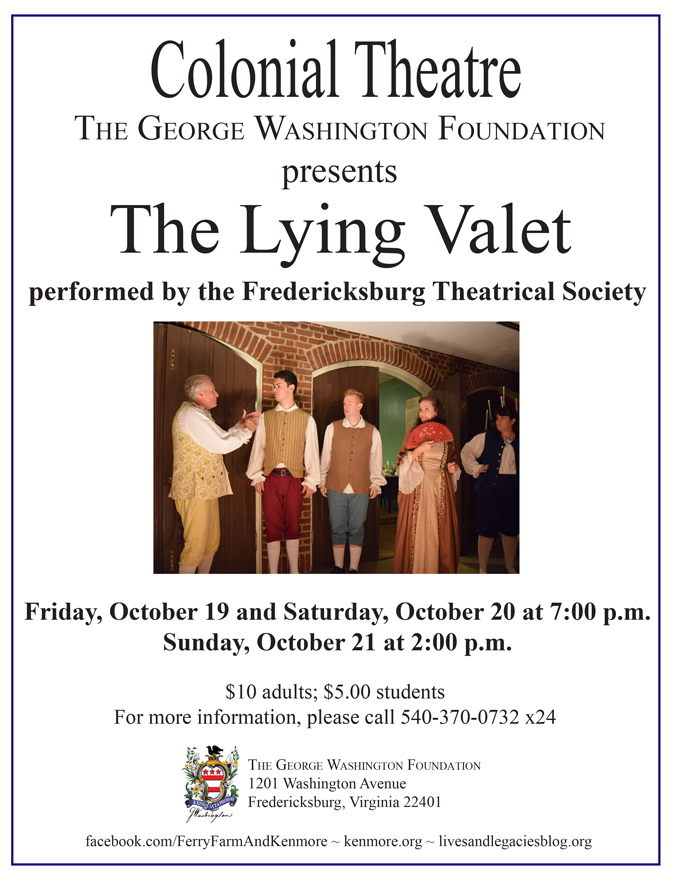
This weekend’s performances of They Lying Valet take place at 7:00 p.m. on Friday, October 19 and Saturday, October 20 with a 2:00 p.m. matinee on Sunday, October 21. Admission is $10 for adults and $5.00 for students. Pre-purchase of tickets is not necessary as payment will be taken at the door. The performances take place in the Crowninshield Museum of Historic Kenmore at 1201 Washington Avenue in Fredericksburg.
Theatre is one of America’s most popular and thriving art forms. It has been a part of American culture since the early part of the 18th century. The development of theatre in the earliest American colonies in New England was prohibited because of those colonists’ strong Puritan beliefs. Colonial America’s first theater was built in Williamsburg, Virginia in 1716 after a number of English actors arrived in the more-accepting South and began performing plays. Acting ensembles and student groups performed plays, which for the most part were amateur productions, in makeshift theaters and temporary venues—anything from a barn to a large tavern room. Eventually, theaters were built in other cities like Philadelphia in 1724, New York in the mid-1730s, and Charleston in 1736.
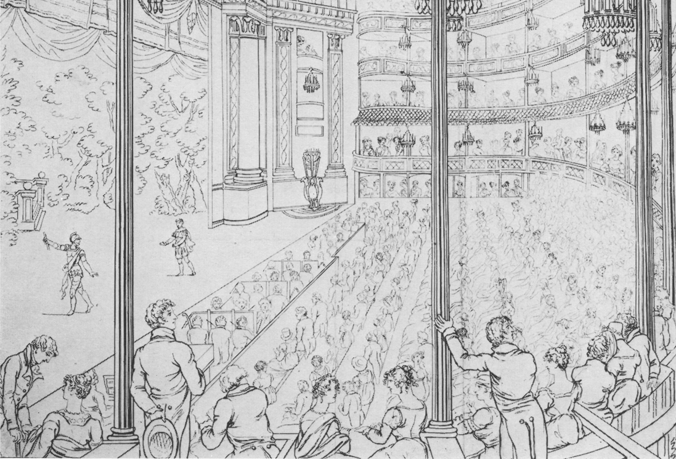
The typical colonial theater was not like the ornate theaters of today. Shaped like a shoebox, the stage occupied one-third of the space. The seating took up the remaining space. All different walks of life and classes came together to enjoy theatre performances from the boxes, the pit, or the gallery. The box seats were reserved for the wealthy, whose objective was to be on display for everyone while watching the play. The boxes were raised on the sides of the theater and faced each other and not the stage. The “middling sort” or middle class sat on the theater’s floor in the pit on wood benches. George Washington, a devoted fan of theatre, was said to have preferred watching from the pit despite being of the higher gentry class than other patrons seated there. The gallery was for the “lesser sort”—students, sailors, and even slaves – and was located in the area we’d call the balcony. In England, the lower sort could determine a play’s success and became known as “the gallery gods.”
This sketch of the Theatre Royal, Drury Lane, London in 1813 — not long after it opened — gives an idea of how one of the world’s finest theaters appeared in the early 19th century. Colonial America’s theaters would not have been this elaborate. Indeed, many of the acting companies traveling in the colonies performed wherever they could. Performances usually took place in taverns but sometimes even in barns. Credit: Public domain.
William Hallam and his brother Lewis Hallam were the first to organize a complete company of professional actors called The London Company of Comedians in Europe to bring to the American colonies. They had seen moderate success but then eventual failure in England, so they decided to try their luck in America. They had their first performance in Williamsburg in 1752, where they rented a large wooden structure which they altered to meet their needs. Their opening play was Shakespeare’s The Merchant of Venice, and music was supplied by a single player on a harpsichord. It was said that the venue was so near the forest that the players were able to shoot wild fowl from the windows of the building.
Nancy Hallam, a niece of Lewis Hallam, as Fidele in Shakespeare’s Cymbeline by Charles Willson Peale (1771). Credit: Courtesy of Colonial Williamsburg Foundation.
Lewis Hallam died in 1754 or 1755 in Jamaica where they had gone to perform, and his widow Sarah married David Douglass, manager of another company in the West Indies. In 1758 the companies merged and returned to New York City with Douglass as manager. The Hallams’ son Lewis Hallam Jr. was an actor and star of the company. Responding to a growing sense of national pride, they renamed themselves the American Company of Comedians in 1763. They toured and converted theatres up and down the East Coast including the Southwark Theatre in Philadelphia, the first permanent playhouse in America and built in 1766. They also built the John Street Theatre, later known as the Theatre Royal, in New York in 1767. The Prince of Parthia, a Neo-Classical tragedy by Thomas Godfrey, was the first stage play written by an American to be presented in America by professional actors on April 24, 1767.
There were frequent attempts to ban plays during the Revolutionary War including a 1774 decision by the Continental Congress. This was a result of the opposition to British imports, as most plays were from England, as well as objections to the supposed frivolous nature of drama and other entertainments during a dangerous political crisis.
Once America gained independence from Britain, theatre began to flourish again as a national cultural art form. Restrictive wartime legislation was soon repealed and theaters opened across the country, including in formerly anti-theatre New England. By the end of the 18th century, American theatre was a rapidly growing, socially acceptable art-form, and it continues to thrive today throughout the country.
Jessica Burger
Manager of Marketing, Communications, and Technology
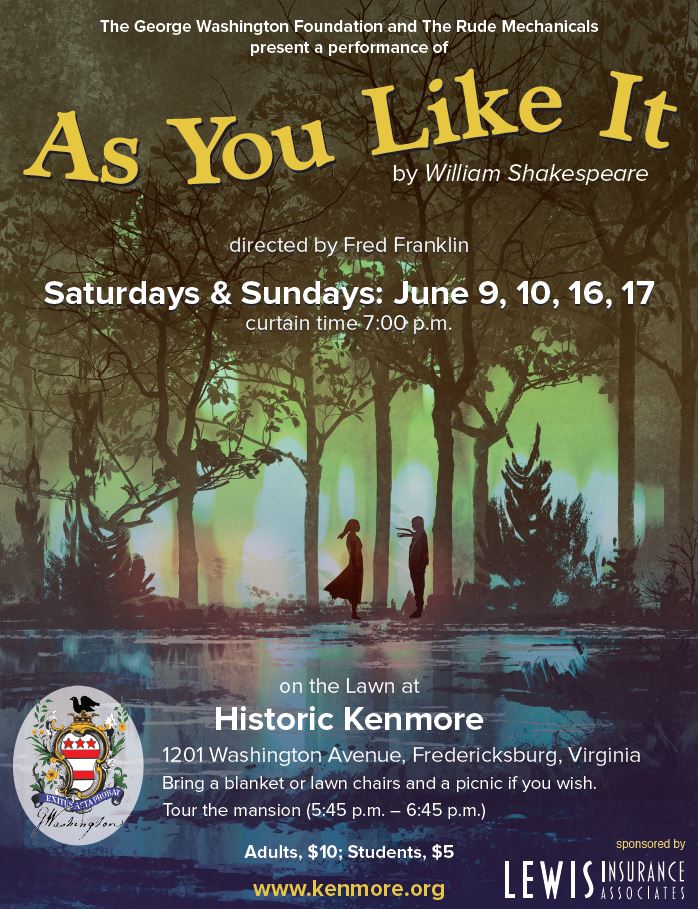
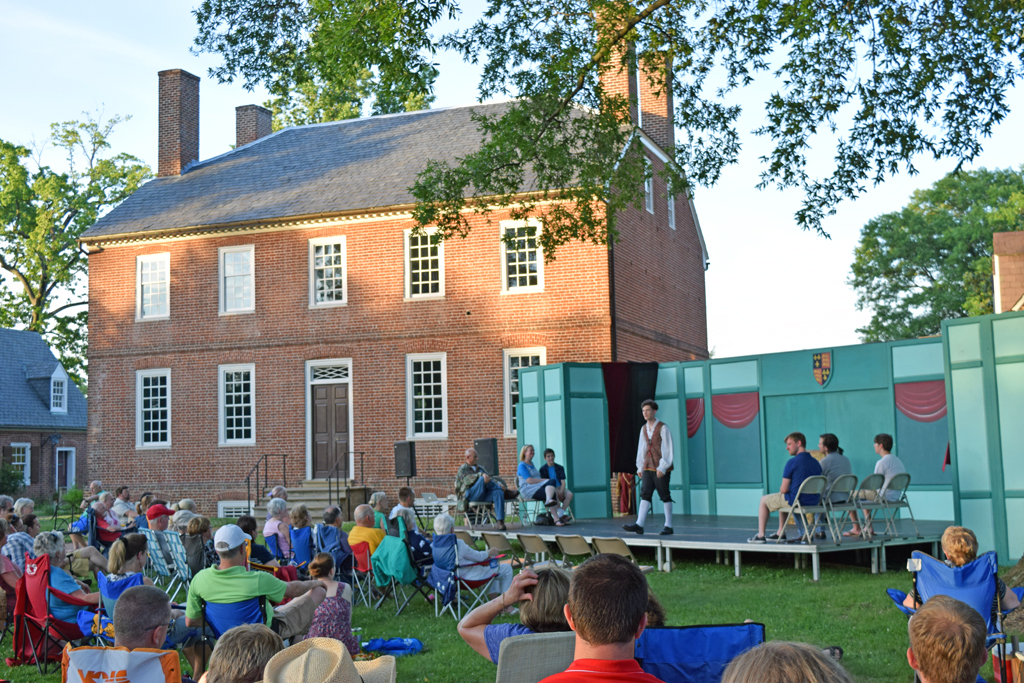
View theatre as many did in the 18th century—outside! Shakespeare on the Lawn at Kenmore returns for its fifteenth year with performances of As You Like It—Saturdays and Sundays: June 9-10 and 16-17, 7:00 p.m. Arrive early to tour the mansion and view the refurnishing. Bring folding chairs or a blanket, and maybe bring a picnic supper to enjoy.
Sources:
Peter Holland and Michael Patterson, “Eighteenth-century Theatre,” The Oxford Illustrated History of Theatre, John Russell Brown, ed., New York: Oxford University Press, 2001: 255-298 http://thowe.pbworks.com/f/eighteenth.century.theatre.pdf [accessed May 25, 2018]
Shakespeare on the Lawn at Historic Kenmore returns this coming weekend with two more performances of Much Ado About Nothing. Catch one of the final shows at 7:00 p.m. either on Saturday, June 17 or on Sunday, June 18. Arrive early to tour the mansion and view the refurnishing. Bring folding chairs or a blanket and a picnic. Thank you to sponsor Lewis Insurance Associates. More event details are here. In the meantime, enjoy these scenes from last weekend’s performances!
A beautiful evening for a play on Kenmore’s lawn!
The audience awaits the evening’s entertainment.
Before the play, which was set in the 1940s, singers and a jazz band entertained the audience with music from the era.
Leonata (Amy Wolf) receives word that Don Pedro is returning home from war.
Benedick (Zach Brown) and Beatrice (Sarah Hall) spar verbally.
Claudio (l-John Flemming) talks with Don Pedro (r-Marcus Salley) about how he is smitten with Hero.
Beatrice and Benedick dance at the Masquerade Ball.
Don John (r-Rae Ehlen) schemes with Borachio (l-Dylan Miles) to prevent Claudio and Hero from falling in love.
Claudio proposes to Hero (Corinn Keene).
Pedro and Leonata scheme with others to make Beatrice and Benedick fall in love.
Antonio (Paul Kartage) joins the scheme.
After hearing that Beatrice is in love with him, Benedick decides her love must be requited even though he vowed to always be a bachelor.
Hero schemes with her cousins to get Beatrice and Benedick to fall in love.
The Watch (l to r-John Flemming, Zach Brown, Erica Turner) receives instructions from Dogberry (center-Marcus Salley) while Verges (far left-Jeffery Bare) listens.
Claudio accuses Hero of unfaithfulness and leaves her at the altar.
Beatrice asks Benedick to kill Claudio for what he’s done to Hero.
The Watch captures Borachio and his friend Conrad (center seated-Claudio Manno) and bring them to Dogberry and the Sexton (far left-Paul Kartage). Borachio confesses that Hero’s unfaithfulness was staged by Don John.
Claudio and Pedro visit what they believe is Hero’s grave.
Hero, who was thought to be dead, is revealed to Claudio to be very much alive.
Beatrice and Benedick finally confess their love for each other.
On Friday, January 6, Saturday, January 7, and Sunday, January 8, Historic Kenmore will again present Twelfth Night at Kenmore, a dramatic theater presentation set in January 1776. It is the first Christmas that Fielding and Betty Washington Lewis celebrate in their newly built home. It is not the usual celebration, however. War brings fear, doubt, and frustration to the Lewis family and their friends. Immerse yourself in the experience the candlelight, music, and decorations of an eighteenth-century Christmas!
This past weekend was Shakespeare by Candlelight at Historic Kenmore! William Shakespeare’s The Taming of the Shrew was presented in eighteenth-century style on the Lawn at Kenmore on Friday and Saturday nights and, because of a thunderstorm, indoors on Sunday night. Enjoy this collection of photographs from the Saturday and Sunday performances. Learn more about The Taming of the Shrew’s history here.
Scene from Shakespeare’s “The Taming of the Shrew” or “Katharina and Petruchio” (1809) by Washington Allston. Public domain. Courtesy of Philadelphia Museum of Art/Wikipedia.
When we look at the history of Shakespeare in America the preference for his classic tragedies is obvious. Romeo and Juliet and Richard III are two of the three most-performed plays of the 18th century (George Farquhar’s The Beaux Stratagem rounded out this top three). While this ranking is based on surviving records of theatrical productions and therefore incomplete, it is still quite apparent that the Bard was unmistakably popular.
Of those oft performed favorites, tragedy wins out. Of the 13 different Shakespeare plays performed in Colonial America, the only comedy was The Merry Wives of Windsor. Why? Was it the general sentiments of an American audience? Was it a larger issue of theatrical expectations? Why didn’t American audiences watch Shakespeare’s comedies?
It is not because the people didn’t want comedies. Just like today, people liked to be entertained and for everyone who loves a heart breaking tragedy, there is someone who would prefer a light-hearted comedy. Comedies were actually wildly popular in colonial America, even beating out many tragedies in popularity! The aforementioned The Beaux Stratagem was one such comedy, as was John Vanbrugh and Colley Cibber’s The Provoked Husband and David Garrick’s The Lying Valet, which were also reportedly performed with regularity.
In colonies opposed to theatre based on moral grounds (think New England), a belief in the inherent sinfulness of plays and entertainment meant that, if theatre was to make its way into these colonies, it should certainly avoid comedies as they were usually rife with scheming rakes (The Beaux Stratagem), irascible wives (The Provoked Husband), and lying servants (The Lying Valet).
Tragedies, however, could be held up as moral lessons. One such play that was extremely popular in the colonies (even though it had fallen out of favor in London) was The London Merchant or The History of George Barnwell. It was a contemporary tragedy that told of a young man whose life had promise and success until he met a conniving woman who tempted him to steal, lie, and cheat for her love. He succumbed to those sins and they ultimately led to his untimely death.
The American Company of Comedians tried to break into the New England market with Othello, but instead of advertising it as a play they described it as “Moral Dialogues… in Five parts, Depicting the Evil Effects of Jealousy and other Bad Passions, and Proving that Happiness can only Spring from the Pursuit of Virtue.”
Such moral apprehension about theatre was nearly non-existent in Virginia. Why do we not see more of Shakespeare’s comedies in Virginia? The lack of comedy performances was also due to the theatrical expectations of the time. Theatre-goers knew that their evening at the playhouse would consist of two plays: a mainpiece and an afterpiece.
The mainpiece was the first play of the evening. It was longer and typically a tragedy or ballad opera (the musicals of the day). While it wasn’t impossible to see a comedy first, mainpiece was traditionally the more serious portion of the evening.
The afterpiece was always much shorter and typically a light-hearted comedy, farce, or romance. This division of the evening into mainpiece and afterpiece meant that there just wasn’t any real place for Shakespeare’s comedies. They were either too light-hearted to be a mainpiece or too long to be an afterpiece.
Shakespeare’s plays, however, did what they always do: they got with the times. Eventually, the Bard’s comedies transformed into shorter afterpieces and one of the most popular comedic afterpieces performed in the colonies was Catherine and Petruchio, essentially a shortened version of Shakespeare’s The Taming of the Shrew. It maintains most of the confrontations between the titular characters and their epic battle of the sexes, a theme popular in many contemporary farces.
The title page from the first quarto, printed in 1631 Quarto of A wittie and pleasant comedie called The Taming of the Shrew. Courtesy of Folger Shakespeare Library/Wikipedia.
Despite American audiences’ preference for the tragic tales of William Shakespeare, his comedies were not lost, only transformed. Indeed, the Bard flourished on early American soil.
Joe Ziarko
Guest Contributor
Enjoy an evening of history and entertainment under the stars on the Lawn at Kenmore with a performance by candlelight of William Shakespeare’s Taming of the Shrew, staged in an eighteenth-century style om August 12, 13, & 14 starting at 8:00 p.m.
Taming of the Shrew was presented in colonial Virginia, and the prologue of the play includes an introduction to theatre in the American colonies, before the Revolutionary War.
$15 adults; $7.50 students For more information contact Vickie Hayes at 540-370-0732 or [email protected]. Candlelight tours of Kenmore offered from 6:45 p.m. – 7:45 p.m. Performance on the Lawn at Kenmore—please bring a folding chair(s).
Shakespeare on the Lawn at Historic Kenmore returns this weekend with two more performances of Hamlet. Catch the one of the final shows at 7:00 p.m. on Saturday, June 18 or Sunday, June 19. Arrive early to tour the mansion and view the refurnishing. Bring folding chairs or a blanket and a picnic! Thank you to sponsor Lewis Insurance Associates! Learn more at http://www.kenmore.org/events.html. In the meantime, enjoy these scenes from last weekend’s performances!