Lives and Legacies

Category: Theater and Theater History

  • Fredericksburg’s June Fair

    Ask someone to list traditional summertime activities and they will probably mention picnics, family reunions, beach vacations, mountain getaways, and baseball games. Their list is likely to include going to the fair as well.  The fair as a summer pastime is a long tradition and like many American traditions can be traced back to the age of Washington.

    In 1738, Augustine Washington moved his wife Mary and their five children, including six-year-old George, to Ferry Farm on the Rappahannock River opposite Fredericksburg, Virginia.  Coincidentally, in the same year, the colony’s General Assembly authorized two fairs to be held each year in Fredericksburg (pg. 35). This act built on an earlier ordinance passed in 1705 allowing for ‘markets and fairs’ as a necessary and civilizing element of early Virginian society.

    Although other cities held fairs, Fredericksburg was one of the few that held a fair in June.  Sometimes called June Fair, it was one of the oldest and largest in the colony.  June Fair and other fairs were “first and foremost a market ‘for the sale and vending of all manner of cattle, victuals, provisions, goods, wares, and merchandizes.’ Prizes, ‘or bounties,’ were sometimes offered for the best stock and poultry” (pg. 18).

    Pieter Angillis, 1685–1734, Flemish, active in Britain (from ca. 1715), Covent Garden, ca. 1726, Oil on copper. Pubic domain. Credit: Yale Center for British Art, Paul Mellon Collection
    Although this painting depicts a busy London agricultural market in the early 1700s, a similar hustle and bustle likely filled Fredericksburg during June Fair.  Covent Garden (1726) by Pieter Angillis, 1685–1734, Flemish, active in Britain (from ca. 1715), Oil on copper. Pubic domain. Credit: Yale Center for British Art, Paul Mellon Collection.

    Fairs were about more than agriculture, however. The importance of a summer fair was its ability to gather people from all over the surrounding counties to a single central location to conduct business and government and to offer social interactions and entertainments.  In an agricultural colony such as Virginia, homes and plantations were very distant from one another and, for much of the year, people hardly saw anyone besides their immediate neighbors and family members.  Most colonial Virginians traveled no more than fifty miles from home in their lifetimes. This made for an isolated existence focused on the constant attendance of crops. During natural seasonal breaks, however, farmers traveled to a town to sell those crops at the fair.

    Fairs were not just for farmers to sell. Court sessions, also known as ‘Public Times’, often coincided with fairs. Soon merchants and entertainers saw opportunity in the large numbers of people gathered together at the fair. Many people got paid or, more likely, an increase in credit and ready money made the fair a natural time to celebrate, entertain, gamble, and socialize.

    Among the amusements common to colonial-era fairs,

    “contests for prizes . . . in cudgeling, wrestling, manual-exercises, foot-racing, dancing, singing, violin-playing, greased-pig-chasing, etc. Prizes were offered to the most beautiful maid.  In towns large enough to warrant their attention, companies of actors sometimes arranged to give plays during fairs. Such plays, however, were held at the local play-house or theatre, and not on the market-square, where the fair usually took place” (pg. 19).

    For example, in 1752, an acting troupe known as “THE Company of COMEDIANS, from the new Theatre at Williamsburg, propose[d] … to proceed to Fredericksburg, to play during the Continuance of June Fair.” The troupe hoped “That all Gentlemen and Ladies, who are Lovers of Theatrical Entertainments, will favour us with their Company.”
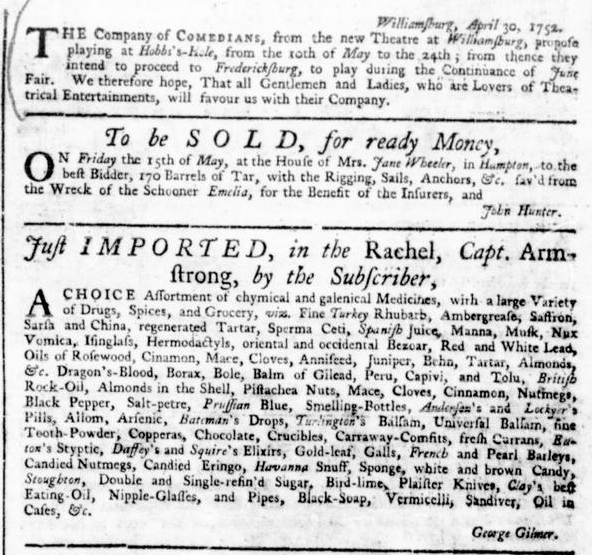
    Company of Comedians - Va Gazette
    Advertisement in The Virginia Gazette announcing the appearance of the Company of Comedians at June Fair in 1752.

    The fair brought people together to conduct more than agricultural business.  Indeed, “the fair was also a place where men met to make and pay debts. Land, houses, storehouses, and personal property were offered for sale at fairs — privately and by public auction” (pg. 18).

    During June Fair in 1751, 19-year-old George Washington auctioned off two of his lots in Fredericksburg.  His announcement of the sale in The Virginia Gazette offered the lots, “where Mr. Doncastle and Mr. Black lately kept Tavern, next June Fair, to the highest Bidder, for Cash or Bills. Eight Months Credit will be allow’d on giving Security, as usual” and was signed “George Washington.”
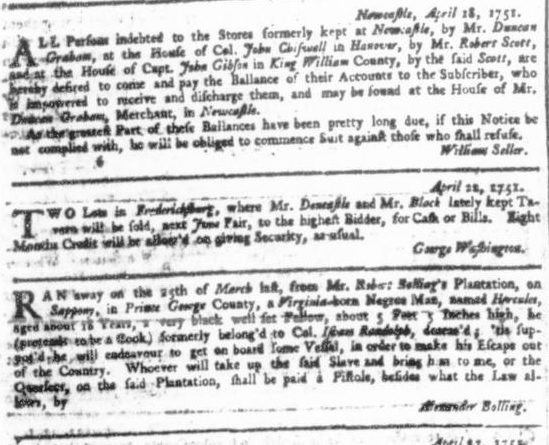
    Washington Virginia Gazette Ad
    Announcement placed in The Virginia Gazette by George Washington announcing his intention to auction off two lots of his land in Fredericksburg at June Fair in 1751.

    A decade later at June Fair in 1760, George’s account ledger shows him paying Fielding Lewis £40.  Furthermore, just few days before paying his debt to brother-in-law Fielding, George also bought tickets to a ball and lost money on a horse race, both popular fair activities.

    Indeed, “the most popular attractions of the fairs in Virginia and Maryland were the horse-races . . . held at race-tracks near the town. Purses were subscribed, and many gentlemen, who had no interest in the other activities, would attend the races” (pg. 19).

    Gambling at the fair, mainly in the form of lotteries, even supported more noble pursuits.  At June Fair in 1769, a lottery was undertaken to raise £450 for building a new church and for purchasing an organ for that church.  The drawing was to take place on “the 7th day of JUNE next (being the first day of the Fredericksburg fair) at the town-house” and was supervised and supported by a host of the town’s luminaries including Charles Dick, Hugh Mercer, Charles Washington (George’s brother), George Weedon, and Fielding Lewis.

    June Fair was a community event attended by Virginians from across the colony and brought George Washington back to his boyhood home on more than one occasion.  At the fair, Virginians sold farm goods and land, settled debts and tried court cases, enjoyed a play and gambled on the horses.  June Fair, much like today’s summer pastimes, was a moment in the year to enjoy the summer weather and the company of neighbors, friends, and family before returning to isolated plantations and farms and the unending work of plowing, planting, and harvest.

    Zac Cunningham
    Manager of Educational Programs

    Joe Ziarko
    Manager of Interpretation & Visitor Services
  • To See or Not to See? Portraying Hamlet in the 18th Century

    Editor’s Note: At the annual Shakespeare on the Lawn performances this June, Historic Kenmore will present Hamlet. The following blog post looks at the actors who played the most famous of Shakespeare’s roles during the 18th century. Details about attending the performances at Kenmore can be found at the end of this entry.

    Since the time when Richard Burbage of The Chamberlain’s Men first performed the role originally written for him by William Shakespeare, actors have long desired to play Hamlet.  As a character, Hamlet must convey both a flamboyant madness and a subtle deception, deliver long speeches of blank verse, and ultimately end the play with exhausting fight scene and tragic death. These highs and lows have made actors covet the complex role for centuries.

    In the 1700s, Hamlet was wildly popular in London in part due to famous portrayals by different actors. At the beginning of that century, Thomas Betterton was still portraying the young Prince of Denmark as he had first done on London stages back in 1661. Although his portrayal of the young Dane spanned 50 years, theatre-going Londoners still praised Betterton’s Hamlet into the eighteenth century.

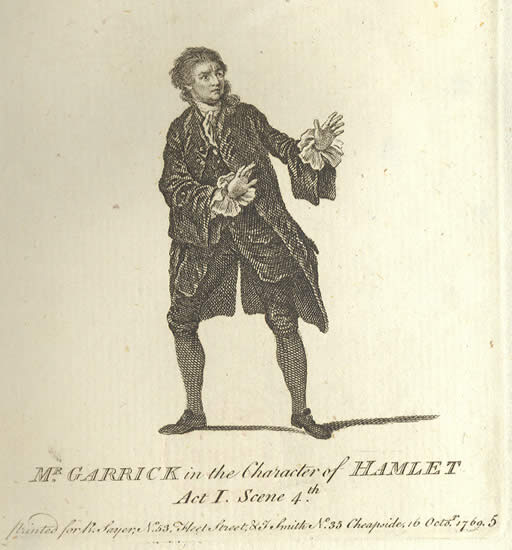
    If there was one name to know on the London stage in the 18th century, it was David Garrick. As a writer and actor, he was synonymous with celebrity. Garrick’s portrayal of Hamlet in the 1740s was one of the performances that made him into that celebrity. He would go on to perform his own adaptation of Hamlet, which omitted Ophelia’s and Gertrude’s deaths, readjusted act breaks, and reintroduced much of Shakespeare’s original text. The original text had slowly been stripped away throughout the 1700s due to the play’s length. It was Garrick’s unique theatricality that inspired him to employ a striking feature.  During the scene when Hamlet first meets the Ghost he wore a special wig with hair that could stand on cue to signifying his terror.

    Garrick as Hamlet
    Etching of David Garrick in Hamlet from Dramatic Characters, or Different Portraits of the English Stage, 1773. Public Domain. Credit: Wikipedia

    Not to be out done by men, actresses of the 18th century were also known to perform Hamlet on English stages. In what were known as ‘breeches roles’ at the time, it was common to see actresses step into men’s roles. However, this was far more common in comedies than in tragedies. Both Fanny Furnival (the first recorded female Hamlet) and Charlotte Charke (daughter of playwright and poet laureate Colley Cibber) played the role of Hamlet, albeit never on a London stage. The most famous eighteenth century female Hamlet to tread the boards was Sarah Siddons, who brought a respectability and gravitas to the role that raised the public esteem of actresses across England.

    Portrait of Mrs. Sarah Siddons (1755-1831)
    Portrait of Mrs. Sarah Siddons (1785) by Sir Thomas Gainsborough . Public domain. Credit: National Gallery, London

    While these different depictions of Hamlet are fascinating, they never crossed the Atlantic. In fact, the first group of professional actors would not perform in the colonies until 1752. At the center of this London Company of Comedians was the Hallam family. They came to the American Colonies in search of audiences seeking quality professional theatre. On September 15, 1752, their first performance was The Merchant of Venice in Williamsburg, Virginia. That evening would also be the debut performance of the young Lewis Hallam Jr., son of the company’s manger and leading lady. Lewis would go on to become the leading man of the company.  In the first recorded performance of Hamlet in the colonies in Philadelphia on July 27, 1759, the playbill lists 17-year-old Lewis in the title role.  He and his company would tour the colonies for the next 15 years until the American Revolution forced theatre from our shores.

    Company of Comedians - Va Gazette
    Hallam’s Company of Comedians announcing their intention to perform in Fredericksburg in The Virginia Gazette on April 30, 1752.

    Not all colonial Americans had the opportunity to see Hamlet upon the stage. Theatre was banned in Massachusetts throughout the colonial time period. Thus, Williamsburg was a frequent stop of Hallam’s company, which came to be called the American Company of Comedians. Of all the recorded performances in Virginia’s capital city, Hamlet is not listed, however. This does not mean that the likes of George Washington and Fielding Lewis could not have seen it.

    In fact, a playbill from May of 1771 reveals the American Company of Comedians performed in Fredericksburg, Virginia. This surviving playbill includes a handwritten addition of two performances, All in the Wrong and Hamlet. While the playbill does not include that evening’s cast, we can safely assume Lewis Hallam Jr. played the title role opposite Nancy Hallam as Ophelia.  We wrote about Nancy here last summer.

    If people are familiar with any words of Shakespeare, those words are most likely the beginning of Hamlet’s famous soliloquy: “to be or not to be?” But the real question for Shakespeare’s theatre going audiences has always been “to see or not to see?”  Ultimately, the decision was made based on the actor (or actress) playing the famous Dane named Hamlet.

    Joe Ziarko
    Manager of Interpretation & Visitor Services

    Hamlet Poster

  • Nancy Hallam: America’s First Celebrity Actress

    Virginia celebrates a proud theatrical history. It boasts the first recorded performance of a play in all the colonies.  It also claims the first permanent playhouse and the first evening of professional theatre. That first evening was in September of 1752 and was presented by Lewis Hallam’s London Company of Comedians. What set this company above others in the colonies was that they had actual experience with professional performances in London.

    At the center of this company was the Hallam family. The leader of the Company and patriarch of the family was Lewis Hallam.  Lewis’s brother sent him to Virginia to start a successful traveling company, which had never been attempted before by performers from England. With him, Lewis brought his wife Sarah, who starred as the new company’s leading lady, and three of their children. In a few short years, the company established itself as a clear success and, in spite of the loss of Lewis Hallam in 1756, the company continued to travel the colonies for almost twenty years.

    In 1765, Nancy Hallam, a young niece of Sarah’s, came from London to perform with the successful troupe now rechristened as The American Company of Comedians. Actually, Nancy may have been the same ‘Miss Hallam’ who played children’s roles with the Company in 1759 but this is uncertain. In 1766, Nancy starred in the ingénue roles and quickly moved up within the Company. In 1769, she took over the role of Juliet while performing in New York, marking her beginning as the company’s leading lady during which she starred in comedies, tragedies, and even ballad operas (the musicals of the age.)

    A playbill for the American Company featuring Nancy Hallam.
    A playbill for the American Company featuring Nancy Hallam. She is featured as the lead in Thomas Arne’s ballad opera Love in a Village.

    In 1770, the American Company returned to Williamsburg with their new ingénue and premiered with The Beggar’s Opera, the most famous ballad opera of the 18th century. This performance was undoubtedly chosen to display Nancy’s vocal talents; talents that both George Washington and Thomas Jefferson would have enjoyed as they were in attendance. Her talent as a singer as well as an actress was praised throughout the colonies. Her performance as Imogen in Shakespeare’s Cymbeline inspired one theatre-goer to write a glowing review in the September 6, 1770 edition of the Maryland Gazette.

    “She exceeds my utmost idea. Such delicacy of manner! Such classical strictness of expression! The musick of her tongue! The Vox Liquida, how melting!… How true and thorough her knowledge of the character she personated! Her whole form and dimensions how happily convertible, and universally adapted to the variety of her part.”[1]

    Nancy Hallam’s portrayal of Imogen caught the attention of another Marylander. After losing his father in 1750, when he was only 9 years old, the young Charles Willson Peale apprenticed as a saddle maker. After completing his apprenticeship and opening his own saddle shop, Peale realized his true calling was to become a painter.  He spent several years travelling the colonies as an amateur painter and met other early American artists such as James Claypoole, Jr. and John Singleton Copley (known for his portrait of Paul Revere). Eventually, Peale traveled to London to study portrait painting from 1767-1769. Upon his return to the colonies, he started taking up commissions around his home of Annapolis, a city the American Company frequented.

    In 1771, Peale painted Nancy Hallam portraying the famous ingénue Imogen in Cymbeline. The painting depicts her in what is known as a ‘breeches role’ where Imogen is hiding her true identity by posing as a male servant named Fidele.  Peale’s painting is the sole image of a professional actor from America in the period. It is also unique because it depicts a woman who is not wearing 18th-century women’s clothing.  The image gives great insight to the level of costuming that went into a professional production. It also illustrates the fashion of the time to dress servants in lavish and unique garb.  In this case, she is in what was known as ‘Turkish’ attire that includes a turban, long waistcoat, and wide loose breeches.

    Nancy Hallam as Fidele in Shakespeare's Cymbeline. 1771. Courtesy of Colonial Williamsburg Foundation.
    Nancy Hallam as Fidele in Shakespeare’s Cymbeline. 1771. Courtesy of Colonial Williamsburg Foundation.

    Peale’s career may have been just beginning, but the American Company and Nancy Hallam were not long for America. The same event  — The American Revolution — pushed one artist to prominence while pushing the others away. During the war, there was no place for frivolous evenings at the playhouse. Professional companies left the warring colonies and Nancy Hallam apparently retired from the stage.

    The year after he painted Nancy Hallam, Charles Willson Peale painted a Virginia Colonel and veteran of the French and Indian War at his home of Mount Vernon. This was not the last time George Washington sat for the painter. Peale is credited with painting the most images of the first President along with other early American notables. Peale also painted several portraits for the Lewis family: two of which hang in Historic Kenmore today.

    John Lewis by Charles Willson Peale. Part of the George Washington Foundation Collection. Currently on display in Kenmore.
    John Lewis by Charles Willson Peale. Part of the George Washington Foundation Collection.

    For a limited time, those portraits are joined at Kenmore by a reproduction of Nancy Hallam’s Cymbeline costume and a print of Peale’s portrait of her.  The costume and portrait are on loan to The George Washington Foundation from the Colonial Williamsburg Foundation.  They are on display in the Crowninshield Museum Building in the run-up to the production of Cymbeline during “Shakespeare by Candlelight” on August 14, 15, or 16.  For more details about attending a performance, which does require reservations, visit www.kenmore.org.

    Joseph Ziarko, Manager of Interpretation & Visitor Services

    [1] Johnson, Odai, The Colonial American Stage, 1665-1774: A Documentary Calendar, Cranbury: Associated University Presses., 2001, pg. 372.