Lives and Legacies

Category: Washington family

  • Behind the Glass of the Archaeology Lab: Creating an Exhibit

    It can be daunting to look at a blank space and realize you are in charge of filling it. And not just filling it, you need to create something that will leave a lasting impression on the public. The process of creating an exhibit is much more complicated than it seems. From the initial idea to the final product, there are many steps that require careful attention.

    With countless artifacts in the Archaeology Lab, finding inspiration for a topic was easy. Once I settled on 18th Century tea practices, everything seemed to fall into place. There were many subjects I could have focused on from this topic. In order to connect the idea to Ferry Farm and the Washington legacy, I chose to focus on Betty Washington and what she would have learned from her mother growing up at Ferry Farm.

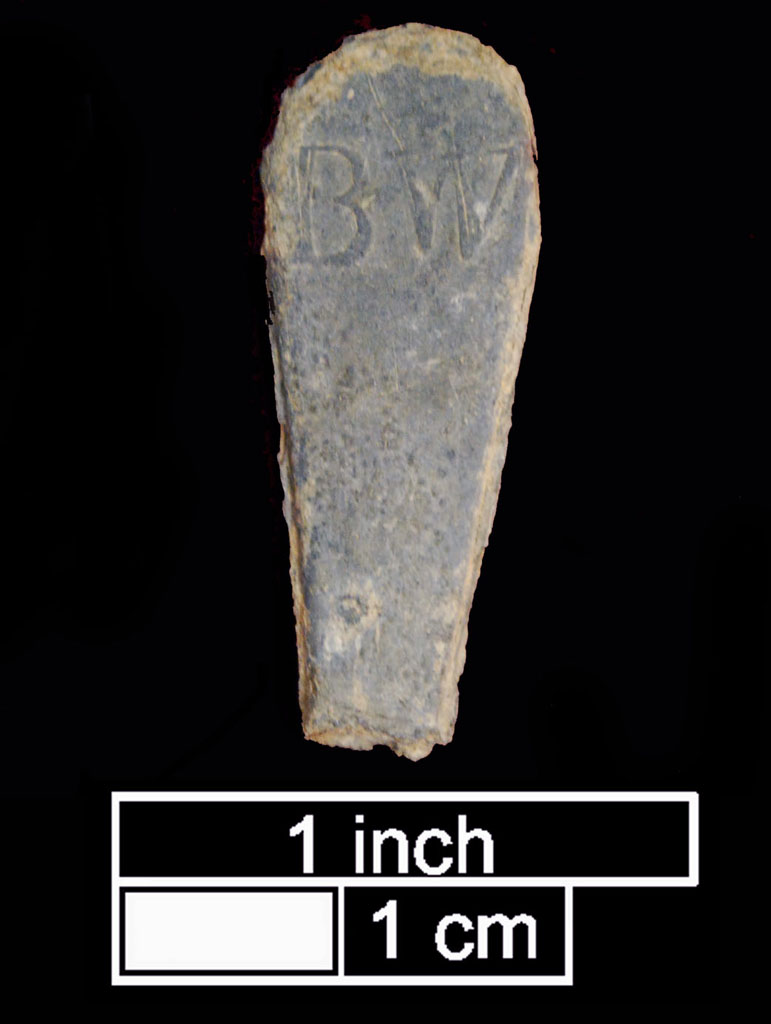
    This inspiration came from an archaeologically excavated pewter teaspoon handle with the initials ‘BW’ stamped into it. It is clear that Miss Betty Washington was the owner of this spoon. The spoon was likely part of a children’s tea set that Betty was given in order to teach her the intricacies of the American Tea Ceremony. This education was Mary’s legacy for Betty; it taught her how to be a proper gentry lady and interact with the upper-class circles in Virginia.

    Teaspoon handle with “BW” initials.

    Once I picked my topic, it was time to begin researching. Research is the backbone of any exhibit, though it might not be the most exciting part. I was able to obtain an understanding of the Tea Ceremony from my research that I applied to my specific topic. The biggest question on my mind throughout my research was: Why was this important for Betty?

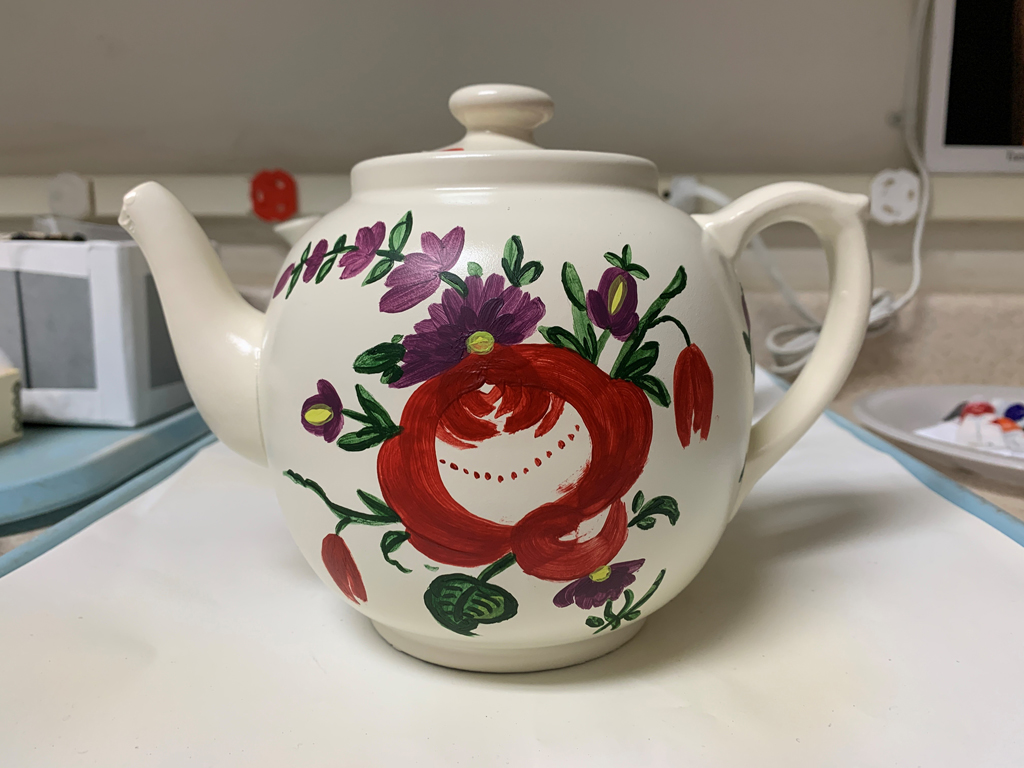
    While working on research, I was simultaneously creating a reproduction 18th Century creamware teapot. With the help of the Archaeology Lab Forgeries Department, I quickly transformed a Goodwill find into delicate creamware with a rose motif. The pot is the centerpiece of the exhibit on 18th Century tea practices. Many scholars wrote that the teapot is the literal and figurative center of the ceremony, bringing people together and initiating the ceremony. This concept inspired my placement of the teapot for the exhibit.

    Hand painting of reproduction teapot.

    After concluding my research, writing the signs for the exhibit, and finishing the replica pot, I had to choose the artifacts to include in the exhibit. Throughout this process, I kept my thoughts on Betty. The BW teaspoon handle was set aside for the exhibit as well as the replica teapot. Including teaware from Ferry Farm and Kenmore displayed the continuity of Betty’s gentry practices throughout her life. A slop bowl excavated from Kenmore, as well as a teacup and a saucer excavated from Ferry Farm were both chosen for the exhibit in order to support that point.

    Once this was all completed, the excitement truly began. I saw my work come to fruition when I set up the display in the conservation window of the Archaeology Lab. Being able to share what I had learned with the public was an excited prospect. The exhibit is currently on display and can be seen in the Ferry Farm Visitor Center.

    Intern Gillian Both standing behind her exhibit.

    This process has taught me a lot about exhibit design and the research process. I couldn’t have completed the exhibit without the Archaeology Lab staff helping me along every step of the way. I encourage you to go and visit the lab to see the exhibit and learn more about archaeology at Ferry Farm.

    Gillian Both

    Fleming Smith Scholar, UMW Class of 2022
  • What in the World is Twelfth Night?: A Visit with the Ghost of Twelfth Night Past

    Usually, at this time of year preparations are well underway for our annual Twelfth Night at Kenmore: A Dramatic Performance.  The play takes place in January 1776, during the first Christmas season celebrated at Kenmore. Unfortunately, this year’s celebration of Twelfth Night at Kenmore is canceled due to winter weather.  However, if you are familiar with the performance, or have read some of our past blog posts, you might already know a thing or two about this once popular Christmastide holiday. While traces of Twelfth Night still exist today, the celebration is much diminished, if not entirely eclipsed, by Christmas and New Year’s. Why is this, exactly? When did we stop celebrating Twelfth Night?

    There is no single, short answer as to why Twelfth Night celebrations fell out of fashion. Rather, attitudes surrounding the Christmas season changed throughout history, and old traditions were often absorbed or re-imagined into something new. A very brief look into the history of the season sheds some light on why today’s Christmas traditions rose in popularity, while Twelfth Night celebrations became part of Christmas Past.

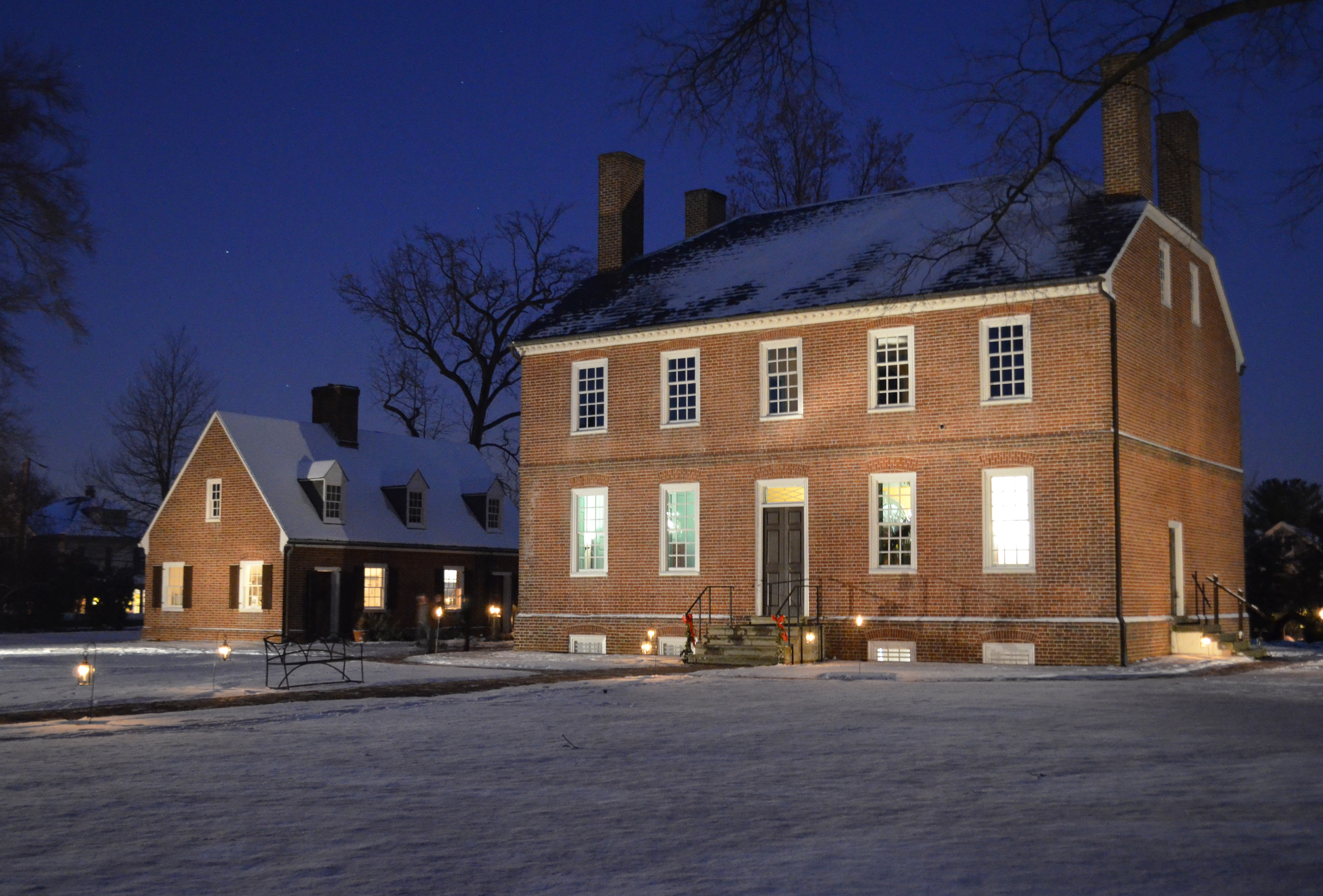
    Historic Kenmore on the eve of Twelfth Night. Credit: GWF Photo

    Many Christmas and Twelfth Night traditions are rooted in holidays celebrating the winter solstice. For example, Saturnalia, a holiday honoring the Roman god Saturn, took place in mid-December. During Saturnalia, the normal social order was temporarily overturned. Romans closed schools and businesses, held grand feasts, and in some families, a king or “Lord of Misrule” was chosen to rule over the household’s festivities.[1] In Scandinavia, people celebrated the winter solstice during the Nordic festival, Yule. Festivities included bonfires (or yule logs), evergreen decorations, and feasts. It wasn’t until the 4th century that the Roman church officially observed December 25th as Jesus’s birth date. Historians speculate that church officials chose this date precisely because so many popular winter celebrations occurred around that same time.[2]

    Saturnalia by Antoine Callet. Credit: Wikipedia

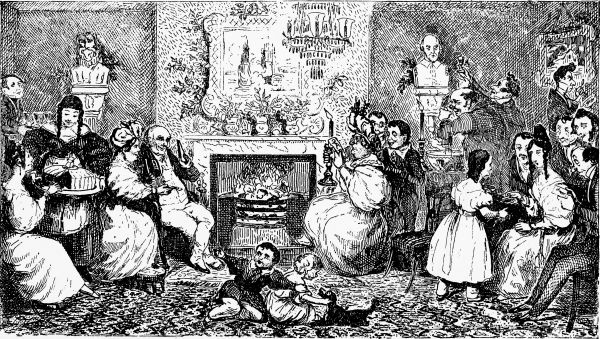
    If we fast forward in time, we see how some of these winter rituals were absorbed into the festivities of Twelfth Night. But first- what exactly is Twelfth Night? Typically celebrated on either January 5th or 6th, Twelfth Night, or Epiphany, is a Christian holiday that marks the end of the Twelve Days of Christmas and commemorates the Magi’s visit to Jesus. During the colonial era, the holiday season kicked off on December 25th and culminated on Twelfth Night. The twelve days after Christmas were full of games, music, dancing, feasts, and visiting with family and friends. Families often celebrated the season with a Twelfth Night Cake. Recipes called for a dried bean and pea to be baked into an elaborately decorated fruit filled cake. The man who found the bean was declared King for the night, while the woman who found the pea was declared Queen.

    Illustration of a Twelfth Night party by Robert Seymour. The woman on the far left serves pieces of a large Twelfth Cake. Credit: The Project Gutenberg

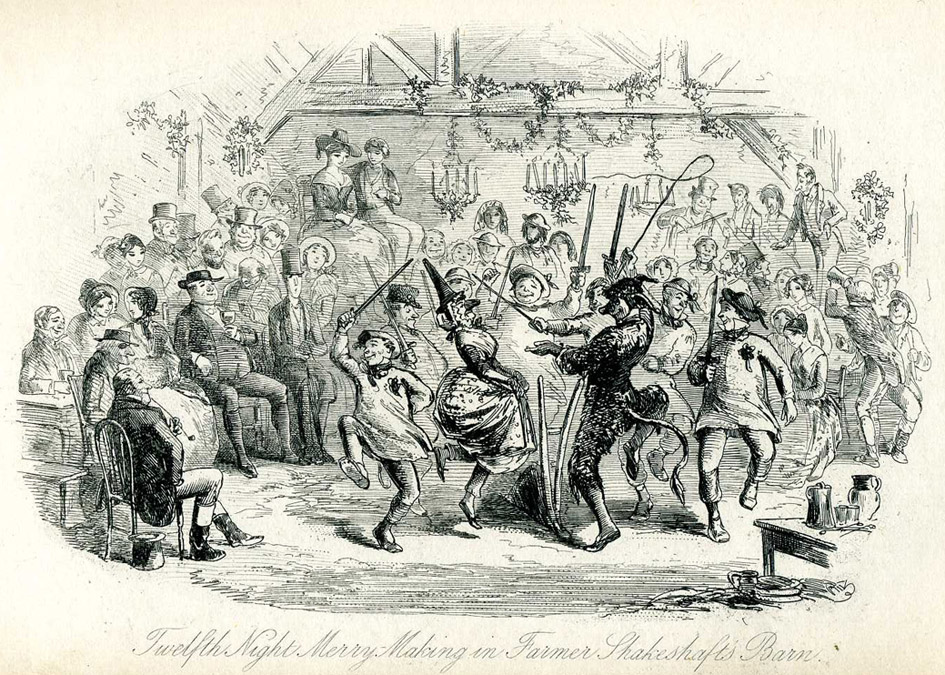
    Of course, there has always been debate surrounding how the Christmas season should be celebrated, and practices varied from place to place and person to person. In the 17th century, New England Puritans (echoing sentiments from Cromwellian England) viewed Christmastime celebrations as rowdy, excessive, and downright bacchanalian. Massachusetts went as far as to outlaw celebrations between 1659 and 1691.[3]

    The Twelfth Night party’s “King” and “Queen” sit on chairs overlooking the crowd. Dancing, drinking, and mumming (costumed acting) are in full swing. Puritans disapproved of these festive antics. Credit: Wikipedia

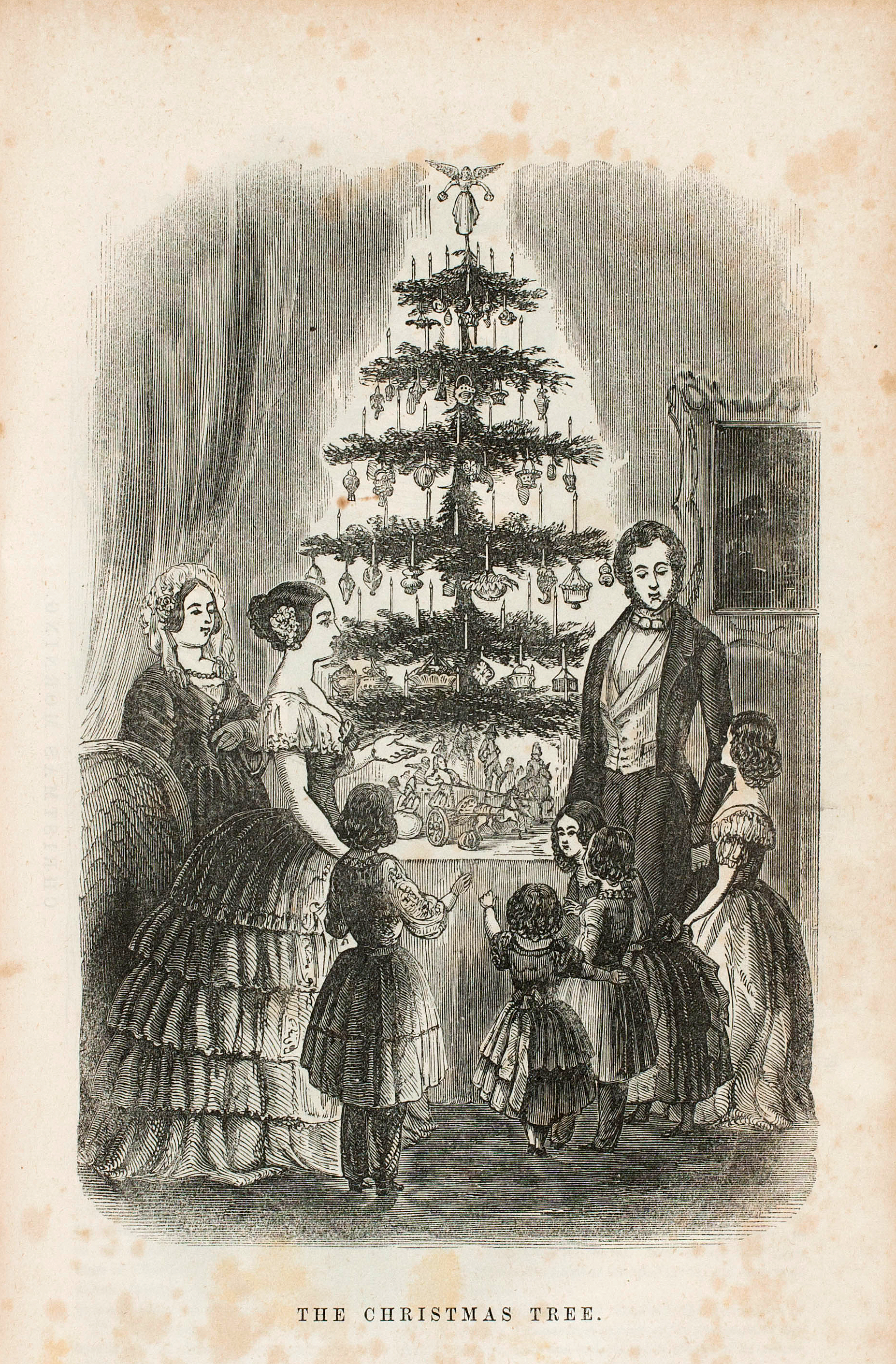
    During the 19th century, Queen Victoria influenced a shift in popular opinion towards a more family-focused Christmas season. In 1850, Godey’s Lady’s Book, a popular American magazine, published an image of the royal family gathered around a Christmas tree. While German immigrants had already introduced the Christmas tree tradition to America, this image fascinated the English and American public alike, and it further popularized the practice. In the American version of the print, editors removed Victoria’s tiara and Albert’s royal sash, and the group came to embody the ideal American family at Christmas.[4]

    Godey’s Lady’s Book illustration. Credit: Wikimedia Commons

    These changing ideals shaped the Christmas season during the Victorian era, and combined with rapid industrialization and commercialization, they sparked the beginning of a number of now familiar traditions. For example, improvements in mass printing technology popularized the practice of sending Christmas cards. In 1843, Charles Dickens published A Christmas Carol, a tale promoting charity, good will, and the virtues of a domestic family Christmas. Thomas Nast, who made popular the modern image of Santa Claus, published his first Santa cartoons in the 1863 edition of Harper’s Weekly.

    You might be asking, where then, does this leave the Twelve Days of Christmas and our Twelfth Night celebrations? As we’ve seen, changing ideals during the 19th century promoted a holiday season focused on children and family. Modern industry and commercialization further bolstered shopping and gift giving habits, and a twelve day holiday certainly didn’t fit within the parameters of the new industrialized era. The once twelve day celebration now culminated on one, and it was celebrated with visits from Santa and gifts for children, rather than with feasts and parties for adults.

    However, some Twelfth Night traditions live on during the modern Christmas season, albeit under new guises. Between Christmas and New Year’s, people may decorate their homes with greenery, raise a toast with a glass of wassail, or host extravagant parties with family and friends. If you visit New Orleans during the carnival season (beginning with Epiphany and ending on Mardi Gras) you might celebrate by eating “King Cake,” where the lucky person who finds the plastic baby figurine inside their piece of cake is crowned “king” for the day! That sounds a little familiar, doesn’t it?

    Ann Waters

    Manager of Interpretation and Visitor Services


    [1]“Saturnalia,” HISTORY, A&E Television Networks, Last modified December 18, 2020, Accessed December 22, 2021, https://www.history.com/topics/ancient-rome/saturnalia

    [2] Stephen Nissenbaum, The Battle for Christmas (New York: Knopf Doubleday Publishing Group, 2010), 4.

    [3] Bruce David Forbes,“Christmas,” In America’s Favorite Holidays: Candid Histories, 1st ed. (University of California Press, 2015), 28.http://www.jstor.org/stable/10.1525/j.ctv1wxrr3.5

    [4] Ibid., 34.

  • Dig These Dishes! We Recreate an 18th Century Table Setting Using Only Artifacts.

    Dig These Dishes! We Recreate an 18th Century Table Setting Using Only Artifacts.

    On a typical day at George Washington’s Boyhood Home at Ferry Farm, visitors experiencing the house tour are ushered into the main hall upon which a dining table is set out before them with 18th-century reproductions of plates, glassware, wine bottles, and serving dishes. This setting creates an interactive experience for our visitors, transporting them back in time to the mid-18th century when the Washington family lived here on site.

    Last month, however, an unexpected sight greeted a tour group as they entered the hall. The dining table was set, not with reproductions, but actual plates, jugs, and serving dishes that could very well have graced the Washington family’s dinner table over 250 years ago.  The principal difference is that nothing on the table was complete – all were fragmented versions of the originals. 

    Dining table in Hall set up for dinner.

    The setting was a special photoshoot for The George Washington Foundation and an occasion to display and highlight the array of vessels, many mended, residing in the Archaeology Department’s collection.  Everything on the table was archaeologically recovered from either Ferry Farm or Historic Kenmore and represent vessels that date to the Washington family’s occupation of Ferry Farm or Betty Washington Lewis’ time at Kenmore. 

    The Archaeology Department at Ferry Farm has been mending vessels over the past couple of years for our museum displays at the Ferry Farm and Kenmore Visitor Centers. This mending was also done for research purposes as the curatorial department worked to furnish the replica house with accurate, period-relevant household items.

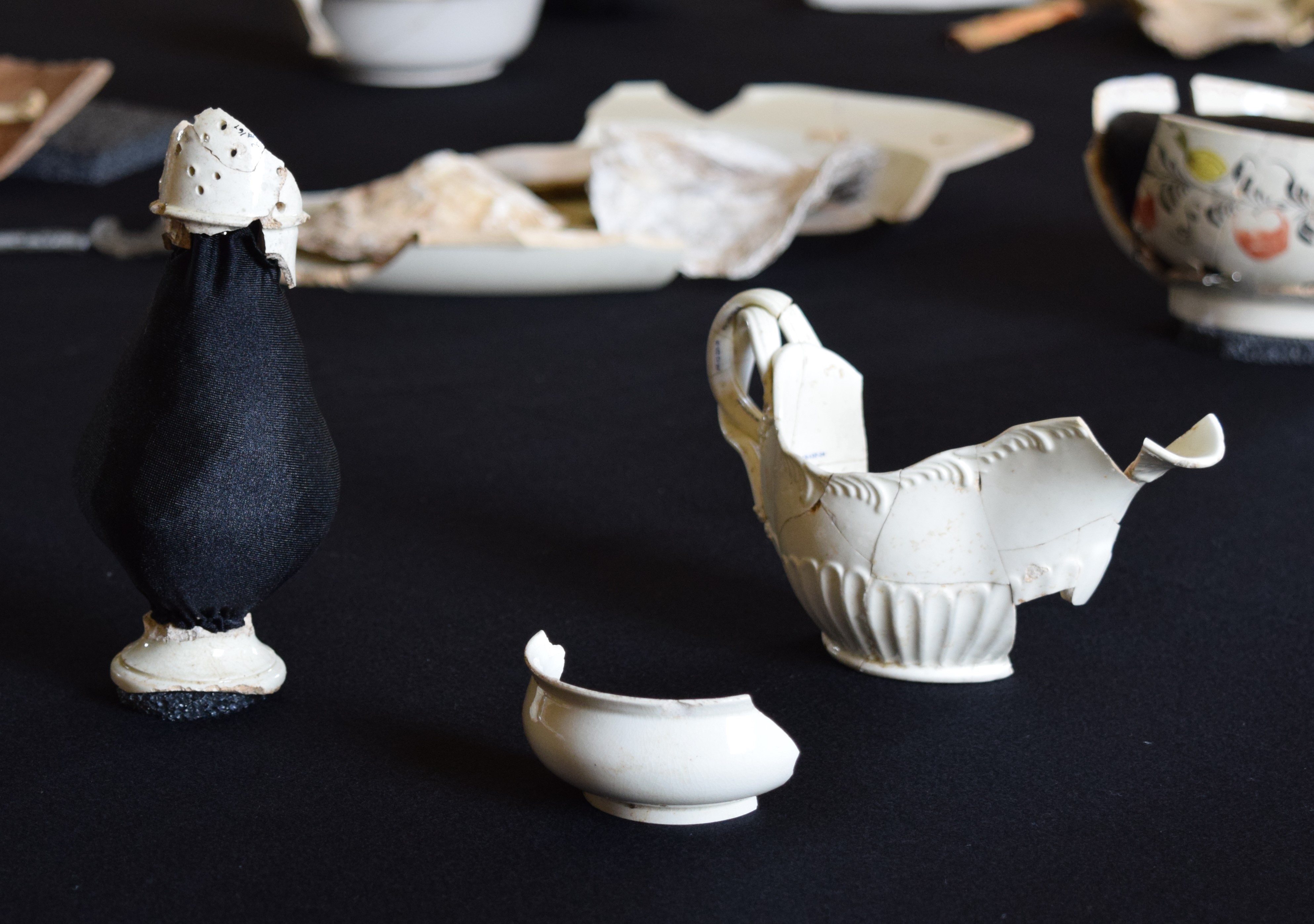
    So what is on the table? Creamware and white salt-glazed plates and serving dishes, glass tumblers and wine glasses, German stoneware jugs, dark green glass wine bottles, a porcelain teacup, coarse earthenware porringers, forks and knives with bone handles, silver spoons, and Mary Washington’s creamware enamel-painted punch bowl.  Many of the ceramic tablewares and a few of the glass tumblers were mended using archival glue.  Some of the objects were able to stand on the table unaided, while others needed mounts for support, such as the wine glass.

    Fragments of dinner and glasswares

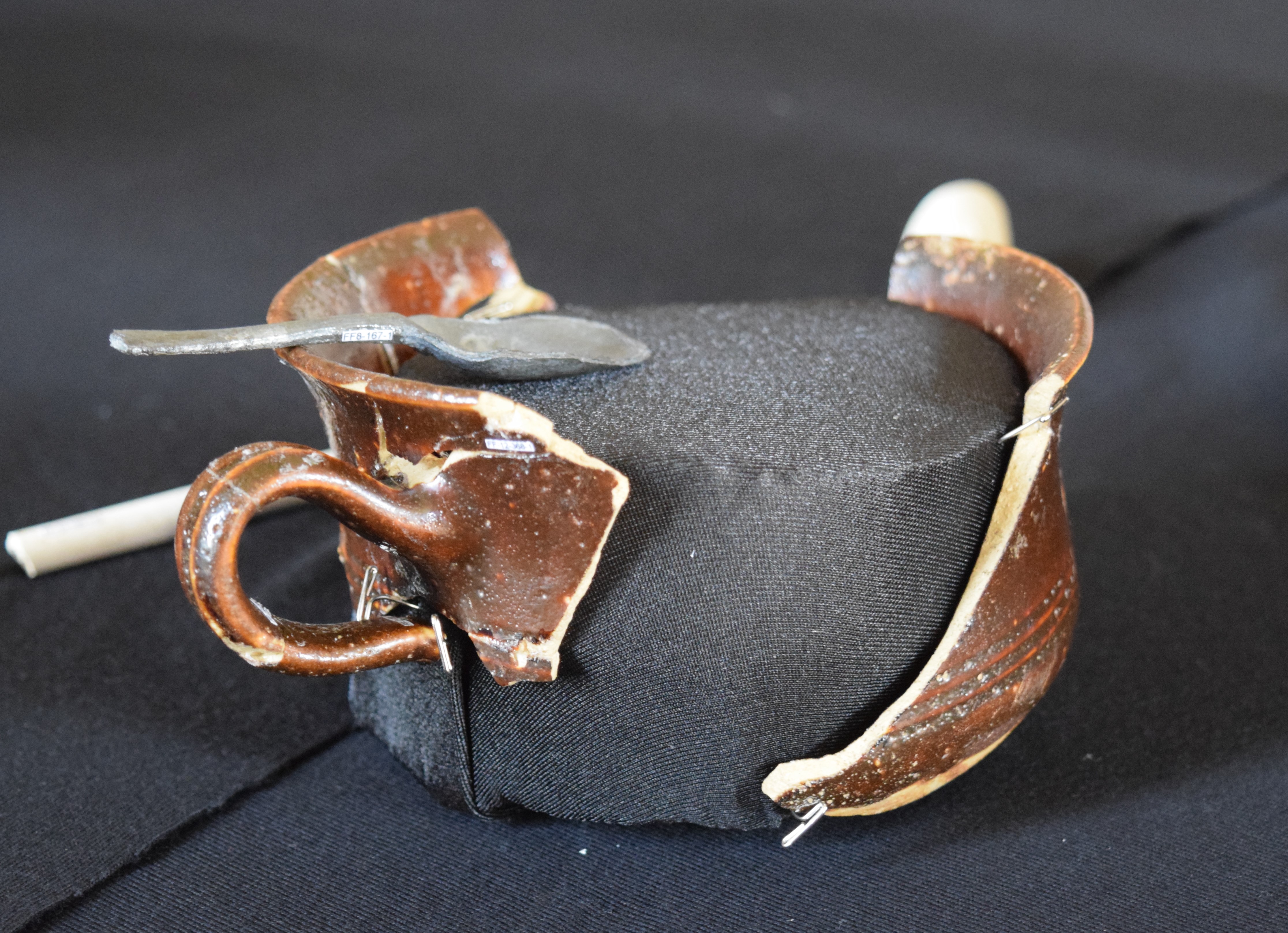
    To help envisage the original shape of some of the fragmented vessels and make them recognizable, we first sculpted their shapes out of foam, covered them with fabric, and then attached the incomplete vessel fragments in their correct positions. This process allowed us to present a more “complete” and familiar view of some of the tablewares, such as the two large stoneware jugs, the creamware pepper pot, the glass tumbler, and the two wine bottles. All of these items would have been very difficult to display simply using the fragments themselves. 

    Having such an array of different ceramic styles on the table is more a function of what we have mended in our collection versus what Mary might have actually had on her table.  But for our purposes, we are happy showcasing all of the different ceramic types presently in our possession.

    Welcome to the Washington dining table! Enjoy!

    Judy Jobrack, Archaeologist
    Co-Field Director

  • A Gift Across the Seas: Betty Washington’s Silver Tea Set from Her Uncle Joseph Ball

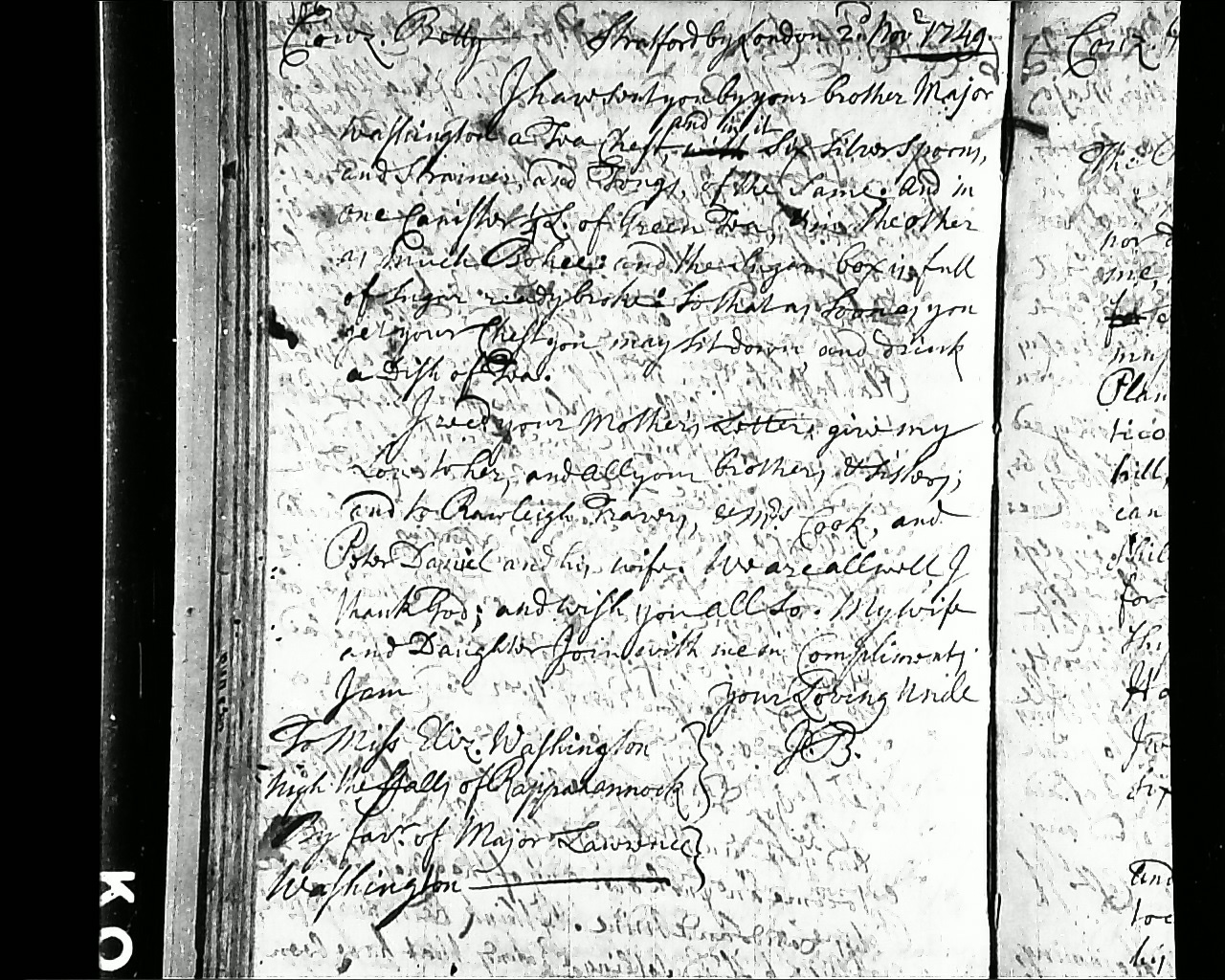
    Couz. Betty                                                     Stratford by London 2nd [Nov] 1749
                I have sent you by your brother Major Washington a Tea Chest; and in it Six Silver Spoons, and Strainer, and Tongs, of the Same. And in one Canister 1/2 L. [pound] of Green Tea, in The other a Pinch Bohee: and the Sugar box is full of Sugar ready broke: So that as Soon as you get your Chest you may Sit down and drink a Dish of Tea.
                I read your Mother’s letter, give my Love to her, and all your brothers, & sisters; and to Rawleigh Travers, & Mrs. Cook, and Peter Daniel and his wife. We are all well I thank God; and wish you allso. My wife and Daughter Join with me in Compliments.
    I am                                                                                                               Your Loving Uncle
                                                                                                                                  J.B
    To Miss Eliz. Washington                                                                                                                              
    nigh the Falls of Rappahannock
    By [fav.] of Major Lawrence Washington

    In 1749, one year before her marriage to Fielding Lewis, Betty Washington received a valuable gift – a silver tea set and other tea equipment – from her Uncle Joseph Ball in England. Tea equipment at this time was still expensive and the tea ceremony was reserved for upper class individuals. By providing Betty with equipment for such an important ceremony, Joseph Ball was helping prepare his niece for success in the gentry class. He provided silver teaspoons, a strainer, tongs, and a tea canister– four of the necessary pieces of equipment for the tea ceremony. Other items needed for the ceremony included a teapot, slop bowl, milk or cream container, sugar container, cups, and saucers.[i] Mary Washington provided these pieces for Betty while she lived at Ferry Farm, using them to teach her daughter how to host the important ceremony.

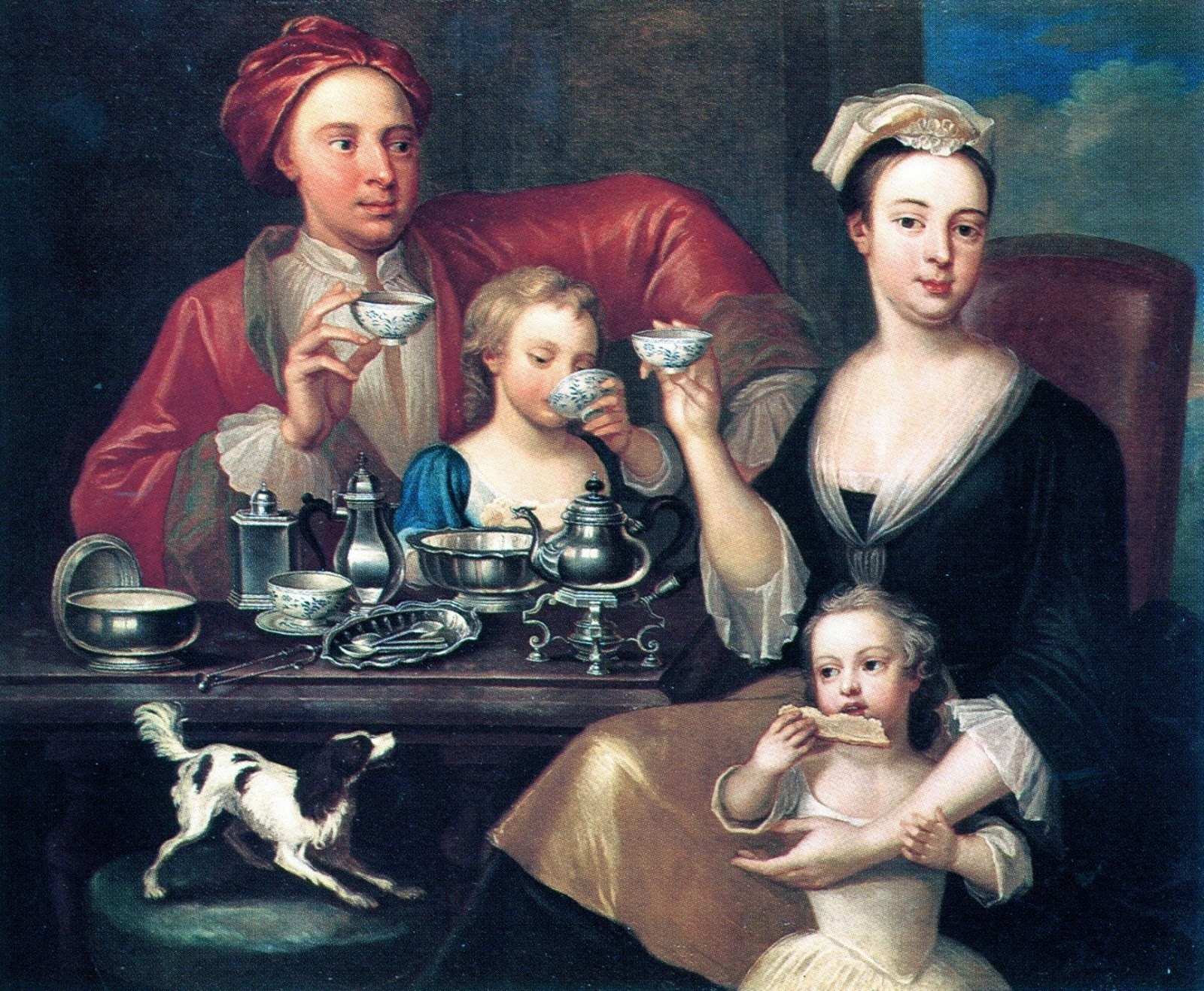
    The tea ceremony was a popular social event in 18th-century American culture. First and foremost, hosting or attending a tea party was a symbol of class.[ii] It was typical for gentry class individuals to participate in this leisure activity as a way to deepen or forge relationships within their community. Only an individual who was part of this class could afford the time and money required to learn the social graces and equip the table for the ceremony. The Washingtons worked hard to project an image of gentility through their material consumption. Participation in the tea ceremony was essential for this image. Mary took the time to “bequeath gentry-level domestic culture and etiquette to her children,” keeping them in leisure class circles.[iii]

    An English Tea Party (c. 1730) by Joseph Van Aken. Credit: Wikipedia

    Within the leisure class the tea ceremony was considered, “as much an instrument of sociability as was a bit of music or conversation.”[iv] With its rules that dictated everything from table arrangement and conversation to order of events, the ceremony was complex. Mastery of the ceremony, especially for women, was key to one’s reputation within social circles. Mary and Betty Washington used the intricate event to maintain the family’s social standing and to interview suitors for Betty. As the oldest daughter, Betty was trained for this ceremony from a young age. She would likely have been the host of numerous tea parties at Ferry Farm before her marriage. Perhaps even using the silver tea set from her uncle during some of the events.

    Replica teapot.

    The social custom of the tea ceremony revolved around the teapot, thus earning it a spot at the center of the tray or tea table.[v] The archaeology department at Ferry Farm recently produced a replica teapot for display in an upcoming exhibit on 18th-century tea practices. This replica will serve as the centerpiece for the exhibit and be surrounded by archaeological artifacts and contemporary examples representative of the Washington family’s tea practices. The exhibit can be viewed through one of the windows into the Archaeology Lab starting December 1. Add George Washington’s Ferry Farm to your list of places to visit during the holiday season to see this small tea exhibit!

    Gillian Both, UMW ‘22
    Fall Fleming Smith Scholar


    [i] Rodris Roth, Tea Drinking in 18th-Century America: Its Etiquette and Equipage (Washington: Tea Trade Mart Publishing Co., 2017), 24.

    [ii] Ibid., 1.

    [iii] Laura J. Galke, “The Mother of the Father of Our Country: Mary Ball Washington’s Genteel Domestic Habits,” in Northeast Historical Archaeology 38 (2009): 33.

    [iv] Roth, 23.

    [v] Roth, 49.

  • Mary’s Dishes [Video]

    In this video, archaeologist Mara Kaktins shares bits of Mary Washington’s dishes excavated at Ferry Farm and explains their significance.

    Read more about Mary’s dishes in this blog post.

  • Appearance is Everything: Mary Washington and Her Specialized Ceramics of Gentility – Some Seriously Fancy Dishes!

    The story of Mary Ball Washington is one of overcoming a lifetime of adversity.  Often overshadowed by her larger than life son George, Mary’s place in history fluctuated from saint to shrew with many historians ignoring the obstacles she faced and overcame.  The archaeological record sheds light on some of the strategies Mary used to navigate her way through mid-18th century life as a widow while trying to maintain her own social status and that of her children.  Fragments of highly-specialized ceramics excavated at Ferry Farm, the plantation Mary called home for much of her life, speaks to her efforts.

    Specialized dishes are those designed for a very specific job unlike, say, a bowl which is multi-purpose.  We have uncovered evidence of many dishes Mary owned that fulfilled single tasks.  These type of ceramics are a sign of gentility. Most households could not afford these items and likely did not possess the resources to make the food and drink that they were designed to hold. 

    As the 18th century progressed, so did dining habits. Increasingly, people of means gravitated toward dinners with multiple courses of entrees, appetizers, beverages, and deserts. Previously, most meals consisted of large one-pot creations with multiple ingredients.  In order to pull course cooking off, one required the specialized dishes designed for serving multiple courses. 

    One prime example of such specialized dishes from Ferry Farm is Mary’s elaborately decorated creamware sauce boats.  The sauce boats are a luxury in and of themselves. They’re highly decorated and were very fashionable at the time.  Not only were they expensive, but they showed that Mary had the refinement to serve her guests the fancy sauces being introduced into colonial cooking.  They also indicated that she had a trained kitchen staff of enslaved workers capable of executing these new and intricate recipes. You never thought a sauce boat could hold so much meaning, did you?

    Portion of a highly-decorated creamware sauce boat that belonged to Mary Washington.

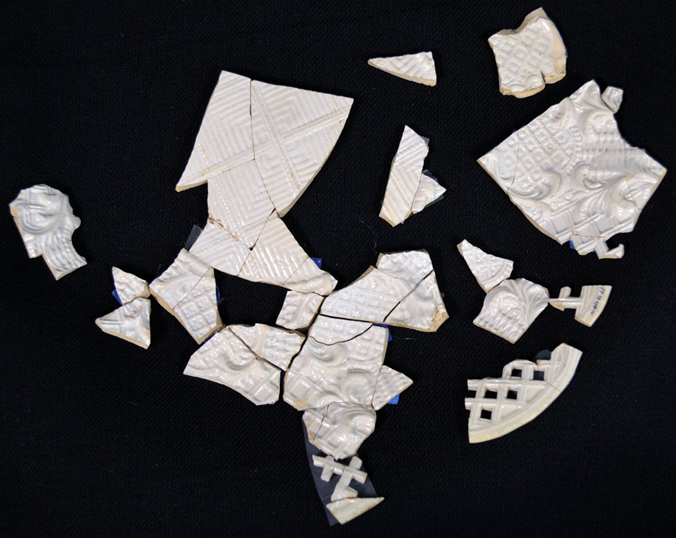
    Fragments of an extremely fancy white salt glazed fruit dish are further examples of Mary’s calculated purchasing of dishes.  Previously written about here and here, this dish was meant to display fruit, another luxury in the 18th century. Being able to afford non-local or out-of-season fruit was a status symbol and necessitated the proper dish to proudly display the fruit.  To put the rarity of fruit in perspective, in colonial America, pineapples were so expensive you could rent one for display at parties in the holiday season because most people couldn’t afford to buy one outright.  While renting a fruit may seem ridiculous to modern readers, the action highlights just how important being seen to own certain items was during the colonial era. Of course, we still engage in this same behavior today, but just not with pineapples.

    Fragments of a white salt-glazed fruit dish excavated at Ferry Farm and a complete example from the collection at Kenmore (above).

    Ferry Farm archaeologists also excavated fragments of two creamware condiment dishes.  Once again, the ability to serve various condiments to dinner guests conveyed status.  Condiments could include relishes, dips, mustards, ketchups (mushroom ketchup being the preferred type), and pickled vegetables such as capers.  Castor sets were also a way to serve other condiments such as olive oil, vinegar, pepper, etc. Generally, these castor sets were only owned by well-to-do households in the colonial period. The base of a creamware castor was recovered at Ferry Farm.

    Creamware castor base excavated at Ferry Farm.

    The fact that so many of Mary’s specialized ceramics are made of creamware should also be noted.  Creamware was invented in 1762 and wasn’t the most expensive type of ceramic (that was porcelain) but it was highly fashionable.  Mary, as a widow with five children and a diminished income following her husband’s death, likely couldn’t afford much porcelain. She opted for the less expensive but still highly-desirable creamware, instead.

    The Washington family went to great lengths to demonstrate their status and refinement to visiting friends, neighbors, and relatives.  At Ferry Farm, this burden fell solely on Mary after the death of her husband.  Her specialized ceramics served to illustrate her place within the gentry class despite her diminished income and refusal to remarry after being widowed.  Her goal was to remain independent while raising five children to be successful adults and members of the Virginia gentry class.  In doing so, she likely realized that the socioeconomic security of her children would ensure her own into the future as well. Consequently, it was important that Mary cultivate a refined household with appropriate table and teawares. Ceramic artifacts from Ferry Farm reveal a woman who carefully selected choice ceramics to perform very specific tasks, while at the same time not overextending her budget.  These ceramics contributed to her goal of remaining a part of the gentry class and teaching her children genteel habits so they could do the same. It was a task in which she overwhelmingly succeeded.

    Mara Kaktins, Archaeologist
    Ceramics & Glass Specialist

  • When a Spoon is More Than a Spoon: The Initialed Teaspoon of Betty Washington

    One of the most exciting and important discoveries archaeologists have made at Ferry Farm is a pewter teaspoon baring the initials B.W.  It belonged to Betty Washington.  This spoon was part of a set that trained her to oversee the extremely important tea ceremony.

    Serving tea in the 18th century was more than an act of providing a mid-afternoon refreshment or a small meal to family and guests.  Tea time, with its prescribed social behaviors and ritualistic customs of service, symbolized gentility and civility, and was an expression of social class.[1]  As an imported good, tea was initially an expensive commodity used only by the upper and middle classes of society.  In addition to the tea, a proper hostess also had to purchase the accouterments of the tea ceremony, such as teapots, cups and saucers, slop and sugar bowls, milk jugs, silverware, and a suitable tea table for presentation.  The cost of these accessories, as well as the time and decorous social habits needed to prepare, serve, and entertain family and guests, meant that the tea ceremony was more a custom of the elite leisure classes, who had the time and money to do such things. 

    As a restricted custom, the tea ceremony transformed into an indicator of class and gentility, and consequently, its “social and cultural significance increased enormously.”[2]  Rules governing the behavior of the participants, including the host, family and guests, were understood by all and represented learned standards of civility. Politeness and courtesy were important, and deference was made to the hostess in terms of the pace and content of conversation.  Even the act of serving tea was ceremonial in nature. Seated at her tea table, the hostess made, poured, and distributed an individualized cup of tea for each guest, who received it in a gracious manner.  It was a “small personal ceremony” that “epitomized the giving that was at the heart of hospitality.”[3]

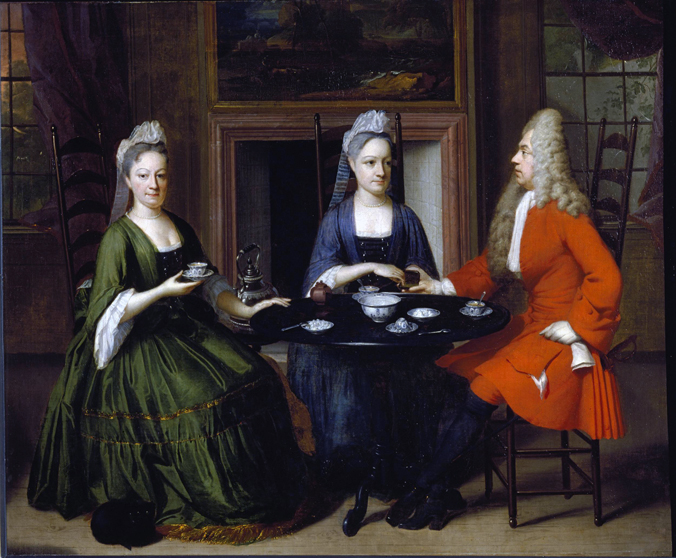
    Two ladies and an officer seated at tea (1715) by unknown artist.
    Credit: Victoria and Albert Museum.

    The tea ceremony was a gendered activity almost exclusively performed by and associated with the women of the household, who selected the teaware that they used in the ceremony[4] A household’s leading female figure, often the wife or oldest daughter, predominantly oversaw the service of tea to family members and guests, emphasizing her position of authority within the household and the gathered social circle.  As such, women used the opportunity to express their gentility and respectability.[5]

    Teatime also supplied a moment to maintain and cultivate important social ties within the community.[6]  Neighbors, business and political associates, and potential suitors met over a convivial small meal and discussed important matters.

    Teatime was also an opportunity to teach the younger generation, especially girls, how to act and behave during this social encounter.[7] As a future wife in charge of her household, it was essential for women, such as Mary Washington’s daughter Betty, to know how to successfully conduct this unique social custom and be able to demonstrate her inclusion and influence in the community elite.[8]  Betty was trained in the art of tea making, as is evidenced by the archaeological presence of a pewter teaspoon bearing her initials at Ferry Farm.  Monogrammed just for Betty, the teaspoon was part of a beginners tea set used by a young lady to train for many future tea times to come.

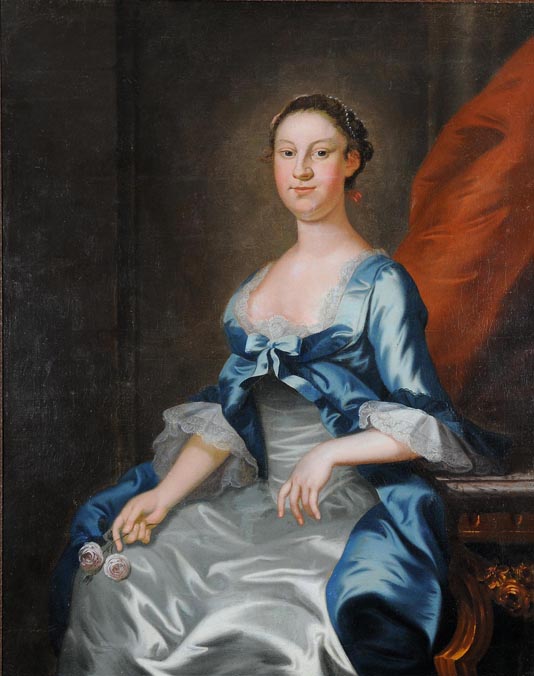
    Betty Washington Lewis (1750) by John Wollaston. Credit: Mount Vernon Ladies’ Association.

    Betty’s uncle Joseph Ball also sent her a silver tea set when she was a teenage girl, further enforcing her future role.[9]  The importance of properly entertaining guests with such tea equipage cannot be overstated, but in addition to this, Betty’s learning how to elegantly serve tea was a must for her prospects as the future wife of a well-off gentleman.  One can imagine a teenage Betty serving tea gracefully to her future husband, Fielding Lewis, having practiced diligently with her pewter and silver tea sets.

    Mara Kaktins, Archaeologist
    Ceramics & Glass Specialist


    [1] Woodruff Smith, Consumption and the Making of Respectability, 1600-1800 (New York: Routledge, 2002), 173; Amanda Vickery, Behind Closed Doors: At Home in Georgian England (New Haven: Yale University Press, 2009), 275.

    [2] Smith, 172.

    [3] Vickery, 273.

    [4] Annie Gray, “‘The Proud Air of an Unwilling Slave’: Tea, Women and Domesticity, c.1700-1900,” in Historical and Archaeological Perspectives on Gender Transformations: From Private to Public, ed. Suzanne M. Spencer-Wood,  23-43 (New York: Springer, 2013), 28; Smith, 174.

    [5] Smith, 173.

    [6] Ibid.

    [7] Smith, 174.

    [8] Laura Galke, “The Mother of the Father of Our Country: Mary Ball Washington’s Genteel Domestic Habits, Northeast Historical Archaeology 38 (2009): 29-48.

    [9] Paula Felder, Fielding Lewis and the Washington Family: A Chronicle of Eighteenth-Century Fredericksburg. (Fredericksburg, VA: The American History Publishing Company, 1998), 68.

  • [Infographic] Ten Pivotal Moments of George Washington’s Boyhood

    You can also read the original blog post with a few more details here.

  • True or False? Test Your Knowledge of Mary Washington

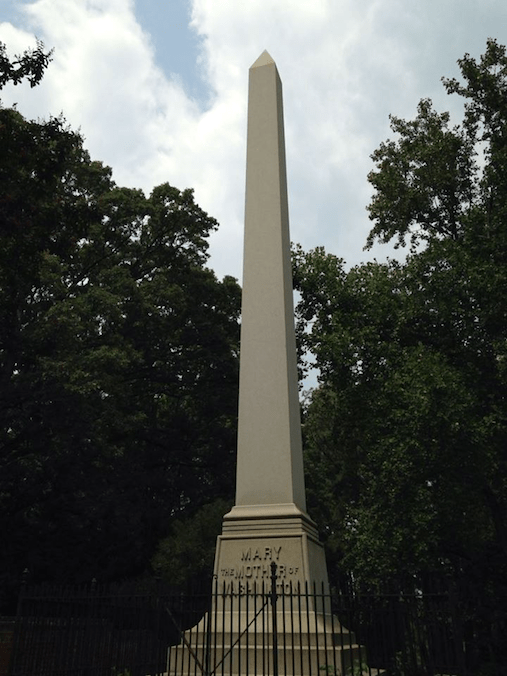
    Mary Washington Monument in Fredericksburg, Virginia. Credit: Beth Hosier/The George Washington Foundation

    True or False?

    Mary Washington had a set of false teeth like her son George?
    FALSE – Mary did not have a famous set of dentures like her son George.

    All of Mary’s children lived to adulthood?
    FALSE – Mary and Augustine Washington had six children together, five living to adulthood.  Their youngest child, Mildred, born in 1738, died at the age of 16 months and is buried at Ferry Farm.

    Mary often traveled to Mount Vernon for extended visits with her son George and his wife Martha?
    FALSE – In fact, George dissuaded his mother from living with them in her later years, arguing that Mount Vernon was much too busy with constant travelers and guests for someone such as his dear and aged mother who deserved peace and quiet.

    Mary lived in Virginia her whole life?
    TRUE – Born and raised on the Northern Neck, Mary moved with her husband throughout their marriage to different family farms located in Westmoreland County, Fairfax County, and then King George County. She lived at Ferry Farm, then called the “Home House”, from 1738 until 1772, when George purchased her a house – the Mary Washington House – in the town of Fredericksburg. She lived there until her death in 1789.

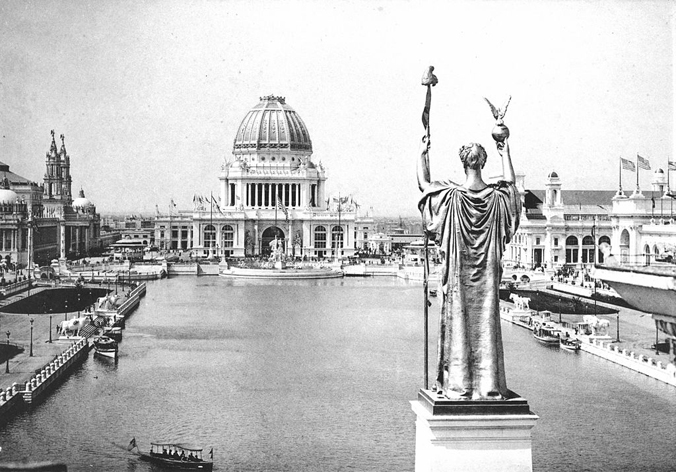
    Mary Washington’s Fredericksburg home was almost sold and moved in its entirety to Chicago for The Colombian Exposition of 1893?
    TRUE – Plans were made to disassemble the Mary Washington House and rebuild it at the 1893 Chicago World’s Fair. The Association for the Preservation of Virginia Antiquities stepped in and purchased house in 1889. They restored and opened it up to the public.

    Chicago World’s Fair looking west from Peristyle, Court of Honor and Grand Basin, 1893. Credit: C. D. Arnold (1844-1927); H. D. Higinbotham; Wikipedia

    Mary remarried after her husband Augustine died in 1743?
    FALSE – It was commonplace during the Colonial era for women to remarry after the death of a spouse. Mary did not, however, preferring to manage the family properties and raise her five young children herself without committing to another marriage that might have restricted her parental control.

    Mary did not live to see her son George become president of the new United States of America?
    FALSE – George visited his mother at her home in Fredericksburg on the way to his presidential inauguration in April 1789 in New York City. Mary died later that same year in August at the age of 81.

    Mary died of breast cancer?
    TRUE – Two doctors treated Mary during the last months of her life in 1789. They could do nothing for her cancer beyond making her comfortable with palliative remedies.

    Mary did not know how to read or write?
    FALSE

    Mary Ball Washington had a ship named after her?
    TRUE – The SS Mary Ball was a “Liberty ship” built during World War II.  Liberty ships were a class of mass-produced cargo vessels simple in design, cheap in cost, and constructed in just a few months.  Built and launched in 1943 as a tank carrier and aircraft freighter, the SS Mary Ball was eventually sold for scrap in 1972.

    SS John W. Brown as an example of a “Liberty Ship” similar to the SS Mary Ball.
    Credit: Wikipedia

    Judy Jobrack, Archaeologist
    Co-Field Director

  • “Your Entire George Washington”: The Affection Between George and Martha

    After George Washington died on December 14, 1799, his wife, Martha, burned all of their correspondence. From the perspective of a historian, her decision devastates. However, it was a common 18th century practice for married couples to burn personal correspondence after the death of one spouse. Perhaps it was a way for the surviving spouse to keep a portion of their loved one to themselves, especially in couples where the public might have a keen interest. Nonetheless, the loss of letters that display affection can often lead to speculation. For example, George Washington never seems to escape rumors about his teenage-crush, Sally Fairfax, as well as the fallacy that he only married Martha for her money. These two claims have been debated by historians practically since George’s death.

    Despite Martha’s efforts to conceal the private life of her and her husband, whether on purpose or on accident, she missed two letters. These letters, both from George to Martha, were found caught behind a drawer in her desk by her granddaughter, Martha Parke Custis Peter, who received the desk as part of her inheritance. The letters were written within five days of each other.

    The Wedding of Washington and Martha Custis (1854) by Junius Brutus Stearns
    Painting in the 1850s, artist Junius Brutus Stearns imagined how the wedding of George Washington and Martha Custis on January  might have looked. Credit: Library of Congress

    In June of 1775, the marriage between George and Martha Washington entered the biggest challenge it ever faced. A month earlier, George had arrived in Philadelphia, after being persuaded to attend the meeting of the Second Continental Congress. While he contributed to several committees, by June the other members of Congress realized Washington’s true value lay in his previous military service during the French and Indian War. George’s fate to serve as Commander-in-Chief of the Continental Army was sealed even though the official announcement wouldn’t come until June 19.

    The day before, on June 18, 1775, George Washington penned a letter to Martha and informed her that, instead of returning to Mount Vernon, he would leave for Boston to take command of the army very soon. In the letter, he expressed his reservations about taking the position of Commander-in-Chief, but also pointed out that it was his duty. He assured Martha “that I should enjoy more real happiness and felicity in one month with you, at home, than I have the most distant prospect of reaping abroad, if my stay was to be Seven times Seven years.” The notion of desiring one month of marital bliss over 49 years anywhere else is certainly a window into George’s true feelings regarding his “dear Patsy”.

    Over the next few days, as he prepared for his departure, George must have thought about his wife and pondered how long it would be until he saw her again. For that reason, he wrote her again on June 23, 1775, only five days later.  A shorter letter, but one that also expressed his true feelings, George wrote “I retain an unalterable affection for you, which neither time or distance can change.” It might seem like poetry or a line from the latest RomCom but, as he penned these words, his country, marriage, and life were each in a precarious position. Perhaps all of this was weighing on his shoulders and he felt the need to express his adoration for his wife. He closed the letter “Yr entire Go:Washington”.

    Throughout history, George and Martha’s marriage has often been questioned. The lack of letters (due to the burning) left little evidence of any affection. Martha was a very wealthy widow when she agreed to marry the young upstart George. Many believe the marriage was strictly strategic. It was true that many marriages and many aspects of marriages in the 18th century were strategic. It was also true that, as a young man, George had eyes for Sally Fairfax. However, the two letters between George and Martha that survive demonstrate the real warmth and adoration George felt for his wife.

    If there is a lack of evidence in letters showing Martha reciprocating George’s affection, there is evidence in other places. Martha is said to have called him “my dearest” or sometimes “old man.” I imagine that during his more stressful moments, like many husbands, George turned to his wife for comfort, advice, and perhaps to just vent. There is evidence that Martha, who was publicly disinterested in politics, made a comment on the final presidential election of her life. Thomas Jefferson, who had been a thorn in George’s side throughout his presidency, stopped at Mount Vernon for the first and only visit he would ever make there. Martha referred to the visit as the “most painful occurrence of her life.” Furthermore, when Jefferson was elected president in 1800, she stated it was the “greatest misfortune our nation has ever experienced.” She despised Jefferson for his years of his opposition to her husband. A wife supposedly indifferent to her husband probably would not feel so strongly about one of his rivals.

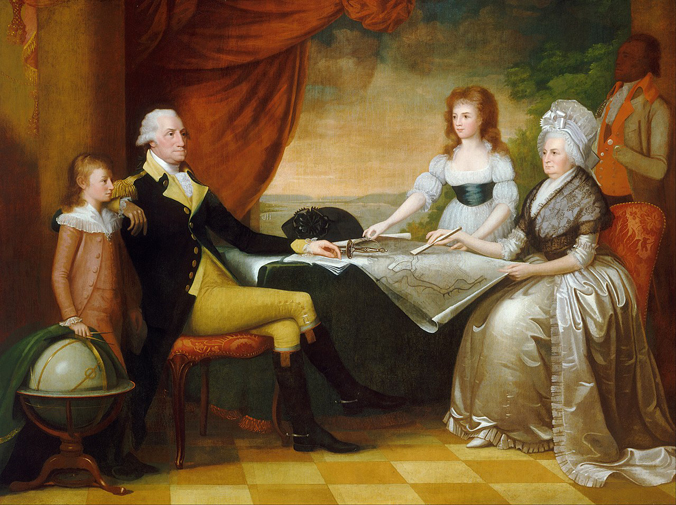
    The Washington Family (late 1790s) by Edward Savage
    The Washington Family (late 1790s) by Edward Savage showing George and Martha, of course. There is also George Washington “Washy” Parke Custis and Eleanor “Nelly” Parke Custis, Martha’s grandchildren and George’s adopted children, as well as an enslaved man, perhaps Billy Lee, George’s manservant or valet. Credit: National Gallery of Art

    The couple would be a little less than a month shy of their 41st wedding anniversary when George died on December 14, 1799.  When he died, he famously uttered the words “’Tis well.” After years of being asked to make sacrifices, years of being separated from her husband for long stretches of time, Martha echoed her husband saying “’Tis well, all is now over. I shall soon follow him. I have no other trials to pass through.”

    Whether you find the few letters and stories of their affection convincing or not, I think it can be agreed that George and Martha’s marriage was one of strength and balance. They completed each other in several ways even though their personalities were quite different. The 6 foot, 3 inch George was the yin to Martha’s 4 foot, 11 inch yang.

    Elizabeth Hosier
    Manager of Interpretation and Visitor Services