Lives and Legacies

Tag: artifact

  • Mending Practice at Ferry Farm’s Archaeology Lab: A Photo Journal

    If you visited Ferry Farm on October 21, 2022, you may have heard a loud crash coming from the archaeology lab – don’t worry, it was on purpose! During my fall semester internship at the Ferry Farm Archaeology Department, I had the pleasure of learning how to mend ceramic vessels, and like any skill, practice makes perfect. I purchased a cheap ceramic bowl from Goodwill and purposefully shattered it so I could practice putting it back together again. Follow along as I take you through the process!
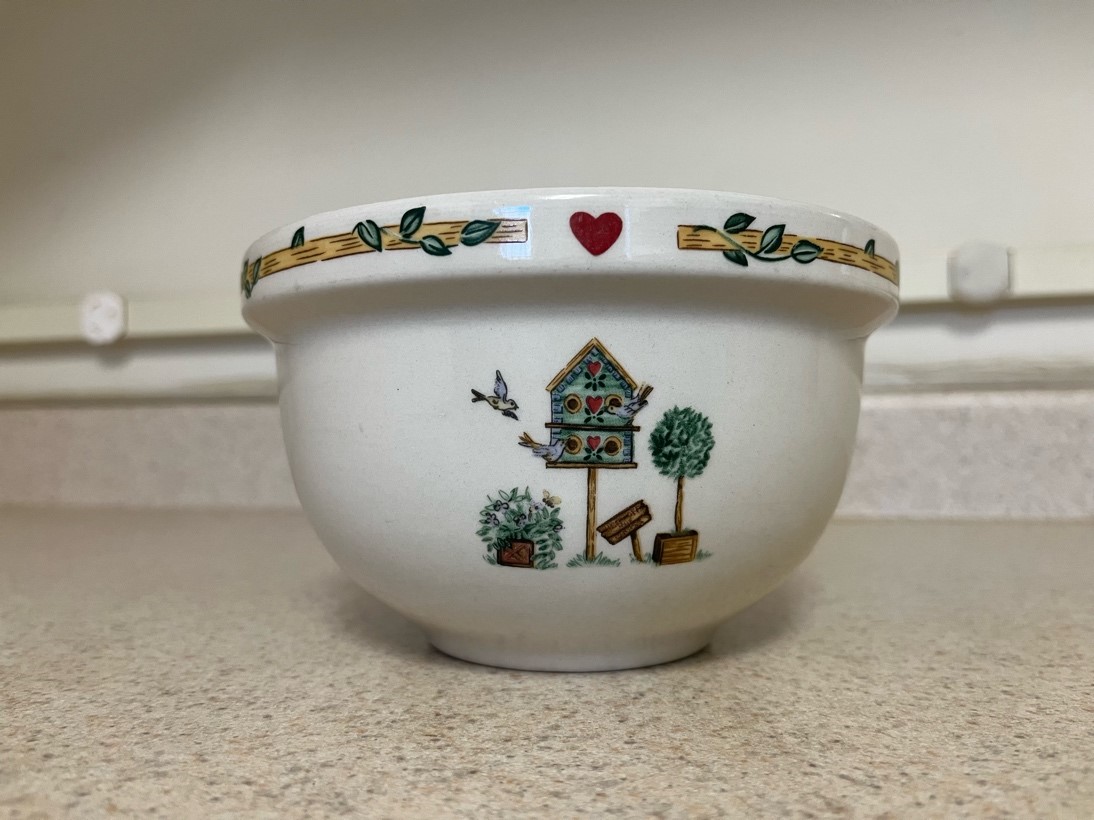
    Bowl in one piece before being broken

    Here is what the bowl looked like when I first bought it – in one piece! I chose this bowl because it was a good size: not too big where it would be too long of a project, but not too small where it would only take a few days to complete.
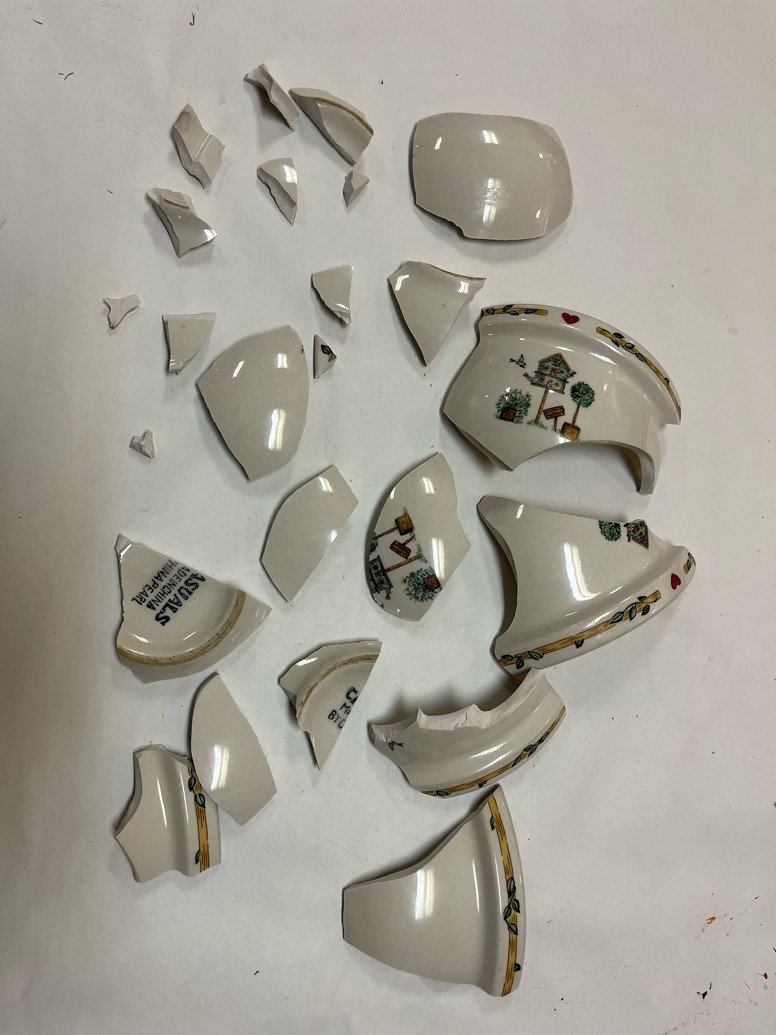
    Breaking the bowl

    Next came the fun part: breaking it! I placed the bowl inside a plastic bag so that all the pieces would stay together. Then, against my natural instinct, I threw the bag onto the ground and broke it into pieces!  Notice how some are larger than others- this means that I had to be very careful as to not accidentally exclude a small piece from the entire bowl.

    Taping sherds

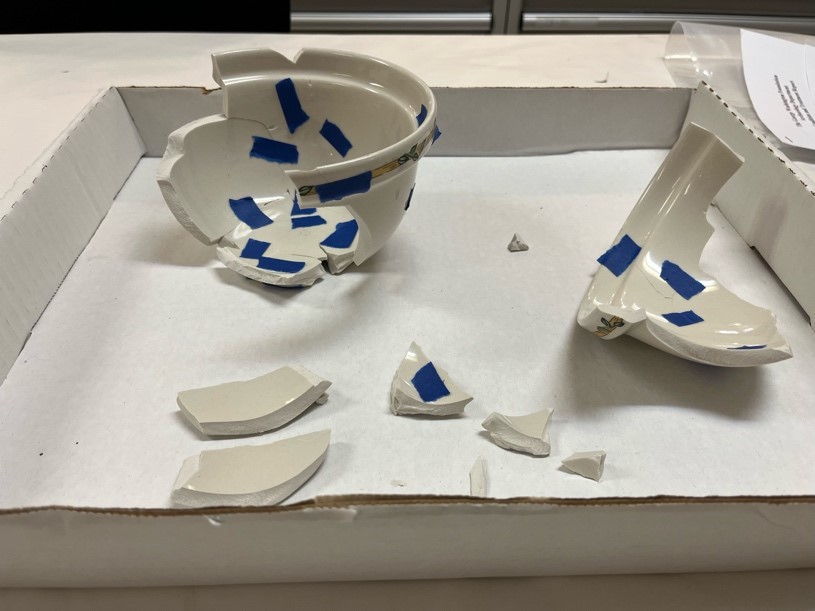
    After collecting all the sherds, my next step was to figure out where everything goes by taping the sherds together. This process allowed me to plan out the order in which the sherds would be glued together.  I used blue painter’s tape to do this because it doesn’t leave residual adhesive on the surface of the sherds. This same tape is used when mending the ceramics found archaeologically at Ferry Farm. 
    More taping

    More taping… it’s coming together!

    Here is the completed bowl after taping! Once all the sherds were back in their rightful places, it was time to carefully plan out how I wanted to glue them. When mending, you don’t want to just start gluing together the first pieces you know fit together. It is important to take into account the shape of the vessel so that you leave as few gaps between the sherds as possible. I developed a plan to start from the base and work my way up to the rim of the bowl. With this done, it was time to start gluing!

    It is protocol in the Archaeology Department to mend ceramics using a reversible method. The glue I used was a solution of 35% B72 in acetone, which is removable with acetone. I started by coating the broken edges of the sherds with a less concentrated solution of the glue, 5% B72 in acetone. This prepped the sherds to have glue applied to it. After this, I applied 35% B72 to only one sherd to be mended and then held it together with its neighbor. After 10 seconds of holding the sherds together, they were sticking quite nicely. I then placed a few pieces of painter’s tape to ensure the glue would hold, and placed the freshly glued sections into a bucket filled with glass beads.
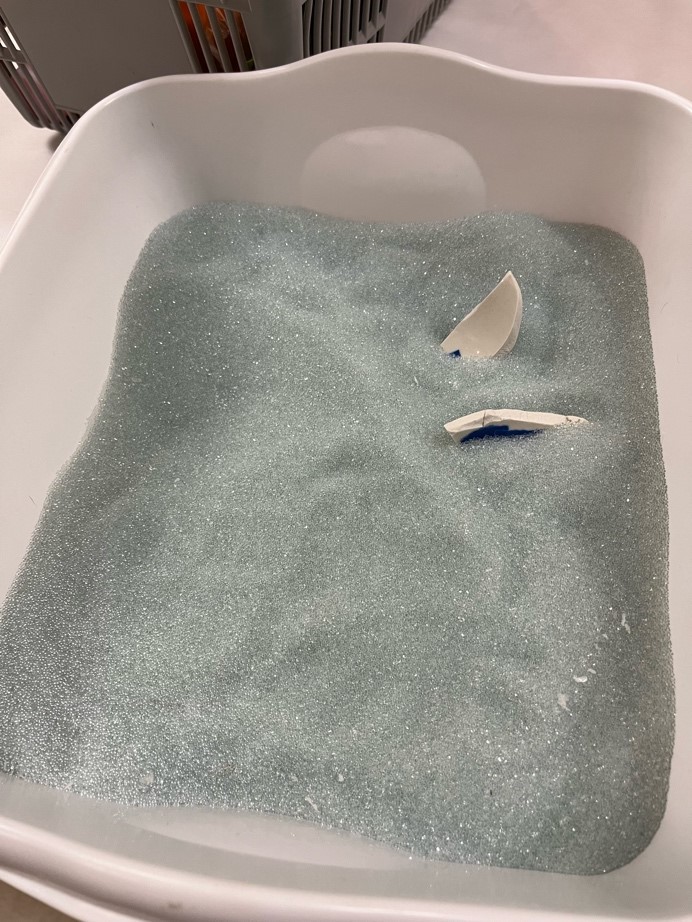
    Glass beads…yes, everyone who goes to the lab runs their fingers through them.

    The glass beads hold the glued sherds together and prevent them from shifting as the glue dries. I repeated this process for all the sherds over the course of a few days until…

    Finished glued bowl

    …the gluing was complete!

    Here is the final product! Now, no mend is ever going to be perfect. Once a vessel is broken, there will always be misaligned sherds in the vessel due to the tension of the entire piece being broken.

    So, why do we mend ceramics in the first place? It can help archaeologists understand what types of objects a site’s occupants would have used and what activities were taking place. It is also an important process in public interpretation: mended ceramics can help the public see what certain vessels would have looked like during a site’s target period of significance.

    Finally, keep in mind that what I did with this bowl was only practice: actual mending with sherds excavated from an archaeological site does not go as smoothly as this. Only a small percentage of a vessel is typically found and thus able to be mended. The reason why so few sherds of one vessel are found is because decades and centuries of being in the ground allows for sherds to get mixed up and moved due to bioturbation (movement of soil by animals such as rodents and insects), erosion, and in some cases, agricultural plowing.

    If you would like to see more on mending at Ferry Farm, be sure to check out past programs that we have done: mending | Lives & Legacies (livesandlegaciesblog.org)

    Katharine Bogen, UMW ‘23

    Fleming Smith Scholar

  • Dig These Dishes! We Recreate an 18th Century Table Setting Using Only Artifacts.

    Dig These Dishes! We Recreate an 18th Century Table Setting Using Only Artifacts.

    On a typical day at George Washington’s Boyhood Home at Ferry Farm, visitors experiencing the house tour are ushered into the main hall upon which a dining table is set out before them with 18th-century reproductions of plates, glassware, wine bottles, and serving dishes. This setting creates an interactive experience for our visitors, transporting them back in time to the mid-18th century when the Washington family lived here on site.

    Last month, however, an unexpected sight greeted a tour group as they entered the hall. The dining table was set, not with reproductions, but actual plates, jugs, and serving dishes that could very well have graced the Washington family’s dinner table over 250 years ago.  The principal difference is that nothing on the table was complete – all were fragmented versions of the originals. 

    Dining table in Hall set up for dinner.

    The setting was a special photoshoot for The George Washington Foundation and an occasion to display and highlight the array of vessels, many mended, residing in the Archaeology Department’s collection.  Everything on the table was archaeologically recovered from either Ferry Farm or Historic Kenmore and represent vessels that date to the Washington family’s occupation of Ferry Farm or Betty Washington Lewis’ time at Kenmore. 

    The Archaeology Department at Ferry Farm has been mending vessels over the past couple of years for our museum displays at the Ferry Farm and Kenmore Visitor Centers. This mending was also done for research purposes as the curatorial department worked to furnish the replica house with accurate, period-relevant household items.

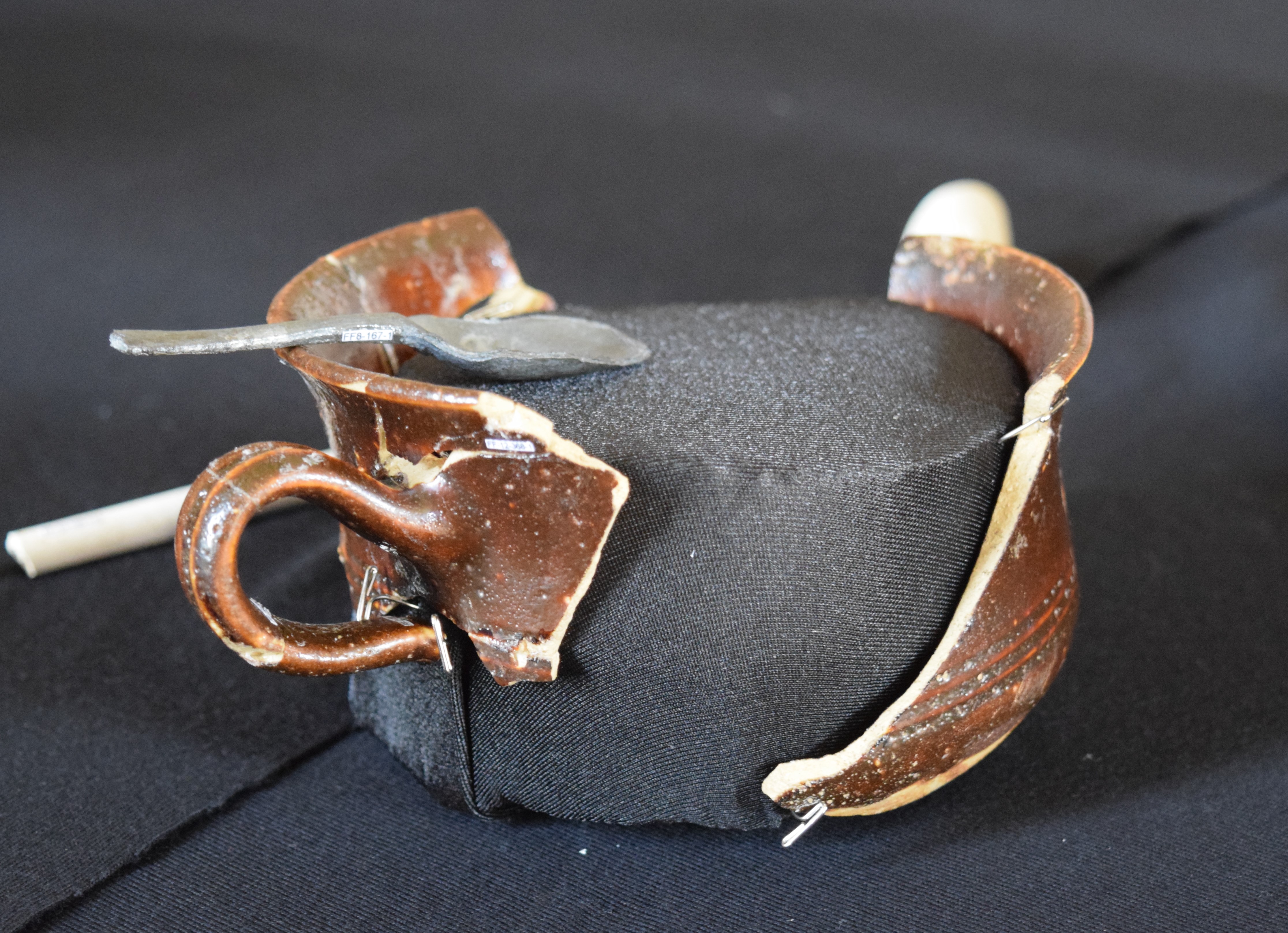
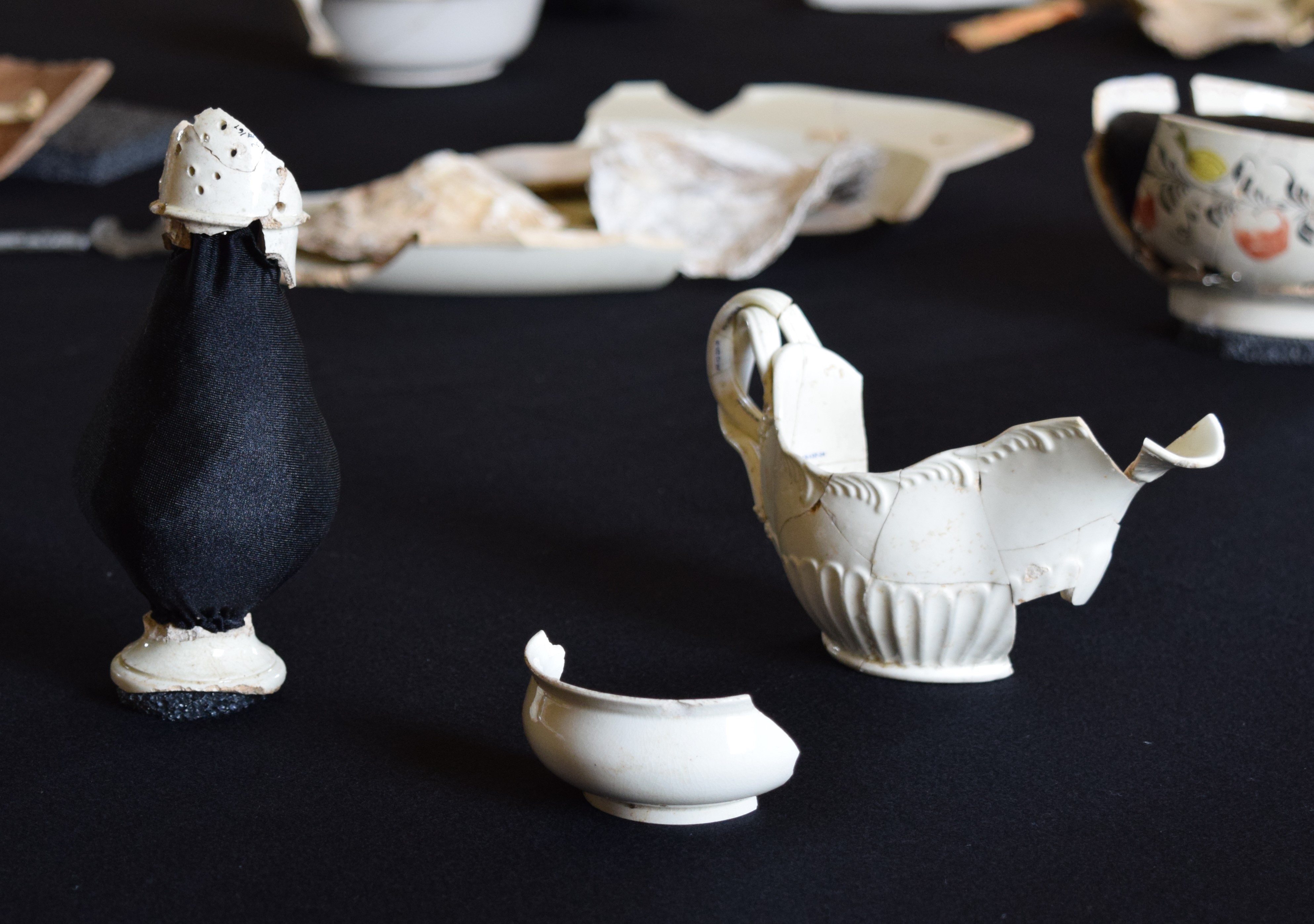
    So what is on the table? Creamware and white salt-glazed plates and serving dishes, glass tumblers and wine glasses, German stoneware jugs, dark green glass wine bottles, a porcelain teacup, coarse earthenware porringers, forks and knives with bone handles, silver spoons, and Mary Washington’s creamware enamel-painted punch bowl.  Many of the ceramic tablewares and a few of the glass tumblers were mended using archival glue.  Some of the objects were able to stand on the table unaided, while others needed mounts for support, such as the wine glass.

    Fragments of dinner and glasswares

    To help envisage the original shape of some of the fragmented vessels and make them recognizable, we first sculpted their shapes out of foam, covered them with fabric, and then attached the incomplete vessel fragments in their correct positions. This process allowed us to present a more “complete” and familiar view of some of the tablewares, such as the two large stoneware jugs, the creamware pepper pot, the glass tumbler, and the two wine bottles. All of these items would have been very difficult to display simply using the fragments themselves. 

    Having such an array of different ceramic styles on the table is more a function of what we have mended in our collection versus what Mary might have actually had on her table.  But for our purposes, we are happy showcasing all of the different ceramic types presently in our possession.

    Welcome to the Washington dining table! Enjoy!

    Judy Jobrack, Archaeologist
    Co-Field Director

  • Playing Around: 20th Century Die-Cast Toys Excavated at Ferry Farm

    A lot of people don’t realize how many 20th century artifacts we excavate at George Washington’s Ferry Farm.  Up until the 1990s, families lived and farmed on the property, leaving tens of thousands of artifacts behind.  Some of our favorite modern artifacts are the toys we recover, whether marbles, plastic army and cowboy figurines, doll parts, or miniature tea sets. In this blog, we look at three die-cast toys left behind by the many children who played on the same ground where young George Washington grew up. 

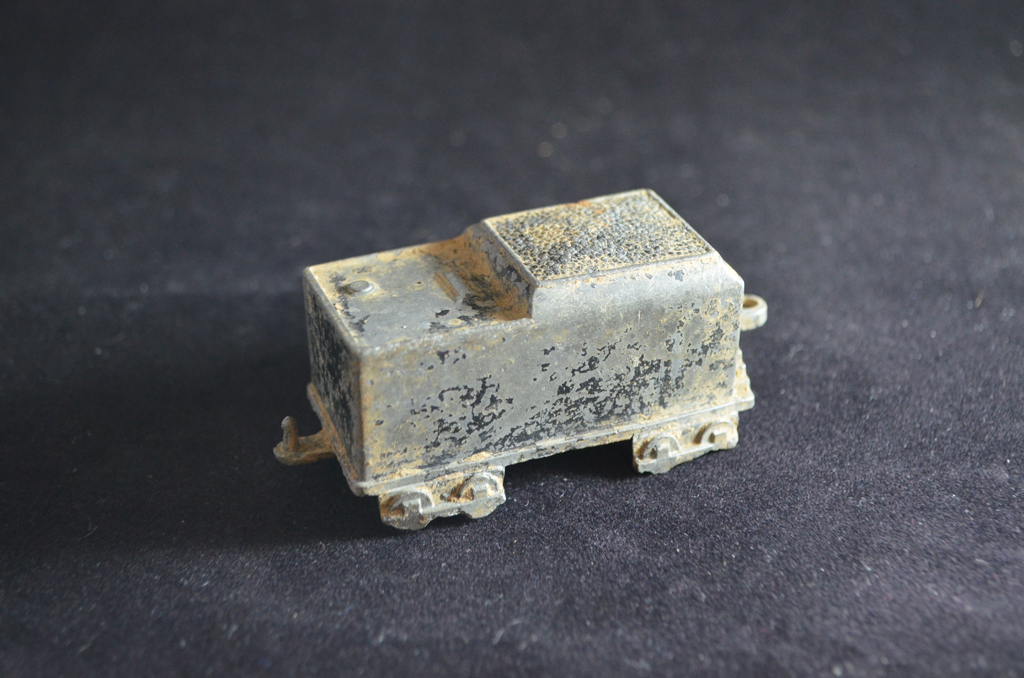
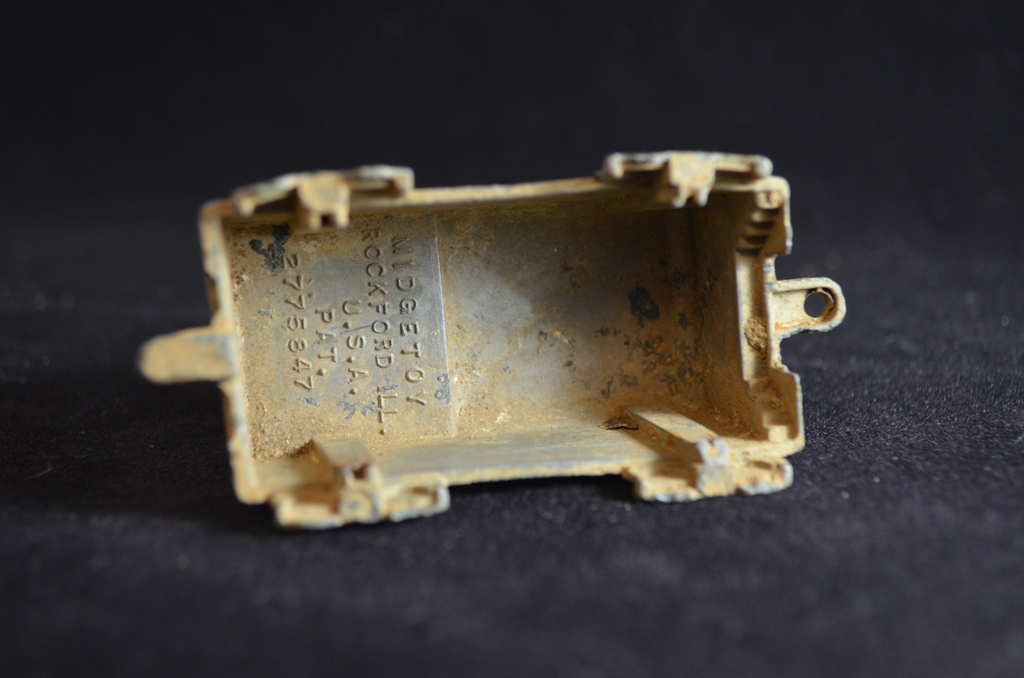
    The first is a small die-cast coal car almost completely intact, except for its missing rubber wheels.  In archaeology terms, we call this artifact ‘talky’.  It makes an archaeologist’s research so much easier when “Midgetoy / Rockford, Ill / U.S.A. / PAT. / 2775847” is embossed on the underside of the car.  However, we still need a date range for this particular toy.  The patent number is a huge help.  After an Internet search, we discovered the patent for this toy was taken out in 1954 by the A&E Tool and Gage Company.  The patent specified an improvement in the wheels to make them rotate more smoothly.  To find the date after which this toy was no longer manufactured, we researched the toy company, Midgetoy, since the patent suggests the toy’s manufacturer started out under a different name.  A&E Tool and Gage was started in 1943 by Alvin and Earl Herdklotz as a defense-based precision tool-and-die business. After the Second World War, they changed their business model to toy making with the goal of creating low-priced die-cast toys.  Thus, Midgetoy was born. The company stopped producing toys in the late 1970s or early 1980s, which represent the approximate end date for this die-cast coal car.
    Our next toy is a fully intact purple die-cast car. With “Tootsietoy Dragster / USA / 3” embossed on the underside, it’s another talky artifact!  Much like Midgetoy, Tootsietoy Corporation started off as something completely different.  Two die casting companies of the Dowst and Shure Brothers were established around the same time in the 1890s.  The companies merged and, in 1909, produced their first model cars: a limousine and Model T Ford. ‘Tootsietoy’ became a registered trademark in 1924. The dragster was not produced until much later, however.  The company didn’t just make cars either It made charms for Cracker Jack boxes as well as die cast dollhouse furniture.  It also produced promotional cars used by dealerships to sell full scale models.  Our dragster has a wedge body with a rear engine, which wasn’t invented until 1974, so this particular toy dates to the mid ‘70s or ‘80s.

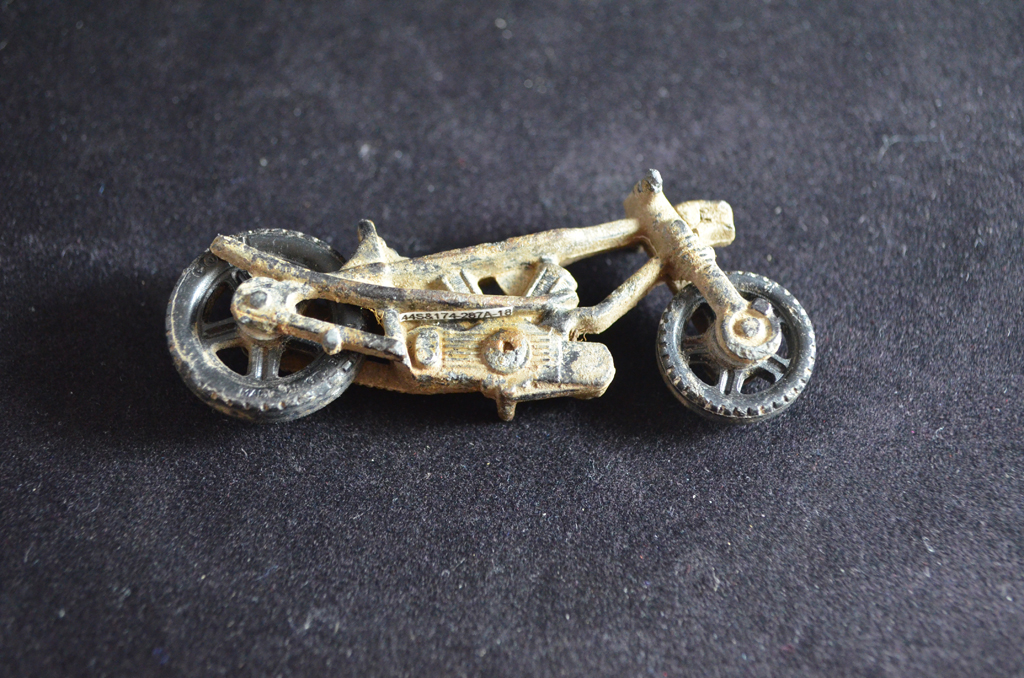
    The last toy is one of my favorites, a funky motorcycle.  When it was first discovered, our lab staff thought it looked a lot like a motorcycle from the First World War.  It has an elongated metal body with hard black plastic tires.  Admittedly, our archaeology department knows very little about motorcycles so we started to do some research.  Initially, it appeared as though the toy had no identifying marks. Closer inspection under magnification ultimately revealed that the larger back tire had ‘Corgi’ and ‘Made in Gt. Britain’ faintly embossed on it.  Our initial assessment of the toy being modeled after a World War I motorcycle was completely off.  Although, the toy looked complete to us, the bike was actually missing some parts.  Roughly modeled after a racing bike, it would have had a plastic front piece and a rider figurine. In this case, either Batman, Spiderman, or (our favorite) the Pink Panther, which we would love to recover in a future excavation.

    Aside from these toys being fun to research while occasionally rolling across our desks as we make ‘vrooooom’ noises, they are also poignant reminders of the kids who played here.  The truth is that aside from the Washington children, we don’t know very much about the youth of Ferry Farm.  In many cases, the only record of them living on this landscape are the toys they left behind.  I often wonder who owned these little treasures and how they got lost.  Were the toys missed?  Would any of the adults who grew up at Ferry Farm remember them? When he’s washing a toy, Robert Bailey, a lab volunteer who lived here as a child, often wonders if it was one of his toys.  Regardless, these toys are a nice reminder of the young ones who once played on the same landscape as little George, and that’s pretty cool.

    Mara Kaktins, Archaeology
    Archaeology Lab Supervisor

  • Bad Medicines: Mercury and Self-Medication in the Civil War

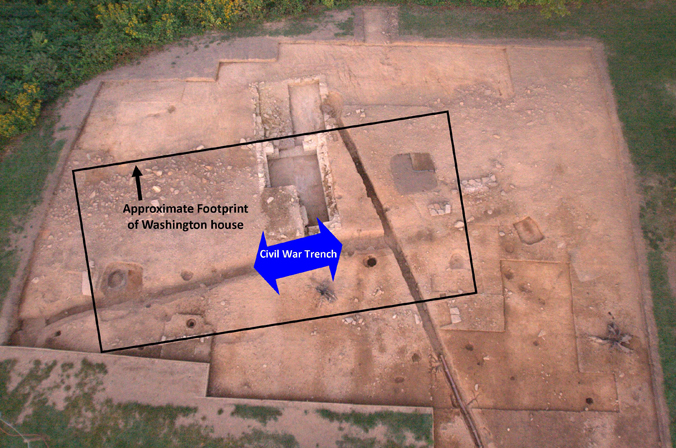
    During the Civil War, George Washington’s Ferry Farm was the site of Union Army encampments that included some defensive works like a trench dug into the crest of the ridge overlooking the river.  In that trench and throughout Ferry Farm’s landscape, Union soldiers lost and threw away a wide array of military gear and personal belongings, which our archaeologists frequently excavate.

    Civil War Trench
    Excavated area containing the footprint of the 18th century Washington house at Ferry Farm and showing a 19th century Civil War trench running the length of the house and beyond.

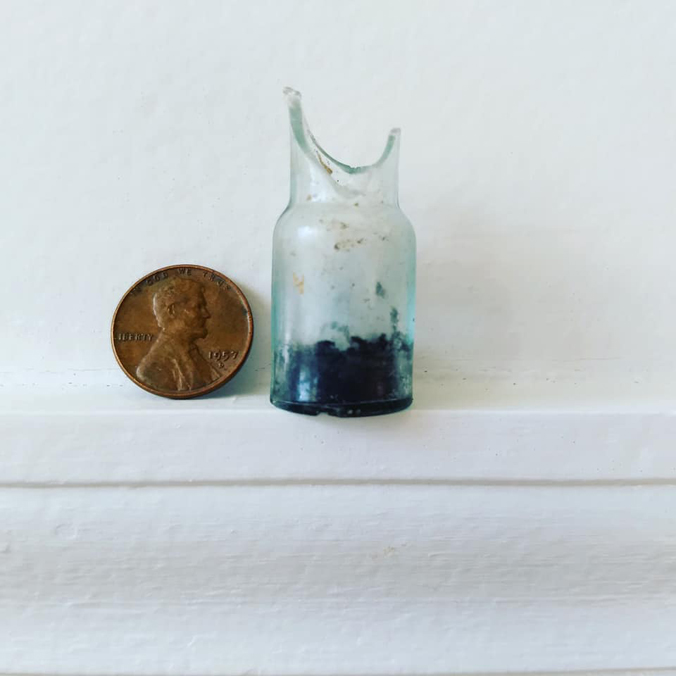
    This blog post highlights an intriguing artifact excavated from the trench: a diminutive glass bottle.  This bottle is not so much interesting because of what it is – it’s a very common medicine style bottle for the mid-19th century– but rather what’s inside.  Clearly visible within the bottle is a hard black substance and for years we’ve wondered what the substance may be.

    Medicine bottle containing mercury residue
    Medicine bottle excavated by archaeologists at George Washington’s Ferry Farm and containing an mystery residue.

    Enter Ruth Ann Armitage, our amazing chemist friend from Eastern Michigan University.  Over the years, she and her colleagues have generously used their extremely fancy equipment to analyze many of the residues we’ve recovered archaeologically. So we chipped off a little fragment of the substance in the bottle and sent it to her lab.

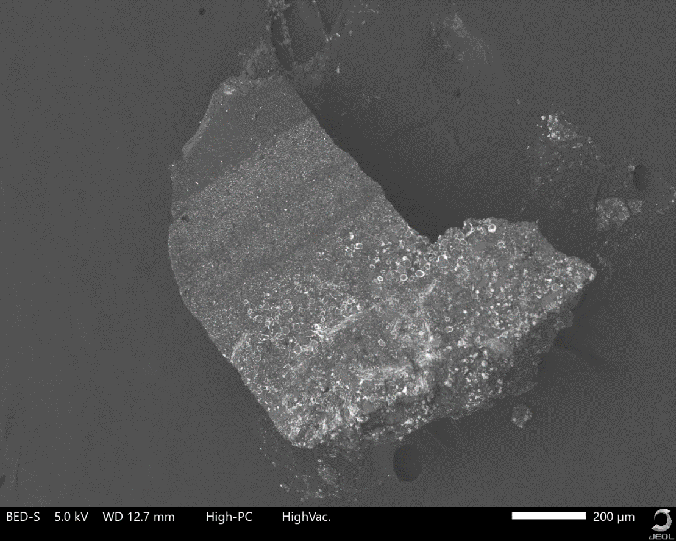
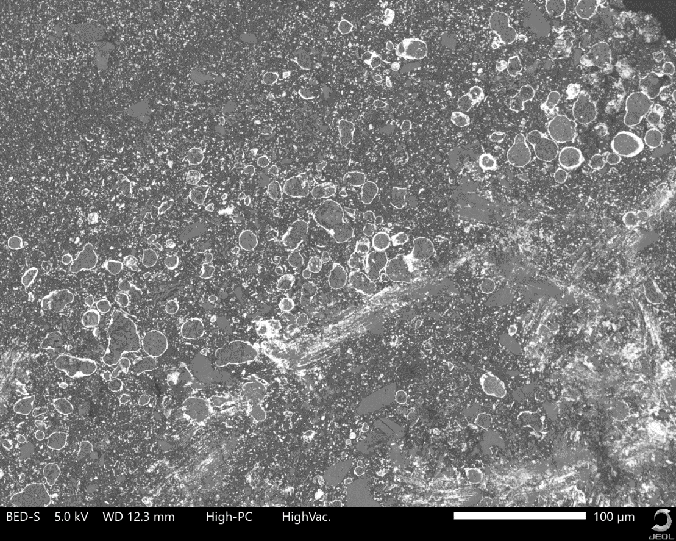
    The sample was analyzed using scanning electron microscopy (SEM).  SEM works by shooting a beam of electrons at the sample, which gives you an image of its surface topography.  Backscattered electrons (BSE), collected in a different detector, tell you about the elemental composition.  In a BSE image, the contrast in the image is related to the atomic number of the material, with brighter areas showing high number elements (usually metals) and darker areas representing low number elements (like carbon). X-rays are also produced when the electron beam hits the sample, so an x-ray detector allows the chemist to do energy dispersive x-ray spectroscopy (EDS) to map out specifically what elements are present in the sample.  To put it simply, all of these techniques are good at alerting the chemist to the elements within a residue.

    Our sample was also run through DART (direct in real time) mass spectrometry.  This technique is good at detecting organic components within a substance.  It’s important to note here that this is not an episode of CSI and a reading does not automatically tell you what is in the bottle.

    Mercury residue analysis 1
    A magnified image BED of sample, which is clearly stratified with darker low atomic number elements such as carbon at the top. The brighter areas represent higher atomic number elements, in this case, mercury.

    That being said, almost immediately, Ruth Ann responded and we weren’t disappointed: “Did you know there’s mercury in this?”  Nope, we did not.

    However, this discovery was not too surprising given the use of mercury in many medicines for thousands of years.  Now a days it’s common knowledge that you shouldn’t drink mercury…or touch it…or inhale it.  Believe it or not many people did not accept mercury’s dangers until well into the 20th century.  Some people born in the 1980s and before might even remember playing with the little balls of mercury from a broken thermometer, am I right?  As weird as it seems this wasn’t that dangerous because mercury is not toxic in such small concentrations.  However, if you were born a little further back you may remember a substance called calomel (mercury chloride), which was marketed as a cure all. Perhaps most tragically, it was as a common teething medication for children until the 1950s.  For a long time, mercury was seen as a potent healing metal and it was readily rubbed on skin, consumed, and vaporized for immediate effect on the lungs.

    And while all of these treatments using mercury did little to address the body’s medical problem, mercury still caused an immediate bodily response, which convinced people it was working to cure their ailments.  When applied topically, it burned. When introduced into the body, it caused a person to sweat, salivate, and have diarrhea. The mucous membranes also went into overdrive, leading many to believe that the bad stuff in your system making you sick was being purged by the mercury.   The reality, of course, was that the body was trying desperately to rid itself of poison, the mercury.  That being said, mercury does actually have a place in the medical world and can be useful, it just took a little while for people to learn how to properly utilize it.

    So, if the residue inside our bottle was medicine, what medicine was it?  Initially our archaeology lab thought it was calomel but the chemical analysis didn’t show any chlorine.  The most interesting components were mercury and sulfur, which could possibly indicate cinnabar, the ore from which mercury is obtained.  The image below is a close up of the mercury and shows the sulfur (dark circles) surrounded by the brighter mercury.

    Mercury residue analysis 2

    Other elements detected include carbon, oxygen, and trace amounts of iron, silica, and aluminum.  A closer look at the DART analysis suggests that the mercury compound might be in the dried remains of a fat or oil based on the presence of substances that form when fats decompose over time.

    What does all this mean?  Unfortunately, without more research, it’s hard to say what was in the bottle other than the basic components already detected.  Because it’s a medicine bottle, our assumption is that the residue it contains was a treatment of some sort in which case we’re dealing with a soldier who had an ailment.  Common Civil War-era uses for mercury-based medicines were treating skin sores and lacerations, internal and external parasite infections, syphilis, and constipation, to name but a few.

    What is even more interesting is that a nearly identical bottle which also contained a hefty amount of mercury was recovered across the river just a few years ago by Dovetail Cultural Resource Group from another Civil War context.  Read more about their discovery here.

    Soldiers throughout history are known to have carried their own medicines with them so it’s very cool to see actual physical evidence of that.  As to the exact medicine, perhaps we’ll know someday but for now let’s just say it was definitely bad medicine.

    Mara Kaktins, Archaeologist
    Archaeology Lab Supervisor

  • Bad Medicines: Mrs. Winslow’s Soothing Syrup

    It’s hard to believe that there was once a time when products weren’t covered in labels listing all their ingredients in great detail. We are used to labels promising the absence of unhealthy chemicals. We are accustomed to labels warning when a product was packaged in the same facility as an allergen. Product safety is serious concern of manufacturers and customers. We, as a society, are growing increasingly aware of what is going into our bodies.

    Label with an allergen warning

    Before the creation of the Food and Drug Administration (FDA) in 1906, products did not carry ingredient labels. Regulations on medicines were especially lax, compared to today. In this blog, we begin exploring historic cases of “bad medicines” that were used by someone living or working either at Ferry Farm and Kenmore long before federal regulations came into play. Medical history is a profound example of how even well-intentioned people can make lasting and deadly mistakes.

    People have lived at or worked on Ferry Farm for over 300 years. We have archaeologically excavated hundreds of thousands of artifacts from the 18th and 19th centuries. Among these artifacts are fragments of glass in all shapes and sizes. Many are bottle fragments- 47,926 of them to be exact. We can’t always determine the function of a bottle from the fragments found, but when we do find enough pieces to identify the bottle’s function, we excitedly begin research into its use.

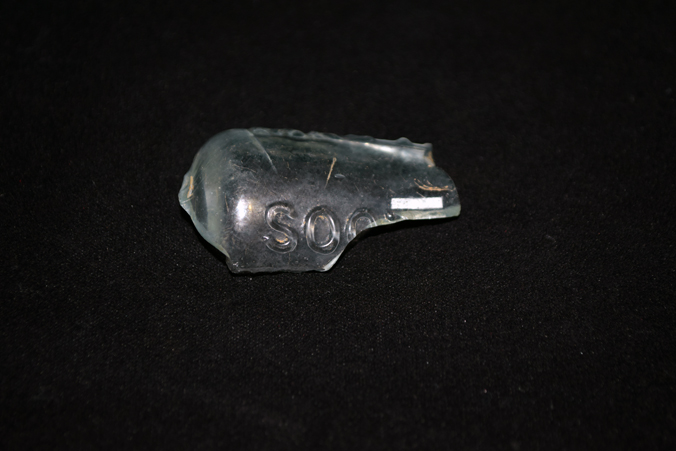
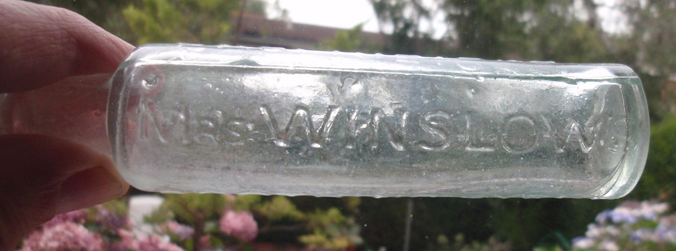
    One such artifact is a larger piece of a patent medicine bottle, one that was large enough to make out the embossed lettering on the side and identify its former ingredients. The bottle contained Mrs. Winslow’s Soothing Syrup, first marketed in 1849. Its basic contents were morphine and alcohol so, I suppose, the soothing part of the name was indeed correct.

    Fragment of Mrs. Winslow's Soothing Syrup bottle
    Mrs. Winslow’s Soothing Syrup bottle fragment excavated at George Washington’s Ferry farm.

    Complete Mrs. Winslow's Soothing Syrup bottle
    Complete Mrs. Winslow’s Soothing Syrup bottle. Credit: P0mbal / Wikipedia

    Today, Avinza® is a common morphine sulfate medication prescribed to patients suffering chronic pain. The FDA has covered its bases on the use of this medication, thoroughly describing how to take this medication without dying. One section very forcibly states:

    “Swallow AVINZA whole. Do not cut, break, chew, crush, dissolve, snort, or inject AVINZA because this may cause you to overdose and die.” [1]

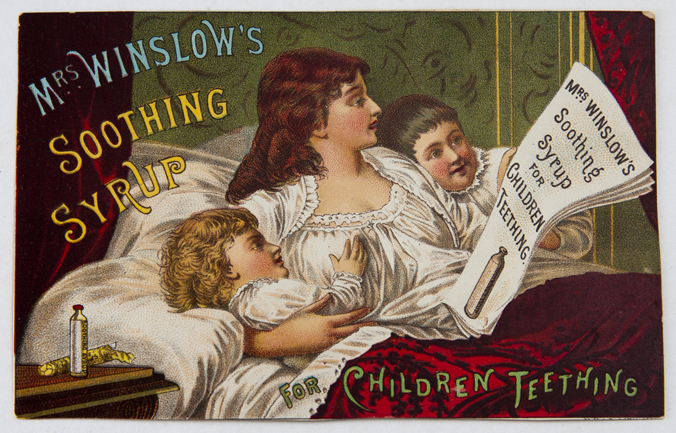
    What is the recommended dosage for this medication, you ask? Around 60 mg of this morphine sulfate PER DAY for an adult. [2] Mrs. Winslow’s soothing syrup contained a whopping 65 mg of morphine PER OUNCE with slack rules on exactly how many drops to give to a teething infant.

    You read that correctly folks – a teething infant.

    Mrs. Winslow's Soothing Syrup advertisement 1
    Advertisement for Mrs. Winslow’s Soothing Syrup. Credit: Museum of Health Care at Kingston

    Mrs. Winslow's Soothing Syrup advertisement 2
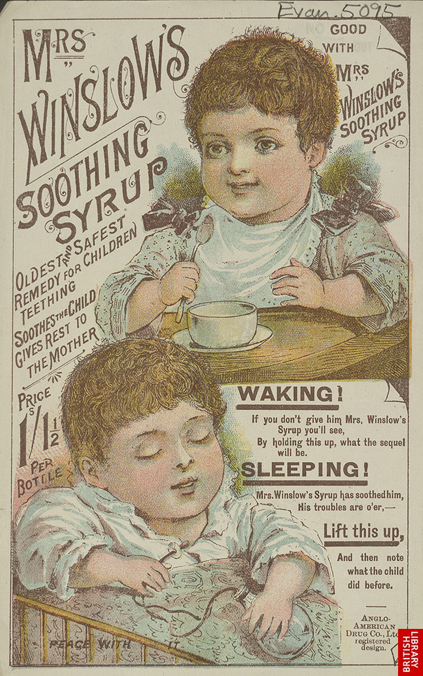
    Advertisement for Mrs. Winslow’s Soothing Syrup. Credit: The British Library

    Mrs. Winslow’s Soothing Syrups and other such 19th century medications led to the deaths of thousands of infants. Several children died from withdrawal symptoms after having taking the medication for an extended period of time, but most simply fell asleep never to wake up. Knowing little about drug reactions at the time, and due to the higher infant mortality rates in the 19th century, the cause of the deaths were often blamed on “crib death” (Sudden Infant Death Syndrome or SIDS) or whatever ailment that was causing the child to be fussy enough to drug in the first place.

    It wasn’t until 1905 when investigative journalist Samuel Hopkins Adams exposed the unregulated world of patent medicines in The Great American Fraud.

    This publication attacked every type of patent medicine with testimonies from doctors and patients as well as scientific reports from trusted sources. In the section aptly titled “Baby Killers”, Adams detailed how various “soothing syrups” led to infant deaths from the mid-1850s to 1905.

    Shockingly, Mrs. Winslow’s Soothing Syrup wasn’t the most deadly such syrup in terms of morphine content. Irreparable damage had been caused by all of the different morphine cocktails available on the market in the 1800s. As grieving parents began to realize what had actually happened to their children, these products were taken off the market.

    With an enraged public and 509 pages of proof from Samuel Hopkins Adams, Congress enacted the Pure Food and Drug Act in 1906, creating the FDA to ensure the safety of American food and medicines.  Still, reports of child death caused by soothing syrups persisted until 1910.

    [1] https://www.fda.gov/media/116920/download

    [2] https://www.rxlist.com/avinza-drug.htm#dosage

  • “I Look Not On Things Beneath Me”: Our Snobbiest Artifact, a Wax Seal Stamp That Needs To Dial Back that Sass

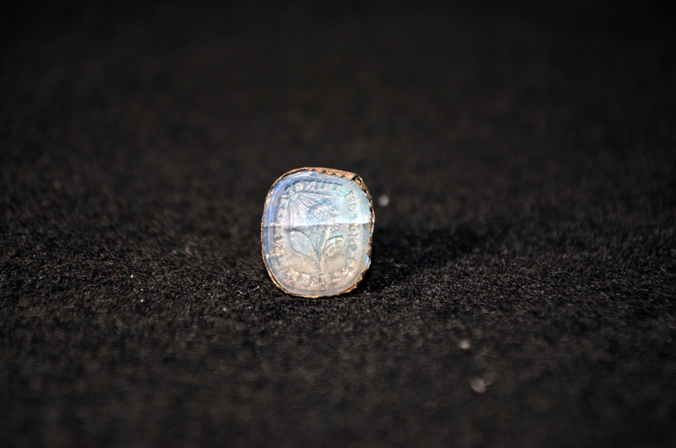
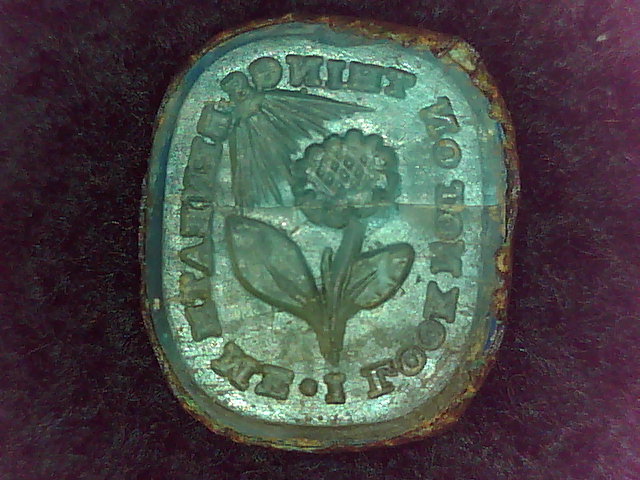
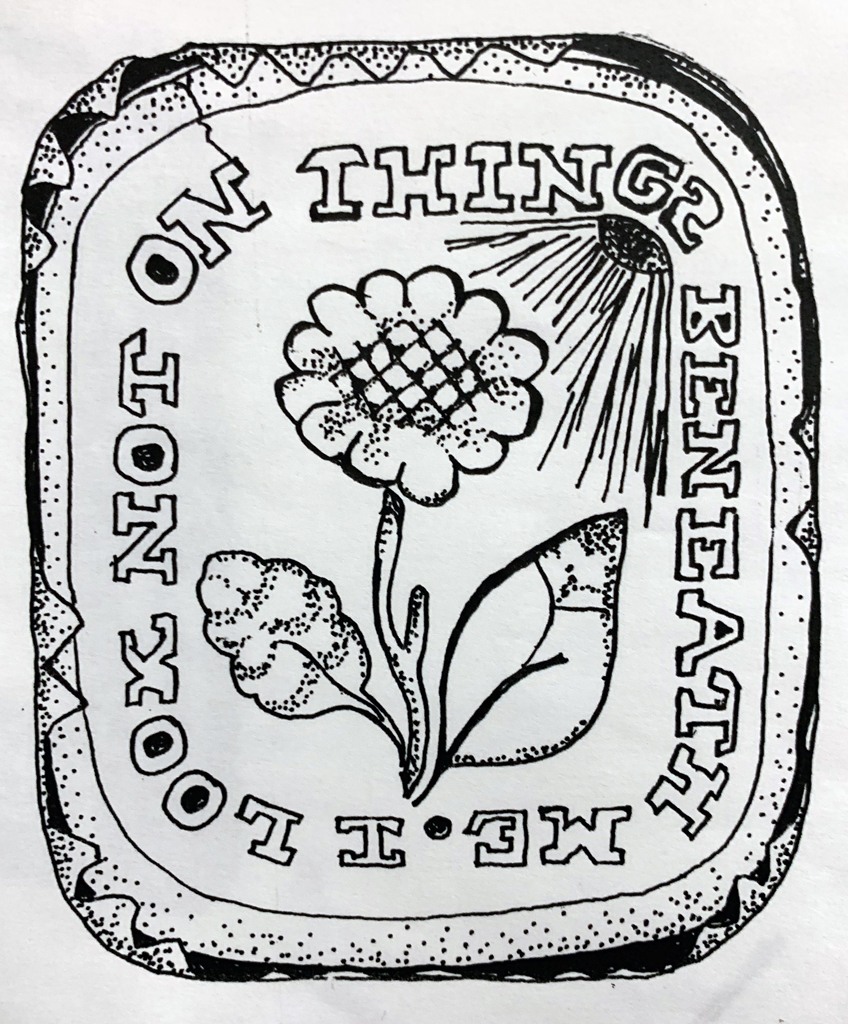
    ‘Haughty’ is not a word used often to describe artifacts.  That is, of course, unless the artifact in question is a glass wax seal stamp with a kind of snooty message on it.  Of diminutive size (smaller than a dime) with a pretty little flower in the center it proclaims in reversed letters “I Look Not on Things Beneath Me”.

    Kenmore Wax Seal Stamp 1
    Wax seal stamp excavated by archaeologists at Historic Kenmore.

    Seal Excavated at Kenmore 2
    Closeup view of the wax seal through a digital microscope.

    Drawing of Wax Seal Stamp
    A drawing of the wax seal stamp with the text reversed so it is legible.

    Initially thought to be a signet ring, archaeologists at Ferry Farm reexamined it and determined the itty bitty blue piece of glass is actually a wax seal stamp used to personalize letters.  This seems to be an odd choice of message for the recipient of a correspondence but who are we to judge?

    Found at Kenmore, this pretty little thing likely dates to the late Victorian period and would have been worn by a woman, possibly at the end of a chatelaine.  Chatelaines were all the rage with Victorian women and consisted of a long chain worn around the neck with charms at the end, which could be tucked into one’s dress or belt.  These charms often had practical uses.  Common chatelaine charms included tiny scissors, cute vials, petite magnifying glasses, and minuscule mirrors.

    Unfortunately, some fashionable lady lost this at Kenmore over a hundred years ago, possibly while wandering through the garden, drink in hand, and idly thinking of sending off a letter sealed with a snarky wax message reminding everyone that “I Look Not on Things Beneath Me.”

    It’s a good thing that we archaeologists don’t take the same attitude.

    Mara Kaktins, Archaeologist
    Archaeology Lab Supervisor

  • The Mystery of the Mane Comb… SOLVED!

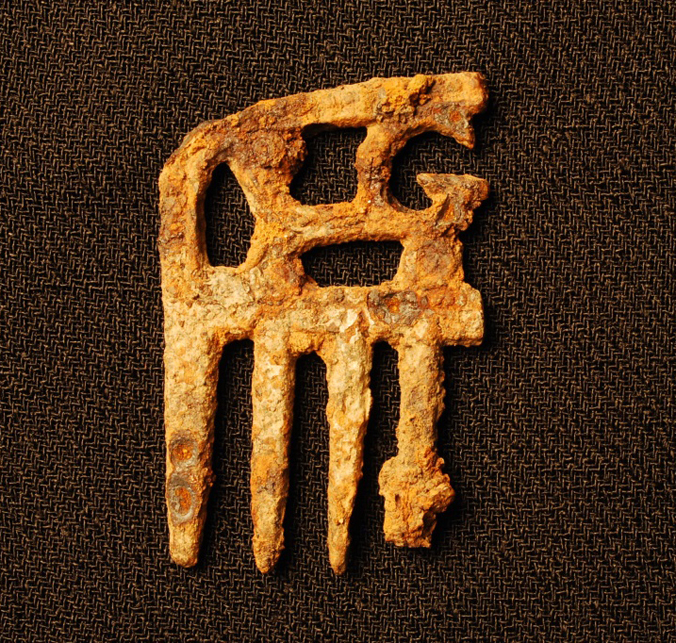
    A little more than a year ago we published a blog post highlighting a horse’s mane comb excavated years ago at George Washington’s Boyhood Home at Ferry Farm. Though the rusty iron mane comb was incomplete, a lone, decorative “G” located along the top of the comb hinted at a longer name we hoped might be “G.[eorge] Washington.”

    Mane comb excavated at Ff
    Mane comb excavated at George Washington’s Ferry Farm.

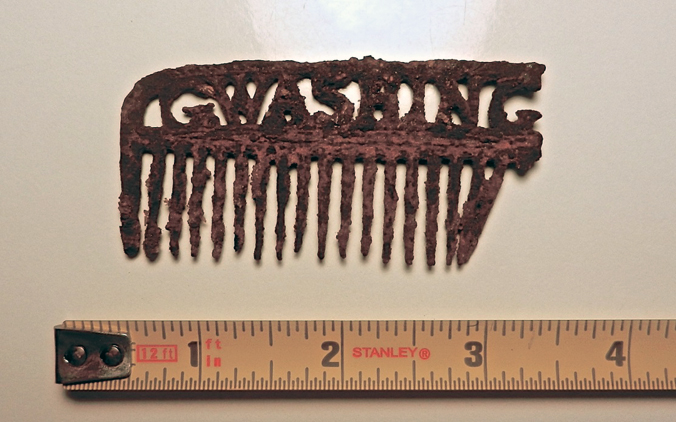
    Fortunately, two outside sources soon came to our attention that confirmed our suspicions. A reader of the blog sent a note disclosing his family has a mane comb very similar to ours.  This comb is more complete than ours but more importantly, it has “G.Washing” inset above the teeth!

    Blog reader's family mane comb
    Blog reader’s family mane comb.

    A second source turned up in an online auction in which a horse mane comb was listed for sale with other early 19th century items.  This comb is a wonderfully complete specimen with “G. WASHINGTON” clearly inset with hollow cut lettering in the upper section of the comb above the teeth.

    Complete mane comb
    Mane comb in an online auction listing. Credit: LiveAuctioneers.com

    Our blog reader was not sure how old his mane comb was, and the auction listed theirs as “Federal Period” (early 19th century).  All three examples have similar rope molded decoration along the upper edge of the comb and on the lettering, and only our comb has a slightly different spacing in front of the first letter.  Considering everything, we think that’s enough proof! “G.WASHINGTON” it is!

    Washington memorabilia is ubiquitous, commemorating everything including his birth, his death, and his Revolutionary War and Presidential experiences.  Statues, medals, buttons, paintings, ribbons, and hundreds of other products have been made to honor our first president over the last 220 years since his death in 1799. It makes sense that these mane combs are part of that heritage, made as homage to his memory. Why there aren’t more of them out there, I don’t know. But I love the fact that one of these combs made its way back to the farm on the Rappahannock River where George grew up.  Ferry Farm is where he spent his formative years learning not only how to ride his horses, but  also developing those leadership skills he would need to one day lead the Continental Army and eventually the United States of America.

    Judy Jobrack
    Co-Field Director, Archaeology Lab Assistant

  • Ferry Farm’s Oldest Artifact

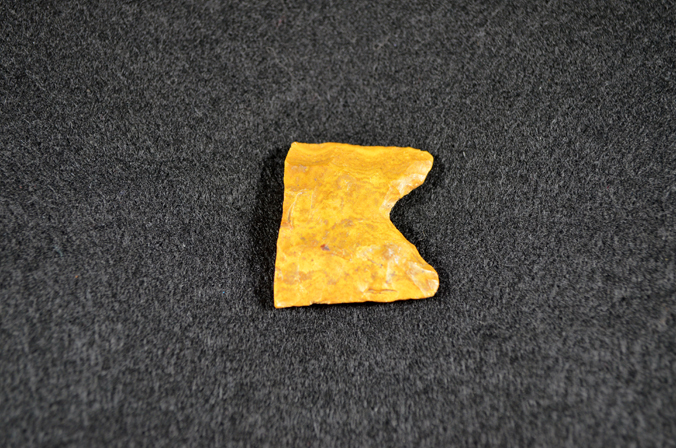
    Many visitors to George Washington’s Ferry Farm are surprised to learn that about a quarter of the 750,000 artifacts excavated by Ferry Farm’s archaeologists were created by Native Americans. However, given that indigenous people were living in the land we call Virginia for thousands of years prior to the arrival of Europeans, it makes perfect sense. The vast majority of these Native American artifacts are stone flakes that are the byproduct of stone tool manufacture (think sawdust or wood shavings from carpentry, but stone) and date to the Archaic period (or 10,000–3,200 years before the present day). A very few are even older. In fact, Ferry Farm’s oldest datable artifact is the basal fragment of an ancient jasper dart point made by a people belonging to what we call the Clovis culture.

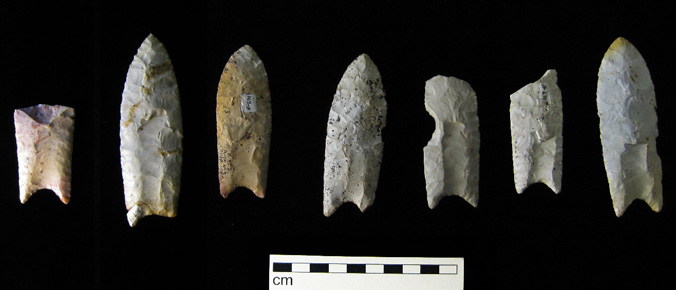
    Clovis points from Iowa's Rummells-Maske Site
    Clovis points from the Rummells-Maske Site in Iowa. These are in the collection of the Iowa Office of the State Archaeologist. Credit: Bill Whittaker / Wikipedia

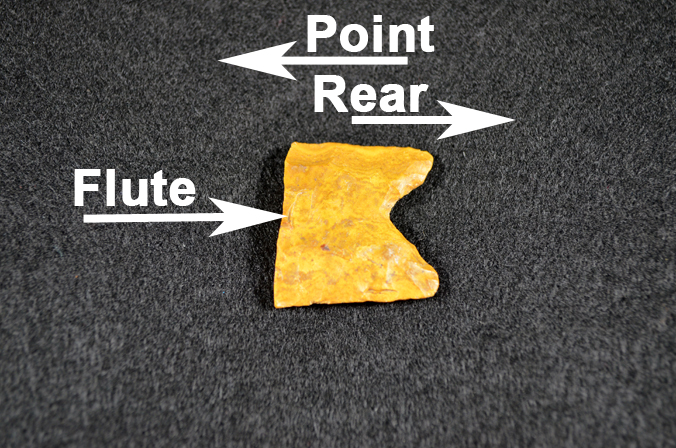
    The Clovis culture were some of the earliest inhabitants of North America, and was named after the Clovis “type site” (an archaeological site where a certain culture or artifact type is first recognized) near the town of Clovis, New Mexico. The Clovis people made distinctive projectile points immediately recognizable by their lanceolate or narrow oval shape that tapers to a point at one end and the presence of “flutes” on their bases. These flutes are narrow channels where flakes of stone were carefully removed from both sides of the point to make it thinner. The fluted point could then easily be slid into a notched wooden or bone shaft- a process called hafting- to make a knife or dart (more on darts below). The sides of the point would be ground near the base to dull them so the point could be secured in its haft with sinew or cordage without cutting through these bindings.

    Ferry Farm's Clovis point
    Base or Proximal end of a Jasper Clovis point recovered archaeologically at George Washington’s Ferry Farm.

    Ferry Farm's Clovis point diagram

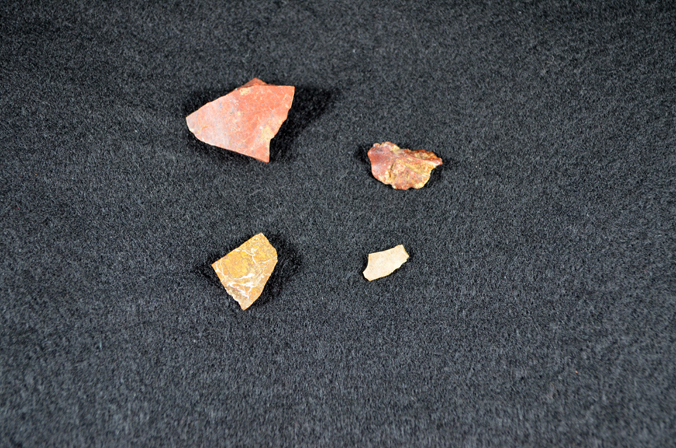
    The Clovis people were well known for being picky about their lithic (stone) materials and traveled long distances to procure them. The closest quarry from which they could have obtained jasper to make Ferry Farm’s point is in Culpeper, at least 35 miles away. The people who made this dart point may have manufactured it here as we also have numerous flakes of this same jasper.

    Jasper Flakes
    Jasper flakes similar to the material of the Clovis point — a byproduct of stone tool manufacture — that were excavated at Ferry Farm.

    Clovis points date to a fairly narrow period from roughly 13,500 to about 12,800 years ago, and are found almost everywhere in North America, from the Southwest to New England. One of the interesting things about Clovis culture is that it is so widespread- no later cultures made artifacts that are found across such a vast area. It’s even more interesting to consider that these points got deposited all across North America in such a relatively short time span of maybe 700 years. This begs the question: What moved? Was it the people making the Clovis points? Or was it the technique of making the Clovis points? Was there a particular group of fluted-point-making people sprinting across the North American or were there already enough people on the pre-Clovis landscape that it the idea of making fluted points just spread from group to group? Archaeologists are working to answer these questions.

    As mentioned, one use for Clovis points were in darts. These darts were not like you throw at a dartboard in a bar. In this context, a dart is like a spear but with a more flexible and lightweight shaft that can fly farther and with greater velocity. Greater distance and speed are achieved by launching the dart with a spear thrower called an atlatl (pronounced “at-lattle”). The atlatl essentially acts as an extension of the arm, creating a longer lever that pushes the dart farther and faster by applying more force with less energy. Although Clovis points were probably multi-purpose tools used as both knives and projectile points. As projectile points, they were likely used on atlatl darts for hunting. Although the extent to which Clovis people relied on meat from such huge creatures is debatable, they probably used their fluted points to bring down a few mammoths and mastodons, at least in the western United States.

    What do you think the owner of the Ferry Farm Clovis point was doing with theirs when they lost it? We may never know, but what we do know is that it gives us evidence that people were living along the Rappahannock River nearly 13,000 years ago. We can still find their tools and those tools piece together the whole story of Ferry Farm’s landscape and people!

    Joseph Blondino, Archaeologist
    Field Director, Dovetail Cultural Resource Group

    Mara Kaktins, Archaeologist
    Archaeology Lab Supervisor, The George Washington Foundation

  • When a Toy Hatchet is so Much More: Trench Art at Ferry Farm

    Lead Hatchet - Flat Side
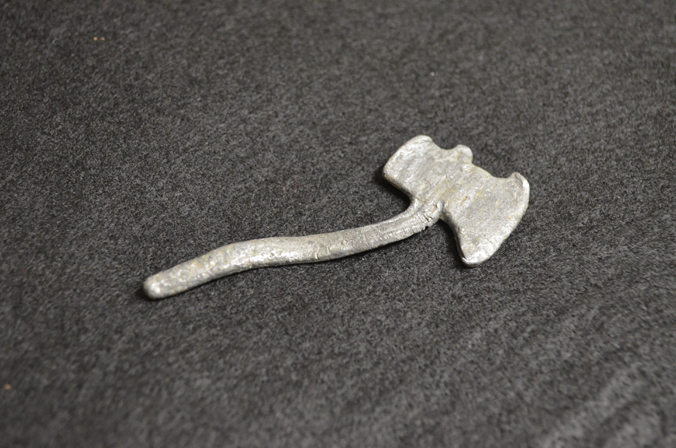
    Lead toy hatchet excavated at George Washington’s Ferry Farm.

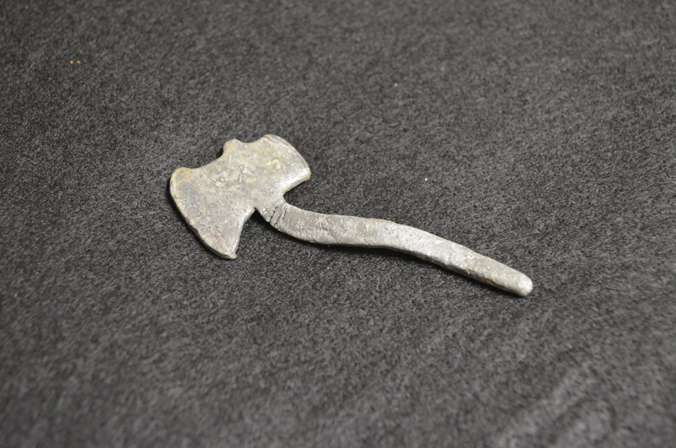
    This is a Memorial Day story of a tiny hatchet excavated at George Washington’s Ferry Farm.  For such a diminutive object it speaks quite loudly to our local history in Fredericksburg, Virginia.  Initially, archaeologists at Ferry Farm assumed it was a pewter toy souvenir given out or sold in 1932, when our country and Fredericksburg celebrated the 200th anniversary of George’s birth.  Indeed, cheap pewter toys were very popular during the time period.


    A closer look at the provenience, or the location on the Ferry Farm landscape, where the artifact was recovered paints a more complex picture.  Provenience is very important in archaeology because whatever is excavated around an artifact paints a more complete picture than one object all by itself.  A reexamination of all the artifacts from the context where the hatchet was found revealed that nothing from that strata (we excavate in layers) had any 20th century artifacts in it, nor did the two strata above it.  In fact, the youngest artifacts from these strata were all mid-19th century.  Additionally, although the archaeologists who excavated the hatchet didn’t know it at the time, the excavation unit from which the hatchet came sat right inside the Civil War-era trench that runs across the property.

    Civil War Trench
    Excavated area containing the footprint of the 18th century Washington house at Ferry Farm showing a 19th century Civil War trench running the length of the house and beyond.

    This revelation shut the door on our ‘it’s a 20th century souvenir’ narrative but opened the door to an even cooler one.  A close examination of the hatchet showed that it didn’t have mold seams, which are always present on cast pewter toys.  Furthermore, for some reason, it had one smooth side and one textured side leading us to believe that it was handmade, not machine cast.  This was supported by a thorough internet search to find an identical toy hatchet, which came up empty, further supporting our new theory that this piece was a one of a kind.  The textured side resembled the grain of wood so we surmised it had been cast in a simple hand carved wooden mold.  All of these clues, combined with its location within a Civil War trench, made us suspect that the hatchet was crafted by a soldier, possibly from a lead minie ball.  The hatchet is likely ‘trench art’.

    Lead Hatchet - Mold Side
    Textured side of the lead hatchet. See photo at the start of post for at image of the smooth side.

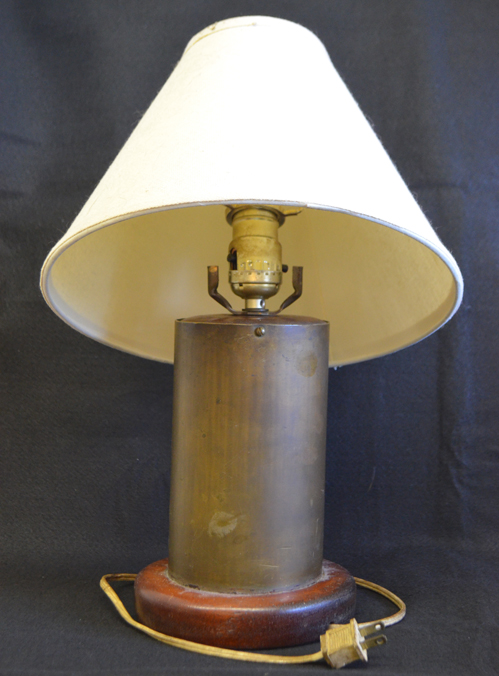
    Trench art is defined as objects either made by soldiers and POWs or by civilians using military items such as brass shell casings or lead bullets.  This simple lamp, owned by the author, was made using a 105 millimeter brass artillery shell casing.

    Lamp - Artillery Shell
    Lamp fashioned from a portion of a 105 millimeter brass artillery shell casing.

    To further support our identification of the hatchet as trench art, we took the artifact to the Virginia Department of Historic Resources where the amazing Katherine Ridgeway analyzed it using XRF or X-ray florescence analysis.  This non-destructive technique determines the composition of metal.  We also brought along a few minie balls recovered from the same unit for comparison.  It turned out that what we thought was a pewter hatchet was actually a lead hatchet with a similar compositional profile to minie balls, which are mostly lead with trace amounts of other metals such as tin and nickel.  While minie balls vary in their composition due to their imprecise method of manufacture, the hatchet was still a close match.

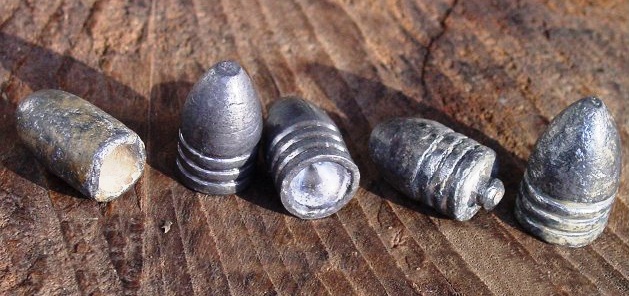
    Minie Balls
    Minie Balls – rifled musket bullets. From left to right: .557 Enfield Minie Bullet, Burton Pattern Minie Bullets .58 Springfield (x 2), Williams Bullet missing zinc base, .69 Caliber Minie Bullet for modified 1843 Springfield Musket. Credit: Mike Cumpston / Wikipedia

    One can just imagine a bored Union soldier whittling the mold and then melting down some of his bullets to pour into it.  He likely chose the hatchet form because of the famous cherry tree story, in which young George Washington owned up to hacking his father’s cheery tree with a hatchet by proclaiming ‘I cannot tell a lie’.  The soldier would have been well-versed in the Washington cherry tree myth, which was set at Ferry Farm by Mason Locke Weems in his first biography of Washington, published in 1800. By the 1860s, the story was nationally known.  Additionally, letters Union soldiers wrote while encamped at Ferry Farm indicate they knew the site’s connection to Washington. They even went so far as to send home cherry seeds for their families.

    While the identification of the hatchet is now secured, we have so many more questions.  Who was this soldier?  How many hatchets did he make and why did this one come to be left behind in his trench? Was it a souvenir for himself or did he send one home to his family or share with fellow soldiers?  Did he survive the war?  Unfortunately these are mysteries that will likely never be solved but that make for great pondering on this Memorial Day.

    Mara Kaktins, Archaeologist
    Archaeology Lab Supervisor

  • Lecture – Drinking with the Washingtons: Archaeological Evidence of Colonial Imbibing at Ferry Farm [Video]

    On Tuesday, May 7, 2019, Archaeologist Mara Kaktins, Ceramics & Glass Specialist at The George Washington Foundation, presented a lecture titled “Drinking with the Washingtons: Archaeological Evidence of Colonial Imbibing at Ferry Farm.” Mara explored a wide variety of beverage-related artifacts from teawares to punch bowls and discussed how cups and glasses reflected efforts by Mary Washington to demonstrate the family’s economic status and refinement.

    Join us on Tuesday, May 14, 2019 for “Food in the Eighteenth Century” when Deborah Lawton, Park Ranger at George Washington Birthplace National Monument, will explore the new dishes and changing tastes that marked the foodways of the eighteenth century. Talk begins at 7:00 p.m. The lecture is FREE and hosted at the Fredericksburg branch of the Central Rappahannock Regional Library at 1201 Caroline Street, Fredericksburg, Virginia. To learn more, visit http://www.kenmore.org.