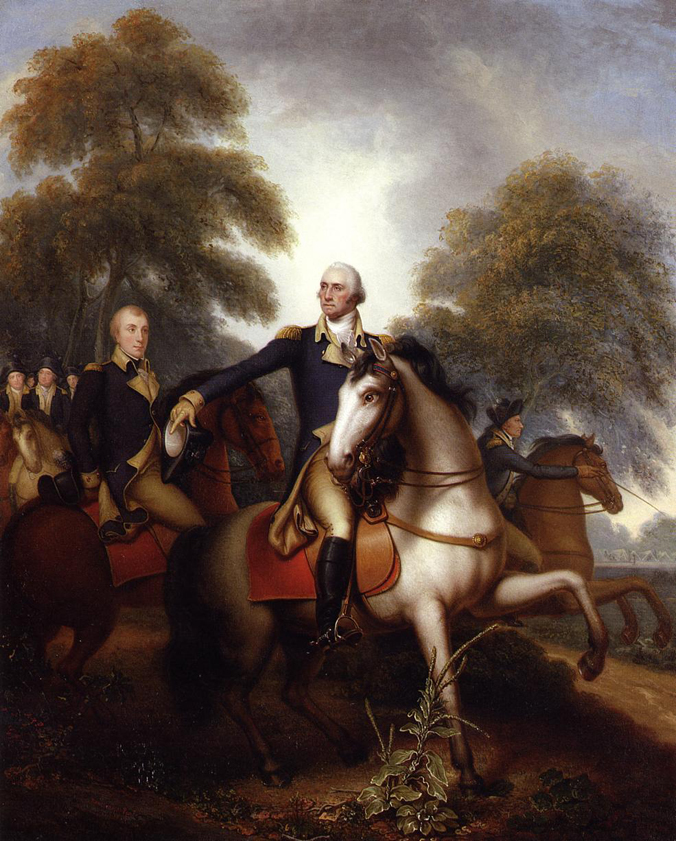
“Washington Before Yorktown” by Rembrandt Peale (1823) Public domain. Courtesy: The Athenaeum/Wikipedia
Editor’s Note: This is the first of two posts inspired by this year’s Summer Olympics. This week, it’s an equestrian-inspired post from Archaeologist Laura Galke, who briefly looks at some of the ornaments found on 18th century horse tack.
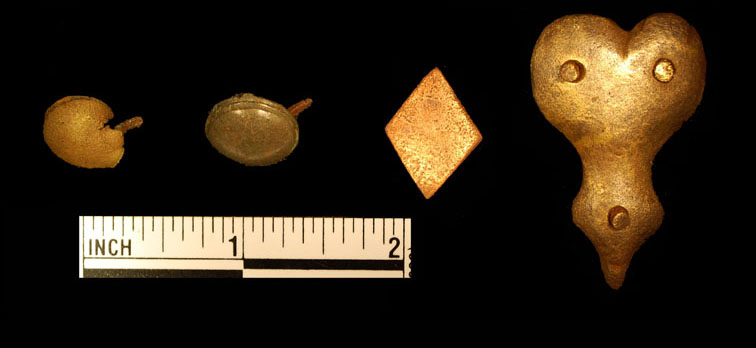
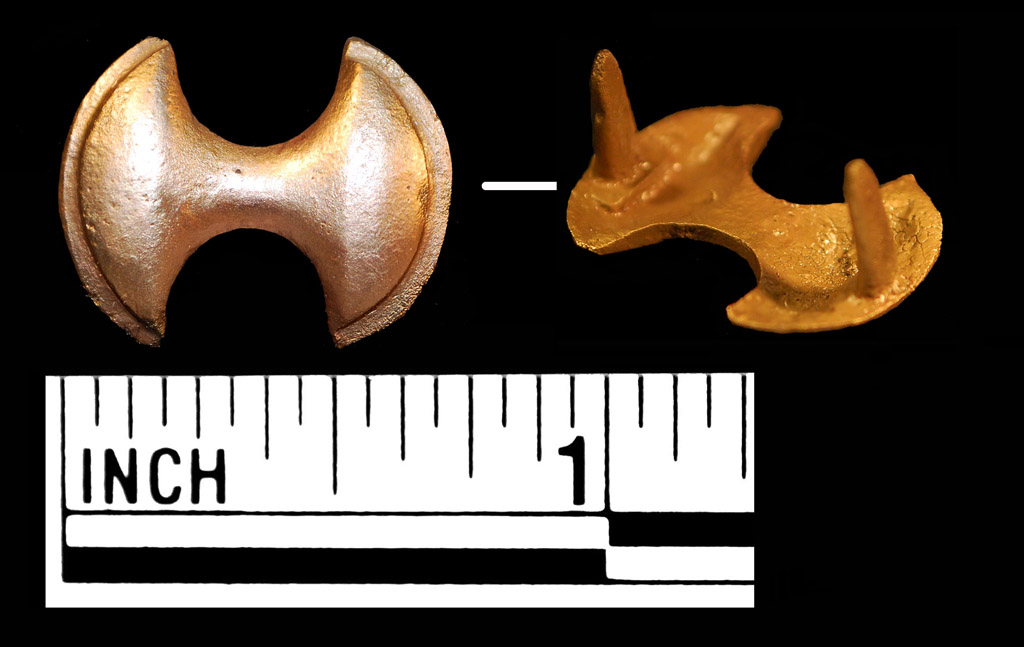
What an impressive sight the Washingtons made as they rode their horses with bridles and straps embellished with these shiny brass decorations. Today, people who study these decorations refer to them as “mounts” or “leather ornaments.” They were used to ornament the leather straps, nosebands, harnesses, and reins of horses. Individual riders enjoyed these, but they also could adorn steeds that pulled carriages. About twenty of these ornaments have been found during recent excavations at Ferry Farm.
Ferry Farm leather ornaments dating from the 1700s. The Harwoods, Strothers or the Washingtons may have purchased these.
Colonial Virginians, including George Washington, took pride in owning horses. Adorning their stallions with such flashy decorations attracted attention to their owners as they journeyed through the streets, on the ferries, and along the trails of Colonial Virginia and beyond. It was also a great way to draw attention to a favorite steed or an elegant carriage in a public setting. Unlike household adornments – which were esteemed by an intimate circle of family, friends, and enslaved attendants – investments in these leather ornaments were appreciated by a wider audience as rider and horse proudly paraded about the colony and region.
This copper-alloy mount dates from the mid-to-late 1700s.
In Colonial households, men typically purchased these showy trimmings. Indeed, they bought most things associated with the stable: horses or transportation. Horse milliners were the source for such tack. However, purchases related to the health of livestock, such as medicine, was the responsibility of women.
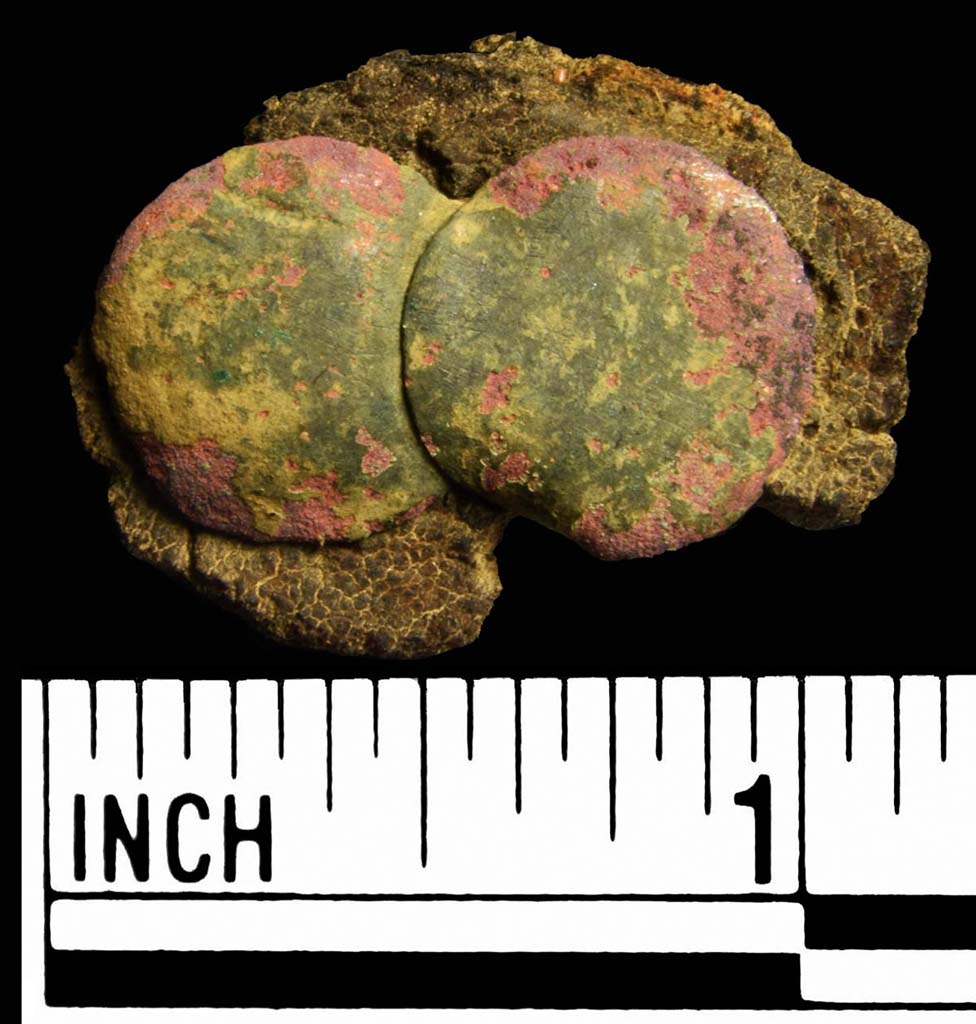
Copper naturally repels the bacteria that break down organic materials such as leather. These mid-to-late 1700s Washington family ornaments have actually preserved a small portion of the original leather straps they adorned.
Laura Galke, Archaeologist
Site Director/Small Finds Analyst
Further Reading
Cofield, Sara Rivers
2008 A Preliminary Study of 17th– and 18th-Century Leather Ornaments from Maryland. Maryland Archaeology 44(2):12-27. Available online http://www.jefpat.org/research.html
Griffiths, Nick
2004 Harness Pendants and Associated Fittings. In The Medieval Horse and its Equipment, c. 1150 – c. 1450, edited by John Clark, pp. 61-71. The Boydell Press, Woodbridge.
McBane, Susan
1992 TheIllustrated Guide to Horse Tack. David and Charles. Milanostampa, Brunel House Newton Abbot Devon.
Noel Hume, Ivor
1991 A Guide to Artifacts of Colonial America. Vintage Books, New York.
Vickery, Amanda
2009 Behind Closed Doors: At Home in Georgian England. Yale University Press, New Haven.
In this video, we show you how archaeologists piece together artifacts in order to learn about the object and, most importantly, the people who used the object.
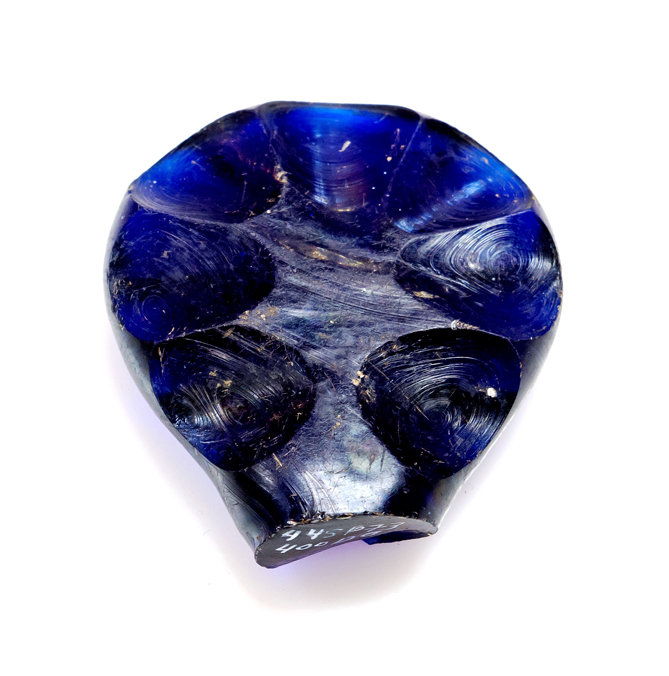
Archaeologists are somewhat unique in their appreciation for all things broken, mostly due to the coveted information discarded items can tell us about those who died long ago. However, occasionally a fragment is unearthed which is both informative and beautiful. Such is the case with a lovely cobalt blue decanter stopper excavated on the grounds of Historic Kenmore. Made from leaded glass to increase clarity, it seems quite heavy when placed in the hand. Six carefully hand-cut flutes adorn each side and when held up to a light it exhibits violet-colored highlights that accent the piece perfectly. Just the stopper alone is beautiful. Imagine how striking the entire decanter would have looked! Conveniently enough, that’s my job!
During the late 18th century, the decanter and its stopper graced one of the rooms at Kenmore and held either fortified wine like Madeira, Port, and Sherry or a stiffer spirit such as rum or gin. It may have been part of a set and adorned with gold gilding that spelled out which heady beverage was contained within. I picture the decanter being picked up by one of the Lewis family’s enslaved servants on a dark night and a glint of purple from deep within the cobalt bottle shining as it reflects off of a candle while dark burgundy Madeira is poured forth into a waiting cup.
All musings aside, however, the reality is that this stopper (which I am clearly obsessed with) also teaches us about how Fielding Lewis and his family lived. The decanter was a showy piece meant for display. It could be argued that, while it was a functional vessel, its primary purpose was to emphasize the wealth of the family and to impress guests.
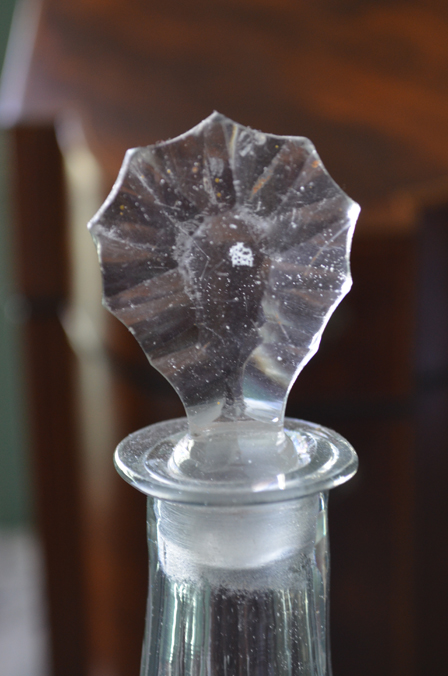
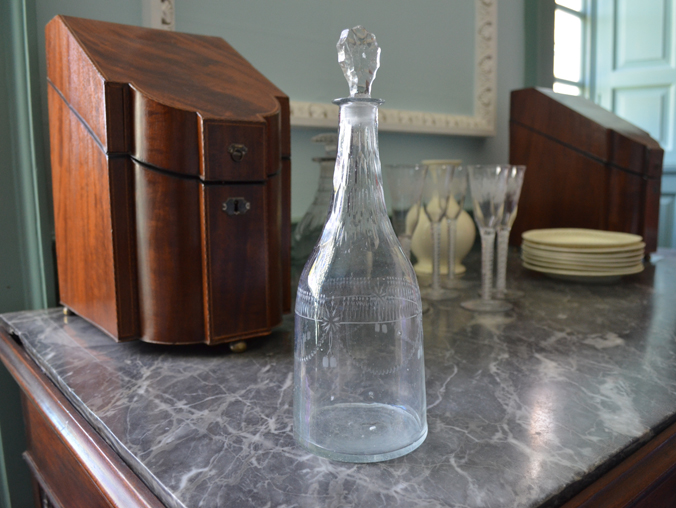
For us today, the stopper has a practical use. Meghan Budinger, Kenmore’s curator, was able to locate a similar vessel using the excavated stopper as a guide. While the decanter on display in Kenmore’s dining room is clear instead of cobalt blue, its shape and design closely match the cobalt decanter and stopper owned by the Lewises. Meghan continues her search for a blue decanter.
Still, visitors and obsessed archaeologists alike may marvel at its beauty. In fact, most of the ceramics and glass in that room have archaeological equivalents that have informed Meghan’s choices. Thus, when asked by visitors why we have selected the beautiful tablewares before them, we can confidently answer that it is not just because they are pretty (so very, very pretty!) but also because, thanks to the archaeological record, we know the Lewis family owned pieces like them!
You can see the clear glass decanter that is based on the cobalt blue stopper while also learning more about their ceramic cousins and about how archaeology has informed the choices of objects displayed inside Kenmore on a new specialty tour of the house called “Posh Pots and Decadent Dishes: The Lewis Family Life through their Ceramics.” Learn more about this new tour here. If antique glass is more your style, you can read more about Kenmore’s “Beautiful Glass” on The Rooms at Kenmore blog here.
Mara Kaktins, Archaeologist
Ceramics & Glass Specialist
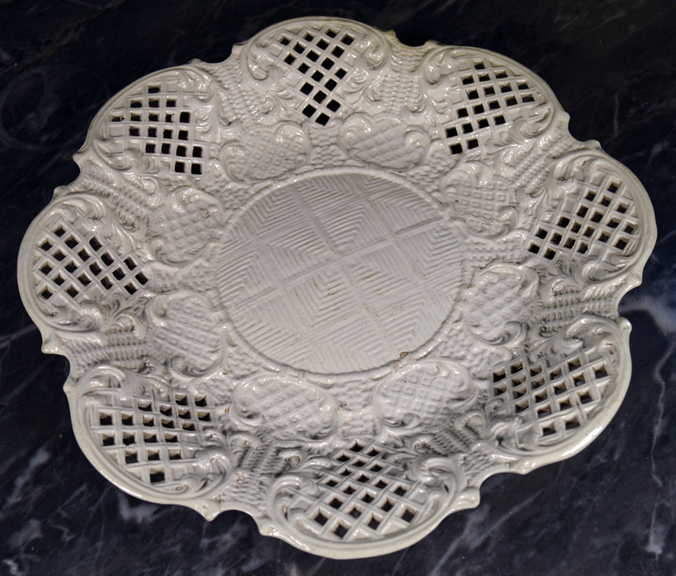
Want to see “in real life” the 18th century ceramic fruit dish we wrote about last August? You can see it and the matching sherds excavated by archaeologists on your next visit to George Washington’s Ferry Farm.
The dish sits inside the Ferry Farm visitor center in a museum display case now dedicated to Lives & Legacies. In this exhibit case, we will showcase some of the artifacts, objects, and stories that we write about on the blog for people visiting George’s boyhood home.
Along with taking the self-guided iPad tour “Uncovering George Washington’s Youth,” viewing the visitor center’s major exhibit “The Science of History at Ferry Farm,” and watching archaeologists at work at the dig site and in the lab, visitors can learn how archaeologists discovered fragments of the unique fruit dish and how the dish and its discovery connects three Washington sites – Ferry Farm, Kenmore, and Mount Vernon – together.
Future subjects for the display case include the glass base that may have been used as a spinning top, jewelry and personal accessories from the 18th century, and Westerwald ceramics found at Ferry Farm and Kenmore, among many others that you have seen on Lives & Legacies. The case will be rotated regularly – stop in to check it out!
For more information about visiting Ferry Farm, click here.
Archaeologists spend much more of their time working to determine the significance of an object than actually finding the object through excavation. This analytical work is done in an archaeology lab, where t is vital to keep the artifacts organized. This video shows how artifacts are labeled to help make sure nothing gets lost.
Sometimes, it can be a challenge to precisely identify an artifact. When faced with this challenge, archaeologists working in the lab put their five senses to work and call upon some interesting ‘tricks of the trade’ to make those difficult identifications.
Learn more about archaeology and being an archaeologist during Archaeology Day at Ferry Farm on Monday, February 15 from 10:00 a.m. – 4:00 p.m. Visit http://www.ferryfarm.org for event details.
Click on the photo for to link to a 3D image the you can zoom, rotate, and manipulate.
Recently, a 3D image of a smoking pipe was added to the Virtual Curation Lab, an online project of Virginia Commonwealth University. You can view rotate, zoom, and manipulate the image by clicking the photo above or by clicking here. The smoking pipe was discovered within the fill of the main cellar of the Washington family house at George Washington’s Ferry Farm, his boyhood home. The pipe features the square and compass and twin pillars that distinguish this as a masonic pipe. Such motifs were very popular. The masonic symbols faced the smoker and fluting characterized that portion visible to surrounding friends. The design elements used suggest that this pipe was likely made in the northeast of England sometime between 1770-1810, in places like Hull.
George Washington was initiated as an apprentice mason on November 4, 1752, passed to fellow craft on March 3, 1753, and became a master mason on August 4, 1753. He achieved all of these masonic ranks at Fredericksburg Lodge No. 4. While it is certainly possible the masonic pipe belonged to George, he was one of four notable masons associated with Ferry Farm. The other three were Fielding Lewis, Hugh Mercer, and George Weedon, who each may also have left this specimen behind in the archaeological record.
The Virtual Curation Laboratory (VCL) at Virginia Commonwealth University, headed by Dr. Bernard K. Means, scanned this pipe bowl in three dimensions. 3D scanning provides two types of digital models: a three-dimensional image to be viewed on a monitor and, with the use of a special 3D printer, a plastic replica of the item. Replicas can be printed at a larger scale, allowing details to be viewed more easily. VCL has used the technology to scan bones from extinct passenger pigeons, allowing researchers from around the nation to compare these known digital models to bird bones in their own assemblages so that they can identify passenger pigeons in their collection.
The pipe bowl being scanned in 3D.
Three-dimensional scanning allows The George Washington Foundation to provide greater public access to fragile artifacts both on the Internet virtually and as 3D printed copies that visitors can see and hold. Making 3D images available online allows more people to see these artifacts than could ever visit Washington’s boyhood home. We can even make these digital files available to researchers on the web, allowing others to 3D print them wherever in the world they may be. In the field, 3D replicas allow staff to engage visitors, showing them (for example) a wig hair curler or tobacco pipe, then inviting them to guess how the object was used in the past.
3D replicas allow Ferry Farm archaeologist Lauren Volkers to share rare and unique artifacts with visitors when the archaeological dig site is open.
Fragile ceramic sherds can be printed in plastic, allowing visitors to mend the pieces together as an educational exercise. Such access allows the original objects to be on exhibit while simultaneously allowing maximum access to the replicas physically and digitally.
Archaeologist Vivian Hite uses a 3D printed plastic replica of the masonic pipe to engage young visitors.
Laura Galke, Archaeologist
Site Director/Small Finds Analyst
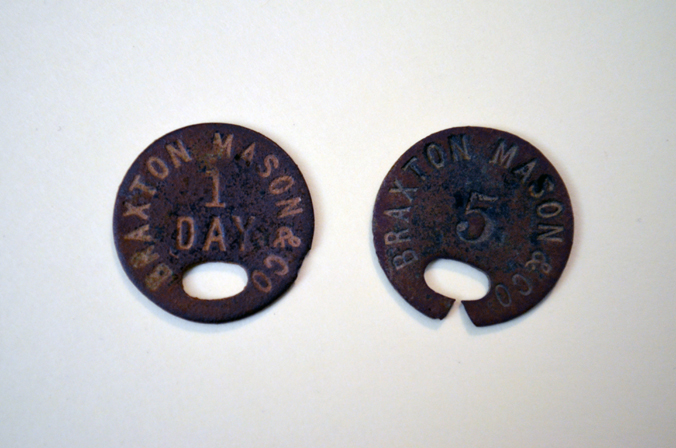
Two of 21 payment tokens discovered by archaeologists at Historic Kenmore.
During excavations around and under Kenmore’s 19th century portico in the early 2000s, archaeologists discovered several small metal disks. Some disks were significantly corroded but a few still showed markings clearly. They were stamped with the words “Braxton Mason & Co” as well as “1 day” and on another disk “5”. The disks had oval-shaped holes punched through the middle. Over the years, excavations have found a total of 21 disks scattered around Kenmore.
Archival box containing artifact bags of payment tokens recovered during excavations at Kenmore.
What were these disks? The machine-made nature of both the disks and the stamped words on them suggested they dated much later the 18th century and were more likely from the late 19th or even early 20th centuries. The first clue to their purpose was the holes punched in the middle of each disk, which suggested they were intended to be strung together on a chain or key ring. Though of different shapes and materials, similar artifacts intended to be strung together in the same manner had been excavated at other sites around Fredericksburg, especially on the nearby Northern Neck. In those instances, the artifacts were identified as payment tokens used by workers in the “truck farming” industry. Day laborers were hired to pick produce, which was collected by the bushel-full in trucks and then sold roadside from the same trucks. For every bushel of produce picked, the laborer received a payment token, usually marked with either the amount “1 bushel” or so many pounds. At the end of the day or of the week, laborers lined up to trade in their tokens for payment. As the 20th century progressed, the Northern Neck became a center for the food canning industry, and eventually the small truck farms raised produce almost solely to supply 120 canneries. These canneries started issuing their own payment tokens often stamped with the company name. [1]
For a long time, it was believed the metal tokens found at Kenmore were payment tokens related to truck farming. The thought was that the Howard family, who owned Kenmore from 1881 until 1914, perhaps used the remaining land surrounding the house for a small truck farming operation. The tokens probably had been inadvertently dropped by laborers around the property. On its surface, this seemed a plausible explanation and was added to the canon of Kenmore’s history.
Upon closer inspection, however, there were issues with the truck farming theory. First, Braxton Mason & Co was neither a Northern Neck cannery nor a business anywhere in the Fredericksburg area in the 20th century. Also, the Kenmore tokens were stamped with time increments instead of quantities. Lastly, there was no other evidence of the Howards being involved in truck farming.
Working in the museum field has its definite perks, and one of them is that we have access to a vast network of people who possess an impressive amount of knowledge about a wide variety of topics. Almost all of them love a good mystery! Armed with the name Braxton Mason & Co and a rough date range of 1820 to 1880, I put out a call to museum colleagues in Virginia. Had anyone ever heard of Braxton Mason & Co? Did anyone have any idea what kind of business it was? Within days, I began receiving bits of information and a truly interesting picture began to emerge.
First, a colleague from Petersburg found a tiny reference to Braxton Mason & Co in the Railroad Gazette of 1871. The single sentence stated that the company won the contract to build a portion of the Lynchburg and Danville railroad.[2] Braxton Mason & Co was a railroading firm! But who were the individuals Braxton and Mason? The Acts of the General Assembly of the State of Virginia for 1870 recorded that a Mr. Braxton and two gentlemen named Mason were among a group of 24 investors who formed the Fredericksburg & Northern Neck Railway Company in April. Could this Braxton and one of the two Masons be our guys?
A second colleague found reference to a Carter M. Braxton in the Fredericksburg City Council minutes of 1866. With the Civil War over, the city renewed pre-war efforts to build a railway line to Gordonsville.[3] The project’s engineer was Carter Braxton. The Fredericksburg-Gordonsville Railroad was completed in 1870, just before Braxton Mason & Co was contracted to build the Lynchburg-Danville line. Could Carter Braxton and one of his fellow investors (named Mason) in the Fredericksburg Northern Neck Railroad Company have split off and formed a smaller railway business? At the moment, that seems the likely explanation.
So, that explains what Braxton Mason & Co was but what did it have to do with Kenmore? A third colleague inadvertently came up with a potential answer. In order for Carter Braxton to complete the rail line to Gordonsville, the 1866 city council minutes said, swampy land that was part of the Kenmore property needed to be drained. It was decided the “owners of Kenmore” would be asked to contribute since they would benefit financially from the railway’s construction. The third colleague involved in this research had done extensive work establishing Kenmore’s ownership history. The upheaval of the Civil War kept this history a bit cloudy. Deeds and records of sale simply did not survive. Because of my colleague’s work, however, we know that, in 1866, Kenmore’s owner was Levi Beardsley, a New Yorker who came to Virginia after the war in hopes of finding promising business ventures.[4] As New Yorkers were not popular in the South, he told people that he was actually from Iowa. His secret came to light during a failed political campaign in 1868 and his various business ventures began to crumble. In order to keep Kenmore safe from his creditors, he put it into trust for his wife.[5] The trustee was a man named William Barton.
In 1870, the same year that Braxton Mason & Co began taking contracts on their own, Beardsley and his wife finally gave up and left Virginia. Kenmore was supposedly auctioned off, but it appears that William Barton retained control of the property. Shortly thereafter, Barton rented the house out to tenants. We have never known the identity or number of these tenants.
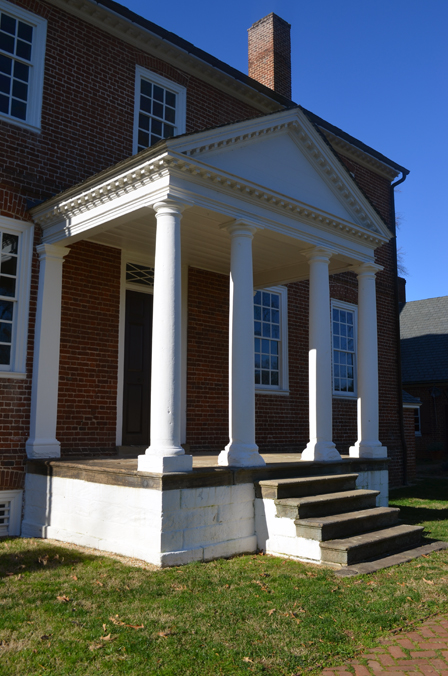
The 19th century portico on the east front of Kenmore.
Is it possible that, while working on the Fredericksburg-Gordonsville Railroad that crossed Kenmore property, Braxton Mason & Co housed their workers at Kenmore itself? Did laborers gather on the house’s portico each week to collect payment for their tokens, some of which were accidentally dropped nearby? It would certainly explain the presence of these perplexing metal disks and fill in the gap of who was living at Kenmore after 1870. Whether this theory can be proven with certainty remains to be seen but, in the end, it’s the investigation that makes it fun…with a little help from our friends.
Meghan Budinger
Aldrich Director of Curatorial Operations
[1] Dodd, Anita L. Day Laborer Tokens: Meaning and Function at Two 18th Century Plantations. 2006.
[2]Railroad Gazette, vol. 3, 1871. Pg. 68. Reference provided by Emmanuel Dabney, Curator, Petersburg National Battlefield.
[3] Minutes of the City Council of Fredericksburg, 1866. Reference provided by Judy Hynson, Archivist, Stratford Hall.
[4] Walker, Travis. Levi A. Beardsley and Family. 2013.
[5] Norman, Gary J. and Edgar R. Hon. Kenmore’s Yankees: The Beardsleys in Fredericksburg. 1996.
Although Fielding Lewis certainly built a home capable of hosting the elaborate Christmas celebrations popular in 18th century Virginia, Historic Kenmore probably never saw occasions on such a lavish scale, with the possible exception of the family’s first Christmas in the house in December 1775. If the family hosted the traditional Christmas celebration, Fielding and Betty would have welcomed lots of friends and family, serving them fancy dinners and entertaining them with dancing and music. They and their guests might have enjoyed fox hunts as well.
Virginians regularly included fox hunts as part of their Christmas celebrations.[1] In an era long before environmental conservation, colonial Virginians viewed foxes as pests that endangered livestock, which is why they hunted them so relentlessly.[2]Additionally, during hunts, gentry men like George Washington could show off their hunting dogs and their skill at horseback riding while chasing foxes through the countryside.
George Washington loved fox hunting. In the year 1768, for example, he went on fox hunts 40 different times. These hunts often lasted hours. On a March day in 1768, he caught “a fox with a bobd Tail & cut Ears, after 7 hours chase.”
George owned numerous hunting dogs and “helped develop the breed known as the American Foxhound.” These hounds chased the fox and hunters on horseback chased the hounds. The chase required galloping horses to jump over streams, bushes, and fences and riders to duck under low-hanging tree limbs. Fox hunting allowed wealthy Virginians to show-off their horse riding skills and George was widely considered an excellent horseman.
Hunters also wore special clothes. George went hunting in “a blue riding frock and scarlet waistcoat threaded with gold lace and topped by a black velvet cap. He wore high boots and carried a . . . riding crop.”[2] He wore cuff links that said “tallio” on them – that’s what hunters would shout when they found a fox. These cufflinks were unearthed by archaeologists at George Washington’s Ferry Farm and their discovery hint at George’s interest in fox hunting even in his younger years. He also hung paintings of fox hunts on the walls of his home at Mount Vernon.
Cufflinks discovered in the parlor root cellar and yard of the Washington House at Ferry Farm show a fox running across grassy rolling hills with the word “tallio” engraved above. This is a popular 18th century motif.
Like the George’s paintings at Mount Vernon, Fielding Lewis included foxes in the decor of his home. At Kenmore, the Lewis children were always reminded of the sneaky ways of foxes when they looked at a picture above the Dining Room fireplace. The plaster image illustrates the Aesop’s fable known as “The Fox and the Crow.”
This plaster over-mantle in Historic Kenmore’s dining room depicts the Aesop’s Fable known as “The Fox and the Crow.”
One day a fox saw a crow flying with a piece of cheese in its beak and settle on a branch of a tree. “That’s for me!’ said Master Fox, and he walked up to the foot of the tree.
“Good-day, Mistress Crow,” he cried, “How well you are looking today; how shiny your feathers; how bright your eyes. Your voice must be more beautiful than that of other birds. Won’t you, please, sing me a song that I may know you are the Queen of Birds?
The crow, quite happy to hear such praise, began to sing her best – “Caw, Caw, Caw”, but when she opened her beak, the piece of cheese dropped to the ground and was snapped up by Master Fox.
A close-up view of the over-mantle shows Mistress Crow dropping her cheese to be scooped up by Master Fox.
“Aha, Mistress Crow,” said he. “That was what I wanted. In exchange for your cheese I will give you some advice for the future: “Beware of false flattery.”
This Christmas, some sneaky foxes have found their way into Kenmore.
A sneaky fox hiding somewhere inside Kenmore.
During the holiday season, younger visitors can help us look for them in a special scavenger hunt and learn about the colonial Christmas custom of fox hunting.
Zac Cunningham
Manager of Educational Programs
[1] Philip Vickers Fithian, Journal & Letters of Philip Vickers Fithian, 1773-1774: A Plantation Tutor of the Old Dominion, ed Hunter Dickinson Farish (Williamsburg, Va., 1943), entry for Dec. 18, 1773: 44
[2] Jane Carson, Colonial Virginians at Play, Williamsburg, VA: Colonial Williamsburg Foundation, 1998: 62-64
[3] Ron Chernow, Washington: A Life, New York: Penguin Press, 2010: 124-5.