Lives and Legacies

Tag: artifacts

  • A ‘Link’ Between the Washingtons and William and Mary

    William III sleeve link
    Close-up of a mid-1700s sleeve link recovered at Ferry Farm. It features the image of King William III.

    This cuff link or ‘sleeve button’ – made in the mid 1700s – was recovered by archaeologists from George Washington’s boyhood home at Ferry Farm.  It is one of the earliest examples of the Washington family’s resistance to King George III.  What makes this sleeve button so interesting is the man depicted:  King William III, who ruled England with Queen Mary.  This sleeve link was made two generations after the death of this monarch.  Nonetheless one of the Washington brothers wore this politically provocative accessory.  What made William III, a monarch who died in 1702, an attractive choice for colonial apparel during the mid-1700s?  The answer resides in this sleeve link’s political dimensions and reflects the Washington family’s early resistance to Crown policy.

    November is an appropriate time to remember the polemical reign of William and Mary:  they were married on November 4, 1677 and William landed at Torbay, England, November 5, 1688 to begin battles against the supporters of King James II, then ruler of England.  When the unpopular James fled to France with his wife and young son (heir to the throne) parliament met and, after some deliberation, offered the monarchy to William and Mary.  Individual rights, representative government, and justified rebellion became associated with the rule of William and Mary and were part of annual celebrations held for this sovereign pair for generations.  Popular items such as coins, playing cards, plates, mugs, and pamphlets reinforced these connotations throughout their reign and beyond.

    Cuff links, such as the William III link from Ferry Farm, were popular fashion accessories throughout the 1700s.  Made from a molded glass ‘gem’ (see photo) originally situated within a copper-alloy setting (not shown), this sleeve button featured King William III’s silhouette.  It was modeled after coins that depicted the English monarch beginning in the mid-1690s (see image).  At that time, the king’s profile, along with his name “Gulielmus” (in Latin) followed by the initials “D. G.” – an abbreviation of the Latin dei gratia (by the grace of god [King]) – were prominently featured on currency.

    William III coin
    A 1697 sixpence featuring King William III. This silhouette (and text) inspired the design of the mid 1700s sleeve link from Ferry Farm.

    Beginning in the mid-1700s, when the Washingtons wore their William III sleeve link, tensions were growing between Britain and her North American colonies, incited by the colonists’ concern over the policies of King George III.  The Sugar Act and the Stamp Act taxed American colonists, even though they had no representation in parliament.

    Colonists asserted that this was a violation of their rights under the English Bill of Rights (enacted in 1689 under the reign of William and Mary).  Thanks to a popular campaign that originally began in the 1690s, William and Mary came to represent the right of subjects to resist a king who was abusing power, and this narrative proved to be enduring.  In fact, colonists supported this narrative with other figures in English history.  As the Washingtons were looking to William and Mary to legitimize their resistance to King George III, Thomas Jefferson took as his role model Oliver Cromwell, whose rebellion resulted in regicide and who was considered particularly militant by the colonists.  While the Washingtons owned cufflinks to celebrate William and Mary, Jefferson owned a miniature depicting the far more revolutionary Cromwell.

    Regardless, William III thus became a symbol for American colonists in general, and the Washington family in particular, as momentum grew to resist crown powers during the mid-1700s.  By wearing this sleeve link, the Washingtons proclaimed their enduring support for representative government.  And, we all know where that led—the American Revolution and birth of the United States, whose first president grew up at Ferry Farm.

    Laura Galke, Archaeologist
    Site Director/Small Finds Analyst

    Additional Reading

    Cofield, Sara Rivers
    2012  Linked Buttons of the Middle Atlantic, 1670-1800.  Journal of Middle Atlantic Archaeology 28:99-116.

    Greene, Jack P.
    1992  The Glorious Revolution and the British Empire 1688-1783.  In The Revolution of 1688-1689:  Changing Perspectives, edited by Lois G. Schwoerer.  Cambridge University Press, New York, pp. 260-271.

    McConnel, James Richard Redmond
    2012  The 1688 Landing of William of Orange at Torbay: Numerical Dates and Temporal Understanding in Early Modern England.  The Journal of Modern History 84(3):539-571.

    McConville, Brendan
    2006 The King’s Three Faces: The Rise and Fall of Royal America, 1688-1776.  University of North Carolina Press, Chapel Hill.

    Schwoerer, Lois G.
    1990  Celebrating the Glorious Revolution, 1689-1989.  Albion: A Quarterly Journal Concerned with British Studies.  22(1):1-20.

    1989  Images of Queen Mary II, 1689-95. Renaissance Quarterly, 42(4):717-748.

    1977  Propaganda in the Revolution of 1688-89.  The American Historical Review 82(4):843-874.

    Weil, Rachel J.
    1992  The Politics of Legitimacy: Women and the Warming-pan Scandal.  In The Revolution of 1688-1689: Changing Perspectives.  Cambridge University Press, New York, pp. 65-82.

    Wieldraaijer, Matthijs
    2010  Good Government and Providential Delivery:  Legitimations of the 1672 and 1688/89 Orangist Revolutions

  • Video – Caring for Historic Kenmore: Winding the Clock

    Among Kenmore’s collection is an 18th century seven-day clock that requires winding weekly. In this video, Collections Manager Heather Baldus shares the clock’s history and winds the clock for another week.

  • Photos: How to Install a New Museum Exhibit

    Back in late February, staff revamped the orientation exhibit in the visitors center at George Washington’s Ferry Farm.  The new exhibit called The Science of History at Ferry Farm tells the story of how archaeologists and historians discovered the location of the Washington family home using, in some cases, the latest scientific techniques.  It includes a variety of artifacts recovered from the house site.  This team effort involved members of the Curatorial, Archaeology, and Buildings and Grounds departments.  These photos present a glimpse behind-the-scenes into how an museum exhibit gets put together.

  • Caring for Historic Kenmore: Climate Control

    Editor’s Note: The behind-the-scenes tour mentioned at the end of this post and on the video’s end title is sold out.

    Today, we’re linking to a behind-the-scenes video on The George Washington Foundation’s YouTube channel.   In the video, Heather Baldus, Collections Manager, gives us a tour of Historic Kenmore’s underground heating and cooling system. This geothermal system helps maintain the proper climate inside the mansion and protects all of the furniture and historic objects on display.

    You can see more during “Kenmore: Behind-the-Scenes” on Saturday, March 21 when Meghan Budinger, Aldrich Director of Curatorial Operations, gives an extraordinary tour of the mansion, including rare stories and insights into its history, furnishings, and ongoing preservation. Visit the cellar, second floor, attic, and other spaces behind-the-scenes! Admission: $12.00 adults, $6.00 ages 12-17. Reservations required and space is very limited.  Please call 540-370-0732 x24 or email hayes@gwffoundation.org. Please note: on this tour, participants visit each floor in the mansion, climbing a total of 80 stairs. A few passageways and stairwells are narrow and confined.

  • Mending Those Humble Sherds

    What do archaeologists do with the broken ceramic and glass artifacts after these objects have been excavated, cleaned, and catalogued? They are cool to look at but what do these little pieces actually tell us about the past? How can we use them to understand the lives of those who purchased, used, and eventually discarded them?

    One method is by mending the sherds (‘sherd’ is the term we use to describe broken pieces of ceramic and glass) to re-create the vessels. We mend by spreading out all of the fragments on a table and carefully seeing which ones fit together. Then, we use non-damaging tape to join the pieces temporarily. If deemed appropriate, we might decide to carefully glue the sherds together – with removable archival glue, of course!

    Sherds to be mending in the Archaeology Lab at George Washington's Ferry Farm
    Sherds to be mending in the Archaeology Lab at George Washington’s Ferry Farm

    As archaeologists mend and a vessel takes shape, we can determine a number of details about the object we couldn’t when it was just a pile of broken stuff! First, we can figure out what type of vessel it was and what its uses were. Determining the vessel type helps us figure out what activities took place in a given excavation area. Cooking vessels mean the area was used for food preparation. Plates, bowls, and cups show the area was used for dining while crocks indicate a storage area.

    Second, we can determine how much a mended vessel was used by the “use-wear” present on it. For instance, a chamber pot kept under a bed and drawn out from its storage place a couple of times a day will start to exhibit wear marks on the base where it is dragged across the floor. These grooves usually run parallel with the handle. The longer the pot is used the more wear it acquires. The same goes for knife-marks on dinner plates or stir-marks in drinking vessels. However, it is difficult to truly examine the use of a chamber pot using just one sherd. It is preferable to have as much of a whole vessel as possible, so we must mend!

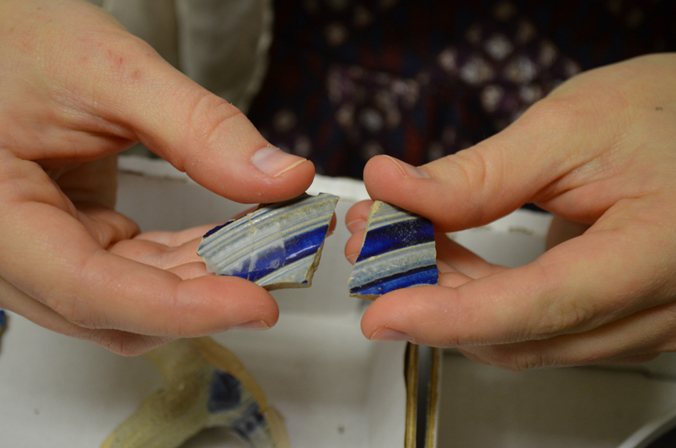
    Yay! They match!
    Yay! They match!

    Within the archaeological community, the general opinion is that mending is a fun activity. It definitely is! What is more fun than taking ancient fragments long-ago discarded by their owners and creating tankards, porringers, teapots, jugs, and all manner of other vessels that say something about who used them? It is one thing to show someone a sherd of porcelain and say “George Washington’s mother may have owned this” and quite another to show them a mended teapot and declare “George Washington was served tea from this very pot!” That being said, mending is also frustrating at times. Imagine taking 100 puzzles, mixing them all together, throwing away 90 percent of the pieces, and then trying to work the puzzles! This is basically mending in a nutshell. Some of us stare at the sherds for so long that we see them when we close our eyes or go to sleep! Now, that’s dedication!

    It is rare that an entire vessel can be completely reconstructed. When an object is broken, perhaps all of the fragments do not get swept up and deposited in the same place. Areas where people lived sometimes become agricultural fields and are plowed for decades or longer, resulting in fragments of vessels being further broken and scattered about the landscape. Insects and animals move artifacts when burrowing in the soil, a process termed ‘bioturbation’. We do the best we can with the artifacts we’ve recovered.

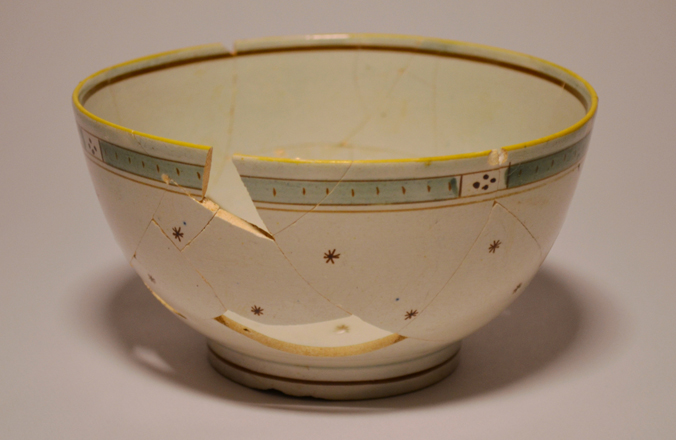
    Pearlware waste or ‘slop’ bowl. Hand painted. Made in England between 1795 and 1830.  This bowl would have been used during the tea ceremony as a receptacle for spent tea leaves or unwanted cold tea before refilling a cup with hot tea.
    Pearlware waste or ‘slop’ bowl. Hand painted. Made in England between 1795 and 1830. Excavated at Historic Kenmore. This bowl would have been used during the tea ceremony as a receptacle for spent tea leaves or unwanted cold tea before refilling a cup with hot tea.

    Still, archaeologists really love when we mend a vessel to near perfection and put it on display for the public along with all the information we’ve learned from it. We’ve actually just finished mending German Westerwald stonewares and we’ll share some of that project’s results in the not-too-distant future. Soon, we’ll be moving onto English white stonewares. On your next visit to Ferry Farm, you’ll likely see a mending project on display in our laboratory and maybe some of our talented staff working hard to unlock the secrets contained within those humble sherds!

    Mara Kaktins
    Archaeologist/Ceramics and Glass Specialist