Lives and Legacies

Tag: gingerbread

  • Thirty Years of Gingerbread

    It’s a long-standing holiday tradition. In fact, it’s so long-standing that this year, 2016, marks the tradition’s 30th year.  What tradition is that?  The annual Gingerbread House Contest and Exhibit at George Washington’s Ferry Farm!

    Since we are marking three auspicious decades for this event, we dug into the archives to present a look back here on Lives & Legacies.

    The contest began in 1987 and, for many years, took place at Historic Kenmore instead of Ferry Farm.  Our records are scant for the contest’s first year but we do know that the 2nd annual contest in 1988 saw middle schoolers Lisa Allen and Erika Paulson win best-in-show, according to a Free Lance-Star clipping in our files. Rev. Ed Boutchyard of Bowling Green’s Zion Full Gospel Church made a church with an ice cream cone steeple!
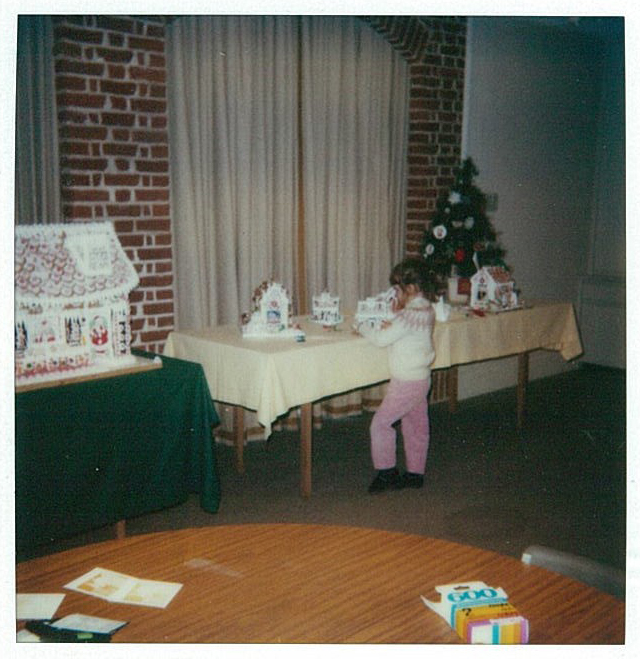
    1987-1
    A Polaroid from the first-ever Gingerbread Contest & Exhibit in 1987.

    Lisa Allen repeated her best-in-show victory in 1989 with the help of her sister Melanie and friends Theresa Stockdill and Courtney Lucado.

    In these early days of the contest, the German Club at James Monroe High School, one of the contest’s longest-running participants, began submitting regular entries and, in 1993, they won their first-ever best-in-show.

    In 1995, the Free Lance-Star (scroll up) profiled Claybourne, Emily, and Meredith Beattie, who, having entered the contest for nearly ten years, had only ever won a single 2nd place ribbon.  For this family, the “tradition of assembling and decorating the houses is far more important than winning prizes.” The kids, along with mom and dad, would visit their grandmother out-of-town over Thanksgiving break. They created their gingerbread houses there and then traveled the 300-miles back to Fredericksburg with the houses packed in the back of the car.  Clay explained that he entered year after year “because I like doing it with my sisters and my family.”
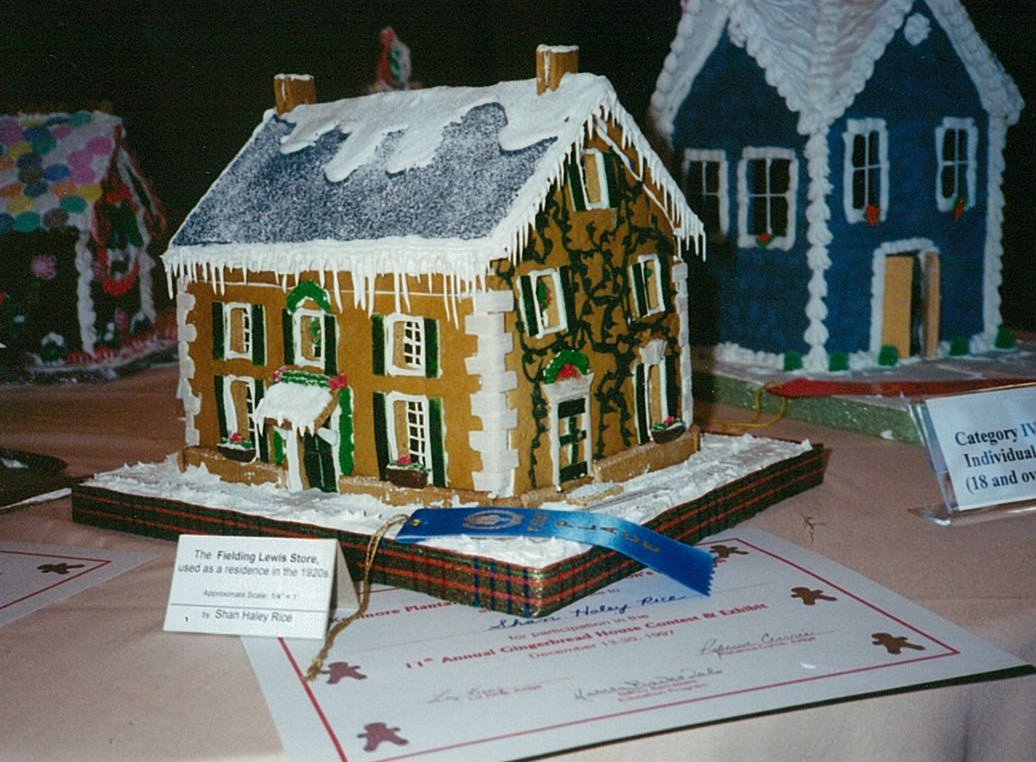
    1997-1
    A gingerbread version of the Fielding Lewis Store from 1997.

    In 2000, the contest and exhibit moved from Kenmore across the Rappahannock River to Ferry Farm, where it has been held every year since.

    There’s still time to enter a gingerbread house in this year’s contest and be a part of the tradition! Gather the family, start baking that gingerbread, and creatively decorate your house together. This year’s theme is “Home for the Holidays.”  Entries are being accepted now through Saturday, December 3 at Ferry Farm. Click here for rules and an entry form.

    The exhibit will open to the public on Sunday, December 4.  Ferry Farm is open Monday – Saturday from 10:00 a.m. – 4:00 p.m. and Sunday from 12:00 p.m. – 4:00 p.m.  General admission to Ferry Farm and the exhibit is $8 adults, $4 students, under 6 free. To view the gingerbread exhibit only, the cost is $4 adults, $2 students, under 6 free. For more details about this and other holiday events at Ferry Farm and Kenmore, visit kenmore.org/events.

    Zac Cunningham
    Manager of Educational Programs

  • Photos: 29th Annual Gingerbread House Contest at Ferry Farm

    It’s a long-standing holiday tradition! Adults and children alike will enjoy the sights and smells of the festive creations displayed at George Washington’s Ferry Farm!

    This year’s theme is “George Washington Slept Here” and a list of contest winners can be seen here (PDF). Visitors may vote for their favorite and this ‘people’s choice’ winner will be announce after the holidays. The gingerbread houses remain on display until December 30.

    Ferry Farm is open Monday – Saturday from 10:00 a.m. – 4:00 p.m and on Sunday from 12:00 p.m. – 4:00 p.m. The site will be closed Christmas Eve and Christmas Day.

    Admission cost for viewing the gingerbread exhibit only is $4 adults, $2 students, under 6 free. There is an additional fee for a self-guided iPad tour of Ferry Farm. Visit www.ferryfarm.org for more details.

  • Kenmore’s Famed Gingerbread

    Historic Kenmore was associated with gingerbread for decades.  Many people’s first memories of Kenmore involve the square of gingerbread and a cup of tea that used to be served at the end of every tour.    The dessert welcomed visitors to the world of colonial Fredericksburg, it comforted soldiers on their way to war in Europe or the Pacific, and, most important of all, it helped save the historic house itself.

    The ladies of the Kenmore Association, which owned and operated the historic home in the 20th century, took on a great challenge when they accepted stewardship of Kenmore.  Raising the money to purchase the house was not the only obstacle they faced.  They also needed funds to restore and staff the house. Unfortunately, the ladies drive to save Kenmore coincided with the Great Depression and the Second World War.  Led by Annie Fleming Smith or “Miss Annie,” the ladies triumphed, kept Kenmore running, and even used the grounds to assist Fredericksburg in the war effort.  They did all this with their indomitable drive and patriotism and with a little help from gingerbread.

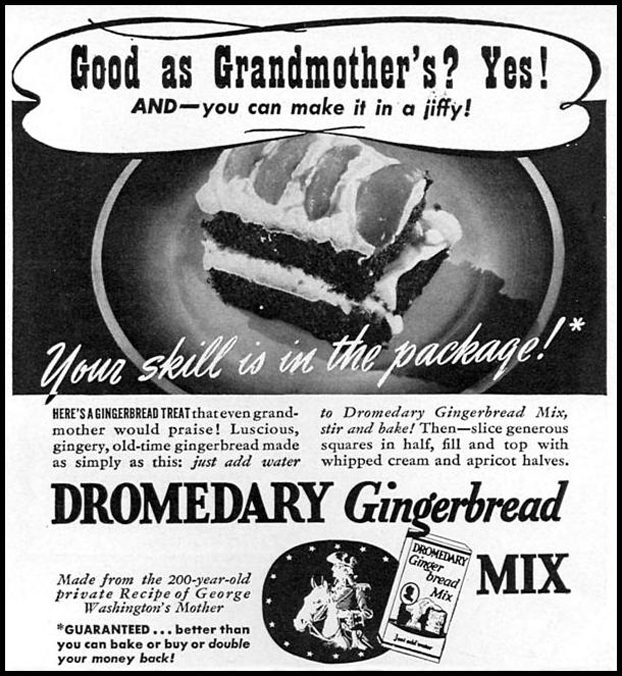
    The beneficial partnership between gingerbread and Kenmore began in the early 1930s when the Dromedary Cake Mix Company launched a nationwide search for gingerbread recipes new and old.  In the search, Mary Washington’s personal recipe was found in a cookbook owned by the Washington-Lewis Chapter of the Daughters of the American Revolution. It was tried and well-liked.  The firm approached the chapter about producing the recipe as one of their mixes.  Because the Washington-Lewis Chapter worked closely with the Kenmore Association in saving, restoring, and caring for Kenmore, Miss Annie and the ladies, being astute business women, brokered a deal with the company to benefit the historic home.

    Dromedary Ad
    An 1940s-era advertisement for Dromedary gingerbread mix “made from the 200-year-old Recipe of George Washington’s Mother.”

    The arrangement allowed Dromedary to produce gingerbread mixes based on Mary Washington’s recipe.  In exchange, the Kenmore Association got all the gingerbread they could serve to visitors.  The company also donated mixes to be sold by the Association and various DAR chapters for 25 cents a box.  The Association got half of the money realized from these sales minus the shipping costs.  This agreement, in the end, earned the Kenmore Association over $38,000 – a hefty sum in the mid-20th century – and provided countless visitors with a yummy Washington family treat.

    In 1941, the United States entered World War II.  Fredericksburg became a hub of activity with thousands of soldiers stationed at the A.P. Hill Military Reservation in Bowling Green visiting town to get a break from military life.

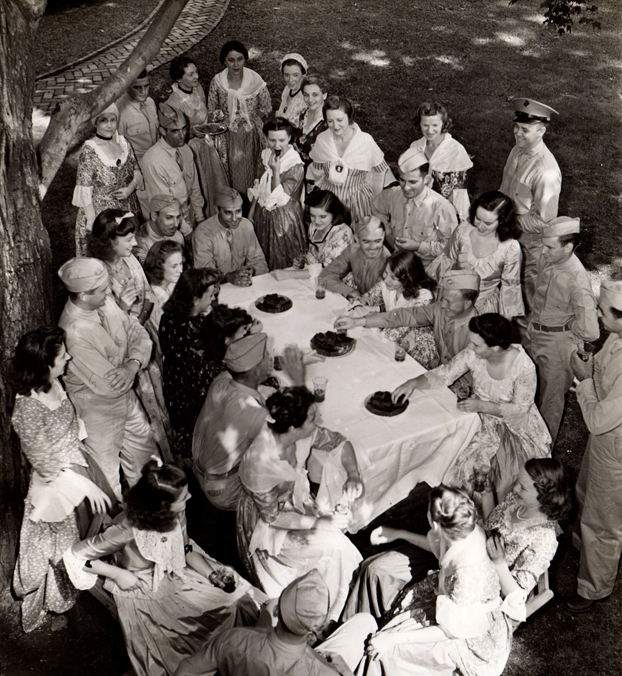
    The Association’s ladies knew that Kenmore, with its historical and patriotic legacy, had a unique opportunity to welcome soldiers who would be fighting for the country and ideals that the Lewis and Washington families helped create. So, they threw open the gates, set out the picnic tables, and recruited local women to put on their colonial best and greet the men of the United States military. At the heart of this hospitality was iced tea and Mary Washington’s gingerbread.

    Gingerbread (1)
    Servicemen enjoy gingerbread and tea on the grounds at Kenmore.

    During the war years, Kenmore hosted over 60,000 soldiers making sure each one was fed and knew his service was greatly cherished.  The ladies of the Washington-Lewis DAR even took time to write each serviceman’s mother, wife, or sweetheart about their loved ones.

    Gingerbread (2)
    C.R. Murphy, Sr. of Coolidge, Georgia wrote The Free Lance Star to express his gratitude for Annie Fleming Smith’s (identified in the letter as Mrs. H.H. Smith)  hospitality towards him and his son during a visit to Fredericksburg from a nearby military post where the son was stationed.

    The humble gingerbread recipe from Mary Washington’s cookbook gave Kenmore a perfect tangible link to its colonial past and bright future.  The gingerbread that resulted assisted the ladies in their community outreach, their historic preservation, and their national patriotic duty.   It was a sign of nostalgia, of hospitality, and most of all appreciation.

    Today, when you tour Kenmore, our guides will happily take you through the reconstructed colonial kitchen that functioned as the Kenmore Association’s tea room.  Regrettably, gingerbread and tea are no longer served to visitors because we do not have a fully-functioning kitchen.  Gingerbread mixes and teas specifically created for The George Washington Foundation are available for purchase by anyone who might wish to relive their first taste of Kenmore’s famed gingerbread.

    Heather Baldus
    Collections Manager

  • Kenmore’s Kitchen: Then & Now

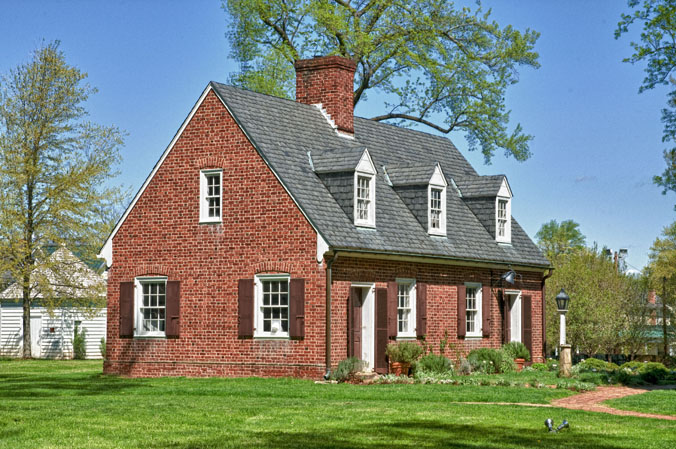
    The brick kitchen building next to Historic Kenmore is not original to the property. It was built in the 1930s in the colonial revival architectural style popular at that time.

    Kitchen01

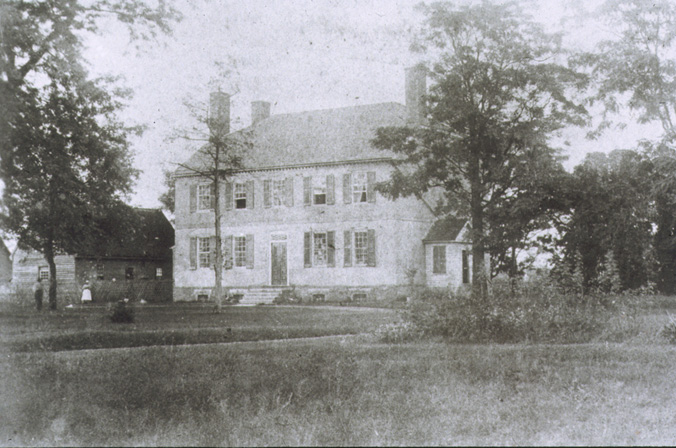
    The brick construction does not reflect the kitchen building seen in the earliest known photo of such a building at Kenmore.  That image, taken around the time of the Civil War, shows a large wooden kitchen to the north of the house as well two enslaved people standing in the kitchen yard.

    pre-1862kitchen02
    The wooden kitchen can be seen to the left of the house in this Civil War-era photograph.

    The Kenmore Association, a group of women who saved the mansion and transformed the property into a historic site open to the public, built the brick kitchen in the 1930s.

    ms 1687
    Inside the brick kitchen just after construction was completed in the 1930s.

    Throughout much of the 20th century, visitors sat around the table in the photo above to enjoy gingerbread and tea served by the ladies of the Kenmore Association.

    Recently, we decided to highlight these ladies and their efforts to preserve Kenmore even more during our tours. We felt the most logical of places to do this was in the kitchen where they served their famed gingerbread and tea.

    We placed a tea set and faux gingerbread on the same table used to serve visitors for so many years. We surrounded that table with many of the same ladderback chairs, though most of their seats have been re-caned. We returned some of the china and the china cupboard that had stood for so long in the kitchen back to that space.

    While we cannot serve actual gingerbread and tea – modern-day museum guidelines prohibit food service inside historic structures – we can discuss the Kenmore Association’s monumental efforts to save Kenmore and make the mansion accessible to the public. You can read about these efforts here.  Although it does not date back to Kenmore’s very beginning, the 80-year-old brick kitchen is still a part of the site’s centuries-long story.

  • Ferry Farm is “Home Sweet Home” for the Holidays

    Tradition says that Mary Ball Washington, mother of George Washington, was well-known for her excellent gingerbread. The story goes that she even served her gingerbread to the Marquis de Lafayette when he visited Fredericksburg as part of his postwar tour of America in 1784. Inspired by this tale and as Mary’s home for three decades from 1738 to 1772, George Washington’s Ferry Farm hosts a Gingerbread Contest and Exhibit each December. This year’s event is the 28th annual and features the theme “Home Sweet Home.”

    The photos in the gallery below show just a few of this year’s contest entries representing a variety of ages and skill-levels. We’re also sharing some photos of Ferry Farm decked out for the holiday season and want to thank the Ann Page Garden Club for beautifully decorating this year.

    To see all the gingerbread creations and to vote for your favorite, visit Ferry Farm before the exhibit ends on December 30. Check out the events page on http://www.kenmore.org for more information!