Stonemason Ray Cannetti tells us the story behind the cornerstone of the Washington house interpretive replica being built at George Washington’s Ferry Farm.
Learn more about the Washington House here and view other videos, photos, and blog posts about the project here.
Expert craftsmen from Blue Ridge Timberwrights arrived last Tuesday, September 6 to build the frame of the Washington house. This collection of photographs documents the first week of their work and begins with pictures of the finished concrete cradle and Aquia sandstone blocks ready to serve as the foundation for the timber frame. Over the past several months, the wood for the frame was carpentered in the Blue Ridge Timberwrights’ shop before being brought to Ferry Farm and pieced together to form the house. Timber framing work will continue for another few weeks.
The concrete cradle and stone foundation…
…awaits the timber frame.
Hand-carved sandstone blocks
Inside the Washington House cellar, new foundation stones rest on top of the original stones.
Timbers arrive from Blue Ridge Timberwrights in Christiansburg.
Unloading
Staging materials.
Placing a beam.
Checking the plans.
Placing a floor joist.
Refining a cut.
A section of completed floor joists.
Placing the first vertical post.
Checking a measurement.
Wood shavings
Wall framing for the front portion of the house is nearly complete.
Early in the timber framing process.
Taking measurements.
Marking the measurement.
Chiseling.
Learn more about constructing the Washington house interpretive replica here, here, and here.
In this video, we learn how Stonemasons Ray Cannetti, Kevin Neito, and Robert Hall split and dressed Aquia sandstone into foundation stones for the Washington House interpretive replica at Ferry Farm.
Learn about the special concrete cradle the foundation stones will rest on in this video and read more about the Washington House project here.
An interpretive replica of the house that young George Washington lived in with his family is being built at his boyhood home at Ferry Farm near Fredericksburg, Virginia. This replica is being constructed on the exact location of the original. Through the use of a specially-designed concrete cradle, the replica will not harm any of the original architectural remains underground. In this video, we see the construction of this cradle and learn about the science and skill that makes this engineering feat possible.
In 1996, the Trustees, Regents, and staff of The George Washington Foundation, known then as the Kenmore Association, were part of a large and vocal group of concerned citizens that banded together to save the site of George Washington’s Boyhood Home from commercial development. While all the Washington-era structures, yards, and fences vanished almost 200 years ago, it was critical to preserve this significant place in our nation’s history—where beginning in 1738 young George and his family called home.
After years of meticulous research and planning by historians, architects, archaeologists, and curators, the Foundation is fulfilling that goal. Up to this point Ferry Farm has been an archaeology park known for its grassy fields, beautiful views of the Rappahannock River, large-scale archaeology excavations, and an amazing and extensive collection of Washington artifacts. Today with the beginning of the construction of the interpretive replica of the Washington house and the surrounding landscape Ferry Farm is beginning its transition to an outdoor living museum.
George Washington lived at Ferry Farm from age 6 to around age 22. The Cherry Tree and the Stone Throw legends were set here. He learned to survey, joined the Masonic Lodge, read his first book on military adventurers, copied the Rules of Civility, and petitioned colonial Virginia’s British Governor for his first military office at Ferry Farm. This is the landscape that was formed by the Washingtons and their enslaved workers, and George Washington’s years on this ground were essential to his development into an extraordinary man.
An architectural rendering of front facade of the interpretive replica of the Washington house at Ferry Farm.
Starting with stone masons, who are now working on the site, the construction process involves a succession of skilled artisans, employing a mix of modern and traditional techniques, including brick masons, blacksmiths, carpenters, joiners, plasterers, and painters, who together will produce the rich detail and beauty of a colonial home.
Once the replica house is in place, the Foundation will reconstruct the support buildings, fences, and yards, informed by archaeology and historical research, that surrounded and served the house. To date, we have unearthed remnants of a kitchen, slave quarter, trash yard, work yard, hen yard, and storehouse from the Washington period. As archaeology continues to reveal additional structures and other elements, they will be added to the landscape until we create a place that evokes early Virginia and portrays what life was like for young George Washington. Because the house is a reconstruction, we look forward to presenting colonial America in ways not possible for most historic house museums. We will light fires in the fireplace, open windows, and invite visitors to sit in the chairs. This unique environment will let guests experience eighteenth-century life with all their senses.
Architectural floor plans of the interpretive replica of the Washington house at Ferry Farm.
As Ferry Farm transitions from grassy fields to construction site, please stop in and witness the making of history up close. George Washington’s Boyhood Home in Stafford County, Virginia, is open Monday through Sunday. We invite you to explore Ferry Farm with the self-guided iPad tour, “Uncovering George Washington’s Youth,” or participate in a dynamic educational program relating to archaeology, history, and the natural environment. The Foundation also offers special events and tours at its sister site, Historic Kenmore Plantation in Fredericksburg. You can follow the progress at Ferry Farm on this blog, as well as the Foundation’s Facebook page and website, where we will offer glimpses into eighteenth-century construction techniques and address historical issues. We hope you will visit George Washington’s Ferry Farm soon.
David Muraca
Director of Archaeology
Learn more about building George Washington’s boyhood home in Clint Schemmer’s article, “George Washington Really Did Sleep Here”, on the Fredericksburg Free Lance-Star’s website.
Fielding Lewis by John Wollaston, ca. 1765. This portrait has been in the Kenmore Collection for many decades. It was recently returned to the Drawing Room, where it would have hung when the Lewis family lived in the house 200 years ago. Watch a video of the hanging process here.
Editor’s Note: This Memorial Day, we again remember ‘The Monuments Men’ and their invaluable work to locate and save European art looted by the Nazis during World War II as well as their continued efforts to conserve and preserve art after the war, including art at Historic Kenmore. This post originally appeared on Lives & Legacies on May 20, 2015.
Recently, while flipping through old files of the Kenmore Association dating back to the 1920s and looking for anything related to our portrait of Fielding Lewis by John Wollaston (ca. 1765), I spotted a familiar name: George Stout. It took me only a moment to realize why the name was familiar. Those of you who read Robert Edsel’s book The Monuments Men: Allied Heroes, Nazi Thieves and the Greatest Treasure Hunt in History or saw the movie The Monuments Men starring George Clooney, Matt Damon, John Goodman, and Bill Murray may also recognize the name.
During World War II, George Stout was a member of the U.S. Army’s Monuments, Fine Arts, and Archives unit, nicknamed the “Monuments Men.” These soldiers volunteered to leave their jobs as curators, historians and conservators to travel the frontlines in Europe, documenting, cataloging and in some cases saving priceless cultural artifacts in harm’s way. Along with serving as a Monuments Man, Stout is widely considered the father of modern methods in art conservation in the museum world. He’s kind of a rock star to all of us who work in museums, as are all of the Monuments Men. It is not often that curators get to be the hero, but those men were.
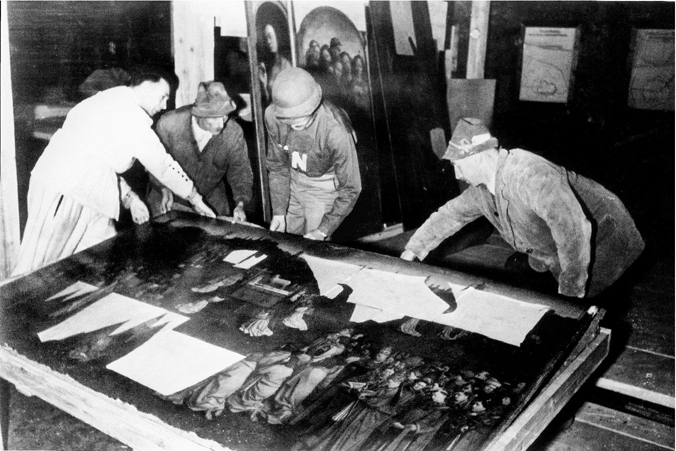
Lieutenant George Stout, U.S. First Army and U.S. Twelfth Army Group. Age: 47. Born: Winterset, Iowa. A towering figure in the then obscure field of art conservation, Stout was one of the first people in America to understand the Nazi threat to the cultural patrimony of Europe and pushed the museum community and the army toward establishing a professional art conservation corps. As a field officer, he was the go-to expert for all the other Monuments Men in northern Europe and their indispensable role model and friend. Dapper and well-mannered, with a fastidiousness and thoroughness that shone in the field, Stout, a veteran of World War I, left behind a wife, Margie, and a young son. His oldest son served in the U.S. Navy. From the Walter Hancock Collection courtesy of the Monuments Men Foundation.ALTAUSSEE, AUSTRIA – JULY 10, 1945: Removal of priceless works of art from the salt mine at Alt Aussee posed problems for Monuments Man George Stout unlike any ever contemplated. Stout constructed a pulley to lift Michelangelo’s Bruges Madonna onto the salt cart to begin its long trip home to Belgium. Visible on the far left is Monuments Man Steve Kovalyak, an expert in packing art, who was a key assistant to Stout. National Gallery of Art photo courtesy of the Monuments Men Foundation.
After the war, many of the Monuments Men returned to their museum jobs where they continued to work together, revolutionizing the care and conservation of artwork and historic objects. They established standards for conservation practices, ethics for conservators, and tested new scientific methods for preserving all varieties of artwork. Perhaps their greatest legacy was that many of them established schools for training conservators, ensuring the future of the field. For the first time, American museums had a cadre of experts to turn to when masterpieces in their collections needed help.
Kenmore’s old files perfectly reveal the post-war story of George Stout and the Monuments Men. It’s a story that also involves numerous other luminaries of the art conservation world such as John Walker, Harold Cross, Sheldon and Caroline Keck, and Russell Quandt.
It all started in 1949, when John Walker, then Chief Curator of the National Gallery of Art, visited Kenmore. His visit moved him to write a letter to Kenmore’s own Louise DuPont Crowninshield, praising the Kenmore Association for its work in saving the property and for its fine collection, which included the Wollaston portrait of Fielding Lewis. Mr. Walker felt very strongly that the Wollaston portrait was in need of immediate conservation treatment. He recommended a young man named Harold Cross, the new restorer at the Corcoran Gallery of Art in Washington, D.C., for the project.
John Walker was not a Monuments Man but he was heavily involved in the complicated and tedious post-war effort to identify artwork looted by the Nazis. This brought him in close contact with many of the Monuments Men over several decades. He suggested the Kenmore Association contact George Stout, then at the Worcester Museum of Art, to get a personal testimonial as to Harold Cross’s abilities. Cross apprenticed under George Stout, receiving training in Stout’s scientific methodology. Mrs. Crowninshield contacted Stout, who highly recommended his former student. Cross performed the first ever restoration of the ca. 1765 Wollaston portrait. The post-war Monuments Men network had made its first mark at Kenmore by saving our only image of Fielding Lewis.
Lieutenant Sheldon Keck (kneeling), United States Army. Read Keck’s biography here. Courtesy of the Monuments Men Foundation.
The next involvement of the Monuments Men with the Wollaston portrait came in 1952, when the ladies of the Kenmore Association became concerned that the portrait was warping at an alarming rate. Through personal connections, they learned that Sheldon and Caroline Keck would be visiting Colonial Williamsburg in January. Sheldon Keck was a former Monuments Man and the chief restorer at the Brooklyn Museum of Art; his wife Caroline was also a restoration specialist at the same museum. Together, they trained more than 150 conservators before they retired.
Their presence in Virginia was fortuitous, and the decision was made to pack up the Wollaston and have Executive Director Mary Mason take it directly to Williamsburg. Mr. and Mrs. Keck agreed to take a look at the painting, and apparently performed their treatment of it in their hotel room, “re-keying” the wooden stretcher so as to tighten the canvas and reduce the warp. The Kecks did not charge for their emergency services “in the field”, rather they indicated that it was their pleasure to assist in the preservation of such an important work.
Finally, in 1957, the Wollaston portrait’s care was passed on to the capable hands of another heir to the Monuments Men legacy. When new preservation issues surfaced, the Kecks recommended a former student of theirs, Russell Quandt, examine the painting. Over the next decade, Mr. Quandt would be the primary conservator of the portrait, performing treatments on it both on-site at Kenmore, at his lab at the Corcoran, and eventually at his own private-practice studio.
1/2 – Initial letter from John Walker to Louise Dupont Crowinsheild, October 18, 1949, offering to assist in the conservation of the Wollaston portrait of Fielding Lewis. Kenmore Manuscript Collection.
2/2 – Walker recommends Harold Cross to do the conservation work and suggests contacting George Stout for a reference. Kenmore Manuscript Collection.
Letter from Sheldon Keck to Mrs. Alfred Bissell, February 11, 1953, reviewing the need for keying the paining and also recommending Russell Quandt and several others for any future restoration work needed on the Wollaston painting.
Letter from Russell Quandt to Mrs. Robert A. Adams, February 5, 1957, asking the painting be ready for him to examine during a trip through Fredericksburg. Kenmore Manuscript Collection.
All told, the Monuments Men were either directly responsible, or had trained those responsible, for the preservation of Kenmore’s Wollaston portrait for almost 20 years. It can be argued that they continue in that role today, as we hire conservators whose professional training has been a direct result of the methods, systems and institutions established by them. Many of today’s conservators are still inspired by the wartime service of the Monuments Men. As Memorial Day approaches, the museum world in both Europe and in this country owes them an immense debt of gratitude.
Historic Kenmore was associated with gingerbread for decades. Many people’s first memories of Kenmore involve the square of gingerbread and a cup of tea that used to be served at the end of every tour. The dessert welcomed visitors to the world of colonial Fredericksburg, it comforted soldiers on their way to war in Europe or the Pacific, and, most important of all, it helped save the historic house itself.
The ladies of the Kenmore Association, which owned and operated the historic home in the 20th century, took on a great challenge when they accepted stewardship of Kenmore. Raising the money to purchase the house was not the only obstacle they faced. They also needed funds to restore and staff the house. Unfortunately, the ladies drive to save Kenmore coincided with the Great Depression and the Second World War. Led by Annie Fleming Smith or “Miss Annie,” the ladies triumphed, kept Kenmore running, and even used the grounds to assist Fredericksburg in the war effort. They did all this with their indomitable drive and patriotism and with a little help from gingerbread.
The beneficial partnership between gingerbread and Kenmore began in the early 1930s when the Dromedary Cake Mix Company launched a nationwide search for gingerbread recipes new and old. In the search, Mary Washington’s personal recipe was found in a cookbook owned by the Washington-Lewis Chapter of the Daughters of the American Revolution. It was tried and well-liked. The firm approached the chapter about producing the recipe as one of their mixes. Because the Washington-Lewis Chapter worked closely with the Kenmore Association in saving, restoring, and caring for Kenmore, Miss Annie and the ladies, being astute business women, brokered a deal with the company to benefit the historic home.
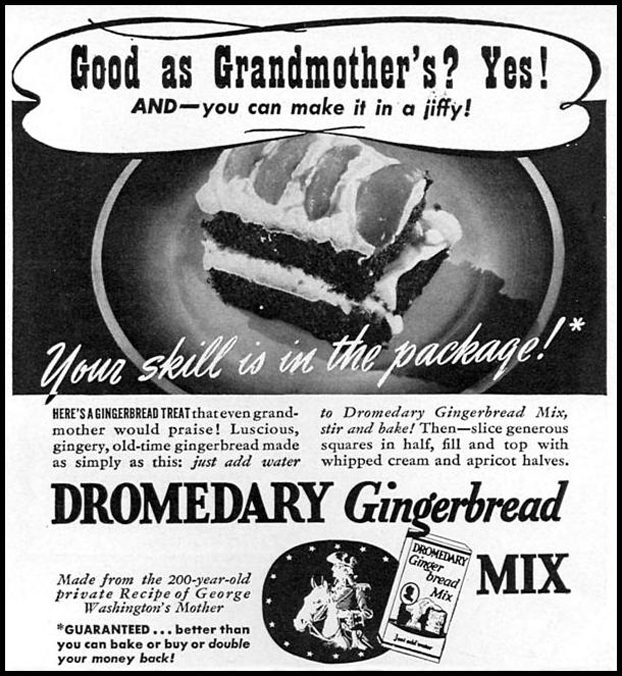
An 1940s-era advertisement for Dromedary gingerbread mix “made from the 200-year-old Recipe of George Washington’s Mother.”
The arrangement allowed Dromedary to produce gingerbread mixes based on Mary Washington’s recipe. In exchange, the Kenmore Association got all the gingerbread they could serve to visitors. The company also donated mixes to be sold by the Association and various DAR chapters for 25 cents a box. The Association got half of the money realized from these sales minus the shipping costs. This agreement, in the end, earned the Kenmore Association over $38,000 – a hefty sum in the mid-20th century – and provided countless visitors with a yummy Washington family treat.
In 1941, the United States entered World War II. Fredericksburg became a hub of activity with thousands of soldiers stationed at the A.P. Hill Military Reservation in Bowling Green visiting town to get a break from military life.
The Association’s ladies knew that Kenmore, with its historical and patriotic legacy, had a unique opportunity to welcome soldiers who would be fighting for the country and ideals that the Lewis and Washington families helped create. So, they threw open the gates, set out the picnic tables, and recruited local women to put on their colonial best and greet the men of the United States military. At the heart of this hospitality was iced tea and Mary Washington’s gingerbread.
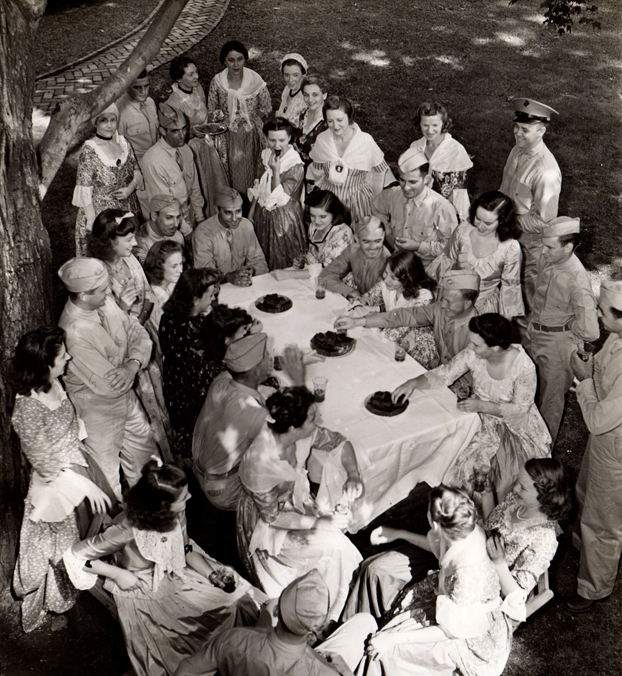
Servicemen enjoy gingerbread and tea on the grounds at Kenmore.
During the war years, Kenmore hosted over 60,000 soldiers making sure each one was fed and knew his service was greatly cherished. The ladies of the Washington-Lewis DAR even took time to write each serviceman’s mother, wife, or sweetheart about their loved ones.
C.R. Murphy, Sr. of Coolidge, Georgia wrote The Free Lance Star to express his gratitude for Annie Fleming Smith’s (identified in the letter as Mrs. H.H. Smith) hospitality towards him and his son during a visit to Fredericksburg from a nearby military post where the son was stationed.
The humble gingerbread recipe from Mary Washington’s cookbook gave Kenmore a perfect tangible link to its colonial past and bright future. The gingerbread that resulted assisted the ladies in their community outreach, their historic preservation, and their national patriotic duty. It was a sign of nostalgia, of hospitality, and most of all appreciation.
Today, when you tour Kenmore, our guides will happily take you through the reconstructed colonial kitchen that functioned as the Kenmore Association’s tea room. Regrettably, gingerbread and tea are no longer served to visitors because we do not have a fully-functioning kitchen. Gingerbread mixes and teas specifically created for The George Washington Foundation are available for purchase by anyone who might wish to relive their first taste of Kenmore’s famed gingerbread.
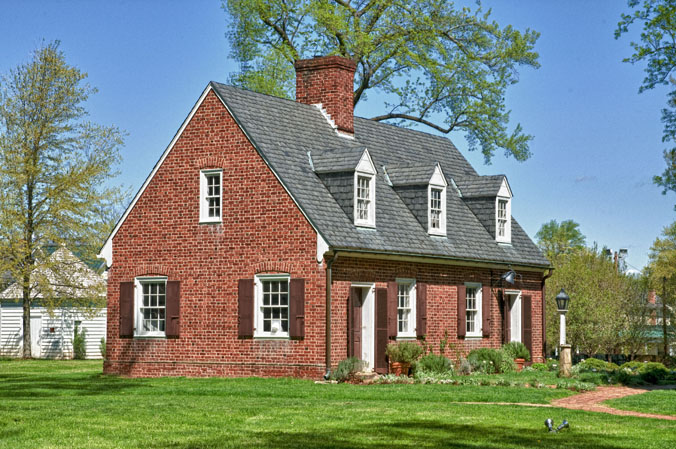
The brick kitchen building next to Historic Kenmore is not original to the property. It was built in the 1930s in the colonial revival architectural style popular at that time.
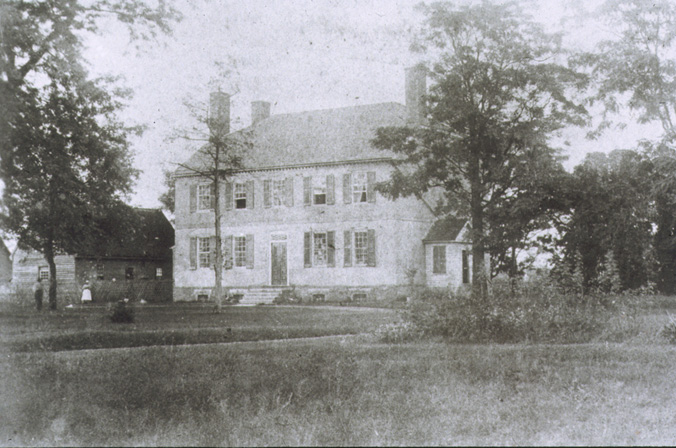
The brick construction does not reflect the kitchen building seen in the earliest known photo of such a building at Kenmore. That image, taken around the time of the Civil War, shows a large wooden kitchen to the north of the house as well two enslaved people standing in the kitchen yard.
The wooden kitchen can be seen to the left of the house in this Civil War-era photograph.
The Kenmore Association, a group of women who saved the mansion and transformed the property into a historic site open to the public, built the brick kitchen in the 1930s.
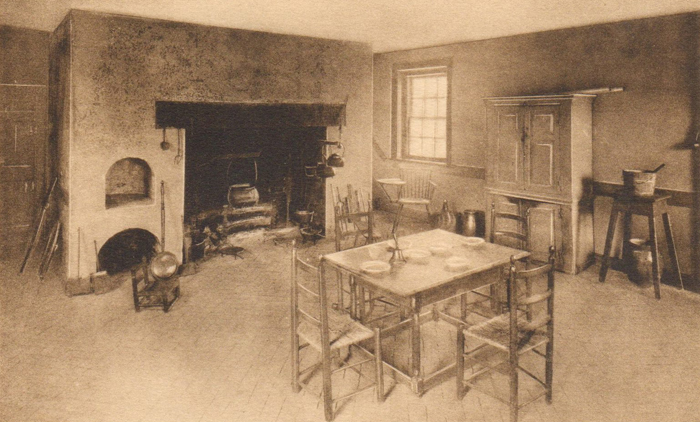
Inside the brick kitchen just after construction was completed in the 1930s.
Throughout much of the 20th century, visitors sat around the table in the photo above to enjoy gingerbread and tea served by the ladies of the Kenmore Association.
Miss Annie Fleming Smith and other ladies serve tea and gingerbread to soldiers during World War II.
Visitors enjoy tea and gingerbread in the kitchen. Several pieces of the china displayed in the cupboard in the background and the cupboard itself have been returned to the kitchen.
Recently, we decided to highlight these ladies and their efforts to preserve Kenmore even more during our tours. We felt the most logical of places to do this was in the kitchen where they served their famed gingerbread and tea.
We placed a tea set and faux gingerbread on the same table used to serve visitors for so many years. We surrounded that table with many of the same ladderback chairs, though most of their seats have been re-caned. We returned some of the china and the china cupboard that had stood for so long in the kitchen back to that space.
While we cannot serve actual gingerbread and tea – modern-day museum guidelines prohibit food service inside historic structures – we can discuss the Kenmore Association’s monumental efforts to save Kenmore and make the mansion accessible to the public. You can read about these efforts here. Although it does not date back to Kenmore’s very beginning, the 80-year-old brick kitchen is still a part of the site’s centuries-long story.
Editor’s Note: The behind-the-scenes tour mentioned at the end of this post and on the video’s end title is sold out.
Today, we’re linking to a behind-the-scenes video on The George Washington Foundation’s YouTube channel. In the video, Heather Baldus, Collections Manager, gives us a tour of Historic Kenmore’s underground heating and cooling system. This geothermal system helps maintain the proper climate inside the mansion and protects all of the furniture and historic objects on display.
You can see more during “Kenmore: Behind-the-Scenes” on Saturday, March 21 when Meghan Budinger, Aldrich Director of Curatorial Operations, gives an extraordinary tour of the mansion, including rare stories and insights into its history, furnishings, and ongoing preservation. Visit the cellar, second floor, attic, and other spaces behind-the-scenes! Admission: $12.00 adults, $6.00 ages 12-17. Reservations required and space is very limited. Please call 540-370-0732 x24 or email [email protected]. Please note: on this tour, participants visit each floor in the mansion, climbing a total of 80 stairs. A few passageways and stairwells are narrow and confined.
January and the start of the year are always a time of new beginnings. Recently, while digging through archival material, I came upon an exciting collection of newspaper clippings and photographs that detailed the New Year’s purchase of Kenmore and the beginning of the old home’s transformation into a historic site to be enjoyed by all.
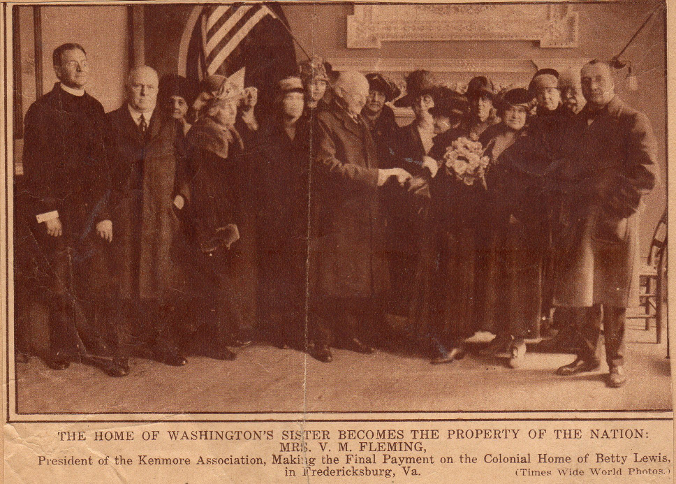
On January 1, 1925 — ninety years ago — a group of well-dressed women in hats and long fur coats assembled at Kenmore to hand over the final $1,000 payment and gain full possession of the house and land. This meeting was the culmination of thirty-two months of persistent work and determination by the ladies of The Kenmore Association to save the historic property from destruction.
Emily White Fleming (identified in the newspaper caption by her husband Vivian Minor Fleming’s initials) makes the final payment to purchase Historic Kenmore on January 1, 1925.
This crusade began four years earlier with a brief notice in the Fredericksburg Daily Star from Mr. E. G. Heflin, the owner of the Kenmore property. The announcement stated: “I have decided to build at once…6 or more modern up-to-date residence [sic] on Kenmore.” Built on a section of the plantation property, these houses prompted concern among many local citizens at the thought of further loss to the historic site.
By 1922, the destruction of the old Lewis home seemed imminent. Mr. Heflin placed an advertisement for the sale of the house itself and cut up much of the original estate into smaller building lots to be sold to developers. If the house was sold, it might be remodel into apartments or just razed to the ground. This escalation increased the alarm even more and some tried to raise funds to purchase Kenmore. This attempt proved unsuccessful and the house did look to be lost. However, salvation appeared in the form of Kate Waller Barrett and the National Society of the Daughters of the American Revolution (DAR).
In March of that year, Mrs. Barrett, Virginia Regent of the DAR, came to Fredericksburg with the purpose of organizing a new chapter in the town. She asked Emily White Fleming to lead the proposed chapter, which would work to save Kenmore. Mrs. Fleming was 68 years old and, though seemingly small and fragile, she, in reality, had a tenacious and determined spirit. She accepted the position and with the help of her daughter Annie Fleming Smith, known as “Miss Annie,” began their campaign to save the old Lewis house from destruction.
The ladies approached Mr. Heflin and negotiated an agreement to the purchase the property. The group had to make a first payment of $10,000 within four months or the deal would be off. Furthermore, if Mr. Heflin got a satisfactory offer within those four months, he could go ahead and sell the property outright. It was a tough deal but the ladies rose to the challenge spectacularly.
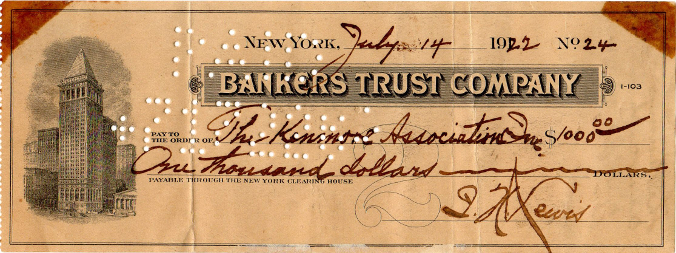
Mrs. Fleming and Miss Annie began fundraising immediately. They wrote hundreds of letters by hand, stating facts about Kenmore in simple, forceful style and then making appeals for help. Mrs. Fleming recalled, “I could write thirty-nine letters a day and Annie forty-nine. We never had a typewriter until the campaign was over.” In response to one of Mrs. Fleming’s letters, Colonel Isaac Newton Lewis, maker of the Lewis machine gun and a descendant of Fielding Lewis, contributed the first $1,000. Not to be outdone, The Colonial Dames of America in the State of Virginia gave a substantial donation of a $1,000 as well.
Donation from Colonel Isaac Newton Lewis donated the first $1,000 to the Kenmore Association.
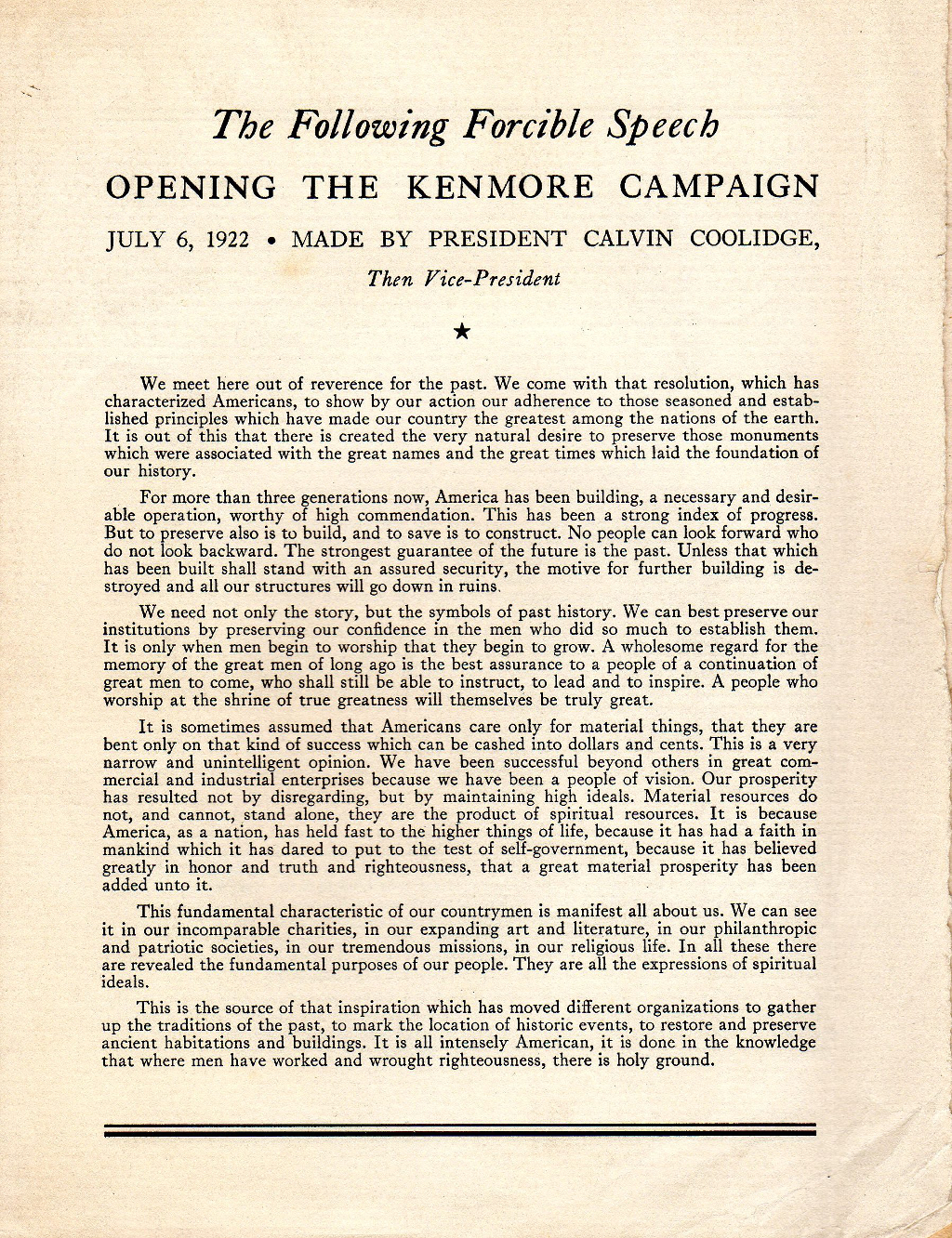
In July 1922, the Kenmore Association launched a public fundraising drive with a host of distinguished men and women coming to Fredericksburg for the start of the campaign. Even Calvin Coolidge, then the vice president under Warren G. Harding, made a speech (see below) pleading for patriotic Americans to save this home that was so critical in the history of the country. “It ought to be preserved for its own sake,” Coolidge demanded, “It must be preserved for the sake of patriotic America.”
Speech made by Vice President Calvin Coolidge in support of the Kenmore Association’s effort to save the historic home.
Through the efforts of this determined group of women, by the first of September 1922, they were able to pay an initial installment of $12,000 on the account. Impressed with the Kenmore Association’s work, Mr. Heflin made his own gift of $2,000. By New Year’s Day 1925, the hard work paid off and the ladies made the final payment and took possession of the property. Historic Kenmore was saved!
Although the purchase of Kenmore nine decades ago certainly marked a new beginning, transforming the house into a historic site for the public to enjoy required many more years of work. Indeed, in many ways, the work begun by Mrs. Fleming, Miss Annie, and the Kenmore Association continues even as 2015 begins. In the new year at Kenmore, we will focus on refurnishing Fielding’s office and will soon hang portraits of Fielding Lewis, Betty Washington Lewis, and other family members in the Drawing Room. You can follow the year’s work here on the “Lives & Legacies” blog and on “The Rooms at Kenmore” blog, which is solely dedicated to the refurnishing project, at www.kenmore.org/wordpress. Like 1925, the year 2015 should prove to be an exciting beginning!