Lives and Legacies

Tag: history

  • Archaeology Is Not For The Faint Of Heart – But We Love It Anyway

    A lot of people have told me that they want or wanted to become archaeologists.  I always find this flattering.  Yours truly was only in my single digits when I declared the same to my family and anyone who would listen.  After reading every National Geographic magazine I could get my hands on, ‘excavating’ abandoned houses and bottle dumps on or near the property where I grew up, and too many years of schooling than I am willing to admit…. here I am today.  I am an archaeologist of 25 years.  That being said, it is not an easy profession to get into.  To wedge your way into this field, it is recommended you have an obsession with learning, stubbornness equal to a Black Friday shopper outside a Target in 20-degree temperatures at 3 am the night before, a hefty amount of luck, the willingness to obsess over dead people’s broken garbage, and just to be sure it would help if you’re at least a little bit mad. 

    Happy archeologists!

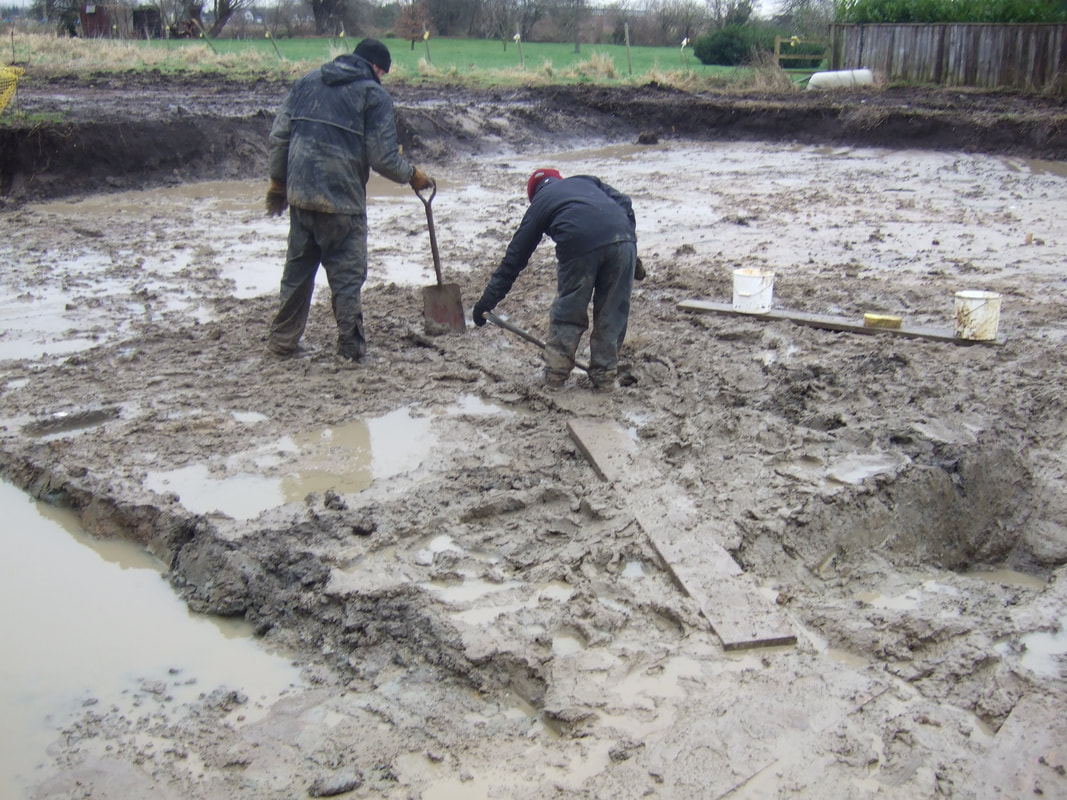
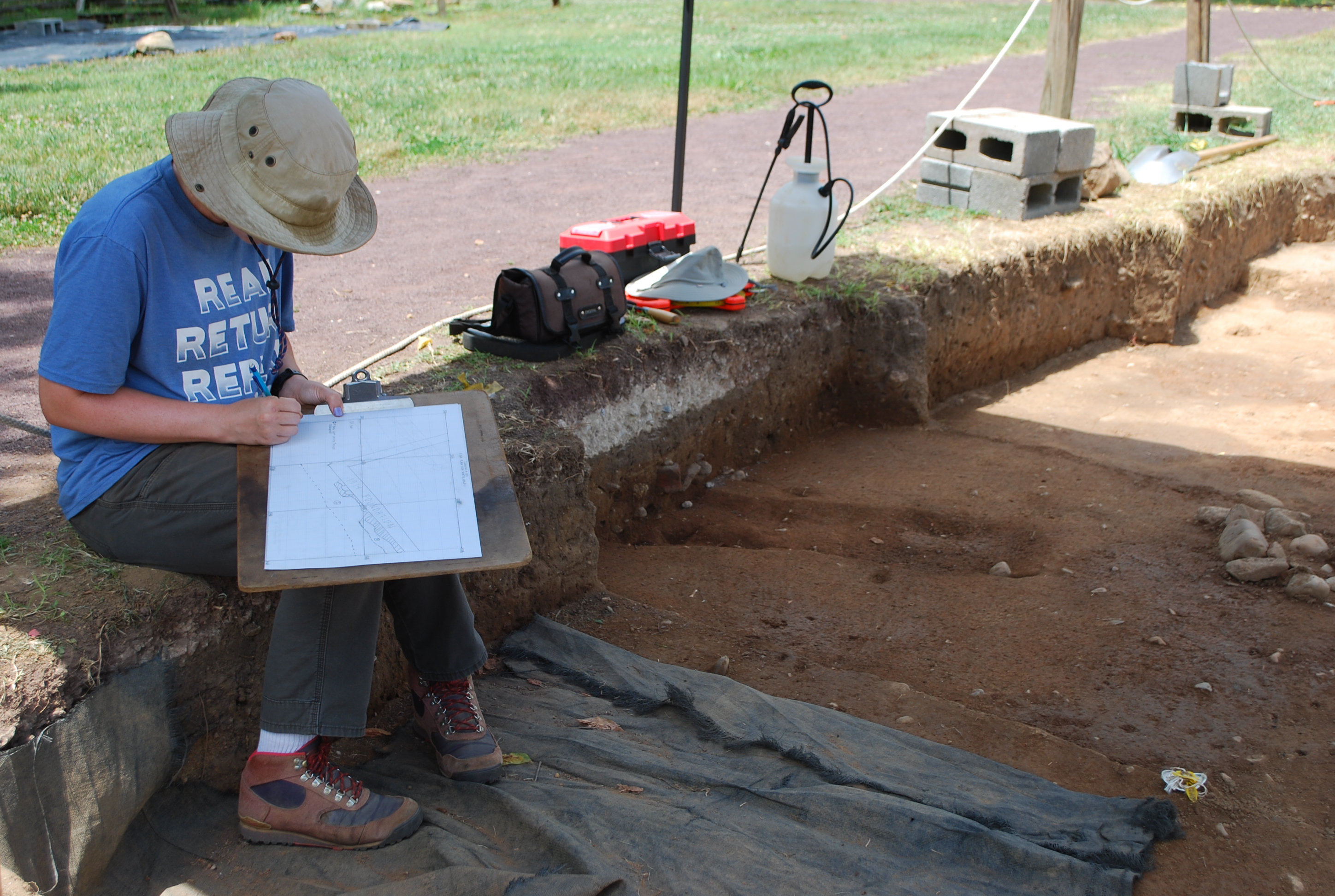
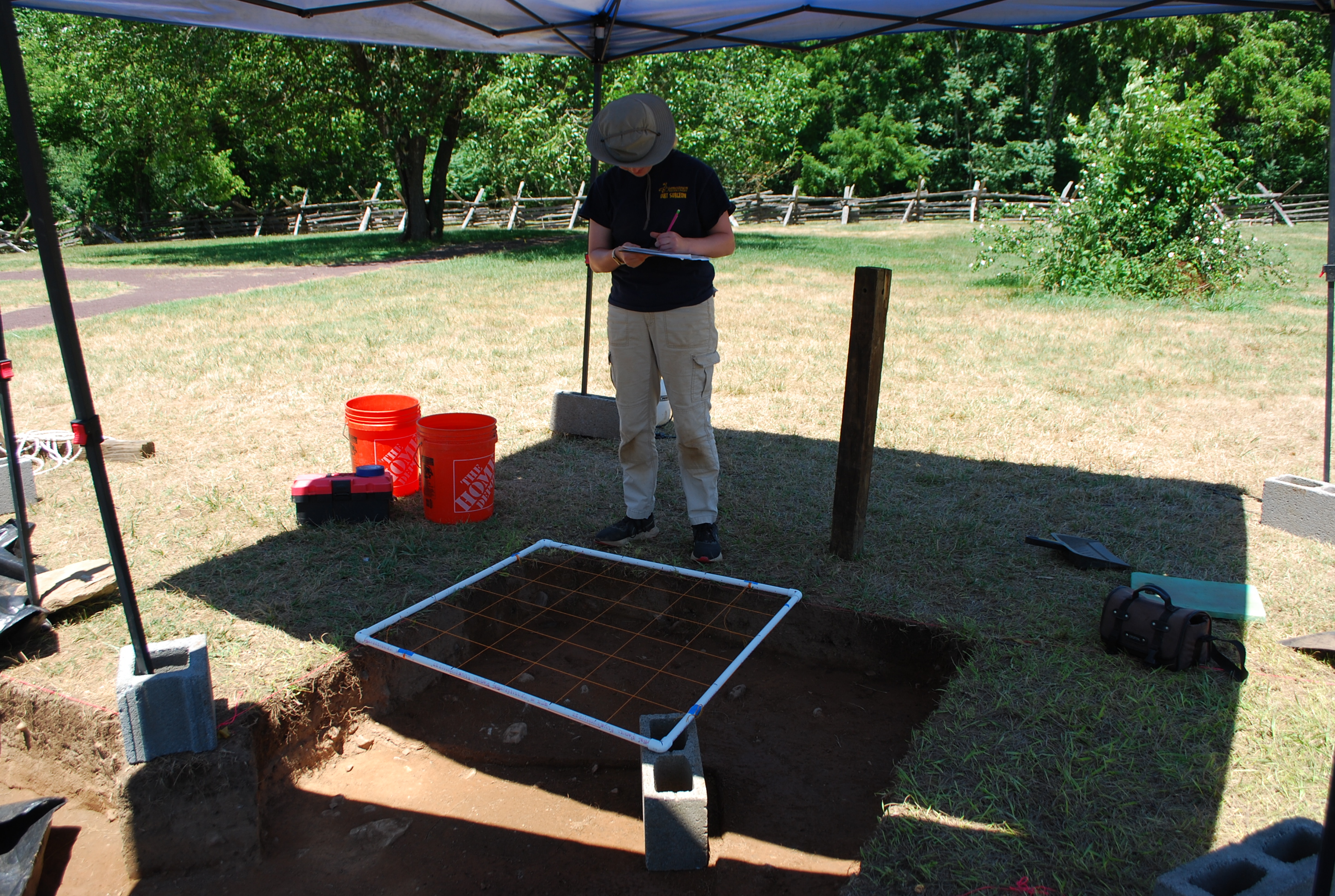
                    Now, I am an archaeology lab manager in our museum, which means I enjoy the comfort of climate control, access to bathrooms, an office, and a place to store my breakfasts and lunches.   But, like most archaeologists, I had to cut my teeth in the field (digging outside), which lacked all the above amenities.  This is where many archaeologists figure out if they genuinely want to go through with the folly they have embarked upon.  Many decide they do not and switch majors.  Good for them; they likely make more money than most archaeologists.   But could it really be that bad?  Isn’t it fun finding cool stuff?  Yes, of course.  But here are all the obstacles those noble field archaeologists face daily:

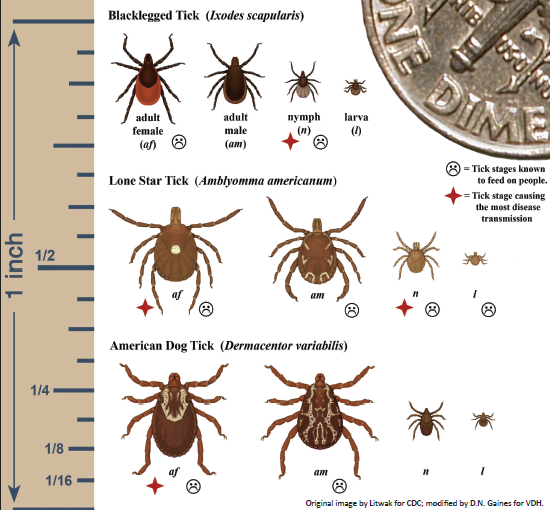
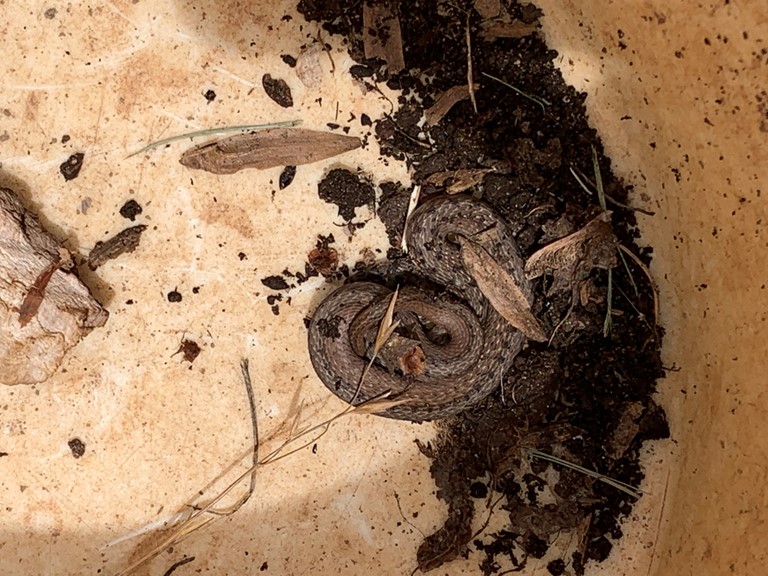
    • Bugs. Lots of them.  Bugs have taken down many of my brave colleagues.  Forget the snakes (Unlike Indiana Jones, most of us like snakes) and spiders.  I am talking about chiggers and ticks.  No one gets just one chigger bite.  They hang out in gangs of hundreds, and you will not know they have bitten you until they have had their fill of your yummy body juices and peace-ed out.  Hours later, you’ll notice around your ankles and waistband the unbelievable itching of dozens of bites that will haunt you for weeks.  Ticks are worse.  Way worse. Ticks carry diseases that can be very serious, including Lyme and Rocky Mountain Spotted Fever, both of which should be avoided at all costs. Don’t forget bees, hornets, and wasps.  No archaeologist worth their salt is without a harrowing tale of valiantly battling or running the heck away from a swam of ticked-off single-minded, murderous, flying, stingy wingy thingies.
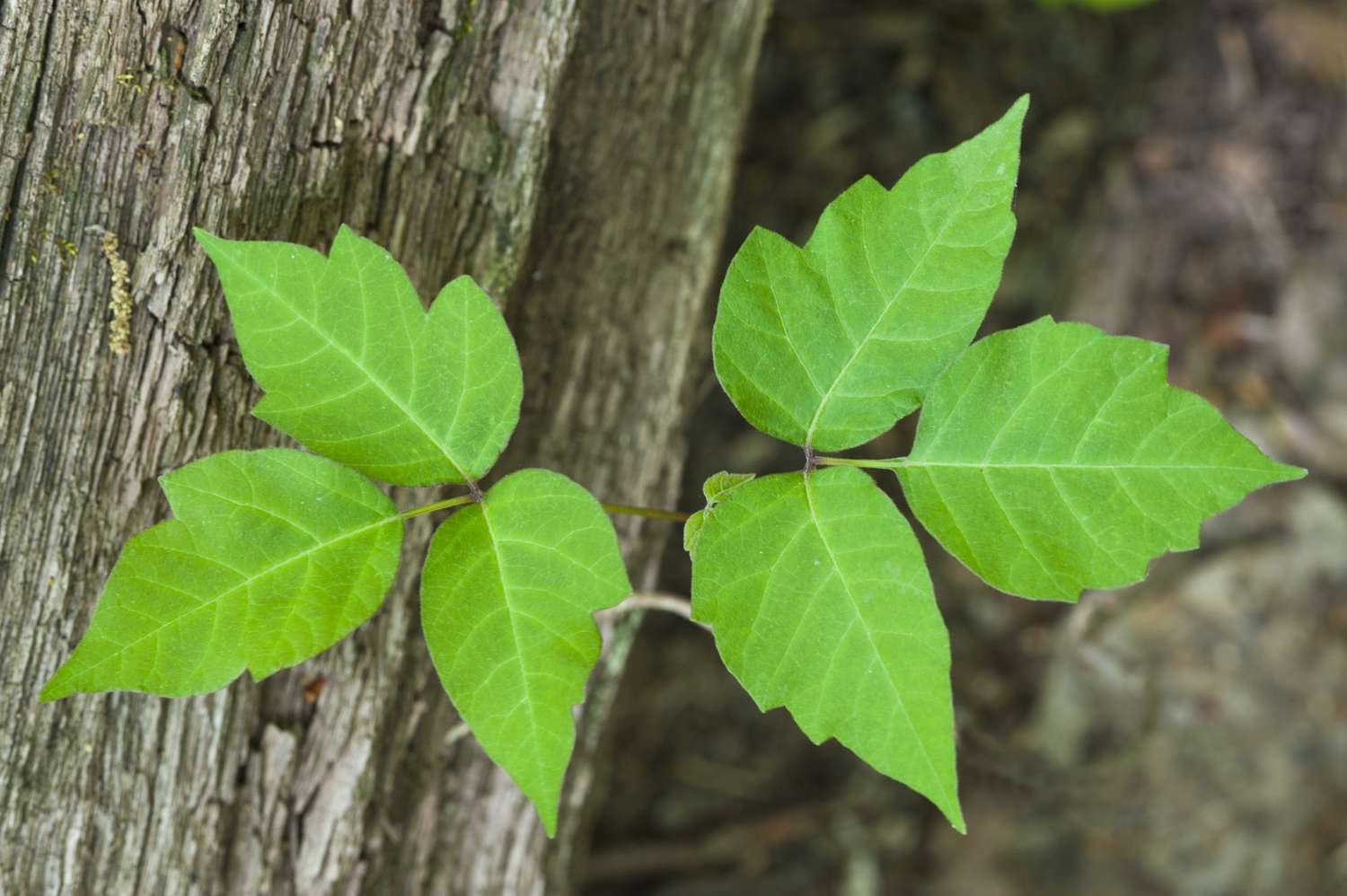
    • Plants that will make you wish you were never born.  Let’s start with some annoying and inconvenient but not diabolical plants: Those with thorns.  After being told by your crew chief that you need to hack your way through a six-foot-tall thicket of blackberries, multiflora rose, devil’s walking sticks (Yep, that’s a thing), cacti, or thistles in order to dig one tiny shovel test pit you WILL begin to question your life’s choices.  However, for those who are allergic to poison ivy, oak, and/or sumac (and it’s most of us), your field career will be a constant battle where your enemy has highly transmittable and very toxic poison juices in every single part of them (even the roots) while you are armed with a bottle of calamine lotion.  Those field archaeologists who do not get poison ivy will make fun of you and flaunt their superpowers, but just remember they’ll get theirs because the more you’re exposed to these plants, the more likely you are to feel their wrath. 
    • Ancient Curses.  No, you should NOT read that inscription on the 3,000-year-old tablet found in that tomb with all the warnings engraved on the entrance.  If I had a nickel every time I had to tell a member of my crew to drop that darn ancient idol that’s started to glow red inside and run, I’d be able to pay off my student debts.  Just kidding, that will never happen. 
    Unbroken seal of King Tut’s tomb…maybe just leave it.
    •  This one is very serious and should never be taken lightly by anyone working outdoors because they take anyone by surprise just like that. Dehydration, heat stroke/exhaustion, sunburn, and frostbite. Field archeologists must dig in almost all conditions and all seasons.  They are wind-worn and road-weary, and you should not mess with anyone who can dig dozens of holes a day in temperatures above 100 or below freezing. 
    •  Animals.  I’m not talking just about the wild ones.  I’ve only ever seen a bear in the woods once, just a few harmless snakes and maybe a couple of bucks that gave me the side eye.  But I have had years knocked off my life by pheasants or tiny fawns exploding out of the brush a foot away from me.  For the most part, pets are not an issue, and petting a friendly dog or cat is a welcome reprieve from digging holes.  Livestock, however, would scare my crews.  I grew up on a farm, so I knew what animals didn’t want to snuggle.  Here’s the thing, though.  Cows are bored and extremely curious when something or someone spices up their daily routine.  It’s hard for someone from the city to calmly stare down a herd of Holsteins weighing 1,500 pounds each while they barrel towards you.  But all they want is to sniff you, rifle through your dig kit, and lick your equipment because it’s salty.  Annoyingly, they will also eat the plastic flagging tape that you carefully tied up to mark your transect line.  So will deer, fun fact. 
    •  Unexploded ordinance (UXO).  Gunpowder does not necessarily become so old that it won’t go boom any longer.  It actually becomes less and less stable.  Sure, that cannonball you found is cool.  Sure, it’s super old.  Stay.  Away.  From.  It. Military bases and old battlefields are ripe with potentially dangerous mortars, shells, grenades, and bullets. Unfortunately, here in Virginia, there are cases of collectors who have brought finds home from Civil War battlefields only to find out the hard way that these artifacts can still do a lot of harm. That being said, you’d be surprised at all the places archaeologists have found things that can explode.  I worked on a project in a former neighborhood, so imagine our surprise when a pit in the backyard of a house was found to contain dozens of WWII live .50 caliber antiaircraft ammunition.  One thing you learn very quickly as an archaeologist is that some people are weird, and they do weird things you will never be able to explain.  The fancy word for this is idiosyncratic behavior, and it’s one of my favorite terms.  It’s the academic way to throw up your hands and say, “I got nothing.”  So, if you find any UXO, contact local law enforcement; they know what to do with it.
    Unexploded Parrott shell, Kennesaw Mountain National Battlefield Park, Georgia
    • Collapsed excavation units. Unstable excavation walls are no joke.  I’ve personally had one collapse on me, and while I was fine, it was still frightening.  Shoring up walls and expanding out before digging deeper can mitigate these issues, but there are many types of soils, and they’re not created equal, so never overestimate the strength of your walls.  Don’t become an artifact yourself. 
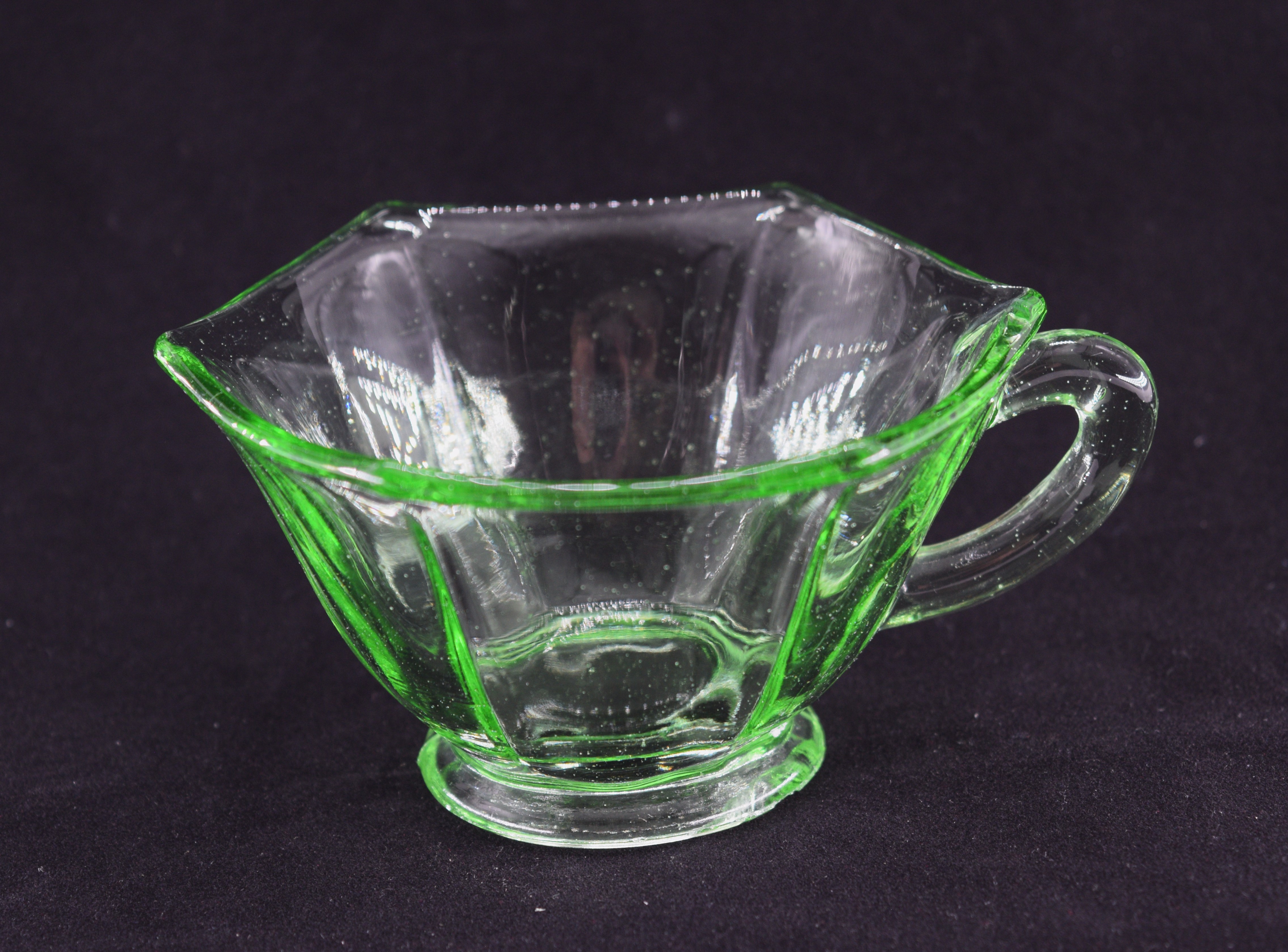
    •  Soil contamination/hazardous waste. Archaeologists occasionally run into hazardous waste, which is bad—enough said. Arsenic was a major embalming ingredient in the 19th century, and since archaeologists are frequently called in to identify and remove burials, arsenic is a significant consideration.  It was also used to make a beautiful green color called Scheel’s green, which was used in dying such things as fabric, book covers, and wallpaper.  Imagine wearing a gorgeous Victorian-era dress while reading a book and sitting in a wallpapered room all dyed green with copious quantities of poison. Green is my favorite color but hold the early death, please.  Mercury was considered a type of cure and used to treat various ailments such as syphilis, toothaches, melancholy, worms, tuberculosis, constipation, and apoplexy, to name a few.  It was in perfumes, lotions, soaps, hats, etc….and just like arsenic, it doesn’t go away in the soil.  And if you’re above a certain age, you definitely remember those mercury thermometers that, when broken, produced magical fun silver balls you could roll across the floor until your mother caught you.   Another principal offender is lead.  Humans discovered how awesome lead was thousands of years ago.  Please don’t personally verify this, but somehow, the Romans found that degraded lead was sweet, so they put it in substandard wine to jazz it up a bit.  Lead was also used in cosmetics until embarrassingly recently to produce that immaculate white complexion valued by the upper crust.  YOLO.  Lead was also used in water pipes, paint, glassware, ceramic glazes, and later in plastics and gasoline.  There is so much lead in our environment now that even non-archaeologists are in danger of exposure.  I could go on and on, but it’s time to move to…
    •  Enraged locals and/or property owners.  We get it.  No one wants that pipeline/highway/gas line/sewer to go through their property.  And when it does, the archaeologists have to test that area.  But please don’t run out of your house while visibly carrying a firearm and threaten the archaeologists.  We are the lowest entity on this unpleasant totem pole and unfortunately the first people you’ll see trapsing over your land and digging holes.  This was not our idea; it was our job.  Working on these projects is the worst because people are understandably angry and want to vent, but this is not the way to do it.  Ironically, one of the only things that can stop that pipeline from going through your horse pasture is if we find some amazing archaeological site with immense cultural significance.  This will force a rerouting of the project, so your neighbors will have to deal with the headache. 
    Dealing with enraged locals is a delicate situation

    This is not by any means intended as an exhaustive list, but I’ve already greatly exceeded my word count for this blog.  You get the idea.  So why, you may ask, does anyone become an archaeologist?  Quite simply put, every job has its hassles, some more than others, but most archaeologists really (and I mean REALLY) love archaeology.  The jobs in archaeology may not fit the stereotypes (full disclosure: most of us adore Indiana Jones, though).  Archaeology is rarely glamorous; it can be dangerous or frustrating, but it is, above all else, AWESOME.  Being a part of uncovering human history and sharing information never gets old, and I wouldn’t trade my job for any other. 


    Mara Kaktins

    Archaeologist & Lab Manager


  • Colonial Scary Stories to Tell in the Dark

    We have reached the best time of the year. The summer heat has broken, the leaves are crispy, and the best holiday, Halloween, is coming up quickly. We all know Halloween was not celebrated in Colonial America, but that doesn’t mean we can’t incorporate a bit of Colonial America into Halloween. 

    To celebrate, I have compiled a list of scary stories, supernatural stories, ghost stories, folklore, and legends that were either written in or set in Colonial America.  This era provided a perfect setting for the development of American horror. Europe had ancient castles, ruins of abandoned abbeys, and moody wind-swept moors to inspire centuries of writers and storytellers.  America had isolated settlers, a strict, religiously controlled society, and an untamed wilderness where any evil could lurk. It was fertile ground for witches, devils, the supernatural, cryptids, and folklore. 

    Witches and the Devil

    The earliest stories date back to the start of America when Puritan communities were on constant guard for the devil, who was a very real and imminent threat.

    In his book Memorable Providences Relating to Witchcrafts and Possessions (1689), Cotton Mather tells stories about incidents involving witches, from the haunting of the children of Boston mason John Goodwin to the murder of Mr. Philip Smith to Mary Johnson and her dealings with the devil at Hartford. 

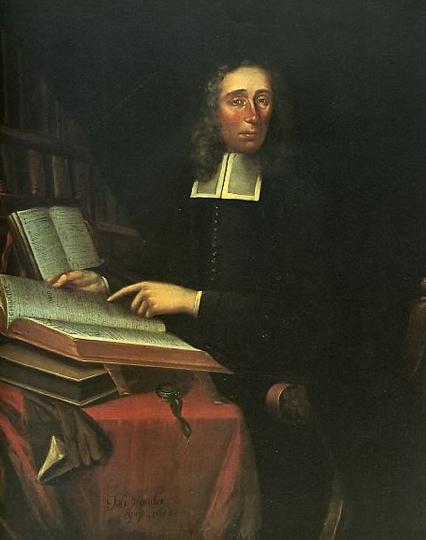
    Cotton Mather, Puritan minister, author, and no doubt a blast at parties. Columbia University

    Witch hysteria came to America while fading out across much of Europe, with the deadliest event being the notorious Salem Witch Trials in 1692/1693.   

    The Mather family (Father: Increase, Son: Cotton) again intervened after the trials to defend the judges’ actions, review the cases, and add further accounts of documented supernatural incidents. Cotton’s book Wonders of the Invisible World (1693) looks at the cases that eventually led to convictions and death and defends them by giving accounts of similar trials heard by Judge Sir Matthew Hale.

    Increase Mather, father of Cotton, a Puritan minister, Harvard graduate who is not mad just very disappointed in you celebrating Halloween. The University of Virginia

    Increase Mather’s An Essay for the Recording of Illustrious Providences (1694) provides a remarkable account of accidents, apparitions, and unaccountable phenomena.  Mather retells the tale of a woman being molested by spirits, a maid possessed by evil, and even a house haunted by a demon. 

    Lithobolia: or, the Stone-Throwing Devil (1698), written by Richard Chamberlayne, is a tale that is considered an early example of supernatural horror writing and what many say is the first documented incident of witchcraft in America. The story centers around incidents of witchcraft, demonic voices, and poltergeist activity that take place at a tavern in New Hampshire in 1682.  Increase Mather mentions the story in Illustrious Providence when documenting the spread of witchcraft before the Salem trials.

    The beginning of American supernatural horror

    Wieland: or, The Transformation: An American Tale (1798) by Charles Brockden Brown is often considered the first American “Gothic” novel.  Gothic means a story characterized by an atmosphere of fear, supernatural occurrences, and often a return of horrible past events and their effects on the present.

    Wieland takes place in Colonial America between the French and Indian War and the American Revolution.  It is a psychological horror story that involves religious fanaticism, family, the supernatural, mental illness, deception, and murder. 

    American Legends

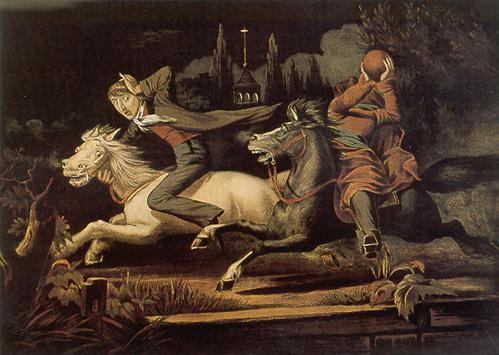
    One of the most well-known legends often told at Halloween is Washington Irving’s The Legend of Sleepy Hollow (1820). Set in Sleepy Hollow, New York, in 1790, it involves pedagogue Ichabod Crane in his competition for the affections of Katrina Van Tassel.  After hearing the legend of the Headless Horseman at a harvest party, Crane makes his way home only to be confronted by the dead Hessian mercenary. 

    Ichabod Crane being chased by the Headless Horseman. Historic Hudson Valley

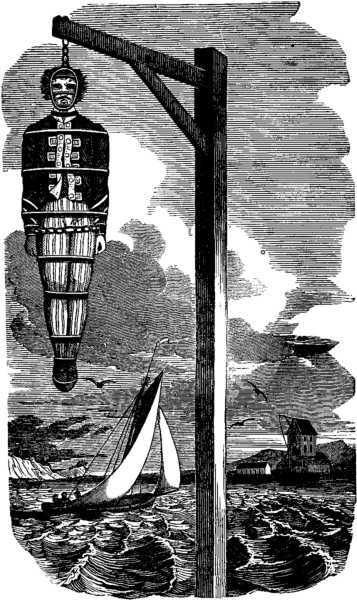
    Another legend from Irving’s book Tales of a Traveller (1824) is that of Captain William Kidd. Captain Kidd was a Scottish privateer who lived in New York City. The governor of New York, Massachusetts Bay, and New Hampshire commissioned him to hunt down pirates and enemy French ships in the Indian Ocean.  Unfortunately, by the time he made it back to America, the political views had shifted, and he was arrested for piracy in Boston and shipped to England to stand trial.  There, in 1701, he was found guilty, hung not once but twice as the rope broke the first time, then gibbeted and displayed over the River Thames.  Kidd supposedly haunts many places around New York City, his beloved adopted city.

    Captain William Kidd gibbeted on London Dock. The Pirates Own Book

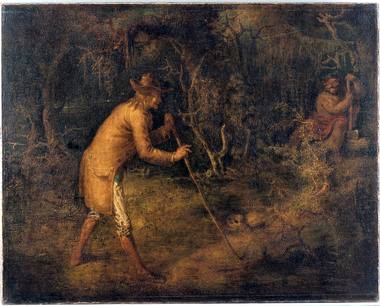
    Another of Irving’s tales, The Devil and Tom Walker, takes place in Massachusetts, where Captain Kidd supposedly buried some of his treasure.  In 1727, Tom Walker, the elderly miser, meets “Old Scratch” at the swamp while walking in an abandoned Wampanoag fortress.  “Old Scratch” offers Walker the riches in the swamp buried by Kidd for a price (his soul).  Then, it explores everything that happens when someone realizes their immortal soul no longer belongs to them and when it comes time to pay the price.

    The Devil and Tom Walker. The Cleveland Museum of Art

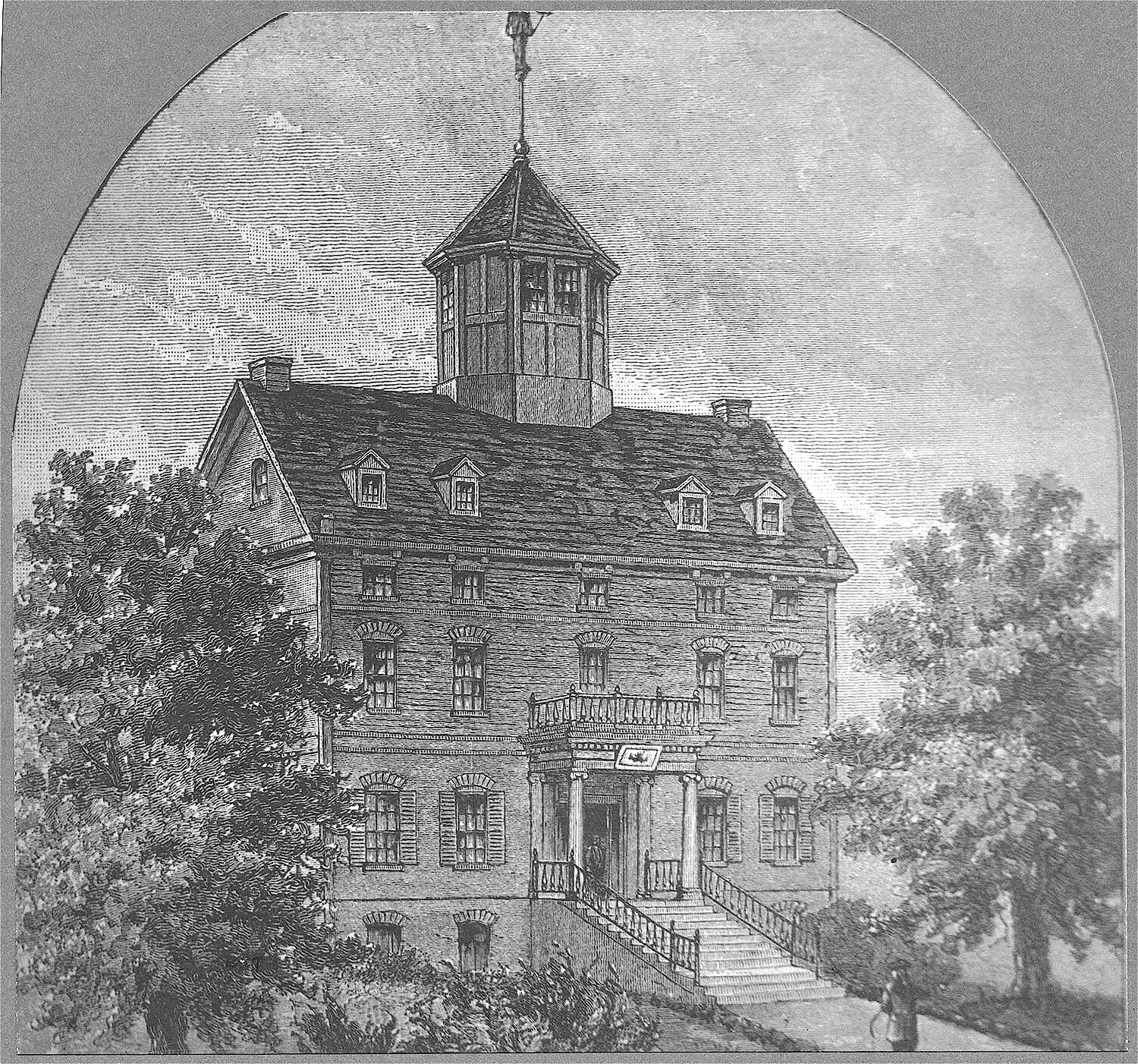
    Even George Washington is mentioned in one ghost story by Nathaniel Hawthorne in his book In Colonial Days when discussing the legends of Old Province House. Howe’s Masquerade follows Governor Howe as he throws a costume party on the eve of the siege of Boston (April 19, 1775)—guests dressed in rags representing Washington and his generals.  Howe and their guests are confronted with a ghostly funeral march of Puritan governors, illustrating the death knell of royal authority and a bad omen for the British in the upcoming battle.

    Old Province House, Boston. The Memorial History of Boston

    American Cryptids

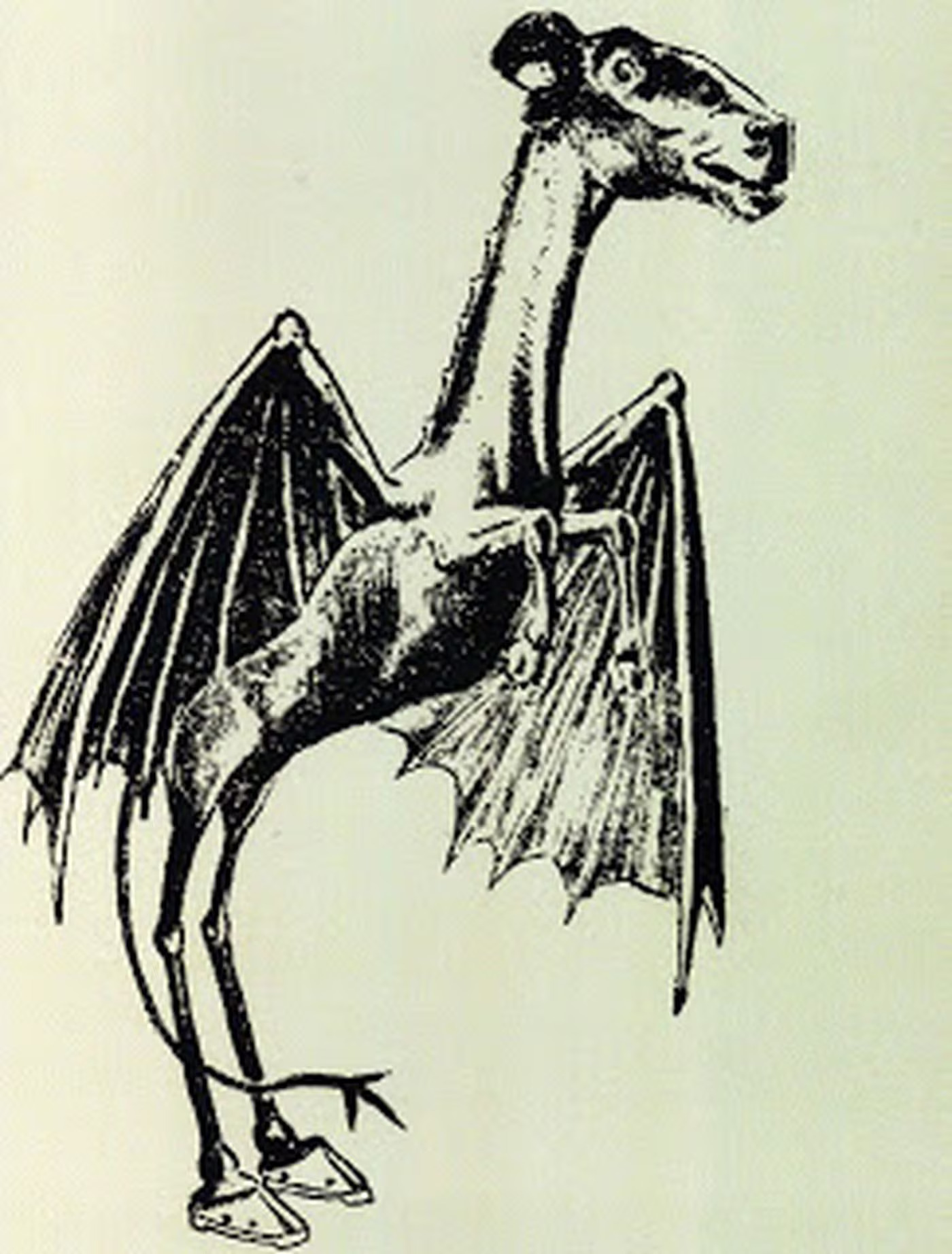
    W.F. Mayer’s In the Pines (1859) explores the beginnings of the Jersey Devil. Deborah Leeds’s thirteenth child was born in 1736 in the Pine Barrens in New Jersey. Soon after birth, the child suddenly turned into a horrible wyvern-like creature with a goat’s head, leathery bat-like wings, horns, small arms with clawed hands, legs with cloven hooves, and a forked or pointed tail.

    The Jersey Devil has haunted the Pine Barrens since being spotted in 1820, 1841, 1909, 1925, 1937, 1951, and as late as 1960.

    The Jersey Devil as seen in 1904

    So, sit back with some Halloween candy and enjoy some scary colonial stories on this fine autumn evening. 


    Heather Baldus

    Collection Manager
  • That’s A Wrap! Ferry Farm’s Dig Season Recap

    October just happens to be Virginia Archaeology Month, and what better way to celebrate than to recap this summer’s excavation at George Washington’s Boyhood Home at Ferry Farm.

    You might remember from our dig preview, that this year’s dig (FF-44) focused on the continued exploration of the 18th-century kitchen site located just northeast of the main house. In 2023, our limited investigations uncovered just a small section of the kitchen’s stone foundation and cellar, giving us a sneak preview of the conditions and parameters of future site work. Armed with this knowledge, our aims this year were to uncover more of the original foundation walls of the kitchen cellar, to uncover additional architectural evidence of the kitchen outbuilding, and explore the surrounding landscape for features. So, did we do it?

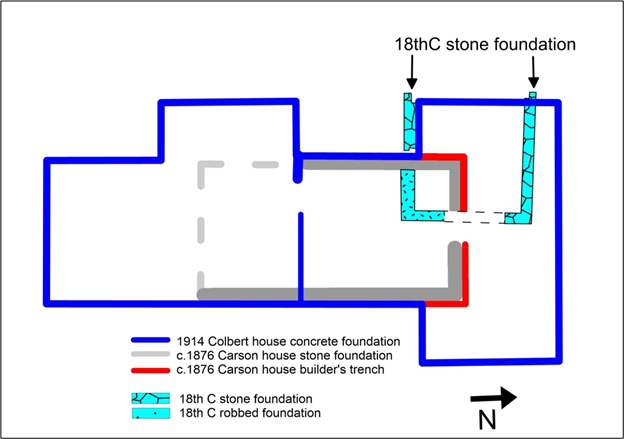
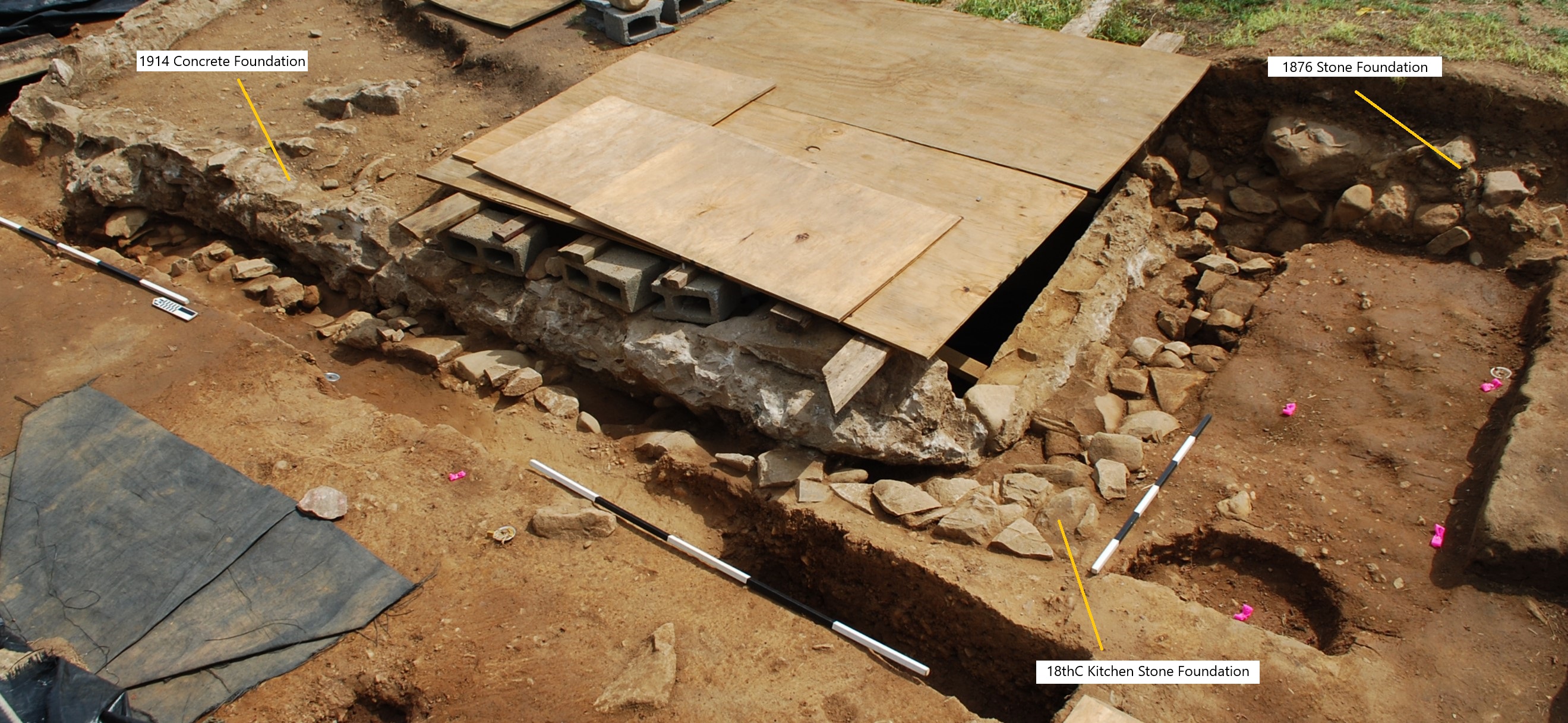
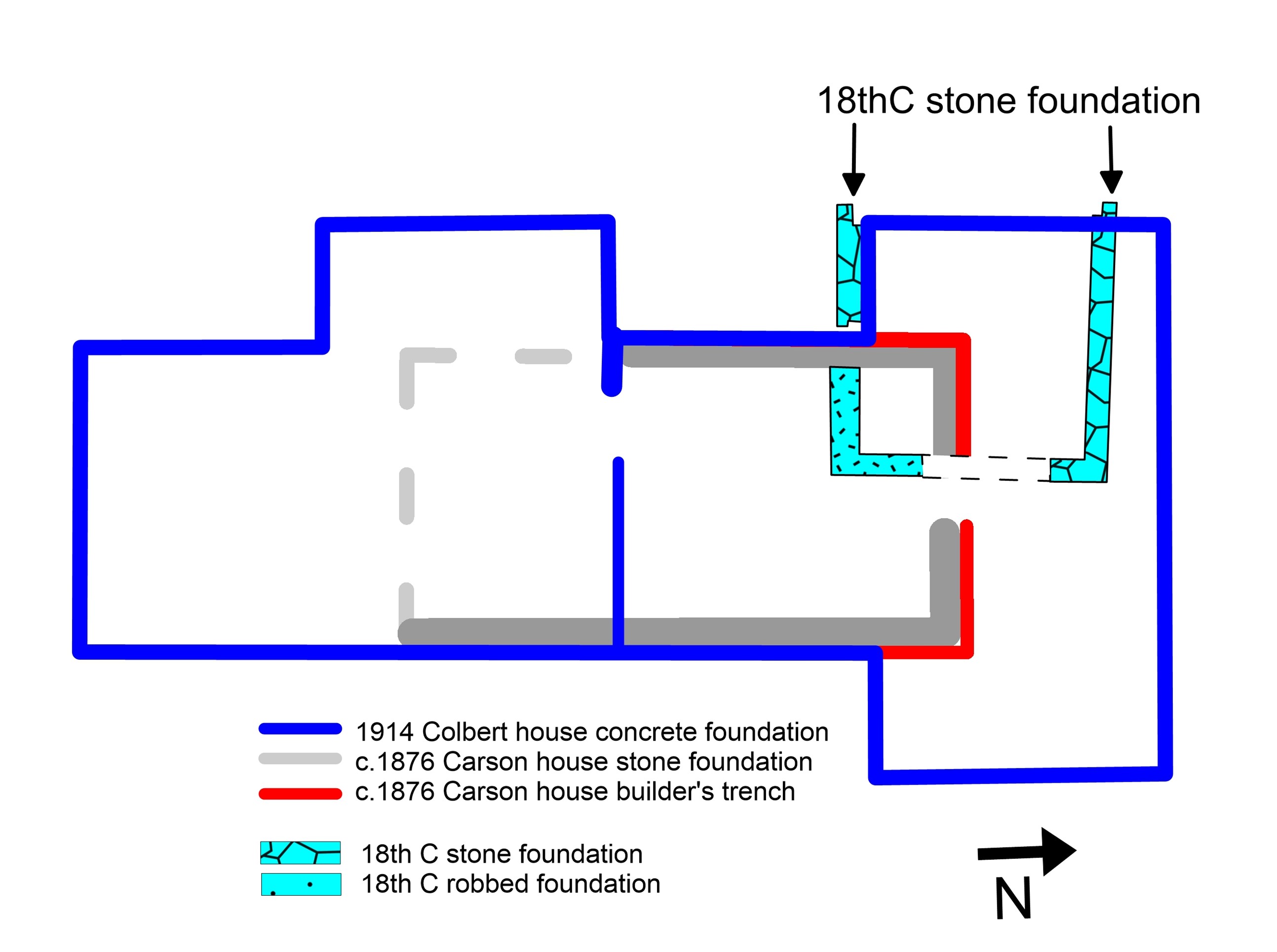
    Location of the 18th century kitchen foundation in relation to two later farmhouses dating to 1876 and 1914. 

    We did! But before we get to the fun discoveries, let’s go over how we got there. As far as sites go here at Ferry Farm, this one has been through a lot. Not only did the original 16’ by 16’ kitchen building burn and collapse in on itself in the middle of the 18th century, but it also had two subsequent farmhouses built on top of it that were either moved, damaged in a fire, or demolished all within the last 150 years. A previous archaeology project on the site introduced another element of complexity in understanding the depositional sequence of fills on the earlier 18th-century site, which had obviously been heavily disturbed by all these later events.

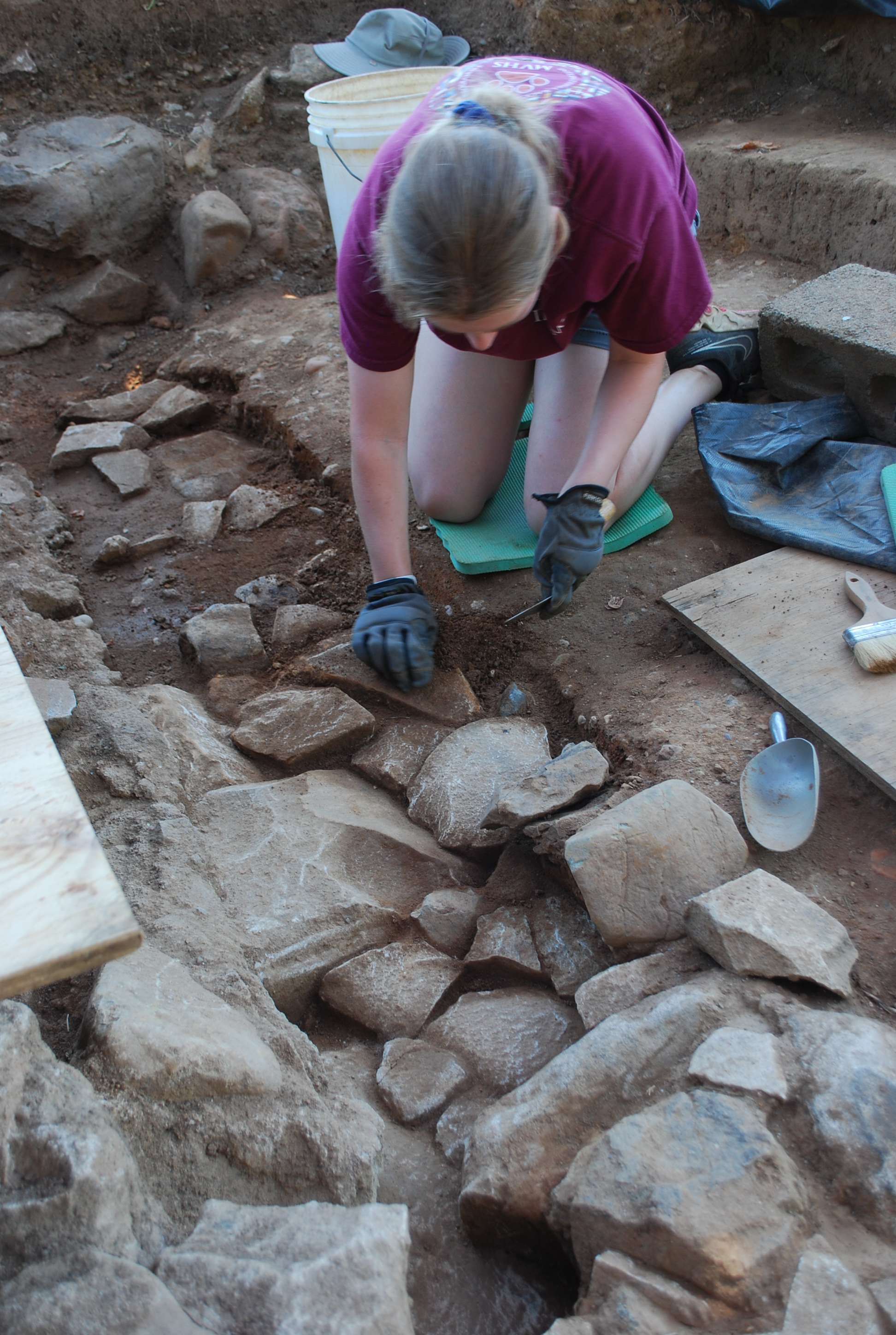
    All this led to an interesting excavation. Since a significant portion of the site had previously been excavated in the 1990s, a sizable amount of our site time was spent re-excavating backfilled archaeology units with the purpose of exposing unexcavated layers around the site. Not only would these unexcavated layers allow us to gather new data, but it would also give us the opportunity to better understand the findings as recorded in the earlier reports.

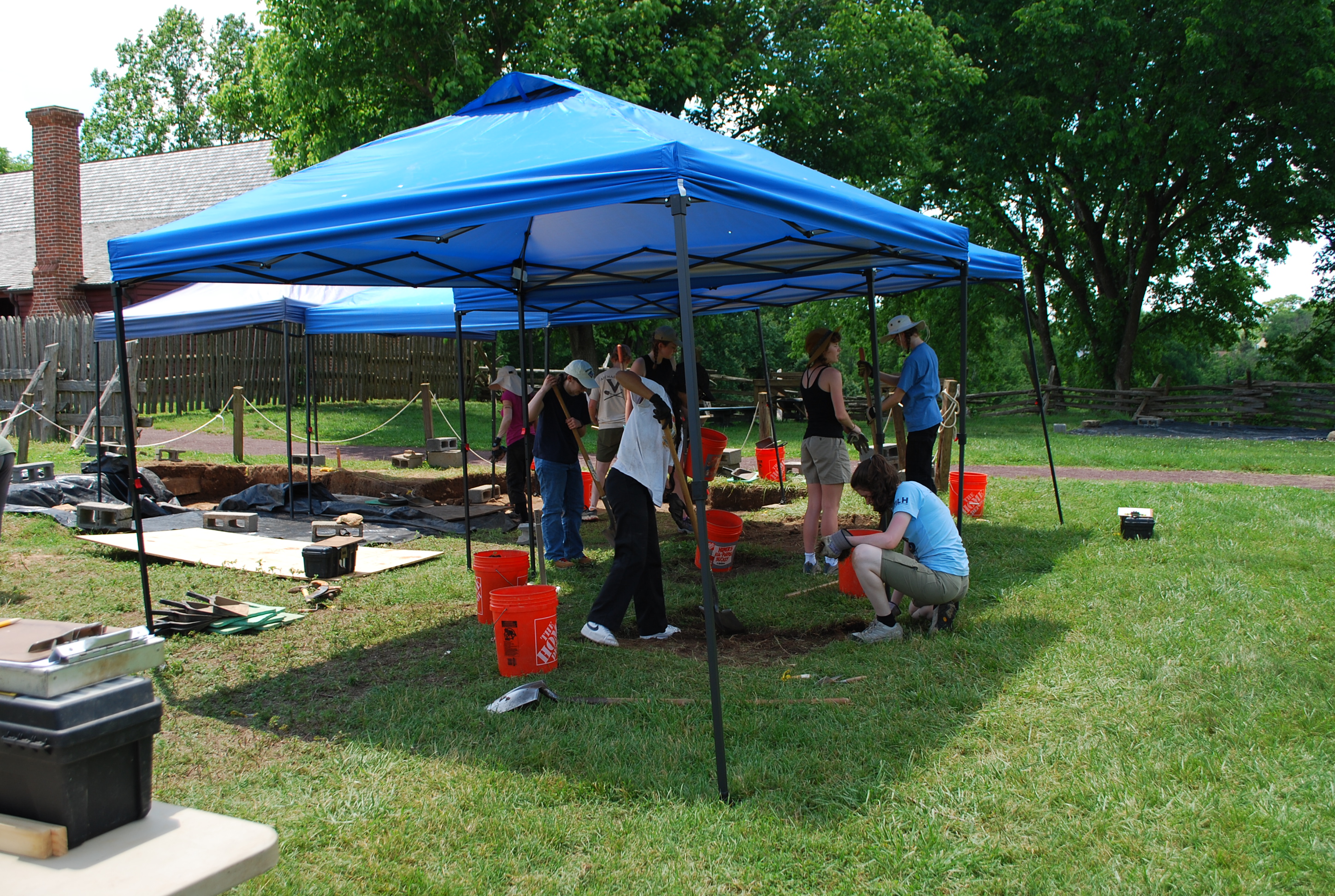
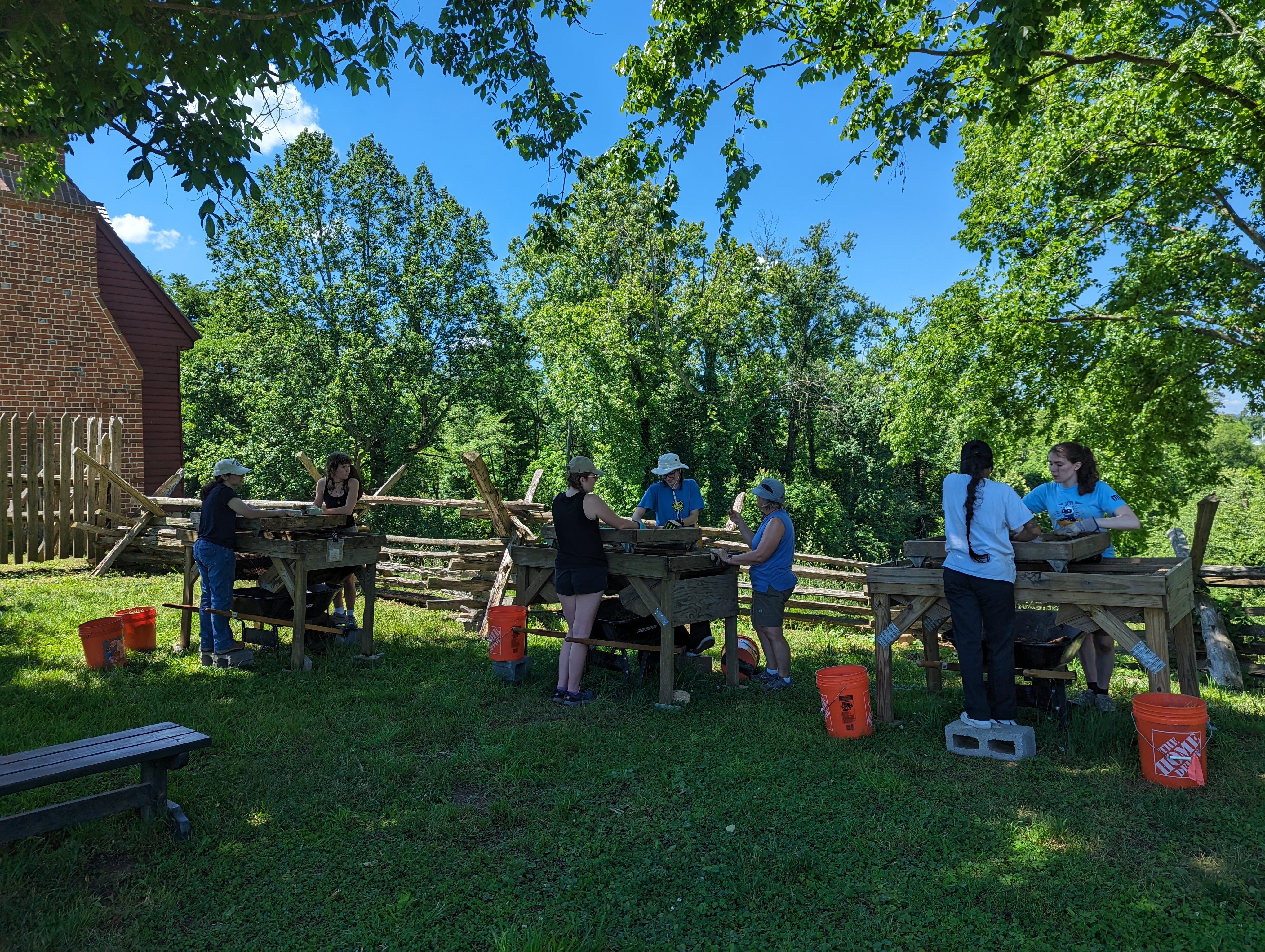
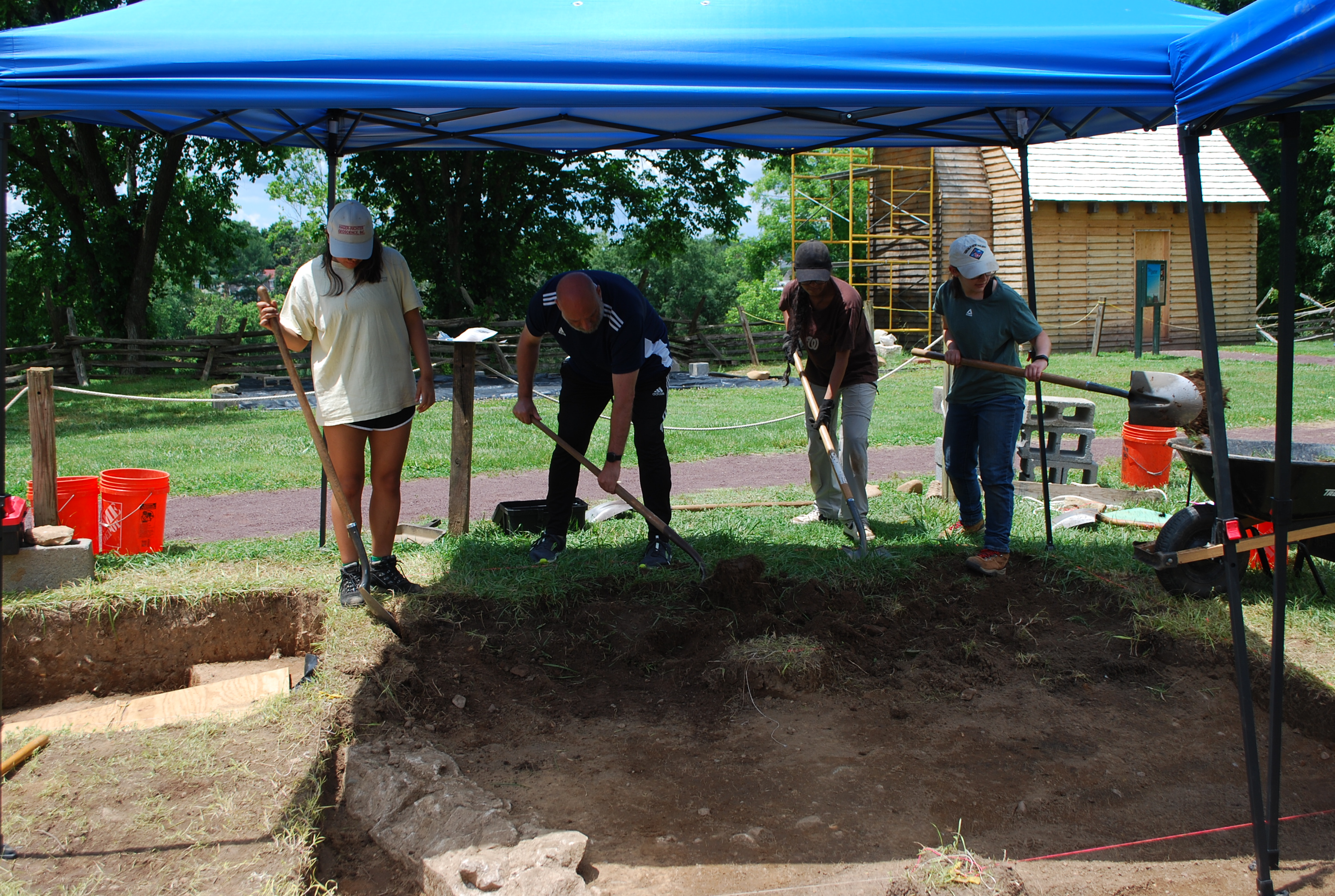
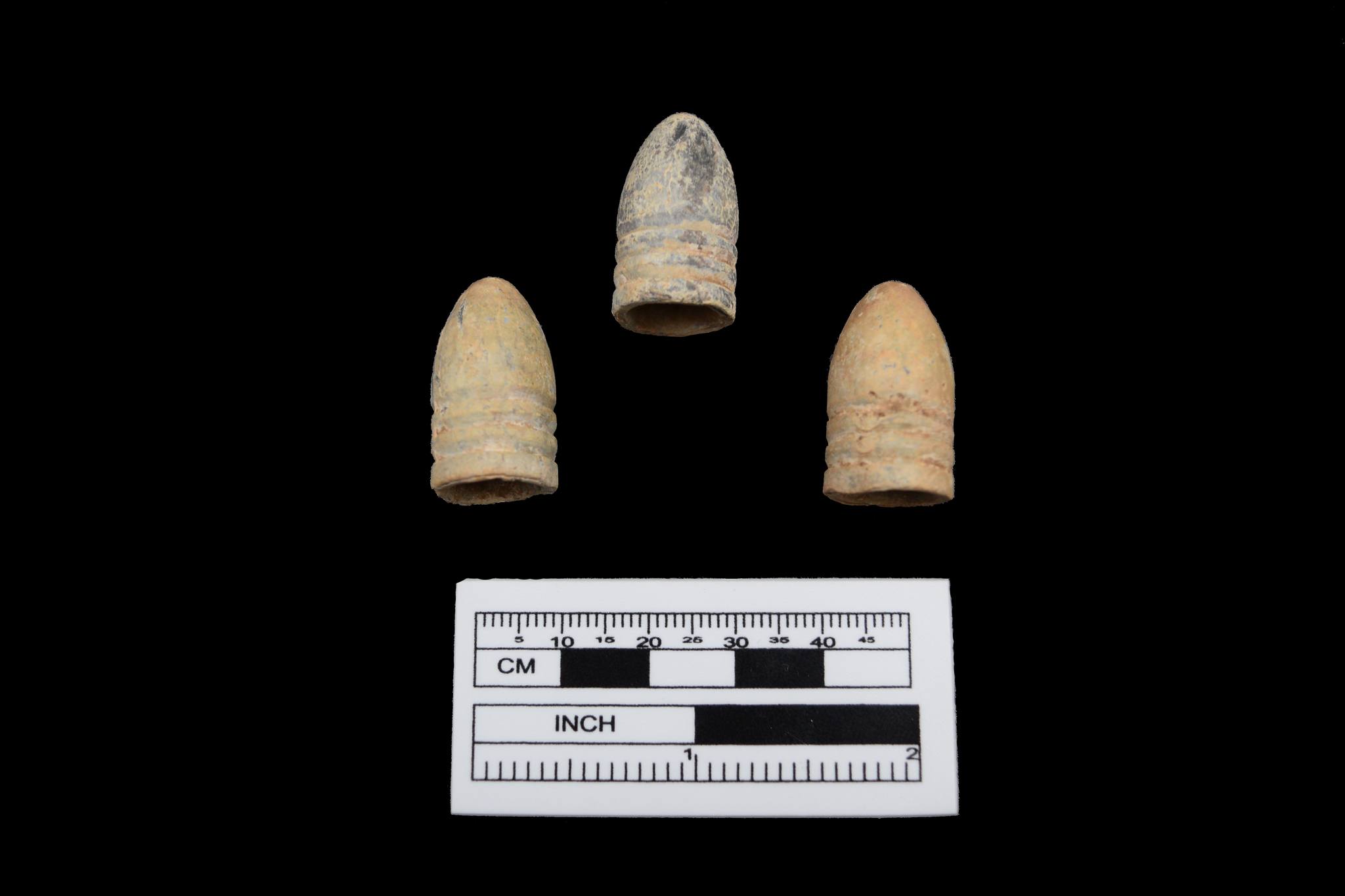
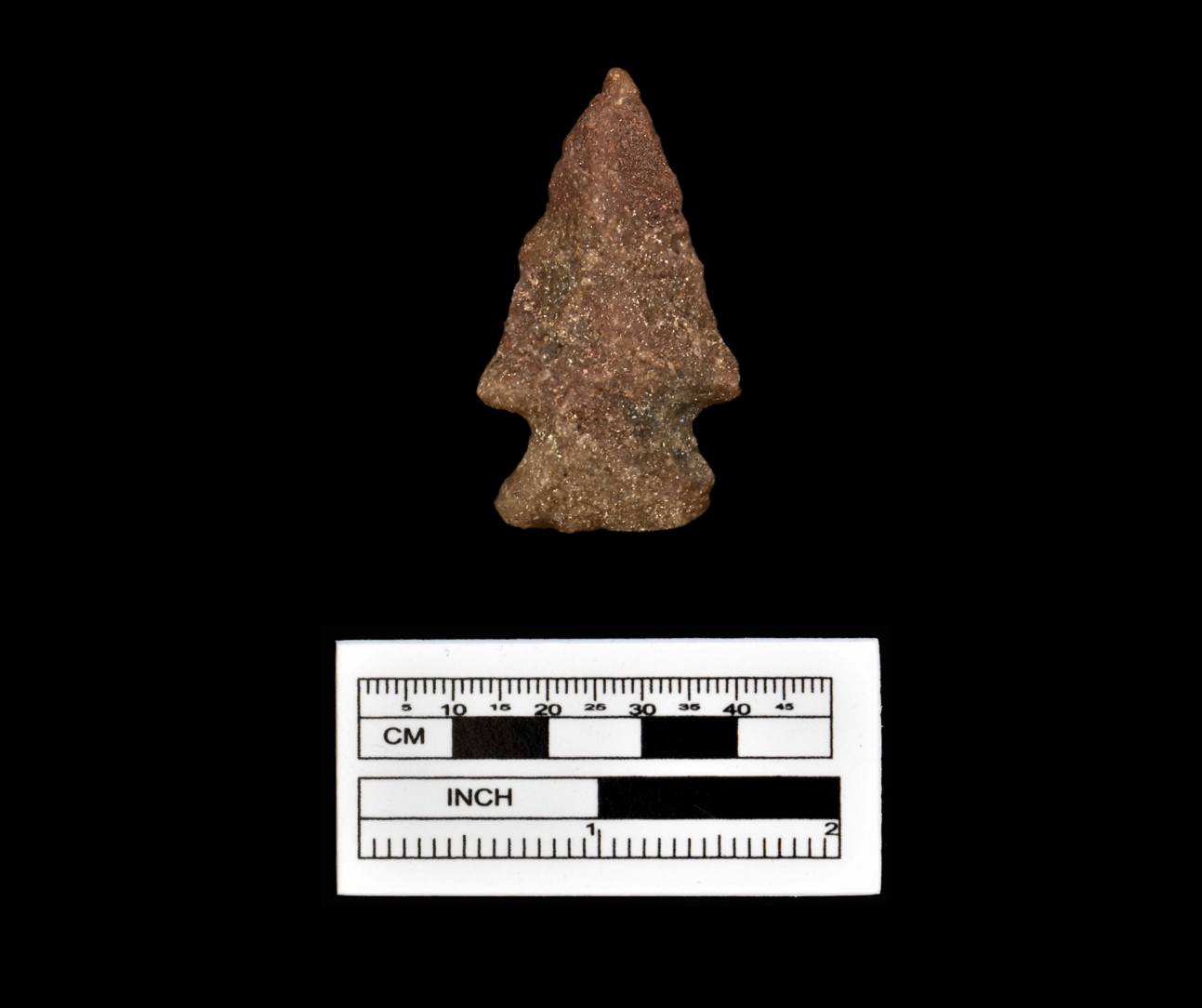
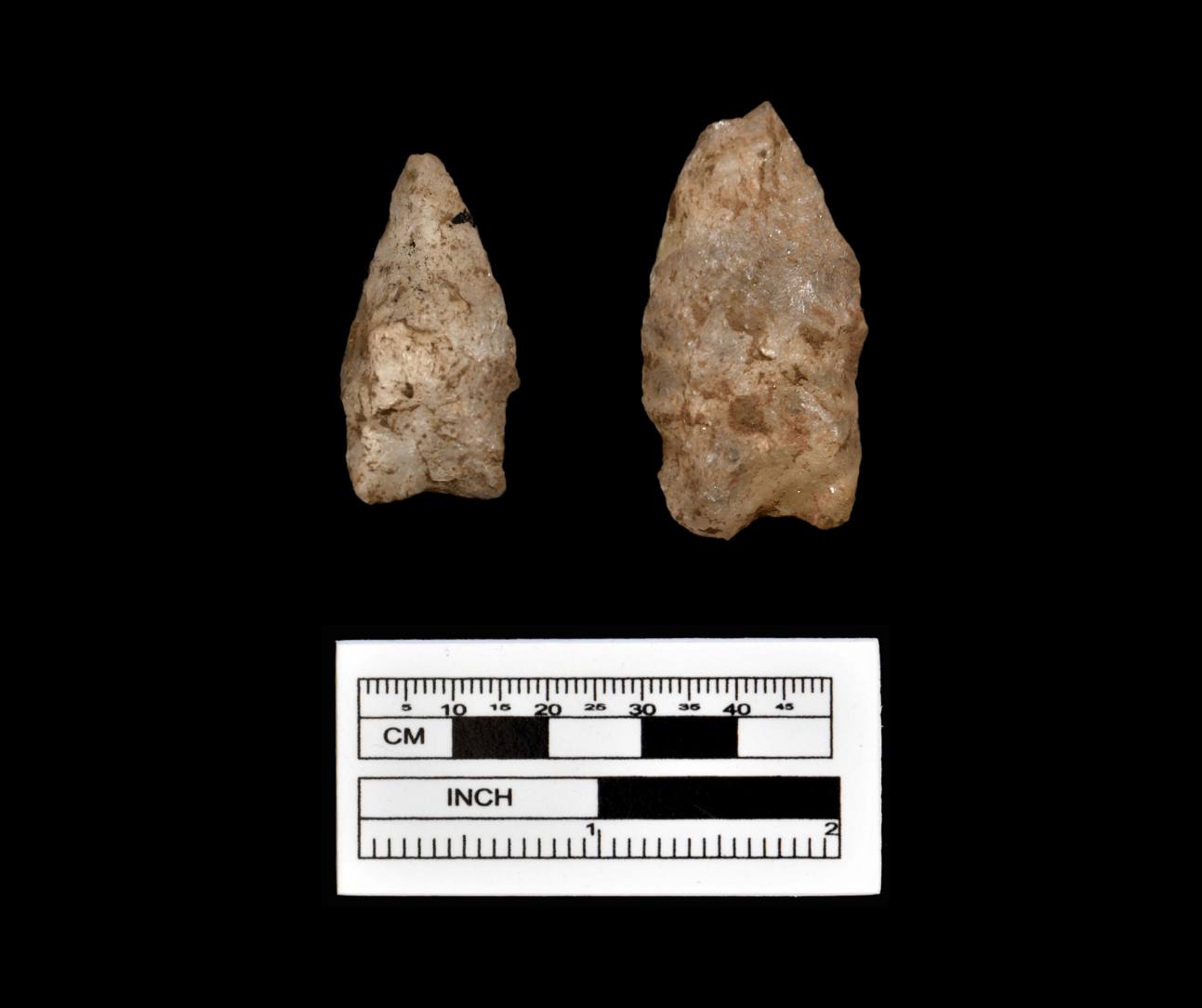
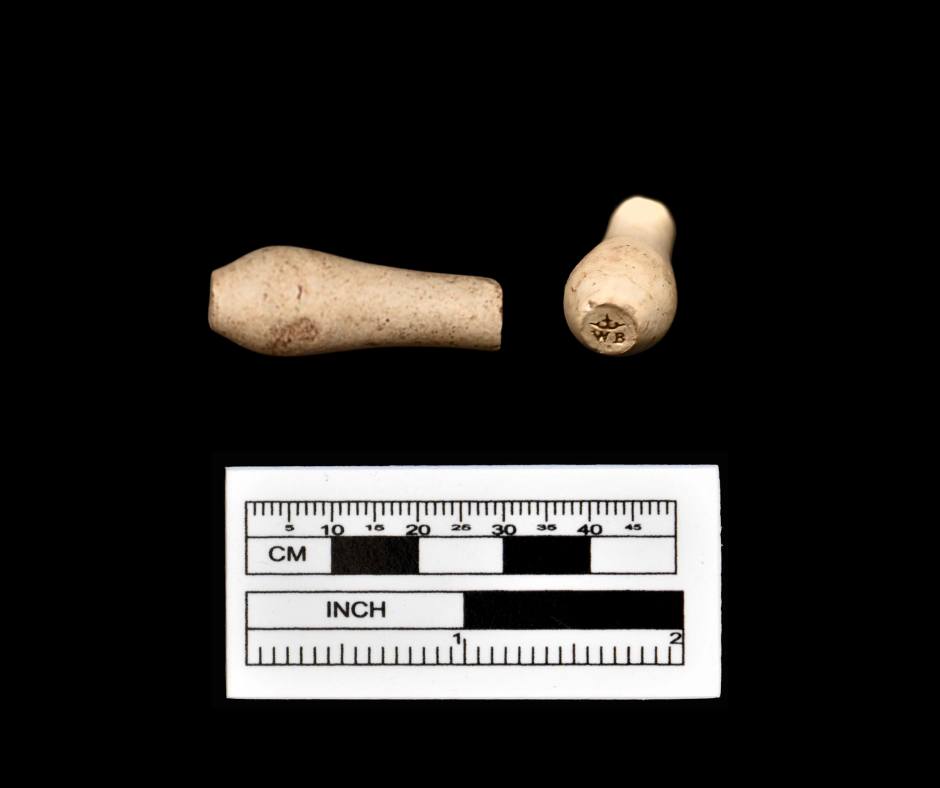
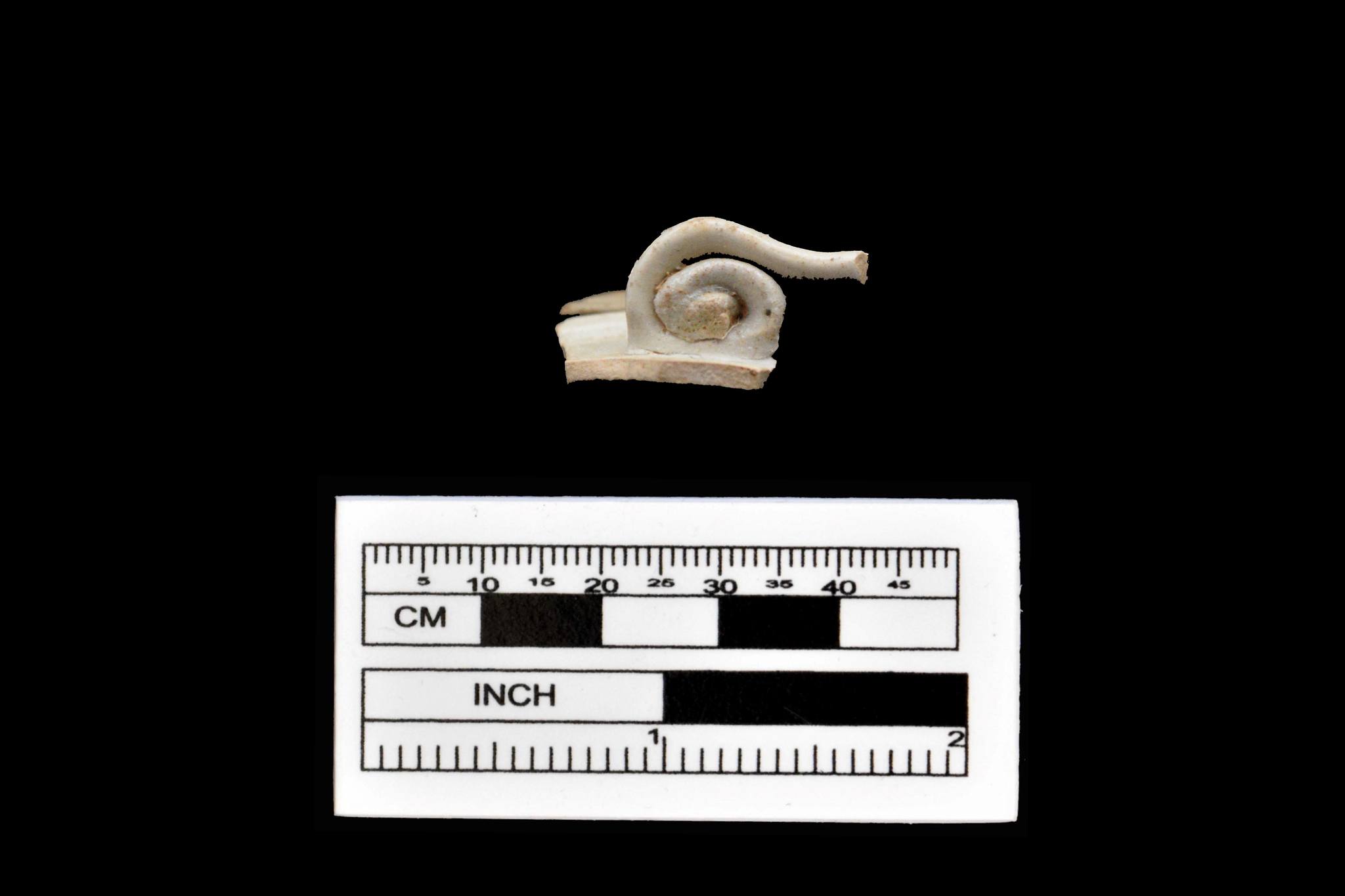
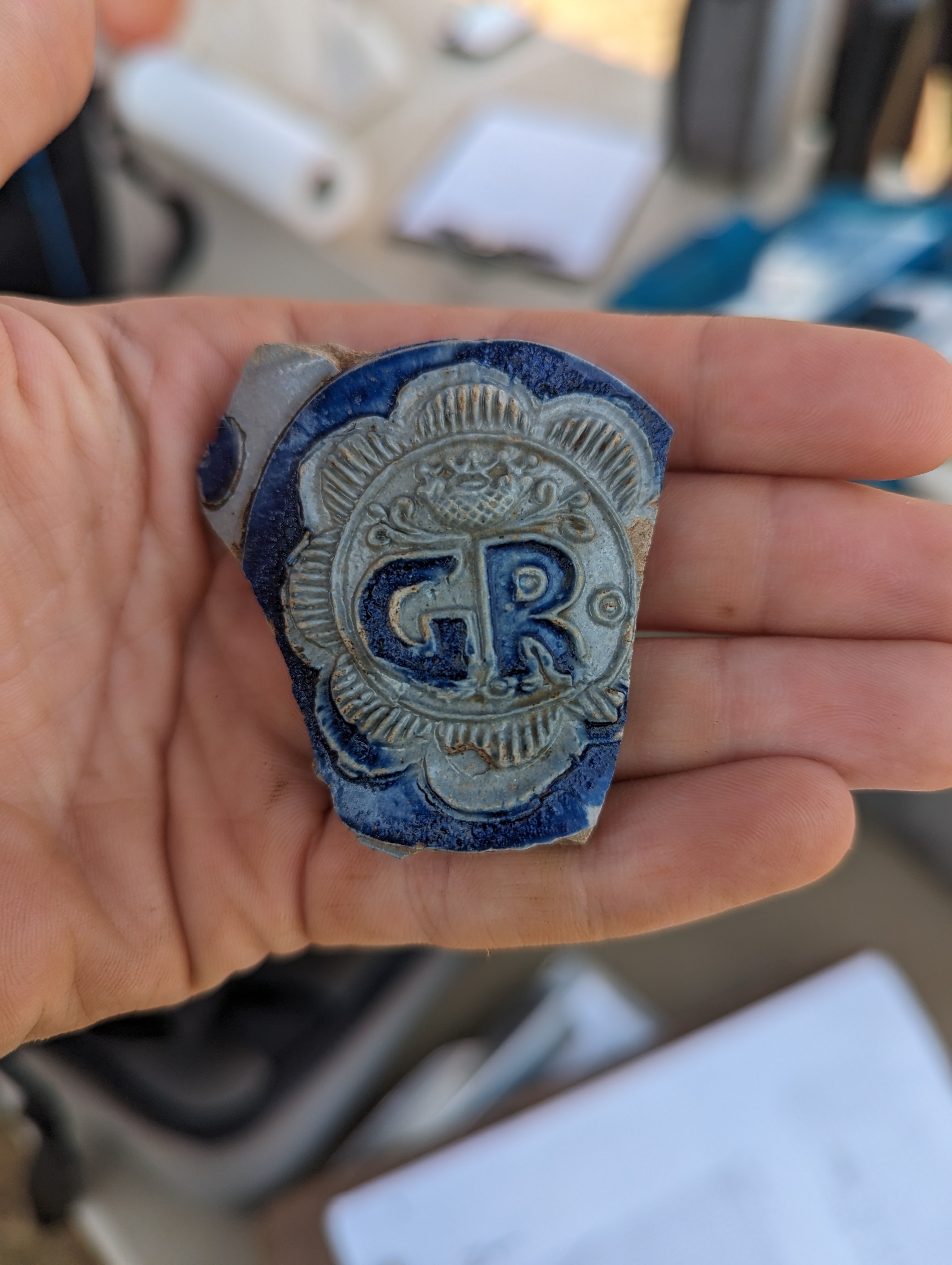
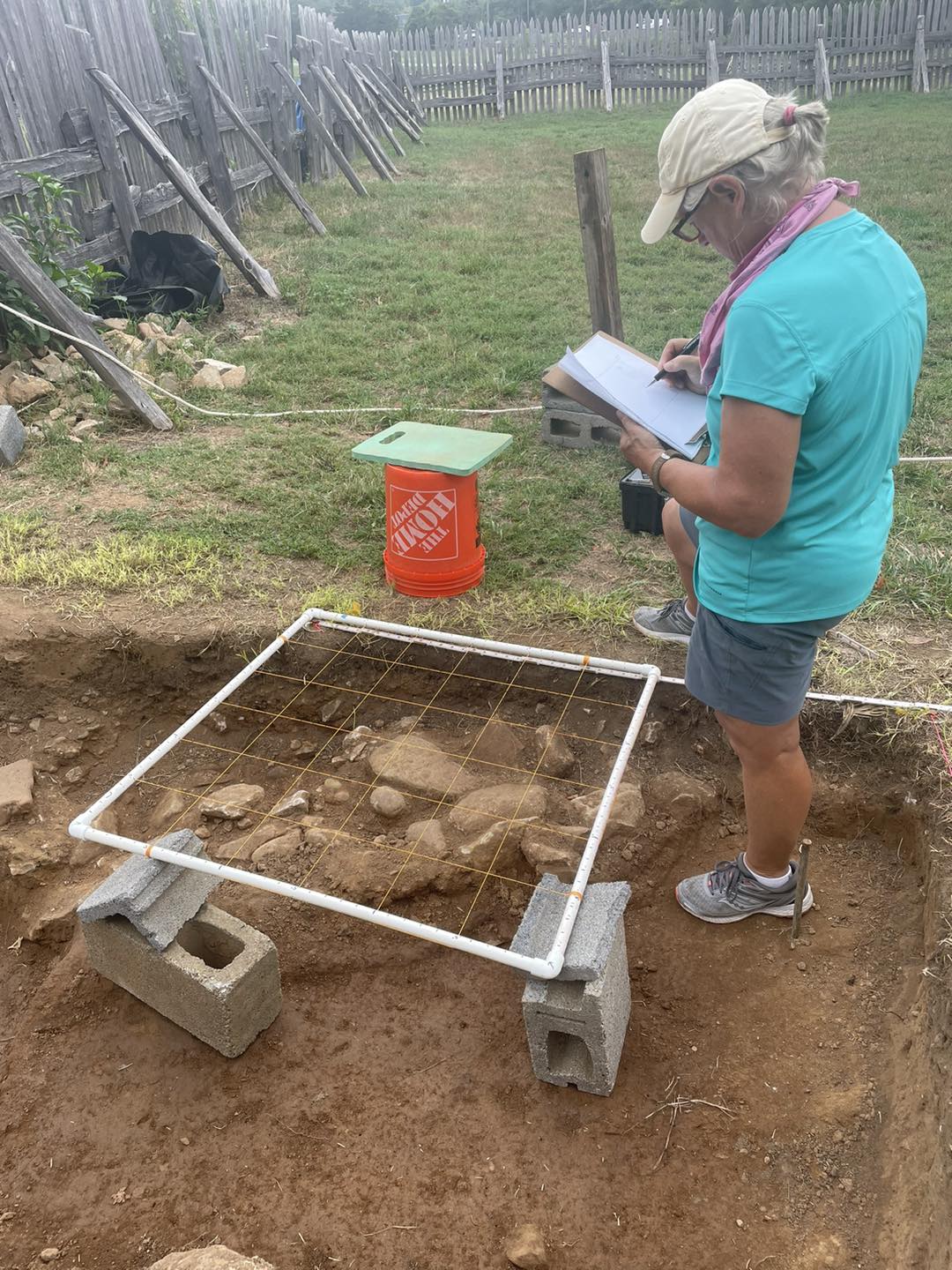
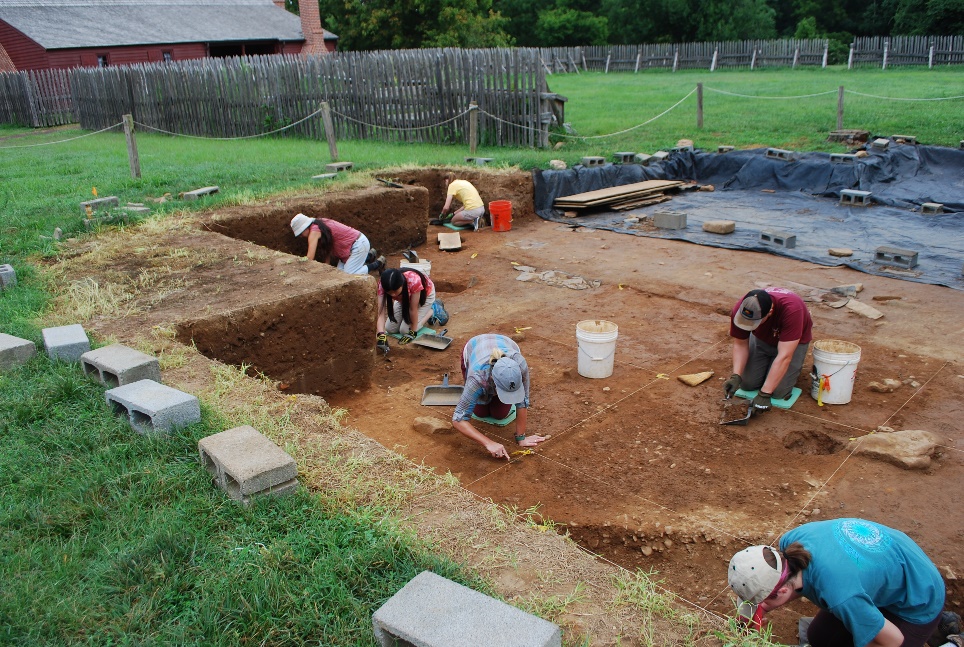
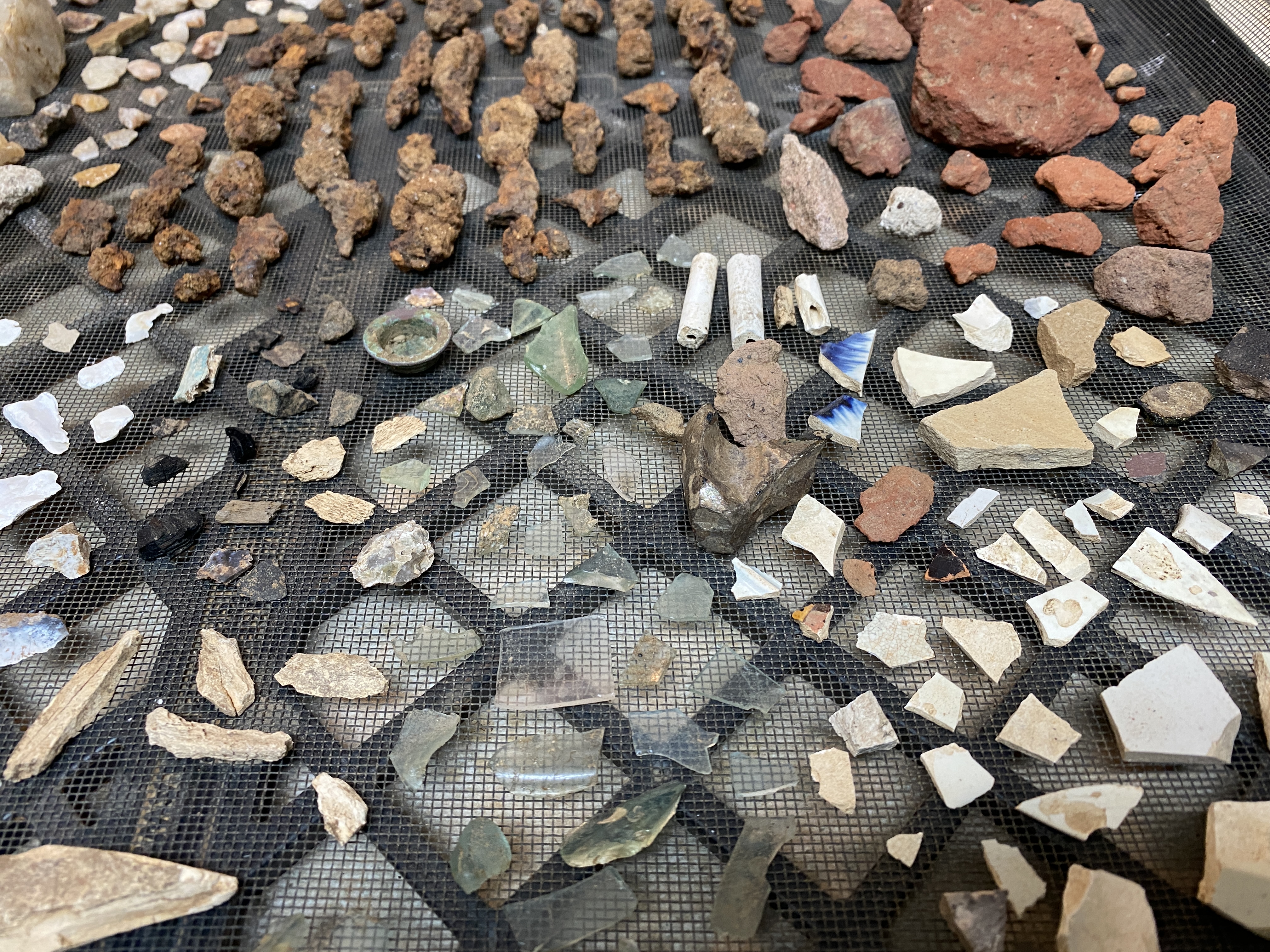
    With the help of our wonderful field school students and interns, we opened a total of twenty-seven 5’x5’ units across the kitchen site. Sifting through the dirt, hundreds of artifacts were found dating to all occupations of Ferry Farm. Super cool finds that date to the 18th-century period of use for the kitchen included tobacco pipe fragments, wine bottle sherds, and a variety of ceramics, including English stoneware, Chinese porcelain, and a German Westerwald ‘GR’ sherd. The prehistoric Native American occupations of the site were represented by an unusually high number of projectile points found (8 and counting!), dating to both the Early Archaic (8000 BC – 6500 BC) and Early Woodland (1100 BC – 500 BC) periods.  Civil War bullets came up in our screens, of course, as did 20th-century plastic, tools, toys, and bottle caps.

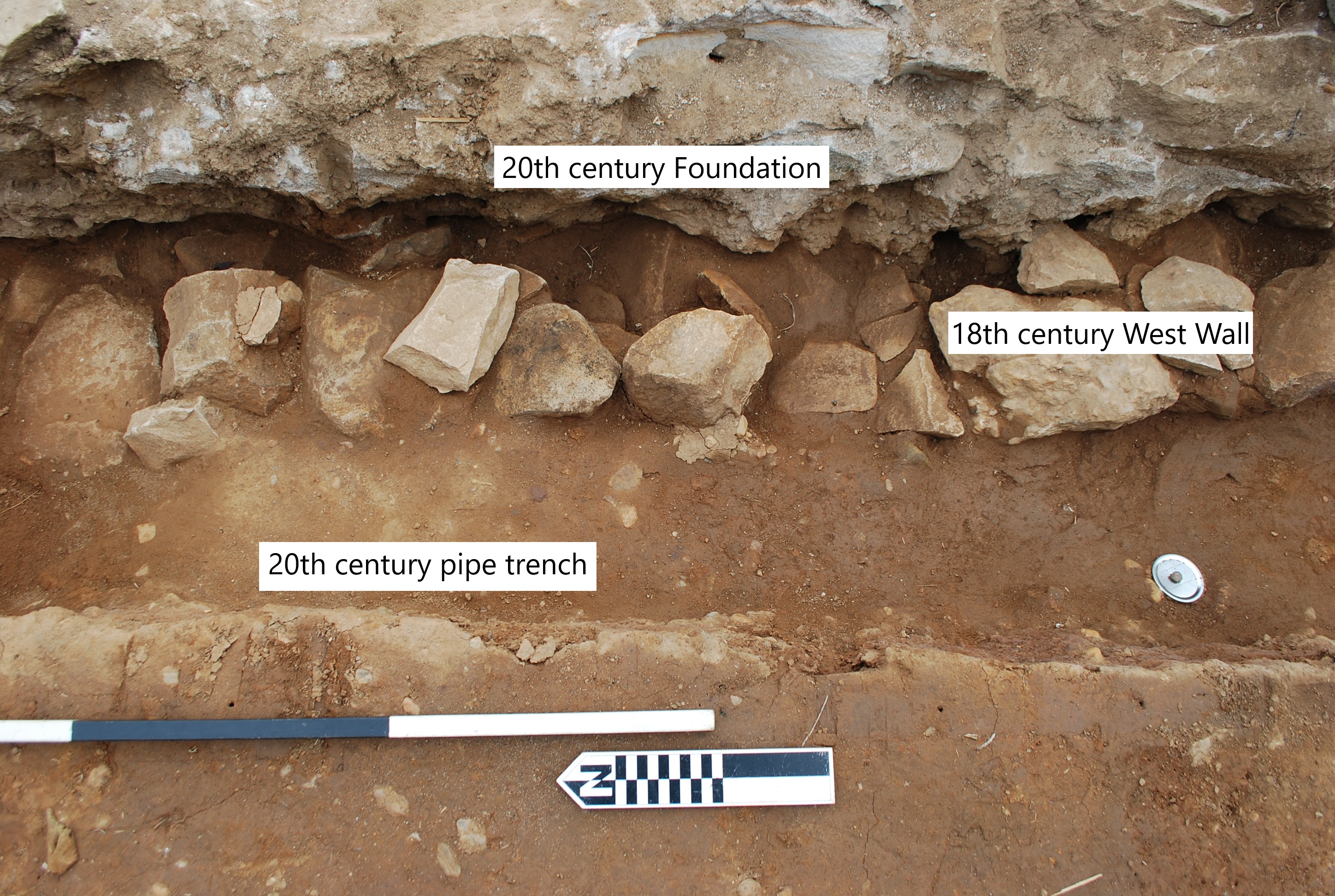
    But when it comes to finds, our most exciting discovery did not turn up in our sifting screens.  In fact, it was discovering that the western foundation wall of the kitchen cellar, thought to have been demolished, still survived!  During the 1990s excavations, the archaeologists did not see this portion of the stone foundation and assumed the construction of the 1914 Colbert house had destroyed it. Fortunately for us, it was hiding under a 20th century utility pipe and trench and lay directly adjacent to the Colbert concrete foundation. Now we have all four foundation walls that we hope to fully uncover next year.

    Exposed south and west stone walls of the colonial kitchen lie adjacent to and just outside of the 1914 concrete foundation wall.  
    West wall of colonial kitchen that was hiding under the pipe trench

    Our excavation units surrounding the kitchen foundation have not, as of yet, exposed additional building features associated with the kitchen outbuilding, such as foundations or fireplaces. That search will continue next year as we continue taking those units down and expanding our site area. Features exposed in the 1990s dig, but not excavated by them or us, such as possible post holes and trash middens, also await our return in 2025, when we plan on finishing their excavation.

    Each year’s excavation is built on the work accomplished in the previous years.  With the incredible amount of work done this past summer of exposing the original kitchen foundation, as well as the later farmhouse foundations, removing old fill, and opening up the adjacent landscape, we are looking forward to expanding our investigations of the kitchen site next year.  Stay tuned as we unravel the mysteries that are here at Ferry Farm, George Washington’s Boyhood Home.


    Danielle Arens and Judy Jobrack

    GWF Archaeology Field Directors

  • Behind the Glass at Ferry Farm’s Archaeology Lab

    The observer stands behind glass and watches. The one being watched picks up the object with her bare hands turns it carefully to see every angle, then sets it down to record data into her computer. Then she washes her hands, unwraps another object – and eats it!

    Visitors to George Washington’s Ferry Farm can explore more than the museum gallery, or the Washington House replica, or newly constructed Quarter and Cellar outbuildings. They can tap into their people-watching curiosities and observe real archaeologists in a laboratory researching, washing objects, making labels, cataloguing, repairing ceramics – and even eating lunch!

    One extraordinary thing about Ferry Farm is that its archaeology lab is viewable and accessible to the public. The mysteries of history lie out in the open, sitting out on tables or in trays ready to be washed and categorized. Like zoo-goers, visitors are mesmerized by the goings-on behind the glass, and likewise, our archaeologists love interacting with the public, glad to answer questions or even pose for a picture.

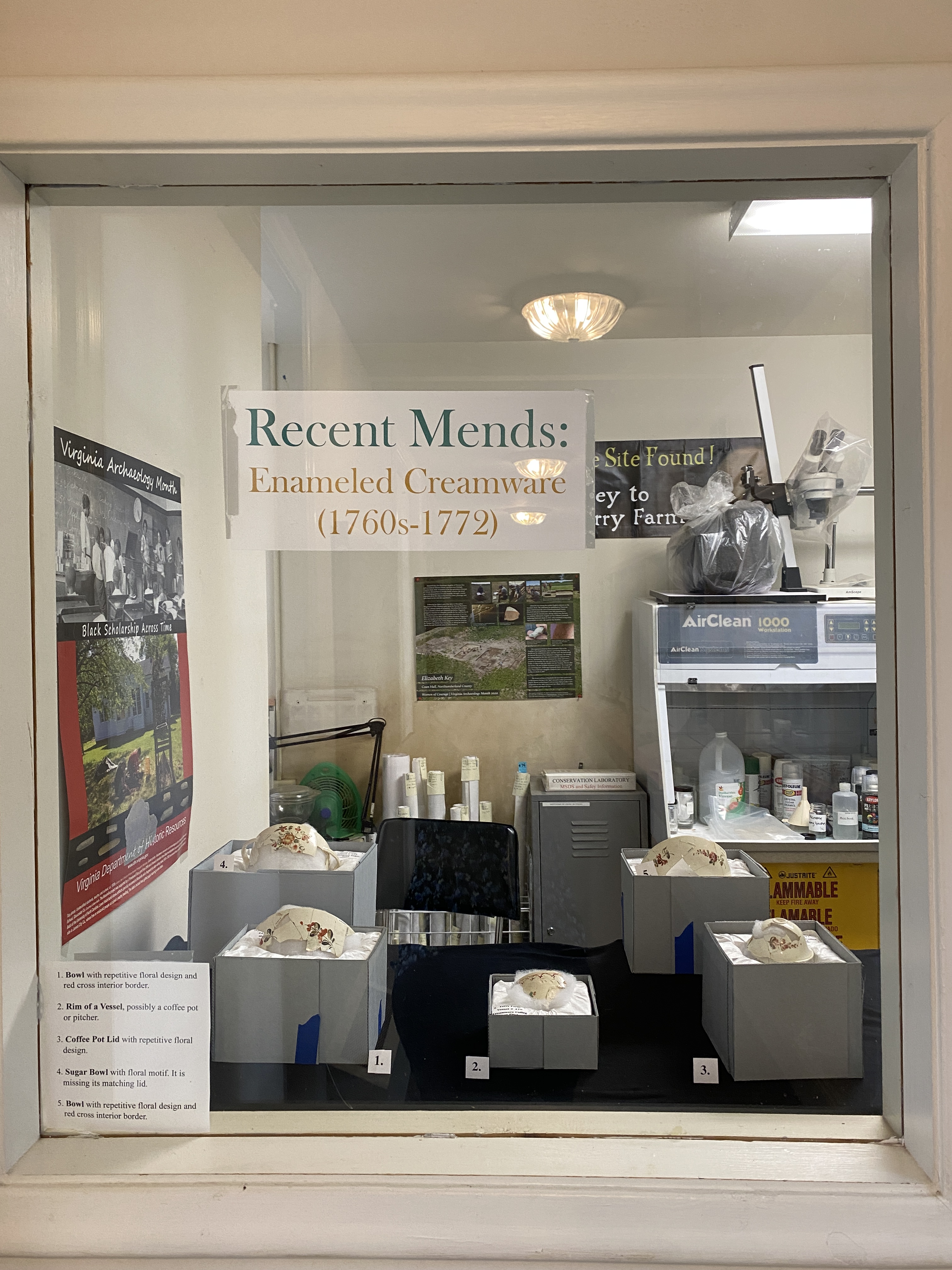
    Recent mends of enameled creamware behind one of several Archaeology Lab observation windows.

    It may be an interesting coincidence, but as Mary Washington drives the story of Ferry Farm and Historic Kenmore was saved by a group of intrepid women, Ferry Farm’s archaeology laboratory is also dominated by women who are passionate about what they do and more than willing to share their findings with guests and professional peers. Who are these interesting women, and what exactly happens in the lab? Its main inhabitants are Lab Supervisor Mara Kaktins and Field Directors Judy Jobrack and Danielle Arens. Also, part of the team (but not in the fishbowl) are Research Archaeologist Emma Schlauder and Director of Archaeology Dave Muraca. Dave, the only man in the department, led the team that discovered the foundation of the Washington House.

    There would be no lab work if there was no field work, and every summer for about 11 weeks, a carefully planned dig occurs on the grounds of George Washington’s Boyhood Home. Rich in artifacts, the land has yielded over 800,000 since the 1990’s. Finds date from indigenous, colonial, Civil War, and a sequence of farms throughout the 20th century. As Dave Muraca has said, “I would never recommend having a Civil War battle on your archaeological site. There are five successive farms out there, one on top of each other. In that way, it’s very complicated and hard to take apart.” That said, the fieldwork is not easy, but incredibly, each season, they find thousands of artifacts that will need to be mapped, processed, washed, bagged, catalogued in the database, labeled, stored, and researched.

    Washed artifacts waiting to be bagged and catalogued.

    Typical finds include ceramic sherds, window glass shards, architectural pieces, household items, mortar, sandstone, personal items, pipes, wig curlers, buttons, personal adornment, and indigenous and faunal (animal remains). Objects popular with the public include a Masonic pipe bowl, cufflinks engraved with foxes and “Tally O,” a chamber pot, and even 20th-century items that indicate children used to live on-site, such as Matchbox cars, a toy motorcycle, or a doll’s head. Observers are also surprised to learn that 21st-century trash is catalogued because it was unearthed, and someday that too will be a part of Ferry Farm’s history.

    It’s important to note that Ferry Farm doesn’t dig exhaustively. While archaeologists are certainly concerned with the past, they also make concessions for the future, leaving areas untouched for future generations to dig using as-yet not invented technology. Ground penetrating radar has not been used much because of all that has happened on the land since Washingtons’ time. The main emphasis is feature-chasing – looking for structures such as the Washington House, cellar, kitchen, the Quarter, and more. No land feature will be recreated without knowing exactly where it stood.

    A unique quality of Ferry Farm’s Archaeology Department is that lab and field duties are not segregated; the same amazing team works both in the lab and field. This creates an intimacy with the artifacts that may not be present elsewhere. One day in the field equals three working days in the lab, processing, interpreting, and analyzing all the data from the artifacts. The first step is turning the field data into a format that’s digestible for record-keeping, end-of-year reports, and future Ferry Farm archaeologists. In the field, a site grid in five-foot increments is established and laid out to track where the finds are. Within that grid, context numbers are assigned to specific soil layers and features. A context is essentially a 5’ x 5’ address that notes the horizontal and vertical location of artifacts, noting spatial distribution where items are concentrated. In the lab, context maps are made from each grid unit, and the maps are put together to create the stratigraphy of a dig site.

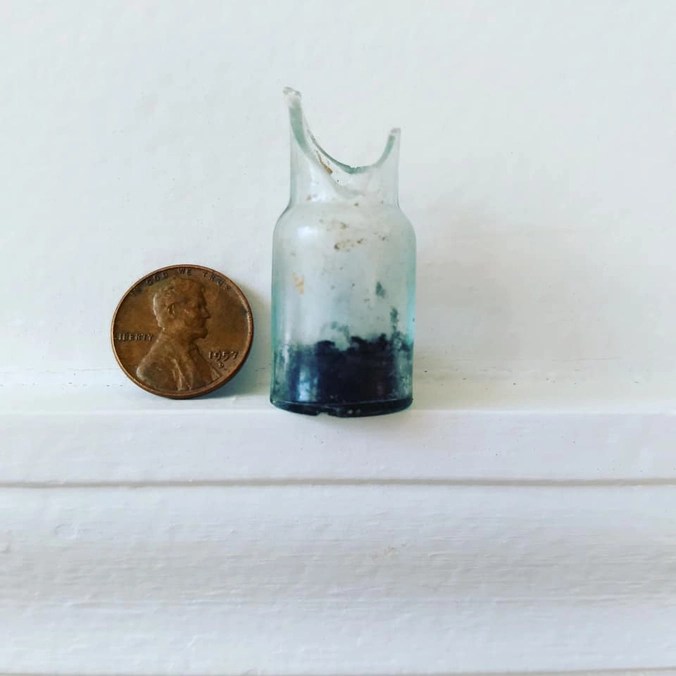
    Leaded glass takes on a blue hue under UV light.

    Artifacts that come in are brought to the Wet Lab and washed with water in a tub or colander using tools such as toothbrushes, pipe cleaners, or dental picks. One might wonder if there are special precautions for handling artifacts, and interestingly, controversy swirls over whether artifacts should be handled with gloves or not. Rubber gloves are worn during lengthy washings to keep hands from getting too waterlogged. It turns out wearing gloves for analysis proves more damaging since touch sensitivity is reduced and gloves are prone to ripping. Items being examined have been surrounded by the elements for years, so oils from hands are not likely to harm artifacts any further.

    Next to the Wet Lab is the Conservation Lab, where acetone might be used to remove glue from previously mended artifacts. It’s equipped with a vent hood for fumes and the archaeologists wear masks for safety. They often create tableware replicas for the Washington House display, which might require the use of spray paint.

    Very well-designed and equipped, the lab was created by archaeologists for archaeologists. Their equipment includes a light table, a Dremel, a fine water screen for the field, and a UV light to identify leaded glass. For further testing, the department may contract out to other labs, such as the University of Eastern Michigan, with DART mass spectrometry capable of identifying organic materials.

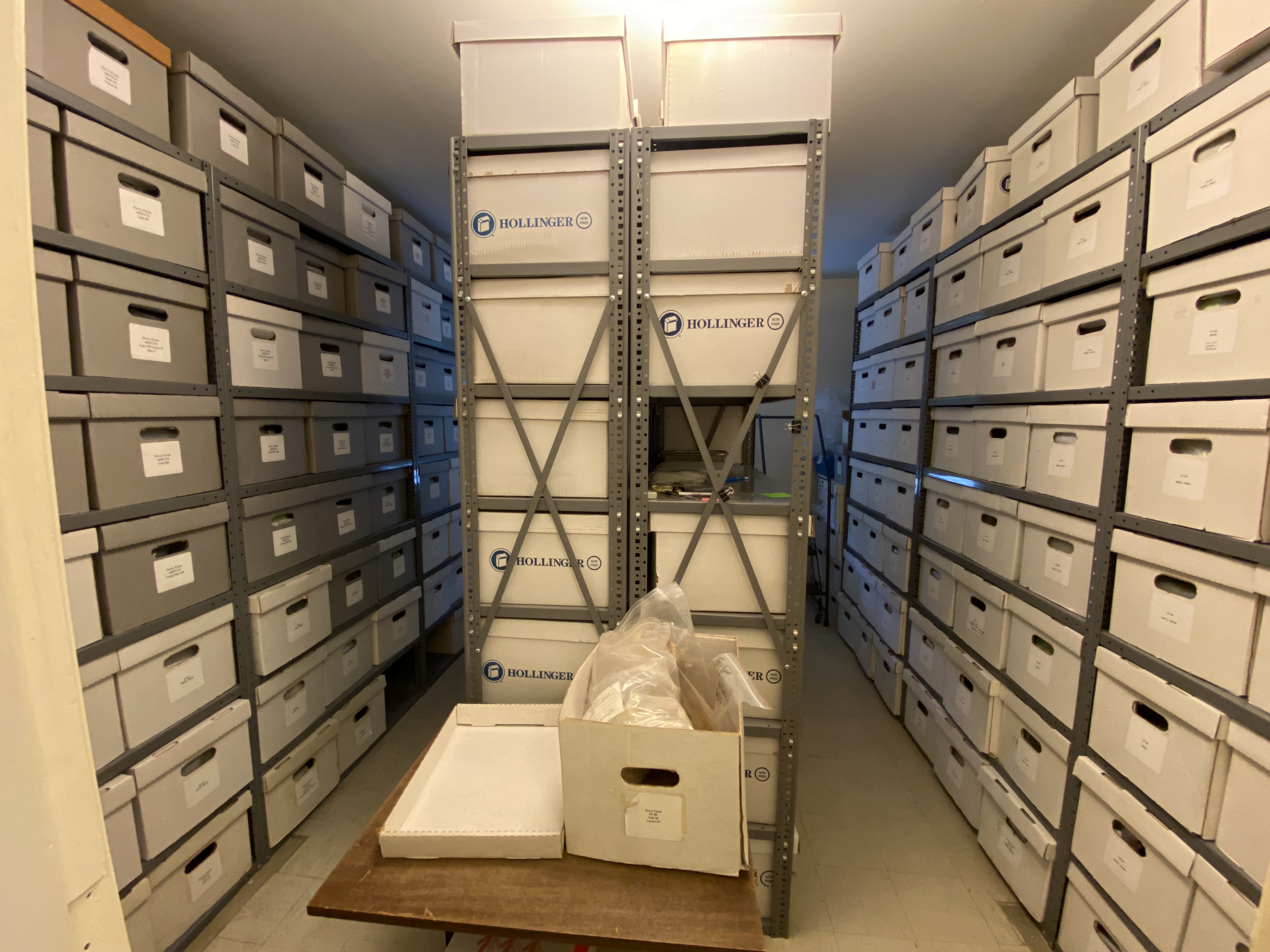
    After artifacts are entered into the database and bagged with tiny labels indicating their project number and context, they are either put in the study collection or housed in cabinets or a storage room. With almost a million artifacts in the collection, the boxes stacked in the storage room resemble a miniature version of the ending scene in Raiders of the Lost Ark.

    Boxes of artifacts stacked in the storage room resemble a miniature version of the ending scene in Raiders of the Lost Ark.

    While one cannot put a value on tiny sherds of 18th-century ceramics, a rusted hinge, or an old button, Kaktins says, “Everything is priceless because of the information gleaned from it.” Archaeology at Ferry Farm is the driving force behind the stories shared with visitors. It informs where the buildings go, reveals the long-forgotten secrets of inhabitants, and intrigues visitors as they glimpse into the past.

    Lori Pikkaart

    Marketing & Communications Manager

  • “The Spirit of ’76”: Lafayette’s Visits Fredericksburg on His American Tour

    In 1824, the United States was approaching its national jubilee—50 years of independence. President James Monroe, looking to create a wave of patriotism and celebration, invited the last surviving General of the American Revolutionary War, an American hero and icon, to take a grand tour of the country revitalizing the “spirit of 1776.” That American hero was…a French aristocrat with a painfully long name of Marie-Joseph Paul Yves Roch Gilbert du Motier de La Fayette, the Marquis de Lafayette.

    1824 portrait of Lafayette by Ary Scheffer is currently in the U.S. House of Representatives

    I won’t go into General Lafayette’s exploits, heroism, and leadership during his time in the Continental Army, but the young man was impressive and quickly became an adopted countryman.

    Lafayette being heroic at the Battle of Brandywine, artist Charles Henry Jeens

    However, we will talk about his American tour, particularly his stop in Fredericksburg.

    Lafayette arrived in New York on August 15, 1824, after setting sail on a merchant packet Cadmus from Le Havre with much disapproval from Louis XVIII, the King of France.  But royal condemnation from Louis XVI (Louis XVIII’s elder brother) hadn’t stopped him from setting sail for America in 1777, and it didn’t stop him in 1824.

    Lafayette arrived in Fredericksburg on the evening of November 20th. He was first received at the parade grounds by two companies of Riflemen, the Washington Guards, and the whole Marine Band from Washington. Then they all commenced in a long column toward town, gaining excited townspeople on horses as they continued down Hanover Street toward Caroline.    (Merchant, 1824) (Levasseur, 1829)

    Cover page of the book by Rufus B. Merchant documenting Lafayette visit, 1825

    The procession made it to the Town Hall, which was festooned with evergreens and flowers. There, it was met by a battalion of little boys called Lafayette Cadets, dressed in sharp white uniforms with red trim. After a quick welcome speech from the mayor, the general was led into the Hall, where he was greeted by a group of garlanded young girls singing his praises. 

    Fredericksburg’s Town Hall, 1814-1816

    The general was then whisked off to his accommodations provided by Mr. James Ross to enjoy refreshments and a “handsome” dinner. At nine o’clock, Lafayette, the Mayor, and Colonel Mercer were taken to the Farmer’s Hotel (west corner of Caroline and Hanover Streets) to partake in a grand welcome ball for a few hours until he retired, presumably exhausted from the day’s activities. (Merchant, 1824) (Crookshanks, 2018)

    On Sunday, the general, his son, and Mr. La Vasseur visited the Freemasons at the Fredericksburg Lodge, No. 4. In addition to observing the solemn and profound ceremonies, Lafayette was elected an honorary member in the Old Lodge Room.  (Masonic Lodge No. 4, 2024)

    The assemblage of Masonic Brethren, civil authorities, military officers, Lafayette, and company was escorted to St. George’s Episcopal Church to enjoy an excellent discourse delivered by the Reverend Edward C. McGuire, also a Mason. 

    The general then spent the evening in the company of Washington relatives at Captain Robert Lewis’s, then retired to his lodging early at 9 o’clock.  As Monday morning arrived, Lafayette was paraded to the town hall in a chariotee drawn by four white horses, where he was greeted by a crowd of ladies who occupied his time until he was led away for a sumptuous dinner at Mr. Gray’s Tavern.  After a few hours of delicious food, songs, and speeches, the general was loaded into a carriage for the final time as he continued his journey to Washington. (Dovetail Cultural Resource Group, 2006)  

    Foundation of Mr. Gray’s tavern (Indian Queen Tavern) located on the current Marriott Hotel site.

    Lafayette’s time in Fredericksburg might have been short this trip, but it gave the city a last chance to thank and honor a valued friend who had been a champion for America and helped fight for this country’s freedom.

    The city will again celebrate General Lafayette’s visit with a Commemoration Weekend on November 23rd and 24th. The weekend will open with a recreation of Lafayette’s arrival at the Old Town Hall, including period music and costumed participants. A reception line with the General will follow it. There will also be a Lafayette Ball on Saturday night, where participants can dress in their finest Regency garb and dance the night away (until 9 p.m.) with the General and President Monroe. 

    Additional Saturday events include tours of the historic Masonic Lodge No. 4.  Learn about the history of George Washington’s Mother Lodge and the fraternity’s importance to the general and see rare artifacts like the original punch bowl used during Lafayette’s visit.  For more information and tour hours, visit the Masonic Lodge No. 4 website

    Sunday will start with recreating Lafayette’s Masonic welcome, with historical speeches and a unique ceremony. There will be additional Lodge tours from 1 to 4 p.m. At noon, a historic church service at St. George’s Episcopal Church will be reminiscent of that performed by Rev Edward McGuire. Lastly, back at the Masonic Lodge from 2 to 3 p.m., historian Chris Ruli will give a lecture discussing his forthcoming book, “Brother Lafayette,” which examines the Marquis’ connection to the ancient fraternity.

    Finally, if you have some extra time on the weekend, stop by the Fredericksburg Area Museum and see their exhibit “Lafayette’s World: Revolutionary Ideals and the Limits of Freedom,” which explores Lafayette’s ideas on freedom, democracy, and abolitionism. 

    If you can’t attend the weekend events but still want to see exclusive artifacts related to Lafayette’s visit, including the extraordinary punch bowl of Masonic Lodge No. 4, stop by the Kenmore Visitor’s Center, check out our new exhibit, take a tour of the house and learn all about Fielding and Betty Lewis. 

    Friend of the Family – Lafayette’s Visit to America, Kenmore Visitor’s Center

    Heather Baldus

    Collections Manager
  • Cowrie Shells: Cultural and Economic Ties in the 18th-Century Atlantic World 

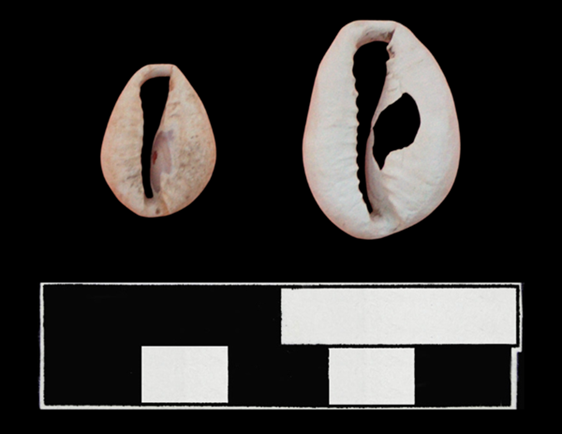
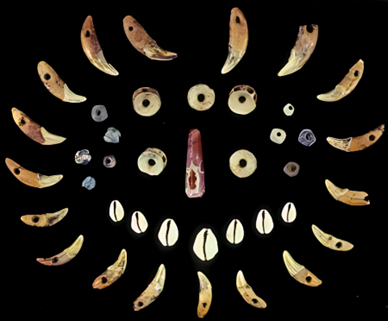
    Figure 1: Ferry Farm cowries

    Many readers will undoubtedly recognize these two artifacts (Fig. 1). Known as cowrie shells, these artifacts have become synonymous with slavery and serve as identifiers for the presence of free and enslaved Black individuals in the Americas. Still, the role of cowries in the 18th century goes far beyond that of a marker.  

    Origin 

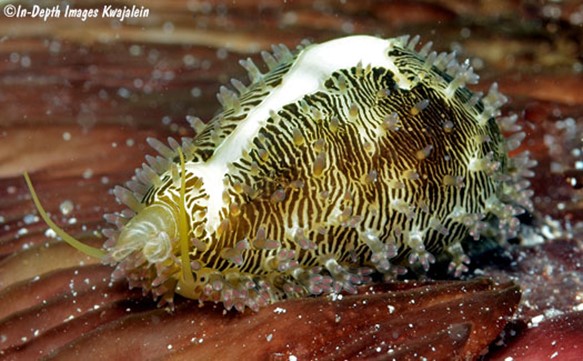
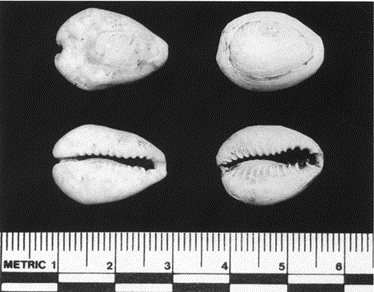
    Cowries (Cypraeidae), a taxonomic family of sea snail, live throughout the world (Fig. 2). However, the species with the most relevance to the 1700s reside in the Indo-Pacific region, particularly in the waters around the Maldives. They include Monetaria annulus (alt. Cypraea annulus, Annulus Linnaeus) and Monetaria moneta (Fig. 3). Even if your Latin proves non-existent, each species’ genus, along with M. moneta’s epithet, easily identifies the original role cowries played in human hands – money.  

    Figure 2: Monetaria monetaKwajalein Underwater
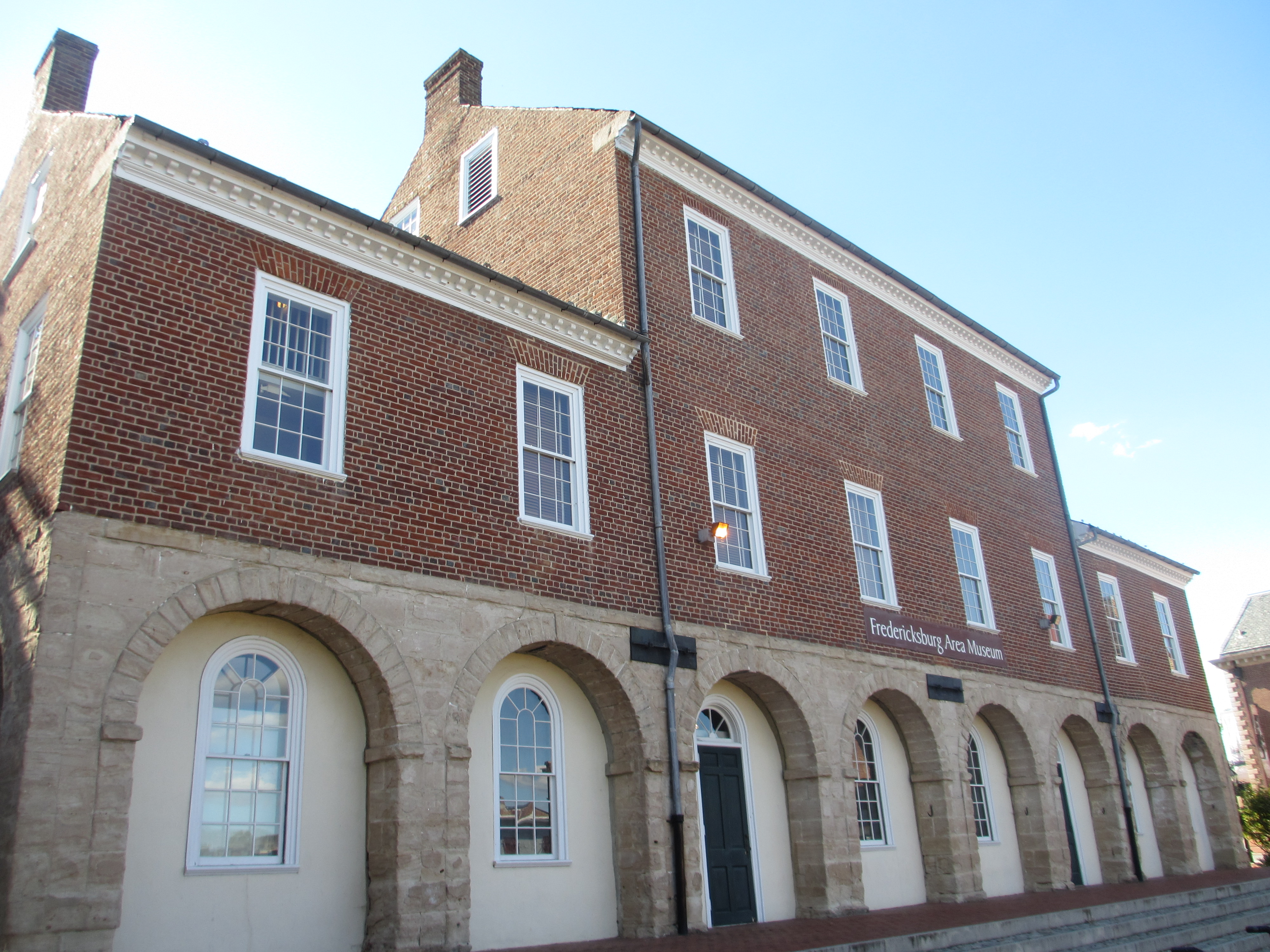
    Figure 3: M. moneta (L) and M. annulus (R) shells in their natural forms
    Barabara Heath

    Economics and Culture in West Africa 

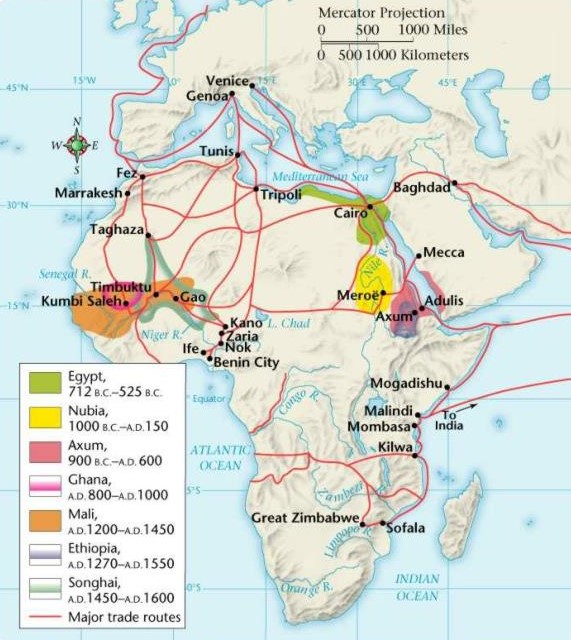
    Centuries before the 1700s, West Africa thrived as a region of independent kingdoms and tribes. With these groups engaged in trade, they required a shared currency that served as a medium of exchange and a store of value. In choosing cowries as currency in the fourteenth century, West Africa continued a long history of groups throughout the world using shell money. Through pre-existing trade routes to the Indo-Pacific, West Africans could easily import the shells via other parts of Africa and had them transported across the Sahara. As the cowries used did not reside in West Africa and proved difficult to forge, the market had built in protections against hyperinflation and counterfeits.  

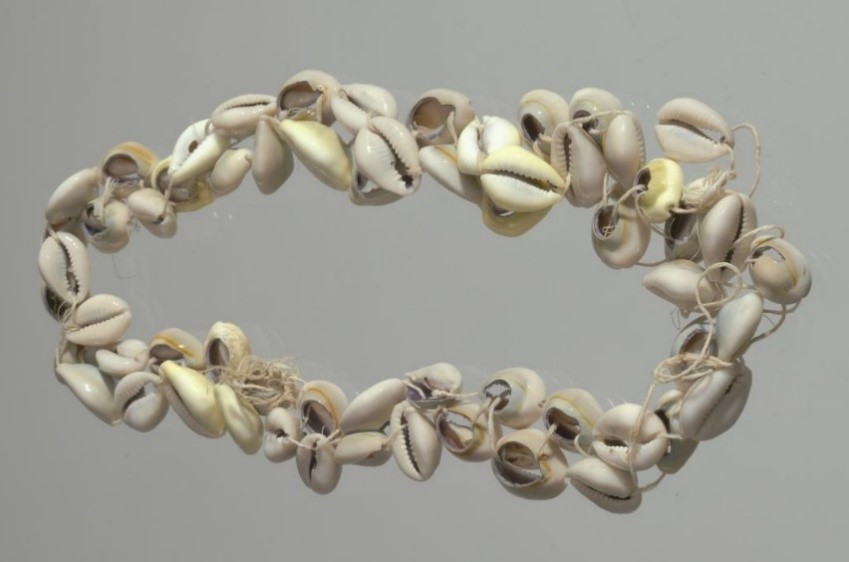
    Figure 4: Modified cowries strung togetherNational Museum of African American History & Culture

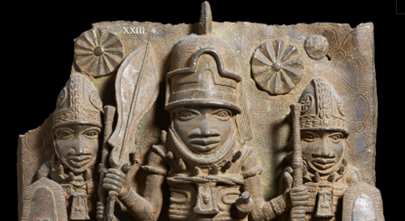
    Once in West Africa, the shells served as the basis of the region’s economies. Still, the shells took on several cultural roles. To keep cowries on hand, the shells often underwent modifications, including slicing off the rounded side of the shell or piercing them (Fig. 4). This allowed for stringing them together and weaving into hair or onto clothing. While done for practical reasons, this led cowries to enter the world of personal adornment. With this, their role expanded to symbols of status, fertility, and beauty while further appearing on ceremonial garb (Fig. 5). 

    Figure 5: Benin Bronze plaque; 16th-17th century. The warriors on either side of the central figure wear helmets decorated with cowries
    British Museum

    Atlantic Trade Routes 

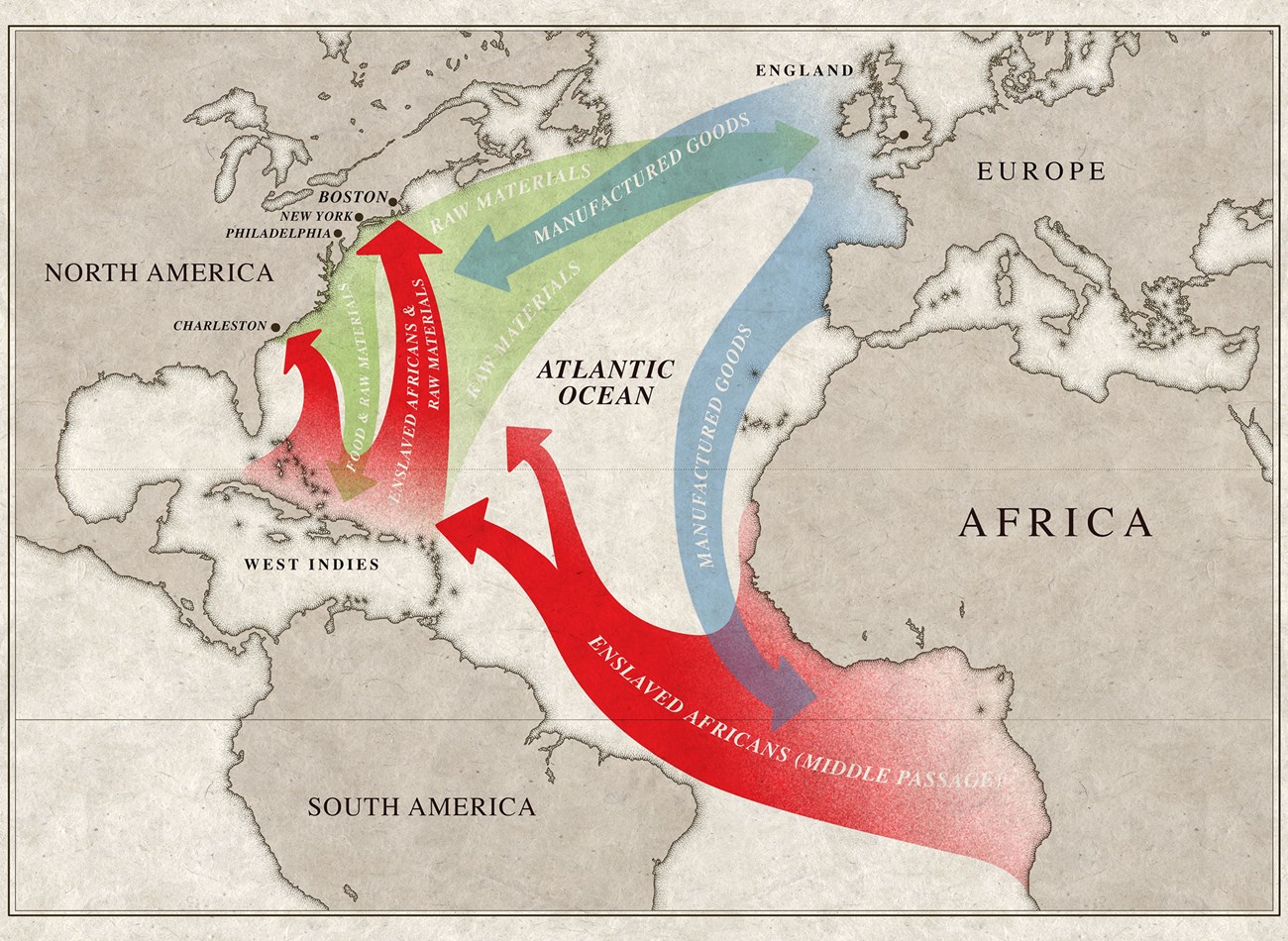
    Europe and Africa had a long history of trade and exchange networks prior to the late 1400s, but the boom of global exploration led to an immediate escalation of these market connections. With European nations expanding their territories abroad and seeking to gain resources not found within their borders, they developed a need to break into the African markets while establishing permanent trade posts in the region. To achieve this, Europeans needed to supply goods that were in demand, and their minds set upon cowries.  

    While an item of currency and self-adornment to West Africans, cowries became a commodity in the hands of European, and later American, merchants. With cowries, merchants could navigate the local economy and barter for desired goods. Inevitably, this included kidnapped Africans. In his memoir, Olaudah Equiano (c. 1745-1797), a famed writer and abolitionist, recalled how one enslaver sold him to another for 172 “little white shells” while still in Africa. An examination of eighteenth-century shipping records reveals that cowries ranked amongst the most common goods transported to West Africa and used to trade for captives (Fig 6). For Africans who then faced the Middle Passage, they forcibly traveled aboard these same ships that in turn provided West Africa with the currency driving the economy and their enslavement — cowries.   

    Figure 6: List of goods imported to the Isle of Man via Rotterdam for trade in Africa, 1761
    Manx National Heritage

    Cowries in the Americas 

    Indo-Pacific cowries arrived in the Americas through several carriers, but ultimately all traveled on slave ships. In trading cowries to West Africa, foreign merchants supplied both types even though the market preferred M. moneta. As such, they often had leftover M. annulus which remained onboard as cargo and ballast when the ships continued their trans-Atlantic journeys. Once in the Americas, some captains elected to dump or sell off the remaining cowries rather than transport them back across the Atlantic. Cowries additionally arrived in the Americas on the bodies of kidnapped Africans. While common practice involved stripping captives in Africa, primary accounts report individuals retained beads and shells in their hair and as necklaces. Enslavers further distributed beads, and likely shells, as pacifiers during the Middle Passage. 

    Once in the Americas, cowries largely remained within Black communities though they did face geographical restrictions. For Virginia, archaeological distribution of the shells, mainly M. annulus, places them within the Tidewater region. Higher counts of shells appear in urban areas (Yorktown = 252) while plantations typically only have a few. Although Virginia’s current archaeological cowrie count falls above 353, this remains too few to support the traditional role as currency. Instead, the shells continued in roles of adornment and ritual with added symbolism of cultural loss, memory, and survival. Outside random finds in areas associated with enslavement, cowries recovered in the Americas have derived from burials, spirit caches, and sub-floor pits (Fig. 7). 

    Figure 7: Necklace recovered from an enslaved burial ground at Newton Plantation, BarbadosJerome Handler

    At Ferry Farm 

    Over the course of our twenty-plus year excavation, two cowries have appeared at Ferry Farm. Found in contexts located around the Washington House, including one in a root cellar, our shells represent M. annulus and have undergone modification to allow for stringing or weaving (Fig. 8). As with findings in previous studies, we believe these shells took on cultural roles through self-adornment. Despite not knowing the identity of the shells’ owner(s), the cowries provide enough information to form an interpretation of who they belonged to and how they arrived at Ferry Farm. 

    Figure 8: Ferry Farm cowries with modifications visible

    As their contexts of origin line up with the Washington House, the enslaved individuals who left them behind likely lived and worked close to the Washington family. This places them within the working realm of the house or the nearby work yard. For accommodation, the owner(s) may have occupied the Quarter adjacent to the Washington house or lived in one of the work yard’s support buildings. 

    Regarding the arrival of cowries on the plantation, this likely happened through the movement and exchange of people and goods. To provide the labor required to meet their goals, enslavers moved those they enslaved between different plantations as needed and expanded their workforce through the enslavement of more people or hiring of persons enslaved by others. This could account for the arrival of cowries at Ferry Farm. Alternatively, Ferry Farm’s proximity to the (port) city of Fredericksburg meant the enslaved community had access to a regional economy and trans-Atlantic vessels. Either network may have transported cowries to the city, but it additionally meant that Fredericksburg served as a meeting and trade point for those enslaved in the region. 

    Legacy 

    Cowries have a long and nuanced history in the Atlantic World. Beginning as a unit of currency and cultural symbol, cowries fell prey to the demands of the market, taking on a new role in the hands of foreign merchants. What once served to strengthen economies and nations suddenly worked to strip away the very people who inhabited West Africa. For those who endured enslavement, the cowries that accompanied them became symbols of a stolen home, a continuation of culture, and a determination to survive. Today, cowries remain important items in African and African American cultures by symbolizing their history as currency, continuing in self-adornment and ritual roles, and appearing prominently in works of art (Fig. 9-11).  

    Figure 9-11: Left: The Central Bank of West African States (BCEAO) tower in Cotonou, Benin, features cowrie shells on its facade Creative Commons Attribution-Share Alike 4.0 International; ReThink Quarterly Center: 20-cedi coin from Ghana. Cedi, the Akan word for cowrie, is Ghana’s unit of currency Michael C. Carlos Museum
    Right: Beyoncé donning a cowrie headdress by Ivorian designer Lafalaise Dion Design Indaba

    Emma Schlauder

    Research Archaeologist


    Bibliography 

    Alpern, Stanley B.                                                                                                                                                  1995     What Africans Got for Their Slaves: A Master List of European Trade Goods. History in Africa 22: 5-43

    Equiano, Olaudah 1789 The Interesting Narrative of the Life of Olaudah Equiano, Or Gustavus Vassa, The African. Written By Himself. London, UK

    Handler, Jerome S. 2006 On the Transportation of Material Goods by Enslaved Africans During the Middle Passage: Preliminary findings from Documentary Sources. African Diaspora Archaeology Newsletter 9 (4): 1-22 (Article 16).

    2007 From Cambay in India to Barbados in the Caribbean: Two Unique Beads from a Plantation Slave Cemetery. African Diaspora Archaeology Newsletter 10(1): 1-10 (Article 1)

    Heath, Barbara J. 2016 Cowrie Shells, Global Trade, and Local Exchange: Piecing Together the Evidence for Colonial Virginia. Historical Archaeology 50 (2): 17-46.

    National Museum of African American History & Culture n.d. Cowrie Shells and Trade Power. National Museum of African American History & Culture, Smithsonian, Washington D.C. <https://nmaahc.si.edu/cowrie-shells-and-trade-power>. Accessed 3 June 2024.

    Ogundiran, Akinwumi 2002 Of Small Things Remembered: Beads, Cowries, and Cultural Translations of the Atlantic Experience in Yorubaland. The International Journal of African Historical Studies 35 (2/3): 427-457.

    Pallaver, Karin 2023 Cowries, the currency that powered West Africa. ReThink Quarterly 7 <https://rethinkq.adp.com/artifact-cowries-west-africa/>. Accessed 3 June 2024.

    Pearce, Laurie E. 1992 The Cowrie Shell in Virginia: A Critical Evaluation of Potential Archaeological Significance. Master’s thesis, Department of Anthropology, College of William & Mary. University Microfilms International, Ann Arbor, MI.

    Radburn, Nicholas J. 2009 William Davenport, the Slave Trade, and Merchant Enterprise in Eighteenth-Century Liverpool. Master’s thesis, Department of History, Victoria University of Wellington, Wellington, New Zealand.

    Samford, Patricia 1994 Searching for West African Cultural Meanings in the Archaeological Record. African Diaspora Newsletter 1 (3): 1-3 (Article 2).
  • Meet the 2024 Field Crew

    The dig is in full swing, and we are a little over halfway through our 11-week dig season. Over the past few weeks, we have made lots of new exciting discoveries, and as you may have noticed, added quite a few new faces to our crew.

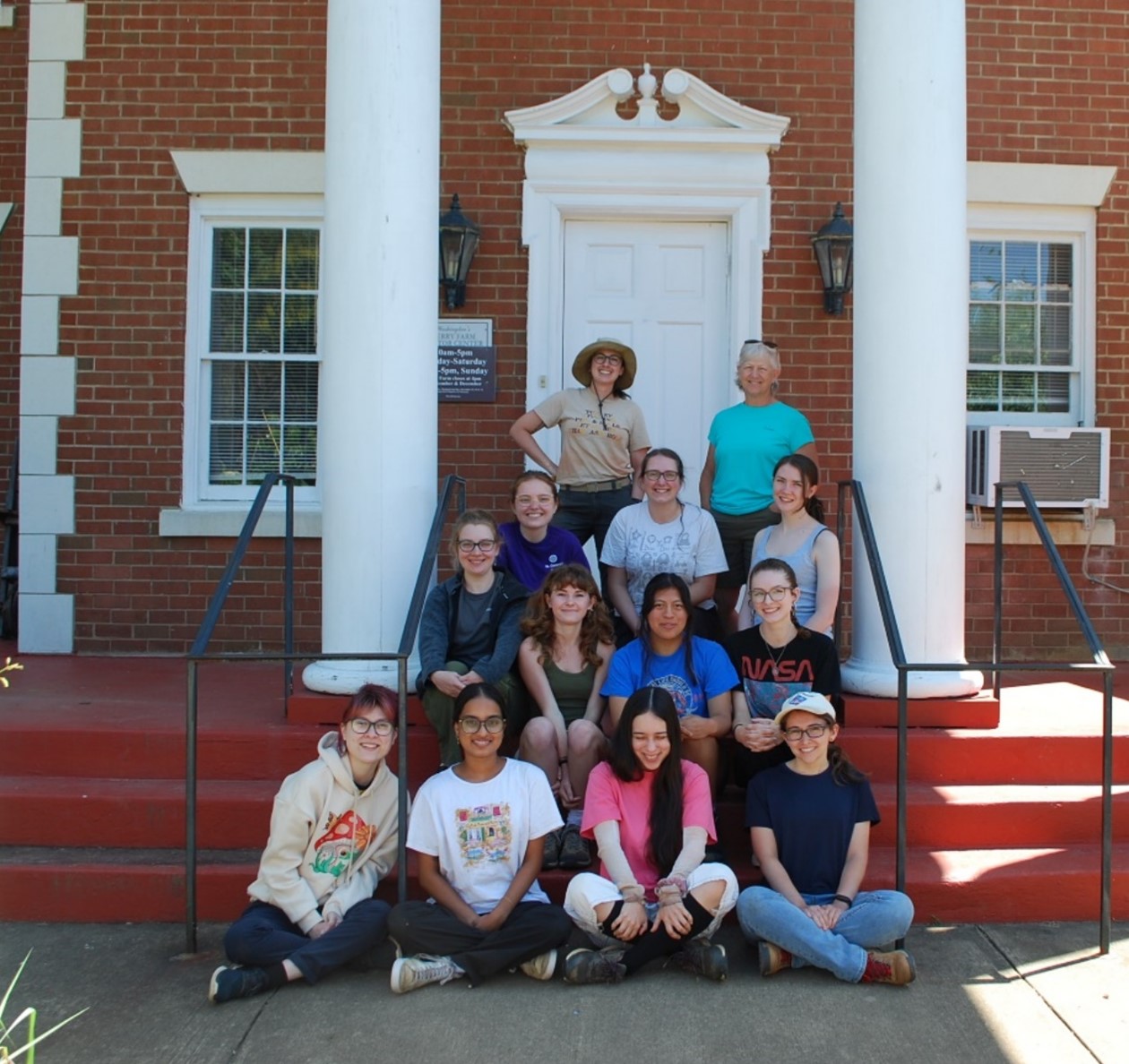
    Hosting a field school from the University of South Florida as well as interns from colleges and universities around the country has more than doubled our crew this season. While this is definitely awesome in itself, the fact that the entire field school and crew are women makes this year’s dig stand out even more. Now before we get into why an all women dig is so impressive, lets meet our crew.

    Front Row Left to Right: Alaina, Srin, Sarah, Sofia. Second Row: Abbie, Amelie, Rosie, Lindsay. Third Row: Kate, Rachel, Kellina. Back Row: Danielle, Judy.

    Srinidhi

    “Srinidhi is from Lithia, Florida. She just recently graduated from the University of South Florida with a bachelor’s degree in history. She plans on attending graduate school sometime in the future. Outside of school, Srinidhi enjoys reading high fantasy novels, playing video games, and hanging out with her dog, Felix.”

    Lindsay Marrion

    “Lindsay Marrion, from Niceville, Florida, attends the University of South Florida for English and Art History. She hopes to continue her education in graduate school, with dreams of working in academia one day. Outside of school, Lindsay in as avid reader and writer, and she loves an adventure of any kind.”

    Alaina Scapicchio

    “Alaina Scapicchio is a doctoral student at the University of South Florida in Tampa. She did her first field school at Ferry Farm in 2018 and now she is the graduate assistant for this year’s field school. Her dissertation is focused on public memory and the commemoration of witch trials in colonial America. She is the owner of two senior citizen fat cats named Tazz and Amira who she misses very much.”

    Sofia Almeida

    “Sofia Almeida is an incoming History PhD student at the University of South Florida. She recently completed her MA thesis on the digitization of historic Black cemeteries in Florida. Moving forward she is interested in American history, historic archaeology, and memory. Outside of school, she enjoys reading, playing guitar, and going on adventures with friends.”

    Amelie

    “Amelie is from Tucson, Arizona and is studying Biology, French, and Anthropology at the University of Arizona. She enjoys reading, hiking, and weightlifting and aspires to travel the world.”

    Rosie Muraca

    “Rosie Muraca is from Fredericksburg, VA. This is her first time working as a field student. She plans to attend Mount Holyoke College in the spring. When she is not digging, she is spending time with her two cats.”

    Kellina

    “Kellina is a rising junior at Yale University. She is an anthropology major from Spotsylvania, VA and she hopes to work in museum conservation. Spending the summer at the Ferry Farm archaeological dig has given her a better understanding of artifacts prior to their museum life and deepened her understanding of American history.”

    Kate McDonald

    “Kate McDonald Yaun is a rising freshman at Sewanee: The University of the South. She is studying Environment Arts and Humanities. Her hobbies include playing her viola, reading, and spending time outdoors.”

    Abbie Wood

    “Abbie Wood graduated from UVA in 2023 with a B.S. in Anthropology and a B.S. in Archaeology. This is her second dig season at Ferry Farm and the fourth overall, following a collections management museum internship. She has a passionate interest in caring for artifacts and history.”

    Sarah

    “Sarah came to Ferry Farm as a student of Virginia Commonwealth University in the summer of 2014. She has participated in half a dozen summer digs as an intern at Ferry Farm since then. Her favorite artifacts consist of the more personal items people had such as buttons, beads, sewing pins and Ferry Farm’s famous and abundant collection of colonial wig hair curlers.”

    So back to why an all women crew is so awesome. Well, our crew illustrates how women are gaining ground in a previously male dominated field. Historically, many professional positions in archaeology were held by men, but times are changing.

    Hopefully we will see some of these faces again somewhere down the archaeology pipeline, or wherever their futures may take them.


    Danielle Arens

    GWF Archaeologist

  • 2024 Dig Preview!

    Spring is in the air. The weather is warming up, flowers are blooming, bees are buzzing, and of course the dig season is about to start here at Ferry Farm, George Washington’s Boyhood Home.

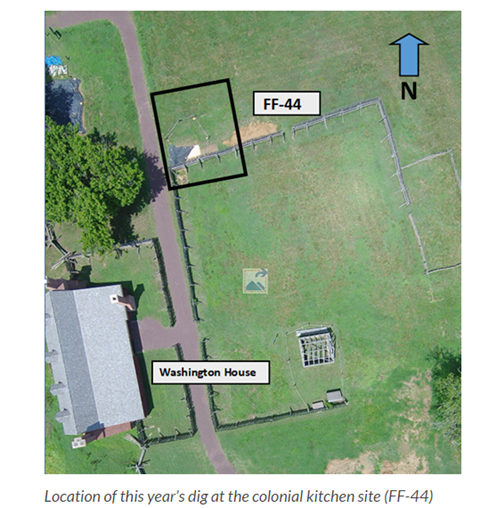
    As part of the 2023 dig season, our team revisited the site of a colonial-era kitchen that had experienced a particularly destructive fire sometime in the middle of the 18th century. The kitchen’s foundation, as well as the surrounding landscape, had been compromised by the construction, and subsequent destruction, of two farmhouses that were built directly on top of everything. This site (FF-44) is located about 50 feet from the northeast corner of the Washington House.

    Location of this year’s dig at the colonial kitchen site (FF-44)

    The 18thC kitchen site was initially explored as part of an archaeological assessment of the Ferry Farm historic property in the early 1990s. The structure and its contents were originally interpreted as a house, but a reevaluation of the excavation notes and artifacts several years later reinterpreted this site as a kitchen, not a primary domestic dwelling. But research queries still exist, such as narrowing down the dates of construction and destruction of the structure, as well as determining the possibility that meaningful artifact deposits and landscape features that might help bolster the interpretation of the building still exist outside of the foundation.

    Location of the 18thC kitchen in relation to later 19th and 20thC farmhouses

    With these questions in mind, our efforts last summer focused on working out a game plan for reexamining the site for our future excavations.  During our dig, we uncovered the southwest corner of the original kitchen as well as the foundation of the 20th-century farmhouse overlaying it. Re-locating the site and evaluating the amount and extent of fill were our primary goals. That completed, this year we will concentrate on investigating the landscape surrounding the foundation and reexamining the burnt fill within.

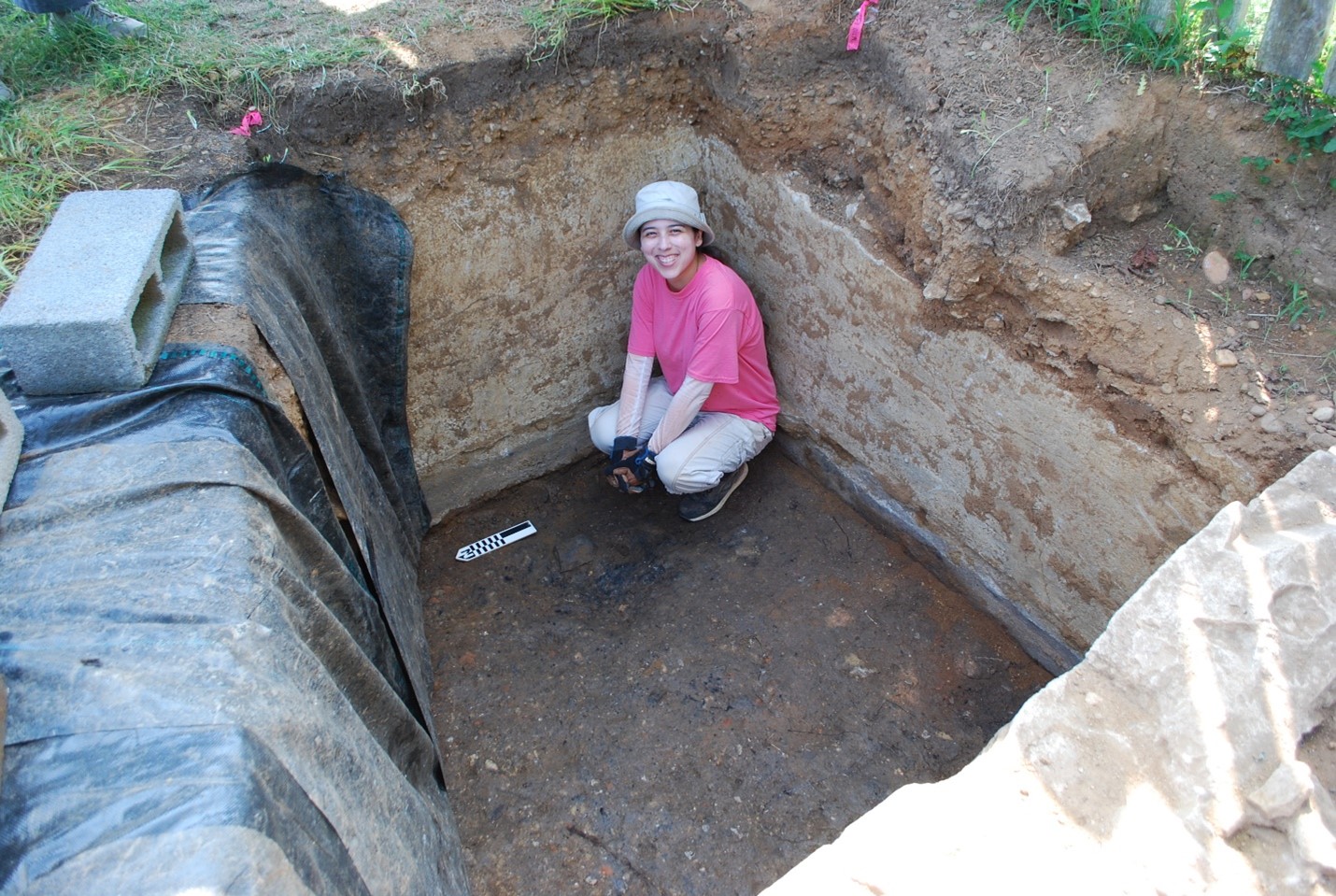
    Last year’s excavation. Red arrow points to area inside of the kitchen, white arrow points to area outside of the building. The stone and concrete wall is part of the 1914 farmhouse foundation, which sits atop the colonial kitchen fill.
    Lead excavator Sarah on floor of kitchen cellar

    An honest question you might ask would be why would we want to learn more about what was outside of the foundation? Isn’t all the important stuff inside? In the archaeological world, a lot of valuable information can be learned from these outlying areas. Eighteenth-century trash middens are often found outside of a building because garbage was being thrown off of the porches and out the doors and windows. Studying this everyday disposal of trash can tell us how and when a building was being used, as well as traffic patterns by those using the building.

    Another interesting feature that can be found outside of a foundation is a builder’s trench. These trenches were dug by the individuals building the foundation, and as they worked and backfilled these trenches, items they were currently using were accidentally left behind. These artifacts can be excellent dating material and can really nail down a construction date.

    Other items we will be looking for are possible supplementary building features, such as post-in-the ground foundations and fences. Additionally, taking a second look at the site will help us better understand the previous archaeology that was done over thirty years ago.

    As for the exciting second site we started excavating last year, Feature 321, we are putting that project on hold for now and concentrating our efforts on the kitchen site. But work continues in the lab on all the interesting artifacts recovered during last summer’s dig.

    This year’s dig begins April 29thand ends July 12th.  Archaeologists are working on site from 8 am until 4 pm, Monday through Friday, and we gladly welcome questions from our site visitors.  So be sure to stop by and see what exciting things we uncover!

    Danielle Arens and Judy Jobrack

    George Washington Foundation Archaeologists


  • Stop Collaborate and Listen TD is Back with a Brand New Edition

    A quick refresher from part one of the TD marked pipe saga – Clay tobacco pipes with the mark TD are a ubiquitous item at historical archaeology sites dating from the mid-18th through the 20th century. While at one point the mark represented a specific maker, it later became a mark synonymous with clay tobacco pipes themselves. So, it’s not surprising that archaeologists and historians have been looking to identify the origin of the mark for years. These efforts led to the naming of Thomas Dormer as the maker most likely to have begun the rise of the TD mark, though this identification was less than certain (Walker, 1966).

    Now that we are all caught up, let’s pick up the quest once again.

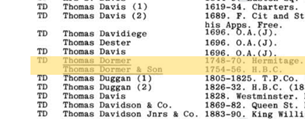
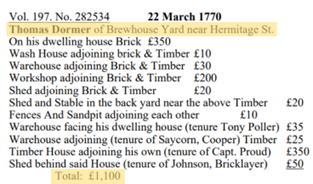
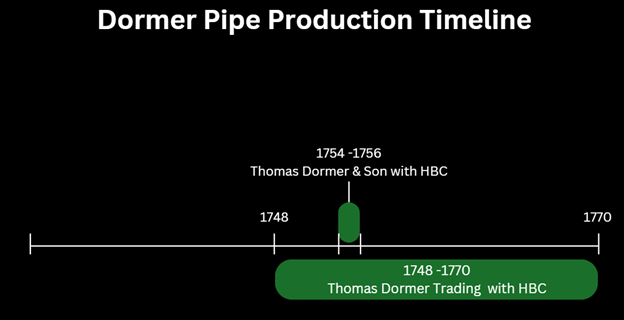
    Adrian Oswald’s (1975) index of pipe makers lists Thomas Dormer as one of the only London-based pipe makers with the initials TD trading with the Hudson’s Bay Company (HBC) in the years 1748-1770. HBC records also mention that Dormer went into business with his son for a brief time from 1754-1756. Oswald built on this by looking at the insurance policies of pipe makers of the time, which shows that the value of Thomas Dormer’s estate was nearly five times that of other pipe makers (Alexander, 1978). In the 18th century, pipe makers and the pipe making industry were often relegated to the lower class and the poorer parts of town (Walker, 1981). Dormer’s large estate implies he stood out at the time.

    So, we know that Thomas Dormer produced and imported his pipes into North America around the time TD marked pipes started popping up at sites, and that he was doing well for himself. We can call it a day and say Thomas Dormer was the original TD, right? While that does sound pretty enticing, there still needs to be more evidence supporting Dormer’s claim to the TD mark. At the time of the previous research there was very little historical documentation of Dormer and his life available, which left some questions unanswered: Why did Dormer stop exporting pipes in 1770? What is the reason behind the brief mention of this son in the mid 1750’s? And why did these pipes continue to be produced beyond 1770 with the TD mark, if not by Dormer himself? These questions made it difficult to confirm that Thomas Dormer was the TD.

    Previous timeline of Dormer pipe production

    This opens the door for my research as I attempt to fill in the blanks surrounding Dormer and his life. Since a trip to London to begin my research was off the table, much of my investigation was done through online archival research. Yay for digitization efforts and increased access to information!

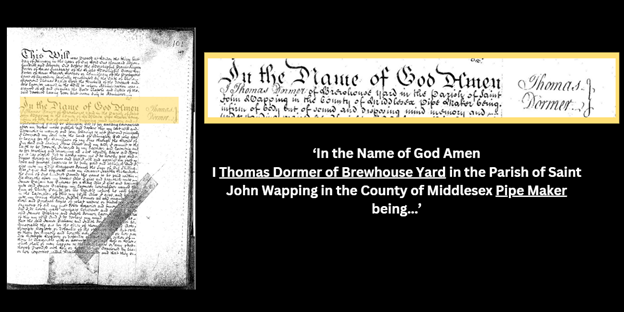
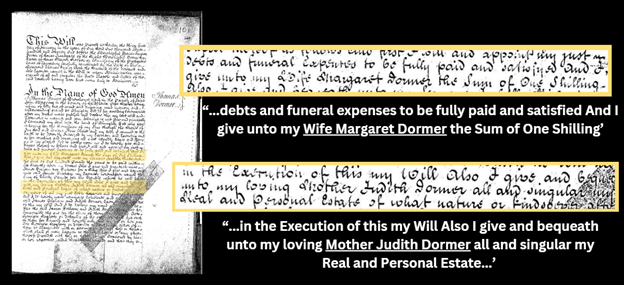
    One of the first items identified was Thomas Dormer’s will dated January 1771 (National Archives). It gives his occupation as a pipe maker and his location at Brewhouse Yard, confirming this to be the correct Thomas Dormer. Finding this document provided information that would further the investigation including a probable death date and the names of family members.

    Thomas Dormer’s will 1771 (National Archives)

    Speaking of family members, Thomas Dormer chose to leave the entirety of his vast estate to his “loving mother Judith.” On the other hand, he left his wife Margaret one single shilling. Hold up, just one shilling? This led me down a mini rabbit hole where I found that Thomas and Margaret had been married for 11 years. Indeed, long enough for her to have a fair share of the estate. Additionally, it wasn’t uncommon for wives to take over their husband’s pipe making business after their death, yet Dormer left things to his mother instead. Ouch!

    Dormer’s division of his estate (National Archives)

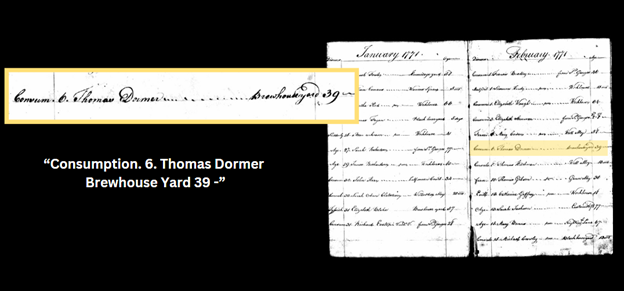
    Anyway, back to the investigation. Using 1771 as a probable death date I was able to find a Burial Notice dated February 1771 stating Thomas Dormer died at the age of 39 due to consumption, or tuberculosis as we know it today (London Metropolitan Archives [LMA]). An age at death gave me the ability to estimate his birthday to sometime around 1731 or 1732 and identified a Christening Record for Dormer dated 1731(LMA). It lists his mother as Judith Dormer which fits with previous records, and it also lists his father who is, wait for it, Thomas Dormer, a pipe maker. This uncovers the fact that there were two Thomas Dormers producing pipes in 18th century London, father and son.

    Dormer’s Burial Notice 1771 (London Metropolitan Archives)
    Dormer’s Christening Record 1731 (London Metropolitan Archives)

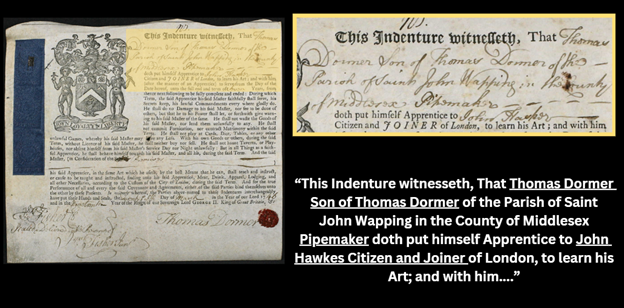
    After finding that fun fact I switched gears to see if I could find information about Thomas Dormer Sr. Given the birthdate of Thomas Jr., I figured Thomas Sr. was probably born some time in the early 1700s. Using that date, I identified his Burial Notice dated December 1756. It listed Thomas Dormer Sr. dying at the age of 56 due to asthma (LMA). Additionally, an apprenticeship indenture for Thomas Jr. was located (LMA). Dated 1746, it lists his seven-year apprenticeship under John Hawkes. Now, an apprenticeship in itself isn’t too exciting, but this was an apprenticeship for a joiner, not a pipe maker. Considering Jr. did go on to be a pipe maker, and a popular one at that, makes his previous foray into joinery an unexpected plot twist.

    Dormer Sr.’s Burial Notice 1756 (London Metropolitan Archives)
    Dormer Jr.’s Indenture Record 1746 (London Metropolitan Archives)

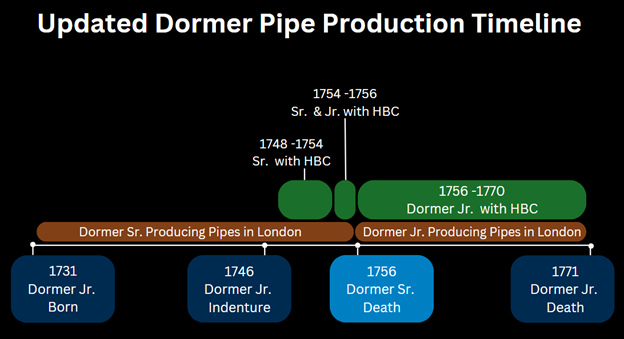
    Let’s put all of this information together. Cue the timeline! The newly discovered documentary evidence now allows me to create an updated chronology of the Dormer pipe production. Thomas Dormer Sr. began producing pipes in the London area some time prior to 1731. By 1748 Dormer Sr. was doing well enough in the business to begin exporting pipes into North America. Indenture records suggest that Dormer Jr. was not always intending to take over the business, but perhaps his father’s health prompted this, or the incoming wealth from overseas changed his mind. Nonetheless, sometime in the year 1754, or the years leading up to it, Thomas Dormer Jr. came into the family business. This partnership was short lived due to Thomas Dormer Sr.’s death in 1756, explaining the brief mention of their partnership in the HBC records. Following Dormer Sr.’s death, his son Thomas Dormer Jr., continued to produce and export pipes to North America until his death in 1771.  

    Updated Dormer pipe production timeline with new information

    This timeline helps put all the previous information into context and more fully supports Thomas Dormer Sr. and then Jr. as the originators of the TD mark.

    But wait there’s more! I also located Judith Dormer’s (Thomas Jr.’s mom) will dated 1782 (LMA). In her will she mentions her properties and its association with Tidy & Evans pipe makers (LMA). During my look into the HBC records I found that Tidy & Evans take over the London pipe export a few years after Dormer Jr.’s death. Now remember, Jr gave her all his estate which included his warehouse and workshop (LMA). Perhaps Tidy & Evans occupied his workshop and continued making TD marked pipes using Dormer’s molds after his death. Using the molds of other pipe makers was not unheard of at the time (Walker, 1981). But why would they want to make pipes with a mark other than their own?

    Mention of Tidy & Evans in HBC records and Judith’s will

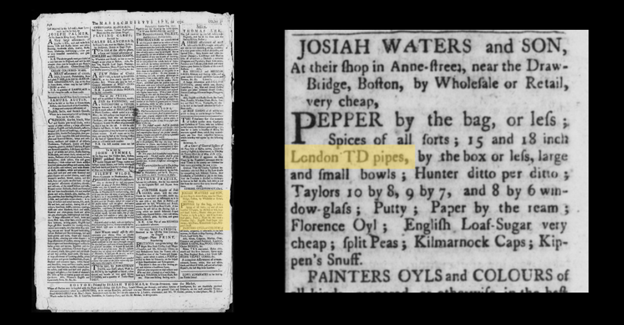
    Well, a search on the Library of Congress’s Chronicling America located a 1771 Massachusetts Spy advertisement that specifically lists London TD pipes (LOC). Not only does this solidify that TD pipes were based out of London, it also supports that the popularization of these pipes occurred during the Dormers’ lifetimes. For these pipes to be advertised by name it can be assumed that their popularity had already been established by this point. Whether this popularity had to do with the quality or the quantity of Dormer’s pipes being imported into North America remains unknown. The resulting name recognition may have caused a continued demand for these pipes, leading Tidy & Evans and others to continue producing them.

    1771 Massachusetts Spy article (LOC)

    These new findings present a solid case for Thomas Dormer being the originator of the TD mark. We can now see that TD pipes were based out of London and popularized during the period when Dormer produced and exported pipes. After 1771 the TD mark stopped representing pipes made by Dormer, and the mark was then used by other makers, perhaps Tidy & Evans, representing tobacco clay pipes themselves rather than a specific maker.

    Research such as this illustrates the importance of revisiting past theories. Whether it be trying to answer questions about a mark representing nearly 300 years of tobacco smoking culture, or looking to find interesting insight into the life of the pipe maker that created it, there is more information out there, we just need to keep looking.

    So, what do you think? Did I solve the mystery of the man behind the mark?

    Danielle Arens

    GWF Archaeologist


    References

    Alexander, L. T. (1978) ‘Clay Tobacco Smoking Pipes from the Caleb Pusey House, The Archaeological Society of Delaware9, 35pp.

    London Metropolitan Archives; London, England; London Church of England Parish Registers; Reference Number: P69/Gis/A/002/Ms06419/016

    London Metropolitan Archives; London, England; London Church of England Parish Registers; Reference Number: P93/JN2/025

    London Metropolitan Archives; London, England; London Church of England Parish Registers; Reference Number: P93/JN2/026

    London Metropolitan Archives; London, England; London Church of England Parish Registers; Reference Number: P93/JN2/026

    London Metropolitan Archive; Reference Number: COL/CHD/FR/02/0778-0-785

    Manitoba Archives. Merchandise exported to HBC posts [microfilm]. H1-16-2 ( A.25/2 )

    National Archives, Kew, Will of Thomas Dormer, Pipe Maker of Saint John Wapping , Middlesex, PROB 11/963/352

    Oswald, A. (1975) Clay Pipes for the Archaeologist, British Archaeological Reports, British Series 14, Oxford, 207pp

    Walker, I. (1966, June). TD Pipes – A Preliminary Study. Quarterly Bulletin Archeological Society of Virginia, pp. 86-102.

    Walker, S. (1981). The Clay Pipe Industry of the Parish of St Olave’s Southwark, in P Davey, The Archaeology of the Clay Tobacco Pipe 6, Pipes and Kilns in the London Region, B97, 173–82

    Woollard, P, (2001) Some Clay Tobacco Pipemakers with Fire Insurance Policies in the Sun Assurance Company 1710-1844, The Society for Clay Pipe Research, 62

  • You Down with Old TD? Yeah, You Know Me!  

     TD Marked Tobacco Pipes That Is! 

    Clay tobacco pipes are a hallmark of historical archaeology. Grandma smoked, the enslaved smoked, the elite smoked, children smoked, just about everyone smoked. Smoking was one of America’s favorite pastimes, and there are plenty of pipes left in the archaeological record to prove it. Tobacco pipes were not only a vessel for a leisurely activity, they could also be a way to display one’s identity or beliefs.  

    Figure 1: A Smoking Club (NYPL)

    Because of this, the motifs and marks on tobacco pipes can tell us a lot about the people who used them.  

    Tobacco pipes can also be valuable tools for dating a site by using pipe bore diameters, typologies, and maker’s marks. This last one helps set the stage for our question of the hour.  

    Some makers would mark their pipes to indicate a product as theirs.  These marks can be found on different parts of a pipe, such as the bowl, heel, or stem. Finding a pipe with a maker’s mark can be very exciting as it allows a pipe to be attributed to a specific pipe maker and, thus, a time period. But that is not always the case. One of the more common maker’s marks in many archaeological sites is the mark “TD.” Remember the two we found during last summer’s dig?  

     So, you’re probably thinking, what’s the question again? Just go look up a pipe maker with the initials TD, and you will have your maker. Well, unfortunately, it’s not always that easy. 

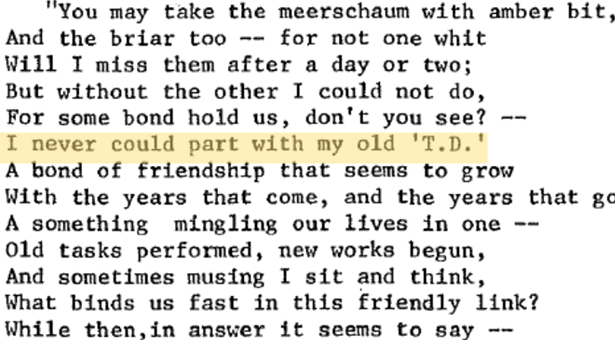
    There are multiple pipe makers with those initials, and the pipes with variations of the TD mark have been found at sites with occupation dates suggesting the mark was being produced from the mid-18th century all the way into the 20th century. At some point, the mark stopped representing a single maker and instead became a symbol used on pipes throughout the years, reflecting clay tobacco pipes themselves. Think of it as the Kleenex or Q-tip of its time. TD became synonymous with clay tobacco pipes. This can be seen in written records like a catalog from 1892 that touts their rendition of “the Celebrated “T.D.” pipe” (Zorn). An early 20th-century song referencing “the Old TD” also supports the lasting influence of the mark (Cooper, 1907, as cited by Walker, 1966).  

    Since there is no solid end date to help frame who the possible maker could be, archaeologists and historians have focused on looking at beginning dates to help find the original maker of the TD pipes, settling on a date in the middle of the 18th century. Archaeologists Adrian Oswald and Iain Walker are often cited as laying the foundations of the current TD lore. The combination of their findings identifies 18th-century London-based pipemaker Thomas Dormer as the most likely originator of the TD mark (Walker, 1966). With that said, Walker (1966) states that more information will have to be found to definitively give Dormer credit for originating the mark. 

    So, that brings us to the start of my research and a revisiting of the foundation of this theory, which was laid out as early as the 1930s.  Who is Thomas Dormer, and is he the original TD? Why were TD pipes so popular that they were copied and made for centuries? And can we find new information to crack the case of the elusive TD mark? 

    The first step of the investigation is reviewing the literature and identifying current thoughts on TD pipes and their maker. One of the earliest deep dives into TD pipe origins can be found in the article “A Theory Regarding TD pipes” in the November 1937 printing of Antiques magazine. In this article, Alfred Hopkins expresses the mystery surrounding the mark and suggests its possible meaning. At the time, Hopkins (1937) and his contemporaries were unable to find potential pipe makers with the initials TD that would indicate the mark was referring to a maker. Instead, he states that it was a trademark of sorts to identify a quality product (Hopkins, 1937). He also mentions that TD may represent the beginning of the Christian hymn Te Deum Laudamus (Hopkins, 1937). Now remember, folks, this was written in the 1930s, and at the time, they didn’t have easy access to information. While more information has since been shared, we now know that there were indeed pipe makers with these initials and look more toward a maker rather than a hymn; Hopkins’ article plays an integral part in our quest by illustrating that there was an interest in the TD mark as early as the 1930s.  

    Figure 7: 1937 Alfred Hopkins article 

    Moving away from the 1930s and into the 1960s, Adrian Oswald compiled an index of pipe makers, which Iain Walker (1966) refined to find three possible English pipe makers that could be the originator of the mark: Thomas Dennis, Thomas Darkes, and Thomas Dormer. Walker (1966) continued this search and identified London-based pipemaker Thomas Dormer as the most likely of the three. Nailing down their sources became the next part of the puzzle in an attempt to confirm this information through primary source research and examination of any sources referred to in support of the theory.  

    This is where the quest to find new information about Thomas Dormer begins. Through this investigation, I was able to identify the “OG TD,” some juicy 18th-century family drama, and the possible first plagiarizers of the TD mark. There are twists, turns, and, unfortunately, too much to tell you in just one blog, so be sure to check out part two, where we get to the bottom of this mystery that began nearly 100 years ago. 

    Danielle Arens

    GWF Archaeologist


    ​​References 

    ​​(2022). Retrieved from George-M-Woodward-mavcor.yale.edu.jpg 

    ​George Zorn & Co. (1892). Pipes & Smokers Articles. Philadelphia. 

    ​Hopkins, A. (1937, November). A Theory Regarding TD Pipes. Antiques, pp. 234-235. 

    ​National Pipe Archive. (n.d.). Retrieved from http://www.pipearchive.co.uk/images/how%20to/pipe_figure_1.jpg&nbsp;

    ​Walker, I. (1966, June). TD Pipes – A Preliminary Study. Quarterly Bulletin Archeological Society of Virginia, pp. 86-102. 

    ​​​