Each January, Historic Kenmore presents Twelfth Night at Kenmore, a dramatic theater presentation that imagines the first Christmas that Fielding and Betty Washington Lewis spent in their newly built home. The play is set in January 1776 and that year is not a time for the usual celebration. War brings fear, doubt, and frustration to the Lewis family and their friends.
The 2019 edition of Twelfth Night at Kenmore took place January 11 and 12. Here are a few photos from the performances.
Snow begins to fall on Kenmore.
Rachel Sargeant as Lucy Thorton Lewis greets visitors in the Passage.
Rae Ehlen as Fielding Lewis (L) and Wilson Johnson as George Weedon (R) share the latest war news.
Anne Lloyd as Mary Washington (L) and Corinn Keene as Nancy Alexander Lewis (R) discuss how the war endangers their loved ones.
Ashlee James as Rachel, the washerwoman (L), and Gladys Perkins as Hetty, the cook (R), talk about the wisdom of running away to freedom promised by the British.
Barbara Cochran as Betty Washington Lewis.
Michael S. Taylor as John Lewis.
Singing “God Rest Ye Merry Gentlemen.”
Marcus Salley as Pompey, the blacksmith, tends a fire.
Sam Fulton as Henry Mitchell, Fredericksburg merchant, alone in the Drawing Room.
On Friday, January 11, Saturday, January 12, and Sunday, January 13, Historic Kenmore will again present Twelfth Night at Kenmore, a dramatic theater presentation set in 1776.
This production depicts the first Christmas that Fielding and Betty Washington Lewis celebrate in their newly built home. It is not the usual joyous atmosphere, however. The Revolutionary War brings fear, doubt, and frustration to the Lewis family, their friends, and Kenmore’s enslaved community. Here are some photos from last year’s performance.
John Lewis (Michael S. Taylor) encourages Betty Washington Lewis (Barbara Escamilla Cochran) to reveal who the Twelfth Night king and queen shall be.
Betty Washington Lewis (Barbara Escamilla Cochran) welcomes guests to her home and offers a holiday toast.
Patriots George Weedon (L-Wilson Johnson) and Fielding Lewis (R-Rae Ehlen) worry about the latest war news.
Hetty, an enslaved washerwoman and house servant (Ashleé James), overhears Weedon and Lewis discussing Dunmore’s Proclamation, which promised freedom to slaves who fought for the British.
Mary Washington (Anne Lloyd) admonishes Nancy Alexander Lewis (Corinn Keene) to be mindful of her duty as a Patriot woman.
Rachel, an enslaved cook (Gladys Perkins), clears the dining room table after the ball’s grand meal is complete.
Having heard about Dunmore’s Proclamation, Hetty wonders how she might escape slavery and join the British cause in the hope of gaining freedom.
Fielding Lewis, Jr. (Sam Fulton) and George Weedon debate the wisdom of suspending horse racing in Fredericksburg as part of the effort to stay focused on the war effort.
The Lewis family sings “The First Noel.”
Henry Mitchell (Preston Simms) talks with Pompy, an enslaved blacksmith (Marcus Salley) and wonders whether he might as well become a Loyalist since his neighbors already seem to think that he is one.
Lucy Thorton Lewis (Cynthia Palmer), wife of John Lewis, acted as a guide for the evening and narrated our story.
Lucy Thorton Lewis (Rachel Sargeant), wife of John Lewis, acted as a guide for the evening and narrated our story.
The “Twelfth Night at Kenmore” cast.
Performance dates: Friday, January 11, Saturday, January 12, Sunday, January 13
Performance times: 3:30 p.m., 4:00 p.m., 4:30 p.m., 5:30 p.m., 6:00 p.m. and 6:30 p.m.
Reservations required. Call 540-370-0732 x24 or email [email protected]
Cost: $12.00 adults, $6.00 ages 3-17; under age 3 free.
This past weekend at Historic Kenmore, the Fredericksburg Theatrical Society presented three performances of the 18th century play The Lying Valet at Historic Kenmore. Here are some photos of the play.
(l-r) Roody Labaze as Sir Gayless, Christian Humphrey as The Lying Valet Timothy Sharp, and Brianne Cook as Miss Kitty Prye
Brianne Cook as Miss Kitty Prye
Roody Labaze as Sir Gayless
Gabrielle Fox as Mistress Melissa
Christian Humphrey as Timothy Sharp, The Lying Valet
Brianne Cook as Miss Kitty Prye
(l-r) Christian Humphrey as The Lying Valet Timothy Sharp and Roody Labaze as Sir Gayless
Gabrielle Fox as Mistress Melissa disguising herself as a Frenchman
The cast of the Lying Valet: (l-r) Brianne Cook, Gabrielle Fox, Wilson Pezzuto (director), Christian Humphrey, and Roody Labaze
Brianne Cook as Miss Kitty Prye
(l-r) Christian Humphrey as The Lying Valet Timothy Sharp and Roody Labaze as Sir Gayless
Christian Humphrey as Timothy Sharp, The Lying Valet
Gabrielle Fox as Mistress Melissa disguising herself as a Frenchman
The cast of the Lying Valet: (l-r) Brianne Cook, Gabrielle Fox, Wilson Pezzuto (director), Christian Humphrey, and Roody Labaze
Gabrielle Fox as Mistress Melissa
(l-r) Roody Labaze as Sir Gayless, Christian Humphrey as The Lying Valet Timothy Sharp, and Brianne Cook as Miss Kitty Prye
Roody Labaze as Sir Gayless
Brianne Cook as Miss Kitty Prye
Check kenmore.org/events for event listings of future theater productions and other special tours, exhibits, and programs or follow us on Facebook.
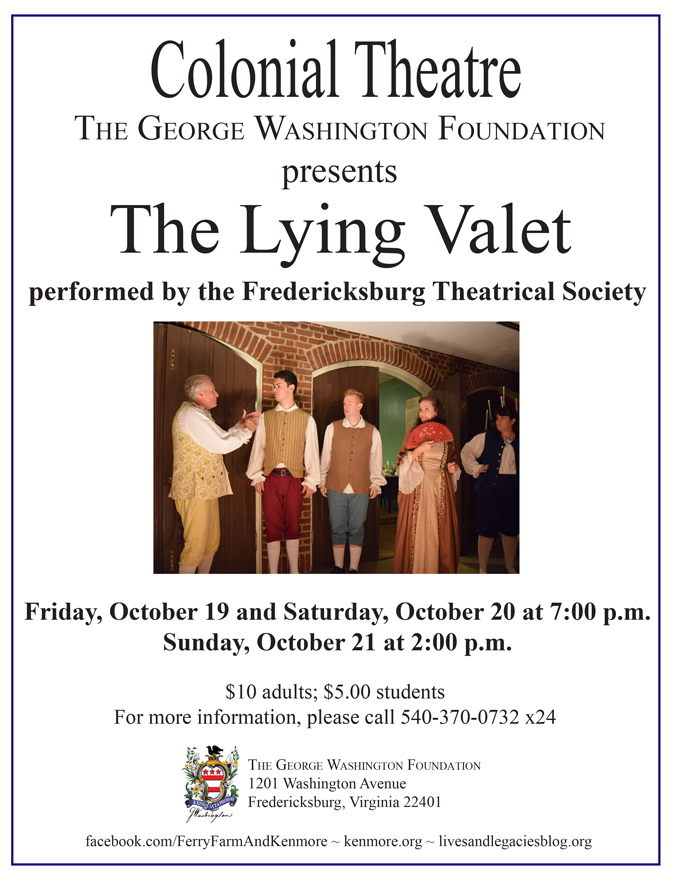
This weekend at Historic Kenmore, The George Washington Foundation will present three performances of The Lying Valet performed by the Fredericksburg Theatrical Society.
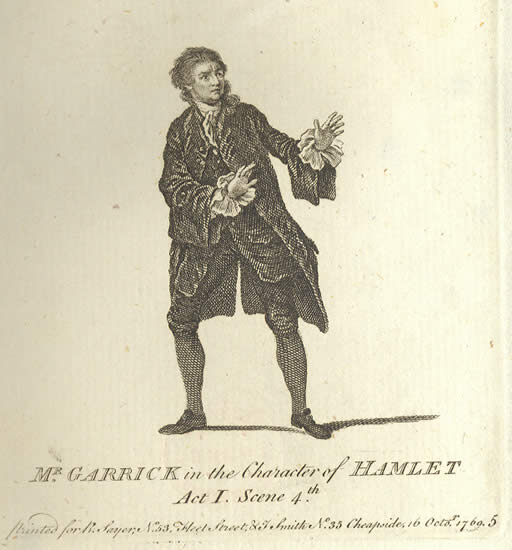
First performed in London in 1741, The Lying Valet was written by David Garrick. “If there was one name to know on the London stage in the 18th century,” as we’ve noted in a previous blog, “it was David Garrick. As a writer and actor, he was synonymous with celebrity” and was one of the leading thespians of the time.
Etching of David Garrick in Hamlet from Dramatic Characters, or Different Portraits of the English Stage, 1773. Public Domain. Credit: Wikipedia
The Lying Valet was performed many times in the British Colonies and perhaps could have even been the very first play that life-long theatre fan George Washington ever saw! As noted in an account ledger he kept, twenty-year-old George saw a play for the first time ever on June 2, 1752 during June Fair in Fredericksburg. June Fair was a annual community gathering where Fredericksburgers and other Virginians sold farm goods and land, settled debts and tried court cases, gambled on horse races, and enjoyed a play. Whatever the play was that Washington saw on that day in 1752, it was performed by the Murray-Kean Company of actors. Intriguingly, The Lying Valet was indeed one of the plays in their repertoire but there is no way to know if the play was performed on that day at June Fair.
The Lying Valet tells the story of William Gayless, who lost all of his money after a series of bad choices. Left only with one chair, Gayless attempts to rectify his situation by marrying the rich young lady Melissa, whom he has come to care for, despite the advice of his servant. Timothy Sharp, Gayless’ lying valet, finds himself weaving a few lies to save face for his master, all the while Kitty Pry, a servant to Melissa, attempts to uncover the truth. One thing leads to another as Sharp finds himself caught on the brink of disaster, and it looks as though Gayless will never have a wedding. Will everything end happily, or will lies, consumption, Frenchmen, drunk cooks, half truths, and a significant lack of funds ruin the whole plot?
This weekend’s performances of They Lying Valet take place at 7:00 p.m. on Friday, October 19 and Saturday, October 20 with a 2:00 p.m. matinee on Sunday, October 21. Admission is $10 for adults and $5.00 for students. Pre-purchase of tickets is not necessary as payment will be taken at the door. The performances take place in the Crowninshield Museum of Historic Kenmore at 1201 Washington Avenue in Fredericksburg.
Theatre is one of America’s most popular and thriving art forms. It has been a part of American culture since the early part of the 18th century. The development of theatre in the earliest American colonies in New England was prohibited because of those colonists’ strong Puritan beliefs. Colonial America’s first theater was built in Williamsburg, Virginia in 1716 after a number of English actors arrived in the more-accepting South and began performing plays. Acting ensembles and student groups performed plays, which for the most part were amateur productions, in makeshift theaters and temporary venues—anything from a barn to a large tavern room. Eventually, theaters were built in other cities like Philadelphia in 1724, New York in the mid-1730s, and Charleston in 1736.
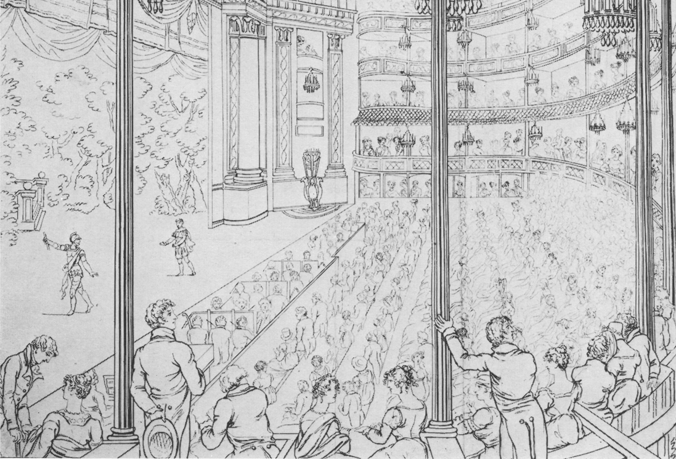
The typical colonial theater was not like the ornate theaters of today. Shaped like a shoebox, the stage occupied one-third of the space. The seating took up the remaining space. All different walks of life and classes came together to enjoy theatre performances from the boxes, the pit, or the gallery. The box seats were reserved for the wealthy, whose objective was to be on display for everyone while watching the play. The boxes were raised on the sides of the theater and faced each other and not the stage. The “middling sort” or middle class sat on the theater’s floor in the pit on wood benches. George Washington, a devoted fan of theatre, was said to have preferred watching from the pit despite being of the higher gentry class than other patrons seated there. The gallery was for the “lesser sort”—students, sailors, and even slaves – and was located in the area we’d call the balcony. In England, the lower sort could determine a play’s success and became known as “the gallery gods.”
This sketch of the Theatre Royal, Drury Lane, London in 1813 — not long after it opened — gives an idea of how one of the world’s finest theaters appeared in the early 19th century. Colonial America’s theaters would not have been this elaborate. Indeed, many of the acting companies traveling in the colonies performed wherever they could. Performances usually took place in taverns but sometimes even in barns. Credit: Public domain.
William Hallam and his brother Lewis Hallam were the first to organize a complete company of professional actors called The London Company of Comedians in Europe to bring to the American colonies. They had seen moderate success but then eventual failure in England, so they decided to try their luck in America. They had their first performance in Williamsburg in 1752, where they rented a large wooden structure which they altered to meet their needs. Their opening play was Shakespeare’s The Merchant of Venice, and music was supplied by a single player on a harpsichord. It was said that the venue was so near the forest that the players were able to shoot wild fowl from the windows of the building.
Nancy Hallam, a niece of Lewis Hallam, as Fidele in Shakespeare’s Cymbeline by Charles Willson Peale (1771). Credit: Courtesy of Colonial Williamsburg Foundation.
Lewis Hallam died in 1754 or 1755 in Jamaica where they had gone to perform, and his widow Sarah married David Douglass, manager of another company in the West Indies. In 1758 the companies merged and returned to New York City with Douglass as manager. The Hallams’ son Lewis Hallam Jr. was an actor and star of the company. Responding to a growing sense of national pride, they renamed themselves the American Company of Comedians in 1763. They toured and converted theatres up and down the East Coast including the Southwark Theatre in Philadelphia, the first permanent playhouse in America and built in 1766. They also built the John Street Theatre, later known as the Theatre Royal, in New York in 1767. The Prince of Parthia, a Neo-Classical tragedy by Thomas Godfrey, was the first stage play written by an American to be presented in America by professional actors on April 24, 1767.
There were frequent attempts to ban plays during the Revolutionary War including a 1774 decision by the Continental Congress. This was a result of the opposition to British imports, as most plays were from England, as well as objections to the supposed frivolous nature of drama and other entertainments during a dangerous political crisis.
Once America gained independence from Britain, theatre began to flourish again as a national cultural art form. Restrictive wartime legislation was soon repealed and theaters opened across the country, including in formerly anti-theatre New England. By the end of the 18th century, American theatre was a rapidly growing, socially acceptable art-form, and it continues to thrive today throughout the country.
Jessica Burger
Manager of Marketing, Communications, and Technology
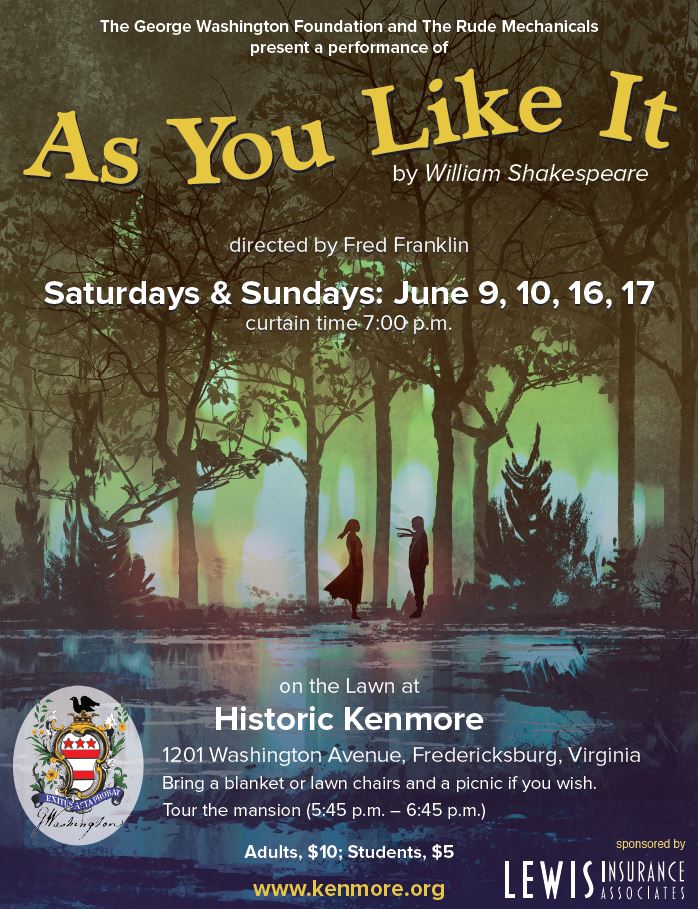
View theatre as many did in the 18th century—outside! Shakespeare on the Lawn at Kenmore returns for its fifteenth year with performances of As You Like It—Saturdays and Sundays: June 9-10 and 16-17, 7:00 p.m. Arrive early to tour the mansion and view the refurnishing. Bring folding chairs or a blanket, and maybe bring a picnic supper to enjoy.
Sources:
Peter Holland and Michael Patterson, “Eighteenth-century Theatre,” The Oxford Illustrated History of Theatre, John Russell Brown, ed., New York: Oxford University Press, 2001: 255-298 http://thowe.pbworks.com/f/eighteenth.century.theatre.pdf [accessed May 25, 2018]
Each January, Historic Kenmore presents Twelfth Night at Kenmore, a dramatic theater presentation that imagines the first Christmas that Fielding and Betty Washington Lewis spent in their newly built home. The play is set in January 1776 and that year is not a time for the usual celebration. War brings fear, doubt, and frustration to the Lewis family and their friends.
The 2018 edition of Twelfth Night at Kenmore took place January 5, 6, and 7. Here are a few photos from the performances.
John Lewis (Michael S. Taylor) encourages Betty Washington Lewis (Barbara Escamilla Cochran) to reveal who the Twelfth Night king and queen shall be.
Betty Washington Lewis (Barbara Escamilla Cochran) welcomes guests to her home and offers a holiday toast.
Patriots George Weedon (L-Wilson Johnson) and Fielding Lewis (R-Rae Ehlen) worry about the latest war news.
Hetty, an enslaved washerwoman and house servant (Ashleé James), overhears Weedon and Lewis discussing Dunmore’s Proclamation, which promised freedom to slaves who fought for the British.
Mary Washington (Anne Lloyd) admonishes Nancy Alexander Lewis (Corinn Keene) to be mindful of her duty as a Patriot woman.
Rachel, an enslaved cook (Gladys Perkins), clears the dining room table after the ball’s grand meal is complete.
Having heard about Dunmore’s Proclamation, Hetty wonders how she might escape slavery and join the British cause in the hope of gaining freedom.
Fielding Lewis, Jr. (Sam Fulton) and George Weedon debate the wisdom of suspending horse racing in Fredericksburg as part of the effort to stay focused on the war effort.
The Lewis family sings “The First Noel.”
Henry Mitchell (Preston Simms) talks with Pompy, an enslaved blacksmith (Marcus Salley) and wonders whether he might as well become a Loyalist since his neighbors already seem to think that he is one.
Lucy Thorton Lewis (Cynthia Palmer), wife of John Lewis, acted as a guide for the evening and narrated our story.
Lucy Thorton Lewis (Rachel Sargeant), wife of John Lewis, acted as a guide for the evening and narrated our story.
Shakespeare on the Lawn at Historic Kenmore returns this coming weekend with two more performances of Much Ado About Nothing. Catch one of the final shows at 7:00 p.m. either on Saturday, June 17 or on Sunday, June 18. Arrive early to tour the mansion and view the refurnishing. Bring folding chairs or a blanket and a picnic. Thank you to sponsor Lewis Insurance Associates. More event details are here. In the meantime, enjoy these scenes from last weekend’s performances!
A beautiful evening for a play on Kenmore’s lawn!
The audience awaits the evening’s entertainment.
Before the play, which was set in the 1940s, singers and a jazz band entertained the audience with music from the era.
Leonata (Amy Wolf) receives word that Don Pedro is returning home from war.
Benedick (Zach Brown) and Beatrice (Sarah Hall) spar verbally.
Claudio (l-John Flemming) talks with Don Pedro (r-Marcus Salley) about how he is smitten with Hero.
Beatrice and Benedick dance at the Masquerade Ball.
Don John (r-Rae Ehlen) schemes with Borachio (l-Dylan Miles) to prevent Claudio and Hero from falling in love.
Claudio proposes to Hero (Corinn Keene).
Pedro and Leonata scheme with others to make Beatrice and Benedick fall in love.
Antonio (Paul Kartage) joins the scheme.
After hearing that Beatrice is in love with him, Benedick decides her love must be requited even though he vowed to always be a bachelor.
Hero schemes with her cousins to get Beatrice and Benedick to fall in love.
The Watch (l to r-John Flemming, Zach Brown, Erica Turner) receives instructions from Dogberry (center-Marcus Salley) while Verges (far left-Jeffery Bare) listens.
Claudio accuses Hero of unfaithfulness and leaves her at the altar.
Beatrice asks Benedick to kill Claudio for what he’s done to Hero.
The Watch captures Borachio and his friend Conrad (center seated-Claudio Manno) and bring them to Dogberry and the Sexton (far left-Paul Kartage). Borachio confesses that Hero’s unfaithfulness was staged by Don John.
Claudio and Pedro visit what they believe is Hero’s grave.
Hero, who was thought to be dead, is revealed to Claudio to be very much alive.
Beatrice and Benedick finally confess their love for each other.
Each January, Historic Kenmore presents Twelfth Night at Kenmore, a dramatic theater presentation that imagines the first Christmas that Fielding and Betty Washington Lewis spent in their newly built home. The play is set in January 1776 and that year is not a time for the usual celebration. War brings fear, doubt, and frustration to the Lewis family and their friends.
The 2017 edition of Twelfth Night at Kenmore took place this past weekend. Here are a few photos from that performance.
Historic Kenmore in the snow on Saturday night.
Betty Washington Lewis (Barbara Cochran) welcomes her Twelfth Night guests and toasts the season while stepson John Lewis (Michael Taylor) looks on with a smile.
Lucy Thorton Lewis (left-Sarah Hall) persuades Nancy Alexander Lewis (right-Corinn Keene), who is worried about the war, to rejoin the party.
The Lewis Family sings a carol in the Dining Room.
Betty, Lucy, and Nancy talk in the Dining Room.
Fredericksburg merchant Henry Mitchell (left-Preston Simms) laments to Pompy (right-Marcus Salley) about how his neighbors whisper about Mitchell’s alleged loyalty to the crown.
Rachel (left-Gladys Perkins) argues with Hetty (right-Ashleé James) about the future that war might bring for the enslaved community and if that future will include freedom.
Editor’s Note: This Friday, Saturday, and Sunday, Historic Kenmore presents its annual production of Twelfth Night at Kenmore (click for event details). This dramatic theatre presentation imagines the first Christmas that Fielding and Betty Lewis celebrate in their newly built home. It is not the usual joyous atmosphere, however. The Revolutionary War brings fear, doubt, and frustration to the Lewis family and their friends. Among these friends is Henry Mitchell, whose support for the American cause is being questioned by his neighbors and by Henry himself. Mitchell is a new character for this year’s Twelfth Night but was also a real merchant living in Fredericksburg in the 1700s. To create this character, we researched the real Henry Mitchell. This blog post shares the fascinating story we discovered.
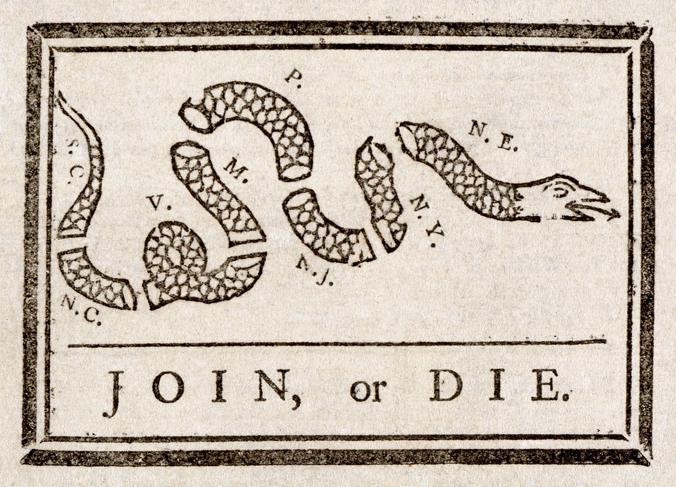
When we look back over two centuries, victory in the American War of Independence seems inevitable. Similarly, we often think that all of our ancestors chose the ‘right’ side and supported independence during the Revolution. Things were far more complex, of course. A sizable portion of the population — two historians say about 20% — living in British North America opposed revolution and fought against independence.
This political cartoon from the a 1754 edition of The Pennsylvania Gazette and believed to have been created by Benjamin Franklin originally appeared during the French and Indian War but was used again during the American Revolution to encourage the colonies to unite against British rule. Credit: Library of Congress
One such individual in Fredericksburg, Virginia was Henry Mitchell, a merchant born in Scotland who came to America, lived in Fredericksburg for nearly two decades, and worked as the Virginia-based factor (representative) for a trading house in Glasgow.[1]
Henry Mitchell participated in the community and, in the early days of tensions between the colonies and the mother country, took part in the anti-British non-importation movement known as the Virginia Association. Indeed, Mitchell was named an Associator on October 23, 1770, the same day Fielding Lewis was placed on the committee as noted in the Virginia Gazette. The Associators made sure the local populace did not purchase boycotted goods. The Association lasted a short-while before collapsing in 1771.[2]
Along with this political activity, Mitchell frequented George Weedon’s tavern and, on December 27, 1773, attended “dinner and club” with Fielding Lewis and several other Fredericksburg luminaries before Masonic services.[3]
Then, a strange incident took place in early 1775. In nearby Orange County, as reported in the Virginia Gazette, Rev. John Wingate was brought before the local patriot committee to answer for allegedly possessing “pamphlets containing very obnoxious reflections on the Continental Congress and their proceedings.” He was ordered to produce the pamphlets. Wingate refused, saying “that they belonged to Mr. Henry Mitchell of Fredericksburg” and that he could not show them to the committee without Mitchell’s “express permission.” The committee tried to persuade Wingate that since Mitchell “was well known to be an associator, and acknowledged by himself to be a hearty friend to the cause” that he would not mind if they looked at the pamphlets. Then, they noted ominously that “if Mr. Mitchell was not this hearty friend we hoped him to be,” then the committee would demand Mitchell himself come before them and show them the pamphlets. Wingate finally relented and no further discussion of Mitchell was recorded.
This incident raises all sorts of questions. Did the pamphlets really belong to Henry Mitchell? Was Wingate telling the truth or attempting to smear Mitchell for some reason? Was Mitchell undergoing some kind of change that had caused or was causing him to shift from supporting the anti-British Virginia Association to embracing loyalism? Were his earlier patriot leanings an act? If so, to what purpose? If you’re not careful, you can succumb to all sorts of wild speculation!
Mitchell continued his trade in Fredericksburg throughout 1775. Then, at the end of the year, he placed an ad in the December 8 edition of the Virginia Gazetteannouncing he would be leaving the colony in the spring and that he wished to settle his accounts before departing. Although loyalists often made their intentions to leave known in this way, Mitchell specifically noted his plans to return.
In July 1776, merchants in Fredericksburg suspected of loyalism were brought before the local committee and direct to either take a loyalty oath as required by the most recent Virginia Convention or, if they would not do so, to give up their arms. Henry Mitchell was among this group of, as the Virginia Gazette put it, “Sundry persons, supposed to be inimical to America” and refused to take the oath. Having refused to swear allegiance to the American cause, he and other loyalists they were ordered to be sent the governor so they could be expelled from Virginia.[4]
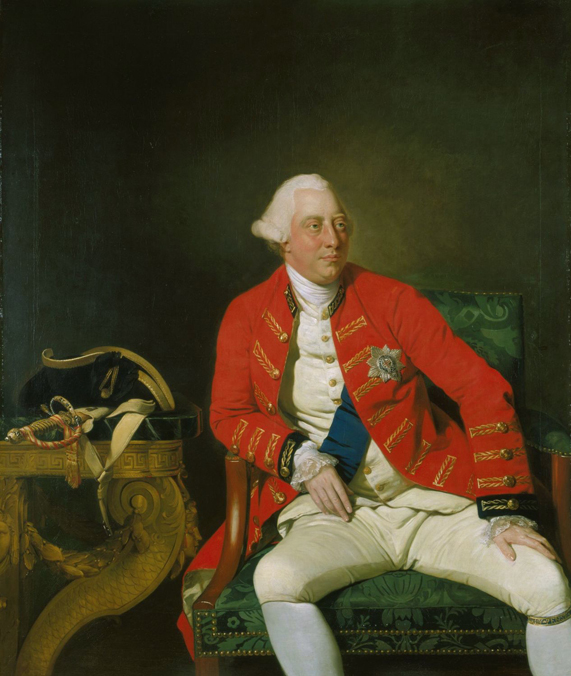
Portrait of George III of the United Kingdom (1771) by Johann Zoffany. Credit: Wikipedia/The Royal Collection.
This expulsion did not happen immediately, however. Mitchell finally placed an ad in the Virginia Gazette on February 21, 1777 announcing his intention “to leave this Country” permanently and notifying those to whom he owed debts and vice versa to settle them up. He also advertised his houses in Fredericksburg as available for sale or rent.
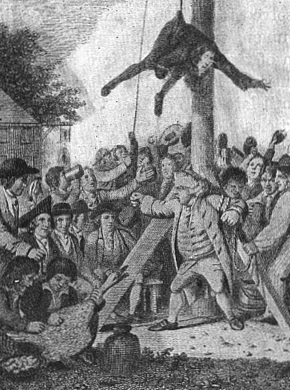
“Mobbing the Tories” illustration in History of the United States by Charles A. Beard and Mary R. Beard, New York: McMillan, 1921
Why did Henry Mitchell and vast numbers of colonists choose to remain loyal to the crown instead of supporting independence? The answer to that question really comes down to each individual loyalist whose motivations were often very personal and unique. Unfortunately, we do not know Mitchell’s particular reasons. People who found themselves held under suspicion by their patriot neighbors were often pushed to loyalism by the fear of mob rule or anarchy. The patriots’ use of loyalty oaths may have actually created many loyalists. People resented being forced to choose sides. Meanwhile, merchants and others whose livelihood depended on trade with Britain and the rest of the empire sometimes choose empire over independence for simple but powerful economic motivations.[5]
In 1777, Mitchell finally left Fredericksburg for H.M.S. Phoenix and went to New York, where he lived until 1781 and continued his trading activities. He then sailed to Scotland in 1781 and found his “partners had misapplied remittances” sent from Virginia. He was left bankrupt and dependent on relatives.[6]
Zac Cunningham
Manager of Educational Programs
[1] “Mitchell, Henry,” American Loyalist Claims, Washington, DC: National Genealogical Society, 1980, 351; Paula Felder, Fielding Lewis and the Washington Family: A Chronicle of 18th Century Fredericksburg, The American History Company, 1998, 238n.