On Friday, January 6, Saturday, January 7, and Sunday, January 8, Historic Kenmore will again present Twelfth Night at Kenmore, a dramatic theater presentation set in January 1776. It is the first Christmas that Fielding and Betty Washington Lewis celebrate in their newly built home. It is not the usual celebration, however. War brings fear, doubt, and frustration to the Lewis family and their friends. Immerse yourself in the experience the candlelight, music, and decorations of an eighteenth-century Christmas!
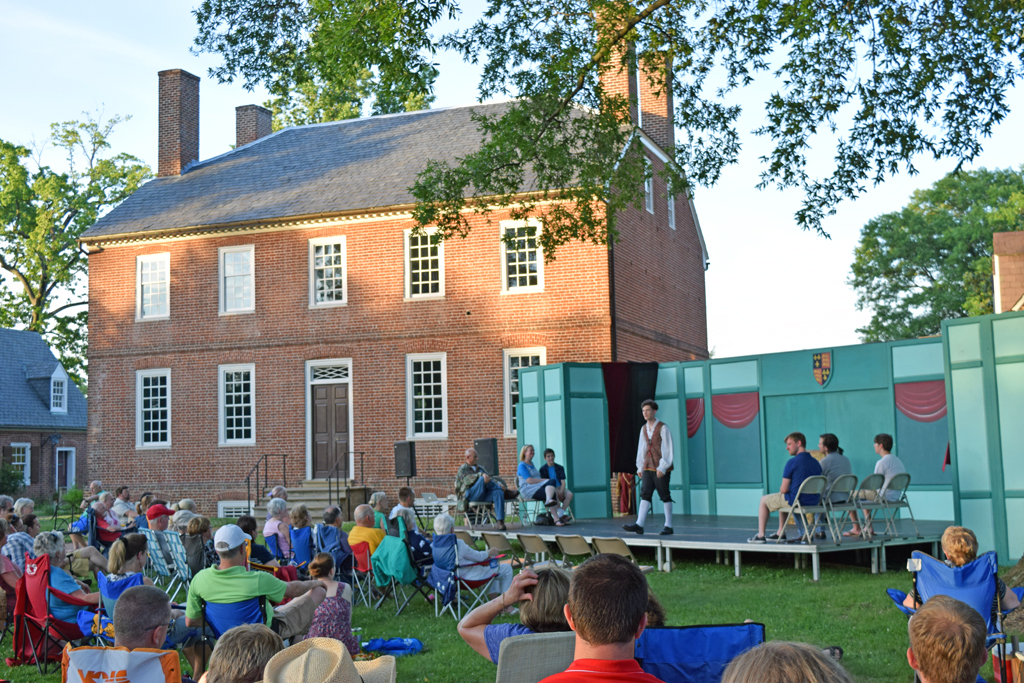
This past weekend was Shakespeare by Candlelight at Historic Kenmore! William Shakespeare’s The Taming of the Shrew was presented in eighteenth-century style on the Lawn at Kenmore on Friday and Saturday nights and, because of a thunderstorm, indoors on Sunday night. Enjoy this collection of photographs from the Saturday and Sunday performances. Learn more about The Taming of the Shrew’s history here.
Scene from Shakespeare’s “The Taming of the Shrew” or “Katharina and Petruchio” (1809) by Washington Allston. Public domain. Courtesy of Philadelphia Museum of Art/Wikipedia.
When we look at the history of Shakespeare in America the preference for his classic tragedies is obvious. Romeo and Juliet and Richard III are two of the three most-performed plays of the 18th century (George Farquhar’s The Beaux Stratagem rounded out this top three). While this ranking is based on surviving records of theatrical productions and therefore incomplete, it is still quite apparent that the Bard was unmistakably popular.
Of those oft performed favorites, tragedy wins out. Of the 13 different Shakespeare plays performed in Colonial America, the only comedy was The Merry Wives of Windsor. Why? Was it the general sentiments of an American audience? Was it a larger issue of theatrical expectations? Why didn’t American audiences watch Shakespeare’s comedies?
It is not because the people didn’t want comedies. Just like today, people liked to be entertained and for everyone who loves a heart breaking tragedy, there is someone who would prefer a light-hearted comedy. Comedies were actually wildly popular in colonial America, even beating out many tragedies in popularity! The aforementioned The Beaux Stratagem was one such comedy, as was John Vanbrugh and Colley Cibber’s The Provoked Husband and David Garrick’s The Lying Valet, which were also reportedly performed with regularity.
In colonies opposed to theatre based on moral grounds (think New England), a belief in the inherent sinfulness of plays and entertainment meant that, if theatre was to make its way into these colonies, it should certainly avoid comedies as they were usually rife with scheming rakes (The Beaux Stratagem), irascible wives (The Provoked Husband), and lying servants (The Lying Valet).
Tragedies, however, could be held up as moral lessons. One such play that was extremely popular in the colonies (even though it had fallen out of favor in London) was The London Merchant or The History of George Barnwell. It was a contemporary tragedy that told of a young man whose life had promise and success until he met a conniving woman who tempted him to steal, lie, and cheat for her love. He succumbed to those sins and they ultimately led to his untimely death.
The American Company of Comedians tried to break into the New England market with Othello, but instead of advertising it as a play they described it as “Moral Dialogues… in Five parts, Depicting the Evil Effects of Jealousy and other Bad Passions, and Proving that Happiness can only Spring from the Pursuit of Virtue.”
Such moral apprehension about theatre was nearly non-existent in Virginia. Why do we not see more of Shakespeare’s comedies in Virginia? The lack of comedy performances was also due to the theatrical expectations of the time. Theatre-goers knew that their evening at the playhouse would consist of two plays: a mainpiece and an afterpiece.
The mainpiece was the first play of the evening. It was longer and typically a tragedy or ballad opera (the musicals of the day). While it wasn’t impossible to see a comedy first, mainpiece was traditionally the more serious portion of the evening.
The afterpiece was always much shorter and typically a light-hearted comedy, farce, or romance. This division of the evening into mainpiece and afterpiece meant that there just wasn’t any real place for Shakespeare’s comedies. They were either too light-hearted to be a mainpiece or too long to be an afterpiece.
Shakespeare’s plays, however, did what they always do: they got with the times. Eventually, the Bard’s comedies transformed into shorter afterpieces and one of the most popular comedic afterpieces performed in the colonies was Catherine and Petruchio, essentially a shortened version of Shakespeare’s The Taming of the Shrew. It maintains most of the confrontations between the titular characters and their epic battle of the sexes, a theme popular in many contemporary farces.
The title page from the first quarto, printed in 1631 Quarto of A wittie and pleasant comedie called The Taming of the Shrew. Courtesy of Folger Shakespeare Library/Wikipedia.
Despite American audiences’ preference for the tragic tales of William Shakespeare, his comedies were not lost, only transformed. Indeed, the Bard flourished on early American soil.
Joe Ziarko
Guest Contributor
Enjoy an evening of history and entertainment under the stars on the Lawn at Kenmore with a performance by candlelight of William Shakespeare’s Taming of the Shrew, staged in an eighteenth-century style om August 12, 13, & 14 starting at 8:00 p.m.
Taming of the Shrew was presented in colonial Virginia, and the prologue of the play includes an introduction to theatre in the American colonies, before the Revolutionary War.
$15 adults; $7.50 students For more information contact Vickie Hayes at 540-370-0732 or [email protected]. Candlelight tours of Kenmore offered from 6:45 p.m. – 7:45 p.m. Performance on the Lawn at Kenmore—please bring a folding chair(s).
Shakespeare on the Lawn at Historic Kenmore returns this weekend with two more performances of Hamlet. Catch the one of the final shows at 7:00 p.m. on Saturday, June 18 or Sunday, June 19. Arrive early to tour the mansion and view the refurnishing. Bring folding chairs or a blanket and a picnic! Thank you to sponsor Lewis Insurance Associates! Learn more at http://www.kenmore.org/events.html. In the meantime, enjoy these scenes from last weekend’s performances!
Ask someone to list traditional summertime activities and they will probably mention picnics, family reunions, beach vacations, mountain getaways, and baseball games. Their list is likely to include going to the fair as well. The fair as a summer pastime is a long tradition and like many American traditions can be traced back to the age of Washington.
Although this painting depicts a busy London agricultural market in the early 1700s, a similar hustle and bustle likely filled Fredericksburg during June Fair. Covent Garden (1726) by Pieter Angillis, 1685–1734, Flemish, active in Britain (from ca. 1715), Oil on copper. Pubic domain. Credit: Yale Center for British Art, Paul Mellon Collection.
Fairs were about more than agriculture, however. The importance of a summer fair was its ability to gather people from all over the surrounding counties to a single central location to conduct business and government and to offer social interactions and entertainments. In an agricultural colony such as Virginia, homes and plantations were very distant from one another and, for much of the year, people hardly saw anyone besides their immediate neighbors and family members. Most colonial Virginians traveled no more than fifty miles from home in their lifetimes. This made for an isolated existence focused on the constant attendance of crops. During natural seasonal breaks, however, farmers traveled to a town to sell those crops at the fair.
Fairs were not just for farmers to sell. Court sessions, also known as ‘Public Times’, often coincided with fairs. Soon merchants and entertainers saw opportunity in the large numbers of people gathered together at the fair. Many people got paid or, more likely, an increase in credit and ready money made the fair a natural time to celebrate, entertain, gamble, and socialize.
Among the amusements common to colonial-era fairs,
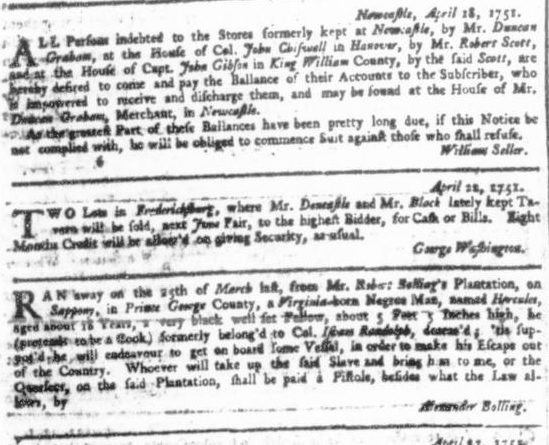
Announcement placed in The Virginia Gazette by George Washington announcing his intention to auction off two lots of his land in Fredericksburg at June Fair in 1751.
Gambling at the fair, mainly in the form of lotteries, even supported more noble pursuits. At June Fair in 1769, a lottery was undertaken to raise £450 for building a new church and for purchasing an organ for that church. The drawing was to take place on “the 7th day of JUNE next (being the first day of the Fredericksburg fair) at the town-house” and was supervised and supported by a host of the town’s luminaries including Charles Dick, Hugh Mercer, Charles Washington (George’s brother), George Weedon, and Fielding Lewis.
June Fair was a community event attended by Virginians from across the colony and brought George Washington back to his boyhood home on more than one occasion. At the fair, Virginians sold farm goods and land, settled debts and tried court cases, enjoyed a play and gambled on the horses. June Fair, much like today’s summer pastimes, was a moment in the year to enjoy the summer weather and the company of neighbors, friends, and family before returning to isolated plantations and farms and the unending work of plowing, planting, and harvest.
Zac Cunningham
Manager of Educational Programs
Joe Ziarko
Manager of Interpretation & Visitor Services
Editor’s Note: At the annual Shakespeare on the Lawn performances this June, Historic Kenmore will present Hamlet. The following blog post looks at the actors who played the most famous of Shakespeare’s roles during the 18th century. Details about attending the performances at Kenmore can be found at the end of this entry.
Since the time when Richard Burbage of The Chamberlain’s Men first performed the role originally written for him by William Shakespeare, actors have long desired to play Hamlet. As a character, Hamlet must convey both a flamboyant madness and a subtle deception, deliver long speeches of blank verse, and ultimately end the play with exhausting fight scene and tragic death. These highs and lows have made actors covet the complex role for centuries.
In the 1700s, Hamlet was wildly popular in London in part due to famous portrayals by different actors. At the beginning of that century, Thomas Betterton was still portraying the young Prince of Denmark as he had first done on London stages back in 1661. Although his portrayal of the young Dane spanned 50 years, theatre-going Londoners still praised Betterton’s Hamlet into the eighteenth century.
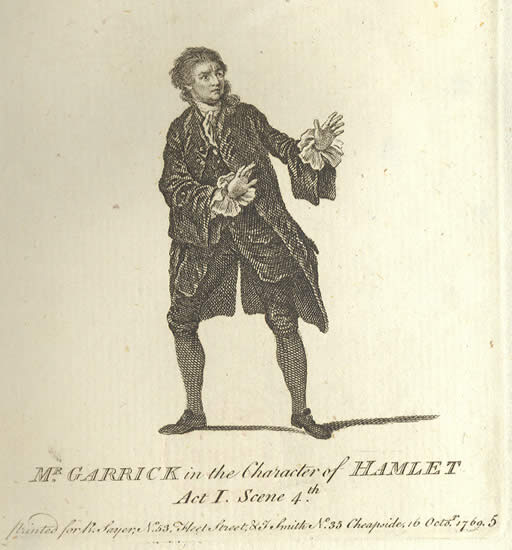
If there was one name to know on the London stage in the 18th century, it was David Garrick. As a writer and actor, he was synonymous with celebrity. Garrick’s portrayal of Hamlet in the 1740s was one of the performances that made him into that celebrity. He would go on to perform his own adaptation of Hamlet, which omitted Ophelia’s and Gertrude’s deaths, readjusted act breaks, and reintroduced much of Shakespeare’s original text. The original text had slowly been stripped away throughout the 1700s due to the play’s length. It was Garrick’s unique theatricality that inspired him to employ a striking feature. During the scene when Hamlet first meets the Ghost he wore a special wig with hair that could stand on cue to signifying his terror.
Etching of David Garrick in Hamlet from Dramatic Characters, or Different Portraits of the English Stage, 1773. Public Domain. Credit: Wikipedia
Not to be out done by men, actresses of the 18th century were also known to perform Hamlet on English stages. In what were known as ‘breeches roles’ at the time, it was common to see actresses step into men’s roles. However, this was far more common in comedies than in tragedies. Both Fanny Furnival (the first recorded female Hamlet) and Charlotte Charke (daughter of playwright and poet laureate Colley Cibber) played the role of Hamlet, albeit never on a London stage. The most famous eighteenth century female Hamlet to tread the boards was Sarah Siddons, who brought a respectability and gravitas to the role that raised the public esteem of actresses across England.
Portrait of Mrs. Sarah Siddons (1785) by Sir Thomas Gainsborough . Public domain. Credit: National Gallery, London
While these different depictions of Hamlet are fascinating, they never crossed the Atlantic. In fact, the first group of professional actors would not perform in the colonies until 1752. At the center of this London Company of Comedians was the Hallam family. They came to the American Colonies in search of audiences seeking quality professional theatre. On September 15, 1752, their first performance was The Merchant of Venice in Williamsburg, Virginia. That evening would also be the debut performance of the young Lewis Hallam Jr., son of the company’s manger and leading lady. Lewis would go on to become the leading man of the company. In the first recorded performance of Hamlet in the colonies in Philadelphia on July 27, 1759, the playbill lists 17-year-old Lewis in the title role. He and his company would tour the colonies for the next 15 years until the American Revolution forced theatre from our shores.
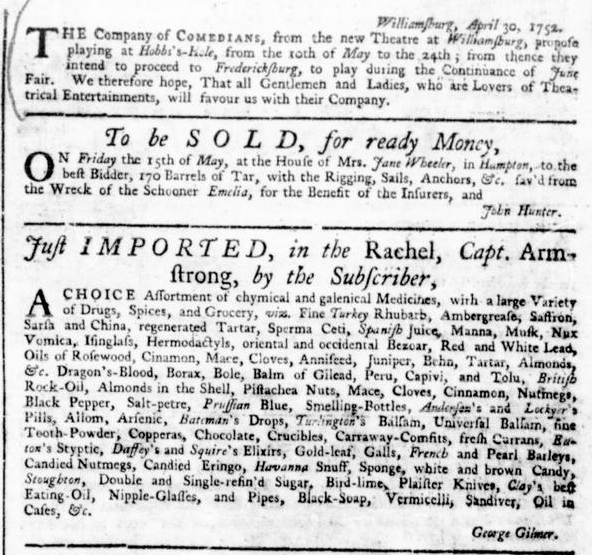
Hallam’s Company of Comedians announcing their intention to perform in Fredericksburg in The Virginia Gazette on April 30, 1752.
Not all colonial Americans had the opportunity to see Hamlet upon the stage. Theatre was banned in Massachusetts throughout the colonial time period. Thus, Williamsburg was a frequent stop of Hallam’s company, which came to be called the American Company of Comedians. Of all the recorded performances in Virginia’s capital city, Hamlet is not listed, however. This does not mean that the likes of George Washington and Fielding Lewis could not have seen it.
In fact, a playbill from May of 1771 reveals the American Company of Comedians performed in Fredericksburg, Virginia. This surviving playbill includes a handwritten addition of two performances, All in the Wrong and Hamlet. While the playbill does not include that evening’s cast, we can safely assume Lewis Hallam Jr. played the title role opposite Nancy Hallam as Ophelia. We wrote about Nancy here last summer.
If people are familiar with any words of Shakespeare, those words are most likely the beginning of Hamlet’s famous soliloquy: “to be or not to be?” But the real question for Shakespeare’s theatre going audiences has always been “to see or not to see?” Ultimately, the decision was made based on the actor (or actress) playing the famous Dane named Hamlet.
Joe Ziarko
Manager of Interpretation & Visitor Services
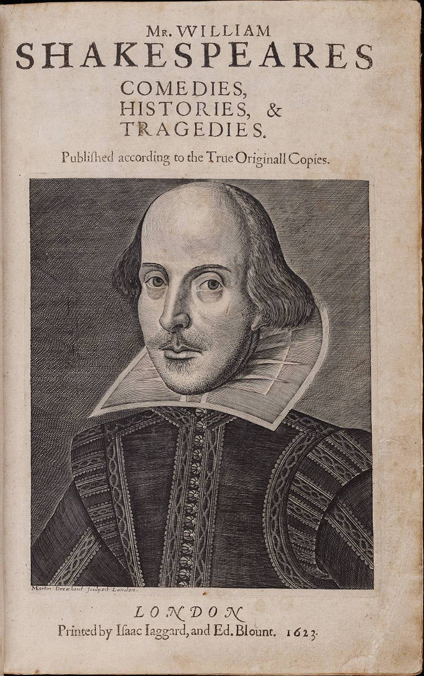
Title page of the First Folio, by William Shakespeare, with copper engraving of the author by Martin Droeshout. Credit: the Elizabethan Club and the Beinecke Rare Book & Manuscript Library, Yale University
Governor Terry McAuliffe has proclaimed today – Saturday, April 23, 2016 – as Shakespeare Day in Virginia!
While we’re planning and preparing Shakespeare on the Lawn in June, our first-ever Shakespeare Camp in July, and Shakespeare by Candlelight in August as Historic Kenmore’s contributions to this year’s many commemorations across the Commonwealth, we want to take a moment on this auspicious day to celebrate Shakespeare’s countless literary achievements!
Both the theater and Shakespeare were beloved by George Washington and that love began when he was young man living here in Fredericksburg. For this reason, The George Washington Foundation has presented regular performances of Shakespeare’s plays for many years now.
To mark Shakespeare Day, we’ve decided to share some photos from last year’s Shakespeare on the Lawn performance of King Lear.
King Lear (Marcus Salley – center) decides to divide his kingdom among his three daughters but demands they declare how much they love him first. Goneril (Corinn Keene – far left) makes her disingenuous declaration.
After her false declaration of love, Lear gives Regan (Amy Wolf) her portion of the kingdom.
Youngest daughter Cordelia (Rachel Sumaray) humbly and with true love states that she loves her father as a daughter should.
Regan and Goneril show disdain for Cordelia’s declaration. Albany (Casey Fero – center left) and Cornwall (Patrick Siegmund – center right) look on.
Lear banishes Cordelia from the kingdom while attendent (Roody Lablaze) looks on with disbelief.
Gloucester (John Hollinger – left) and Edmund (Sam Fulton – right) discuss the king’s choices.
The results of Lear’s decision are anger…
cruelty… (Topher Embry as the Fool – left and Kenny Bellamy as Kent – right)
schemeing…
murder…
and madness.
Cast and support staff operate 18th-century sound effect machines to create rain, wind, and thunder for the dramatic storm scene.
You can see an additional photo album of last year’s Shakespeare by Candlelight presentation of Cymbelinehere as well as a collection of posters from a variety of other past performances here. Furthermore, read up on Shakespeare and theater history here, here, and here.
Finally, here is the text of the Governor’s proclamation:
WHEREAS, William Shakespeare, an English poet, playwright, and actor is widely regarded as one of the greatest writers in the English language and one of the world’s pre-eminent dramatists; and
WHEREAS, 2016 marks the 400th anniversary of William Shakespeare’s death and is an opportunity to celebrate his work and influence in English literature, film, poetry, and classics studies; and
WHEREAS, the Virginia Shakespeare Initiative (VSI) is a statewide celebration of William Shakespeare’s work, and will host more than a dozen events across the Commonwealth on April 23, 2016; and
WHEREAS, on this day, tourism councils, schools, college systems, libraries, and museums will open their doors to exhibits, activities, and celebrations focusing on the works of Shakespeare; and
WHEREAS, Virginians are encouraged to participate in Shakespeare Day;
NOW, THEREFORE, I, Terence R. McAuliffe, do hereby recognize April 23, 2016, as SHAKESPEARE DAY in our COMMONWEALTH OF VIRGINIA, and I call this observance to the attention of all our citizens.
Each January, Historic Kenmore presents Twelfth Night at Kenmore, a dramatic theater presentation that imagines the first Christmas that Fielding and Betty Washington Lewis spent in their newly built home. The play is set in January 1776 and that year is not a time for the usual celebration. War brings fear, doubt, and frustration to the Lewis family and their friends.
The 2016 edition of Twelfth Night at Kenmore took place this past weekend. Here are photos from that performance.
Kenmore is ready for the party.
George Lewis (Joe Ziarko) gazes out the window and ponders enlisting in the Continental Army.
George Weedon (L-Rae Ehlen) and Fielding Lewis (R-John Hollinger) lament the burning of Norfolk and Dunmore’s Proclamation.
The dessert table includes a hedgehog cake.
Candles light the Passage
Betty Washington Lewis (L-Barbara Cochran) and Nancy Alexander Lewis (R-Corinn Keene) determine to smile through the troubles of war.
The Lewis family and guests sing “God Rest Ye Merry Gentlemen.”
The Payne Family provided music for the performance. (L-R) Zach, Kelsey, Kaylee, and Luke.
George Weedon explains to Captain Richard Taylor (Sam Fulton) why horse racing ought to be banned during the war.
Captain Taylor, John Lewis (Mike Taylor), and George Lewis play cards.
Wassail in a punch bowl.
Sausage cooking over the fire in the kitchen.
Rachel (Gladys Perkins), enslaved cook for the Lewis family, tends the fire.
Rachel ponders the future that war might bring for the enslaved community and if that future will include freedom.
On January 8, 9, and 10, Historic Kenmore presents “Twelfth Night at Kenmore,” a dramatic theater performance inside the 18th century home of Fielding and Betty Lewis. This short video previews the performance.
Immerse yourself in the experience the candlelight, music, and decorations of an eighteenth-century Christmas!
Performance Times: 3:00, 3:45, 4:45 and 5:30 p.m. Reservations required. Call 540-370-0732 x24 or email [email protected] Cost: $12.00 adults, $6.00 ages 3-17; free ages 3 and under.
This past weekend, visitors to George Washington’s Ferry Farm and Historic Kenmore learned about Fielding Lewis in the dramatic presentation, Fielding’s Story: A Gentleman’s Sacrifice. They were able to step back in time and see colonial-era Fredericksburg through the eyes of Fielding Lewis—member of Virginia’s gentry, wealthy merchant and leading citizen of Fredericksburg, builder of Kenmore, patriot and supporter of the American Revolution, and husband of Betty Washington Lewis.
In this historical drama, which spanned from 1750 to 1781, actors portrayed people and events from Fielding’s life in the settings where those events took place. Guests saw Fielding’s courtship and marriage to Betty Washington, visited his newly built home as the guest of Betty , eavesdropped as Fielding considered wartime plans, and witnessed the sacrifices he made for the Patriot cause.
In certain scenes, dialogue was taken directly from historic documents including a 1750 edition of the Anglican Book of Common Prayer, a letter dated November 14, 1775 from Fielding Lewis to George Washington, and an authentic patriotic appeal in the Virginia Gazette.
Here are images from Fielding’s Story: A Gentleman’s Sacrifice…
The play began with Betty Washington (standing-Juliana Jones) arranging tea for an important visitor.
Betty and her mother Mary Washington (Allie Goldstein) hear the sound of riders approaching.
Fielding Lewis (Joey Weisband) proposes to Betty.
Betty Washington Lewis (Barbara Cochran) shows visitors her home and talks about the family she and Fielding have built.
Betty looks out the window toward the home of her mother.
Hetty (Ashleé James), an enslaved house servant and washerwoman owned by the Lewises, debates whether to runaway to the British, who promised freedom to slaves and indentured servants that belonged to Patriots.
Charles Dick (Mike Taylor) arrives to discuss the latest war news with Fielding, his business parther and friend.
Fielding (John Hollinger) greets his friend.
Charles and Fielding discuss how to fund the Patriot gun factory they have been made responsible for by the Virginia Convention.
Lawrence (Elijah Beale) questions his father Fielding about whether all the sacrifices he made are worth independence.
With his father deathly ill, Lawrence wonders about the future.
The next theater production presented by The George Washington Foundation will be Twelfth Night at Kenmore in January 2016. As we approach the holidays, watch http://www.kenmore.org/events.html for details!