On January 8, 9, and 10, Historic Kenmore presents “Twelfth Night at Kenmore,” a dramatic theater performance inside the 18th century home of Fielding and Betty Lewis. This short video previews the performance.
Immerse yourself in the experience the candlelight, music, and decorations of an eighteenth-century Christmas!
Performance Times: 3:00, 3:45, 4:45 and 5:30 p.m. Reservations required. Call 540-370-0732 x24 or email [email protected] Cost: $12.00 adults, $6.00 ages 3-17; free ages 3 and under.
Today – January 6 – marks the end of Christmas or, at least, it did two centuries ago. If we lived in the days of George Washington, Betty Washington Lewis, and Fielding Lewis and moved within their social circle, we would all be preparing for the grandest celebration of the Twelve Days of Christmas, which began on December 25. This grand event, known as Twelfth Night, was celebrated much in the same way that many of us mark New Year’s Eve with family and friends gathered together for food, drink, sweets, music, dancing, games, and conversation.
This past weekend, Historic Kenmore hosted just such a celebration in the form of a theatrical presentation titled “Twelfth Night at Kenmore.” Set in January 1776, as Fielding and Betty Washington Lewis end their first Christmas in their newly built home, “Twelfth Night at Kenmore” depicted an unusual seasonal celebration, as the growing American Revolution brings fear, doubt, and frustration to the Lewis family, their friends, and members of the enslaved community.
Kenmore is lit for the celebration.
Betty Washington Lewis (Amy Wolf) and daughter-in-law Nancy Alexander Lewis (Juliana Jones) ponder how the war might impact the family.
Betty welcomes her guests.
Guests listen to Betty’s welcome.
(l-r) John Lewis (Michael Taylor) and George Lewis (Will Goldstein), two of Fielding Lewis’s sons, are joined by Captain Richard Taylor (Scott Houk) , a local ship’s master, in the singing of a traditional carol.
Visitors, some who came dressed in colonial-era clothing, join in the singing.
Fielding Lewis (John Hollinger) leads the singing.
Our excellent musicians for the evening: Zach, Kelsey, Kaylee, and Luke Payne.
George Weedon, a leading Fredericksburg patriot and tavernkeeper.
Captain Taylor and George Weedon argue about the wisdom of suspending horse racing because of the war.
The men continue debating.
George Lewis (Will Goldstein) expresses his desire to enlist in the Continental Army.
Captain Taylor, John Lewis, and George Lewis play cards while discussing George’s desire to enlist.
Hetty (Ashlee’ James), an enslaved washerwoman and house servant for the Lewises, overheard party guests talking about Lord Dunmore’s offer of freedom to slaves and wonders if she ought to run away to the British side.
In the colonial-era, the Christmas season lasted into January and concluded on Twelfth Night, a festive evening to mark the end of the Twelve Days of Christmas and celebrated much like our New Year’s Eve is today. While the entire period featured frequent banquets and balls with much food and spirits, Twelfth Night was especially known for its revelry.
Just as we do today, many colonial Americans got into the holiday ‘spirit’ with a glass of something special and warming on Twelfth Night. Special drinks called for distinctive mugs, glasses, and containers that were both functional and designed to impress your party guests. In these containers, early Americans enjoyed familiar festive beverages like eggnog, hot chocolate, hot toddies, and punch. At the same time, some of their holiday drinks are now a thing of the past or perhaps only enjoyed by those imbibers with an appreciation for history.
Many of these holiday beverages were created out of a desire to preserve the taste of fresh fruits harvested in the summer and fall so they could be enjoyed during the winter months. Cherry ‘Bounce’ is a great example of this – in addition to being fun to say! Easy to make, cherry bounce was started in the early summer when the fruit is ripe. Fresh cherries (traditionally of the sour variety) were placed in bottles and topped off with brandy then stored for as long as you could stand to wait. Leaving the fruit to infuse as long as possible increased the flavor and lent a lovely red color to the brandy. The decanted off-flavored brandy was mixed with sugar and spices. Martha Washington possessed a recipe for cherry bounce that included cloves, cinnamon and nutmeg and George Washington was said to have loved it so much that he took some in a canteen with him on a trip over the Allegheny Mountains in 1784.
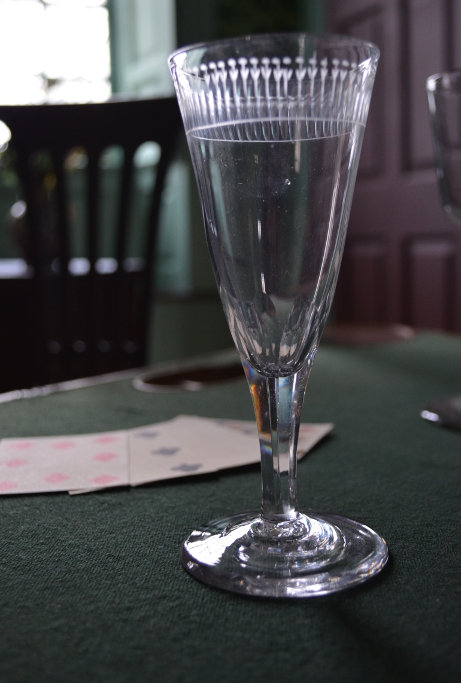
Copper wheel engraved wine glass.
Syllabub is another colonial beverage that has been forgotten. Originating in England, this odd-sounding half-dessert, half-cocktail, was created by combining spirts such as wine, sherry, ale or cider with fresh milk – preferably so fresh that it had just come out of the cow and was still warm! In fact, some recipes stated that a maid should milk the cow directly into a pan of your chosen spirit. Unfortunately, this technique probably also resulted in some ‘barn yard’ material ending up in the concoction. Sugar, spices and possibly citrus were then added. While there are many versions of syllabubs, it often involved a frothy mixture of whipped egg whites, curd or cream that can be spooned off and eaten while you drink the liquid whey that separates beneath. Served in a conical glass and sometimes displayed on a pyramid-shaped dessert tray with colorful jellies, syllabub made for a very festive holiday drink.
A Copper Wheel engraved dessert/fortified wine glass used to serve syllabub.
While many people may not have heard of syllabub and cherry bounce, wassail is a term that most are familiar with even if they’re not entirely sure what it is. Actually, wassail was both a beverage and an activity. Similar to today’s mulled ciders and wine, wassail was often served from a punch bowl passed around from person to person in an act of sharing and celebration. The old Christmas carol “Here We Come A-Wassailing” describes the act of going from house to house singing and wishing good cheer while also sipping the punch-like drink composed of hot wine or ale mixed with spices, apples and sometimes topped with bread or toast. But before you condemn our ancestors for drinking odd things, just think what future generations might think of what we consume today. And perhaps try a colonial holiday beverage or two this Twelfth Night and evoke the spirit of holidays past!
Hand-blown mug for hot beverages such as wassail.
You can experience a dramatic theater presentation depicting a Twelfth Night celebration (minus the alcohol) at Historic Kenmore on Saturday, January 3 or Sunday, January 4. Reservations are required and can be made by calling 540-370-0732 x24 or emailing [email protected]. Visit the events page on http://www.kenmore.org for more information!
Mara Kaktins
Archaeologist, Ceramics and Glass Specialist
Historic Kenmore is decorated for the holidays, portraying what it may have looked like during the Christmas season of 1775. At that time, the Lewis family would have just moved into Kenmore a couple of months earlier, and it would have been their first Christmas in the new house. It was a time of some sadness, as well – their 15 year old son Charles had died that fall, of an unidentified illness. Although unknown at the time, it also would be the last “normal” holiday before the Revolution began in earnest.
The photos in the gallery below provide a glimpse of some traditional holiday decorations (a few have modern twists) and customs common to the 1700s.
Want to see Historic Kenmore in all of its holiday splendor? Seasonal tours are offered daily through December (Closed Christmas Eve, Christmas Day, and New Year’s Eve). Or reserve a spot for our dramatic theater presentation that re-creates a Twelfth Night celebration inside the house on Saturday, January 3 and Sunday, January 4. See the events page on www.kenmore.org for more information!
A wreath adorns Kenmore’s front gate.
Kenmore peaks through the center of a wreath.
A wreath on the door of an administrative building.
Kenmore’s garden volunteers created the amazing wreaths and swags hanging on our buildings this year.
A wreath on the door of an administrative building.
A close-up view of a wreath.
The garden gate.
The west front of Kenmore.
Festive doors.
Magnolia in an evergreen swag.
Inside of Kenmore, we bring out greenery to decorate the banister in the Passage.
Curatorial staff attach the greenery to the banister.
In the 1700s, evergreens and local plant material, like boxwood, magnolia and holly would be brought into the house, but in small quantities.
Colonial-era decorations were quite subdued.
Branches of pine or holly would be placed in clay jars and set on tables or mantels.
In the Passage, we re-create a dessert table Betty Lewis might have created to impress her holiday guests.
We carefully unwrap jelly glasses to be displayed on the table.
The table features plum pudding, miniature marzipan fruits, candied citrus, and syllabubs.
The desserts served as the centerpiece of a Twelfth Night ball.
The Christmas season lasted much longer than ours does, extending into January to Twelfth Night (a festive night marking the end of the Twelve Days of Christmas and celebrated much like New Year’s Eve is today).
During the ball, usually around midnight, guests were treated to the unveiling of the elaborate dessert table…
…filled to overflowing with sweets and confections arranged in imaginative ways and displayed on the best silver and glassware.
There is also a hedgehog cake, a favorite of Martha Washington’s at Mount Vernon.
The lady of the house would be severely judged on the creativity of her dessert table.
Among this year’s decorations are five tiny foxes, part of scavenger hunt for our younger visitors.
Fox hunts were a popular holiday custom with colonial Virginians and were much-loved by George Washington.
The completed decorations in the Passage.
Looking down into the Passage from above.
Holiday swags with modern lights on Kenmore’s doors.