The Washington house at Ferry Farm is now open for tours! Using information from the probate inventory and archaeological evidence, the interpretive replica of George Washington’s boyhood home is currently being furnished with replica furniture and ceramics. You can read an in-depth post about the house here and below you will find photos that provide a glimpse of the house’s exterior and interior as well as the surrounding landscape.
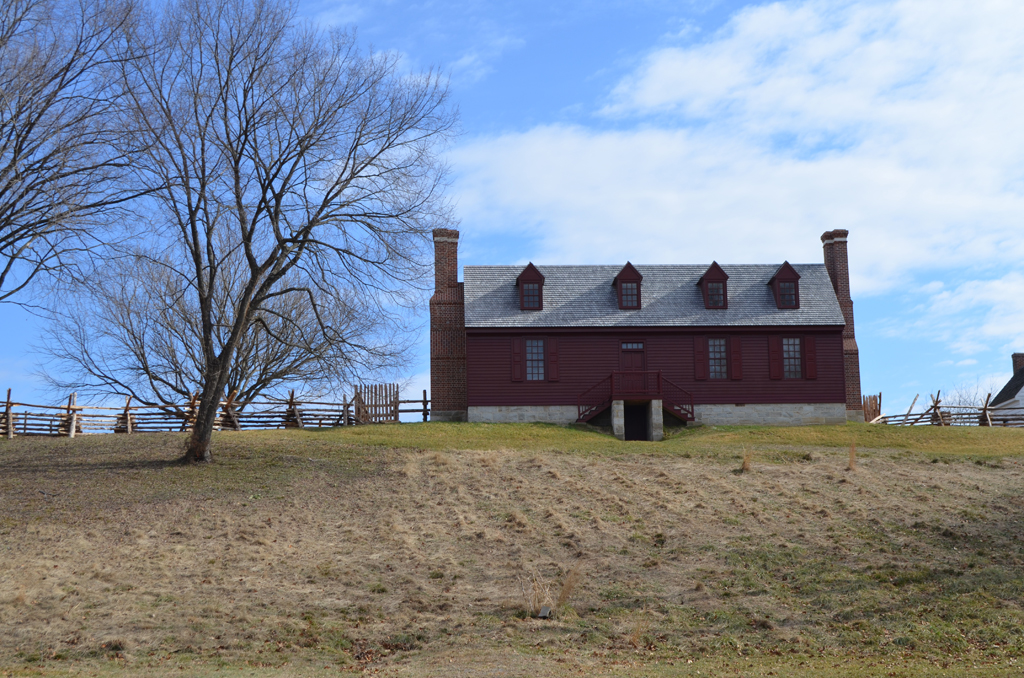
View of the front of the house that faces Fredericksburg and the Rappahannock River.
View from the front door.
The passage.
The staircase.
One of the upstairs bedrooms.
Surveying equipment rests on a window sill.
View of Fredericksburg and the river from a window.
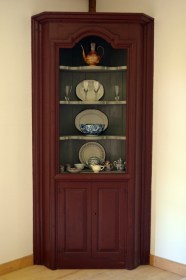
The corner cupboard in the parlor.
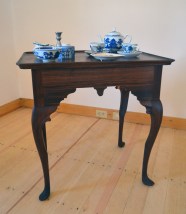
The tea table in the hall back room.
A bed in the hall back room.
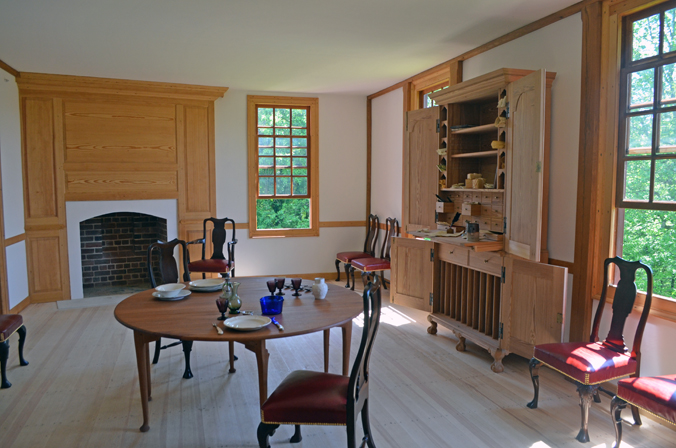
The hall.
Table setting in the hall.
The escritoire, a massive cabinet-sized desk, in the hall.
Inside the escritoire.
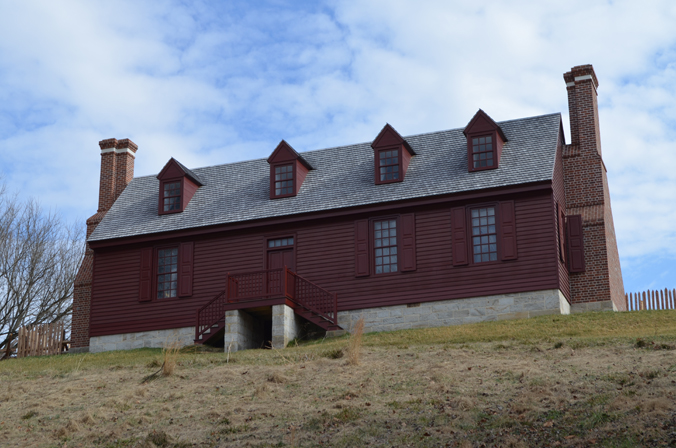
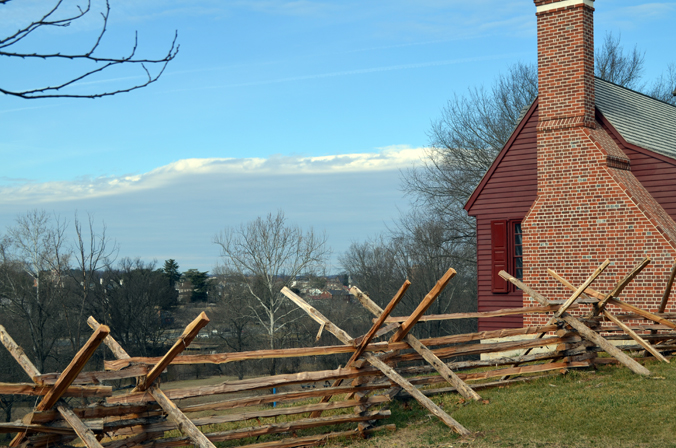
The north side of the house.
Another view across the river into Fredericksburg.
The 1870s-era “Surveyor’s Shed” next the the Washington house replica.
The work yards behind the Washington house.
Learn more about this comprehensive project here and here.
Please visit www.ferryfarm.org and www.kenmore.org for more information on two National Historic Landmark sites, George Washington’s Ferry Farm and Historic Kenmore.
The completed reconstruction of the Washington house at George Washington’s Ferry Farm.
The Washington house at Ferry Farm is now open for tours. The interpretive replica of George Washington’s boyhood home is an interactive and hands-on experience for all ages, where visitors can experience what life was like in the eighteenth century. Using information from the probate inventory and archaeological evidence, the Washington house is currently being furnished with replica furniture and ceramics of what was originally in the home. This allows guests the opportunity to sit on the furniture and handle the objects.
Corner Cupboard
Following a plan conceived by The George Washington Foundation’s Collections Committee and curators, noted cabinetmakers are crafting reproduction furniture using pieces from the time period of the Washington house as examples. Craftsmen from Colonial Williamsburg produced a corner cabinet in the joiners’ shop and a tea table in the cabinetmakers’ shop using examples from the Colonial Williamsburg Foundation’s collection. Additionally, two dining tables, a set of twelve leather upholstered chairs, a “scrutore” – or desk with bookcase, a low-post bed, and a gaming table are currently on view in the Washington house.
Tea Table
The construction of the Washington house on its archaeological footprint is part of the first phase of The George Washington Foundation’s multi-year venture to physically develop George Washington’s Ferry Farm into an outdoor living museum. The first phase of the project will also include reconstructing the kitchen and outbuildings, and recreating the period landscape. Moreover, the Foundation is establishing a new entrance to the museum property, has erected a maintenance facility, and is completing necessary infrastructure.
Dining table, chairs, and “scrutore” in the Hall of the Washington house.
Employing building methods of the period, artisan masons laid the foundation for the Washington house using hand-cut Aquia sandstone in an oyster-shell mortar. Next, timber framers joined massive wood beams to create the frame of the home. Carpenters covered the roof with traditional, hand-prepared wood shingles and installed skillfully-crafted exterior doors and window sashes, as well as beaded weatherboard siding painted a traditional, deep red “Spanish brown” color.
Masons completed the brickwork for the three chimneys, each set in an English bond interspersed with glazed headers, while the carpenters fitted paneled doors with hand-wrought iron hardware and fabricating interior features such as an elaborate staircase in the center passage. Accomplished plasterers installed a traditional lime plaster, strengthened with animal hair, on wood lath across the walls of the Washington house.
The work yards behind the Washington house.
Constructing the Washington house and the first phase of improvements at Ferry Farm is a funding priority for the Foundation as part of The Future of Our Past Campaign—a $40 million dollar comprehensive fundraising initiative in support of efforts across its two National Historic Landmark sites: Historic Kenmore and George Washington’s Ferry Farm.
George Washington moved to Ferry Farm in 1738 with his parents, Mary and Augustine, his sister Betty, and their siblings, purchasing the site from William Strother III, a prominent colonial Virginian. Young George lived at the farm from age 6 to 22. Referred to as the Washington home house in George’s day, the property was later known as Ferry Farm—a historic ferry adjacent to the Washingtons’ house once linked it to the city of Fredericksburg via the Rappahannock River. The site was the setting of some of the best-known stories related to his youth, including tales of the cherry tree and throwing a stone across the Rappahannock River.
George was eleven when his father died in 1743. Augustine left Ferry Farm to George, for him to inherit when he reached majority. Mary Washington continued to live at Ferry Farm until 1772, when she moved to Fredericksburg to live closer to Kenmore and Fielding and Betty Washington Lewis.
View from the Washington house of Fredericksburg across the Rappahannock River.
In 1996, Ferry Farm was saved from commercial development through the hard work and determination of the Regents and Trustees of The George Washington Foundation (known then as the Kenmore Association), a long list of individuals, and several organizations.
The Foundation announced on July 2, 2008 that its archaeologists had located and excavated the remains of the long-sought house where Washington was raised. To date, over 750,000 artifacts have been unearthed at Ferry Farm. Ongoing research suggests that George’s experiences at Ferry Farm were influential in shaping the man that he would become.
On Saturday, April 25, 2015, the Foundation broke ground on the Washington house and the first phase of construction at Ferry Farm, forever preserving this remarkable landscape and providing a powerful stage to tell the story of young George and his family. Doris Kearns Goodwin, renowned presidential historian and Pulitzer Prize-winning author, was the keynote speaker for the Groundbreaking Ceremony.
Learn more about this comprehensive project here and here.
Please visit www.ferryfarm.org and www.kenmore.org for more information on two National Historic Landmark sites, George Washington’s Ferry Farm and Historic Kenmore.
David Muraca
Vice President of Museum Operations
Director of Archaeology
On Tuesday, May 1, 2018, Dr. Kelly Brennan Arehart, Manager of Interpretation & Visitor Services at The George Washington Foundation, presented a lecture titled “Betty Washington Lewis and Women’s Health.” Betty Washington Lewis gave birth to 11 children; a feat almost unheard of today. Kelly explored Betty’s journey from childhood to womanhood, from maiden to mother, and medical challenges that 18th century women faced. A cradle to grave examination of women’s heath tells us of the strength and resilience of Betty Washington Lewis and other women who endured at time without anesthetics or knowledge of germs.
Join us at the library on Tuesday, May 8, 2018 for “Coinage and Credit: The Economy of Colonial Virginia,” a lecture about the business and trade of Fredericksburg merchant Fielding Lewis presented by David Arehart, a site supervisor at Colonial Williamsburg. Talk begins at 7:00 p.m. The lecture is FREE and hosted at the Central Rappahannock Regional Library at 1201 Caroline Street, Fredericksburg, Virginia. To learn more, visit http://www.kenmore.org or livesandlegaciesblog.org.
In this video, Fredericksburg, Virginia-based furniture maker Steve Dietrich discusses some of the techniques he used to create four low post beds for the reconstructed Washington house at George Washington’s Ferry Farm.
Watch other videos and read more about rebuilding the Washington house here.
“THE BLOOD IS THE LIFE!” ACCOMPLISHED AT LAST! THE EFFICACY OF ELECTRICITY!! Nearly all Diseases Effectually Cured by BOYD’S MINIATURE GALVANIC BATTERY!
This is the opening pitch of an 1879 advertising circular for a popular medical medallion called a Boyd’s Battery. The battery was a disc, about 1¼ inch in diameter, meant to hang from one’s neck on a cord and that used the “soft and gentle” galvanic action of electricity to purportedly cure a host of diseases.
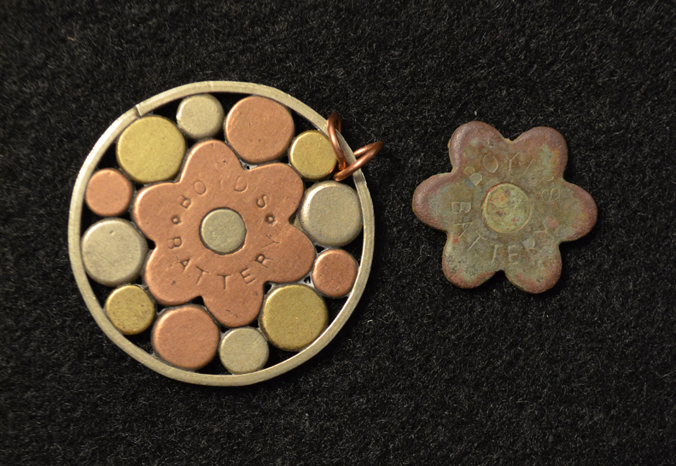
The medallion consisted of a flower-shaped central disc of copper and brass, surrounded by twelve smaller discs of various metals, all encased within another metallic band. These adjoining metals, using the humidity of the wearer’s skin, would supposedly produce a gentle electrical charge that was transferred to the wearer’s bloodstream. “By electrifying the blood, it stimulates the entire system, so that it enables nature to throw off nearly all diseases, and causes the blood to become youthful and vigorous in its action,” the advertisement claimed.
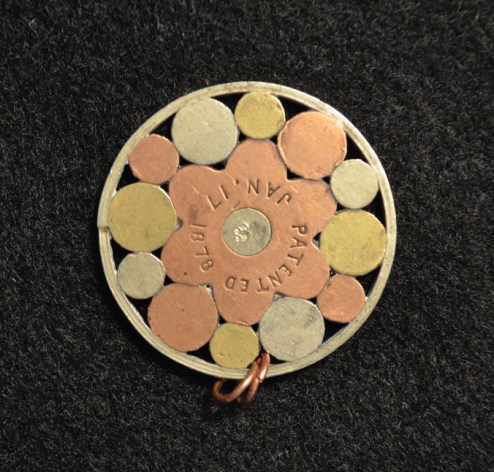
A complete Boyd’s Battery (left) next to a portion of one (right) excavated at George Washington’s Ferry Farm.Reverse of a Boyd’s Battery showing it’s patent date as Jan. 17, 1878.
Part of a Boyd’s Battery was excavated in 2006 at George Washington’s Ferry Farm during the summer excavations around the site of the 18th century era Washington home. The only surviving part of the battery found was the rosette-shaped innermost disc, stamped with “BOYD’S BATTERY.” Jane and John Corson, who bought the property in 1872, owned Ferry Farm during the late 19th century during the height of popularity for Boyd’s Batteries. John Corson’s death notice in the April 1, 1887 Fredericksburg Free Lance mentioned that he suffered a shock of paralysis a couple of years before his death from a stroke.[1] We’ll never know for sure but perhaps Mr. Corson was trying to relieve or cure his symptoms of paralysis by wearing a Boyd’s Battery?
“Professor” James C. Boyd, a man of dubious legitimacy in the real academic world, patented Boyd’s Batteries in 1878. Each medallion cost just 50 cents and results were guaranteed or your money back. The instructions specified a battery should be worn day and night directly on the skin, though it was recommended that children under six should wear a battery only at night. In certain extreme cases, two batteries could be worn at the same time, one on the chest and the other between the shoulder blades. The batteries lasted a lifetime but the ad circular cautioned that “under no circumstances should the same Battery be used by two different persons, as the disease from one would be conveyed to the other.”
The list of diseases and conditions that allegedly could be cured by wearing this medallion was impressive and wide-ranging. Patients suffering from the following conditions were encouraged to wear it: paralysis, restless nights, gout, sciatica, fainting spells, disordered conditions of the liver, blood and kidneys, loss of confidence, loss of manhood, female complaints, asthma, deafness, ulcers and tumors, chills, vertigo, and the list goes on. Boyd did add a disclaimer to his product that also listed diseases or conditions the battery could not cure, such as yellow fever, cholera, congestion of the brain, gleet, influenza, worms, whooping cough and consumption.
Boyd’s Battery advertising circular from 1879.
Credit: The Skeptiseum
Advertising circulars and testimonial books extolled the merits of the product. One book, titled “Boyd’s Battery” listed numerous testimonials from satisfied patients that were meant to sway unconvinced customers. Boyd also used the circulars in his search for agents to sell his products. Boyd’s Batteries were sold to the public either door to door, by mail order, or through businesses such as druggists.
Electricity has a long history of being used for the treatment of pain and disease. Roman, Greek, and Egyptian doctors treated patients with arthritis, epilepsy, and migraines by touching or attaching electric eels or fish to the affected areas. In one case a live torpedo fish, also known as a “narce”, was placed on the head of a patient suffering from migraines and left there until the area was numb.
The use of electricity as a therapeutic procedure gained momentum during the late 18th century after scientist Luigi Galvani observed twitches in the legs of dead frogs when they were touched by an electrical current. Further electrical experimentation by fellow scientists followed and by the early 19th century a small number of hospitals had organized their own electrical therapy departments.
By the 1870s, there were numerous self-help products sold to the general public touting the healing effects of electricity and Boyd’s Battery was not the only medical medallion to capitalize on this trend. There were a number of direct battery knock offs produced under the names of Sagendorph, Elias, Richardson, Flanigan, and Downing, differing only in their battery design.
J.C. Boyd went into the battery business in 1878 with his partner, Ellis H. Elias. Boyd supplied the startup money and Elias ran the daily business. Interestingly, Elias, and his brothers William, Henry, and Richard, were well-known con men of the time, running a number of different scams and swindles in New York City and Cincinnati during the 1870s and 1880s. They were constantly being hounded by the authorities who were trying to shut down their many illegal schemes. Even Ellis Elias’ death notice in the New York Times [PDF] noted “his connection with various enterprises of a doubtful character” and referred to him as “the chief of the gang of sawdust swindlers.”
Boyd’s Batteries clearly fell into the category of a “scheme or swindle.” In fact, there was some question as to exactly who was the original inventor of “Boyd’s” Battery. In a case before the New York Supreme Court, Boyd testified that he wasn’t sure who invented the battery but that it wasn’t him. In fact, Richard Elias testified that his brother Ellis initially used George Sagendorph’s name in the battery business before using Boyd’s name in 1878. The circulars for the Sagendorph and Boyd Batteries were practically identical and it was a common practice at that time to simply slap a new name onto a previous business and continue on with the swindle.[2] Even though journalists at the time exposed such schemes as frauds, they were still surprised that “people will believe that the wearing of the thing does them good.”[3]
People today are still looking for self-help treatments that don’t involve doctors or medically-approved medicines and treatments and there are a multitude of dubious products out there right now to fill this need. Surprisingly, even George Washington placed his trust in a similar product of his time called Perkins Metallic Tractors.
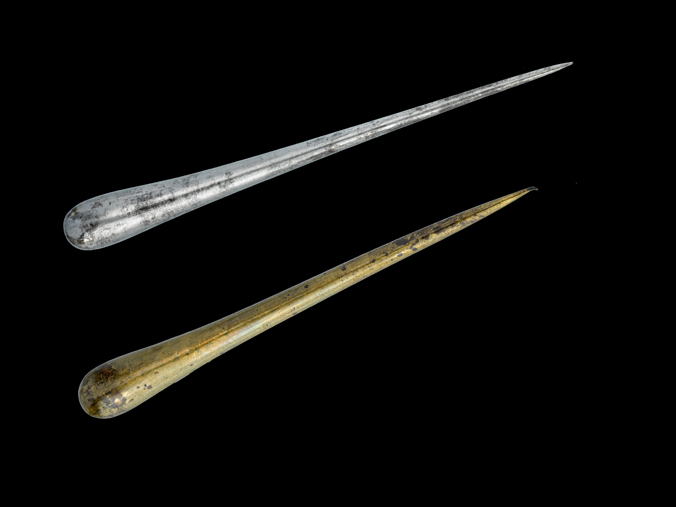
The Tractors were patented by Elisha Perkins in 1797 and consisted of two metal pins, one brass and one steel, that when rubbed together over an affected area would supposedly cure rheumatism, gout, burns, boils, cramps, and even cancer. Even though the efficacy of this product was promptly debunked by scientists, Perkin’s Metallic Tractors like the later Boyd’s Battery continued to be a popular product.
In this video, we do some experimental archaeology and try four different techniques used to preserve fresh uncooked eggs before the advent of refrigeration.
You can also read about meat preservation techniques prior to the invention of refrigeration here.
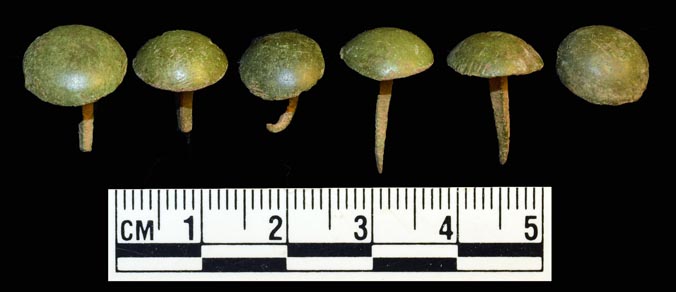
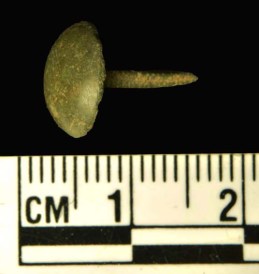
Tacks recovered archaeologically at George Washington’s Ferry Farm.
Let’s do our tacks! I know you’ve been dreading doing your tacks, and putting it off as long as you could, but time is running out. It is time to do our tacks, friends.
Whether iron alloy or copper alloy, tacks provide important clues to the presence of upholstered furniture, trunks, and horse tack at a site. Delicate items have disappeared but their tacks remain. There is “tacks-ation without representation.”
Copper alloy tacks often called brass tacks are one of those artifacts that archaeologists occasionally encounter. They tend to occur in small quantities at any given site. Archaeologists also recover iron alloy tacks used in cabinetry, furniture, and architecture but this blog will focus mainly upon brass tacks.
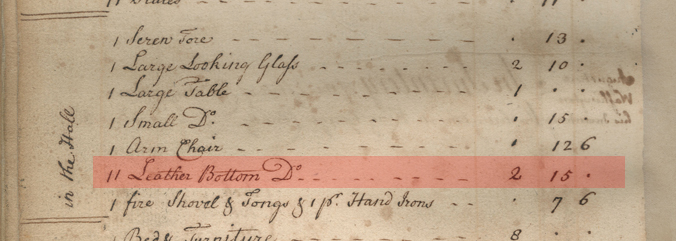
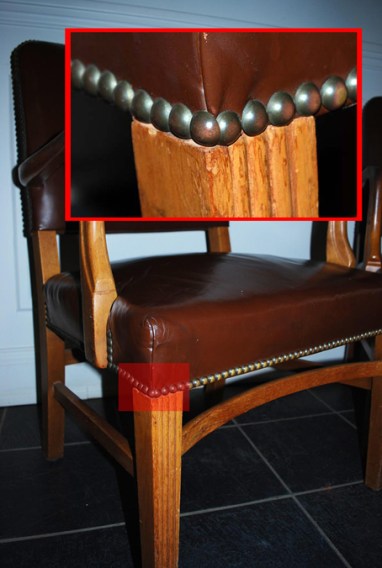
Brass tacks were shiny beacons of taste that drew well-deserved attention to the fine fabric or leather coverings that encased upholstered furniture. Augustine Washington’s 1743 probate inventory lists eleven “leather bottom” chairs in the home’s hall where George and his family dined while sitting upon these chairs. It was likely that brass tacks secured the leather to the frame of the chairs. Leather was an especially popular chair covering in Virginia, due in part to its availability to talented Williamsburg craftsmen.
A portion of Augustine Washington’s probate inventory from 1743. The highlighted entry shows eleven leather bottom chairs in the Hall. The entry reads “11 Leather Bottom Do.” The Do. is an abbreviation for “ditto” meaning the prior entry will indicate the item being inventoried.A modern leather chair using tacks that are similar in appearance and function to 18th century tacks.
Furthermore, a couch was located in the passage, and might also have been tastefully tack adorned. While often associated with furniture cushions, tacks were also widely popular on saddles, carriages, and riding chairs. Copper alloy tacks even embellished trunks, coffins, and were employed to hang window coverings.
To date, 127 copper alloy tacks have been discovered by excavators at Ferry Farm. They are scattered throughout the yard spaces surrounding the multiple colonial and antebellum-era dwellings of this site. This assemblage of tacks represents a very small proportion of the tacks used here historically. Like many of our discoveries at this site, the vast majority represent items that were inadvertently lost. Such loss increased when the items they adorned were used, cleaned, repaired, or moved.
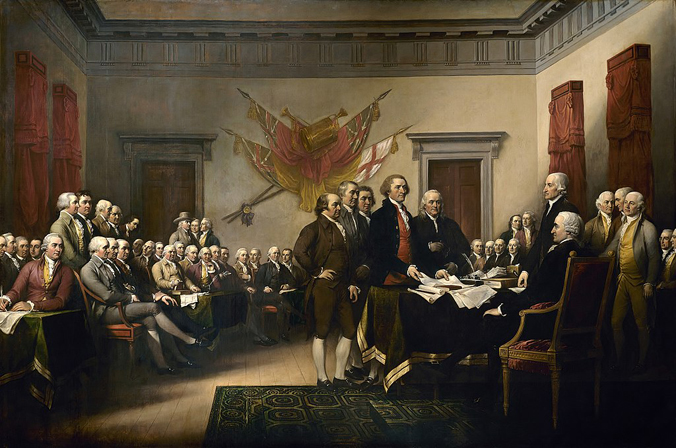
“Taxation without representation” was a rallying cry of the American colonists against British Parliament in the years following the French and Indian War. The victory against the French had been costly, and Britain needed her colonists to contribute to defraying the costs. Parliament opted to impose a variety of taxes – such as on paper and upon tea – and the King’s North American subjects found these fees increasingly irksome. Because the colonists lacked a representative in Britain, Parliament was unable to benefit from the perspective and wisdom of the colonies. Being taxed without such representation was unacceptable, and the colonists took steps to provincial they had no influence on legislation and taxation upon the colonists. The “Declaration of Independence” (1818) by John Trumbull. Credit: Architect of the CapitolThe shanks of tacks can be square in cross section or round, their ends pointed or blunt, depending upon their function and method of manufacture. Sometimes the shanks are straight and other times they are bent. Bending a shank was sometimes done to ensure the tack was well fastened, and less likely to be lost. However, it can be difficult – some might argue impossible – to discern whether bent shanks were an intentional part of their past function, or whether the shanks were altered as an incidental consequence of their loss, burial, and exposure to subsequent activities that occurred at the site. Occasionally, the shank is missing altogether: broken off and irrevocably misplaced.
Tacks are a timely reminder that the archaeological record does not preserve all of the items that the families who lived here used. The artifacts that we unearth from the yards surrounding the dwellings that were here only represent those things that preserve well and were sturdy. The primary components of furniture decompose readily, often because they are manufactured from organic items. The fabric, leather, canvas, marsh grass, Spanish moss, horsehair, iron hardware, and wood that typified colonial upholstered items do not survive long in the environmental conditions under which the archaeological record of Ferry Farm is exposed. Even under ideal, indoor circumstances, upholstery fairs poorly over time, becoming faded, outdated, and brittle. Cushioning sags and droops over time. Addressing these maintenance issues can result in replacement of these materials and the unintentional loss or even the replacement of its hardware, including tacks.
Despite these limitations, tacks often reflect the use of upholstered furniture, even if the furniture itself has not endured. Most sites lack probate inventories or wills, and tacks provide important clues to the presence of upholstered furniture, trunks, and horse tack. Hence the “tacks-ation without representation” title: while the delicate items which these tacks graced have literally disappeared or are no longer represented, their tacks bear testament to their presence on the site. In the coming years, as archaeologists record more attributes and generate larger collections of these items, their full interpretive potential may be realized.
Laura Galke, Archaeologist
Small Finds Analyst/Field Director
Recently, on a gray overcast March morning, four members of the Fredericksburg Birding Club bundled up against the unseasonable cold to trudge across the open fields and through the forests of George Washington’s Ferry Farm to conduct their latest bird survey. It was their fourth such survey in the past seven months.
During these surveys birding club members spotted a total of 41 species. They recorded each species observed and compared their observations to “A Checklist of the Birds at Ferry Farm,” a pamphlet available to visitors at Washington’s boyhood home. Club members noted that they saw all of the species listed on the “Checklist” as abundant or common. They saw 13 uncommon species defined by the “Checklist” as “present, but not certain to be seen” as well as three species listed as occasional, meaning “seen only a few times during a season.” They spotted three rare species. Most excitingly, they sighted the American Pipit, a species not yet included on Ferry Farm’s “Checklist.” The pipit’s habitat is shorter grasses so it was probably attracted to a freshly mown field on the grounds.
American Pipit. Credit: Becky Matsubara / Wikipedia
Club members also noted some early breeding activity as three tree swallows were inspecting some of the bluebird boxes in Ferry Farm’s wildflower meadow.
Ferry Farm’s abundance of bird life is due to the many favorable micro-habitats available on the 80-acre property. This includes native grasses and a wildflower meadow, hardwood bottomlands, fallow areas, open lawn, and the adjacent waters of the Rappahannock River.
Wildflower Meadow at George Washington’s Ferry Farm.
Hardwood bottomlands at Ferry Farm.
The Rappahannock River at Ferry Farm.
During the Fredericksburg Birding Club’s survey on March 27, club members spotted the species listed below in alphabetical order. The number following each species name represents the number of individuals seen. This same data can also be found at ebird.org.
American Crow – 6
American Goldfinch – 6
American Kestrel – 1
American Pipit – 6
American Robin – 33
Bald Eagle – 2
Black Vulture – 1
Blue Jay – 3
Canada Goose – 20
Carolina Chickadee – 5
Carolina Wren (heard only) – 2
Cedar Waxwing – 9
Common Grackle – 8
Dark-eyed Junco – 14
Double-crested Cormorant – 3
Downy Woodpecker – 5
Eastern Bluebird – 7
Eastern Phoebe – 1
European Starling – 23
Hermit Thrush – 1
Mourning Dove – 7
Northern Cardinal – 20
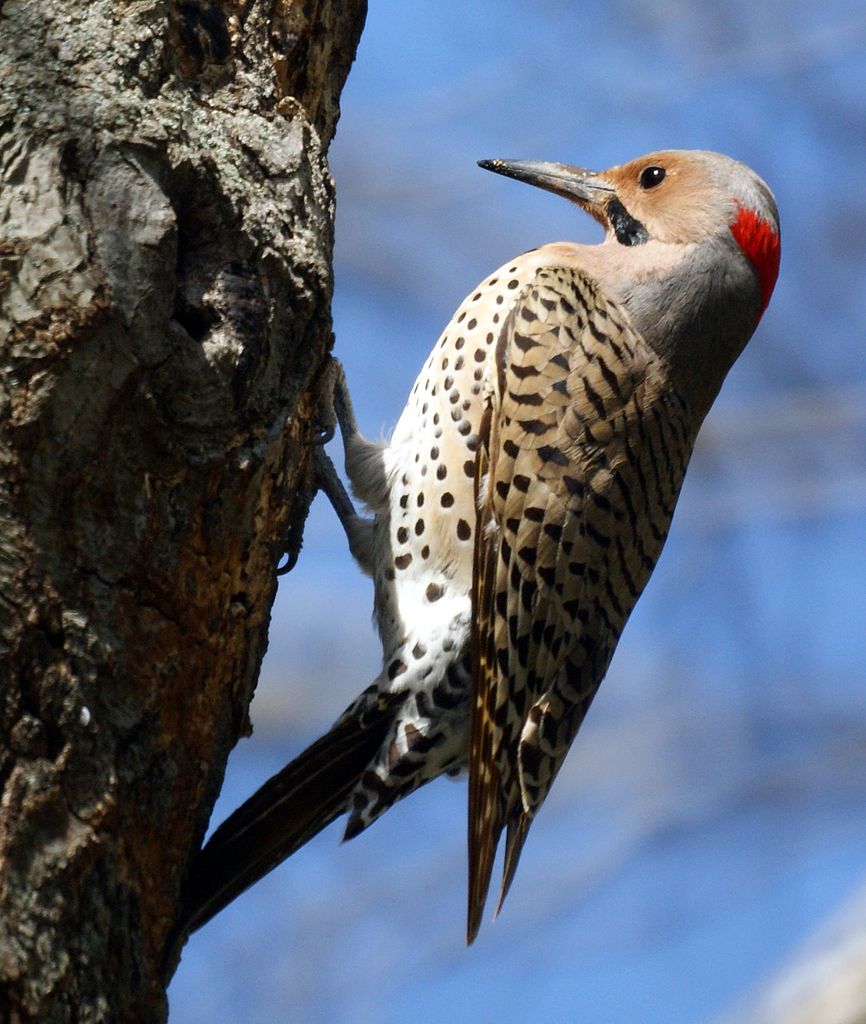
Northern Flicker – 1
Northern Mockingbird – 2
Osprey – 3
Red-bellied Woodpecker – 3
Ring-billed Gull – 15
Rock Pigeon (Feral Pigeon) – 1
Ruby-crowned Kinglet – 1
Song Sparrow – 3
Tree Swallow – 3
Tufted Titmouse – 4
Turkey Vulture – 6
White-throated Sparrow – 4
Yellow-rumped Warbler – 24
American Kestral with a freshly killed American Pipit. Credit: Gregory “Slobirdr” Smith / WikipediaNorthern Flicker. Credit: Mike’s Birds / Wikipedia
You can observe birds yourself at Ferry Farm during regular operating hours, which are from 10:00 a.m. to 5:00 p.m. on Monday-Saturday and from Noon to 5:00 p.m. on Sunday. Pay your admission inside the Visitors Center and ask for a copy of “A Checklist of the Birds at Ferry Farm.”
Furthermore, on Saturday, May 5, you can join members of the Fredericksburg Birding Club for a Birding Tour of Ferry Farm, a morning walk through the grounds during spring migration. Participants will see birds that are passing through, as well as those who have arrived at Ferry Farm for the summer. Bring your own binoculars. The cost is regular admission: $9.00 adults, $4.50 students. Reservations required. For more information and reservations, please call (540) 370-0732 ext. 24 or email [email protected].
Mara Kaktins, archaeology lab supervisor at George Washington’s Ferry Farm, explains the weird patination on some glass artifacts excavated by our archaeologists.
With building work on the reconstructed Washington family home at George Washington’s Ferry Farm nearly finished, our archaeologists are in the midst of identifying Washington-owned plates, bowls, glasses, and other household artifacts to be used to furnish the house once construction is finally complete.
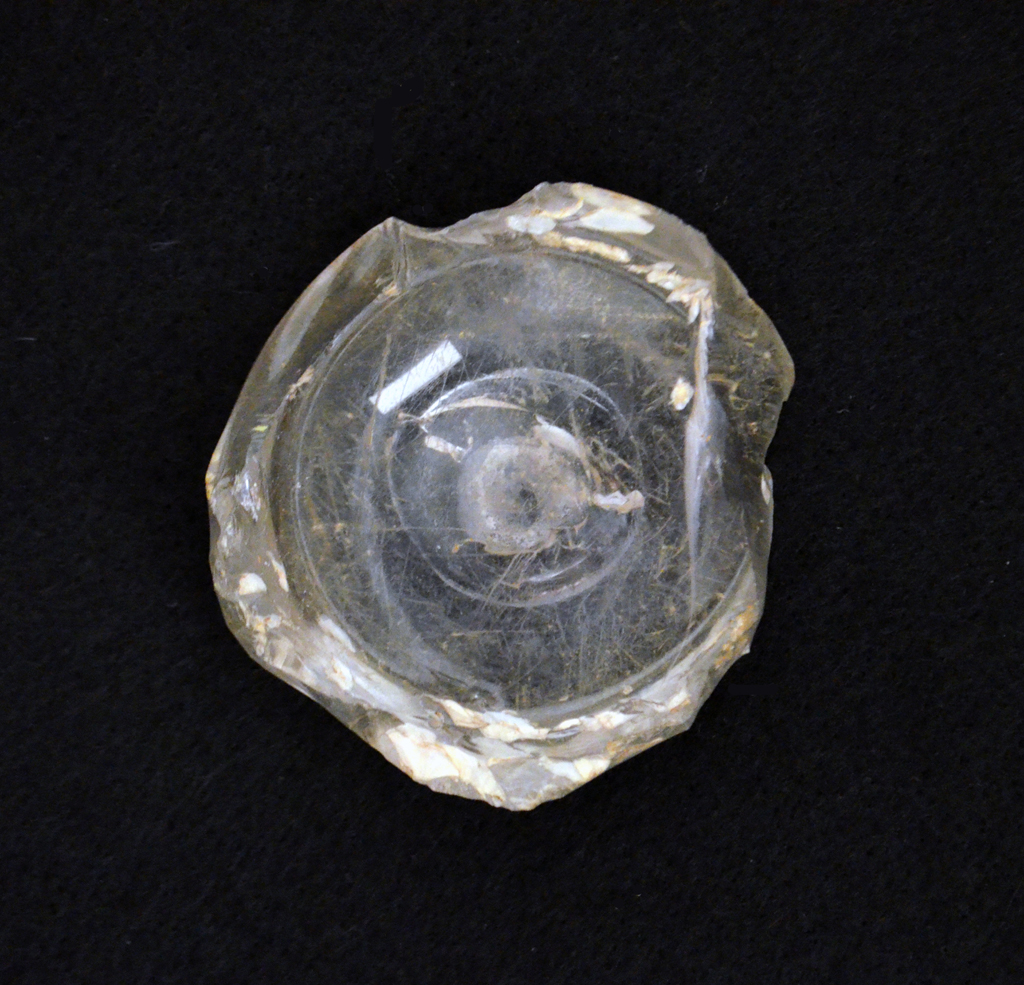
While working to identify things, archaeologists sometimes encounter a “mystery artifact” that either can’t be identified or has been altered to serve an unknown purpose from what was originally intended. We wrote about one especially perplexing mystery artifact almost three years ago. With that mystery artifact, someone intentionally and for unknown reasons chipped away the edges of that 18th century leaded glass base from a cup or mug to form a disc .
Recently, during analysis of the Washington family’s table glass, Ferry Farm archaeologists discovered another base from an 18th century drinking glass that someone tried to modify by actually breaking or knapping off flakes of glass. It was an apparent attempt to turn the base into a disc. As before, we don’t know for what reason.
To confirm the glass was knapped, Ferry Farm archaeologists got “science-y” and asked nearby Dovetail Cultural Resource Group in Fredericksburg to take photographs of the glass base using a microscope camera.
Using this microscope camera made the clear glass appear green in the resulting photos. More importantly, the photos helped us to see flake scars from knapping, which we’ve outlined in black in the photo below, and thus confirm that the glass was actually knapped by someone.
As often happens when studying the past, however, our analysis provided answers but also created many more questions. Who did the knapping? Was it perhaps the job of an enslaved worker? What was the goal? Why make these modifications? Although it’s the science of history, even archaeology can’t yet provide answers to these questions. In fact, we many never have the answers. In the end, sometimes not knowing is just as much a part of archaeology as knowing.




 In this video, Fredericksburg, Virginia-based furniture maker Steve Dietrich discusses some of the techniques he used to create four low post beds for the reconstructed Washington house at George Washington’s Ferry Farm.