Lives and Legacies

Author: ferryfarmandkenmore

  • Our Best Guess about Mary Washington’s Best Bed

    Furnishings posts logo finalIn July, we were very excited to see the culmination of at least a year’s worth of research and work when the “best bed” was installed in the Hall Back Room (the master bedchamber) of the Washington House. Between its imposing size (it nearly touches the ceiling) and it’s bright blue bed curtains in a house where there was very little color, the best bed is one of the most memorable pieces in the house, both today and when the Washington family resided at Ferry Farm.
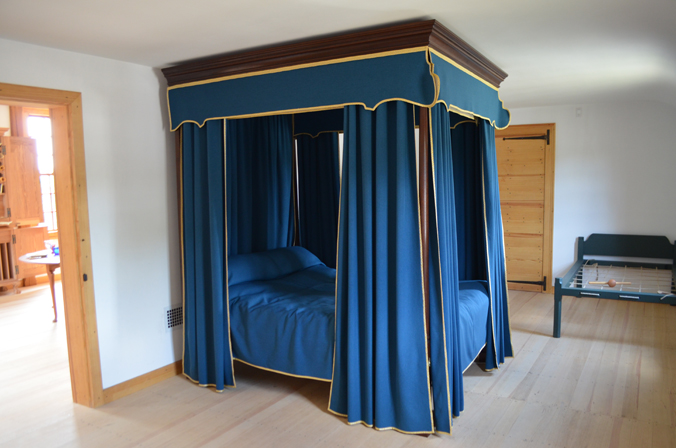
    Best Bed
    The “best bed” in the Hall Back Room of the replica Washington house at Ferry Farm.

    The “best bed” in a colonial gentry home like the Washington’s was intended to be a showstopper, and a visual statement to visitors about the prosperity of the family that owned it.  It was one of the reasons that the bedchamber in which the best bed stood was usually considered a public entertaining room – all the better to have people see the bed.

    But how do we know what the Washington best bed looked like? In this case, we had several clues from historic documents and archaeological finds that we pieced together with what we know about life in early 18th century Virginia households.

    The first question we had to answer was what type of bed was it? Augustine Washington’s 1743 probate inventory describes the bed simply as “1 Bed & Furniture…..£8.” At first glance, this scant information doesn’t seem to tell us much (other than this bed is indeed the most valuable single item in the entire Washington household at £8).  But, the mention of “furniture” along with the bed is actually quite useful.
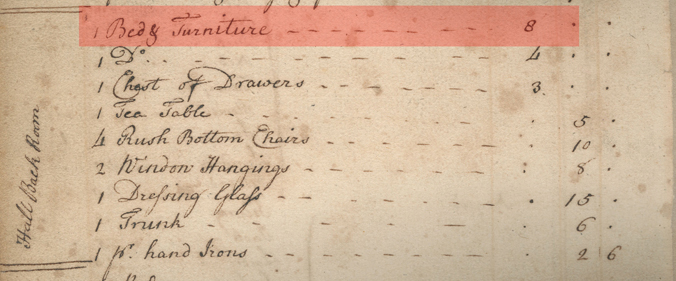
    Best Bed on Probate Inventory
    “1 Bed & Furniture” valued at £8 listed on the probate inventory of Augustine Washington’s personal property done after his death in 1743.

    In this context, “furniture” refers to all the textile accessories associated with the bed, including bed curtains.  In order for a bed to have bed curtains, it must be an expensive tall-post bed, rather than low-post.  While we refer to the Washingtons as being among the gentry class, meaning they were able to furnish their home with higher end furnishings, this was actually a question for some time.  At this early point in the 18th century, being gentry might not actually mean living in the luxury that we associate with homes like Kenmore or Mount Vernon of the century’s later decades.  Simply owning a bedstead – of any variety – put you well ahead of the vast majority of colonial Virginians.  The traditional view of George Washington’s childhood is one of a very simple, primitive lifestyle.  Our archaeological findings at Ferry Farm have begun to change that view.  In actuality, the Washington family owned and used a wide variety of imported luxury goods in their home.

    Bed bolts are one artifact changing the old view and pertain directly to the level of bed in the house.  Bed bolts were long, heavy screws inserted through the lower ends of the tall bed posts to hold them to the side rails of the bed.  Their presence at Ferry Farm proves the existence of tall-post beds.  So, this line item in the probate inventory actually serves to bolster the idea that the Washingtons were living a relatively high lifestyle – they had a tall-post bed with curtains in the Hall Back Room.
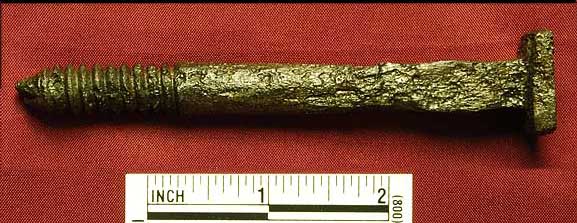
    FF-Bedbolt
    Bed bolt excavated by archaeologists at Ferry Farm.

    Once we determined the style of bed, we had to decide what the bed curtains and bed covering would look like.  The probate inventory was not overly helpful on this front – almost no descriptive information of any textile in the house is given.  However, there are several other documents related to Mary Washington’s estate that we could consult.

    The first was her will, which was recorded in 1788, the year before her death.  This document details a number of her household goods, and which of her family members they were to go to.  While the list of items is not nearly as complete as a probate inventory, it does provide more descriptive information.  Among other textiles, a blue and white quilt, a white counterpane, purple bed curtains and “Virginia cloth” bed curtains are mentioned.

    In another document, a list of household items sold at vendu (a public sale of personal property, sort of like a yard sale today) after Mary’s death in 1789, reference is made to blue and white coverlets, a blue and white counterpane, and several blue or white bed coverings, one of which is called “ye best.” Several sets of bed curtains are mentioned, but they are not described.
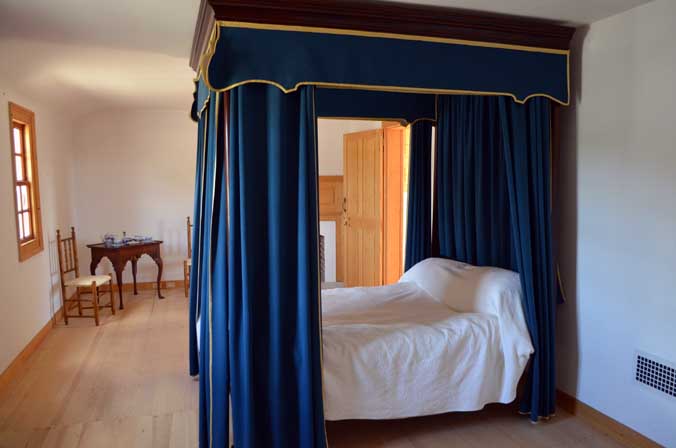
    Best Bed with White Counterpane
    The best bed with its summertime white coverlet.

    Although both of these documents date to more than 40 years after the time period that we are interpreting at Ferry Farm, we can surmise that much of Mary’s bed textiles were blue and white and that this color combination was a particular favorite of hers.  As bed curtains and bedding such as quilts and counterpanes represented major financial investments in an 18th century household, it’s not unlikely that many of the finer textiles in the Washington house at Ferry Farm were still in use at the time of Mary’s death many years later, when she was living across the river in downtown Fredericksburg.  Because of these documents, we decided to depict the best bed at Ferry Farm with blue and white bedcoverings (a quilt for winter, and a matelessé counterpane for summer) and blue bedcurtains.

    As with all the furnishings in the Washington house, we hope that Mary would recognize her bed if she were set foot inside the room today.

    Meghan Budinger
    Aldrich Director of Curatorial Operations

  • The Furniture Makers: Harrison Higgins [Video]

    Furnishings posts logo finalThe replica Washington house is open at George Washington’s Ferry Farm but furnishing is still ongoing. We traveled to Richmond to visit furniture maker Harrison Higgins and he told us about the furniture that he and his crew have made for the Washington house.

    Watch other videos and read more about rebuilding the Washington house here.

  • Introducing Caty: More Than “Merry Laugh…and Lively Wit”

    Editor’s Note: At George Washington’s Ferry Farm, we are always interested in reexaminations of accepted history.  Archaeology is creating new and more complete understandings of George’s Washington’s youth as well as of Mary Washington as a person.  Mary has been both revered and reviled by history but archaeological discoveries at Ferry Farm are painting a more complex picture of her as an independent and intelligent woman facing the world on her own after her husband’s death. Inspired by Mary, Lives & Legacies asked Carin Bloom, Museums Program Associate at Middleton Place Foundation in Charleston, South Carolina and a friend of the blog, to re-examine another independent, intelligent woman in the Washington family’s orbit: Catharine “Caty” Greene.

    George Washington is considered the Father of the United States of America, but long before he and his wife Martha became the parents of the nation, they were parents, both real and surrogate, to several prominent patriots and revolutionaries. For example, much is known of the relationship between General Washington and his Aide de Camp, the Marquis de Lafayette – the affection of a father and son are clear in their communications, both during and after the American War for Independence.

    Nathanael Greene
    Nathanael Greene (1783) by Charles Willson Peale

    The Marquis was not the only one to enjoy the mentorship, tutelage, and friendly affection of the great General Washington. So too did the only other man to hold the rank of General for the duration of the American Revolution: Nathanael Greene. Promoted from the rank of Private in the Kentish Guards, a militia unit raised in his home county in Rhode Island Colony, Greene became the Brigadier General of all three Rhode Island regiments of the Continental Army in the spring of 1775. He quickly became (in turns) a close friend, advisor, and student of General Washington. The two commanders’ relationship is perhaps less well-known outside of academic circles, but it is still well-documented.

    Those relationships aren’t what this blog post is about.

    This blog post began in very much the way that stories from the past often begin – with the great men of the Age and what they did, or how they interacted. Their wives are secondary (if mentioned at all) and are supporting characters in a drama of great ideals and noble causes. In reality, these women were so much more, and their stories are important. While Women’s History and Women’s Studies programs in academia became prominent around the time of the nation’s Bicentennial, there has been relatively little advance or innovation in the study of feminine experiences of historic eras. Now, however, modern social and political climates are bringing women’s stories into focus again, allowing the women of the past to be re-examined once more. Conspicuous among the women of the Revolutionary era being re-examined are the same names we’ve all heard since elementary school – Abigail Adams, Peggy Shippen, the fictional Molly Pitcher, and of course, Martha Washington.

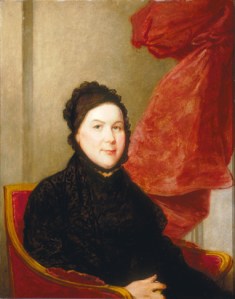
    Incomplete Portrait of Martha Washington (1796) by Gilbert Stuart
    An unfinished portrait of Martha Washington begun in 1796 by Gilbert Stuart.

    Martha and George Washington are revered for many reasons, but little is spoken about their personal nurturing and encouragement of young patriots, the men and women with whom they were surrounded. In fact, they occupied the parental pedestals for both Nathanael and his wife Catharine Greene – but perhaps especially for “Caty”. Orphaned at a young age and raised by a somewhat eccentric aunt, Caty was 19 and newly married when the Revolution broke out. She was tutored and educated in the 18th century society that befit her station, but it seems she wasn’t ready to be a General’s wife. For tutelage she looked to Lady Washington.

    Their mother-daughter relationship blossomed quickly, and Catharine seemed to flourish under Martha’s indulgence. Caty is most often described in terms of her appearance and temperament, “She was a small brunette with high color, a vivacious expression, and a snapping pair of dark eyes.”[1] Her biographer adds, “To men her appeal, like that of her Aunt Catharine, was not simply a matter of flirtation that fed their masculine vanities; deep emotions were touched as well.”[2]

    Carin Bloom as Caty Greene (3)
    The blog post’s author Carin Bloom portraying Caty Green reading from Joe Miller’s Jests, or the Wit’s Vade-Mecum (1739) in the Washington house at Ferry Farm.

    With a description like that, I started to wonder, why don’t we know more about the young Catharine Greene? She was called Kitty as a girl, was known to her husband’s equals and subordinates as Lady Greene, and to her devoted husband as Caty – and no matter what she was called, she became a force to be reckoned with. Her biographers make careful note that she would have grown up in the cradle of the Revolution, listening to the great minds gathering in her uncle’s library discussing politics, self-governance, and eventually open rebellion. An enigma equal to her fighting Quaker husband for her indifference to religious leanings, she is described as a balm of good morale for dour officers and aides: “she laughed, danced, sipped Madeira wine and played cards and parlor games. She engaged in repartee…with perhaps a burst of unladylike glee at a slip of the tongue or double entendre that would have horrified her female counterparts but delighted their husbands.”[3]

    Many of these attributes came naturally to Caty or were self-taught, but her refinement as a true lady of the 18th century came from her time spent with her equals and betters. Specifically, she was looked after by Lady Washington; when other young officers’ wives felt threatened by Caty’s beauty, and exuberance, “Martha was secure in her place in her husband’s heart. Although she knew that the general looked at the beautiful Caty with deep male appreciation, she found no cause for disapproval. Caty was like a daughter to them both. She was accepted for what she was…”[4]

    Carin Bloom as Caty Greene (2)
    Caty Greene (Carin Bloom) pens a letter to husband Nathanael on the escritoire desk in the Hall of the Washington house.

    From the his occasional service as a personal courier for Caty and Nathanael’s letters to one another, to his own assurance of her safe arrival in camp during the Siege of Charleston early in 1782, General Washington’s own words and actions belied his affections not just for his best General, but for Caty as well. Likewise, Martha Washington opened her home at Mount Vernon to Caty, as well as to both Ladies Stirling, Lucy Knox, and a few other officers’ wives, when they could not be with their husbands. It was at these gatherings, presumably around a copious amount of tea, that Caty would have come to understand feminine refinement that would have served her well into old age, and long after Lady Washington was gone.

    Though only one nonfiction biography of the remarkable Catharine Greene has been written, she comes to life with alarming effervescence in its pages. Her abilities to both navigate her world as a cog in the wheel of 18th century society, as well as to stand apart from it and maintain utterly her own identity, were enough to cause me to delve into her world for over a year. As a young woman she was the subject of much gossip; everything from accusations of turning her husband from his Quaker faith in disgrace, to extramarital affairs with his subordinates – none of it managed to stick to her. In her later life Caty was a financier (and now suspected to have been a partner in design) of Eli Whitney and his Cotton Gin, as well as a property-holding single woman until she chose of her own accord to remarry.

    Catharine Littlefield Greene
    Catharine Greene (1809) attributed to James Frothingham

    All in all, this was a woman whose life could be the stuff of Hollywood legend, and yet, in every living history scenario that manages to feature a woman, she is always a Martha Washington, or an Abigail Adams, or a Molly Pitcher – and always in a vacuum. Surely Martha did not spend her days with only her husband and his men, or alone by herself? The past is populated with scores of women, and yet, we rarely see the majority of them come to life. That is my aim in portraying Catharine Greene – to use her life as a vehicle for an immersive experience of a multifaceted past, so much more complex than what we currently understand. George and Martha Washington, Nathanael and Catharine Greene, they weren’t so different from us; as we understand their stories, both individually and as participants in a community, a nation, and a world, we may find new enrichment in our own lives.

    Carin Bloom
    Museums Program Associate
    Middleton Place Foundation

    Trained as an archaeologist specializing in the American Revolution, Carin plans and executes programs at Middleton Place National Historic Landmark in Charleston, South Carolina. She holds a BA (University of Delaware) and two MAs (University of Pennsylvania and Temple University), all in Anthropology with a concentration in Historical Archaeology, and has been working at non-profit historic sites for over a decade.  She has studied Catharine Littlefield Greene extensively and enjoys bringing Caty to life at living history events up and down the east coast, as well as working in classroom settings with school programs and summer camps.

    Carin Bloom as Caty Greene (4)

    [1] 1871 – Greene, George Washington. The Life of Nathanael Greene, 3 vols, Cambridge. Vol 1, pg. 72.

    [2] 1977 – Stegeman, John F. and Janet A. Stegeman. Caty: A Biography of Catharine Littlefield Greene, pg. 8, University of Georgia Press.

    [3] 1977 – Stegeman, John F. and Janet A. Stegeman. Caty: A Biography of Catharine Littlefield Greene, pg. 26, University of Georgia Press.

    [4] 1977 – Stegeman, John F. and Janet A. Stegeman. Caty: A Biography of Catharine Littlefield Greene, pg. 58, University of Georgia Press.

  • Archaeologists Dig History! [Photos]

    This summer out on the dig site, one of our archaeology interns sometimes wore a t-shirt that read “archaeologist (n): one who digs history.” In this album, you’ll see this year’s excavation crew — field director Steve Lenik, assistant field director Elyse Adams, interns Reagan Andersen, Cheyenne Johnson, and Aileen Kelly, and field school students from Georgia Southern University and the University of South Florida — doing just that!

    Read a summary of the work done during the 2018 dig at Ferry Farm here.

  • We Really Dig History!: This Summer’s Excavations at Ferry Farm

    Archaeological excavations at George Washington’s Ferry Farm have occurred nearly every summer since The George Washington Foundation purchased the property in 1996. The summer of 2017, when the majority of the replica Washington house construction was underway, was the major exception. The archaeological site was proved too close to ongoing construction so excavations were put on hold until the summer of 2018.

    This year, a five person crew consisting of a field director Steve Lenik, assistant field director Elyse Adams, and interns Reagan Andersen, Cheyenne Johnson, and Aileen Kelly worked from April to July on the Ferry Farm property. For five weeks, an additional seven students from Georgia Southern University and the University of South Florida came to Ferry Farm for a field school, to learn the basics of excavation and lab work.

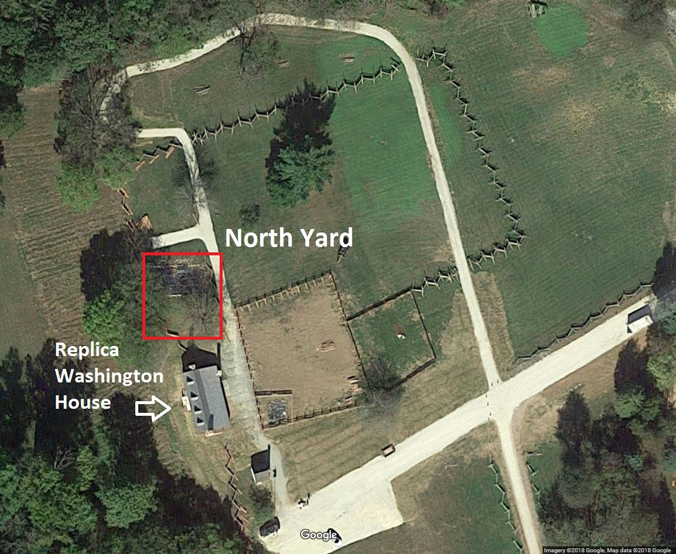
    The North Yard

    Historic AreaN

    We investigated two areas.  The first, an area at the crest of the ridge to the north of the replica house, was the North Yard.  This yard lies between the Washington House and a slave quarter that was completely excavated in previous years. The purpose of digging in this area was to find evidence about who controlled this space. Was it the domain of those who lived in the Washington House or of the enslaved population who lived in the quarter?

    Excavations are not yet complete in this area, but we discovered that this space was relatively clean compared to the Work Yard and areas immediately behind the Washington house, where a lot of trash and debris from daily 18th century activities were found during past excavations. The lack of trash and debris in the North Yard was likely because, in colonial times, this was part of the property visible from Fredericksburg and therefore was well-kept  A public space like this one would have likely fallen under the control of those who lived in the Washington house.

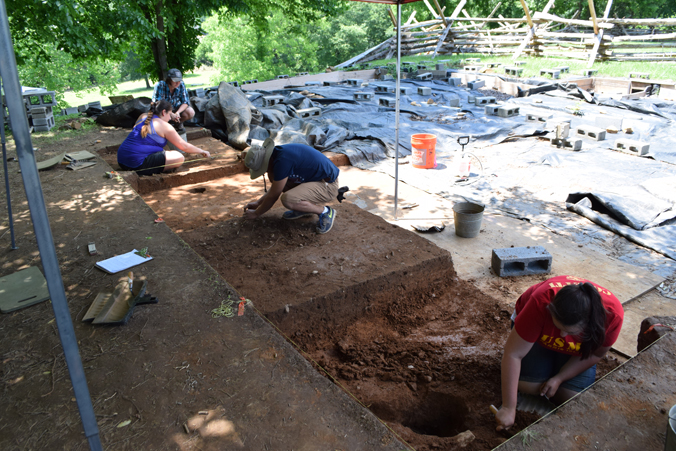
    North Yard Excavating
    Field school students excavating the North Yard.

    We were also looking for evidence of any other outbuildings and gardens, in order to accurately recreate the landscape of the farm as it was in the 1700s. We discovered evidence of large trees that lived on the landscape during the 18th century in this area. This discovery will allow archaeologists to look even closer into the use of this space with the goal of re-creating it as it was in the time of the Washingtons.

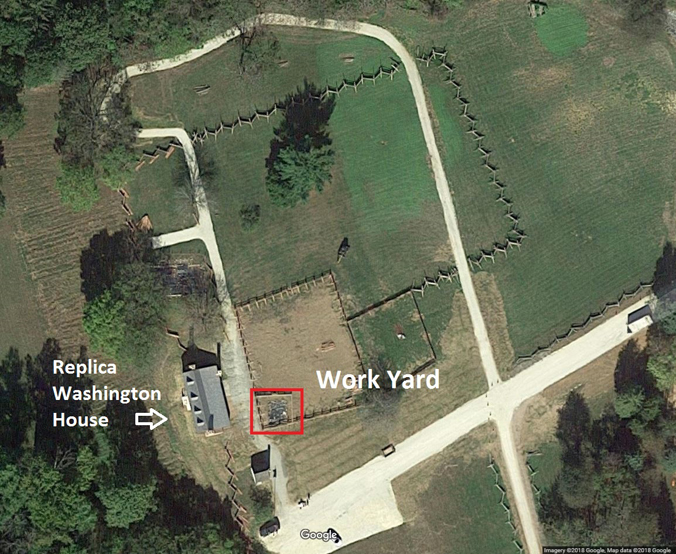
    The Work Yard

    Historic AreaW

    The second area we investigated during this summer’s dig was behind the Washington house in the Work Yard, which is exactly what it sounds like—a space for work to be done on a farm in the 1700s. This space is special to our research here at Ferry Farm.  Much of this space was excavated already in past years, yielded a treasure trove of artifacts and information, and was then filled back in once excavations were complete.

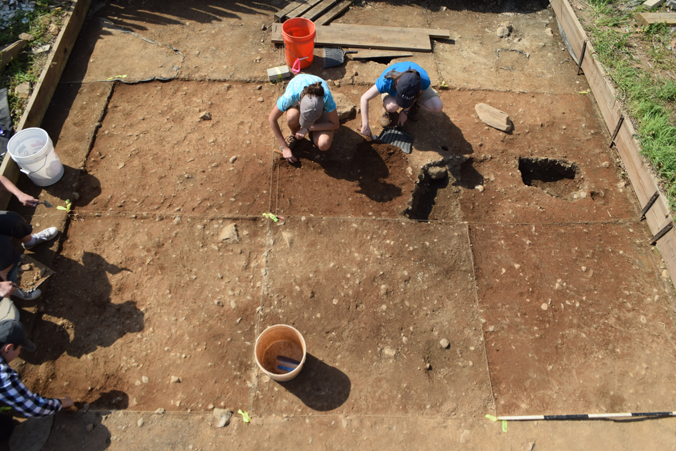
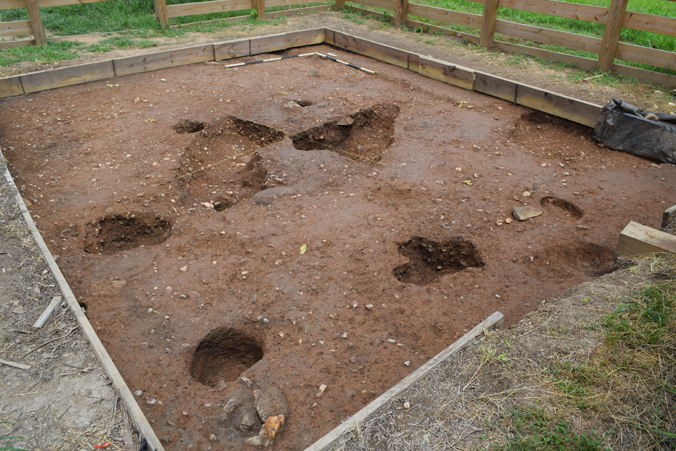
    One small area just behind the house was left to excavate, however, and that’s where we worked this summer.  We discovered large stains in the soil, very deep in the ground.  They were made during the colonial era but, as yet, we do not know why.  This area was originally thought to be a cellar, but as excavations continued, we began to notice a series of pits instead.  Analysis is still ongoing and artifacts excavated in this space are still being processed so we don’t have answers to any of our questions yet.

    Work Yard Excavating
    Field crew exposing the large soil stain of possible cellar at the start of the 2018 excavations.
    Work Yard Features
    Final photo of the Work Yard pits at the end of the 2018 excavations.

    Nevertheless, our minds were racing with possible explanations of these pits and we couldn’t help but wonder if they were somehow related to Ferry Farm’s collection of at least 215 wig curlers—very unusual finds for a Virginia farm—that were excavated above or around this space.

    It’s far too soon to tell, we don’t have any complete answers, and we still aren’t finished excavating the Work Yard, but this area already is proving important to the Ferry Farm story. Once we understand the landscape and complete the Work Yard excavations, the 18th century outbuildings that have been identified and that once stood in this space will be replicated just like the main house.

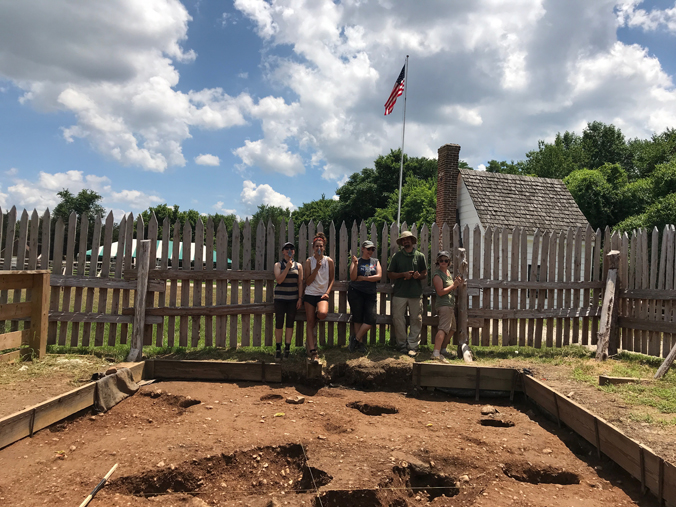
    Archaeology Team
    The dig team! (l-r) Reagan Andersen, Cheyenne Johnson, Aileen Kelly, Steve Lenik, Elyse Adams

    Future excavations will continue to yield the information we need to replicate the entire boyhood landscape of George Washington’s home. Every bit of information, no matter how small the tree root or how tiny the artifact, is pertinent to the understanding and accurate interpretation of this important landscape, and to understanding the lives of all who have lived and worked here. We look forward to many more years of discovery, and many more summers of digging into the history of the Washington Farm.

    Elyse Adams, Archaeologist
    Assistant Field Director

  • The Tale of the “Black Dogg”

    FerryFarmFF10-273-50-1552.small

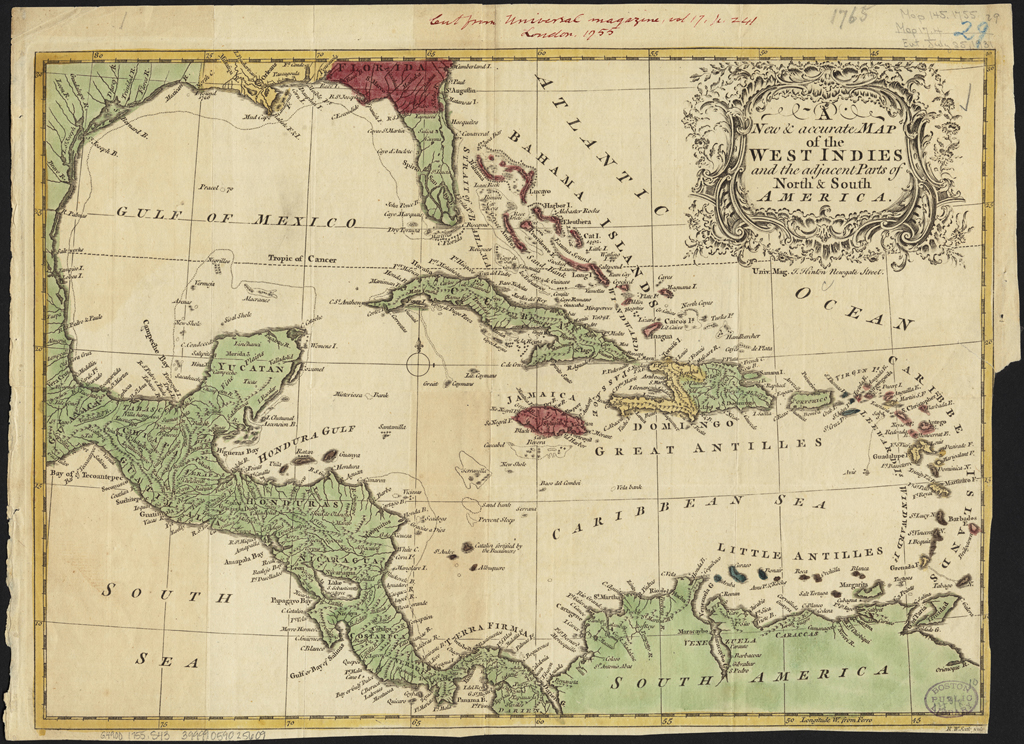
    The heavily worn coin, known as a “black dogg” and pictured above, is a unique archaeological find at George Washington’s Ferry Farm. It was originally circulated in the French Caribbean and certainly traveled some distance to find its way to British Virginia.  The coin may have traveled this distance in the pocket of a sailor whose ship first visited the West Indies, as the Caribbean islands were known in the 1700s, and then docked at Fredericksburg to unload its cargo.  Fredericksburg was a port town in the 18th century and marked the furthest point up the Rappahannock River that small ocean-going vessels could travel before encountering rapids.  These sailing vessels were a familiar sight to the Washington family as they looked down upon the river from their home atop the bluff (Read this blog post about a Fredericksburg ship’s voyage around the Atlantic in 1732).

    The coin’s poor condition is a tribute in part to how popular it was as currency. Some black doggs featured a high pewter content. Their darker color, when compared to other coinage of the time, is how they came to be called black dogs or black doggs in the British colonies. British colonists used the term generally to refer to non-British, small change coinage that came from the West Indies.  It was not a complimentary term, and these coins were typically the lowest value available.

    While the French government provided coinage for its Caribbean colonies, hard currency proved difficult to come by for these islanders. French Caribbean coins such as our black dogg were widely circulated. An amalgam of copper and silver alloy coin bits, these debased silver coins provided much needed small change for remote colonies.

    A new & accurate map of the West Indies and the adjacent parts of North & South America (1755) by William Richard Seale
    “A new & accurate map of the West Indies and the adjacent parts of North & South America” (1755) by William Richard Seale. Credit: Norman B. Leventhal Map & Education Center at the Boston Public Library

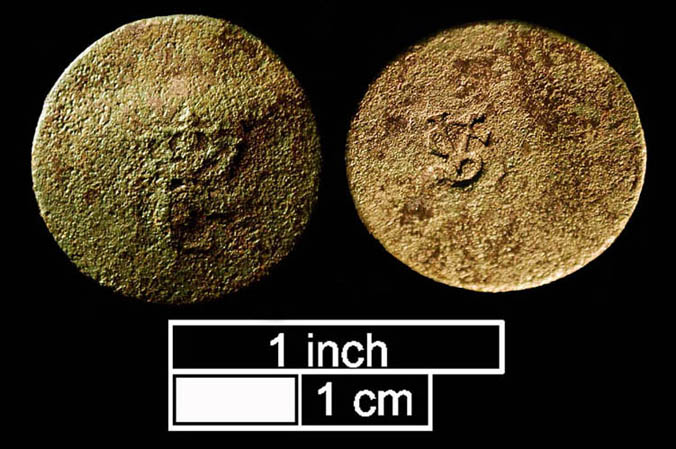
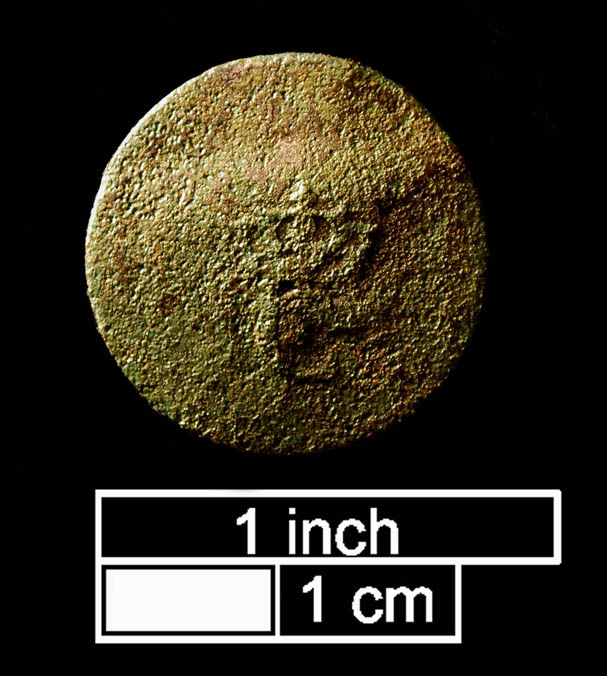
    In 1779, France issued a coin for their Caribbean islands featuring a crowned “C” in relief on the front. The reverse side was blank, and individual islands often elected to stamp them with initials emblematic of a particular island.

    FerryFarm10-273-50-1552
    The black dogg’s front featuring a barely visible crowned “C” in relief.

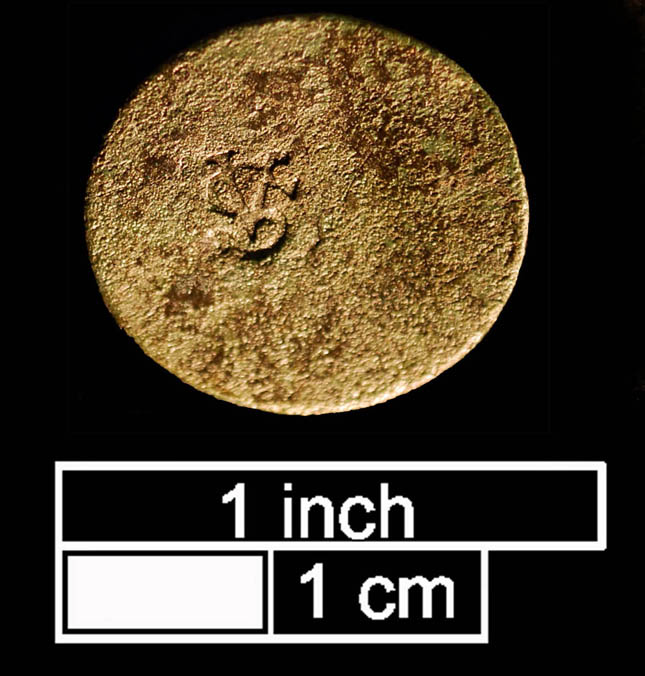
    Although Ferry Farm’s black dogg is in poor condition given both its many years in the soil and its popularity while in use, the “SV” counter stamp is clear, and refers to the island of Saint Vincent. Saint Vincent was a prize the British Crown enjoyed after the Treaty of Paris that ended the Seven Years’ War in 1763. However in 1779, the year this coin was made, the French regained control of the island for a few years. Saint Vincent was eventually returned to the British under the terms of the Treaty of Versailles in 1783, which ended the hostilities between allies France and Spain and their adversary Britain that had resulted from the American War of Independence.

    FerryFarm10-273-50-1552-Black Dogg
    The black dogg’s reverse featuring a stamped “SV” for Saint Vincent.

    At the same time, this coin may be a counterfeit produced in England. Birmingham produced many counterfeit coins, which were sometimes referred to as “stampe” or “stampee.” Since a counterfeit coin possessed some silver content, it provided some value for its users, but it was not minted by a government.  Caribbean islanders were so desperate for hard currency that even coins that were easily recognized as counterfeit circulated freely, much to the dismay of colonial governments.

    Correspondence of the time occasionally refers to people buying “a dogs worth” of a given product. In this context, “dog” referred to the currency used, not our four-legged friends. A dogs worth would represent a very small quantity. For poor people and the enslaved –  whose commerce involved trading or purchasing items of low value – coins worth a fraction of a pence were popular indeed.

    Although the black dogg coin found at Ferry Farm was of little value in the 1700s, for us today, it is an excellent representation of the far-flung British empire and of a thriving global network of trade that even reached Fredericksburg and the Washington family at Ferry Farm.

    If you’d like to learn more about 18th century coins and the colonial economy, watch the lecture “Credit and Coinage: The Economy of Colonial Virginia”.

    Laura Galke, Archaeologist
    Small Finds Analyst

  • Archaeology Camp at Ferry Farm 2018 [Photos]

    Last week, George Washington’s Ferry Farm hosted Archaeology Camp for ages 9-12.  From digging, washing, and mending “artifacts” that they “excavated” in educational mock digs at Ferry Farm, campers learned about the entire archaeology process and the importance of archaeology to history. They also visited the archaeology laboratory for a behind-the-scenes tour and learned about interpretation and conservation of artifacts and the recording of information. The camp culminated with each camper creating an artifact diorama to take home, along with a new-found knowledge of what is beneath their feet! Here are some photos of the camp.

  • Photos: The Fourth of July at Ferry Farm 2018

    Scenes from last week’s Independence Day celebration at George Washington’s Ferry Farm!  Read “Celebrating the Fourth and what makes America great” by Kristin Davis for The Free Lance-Star about the Ferry Farm and other area celebrations.


  • The Mystery of the Mane Comb

    Before there were planes, trains, and automobiles, and other engine-driven devices, people of the 18th, 19th and early-20th centuries used horses, mules, and other four-legged draft animals to transport themselves, pull their wagons and carriages, and help manage the chores of farm and rural life.

    Just like the time and expense we currently spend on car, truck, and small engine maintenance to keep those running smoothly, an equal amount of attention is essential to keeping horses healthy, clean, and physically fit so that they can perform the tasks we ask of them. The process of grooming a horse not only improves the health of their skin, coat, hooves, mane, and tails but it also allows the groomer to notice any health issues or problems that aren’t apparent until seen up close.

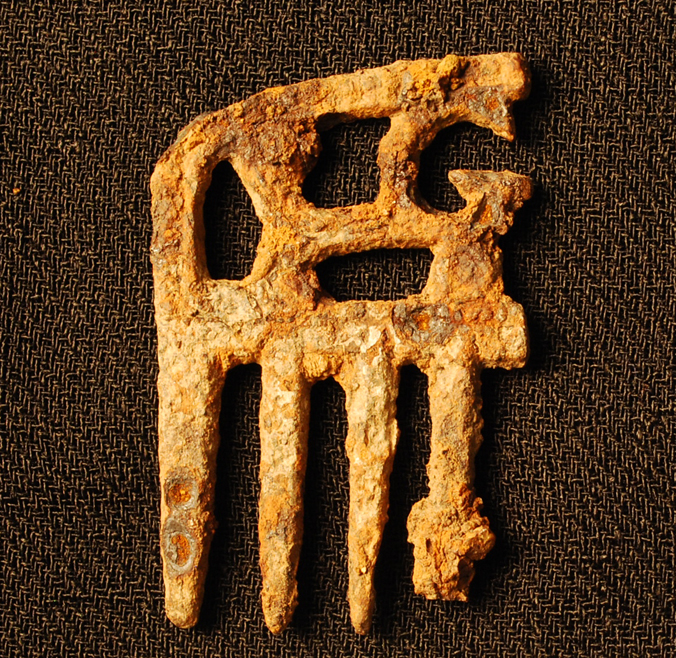
    A mane comb, an essential horse grooming tool, was excavated at George Washington’s Ferry Farm from an early nineteenth-century context. This rusty iron alloy comb is incomplete, measuring two inches high with a broken width of 1 ¼ inches.  The finished width might have been between 3 and 4 inches.  What makes this find interesting is that there is a decorative “G” inset above the comb’s teeth.  This letter was obviously followed by others, but what the complete word or initials indicate is a complete mystery.  Was the word a favorite horse’s name or just the name of the comb maker?  Was it actually a person’s name? And, of course, if it is a person name, could it possibly be George Washington’s name?

    Mane comb
    Mane comb excavated at George Washington’s Ferry Farm.

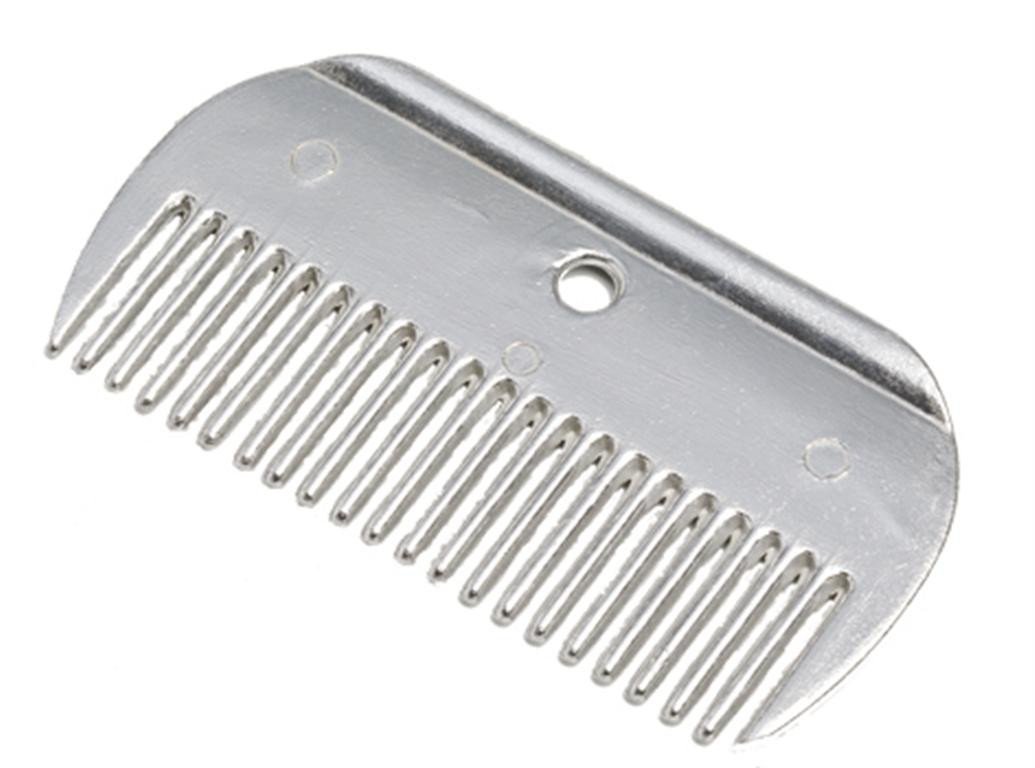
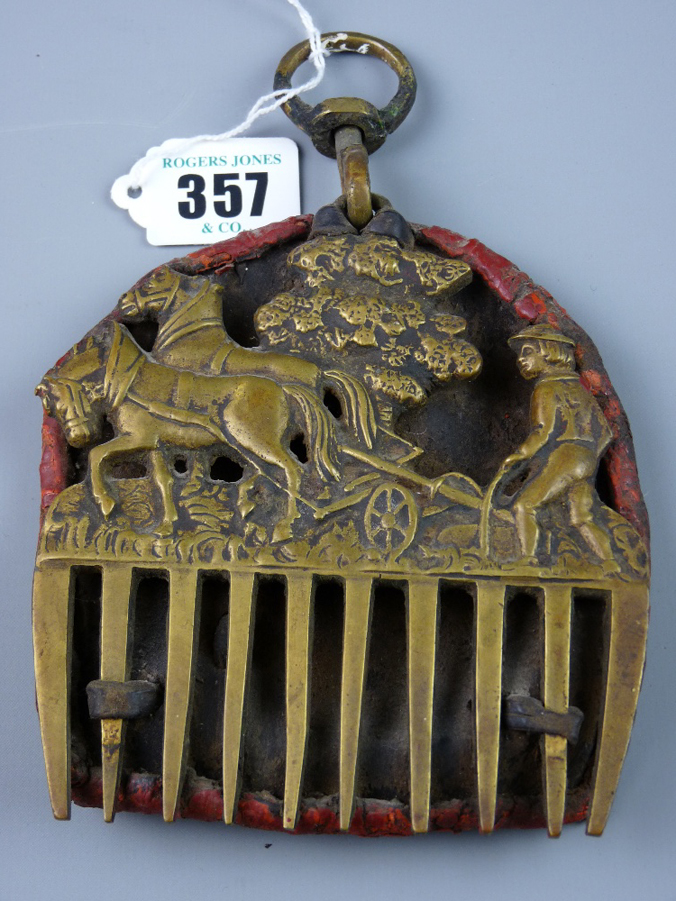
    Mane combs are just one piece in any essential grooming kit for horses, which also includes curry combs, brushes, hoof picks, and grooming cloths.  The mane comb is used to comb out the tangles and remove debris from the mane and tail of horses.  It can be very simple and utilitarian in looks, similar to a common hair comb, or more ornate and decorative, such as this example that is stored on a leather backing. Our mane comb falls between these two extremes. It does not have an elaborative top but it is still decorated within the handle area with a swirled scroll, raised beading along the outer band, and the letter “G–”.

    CT-5774-5_W-1520
    A simple modern mane comb. Credit: MyEquineStore.com
    original
    A more ornate antique mane comb with decorative handle. Credit: Roger Jones & Co.
    DRAWING OF COMB inked1
    A drawing of the mane comb excavated at Ferry Farm clearly showing the decorative inset “G”.

    Ferry Farm archaeologists are curating a number of artifacts related to animal husbandry, an assemblage dominated by utilitarian buckles. Such buckles may have been part of harnesses but these fasteners had many uses around a farm. Horseshoes are the next most frequently recovered item, and they date from throughout the 1800s and 1900s. A few are of a style of manufacture that reliably derives from the colonial era. Bits, stirrups, curb chains, and harness rings were also lost or discarded by their owners. A mid-1800s iron alloy brace for a saddle was also discovered. Ferry Farm archaeologists found evidence for mules as well, as our collection includes a few mule shoes. A few bolts for carriages or wagons were recovered. Perhaps our favorite animal husbandry objects are the brass ornaments used to embellish leather horse tack. Several of these have been recovered and all date from the colonial period, when these early New World equestrians relished showing off their fine steeds.

    So if there are any horse-loving readers out there who recognize this style of mane comb or have a clue as to what “G” could be the start of, please let us know.  We may never know but we do hope that maybe the “G” is the beginning of the name of our site’s most famous horseman, George, who was certainly well known for his horsemanship skills!

    Juby Jobrack, Archaeologist
    Assistant Lab Supervisor

    Laura Galke, Archaeologist
    Small Finds Analyst/Field Director

  • Why Did Yankee Doodle Call a Feather “Macaroni”?

    Vintage July 4th Postcard
    A vintage Independence Day postcard with the beginning lyrics of “Yankee Doodle”.

    In honor of the Independence Day, I want to talk about a pressing question I had as a child pertaining to one of our most popular patriotic songs “Yankee Doodle”.

    We all know the first verse.

    Yankee Doodle went to town
    A-riding on a pony,
    Stuck a feather in his cap
    And called it macaroni.

    The question is why did he call a feather in his cap “macaroni”?

    Macaroni does not refer to the tasty cheesy pasta dish that we all love and know.  It refers to an elaborate short-lived fashion trend in England at the end of the 18th century.  The trend started with upper-class youths who returned from their Grand Tours of mainland Europe with a great appreciation for continental style and taste.  They brought back the luxurious fabrics of the French as well as the pasta dishes of the Italians, thus macaroni was used to refer to the fashion trend.[1]

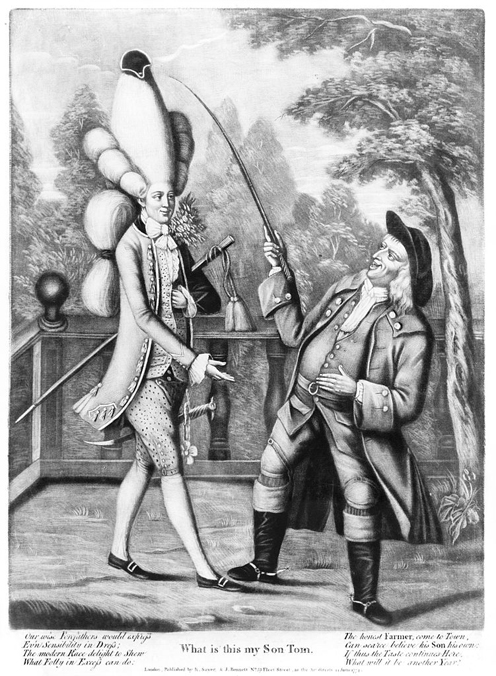
    The macaroni style consisted of a tight-sleeved coat with short skirts, waistcoat and knee breeches.  Macaroni emphasized pastel color, patterns and ornamentation like brocaded or embroidered silks and velvet.  On their head, they wore tall wigs with a rising front and “club” of hair behind that required an extensive amount of pomade and powder.  This wig was usually garnished with a large black satin wig-bag trimmed with bow.  The feet were clad in red-heeled slipper-like leather shoes with decorative buckles of diamond, paste or polished steel.  Additionally, as much ornamentation as possible was added with large floral nosegays, hanging watches, swords and tasseled walking sticks.[2]

    What is This My Son Tom (1774) published by R. Sayer & J. Bennett
    In this print titled “What is This My Son Tom” and published by R. Sayer & J. Bennett in 1774, an “honest farmer” is seen with his adult son, who has large, elaborate hairstyle and stylish clothes following the macaroni trend. Credit: Library of Congress

    To be “macaroni” was to be sophisticated, upper class, and worldly.  An elite figure marked by the cultivations of European travel, wealth and taste.

    So what did the British troops, who first sang the song about their colonial cousins, mean when they said that Mr. Yankee Doodle stuck a feather in his cap and called it macaroni?

    The song was not meant to be a compliment but rather a joke.  A “Yankee Doodle” was a simpleton who thought that just putting a feather in his hat would make him macaroni or fashionable when, in reality, he was just a country bumpkin.  He lacked class, could never mingle in high society, and was too simple to even realize it.

    It was obviously a broad generalization of Americans because in the colonies there was a broad range of fashion.  America didn’t have a global metropolis like London but wealthier colonists like Historic Kenmore’s Fielding and Betty Lewis could afford the luxurious imported fabrics and trendy ornamentation.[3]  Even with the delay in news from England the wealthy always tried to follow the a la mode styles.

    The average colonist would probably not have had a pastel silk waistcoat or stripped knee socks, however.  For them, linen, wool, cotton and linsey-woolsey were all common clothing fabrics in more natural or sedate colors.  An average person may only have had 2 or 3 outfits so durability was preferable to style.[4]

    What seems like just a silly sounding verse in a marching tune actually illustrates how the British viewed and had always viewed the colonies.   They looked down on the overseas colonies; after all if it wasn’t for the support of the Crown the initial colonial settlements might not have survived. They felt that the American colonists owed them a great deal for protection, for purveying their culture, for providing them with manufactured goods.[5]

    So, if the British were insulting Americans in “Yankee Doodle”, why is it such a common American patriotic song now?  Why would Connecticut even make it their state anthem?[6]

    As is often the case with insults leveled at a supposed inferiors by people who sees themselves as superior, the colonists appropriated the negative image of a Yankee Doodle and gave it a positive meaning.  No longer was this motley “macaroni” viewed as a garish fool but rather became a symbol of a homespun American identity.

    Yankee Doodle from Uncle Sam's panorama of Rip van Winkle and Yankee Doodle (1875) by Thomas Nast
    One of six scenes from the story of Yankee Doodle showing an Uncle Sam figure tipping his feathered top hat to the departing British represented by Britannia and the crowned lion and unicorn on King George III’s coat of arms. This scene and five others were pasted together to form a long panoramic strip on a late 19th century children’s toy made by McLoughlin Bros. and illustrated by Thomas Nast. Credit: Beinecke Library, Yale University.

    America was a place where your status in society was based on merits of work, enterprise, and earned wealth.  Your value didn’t come from an inherited title or a fancy ensemble but rather from your own abilities and hard work. In America, anyone could indeed stick a feather in his cap and rightly call it macaroni.   The British could keep their macaroni men, Americans would rather be a Yankee Doodle.

    Heather Baldus
    Collections Manager

    [1] Hair, Authenticity, and the Self-Made Macaroni, Amelia Rauser, 2004, pg 101

    [2] McNeil, Peter. “Macaroni Dress” https://fashion-history.lovetoknow.com/clothing-types-styles/macaroni-dress

    [3] The Revolution and the New Republic, 1775-1800 http://www.americanrevolution.org/clothing/colonial7.php

    [4] Baumgarten, Linda. “Looking at Eighteenth-Century Clothing” http://www.history.org/history/clothing/intro/clothing.cfm

    [5]  “Iron Tears,” a British View of American Revolution, Interview with Stanley Weintraub, July 3, 2005. https://www.npr.org/templates/story/story.php?storyId=4727956

    [6] Yankee Doodle, Connecticut State Song. https://statesymbolsusa.org/symbol-official-item/connecticut/state-song/yankee-doodle