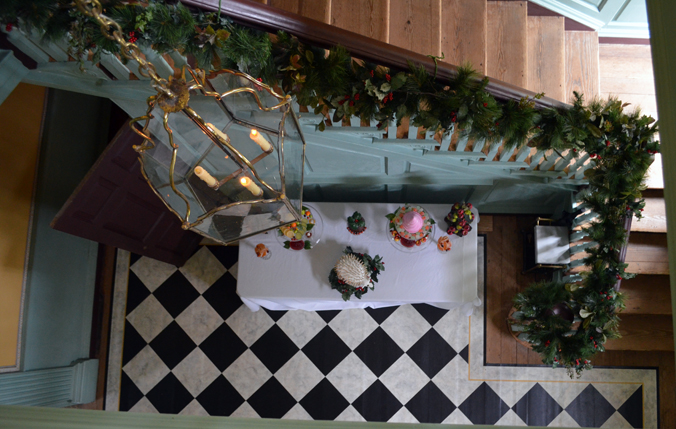
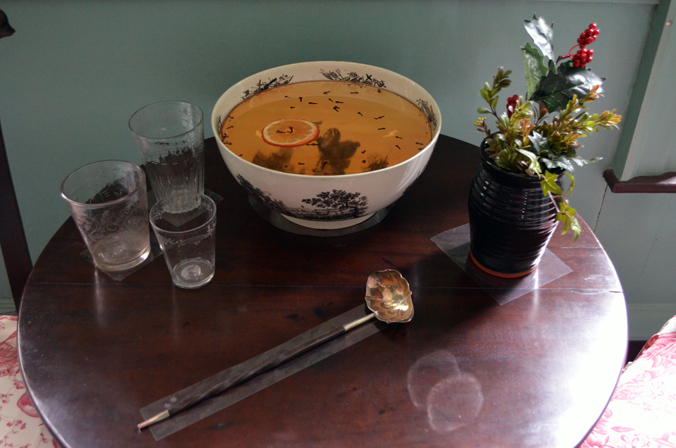
Over the years, we’ve often discussed how colonial-era Christmas celebrations and decorations were different from our own modern-day versions (read here, here, here, here, and here). Each year, throughout the month of December at Historic Kenmore, we depict the Twelfth Night festivities possibly enjoyed by the Lewis family because, in the 1700s, the main holiday celebration took place in January at the end of the Christmas season, rather than on Christmas day. We show an elaborate dessert table, loaded with fanciful sugar creations and treats, waiting for midnight revelers to partake during a break from music and dancing. We place simple jars of greenery around the house, and show a large punch bowl at the ready to serve holiday visitors. There are no Christmas trees or mentions of Santa yet – those would come later, in the 19th century.
Dessert table from overhead in the passage at Historic Kenmore.Punch bowl and tumblers in the drawing room at Kenmore.
This year at George Washington’s Ferry Farm, we have a new challenge: how do we show the Christmas season in the Washington house? The Washington family lived at Ferry Farm in the 1740s when Colonial Virginia was a more rustic place. While the Washington family was living in a far better situation than most of their neighbors, they still couldn’t imagine the luxuries that the Lewises would know at Kenmore 40 years later. So what was Christmas like for the Washingtons?
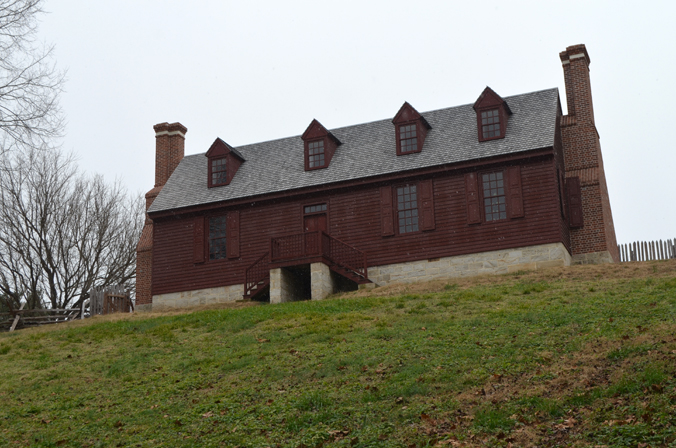
The Washington house replica at Ferry Farm as snow flurries fall on a December day at the end of 2018.
Unfortunately, we don’t have a lot of information from that early part of the 18th century to give us much detail. The Christmas season was rarely mentioned in correspondence or journal entries, and so we can surmise that the lack of mention means that the holidays weren’t an especially unusual time in the lives of most early Virginians.
Interestingly, we actually know more about the seasonal happenings of an even earlier time – that of the very first colonists to arrive in the New World during the 1600s. Because those early colonists were religiously devout, they observed the sacred aspects of the season strictly, even in the harsh environment they found themselves in after crossing the ocean. There are a number of holy days, feasts and saints’ days that occur throughout the Christmas season, and marking each of them with church services, large meals or simply readings and recitations comprised the holiday period for those early Virginians. With a few exceptions, decorations, special foods, small gift-giving, music, parties and the other secular trappings of the holiday would be largely confined to the late 18th century celebrations known to places like Kenmore. The Washingtons at Ferry Farm probably fell somewhere in between these earlier and later extremes.
Although the Washingtons probably decorated even less than the Lewises, we do have the opportunity at Ferry Farm to show one aspect of early 18th century Christmas that we cannot show in a traditional antique-filled house museum – the use of fragrant herbs.
For most colonial era churches, incense was an expensive and not easily obtained luxury. To mimic its pleasant smell during holy days, parishioners strew fragrant dried herbs on the floors of the sanctuary. As the herbs were crushed under foot, they added a pleasant holiday aroma to the room. Sage, rosemary, and thyme were the most commonly used herbs but lavender and rose petals might also be added.
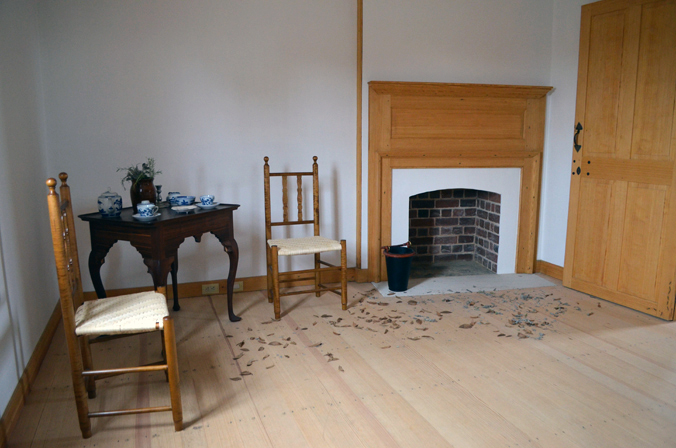
Herbs strewn on the floor of the Hall Back Room in the Washington house.
This practice of strewing herbs on the floor was adopted in private homes, too, especially when a household didn’t have a church nearby and services were conducted at home. Sachets of herbs might also be hung from doorways and windows, and small bundles of herbs might be occasionally tossed into the fire to add to the scent. The practice served to sanctify the house, but also gave people a break from the never ending parade of bad smells they encountered on a daily basis.
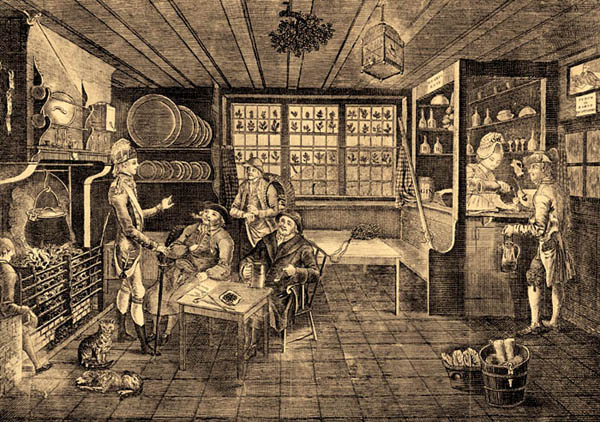
Another common practice among parishioners in decorating their churches was to place sprigs of holly and mistletoe in the muntins of the windows. Like the strewing of herbs, sprigging the windows found its way into the home and likely was the only greenery early 18th century colonial Virginians like the Washingtons used to mark the season.
Although a depiction of a tavern from later in the 18th century, this engraving shows the practice of sprigging the windows at Christmas time still continues. A ball of mistletoe also hangs from the ceiling. Settling the Affairs of the Nation. Engraving; Bowles & Carver, publishers; London, 1775.
At Ferry Farm, because the Washington house is filled with reproduction furnishings, we can use both real herbs on the floors and real sprigs of greenery in the windows. It may be much less than our 21st century eyes are accustomed to, but the Washingtons would have recognized these signs of the season right away.
Sprigged windows in the Washington house.
This holiday season, we invite you to visit both Ferry Farm and Kenmore to experience these sights and, for the first time this year, the smells of the 18th century’s evolving Christmas celebrations as marked by the Washingtons, the Lewises, and their fellow early Americans. To learn about visiting Ferry Farm and Kenmore during the holiday season and to see a list of special holiday events, click here.
Meghan Budinger
Aldrich Director of Curatorial Operations
It’s the 32nd year of a a long-standing holiday tradition: the Gingerbread Contest & Exhibit at George Washington’s Ferry Farm! This year’s theme is “Cartoon Adventures.”
“Snoopy’s Christmas Love” by Gloria Tignor
“A Minon Christmas”
“Yabba Dabba Doo” by The Feeback Family
“A Charlie Brown Christmas” by Ni River Special Education
“Hobbit House” by Chancellor High German Club
“Cartoon Advent Calendar” by Ms. Redelman’s Class at Courtland High School
“Rapunzel” by Angela Saathoff
“Frosty the Snowman” by Samantha Wainwright
“Grinch’s House” by CJ Crocker
“Scooby Doo Miner 49er Chase” by Susan Dodson
“Transformer Making a Snow Angel” by Misha Sanborn
“Calvin & Hobbes” by The Szlyk Family
“Calvin & Hobbes” by The Szlyk Family
“Whoville” by Ms. Bekah’s ECSE 3 Class
“Calvin & Hobbes Winter Wonderland” by Jessica Kamuar
“Charlie Brown’s Christmas”
“A Christmas in WhoVille” by The Jackson 5
Adults and children alike will enjoy the sights and smells of these festive creations displayed at Ferry Farm! Ferry Farm’s hours are Monday – Saturday 10:00 a.m. – 4:00 p.m. and Sunday from 12:00 p.m. – 4:00 p.m. Ferry Farm is closed Christmas Eve and Christmas Day. The gingerbread exhibit ends on December 30. General admission to Ferry Farm and the exhibit is $9 adults, $4.50 students, under 6 free while admission to the exhibit only is $4.50 adults, $2.25 students, under 6 free.
For more information, call (540) 370-0732 x24 or email [email protected].
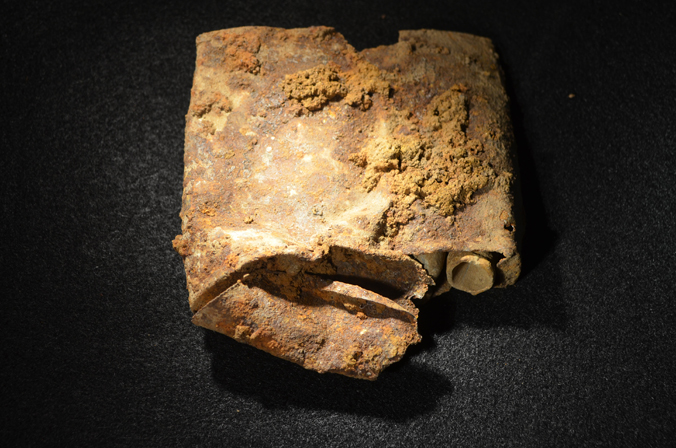
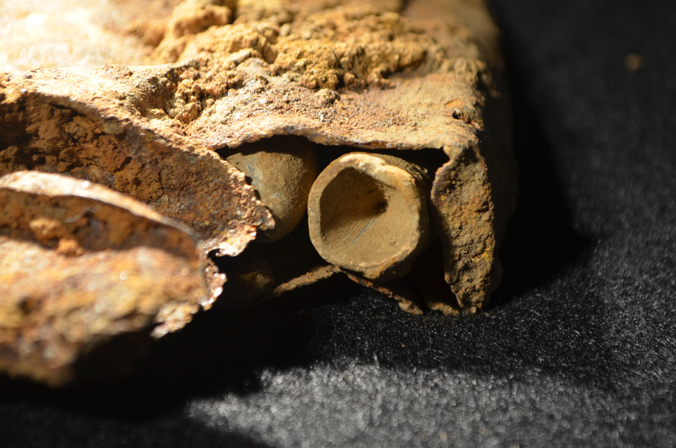
Old, crushed, and rusted food cans in and of themselves aren’t terribly interesting, at least not to me. But when the can contains 150-year-old bullets, it becomes very interesting indeed. Recently, while going through our artifact collection database, I came across an item excavated at George Washington’s Ferry Farm nearly 20 years ago and simply listed as a ‘can’. Wanting to know the exact nature of this can (Was it a food can? Was it a paint can?), I looked at the database’s comments section, which sometimes describes an artifact in more detail. The comment read: “Smashed can containing Minié balls.” Now this can had my full attention! I had the can pulled from artifact storage and was not disappointed. It was, as advertised, a flattened can with at least 3 visible Minié balls lodged inside. Furthermore, there was something not visible rattling around inside of it. Because it had simply been cataloged as a ‘can’, it escaped the notice of our crack team of research archaeologists for two decades. I began investigating!
Flattened can containing Minié balls excavated at George Washington’s Ferry Farm.The end of Minié ball sticking out of the can.
First, I wanted to know the age of the can. I knew the Minié balls dated to a little over 150 years ago when Union soldiers were stationed at Ferry Farm during the Civil War. The can, however, may have been from a later date. In oral histories, people who lived at Ferry Farm in the 20th century have mentioned collecting Civil War bullets in cans so my initial assumption was that this was the forgotten treasure of a relic hunter. The next step was to examine the other artifacts recovered with the can at the same time and in the same spot on the Ferry Farm landscape. All of these artifacts were from the mid-19th century. Furthermore, the can was excavated from smack dab in the middle of a Civil War trench that runs across Ferry Farm. So the can and the bullets were from the same time period.
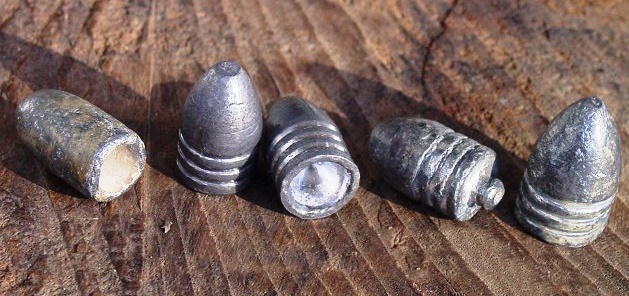
Various types of Minié balls from left to right: .577 Enfield Minié Bullet, Burton Pattern Minié Bullets .58 Springfield (x 2), Williams Bullet missing zinc base, .69 Caliber Minié Bullet for modified 1843 Springfield Musket. Credit: Mike Cumpston / Wikipedia
But the can didn’t look anything like a typical cartridge box. It looked like a run of the mill tinned food can and what was rattling around inside? It was time to do some science! I took the can to the Virginia Department of Historic Resources where their awesome conservator Katherine Ridgway was kind enough to x-ray the can. The x-rays proved the can was a food can and that the rattling object inside was another Minié ball.
While we now know a lot more about our can now, one mystery still remains. Why did a soldier store some of his bullets in a can? What we do know is that, at some point, the can was abandoned or forgotten at the bottom of the trench and then crushed either under a boot or by the weight of the dirt once the trench was filled in after the war. A 150 year old moment in time captured in the archaeological record.
Mara Kaktins, Archaeologist
Archaeology Lab Supervisor
The moment anyone mentions trees and George Washington, you probably think of the famous Cherry Tree Story. However, this tale of young George taking a hatchet to his father’s cherry tree and, when confronted about the act, asserting “I cannot tell a lie” is probably just that — a story meant to demonstrate the integrity of the Father of Our Country. In reality, the trees of Ferry Farm have a much more fascinating history. Their story reflects, on a small local scale, vast environmental changes in eastern North America and shifting American attitudes toward the environment throughout the 18th, 19th, and 20th centuries.
Today, we see wilderness as a good thing that needs protected and preserved. But in the 1700s, Europeans settlers saw wilderness as a bad thing. Preeminent environmental historian William Cronon notes, Europeans described wilderness as “’deserted,’ ‘savage,’ ‘desolate,’ ‘barren’—in short, a ‘waste,’.” People did not look at forests, deserts, or mountains as places to protect and visit. Instead, they were places to be feared and tamed.
The opposite of wilderness was the managed landscape of Europe. In cities, towns, and farms, Europeans tried to control nature and make it follow humanity’s rules. These efforts to tame the wilderness were transplanted to colonial plantations in the Americas.
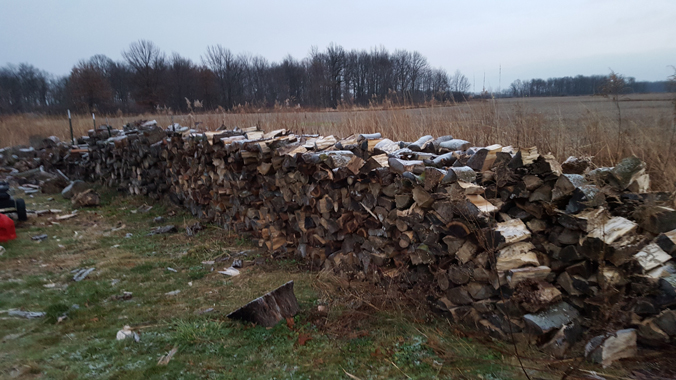
The first step in building a plantation and taming the wilderness was clearing the land for farming. Huge numbers of trees were cut down to do this. On top of that, trees were cut down to make almost everything people of the 1700s and 1800s used and owned. Furthermore, they were also cut down to do many everyday tasks.
Throughout the 18th and 19th centuries, the wood from trees was…
used as the main architectural building material in houses, most other structures, farm buildings, fences, and more
used to build ships, boats, ferries, bridges, carriages and wagons that moved people and things from place to place
used to make everyone’s furniture (beds, chairs, tables, desks, cabinets, and trunks) as well as many household items and farming tools
Five cords of firewood. A colonial home used 8 or 9 times this amount in a year for just heating and cooking. Credit: Chris StevensonCredit: Chris Stevenson
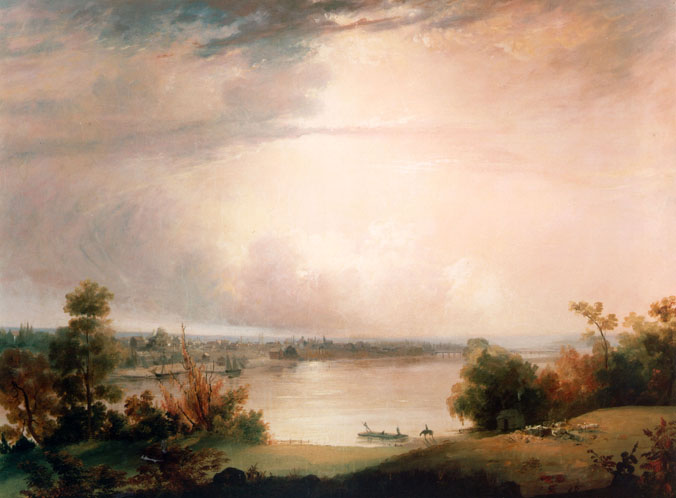
These large scale trends can be seen on a small scale at Ferry Farm. The European settlers who lived here, including the Washingtons, cut down a significant number of trees but not so many that there weren’t still quite a few standing when John Gadsby Chapman painted Ferry Farm’s landscape in 1833.
“The Old Mansion of the Washington Family” (1833) by John Gadsby Chapman shows the foundation stones of the house where George grew up at Ferry Farm and trees along the riverbank.
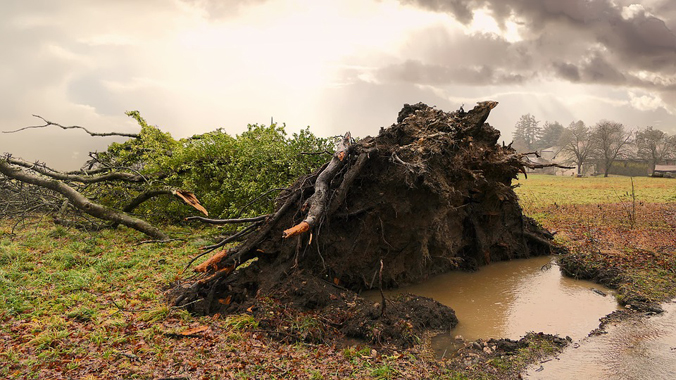
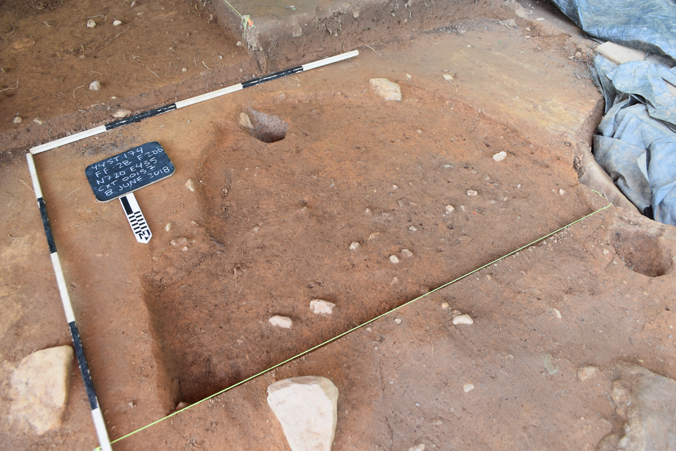
We also have archaeological evidence showing the locations of trees during the Washington era. This past summer in the yard north of the Washington house replica archaeologists uncovered “soil stains” left after trees fell in the past. Soil stains are where the soil is a slightly different color than surrounding areas and indicate where people filled in holes created by uprooted trees. In other words, such soil stains indicate that a tree once stood there.
In some cases, our archaeologists found that the holes were filled in multiple episodes, indicating that the soil settled and new dirt was later added or the person filling the hole borrowed different dirt of different colors from multiple locations. By excavating the soil from these soil stains and analyzing the artifacts, we can tell around when the holes were filled.
Soil stain marking the site of an 18th and 19th century tree on the landscape at George Washington’s Ferry Farm.
One very large tree left the sizable soil stain – almost 5ft x 5ft – pictured above. Based on artifacts found in its soil, the hole was filled during the mid-19th century. We can tell by the size of the stain that the tree was quite mature. Together, these facts are evidence of a tree that grew just 40 feet north of the original Washington house during the time George and his family lived at Ferry Farm. This discovery gives us another detail about the landscape so it can eventually be accurately recreated just as we did the main house.
Finally, Ferry Farm archaeologists learned from these tree features and from the lack of other features in this yard that the area was well-kept. In the 18th century, this portion of the landscape was probably well-maintained because it was visible from Fredericksburg across the river.
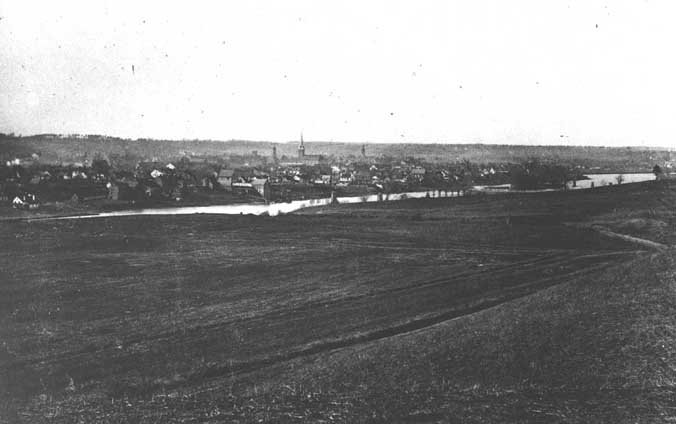
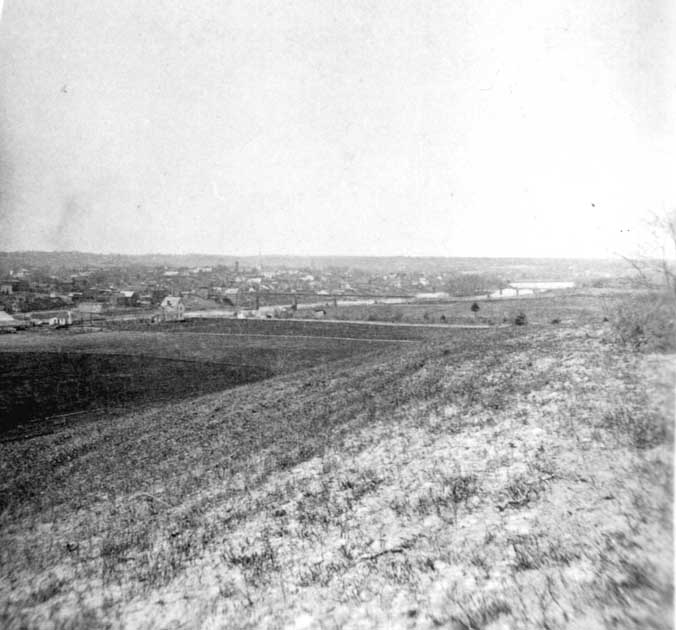
In the 1860s, the Civil War exacerbated deforestation at Ferry Farm and throughout Stafford County. Hundreds of thousands of Union Army soldiers radically altered the local environment to get the wood they needed for cooking and heating, to help build their fortifications and pontoon bridges, and even to build shelters. During winter lulls in fighting, 18th and 19th century armies did not camp in tents. The soldiers built small log cabins. By war’s end, Ferry Farm and Stafford County were nearly treeless as seen in the two photos of Ferry Farm below taken in the decades after the war ended.
View of Ferry Farm property in the 1870s.View of the Ferry Farm property in the 1880s
As the 19th century turned into the 20th, wilderness, nature, and the environment were increasingly seen as special and deserving of protection and preservation, sparking the creation of national and state parks, government agencies like the Forest Service, private conservation groups such as the Sierra Club, and, in 1872, the very first Arbor Day.
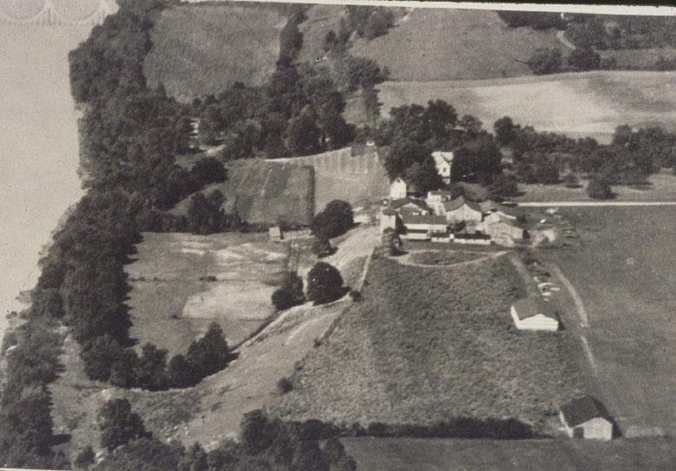
We can see the impact of new attitudes toward the environment at Ferry Farm in photos below. The top one from the 1930s, a period of intense conservation efforts nationwide, shows trees starting to appear once again while the other from 2017 shows trees on a portion of Ferry Farm stretching out as far as the eye can see to the north.
Aerial view of Ferry Farm taken in 1930.Aerial view of a portion of Ferry Farm and points north taken in 2017. Credit: Joe Brooks / Eagle One Photography
The early 20th century saw the nadir of American deforestation in 1910. But since that year, forest acres in the U.S. have largely held steady [PDF]. The new conservation ethic symbolized in the practice of planting trees to replace those cut down, the reduced use of wood as a building material and fuel source, the need for less farm land, and the movement of people from rural to urban areas (all of which present their own challenges to the environment) have provided a reprieve for America’s forests.
While George’s mythical chopping of the Cherry Tree is the most well-known tale about trees at Ferry Farm, the more important and fascinating story is how the 300 hundred year history of trees at Ferry Farm reflects broader post-settlement environmental changes in North America and how the Americans who made those changes grew to see the world differently.
When Mr. Gilchrist [the hairdresser] opened my aunt’s head, …its effluvias [bad odor] affected my sense of smelling disagreeably, which stench however, did not surprise me when I observed the great variety of materials employed in raising the dirty fabric. False locks to supply the great deficiency of native hair, pomatum with profusion, greasy wool to bolster up the adopted locks, and gray powder to conceal at once age and dirt, and all these caulked together by pins of an indecent length and corresponding color. When the comb was applied to the natural hair, I observed swarms of animalculas [small insects] running about in the utmost consternation and in different directions, upon which I …asked …[Mr. Gilchrist] whether that numerous swarm did not from time to time send out colonies to other parts of the body? He assured me that they could not; for that the quantity of powder and pomatum formed a glutinous matter which… caught and clogged [them]… and prevented their migration. Here I observed my aunt to be in a good deal of confusion, and she told me that she would not detain me any longer from better company; for …the operations of the toilette were not a very agreeable spectacle to bystanders, but that they were an unavoidable evil; for, after all, if one did not dress a little like other people, one should be pointed at as one went along.
-August, 1768 London Magazine. Quoted in Corson Fashions in Hair: The First five Thousand Years, pp. 337-338.
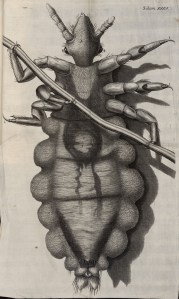
You’ve probably heard of – or even used – the term “lousy” to refer to an unpleasant situation, but were you aware that it refers to the state of being infested with lice? “Louse” is the singular form of the plural “lice.” The continued popularity of terms such as “lousy” and “nitpicking” reflects the enduring legacy we’ve inherited from a long history of human lice infestations.
A louse as depicted in Hooke’s Micrographia. Credit: National Library of Wales. Public Domain.
Lice feast upon the blood from their reluctant hosts, and their rapacious bites make the scalp itch incessantly. During the colonial era, desperate hosts combated these voracious pests by cutting their hair short or shaving it off altogether!
In the 1700s, the most popular hair styles for adults combined greasy pomade with by a liberal (and frequent) application of hair powder (often wheat flour-based). The resulting impenetrable pasty blend of lard and starch provided an irresistible condiment for pests of all kinds. Hair thus embellished demanded careful maintenance. The frequency of hair care depended upon individual preference, availability of a trusted hairdresser, the presence of pests, and how the hairstyle’s veneer of pomade-and-powder responded to the weather (hot weather and rain, for example, prove devastating).
Combating pests was so stressful that many found wearing a wig (or ‘peruke’) less troublesome than maintaining one’s own hair. Wigs can be removed, cleaned, boiled, combed, and have requisite unguents applied by a hairdresser without the wearers being involved. A cleaned and dressed peruke was presented to its owner without the time and discomfort associated with having these procedures applied directly to his scalp.
Until the later decades of the 1700s, wearing wigs was essential for most fine gentlemen. Women might wear wigs if some illness caused the loss or thinning of their own hair, but wearing them as fashion accessories was frowned upon for ladies during the 17th and much of the 18th centuries. Well-heeled ladies grew their own hair long and – especially in the final decades of the 1700s – piled it ever higher upon the top of their head. Architecture was even influenced by the tall styles of both men and women, as doorways became higher or arched to accommodate soaring headdresses.
Whether part of a wig or confined to one’s own locks, prolific hair was fashionable and wool pads increased their towering heights dramatically. Purchasing separate lengths of curled hair to augment feminine hairstyles was especially popular among refined ladies. Thomas Jefferson purchased such curls for an esteemed female family member from a Williamsburg wig shop in 1770.
In this print titled “What is This My Son Tom” and published by R. Sayer & J. Bennett in 1774, an “honest farmer” is seen with adult son, who has large, elaborate hairstyle and stylish clothes following the macaroni trend. Credit: Library of Congress
A satirical view of the “Coiffure à la Belle Poule.” Public domain. Credit: Henri Moreau/Wikipedia.
Laborers, however, required practical hair styles that could withstand the strenuous environmental conditions and exertions of their physical tasks. The 18th century hairstyles of dedicated workers reflected the minimal time they possessed to style and maintain their hairstyles. These people wore their own hair in easy-to-maintain styles: under most circumstances they simply couldn’t afford the time, products, or talented hairdressers required of fancy hairstyles.
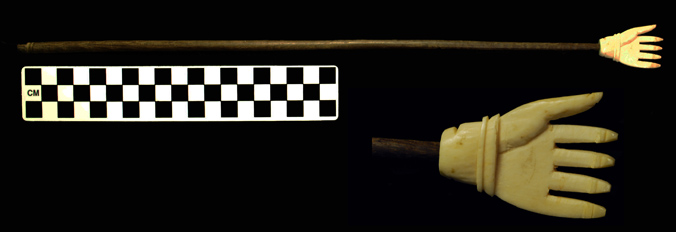
The greasy pomade-and-powder enhanced styles of refined men and ladies attracted dust in addition to insects. Scalps were tickled by crawling insects, plagued by biting lice, and irritated by an accumulation of products: they itched! Men could reach under their wig for a quick scratch or, if alone, could remove their wig for a well-earned scrape. For those men and women who wore their own pomaded hair, a clumsy, direct manual scratching by hand disturbed their inflexible tresses. Head scratchers (or grattoirs), such as the one shown below, allowed people to itch their scalp while minimizing the damage done to their elaborate styles, stiffened as they are by layers of pomade and powder. The hairpins that festoon elaborate hairstyles also provided a means of relief: discretely shifting those hairpins back and forth across one’s scalp strategically satisfies itchy crowns. Of course, the lard-infused pomade attracted not only pore-clogging dust, but additional insatiable insects and even rodents.
This head scratcher, or ‘grattoir,’ allowed its owner to scratch their scalp without disturbing their stiff, pomade-and-powder-encrusted hairstyle. It features a wooden handle and an ivory hand (inset), a popular motif in these essential tools.
Bugs were such a fact of life that etiquette about the manner in which to deal with these pests while under the scrutiny of company was carefully considered. ‘Pest protocols’ were included in The Rules of Civility and Decent Behavior in Company and Conversation, a conduct manual written in the late 16th century that young George Washington copied word-for-word as part of his gentlemanly education during his time at Ferry Farm. There were 110 rules, and Washington carefully numbered each one. Dealing with those ever present vermin infesting bodies was number 13 on his edition:
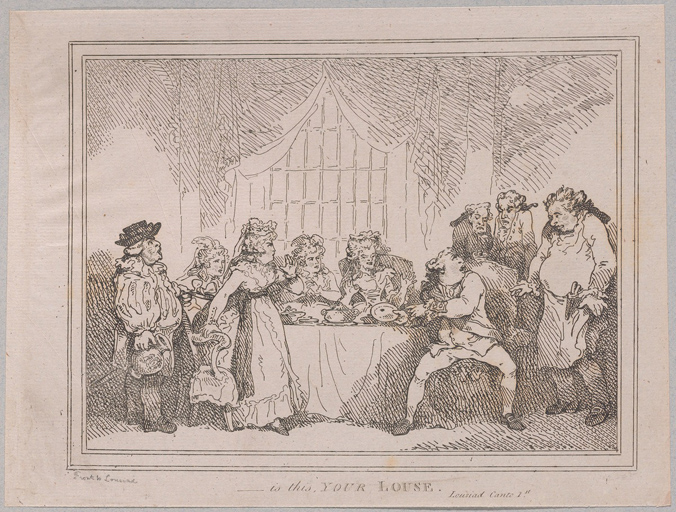
From servants to sovereigns, blood-sucking head lice were a nuisance for all. Speaking of itchy crowns, King George III encountered a louse on his dinner plate! He blamed the kitchen staff for this uninvited dinner guest.
“Is this Your Louse?” King George III queries a member of the kitchen staff after discovering a louse on his dinner plate. Thomas Rowlandson, 1787. Lewis Walpole Library.
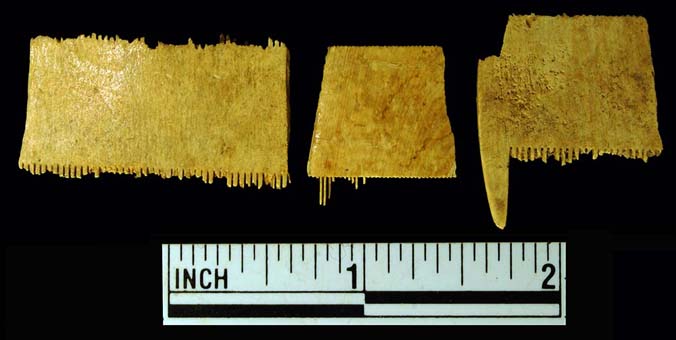
The eggs of these pests, called nits, are really small. Nitpicking is tiresome. Fine-toothed combs, just like those found at Ferry Farm (see photo), enjoy millennia-long application in the battle against these parasites worldwide. But, some cautioned that combing hair caused headaches if done too frequently! Combing once every week or two was ideal. Between fear of water, ineffective soaps, and an aversion to combing, hairstyles might go weeks or even months without being combed.
These bone grooming comb fragments are from Ferry Farm. Their delicate teeth are missing because they have broken off and decayed over time.
Keeping hair short, or shaving it altogether, was an effective deterrent against these pests. Unlike one’s own hair, wigs could be boiled and baked to ensure lice and their eggs (‘nits’) are destroyed. However, without proper maintenance, wig hair could host just as many pests as natural hair. In 1664, Samuel Pepys was dismayed to discover that the brand new peruke he purchased was infested with nits and lice.
Hairstyle historian Maria Jedding-Gesterling claims that some desperate hirsute fashionistas tucked insect traps within their towering coiffures. Fabrics soaked in blood or honey lured hungry fleas into these pierced ivory traps. And for those people who had surrendered in the war against insects, wearing clothing that was flea colored provided a savvy strategy for hiding those intimate, tiny bedfellows. Flea-colored clothing became popular in the mid-1770s, even among the Court at Versailles.
Is your head itching? Mine is!
Laura Galke, Archaeologist
Small Finds Analyst
Further Reading
For young scholars/general interest:
Fisher, Leonard Everett. 2000 [1965]. The Wigmakers. Benchmark Books, New York.
Galke, Laura. 2015. Wigs, 1715-1785. In Clothing and Fashion: American Fashion from Head to Toe, Volume 1, Pre-Colonial Times through the American Revolution, edited by Jose Blanco F., and Mary D. Doering, pp. 301-303. ABC-CLIO, Santa Barbara.
Huey, Lois Miner. 2014. Ick! Yuck! Eew! Our Gross American History. Millbrook Press, Minneapolis.
Hunt-Hurst, Patricia. Wigs, 1776-1819. In Clothing and Fashion: American Fashion from Head to Toe, Volume 2, The Federal Era through the 19th Century, edited by Jose Blanco F., and Patricia Hunt-Hurst, pp. 267-268. ABC-CLIO, Santa Barbara.
Trasko, Mary. 1994. Daring Do’s: A History of Extraordinary Hair. Flammarion, Paris.
Vincent, Susan J. 2009. The Anatomy of Fashion: Dressing the Body from the Renaissance to Today. Berg, New York.
For mature researchers:
Arnold, Janet. 1970. Perukes and Periwigs. Her Majesty’s Stationery Office, London.
Bristol, Douglas Walter, Jr. Knights of the Razor: Black Barbers in Slavery and Freedom. Johns Hopkins University Press, Baltimore.
Brown, Kathleen M. 2009. Foul Bodies: Cleanliness in Early America. Yale University Press, New Haven.
Corson, Richard. 2012 [1965]. Fashions in Hair: The First Five Thousand Years. Peter Owen, London.
Cox, J. Stevens. 1965. The Wigmaker’s Art in the 18th Century. George S. MacManu Company. Philadelphia.
Cruse, Jen. 2007. The Comb: Its History and Development. Robert Hale, London.
Festa, Lynn. 2005. Personal Effects: Wigs and Possessive Individualism in the Long Eighteenth Century. Eighteenth-Century Life. 29(2):47-90.
Galke, Laura. 2018. Tressed for Success: Male Hair Care and Wig Hair Curlers at George Washington’s Childhood Home. Winterthur Portfolio 52(2):1-51.
Jedding-Gesterling, Maria
1988 Regency, Rococo and Louis XVI (1715-1789). In Hairstyles: A Cultural History of Fashions in Hair from Antiquity up to the Present Day, edited by Maria Jedding-Geserling. Hans Schwarzkopf, Hamburg. Pp. 119-148.
Kern, Susan. 2010. The Jeffersons at Shadwell. Yale University Press, New Haven.
Kwass, Michael. 2006. Big Hair: A Wig history of Consumption in Eighteenth-Century France. The American Historical Review 111(3):631-659.
Moore, William. 1780. The Art of Hair-Dressing and Making it Grow Fast, Together With a Plain and Easy Method of Preserving it; With Several Useful Recipes, Etc. Printed for the Author by J. Salmon, in Stall-Street, Bath.
Pointon, Marcia. 1993. Hanging the Head: Portraiture and Social Formation in Eighteenth-Century England. Yale University Press, New Haven.
Richardson and Urquhart. 1778. The New London Toilet: or, a Compleat Collection of the Most Simple and Useful Receipts for Preserving and Improving Beauty. Printed for Richardson and Urquhart, London.
Sherrow, Victoria. 2006. Encyclopedia of Hair: A Cultural History. Greenwood Press, Westport, Connecticut.
Stewart, James. 1782. Plocacosmos: or the Whole Art of Hair Dressing; Wherein is Contained, Ample Rules for the Young Artizan. Printed for the Author, No. 12, Old Broad-Street, London.
Warwick, Edward, Henry C. Pitz, and Alexander Wyckoff. 1965. Early American Dress: The Colonial and Revolutionary Periods. Bonanza Books, New York.
On December 14, 1799, as George Washington lay in his final moments on his death bed, he told his secretary Tobias Lear what were likely his last words. Tobias recalled later:
Why did George feel the need to state this on his death bed? These were his last known words, and must have been a thought of importance to Washington. Taphophobia, or the fear of being buried alive, may, in part, explain his final words.
The medical field advances constantly and surprises us every day with new knowledge of the human body. DNA testing, cancer screening, vaccines, bionic limbs… I could go on forever about how the world of medicine has evolved. Today, it’s hard to imagine life before these advances when something as simple as detecting death was not even clear cut.
Technological and medical advancements in the mid-20th century brought us machines that could detect even a very faint heartbeat – the surest sign of life – and, by that time, people were no longer as concerned with accidentally being pronounced dead. Certainly, after embalming became standard, people were even less worried about waking in the grave because one could not survive the embalming process.
In earlier centuries, however, being incorrectly pronounced dead and accidentally buried was a real possibility and a common fear. George Washington wasn’t alone in taking precaution to ensure he was not buried prematurely. Several historical figures, the best known being Edgar Allen Poe, were taphophobic, as were some other members of the Washington family.
A Brief History of Being Buried Alive (Vivesepulture)
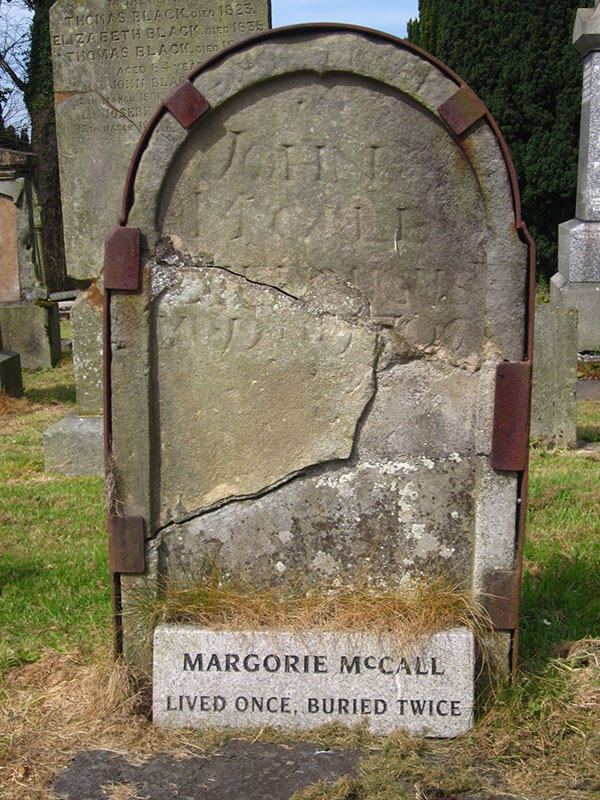
Have you heard the tale of Margorie McCall, whose tombstone in Lurgan, County Armagh in Northern Ireland reads “Margorie McCall, Lived Once, Buried Twice”? As her story goes, in 1705, poor Margorie fell ill with fever (fever being a catch-all term for illnesses not yet identified). Her husband, a doctor, was sick with worry as many people during the time rapidly succumbed to now treatable ailments. When Margorie died, her husband, aware of how rampantly sickness could spread, had her buried quickly.
As soon as the dirt settled, grave robbers aware of Margorie’s wealth decided to loot her grave. She was buried with her wedding ring, which was of considerable value. The grave robbers could not pull off the ring due to swelling, so they used a knife and began to remove the finger. The moment she was cut, a confused Margorie awoke, presumably giving the grave robbers the fright of their lives. They fled, and she wandered back home to make a full recovery, have children, and outlive her husband.
While the grave of Margorie McCall is real, the legend may be just that – a legend. “Lady with the ring” tales existed in several European countries from the 14th through the 18th centuries and continued into American folklore. The place, names, and dates were different, but the fate of the lady remained the same. But why would people believe it? Why was it passed on for centuries?
Well, in part, this and similar stories were spread by anti-premature burial activists (Yes, this was a thing.) in European countries in the 18th and 19th centuries. Some authors even sold pamphlets on the subject of premature burial, and used “lady with the ring”-style stories to agitate fear on the subject. Dr. Franz Hartmann, published a pamphlet entitled Buried Alive: An examination into the occult causes of apparent death, trance and catalepsy in 1894, that was filled with gruesome (and mostly untrue) tales of premature burial. These kinds of stories resonated and instilled taphophobia in everyday people.
How to be Sure that Someone is Dead
Taphophobia was a fear with some validity. Indeed, for most of history, the only sure way to determine that life was extinguished from a person was noticeable decomposition.
Just before Hannah Bushrod Washington, George Washington’s sister-in-law, died two years after George’s death, she made a specific request regarding the treatment of her body after death. She wrote in her will that since:
For several reasons – spread of disease, the smell, etc. – not everyone was comfortable with or had the means to allow a corpse to decompose above ground.
So, how did people in earlier centuries make certain that they didn’t bury a living person? One way was to remove the heart of the deceased. Some instances exist of people putting in their will to have their heart removed or to even be decapitated before burial. For those that didn’t want to accidentally have their still-beating heart removed, as this may have been an even worse fate than the premature burial itself, there were other options to be sure that a corpse was really a corpse. Pouring liquid ammonia into the nose, burning the bottoms of the feet with an iron, and pricking needles underneath the fingernails, for example, were ways to rouse a person in a death-like state. As cringe-inducing as all of these options are, it’s not surprising that they would indeed wake someone who was only unconscious. Additionally, tobacco pipe enemas were considered another useful way to rouse the dead. Putting a light source behind the fingers to look for signs of circulation, or a “diaphanous test”, was a less painful way to look for life.
The Old Tomb where George Washington was originally buried in 1799 before ultimately being moved to the New Tomb, which Washington had ordered built in his will, in 1831. Credit: Sarah Stierch / Wikipedia
Why They Mistook the Living for Dead
Ideally, one just waited the customary three days before burial, but that was not always feasible. During epidemics before the spread of disease was fully understood, hasty burial of the sick was common.
Today, with medical advances and a much better understanding of the human body, the likelihood of misidentifying death is minimal, but it is not unheard of even in the modern era when people suffer rare conditions that cause them to appear dead. There are many death-like conditions that can fool us. Catalepsy, a condition that can leave you unresponsive and immobile for minutes, days, or even weeks was rare and unknown to past physicians. Catalepsy can accompany a variety of mental disorders, which themselves were not well understood, even into the 20th century. “Sleeping sickness”, or African Trypanosomiasis, was a very real condition caused by the bite of a tsetse fly that caused a coma-like state that led to people being presumed dead in the 19th century. Several other conditions that result in unconsciousness even today like seizures, diabetes, dehydration, and low blood pressure could have been the culprits in people being presumed dead before the modern era.
Being shot in the head would also constitute as a condition that could lead doctors, even today, to believe you were dead. But, in May of 1799, about 7 months before George Washington’s death, an article was published in a Philadelphia newspaper telling of a soldier who had been shot in one temple, the bullet exiting the other temple. Even today most would assume death of the victim was imminent. A grave was even being dug and the soldier prepared for burial. However, a fellow soldier “thought that he noticed symptoms of animation” in the man. Unbelievably, the man was miraculously alive and gaining consciousness. The lucky soldier was attended by a surgeon and made nearly a full recovery, suffering later only some weakness in his eyes. Had George perhaps heard of this, and possibly have been startled by the fact that this man was nearly buried alive?
How to Not Bury Someone Alive
When burial couldn’t wait, or when the deceased or the family of the deceased were really taphopohbic, there were avenues to ensure an escape from the grave, if the dead returned to life. The use of bells was perhaps the most affordable way to watch for premature burial. Bells were tied to the body and hung on the ground surface above the grave. The bell would ring if there was movement below ground. This is where the term “dead-ringer” originates.
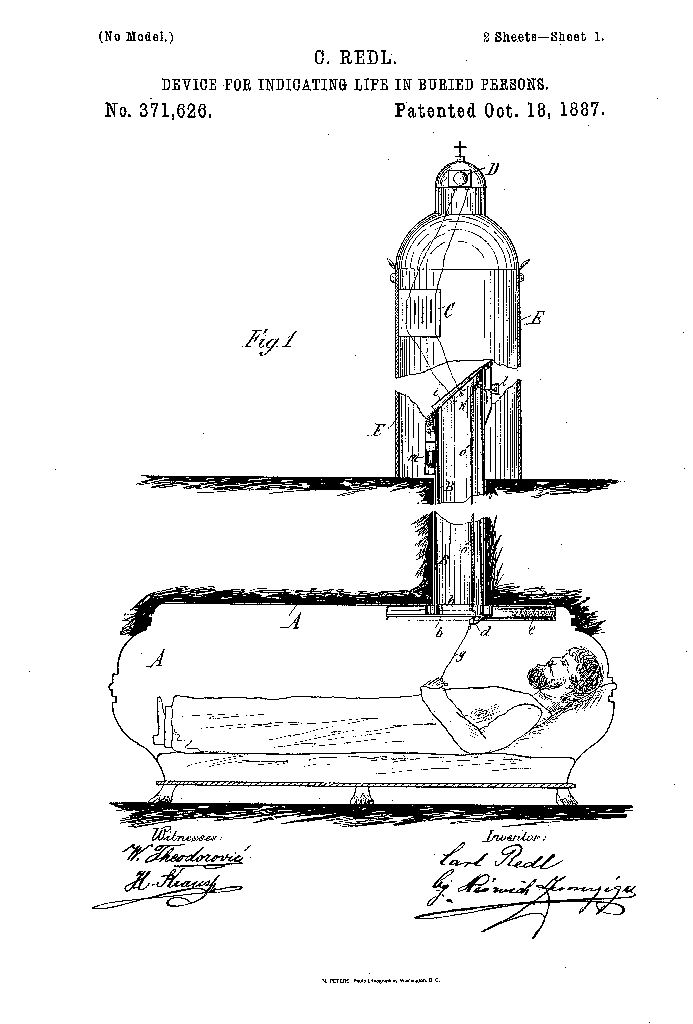
Other inventions required a bit more expense, so not everyone had access to them. “Safety coffins” were gave piece of mind to the loved ones of the deceased. Some featured an air pipe AND an alarm system that indicated movement if a buried person became conscious. Air pipes would be removed once the smell of decomposition set in or a sufficient amount of time had passed.
Patent drawing for a safety coffin. Credit: U.S. Patent Office
The first “waiting mortuary” or Leichenhaus, was designed in Germany in 1792. A worker, called a Leichenhäuser, would be expected to sit vigil at the window of the corpse room and await movement. Workers were not allowed to leave the “patients” for any period of time, and were required to have equipment to resuscitate a person if they stirred.
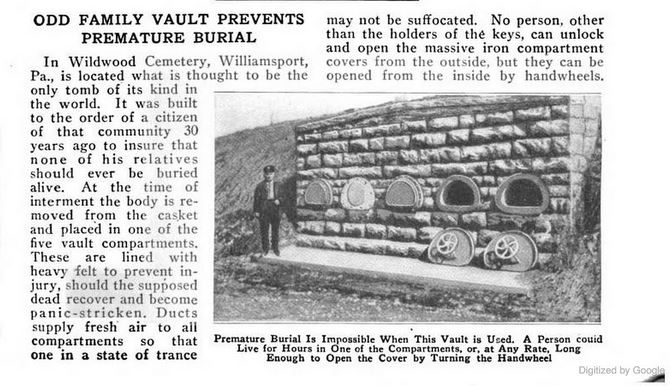
Similarly, a special vault was once built in Wildwood Cemetery in Williamsport, Pennsylvania that featured air flow and hand wheels on doors for those who awoke in the vault to help them escape. It was used as a safe holding area to give the deceased time to revive before being removed to their grave in another part of the cemetery.
Wildwood Cemetery’s special vault in Williamsport, Pennsylvannia as featured in the July 1921 edition of Popular Mechanics.
There were many normal reasons for relocating a family member’s body, just as George Washington’s body was moved into the new vault at Mount Vernon 32 years after his death. What wouldn’t be considered normal, would be to find that the deceased had rolled over, pulled out their hair, or scraped off their fingernails on the interior of the coffin lid. Opening a burial vault for the first time in years to relocate a body, or to inter another family member, only to come to the realization that the person was clearly not dead when they entered the grave, was a common fear. Stories existed of family finding the skeleton of a deceased relative inside a vault but outside of their coffin, having apparently starved to death in the mausoleum. No doubt some of these stories were fictional, but some were probably true as well.
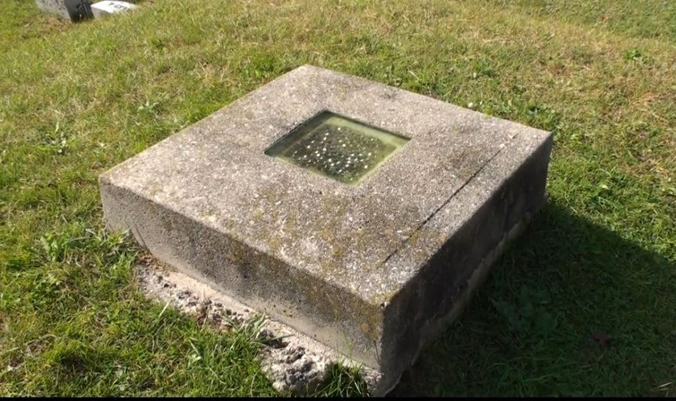
Finally, glass windows allowed people to see into the grave vault. They weren’t always installed just for fear of premature burial. Families have been known to install grave windows for other reasons that have to do with the mourning process. They were a useful tool, however, in being able to make sure the dead had not woken up. Some famous examples of grave windows still exist today.
A window into the grave of Dr. Timothy Clark Smith in the Evergreen Cemetery in New Haven, Vermont. Credit: Vermonter.com
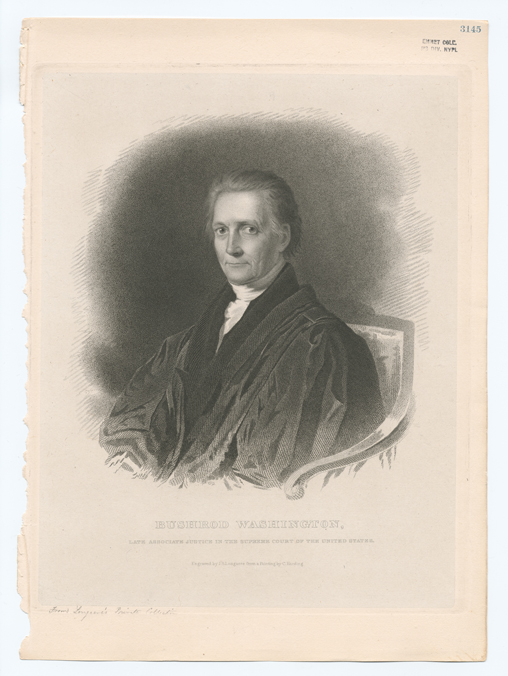
Upon his death in November of 1829, Bushrod Washington, Hannah Bushrod Washington’s son and George Washington’s nephew, requested a special coffin to be placed in for a while before burial on top of a waiting period to be sure he was actually dead:
Bushrod Washington was George Washington’s nephew, the son of John Augustine Washington, and an Associate Justice of the Supreme Court of the United States. Depicted in an engraving made in 1830 by James Barton Longacre from a portrait by Chester Harding. Credit: New York Public Library.
A “phobia” is a word used in terms of an irrational fear. But was taphophobia really irrational in the 18th and 19th centuries or was it simply justified caution? Ultimately, we will never know how many people tragically succumbed to vivesepulture. What we do know is that George Washington made certain that he would not.
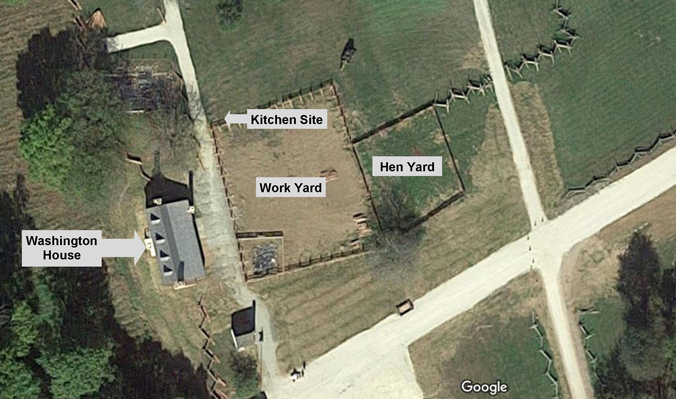
Twenty years ago, archaeologists digging at George Washington’s Ferry Farm unearthed the remains of a mid-eighteenth century kitchen. It was immediately obvious from the state of the artifacts that this kitchen had not simply fallen into to ruin and been abandoned – it had burned down. While this is fairly interesting in and of itself, a reexamination of the kitchen fire artifacts this year revealed surprising information about the intensity of the fire.
Overhead image of George Washington’s Ferry Farm showing location of the kitchen that burnt down in the 18th century. Credit: Google
What first struck us was the sheer density of artifacts in this kitchen. We recovered A LOT of artifacts. Furthermore, these broken sherds could be mended to form almost whole bottles, crocks, jugs, pans, and such. The number of artifacts and the fact they could be put together to form entire objects tell us that the Washington family and their slaves did not have much, if any, time to salvage what was inside the burning kitchen. Food, wine bottles, food storage and preparation vessels and utensils, furniture, and more all destroyed exactly where they stood. Think of this kitchen as a mini Pompeii or Titanic. Just about everything that the Washington’s had in their kitchen went down with the ship and was still there, just squished and burned.
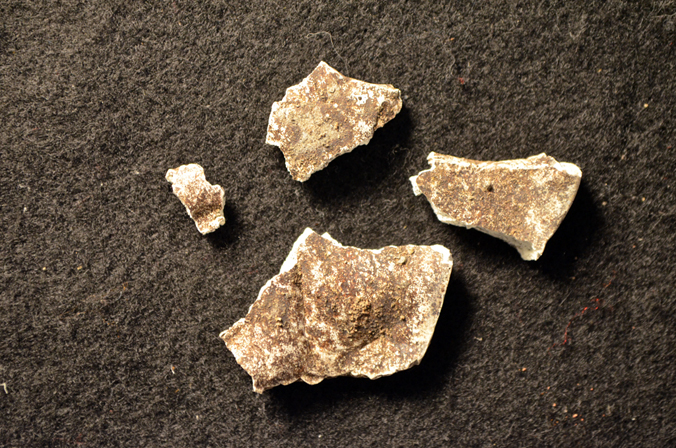
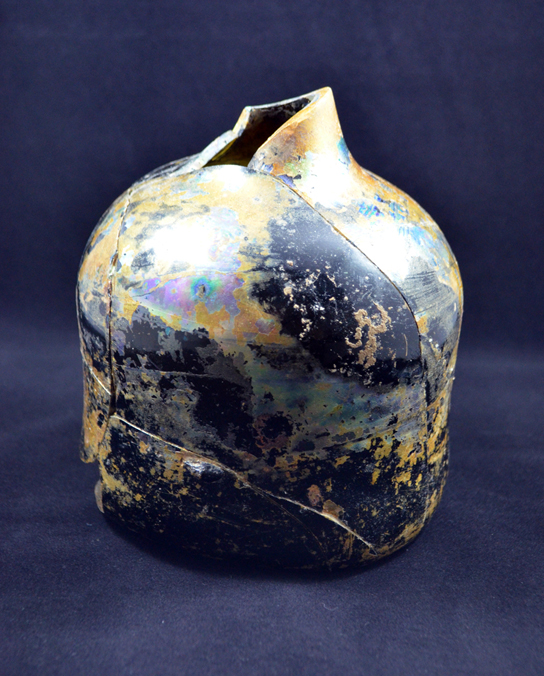
A preserved moment in time like this fire is a great opportunity for archaeologists to study the Washingtons but it comes with one big problem—most of the artifacts were totally cooked and absolutely toasted beyond recognition in some cases. Soft metal artifacts made from lead and copper, for example, were reduced to melted blobs by the fire. Ceramic vessels appear to have exploded from the heat and were reduced to blackened sherds. Some of the glass bottles survived with a minimal amount of warping from heat but the majority were melted or even burned in a process called ‘devitrification’. And oddly enough there was very little animal bone, which is usually ubiquitous in kitchens found archaeologically.
To put the intensity of this kitchen fire in context here are some quick statistics (in Fahrenheit):
Lead melts at 621.4 degrees.
According to the National Institute of Fire and Safety Training, the average modern house fire tops out at around 1,100 degrees.
1,400-1,800 degrees is the temperature at which bone will be destroyed
Copper melts at 1,984 degrees
Glass melts between 2,600 and 2,800 degrees.
Since the Washington kitchen fire was hot enough to actually burn glass, not just melt it, we’re looking at a fire that likely exceeded 2,800 degrees. That’s incredible! It also explains why there was so little animal bone recovered. Most bone was probably completely destroyed by the flames.
Extremely burned tin glaze ceramic recovered from the kitchen site at Ferry Farm.Devitrified glass from the burnt Washington kitchenMelted copper alloy excavated from the Ferry Farm kitchenBlobs of lead alloy recovered from the kitchen siteSlightly burned wine bottle from the kitchenA second slightly burned wine bottle
So, how on earth did the fire get that hot? We’ll probably never know, unfortunately. Some possible explanations may be the environmental conditions at the time of the blaze – a hot dry day with high winds could produce a perfect storm for a wooden kitchen to turn into an inferno. The fire also may have started at night when few people were awake to notice and try to put it out, although presumably the kitchen housed enslaved people, as was common for that time period. Another culprit may have been what was kept in the kitchen. There were dozens of wine bottles in there. While we call them ‘wine’ bottles today, they were actually all-purpose vessels that held any kind of spirituous liquid including harder alcohol like gin, whiskey, and rum, which are highly combustible. Animal products such as lard, tallow, beeswax, and even whale oil for lamps were likely stored in the kitchen and all burn quite well for long periods of time.
Regardless of the fire’s cause, it is clear from archaeological evidence that it happened quickly because not much within the structure could be saved, if anything. We also know that it burned extremely hot and for a sustained period of time in order to have caused so much damage to the items within.
Finally, perhaps, the last and the biggest mystery is where the replacement kitchen was located. Kitchens were almost all outbuildings because, as you may have deduced, they tended to catch on fire easily. A colonial household absolutely required a kitchen, however, and another would have been built almost immediately. Somewhere on the landscape at Ferry Farm, there is another kitchen waiting to be discovered archaeologically.
In the meantime, The George Washington Foundation plans to reconstruct the original Washington era kitchen so visitors can experience the sights, sounds, and smells of an eighteenth century kitchen, minus the blazing inferno, of course.
Mara Kaktins, Archaeologist
Archaeology Lab Supervisor
Ceramics & Glass Specialist
This past weekend at Historic Kenmore, the Fredericksburg Theatrical Society presented three performances of the 18th century play The Lying Valet at Historic Kenmore. Here are some photos of the play.
(l-r) Roody Labaze as Sir Gayless, Christian Humphrey as The Lying Valet Timothy Sharp, and Brianne Cook as Miss Kitty Prye
Brianne Cook as Miss Kitty Prye
Roody Labaze as Sir Gayless
Gabrielle Fox as Mistress Melissa
Christian Humphrey as Timothy Sharp, The Lying Valet
Brianne Cook as Miss Kitty Prye
(l-r) Christian Humphrey as The Lying Valet Timothy Sharp and Roody Labaze as Sir Gayless
Gabrielle Fox as Mistress Melissa disguising herself as a Frenchman
The cast of the Lying Valet: (l-r) Brianne Cook, Gabrielle Fox, Wilson Pezzuto (director), Christian Humphrey, and Roody Labaze
Brianne Cook as Miss Kitty Prye
(l-r) Christian Humphrey as The Lying Valet Timothy Sharp and Roody Labaze as Sir Gayless
Christian Humphrey as Timothy Sharp, The Lying Valet
Gabrielle Fox as Mistress Melissa disguising herself as a Frenchman
The cast of the Lying Valet: (l-r) Brianne Cook, Gabrielle Fox, Wilson Pezzuto (director), Christian Humphrey, and Roody Labaze
Gabrielle Fox as Mistress Melissa
(l-r) Roody Labaze as Sir Gayless, Christian Humphrey as The Lying Valet Timothy Sharp, and Brianne Cook as Miss Kitty Prye
Roody Labaze as Sir Gayless
Brianne Cook as Miss Kitty Prye
Check kenmore.org/events for event listings of future theater productions and other special tours, exhibits, and programs or follow us on Facebook.
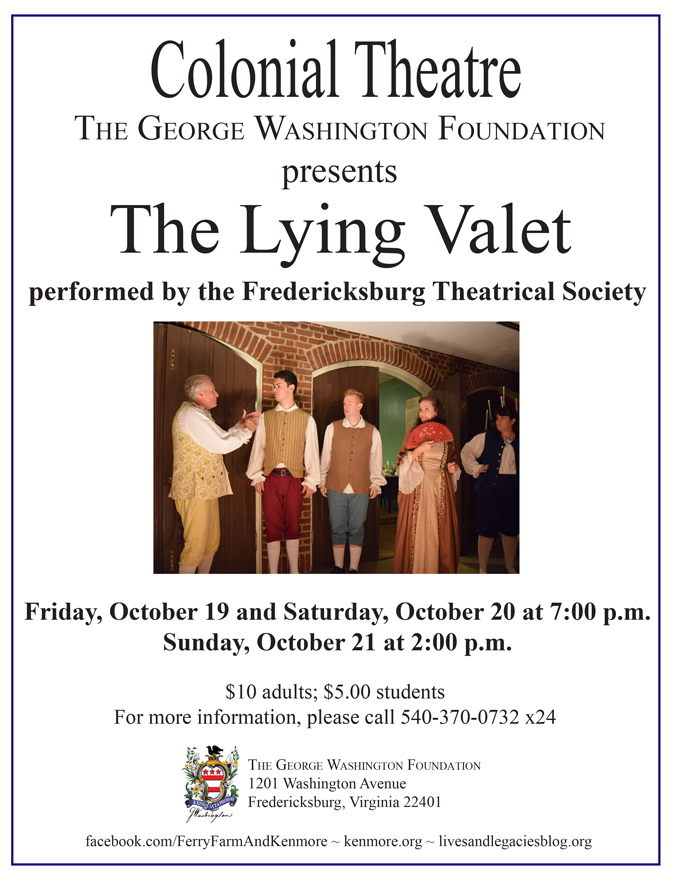
This weekend at Historic Kenmore, The George Washington Foundation will present three performances of The Lying Valet performed by the Fredericksburg Theatrical Society.
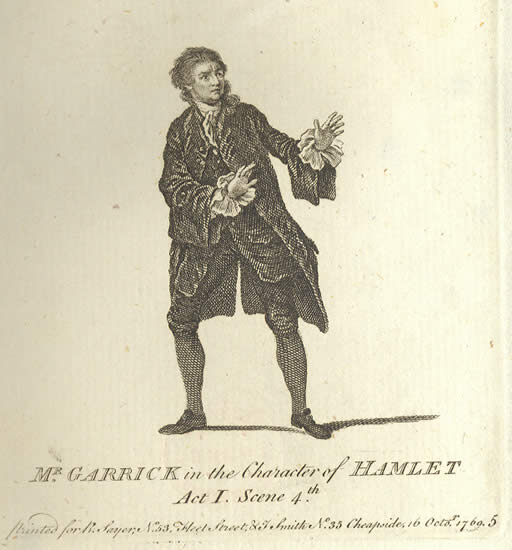
First performed in London in 1741, The Lying Valet was written by David Garrick. “If there was one name to know on the London stage in the 18th century,” as we’ve noted in a previous blog, “it was David Garrick. As a writer and actor, he was synonymous with celebrity” and was one of the leading thespians of the time.
Etching of David Garrick in Hamlet from Dramatic Characters, or Different Portraits of the English Stage, 1773. Public Domain. Credit: Wikipedia
The Lying Valet was performed many times in the British Colonies and perhaps could have even been the very first play that life-long theatre fan George Washington ever saw! As noted in an account ledger he kept, twenty-year-old George saw a play for the first time ever on June 2, 1752 during June Fair in Fredericksburg. June Fair was a annual community gathering where Fredericksburgers and other Virginians sold farm goods and land, settled debts and tried court cases, gambled on horse races, and enjoyed a play. Whatever the play was that Washington saw on that day in 1752, it was performed by the Murray-Kean Company of actors. Intriguingly, The Lying Valet was indeed one of the plays in their repertoire but there is no way to know if the play was performed on that day at June Fair.
The Lying Valet tells the story of William Gayless, who lost all of his money after a series of bad choices. Left only with one chair, Gayless attempts to rectify his situation by marrying the rich young lady Melissa, whom he has come to care for, despite the advice of his servant. Timothy Sharp, Gayless’ lying valet, finds himself weaving a few lies to save face for his master, all the while Kitty Pry, a servant to Melissa, attempts to uncover the truth. One thing leads to another as Sharp finds himself caught on the brink of disaster, and it looks as though Gayless will never have a wedding. Will everything end happily, or will lies, consumption, Frenchmen, drunk cooks, half truths, and a significant lack of funds ruin the whole plot?
This weekend’s performances of They Lying Valet take place at 7:00 p.m. on Friday, October 19 and Saturday, October 20 with a 2:00 p.m. matinee on Sunday, October 21. Admission is $10 for adults and $5.00 for students. Pre-purchase of tickets is not necessary as payment will be taken at the door. The performances take place in the Crowninshield Museum of Historic Kenmore at 1201 Washington Avenue in Fredericksburg.




 The moment anyone mentions trees and George Washington, you probably think of the famous Cherry Tree Story. However, this tale of young George taking a hatchet to his father’s cherry tree and, when confronted about the act, asserting “I cannot tell a lie” is probably just that — a story meant to demonstrate the integrity of the Father of Our Country. In reality, the trees of Ferry Farm have a much more fascinating history. Their story reflects, on a small local scale, vast environmental changes in eastern North America and shifting American attitudes toward the environment throughout the 18th, 19th, and 20th centuries.