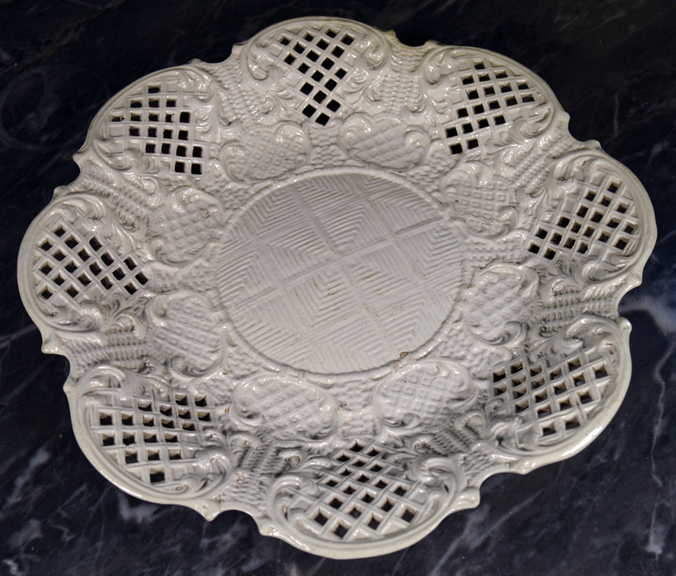
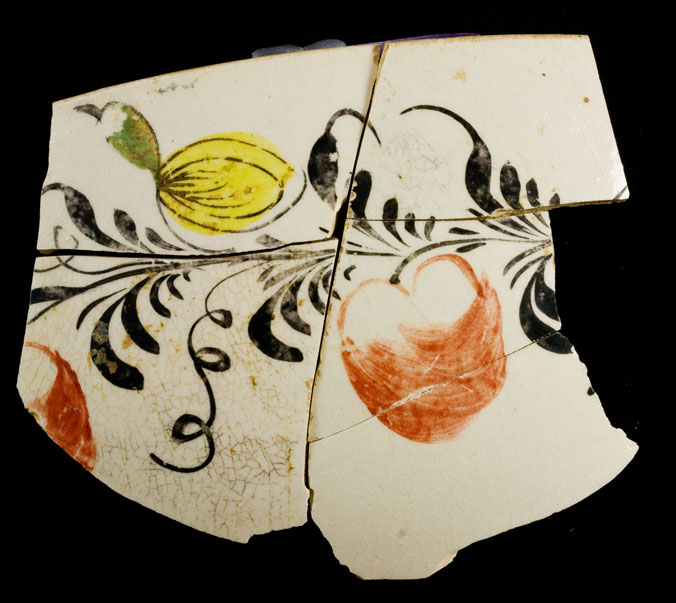
Want to see “in real life” the 18th century ceramic fruit dish we wrote about last August? You can see it and the matching sherds excavated by archaeologists on your next visit to George Washington’s Ferry Farm.
The dish sits inside the Ferry Farm visitor center in a museum display case now dedicated to Lives & Legacies. In this exhibit case, we will showcase some of the artifacts, objects, and stories that we write about on the blog for people visiting George’s boyhood home.
Along with taking the self-guided iPad tour “Uncovering George Washington’s Youth,” viewing the visitor center’s major exhibit “The Science of History at Ferry Farm,” and watching archaeologists at work at the dig site and in the lab, visitors can learn how archaeologists discovered fragments of the unique fruit dish and how the dish and its discovery connects three Washington sites – Ferry Farm, Kenmore, and Mount Vernon – together.
Future subjects for the display case include the glass base that may have been used as a spinning top, jewelry and personal accessories from the 18th century, and Westerwald ceramics found at Ferry Farm and Kenmore, among many others that you have seen on Lives & Legacies. The case will be rotated regularly – stop in to check it out!
For more information about visiting Ferry Farm, click here.
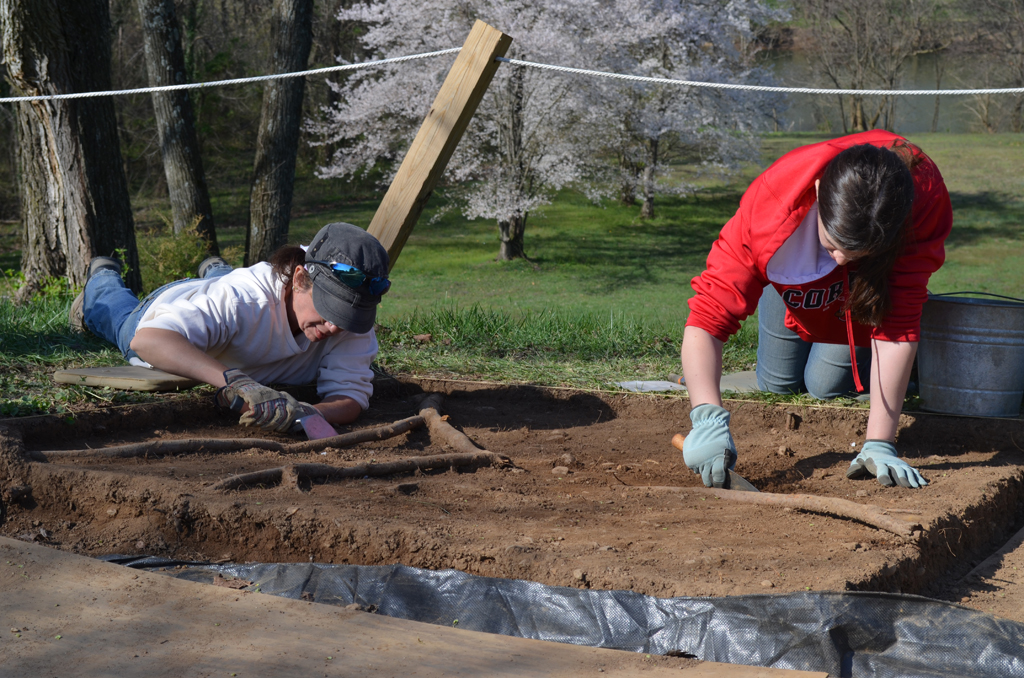
Last week, another archaeological excavation season began at George Washington’s Ferry Farm. Here are some scenes from the first week of digging.
Orientation for the dig staff.
Laura Galke, dig site director, explains how to properly complete a context register form, which helps track where an artifact was found.
Moving equipment to the dig site.
Dry screens ready for use.
Munsell books, pens, sharpies, scissors, chaining pins, plumb bobs, line levels, trowels, string and duct tape AKA archaeology supplies!
All the wheelbarrows!
Gathering shovels. Shovels are important.
Did we mention shovels are important?
The dig site is waiting.
Dig, dig, dig.
Rooting out the artifacts
Scraping dirt into a dust pan to be screened.
Brooms and buckets.
Documenting the work is crucial to excavating properly.
On weekdays, see Ferry Farm’s archaeologists working at the excavation site from now through late-June or, if you can’t visit before June, spend a day on the dig site by watching the video below.
In this day and age, it is easy to discover the particulars of someone’s life simply with the click of a button. Phone number, age, home address, professional resume and more can easily be obtained by searching through public records on the Internet or at the library. A treasure trove of current primary and secondary resources awaits the present-day researcher trying to uncover the facts of someone’s life in the 21st century.
But what do you do when the person lived over 250 years ago? What public and private historical records are available that will tell us who a person was, how they lived, when they died, and who their family was? Time, circumstances, and the natural decay of paper all take a toll on the sources we use to study the history of the people who came before us. But the amount and quality of available information about a person also depends on the status and role they played in their own time.
In 1750, an enslaved person living at George Washington’s boyhood home, now called “Ferry Farm,” was murdered. His name was Tame and he was killed by Harry, another enslaved man owned by the Washington family. These bare facts were recorded at a King George County Court of Oyer and Terminer, with no further explanations given of the crime or of the motives involved.[1]
What led to Tame’s death? For that matter, who was Tame? How old was he? Where did he come from? How long was he with the Washington family and how does his fateful story figure into the daily operations of the farm and household? Answers to these kinds of questions are hard to come by because the stories of the enslaved population in the historical record are limited, in many cases, to just a few documents spanning their lifetime.
Excavated by archaeologist at Ferry Farm, this broad hoe, also known as a “weed hoe,” was used sometime in the mid-1700s by enslaved people to remove weeds and loosen soil around crops. Older slave children joined adults in the fields to do this difficult task.
Discovering Tame’s story begins with finding him in the written records. Augustine Washington, George’s father, died on April 12, 1743, seven years before Tame’s murder. His will, written a day before his death, lists by name some of the slaves that belonged to him and to whom he gave them. Tame is not among those mentioned.[2] The subsequent July 1, 1743 probate inventory of Augustine’s estate details the property and personal items he owned and their value, including a list of the enslaved population, but Tame, again, is not listed.[3]
Since he was not mentioned in either of these two historical documents relating to Augustine’s property, it’s possible that Tame was acquired after Augustine died, either by his estate, his heirs, or by his wife Mary and sometime between 1743 and 1750.
There is another scenario to consider, however. Perhaps Tame does not show up in the court documents surrounding Augustine’s death because Tame was actually the property of Mary, Augustine’s wife, instead.
To burn efficiently and ensure a clean flame, the cotton wicks of candles needed to be trimmed frequently. These tools, known as wick trimmers (above and below), were used for this purpose and discovered during excavations at Ferry Farm. Due to the mundane and constant nature of the task, household slaves were often charged with maintaining candle wicks.
Mary Ball, who married Augustine Washington in 1731, was born to Mary Johnson and Joseph Ball in 1708 in Lancaster County, Virginia. When her father Joseph died in 1711, he willed to her a young slave: ”Item: I give to my daughter Mary my negro boy Tame…” (Lancaster County Will Book 10:88). Since Tame is described as a “boy” in the document, he could be roughly any age between 5 and 16 years.
Is this boy, willed to Mary when she was but three years old, the same person who was murdered 39 years later in 1750 at Ferry Farm? As Mary’s property, the boy Tame would have been part of her household wherever she lived: with her mother in Northumberland County following her father’s death, with her as Augustine’s wife at Pope’s Creek, Westmoreland County, and then, finally, at Ferry Farm, where she lived mostly as a widow. As Mary’s property, Tame would not have appeared in the will or probate lists of her husband. What is also interesting is that both Tame and the man accused of murdering him were described in the 1750 court proceedings as “belonging to Mary Washington of this county widow.”
Exactly what role Tame played on the Washington farm and within their enslaved community is unknown. If Tame is the same boy Mary received when she was 3, he would be in his 40s or 50s when at Ferry Farm, and thus someone Mary had known well her whole life. Did he work in or around the main household for the family or as a field laborer? Did his age and long term relationship with Mary relate in any way to his unfortunate murder in 1750? What was his status within the slave community? Even Tame’s name adds an interesting aspect to his story that separates him from the other Washington slaves on the farm. “Tame” is a name of West African origin and is unlike the usual Anglicized names of contemporary Washington slaves, such as Jack, Ned, Tim, Steven and Adam, as recorded in Augustine’s will and probate inventory.
Recent research shows cowry shells like this one were used as currency as part of the slave trade. The modifications to cowries discovered at Ferry Farm facilitated stringing them into groups of 40. These shells, originally from the east Indian Ocean, traveled to Virginia with their enslaved owners. Evoking memories of their African homeland and heritage, such familiar emblems helped comfort those who remembered a life of freedom and helped them to maintain elements of their culture.
Tame’s existence in the historical documents is brief and mysterious. It may always remain a mystery but further research may yet illuminate this man’s story and his long association with Mary Washington. History is indeed an unending journey.
This month marks the 284th anniversary of George Washington’s birth. Americans have celebrated our first president’s birthday since long before it became an official national holiday in the late 1800s. In fact, early Americans even marked George’s birth during his lifetime, most notably with “Birthnight Balls” that replicated the grand dances held in Britain to celebrate the monarch’s birthday. In 1879, an Act of Congress made February 22 a holiday within the District of Columbia. Six year later, Congress expanded the holiday to all federal offices across the country.
As with many American holidays, both officially recognized and otherwise, businesses created postcards and greeting cards to be used to send good wishes to family and friends on the holiday. We have four such Washington Birthday postcards in our collection. These cards date from around 1912-13, as a couple of the cards include cancelled postage stamps that note it being the 180th birthday of George Washington.
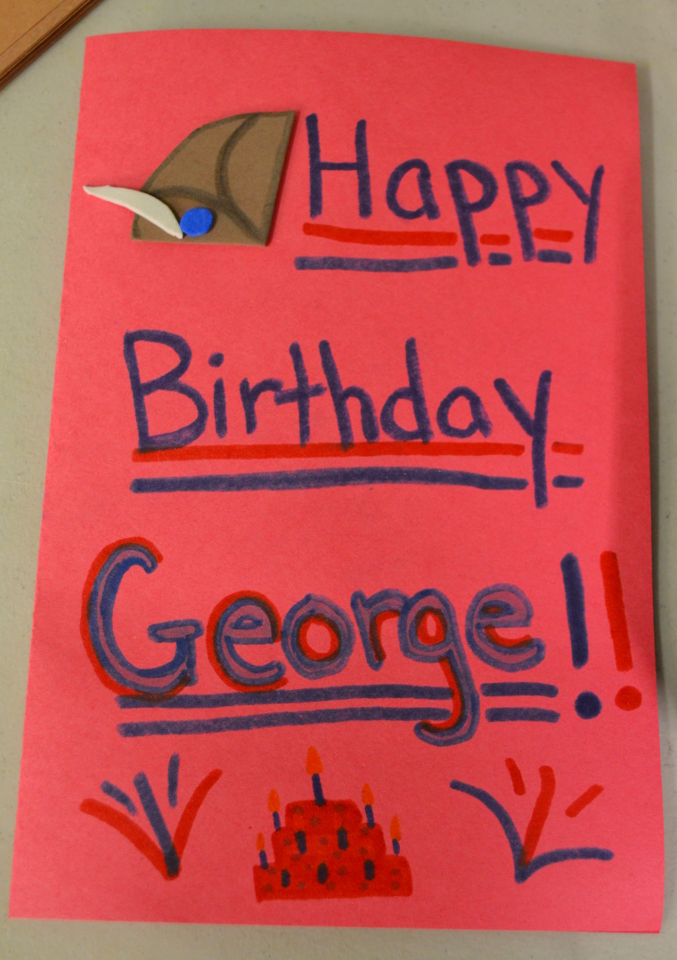
This year, you can celebrate George Washington’s Birthday at Ferry Farm by making your own birthday card for George!
Visit his boyhood home on Saturday, February 13 from 10:00 a.m. – 4:00 p.m. for family fun, including games, crafts, exhibits, the Stone Throw Challenge (weather permitting), history theater, and birthday cake! “General Washington” will attend the Birthday Celebration to talk about his youth on the farm! You can see a short video of last year’s celebration here. $5 adults; 17 and under free.
Additionally, on Presidents’ Day, Monday, February 14 from 10:00 a.m. – 4:00 p.m., learn about archaeology at George Washington’s Boyhood Home. Enjoy crafts, theater performances, presentations by Muraca the Magnificent – Guru of Glues, tours of the archaeology lab, a scavenger hunt, and the Archaeology Artifact Challenge. Archaeology Day is a free event.
For more information call 540-370-0732 x22 or email [email protected].
Celebrate George Washington’s 284th birthday at his boyhood home with fun activities for the whole family, including games, crafts, exhibits, the Stone Throw Challenge (weather permitting), history theater, and birthday cake! “General Washington” will attend the Birthday Celebration to talk about his youth on the farm! The video below is a preview of the celebration.
This year’s celebration is Saturday, February 13 from 10:00 a.m. to 4:00 p.m.
For more information call 540-370-0732 x22 or email [email protected].
Click on the photo for to link to a 3D image the you can zoom, rotate, and manipulate.
Recently, a 3D image of a smoking pipe was added to the Virtual Curation Lab, an online project of Virginia Commonwealth University. You can view rotate, zoom, and manipulate the image by clicking the photo above or by clicking here. The smoking pipe was discovered within the fill of the main cellar of the Washington family house at George Washington’s Ferry Farm, his boyhood home. The pipe features the square and compass and twin pillars that distinguish this as a masonic pipe. Such motifs were very popular. The masonic symbols faced the smoker and fluting characterized that portion visible to surrounding friends. The design elements used suggest that this pipe was likely made in the northeast of England sometime between 1770-1810, in places like Hull.
George Washington was initiated as an apprentice mason on November 4, 1752, passed to fellow craft on March 3, 1753, and became a master mason on August 4, 1753. He achieved all of these masonic ranks at Fredericksburg Lodge No. 4. While it is certainly possible the masonic pipe belonged to George, he was one of four notable masons associated with Ferry Farm. The other three were Fielding Lewis, Hugh Mercer, and George Weedon, who each may also have left this specimen behind in the archaeological record.
The Virtual Curation Laboratory (VCL) at Virginia Commonwealth University, headed by Dr. Bernard K. Means, scanned this pipe bowl in three dimensions. 3D scanning provides two types of digital models: a three-dimensional image to be viewed on a monitor and, with the use of a special 3D printer, a plastic replica of the item. Replicas can be printed at a larger scale, allowing details to be viewed more easily. VCL has used the technology to scan bones from extinct passenger pigeons, allowing researchers from around the nation to compare these known digital models to bird bones in their own assemblages so that they can identify passenger pigeons in their collection.
The pipe bowl being scanned in 3D.
Three-dimensional scanning allows The George Washington Foundation to provide greater public access to fragile artifacts both on the Internet virtually and as 3D printed copies that visitors can see and hold. Making 3D images available online allows more people to see these artifacts than could ever visit Washington’s boyhood home. We can even make these digital files available to researchers on the web, allowing others to 3D print them wherever in the world they may be. In the field, 3D replicas allow staff to engage visitors, showing them (for example) a wig hair curler or tobacco pipe, then inviting them to guess how the object was used in the past.
3D replicas allow Ferry Farm archaeologist Lauren Volkers to share rare and unique artifacts with visitors when the archaeological dig site is open.
Fragile ceramic sherds can be printed in plastic, allowing visitors to mend the pieces together as an educational exercise. Such access allows the original objects to be on exhibit while simultaneously allowing maximum access to the replicas physically and digitally.
Archaeologist Vivian Hite uses a 3D printed plastic replica of the masonic pipe to engage young visitors.
Laura Galke, Archaeologist
Site Director/Small Finds Analyst
As an archaeologist, I am often asked “What is the coolest thing you’ve ever found?” The answer is complicated. Although I’ve unearthed 10,000 year old Paleoindian hearths, elaborate porcelains, coins, long lost jewelry, and ancient stone tools, I say that the coolest thing I’ve ever found is …. glue. This proclamation always elicits questioning looks from well-meaning folks who expect something a little more glamorous. Let me tell you why, to date, glue is the “coolest thing I’ve ever found.”
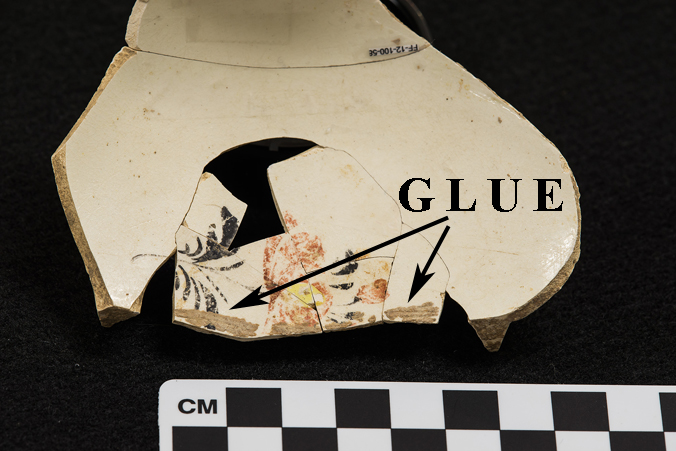
It’s not just the glue itself that is incredible but also the object on which the glue was found. When I started working at George Washington’s Ferry Farm, my first assignment was to examine creamware associated with Mary Washington, George’s mother, which was excavated from the cellar of the Washington home. I focused on a lovely punch bowl with beautiful hand-painted enamel depicting a floral motif with cherry accents. Obviously, we adore cherries at Ferry Farm, being the setting of the fabled chopping down of a certain tree by young George, and we wanted to learn more about it.
The punch bowl was manufactured in the 1760s or early 1770s. It exhibited a lot of use wear, indicating it was obviously a favorite of Mary’s. The punch bowl was of a size designed to be passed around at a gathering for each guest to take a sip directly from it. This was a time before germs were well understood. Thankfully, for health’s sake, 18th century punch contained a hefty amount of alcohol. This also meant that punch was not cheap. Actually, the production and drinking of punch was very much a ceremonial form of conspicuous consumption. Mary chose this special bowl as much for its beauty as for its function.
After close inspection of the vessel, I noticed a strange substance adhering to many of the edges. This unsightly brown stuff extended across the many breaks in the bowl and, upon microscopic examination, exhibited suspicious brush marks. Furthermore, additional ceramics from the same cellar excavation revealed similar residues. Could it be glue? If it were, this would shed light on a previously unknown behavior taking place in the Washington home – the breaking and subsequent repair of ceramics. We had to know! What followed was a multi-year study during which we tested the historic glue residue samples utilizing mass spectrometry courtesy of Eastern Michigan University. We spent months researching historic glues, replicating those glues, and then breaking and mending much thrift store pottery with the aforementioned glue in the name of science. The conclusion? We had indeed discovered eighteenth century glues!
While this may not seem like a ‘eureka’ moment, it was actually quite significant. First of all, it’s amazing that 250-year-old glue survived in the ground for so long. Second, the discovery improves our understanding of Mary Washington, a woman that gave birth to and shaped the young life of our first president. By replicating period glues and mending modern pottery, we also learned that the vessels Mary had repaired probably were not used for anything other than display after mending. They could not have held a liquid, which means that after it was broken and mended, the beloved punch bowl was probably relegated to mantle or shelf where the delicate hand-painted flowers and charming cherries could be admired but never used for its intended purpose ever again.
We also concluded that Mary herself would probably not have made and applied the glues personally. Turns out making eighteenth century glues involved a wide array of bizarre and often stinky ingredients including ox gall, animal hide, bull’s blood, garlic, eggs, cheese, isinglass (extracted from a fish’s swim bladder), and the slime from garden snails (yep). Watch the video below to see how colonial-era glue was made. You can also click here. It was a time consuming and messy endeavor that was likely undertaken by the enslaved people living at Ferry Farm rather than by the mistress of the house.
To date, seven vessels belonging to Mary exhibit glue residue. Interestingly, even though a professional mender was operating in the town of Fredericksburg just across the river from where she lived, Mary chose to have glue prepared at home with which to repair her ceramics. That, plus the fact that she had these pieces mended even though she could never use them again means Mary was a thrifty woman who saw the value in displaying the objects. Perhaps demonstrating that she owned these highly fashionable ceramics took precedence over using them?
What makes the glues even more exciting is that nowhere in the historic record does it mention that Mary was repairing ceramics at home. Our only evidence for this activity is archaeological and it has revealed a previously unknown aspect of her life. Perhaps now the question is not “Did George chop down the cherry tree?” but rather “Did George break the cherry punch bowl”?
And all that is why glue is the coolest thing I’ve ever found.
Mara Kaktins, Archaeologist
Ceramics & Glass Specialist
The George Washington Foundation wishes everyone a joyous holiday season! Enjoy these photos of holiday decorations created by wonderful volunteers! The George Washington Foundation Garden Guild decorated at Kenmore and the Lake Anna Garden Club decorated at Ferry Farm.
There is still time to see Historic Kenmore and George Washington’s Ferry Farm adorned for the season as well as each site’s annual display of dollhouses, miniatures, and gingerbread creations. For details about these exhibits, visit kenmore.org/events. Finally, if you missed it, check out our most recent post A Christmas of Uncertainty, December 1775.
It’s a long-standing holiday tradition! Adults and children alike will enjoy the sights and smells of the festive creations displayed at George Washington’s Ferry Farm!
This year’s theme is “George Washington Slept Here” and a list of contest winners can be seen here (PDF). Visitors may vote for their favorite and this ‘people’s choice’ winner will be announce after the holidays. The gingerbread houses remain on display until December 30.
Ferry Farm is open Monday – Saturday from 10:00 a.m. – 4:00 p.m and on Sunday from 12:00 p.m. – 4:00 p.m. The site will be closed Christmas Eve and Christmas Day.
Admission cost for viewing the gingerbread exhibit only is $4 adults, $2 students, under 6 free. There is an additional fee for a self-guided iPad tour of Ferry Farm. Visit www.ferryfarm.org for more details.
Mr. Gingerbread happily accepts votes for favorite gingerbread house.
All the gingerbread creations make the museum gallery smell delicious!
Visitors view the gingerbread houses during Sunday’s opening reception.
Young visitor looks one of the gingerbread houses.
“Valley Forge, 1777” by Matthew Yagla
“George Washington’s Birthplace” by Rachel Bosco
“Washington’s Headquarters at Valley Forge” by C.J. Crocker
“Young George at Ferry Farm” by Lachlan Eaton shows George chopping down a cherry tree.
“Ferry Farm” by Ryan Jackson
George slept here.
“Kenmore” by Diane Jackson
“Washington’s Headquarters at Fort Cumberland” by Gavin Carpenter
Interior view of the Ft. Cumberland headquarters.
“Mary Washington House” by Maggie Jackson
“Valley Forge, Washington Headquarters” by Valerie Jackson
“Hoovervilles” by Post Oak Middle School German Club
“Schlaf gut, Geroge! (Sleep well, George!)” by Chancellor Middle School German Class
“George’s Mount Vernon” by Chancellor High School German Club
“Martha & George in Love” by Courtland High School German Club depicts the Longfellow House.
“Chatham” by Girl Scout Troop 5057
“George Washington Surveying Natural Bridge” by Mr. & Mrs. John Simmers
George with his surveying equipment
“Washington’s Revolutionary War Headquarters” by Carrie Gonzalez and Shelley Brosius depicts the Ford Mansion in Morristown, NJ
“Gingerbread Friends at Ferry Farm”
“RACSB, RAAI Gingerbread House”
“Washington Headquarters, Longfellow House” by Nancy Rowland
Scenes from a recent autumn stroll around George Washington’s Ferry Farm. This semester’s Fleming-Smith Scholar Courtney Kuzemchak, a student at the University of Mary Washington, captured these seasonal images. You can see photos of Ferry Farm in winter here and a video from summer here.
The visitor center at Ferry Farm built in the 1960s.
Sunshine and shade.
The Great Oak Pavilion was built in 2005 by the Timber Framers Guild and Virginia Military Institute.
The so-called “Surveyor’s Shed,” long-held by local legend to be George’s surveying office, actually dates from the late 1800s.
A flag marking one stop on the self-guided iPad tour of the Ferry Farm grounds.