It’s the 30th year of a a long-standing holiday tradition: the Gingerbread Contest & Exhibit at George Washington’s Ferry Farm! This year’s theme is “Home for the Holidays.” Read about Thirty Years of Gingerbread.
Adults and children alike will enjoy the sights and smells of the festive creations displayed at Ferry Farm! Ferry Farm’s hours are Monday – Saturday 10:00 a.m. – 4:00 p.m. and Sunday from 12:00 p.m. – 4:00 p.m. Ferry Farm is closed Christmas Eve and Christmas Day. The gingerbread exhibit ends on December 30. General admission to Ferry Farm and the exhibit is $8 adults, $4 students, under 6 free while admission to the exhibit only is $4 adults, $2 students, under 6 free.
For more information, call (540) 370-0732 x24 or email [email protected].
“Christmas on Clifton Boulevard” by Valerie Jackson and family
“Holiday Friends & Snowtime Adventures” by Parkside Elementary ECSE Classe
“The Mouse Family at the New George’s Ferry Farm House” by Carrie Szlyk and family
“The Marker’s Lodge” by Carol Gick and family
“Home for Christmas” by Aileen Roark and family
“The Dog Always Finds the Best Place to Nap” by Susan Bosco
“Hickory Dickory Clock!” by Susan Dodson
“Gingerbread Caroling” by Julie Jennings
“A Christmas Eve Return” by John & Florence Simmers
In June, we visited Blue Ridge Timberwrights in Christiansburg, Virginia. We saw skilled craftsmen fashioning the timbers for the Washington house frame and talked with Sandy Bennett, president of Blue Ridge Timberwights.
Learn more about the Washington House here and view other videos, photos, and blog posts about the project here.
It’s a long-standing holiday tradition. In fact, it’s so long-standing that this year, 2016, marks the tradition’s 30th year. What tradition is that? The annual Gingerbread House Contest and Exhibit at George Washington’s Ferry Farm!
Since we are marking three auspicious decades for this event, we dug into the archives to present a look back here on Lives & Legacies.
The contest began in 1987 and, for many years, took place at Historic Kenmore instead of Ferry Farm. Our records are scant for the contest’s first year but we do know that the 2nd annual contest in 1988 saw middle schoolers Lisa Allen and Erika Paulson win best-in-show, according to a Free Lance-Star clipping in our files. Rev. Ed Boutchyard of Bowling Green’s Zion Full Gospel Church made a church with an ice cream cone steeple!
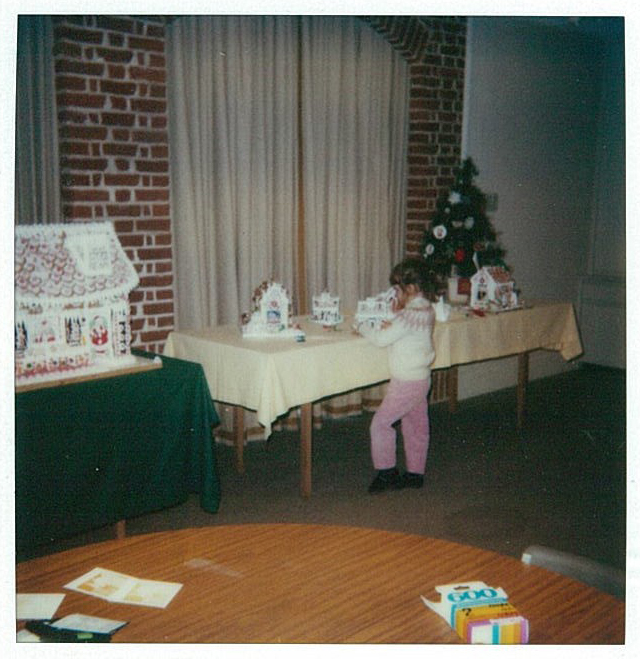
A Polaroid from the first-ever Gingerbread Contest & Exhibit in 1987.
Three entries from the 1988 contest.
Lisa Allen repeated her best-in-show victory in 1989 with the help of her sister Melanie and friends Theresa Stockdill and Courtney Lucado.
In these early days of the contest, the German Club at James Monroe High School, one of the contest’s longest-running participants, began submitting regular entries and, in 1993, they won their first-ever best-in-show.
A few entries from 1993.
In 1995, the Free Lance-Star (scroll up) profiled Claybourne, Emily, and Meredith Beattie, who, having entered the contest for nearly ten years, had only ever won a single 2nd place ribbon. For this family, the “tradition of assembling and decorating the houses is far more important than winning prizes.” The kids, along with mom and dad, would visit their grandmother out-of-town over Thanksgiving break. They created their gingerbread houses there and then traveled the 300-miles back to Fredericksburg with the houses packed in the back of the car. Clay explained that he entered year after year “because I like doing it with my sisters and my family.”
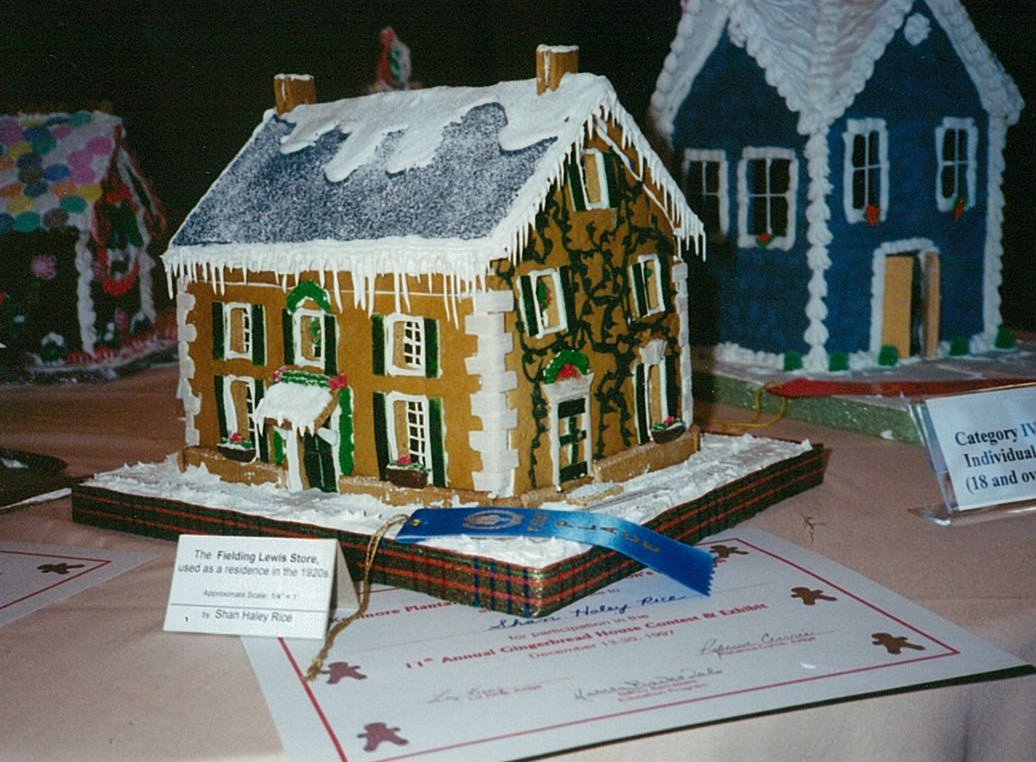
A gingerbread version of the Fielding Lewis Store from 1997.
In 2000, the contest and exhibit moved from Kenmore across the Rappahannock River to Ferry Farm, where it has been held every year since.
Some entries, including this gingerbread version of Kenmore, from 2001.
There’s still time to enter a gingerbread house in this year’s contest and be a part of the tradition! Gather the family, start baking that gingerbread, and creatively decorate your house together. This year’s theme is “Home for the Holidays.” Entries are being accepted now through Saturday, December 3 at Ferry Farm. Click here for rules and an entry form.
The exhibit will open to the public on Sunday, December 4. Ferry Farm is open Monday – Saturday from 10:00 a.m. – 4:00 p.m. and Sunday from 12:00 p.m. – 4:00 p.m. General admission to Ferry Farm and the exhibit is $8 adults, $4 students, under 6 free. To view the gingerbread exhibit only, the cost is $4 adults, $2 students, under 6 free. For more details about this and other holiday events at Ferry Farm and Kenmore, visit kenmore.org/events.
The timber frame – from floor joists to roof sheathing — of the rebuilt Washington house at Ferry Farm was recently completed. The work was done by tradesmen using a mix of 18th century building methods and 21st century equipment. The timbers were fashioned by Virginia-based Blue Ridge Timberwrights.
Learn more about the Washington House here and view other videos, photos, and blog posts about the project here.
The use of folk magic may seem foreign and exotic to many of us in the 21st century. If we look closer, though, it is apparent that some modern Americans still practice it today – even if they don’t realize it. Have you ever hunted for a four-leaf clover? Have you ever hung a horseshoe over your door? If so, you’re participating in a kind of folk magic.
Folk magic is (and was) thought to be a way to influence forces, seen and unseen, for good or for ill. It is sometimes referred to as “low” magic, not because it was seen as evil, but because it was passed down generation to generation rather than learned from books or formal tutors. “High” magic has its own fascinating history, but this blog post focuses on the everyday magic that 18th century Virginians, both black and white, practiced. Hoping to ward off evil and bring peace, prosperity, and abundance into their homes, some of these early Americans used magical means to their ends.
Europeans and Africans in British North America brought with them the spiritual, religious, and magical traditions of their homelands. The blending of these traditions became the bedrock for future iterations of American folk magic. One modern archaeologist says that this blending process makes it hard to tell exactly who was using what folk tradition while creating some of the material culture of folk magic; it is not always clear from the archaeological record exactly who made an object and what that object’s intended purpose was.[1]
One of the things that may have contributed to the cross-cultural blending is the similarities between English and African folk magic traditions. Both groups recognized that there were some people who were “set apart” from the rest of the group. These individuals were believed to possess special powers that made them respected, feared, or both. African and English traditions also shared a belief in magical objects, even everyday objects, that could be imbued with power. And lastly, both groups believed in the power of burying magical objects for protection – or for malice.
People thought talented in the magical arts were known as “cunning folk” in the English/English-American tradition and as “conjurors” in the African/African-American tradition. Cunning folk were not witches, who were thought to inhabit the fringes of society, but rather “practitioners of magic who healed the sick and the bewitched, who told fortunes, identified thieves, [and] induced love.”[2] This description of cunning folk is very similar to W.E.B. Du Bois’s definition of the conjuror, “the healer of the sick, the interpreter of the Unknown, the comforter of the sorrowing, the supernatural avenger of wrong . . .”[3]
The rest of Du Bois’s quote, however, highlights an essential difference between white cunning folk and the enslaved conjuror. The conjuror was also “. . . the one who rudely but picturesquely expressed the longing, disappointment, and resentment of a stolen and oppressed people.”[4] Despite their many similarities, enslaved conjurors and cunning folk operated in very different realities. In Du Bois’s estimation, the conjuror did more than just take care of the physical and spiritual needs of the enslaved; he or she took on the weight of slavery itself.
Both conjurors and cunning folk created magical charms and charged objects with magical meaning. At George Washington’s Ferry Farm, we found an excellent example of an object charged with meaning. A carnelian bead excavated on the property may indicate that a powerful conjuror might have lived here during the Washington’s time. This bead is similar to two found in Barbados and Archaeologist Jerome Handler asserts that these carnelian beads were the product of Cambay, India and were indications of the status of the person with whom they were buried.[5] Dave Muraca, director of archaeology at Ferry Farm, describes “all three beads” as “generally reddish-orange color” with “tapered ends and cylindrical shapes. Each one has 8 longitudinal facets and 4 beveled facets at each end. The main difference between the Washington site bead and the Barbadian beads is size, with the Barbadian beads being almost twice as long as the one recovered at the Washington farm.”[6]
Multiple views of the Carnelian bead excavated at George Washington’s Ferry Farm.
Cunning folk also made objects with magical meaning. Written charms, or amulets, were popular since they were easy to make and could be worn on the body. These charms often served as protection for people and livestock against witches’ attacks. An example of these charms can be found in Colonial Williamsburg’s Special Collections. This small piece of paper, dating to about 1700, promised to protect the wearer from “any mannor [sic] of Witchcraft or Evle [sic] spirit.” The amulet invokes the power of faith and the intervention of Jesus Christ on behalf of the afflicted woman. It closes with “amen, amen, amen,” and “fiat, fiat, fiat;” “fiat” being the Latin translation of ‘amen.” “Fiat” and “amen” had been used together since the 2nd century, particularly when the prayer it ended was one of condemnation.[7]
Witchcraft amulet, circa 18th century. Credit: Special Collections, John D. Rockefeller, Jr. Library, The Colonial Williamsburg Foundation
It was not uncommon for black and white practitioners of magic, to bury magical objects for protection. The nature of these objects may have been different, but the intent was the same – warding off evil and restoring peace to the household. At Ferry Farm, archaeologists have discovered whole oysters deliberately buried in the stone-lined cellar of the Washington house. The act of burying the oysters, which were seen as magical objects in the African/African American community, was likely an effort to protect the home. They were often used in burial rituals and were associated with death and the afterlife; an association that makes the oyster shells found at Ferry Farm all the more intriguing.
Whole oyster shell excavated from the Washington house cellar at Ferry Farm.
English/English-Americans also buried objects for protection, but some of the objects they buried were man-made rather than a product of the natural world. Witches bottles, often glass bottles filled with pins, nails, and even human urine, were designed to cure the afflicted of his or her bewitchment. A witch bottle found near in Virginia Beach, Virginia, known as the Great Neck witch bottle, dates to 1690-1750. Archaeologist M. Chris Manning describes it as being, “[a] small, narrow, light green glass medicine vial was found buried in an inverted [upside-down] position” containing 25 brass pins and 3 iron nails. It may have also contained the urine of the bewitched at some point.[8] These bottles were designed to hurt witches; their pins and needles were thought to injure those who placed malevolent spells on the innocent. In both the African/African-American and the English/English-American tradition, these buried objects were tasked with banishing evil forces in an effort to bring in positivity and peace to the household.
These are just a few examples of the similarities between the African and the English folk magic traditions. There are significant differences, in part because “magic” was part of African cosmology, meaning religion and magic were tied together, sometimes to the point where it’s hard to tell where one ended and the other began. This is different from the English tradition, where religion and folk magic were seen as separate, at least officially. Religious and secular authority figures in colonial America condemned the use of folk magic, but this did little to stem the tide of magic’s popularity.
The next time you pick up a lucky penny or even cross your fingers, remember that you are participating in a tradition older than America itself. While we may not make witches bottles or bury oyster shells anymore, there are plenty of instances where we seek luck, protection, love, and other good vibes through essentially “magical” means.
Kelly Arehart
Manager of Interpretation & Visitor Services
[1] Christopher C. Fennell, “Conjuring Boundaries: Inferring Past Identities from Religious Artifacts,” International Journal of Historical Archaeology, Vol. 4, No. 4, pp.284.
[2] Owen Davies. Popular Magic: Cunning Folk in English History, (London: Continuum), 2007, p. VII.
[3] W.E.B. Du Bois, Souls of Black Folk, Essays and Sketches, (Chicago: A.C. McClurg & Co.), 1903, 211.
[5] Jerome S. Handler, “An African-Type Healer/Diviner and His Grave Goods: A Burial from a Plantation Slave Cemetery in Barbados, West Indies,” International Journal of Historical Archaeology, Vol. 1, No.1, (June 1997), 91-130.
[6] David Muraca, “Murder and Magic at the Washington Farm,” George Washington Foundation, Fredericksburg, VA, unpublished report, 9.
[8] M. Chris Manning, “Homemade Magic: Concealed Deposits in Architectural Contexts in the Eastern United States,” Master’s Thesis, Ball State, 2012, 114.
Expert craftsmen from Blue Ridge Timberwrights recently completed constructing the timber frame of the Washington house interpretive replica at Ferry Farm. This collection of photographs documents the their work and begins a week into the process. You can see photos from the first week of work here. What’s next? Shingles!
Adding rafters.
Sunlight between posts.
Wooden pegs.
Chiseling a peg.
Tools.
Joists above and below.
Sawing.
Second floor rafters in place.
Visitors hear about the timber framing work.
Rafters and shed roof beams all in place.
Placing roof sheathing.
Framing and roof sheathing complete. Shingles will come next.
Learn more about constructing the Washington house interpretive replica here, here, and here.
When you enter a museum you’re surrounded by cool stuff. Be it paintings, fossils, or ancient artifacts, they’re all special items that you’d be hard pressed to find elsewhere. But what if I told you that the cool objects you see on display in a museum are a mere fraction of what most museums actually have in their collections? There is just never enough room, even for the biggest museums, to display everything. Additionally, some items are just too delicate to make available to the public. This is one of the reasons I love my job. My fellow archaeologists and I get a daily backstage pass to all the incredibly cool things excavated at George Washington’s Ferry Farm. Here’s our list of “Ten Cool But Rarely-Exhibited Artifacts Found at Ferry Farm.” Be sure to click on any of the photos for more detailed views of the artifacts.
Wine Bottle Seal Starting in the 17th century if you were a wealthy gentleman or tavern owner chances are you ordered at least a few custom wine bottles complete with your personal seal. The seals were stamped in various ways, such as with names, initials, symbols, crests, and dates. Archaeologists love them because they’re ‘talky,’ meaning the artifact yields lots of information. A fragmentary bottle seal was found here in 2004 and bears the incomplete name of its owner. The letters visible are either a capital “I” or “J” (the English used the letter I for J), and below that are the letters “-bin”. These few letters might refer to someone in the Corbin family, an extensive Virginia family with local ties. With a little investigation, perhaps we can flush out who was the mystery guest that brought his own bottle of wine for a visit to Ferry Farm!
Lead Whistle Instruments and toys tend to grab our imagination because they make us think about who used them and how the object got lost to time and archaeology. In our collection we have a simple lead whistle, measuring 1 7/8” long and 3/8” in diameter, with “U.S.A.” stamped on the side. It’s cheaply made out of lead, which was a very inexpensive material that has, for obvious reasons, been phased out of the toy industry. In the “Good Ol’ Days”, no one thought twice about making an instrument you put in your mouth out of lead. Maybe it’s a good thing that the person who owned the whistle lost it.
Chunkey Stone Fun to say. Fun to play. Basically a prehistoric rock doughnut, this hand-ground stone was used in a Mississippian Indian game called “Chunkey.” Warriors rolled disc-shaped stones across the ground and threw spears as close to the stone as possible. Similar to the Italian game of bocce, but unlike the Italians who threw wooden balls, Chunkey players threw spears, which is pretty awesome. It’s a bit of a mystery as to how it got to Ferry Farm because there is no evidence that Chunkey was played in eastern Virginia, however some of these gaming stones have been excavated in Maryland and Northern Virginia. It is also possible that one of Ferry Farm’s colonial inhabitants collected this exotic looking artifact for their cabinet of curiosities.
“Joseph” bottle fragment Normally broken bottle glass would have trouble finding its way onto any top ten list, but this fragment is one of a kind. Its owner inscribed his name “Joseph” and the date “174?” into the body of the bottle. That’s not an easy or common thing to do. The inscription is carved in an elegant and beautiful form indicating a gentry status for its owner. While no occupant of Ferry Farm was named Joseph, Mary Ball Washington’s older brother bore that name.
Joseph Ball, though living in England, was heavily involved with Ferry Farm. He absentee owned and operated a neighboring plantation. Joseph was lavish in both his gifts and advice to the Washingtons. He gave Betty, George’s sister, a beautiful silver tea set just before she married. He offered Mary advice on how to keep George out of the Royal Navy when a plan was hatched to put the then 13-year-old onboard a ship. And maybe, just maybe, he sent over a special bottle of wine with his name engraved on it for the Washington family.
Lead Toy Hatchet More lead toys? Yep. This little beauty has special significance to Ferry Farm because of the cherry tree myth. The 3-inch lead hatchet appears to be a souvenir made during the 20th century, possibly dropped during 1932’s anniversary celebration of George Washington’s birth. Keepsakes associated with George and the cherry tree abound in Fredericksburg. Previous private owners of Ferry Farm were known to capitalize on the history of the property, often selling fragments of the ‘original cherry tree’ and cherry seeds to visitors. This hatchet is an obvious symbol recalling the cherry tree story that is so closely associated with Washington’s childhood.
Milk Glass Darning Egg Recovered completely intact from an old burrow belonging to a groundhog, this artifact had multiple uses on a 19th and 20th century homestead. The glass egg was a darning aid used to fill out a sock while it was repaired or could be placed in a henhouse to encourage the ladies to lay eggs in a particular spot. There is also a persistent myth that these eggs were used to kill snakes. The snake would eat the glass egg, it was believed, which would then shatter inside them. This line of reasoning ignores the fact that snakes hunt by detecting chemical signatures of their prey and that snakes can’t really see the egg-like shape of our artifact because of their poor vision. But it’s a story that highlights the mythology that surrounds some objects once they fade into obscurity.
Tambour Hook The tambour hook falls into the category of artifacts that are a little too fragile to display. Made of carved bone and metal, this exceptional object was used by a gentlewoman, probably George’s sister Betty, to adorn fabric with elaborate embroidery. Recovered from the bottom-most soil level of the Washingtons’ root cellar where it was deposited sometime between 1741 and 1760, the carved designs that cover the bone handle feature a parrot, leaves, flowing vines, and numerous flowers and represent some of the most popular embroidery themes of the time. This hook helps demonstrates the fashionability of the Washington women, which contradicts the portrait painted by many modern biographers.
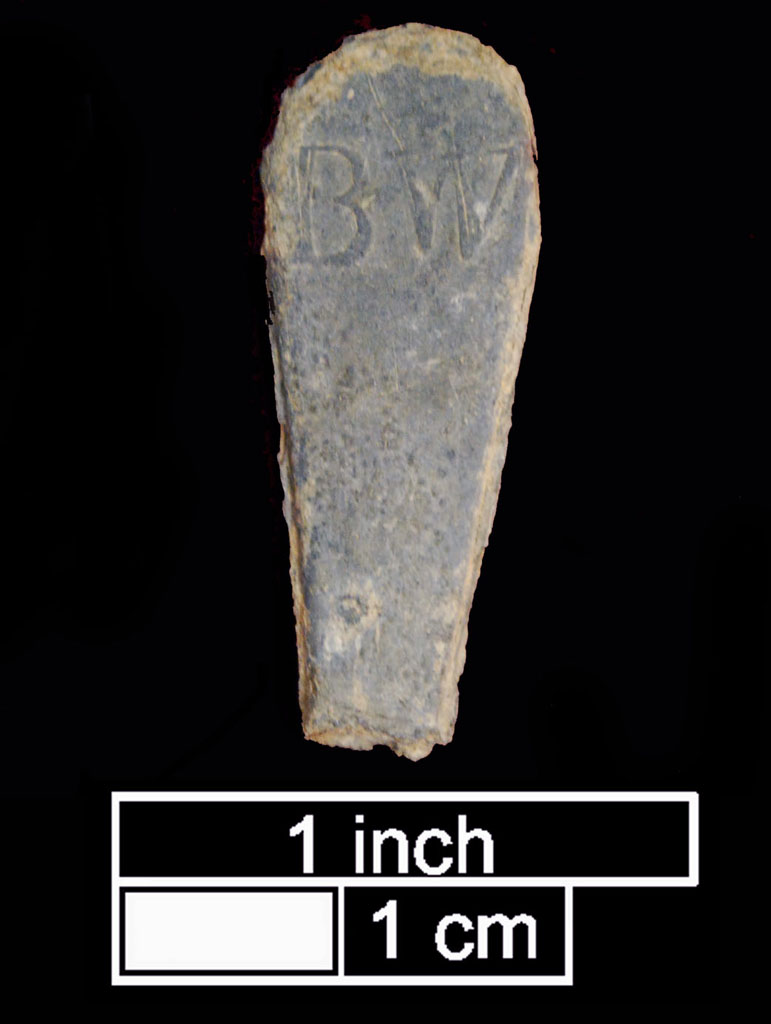
Pewter Teaspoon with Betty Washington’s Initials Betty had some of the coolest artifacts and this one literally has her name on it. It was customary for tea to be dispensed by the wife or by the oldest daughter in the house and Betty, as the only daughter, was clearly groomed in this ceremony as is evidenced by her own teaspoons. Pewter, an alloy containing a number of different metals including lead (yes, more lead), wasn’t as fancy as silver but the fact that it’s customized makes it special. This tea set appears to be part of a “practice” set that Betty used before her uncle gave her a silver tea set around her 16th birthday.
Bartmann or Bellarmine Jug/Bottle Who doesn’t want to drink out of a jug exhibiting the large face of a crazy bearded man? I do, and if you were a colonist in the 1700s and early 1800s, you did as well. Originating in Germany, these face jugs depicted a ‘wild man’ of the woods character popular in Eastern European folklore. By the time these vessels made it to the English market that aspect seems to have been forgotten. Subsequently, the English created their own story behind the bearded man revolving around their dislike for a similarly-bearded and unpopular anti-protestant cardinal by the name of Robert Bellarmine. For more about this artifact, read this blog post.
Repaired Creamware Cherry and Flower Punchbowl This artifact is cool for so many reasons. A beautiful bowl adorned with graceful hand painted flowers and cherries (remember, we love those here), it also exhibits a complicated and tortured use-life while highlighting the importance of punch drinking in the eighteenth century. Written about here, this bowl was owned by Mary Washington, George’s mother. Punch bowls vary in size and this one would have been called a ‘sneaker’, which denotes a bowl small enough for guests to take turns sipping out of it before passing it to the next person. Mary clearly loved the bowl so much that, when it broke sometime between 1765 and 1772, she had it repaired with glue. Although the hide or cheese-based glue used would not have resulted in a vessel capable of holding punch again, she could display it on her mantle or in her china cabinet…Oh, and the glaze? It has lead in it.
Laura Galke, Site Director/Small Finds Analyst
Judy Jobrack, Assistant Lab Supervisor
Mara Kaktins, Ceramics & Glass Specialist
Melanie Marquis, Lab Supervisor
Dave Muraca, Director of Archaeology
Sputniks and mutniks, flying through the air,
Sputniks and mutniks, flying everywhere,
It’s so ironic. Are they atomic?
Those funny missiles have got me scared. -Lyrics from “Sputniks and Mutniks” by Ray Anderson and the Home Folks (1958)
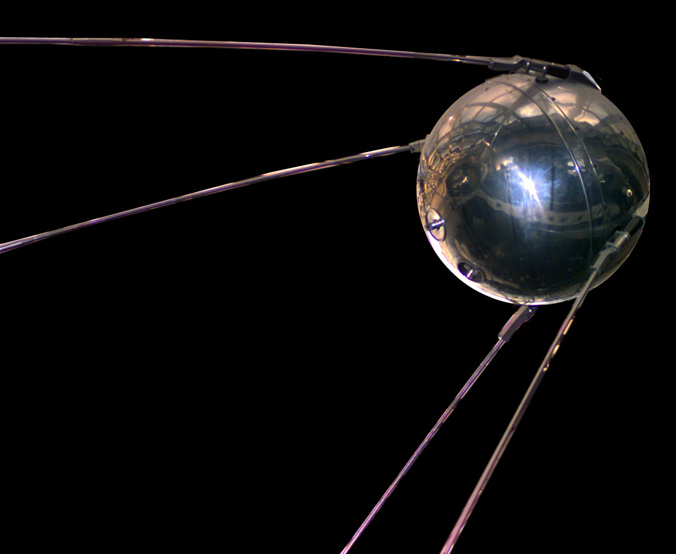
A replica of Sputnik at the National Air and Space Museum in Washington, DC. Credit: NASA/Wikipedia.
“Beep, Beep, Beep…” went the sinister telemetry signals from the Earth’s first artificial satellite. Launched by the Soviet Union on October 4, 1957 — 59 years ago today — those irritating beeps, which can be heard below, provided undeniable evidence of the successful launch. It occurred during the Cold War between the Communist East and the Capitalist West, and represented the dawn of the space age. Embedded within Sputnik were two radio transmitters that, using a single watt of power, broadcast a series of beeps received by radios and televisions all over the world. These beeping sounds frightened some, who mistrusted the technological breakthrough and its potential military applications.
Uncle Sam is “Awake at Last” from his bed of complacency while Sputnik can be seen through the window hurtling across the sky transmitting it’s urgent ‘beep.’ Cartoon by Edwin Marcus. Credit: Library of Congress
Sputnik roused considerable political anxiety on the part the United States, a country determined to perfect satellite technology and to engage in cosmic exploration. They underestimated the progress of the Soviet program. Today, in popular parlance, a “sputnik moment” refers to being spectacularly caught off guard by the unanticipated advancements of a rival. President Obama incorporated “Sputnik moment” in his 2011 State of the Union Address designed to encourage investment in research and technology.
At the height of the crisis in 1957, the Eisenhower administration referred to Sputnik as “…a silly bauble….” The satellite represented a rather modest accomplishment whose engineers prioritized being first in orbit over producing a sophisticated data-gathering tool. Recently, some scholars have suggested that the satellite was a bit of a ‘bluff’ to make the United States believe that the Soviet program was more sophisticated than it was. Like many martial ‘bluffs,’ the impact was far-reaching and it exacerbated and escalated an already frigid Cold War.
About the size of a beach ball, Sputnik orbited less than 600 miles above earth. Each orbit lasted 96 minutes. The National Aeronautics and Space Administration (NASA) was created in 1958 as a response to this (perceived) technological “wake up” call. Nationally, efforts to strengthen primary school science education ensued and encouraged more students to seek technologically-oriented careers in service of a more robust space program.
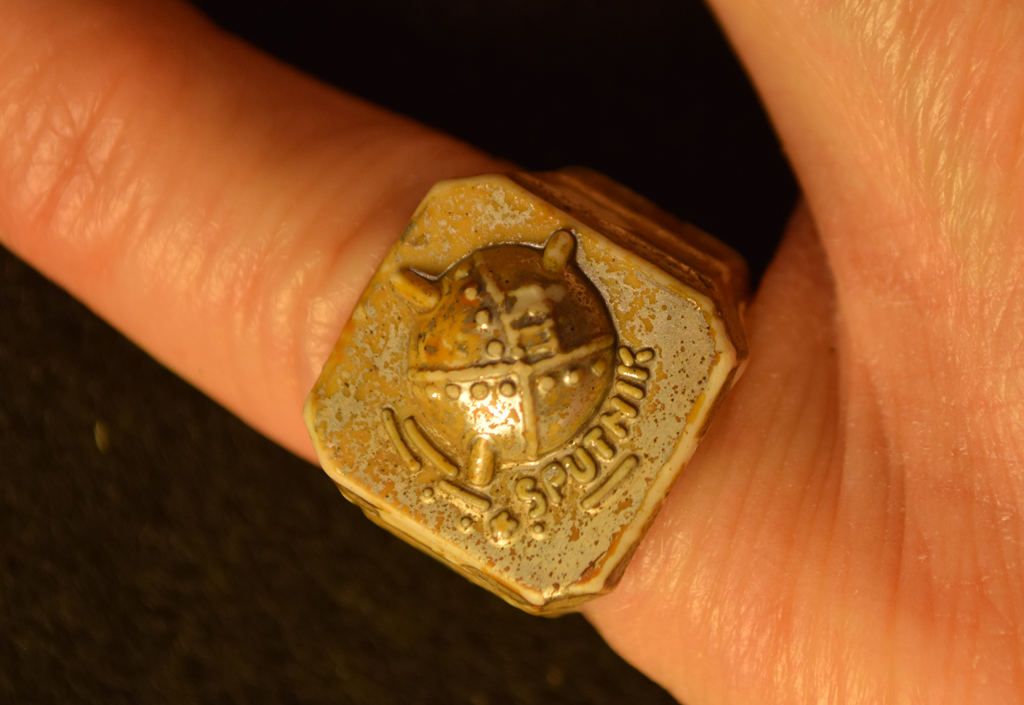
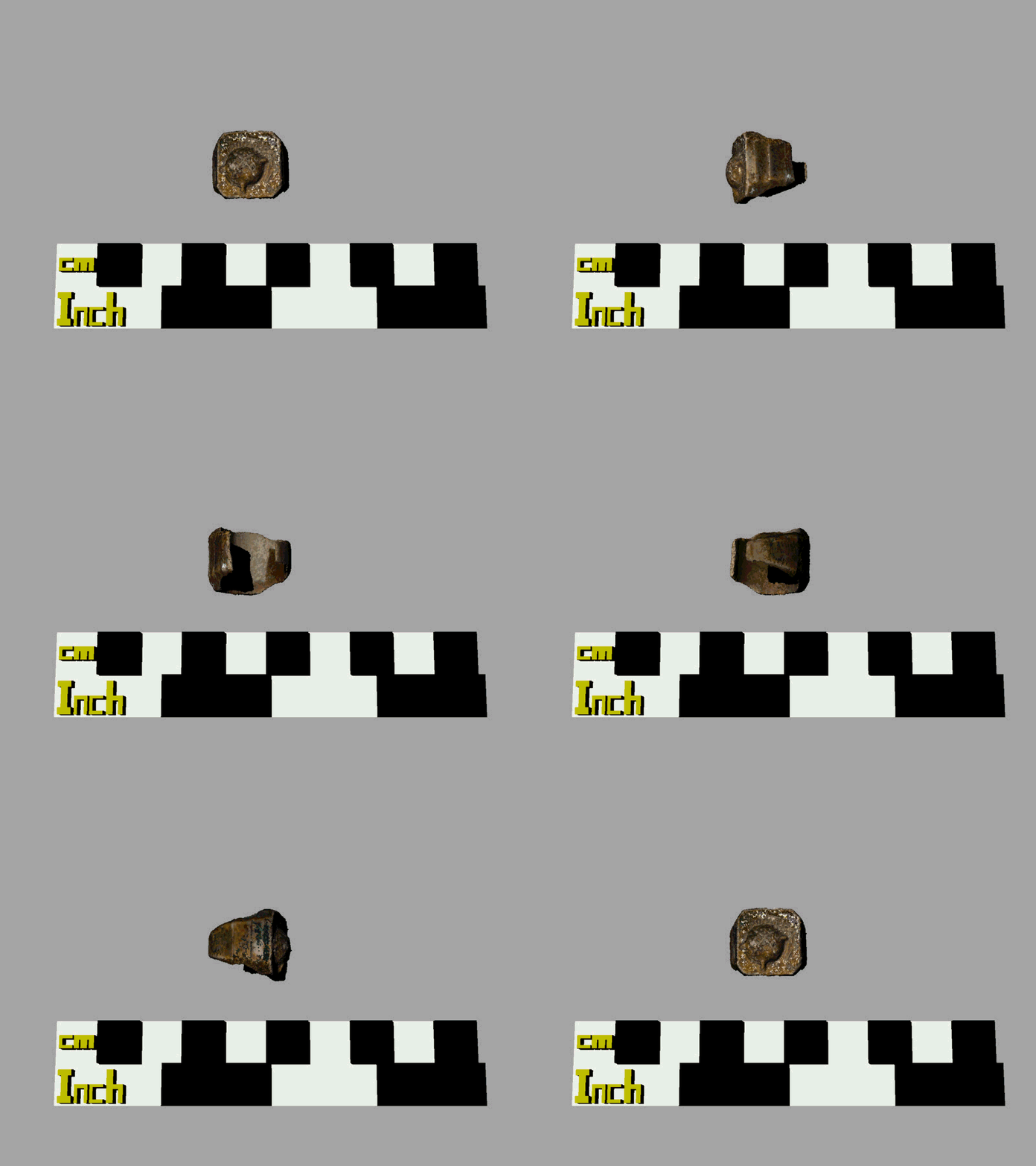
In 2014, Ferry Farm archaeologists unearthed a tangible prize from this moment: a plastic toy “Sputnik” finger ring. Remember that Ferry Farm remained home to a variety of individuals and families in the centuries since the Washingtons lived there. The flashy gold-colored ring, originally dispensed from a gumball machine, featured an idealized image of the satellite and the word “SPUTNIK.” It was no doubt cherished by its original owner, and envied by the prospective young space explorer’s friends.
The Sputnik ring recovered archaeologically at George Washington’s Ferry Farm.A 3D image of the Sputnik ring.
As an archaeologist, the find confused me: why would toys commemorating Soviet satellites exist in the United States? Who would buy this celebratory object for their child? For goodness sake this land had once been Washington’s home, first president of the definitely-not communist United States. I foremost saw the object through a politico-military lens, rather than as a space-age wonder for all people.
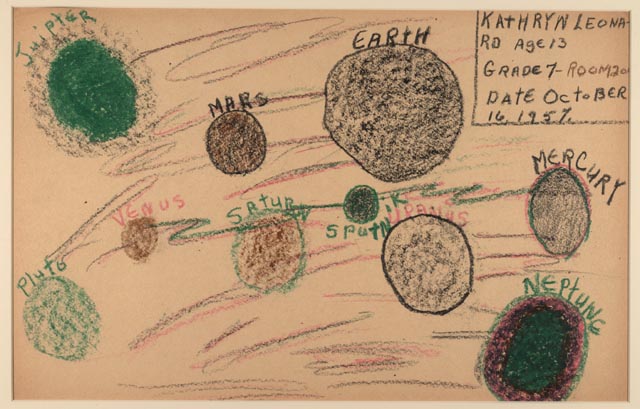
In popular American culture of the late 1950s, the surprise of Sputnik frequently was one of delight rather than apprehension. For some, those cosmic beeps were inspirational, promising future space travel and technological progress. From this new age of cosmic exploration emerged songs, dance, theatre, literature, and graphic art.
A generation of young Americans, enthralled by science fiction adventures of Buck Rogers and Flash Gordon, could not contain their excitement. They were captivated by the real-life manifestation of their outer space fantasies. The launch excited children who dreamed of the day they might defend the earth against hostile invaders from space. Kids who spent their school days engaged in “duck and cover” drills ironically raced out to their back yard for a glimpse of the Soviet technology racing across the night sky.
The satellite orbited the earth for three months, though its radio signals tactfully subsided after three weeks. Sputnik’s orbit eroded 4 January 1958. Its effects were as far reaching as they were long lasting.
The Sputnik launch garnered a diverse array of reactions nationally and internationally: pride, disquiet, excitement, imagination, and infinite inspiration. The rich variety of these responses led to the creation of a wide range of material culture – objects as small and inexpensive as a child’s toy ring and as massive an investment as the Kennedy Space Center. People created – and experienced – music, technology, literature, dance, and theatre that allowed them to understand this event in ways relevant to their own lives. These responses reflect humankind’s desire to comprehend pivotal events that are beyond their control through personal agency. Material culture – artifacts – gives us the capacity to participate in, to understand, and to ‘own,’ grand events that are larger than we are.
This was true in the past as well, as the assorted artifacts analyzed daily at Ferry Farm attest. Prehistoric ground stone tools were an astonishing advancement in their time: this technology allowed our ancestors to maximize the nutritional benefits of nuts, seeds, and grains, to fell trees that made dwellings more comfortable, and to toss spears farther and with greater force. Such scientific wonders no doubt inspired non-ground stone-producing peoples to invest in technological developments of their own.
Have a Sputnik moment! Let’s redefine the phrase to commemorate the boundless scientific and artistic creativity that the launch stimulated, rather than the political anxiety that emerged. Create a technologically- or arts-inspired marvel of your own! Don’t avoid sputnik moments… pursue them. Show your support for World Space Week, which is held annually October 4-10. To learn more about this year’s events: http://www.worldspaceweek.org/
Laura Galke, Archaeologist
Site Director/Small Finds Analyst
Blough, Glenn O.
1957 “Children, Put Away Your Sputniks.” The Science Teacher 24(8):373-374.
Bonner, Thomas N.
1958 “Sputniks and the Educational Crisis in America.” The Journal of Higher Education 29(4):177-184, 232.
Brandau, Daniel
2015 “Demarcations in the Void: Early Satellites and the Making of Outer Space.” Historical Social Rsearch/Historische Sozialforschung 40(1[151]):239-264.
Cowen, Ron
2007 “Sputnik + 50: Remembering the Dawn of the Space Age.” Science News 172(14):216-217, 221.
Kabakchi, V. V. and Charles Clay Doyle
1990 “Of Sputniks, Beatniks, and Nogoodniks.” American Speech 65(3):275-278.
Launius, Roger D.
2009 “Abandoned in Place: Interpreting the U.S. Material Culture of the Moon Race.” The Public Historian 31(3):9-38.
In this video, you’ll see a lime rick burn that recently took place at George Washington’s Ferry Farm and expert artisan Kenneth Tappan will explain the ins and outs of building and burning a lime rick.
Learn more about the Washington House here and view other videos, photos, and blog posts about the project here.
Recently, expert artisans Bill Neff and Kenneth Tappan along with staff from The George Washington Foundation built a lime rick — a large crib of wood and oyster shells — at George Washington’s Ferry Farm. This past Saturday, the rick was lit on fire to produce lime for stone and brick work as part of constructing the Washington house.
In eighteenth-century Virginia, near the coast, oyster shells were abundant and commonly burned in one-time-use oyster ricks – different than lime kilns constructed of brick – to yield the lime required for brick and stone masonry. After heating, the burnt shells are slaked with water, causing them to break apart into lime. Mixed with sand and water, as well as sometimes brick dust, clay, charcoal, and bits of shell, lime was the binder in early mortar.
Here are photos of the building and the burning of the lime rick.
Bill Neff bundles together small branches and other kindling into the lime rick’s wick around which all the larger wood will be placed.
Firewood ready to be assembled into the lime rick.
The oyster shells that will be burned.
Placing the wick.
With the wick set, work to build the rick itself began the next morning before dawn.
The first layer of wood is placed.
The first layer of shell is added.
Kenneth Tappan throws a log…
…onto the rick.
Bill Neff adds some smaller firewood.
Spreading out the top layer of oyster.
9:50 a.m. – The lime rick is ready to burn.
10:05 a.m. – The wick is lit and slowly burns down lighting the ends of the logs on fire.
10:40 a.m. – A lot of smoke at first.
10:50 a.m. – Flames appear.
Burning a lime rick of oyster shells to make mortar.
11:30 a.m. – As the rick burns, it collapses in on itself.
12:30 p.m. – As the wood burns, the pile gets ever smaller.
3:00 p.m. – The shell would smolder for hours and remain hot into the next day.
On the next day, the burned and brittle shells were ready to be sifted to remove the ash and stored in barrels. Water must be added to break the shell down into lime.
Read more about the lime rick burn in this article by The Free Lance-Star. Learn more about constructing the Washington house interpretive replica here, here, and here.