Lives and Legacies

Category: George Washington’s Ferry Farm

  • Glass Tablewares of the Washington Household

    As work continues on the reconstructed Washington family home at Ferry Farm, we archaeologists are continuing to identify items that were owned by the Washingtons so we can eventually fill the reconstructed house with plates, bowls, glasses, and many other objects based on artifacts we’ve discovered.  Our latest mending project towards this goal involves glass tablewares.  Piecing together thousands of fragments of clear tableglass is a special kind of agony but a wonderful amount of data has been collected from this painstaking exercise. And we’re not even close to being done yet!  In this post, I’ve written about three of the glasswares we have identified in our study thus far.

    LEAD GLASS BOTTLE
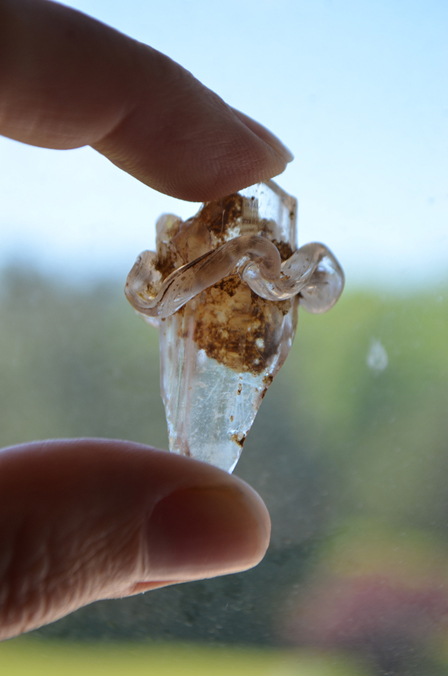
    Lead Glass Bottle Neck
    Fragment of the neck of a lead glass bottle excavated at George Washington’s Ferry Farm.

    This particular fragment likely belonged to a small decanter or carafe.  It could also possibly be part of a scent bottle, meant to hold perfumes.  It was created using a pattern mold.  The craftsman would have blown the glass into a simple mold with a ribbed pattern and then twisted it to get this diagonal line effect.  He would finish the bottle by adding a separate piece of glass to create the delightful ‘ruffle’ on the neck.  Below is an example of what the whole vessel may have looked like.  Hopefully, we’ll find more fragments and know precisely what this piece is soon!
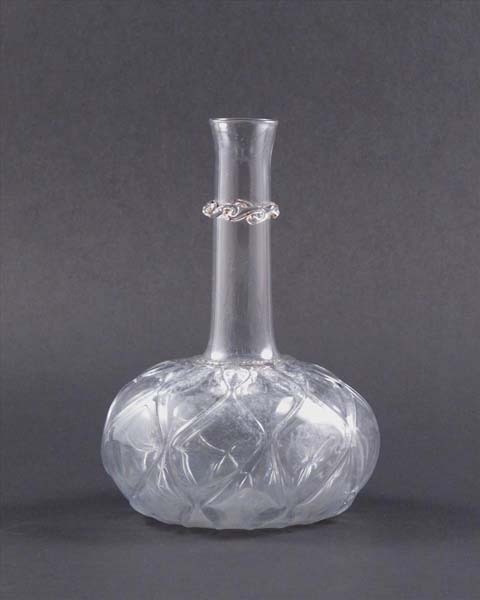
    Lead Glass Bottle
    Lead glass bottle showing the ruffled neck on the fragment excavated at Ferry Farm.

    FLIP CUP

    Flip Cup (1)
    Portions of a flip cup dug up by Ferry Farm archaeologists.

    If you google ‘flip cup’, the first image result is a large red plastic cup commonly associated with college parties.  The original flip cups were far more aesthetically pleasing. However, they too were used to enjoy recreational beverages.  The drink called flip was the original cocktail and needed its own fancy glassware.  Colonists loved flip and made it by combining a  bizarre (by our modern standards) mixture of beer, hard liquor, spices such as nutmeg, a raw egg (a not uncommon ingredient in eighteenth century drinks), and then immersing a hot iron poker into the concoction.  This resulted in a delightfully lukewarm eggy, boozy beverage that was then decanted into a decorative tumbler – the flip cup.  While these cups were not only used for flip, the name has stuck. They are delicate and were often engraved with elaborate designs or scenes using a copper wheel.  At Ferry Farm, we have a number of archaeological fragments of flip cups.  Our examples are made of soda lime glass, not leaded glass, which is common.

    Flip Cup (2)
    Flip cup in the collection at Historic Kenmore. It features the same design as the fragments discovered at Ferry Farm.

    VENETIAN GLASS

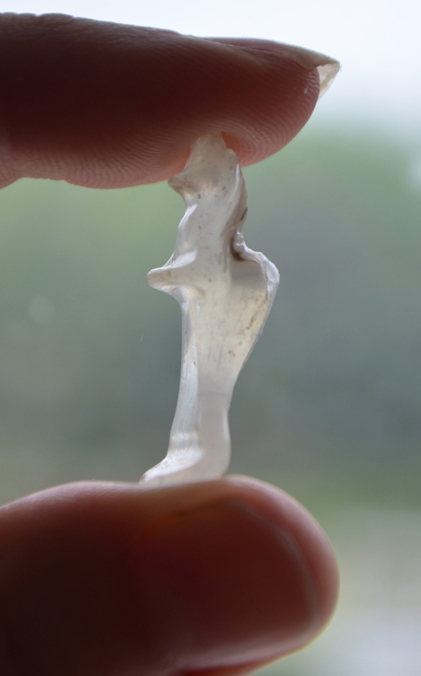
    Venetian Glass
    Archaeologists excavated this small fragment of Venetian glass at Ferry Farm.

    This fragment represents what may be the fanciest glassware owned by the Washington family during their time at Ferry Farm.  It is a piece of a pincered and buttressed handle that belonged on a vessel such as the beautiful goblet pictured below.  Although the sherd may appear unassuming, it is likely part of an elaborate hand-blown Venetian piece made of finely crafted colorless soda lime glass with a barely visible bead of opaque glass running through the center.  This would certainly have been a show piece and displayed prominently within the house.
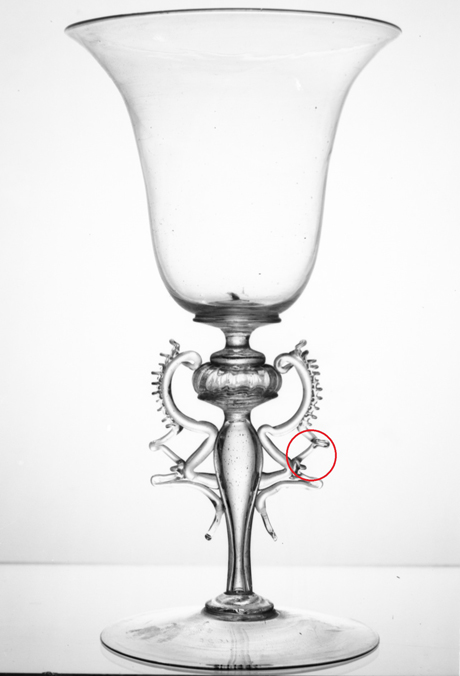
    91.1.1442
    The portion of the handle circled in red on this 16th century Venetian glass goblet is similar to the fragment excavated at Ferry Farm. Credit: The Metropolitan Museum of Art

    Follow Lives & Legacies for updates on the Washington family’s glasswares we are identifying at Ferry Farm. More discoveries await!

    Mara Kaktins, Archaeologist
    Ceramics & Glass Specialist

  • Photos: Grandparent-Grandchild Archaeology Day Camp

    During spring break last week, George Washington’s Ferry Farm hosted to Grandparent-Grandchild Archaeology Camp. Campers, young and old, got a crash course on the entire archaeology process at Ferry Farm and the importance of archaeology to history. From recording information and digging up artifacts to a behind-the-scenes lab tour and creating an artifact diorama, campers left with a new-found knowledge of what is beneath their feet!  Here are some photos of the camp.

  • Video: Building George’s House – Roofing

    In this video, we learn about the roof of the Washington house reconstruction from Project Manager John Jeanes.

    Check out a timelapse video of the roof being built here.

    Learn more about the Washington House here and view other videos, photos, and blog posts about the project here.

  • Building George’s House: Why Red? How We Picked the Paint

    A few weeks ago at George Washington’s Ferry Farm, painters finished painting the exterior of the Washington house.  They used a red color known as “Spanish brown.” The paint is linseed oil-based and actually behaves more like a stain.  Modern oil-based paint can, in a way, be thought of as a plastic that laying atop the surface and coating the wood.  The historic pigment we used actually seeps into the wood itself and essentially stains the wood the deep red.

    Washington House without Scaffolding
    River-facing side of the Washington house at Ferry Farm.


    House Painting (8)
    Falling snow against the new paint on the Washington house.

    In the 18th century, the pigment came from clay mixed with red lead, an iron oxide. The paint was “made by grinding the earth into a very fine powered consistency that would then be added to the linseed oil and turpentine – the content of the dirt and the amount used ultimately determined the color” which could range from “burnt orange through reds and into browns.”

    Why did we choose Spanish brown as the Washington house’s exterior paint?  Well, we have evidence, both documentary and archaeologically, that suggests the original Washington home was this very color.

    First, our archaeologists recovered fragments of plaster with Spanish brown on them, which demonstrates the color was available and used at Ferry Farm.

    Second, Mason Locke Weems wrote “The house in which he lived is still to be seen. It lifts its low and modest front of faded red, over the turbid waters of the Rappahannock.” (Page 11)  While Weems included myths about Washington, his biography was published in 1800 meaning the house could certainly have still been standing for either him to visit or for persons who had seen the house to describe it too him.  We know the house became a ruin just after 1830.

    Finally, when paint analysis of colonial houses is done, Spanish brown is frequently encountered.  The color was extremely popular during the 1700s.  Here in Virginia paint analysis found it used at William Randolph’s Tuckahoe and in Williamsburg at Nathaniel Walthoe’s storehouse, Bruton Parish Church, and, most notably, the Peyton Randolph House.[1]

    Peyton Randolph House
    The Peyton Randolph House in Colonial Williamsburg. Credit: Wikipedia / Jrcla2

    Spanish brown was also popular beyond Virginia.  It adorned the Palmer-Marsh House in North Carolina and Sotterley Plantation in Maryland.[2]  A survey of advertisements for Rhode Island paint shops between 1760 and 1819 found it offered “in nearly every ad.”

    Palmer Marsh House
    Palmer Marsh House in Bath, North Carolina. Credit: North Carolina Historic Sites

    Spanish brown was “the ubiquitous color of colonial America” and “was cheap, probably the cheapest available – dirt cheap because it was dirt.”  Its inexpensiveness did not prevent it from being popular among the gentry class.  If possible, the Washingtons and their fellow gentry would have preferred homes of brick that symbolized “dominance, prosperity, and social status.” With this desire in mind, “red paint in its various shades can be seen as an attempt to give otherwise well-finished frame buildings the same aura of permanence that brickwork offered.”[3]

    Zac Cunningham
    Manager of Educational Programs

    [1] Susan Buck and Willie Graham, Chap. 15 “Paint” in The Chesapeake House: Architectural Investigation by Colonial Williamsburg, ed. by Cary Carson and Carl R. Lounsbury, Raleigh, NC: University of North Carolina Press, 364.

    [2] Ibid.

    [3] Ibid.

  • Photos: Flowers at Ferry Farm

    Spring flowers are blooming at George Washington’s Ferry Farm!

  • Building George’s House: Roofing Timelapse

    The roof of the rebuilt Washington house at Ferry Farm was recently completed.  The work was done by tradesmen using a mix of 18th century building methods and 21st century equipment.  The roofing was done by Peter Post Restorations.

    Learn more about the Washington House here and view other videos, photos, and blog posts about the project here.

  • Photos: Building George’s House – Painting the Exterior

    Painters recently finished painting the exterior of the Washington house at Ferry Farm.  The house was painted a red color common to the 18th century and known as “Spanish brown.”  The paint was linseed oil-based just as it would have been in the 1700s.  We’ll have a more detailed blog post in a few weeks explaining how we came to choose Spanish brown as the color to use.  In the meantime, here are a few photos of the painters working as well as of the finished job.

    Learn more about the Washington House here and view other videos, photos, and blog posts about the project here.


  • Video: Furnishing George’s House – Painting the Corner Cupboard

    Furnishings posts logo finalOver the last week on Lives & Legacies, we’ve been talking a lot about the Washington house corner cupboard!  We’re obviously excited because not only is the cupboard beautiful and a beautifully-made piece but because it also represents a shift from building the structure of the Washington house itself to an increased focus on the interior details as well as the start of the furnishing process.
    As you learned in last week’s video and written post, talented joiners from Colonial Williamsburg built the corner cupboard. They also painted it and, recently, shared a quick timelapse video of the painting on the Historic Trades & Skills of Colonial Williamsburg Facebook page.  We wanted to share the video too!

    Learn more about the Washington House here and view other videos, photos, and blog posts about the project here.

  • Furnishing George’s House: The Corner Cupboard

    Furnishings posts logo finalAs construction of the Washington house at Ferry Farm continues, our attention is turning to the furnishings of the house.  Our goal is to furnish the house entirely with reproductions of 18th century pieces, so that our visitors can fully interact with them, without fear of damage to an irreplaceable piece.  Guests will be able to sit on the chairs, open drawers, pick up the utensils on the table, smell the smoke from real fires in the fireplaces, and feel the breeze coming through open windows.  In short, the interior of the house will be as close to what the Washington family would have known as we can make it both in design and experience.

    Making the Corner Cupboard 1
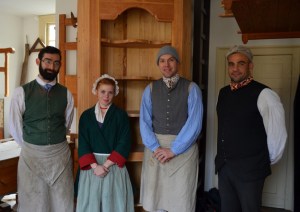
    The joiners at Colonial Williamsburg (l-r): Peter Hudson, Amanda Doggett, Scott Krogh, Ted Boscana.

    Fully furnishing the house will take several years, but the first piece in the process is already on its way to Ferry Farm! It is a corner cupboard, made for us by the talented craftsmen in Colonial Williamsburg’s joiners’ shop and based upon an original 18th century corner cupboard in the CW collection.  The story of our corner cupboard is an interesting one, and embodies the work solving mysteries with both history and science that we do at Ferry Farm every day.

    The story of the corner cupboard begins with Augustine Washington’s 1743 probate inventory, but not because the corner cupboard is listed in the document.  Rather, the fact that it wasn’t listed in the inventory is what caught our attention.  In the Parlor, the inventory lists a variety of furnishings, including 3 chairs, a table, a desk, a mirror and a set of window curtains.  A value is given for each of these line items, as expected.

    The document also lists a value for “lumber in the room and cubbord.” This phrase tells us several things.  First, in the 18th century, “lumber” was the term used for what we might call junk today. Lumber was a group of odds and ends or a mish-mash of objects, none of which had much value, and usually lumped together and appraised as a group. “Lumber” did not mean wood. The Washingtons were not storing piles of wood in their Parlor.

    Probate Inventory - Corner Cupboard
    Page from Augustine Washington’s probate inventory showing the “Lumber in the Room & Cubbord” as recorded by the inventory takers in 1743.

    “Lumber in the room and cubbord” tells us that there was an assortment of junk in the room – not overly useful info, although maybe it does help us all relate to the family a bit since most of us have a junk drawer or closet somewhere in our homes.  The important info that the phrase reveals is the existence of a “cubbord” (phonetic spelling for cupboard) in the room.  The fact that the cupboard is only mentioned as a container for the lumber and not as a piece of furniture (it is not given a line item, and is not given a value of its own in the inventory) tells us that the people conducting the inventory felt that the cupboard was not a free-standing piece, but rather a part of the architecture of the house itself.  In other words, it was what we would call a built-in.

    In the 18th century, built-ins were not exactly common, but they were popular among the upper gentry, and usually took the form of corner cupboards.  These corner cupboards served as storage places usually in the a cabinet section in the lower half of the piece covered by a pair of doors. More importantly, they were a place to display luxury goods, like fine ceramics or important silver pieces  on the open shelves in the top half of the piece.  Through this research, thorough knowledge of 18th century material culture, and some logic, we concluded with strong certainty that the Washington house had a corner cupboard in the Parlor.

    Because corner cupboards were built in to the structure of a house in the 18th century, they usually were not constructed by the same furniture makers who produced the chairs and tables for a house.  Instead, they were crafted by joiners, who specialized in more architectural work.  It was decided to have our corner cupboard constructed off-site at Colonial Williamsburg, so that the historically trained craftsmen there would have ready access to the piece we were trying to reproduce.  This original piece dates to approximately 1745 and was probably from the James River Basin region of Virginia.

    Conservators at Colonial Williamsburg performed paint analysis on the remnants of original pigments still embedded in the wood of the original cupboard and determined that it was painted a light gray.  As the purpose of corner cupboards was often to display fine ceramics, they were usually painted in subdued colors that would contrast with any bright or heavily-painted ceramics.

    Unfortunately, most of the best ceramics found archaeologically at Ferry Farm are white or lightly-painted.  Gray would not have done much for them.  So, research was done by architectural historian Mark Wenger into the paint analysis of the trims and moldings in other Virginia homes of the time period.  In the end, it was decided that the cupboard will be painted a dark red color, with a dark gray interior.

    Finished Corner Cupboard
    The finished reproduction corner cupboard for the Washington house at Ferry Farm.

    A quirk of 18th century construction methods dictates that all the decorative trims and moldings in a house would be in place before plastering, and then plaster would be applied up to those trims, rather than the trim being applied over finished plaster.  So, the corner cupboard will need to be in place inside the house before the plaster can be applied.  The day when this special corner cupboard will take its place in the Washington house is fast approaching!

    Meghan Budinger
    Aldrich Director of Curatorial Operations


  • Video: Building George’s House – The Corner Cupboard

    Furnishings posts logo finalIn this video, we learn from Curator Meghan Budinger about how we will furnish the Washington house reconstruction, we see a corner cupboard for the house being built, and talk with Master Joiner Ted Boscana from Colonial Williamsburg about making the cupboard.

    Learn more about the Washington House here and view other videos, photos, and blog posts about the project here.