You’ve probably heard the phrase “colonial revival” before. Most people think of it as an architectural style –what they mean when they say “a colonial style house.” In actuality, the phrase refers to a whole cultural movement in the United States that had its beginnings in the late 19th century and that still exists today. It is a style of architecture, decoration, literature, art, fashion, and even philosophy that has become so intertwined with American identity that we often have difficulty in separating what is truly Revival from what is truly colonial.
As with many trends in American history, the Colonial Revival can trace its birth to a World’s Fair, specifically the Philadelphia Exposition of 1876, commemorating the nation’s centennial. At the time, the United States was still healing from the Civil War, dealing with a rough economy, and experiencing a wave of immigration that was drastically changing the population. In the midst of this upheaval, Americans began to look longingly to their colonial past, when life seemed so simple and pure, and the ideals of the Revolution were supposedly clear-cut. Exhibits at the 1876 Exposition highlighted the virtues of simple, sturdy colonial American craftsmanship in furniture and household goods. Romanticized biographies of the Founding Fathers set forth a new American mythology. The clean, simple lines of Georgian and Federal style architecture were extolled as the epitome of Americanism. The realities of life in war-torn colonial America were lost in the skirl of fifes and drums, powdered wigs, and pewter tankards, however. Yet, Gilded Age Americans went wild for it. A craze was born, complete with wallpaper, draperies and spinning wheels. The Colonial Revival peaked in popularity in the 1920s, but then experienced a Colonial Revival revival in 1976, during the Bicentennial.
Photos showing the Kenmore exhibit in the Virginia Hall at the Philadelphia Exposition in 1926. Emily Minor Fleming (pictured second from the left, front row in the photograph below) lead the effort to construct a life-size replica of Kenmore’s portico and East façade. The exhibit highlighted important antiques from the colonial era in Virginia. (Kenmore Photographic Collection, .1345 and .1345-2 PBW)
The Colonial Revival had an especially interesting effect on historic sites and museums across the country. Today, historic house museum employees spend a great deal of time (some might say too much time!) pursuing historical accuracy and researching everything we do. Our early 20th century predecessors had a different idea of what a historic house should be. The homes of the Revolution’s great figures were seen as memorials not only to those great figures, but to their way of life, and thus the true American way of life. Emphasis was placed on collecting fine examples of antique furnishings, although the actual dates of those antiques were not so important. An English hall chair from the 1690s might sit beside a pie crust tea table from the 1790s, while the tea was being served from a silver plated teapot from the 1890s. It was more important that when put together these antique pieces created a certain feel and image to a room, one that conveyed a sense of cozy warmth, family values, and individual enterprise. The result was the postcard-perfect rooms that we’ve all seen – a wooden hutch against the wall, lined with pewter plates and tankards (which in actuality would have been used on a daily basis and not reserved for decoration), a handmade rag rug on the wide plank pine floors (rag rugs were actually a 19th century staple), a spinning wheel before the fireplace (spinning was considered labor and would not have taken place in the public spaces of a house, and probably not near open flame), a pot bubbling over the fire (cooking didn’t happen in the house), a smattering of toy soldiers scattered playfully on the hearth (children didn’t have much in the way of toys, let alone toy soldiers). The time, care, and effort that went into creating these rooms was immense, and it was the first time that the American public saw their history brought to life. While perhaps inaccurate by our measure today, the Colonial Revival created an intense interest in American history and is probably the main reason so many historical sites have survived.
Postcards from the 1970s showing Kenmore’s kitchen and “Children’s Room” in all their early American splendor. Descriptions of the rooms on the reverse of the postcards capture the essence of the Colonial Revival spirit. (The George Washington Foundation Manuscript Collection, MS 1675 and MS 1684)
Events and programs at historic sites at the height of the Colonial Revival also reflected this emphasis on the colonial ideal. Especially in the early 20th century, there was a strong belief that by exposing America’s youth to the style of colonial life, they would be instilled with the virtues — honesty, integrity, a strong work ethic and patriotic spirit — of the Founding Fathers. As such, events at historic sites were often aimed at young adults, and often called upon the participants to role play the parts of historical figures. At Kenmore, for instance, Colonial-themed balls took place and theatrical presentations were held on the lawn. Young soldiers headed to battle during the Second World War were entertained at Kenmore with ginger bread and tea, served by young ladies in colonial garb, and encouraged to “remember the Spirit of ’76, boys!” At Ferry Farm, where George Washington lived during his childhood, a home for wayward boys was established on the property, specifically in the hopes that living on the site of Washington’s youth would cause the boys to reform their ways.
Photos from a re-enactment of the Peace Ball, held in the Kenmore dining room in 1924. The participants are students from the Fredericksburg State Teacher’s College. (Kenmore Photographic Collection, .1713 and .1713-2 PBW)
The ideas of the Colonial Revival even traveled from the museum into people’s homes. It was during the heyday of the Colonial Revival that museums and home fashion crossed paths, perhaps for the first time in any significant way. Thousands of antique pieces from museum collections all over the country were selected to be reproduced for re-sale to modern homeowners wanting to bring the colonial style into their lives. Some of it was, shall we say, kitschy, while some of it was actually quite well done. Colonial Williamsburg became a leader in this industry, making a concerted effort to educate their customers on the history of the pieces they were selling in their shops and through an extensive mail order business. Even today, there are collectors who focus exclusively on finding pieces from the height of Colonial Williamsburg’s reproduction sales.
Advertisements for home furnishings in the Colonial Revival style in the 1960s and 1970s.
For the current Washington house reconstruction project at Ferry Farm, we find ourselves in a unique situation with regard to the Colonial Revival different from the one at Historic Kenmore. We recently completed a 10-year long restoration and re-furnishing project at Kenmore that was intensely focused on historical accuracy as determined through a nearly-forensic investigation of the house and its documentation. In essence, we have been trying to be less Revival and more colonial. Ferry Farm’s Washington house recreation has been a similarly intense forensic project but, in this case, we are actually turning to the Colonial Revival for some assistance. As you probably know, the Washington house will be fully furnished with reproduction pieces, allowing our visitors to sit on the chairs, open drawers and pick up the plates on the table. However, finding accurate, well-made reproductions of pieces from the Washington-era is no small feat.
Because of the scope of the Colonial Revival in this country, there are in fact well-made reproductions to be found, and there are craftsman trained in colonial-era techniques who know how to make these reproductions. Our Washington house furnishing project is the melding of intensive research into what the Washingtons really had in their house with the skills and products born out of a movement that ran counter to such research. Rather than finding our furnishings in antiques showrooms and in the treasure-troves of dealers and auction houses, our sources are a little different. In the coming weeks, we hope to share some of those interesting sources, from Hollywood production sets to hole-in-the-wall flea markets, and to give you some insight into how we find them.
Meghan Budinger
Aldrich Director of Curatorial Operations
After lengthy research and an occasional head-scratcher, the furnishings plan for the Washington house at George Washington’s Ferry Farm is finished! Reproduction furnishings are now being made. The probate inventory made after Augustine Washington’s death in 1743 guided us in determining the furnishings for the house, but because it was written over 270 years ago before standardized spelling, certain objects named on the inventory were pretty unfamiliar to us. Some items in particular required some detective work to determine what exactly they were.
The first unusual item was a scrutoire in the Hall, which we wrote about in part 1. The second unusual item in the inventory was listed in the Parlor. At first glance, it didn’t seem so mysterious. It is a “sugar box”, which was not an unknown term in 18th century probate inventories, especially those from the southern American colonies. Obviously, we can assume the item was intended for the storage of sugar, but beyond that it gets a little murky.
Portion of Augustine Washington’s probate inventory with “Sugar Box” highlighted in pink.
The descriptor “sugar” is often found in front of a variety of furniture forms in probate inventories – chests, cupboards, cases, boxes, etc. The two most common combinations are “sugar box” and “sugar chest,” with the boxes more common to coastal Virginia and North Carolina inventories and the chests being more likely to show up on inventories further inland.
Only a few 18th century identified sugar chests still exist. They are all finely made boxes on stands of turned or carved legs, equipped with drawers and compartments, and adorned with fine hardware. In short, sugar chests were considered fine pieces of furniture, not simply storage devices. They were status symbols, probably placed on prominent display in the best rooms of a house, signifying to visitors that this household, even though far inland, could afford the rare and expensive commodity of sugar.
So, what were the sugar boxes of coastal Virginia like? Until recently, no known sugar boxes were thought to have survived, but new scholarship may indicate that they were hidden in plain sight all along. Bottle cases, or cellarettes, are known forms found in all sorts of households in colonial Virginia. They were simply crates, or sometimes something more elaborate, intended to store bottles of alcohol. The interiors were divided into standard size compartments (4”x4”) to fit the standardized gin bottles being produced in England.
Occasionally, a bottle case would surface that had abnormally large compartments inside, perhaps only two or three. The assumption was made that these bottle cases were simply intended for larger sized alcohol containers. The prevailing theory now, though, is that these particular cases, which almost always look like miniature blanket chests, were actually the mysterious sugar boxes. The two or three large compartments were intended to hold loaves of sugar, or perhaps cones of sugar.
Sugar boxes were not nearly as elaborate and finely made as their inland sugar chest counterparts for one basic reason – it was much easier for coastal Virginians to access imported sugar than it was for inland colonists. Sugar wasn’t nearly the status symbol on the coast that it was inland. Coastal Virginians didn’t need to show off their sugar – they simply needed to store it.[1]
As a result of this current scholarship on 18th century sugar boxes, a piece from the Foundation’s own collection has been selected for reproduction. It was originally cataloged as a Virginia-made cellarette, as its interior is divided into compartments. However, its exterior can be described as a diminutive blanket chest. In reproducing the piece, the interior will be divided into only two compartments instead of the current arrangement for multiple bottles. Thus, we will have a sugar chest in the Washington house.
Cellarette at Historic Kenmore that has been selected for reproduction as a Sugar Box for the Washington house at Ferry Farm.An interior view of the cellarette at Kenmore shows the large compartment on the upper right that may have been used for sugar storage.
As you seen with both the scrutoire and sugar box listed on Augustine Washington’s probate inventory, even when we have 270 year-old written documentation, there can still be mysteries to solve!
Meghan Budinger
Aldrich Director of Curatorial Operations
The “Surveyor’s Shed” at George Washington’s Ferry Farm.
It isn’t known when the myths about the small white building called the Surveyor’s Shed at George Washington’s Ferry Farm began, or why it was believed by so many that the structure existed during George Washington’s childhood. It was long-held myth was that Augustine Washington taught his son, George, how to survey in this building but, in truth, the structure was built after the Civil War. As with many historic structures, the years have not been kind to the little frame building. Repairs and renovations over the years have periodically exposed its architectural secrets, revealing the true story of Ferry Farm’s oldest standing building. The collection of myths about this structure, referred to as the “Surveyor’s Shed” or “Surveyor’s Office” are of equal importance to its documented architectural history. Valuable oral histories from the people who once lived, worked, or visited at Ferry Farm include their own interpretations of the land on which George Washington spent his boyhood. Collected by Ferry Farm staff, these oral histories offer insights into the myth of the Surveyor’s Shed and give us clues as to why the story has remained so entrenched, regardless of the fact that the structure was built a century after George’s mother, Mary, left the property.
The Myth
For decades, the Surveyor’s Shed was believed to be and indeed was introduced to visitors as George Washington’s first surveying office, where his father, Augustine, taught George how to survey. Having purchased the property years earlier, James B. Colbert built a large Victorian-style farm house at Ferry Farm in 1914. This farmhouse changed hands multiple times and was occupied for most of its existence. The house burned down on the morning of September 26, 1994.
James B. Colbert
It is believed that Mr. Colbert began the Surveyor’s Office myth, since the building was not referred to by that name before Colbert owned the property. In Where the Cherry Tree Grew, Philip Levy, describes the relationship between J.B. Colbert and the Ferry Farm myths:
“Was it Colbert’s idea to serve up these stories in aid of his own ends, or were visitors bringing their beloved Washington tales with them? There is no way to know for sure, but J.B. was orchestrating these stories- adding to them, accommodating them, making the most he could of them, and seeking ways to profit from them. He may not have set this Ferry Farm Weemsian renaissance in motion, but he certainly kept it rolling along and was its principal beneficiary.”[1]
In an oral history interview, Charles Linton, a later resident of the home, remembered that Belle Colbert — J.B.’s daughter — came to pay her respects once a year at the Surveyor’s Office.
The Linton family continued to share Ferry Farm’s most famous myths with visitors to the property during the 1940 and 50s. While the Linton’s lived at Ferry Farm, tourists were welcomed. Charles Linton recalled two or three guests showed up unexpectedly in a single day. The family kept a guestbook inside the Surveyor’s Office and greeted anyone who showed up to visit. When guests arrived, they were offered a tour that included the Surveyor’s Office and a cherry tree stump purported to be descended from the tree George cut down with his little hatchet. This stump was revered by visitors and treated as a shrine. The Lintons never questioned the authenticity of the shrines.
A young boy stands proudly by the cherry tree stump. The rear of the Surveyor’s Shed is visible in the background.
Additionally, a trunk of a cherry tree was housed inside the Surveyor’s Office, and the Linton children cut off pieces of its bark to sell as souvenirs. Charles Linton remembered in his interview, that when one trunk was used up, he and his brother, Tayloe, crossed Kings Highway to cut down another cherry tree and sell parts of that trunk, as pieces were in such high demand.
Paul Millikan moved into the Colbert house with his wife and children in 1962. He recalled during an oral history interview that upon moving in, most of the downstairs of the home was used as a museum and the upstairs was the family’s living area. He also noted that the Surveyor’s Office had surveying equipment on display, although the equipment was not of the Washington’s era. Like the Lintons, Millikan did not immediately question the authenticity of the Surveyor’s Office at first. Over time, he began to question the possibility that the building was not of Washington’s time, but remained inspired by those who revered this land and its shrines as authentic Washington era relics.
The Truth
The Surveyor’s Shed was officially listed as “George Washington’s First Surveying Office” in the Historic American Building Survey of 1935 but this listing was accompanied by a note stating that the claim was not supported with written proof. In 1972, the Surveyor’s Shed was added to the National Register of Historic Places. Its nomination form (PDF) described the building as a 13’ x 12’ frame house sitting on loose stones, 20 feet to the south of where “George’s mother’s house stood”. While the structure was referred to as “George Washington’s surveying shed” on the NHRP application, this document clearly stated the building was not of colonial origin.
In reality, the construction of the shed likely began when the Carson family owned Ferry Farm in the late 19th century; a full 100 years after Mary Washington left the property. To build the structure, the Carsons used materials from other structures owned by the family on the property. Machine-cut lath in the original plaster walls and ceiling, the cut nails holding the structure together, and the platform framing are all evidence the building was constructed after 1870. The onslaught of the Civil War and the occupation of Ferry Farm by Union soldiers would have almost definitely caused major damage, if not complete destruction, of a small building like the shed if it had been standing pre-war. The war’s destruction was immense as evidenced by letters and photographs of Ferry Farm from the Civil War show a land denuded of trees or wood of any kind. Soldiers used every scrap of wood they could find to fuel fires for cooking keeping warm.
The Surveyor’s Shed in winter.
Nevertheless, the Surveyor’s Office was added to the National Register of Historic Places in 1972, and was again carefully recorded and repaired by historic preservationists after suffering damages from weathering, aging, and even wildlife. Ferry Farm’s oldest building, while not from George Washington’s times, is still an important part of George’s boyhood home, and is considered an important American shrine by Fredericksburg locals. The myth of the structure being from the Washington era has been dispelled, but the little building is close to its sesquicentennial year as a symbol of the importance of the property it sits on. The myth behind the Surveyor’s Shed has become valuable in its own right, similar to the Cherry Tree Story. Both myths have affected the way we look at George Washington’s formative years. Had it not been for this little white building, and J.B. Colbert propagating these myths as facts, the narrative of the Surveyor’s Shed might not be as well-known, and Ferry Farm itself might not have been saved and protected as it is today.
Elyse Adams, Archaeologist
Artifact Cataloger & Field Monitoring Technician
[1] Levy, Philip. Where the Cherry Tree Grew: The Story of Ferry Farm, George Washington’s Boyhood Home. New York, St. Martin’s Press. 2013: 148.
“There is no man who hates the power of the crown more, or who has a worse opinion of the Person to whom it belongs than I.” – Charles James Fox, letter to Edmund Burke, 24 January 1779. Quoted in L. G. Mitchell, Charles James Fox (1997:41).
“It is intolerable that it should be in the power of one blockhead to do so much mischief.” – Charles James Fox referring to King George III. From a letter to Mr. Fitzpatrick, 9 September 1781. Quoted in John Brooke, George III (1974:363-364).
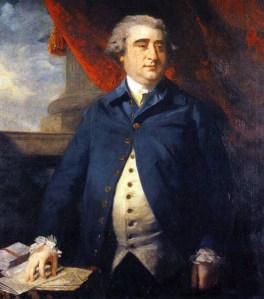
The Right Honourable Charles James Fox, MP, wore buff and blue apparel for this 1782 portrait by Joshua Reynolds. Credit: Wikipedia.
Charles James Fox was contrary. He gambled excessively, drank heavily, and he was generally irreverent. He enjoyed resisting powerful people, supported unpopular causes, and expressed his disdain for high society by adopting a disheveled appearance later in life. His colorful British Parliamentary career spanned decades. He was a champion of liberty: including the abolition of slavery, religious freedom, the colonists’ struggles with King George III, and he supported the French people in their quest for democracy.
Fox questioned King George III’s policies toward the American colonies and feared that the monarch was becoming tyrannical. It was parliament’s job to guard against such corruption. Fox and his supporters often wore apparel in the colors of buff and blue – the colors of Washington’s army – to show their support for American concerns. The Americans, in turn, honored their parliamentary champion with their own fashion accessory: they wore buttons that featured a fox, an obvious – and often used – stand-in for the controversial orator.[1]
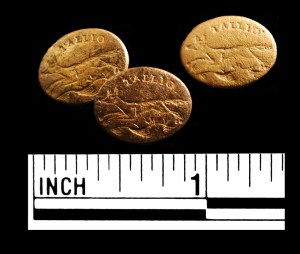
Buttons featuring a fox racing across the landscape with the word “TALLIO” were intensely popular from the 1770s through at least the first quarter of the 1800s and they are common discoveries at archaeological sites. “Tallio,” “talley-o,” “talley-oh,” “talleo” and “talley ho” were all acceptable spellings for the traditional huntsmen’s shout upon spotting the fox during a chase. But this exclamation dates from the 1770s: well over a century after the sport had been brought to the Chesapeake. [2]
A close-up of a “TALLIO” sleeve button from the Washingtons’ parlor cellar, c. 1766-1772.
Fox hunting enjoyed wide popularity among Chesapeake gentlemen. The English Brook family brought their foxhound pack to Prince George’s County, Maryland when they immigrated in 1655.[3] Fox hunting continued in the Brook family for generations, and the popularity of this privileged recreational activity spread. Fox hunting on horseback was an amusement of the leisure class and the chase was considered more important than the capture of the prey. By the late 1760s, Washington himself maintained a pack of fox hounds at Mount Vernon.
Additional TALLIO sleeve buttons from the antebellum-era plowzone at Washington’s boyhood home. They are notably more weathered from its increased exposure to the elements given its shallow soil burial environment.
Many who discover these buttons today attribute their imagery solely to the popularity of fox hunting as a sport. These buttons are often referred to as “hunt” buttons, a category that includes buttons which feature favored hobbies or athletic pursuits. Some assert that these sleeve links were widespread because fox hunting was so popular. And indeed, it was. These links – historically referred to as ‘sleeve buttons’ – enjoyed great popularity in the years surrounding the American Revolution, the Early Republic, and into the antebellum period.
I believe these buttons also achieved a deeper, political meaning, however, especially in the years around the American Revolution. Due to the support by Charles James Fox of the American cause, fox imagery came to represent resistance to tyranny. A number of contemporary British political cartoons used a fox to symbolize this politician. In addition to this documentary evidence, I believe the fox imagery used on these buttons came to symbolize the fight for liberty. For those recovered buttons for which we have context, it is evident that they are especially prevalent at sites associated with the Revolutionary War and with American patriots.
Colonial discord is represented in this 1776 image showing America (symbolized as a woman in a feathered headdress, center left) attacking a defenseless Britannia (symbolized by the woman at center right). Charles James Fox is represented as a fox in the background (see arrow). Courtesy of the Lewis Walpole Library, Yale University.
As the political difficulties between the British Crown and the American colonies intensified, Fox’s outspoken support of colonial concerns attracted attention on both sides of the Atlantic. In Britain, some called Fox a traitor for his disrespectful rhetoric against the crown. In Britain’s North American colonies, his stoic support for their cause provided colonists a crucial ally in an unexpected, but politically powerful position. Patriots and revolutionaries enthusiastically incorporated these fox hunting-themed buttons into a celebration of Fox’s ardent support.
A 1784 image of a fox, featuring the head of British parliamentarian Charles James Fox. Courtesy of the Lewis Walpole Library, Yale University
Tallio/fox buttons have been recovered from several American Revolution-era and Early Republic era forts in Tennessee and New York. Two domestic sites associated with George Washington have yielded these buttons as part of their archaeological discoveries. Signer of the Declaration of Independence, William Paca, proudly wore a tallio/fox button. Colonial towns such as Dumfries, Virginia and Jacksonborough, South Carolina have yielded these buttons from layers dating from the Revolutionary era.
Anthropologists – scholars who study people – make special efforts to identify such symbols in societies, both in contemporary studies and in analyses of past people.[4] Symbols are especially powerful because viewers do not need to be able to read, to understand language, to hear, or to speak, in order to comprehend a symbol’s message. These messages can summon strong emotional responses. Think about how you feel when you see an American flag and how your responses might change depending on how a flag might be used at a protest, funeral, or baseball game. During the last quarter of the eighteenth century, the fox symbolized resistance to tyranny, freedom, and the pursuit of liberty. Wearing a fox button proclaimed your support for American independence.
The die struck fox image on these buttons was not originally created as a political symbol for Charles Fox, however. The meaning of these buttons was adapted to that purpose after their initial manufacture. As we have seen, fox hunting was indeed a common pastime for gentlemen, and these fashionable buttons were popular among those who “chased the hounds.” As tensions between Britain and her North American colonies increased, beginning by the 1760s, the fox symbolism present on tallio buttons was malleable[5], and provided a gentleman with leeway in a politically volatile climate: its meaning could change according to a gentleman’s situation. Among unfamiliar company, such a multivocal symbol would allow an adroit – or perhaps even a vacillating – patriot some political latitude. Uncertain if the person with whom you’re dining is a Tory? Your innocent little TALLIO sleeve link merely celebrates a popular, recreational activity, whose roots in the Middle Atlantic region went back generations. But, at the same time, comrades in the struggle for American Independence recognized their solidarity in the symbolism of the fox: honoring their parliamentary advocate of colonial resistance to the King George III.
Along with the tallio sleeve button, another apparel item as evidence for the Washington family’s burgeoning resistance to the Crown has been found at Ferry Farm. As I wrote in an earlier blog post, the Washingtons wore a mid-1700s William III sleeve button to display their resistance to George III: a monarch that many colonists deemed tyrannical in his exercise of power. On more than one occasion, Charles Fox himself compared America’s Declaration of Independence to William and Mary’s “Glorious Revolution,” and (fairly or not) drew parallels between the monarchical abuse of powers exercised by George III and James II. British subjects had the right to replace a tyrannical king with another: an example set by William and Mary, and an important precedent for the American colonists. The Washingtons’ support for the Leedstown Resolves in February 1766 provides documentary evidence for their concerns with Britain’s rule and (at the time) their loyalty to the Crown.[6]
Close-up of a mid-1700s sleeve button recovered at Ferry Farm. It features the image of King William III and reads “Gulielmus D. G.” which translates as “William by the grace of God King.” This button is another demonstration of growing resistance to George III from Washington’s boyhood home.
Together, the symbolism on each of these buttons and the Washington brothers’ participation in the Leedstown Resolves demonstrates a long and growing frustration among Virginians with Britain’s colonial policies. The material expression of these sentiments can be traced back to the mid-1700s-era male apparel buttons at Washington’s childhood home. These discoveries were possible thanks to the preservation of this site, the thorough excavation of its layers, and a contextual understanding of the social and political landscape of this period.
This fox/liberty symbolism apparently endured well into the 1800s in the United States. Archaeologists recovered a “TALLIO” sleeve button from the root cellar of a quarter for enslaved laborers in South Carolina:[7] strong circumstantial evidence that this symbol of the struggle for liberty and freedom continued beyond the American Revolution. As previous mentioned, Fox was an ardent abolitionist. The layer from which this particular button was recovered dated no earlier than 1845. In this context, this symbol of liberty underwent another change and now represented a reproach displayed by enslaved Americans to highlight the paradox of slavery in what was supposed to be a democracy. Though Charles James Fox died in 1806, the use of the fox as a symbol for the struggle for freedom endured.
Laura Galke, Archaeologist
Site Director/Small Finds Analyst
Sites where such TALLIO links have been recovered Collectors and archaeologists have found TALLIO buttons from at least New York to South Carolina, and westward to Tennessee,[8] where they occur at a number of United States military forts, late 1700s-era towns, and at sites associated with patriots.
Bledsoe’s Station, Tennessee (1783-1795) – “civilian fort” (Context dates from c. 1783-1795).
British Officer’s Revolutionary War Hut in New York (Calver and Bolton 1950: 225, 227).
Fitts, Mary Elizabeth, Ashley Peles, and R. P. Stephen Davis, Jr.
2012 Archaeological Investigations at the Vance Site on the University of North Carolina Campus, Chapel Hill, North Carolina. Research Report No. 34. The University of North Carolina, Chapel Hill.
Hastings, Anne M.
1997 Fox Hunting: History and Change in a Mountain Sport. Appalachian Journal 25(1):30-46.
Mitchell, Leslie George
1997 Charles James Fox. Penguin, London.
Noël Hume, Ivor
1961 Sleeve Buttons: Diminutive Relics of the Seventeenth and Eighteenth Centuries. In Antiques 79(4):380-383.
Polhemus, Richard R.
1979 Archaeological Investigations of the Tellico Blockhouse Site (40MR50): A Federal Military and Trade Complex. Report of Investigations 26, Department of Anthropology, University of Tennessee, Knoxville.
Reich, Jerome R.
1998 British Friends of the American Revolution. M. E. Sharpe, Armonk, New York.
Smith, Kevin E.
2000 Bledsoe Station: Archaeology, History, and the Interpretation of the Middle Tennessee Frontier, 1770–1820. Tennessee Historical Quarterly 59(3):175–187.
Smith, Samuel D., and Benjamin C. Nance
2000 An Archaeological Interpretation of the Site of Fort Blount, a 1790s Territorial Militia and Federal Military Post, Jackson County, Tennessee. Tennessee Dept. of Environment and Conservation, Division of Archaeology, Nashville, TN
Smith, Steven D., Audrey R. Dawson, and Tamara S. Wilson.
2008 The Search for Colonial Jacksonborough (38CN280) Colleton County, South Carolina. South Carolina Institute of Archaeology and Anthropology Report, Columbia. Presented to Lowcountry Council of Governments, Yemassee, and Francis Marion Trail Commission, Florence.
Sprouse, Deborah A.
1988 A Guide to Excavated Colonial and Revolutionary War Artifacts. Heritage Trails, Turbotville, Pennsylvania..
Steen, Carl
2008 Archaeology on the Great Pee Dee River: The Johannes Kolb Site. http://38da75.com/professional.htm, accessed July 31, 2012. Diachronic Research Foundation, Columbia, SC.
Notes
[1] A generation earlier Fox’s father, Henry Fox – also a member of parliament – found himself represented as a fox on multiple occasions in political satire.
[2] The recovery of this artifact from a layer created between 1766 and 1772 indicates that “tallio” was a term popular before it first appeared in print in 1773 (“tally-ho, int. and n.” OED Online. Oxford University Press, March 2017. Web. 31 May 2017). Since this “TALLIO” button was deposited before 1773, perhaps the Oxford University Press might consider updating their “tally-ho” entry.
[3] A nice history of fox hunting is provided in Anne M. Hastings, 1997 article “Fox Hunting: History and Change in a Mountain Sport.” Appalachian Journal 25(1):30-46.
[4] Archaeology is a subfield of anthropology. Archaeologists study past peoples.
[5] Political sleeve buttons that said “Liberty” (revolutionary) or portrayed a Crown (Loyalist) provided their gentlemen no political leeway: they betrayed the political sympathies of their gentlemen quite directly. Did gentlemen who elected to wear TALLIO buttons lack commitment, perhaps coveting the ambiguous – and potentially innocent – message of the fox imagery?
[6] Samuel, John Augustine, and Charles Washington all signed the Leedstown Resolves which, though it expresses concern, is nonetheless effusive in its expressed respect for the monarchy.
[7] Carl Steen, Personal Communication, 15 April 2013.
The furnishings plan for the Washington house at George Washington’s Ferry Farm is done, and the reproduction furnishings are being made. Whew! It was a long process, filled with lengthy research and sometimes a few head-scratchers. Augustine Washington’s 1743 probate inventory was our guiding document in determining the furnishings for the house, but because it was written more than 270 years ago (and long before spelling was standardized) the names on it for certain objects were pretty unfamiliar to us. Some items in particular required some digging to determine what exactly they were.
Right off, we have the enigmatic entry on the first line of the inventory for the Hall. The handwritten words seemed to be “Scren Fore” or perhaps “Scren Tore”, with a valuation of 13 shillings. There is no colonial-era furnishing known by that name, and extensive research turned up very little evidence as to what the inventory-takers could have meant by a “scren fore” or “scren tore.” At present, our best educated guess is that “scren tore” was an attempt at phonetically spelling the word “scrutoire”, a furniture form unique to the Rappahannock river valley and eastern Virginia during the first half of the 18th century. Several variations of the word “scrutoire” show up in advertisements and probate inventories from those early years, suggesting there was a wide interpretation of how to spell and pronounce the word. In fact, it is believed that “scrutoire” itself is a corruption of the French word “escritoire,” which describes a diminutive ladies’ desk.
Portion of Augustine Washington’s probate inventory with “Scren Fore” or “Scren Tore” highlighted in pink.
A scrutoire in colonial Virginia was also a desk, topped with a bookcase or shelving, and enclosed with two pairs of doors. The main difference between a scrutoire and a bookcase-on-desk of the variety we are most accustomed to seeing is that there is no slant-top, or fall-front writing surface in a scrutoire. Rather, the writing surface is a pull-put board, which is also hidden by the doors when closed. When not in use, a scrutoire resembles a cabinet or cupboard.
The scrutoire is usually associated with shopkeepers or merchants, as the desks almost always feature slots for oversized ledgers, and a variety of cubbyholes and small drawers for accounting purposes. It appears that the scrutoire was a form brought to the Virginia colony by Scottish furniture makers, who settled near the Rappahannock and along the eastern shore, in places like Fredericksburg and Williamsburg. In Scotland, the scrutoire had existed as far back as the 17th century.
The reproduction scrutoire that will be displayed inside the completed Washington house at Ferry Farm.
The valuation given to the supposed scrutoire in the probate inventory was also a somewhat problematic clue. At just 13 shillings, it seems rather low for a significant case piece. However, this oddity may be explained by Sumpter Priddy in his 2012 article on scrutoires in the Museum of Early Southern Decorative Arts’ journal. As they were a form popular in Scotland as early as the 17th century, they arrived in colonial Virginia rather early in its history, and by the mid-18th century had fallen out of favor to the more common slant-front bookcase-on-desk. While their valuations in early probate inventories show them to be highly valued household furnishings, by mid-century, they are almost universally given low values, indicating their old, worn-out, unfashionable status in the household.
A scrutoire currently in the collections of Mount Vernon served as the basis for our reproduction. This example dates to slightly after Augustine Washington’s death. It is attributed to Robert Walker, a Scottish craftsman who counted Augustine and Mary Washington among his clients in the 1740s and 1750s. Later, he would produce pieces for the next generation of the Washington family as well as for Fielding Lewis, George Washington’s brother-in-law at Kenmore. It seems likely that if the Washingtons of Ferry Farm did indeed own a scrutoire, it would have been produced by their favorite local Scottish craftsman. The Mount Vernon piece does have a tradition of ownership on Virginia’s Northern Neck, where it descended in the Jett family, who lived in close proximity to the Washingtons at Pope’s Creek, and were not far from Fredericksburg and the later Washington home at Ferry Farm.
We’re pretty confident we’ve solved the mystery of the “Scren Fore” or “Scren Tore” but that left at least one other strange item on Augustine Washington’s 270-year-old probate inventory to investigate. We’ll turn to that mystery in part 2 of this post in early August!
Meghan Budinger
Aldrich Director of Curatorial Operations
Brickmasons Ray Cannetti, Robert Hall, and Kevin Nieto recently finished building the second of three chimneys for the Washington house at George Washington’s Ferry Farm. Located on the house’s north side and made from hand molded brick by the Old Carolina Brick Company, this chimney includes two fireplaces. One fireplace each on the first and second floors. These images show Kevin working on the second story’s fireplace as well as the entire chimney after it was completed and the scaffolding around it was removed last week. To see photos of the east chimney being built click here.
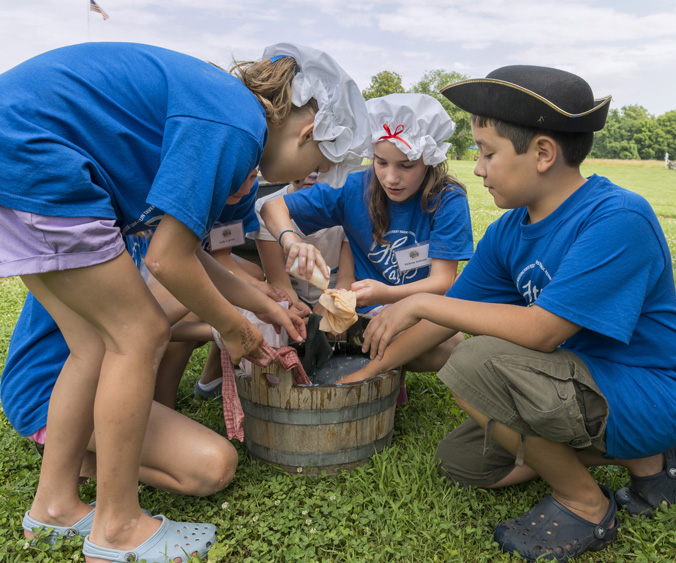
George Washington’s Ferry Farm is busy reconstructing the Washington House and, behind the scenes, we are equally busy creating educational and interpretive activities to take place inside and outside the house. One common colonial chore you may eventually see being done outside the house is laundry. While doing laundry is still part of our routines, the way we do it today looks a lot different from methods used a few hundred years ago.
Children learning how to do laundry using 18th century methods during History Camp at George Washington’s Ferry Farm.
To begin with, in the past, most households had to make their own soap. I’m not talking about lavender-infused goat’s milk soap with rosehip essential oils and colloidal oatmeal exfoliant. I’m referring to a very basic soap composed of animal or vegetal fats combined with lye water. The end result was considered a success if it removed dirt without burning your skin off. Consequently, we figured it would be a good idea if we made some soap, just to get an idea of how it is done.
For our soap making experiment, we needed two basic ingredients: lye and animal fat. Fortunately, I raise pigs and had plenty of lard to contribute to the effort so we already had our first ingredient. Soap making was often a fall or early winter activity as this corresponded with the butchering of pigs and cows. Alternatively, a household could save up their old cooking grease to turn into soap (yum). The lye, our second ingredient, was easy to obtain….online! I did briefly look into making our own lye and quickly realized this was a task far too time consuming.
Colonists, however, not having the benefit of Amazon, wouldn’t have had a choice. To make lye, they began with a hopper filled with many fires worth of hardwood ashes. After enough ashes were secured, water would be filtered through it and collected below. The resulting liquid was boiled down to create the correct concentration, which involved a lot of guess work. If the lye was too weak it would not react enough with the fats to create soap. If it was too strong, the soap would impart nasty chemical burns. Colonial soap making involved quite a lot of effort.
Along with purchasing the lye online, we took yet another shortcut and used crockpots instead of a fire. This way we could regulate the temperature and keep it steady. Imagine standing in front of a hot fire and stirring a pot of caustic lye and smelly animal fat for hours and hours? No, thank you, I’ll use the crockpot!
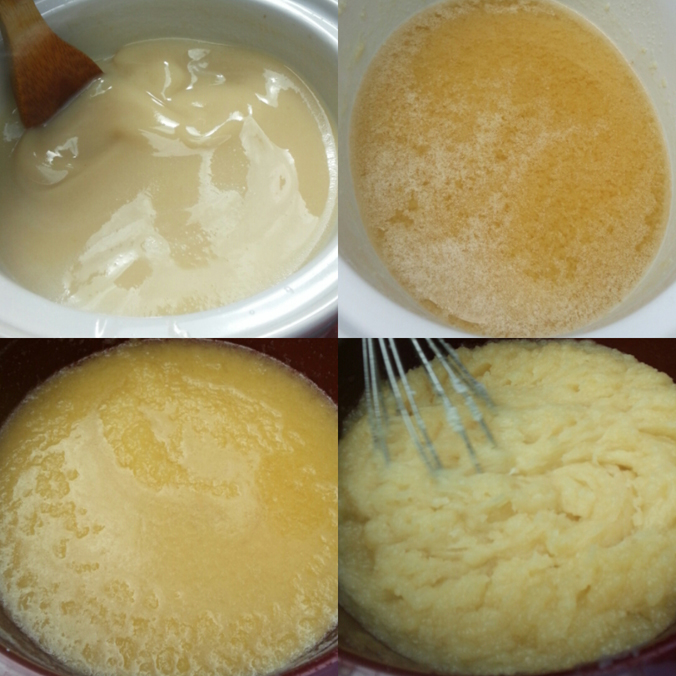
Our first step was to melt the lard in the pot and then slowly add in the lye water. The resulting chemical reaction was quite interesting. Initially, the clear lard turned a creamy caramel color before it thinned into the consistency of melted butter. Then it began to turn darker and separate into what can only be described as an ‘applesauce’ texture. After what seemed like an eternity of stirring, the mixture progressed into a ‘mashed potato’ phase (hungry yet?). This fluffy concoction was transferred to a mold and left to set up for a few days.
These four pictures show the consistency of the soap in four stages: caramel (top left), melted butter (top right), applesauce (bottom left), mashed potatoes (bottom right). Credit: Elisa Gale
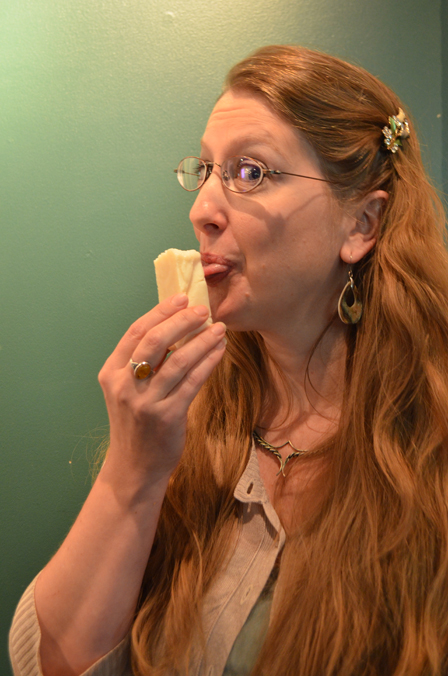
Our helpful instructor taught us the ‘zap’ test to roughly determine the pH of the soap, which was also a technique used by colonials. This involves touching the tip of your tongue to the soap. If you get a strong taste or ‘zap’, it means the pH is off, the soap is too alkaline, and could irritate your skin. If you taste nothing or only get a slight zap, it’s safe and good soap. After much soap licking, it was determined that we had indeed produced legitimate soap. This conclusion was further supported by our crockpots filling up with happy suds when we rinsed them with water.
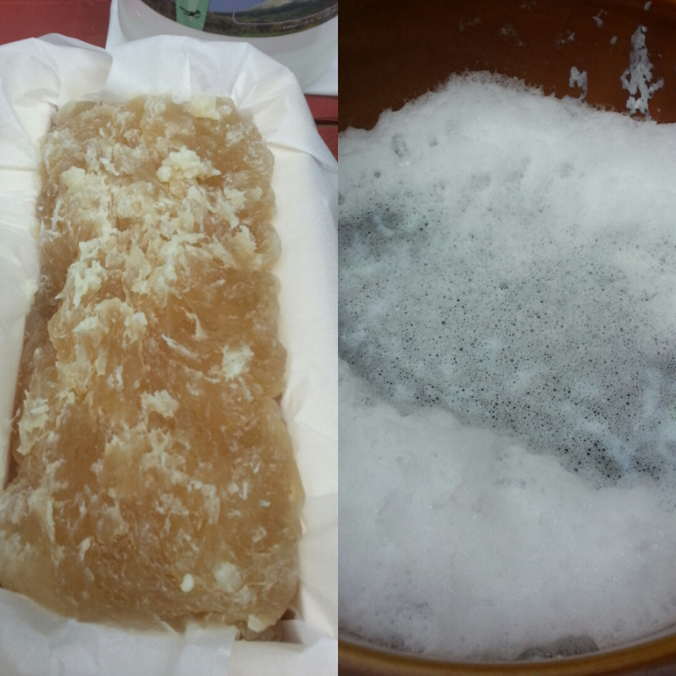
The photo on the left shows the newly made soap cooling in a parchment paper-covered wooden mold while the photo on the right shows suds in a slow cooker. Credit: Elisa GaleZap test!
If you were a colonist, making soap is where doing your laundry started. It took months of preparation just to make soap, a product so cheap, easily obtainable, and ubiquitous in today’s society that we rarely give it a second thought. If you’re interested in learning more about how soap was made come to Ferry Farm this Fourth of July where there will be a traditional soap making demonstration!
Mara Kaktins, Archaeologist
Ceramics & Glass Specialist
In this video, we see the flooring in the Washington house being installed and talk with Project Manager John Jeanes about the flooring materials and installation process.
Learn more about the Washington House here and view other videos, photos, and blog posts about the project here.

 You’ve probably heard the phrase “colonial revival” before. Most people think of it as an architectural style –what they mean when they say “a colonial style house.” In actuality, the phrase refers to a whole cultural movement in the United States that had its beginnings in the late 19th century and that still exists today. It is a style of architecture, decoration, literature, art, fashion, and even philosophy that has become so intertwined with American identity that we often have difficulty in separating what is truly Revival from what is truly colonial.





 Anthropologists – scholars who study people – make special efforts to identify such symbols in societies, both in contemporary studies and in analyses of past people.
 beginning by the 1760s, the fox symbolism present on tallio buttons was malleable