Stonemason Ray Cannetti tells us the story behind the cornerstone of the Washington house interpretive replica being built at George Washington’s Ferry Farm.
Learn more about the Washington House here and view other videos, photos, and blog posts about the project here.
Expert craftsmen from Blue Ridge Timberwrights arrived last Tuesday, September 6 to build the frame of the Washington house. This collection of photographs documents the first week of their work and begins with pictures of the finished concrete cradle and Aquia sandstone blocks ready to serve as the foundation for the timber frame. Over the past several months, the wood for the frame was carpentered in the Blue Ridge Timberwrights’ shop before being brought to Ferry Farm and pieced together to form the house. Timber framing work will continue for another few weeks.
The concrete cradle and stone foundation…
…awaits the timber frame.
Hand-carved sandstone blocks
Inside the Washington House cellar, new foundation stones rest on top of the original stones.
Timbers arrive from Blue Ridge Timberwrights in Christiansburg.
Unloading
Staging materials.
Placing a beam.
Checking the plans.
Placing a floor joist.
Refining a cut.
A section of completed floor joists.
Placing the first vertical post.
Checking a measurement.
Wood shavings
Wall framing for the front portion of the house is nearly complete.
Early in the timber framing process.
Taking measurements.
Marking the measurement.
Chiseling.
Learn more about constructing the Washington house interpretive replica here, here, and here.
Colonial American. Think about that term. What does it mean to you? It refers to citizens of the American colonies prior to the Revolution. In the minds of many of us in the present-day United States, however, it might denote a unique American identity, probably because our own identities as Americans are firmly set and celebrated. But what if I told you that most of these colonial Americans considered themselves to be loyal British subjects for much of the colonial period and proudly displayed objects that confirmed their loyalty?
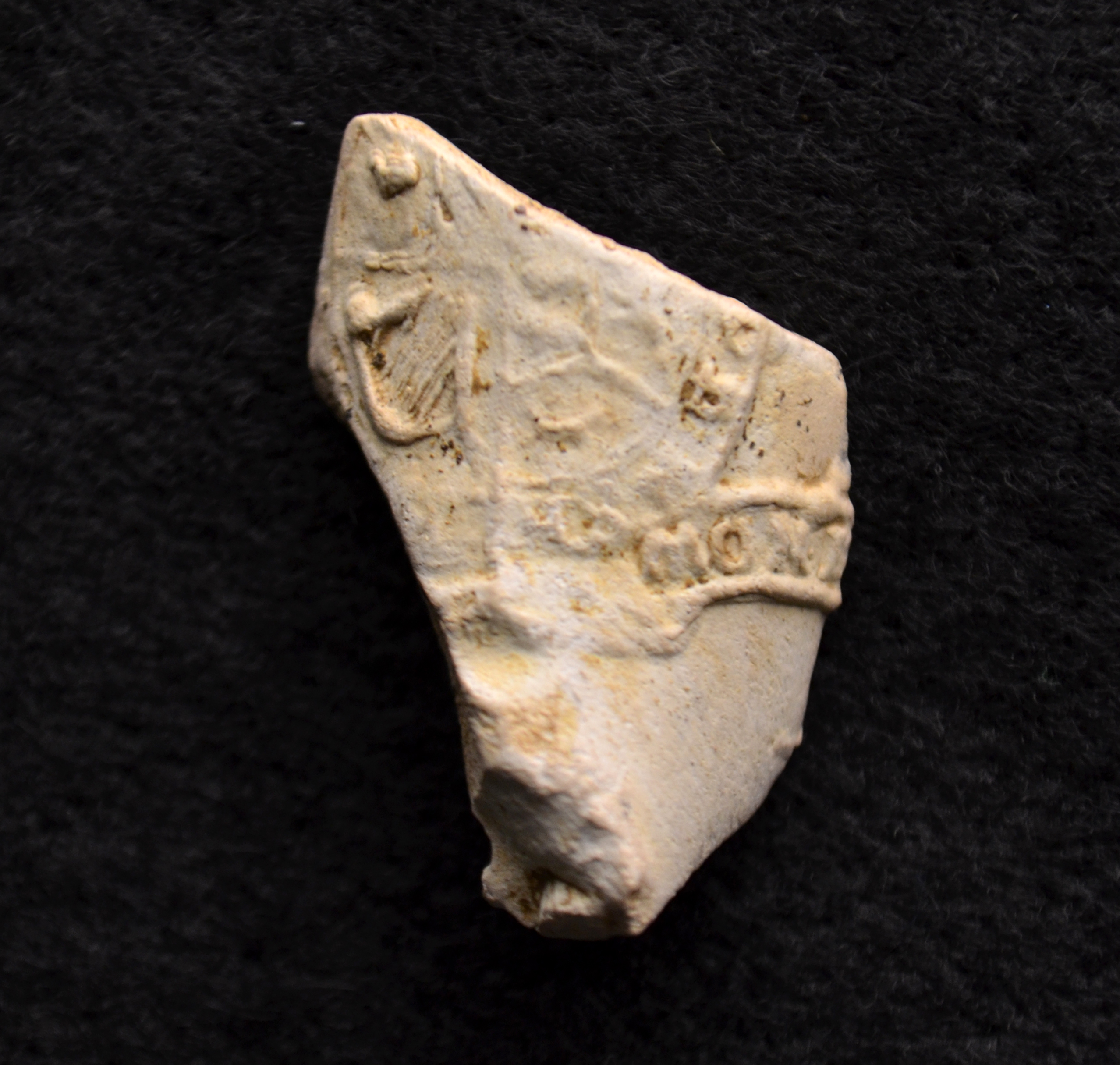
One such object discovered at George Washington’s Ferry Farm is a small fragment from a white clay smoking pipe bowl. The design on this tiny fragment includes a small harp and the letters “Mon D…”.
Pipe bowl fragment excavated by archaeologists at George Washington’s Ferry Farm.
Sometimes in archaeology we have genuine ‘Ah Ha!’ moments and, for me, this was one such instance. I grew up with a suncatcher – a gift from an English family friend — in my bedroom that featured a rearing unicorn above the words ‘Mon Droit.
I loved that suncatcher and, when I saw the pipe fragment, I recognized what the design was right away. It was the British royal coat of arms!
On pipe bowls like the one unearthed at Ferry Farm, the coat of arms wrapped around three quarters of the circular bowl. A lion, shield, and unicorn each filled their own quarter of the bowl above the full French phrase “Dieu Et Mon Droit” or “God and my right,” a claim that the right of the British monarch to govern was divine in nature. This phrase has a long history in England. It was first used as a battle cry by Richard I in the 12th century and picked up as a royal motto by King Henry V, who lived from 1386-1422. The use of the French language for an English motto may seem odd but French was very fashionable and the official language of the English court.
The British royal coat of arms from 1714-1800 during the Hanover dynasty. Credit: Sodacan/Wikipedia
It is doubtful that anyone living at Ferry Farm after the America Revolution wanted to advertise their loyalty to the British crown so we can safely say this pipe was probably used between 1714, when the Hanover dynasty began under George I, and, at the latest, the 1770s. During most of this time period, the Washington family lived at Ferry Farm.The royal coat of arms is full of important symbols. Grasping the center shield is a lion signifying England and a unicorn representing Scotland. On the shield’s lower left is a harp symbolizing Ireland. The harp is clearly identifiable on the pipe fragment excavated at Ferry Farm. The lower right section of the shield includes a columned monument and another lion. These symbols were added during the House of Hanover’s reign. Monarchs regularly changed the coat of arms as each new king or queen sought to make their mark on the official emblem. The monument and small lion were included on the shield to denote the Hanovers’ rule over their territory in what is now Germany. The fragment found at Ferry Farm also contains these elements indicating that it was manufactured between 1714 and 1800.
Pipes featured more than political symbols. This is a 3D image of another smoking pipe bowl excavated at Ferry Farm decorated with a Masonic symbol. The pipe was probably made in the northeast of England between 1770-1810. You can read more about this pipe here.
Why is this pipe fragment a big deal? During the 18th century, smoking a pipe with a political symbol like the one we’ve found was the equivalent of slapping a candidate’s bumper sticker on your car, placing a political party’s sign in your yard, or sharing a favorite political meme on social media. The act was public, deliberate, and did not go without notice. The practice continued well into the 1800s when groups such as the Irish employed smoking pipes to advertise their support for causes such as a free Ireland. It was a way to signal identity to others.
During most of the colonial period in America, aligning yourself with the crown was not at all radical but rather what was expected of most subjects. In fact, this pipe bowl fragment is not the only artifact excavated at Ferry Farm to hint at past occupants’ loyalty to Britain. As noted in a previous blog, we have found several drinking vessels exhibiting the initials ‘G.R.’ for ‘George Rex’ or King George. In another blog, we also discussed an artifact uncovered at Ferry Farm that points toward a growing resistance to the British crown. This mid-18th century sleeve button depicts William III, who, although he died decades before the button was manufactured, came to represent the right of subjects to resist a king who was abusing power.
G.R. medallion on a Westerwald jug fragment
Close-up of a mid-1700s sleeve link recovered at Ferry Farm. It features the image of King William III.
What we may be seeing in these three types of artifacts present at Ferry Farm is a fundamental shift of views within the Washington family as the political climate changed throughout the 1700s. The objects hint at a swing from loyal British subjects to revolutionaries and the beginning of our identity as independent Americans.
Mara Kaktins, Archaeologist
Ceramics & Glass Specialist
In this video, we learn how Stonemasons Ray Cannetti, Kevin Neito, and Robert Hall split and dressed Aquia sandstone into foundation stones for the Washington House interpretive replica at Ferry Farm.
Learn about the special concrete cradle the foundation stones will rest on in this video and read more about the Washington House project here.
An interpretive replica of the house that young George Washington lived in with his family is being built at his boyhood home at Ferry Farm near Fredericksburg, Virginia. This replica is being constructed on the exact location of the original. Through the use of a specially-designed concrete cradle, the replica will not harm any of the original architectural remains underground. In this video, we see the construction of this cradle and learn about the science and skill that makes this engineering feat possible.
In 1996, the Trustees, Regents, and staff of The George Washington Foundation, known then as the Kenmore Association, were part of a large and vocal group of concerned citizens that banded together to save the site of George Washington’s Boyhood Home from commercial development. While all the Washington-era structures, yards, and fences vanished almost 200 years ago, it was critical to preserve this significant place in our nation’s history—where beginning in 1738 young George and his family called home.
After years of meticulous research and planning by historians, architects, archaeologists, and curators, the Foundation is fulfilling that goal. Up to this point Ferry Farm has been an archaeology park known for its grassy fields, beautiful views of the Rappahannock River, large-scale archaeology excavations, and an amazing and extensive collection of Washington artifacts. Today with the beginning of the construction of the interpretive replica of the Washington house and the surrounding landscape Ferry Farm is beginning its transition to an outdoor living museum.
George Washington lived at Ferry Farm from age 6 to around age 22. The Cherry Tree and the Stone Throw legends were set here. He learned to survey, joined the Masonic Lodge, read his first book on military adventurers, copied the Rules of Civility, and petitioned colonial Virginia’s British Governor for his first military office at Ferry Farm. This is the landscape that was formed by the Washingtons and their enslaved workers, and George Washington’s years on this ground were essential to his development into an extraordinary man.
An architectural rendering of front facade of the interpretive replica of the Washington house at Ferry Farm.
Starting with stone masons, who are now working on the site, the construction process involves a succession of skilled artisans, employing a mix of modern and traditional techniques, including brick masons, blacksmiths, carpenters, joiners, plasterers, and painters, who together will produce the rich detail and beauty of a colonial home.
Once the replica house is in place, the Foundation will reconstruct the support buildings, fences, and yards, informed by archaeology and historical research, that surrounded and served the house. To date, we have unearthed remnants of a kitchen, slave quarter, trash yard, work yard, hen yard, and storehouse from the Washington period. As archaeology continues to reveal additional structures and other elements, they will be added to the landscape until we create a place that evokes early Virginia and portrays what life was like for young George Washington. Because the house is a reconstruction, we look forward to presenting colonial America in ways not possible for most historic house museums. We will light fires in the fireplace, open windows, and invite visitors to sit in the chairs. This unique environment will let guests experience eighteenth-century life with all their senses.
Architectural floor plans of the interpretive replica of the Washington house at Ferry Farm.
As Ferry Farm transitions from grassy fields to construction site, please stop in and witness the making of history up close. George Washington’s Boyhood Home in Stafford County, Virginia, is open Monday through Sunday. We invite you to explore Ferry Farm with the self-guided iPad tour, “Uncovering George Washington’s Youth,” or participate in a dynamic educational program relating to archaeology, history, and the natural environment. The Foundation also offers special events and tours at its sister site, Historic Kenmore Plantation in Fredericksburg. You can follow the progress at Ferry Farm on this blog, as well as the Foundation’s Facebook page and website, where we will offer glimpses into eighteenth-century construction techniques and address historical issues. We hope you will visit George Washington’s Ferry Farm soon.
David Muraca
Director of Archaeology
Learn more about building George Washington’s boyhood home in Clint Schemmer’s article, “George Washington Really Did Sleep Here”, on the Fredericksburg Free Lance-Star’s website.
Pulling Down the Statue of King George III, NYC (ca. 1859) by Johannes A. S. Oertel. Painting in the mid-1800s, Oertel created a thrilling but historically inaccurate depiction of New Yorkers destorying a statue of George III after hearing news of the Declaration of Independence. The event did happen but much of Oretel’s painting is fanciful. Public domain. Courtesy: Wikipedia.org
Writing to wife Abigail following Congress’s adoption of the Declaration of Independence, John Adams famously outlined his vision for how future generations would celebrate the historic moment. “I am apt to believe that it will be celebrated, by succeeding Generations, as the great anniversary Festival,” Adams wrote in an oft quoted passage. “It ought to be commemorated, as the Day of Deliverance by solemn Acts of Devotion to God Almighty. It ought to be solemnized with Pomp and Parade, with Shews, Games, Sports, Guns, Bells, Bonfires and Illuminations from one End of this Continent to the other from this Time forward forever more.”
Adams’ prediction was borne out immediately. News of independence spread from Philadelphia across the new American states like a circle of ripples on a great lake. By July 10, 1776, the first word arrived in Fredericksburg, Virginia, hometown of General George Washington and where his mother Mary still lived. Indentured servant John Harrower, who served as tutor for Colonel William Daingerfield’s family at Belvidera plantation about seven miles downstream from Fredericksburg on a bluff overlooking the Rappahannock, recorded the moment in his journal. [1]
“Wednesday 10th. At 6 pm went to Mrs. Battaile’s & teach’d until sunset and then returned home & soon after hea[r]d a great many Guns fired towards Toun. About 12 pm the Colo. Despatc[h]ed Anthy. Frazer there to see what was the cause of [it?] who returned, and informed him that there was great rejoicings in Town on Accott. of the Congress having declared the 13 United Colonys of North America Independent of the Crown of great Britain.”[2]
Young members of the Continental Army recreate a charge during Fourth of July at Ferry Farm!
Some days later, on July 26, when the Declaration was officially read out in Williamsburg, Virginia’s capital, the proclamation was made “amidst the acclimations of the people, accompanied by firing of cannon and musketry, the several regiments of continental troops having been paraded.”
One year later, Adams prediction continued to bear fruit, as the infant nation celebrated its First Birthday. In Charleston, South Carolina, on July 4, 1777 “ringing of bells ushered in the Day” and “At sun-rise American colours were displayed from all the forts and batteries, and vessels in the harbour.” There was a parade of military troops and then “at one o’clock the several forts, beginning at Fort Moultrie on Sullivan’s Island, discharging seventy six pieces of cannon . . . and the militia and artillery fired three general vollies.” The new state’s leaders gave a banquet with thirteen toasts and “double the number [of guests] that ever observed the birthday of the present misguided and unfortunate King of Great Britain.” To end the day-long celebration, “the evening was concluded with illuminations, &c. far exceeding any that had ever been exhibited before.”.
Back north, in Philadelphia, Pennsylvania, ships were also “dressed . . . with the colours of the United States and streamers displayed.” The crews climbed into the rigging and stretched out across the yardarms to salute the day and each ship fired thirteen cannons. On land, a banquet was held for Congress during which “The Hessian band of music taken at Trenton the 26th of December last, attended and heightened the festivity with some fine performances suited to the joyous occasion, while a corps of British deserters, taken into the service of the continent by the State of Georgia, being drawn before the door, filled up the intervals with feux de joie.” A feu de joie, French for “fire of joy”, is the firing of guns into the air in quick succession. It is sometimes described as a “running fire of guns.”. The dinner also included many toasts. The late afternoon featured a parade of military troops and the ringing of bells. “At night there was a grand exhibition of firework, which began and concluded with thirteen rockets.”
After flying for a year over Washington’s boyhood home, one U.S. flag is retired replaced with a new flag during the Patriotic Flag Retirement Ceremony at Ferry Farm’s Fourth of July celebration.
Whether in Virginia in 1776 or South Carolina and Pennsylvania in 1777, all of these acts of celebration were quite traditional and had been used for decades to celebrate the monarch’s birthday each year. In 1727, Willliamsburg marked the king’s birthday.
“The colors were displayed at the Capitol and salvos fired from the cannon at the Palace, at the forts, and on board the king’s ships in Virginia waters at the time. In the evening the Capitol, the Palace, the College, and ‘most of the Gentlemen’s and other House of Note’ were illuminated and bonfires were sometimes set in public squares in the city. At the governor’s dinner the drinking of all the loyal healths consumed a great deal of time, a variety of choice wines and liquors, and a large store of gunpowder. The populace was sometimes treated to ‘plenty of liquor’ and drank the same healths outside the Palace or at one of the taverns. The day’s festivities closed with the governor’s ball for all the ladies and gentlemen in town.” [3]
More than two centuries later, we still celebrate the Fourth of July with decorations of red, white, and blue, ubiquitous American flags, military parades, cannon fire, large amounts of food, the enjoyment of spirited beverages, music, and fireworks. John Adams vision was far-reaching indeed!
Zac Cunningham
Manager of Educational Programs
Celebrate Independence Day where George Washington spent his boyhood years!
See more photos from last year’s Fourth of July at Ferry Farm here.
This year’s theme, “We The People” focuses on The Declaration of Independence with a variety of activities and entertainment for young and old alike. Learn about archaeology at Ferry Farm, enjoy a patriotic flag retirement ceremony,interact with colonial and Civil War re-enactors as well as members of the Patawomeck tribe, listen to patriotic music, and participate in educational programs, crafts and games, and hands-on activities for the whole family. Visit kenmore.org/events.html to learn more.
Cost: $1 per person Parking: Eagles Lodge – 21 Cool Spring Road Fredericksburg, VA 22405 Shuttles will run between the Eagles Lodge and Ferry Farm.
[1] John Harrower, The Journal of John Harrower: An Indentured Servant in the Colony of Virginia, 1773-1776, edited by Edward Miles Riley, Williamsburg, VA: Colonial Williamsburg, 1963: xvi.
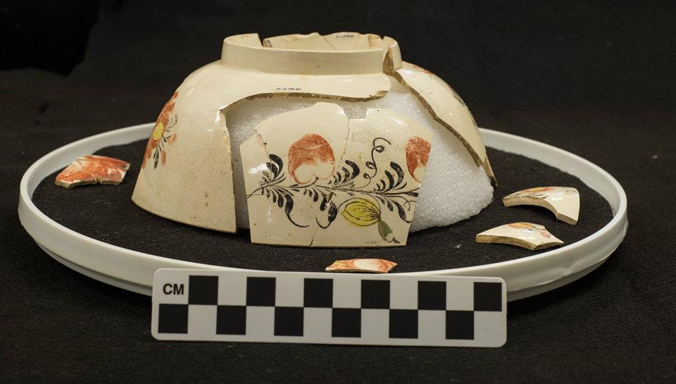
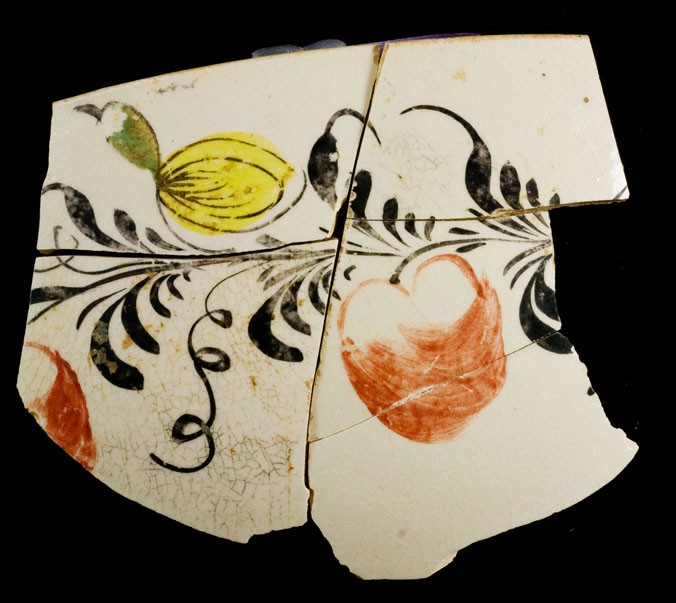
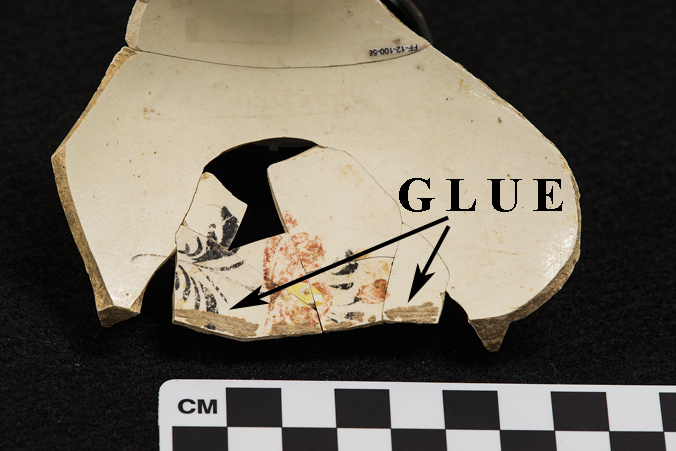
While living at Ferry Farm, Mary Washington, mother of George, owned a creamware punch bowl with beautiful hand-painted enamel depicting a floral motif and cherry accents. Archaeologists excavated pieces of this bowl from the cellar of the Washington home and subsequently discovered glue residue on the sherds.
We’ve written about the importance of the bowl’s discovery here and even showed how we recreated a glue similar to the one used to repair the bowl here.
As part of our continuing efforts to learn as much as we can about the punch bowl and these glue residues, we took the sherds to the archaeology lab at Dovetail Cultural Resource Group here in Fredericksburg, where they took photos using a microscope.
A microscopic view of the glue residue on the bowl that reveals brush strokes from when the glue was applied.
More glue.
In addition to closer views of the glue, these photos show dark flecks of iron in the red paint and reveal that iron was, in part, used to create the red pigment.
Whatever was used to create the yellow pigment could be ground up more finely than the iron in the red.
The microscopic view even revealed the brush strokes made by the artist who hand pained the decoration onto the bowl.
Mara Kaktins, Archaeologist
Ceramics & Glass Specialist