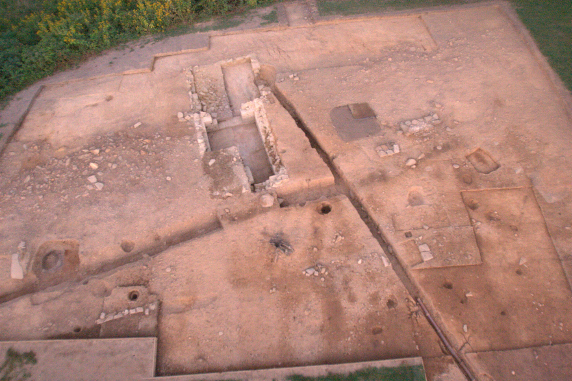
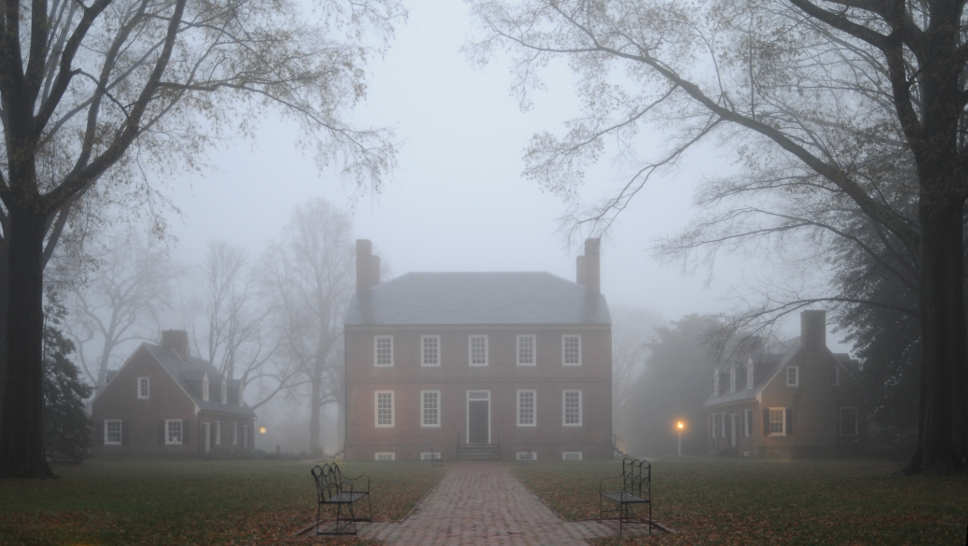
Occasionally, archaeologists uncover an artifact which raises more questions than it answers. Recent re-examination of artifacts recovered from Historic Kenmore revealed a number of ceramic sherds with an elaborate but unidentified crest. Determining the ware and vessel type was a snap, it was clearly a creamware pitcher with olive over-the-glaze printing. The glaze may have originally been black but, because it was not glazed over, the decoration degraded after burial.
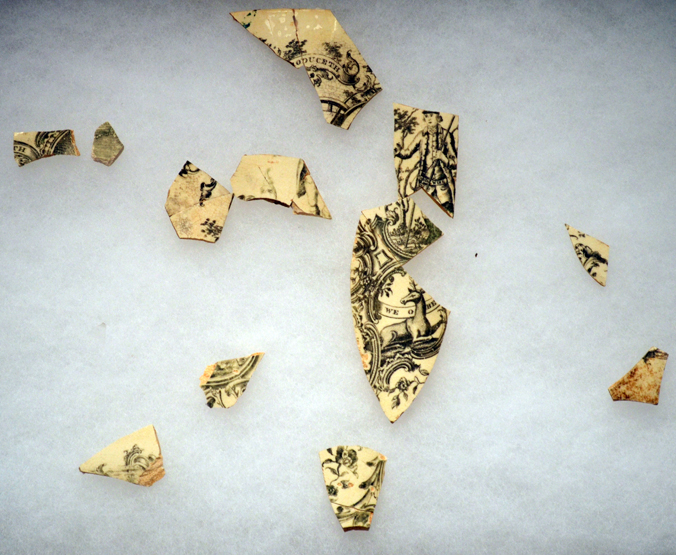
But what of the mysterious crest? Did it belong to a family or a specific city? Thankfully, it was a fairly distinctive crest with a multitude of phrases written on it including “Industry Produceth Wealth”, “We Obey”, “Be Merry And Wise”, “Freedom With Innocence” and “Unanimity Is The Strength Of Society”. In archaeology terms we would call it ‘talky’. Unfortunately, nowhere on the pitcher did it state a family’s name, a city’s name, or clearly indicate the identity of the crest in any other way. Talk about frustrating!
One of the problems lay in the popularity of drinking vessels emblazoned with similar motifs during the late 18th and early 19th centuries. Ceramic vessels such as punch bowls, mugs, and pitchers printed with scenes or crests proclaiming the political views, the patriotism, or the private affiliations of the owner were quite common. After many hours of pouring over books and the Internet later, we discovered the identity of the mysterious crest. It belonged to an organization called The Most Ancient and Honourable Society of Bucks.
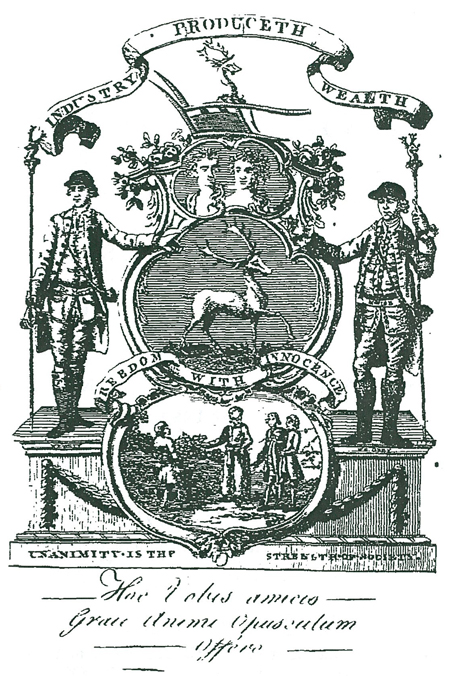
The Society of Bucks was a somewhat obscure secret fraternal organization (sort of like the Masons) that claimed it descended from Nimrod, a Mesopotamian king figuring in several Biblical stories. Despite these allegedly lofty origins, in reality, the society was more of a gentlemen’s drinking club known for its rowdy parties. A member of the society in the 1770s – a man known to history only as “Hurle” – left the group after becoming disgusted with their behavior. In 1781, he founded another fraternal order known as the Ancient Order of Druids, which forbade its members from using profanity or discussing politics. Apparently, the Society of Bucks had quite a reputation.
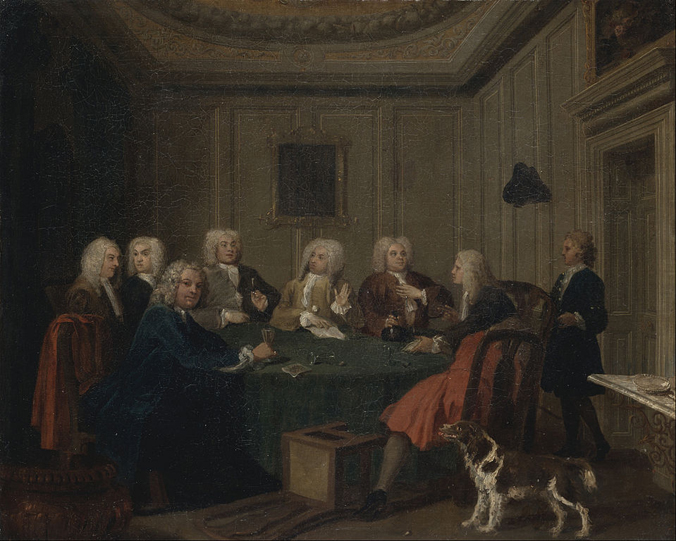
The Society existed in Britain from the 1720s through the 1820s. It’s heyday seems to have been in the 1760s and 1770s. The fragments found at Kenmore showing the Bucks crest indicate the vessel dates to sometime after 1757. The Society’s crest had a different appearance before that year, when John Sadler published a print of a new version of the crest.
While these fragments indicate the presence of a very specific piece that we can now set about acquiring for display in Kenmore, they have also opened a window on a completely new possibility in our knowledge of Fielding Lewis’s life.
Fielding was a Mason, having joined the Fredericksburg Lodge in 1754, but his level of involvement in the organization has always been unknown. Masonry at the time was as much about secret vows and handshakes as it was about social status and business connections. It also had a heavy political component, as many of the leaders of the colonial revolutionary movement were Masons. It is unknown which aspect appealed most to young Fielding. As with most things in his life, we are left with very few clues as to his thoughts and motivations, especially from his own hand.
One fact that we thought we had firmly nailed down was the surprising notion that he had never been to England, or even left Virginia. For a man of his status, and of his family’s status during his childhood, it is rather unusual that Fielding had never visited England, whether for business or education. But no historical document makes mention of such a trip, and in the timeline of his life it is hard to find a window in which such a lengthy voyage could have taken place. The discovery of the Society of Bucks fragments at Kenmore raises some intriguing possibilities.
First, the society originated in Liverpool, the city in which most of Fielding’s trade relationships existed. It apparently never made the leap across the Atlantic to the New World, as no indications of the Society of Bucks being present in the colonies has ever been found. If Fielding could never have encountered the Society of Bucks in Virginia, and he never travelled to the city with which he did so much business, how did he come to own these vessels? Is it possible that he did in fact visit Liverpool at some point? While there, did he perhaps join the local fraternal society as a way to network with local businessmen, much as he did with the Masons in Fredericksburg? Were these vessels perhaps a gift from members of the Society? Whatever the case, the archaeological fragments found at Kenmore continue to call into question some long-held beliefs about Fielding Lewis’s life and remind us again that history is a dynamic and ever-changing story.
Meghan Budinger
Aldrich Director of Curatorial Operations
Mara Kaktins, Archaeologist
Ceramics & Glass Specialist