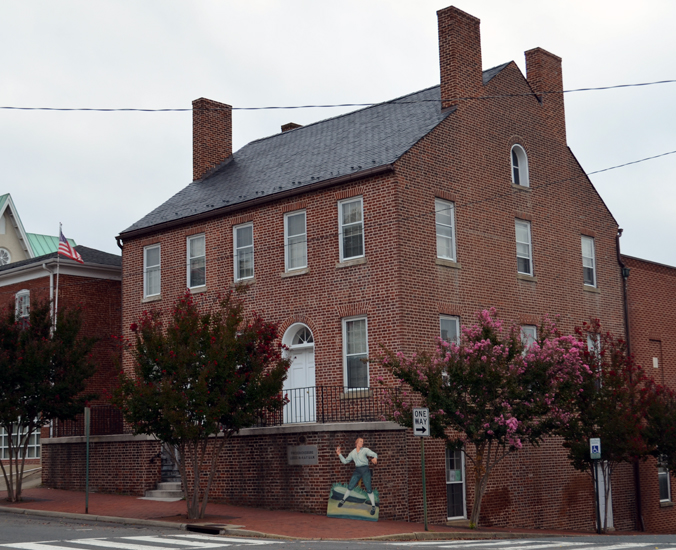
Each January, Historic Kenmore presents Twelfth Night at Kenmore, a dramatic theater presentation that imagines the first Christmas that Fielding and Betty Washington Lewis spent in their newly built home. The play is set in January 1776 and that year is not a time for the usual celebration. War brings fear, doubt, and frustration to the Lewis family and their friends.
The 2019 edition of Twelfth Night at Kenmore took place January 11 and 12. Here are a few photos from the performances.
Snow begins to fall on Kenmore.
Rachel Sargeant as Lucy Thorton Lewis greets visitors in the Passage.
Rae Ehlen as Fielding Lewis (L) and Wilson Johnson as George Weedon (R) share the latest war news.
Anne Lloyd as Mary Washington (L) and Corinn Keene as Nancy Alexander Lewis (R) discuss how the war endangers their loved ones.
Ashlee James as Rachel, the washerwoman (L), and Gladys Perkins as Hetty, the cook (R), talk about the wisdom of running away to freedom promised by the British.
Barbara Cochran as Betty Washington Lewis.
Michael S. Taylor as John Lewis.
Singing “God Rest Ye Merry Gentlemen.”
Marcus Salley as Pompey, the blacksmith, tends a fire.
Sam Fulton as Henry Mitchell, Fredericksburg merchant, alone in the Drawing Room.
It’s the 32nd year of a a long-standing holiday tradition: the Gingerbread Contest & Exhibit at George Washington’s Ferry Farm! This year’s theme is “Cartoon Adventures.”
“Snoopy’s Christmas Love” by Gloria Tignor
“A Minon Christmas”
“Yabba Dabba Doo” by The Feeback Family
“A Charlie Brown Christmas” by Ni River Special Education
“Hobbit House” by Chancellor High German Club
“Cartoon Advent Calendar” by Ms. Redelman’s Class at Courtland High School
“Rapunzel” by Angela Saathoff
“Frosty the Snowman” by Samantha Wainwright
“Grinch’s House” by CJ Crocker
“Scooby Doo Miner 49er Chase” by Susan Dodson
“Transformer Making a Snow Angel” by Misha Sanborn
“Calvin & Hobbes” by The Szlyk Family
“Calvin & Hobbes” by The Szlyk Family
“Whoville” by Ms. Bekah’s ECSE 3 Class
“Calvin & Hobbes Winter Wonderland” by Jessica Kamuar
“Charlie Brown’s Christmas”
“A Christmas in WhoVille” by The Jackson 5
Adults and children alike will enjoy the sights and smells of these festive creations displayed at Ferry Farm! Ferry Farm’s hours are Monday – Saturday 10:00 a.m. – 4:00 p.m. and Sunday from 12:00 p.m. – 4:00 p.m. Ferry Farm is closed Christmas Eve and Christmas Day. The gingerbread exhibit ends on December 30. General admission to Ferry Farm and the exhibit is $9 adults, $4.50 students, under 6 free while admission to the exhibit only is $4.50 adults, $2.25 students, under 6 free.
For more information, call (540) 370-0732 x24 or email [email protected].
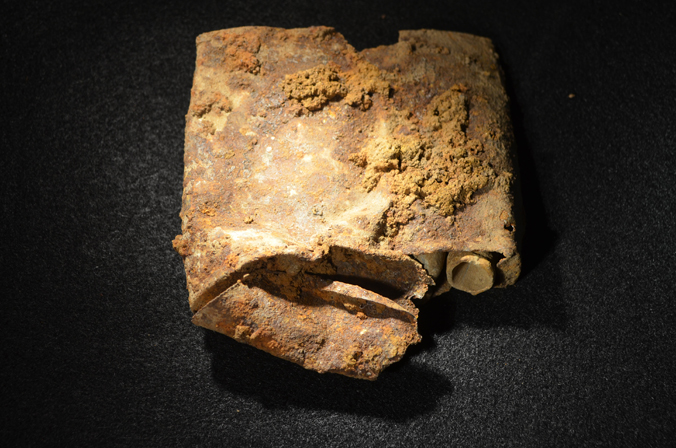
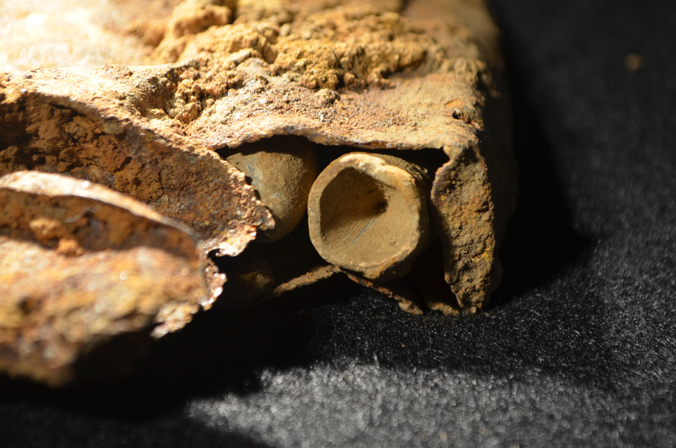
Old, crushed, and rusted food cans in and of themselves aren’t terribly interesting, at least not to me. But when the can contains 150-year-old bullets, it becomes very interesting indeed. Recently, while going through our artifact collection database, I came across an item excavated at George Washington’s Ferry Farm nearly 20 years ago and simply listed as a ‘can’. Wanting to know the exact nature of this can (Was it a food can? Was it a paint can?), I looked at the database’s comments section, which sometimes describes an artifact in more detail. The comment read: “Smashed can containing Minié balls.” Now this can had my full attention! I had the can pulled from artifact storage and was not disappointed. It was, as advertised, a flattened can with at least 3 visible Minié balls lodged inside. Furthermore, there was something not visible rattling around inside of it. Because it had simply been cataloged as a ‘can’, it escaped the notice of our crack team of research archaeologists for two decades. I began investigating!
Flattened can containing Minié balls excavated at George Washington’s Ferry Farm.The end of Minié ball sticking out of the can.
First, I wanted to know the age of the can. I knew the Minié balls dated to a little over 150 years ago when Union soldiers were stationed at Ferry Farm during the Civil War. The can, however, may have been from a later date. In oral histories, people who lived at Ferry Farm in the 20th century have mentioned collecting Civil War bullets in cans so my initial assumption was that this was the forgotten treasure of a relic hunter. The next step was to examine the other artifacts recovered with the can at the same time and in the same spot on the Ferry Farm landscape. All of these artifacts were from the mid-19th century. Furthermore, the can was excavated from smack dab in the middle of a Civil War trench that runs across Ferry Farm. So the can and the bullets were from the same time period.
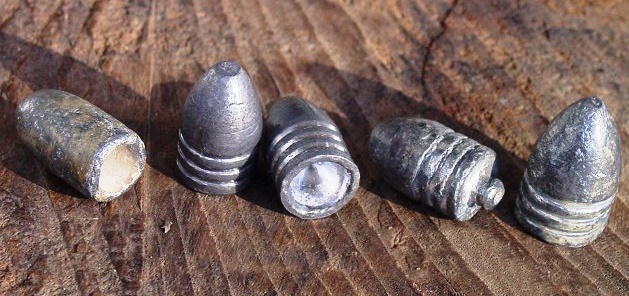
Various types of Minié balls from left to right: .577 Enfield Minié Bullet, Burton Pattern Minié Bullets .58 Springfield (x 2), Williams Bullet missing zinc base, .69 Caliber Minié Bullet for modified 1843 Springfield Musket. Credit: Mike Cumpston / Wikipedia
But the can didn’t look anything like a typical cartridge box. It looked like a run of the mill tinned food can and what was rattling around inside? It was time to do some science! I took the can to the Virginia Department of Historic Resources where their awesome conservator Katherine Ridgway was kind enough to x-ray the can. The x-rays proved the can was a food can and that the rattling object inside was another Minié ball.
While we now know a lot more about our can now, one mystery still remains. Why did a soldier store some of his bullets in a can? What we do know is that, at some point, the can was abandoned or forgotten at the bottom of the trench and then crushed either under a boot or by the weight of the dirt once the trench was filled in after the war. A 150 year old moment in time captured in the archaeological record.
Mara Kaktins, Archaeologist
Archaeology Lab Supervisor
Archaeological excavations at George Washington’s Ferry Farm have occurred nearly every summer since The George Washington Foundation purchased the property in 1996. The summer of 2017, when the majority of the replica Washington house construction was underway, was the major exception. The archaeological site was proved too close to ongoing construction so excavations were put on hold until the summer of 2018.
This year, a five person crew consisting of a field director Steve Lenik, assistant field director Elyse Adams, and interns Reagan Andersen, Cheyenne Johnson, and Aileen Kelly worked from April to July on the Ferry Farm property. For five weeks, an additional seven students from Georgia Southern University and the University of South Florida came to Ferry Farm for a field school, to learn the basics of excavation and lab work.
The North Yard
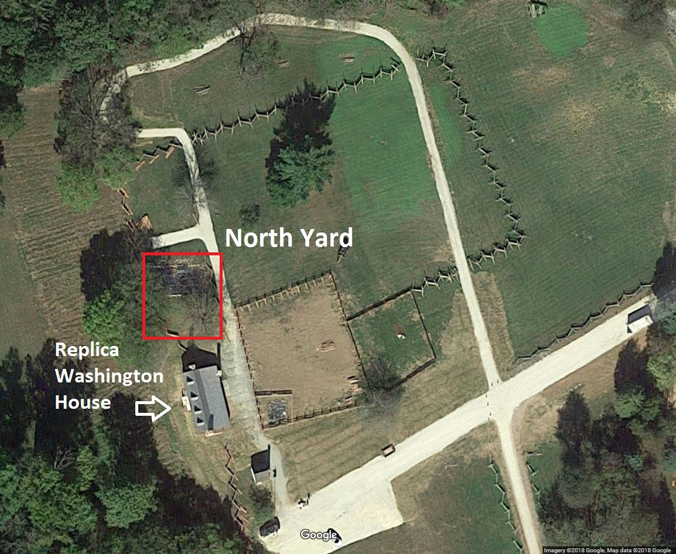
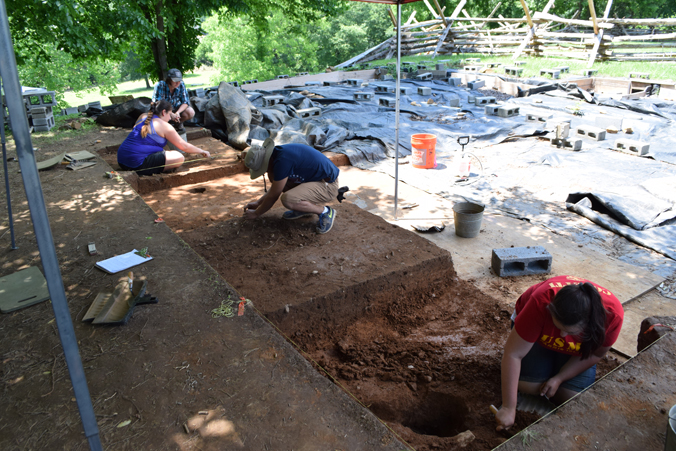
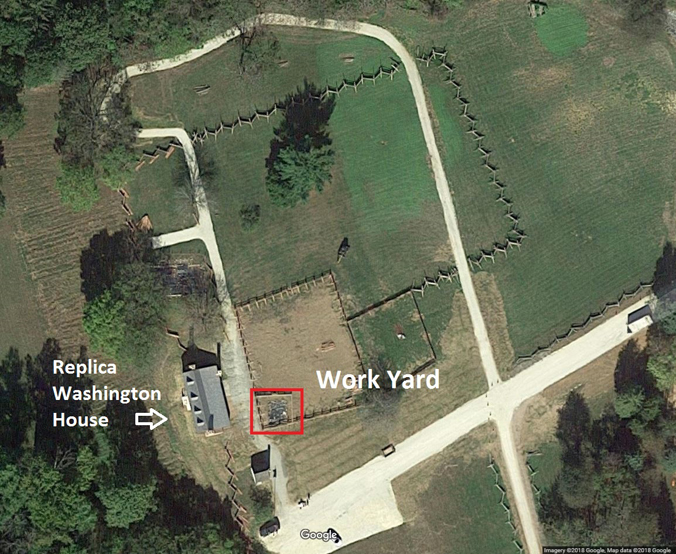
We investigated two areas. The first, an area at the crest of the ridge to the north of the replica house, was the North Yard. This yard lies between the Washington House and a slave quarter that was completely excavated in previous years. The purpose of digging in this area was to find evidence about who controlled this space. Was it the domain of those who lived in the Washington House or of the enslaved population who lived in the quarter?
Excavations are not yet complete in this area, but we discovered that this space was relatively clean compared to the Work Yard and areas immediately behind the Washington house, where a lot of trash and debris from daily 18th century activities were found during past excavations. The lack of trash and debris in the North Yard was likely because, in colonial times, this was part of the property visible from Fredericksburg and therefore was well-kept A public space like this one would have likely fallen under the control of those who lived in the Washington house.
Field school students excavating the North Yard.
We were also looking for evidence of any other outbuildings and gardens, in order to accurately recreate the landscape of the farm as it was in the 1700s. We discovered evidence of large trees that lived on the landscape during the 18th century in this area. This discovery will allow archaeologists to look even closer into the use of this space with the goal of re-creating it as it was in the time of the Washingtons.
The Work Yard
The second area we investigated during this summer’s dig was behind the Washington house in the Work Yard, which is exactly what it sounds like—a space for work to be done on a farm in the 1700s. This space is special to our research here at Ferry Farm. Much of this space was excavated already in past years, yielded a treasure trove of artifacts and information, and was then filled back in once excavations were complete.
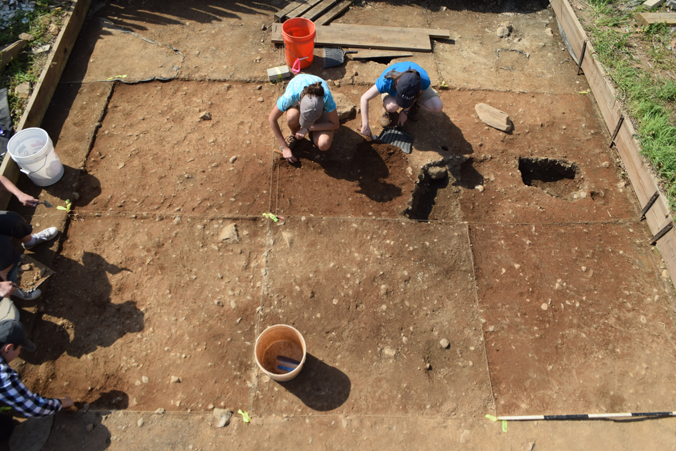
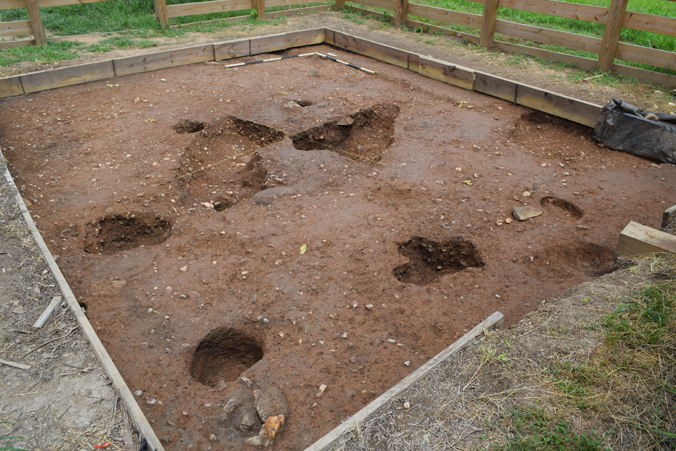
One small area just behind the house was left to excavate, however, and that’s where we worked this summer. We discovered large stains in the soil, very deep in the ground. They were made during the colonial era but, as yet, we do not know why. This area was originally thought to be a cellar, but as excavations continued, we began to notice a series of pits instead. Analysis is still ongoing and artifacts excavated in this space are still being processed so we don’t have answers to any of our questions yet.
Field crew exposing the large soil stain of possible cellar at the start of the 2018 excavations.Final photo of the Work Yard pits at the end of the 2018 excavations.
Nevertheless, our minds were racing with possible explanations of these pits and we couldn’t help but wonder if they were somehow related to Ferry Farm’s collection of at least 215 wig curlers—very unusual finds for a Virginia farm—that were excavated above or around this space.
It’s far too soon to tell, we don’t have any complete answers, and we still aren’t finished excavating the Work Yard, but this area already is proving important to the Ferry Farm story. Once we understand the landscape and complete the Work Yard excavations, the 18th century outbuildings that have been identified and that once stood in this space will be replicated just like the main house.
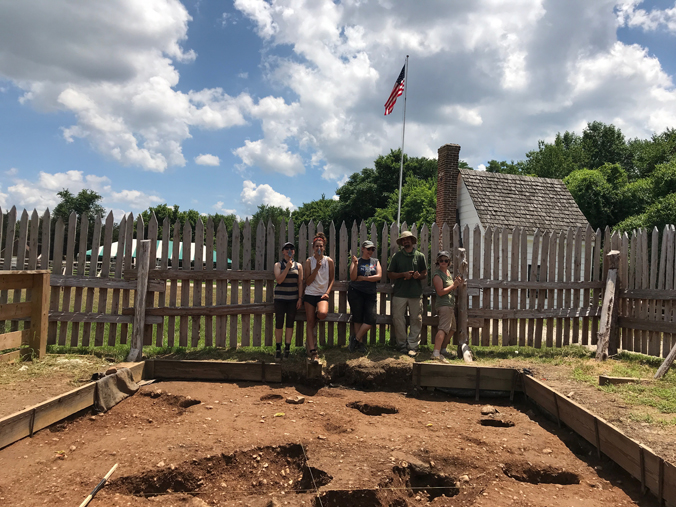
The dig team! (l-r) Reagan Andersen, Cheyenne Johnson, Aileen Kelly, Steve Lenik, Elyse Adams
Future excavations will continue to yield the information we need to replicate the entire boyhood landscape of George Washington’s home. Every bit of information, no matter how small the tree root or how tiny the artifact, is pertinent to the understanding and accurate interpretation of this important landscape, and to understanding the lives of all who have lived and worked here. We look forward to many more years of discovery, and many more summers of digging into the history of the Washington Farm.
Elyse Adams, Archaeologist
Assistant Field Director
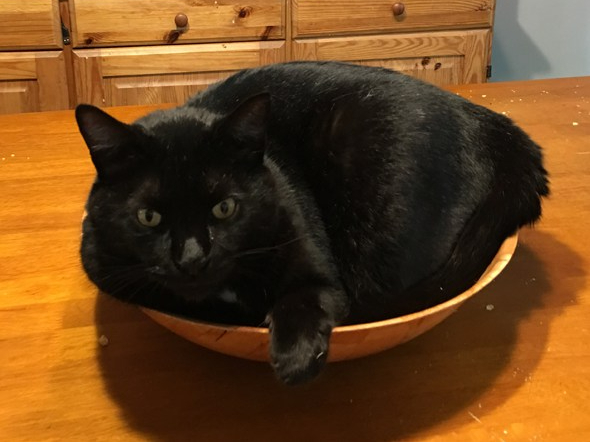
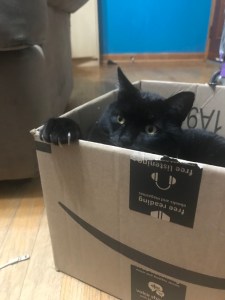
We look at our cats today as the furriest, purriest companions known to humankind. But most cats in colonial America worked for their status as the designated house cat. It wasn’t all lazy days trying to squeeze into the smallest box possible or snoozing in that tiny sliver of sunlight on the living room floor. I’m a proud companion of a seven year-old fat cat named Jeffrey, who spends much of his time doing these very things.
Jeffrey in his favorite spot- the fruit bowl on the kitchen table.
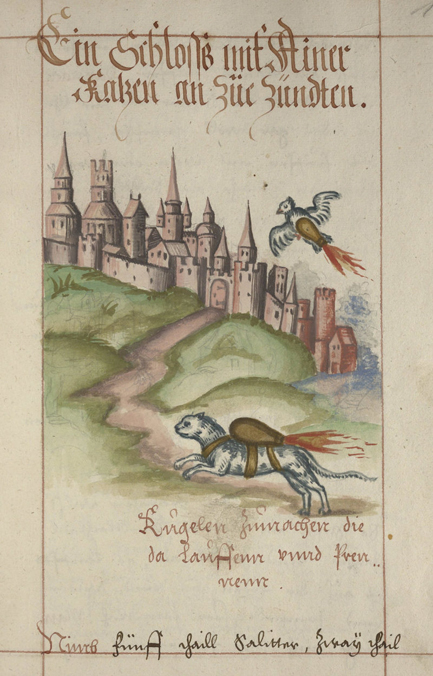
Jeffery probably would not have enjoyed being a working cat in the past. Don’t get me wrong, according to archaeologists; many civilizations have treated cats as companions for at least 8,000 years! But cats were often expected to serve a practical purpose, too. Along with companionship, cats were expected to work at jobs like pest control and to even serve as weapons. This extreme version of work was proposed in an early German explosives and artillery manual that depicts a weaponized cat and bird set loose into an enemy town.
I expect neither pest control nor explosive assaults from Jeffrey, however. The only thing he “attacks” is the lawn and, more often than not, cardboard boxes.
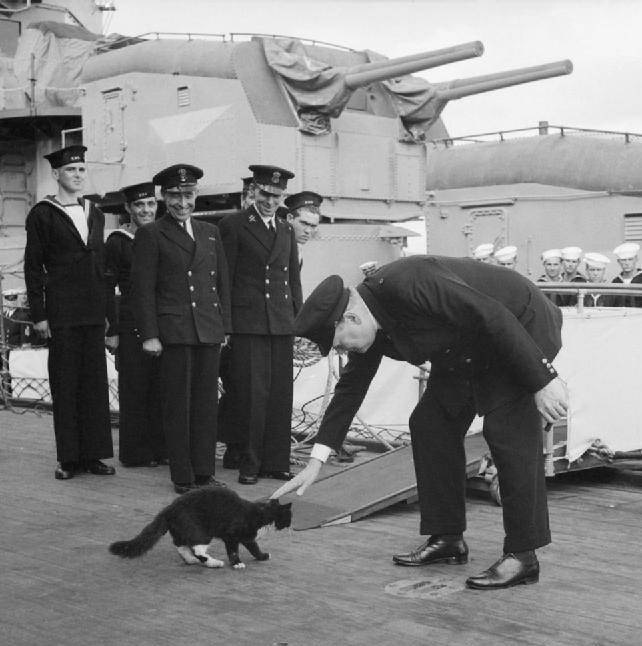
Cats as Work Animals For thousands of years, cats accompanied sailors to sea, including European sailors travelling to the colonies. Rats carrying fleas and disease are common stowaways on ships. As a result, cats were — and still are — used as pest control during sea travel. Even today, sailors have “ship’s cats” to control vermin onboard their vessels. Not only do they prevent disease and destruction of foodstuffs but they keep vermin from damaging ropes and electrical wiring, which could prove CATastrophic (heh heh heh) if not for ship’s cats.
Prime Minister Winston Churchill stops ‘Blackie’, ship’s cat of the HMS Prince of Wales, from crossing over to an American destroyer during the Atlantic Conference with President Franklin D. Roosevelt off the coast of Newfoundland in August 1941. Credit: Imperial War Museum.
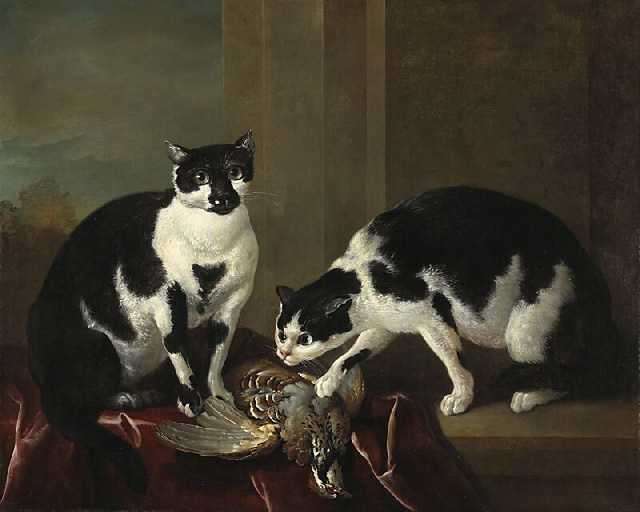
Similarly, when Europeans first established their colonies, survival rates were much lower in the beginning due to famine and disease, so pest control was important on land as well as at sea. Settlers often kept pragmatic, but friendly relationships with cats in order to keep vermin at bay.
“Two Cats” by Jean-Baptiste Oudry (18th century) depicts cats doing what they were expected to do, which was to kill disease carriers and some birds, like rats, carried disease vectors or could endanger crops. Credit: National Gallery of Canada.
The Enlightenment We humans of course established bonds with our friendly working critters and some cats were adopted as what we now call “pets”. The 18th century was a transformative time in pet ownership as we have shown with dogs in another blog post. It had not always been acceptable to keep a pet in European countries. The luxuries that our pets enjoy today would be inconceivable to a person before the Age of Enlightenment. Outfits, daycare, even hotels are now available to our furry friends. In earlier times, pets were deemed wasteful because keeping them devoted resources to an animal that was neither food nor used for its labor. It was even considered sinful to squander resources on non-working animals. Pets were a luxury saved for the bourgeoisie.
During the Enlightenment, people became more aware of their own sensibilities and opened up to a range of new philosophical ideas. There was a shift from the church being the main authority to the belief that the primary source of authority and knowledge was reason. People who were newly questioning authority also undoubtedly questioned why they could not devote resources and attention to an animal for no other reason than enjoyment and companionship. With this attitude change, animals became viewed more as a non-human member of the household and were eventually valued in their own right. Cats became pets.
“Favourites” We can see the growing prominence of cats as pets in 18th century poetry, paintings, and songs.
One such poem by Thomas Gray published in 1748 was called Ode on the Death of a Favourite Cat, Drowned in a Tub of Gold Fishes. The next-to-last stanza describes the tragic moment.
Eight times emerging from the flood She mewed to every watery god, Some speedy aid to send. No dolphin came, no Nereid stirred; Nor cruel Tom, nor Susan heard; A Favourite has no friend!
When Gray called the ill-fated cat “a Favourite,” he used an earlier term for “pet”.
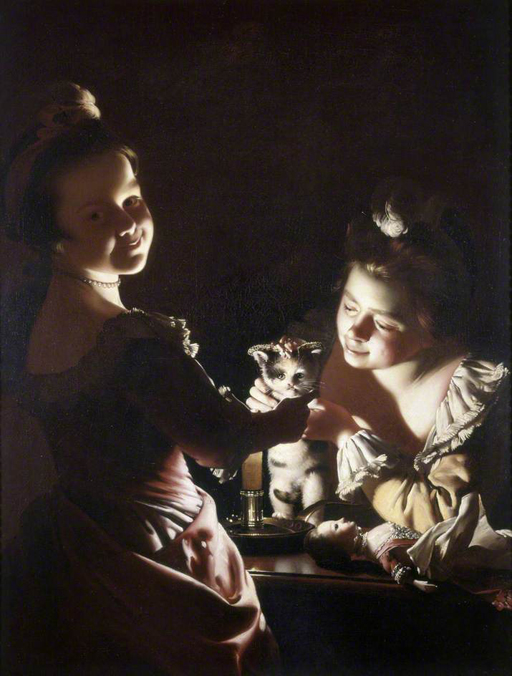
European and American portraiture repeatedly depicted people with their pets and cats were common subjects both alone and with their human counterparts. Below, you can see two 18th century portraits of people interacting with their favorite cats.
As seen above, Joseph Wright took time to depict two small girls dressing up a kitten. In children especially, the joy a companion animal brings was irresistible. This critter was undoubtedly a favorite and probably wasn’t expected to do much in the way of work.
Above Edward Bird shows a woman enjoying her tea with her companion cat by her side. She even seems to allow the cat onto the table, which many people won’t allow their pets to do even today.
Finally, an 18th century Polish folk song called “Wlazł kotek na płotek” or “The Kitten Climbed the Fence” was a very popular lullaby, describing a child and grandmother treating the kitten as a favorite by giving it milk when it climbs the fence into their yard.
Thanks to the Enlightenment, according to the Humane Society of the United States, over 97% of cat owners today consider their cats to be a family member or companion. In a way, nearly all domestic cats in America today are “favorites” rather than sources of labor. The nature in which Americans treat their pets, whether cats, dogs, chickens, or goldfish, reflects the progression of change from the time of the Enlightenment and into present day. While academic research on such an abstract subject is difficult, it is easy to understand how cats progressed from worker and protector to best friend.
Elyse Adams, Archaeologist
Artifact Cataloger & Field Monitoring Technician
As George Washington’s Ferry Farm prepares to celebrate the reconstruction of the Washington house, we traveled around George’s hometown – Fredericksburg, Virginia – to visit a few places important in the transformation of George from boy to man.
In 1753, 21-year-old George Washington became a Master Mason having joined the Masonic Lodge in Fredericksburg the year prior. In his encyclopedia on all things George, Frank Grizzard concluded that “For Washington, joining the Masons was a rite of passage, a formal entry into respectable and genteel if not elite society.” The boy who arrived at Ferry Farm at the age of 6 was now an upper class Virginia gentleman.
The Masonic Lodge of Fredericksburg at the intersection of Princess Ann and Hanover Streets.
The Fredericksburg lodge formed in 1753, the year Washington joined. Its current building (pictured) was built in 1816.
Join us at the Washington House Celebration on Saturday, October 7, 2017 from 12:00 p.m. – 4:30 p.m. to celebrate the construction of the Washington house! A special ribbon-cutting ceremony will begin at 1:30 p.m. featuring notable speakers. After the ceremony, guests will be invited to view the reconstructed Washington house!
Ferry Farm opens to visitors at noon on Saturday, October 7.
PLEASE NOTE: PARKING for the event is off site at the VRE Fredericksburg Park and Ride Lot G at the corner of Prince Edward Street and Frederick Street. Buses will transport guests to and from Ferry Farm—traveling from the VRE lot to Ferry Farm on a regular schedule from 11:45 a.m. to 1:15 p.m., and 3:00 p.m. to 4:15 p.m. Bus transportation will pause during the ribbon-cutting ceremony. The last bus will depart Ferry Farm at 5:15 p.m. Limited handicap parking is available at Ferry Farm.
The timber framing of the Washington house is complete. In this video, we get a close-up view of the construction of the house’s timber frame. For a timelapse view of the timber framing, watch this video. To see how the beams in the frame were fashioned, watch this video.
Learn more about the Washington House here and view other videos, photos, and blog posts about the project here.
This December marks the one-year anniversary of Lives & Legacies: Stories from George Washington’s Ferry Farm and Historic Kenmore. As we bring the blog’s first year to a close, we thought it might be worthwhile to share once again several of our most read entries from 2015. We hope you enjoy reading them for the first time or reading them again as we move into 2016 and year two of Lives & Legacies.
Here are our Top 5 Most Read Posts of 2015:
#5… Nancy Hallam: America’s First Celebrity Actress tells the story of the the earliest known acting troupe in the colonies and that troupe’s close connection to Virginia. At the center of this story was a young actress named Nancy Hallam, whose talent was greatly praised at the time and who probably performed for Thomas Jefferson and George Washington. Her renown was such that she was even painted by Charles Willson Peale.
#4… What is this Artifact? is one of many entries during the year focused on one particular artifact recovered by archaeologists at George Washington’s Ferry Farm. As is often the case with archaeology, the artifact presented a mystery to solve. A variety of alterations to an 18th century leaded glass base from a cup or mug raised the possibility that the resulting glass disc may have been a homemade toy top.
#3… George Toasts George? investigates the political meanings found in Westerwald stoneware recovered at Ferry Farm. The presence of these artifacts celebrating the British Crown at George Washington’s boyhood home show that until the Revolution the Washington family, like most Americans, viewed themselves as loyal subjects of the king. It is indeed intriguing to picture a young George Washington drinking heartily from a ‘G.R.’ mug and toasting a king against whom he would lead a revolution.
#2… After Digging: What Happens in the Archaeology Lab? reveals that archaeology is far more than just digging for artifacts. In fact, generally, archaeologists spend 3 days in the lab cleaning, cataloging, labeling, and analyzing objects discovered for every 1 day spent digging them up. This post explains the process artifacts go through in the lab after being excavated from an archaeological site.
#1… Perukes, Pomade, and Powder: Hair Care in the 1700s begins with the fact that archaeologists at Ferry Farm have recovered a variety of hair care artifacts, including over 200 wig hair curlers. These baked clay curlers were used exclusively to curl wigs, or ‘perukes’, and formed part of the Washington family’s regimen of wig maintenance. The regimen included wearing wigs made from human hair, styling those wigs using pomades made from animal fats, and powdering them with flour or clay. The post also discusses why powdered wigs were highly fashionable among gentlemen of the 1700s.