Lives and Legacies

Tag: Joseph Ball

  • A Gift Across the Seas: Betty Washington’s Silver Tea Set from Her Uncle Joseph Ball

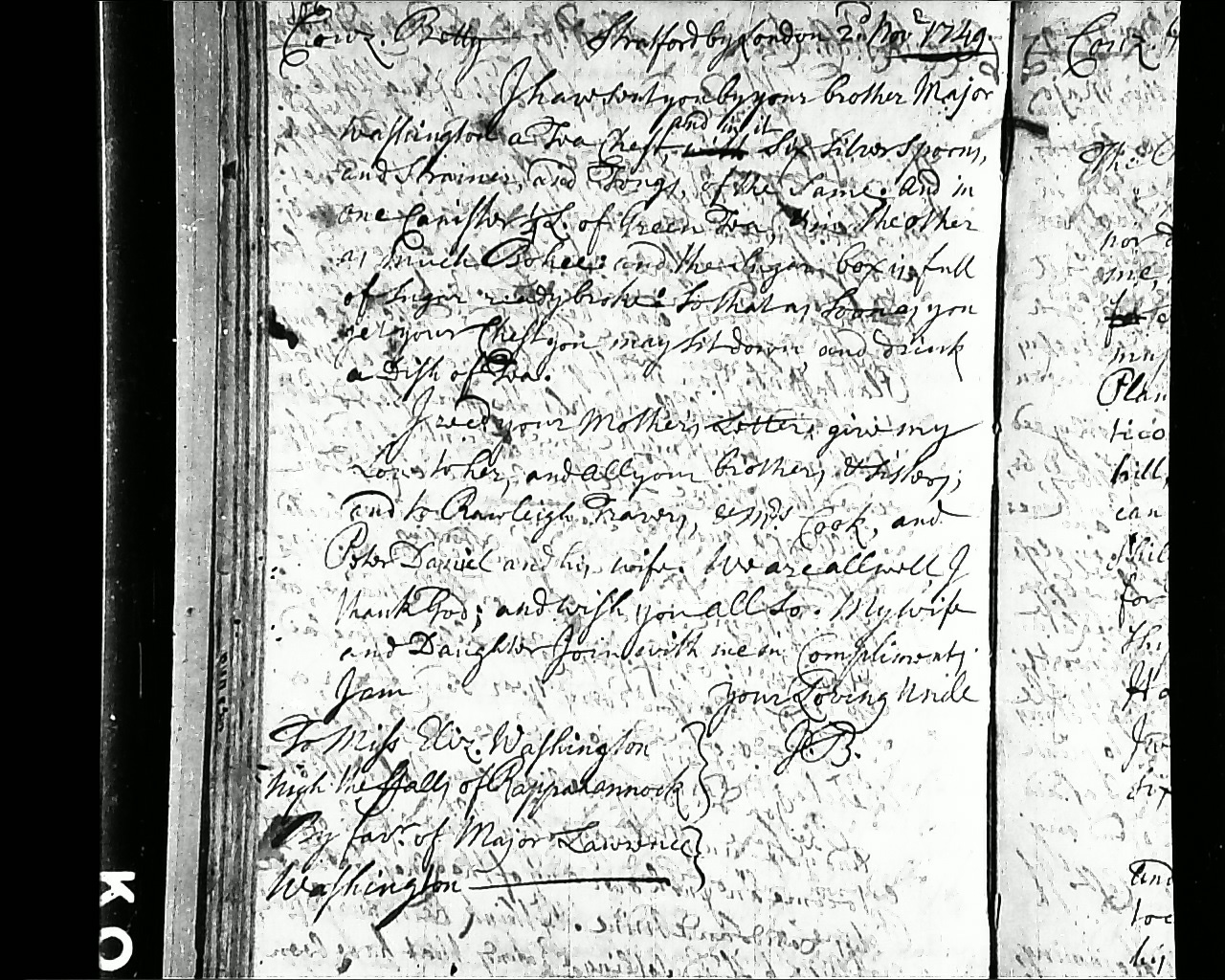
    Couz. Betty                                                     Stratford by London 2nd [Nov] 1749
                I have sent you by your brother Major Washington a Tea Chest; and in it Six Silver Spoons, and Strainer, and Tongs, of the Same. And in one Canister 1/2 L. [pound] of Green Tea, in The other a Pinch Bohee: and the Sugar box is full of Sugar ready broke: So that as Soon as you get your Chest you may Sit down and drink a Dish of Tea.
                I read your Mother’s letter, give my Love to her, and all your brothers, & sisters; and to Rawleigh Travers, & Mrs. Cook, and Peter Daniel and his wife. We are all well I thank God; and wish you allso. My wife and Daughter Join with me in Compliments.
    I am                                                                                                               Your Loving Uncle
                                                                                                                                  J.B
    To Miss Eliz. Washington                                                                                                                              
    nigh the Falls of Rappahannock
    By [fav.] of Major Lawrence Washington

    In 1749, one year before her marriage to Fielding Lewis, Betty Washington received a valuable gift – a silver tea set and other tea equipment – from her Uncle Joseph Ball in England. Tea equipment at this time was still expensive and the tea ceremony was reserved for upper class individuals. By providing Betty with equipment for such an important ceremony, Joseph Ball was helping prepare his niece for success in the gentry class. He provided silver teaspoons, a strainer, tongs, and a tea canister– four of the necessary pieces of equipment for the tea ceremony. Other items needed for the ceremony included a teapot, slop bowl, milk or cream container, sugar container, cups, and saucers.[i] Mary Washington provided these pieces for Betty while she lived at Ferry Farm, using them to teach her daughter how to host the important ceremony.

    The tea ceremony was a popular social event in 18th-century American culture. First and foremost, hosting or attending a tea party was a symbol of class.[ii] It was typical for gentry class individuals to participate in this leisure activity as a way to deepen or forge relationships within their community. Only an individual who was part of this class could afford the time and money required to learn the social graces and equip the table for the ceremony. The Washingtons worked hard to project an image of gentility through their material consumption. Participation in the tea ceremony was essential for this image. Mary took the time to “bequeath gentry-level domestic culture and etiquette to her children,” keeping them in leisure class circles.[iii]
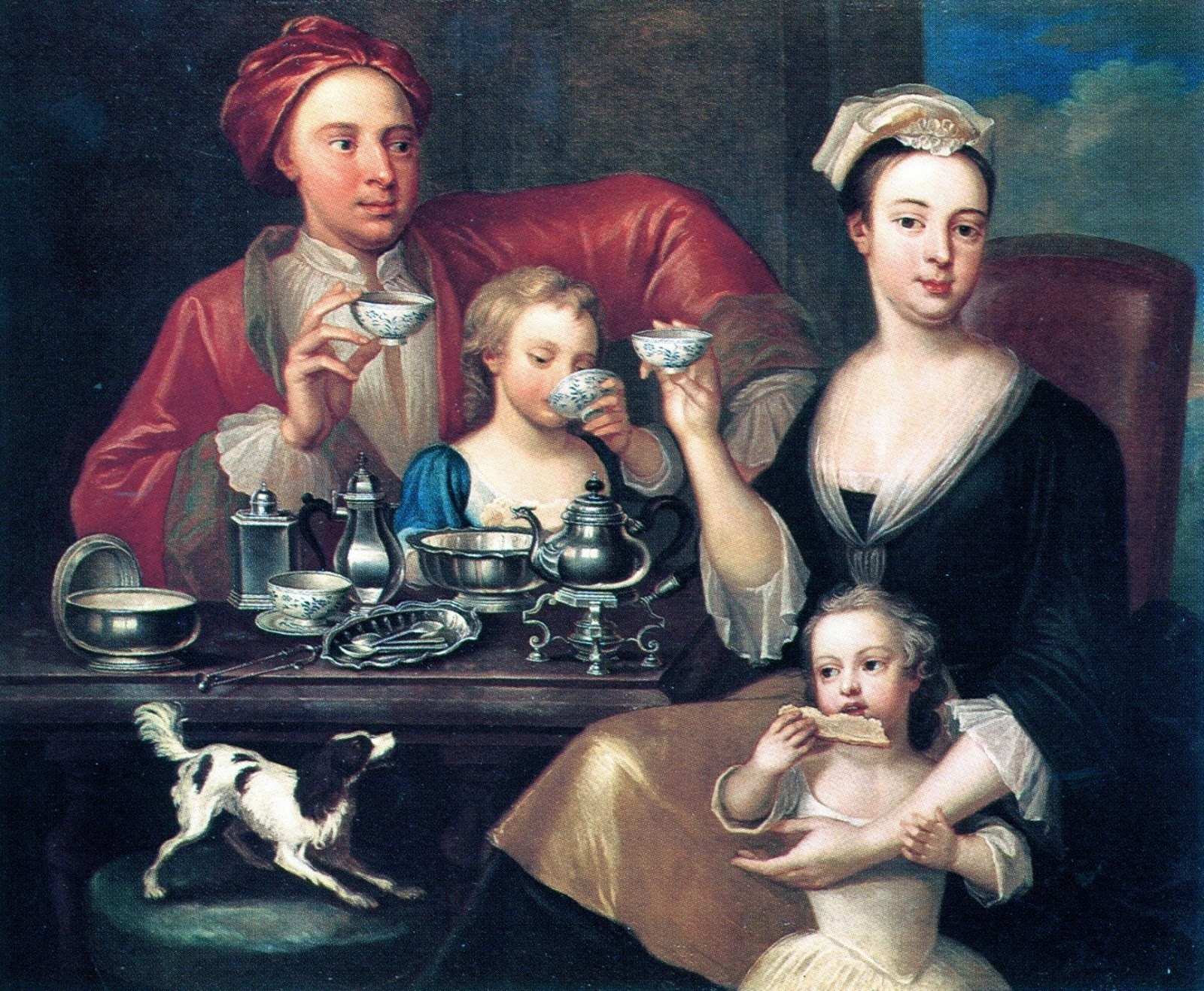
    An English Tea Party (c. 1730) by Joseph Van Aken. Credit: Wikipedia

    Within the leisure class the tea ceremony was considered, “as much an instrument of sociability as was a bit of music or conversation.”[iv] With its rules that dictated everything from table arrangement and conversation to order of events, the ceremony was complex. Mastery of the ceremony, especially for women, was key to one’s reputation within social circles. Mary and Betty Washington used the intricate event to maintain the family’s social standing and to interview suitors for Betty. As the oldest daughter, Betty was trained for this ceremony from a young age. She would likely have been the host of numerous tea parties at Ferry Farm before her marriage. Perhaps even using the silver tea set from her uncle during some of the events.
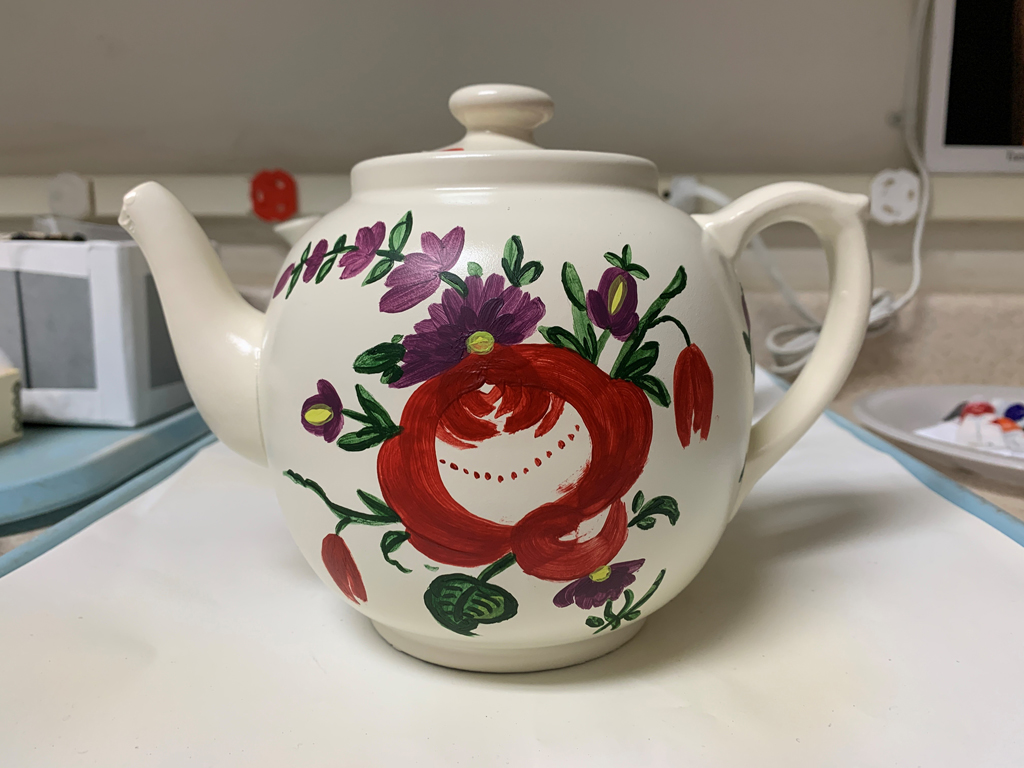
    Replica teapot.

    The social custom of the tea ceremony revolved around the teapot, thus earning it a spot at the center of the tray or tea table.[v] The archaeology department at Ferry Farm recently produced a replica teapot for display in an upcoming exhibit on 18th-century tea practices. This replica will serve as the centerpiece for the exhibit and be surrounded by archaeological artifacts and contemporary examples representative of the Washington family’s tea practices. The exhibit can be viewed through one of the windows into the Archaeology Lab starting December 1. Add George Washington’s Ferry Farm to your list of places to visit during the holiday season to see this small tea exhibit!

    Gillian Both, UMW ‘22
    Fall Fleming Smith Scholar


    [i] Rodris Roth, Tea Drinking in 18th-Century America: Its Etiquette and Equipage (Washington: Tea Trade Mart Publishing Co., 2017), 24.

    [ii] Ibid., 1.

    [iii] Laura J. Galke, “The Mother of the Father of Our Country: Mary Ball Washington’s Genteel Domestic Habits,” in Northeast Historical Archaeology 38 (2009): 33.

    [iv] Roth, 23.

    [v] Roth, 49.

  • When George Washington Almost Joined the British Royal Navy

    Not long ago, we explored Three Military Adventures that Inspired George Washington and the influence that Lawrence Washington and his wartime service played in stoking George’s interest in military matters.

    Lawrence fought with the British in the War of Jenkins’ Ear in the early 1740s and spent time aboard the flagship of Admiral Edward Vernon, who commanded British forces during the Battle of Cartegena de Indias.  Lawrence returned to Virginia with stories sure to spark his 10-year-old brother George’s imagination and desire for adventure.  Lawrence’s military service and George’s interest in military things had a fascinating, if perplexing, practical outcome when, late in 1746, Lawrence proposed for 14-year-old George to join the Royal Navy.

    Lawrence Washington attributed to Gustavus Hesselius (c 1738)
    Portrait of Lawrence Washington attributed to Gustavus Hesselius (c. 1738). Credit: Wikipedia / Mount Vernon.

    This is a relatively little known and rather mysterious incident in the life of young George Washington.  Few documents survive that address the matter directly.  There are no documents written by George, Lawrence, or Mary Washington that reveal their actions or motivations in the matter.  The three letters that do address the incident were all written by secondary figures involved.

    It all began in the fall of 1746 when Lawrence sent two letters — one each for George and Mary respectively – to Fredericksburg via Colonel William Fairfax.  George was to deliver Mary’s himself and keep the one to him a secret from her.  We do not know what either of these letters said.

    What we do know is only what William Fairfax told Lawrence in a report dated September 9, 1746 and sent to Lawrence at Mount Vernon.  Fairfax wrote:

    “The weather being so sultry, and being necessarily obliged to go about this town to collect several things wanted, I have not yet seen Mrs. Washington.  George has been with us, and says He will be steady and thankfully follow your Advice as his best Friend.  I gave him his Mother’s letter to deliver with Caution not to shew his.  I have spoke to Dr. Spencer who I find is often at the Widow’s and has some influence, to persuade her to think better of your advice in putting Him to Sea with good Recommendation.”[1]

    The Dr. Spencer mentioned may have been William Spencer, who often was involved as a witness for land transfers to Lawrence.  The secretiveness of George hiding his letter from Mary and of Lawrence apparently enlisting his business partners to argue in favor of the proposal for George to go to sea emphasize the conspiratorial nature of Lawrence’s efforts.

    It appears that, for a time, Lawrence’s manipulations may have worked.  On September 18, 1746, Robert Jackson, a Washington family friend, wrote to Lawrence that “I am afraid Mrs. Washington will not keep up to her first resolution.”  This seems to indicate that she wasn’t against the idea immediately but she did change her mind.  Jackson reported that Mary “seems to intimate a dislike to George’s going to Sea and says several Persons have told her it’s a very bad Scheme.”  He condescendingly dismisses her concerns as “trifling objections such as fond and unthinking mothers naturally suggest” and expresses frustration that “one word against [George’s] going has more weight than ten for it.”

    Jackson noted that William Fairfax was inclined to visit Mary and, moreover, Jackson noted that he himself would “take an opportunity to talk with her and will let you knew her result.”[2]  While Jackson may have let Lawrence know the result, no document has been found to let us know the result of these specific discussions two centuries later.

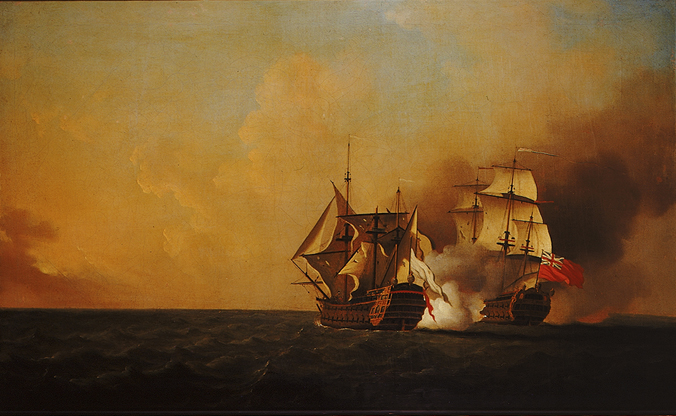
    Action Between Nottingham and Mars, 1746 by Samuel Scott
    “Action Between Nottingham and Mars” (1746) by Samuel Scott depicts a British-French naval battle in October 1746 when the Washingtons were debating whether George should join the Royal Navy. Credit: Wikipedia/National Maritime Museum.

    At some point, perhaps feeling outnumbered, Mary decided to solicit the advice of her brother Joseph Ball in England.  Dated May 19, 1747, his reply, which is a disdainful rejection of the entire proposal, is worth quoting at length.

    “I understand that you are advised and have some thoughts of putting your son George to sea.  I think he had better be put apprentice to a tinker, for a common sailor before the mast has by no means the common liberty of the subject; for they will press him from ship to ship where he has fifty shillings a month, and make him take twenty-three, and cut and slash and use him like a negro, or rather like a dog.  And as to any considerable preferment in the navy, it is not to be expected, as there are so many gaping for it here who have interest, and he has none.  And if he should get to be master of a Virginia ship (which is very difficult to do), a planter who has three or four hundred acres of land, and three or four slaves, if he be industrious, many live more comfortably, and have his family in better bread than such a master of a ship can . . .  He must not be too hasty to be rich but go on gently and with patience as things will naturally go.  This method without aiming at being a fine gentleman before his time, will carry a man more comfortably and surely thought the world than going to sea, unless it be a great chance indeed.”[3]

    Mary must have ultimately and definitely rejected Lawrence’s plan, a courageous act for a woman in male dominated colonial Virginia.  George, of course, did not pursue a career at sea but turned to surveying instead.

    Like many incidents in young George Washington’s life, the historical record is elusive and often raises more questions than it answers.  What prompted Lawrence to make the suggestion in the first place?  What were George’s views on the proposal and the debate?  What were Mary’s specific objections?  None of these questions may ever be answered.  Of course, the greatest question raised by the incident is the also unknowable counterfactual one.  Would history have unfolded differently if the man who was supposed to have been the commander of the Continental Army ended up spending his life on the King’s ships?

    Zac Cunningham
    Manager of Educational Programs

    [1] William Fairfax to Lawrence Washington, September 9, 1746, quoted in Moncure Daniel Conway’s Barons of the Potomack and the Rapphannock, New York, Grolier Club, 1892: 238, available at https://books.google.com/books?id=zDESAAAAYAAJ&dq=barons%20of%20the%20potomac%20and%20rappahannock&pg=PP1#v=onepage&q&f=false [accessed August 26, 2017].

    [2] Robert Jackson to Lawrence Washington, September 18, 1746, quoted in Moncure Daniel Conway’s Barons of the Potomack and the Rapphannock, New York, Grolier Club, 1892: 239-40, available at https://books.google.com/books?id=zDESAAAAYAAJ&dq=barons%20of%20the%20potomac%20and%20rappahannock&pg=PP1#v=onepage&q&f=false [accessed August 26, 2017].

    [3] Joseph Ball to Mary Washington, May 19, 1747 quoted in Marion Harland’s The Story of Mary Washington, New York: Houghton, Mifflin & Co, 1893: 79-80 available at https://archive.org/details/storyofmarywashi00harl [accessed August 26, 2017].

  • Ten Cool But Rarely-Exhibited Artifacts Found at Ferry Farm

    When you enter a museum you’re surrounded by cool stuff.  Be it paintings, fossils, or ancient artifacts, they’re all special items that you’d be hard pressed to find elsewhere.  But what if I told you that the cool objects you see on display in a museum are a mere fraction of what most museums actually have in their collections?  There is just never enough room, even for the biggest museums, to display everything.  Additionally, some items are just too delicate to make available to the public.  This is one of the reasons I love my job.  My fellow archaeologists and I get a daily backstage pass to all the incredibly cool things excavated at George Washington’s Ferry Farm.  Here’s our list of “Ten Cool But Rarely-Exhibited Artifacts Found at Ferry Farm.” Be sure to click on any of the photos for more detailed views of the artifacts.

    Wine Bottle Seal
    wine-bottle-seal
    Starting in the 17th century if you were a wealthy gentleman or tavern owner chances are you ordered at least a few custom wine bottles complete with your personal seal.  The seals were stamped in various ways, such as with names, initials, symbols, crests, and dates.  Archaeologists love them because they’re ‘talky,’ meaning the artifact yields lots of information.  A fragmentary bottle seal was found here in 2004 and bears the incomplete name of its owner. The letters visible are either a capital “I” or “J” (the English used the letter I for J), and below that are the letters “-bin”.   These few letters might refer to someone in the Corbin family, an extensive Virginia family with local ties. With a little investigation, perhaps we can flush out who was the mystery guest that brought his own bottle of wine for a visit to Ferry Farm!

    Lead Whistle
    lead-whistle
    Instruments and toys tend to grab our imagination because they make us think about who used them and how the object got lost to time and archaeology.  In our collection we have a simple lead whistle, measuring 1 7/8” long and 3/8” in diameter, with “U.S.A.” stamped on the side.  It’s cheaply made out of lead, which was a very inexpensive material that has, for obvious reasons, been phased out of the toy industry.  In the “Good Ol’ Days”, no one thought twice about making an instrument you put in your mouth out of lead.  Maybe it’s a good thing that the person who owned the whistle lost it.

    Chunkey Stone
    chunkey-stone
    Fun to say.  Fun to play.  Basically a prehistoric rock doughnut, this hand-ground stone was used in a Mississippian Indian game called “Chunkey.”  Warriors rolled disc-shaped stones across the ground and threw spears as close to the stone as possible.  Similar to the Italian game of bocce, but unlike the Italians who threw wooden balls, Chunkey players threw spears, which is pretty awesome.  It’s a bit of a mystery as to how it got to Ferry Farm because there is no evidence that Chunkey was played in eastern Virginia, however some of these gaming stones have been excavated in Maryland and Northern Virginia.   It is also possible that one of Ferry Farm’s colonial inhabitants collected this exotic looking artifact for their cabinet of curiosities.

    “Joseph” bottle fragment
    joseph-bottle-fragment
    Normally broken bottle glass would have trouble finding its way onto any top ten list, but this fragment is one of a kind.  Its owner inscribed his name “Joseph” and the date “174?” into the body of the bottle. That’s not an easy or common thing to do.  The inscription is carved in an elegant and beautiful form indicating a gentry status for its owner.  While no occupant of Ferry Farm was named Joseph, Mary Ball Washington’s older brother bore that name.

    Joseph Ball, though living in England, was heavily involved with Ferry Farm.  He absentee owned and operated a neighboring plantation.  Joseph was lavish in both his gifts and advice to the Washingtons.  He gave Betty, George’s sister, a beautiful silver tea set just before she married.  He offered Mary advice on how to keep George out of the Royal Navy when a plan was hatched to put the then 13-year-old onboard a ship. And maybe, just maybe, he sent over a special bottle of wine with his name engraved on it for the Washington family.

    Lead Toy Hatchet
    toy-hatchet
    More lead toys?  Yep.  This little beauty has special significance to Ferry Farm because of the cherry tree myth.  The 3-inch lead hatchet appears to be a souvenir made during the 20th century, possibly dropped during 1932’s anniversary celebration of George Washington’s birth.  Keepsakes associated with George and the cherry tree abound in Fredericksburg.  Previous private owners of Ferry Farm were known to capitalize on the history of the property, often selling fragments of the ‘original cherry tree’ and cherry seeds to visitors. This hatchet is an obvious symbol recalling the cherry tree story that is so closely associated with Washington’s childhood.

    Milk Glass Darning Egg
    darning-egg
    Recovered completely intact from an old burrow belonging to a groundhog, this artifact had multiple uses on a 19th and 20th century homestead.  The glass egg was a darning aid used to fill out a sock while it was repaired or could be placed in a henhouse to encourage the ladies to lay eggs in a particular spot. There is also a persistent myth that these eggs were used to kill snakes. The snake would eat the glass egg, it was believed, which would then shatter inside them.  This line of reasoning ignores the fact that snakes hunt by detecting chemical signatures of their prey and that snakes can’t really see the egg-like shape of our artifact because of their poor vision.  But it’s a story that highlights the mythology that surrounds some objects once they fade into obscurity.

    Tambour Hook
    tambour-hook
    The tambour hook falls into the category of artifacts that are a little too fragile to display.  Made of carved bone and metal, this exceptional object was used by a gentlewoman, probably George’s sister Betty, to adorn fabric with elaborate embroidery.  Recovered from the bottom-most soil level of the Washingtons’ root cellar where it was deposited sometime between 1741 and 1760, the carved designs that cover the bone handle feature a parrot, leaves, flowing vines, and numerous flowers and represent some of the most popular embroidery themes of the time.  This hook helps demonstrates the fashionability of the Washington women, which contradicts the portrait painted by many modern biographers.

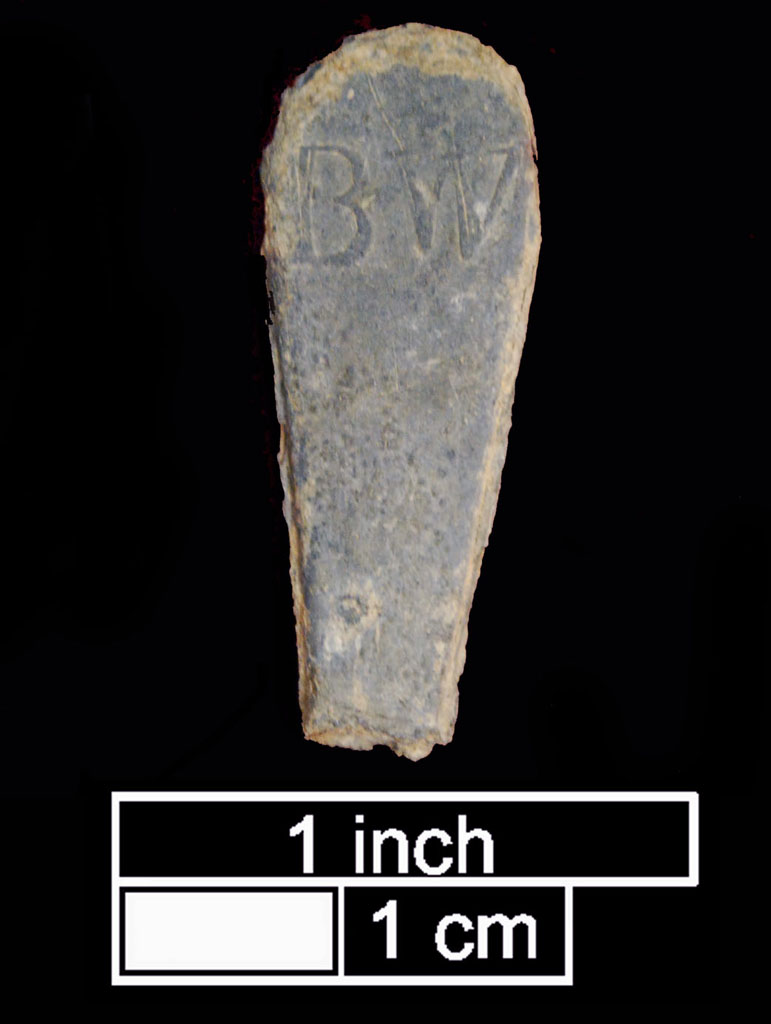
    Pewter Teaspoon with Betty Washington’s Initials
    teaspoon-fragment-with-betty-initials-1
    Betty had some of the coolest artifacts and this one literally has her name on it.  It was customary for tea to be dispensed by the wife or by the oldest daughter in the house and Betty, as the only daughter, was clearly groomed in this ceremony as is evidenced by her own teaspoons.  Pewter, an alloy containing a number of different metals including lead (yes, more lead), wasn’t as fancy as silver but the fact that it’s customized makes it special.  This tea set appears to be part of a “practice” set that Betty used before her uncle gave her a silver tea set  around her 16th birthday.

    Bartmann or Bellarmine Jug/Bottle
    bartmann-bottle-1
    Who doesn’t want to drink out of a jug exhibiting the large face of a crazy bearded man?  I do, and if you were a colonist in the 1700s and early 1800s, you did as well.  Originating in Germany, these face jugs depicted a ‘wild man’ of the woods character popular in Eastern European folklore. By the time these vessels made it to the English market that aspect seems to have been forgotten.  Subsequently, the English created their own story behind the bearded man revolving around their dislike for a similarly-bearded and unpopular anti-protestant cardinal by the name of Robert Bellarmine.  For more about this artifact, read this blog post.

    Repaired Creamware Cherry and Flower Punchbowl
    punchbowl
    This artifact is cool for so many reasons.  A beautiful bowl adorned with graceful hand painted flowers and cherries (remember, we love those here), it also exhibits a complicated and tortured use-life while highlighting the importance of punch drinking in the eighteenth century.  Written about here, this bowl was owned by Mary Washington, George’s mother.  Punch bowls vary in size and this one would have been called a ‘sneaker’, which denotes a bowl small enough for guests to take turns sipping out of it before passing it to the next person.  Mary clearly loved the bowl so much that, when it broke sometime between 1765 and 1772, she had it repaired with glue.  Although the hide or cheese-based glue used would not have resulted in a vessel capable of holding punch again, she could display it on her mantle or in her china cabinet…Oh, and the glaze? It has lead in it.

    Laura Galke, Site Director/Small Finds Analyst
    Judy Jobrack, Assistant Lab Supervisor
    Mara Kaktins, Ceramics & Glass Specialist
    Melanie Marquis, Lab Supervisor
    Dave Muraca, Director of Archaeology