Lives and Legacies

Tag: The Rooms at Ferry Farm

  • Artifact, Object, Repro: Part 2 – White Salt-Glaze and Westerwald Stonewares

    Furnishings posts logo finalToday, we continue our look at the different ceramics displayed or soon to be displayed in the Washington house at George Washington’s Ferry Farm.  We’re examining the artifacts recovered at Ferry Farm, the complete 18th century objects those artifacts represent, and the reproduction pieces inspired by these artifact sherds as well as by the complete originals.  Last week, we learned about the blue and white Chinese Export Porcelain reproductions gracing the house.  This week, in the second post of this series, will investigate the white salt-glaze stoneware and the Westerwald stoneware.

    These fragments are from white salt-glazed (WSG) stoneware dinner plate rims, and show two different styles of molded decoration.  The pattern in the above photo on the left was known as “dot/diaper/basket” and the pattern in the above photo on the right was known as “royal rim.”


    Molded WSG came into existence in the 1740s, so the Washington family was right on trend.  A few decades later, creamware would replace it as popular dinnerware, but the rim patterns found on WSG were often very similar to those used on later creamware.

    During the height of the Colonial Revival decorating style in mid-20th century America, the patterns used on WSG and creamware back in the 18th century had a major resurgence.  Several American potteries started producing white stoneware table wares, similar to WSG, with glossy surfaces similar to creamware, using molded rim decorations that were almost exactly like their 18th century predecessors.  The Canonsburg Pottery outside of Pittsburgh, Pennsylvania, produced dot/diaper/basket plates under the pattern name of American Traditional from the early 20th century through the company’s closure in 1978.  The Red Cliff Company pottery in Chicago produced plates with a rim pattern taken from the “royal” rim style on 18th century creamware (which was similar to an earlier WSG rim) under the pattern name Heirloom from the 1950s until their closure in 1977.  Similarly, Sears sold an almost identical plate under the pattern name American Federalist until the mid-1980s.  Luckily for us, all of these 20th century patterns are collectible and we found many of them in stores and on-line.

    C1 - Westerwald Artifact

    The above fragment came from either a mug or a jug made from grey stoneware decorated with cobalt blue glaze, known as Westerwald.  The Washington family owned quite a bit of Westerwald ceramic, as did the Lewis family at Kenmore.
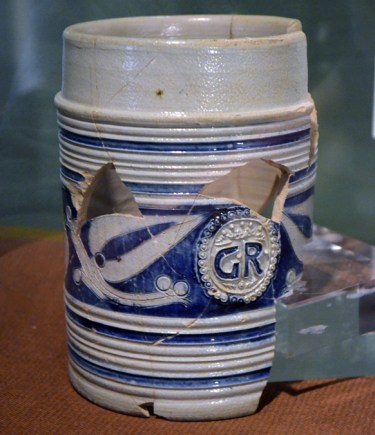
    C2 - Westerwald Mug

    Westerwald pottery originated in 17th century Germany, and it is still produced there today.  It was a popular style for traditional German steins, often with pewter lids attached.  In the 18th century, it was often made for export to England and was therefore decorated with the “GR” emblem, referencing Georgius Rex (King George).
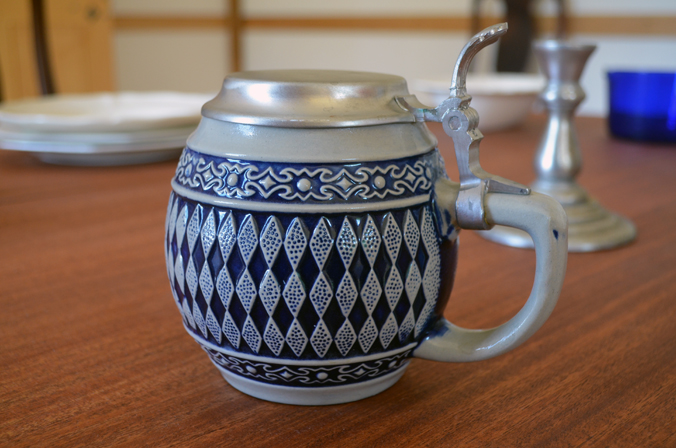
    C2 - Westerwald Repro

    During one of our treks through a thrift store, we came across this lidded Westerwald mug, and we were amazed at how similar to our 18th century fragments it was.  So amazed, in fact, that we questioned whether or not it might actually be an antique piece (that somehow remained in pristine condition)! A look at the bottom revealed a very 20th century maker’s mark, however, but it also spurred a desire to find out more about the company that was producing such excellent Westerwald. The mark indicated that the Markpiece was “Original Gerzit,” and some internet research revealed that the Gerzit Company in Höhr-Grenzhausen, Germany, was originally the pottery founded by Simon Peter Gerz in 1857.  The family owned and continued to operate the pottery through World War II, at which time they changed the name to Gerzit.  By German law established in 1887, Westerwald produced for export has to be marked Made in Germany.  Westerwald produced for sale in Germany doesn’t have to carry a mark at all.  Any Westerwald produced after World War II for export has to specify whether it was made in East or West Germany.  Putting all of that together, and comparing it to the mark on our newly acquired mug, shows us that it was produced sometime between 1949 (when the company name changed) and 1997 (when the company closed) and was originally intended for sale within Germany.  How it ended up in a thrift store in Virginia is anyone’s guess, but it was a very lucky find for us!

    In part 3, we’ll revisit Chinese Export Porcelains to see imari and famille rose artifacts, originals, and reproductions that will go in the Washington house.

    Meghan Budinger
    Aldrich Director of Curatorial Operations
  • Artifact, Object, Repro: Part 1 – Blue & White Chinese Export Porcelain

    Furnishings posts logo finalAs you may recall from past posts (here and here) about our hunt for reproduction ceramics and glassware to use in the Washington house at George Washington’s Ferry Farm, and taking a page from the Colonial Revival playbook, our sources have been varied and surprising – junk shops, flea markets, TV show props liquidation sales, attics of friends and relatives.  You name it, we’ve probably been there! Now it’s time to take a look at what we’ve found, and show you how we decided what passed muster to be placed in the Washington house.  In this series of posts, we’ll examine different ceramics and take a look at the artifact recovered at Ferry Farm, the complete 18th century object those artifacts represent, and the reproduction pieces inspired by the artifacts and originals.  This first post will examine blue and white Chinese Export Porcelain (CEP).

    Blue and White Artifact
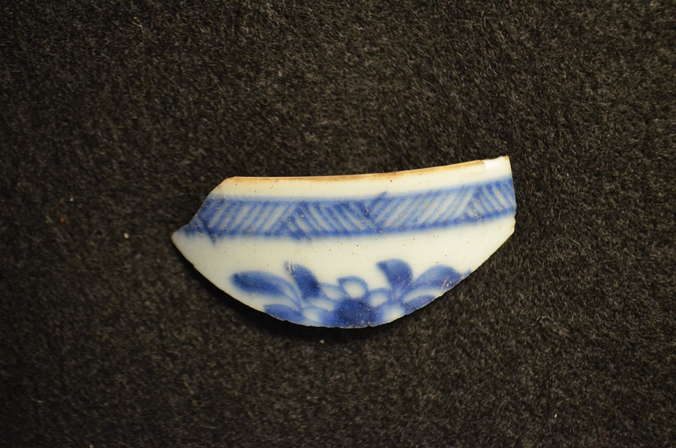
    Blue and white Chinese Export Porcelain artifact excavated at George Washington’s Ferry Farm.

    The above tiny archaeological fragment was found on the Washington house site and identified by our archaeologists as being from fine, white porcelain tea wares, decorated in applied blue motifs.  Such tea wares are known as blue and white Chinese Export Porcelain (CEP) and were produced throughout the 18th century.

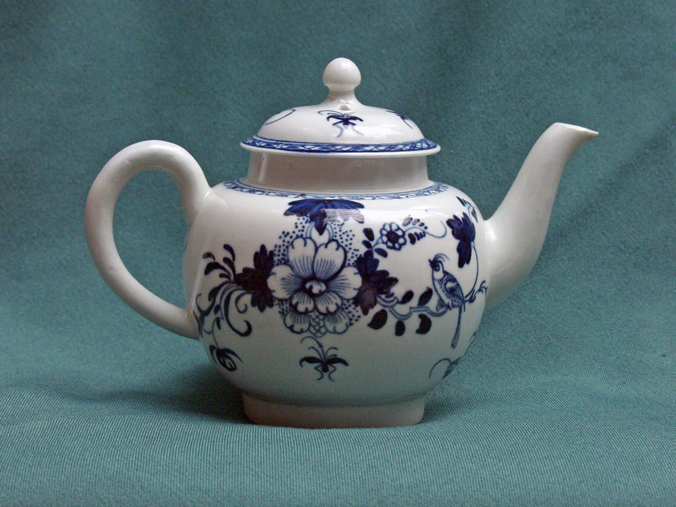
    This 18th century blue and white teapot in the collection at Historic Kenmore is an excellent example of an English attempt to create porcelain like CEP.

    Original porcelain made in China, where the technique was created and perfected, was highly coveted during the 1700s, but it wasn’t easy to come by and was often quite expensive.  Eventually, makers in England and other European countries tried producing this porcelain.  They were never quite able to simulate the very thin, nearly translucent white body, but they came close in replicating the decoration.  Colonists in Virginia, like the Washingtons, had an even tougher time coming across true CEP, so their collections of “porcelain” tea wares were often a mix of true porcelain and the thicker European variety.  The above teapot from the Kenmore collection is an example of an 18th century English attempt at creating porcelain like CEP.  While the ceramic body is sturdier than true Chinese porcelain, the blue decoration is very similar to CEP.

    Blue and White Repro
    20th century blue and white Chinese Export Porcelain reproduction teapot displayed inside the Washington house replica at Ferry Farm.
    Blue and White Repro teawares
    20th century blue and white CEP teaware reproductions in the Washington house.

    Above are some of the blue and white ceramics that we found to represent the Washington’s original blue and white CEP tea wares.  The difficulty in finding true porcelain continues even today! These pieces were selected because they all have blue decoration that is very similar to the typical motifs used in the Washington period, and their shapes and sizes correspond to what was available in the time period too.  In other words, from 5 steps away, they look just like period examples.  They were all produced in the 20th century, however, and represent manufactories in Germany and England.  Piecing together a tea service from multiple sources allowed us to accomplish another hallmark of 18th century tea wares: Nothing matches! Discerning buyers in the Washington’s time might choose a particular colorway that they liked and find individual pieces exhibiting those colors, but the idea of buying a complete tea set in one pattern was not a possibility until much later in the 19th century.

    In the part 2, we’ll examine white salt-glazed stoneware artifacts, originals, and reproductions that will go in the Washington house.

    Meghan Budinger
    Aldrich Director of Curatorial Operations
  • Washington House at Ferry Farm [Photos]

    Washington House replica at Ferry Farm (2)

    The Washington house at Ferry Farm is now open for tours! Using information from the probate inventory and archaeological evidence, the interpretive replica of George Washington’s boyhood home is currently being furnished with replica furniture and ceramics. You can read an in-depth post about the house here and below you will find photos that provide a glimpse of the house’s exterior and interior as well as the surrounding landscape.

    Learn more about this comprehensive project here and here.

    Please visit www.ferryfarm.org and www.kenmore.org for more information on two National Historic Landmark sites, George Washington’s Ferry Farm and Historic Kenmore.

  • Washington House at Ferry Farm Now Open for Tours

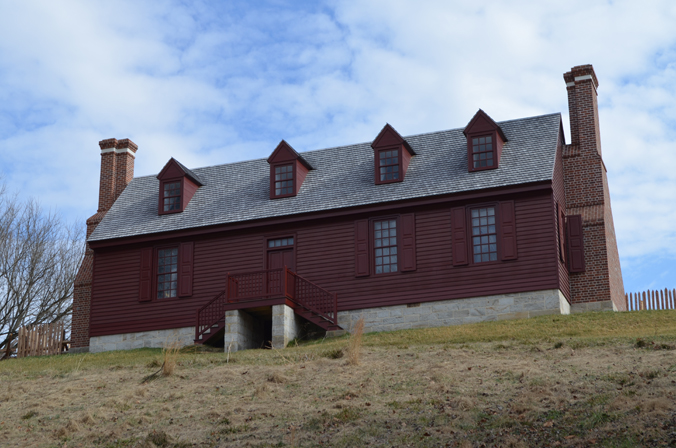
    Exterior of Washington house front
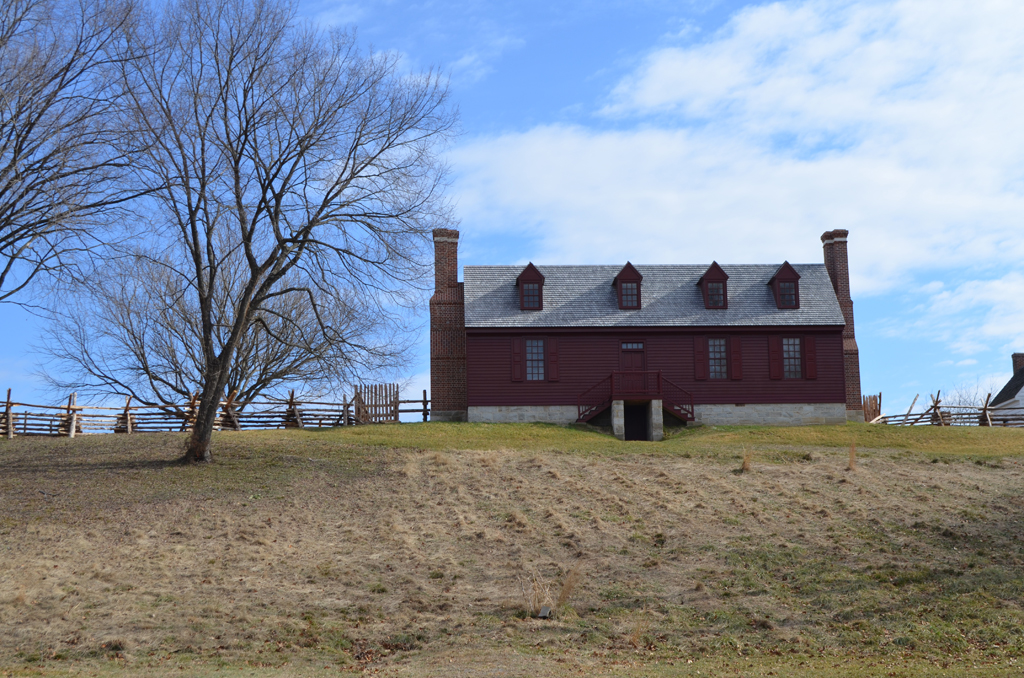
    The completed reconstruction of the Washington house at George Washington’s Ferry Farm.

    The Washington house at Ferry Farm is now open for tours. The interpretive replica of George Washington’s boyhood home is an interactive and hands-on experience for all ages, where visitors can experience what life was like in the eighteenth century. Using information from the probate inventory and archaeological evidence, the Washington house is currently being furnished with replica furniture and ceramics of what was originally in the home. This allows guests the opportunity to sit on the furniture and handle the objects.

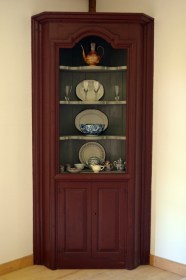
    Corner Cupboard in Parlor
    Corner Cupboard

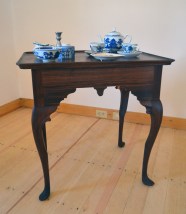
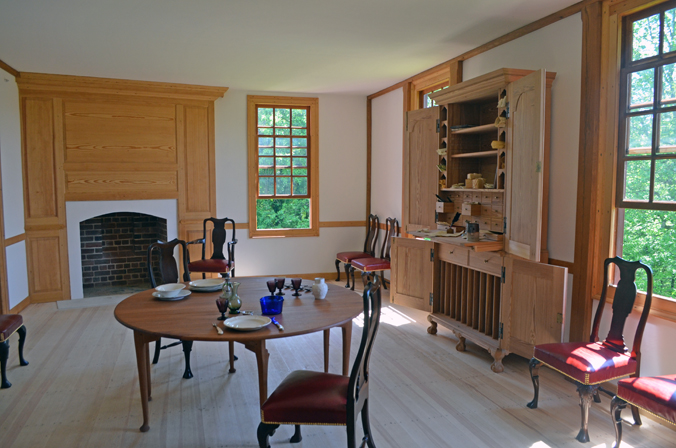
    Following a plan conceived by The George Washington Foundation’s Collections Committee and curators, noted cabinetmakers are crafting reproduction furniture using pieces from the time period of the Washington house as examples. Craftsmen from Colonial Williamsburg produced a corner cabinet in the joiners’ shop and a tea table in the cabinetmakers’ shop using examples from the Colonial Williamsburg Foundation’s collection. Additionally, two dining tables, a set of twelve leather upholstered chairs, a “scrutore” – or desk with bookcase, a low-post bed, and a gaming table are currently on view in the Washington house.

    Tea Table in Hall Back Room
    Tea Table

    The construction of the Washington house on its archaeological footprint is part of the first phase of The George Washington Foundation’s multi-year venture to physically develop George Washington’s Ferry Farm into an outdoor living museum. The first phase of the project will also include reconstructing the kitchen and outbuildings, and recreating the period landscape. Moreover, the Foundation is establishing a new entrance to the museum property, has erected a maintenance facility, and is completing necessary infrastructure.

    Hall
    Dining table, chairs, and “scrutore” in the Hall of the Washington house.

    Employing building methods of the period, artisan masons laid the foundation for the Washington house using hand-cut Aquia sandstone in an oyster-shell mortar. Next, timber framers joined massive wood beams to create the frame of the home. Carpenters covered the roof with traditional, hand-prepared wood shingles and installed skillfully-crafted exterior doors and window sashes, as well as beaded weatherboard siding painted a traditional, deep red “Spanish brown” color.

    Masons completed the brickwork for the three chimneys, each set in an English bond interspersed with glazed headers, while the carpenters fitted paneled doors with hand-wrought iron hardware and fabricating interior features such as an elaborate staircase in the center passage. Accomplished plasterers installed a traditional lime plaster, strengthened with animal hair, on wood lath across the walls of the Washington house.

    Work Yards Behind the House
    The work yards behind the Washington house.

    Constructing the Washington house and the first phase of improvements at Ferry Farm is a funding priority for the Foundation as part of The Future of Our Past Campaign—a $40 million dollar comprehensive fundraising initiative in support of efforts across its two National Historic Landmark sites: Historic Kenmore and George Washington’s Ferry Farm.

    George Washington moved to Ferry Farm in 1738 with his parents, Mary and Augustine, his sister Betty, and their siblings, purchasing the site from William Strother III, a prominent colonial Virginian. Young George lived at the farm from age 6 to 22. Referred to as the Washington home house in George’s day, the property was later known as Ferry Farm—a historic ferry adjacent to the Washingtons’ house once linked it to the city of Fredericksburg via the Rappahannock River. The site was the setting of some of the best-known stories related to his youth, including tales of the cherry tree and throwing a stone across the Rappahannock River.

    George was eleven when his father died in 1743. Augustine left Ferry Farm to George, for him to inherit when he reached majority. Mary Washington continued to live at Ferry Farm until 1772, when she moved to Fredericksburg to live closer to Kenmore and Fielding and Betty Washington Lewis.

    View of Fredericksburg across the River
    View from the Washington house of Fredericksburg across the Rappahannock River.

    In 1996, Ferry Farm was saved from commercial development through the hard work and determination of the Regents and Trustees of The George Washington Foundation (known then as the Kenmore Association), a long list of individuals, and several organizations.

    The Foundation announced on July 2, 2008 that its archaeologists had located and excavated the remains of the long-sought house where Washington was raised. To date, over 750,000 artifacts have been unearthed at Ferry Farm. Ongoing research suggests that George’s experiences at Ferry Farm were influential in shaping the man that he would become.

    On Saturday, April 25, 2015, the Foundation broke ground on the Washington house and the first phase of construction at Ferry Farm, forever preserving this remarkable landscape and providing a powerful stage to tell the story of young George and his family. Doris Kearns Goodwin, renowned presidential historian and Pulitzer Prize-winning author, was the keynote speaker for the Groundbreaking Ceremony.

    Learn more about this comprehensive project here and here.

    Please visit www.ferryfarm.org and www.kenmore.org for more information on two National Historic Landmark sites, George Washington’s Ferry Farm and Historic Kenmore.

    David Muraca
    Vice President of Museum Operations
    Director of Archaeology

  • Video: The Seven Easy Pieces of Furniture – Episode 1: Low Post Beds

    Furnishings posts logo finalIn this video, Fredericksburg, Virginia-based furniture maker Steve Dietrich discusses some of the techniques he used to create four low post beds for the reconstructed Washington house at George Washington’s Ferry Farm.

    Watch other videos and read more about rebuilding the Washington house here.

  • Video: The Rooms at Ferry Farm – A Furnishings Update

    In this video, Curator Meghan Budinger shows us early arrivals among the reproduction furniture to go into the reconstructed Washington house at George Washington’s Ferry Farm.


  • Why Were There Weird Animal Feet on 18th Century Furniture?

    Furnishings posts logo finalAs more of reproduction furnishings for the Washington house get underway, I thought I might address one of the more notable characteristics of the pieces: their feet.  Anyone familiar with antique furniture has noticed the sometimes rather odd appearance of foot shapes at the end of table and chair legs.  We have a variety of feet among the Washington house furnishings, some more unusual to our modern eyes than others.  There are three furniture styles represented in the Washington house furnishings: William and Mary (the earliest, dating from the late 17th century to the very early 18th century), Queen Anne (early to mid-18th century) and a bit of Chippendale (mid-18th century onward).  Each of these styles had their own weird feet.

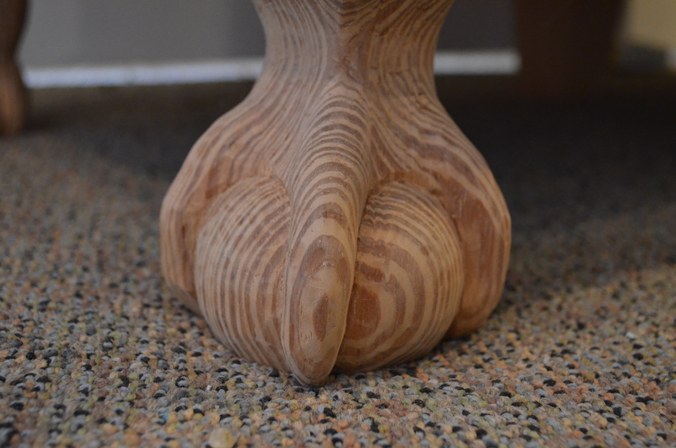
    Probably the most well-known type of furniture foot is the “ball-and-claw.” As the name suggests, the foot looks like the talons or claws of a large animal or bird gripping a ball.  The talons or claws could be quite detailed and realistic or a bit more stylized.

    Furniture Feet (1)
    An example of the ball-and-claw foot on a reproduction escritoire — a massive cabinet-sized desk — that will sit in the Hall of the Washington house.

    Why did these somewhat grotesque feet take hold in furniture design? In the early 17th century, design elements and decoration from the Orient began showing up in everything from ceramics to textiles to furniture all over Europe, as maritime trading vessels brought Asian goods to new markets.  The image of a dragon’s claw gripping a precious stone had been a common symbol in Chinese mythology for centuries, and was usually intended to symbolize the Emperor’s protection of knowledge.  As with many Chinese decorative elements imported to Europe at the time, the reason it was used in China was less important to European buyers than its exotic look.

    In England, the ball-and-claw style of foot was used primarily during the Queen Anne period and faded in popularity as the Chippendale style came into vogue.  In America, however, the ball-and-claw remained a popular decorative feature well into the 19th century.  As a result, American Chippendale style chairs will often have ball-and-claw feet, while English Chippendale chairs often do not.  During the height of its popularity, English furniture makers adapted the ball-and-claw style to other types of claws, often favoring a lion’s paw, to represent the King.  In America, eagle talons were the preferred model.  The level of detail portrayed was purely up to the desire and skill level of the furniture maker and carver.

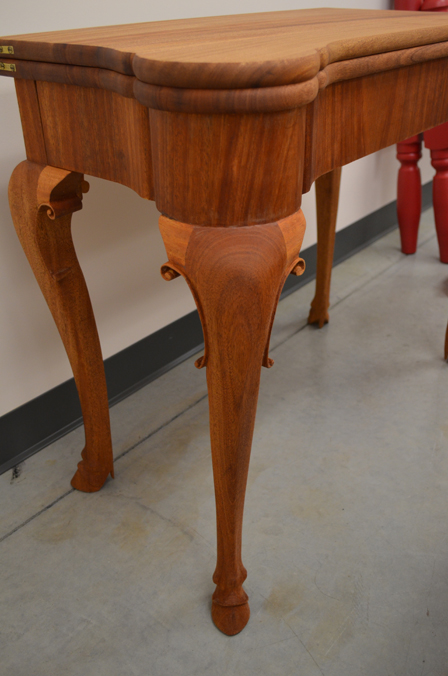
    Another animal-inspired foot found on furnishings in the Washington house is known as the “pied de biche” (literally translated from the French as “doe’s foot”) or hoof foot.  Much like a ball-and-claw, this style can either be an exact replication of a delicate deer’s cloven hoof, or it can be a shape inspired by the graceful curve of a deer leg and foot.

    Furniture Feet (3)
    An example of a “pied de biche” furniture leg on a gaming table that will be displayed in the Washington house.

    The reason for its popularity comes from two related trends in furnishings.  In the early 18th century there was a strong backlash against the bold, heavy, bulky style of the William and Mary period, which resulted in something completely opposite – the very graceful and delicate curves of the Queen Anne style.  This preference for lighter furnishings in the Queen Anne period also ushered in the beginnings of interest in classical themes, such as ancient Roman and Greek art.  Animal feet were featured prominently in classic Roman style, and the legs and feet of a deer just so happened to emulate the graceful, delicate curves that exemplified the Queen Anne style, so it was a perfect match.  Pied de biche feet are often found on Queen Anne furnishings in both England and America, but it was raised to a real art form by the French.

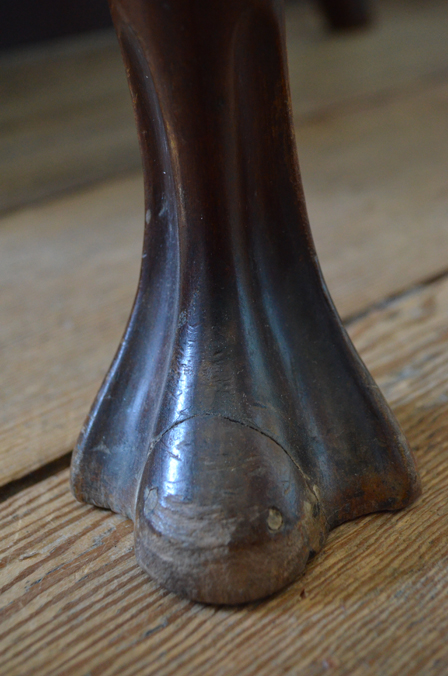
    The last weird foot that we’ll cover in this installment is probably the most mysterious, simply because we aren’t sure exactly why it came into being.  Known as the trifid foot in America, this style is found mostly on Queen Anne furniture.  In some cases it appears to be more of a three-toed paw, while on other pieces it looks like three webbed toes.  The webbed toes may have been its original iteration, because in Britain this style of foot is often referred to as a “drake” foot, drake referring to a male duck.  Interestingly, it was Irish furniture makers who began using stylized duck feet on their work, and so the trifid foot shows up in American in regions with high Irish immigration, like the area around Fredericksburg. As to why the Irish chose duck feet, well, that remains a mystery, nevertheless we can add the trifid foot to the list of unusual animal feet in the Washington house.

    Furniture Feet (2)
    A trifid foot on a chair at Historic Kenmore.

    So whether it was Chinese dragons or Roman deer, furniture designs of the 18th century were looking to the past for inspiration, although the actual reasons behind these choices are sometimes forgotten.  Visitors to the Washington house will have the chance to see a wide variety of homages to these ancient cultures, whether they know it or not.

    Meghan Budinger
    Aldrich Director of Curatorial Operations

  • Photos: “Antiques” Hunt!

    Furnishings posts logo finalSeveral weeks ago, staff from George Washington’s Ferry Farm went hunting for objects to go into the reconstructed Washington house, which will be fully furnished with reproduction pieces to allow our visitors to sit on the chairs, open drawers, and pick up the plates on the table.  Finding accurate, well-made reproductions of pieces from the Washington-era is no small feat but staff members have traveled to a variety of flea markets and consignment shops on the hunt for 20th century Colonial Revival objects that will pass as 18th century.  Here are a few photos from one of these trips…

    To learn more about the reconstructed Washington house furnishing effort, you might wish to read these blog posts…

    Furnishing George’s House: The Corner Cupboard
    Furnishing George’s House: What Exactly is That? Curatorial Conundrums in the Washington House – Part 1: Scrutoire
    Furnishing George’s House: What Exactly is That? Curatorial Conundrums in the Washington House – Part 2: Sugar Box
    Search for Washington House Furnishings Takes Exciting Turn!
    Just What is Colonial Revival?
    Getting “Judgy” With Colonial Revival Ceramics

    Video – Lecture: “The Rooms at Ferry Farm”

    Meghan Budinger
    Aldrich Director of Curatorial Operations

  • Getting “Judgy” With Colonial Revival Ceramics

    Furnishings posts logo finalPreviously on Lives and Legacies, curator Meghan Budinger laid out a wonderful summary of the Colonial Revival movement.  At no point did she weigh-in with her opinion of Colonial Revival and she should be applauded for her diplomacy.  To be honest, though, many historians, material culture specialists, and decorative arts enthusiasts (among others) can get a little ‘judgy’ when it comes to Colonial Revival.

    Copies of copies rarely turn out as nice as the original and, as Meghan discussed, Colonial Revival items conform more to our notion of how things looked in the 18th century than how they actually looked in the 18th century.

    When dealing with ceramics, Colonial Revival copies are almost always ‘clunky’ compared to the beauties they seek to emulate.  This is because the reproductions are machine made, while the colonial originals were handmade and hand-decorated. It’s very hard to imitate that kind of craftsmanship with a machine.  Experts call it being ‘debased’.  The copy is simply of a lower quality and slightly distorted.

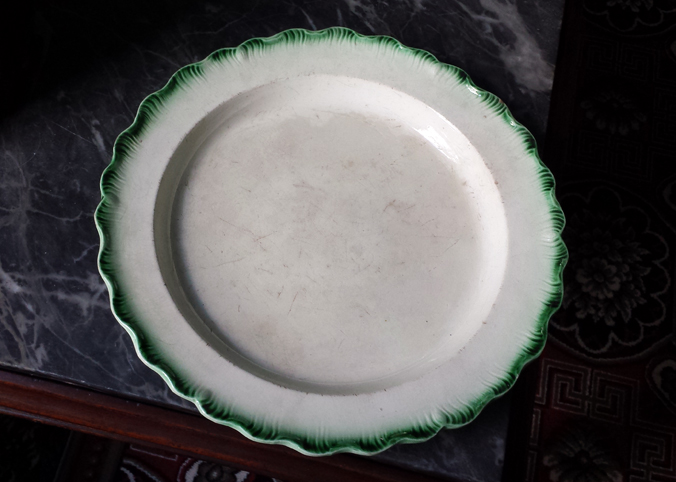
    Take for example this, um, interesting platter made between 1935 and 1941 by The Homer Laughlin China Company. It is a hideous imitation of the beautiful shell edge decoration popular in the late 18th and first half of the 19th century.  Of course, not all Colonial Revival is quite this debased as this extreme example.

    Colonial Revival Ceramics 3
    This 20th century Colonial Revival reproduction made by The Homer Laughlin China Company is a ‘debased’ version of a shell edge platter from the 18th century pictured below.

    Colonial Revival Ceramics 4

    Some are actually pretty accurate, like this tasteful white granite pitcher or this stoneware mustard pot, which dates from 1993.  I’m pretty sure it came from The Cracker Barrel.

    Colonial Revival Ceramics 2
    Colonial Revival white granite pitcher.
    Colonial Revival Ceramics 1
    Colonial Revival stoneware mustard pot dating from 1993 and perhaps sold by The Cracker Barrel.

    It just so happens that our awesome team of specialists (curators and archaeologists – a fun bunch) are currently furnishing the Washington house at Ferry Farm with reproductions the public may handle as we create an interactive house. Original 18th century objects are not an option.  Good colonial reproductions can sometimes cost as much as originals and can also be surprisingly hard to find.  Thus, despite our prejudices, we’re finding ourselves extremely grateful for the glut of Colonial Revival tea and tablewares currently on the market.

    Colonial Revival pieces are often quite sturdy, relatively inexpensive, and no member of our staff will dissolve into tears if a stoneware crock with cobalt blue hand-painted decoration originally purchased at The Cracker Barrel in 1997 broke.  We might actually celebrate it.  And so we hunt for modern items that straddle the line between historically accurate and, if need be, expendable.  We are diligently scouring auction sites, thrift and junk shops, antique markets, and sometimes our own cupboards in our never ending quest for Colonial Revival.  We will be sure to keep you updated on our progress and hope you can visit the Washington House to see how we did!

    Mara Kaktins, Archaeologist
    Ceramics & Glass Specialist

  • Video – Lecture: “The Rooms at Ferry Farm”

    Furnishings posts logo finalOn Tuesday, September 19, 2017, Meghan Budinger, Aldrich Director of Curatorial Operations at The George Washington Foundation, presented a lecture titled “The Rooms at Ferry Farm.” Meghan surveyed how we plan to furnish the reconstructed Washington house using traditional decorative arts scholarship but also adopted skills from genealogists, architectural historians, material cultural experts, scientists, and even investigative reporters. Meghan discussed how the Washington house and the effort to accurately furnish its rooms is a prime example of the synthesis of all of these vocations. The lecture was given at the Central Rappahannock Regional Library headquarters in Fredericksburg, Virginia.
    Join us at the Washington House Celebration on Saturday, October 7, 2017 from 12:00 p.m. – 4:30 p.m to celebrate the construction of the Washington house! A special ribbon-cutting ceremony will begin at 1:30 p.m. featuring notable speakers. After the ceremony, guests will be invited to view the reconstructed Washington house! Parking for the event is off site at the VRE Fredericksburg Park and Ride Lot G at the corner of Prince Edward Street and Frederick Street.  Limited handicap parking is available at Ferry Farm. Buses will transport guests to and from Ferry Farm. The Washington House Celebration is a free event and RSVPs are not required.

    Learn more about the Washington House here and view other videos, photos, and blog posts about the project here.