Lives and Legacies

Tag: transatlantic trade

  • Cowrie Shells: Cultural and Economic Ties in the 18th-Century Atlantic World 

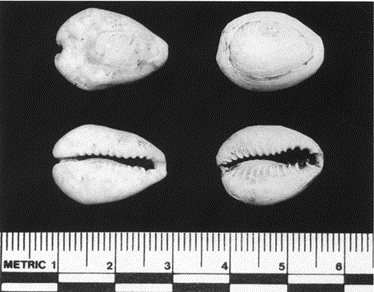
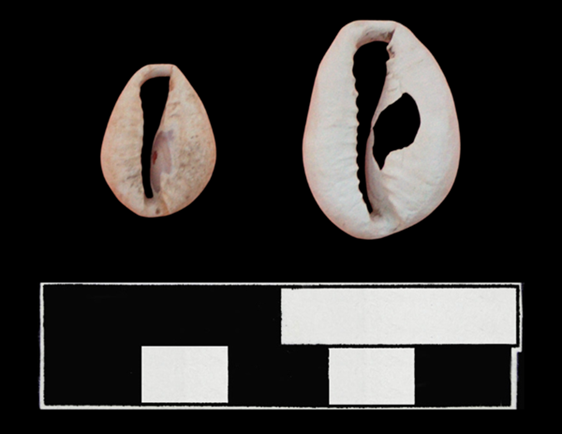
    Figure 1: Ferry Farm cowries

    Many readers will undoubtedly recognize these two artifacts (Fig. 1). Known as cowrie shells, these artifacts have become synonymous with slavery and serve as identifiers for the presence of free and enslaved Black individuals in the Americas. Still, the role of cowries in the 18th century goes far beyond that of a marker.  

    Origin 

    Cowries (Cypraeidae), a taxonomic family of sea snail, live throughout the world (Fig. 2). However, the species with the most relevance to the 1700s reside in the Indo-Pacific region, particularly in the waters around the Maldives. They include Monetaria annulus (alt. Cypraea annulus, Annulus Linnaeus) and Monetaria moneta (Fig. 3). Even if your Latin proves non-existent, each species’ genus, along with M. moneta’s epithet, easily identifies the original role cowries played in human hands – money.  
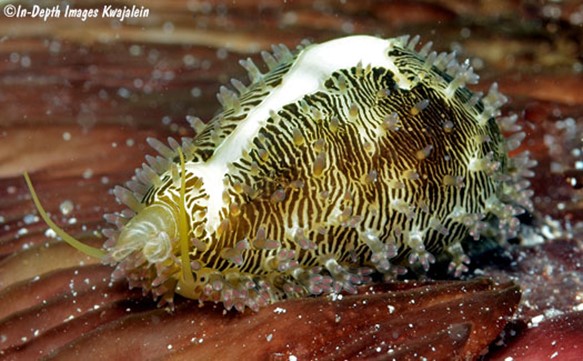
    Figure 2: Monetaria monetaKwajalein Underwater
    Figure 3: M. moneta (L) and M. annulus (R) shells in their natural forms
    Barabara Heath

    Economics and Culture in West Africa 

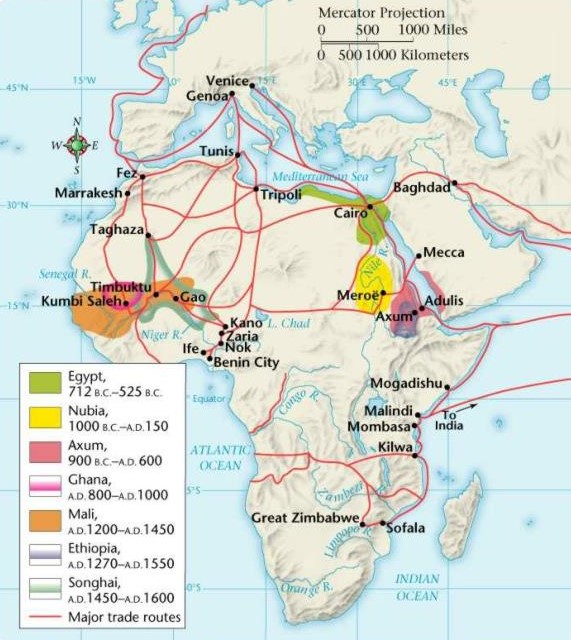
    Centuries before the 1700s, West Africa thrived as a region of independent kingdoms and tribes. With these groups engaged in trade, they required a shared currency that served as a medium of exchange and a store of value. In choosing cowries as currency in the fourteenth century, West Africa continued a long history of groups throughout the world using shell money. Through pre-existing trade routes to the Indo-Pacific, West Africans could easily import the shells via other parts of Africa and had them transported across the Sahara. As the cowries used did not reside in West Africa and proved difficult to forge, the market had built in protections against hyperinflation and counterfeits.  
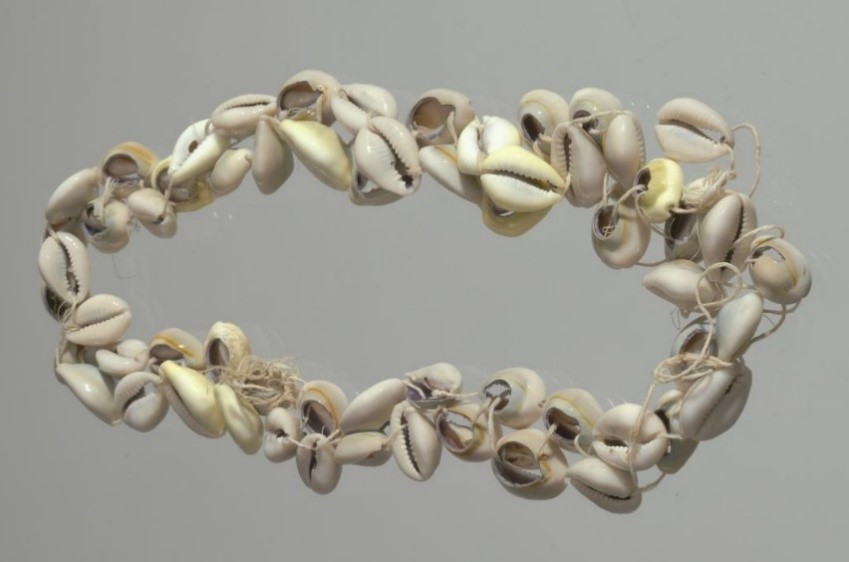
    Figure 4: Modified cowries strung togetherNational Museum of African American History & Culture

    Once in West Africa, the shells served as the basis of the region’s economies. Still, the shells took on several cultural roles. To keep cowries on hand, the shells often underwent modifications, including slicing off the rounded side of the shell or piercing them (Fig. 4). This allowed for stringing them together and weaving into hair or onto clothing. While done for practical reasons, this led cowries to enter the world of personal adornment. With this, their role expanded to symbols of status, fertility, and beauty while further appearing on ceremonial garb (Fig. 5). 
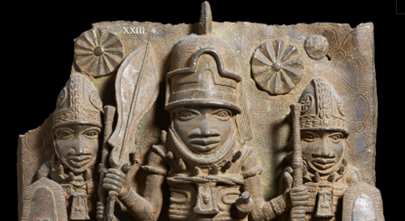
    Figure 5: Benin Bronze plaque; 16th-17th century. The warriors on either side of the central figure wear helmets decorated with cowries
    British Museum

    Atlantic Trade Routes 

    Europe and Africa had a long history of trade and exchange networks prior to the late 1400s, but the boom of global exploration led to an immediate escalation of these market connections. With European nations expanding their territories abroad and seeking to gain resources not found within their borders, they developed a need to break into the African markets while establishing permanent trade posts in the region. To achieve this, Europeans needed to supply goods that were in demand, and their minds set upon cowries.  

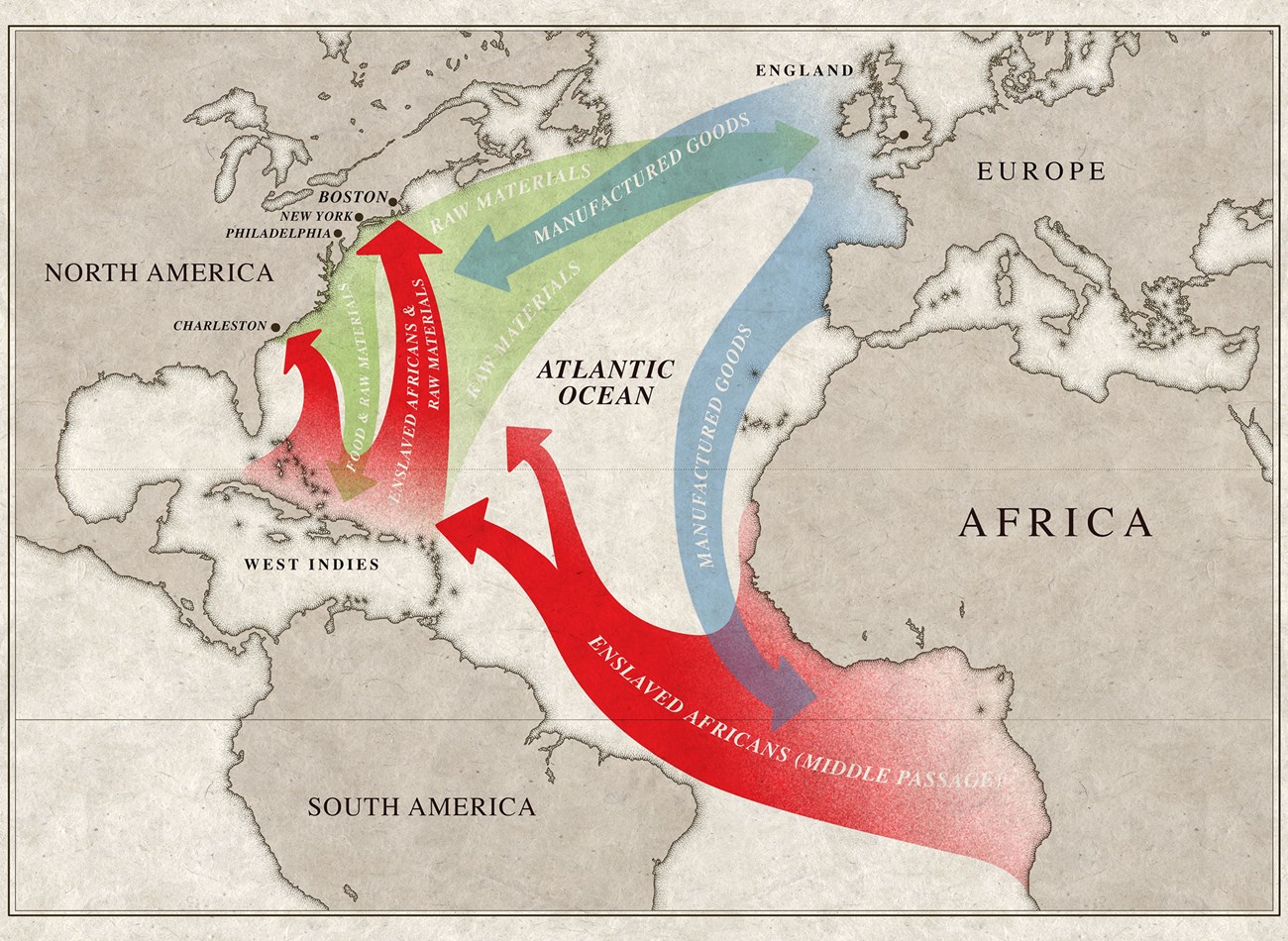
    While an item of currency and self-adornment to West Africans, cowries became a commodity in the hands of European, and later American, merchants. With cowries, merchants could navigate the local economy and barter for desired goods. Inevitably, this included kidnapped Africans. In his memoir, Olaudah Equiano (c. 1745-1797), a famed writer and abolitionist, recalled how one enslaver sold him to another for 172 “little white shells” while still in Africa. An examination of eighteenth-century shipping records reveals that cowries ranked amongst the most common goods transported to West Africa and used to trade for captives (Fig 6). For Africans who then faced the Middle Passage, they forcibly traveled aboard these same ships that in turn provided West Africa with the currency driving the economy and their enslavement — cowries.   

    Figure 6: List of goods imported to the Isle of Man via Rotterdam for trade in Africa, 1761
    Manx National Heritage

    Cowries in the Americas 

    Indo-Pacific cowries arrived in the Americas through several carriers, but ultimately all traveled on slave ships. In trading cowries to West Africa, foreign merchants supplied both types even though the market preferred M. moneta. As such, they often had leftover M. annulus which remained onboard as cargo and ballast when the ships continued their trans-Atlantic journeys. Once in the Americas, some captains elected to dump or sell off the remaining cowries rather than transport them back across the Atlantic. Cowries additionally arrived in the Americas on the bodies of kidnapped Africans. While common practice involved stripping captives in Africa, primary accounts report individuals retained beads and shells in their hair and as necklaces. Enslavers further distributed beads, and likely shells, as pacifiers during the Middle Passage. 

    Once in the Americas, cowries largely remained within Black communities though they did face geographical restrictions. For Virginia, archaeological distribution of the shells, mainly M. annulus, places them within the Tidewater region. Higher counts of shells appear in urban areas (Yorktown = 252) while plantations typically only have a few. Although Virginia’s current archaeological cowrie count falls above 353, this remains too few to support the traditional role as currency. Instead, the shells continued in roles of adornment and ritual with added symbolism of cultural loss, memory, and survival. Outside random finds in areas associated with enslavement, cowries recovered in the Americas have derived from burials, spirit caches, and sub-floor pits (Fig. 7). 
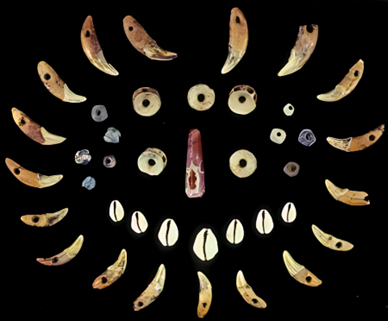
    Figure 7: Necklace recovered from an enslaved burial ground at Newton Plantation, BarbadosJerome Handler

    At Ferry Farm 

    Over the course of our twenty-plus year excavation, two cowries have appeared at Ferry Farm. Found in contexts located around the Washington House, including one in a root cellar, our shells represent M. annulus and have undergone modification to allow for stringing or weaving (Fig. 8). As with findings in previous studies, we believe these shells took on cultural roles through self-adornment. Despite not knowing the identity of the shells’ owner(s), the cowries provide enough information to form an interpretation of who they belonged to and how they arrived at Ferry Farm. 

    Figure 8: Ferry Farm cowries with modifications visible

    As their contexts of origin line up with the Washington House, the enslaved individuals who left them behind likely lived and worked close to the Washington family. This places them within the working realm of the house or the nearby work yard. For accommodation, the owner(s) may have occupied the Quarter adjacent to the Washington house or lived in one of the work yard’s support buildings. 

    Regarding the arrival of cowries on the plantation, this likely happened through the movement and exchange of people and goods. To provide the labor required to meet their goals, enslavers moved those they enslaved between different plantations as needed and expanded their workforce through the enslavement of more people or hiring of persons enslaved by others. This could account for the arrival of cowries at Ferry Farm. Alternatively, Ferry Farm’s proximity to the (port) city of Fredericksburg meant the enslaved community had access to a regional economy and trans-Atlantic vessels. Either network may have transported cowries to the city, but it additionally meant that Fredericksburg served as a meeting and trade point for those enslaved in the region. 

    Legacy 

    Cowries have a long and nuanced history in the Atlantic World. Beginning as a unit of currency and cultural symbol, cowries fell prey to the demands of the market, taking on a new role in the hands of foreign merchants. What once served to strengthen economies and nations suddenly worked to strip away the very people who inhabited West Africa. For those who endured enslavement, the cowries that accompanied them became symbols of a stolen home, a continuation of culture, and a determination to survive. Today, cowries remain important items in African and African American cultures by symbolizing their history as currency, continuing in self-adornment and ritual roles, and appearing prominently in works of art (Fig. 9-11).  

    Figure 9-11: Left: The Central Bank of West African States (BCEAO) tower in Cotonou, Benin, features cowrie shells on its facade Creative Commons Attribution-Share Alike 4.0 International; ReThink Quarterly Center: 20-cedi coin from Ghana. Cedi, the Akan word for cowrie, is Ghana’s unit of currency Michael C. Carlos Museum
    Right: Beyoncé donning a cowrie headdress by Ivorian designer Lafalaise Dion Design Indaba

    Emma Schlauder

    Research Archaeologist


    Bibliography 

    Alpern, Stanley B.                                                                                                                                                  1995     What Africans Got for Their Slaves: A Master List of European Trade Goods. History in Africa 22: 5-43

    Equiano, Olaudah 1789 The Interesting Narrative of the Life of Olaudah Equiano, Or Gustavus Vassa, The African. Written By Himself. London, UK

    Handler, Jerome S. 2006 On the Transportation of Material Goods by Enslaved Africans During the Middle Passage: Preliminary findings from Documentary Sources. African Diaspora Archaeology Newsletter 9 (4): 1-22 (Article 16).

    2007 From Cambay in India to Barbados in the Caribbean: Two Unique Beads from a Plantation Slave Cemetery. African Diaspora Archaeology Newsletter 10(1): 1-10 (Article 1)

    Heath, Barbara J. 2016 Cowrie Shells, Global Trade, and Local Exchange: Piecing Together the Evidence for Colonial Virginia. Historical Archaeology 50 (2): 17-46.

    National Museum of African American History & Culture n.d. Cowrie Shells and Trade Power. National Museum of African American History & Culture, Smithsonian, Washington D.C. <https://nmaahc.si.edu/cowrie-shells-and-trade-power>. Accessed 3 June 2024.

    Ogundiran, Akinwumi 2002 Of Small Things Remembered: Beads, Cowries, and Cultural Translations of the Atlantic Experience in Yorubaland. The International Journal of African Historical Studies 35 (2/3): 427-457.

    Pallaver, Karin 2023 Cowries, the currency that powered West Africa. ReThink Quarterly 7 <https://rethinkq.adp.com/artifact-cowries-west-africa/>. Accessed 3 June 2024.

    Pearce, Laurie E. 1992 The Cowrie Shell in Virginia: A Critical Evaluation of Potential Archaeological Significance. Master’s thesis, Department of Anthropology, College of William & Mary. University Microfilms International, Ann Arbor, MI.

    Radburn, Nicholas J. 2009 William Davenport, the Slave Trade, and Merchant Enterprise in Eighteenth-Century Liverpool. Master’s thesis, Department of History, Victoria University of Wellington, Wellington, New Zealand.

    Samford, Patricia 1994 Searching for West African Cultural Meanings in the Archaeological Record. African Diaspora Newsletter 1 (3): 1-3 (Article 2).
  • Maritime History at Kenmore & Ferry Farm

    Today – September 30 – is World Maritime Day. The United Nations and the International Maritime Organization created World Maritime Day in 1978 “to celebrate the international maritime industry’s contribution towards the world’s economy, especially in shipping.”

    “The South East Prospect of London from the Tower to London Bridge” (1746) by John Maurer. Credit: Royal Collection Trust / © HM Queen Elizabeth II 2018

    Both Historic Kenmore and George Washington’s Ferry Farm – perhaps surprisingly – feature fairly significant maritime histories.  Situated on the Rappahannock River, Fredericksburg was a bustling seaport in the 1700s when George Washington grew up at Ferry Farm and when Fielding Lewis practiced his merchant trade while living at Kenmore.  George saw ocean-going sailing vessels unloading and loading cargo from his bedroom window.  Some of these ships were owned by Fielding and his family.  Both men were part of “the Atlantic World,” a global community of many different peoples trading back and forth across the Atlantic Ocean.

    Here on Lives & Legacies, we’ve written regularly about Fredericksburg as a seaport and about the impact of Atlantic trade on both the Washingtons and the Lewises.

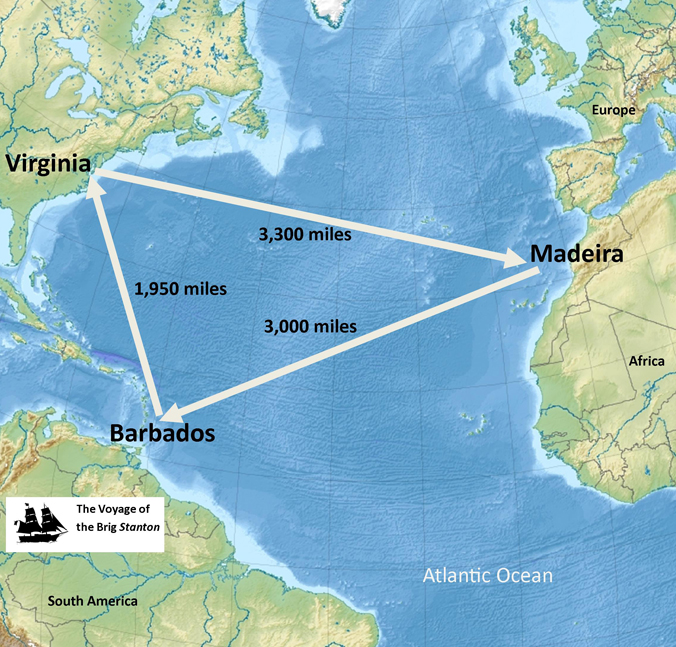
    “The Voyage of the ‘Stanton’” recounts one voyage of a Lewis family ship and the cargo it carried traveling from Virginia to Madeira off the European coast, then to the British West Indies in the Caribbean, and finally back to Virginia.  Each leg of this journey formed part of the Atlantic World’s famed “Triangular Trade.”

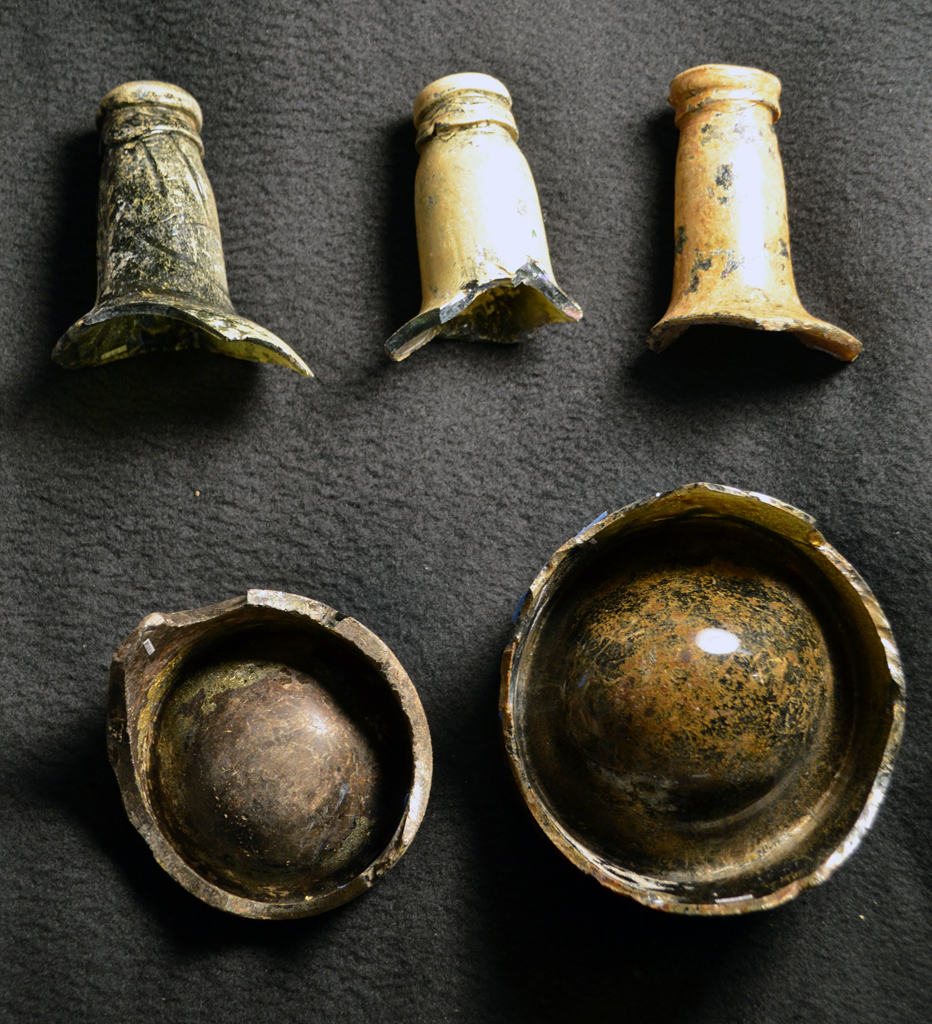
    Many of the Washington family artifacts recovered at Ferry Farm came to their home from different parts of this triangle and beyond.  For example, the fragments of wine bottles depicted below and written about in “The Wine Bottle: Ubiquitous and Informative” may have carried fortified wine from Madeira to Ferry Farm. European grapes did not grow well in the colonies while native grapes did not make good wine so wine was imported.

    Mid-18th century bottle neck and base fragments excavated from the Washington house cellar at Ferry Farm.
    An example of what the bottles excavated at Ferry Farm looked when they were whole.

    The maritime-based economy that brought Madeira wine and the many other goods used by the Washingtons at Ferry Farm is also perfectly symbolized by a “black dogg” coin. Unearthed not far from the Washington house site and written about in “The Tale of the ‘Black Dogg,’” this coin “originally circulated in the French Caribbean” and may well have come to Fredericksburg in a sailor’s pocket.

    “Black dogg” coin excavated at George Washington’s Ferry Farm.

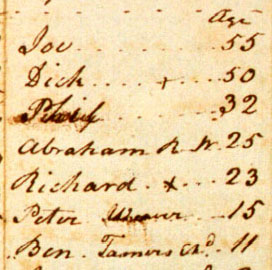
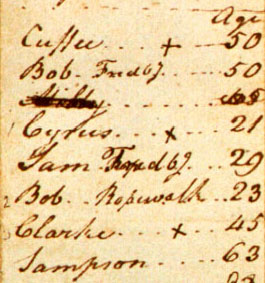
    As a merchant, Fielding Lewis owned ships that traveled the Atlantic World carrying goods to and from Fredericksburg.  The goods brought to Fredericksburg he then sold to the community or placed in his fashionable home.  Maritime trade was Fielding’s life-long business and he put some of his enslaved workers to that task.  As written about in “Abraham and The Ropewalkers,” a handful of Lewis slaves wove rope at ropewalks near Fredericksburg or perhaps even in Richmond.  Of course, much of this rope was likely used on Virginian sailing vessels.

    Portion of The Divvy List made by Betty Washington Lewis showing Abraham with an “R.W.” after his name.
    Portion of The Divvy List showing Bob #2 with “Fredbg” after his name and Bob #2 with “Ropewalk” after his name.

    The impact of today’s ocean-going global trade can be largely unseen. Similarly, the maritime histories of Kenmore and Ferry Farm are not immediately evident to our eyes. However, sailors, ships, and their cargos significantly influenced the lives of the Washingtons, the Lewises, and the enslaved people of Ferry Farm and Kenmore in 1700s.  World Maritime Day is a good day to remember the impact of the international maritime industry, past and present.

    Zac Cunningham
    Manager of Public Programs

  • Five International Influences on George Washington’s Early Life

    An Essay of a New and Compact Map, Containing the Known Parts of the Terrestrial Globe by Jacques-Nicolas Bellin was published in 1750 when George Washington was 18-years-old. Credit: Wikipedia.

    Ferry Farm was a unique place to live in the mid-1700s. Situated where farm, frontier, city, river, and road converged on the edge of English empire, young George Washington, his family, and the farm’s enslaved community found their daily lives governed by Britain’s global economy and imperial culture.  Ferry Farm, nearby Fredericksburg, and the colonies more broadly were international places made up of a host of different European, African, and Native American ethnicities and nationalities in the 18th century.  Accordingly, we present a list of “Five International Influences on George Washington’s Youth.” This is by no means an exhaustive list but each influence helped shape young Washington into a man capable of commanding the Continental Army and serving as the new nation’s first president.

    1) The Rappahannock River

    The Rappahannock River as viewed from a window in the Washington house replica at Ferry Farm.
    Voyages of British ships in the last half of the 18th century. Created by Geographer James Cheshire, PhD, on his Spatial.ly blog and used with permission.

    Young George could look from a window in the family home at Ferry Farm down the bluff to the Rappahannock River. He saw ocean-going, sailing vessels being loaded and unloaded at the wharves and warehouses of Fredericksburg. These vessels were part of a global trade network, which we’ve written about here and here, that stretched to Europe, Africa, the Caribbean, India and China. These vessels were not large but traveled the world nonetheless.  They took the corn, wheat, and timber of places like Ferry Farm to Europe or the Caribbean and returned with Westerwald mugs from Germany, tea from India, porcelain from China, and enslaved laborers from Africa. The sailors on these ships probably represented numerous ethnicities and nations. One easily can imagine young George, so prone to a thirst for adventure, finding any excuse he could to visit the docks and ships down on the river and, by doing so, traveling the world without leaving the Rappahannock.

    2) Westerwald stoneware

    Those ships carried numerous manufactured goods from all over the world to Ferry Farm. Westerwald ceramics were one such import. Produced in the Westerwald region of what is now Germany beginning in the 1500s, archaeologists have excavated numerous bits of decorated stoneware tankards, jugs, and other drinking vessels used in the 1700s at Ferry Farm.  Several of these excavated vessels sported the initials ‘G.R.’, meaning Georgius Rex, the Latin for King George. The three British kings of the 18th century were all named George and came from the House of Hanover, a German royal family placed on the British throne in 1714. A gentleman sporting a ‘G.R.’ on his Westerwald tankard or jug advertised his loyalty to the Crown with every draught of ale. The presence of these initialed drinking vessels at Ferry Farm show that, until the Revolution, Washington, like most Americans, viewed himself as a loyal subject of the British Crown (ironically worn by a German head).

    G.R. medallion on a Westerwald jug fragment.
    A nearly complete Westerwald drinking vessel in the collection at Historic Kenmore.

    3) Venetian glass

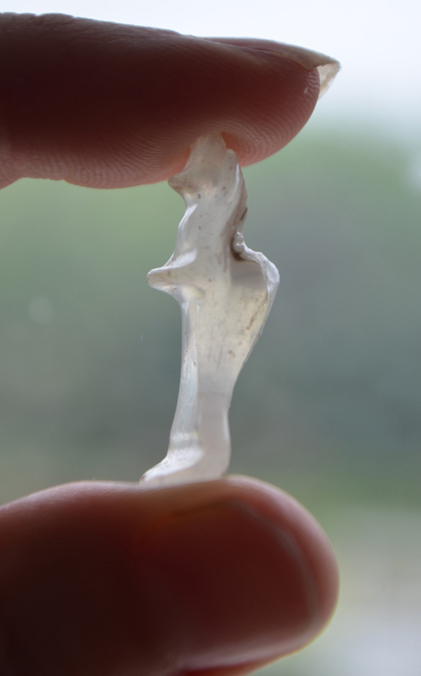
    The vast majority of ceramics in the Washington household came from England. The same can be said about the family’s table glass, but the fanciest glassware owned by the Washington family actually came from Venice, Italy.  Found by our archaeologists, this piece of a pincered and buttressed handle is likely part of an elaborate hand-blown Venetian piece, made of finely crafted colorless soda lime glass with a barely visible bead of opaque glass running through the center.  A Venetian glass goblet such as this was a show piece displayed prominently within the house to emphasize that, despite their colonial location, the Washington family strived to maintain a level of European refinement appropriate to their gentry status.

    Archaeologists excavated this small fragment of Venetian glass at Ferry Farm.
    Wine goblet made in the 16th century in Venice, Italy. Credit: The Metropolitan Museum of Art

    4) Barbados

    In 1751, George Washington made his only trip off the North American continent, traveling with his half-brother Lawrence to Barbados. Visiting the island’s fortifications and meeting members of its military garrison fed George’s growing desire for a military career. As Jack Warren concludes, “After returning to Virginia, he dedicated himself to advancement in the military more completely than any of his Virginia contemporaries. And unlike most of the prominent colonial militia officers of the 1750s, he sought a commission in the regular British military establishment – an ambition that was probably prompted, and undoubtedly stimulated, by his experience in Barbados.”

    Needham’s Point, Barbados. Credit: Reinhard Link.

    5) The Frontier

    Military service eventually took George into the frontier wilderness of the vast Ohio country. Tasked by Governor Dinwiddie with delivering a demand to the French to leave lands claimed by Virginia and the British Crown, young Major George Washington embarked on a thousand-mile, ten-week trek to and from Fort LeBoeuf on Lake Erie. He was accompanied by the Dutchman Jacob Van Braam, who served as his French interpreter, and by Tanacharison, known as Half-King, as well as other men from Native American nations. Along the way, he met several French officers and soldiers. Although confined to North America, this trip in late 1753 and early 1754 was, in reality, a foreign trip that exposed Washington to different peoples and cultures. It provided vital diplomatic, military, and intelligence gathering experience to the future Continental Army commander and first president. Washington, notes Paul Royster, “practiced diplomacy to keep the Native leaders allied to the English cause; he interviewed French deserters and reported on the extent of French military posts between New Orleans and the Great Lakes; he reconnoitered the Forks of the Ohio with an eye to the proper site for building a fort; and he inspected and reported on the construction of the new French forts and made estimates of their strength . . . .”

    Portrait of George Washington, 1772 by Charles Willson Peale. Credit: National Portrait Gallery
    The Ohio region from Cumberland to Fort LeBoeuf through which Washington journeyed, overlayed onto the famed map in Thomas Jefferson’s Notes on the State of Virginia (1787). Credit: Paul Royster / University of Nebraska.

    Conclusion

    Although a fourth generation American, George Washington grew up in a time and place – 18th century Ferry Farm and British North America — where international economic and cultural influences on his life were quite numerous. Through the five international influences we’ve briefly examined, we’ve seen how these influences helped Washington maintain his gentry status, which ultimately set him on a path to military and political greatness.

    Zac Cunningham
    Manager of Educational Programs

    Mara Kaktins, Archaeologist
    Ceramics & Glass Specialist

  • Lecture – Credit and Coinage: The Economy in Colonial Virginia [Video]

    On Tuesday, May 8, 2018, Cash Arehart, Site Supervisor of the Capitol Building at Colonial Williamsburg presented a lecture titled “Credit and Coinage: The Economy of Colonial Virginia.” Using Kenmore’s Fielding Lewis as an example, he discussed currency, credit, the tobacco economy, and the Transatlantic trade and how they all converged to make Col. Lewis a successful and prominent businessman in Fredericksburg and Virginia a successful colony within the British Empire.

    Join us at the library on Tuesday, May 15, 2018 for “Curiosities of Kenmore,” when Meghan Budinger, the George Washington Foundation’s curator, will talk about some of the most exciting and unusual objects in Kenmore’s collection and that are rarely seen by the public. Talk begins at 7:00 p.m. The lecture is FREE and hosted at the Central Rappahannock Regional Library at 1201 Caroline Street, Fredericksburg, Virginia. To learn more, visit kenmore.org or livesandlegaciesblog.org.